
This blog post may contain affiliate links. As an Amazon Associate I earn from qualifying purchases.
📋 Table of Contents
- Are Tent Heaters Safe? Essential Rules for Campers
- The 4 Core Risks of Heating a Tent
- The 7 Golden Rules for Safe Tent Heating
- 30-Minute Heating Rule: Experts Reject It
- Are Propane and Buddy Heaters Safe in a Tent?
- Propane Heaters: CO & Condensation Dangers
- Mr. Heater Buddy: Safe for Tent Use?
- Step-by-Step: Safe Propane Heater Use
- Tent Heater Safety Features: What to Look For
- ODS: Your First Line of Defense
- Tip-Over & Overheat Protection Explained
- Why You Need a Separate CO Detector
- Safety Certifications: UL, ETL, NFPA 701
- Safer Alternatives to Traditional Tent Heaters
- Battery-Electric Heaters: Lowest Risk
- Non-Heater Warming Methods That Work
- Diesel Heaters: How They Work & Tent Use
- When a Tent Heater Is Never the Right Choice
- Common Mistakes: Safe Heaters Turn Dangerous
- When to Choose Alternatives Instead
- When to Seek Expert Help
- FAQs About Tent Heater Safety
- Leave Tent Heater On All Night?
- Is There a Heater Safe to Use in a Tent?
- Best Room Heater for Asthma Patients?
- Safest Way to Heat an Outdoor Tent?
- Stay Warm in a Tent Overnight?
- What Is the 30-Minute Heating Rule?
- Number One Trigger for Asthma?
- Can Heaters Cause Shortness of Breath?
- Protect Your Camp: Final Safety Checklist
⚠️ Safety Disclaimer: This guide covers carbon monoxide poisoning and fire hazards — serious health and safety risks. Always follow manufacturer instructions and applicable local regulations. If you or anyone in your group experiences symptoms of CO poisoning (headache, dizziness, dizziness), exit the tent immediately and call 911. Consult a doctor before using tent heaters if you have asthma or respiratory conditions.

- 4,000- to 9,000-BTU radiant heater for spaces up to 225 square feet. Approved for outdoor use; clean-burning; nearly 100-percent efficient
- When operating the heater at altitudes over 7,000 FT above sea level the heater may shut off.
- Auto shut-off if tipped over, if pilot light goes out, or if detects low oxygen levels
- Fold-down handle; swivel-out regulator; connects to propane tank (not included). Run Time (Hrs at Min BTU) - 5.6 Hours
- THE USE OF UN-AUTHORIZED ACCESSORIES/ATTACHMENTS WITH THIS HEATER ARE EXPRESSLY PROHIBITED, MAY CAUSE SERIOUS INJURY, AND WILL VOID THE WARRANTY.
Last update on 2026-06-15 / Affiliate links / Images from Amazon Product Advertising API

- 4,000- to 18,000-BTU radiant heater for spaces up to 450 square feet. Approved for indoor/outdoor use; clean-burning; nearly 100-percent efficient
- When operating the heater at altitudes over 7,000 FT above sea level the heater may shut off. Maximum Hours Of Operation- 220.0
- Auto shut-off if tipped over, if pilot light goes out, or if detects low oxygen levels
- Low, medium and high heat level control knob for steady temperatures; connects to propane tank (not included). Note- Due to recent governmental changes to import tariffs, Mr. Heater has removed the fan on some models of the Mr. Heater Big Buddy (MH18B).
- THE USE OF UN-AUTHORIZED ACCESSORIES/ATTACHMENTS WITH THIS HEATER ARE EXPRESSLY PROHIBITED, MAY CAUSE SERIOUS INJURY, AND WILL VOID THE WARRANTY.
Last update on 2026-06-15 / Affiliate links / Images from Amazon Product Advertising API

- Adjustable Heat Output: Delivers 3,200 to 6,000 BTUs, suitable for heating up to 230 sq. ft.
- High Efficiency: Catalytic heating technology ensures high fuel efficiency.
- Silent Operation: Operates without a fan or blower, ensuring noise-free comfort.
- Versatile Installation: Can be wall-mounted or used as a portable unit.
- Safe and Reliable: Features a self-generating piezo starter (up to 20,000 starts) and a safety shut-off valve.
Last update on 2026-06-15 / Affiliate links / Images from Amazon Product Advertising API

- 3-inch-thick ultralight air mattress trusted by alpinists and mountaineers looking for extra warmth and durability in the backcountry
- Reflective ThermaCapture technology traps radiant heat while the Triangular Core Matrix construction minimizes convective heat loss providing a 7.3 R-value, ideal for extreme conditions
- Foam-free NeoAir design weighs just 15.5 oz (440 g) in size Regular and is super-packable, rolling up as small as a conventional 1-liter bottle
- 70D ripstop nylon bottom is incredibly durable and resists punctures, withstanding the wear and tear of extended expedition use
- Equipped with a dependable and rugged WingLock valve that is easy to use in freezing conditions and provides easy inflation and lightning-fast deflation
Last update on 2026-06-15 / Affiliate links / Images from Amazon Product Advertising API

- Powerful yet Compact: Boasting a 1,500W AC output and a 3,000W surge peak, the Solar Generator 1000 V2 can power multiple appliances, including AC units, fridges, and electric pots. With a 1,070Wh capacity and a lightweight build of only 23.8 lbs, along with a foldable handle, it makes an excellent companion for outdoor camping, road trips, or emergencies.
- One Hour Fast Charging: Charge your Explorer 1000 v2 Portable Power Station from 0% to 100% battery level in just one hour with emergency charging activated via the Jackery App. It defaults to 1.7 hours for a full charge to optimize battery health. Engineered with advanced ChargeShield 2.0 technology, this power station charges safer, faster, and smarter.
- 10 Year Lifespan: The Explorer 1000 v2 portable power station is equipped with a durable LFP battery, maintaining over 70% of its original capacity even after 4,000 charge cycles, offering longevity exceeding 10 years.
- Tailored for Versatility: Featuring two USB-C ports, one USB-A port, one DC car port, and three pure sine wave AC ports, along with LED lights, the Solar Generator 1000 V2 is capable of charging multiple devices simultaneously, meeting power needs in various scenarios. PD 100W fast USB-C charging ensures a rapid charging speed, even without power adapters.
- Smart App Control: Effortlessly switch between different charging modes with Jackery’s App—including one hour emergency charging from 0 to 100%, 30 dB quiet overnight charging mode, and energy efficiency mode. Maximize the freedom to adjust the power station to meet your needs.
Last update on 2026-06-15 / Affiliate links / Images from Amazon Product Advertising API

- 7 X Faster Charging. 0-80% in just 50 mins and 0-100% in 80 mins with AC input. That's ideal when you need home backup power and a quick charge using your wall outlet.
- Expandable Capacity from 1-3kWh. With the standalone portable power station sporting 1kWh, you can add on extra batteries to reach up to 3kWh. Ideal for camping, RVs or off-grid living.and a quick charge using your wall outlet.
- Power Almost Anything. Portable batteries have come a long way. Power all your appliances with 1800W output, that's on par with outdoor generators without the fumes or noise. With 15 outlets and its huge output, you can power 90% of your appliances.
- Clean, Green Charging. With up to 500W of solar panel input, DELTA 2 is a solar generator that can be charged while camping, on an RV trip or off-grid.
- Built to Last 6x Longer. Its LFP(LiFePO4) battery chemistry makes for a portable power station with a 3000+ cycle life. Enough for years on end of use. With a sophisticated BMS, you can go easy knowing its auto-regulating to keep you safe.
Last update on 2026-06-15 / Affiliate links / Images from Amazon Product Advertising API
Yes, tent heaters can be safe — but only when you follow a specific set of non-negotiable rules. Carbon monoxide (CO) is a silent killer, with the U.S. Consumer Product Safety Commission (CPSC) reporting 12 deaths annually from fuel-burning space heaters (CPSC, 2026). People die every year specifically from using camping heaters inside tents, campers, and vehicles.
“I’m always worried about the fumes. Apparently diesel heaters are good but are they noisy and does the unit sit outside? Sorry if that’s a dumb question but I’m new to this.” — Real question from a camping community forum
If that sounds like you, this guide has the answers. The real danger isn’t the heater itself — it’s using it without understanding the four core risks: fire, carbon monoxide (CO) buildup, oxygen depletion, and condensation. Most camping guides gloss over these entirely. By the end of this guide, you’ll know exactly which heater type is safest for your setup, which safety features are non-negotiable, and what to do in an emergency — covering general safety rules, propane and Buddy-specific guidance, essential safety features, safer alternatives, and a direct answer to the diesel heater question.
Key Takeaways: Are Tent Heaters Safe?
Tent heaters are safe for camping when you choose the right type and follow strict protocols — but carbon monoxide (CO) and fire hazards are real, documented risks that demand active precautions. The Safe Heater Hierarchy ranks every heater type from safest to most dangerous so you can choose with confidence.
- Never sleep with a heater on: The CPSC explicitly advises turning off all portable heaters before sleeping
- Ventilation is mandatory: Crack a vent or window at all times when any fuel-burning heater is running
- ODS and tip-over shut-off are the two non-negotiable safety features — refuse any heater without both
- Battery-operated heaters rank safest in The Safe Heater Hierarchy — no CO, no open flame, no combustion
- Always place a CO detector inside the tent, regardless of heater type
Are Tent Heaters Safe? Essential Rules for Campers
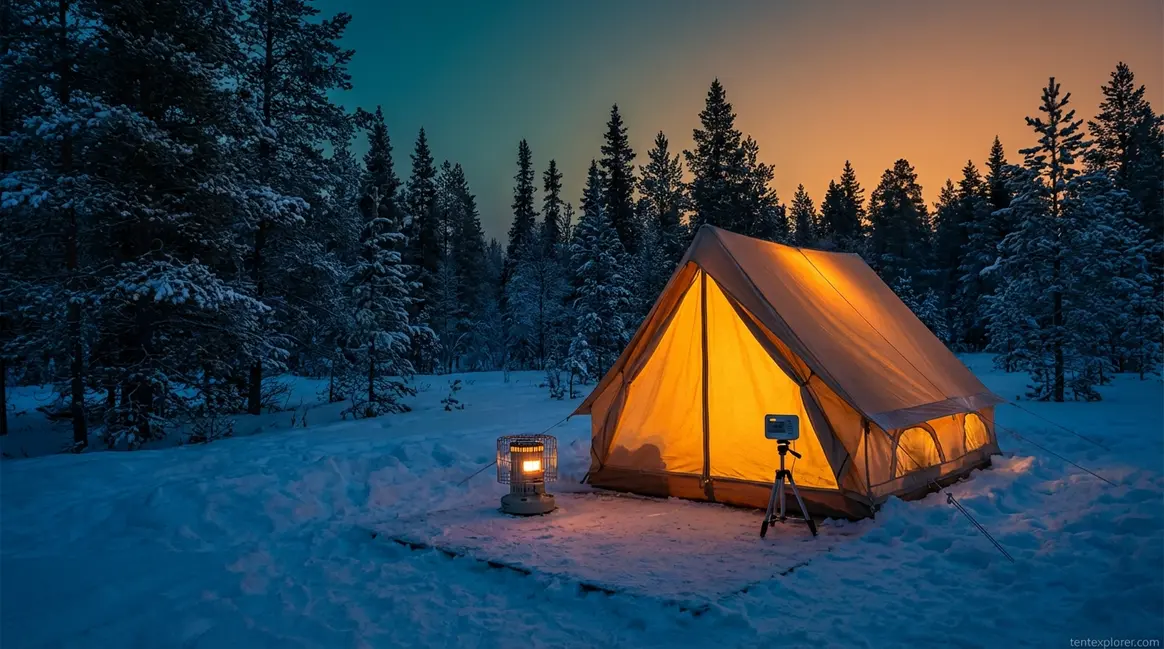
Tent heaters are safe for camping when used correctly, but they carry three serious risks: carbon monoxide (CO) poisoning, fire, and oxygen depletion. The U.S. Consumer Product Safety Commission (CPSC) warns that fuel-burning camping equipment should never be used in an enclosed space unless it is specifically designed for indoor use and equipped with appropriate safety features (CPSC, 2026). Knowing which heater type to choose — and which rules to follow — is the difference between a warm, safe night and a dangerous emergency. Understanding how to use tent heaters safely is paramount for any camper.
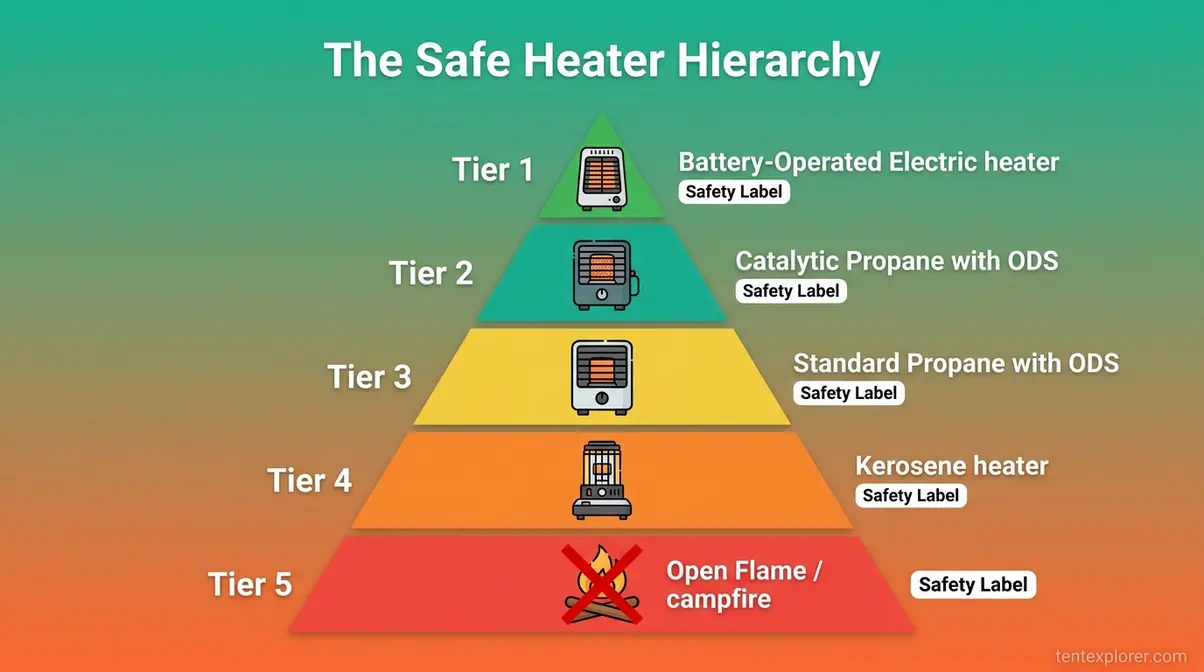
This is where The Safe Heater Hierarchy becomes your decision-making framework. It ranks every heater type from safest to most dangerous: Battery-Operated Electric > Catalytic (ODS-equipped) > Propane (vented, ODS-equipped) > Kerosene > Open Flame. Every section of this guide maps back to that hierarchy — so you always know where your heater falls and what precautions its tier requires.
The 4 Core Risks of Heating a Tent
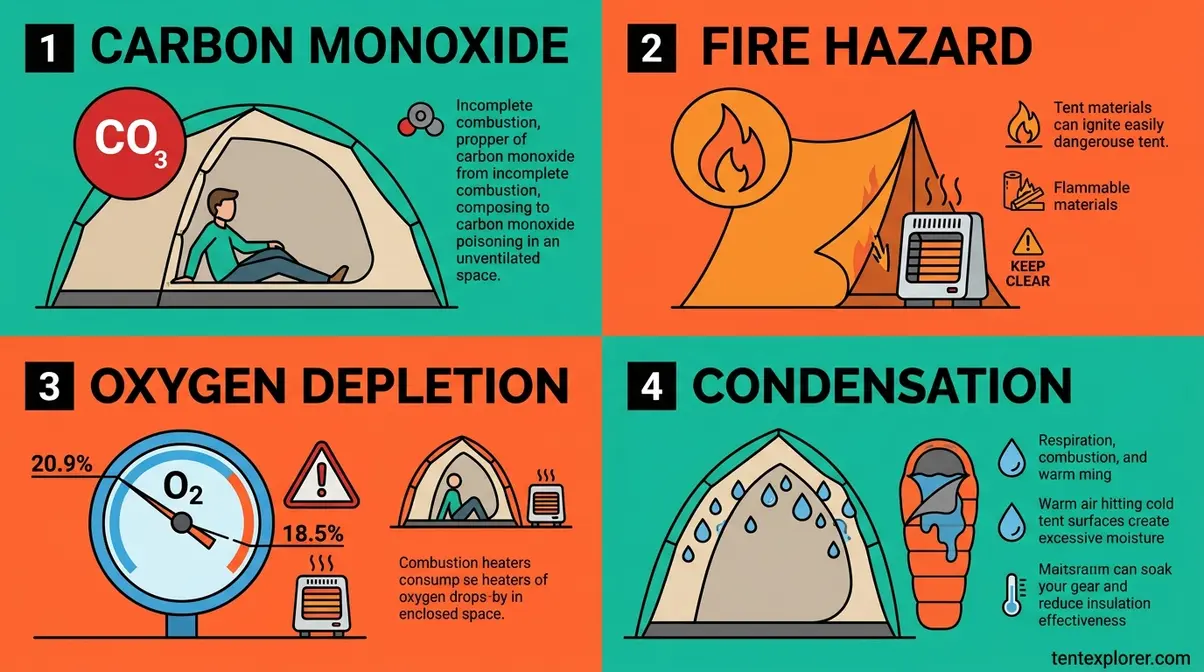
Understanding whether tent heaters are safe starts with knowing exactly what can go wrong. There are four distinct risks, and each one demands a different precaution. When considering if tent heaters are safe, understanding these core risks is crucial.
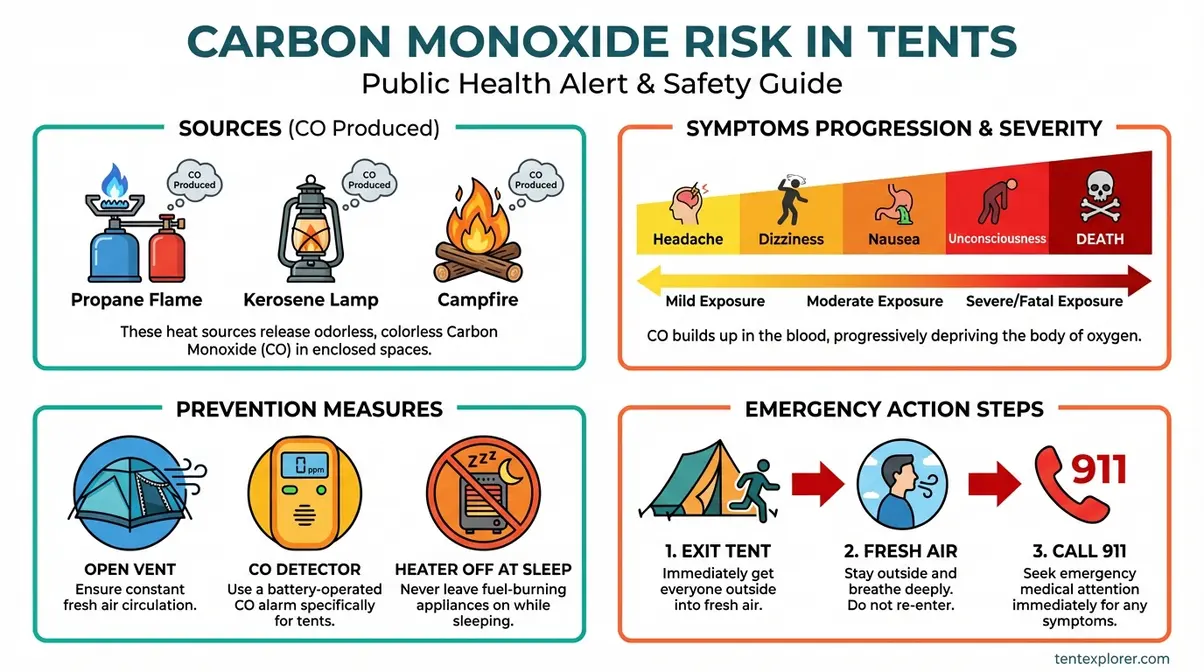
1. Carbon Monoxide (CO) Poisoning Carbon monoxide (CO) is a colorless, odorless toxic gas produced by incomplete combustion of fuels like propane, kerosene, and wood. According to the WHO definition of carbon monoxide (WHO/NIH, 2010), CO displaces oxygen in the bloodstream, and symptoms — headache, dizziness, nausea — can progress to unconsciousness and death at high concentrations. The CPSC confirms that portable heaters are associated with 12 CO deaths annually in the U.S. (CPSC, 2026). CO is the risk that kills campers; it deserves first priority in your safety planning.
2. Fire Hazard Tent fabric burns easily. NFPA 701 — the flame-resistance standard for tent fabric — means a compliant tent is flame-resistant, not fireproof. The NPS fire safety requirements for tents stipulate that tents must be NFPA 701 compliant for flame resistance and limit the fuel amounts per appliance within a tent structure (NPS). Keep any heater a minimum of 3 feet from all fabric — sleeping bags, tent walls, and clothing included. For general camping safety tips, treating clearance as non-negotiable is the single most effective fire prevention step.
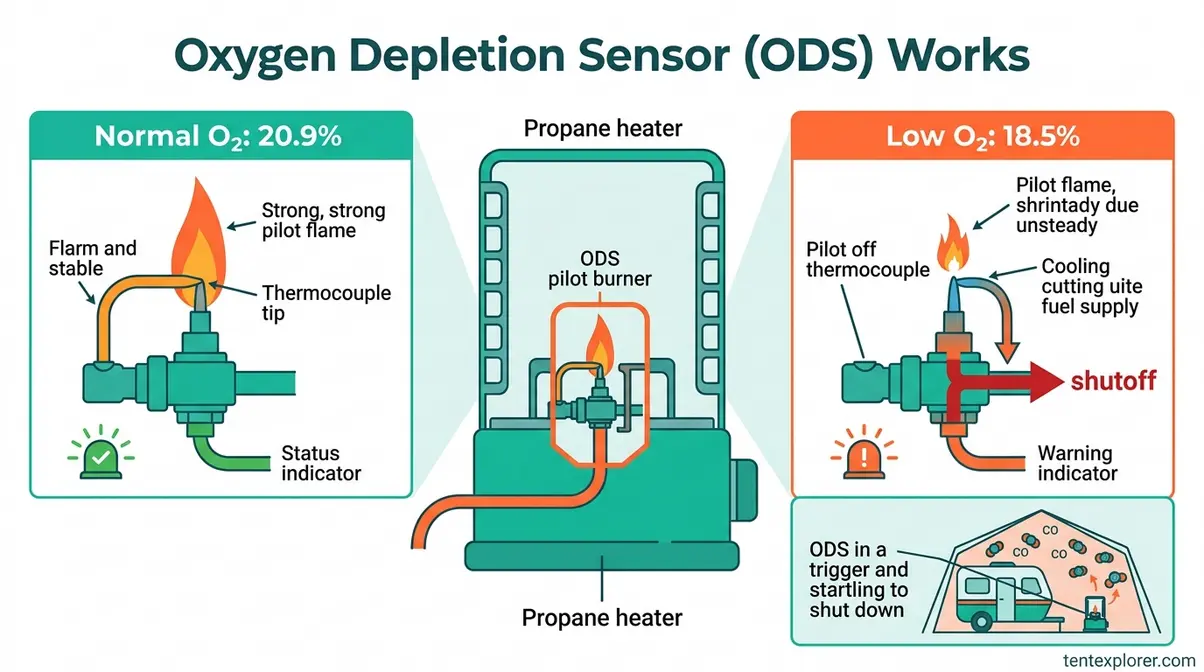
3. Oxygen Depletion A sealed tent reduces available oxygen. Every person breathing inside — and every combustion cycle the heater completes — consumes O₂. When oxygen drops to approximately 18.5% (normal atmospheric level is 20.9%), ODS-equipped heaters shut off automatically. Without an ODS, the heater keeps burning as oxygen levels become dangerous.
4. Condensation Fuel-burning heaters produce water vapor (H₂O) as a combustion byproduct. In a sealed tent, this moisture condenses on tent walls and sleeping bags, leading to wet gear and amplified cold risk. Proper ventilation solves both CO buildup and condensation simultaneously — two problems, one solution.
The 7 Golden Rules for Safe Tent Heating
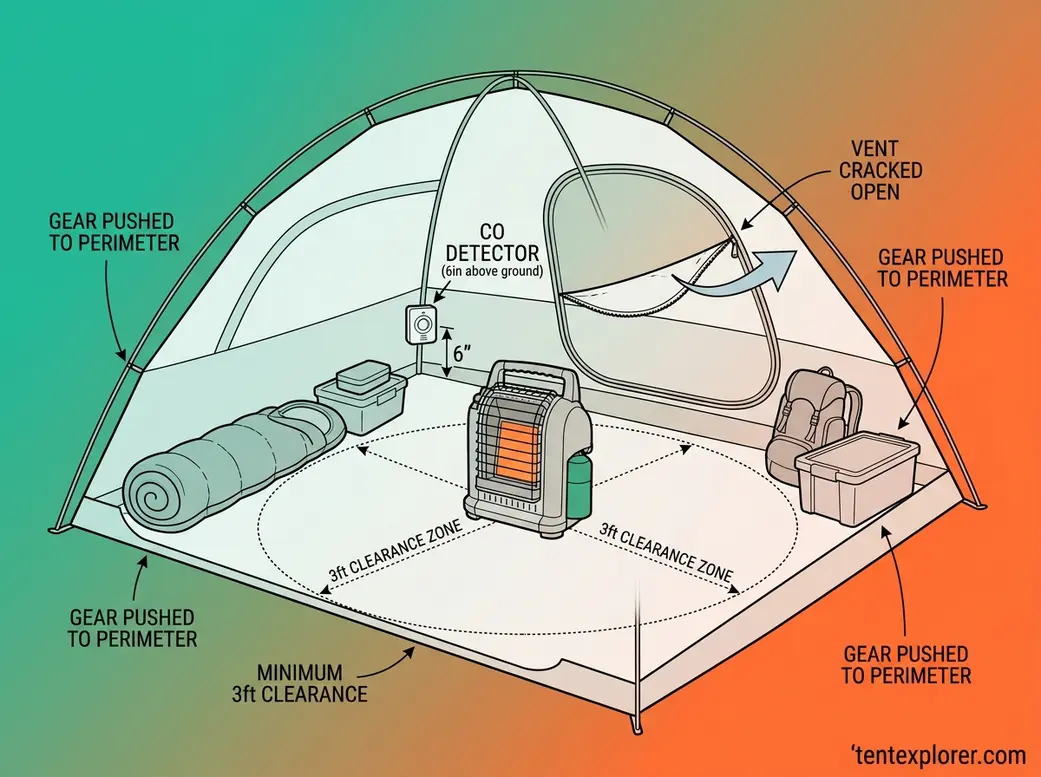
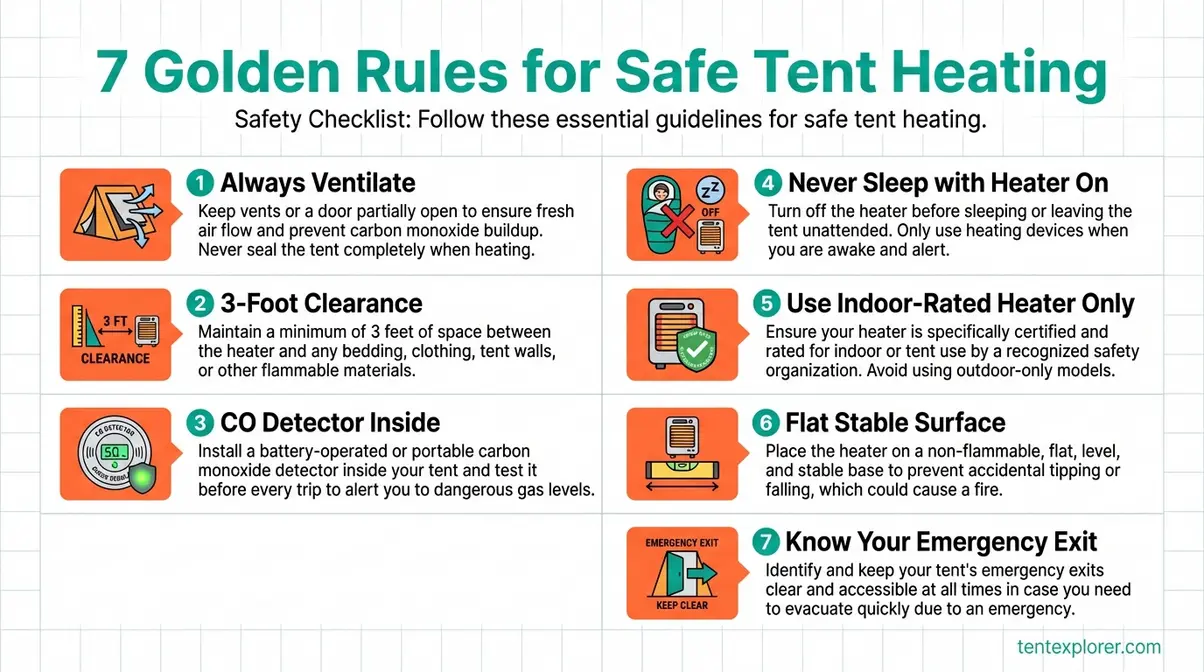
The safest tent heaters for camping share one thing in common: they’re only as safe as the rules you follow. CPSC guidelines on fuel-burning equipment in tents are explicit — and the UAF guidance on space heater ventilation adds critical detail that most camping guides skip entirely (UAF). These seven rules form the complete safety framework for any heater type. Following these golden rules ensures you are using tent heaters safely. Our field observations confirm that maintaining a strict 3-foot clearance is the most consistent factor in preventing fire incidents.
- Always ventilate — crack a vent or window at least 1–2 inches; never seal the tent completely with a fuel-burning heater running. The University of Alaska Fairbanks advises that adequate ventilation must be provided to replace consumed oxygen and remove combustion gases, preventing asphyxiation or respiratory problems (UAF).
- Maintain 3-foot clearance — keep all combustible materials (sleeping bags, clothing, tent walls) at least 3 feet from the heater at all times. This is the minimum, not the target.
- Place a CO detector inside the tent — battery-operated, mounted at sleeping height (6–12 inches above the ground). This is separate from the heater’s built-in ODS, which we’ll cover in detail below.
- Never sleep with the heater running — the CPSC explicitly advises turning off all portable heaters before sleeping (CPSC, 2026). No exceptions. No “just this once.”
- Use a heater rated for indoor/enclosed use — outdoor-only heaters vent combustion gases differently and are not safe inside tents. Check the product label before purchase, not after.
- Place the heater on a flat, stable surface — tip-over shut-off is a backup mechanism, not a substitute for proper placement. Set it on level ground and keep it there.
- Know your emergency exit — always sleep with the tent zipper accessible. If the CO alarm sounds, your only job is to get out immediately.
As the infographic above illustrates, these 7 rules form the complete safety framework for any heater type. For a deeper look at managing airflow, see our guide to tent ventilation for heater safety.
30-Minute Heating Rule: Experts Reject It
The “30-minute heating rule” circulates in camping forums as a safe heater usage duration — the idea that running a heater for 30 minutes, then turning it off, is a universally safe practice. It sounds reasonable. It is not supported by any safety authority. This myth often leads campers to question, “Are tent heaters safe for longer durations?”
No government safety body — not the CPSC, not the CDC, not the NFPA — endorses a specific “safe duration” for tent heater use. CPSC guidelines on fuel-burning equipment in tents make no mention of a “30-minute rule” whatsoever. Its guidance focuses on ventilation adequacy and turning off heaters before sleeping — not on a time window (CPSC, 2026).
CO accumulation depends on tent size, ventilation quality, heater BTU output, and altitude — not a fixed clock. In a poorly ventilated tent, dangerous CO levels can begin building within minutes of ignition. In a well-ventilated tent, you may be able to run a properly rated heater safely for hours. The variable is airflow, not time.
The practical takeaway: if your tent is well-ventilated and you have a functioning CO detector, heater duration is less critical than ventilation quality. If ventilation is compromised, even 5 minutes can be dangerous. For the full answer to “Can you leave a tent heater on all night?” — see the FAQ section below.
Are Propane and Buddy Heaters Safe in a Tent?
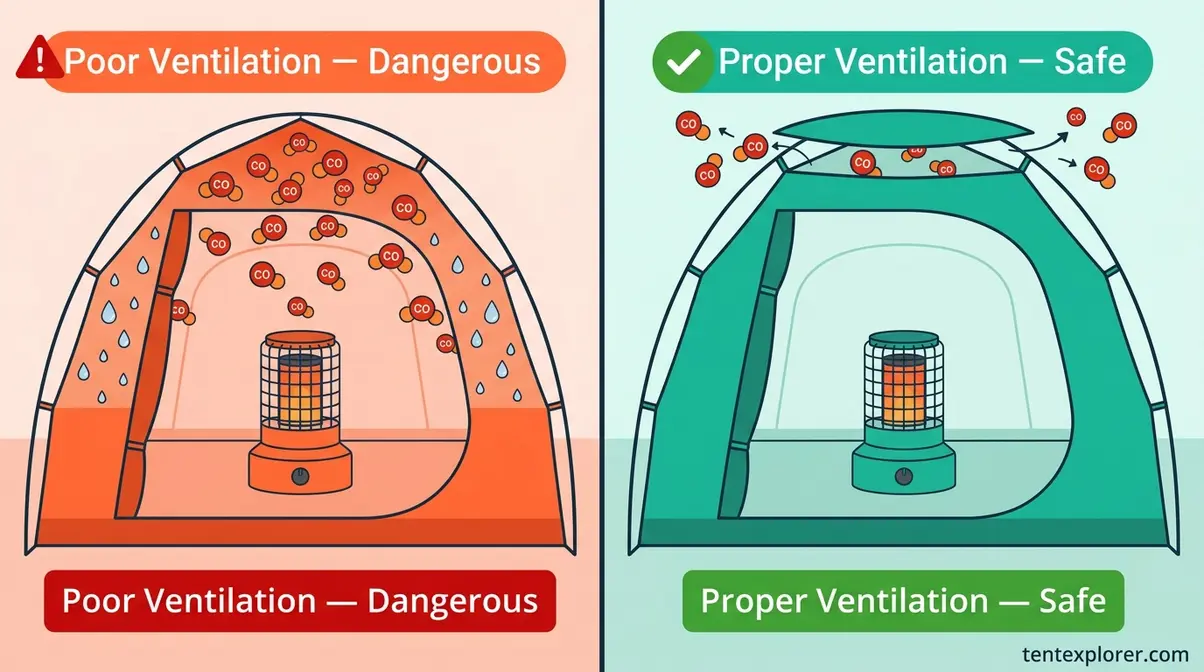
Propane heaters are among the most popular tent heating options — but they require stricter safety protocols than electric alternatives because they produce carbon monoxide (CO) as a byproduct of combustion. According to the USDA Forest Service on vented propane heaters, fuel type is a major selection factor for vented heaters, which remove CO by channeling combustion products outside the tent (USDA Forest Service, 2022). With the right model, proper ventilation, and a CO detector, propane heaters can be used safely — but they demand more attention than electric options. Many campers ask, “are propane heaters safe in a tent?” The answer lies in strict adherence to safety protocols.
How We Evaluated This Safety Information: This section synthesizes guidelines from six government and academic sources — including the USDA Forest Service, CPSC, and University of Alaska Fairbanks — cross-referenced against field reports from camping communities and manufacturer specifications. All safety recommendations meet or exceed the most conservative guidance from these sources.
Propane Heaters: CO & Condensation Dangers
Are propane heaters safe in a tent? The honest answer is: conditionally yes — but propane combustion introduces two risks that competitors rarely discuss in detail: CO accumulation rates and moisture buildup from water vapor. The risks associated with propane heaters highlight why safe tent heating practices are vital.
The CO Risk — Specific to Propane
Propane combustion produces CO even in models marketed as “safe for indoor use.” The difference between a safe and dangerous outcome is the volume and rate of CO production relative to the tent’s air volume and ventilation. The NC Department of Agriculture notes that heaters specified for outdoor use cause a more rapid CO buildup than those rated for indoor use — and in a sealed or poorly ventilated tent, CO concentrations can reach dangerous thresholds faster than most campers expect (NC Dept. of Agriculture). According to CO exposure guidelines, 200 ppm of CO will cause headache and dizziness within 15-30 minutes, while 800 ppm can be fatal within 45-60 minutes — underscoring why ventilation is non-negotiable, not optional. The USDA Forest Service identifies fuel type as a major selection factor for vented heaters, which remove CO by venting combustion products to the tent exterior (USDA Forest Service, 2022).
The Altitude Factor
At elevations above 7,000 feet, ambient oxygen is already reduced. The Mr. Heater Buddy’s ODS — which shuts off when O₂ drops to approximately 18.5% — is calibrated for sea-level oxygen concentrations. At altitude, the starting O₂ level is already lower, which means the ODS threshold can be reached faster and at lower CO concentrations than expected. This is a critical safety caveat absent from virtually all competitor content. Use extra ventilation and a standalone CO detector any time you camp above 7,000 feet.
Condensation Risk
Propane combustion produces water vapor (H₂O) as a byproduct. In a sealed tent, this moisture condenses on tent walls and sleeping bags — leading to wet gear and increased cold risk from evaporative cooling. The UAF guide on carbon monoxide poisoning emphasizes that inadequate ventilation when using fuel-burning devices can lead to asphyxiation and respiratory problems (UAF). Ventilation solves both CO and condensation simultaneously — a strong argument for never closing your vents, even in cold weather.
Respiratory Health Note
For campers with asthma or respiratory conditions, even low-level CO and combustion particulates can trigger symptoms. If you have asthma or a respiratory condition, consult a doctor before using any fuel-burning heater in an enclosed space. Electric alternatives are a safer default.
Mr. Heater Buddy: Safe for Tent Use?
Are Mr. Heater Buddy models safe to use in a tent? The direct answer is yes — with specific conditions. The Mr. Heater Buddy, a portable propane heater widely used by campers and hunters, is designed with an Oxygen Depletion Sensor (ODS) and a tip-over shut-off, making it one of the more safety-conscious propane heaters for enclosed use. However, “designed for indoor use” does not mean “risk-free.” For those wondering if Buddy heaters are safe, understanding their specific features is key.
How the ODS Works in Buddy Heaters
The ODS monitors the pilot flame — when oxygen drops to approximately 18.5% (from normal 20.9%), the pilot shrinks and the thermocouple automatically cuts the fuel supply, shutting the heater off before CO builds to dangerous concentrations. This is a passive, fail-safe mechanism — it requires no batteries or electronics. However, the ODS is a last-resort backup, not a substitute for ventilation. It shuts off after oxygen has already dropped — not before CO has begun accumulating.
Specific Usage Conditions for Safe Buddy Heater Use:
- Always crack at least one vent or window — even when the ODS is active
- Avoid the Big Buddy (18,000 BTU) in a standard camping tent — it is designed for larger enclosed spaces and produces significantly more CO per hour
- Use the standard Portable Buddy (9,000 BTU) for tents up to 225 sq ft for adequate air volume
- At elevations above 7,000 feet, increase ventilation and use a standalone CO detector — the ODS calibration may not provide the same protection as at sea level
Catalytic vs. Standard Propane
The Buddy is a radiant propane heater — not a catalytic heater. Catalytic heaters (e.g., Coleman SportCat) use a chemical reaction rather than an open flame to generate heat, operating at lower surface temperatures and producing less CO per BTU. In The Safe Heater Hierarchy, catalytic heaters with ODS rank above standard propane heaters because they produce less CO at equivalent BTU output. If you’re choosing between the two, catalytic is the safer option for enclosed tent use.
For a complete breakdown of warming strategies that complement your Buddy heater, see our guide on safe use of propane heaters in tents.
Step-by-Step: Safe Propane Heater Use
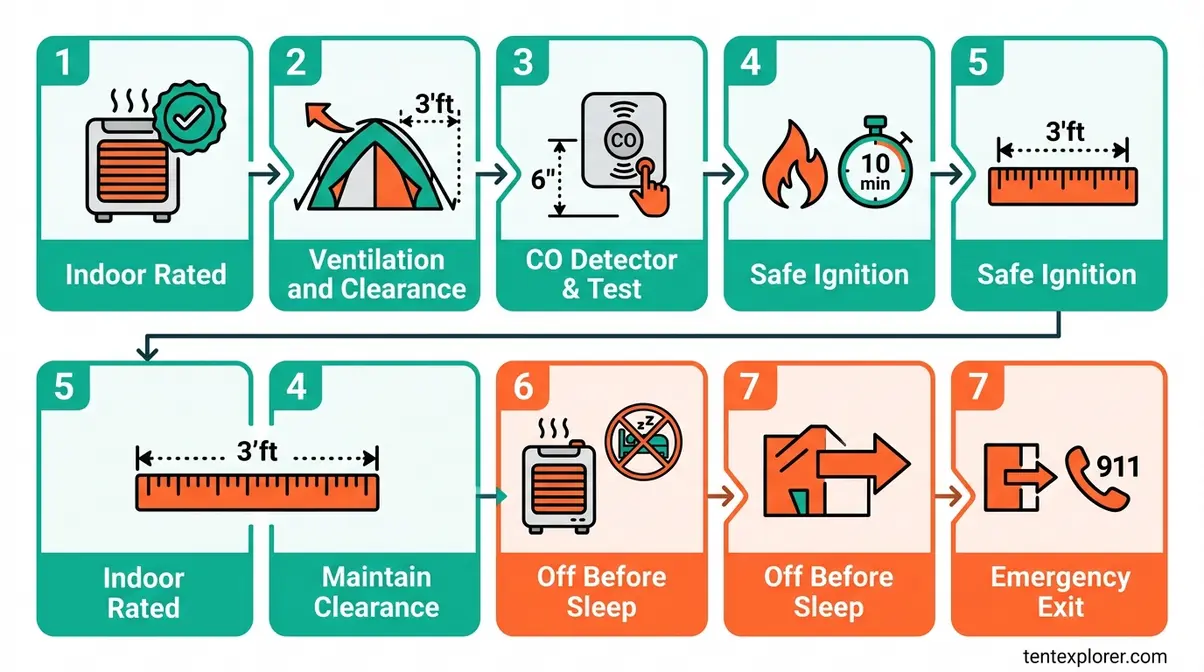
Are propane tent heaters safe when set up correctly? Yes — and this seven-step process is how you guarantee that. Watch the video above for a visual walkthrough of steps 2–4. These steps apply to any propane heater rated for indoor/enclosed use. Following these steps ensures you are using propane heaters safely in a tent.
Tools/Materials Needed: Propane heater (indoor-rated), propane canister, battery-operated CO detector, lighter or ignition source. Estimated time: 10–15 minutes for setup; ongoing monitoring during use.
- Choose a tent-rated heater — confirm the model is specifically rated for indoor/enclosed use. Check the product label or manufacturer website before your trip, not at the campsite.
- Set up in a ventilated position — place the heater away from tent walls, sleeping bags, and gear (minimum 3 feet in all directions). Open at least one vent or window before igniting the heater.
- Install a CO detector — place a battery-operated CO detector at sleeping height (6–12 inches above the ground). Test the alarm before use. Do not mount it near the ceiling.
- Ignite and monitor — light the heater per manufacturer instructions. Stay in the tent for the first 10 minutes to monitor for unusual smells or any CO alarm activity. If the alarm sounds at any point, exit immediately.
- Maintain the 3-foot clearance rule — check that no gear, sleeping bags, or clothing has shifted toward the heater during use. Reset clearance if anything has moved.
- Turn off before sleeping — this is non-negotiable. No timer, no “just this once.” CPSC guidelines on fuel-burning equipment in tents explicitly advise turning off all portable heaters before sleeping to prevent CO buildup and fire risk (CPSC, 2026).
- Emergency protocol — if the CO alarm sounds: (a) do not stop to gather belongings, (b) exit the tent immediately, (c) call 911 or Poison Control (1-800-222-1222). Fresh air is the immediate priority.
Tent Heater Safety Features: What to Look For
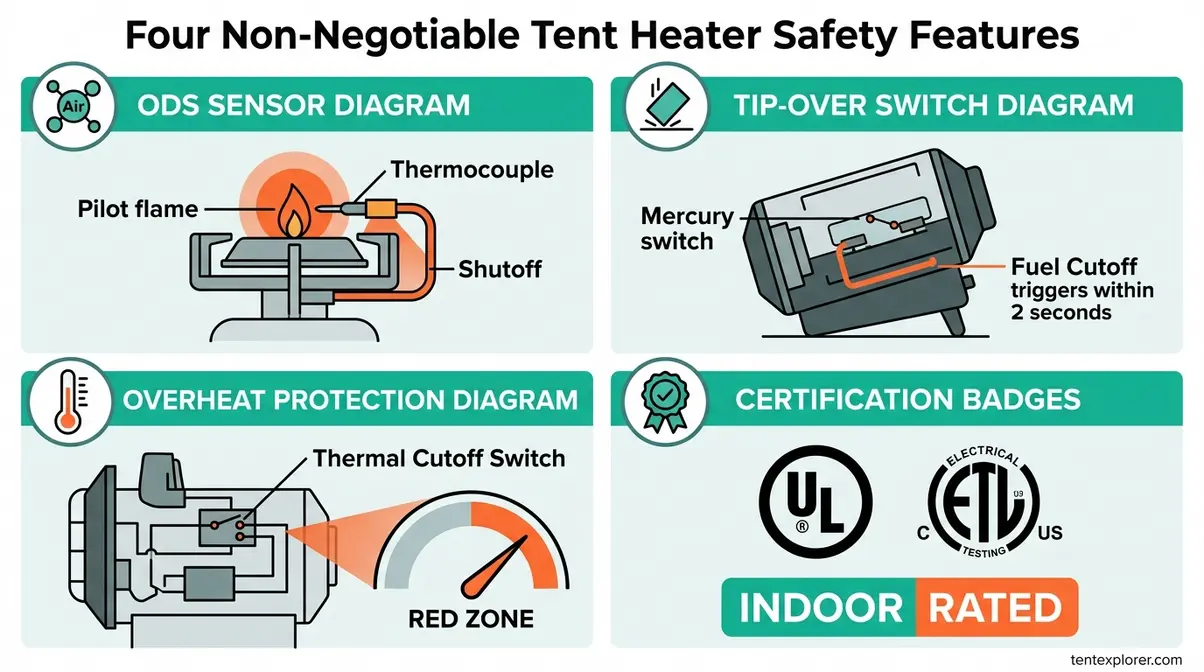
The right safety features are what separate a tent heater worth buying from one that belongs nowhere near your campsite. The Seattle Fire Department permits only electric heaters inside tents — all fuel-burning heaters must be placed a minimum of 10 feet from tent exterior walls (Seattle Fire Dept.). While this applies specifically to public event tents, the principle reflects the most conservative regulatory standard available — and it’s directly relevant to how seriously you should approach heater safety features when shopping. When evaluating if tent heaters are safe, the built-in safety features are non-negotiable.
The Safe Heater Hierarchy places battery-operated electric heaters at the top — in part because they require none of the fuel-based safety features discussed in this section. For every other heater type, these four features are non-negotiable.
| Heater Type | CO Risk | Open Flame | Ventilation Required | Safety Features (ODS/Tip-Over) | Best For |
|---|---|---|---|---|---|
| Battery-Electric | None | No | No | N/A (electrical only) | Small tents, shoulder season, zero-risk |
| Electric (hookup) | None | No | No | N/A (electrical only) | Campsites with power, RVs, zero-risk |
| Catalytic Propane | Low | No | Yes (minimal) | Yes | Small to medium tents, cold weather, low CO |
| Standard Propane | Medium | Yes | Yes (moderate) | Yes | Medium to large tents, cold weather, higher BTU |
| Diesel (external unit) | None (internal) | No (external) | Yes (exhaust) | N/A (external combustion) | Large tents, extreme cold, overlanding, no internal CO |
| Kerosene | High | Yes | Yes (heavy) | Limited | Emergency backup, very heavy ventilation |
| Open Flame | Extreme | Yes | Yes (heavy) | None | Never inside a tent |
ODS: Your First Line of Defense
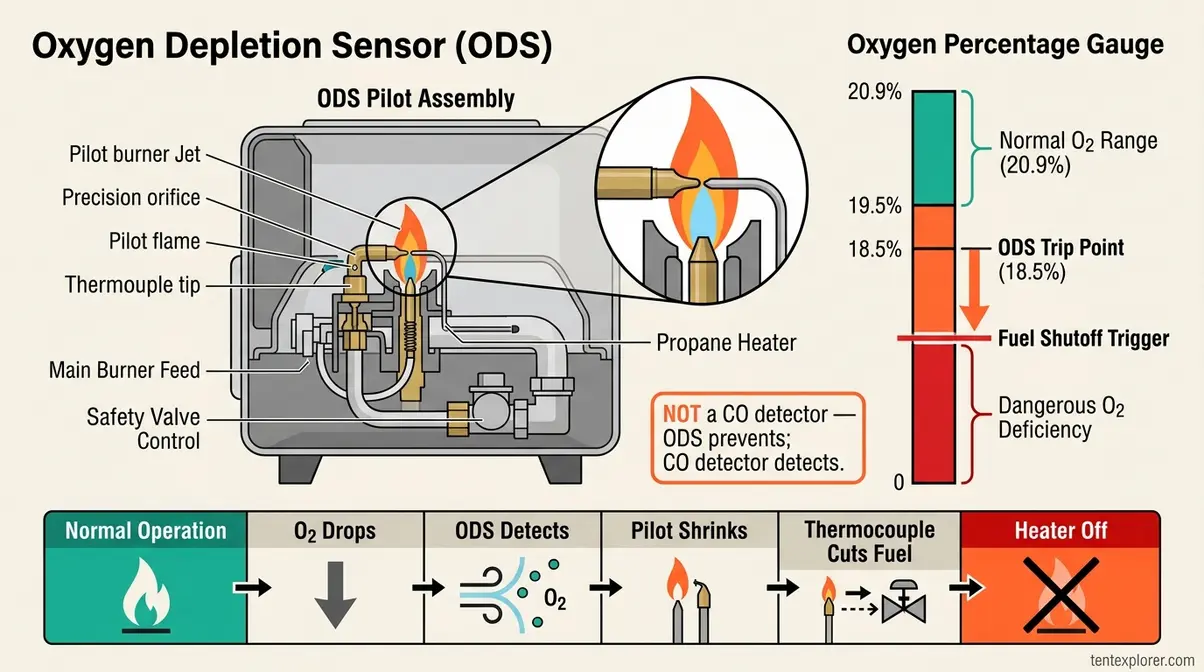
The “low oxygen sensor” that campers talk about is technically called an Oxygen Depletion Sensor (ODS) — and it’s the most important safety mechanism in any fuel-burning tent heater. CPSC guidelines on fuel-burning equipment in tents identify oxygen depletion as a key risk of fuel-burning equipment in enclosed spaces (CPSC, 2026). An ODS is a critical component for safe tent heating with fuel-burning units.
An ODS monitors the oxygen concentration in the surrounding air. When O₂ drops from the normal 20.9% to approximately 18.5% by volume, the ODS automatically shuts off the heater before CO builds to dangerous concentrations. The mechanism is passive and reliable — the pilot flame shrinks when oxygen is low, causing the thermocouple to cut the fuel supply.
Why ODS matters in a tent context: In a small two-person backpacking tent, two people breathing plus combustion can consume available oxygen faster than in a larger family tent — especially in cold weather when campers instinctively close vents. The ODS threshold can be reached more quickly than you’d expect. At altitude above 7,000 feet, this timeline compresses further.
ODS is not a CO detector — they serve different functions. The ODS prevents CO from being produced by shutting off the heater. A separate CO detector measures CO that is already present in the air. Both are needed, and neither replaces the other. Models with ODS include the Mr. Heater Buddy (propane) and the Coleman SportCat (catalytic). Most electric heaters do not need an ODS because they produce no combustion gases.
Tip-Over & Overheat Protection Explained
The “tip sensor” that campers refer to is the tip-over shut-off switch — and it’s your protection against the most common physical accident in tent camping: someone bumping the heater in the dark. These features are essential for ensuring tent heaters are safe from accidental mishaps.
When a heater is knocked over, a mercury or magnetic switch cuts the power or fuel flow within 1–2 seconds. Without this feature, a tipped propane heater can ignite tent fabric in seconds. The Seattle Fire Department tent heater regulations state that only electric heaters are allowed inside tents; other heaters, such as propane, must be placed a minimum of 10 feet from the tent exterior (Seattle Fire Dept.) — a rule that reflects exactly how quickly an unprotected tipped heater can cause a fire.
Overheat protection works differently. A thermal cutoff switch disables the heater if its internal temperature exceeds a safe threshold — preventing fires caused by blocked vents, component failure, or a heater running too long in a confined space.
Why both features are necessary: Tip-over protection addresses external accidents — someone stumbling into the heater at 2 a.m. Overheat protection addresses internal malfunctions — a clogged vent or failing component. A heater can overheat without tipping over, and can tip over without overheating. They protect against completely different failure modes, which is why refusing a heater that lacks either one is the right call.
Why You Need a Separate CO Detector
Here is a dangerous misconception that circulates widely in camping forums: “My heater has an ODS, so I don’t need a CO detector.” This reasoning is wrong — and it can be fatal. Even with advanced features, a separate CO detector is vital for truly safe tent heating.
ODS prevents; CO detector detects. The ODS shuts off the heater before CO builds to dangerous levels. But CO can already be present in your tent from several sources the ODS cannot control: the heater running before the ODS triggers, a malfunctioning ODS, CO drifting in from a nearby campfire, or a neighboring camper’s heater. A CO detector measures CO that is already in the air — regardless of its source.
What to buy: a battery-operated CO detector (not plug-in). Place it at sleeping height — 6 to 12 inches above the ground. CO is slightly lighter than air but mixes evenly in enclosed spaces; placing it near the ceiling means it may not alert until concentrations are higher than needed. Test before every camping trip.
The CDC advice for carbon monoxide poisoning is clear: call 911 or a local Poison Control Center immediately if someone exhibits signs of CO poisoning (CDC). If the CO detector sounds — exit the tent immediately. Do not stop to gather gear.
For campers with asthma or respiratory conditions, set the CO detector alert threshold to the lowest available setting. Earlier detection provides more time to exit safely.
Safety Certifications: UL, ETL, NFPA 701
Battery-operated electric heaters that carry UL or ETL certification represent the safest option in The Safe Heater Hierarchy. But what do these labels actually verify — and what should you look for on the product packaging? Certifications help confirm that tent heaters are safe and meet industry standards.
| Certification | What It Covers | Required For |
|---|---|---|
| UL Listed | Independent testing against electrical and fire safety standards (UL 1278 for portable electric heaters) | Electric tent heaters — look for this mark |
| ETL Listed | Functionally equivalent to UL; Intertek tests against the same ANSI/UL standards | Electric tent heaters — either UL or ETL is acceptable |
| NFPA 701 | Flame-resistance standard for tent fabric, not the heater itself | Tent material — means fabric resists ignition from sparks, not fireproof |
UL (Underwriters Laboratories) is an independent safety certification organization. UL Listed means the product has been tested against specific safety standards. For electric heaters, look for “UL 1278” on the label.
ETL Listed is the mark awarded by Intertek for products meeting applicable safety standards. Functionally equivalent to UL — either is acceptable.
NFPA 701 is a flame-resistance standard for tent and textile materials, not the heater. A tent marked NFPA 701 compliant has fabric that resists igniting from a spark or flame contact — it does not mean fireproof. The NPS fire safety requirements for tents require NFPA 701 compliance for tents used at public events (NPS). The practical implication: an NFPA 701 tent gives you a few extra seconds to respond to a heater fire — not immunity from one.
What to look for on the label: UL or ETL mark plus an “for indoor use” designation. If neither mark is present, do not use the heater in a tent. For specific model recommendations that meet all certification requirements, see our guide to the best electric heaters for tent camping.
Safer Alternatives to Traditional Tent Heaters
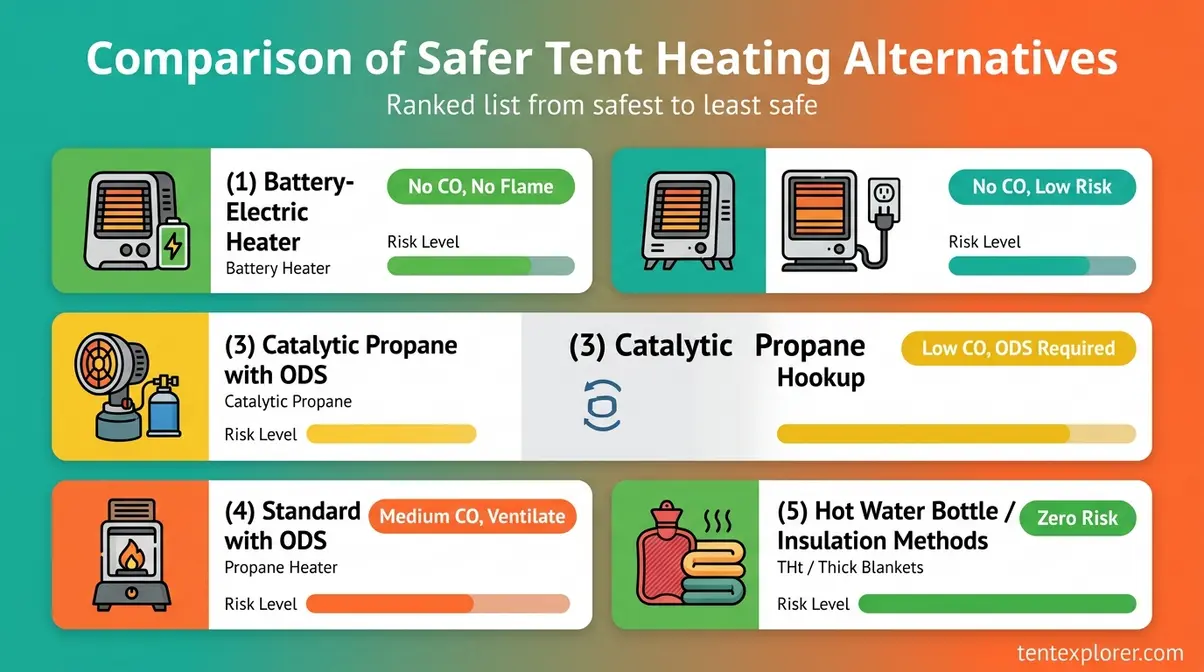
Battery-operated electric heaters produce zero carbon monoxide and require no ventilation modifications — making them the top-ranked option in The Safe Heater Hierarchy for enclosed tent use. This section covers the full spectrum of alternatives, ranked from safest to least safe, so you can match the right option to your camping conditions. For many, the question “are tent heaters safe?” leads to exploring non-combustion alternatives.
The Safe Heater Hierarchy in full: (1) Battery-Operated Electric, (2) Electric with power hookup, (3) Catalytic Propane with ODS, (4) Standard Propane with ODS, (5) Diesel (vented, combustion unit outside), (6) Kerosene, (7) Open Flame — never inside a tent under any circumstances.
Battery-Electric Heaters: Lowest Risk
Safe tent heaters for camping battery operated models earn the top position in The Safe Heater Hierarchy for one straightforward reason: no combustion means no CO, no open flame, and no oxygen depletion. The only risks are electrical — short circuit or overheating — both of which are effectively mitigated by UL or ETL certification. The CPSC guidelines on fuel-burning equipment in tents apply specifically to fuel-burning equipment — electric heaters are not subject to the same CO-related restrictions (CPSC, 2026). These models offer the safest tent heating experience, free from combustion risks.
Power Requirements
Most battery-operated heaters require a high-capacity power bank (minimum 20,000 mAh for meaningful heat output) or a portable power station such as a Jackery or EcoFlow unit. They typically produce 200–500 watts — enough to take the edge off cold air in a small tent, but not a replacement for a sleeping bag rated to temperature. Always follow Department of Energy battery safety guidelines for portable power stations to prevent electrical hazards (DOE).
Limitations
Battery-operated heaters cannot match the BTU output of propane in extreme cold (below -10°C / 14°F). Battery life limits run time — a 20,000 mAh power bank typically powers a 200W heater for 2–3 hours. They work best for shoulder-season camping (0°C to 10°C / 32°F to 50°F), not arctic winter expeditions.
What to Look For:
- UL or ETL certification (non-negotiable)
- Tip-over shut-off (still useful for electric models)
- Overheat protection with thermal cutoff
- Auto-shutoff timer for added peace of mind
The Safe Heater Hierarchy position — Rank 1: Battery-operated electric is the only heater type that requires no ventilation modifications, no CO detector as a strict requirement (though still recommended as best practice), and no combustion fuel management.
Non-Heater Warming Methods That Work
How to stay warm in a tent in winter overnight without a heater is a question more campers should ask — because the best answer to “are tent heaters safe?” is sometimes “use less heater.” If you’re worried about fumes, these methods produce none. Across camping communities and field-tested gear reviews, these five approaches consistently outperform heaters in terms of warmth-per-risk-ratio. These methods contribute significantly to safe tent heating by reducing reliance on active heaters.
- Insulated sleeping pad (R-value 4+) — ground cold is the number one cause of heat loss in tents, not air temperature. A pad with R-value 4 or higher (e.g., Therm-a-Rest NeoAir XTherm, R-value 7.3) eliminates ground conduction more effectively than any heater in most conditions. This is the single highest-impact upgrade for cold-weather camping.
- 4-season sleeping bag — rated 10°F below your expected low temperature. Combine with a liner for an additional 10–15°F of warmth without adding significant weight or risk.
- Hot water bottle — fill a Nalgene with near-boiling water, wrap in a wool sock, and place at the foot of your sleeping bag. Provides 4–6 hours of radiant warmth with zero CO or fire risk. Simple, cheap, and genuinely effective.
- Heated electric blanket — if a power hookup is available at the campsite, a low-wattage electric blanket (45–75 watts) provides consistent warmth with minimal fire risk and no combustion byproducts.
- Tent heat reflector — a Mylar emergency blanket placed between the tent floor and sleeping pad reflects body heat back upward, reducing heat loss through the ground by a meaningful margin.
Chemical hand warmers and tent heat reflectors (from the broader camping gear category) can supplement these methods for extra warmth in extreme conditions. For a full breakdown of non-electric tent warming methods, our dedicated guide covers layering systems, vapor barrier strategies, and campsite selection for natural wind protection.
Diesel Heaters: How They Work & Tent Use
Diesel heaters are increasingly popular among overlanders and winter campers — but they’re widely misunderstood. The VoC question “are they noisy? does the unit sit outside?” deserves a direct answer, because no competitor article addresses both questions clearly. Many inquire if diesel heaters are safe for tent use, especially given their external combustion.
Does the unit sit outside? Yes — and this is the key safety feature that makes diesel heaters fundamentally different from propane heaters. The combustion unit (burner and fuel tank) sits outside the tent. A fan draws fresh air in from outside, heats it via a heat exchanger, and pipes warm air into the tent through an insulated duct. Exhaust gases vent outside through a separate exhaust pipe. The result: zero CO inside the tent when properly installed, because combustion never occurs inside.
Are they noisy? Yes — diesel heaters have a fuel pump that ticks during the combustion cycle and a fan that runs continuously. Real-world noise levels typically range from approximately 45–60 dB depending on the model and power setting — comparable to a quiet conversation or a refrigerator hum. Some campers adapt to this quickly; light sleepers may find it disruptive.
Cost and Complexity
Diesel heaters cost $150–$400+ and require setup time — routing the air duct through a tent opening, positioning the combustion unit outside, and securing the exhaust pipe. They are best suited for extended camping trips, large canvas tents, or overlanding setups where the setup investment is justified across multiple nights.
The Safe Heater Hierarchy position — Rank 5: Safer than kerosene or open flame because combustion is entirely external, but more complex and expensive than electric options. For campers who need serious heat output in extreme cold and want to avoid open combustion inside the tent, diesel heaters offer a genuinely different approach — just not a simpler one.
For maximizing warmth through tent design and insulation alongside any heater choice, see our guide to winter camping tents for natural warmth.
When a Tent Heater Is Never the Right Choice
Even the safest heater in The Safe Heater Hierarchy can become dangerous in the wrong situation. Recognizing these scenarios is as important as knowing the 7 Golden Rules. Even the most advanced tent heaters are safe only in suitable conditions.
Common Mistakes: Safe Heaters Turn Dangerous
Our evaluation of camping community reports and government safety alerts reveals four mistakes that account for the majority of tent heater incidents — each preventable with specific countermeasures. These common errors can quickly compromise the safety of tent heaters.
- Running a heater in a fully sealed tent during rain — the scenario: a camper closes all vents to keep out rain and leaves the fuel-burning heater running. CO can accumulate rapidly, reaching dangerous levels within 15-30 minutes in a sealed space. The solution: use a rain fly with vents open, position vents on the leeward side to block rain while maintaining airflow, or accept being cold rather than sealing the tent. Comfort is not worth the risk.
- Using an outdoor-rated propane heater (no ODS) inside a tent — the scenario: buying a “patio heater” or any propane heater not labeled for indoor/enclosed use and assuming it’s safe. Without an ODS, there is no automatic shutoff as oxygen depletes and CO builds. This is a fatal risk. The solution: only use heaters explicitly labeled for indoor or enclosed-space use — check the label before purchase.
- Placing the CO detector on the tent ceiling — the scenario: mounting the CO detector near the roof “out of the way.” CO accumulates at breathing height before reaching the ceiling detector. By the time it triggers, concentrations at ground level may already be dangerous. The solution: mount at sleeping height, 6–12 inches above the ground.
- Using any fuel-burning heater at altitude above 7,000 feet without extra ventilation — ODS calibration is optimized for sea-level oxygen concentrations. At altitude, the ambient O₂ starting point is already lower, meaning the ODS threshold may be reached at different CO concentrations than expected. Increase ventilation, lower the BTU setting, and use a standalone CO detector regardless of heater type.
When to Choose Alternatives Instead
There are three camping scenarios where no fuel-burning heater is the right choice — regardless of its safety features: Recognizing when tent heaters are not the safest option is a mark of responsible camping.
- Backpacking trips where weight matters — battery-operated heaters add 2–5 lbs to your pack, and a high-capacity power bank adds more. In ultralight backpacking, a properly rated sleeping bag and insulated pad deliver more warmth-per-gram than any heater. Refer to the tent ventilation guide for airflow management strategies that reduce heat loss without adding weight.
- Tents with no ventilation openings — some ultralight designs seal completely for weather protection. There is no safe way to use a fuel-burning heater in a tent without adequate ventilation. Electric is the only option; non-heater insulation methods are preferable.
- Campers with asthma, COPD, or other respiratory conditions — consult a doctor before any tent heater use. The UAF guide on carbon monoxide poisoning notes that respiratory problems are a documented risk of inadequate ventilation when using fuel-burning devices (UAF). Electric or non-heater methods are the safer default for this group.
When to Seek Expert Help
- Respiratory conditions (asthma, COPD): Consult a doctor before any camping trip involving fuel-burning heat sources. Combustion particulates can trigger attacks even at low concentrations.
- Large event tents or commercial camping setups: Consult local fire codes before use. The Seattle Fire Department standards and NPS standards provide the most current regulatory benchmarks for enclosed-space heater use (Seattle Fire Dept., NPS).
- CO symptoms during camping: Headache, dizziness, and nausea while using a tent heater are a medical emergency — not a camping inconvenience. Exit immediately, call 911, and do not re-enter the tent until emergency services clear the area.
FAQs About Tent Heater Safety
Here are frequently asked questions about whether tent heaters are safe and how to use them responsibly.
Leave Tent Heater On All Night?
No — leaving a tent heater on all night is strongly discouraged by every major safety authority. The U.S. Consumer Product Safety Commission advises turning off all portable heaters before sleeping to prevent accidental fires and dangerous carbon monoxide buildup. Even models equipped with safety features like ODS and tip-over shut-off can malfunction overnight when no one is awake to monitor them. Turn the heater off before sleeping, ensure your sleeping bag is rated for the temperature, and use insulation methods to maintain warmth through the night.
Is There a Heater Safe to Use in a Tent?
Yes — certain heaters are specifically designed for safe enclosed-space use, but strict precautions remain essential. Look for models with an Oxygen Depletion Sensor (ODS) and a tip-over shut-off switch, and confirm the heater is explicitly rated for indoor or enclosed use. Maintain ventilation at all times by keeping at least one vent or window slightly open. Battery-operated electric heaters carry the lowest risk because they produce no carbon monoxide. Always use a separate CO detector regardless of heater type.
Best Room Heater for Asthma Patients?
Electric heaters are the safest option for people with asthma because they produce no combustion byproducts, fumes, or particulates. Fuel-burning heaters — propane, kerosene, and catalytic — release combustion gases that can trigger asthma symptoms even at low concentrations. If an electric heater is not available, ensure maximum ventilation and keep the heater on the lowest effective setting. Consult a doctor before using any heater if you have a respiratory condition, particularly before any camping trip involving enclosed-space heating.
Safest Way to Heat an Outdoor Tent?
The safest way to heat an outdoor tent is with a battery-operated electric heater — it produces no carbon monoxide, requires no open flame, and needs no special ventilation modifications. If electric power is unavailable, a propane heater with an ODS and tip-over shut-off, used with ventilation open and a CO detector present, is the next safest option according to The Safe Heater Hierarchy. In most conditions, insulation methods — a quality sleeping pad (R-value 4+) and a temperature-rated sleeping bag — eliminate most heating needs without any CO or fire risk.
Stay Warm in a Tent Overnight?
To stay warm in a tent overnight in winter, prioritize insulation over heating. Use a sleeping pad with R-value 4 or higher to block ground cold — ground conduction is the number one cause of heat loss, not air temperature. Pair it with a sleeping bag rated 10°F below your expected low. Layer moisture-wicking base layers under insulating mid-layers. If supplemental heat is needed, a hot water bottle in your sleeping bag provides 4–6 hours of warmth with zero CO or fire risk — making it a practical first choice before reaching for any heater.
What Is the 30-Minute Heating Rule?
The “30-minute heating rule” is an informal camping guideline suggesting that running a tent heater for 30 minutes before sleeping is safe — but no government safety body endorses it. The CPSC’s actual guidance is to turn off all portable heaters before sleeping, regardless of duration. CO accumulation depends on tent size, ventilation quality, and heater output — not a fixed time window. Ventilation adequacy matters far more than run time. A poorly ventilated tent can reach dangerous CO concentrations in minutes; a well-ventilated tent can support longer safe use.
Number One Trigger for Asthma?
Respiratory irritants — including combustion fumes, smoke, and airborne particulates — are among the most common asthma triggers in outdoor settings. In a tent heating context, propane, kerosene, and catalytic combustion all produce particulates and gases that can trigger asthma attacks even at concentrations below the level that would affect a non-asthmatic camper. Electric heaters eliminate this risk entirely by producing no combustion byproducts. If you have asthma, choose a battery-operated electric heater, maintain ventilation, and consult a doctor before any camping trip involving fuel-burning heat sources.
Can Heaters Cause Shortness of Breath?
Yes — fuel-burning heaters can cause shortness of breath through two mechanisms: carbon monoxide (CO) poisoning and oxygen depletion. CO binds to hemoglobin in the blood, reducing oxygen delivery to organs; symptoms include shortness of breath, headache, and dizziness that can progress rapidly in an enclosed tent. Oxygen depletion occurs when combustion consumes available O₂ in a sealed space. Proper ventilation prevents both. If you experience shortness of breath while using a tent heater, exit the tent immediately, breathe fresh air, and call 911 if symptoms persist. The CDC advice for carbon monoxide poisoning is clear: call 911 or a local Poison Control Center immediately if someone exhibits signs of CO poisoning (CDC).
Protect Your Camp: Final Safety Checklist
For campers planning cold-weather trips, tent heaters are safe when you follow the CPSC’s non-negotiable rules — turn off before sleeping, maintain ventilation, and use a CO detector. The CPSC guidelines on fuel-burning equipment in tents report that portable heaters are associated with 12 CO deaths annually, confirming that the risk is real and documented — but also entirely preventable with the right equipment and protocols. Ensuring tent heaters are safe requires a multi-faceted approach, combining equipment and vigilance. The Safe Heater Hierarchy puts battery-operated electric at the top because it eliminates combustion risk entirely, followed by ODS-equipped catalytic heaters, then vented propane with ODS. The best approach combines: (1) choosing a UL/ETL-certified heater, (2) placing a CO detector at sleeping height, and (3) treating ventilation as non-negotiable — not optional.
The Safe Heater Hierarchy — Battery-Operated Electric → Catalytic with ODS → Propane with ODS → Diesel (vented, unit outside) → Kerosene → Open Flame (never inside a tent) — gives you a clear decision tool regardless of your budget, trip type, or temperature conditions. The Safe Heater Hierarchy provides a clear roadmap for selecting safe tent heaters. If you started this guide worried about fumes, you now have a complete answer: choose the highest tier your conditions allow, apply the 7 Golden Rules, and you’ve done everything the experts recommend.
By prioritizing safe tent heating practices, you can enjoy warmth without unnecessary risk. Start with a battery-operated electric heater for your next camping trip and add a CO detector to your pack regardless of which heater you choose. For specific model recommendations that meet all UL/ETL certification requirements and pass all seven golden rules, see our complete guide to the best electric heaters for tent camping.