
This blog post may contain affiliate links. As an Amazon Associate I earn from qualifying purchases.
📋 Table of Contents
- Core Camping Essentials: Your Master Checklist
- Shelter and Sleeping Essentials
- Camp Kitchen and Food Supplies
- Clothing and Personal Care
- Safety, Navigation, and First Aid
- The Campsite-Ready Framework: Pack, Test, Drive
- Step 1: Pack by Category
- Step 2: Test at Home
- Step 3: Pace Your Drive (The 2-2-2 Rule)
- Tent, Car, and RV Camping Checklists
- Tent Camping Checklist
- Car Camping Checklist
- Beginner RV Camping Checklist
- Camping Style Comparison: What Gear Changes?
- Family Camping Checklist: Packing for Kids
- Kid-Specific Gear and Comfort Items
- Campsite Safety Tips When Children Are Present
- Kid-Friendly Meals and Activities
- Your Free Printable Family Camping Checklist
- Camping Rules, Etiquette, and What FF Means
- Leave No Trace Principles
- Campsite Quiet Hours and Site Rules
- What Does FF Mean at a Campground?
- What is the 3-3-3 rule for camping?
- What are the 7 C’s of camping?
- Download Your Free Beginner Camping Checklist PDF
- The REI Camping Checklist: A Quick Comparison
- Common Beginner Camping Mistakes
- Common Pitfalls
- When to Choose Alternatives
- When to Seek Expert Help
- Frequently Asked Questions
- What is the 2-2-2 rule for camping?
- What do I need for camping as a beginner?
- What is the most forgotten item when camping?
- Your First Campsite Starts Here
You’ve booked the campsite. You’re excited. Then you open a blank notes app and stare at it — because you genuinely have no idea where to start. That feeling is nearly universal among first-time campers, and it’s exactly why so many people end up at the campsite without toilet paper, a can opener, or dry socks.
This beginner camping checklist solves that problem with more than a list — it gives you a system. The Campsite-Ready Framework breaks your prep into three steps: Pack by Category (the master checklist), Test at Home (a quick gear run-through before you leave), and Pace Your Drive (the 2-2-2 rule for smart travel). Work through each step and you’ll arrive at the trailhead confident, not scrambling.
Whether you’re starting from scratch or filling in the gaps in your gear collection, this guide covers every essential — from shelter and sleep to cooking, clothing, safety, and campsite etiquette.
The Campsite-Ready Framework turns your beginner camping checklist into a repeatable system: Pack by Category, Test at Home, and Pace Your Drive.
- Shelter & Sleep: A 3-season tent, sleeping bag rated to 20°F below your expected low, and a sleeping pad are non-negotiable.
- Safety First: A first aid kit, headlamp with spare batteries, and a way to purify water are the three items most commonly forgotten — and most critical.
- Before You Go: Download the free PDF checklist below, do a 10-minute backyard gear test, and apply the 2-2-2 rule to your drive.
Core Camping Essentials: Your Master Checklist
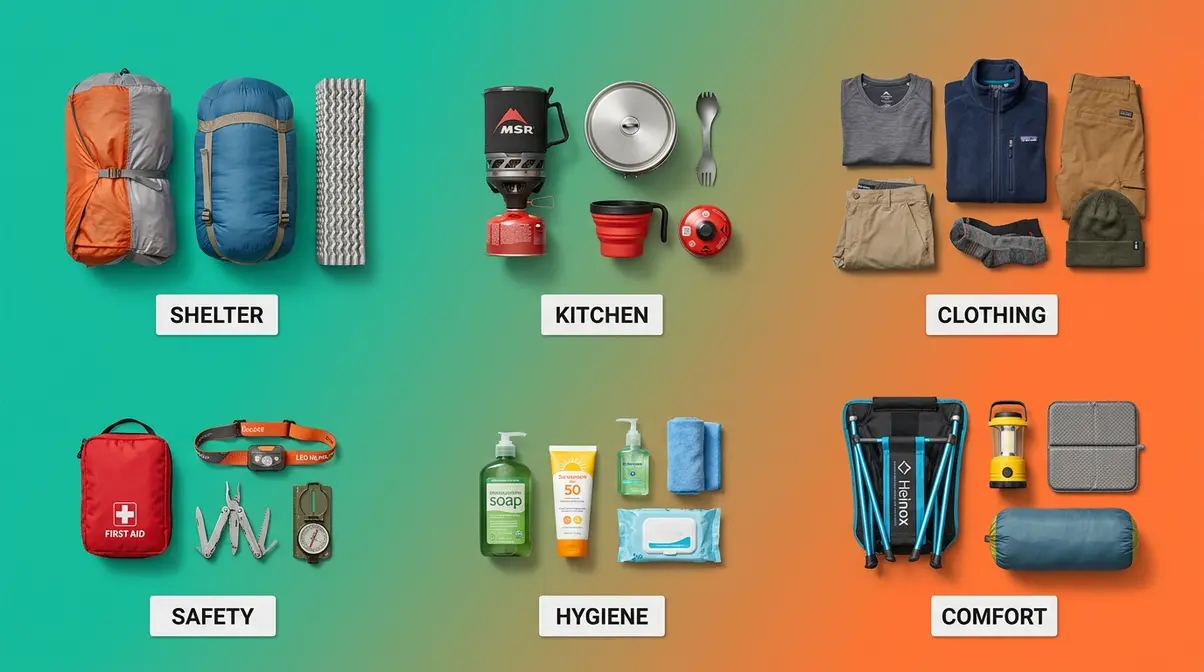
A good beginner camping checklist doesn’t just name items — it tells you why each one earns a spot in your pack. Our team evaluated gear recommendations across camping communities, NPS guidance, and REI’s field-tested advice to build a category-by-category list that covers every real scenario you’ll face on a first overnight trip.
Before diving in, here’s the voice of nearly every first-timer who’s ever posted in an outdoor forum:
“Here are some of the few things that you would need when you go camping: Tent, sleeping bag, water bottle, fire starter, first aid kit, food, and a pocket …”
That instinct is right — but the gaps are where trips go sideways. The categories below fill in everything that quote leaves out.
Shelter and Sleeping Essentials
Shelter is the one category where cutting corners costs you the entire trip. A bad night’s sleep or a wet tent doesn’t just make you uncomfortable — it makes you want to leave at 3 a.m.
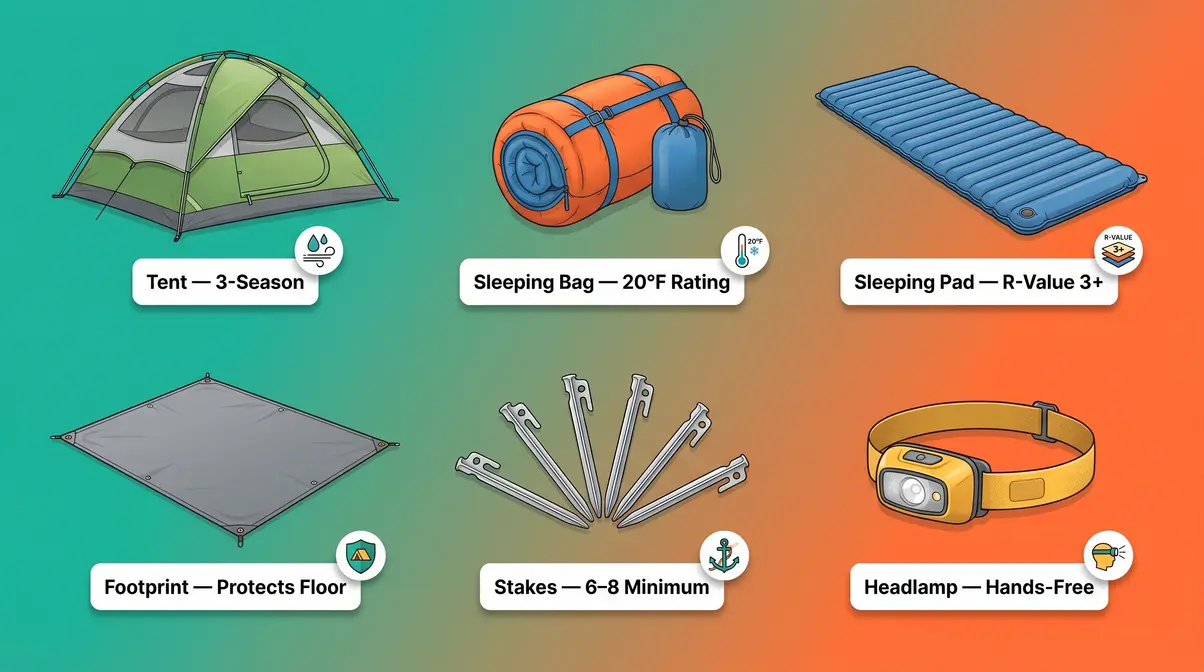
Tent: Choose a 3-season tent for most beginner trips. A 2-person tent works for solo campers too — the extra room gives you space to store gear out of the rain.
Footprint (a ground cloth that protects your tent floor): Many beginners skip this. Don’t. A footprint extends tent life and adds a thin layer of insulation under your floor.
Sleeping bag: Match the temperature rating to your trip’s expected overnight low, then subtract 10°F as a buffer. A bag rated to 20°F handles most spring-through-fall camping in North America.
Sleeping pad (the insulating layer between you and the ground): This is the most underestimated item on any beginner camping checklist. Cold ground pulls heat from your body far faster than cold air — a sleeping pad prevents that.
Stakes and guylines: Most tents include them, but check before you leave. Wind is unpredictable at elevation.
| Item | Why It Matters | Beginner Tip |
|---|---|---|
| 3-Season Tent | Handles rain, wind, and mild cold | Practice setup once at home |
| Footprint | Protects tent floor from punctures | Cut to tent shape, not larger |
| Sleeping Bag (20°F) | Core warmth overnight | Store uncompressed between trips |
| Sleeping Pad (R-value 3+) | Ground insulation | Foam pads are cheaper; inflatable pads pack smaller |
| Stakes (6–8) | Secures tent in wind | Carry 2–3 extras |
| Headlamp | Hands-free lighting for setup and cooking | Bring spare batteries |
If you are still looking for the perfect shelter, check out our comprehensive camping checklist for first-time campers for detailed tent recommendations.
Camp Kitchen and Food Supplies
Eating well at camp isn’t complicated, but the wrong gear makes it miserable. A camp stove with a dead fuel canister, no pot to boil water in, or food that requires refrigeration are the three most common kitchen failures among first-time campers.
Here’s what to pack:
- Cooking gear:
- Camp stove (canister or propane) + fuel — verify fuel type matches stove before leaving
- Lightweight pot or camp cookset
- Eating utensils (fork, spoon, knife), camp mug, and bowl
- A long-handled spoon or spatula for cooking over heat
- Biodegradable camp soap and a small sponge
- Food and storage:
- Meal plan for every meal + one emergency extra (a pack of instant oatmeal, a cliff bar)
- Bear canister or hang bag for food storage — required at many NPS campsites
- Cooler with ice (if car camping) — keep raw proteins double-bagged
- Reusable water bottles (at least two per person) + a water filter or purification tablets
Why a headlamp beats a flashlight for cooking: Your hands are busy — stirring, pouring, opening packages. A headlamp worn on your forehead keeps both hands free and lights exactly where you’re looking. Pack this in your kitchen kit, not buried in your bag.
According to NPS camping guidance, proper food storage is mandatory at many federal campsites — not just recommended. A bear canister or approved hang system isn’t optional gear; it’s a legal requirement in many wilderness areas.
Clothing and Personal Care
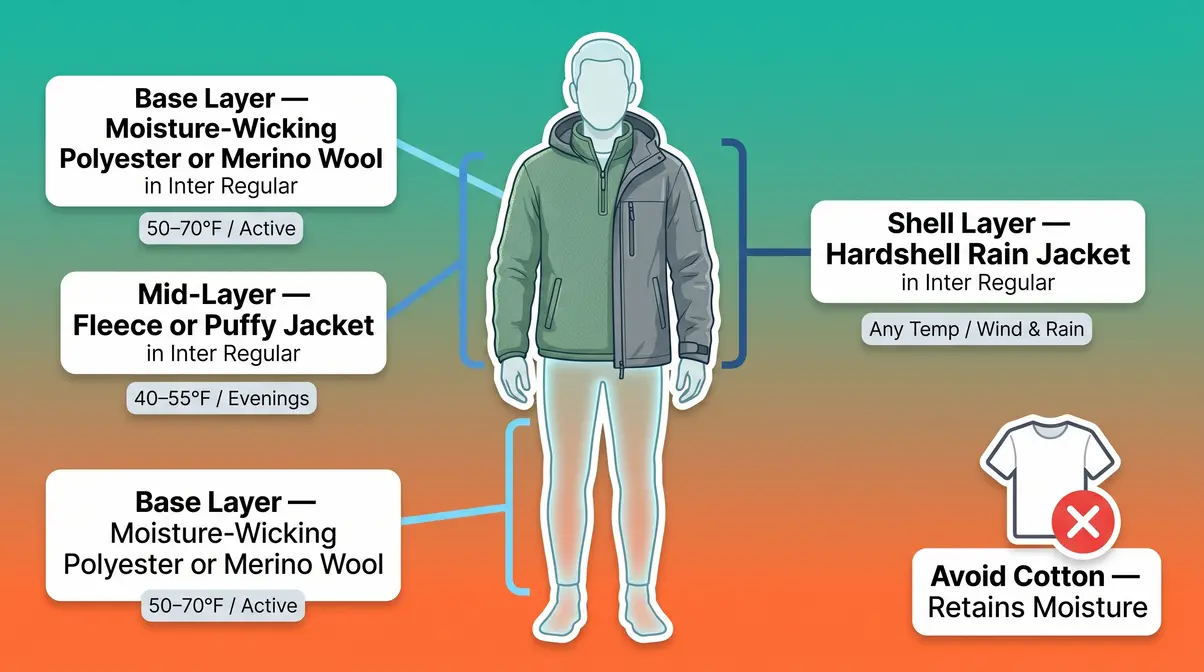
Layering is the single skill that separates comfortable campers from cold, wet ones. Temperatures can swing 30°F or more between midday and midnight — especially at elevation. Pack for the low, not the average.
- Clothing checklist:
- Base layers (moisture-wicking underlayers): polyester or merino wool, not cotton. Cotton holds moisture and chills you.
- Mid-layer (fleece or puffy jacket) for evenings and mornings
- Rain jacket or hardshell — non-negotiable even if the forecast looks clear
- Quick-dry pants or hiking pants (one pair minimum)
- 2–3 pairs of wool or synthetic socks (cotton socks are the #1 blister cause)
- Sturdy hiking boots or trail shoes — broken in before the trip
- Camp sandals or crocs for around the site
- Warm hat and gloves (even in summer — nights get cold)
- Sun hat and UV-rated sunglasses for daytime
- Personal care:
- Biodegradable soap and shampoo
- Toothbrush, toothpaste, floss
- Toilet paper + a small trowel (for burying waste if no facilities)
- Hand sanitizer
- Sunscreen (SPF 30+ minimum) and insect repellent (DEET or picaridin)
- Prescription medications in original containers + a 2-day extra supply
Safety, Navigation, and First Aid
Safety gear is the category most beginners under-pack because they assume they won’t need it. That assumption is exactly why the NPS treats first aid preparedness as a baseline requirement, not an optional extra.
Pack this without compromise:
- First aid kit — pre-assembled kits from REI or Adventure Medical cover the essentials; supplement with any personal medications
- Headlamp (listed again intentionally — it’s also a safety item)
- Whistle (three blasts = universal distress signal)
- Emergency blanket (Mylar space blanket, weighs 2 oz, can prevent hypothermia)
- Multi-tool or pocket knife
- Fire starter: waterproof matches + a backup lighter + a ferro rod if you’re learning fire craft
- Map of the campground and surrounding area (downloaded offline — cell service is unreliable)
- Compass (and the basic knowledge to use it)
- Extra rope or paracord (50 ft minimum)
For more detailed guidance, review our essential camping safety tips before you pack.
Field testing by the American Red Cross confirms that the most common wilderness first aid scenarios — blisters, insect stings, minor cuts, and dehydration — are all preventable or manageable with a well-stocked first aid kit and basic preparation. Across camping communities, the consistent advice is to take a one-day wilderness first aid course before your first multi-night trip.
The Campsite-Ready Framework: Pack, Test, Drive
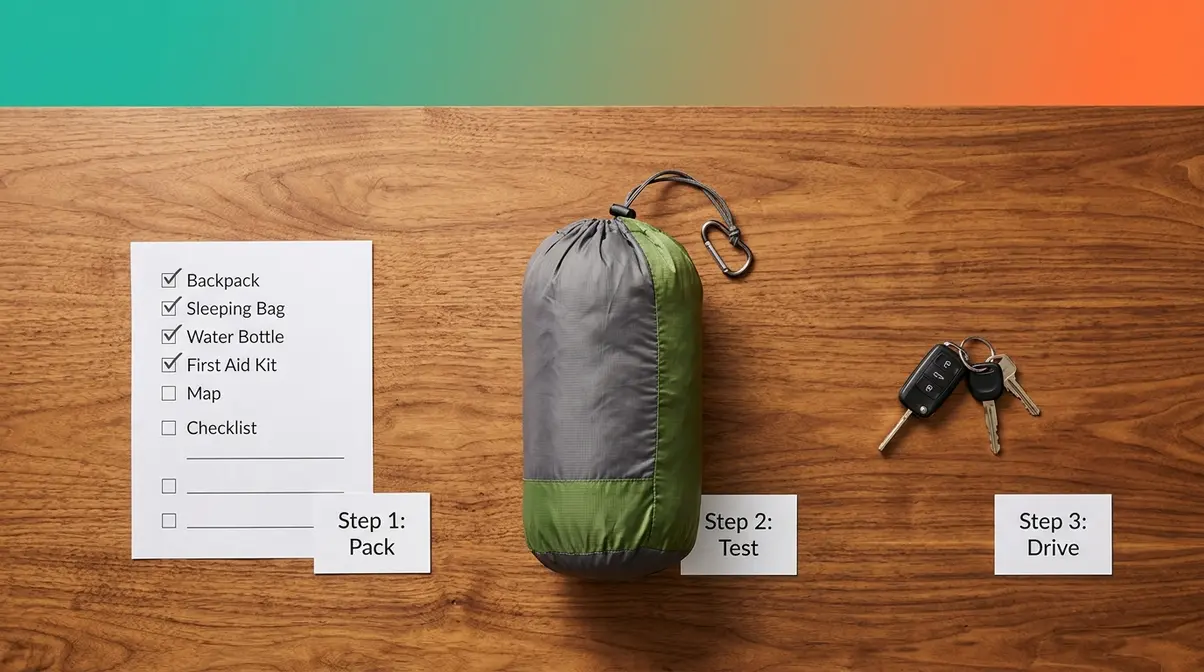
The Campsite-Ready Framework is the system that separates a confident first-timer from a stressed one. Most beginner camping guides stop at the list. This framework turns that list into a three-step process you can repeat on every future trip.
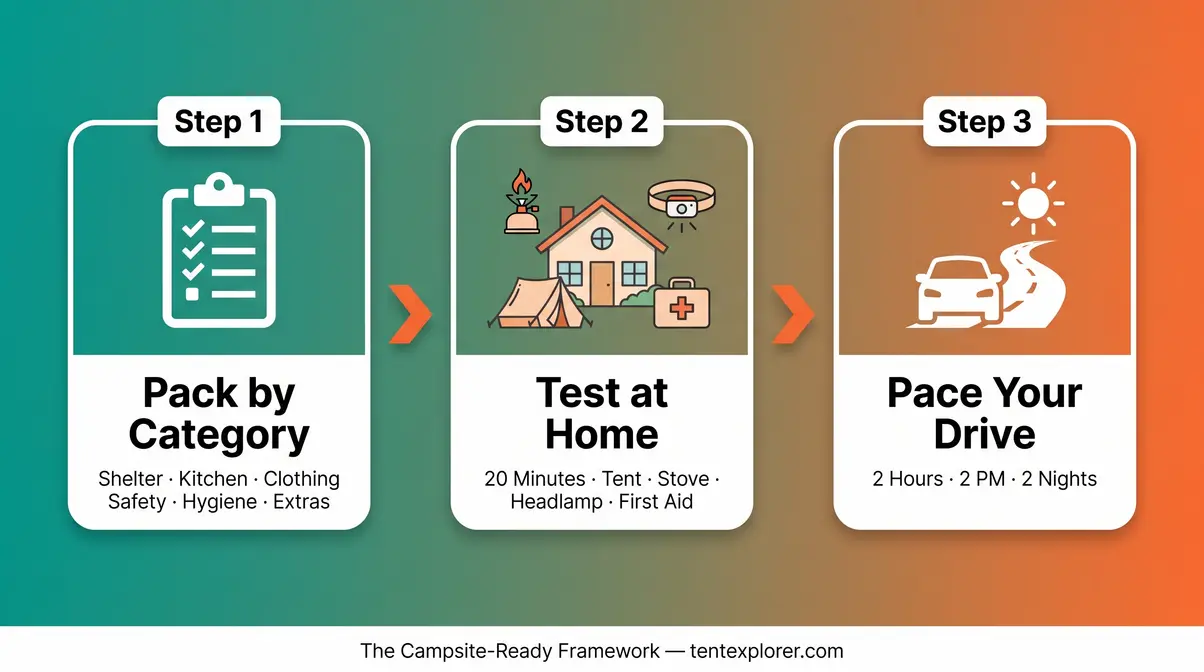
Step 1: Pack by Category
Don’t pack by memory — pack by category. Gear organized into categories is far harder to forget than a random mental list. Use the six categories from this guide as your packing sequence:
- Shelter & Sleep — tent, footprint, stakes, sleeping bag, sleeping pad
- Camp Kitchen — stove, fuel, cookware, food, water filtration
- Clothing — base layers, mid-layer, shell, socks, footwear
- Safety & Navigation — first aid kit, headlamp, fire starter, map, multi-tool
- Hygiene & Personal Care — soap, toiletries, sunscreen, insect repellent
- Camp Comfort & Extras — camp chairs, lantern, tarp, books, games
Pack each category into its own stuff sack or labeled dry bag. When you open the car at the campsite, every category has a home — nothing gets buried under a sleeping bag and forgotten.
Step 2: Test at Home
This step takes 20 minutes and prevents 80% of campsite surprises. After packing, do a quick gear run-through in your backyard or living room:
- Set up your tent — does it go up smoothly? Are all poles and stakes present?
- Light your camp stove — does the igniter work? Is there enough fuel?
- Test your headlamp — fresh batteries? Does the red-light mode work?
- Check your sleeping bag and pad — any visible damage, broken zippers, or slow leaks?
- Verify your first aid kit is stocked and medications haven’t expired.
Tools you need: 20 minutes, your full gear pile, and your printed checklist.
| Test | What to Check | Fix Before You Leave |
|---|---|---|
| Tent setup | All poles, stakes, zippers | Replace any broken components |
| Stove ignition | Fuel level, igniter function | Carry a backup lighter always |
| Headlamp | Battery level, brightness | Install fresh batteries |
| Sleeping pad | Inflation, valve seal | Patch kits are cheap — carry one |
| First aid kit | Stock completeness, expiry dates | Replace expired or missing items |
Step 3: Pace Your Drive (The 2-2-2 Rule)
The 2-2-2 rule is one of the most practical camping guidelines you’ve never heard of — and it’s completely absent from most competitor guides. It works like this:
- Drive no more than 2 hours to your first campsite
- Arrive by 2 p.m. so you have daylight to set up
- Stay at least 2 nights so you’re not spending 70% of your trip in the car
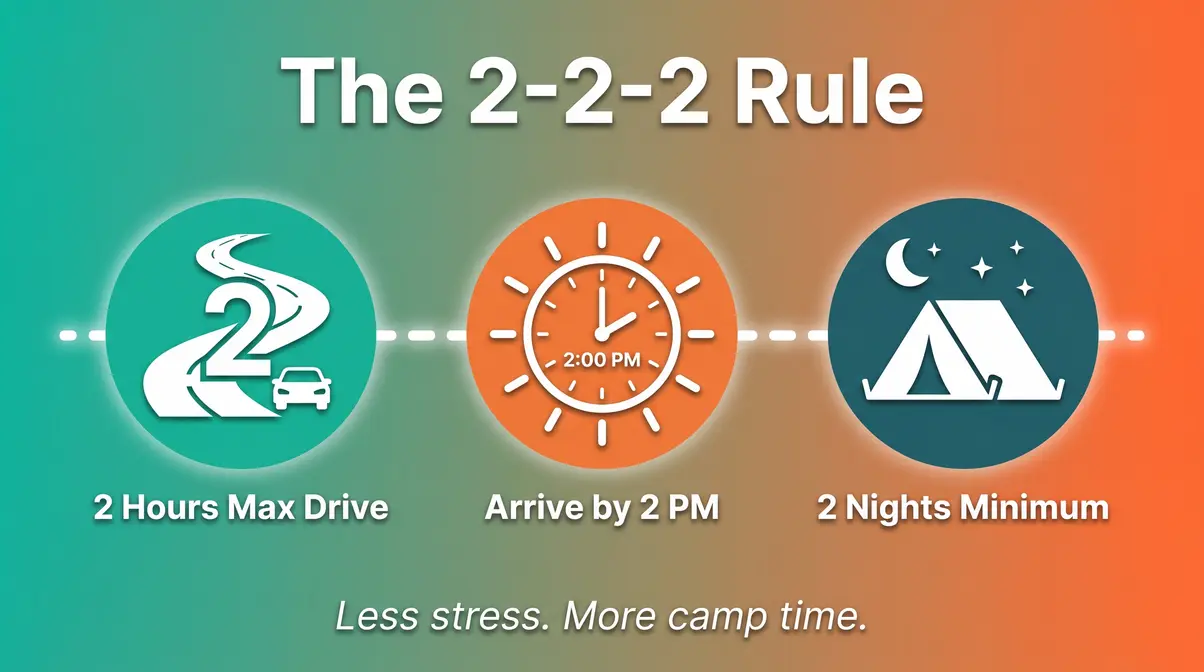
The 2-2-2 rule protects beginners from two specific failure modes. First, a long drive on day one burns energy you need for setup. Second, arriving after dark means setting up your tent by headlamp — a stressful experience that turns a fun trip into a frustrating one. Two nights gives you time to actually enjoy the experience, not just survive it.
For your first trip, choose a campground within 90–120 minutes of home. According to KOA’s camping research, proximity to home is the #1 factor first-time campers cite for reducing trip anxiety — and it keeps you close to a hardware store if you genuinely forgot something.
Tent, Car, and RV Camping Checklists
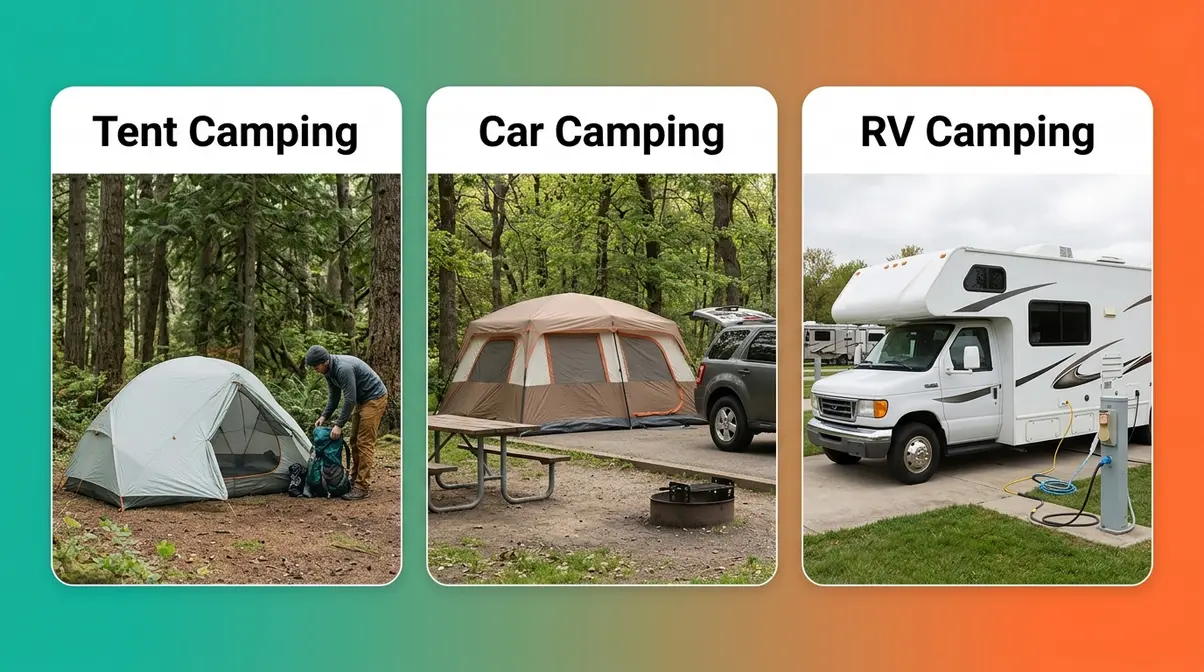
While the core essentials apply to everyone, your specific camping style dictates the nuances of your gear. A backpacker’s tent looks very different from a family’s RV setup. Here is how to adapt the master checklist for the three most common beginner camping styles.
Tent Camping Checklist
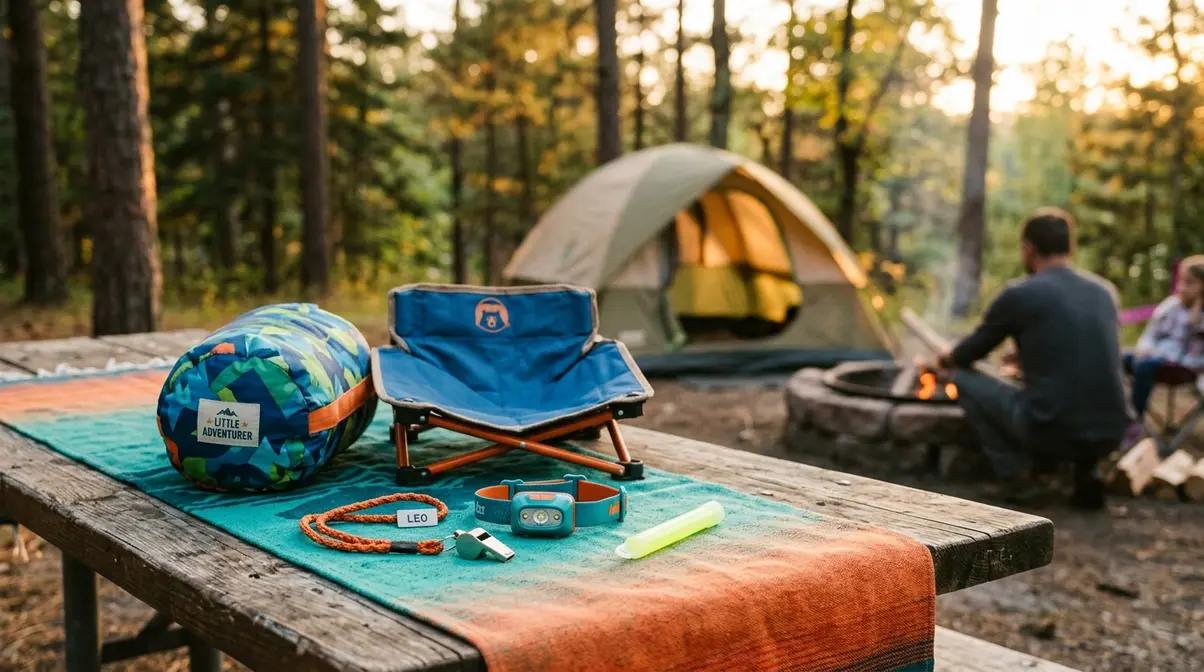
- Tent camping is the classic outdoor experience. When you are relying entirely on what you can carry from the car to the campsite, weight and weather resistance become your top priorities.
- Shelter: Focus on a high-quality 3-season tent with a full-coverage rainfly.
- Sleep System: Prioritize a sleeping pad with an R-value of at least 3.0 to block the cold ground.
- Kitchen: A compact two-burner propane stove is ideal. You don’t have the luxury of an RV kitchen, so prep your meals at home (chop vegetables, marinate proteins) to minimize campsite cleanup.
- Storage: Use clear, waterproof plastic bins to organize your gear. This keeps moisture out and makes finding your headlamp much easier in the dark.
Car Camping Checklist
- Car camping means you can drive right up to your campsite. Because you aren’t carrying gear on your back, you can prioritize comfort over weight.
- Shelter: You can afford to bring a larger, heavier cabin-style tent that allows you to stand up inside. If you need recommendations, finding the best tent for car camping often comes down to prioritizing peak height and floor space.
- Sleep System: Upgrade to a thick air mattress or a memory foam camping pad. Bring your standard pillows from home.
- Kitchen: Bring a full-sized cooler (like a Yeti or RTIC) packed with block ice, which lasts longer than cubed ice. You can pack a cast-iron skillet for over-the-fire cooking.
- Comfort: Pack full-sized camp chairs, a hammock, and a portable battery station to charge devices.
Beginner RV Camping Checklist
- Renting or buying an RV changes the camping experience entirely, replacing the tent with a rolling cabin. However, it introduces mechanical systems you must pack for.
- Hookup Gear: You must pack a fresh water hose (never use a standard garden hose), a water pressure regulator, and a sewer hose with proper fittings.
- Leveling: Bring leveling blocks and wheel chocks. A refrigerator in an RV will not function properly if the vehicle isn’t level.
- Kitchen & Sleep: You can use standard bedding and cookware, but ensure all cabinets are secured with tension rods before driving.
- Safety: RV-specific toilet paper (rapid dissolving) is non-negotiable to prevent black tank clogs.
Camping Style Comparison: What Gear Changes?
| Gear Category | Tent Camping | Car Camping | RV Camping |
|---|---|---|---|
| Shelter | Lightweight 3-season tent | Large cabin-style tent | The RV itself |
| Sleep | Compact sleeping pad | Thick air mattress | Standard sheets/blankets |
| Kitchen | Compact 2-burner stove | Full cooler & cast iron | Built-in appliances |
| Power | Power bank for phone | Portable power station | Shore power / Generator |
Family Camping Checklist: Packing for Kids
Camping with children requires a shift in perspective. You aren’t just packing for survival and comfort; you are packing for entertainment, safety, and rapid temperature changes. Kids lose body heat faster than adults and are more susceptible to the elements.
Kid-Specific Gear and Comfort Items
- Children need their own dedicated gear to feel comfortable and involved in the trip.
- Sleep: Pack a familiar blanket or stuffed animal from home to ease anxiety in a dark tent. Ensure their sleeping bag is rated appropriately; adult bags leave too much empty space for a child’s body to heat effectively.
- Clothing: Pack three times as many socks as you think they need. Puddles are magnetic to toddlers. Bring dedicated sleep clothes that stay dry in the tent.
- Comfort: Buy them their own kid-sized camp chair and a personal headlamp. Giving them their own light source reduces nighttime fear and gives them a sense of responsibility.
Campsite Safety Tips When Children Are Present
- The wilderness is an incredible playground, but it lacks the guardrails of a suburban backyard.
- Boundaries: As soon as you arrive, walk the perimeter of the campsite with your kids. Establish clear physical boundaries (“Do not go past that large oak tree”).
- Visibility: Give each child a whistle to wear around their neck and teach them to blow it three times if they get lost. At night, attach a glow stick to their jacket zipper so you can spot them instantly in the dark.
- Fire Safety: Establish a “three-foot rule” around the fire ring. No running or playing within that circle, even when the fire is unlit.
Kid-Friendly Meals and Activities
- Hungry, bored kids make for a miserable camping trip. Keep meals simple and activities structured.
- Food: Skip complex camp meals. Stick to guaranteed hits: hot dogs on sticks, foil-packet nachos, and pre-made pasta salad. Always have instant snacks (granola bars, fruit snacks) accessible without opening the main cooler.
- Activities: Bring a magnifying glass, a bug-catcher kit, and a printed scavenger hunt list. Let them be in charge of collecting kindling (small twigs) for the fire.
- Downtime: Pack a deck of cards, a travel board game, or coloring books for when it rains or during the midday lull.
Your Free Printable Family Camping Checklist
To make packing for the whole crew easier, we’ve integrated kid-specific items into our master list. When you download the PDF below, you’ll find a dedicated section for family gear to ensure no favorite toy or extra pair of socks gets left behind.
Camping Rules, Etiquette, and What FF Means
Knowing the rules before you arrive is as important as knowing what to pack. Campsite violations — from noise complaints to improper food storage — can result in fines, forced early checkout, or permanent damage to wilderness areas. The good news: the core rules are simple and follow a common-sense logic.
Leave No Trace Principles
The Leave No Trace Center for Outdoor Ethics outlines seven principles that govern responsible camping. For beginners, the four most immediately actionable are:
- Pack it in, pack it out — every piece of trash, food scrap, and packaging leaves with you
- Dispose of waste properly — use designated facilities; if none exist, bury human waste in a 6-inch cathole at least 200 feet from water
- Leave what you find — no picking wildflowers, moving rocks, or carving trees
- Respect wildlife — observe from a distance; never feed animals, even small ones
These principles aren’t optional etiquette. Many NPS and Forest Service campsites enforce them, and violations can result in citations.
Campsite Quiet Hours and Site Rules
Most campgrounds enforce quiet hours from 10 p.m. to 6 a.m. Generators are typically prohibited during those windows. Check the specific rules for your campground when booking — some sites have earlier cutoffs, especially in family sections.
- Additional standard rules at most campgrounds:
- Campfires only in designated fire rings — never on bare ground
- Keep pets leashed at all times
- Park only in designated spots — don’t park on grass or neighboring sites
- Check fire ban status before your trip (especially in summer in the western US)
What Does FF Mean at a Campground?
FF at a campground stands for “Full Facility” — meaning the site includes electrical hookups, a water connection, and sewer access. You’ll see this designation on reservation sites like Recreation.gov and ReserveAmerica. FF sites are designed for RVs and camper vans with hookup needs. As a tent camper, you generally want a “Standard” or “Tent Only” site, which costs less and is often positioned in more scenic, wooded areas of the campground.
- Other common campsite designations you’ll encounter:
- E or W/E — Electric only, or Water and Electric (no sewer)
- WES or Full Hookup — Water, Electric, and Sewer (same as FF at many parks)
- Primitive — No facilities; pack out all waste, no running water
What is the 3-3-3 rule for camping?
The 3-3-3 rule is a structured camping guideline: drive no more than 3 hours to your destination, arrive by 3 p.m., and stay for at least 3 nights. It’s similar in structure to the 2-2-2 rule but designed for slightly more experienced campers who can handle longer drives and extended stays. For first-time campers, the 2-2-2 rule is the better starting framework — shorter drive, earlier arrival, and enough time to enjoy two full days without overcommitting. Both rules share the same core logic: protect your energy and daylight on arrival day.
What are the 7 C’s of camping?
The 7 C’s of camping are a memory framework covering the core competency areas every camper should understand: Campsite selection, Cooking, Clothing, Comfort, Communication, Cleanliness, and Care (for both the environment and yourself). Different outdoor educators use slightly varied versions, but the core categories remain consistent. For beginners, the most actionable C’s are Campsite selection (pick a developed site for your first trip), Clothing (layer in synthetics, never cotton), and Cleanliness (Leave No Trace waste disposal). Across camping communities, this framework is used as a pre-trip mental checklist rather than a gear list.
Download Your Free Beginner Camping Checklist PDF
You’ve read the categories. Now make it printable.
Download the Free Beginner Camping Checklist 2026 PDF Here
The PDF includes all six gear categories, a pre-trip test checklist, the 2-2-2 rule reminder card, and blank lines to add your personal items. Print it, fold it in your pack, and check items off as you go.
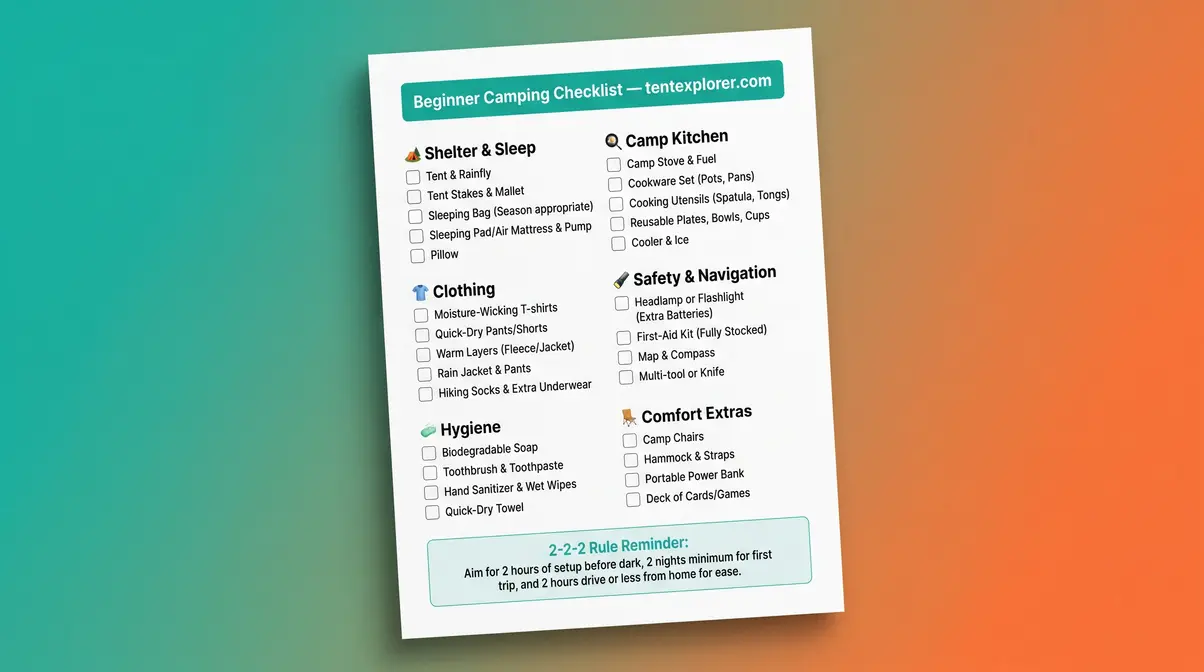
Who this PDF is for: Anyone planning their first overnight trip who wants a tangible, printable list they can check off item by item. The PDF mirrors the structure of this guide — Pack by Category, Test at Home, and Pace Your Drive — so you’re never working from two different systems.
According to REI’s camping preparation guidance, breaking your packing into gear categories — rather than trying to remember everything at once — reduces the likelihood of forgetting essential items by making each category a discrete mental checkpoint. That’s the same logic behind the PDF’s structure.
The REI Camping Checklist: A Quick Comparison
As you research gear, you will inevitably encounter the official REI camping checklist. It is widely considered the gold standard in the outdoor industry, but how does it compare to our Campsite-Ready Framework?
REI’s checklist is incredibly comprehensive, covering everything from sun hats to specialized tent repair kits. It is an excellent resource for intermediate campers who want to ensure they haven’t missed a single luxury item. However, for a true beginner, the sheer volume of items on the REI list can induce “packing paralysis.” It lists over 80 individual items without distinguishing between absolute necessities and optional upgrades.
Our Campsite-Ready Framework takes a different approach. Instead of just giving you a massive inventory list, we prioritize the process. We focus on the core essentials that prevent a trip from becoming a disaster, and we pair that list with the 2-2-2 rule and the mandatory home gear test. If you are a beginner, start with our framework to build your confidence. Once you have a few trips under your belt, graduating to the REI checklist will help you refine your camp comfort.
Common Beginner Camping Mistakes
First-time campers make the same mistakes in a predictable order. This section isn’t meant to discourage you — it’s a calibration tool. Knowing what goes wrong most often is the fastest way to make sure it doesn’t go wrong for you.
Common Pitfalls
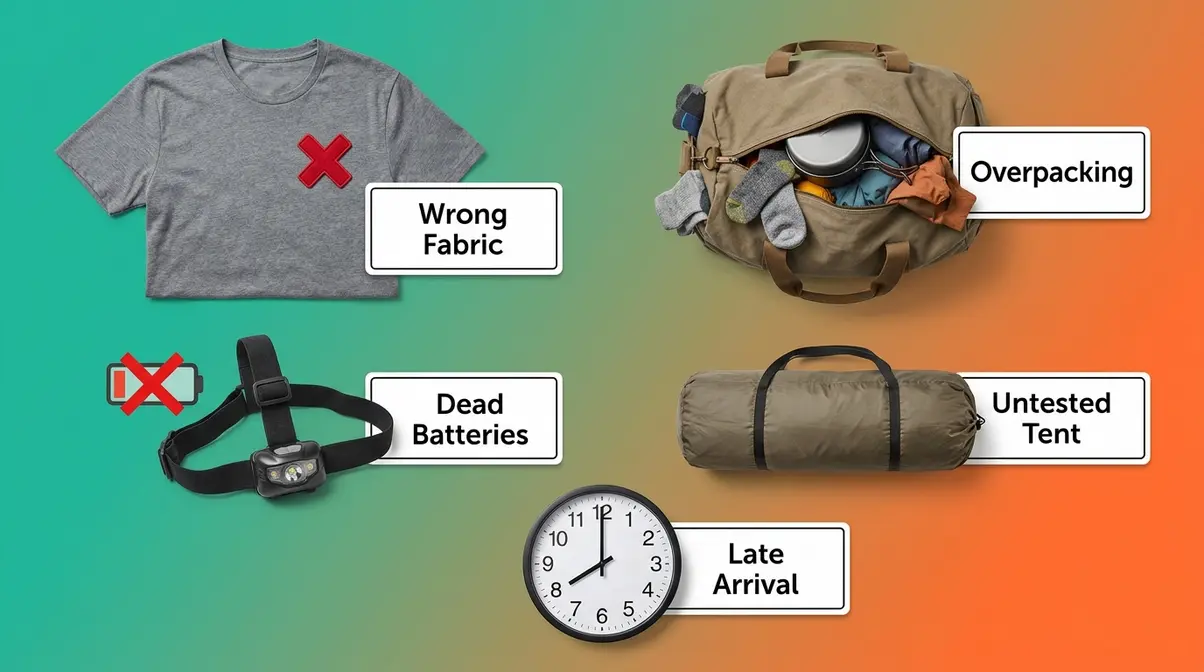
Pitfall 1: Overpacking for “what ifs.” First-timers often pack for every conceivable scenario — four pairs of shoes, a full-size pillow, a cast iron skillet. The result is a car so packed that setup becomes a 90-minute excavation. Fix: Use the category checklist and limit yourself to one item per listed slot unless a specific activity requires more.
Pitfall 2: Skipping the home gear test. Tents with bent poles, stoves that won’t ignite, and headlamps with dead batteries are all discovered at the campsite — usually after dark. Fix: Run the Step 2 Test at Home protocol from the Campsite-Ready Framework the evening before you leave.
Pitfall 3: Choosing cotton clothing. Cotton is comfortable at home and miserable at camp. It absorbs moisture and takes hours to dry, which means sweat, rain, or a stream crossing leaves you cold for the rest of the day. Fix: Swap any cotton base layers or socks for polyester or merino wool equivalents before your trip.
Pitfall 4: Arriving after dark. Setting up a tent for the first time by headlamp, in unfamiliar terrain, after a long drive is genuinely stressful. Fix: Apply the 2-2-2 rule. Arrive by 2 p.m. on day one.
Pitfall 5: Underestimating water needs. A common assumption is that a single 32 oz bottle per person is enough. The CDC’s outdoor hydration guidance recommends a minimum of 0.5 liters per hour of moderate activity in moderate temperatures — significantly more in heat or at elevation. Pack at least two liters per person for a day hike, plus a water filter for campsite water.
When to Choose Alternatives
The gear list in this guide is optimized for car camping at a developed campground — the right starting point for most beginners. If your situation differs, adjust accordingly:
- Backpacking: Every item needs a weight review. Swap the 3-season tent for an ultralight option, and rethink your sleeping system entirely. A backpacking-specific guide is a better starting resource.
- Winter camping: Below-freezing trips require a 4-season tent, a sleeping bag rated to at least -20°F, and significantly more clothing. Don’t attempt winter camping as your first trip.
- Group camping (6+ people): Food storage, cooking capacity, and site size requirements scale up quickly. Designate a gear coordinator and use the category system to avoid duplication and gaps.
When to Seek Expert Help
If you’re planning a trip into a wilderness area with no cell service, no designated campsites, and trails that require navigation by map and compass, consider taking a NOLS or Wilderness First Responder course before you go. These are not beginner scenarios. Start at a developed campground — one with a camp host, marked sites, and bathroom facilities — until you’ve completed at least three overnight trips.
Frequently Asked Questions
What is the 2-2-2 rule for camping?
The 2-2-2 rule means: drive no more than 2 hours, arrive by 2 p.m., and stay at least 2 nights. It’s specifically designed for beginner and family campers to reduce first-trip stress. Arriving by 2 p.m. gives you 3–4 hours of daylight for setup before evening temperatures drop. Limiting your drive to 2 hours keeps you close to home if you forget critical gear. Staying 2 nights means your travel-to-camping ratio makes the trip worthwhile.
What do I need for camping as a beginner?
Every beginner camping checklist needs six core categories: shelter and sleep (tent, sleeping bag, sleeping pad), camp kitchen (stove, cookware, food, water filter), clothing (base layers, rain jacket, wool socks), safety and navigation (first aid kit, headlamp, fire starter, map), hygiene and personal care (biodegradable soap, sunscreen, insect repellent), and camp comfort extras (chairs, lantern, tarp). The most commonly underestimated items are the sleeping pad (critical for ground insulation), a water filtration system, and a headlamp with spare batteries. Start with this list, apply the Campsite-Ready Framework, and download the free PDF above to ensure you don’t miss any crucial items.
What is the most forgotten item when camping?
The most commonly forgotten camping item is a headlamp — or its batteries. According to camping gear surveys, toilet paper, a can opener, and a camp towel round out the top five most-forgotten items. The fix is to pack by category (not by memory) and include a dedicated “small essentials” subcategory in your checklist.
Your First Campsite Starts Here
The Campsite-Ready Framework works because it replaces anxiety with process. You’re not trying to remember everything at once — you’re moving through six gear categories, running a 20-minute home test, and applying the 2-2-2 rule to your drive. Each step is small. Together, they eliminate the fear of forgetting something critical.
Most first-time campers who have a bad experience trace it back to a single preventable gap: no headlamp batteries, a tent that was never tested, or an arrival after dark on a cold night. None of those gaps are gear failures — they’re preparation failures. The checklist above closes all of them.
Download the free PDF, print it, and check off each category before you load the car. If you’re within 90 minutes of a state or national park, your first trip is closer than you think. Pick a date, book the site, and trust the system.
Download Your Free Beginner Camping Checklist 2026 PDF (Print & Go)