

This blog post may contain affiliate links. As an Amazon Associate I earn from qualifying purchases.
You’re browsing tent specs, and the word “vestibule” keeps showing up. You’re not sure what it means — but something tells you it matters. It does. If you are wondering what is a tent vestibule, you are not alone. Once you understand this feature, you’ll never shop for shelter without checking for one.
Without a vestibule, every rainstorm turns your tent door into a problem. Open it, and wind and rain flood your sleeping space. Leave your boots outside, and they’re soaked by morning. Keep your pack inside, and your sleeping area becomes a cluttered, muddy mess. A vestibule solves all three.
By the end of this guide, you’ll know exactly what a tent vestibule is, why it matters, how to use it safely, and whether the tent you’re eyeing actually has one — covering definition, types, terminology, safety, and the most common beginner questions.
To answer the question of what is a tent vestibule: it is a covered, typically floorless porch attached to the outside of your tent’s door — your outdoor mudroom for storing wet gear and dirty boots. The Mudroom Principle frames it simply: the vestibule is the buffer between the wet outside world and your clean, dry sleeping space.
- Gear storage: Keep packs, boots, and wet layers out of your sleeping area
- Weather buffer: Blocks wind and rain when you open the tent door
- Safety note: Never cook in a closed vestibule without proper ventilation — CO risk is real
- Two main types: Integrated (built-in) and add-on (purchased separately)
What Is a Tent Vestibule? Definition and Purpose
A tent vestibule is a covered, typically floorless area attached to the outside of your tent’s entrance, created by an extension of the rainfly (your tent’s waterproof outer shell). Think of it as your tent’s mudroom — a small, sheltered transition zone between the wet, muddy outside world and your clean, dry sleeping interior. For any camper dealing with rain, mud, or gear management, it’s one of the most practical features a tent can have.
As the diagram below shows, the vestibule extends outward from the tent door, sloping down to the ground where it’s secured with stakes.
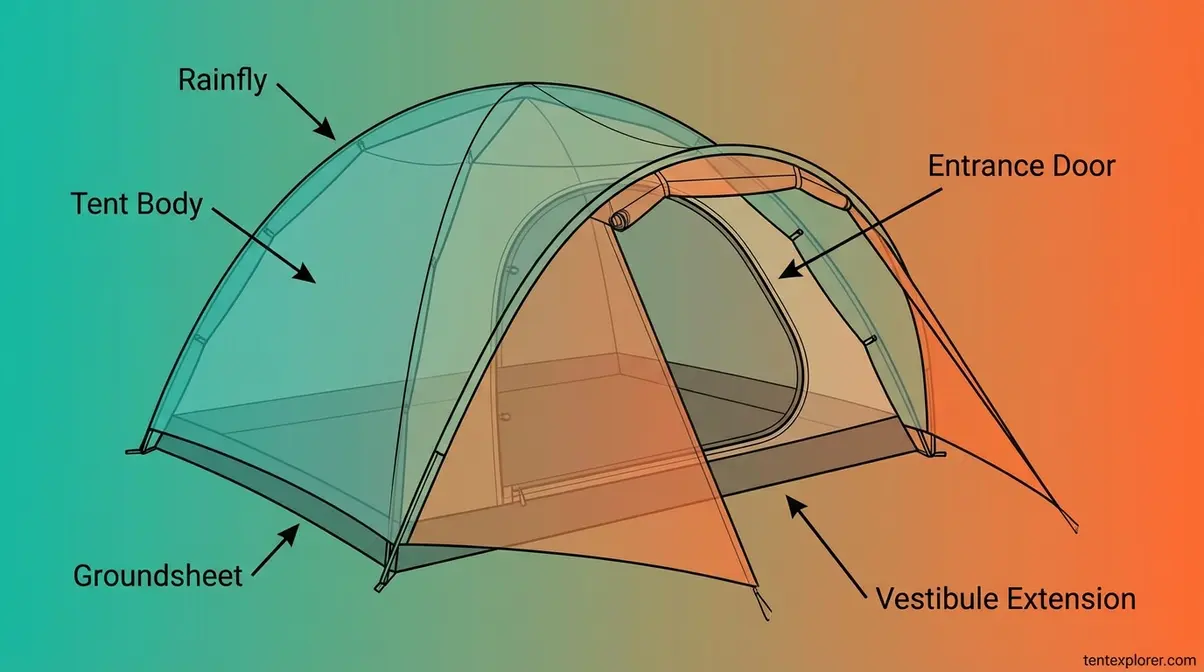
Caption: A labeled front-view diagram showing how the tent vestibule extends from the rainfly as a covered entry zone separate from the sleeping compartment.
What does a vestibule look like?
A vestibule, in the camping context, is the covered porch-like area just outside your tent door. Section Hiker, where veteran backpacker Philip Werner describes the vestibule as functioning exactly like a mudroom for your tent, puts it well: it’s the place where outside stays outside.
Physically, a vestibule is a sloped, canopy-like extension off the tent door — typically triangular or arched, made from the same waterproof material as the rainfly. That slope is intentional: it sheds rain away from the entrance rather than pooling it at your feet.
Think of it the way you think of a mudroom in a house: a small, purpose-built transition zone where you shed your wet jacket and muddy boots before stepping inside. The key detail most beginners miss is that vestibules are usually floorless — the ground is the floor. Some premium tents include a partial sewn-in vestibule floor, but that’s the exception, not the rule.
Size varies by tent design. Based on current manufacturer specs for two-person backpacking tents, vestibules typically range from about 8 to 20 square feet per side — enough for a pack, boots, and trekking poles, or tight for two people’s full gear loads.
Knowing what a vestibule looks like is one thing — understanding the four specific jobs it does for you on a real camping trip is where it gets practical.
What is the purpose of a vestibule?
When asking what is a tent vestibule in practical terms, it’s a multi-purpose buffer zone. Across camping communities, four functions come up consistently:
- Gear Storage. Your backpack, hiking boots, trekking poles — all of it stays dry under the vestibule without crowding the sleeping area. No more mud tracked inside, no more morning scramble to find soaked shoes.
- Weather Buffer. When you open the tent door in a rainstorm, the vestibule acts as a windbreak and rain shield. Without one, every door-opening event sends weather straight into your sleeping space.
- Wet Transition Space. The vestibule is where you strip off your rain jacket, waterproof pants, and soaked boots before entering — keeping the interior dry. This is the core of The Mudroom Principle: you manage the wet-to-dry transition before you cross the threshold.
- Cautious Cooking. Some campers use the vestibule as a sheltered spot during light rain. This requires strict safety precautions — a full guide follows in the safety section. Do not treat cooking under a vestibule as routine without understanding the carbon monoxide risks first.
The National Park Service campsite setup guidelines recommend identifying separate cooking and sleeping zones at your campsite — a principle the vestibule helps you apply even in a compact backpacking setup.
If you’re ready to shop, see our picks for the best tents with vestibules.
Now that you know what a vestibule does, let’s look at the different types — because not all vestibules are the same, and the right choice depends on how and where you camp.
Types of Tent Vestibules (and How They Differ)
Vestibules come in two main configurations, and knowing the difference helps you choose the right tent — or figure out whether you can upgrade the one you already own. Understanding what vestibule is in a tent, and which kind suits your camping style, prevents a common beginner mistake: buying a new tent when a simple add-on would have done the job.
The diagram below shows how front and side vestibules differ in position, size, and access.
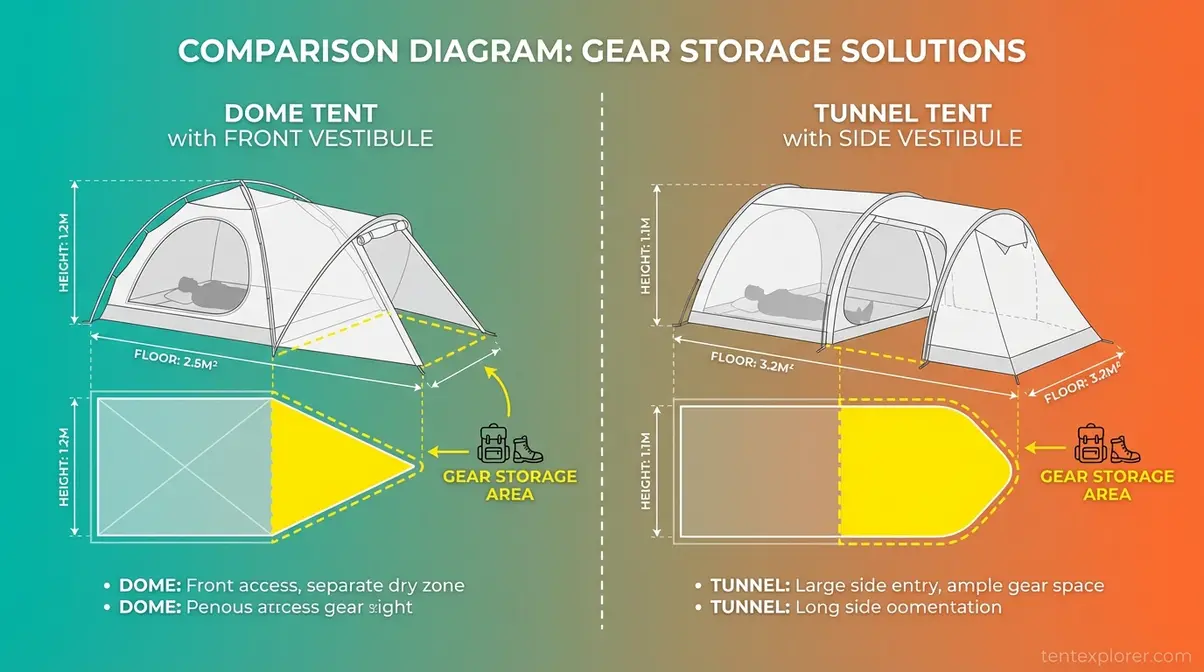
Caption: Front vestibules center over the main door on dome tents; side vestibules run along the length of tunnel tents, giving each camper a private gear zone.
Integrated vs. Add-On Vestibules
What is a vestibule in a tent when it comes to buying decisions? It depends on whether it’s built in or bolted on. Terra Nova, a UK tent manufacturer, notes that integrated vestibules come in different shapes depending on tent architecture — tunnel designs create long, sweeping side vestibules, while dome tents produce smaller, triangular front vestibules.
| Feature | Integrated | Add-On |
|---|---|---|
| Included with tent? | Yes | No (purchased separately) |
| Typical cost | Included in tent price | Varies by brand and tent model |
| Compatibility | Universal (designed for tent) | Check manufacturer specs carefully |
| Setup ease | Part of standard tent pitching | Extra attachment step required |
| Best for | New tent buyers | Upgrading an existing tent |
“The add-on vestibule isn’t that big (nor that expensive), but it makes a great transition between the wet and the comfy dry.”
Many beginners don’t realize add-on vestibules exist at all — which means they assume they must buy a new tent to gain vestibule benefits. That’s not always true. Brands like Black Diamond and Kodiak Canvas offer proprietary add-on vestibules for specific tent models, typically in the range of $150–$270 depending on size and material. Compatibility is the key variable: add-ons clip or attach to the tent door frame or pole sleeves, and they are not universally interchangeable. Always verify with your tent’s manufacturer before purchasing.
Whether integrated or add-on, The Mudroom Principle holds — the goal is always the same: create a clean buffer between outside and inside.
For more on protecting the rest of your tent’s floor system, see our guide to tent footprint and floor protection.
Where the vestibule sits on your tent — front or side — changes how you use it. Here’s what that means in practice.
Front Vestibule vs. Side Vestibule
The vestibule area in a tent varies significantly depending on its position. Front vestibules sit over the main door and are most common on dome tents. They create a single shared entry and storage zone — practical for solo campers or pairs who tend to move in and out of the tent together.
Side vestibules run along the length of the tent, typically on tunnel-style designs. They allow each camper their own private storage zone, with no need to crawl over a tent-mate’s gear. For two people sharing a tent in the rain, a two-door design with two side vestibules is a meaningful quality-of-life upgrade.
A solo backpacker on the Appalachian Trail needs only a front vestibule for their pack and poles. A couple car-camping in the rain will genuinely appreciate two side vestibules — one per person, each with their own dry gear zone.
Tunnel tents, in particular, are known for their large side vestibules — see our guide to tunnel tents for a closer look at how these designs maximize covered storage space.
Before we cover safety, let’s clear up one of the most common points of confusion in tent shopping: the difference between a vestibule, an awning, and a porch.
Vestibule, Awning, or Porch? The Differences
In tent terminology, a vestibule is an enclosed or semi-enclosed covered area at the entrance; an awning is an open canopy extension; a porch is a larger, open-sided covered space; and an annex is an enclosed room-like addition. These terms are used interchangeably by different brands — which causes real confusion at checkout.
A Side-by-Side Terminology Breakdown
The word “vestibule” comes from architecture, where it refers to an entrance hall or antechamber — what is a vestibule in a building is essentially a lobby or transition room before the main interior. What is a vestibule in a house is the same concept: a small entry zone that separates the outside from the main living space. Tent designers borrowed this term directly. UK brands tend to say “porch” for the same structure that North American brands call a “vestibule” — same feature, different regional vocabulary.
| Term | What It Is | Has a Floor? | Has Walls? | Enclosed? |
|---|---|---|---|---|
| Vestibule | Covered entry area, extension of rainfly | Usually no | Partial | Semi-enclosed |
| Awning | Open canopy extending from tent | No | No | Open |
| Porch | Larger open-sided covered space | Sometimes | Open sides | Open |
| Annex | Enclosed room-like addition (separate purchase) | Yes | Yes | Fully enclosed |
According to the CampNab camping glossary, a vestibule is specifically the covered, typically floorless area at the entrance of a tent — a definition that aligns with how most major tent manufacturers use the term regardless of regional naming conventions.
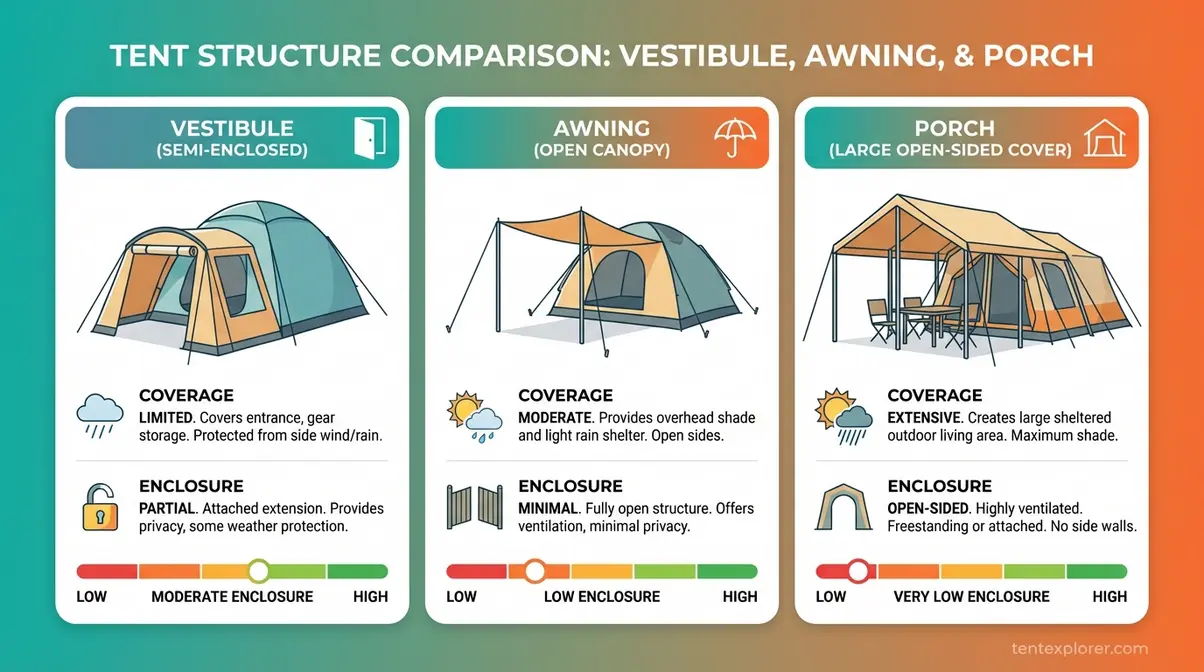
Caption: Side-by-side visual comparison of vestibule, awning, and porch tent structures — showing how enclosure level and wall coverage differ between each type.
Now for the section most camping guides skip entirely — what happens when you try to cook under that covered porch, and why it can be genuinely dangerous.
Vestibule Safety: The Carbon Monoxide Risk
Cooking under a tent vestibule is one of the most misunderstood practices in camping. Most guides either ignore it entirely or mention it without adequate context. The Mudroom Principle has one important exception: unlike a home mudroom, a tent vestibule is not built for cooking. Here’s why that distinction can save your life.
Why CO Buildup Is a Real Risk
Fuel-burning camp stoves — whether propane, butane, or white gas — produce carbon monoxide (CO) as a byproduct of combustion. In an open field, that CO disperses immediately. In an enclosed or semi-enclosed space like a vestibule with the panels closed, it has nowhere to go. There is no ventilation system, no range hood, no passive airflow designed into the structure.
CO is colorless, odorless, and can incapacitate a camper before they realize anything is wrong. A CDC report on carbon monoxide risks in tents documents CO poisoning deaths associated with using portable gas stoves inside tents and enclosed camping spaces. The Boy Scouts of America camping safety guidelines are unambiguous: fuel-burning equipment should never be used inside a tent or enclosed vestibule.
According to the CDC, using portable fuel-burning stoves inside a tent or enclosed vestibule can produce lethal carbon monoxide levels within minutes. This is not a theoretical risk — it has caused documented camping fatalities.
That said, if weather forces you to cook under cover, there are specific precautions that reduce — though never eliminate — the risk.
Safe Ventilation Practices for Cooking
If severe weather makes outdoor cooking impossible, Backpacker Magazine on camp stove CO risks reports that operating camp stoves inside a closed vestibule rapidly produces dangerous CO levels — making proper ventilation not optional but critical.
Follow this three-step protocol if you must cook under cover:
- Position at the vestibule entrance with all panels fully open. Both the vestibule door and the tent door must remain open. Never cook with any vestibule panel closed.
- Use the shortest possible cooking time. Boil water for a dehydrated meal rather than cooking from scratch. Every extra minute increases CO accumulation.
- Keep a portable CO detector in your tent kit. Compact, battery-powered CO detectors designed for travel — such as those from Kidde or Forensics Detectors — are widely available and weigh only a few ounces. Consumer Reports recommends prioritizing UL-certified models with loud alarms for camping use.
If you feel dizzy, experience a headache, or feel confused while cooking, get outside immediately — these are early symptoms of CO poisoning.
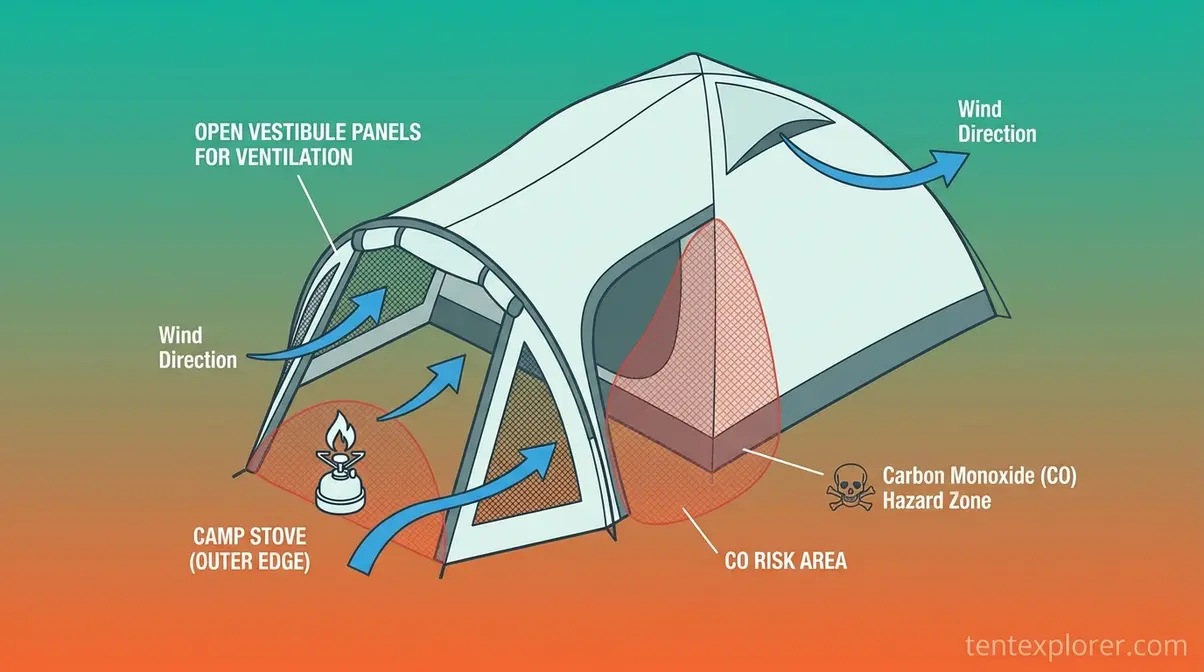
Caption: Safe cooking position at vestibule entrance — both vestibule and tent door fully open, stove positioned at the outer edge to maximize CO dispersal.
With safety covered, let’s zoom out and understand how the vestibule fits into the rest of your tent’s structure — because knowing your gear’s anatomy makes you a better camper.
Understanding Your Tent’s Anatomy
A tent is a system of three connected layers, and understanding how they work together helps you see exactly where the vestibule fits. For a complete walkthrough of pitching your tent correctly — including how to stake out your vestibule — see our step-by-step tent setup guide.
Flysheet, Groundsheet, and Tent Body
What is the outer layer of a tent called? It’s the flysheet, also known as the rainfly — the waterproof outer shell that keeps rain off your sleeping compartment. The vestibule is literally an extension of this layer, not a separate component. When shopping for tents, understanding what is a tent vestibule helps you look for one that attaches seamlessly to the flysheet — gaps or poor sealing are a common source of leaks.
The tent body is the inner structure where you sleep. It uses mesh or fabric walls for breathability but has no waterproofing on its own — it relies entirely on the flysheet above to stay dry.
The groundsheet, or tent floor, is the base of the tent that provides a moisture barrier from below. Note that the vestibule is typically floorless — the groundsheet ends at the tent door, which is why vestibule storage sits directly on the ground. For a deeper look at protecting your tent’s floor, see our guide to tent footprints and floor protection.
Even with a great vestibule, there are situations where it simply won’t be enough — and knowing those limits helps you plan smarter.
When a Vestibule Isn’t the Right Solution
Vestibules solve a lot of camping problems, but not all of them. Knowing the limits of this feature — and when a different shelter approach makes more sense — is a sign of practical camping knowledge, not pessimism.
When a Vestibule Falls Short
- Extreme winter camping. A vestibule provides coverage but not insulation. For sub-zero camping, you need a hot tent (a tent designed with a stove jack for an internal wood-burning stove). A vestibule keeps gear covered, but it won’t keep your water bottles from freezing overnight.
- Ultralight backpacking. Every ounce matters on a long-distance trail. A vestibule adds weight and setup complexity. Many ultralight backpackers prefer a bivy sack (a close-fitting, weatherproof sleeping bag cover) combined with a tarp, removing the vestibule question entirely.
- Very large gear. A standard backpacking vestibule — typically 8–20 sq ft — won’t accommodate a full kayak, large cooler, or bulky base camp equipment. A tarp extension or dedicated gear shelter is a better solution for oversized storage needs.
For some camping styles, a completely different shelter approach makes more sense.
When to Choose a Different Shelter Setup
For campers who want maximum vestibule space, tunnel tents are the gold standard — their long, arched structure creates naturally large side vestibules that outperform dome designs at equivalent price points. See our full guide to tunnel tents and their large vestibule designs for specific model comparisons.
For ultralight campers who don’t need gear storage, a bivvy tent removes the vestibule question entirely — there’s no door to manage, no transition zone to maintain. See our comparison of bivy sacks vs. traditional tents to evaluate whether this tradeoff makes sense for your pack weight goals.
The National Park Service campsite setup guidelines recommend identifying separate cooking and sleeping zones when setting up camp — a reminder that no vestibule fully replaces a well-planned campsite layout.
Let’s close with the most common questions campers ask about tent vestibules — answered directly.
Frequently Asked Questions
What is a vestibule in a tent?
A tent vestibule is a covered, typically floorless area attached to the outside of a tent’s entrance, created by an extension of the rainfly. It functions as an outdoor mudroom — a sheltered transition zone where you store gear, shed wet clothing, and keep the sleeping area clean and dry. Most vestibules are semi-enclosed, with fabric on top and sides but open to the ground below. Based on current manufacturer specs, a standard vestibule on a two-person backpacking tent provides roughly 8–20 square feet of covered storage space (Section Hiker). Whether you need one depends on your camping style — vestibules matter most in wet or cold conditions.
How much does a tent vestibule cost?
The cost of a tent vestibule depends entirely on whether it is integrated or an add-on model. Integrated vestibules are built directly into the tent’s rainfly, meaning their price is included in the overall cost of the tent. If you are purchasing an add-on vestibule to upgrade an existing tent, prices typically range from $150 to $270. This cost varies based on the brand, square footage, and the durability of the waterproof materials used. Upgrading with an add-on is often much more cost-effective than buying a completely new shelter just to gain gear storage space.
What is the entrance to a tent called?
The main entrance to a tent is simply called the tent door, but the covered area immediately outside is the vestibule. This sheltered transition zone acts exactly like a front porch or mudroom for your campsite. It protects the inner sleeping compartment from rain and wind whenever you unzip the main door. Having this covered entry makes getting in and out of the tent significantly more comfortable during bad weather.
Can you cook in a tent vestibule?
You can cook in a tent vestibule, but it requires extreme caution and is generally not recommended. Using a fuel-burning camp stove in an enclosed or semi-enclosed vestibule creates a real risk of carbon monoxide (CO) buildup — a colorless, odorless gas that can be lethal before symptoms are noticed. According to a CDC report on carbon monoxide risks in tents, CO poisoning deaths have been documented from using portable gas stoves in enclosed camping spaces. If cooking under cover is unavoidable, keep all vestibule panels fully open and minimize cooking time. Whenever weather permits, cook outside the tent entirely.
Common Types of Tent Vestibules
The most common types of tent vestibules are integrated and add-on models. Integrated vestibules are built directly into the tent’s rainfly and come standard on most 3-season backpacking and camping tents — no extra purchase needed. Add-on vestibules are separately purchased accessories that attach to an existing tent’s entrance; pricing varies significantly by brand and tent model, so check your tent manufacturer’s accessories page for compatibility and current cost. Vestibules also vary by position: front vestibules sit over the main door on dome tents, while side vestibules — common on tunnel tents — give each camper their own storage zone. For two-person tents, a two-door design with two side vestibules is a significant practical upgrade.
Conclusion
For campers who want to keep their sleeping area clean, dry, and organized, a tent vestibule is one of the most practical features a tent can have. The Mudroom Principle delivers a simple framework: the vestibule is a dedicated buffer zone between the wet, muddy outside world and your comfortable sleeping interior. Whether you’re buying a new tent or evaluating an add-on, understanding what is a tent vestibule — and how to use it safely — makes every camping trip more comfortable and better organized.
The Mudroom Principle reminds us that the best camping setups are intentional ones. A vestibule doesn’t just store your boots — it changes how you interact with your campsite, keeping your system clean and your sleeping area dry from the moment you arrive. That small structural decision pays dividends on every rainy night, every muddy trail return, and every pre-dawn boot-up in the cold.
Ready to find a tent with the right vestibule for your camping style? Start with our list of the best tents with vestibules — we’ve evaluated front and side configurations, integrated and add-on options, and matched them to specific camping use cases so you can make the right call before your next trip.