
This blog post may contain affiliate links. As an Amazon Associate I earn from qualifying purchases.
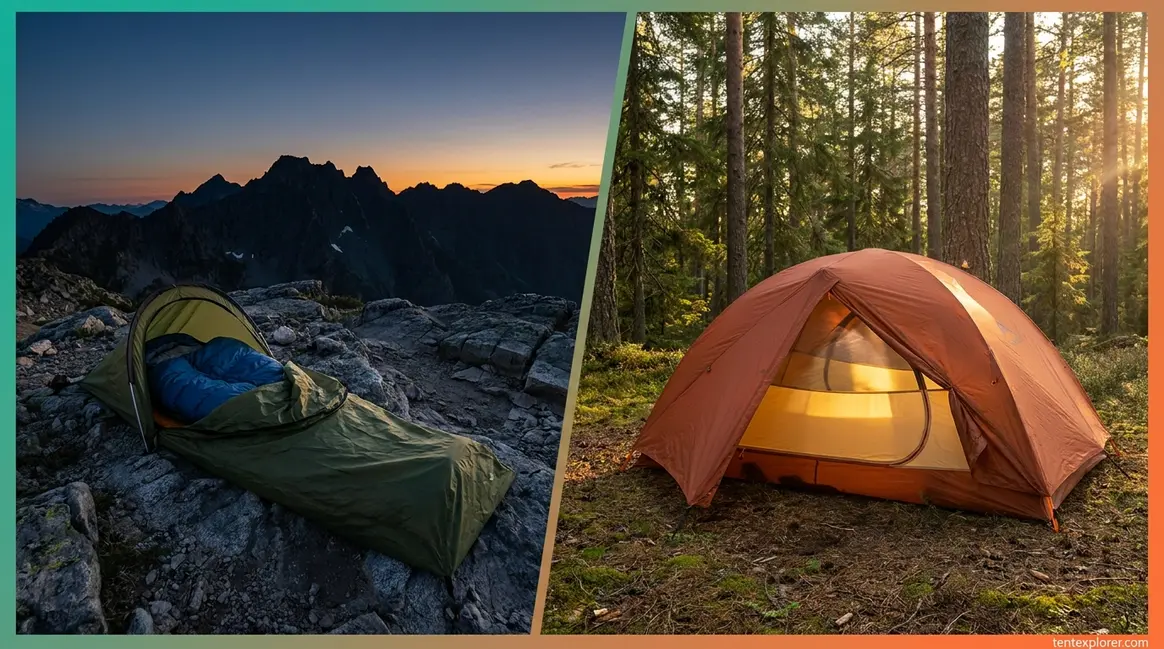
Most gear guides treat the bivy vs. tent decision like a coin flip — pick the lighter option and suffer the consequences. The real question is different: where does your specific adventure sit on the weight-to-livability spectrum? A standard bivy sack saves roughly 1–2 lbs over a comparable solo tent (Outside Online), but that single number tells you almost nothing about whether you should buy one.
Make the wrong call and you’ll feel it fast. Choose a tent for a 200-mile bikepacking route and you’re lugging around a 1.4 kg shelter when a 400g bivy would do. Choose a bivy for a five-day Cascades traverse in October and you’re lying in a damp shell at 2am, wishing you had a dry place to sit up and eat breakfast. Neither outcome is about gear quality — it’s about matching the shelter to the adventure.
This guide gives you an exact weight-and-comfort comparison table, adventure-specific go/no-go criteria for backpacking, bikepacking, and mountaineering, and a hybrid tarp+bivy framework — so you can choose the right shelter for your trip, not someone else’s. We cover four shelter systems in sequence: standard bivy sacks, hooped bivies and bivy tents, tarp+bivy combos, and solo tents.
The bivy vs. tent decision is a spectrum of weight-to-livability trade-offs, not a binary choice. The Shelter Spectrum framework positions four shelter types on a single axis — from the lightest bivy sack to the most livable solo tent — so you can find your exact position based on adventure type.
- Bivies win for fast-and-light trips: alpine climbs, bikepacking, and stealth camping where every gram and every cubic inch of pack space counts
- Tents win for comfort and weather protection: multi-day trips, rain-heavy routes, and any situation where you might spend a full day inside your shelter
- Tarp + bivy combos offer the lightest full-weather-protection system available — under 900g combined — for those willing to learn a slightly more involved setup
- The right choice depends on adventure type, not generic pros-and-cons lists that leave you more confused than when you started
Bivy vs. Tent: Head-to-Head Comparison
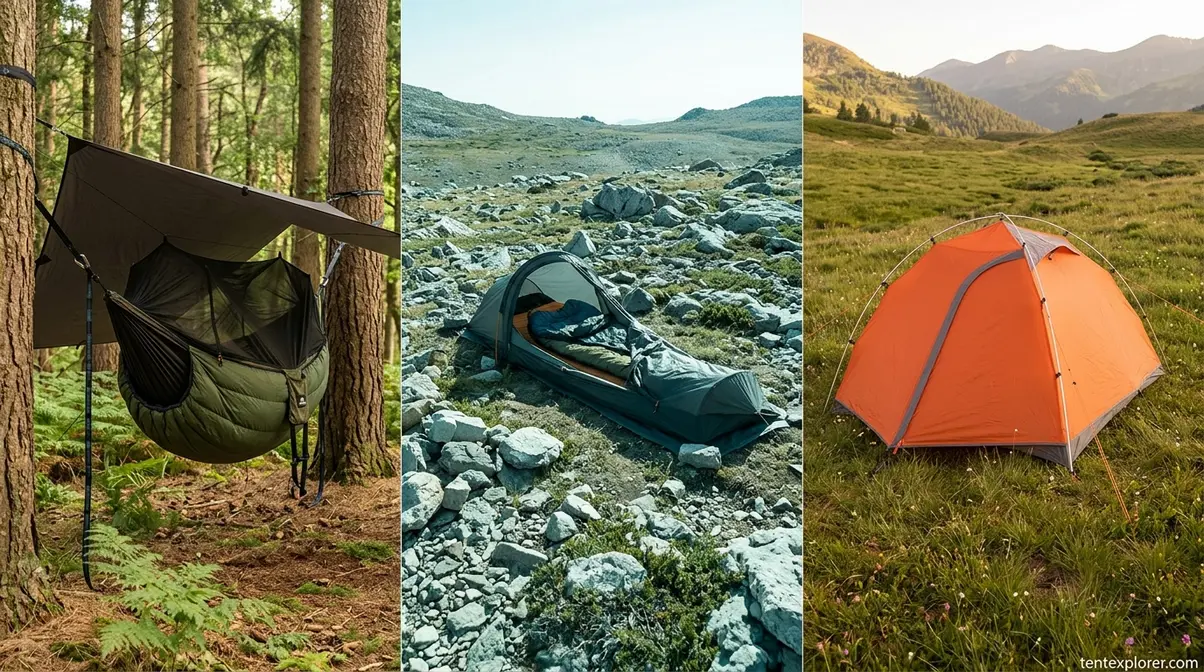
The Shelter Spectrum positions every shelter type — bivy sack, hooped bivy, tarp+bivy, and solo tent — on a single weight-vs-livability axis rather than treating them as binary opposites. A bivy sack weighs roughly 300–500g while a comparable solo tent weighs 800g–1.4kg, according to weight data from Switchback Travel’s 2026 ultralight shelter comparison chart. However, that weight gap is only part of the story — the real cost of a bivy is zero square feet of dry interior living space during a rainstorm, which no weight figure captures.
A bivy sack weighs roughly 1 lb (450g) while a comparable solo tent weighs 2–3 lbs — but the real cost isn’t weight, it’s the 0 sq ft of dry living space inside a bivy during a rainstorm. Understanding both dimensions is what separates a confident shelter decision from an expensive mistake on day three of a wet route.
For backpackers and bikepackers comparing a bivy sack vs. tent, the weight versus comfort tradeoffs of bivy sacks come down to a simple truth: a decent two-person tent only weighs about one pound more per person than a bivy bag, offering significantly more comfort (Outside Online). That finding reframes the entire debate — the bivy’s weight advantage is real but narrower than most people assume.
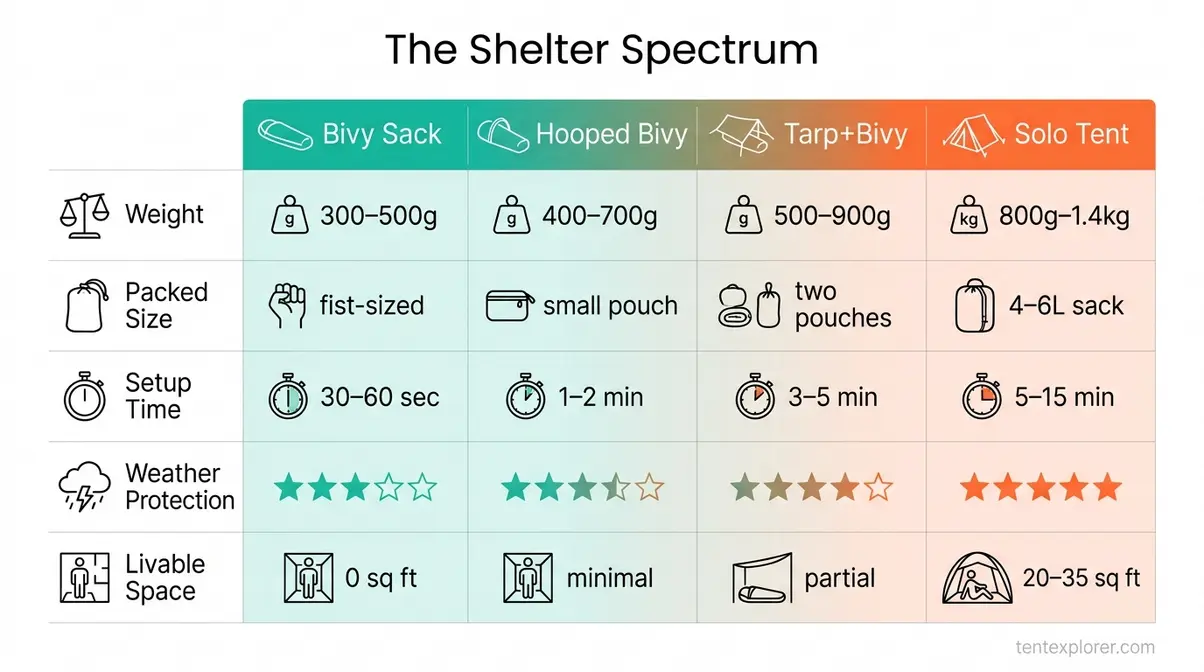
Comparison Table — Bivy Sack vs. Solo Tent:
| Feature | Bivy Sack | Solo Tent |
|---|---|---|
| Average Weight | ~300–500g (10–18 oz) | ~800g–1.4kg (28–50 oz) |
| Packed Size | Fist-sized | 4–6L stuff sack |
| Setup Time | 30–60 seconds | 5–15 minutes |
| Weather Protection | ★★★☆☆ | ★★★★★ |
| Bug Protection | ★★★★☆ | ★★★★★ |
| Condensation Risk | High (without breathable membrane) | Low–Medium |
| Livable Interior Space | 0 sq ft | 20–35 sq ft |
| Best For | Alpine, bikepacking, fast-and-light | Multi-day, wet weather, comfort |
| Price Range (entry level) | $50–$150 | $80–$250 |
Sources: Switchback Travel ultralight shelter comparison chart, 2026; Outside Online bivy vs. tent weight analysis.
If you’re already leaning toward a tent after reviewing that table, our guide to budget backpacking tent options covers tested picks across weight classes.
Weight & Packability: How Much Does the Difference Really Matter?
The bivy vs. tent weight gap is real — but context determines whether it’s decisive. Ultralight bivy sacks range from 142–454g (5–16 oz), while capable solo tents start at around 595g and commonly run 800g–1.4kg (Switchback Travel, 2026). On a 3-day, 20-miles-per-day route totaling 60 miles, that 500–900g difference works out to roughly 8–15 grams per mile of travel — a figure that sounds small but compounds across a loaded pack over consecutive long days.
Pack size is where the bivy’s advantage becomes undeniable for bikepackers. A bivy sacks down to fist-size; a solo tent requires a 4–6L stuff sack plus a separate pole bag. On a loaded bike with frame bags, saddle bags, and handlebar rolls measured in liters, that space differential is often the deciding factor before weight even enters the equation. The space-saving benefits of pole-less bivy setups make ultralight bivy configurations highly favored for minimalist bike touring because they require no awkward poles and take up significantly less pack space than traditional tents (Bikepacking.com).
The “gram-weenie threshold” — the point where weight savings actually matter — depends entirely on your pace. For trips under 10 miles per day with a base camp mentality, the 500–900g difference between a bivy and a solo tent is genuinely negligible. For bikepacking or fastpacking over 20 miles per day, it’s significant enough to affect how you feel at mile 18. Consider a bikepacker carrying a 15 lb kit versus a 17 lb kit over a 200-mile route: that 2 lb difference means lug around roughly 200 fewer grams per hour of riding — and it shows up most when you’re already tired.
Weather Protection & Condensation: The Real-World Trade-Off
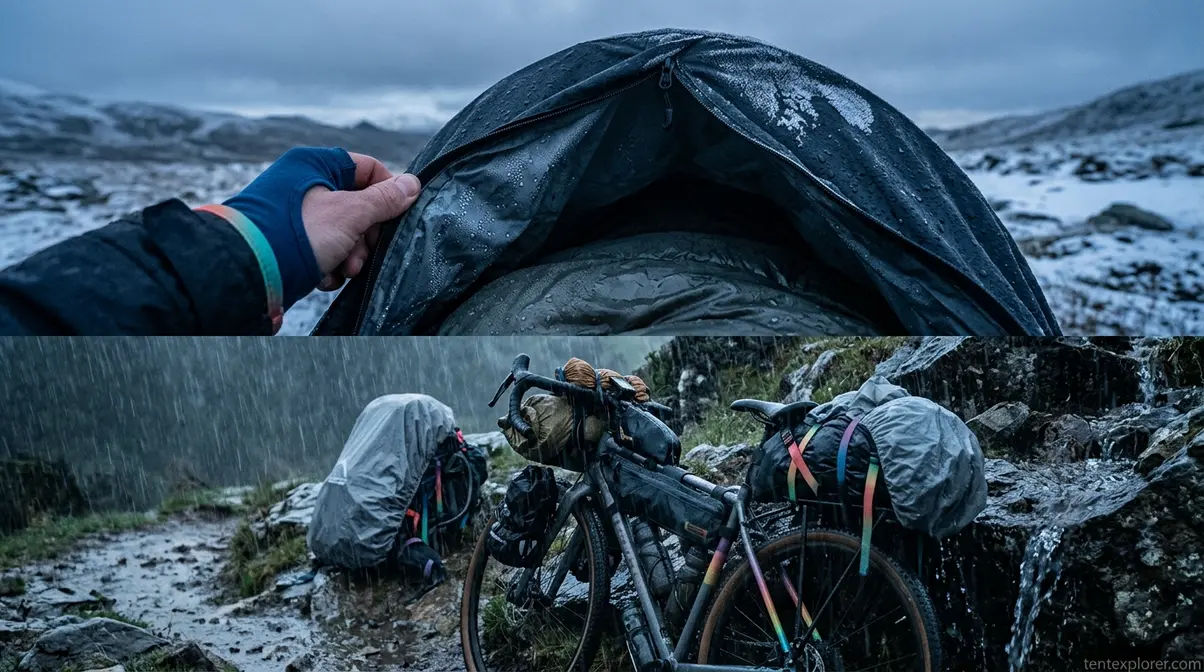
Weather protection is where the bivy sack vs. tent comparison gets genuinely complicated. The core problem is condensation: your body produces roughly 1 liter of moisture vapor per night, and a bivy sack traps that moisture between you and the shell. In a non-breathable bivy made from silnylon or basic coated nylon, that moisture has nowhere to go — you wake up damp inside a dry-on-the-outside shell.
The solution lies in fabric breathability science. The eVent membrane — a highly breathable waterproof fabric used in premium bivy sacks — uses a direct air-permeable structure that lets moisture vapor escape before it condenses, achieving MVTR ratings up to 30,000 g/m²/24hr (Nail the Trail). Gore-Tex Pro offers high durability with strong waterproofing but lower air permeability than eVent, making it better for sustained precipitation but less effective at moisture vapor transmission. Basic nylon sits at the bottom of both metrics — cheapest to buy, worst for overnight condensation management.
| Fabric | MVTR Rating | Best For | Trade-Off |
|---|---|---|---|
| eVent membrane | ~20,000–30,000 g/m²/24hr | High-output use, shoulder season | Higher cost |
| Gore-Tex Pro | ~15,000–20,000 g/m²/24hr | Sustained rain, durability | Lower breathability than eVent |
| Basic nylon | <5,000 g/m²/24hr | Budget, fair-weather use | High condensation risk |
The “dead air space” and “bellows effect” inside a non-breathable bivy create a moisture trap: body heat warms the air pocket, moisture accumulates, and by morning you’ve effectively been sleeping in a humidity chamber. To prevent condensation and cold weather injuries, users must avoid accumulating moisture from the body inside the bivy shelter — a risk documented in U.S. Army cold weather condensation guidelines from the U.S. Army Corps of Engineers.
Tents win decisively in sustained bad weather — not just because of lower condensation risk, but because of livability under pressure. A tent vestibule provides 10–20 sq ft of covered gear storage. You can cook in the porch during a storm, change clothes without contorting, and wait out 10 hours of rain without developing genuine psychological distress. Consider a hiker on the Pacific Crest Trail (PCT) in the Cascades section — an area receiving 70+ inches of annual rainfall — choosing between a bivy and a 2.5 lb ultralight tent like the Big Agnes Copper Spur HV UL1. For that specific route, in that specific season, the tent’s weather protection typically justifies the weight penalty.
Setup Speed, Comfort & Livability
Tent vs. bivy setup time is not a close contest. A bivy deploys in 30–60 seconds: unroll it, climb in. A solo tent requires staking the footprint, threading poles, attaching the rain fly, and tensioning guylines — typically 5–15 minutes in good conditions, longer in wind or darkness. Arriving at camp after a 30-mile day at 9pm with fading light, that 14-minute difference feels significant.
The interior space and comfort gap is where the two shelter types diverge most sharply. A standard bivy sack offers zero sitting headroom — you’re in a sleeping-bag-shaped shell. A hooped bivy adds 6–12 inches of clearance above your face. A solo tent offers 20–35 sq ft of livable floor space where you can sit up, organize gear, eat, and wait out weather without feeling entombed. The psychological difference is real:
“While a tent offers a roomier, roof-over-your-head sensation, a bivy is almost like sleeping under the stars — a very liberating experience.”
That dual reality — liberating for some, claustrophobic for others — is the central livability variable in the bivy vs. tent decision. Neither response is wrong; they reflect genuinely different relationships with outdoor shelter.
Gear storage is the third livability factor most people underestimate. A bivy offers zero interior storage — your pack, shoes, and electronics sit outside, exposed to whatever weather arrives overnight. A tent vestibule changes that equation entirely, providing covered space for your pack and gear without bringing it into your sleeping area. On a 2-day overnighter where you sleep 8 hours and move for the other 16, a bivy’s livability limitations barely register. On a 5-day trip with a storm day, being confined to a bivy for 10 hours is a genuinely difficult experience that affects decision-making and morale.
For riders and hikers prioritizing livability, our guide to budget backpacking tent options covers tested picks across weight classes with verified setup times.
Are Bivys Better Than Tents?
Bivies are better than tents for ultralight, fast-and-light adventures where minimizing weight and pack size is the top priority. A bivy saves 500g–1kg over a comparable solo tent (Outside Online) and packs to fist-size, but offers zero interior space and carries higher condensation risk without a breathable membrane. Setup takes under 60 seconds versus 5–15 minutes for a tent (Switchback Travel). For trips over 4 days or in sustained wet weather, a tent’s livability advantage typically outweighs the weight savings.
What Is a Bivy? Types and Features Explained
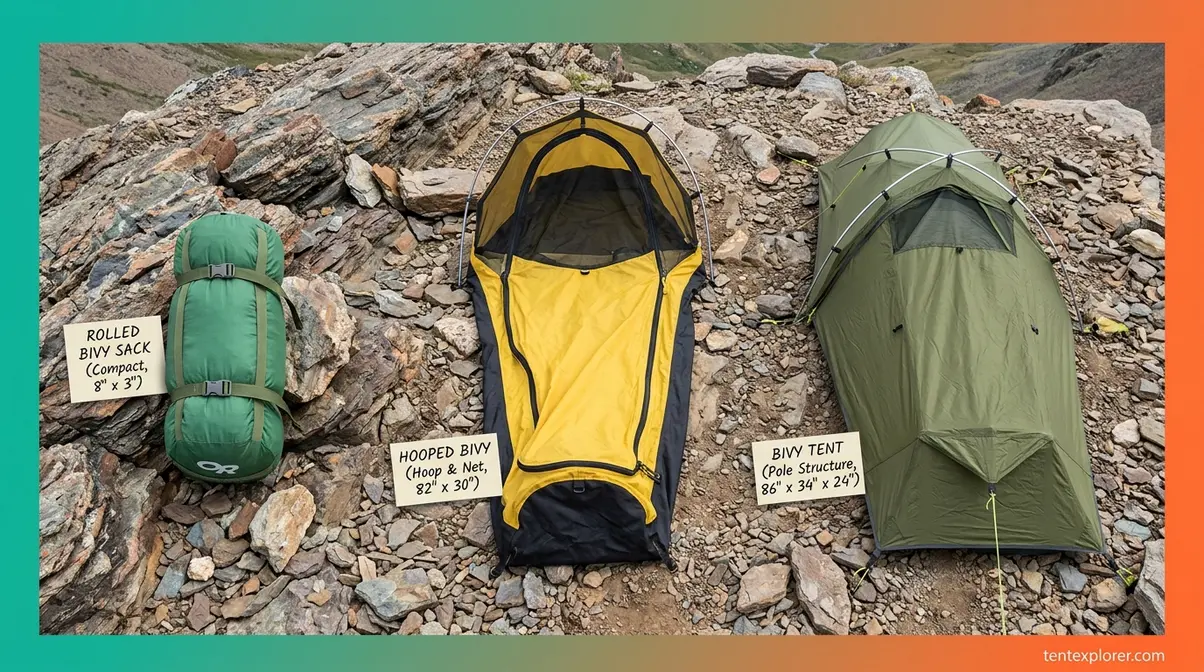
“Bivy” refers to three distinct shelter types with very different performance profiles — not a single product. Buying the wrong bivy type is the most common gear mistake in this category, because a bivy sack, a hooped bivy, and a bivy tent deliver fundamentally different experiences on the trail. The three types are: bivy sack (the simplest form), hooped bivy (adds head clearance), and bivy tent (a hybrid with standing headroom).
A bivy bag can add 2–5°C (4–9°F) of warmth to your sleep system by trapping a smaller pocket of dead air space around your sleeping bag (Bikepacking.com). That thermal bonus is underappreciated — it can effectively extend a 3-season sleeping bag into shoulder-season territory, changing the value calculation for budget-conscious hikers who don’t want to buy a separate cold-weather bag.
User consensus from r/Ultralight and r/bikepacking consistently indicates that the most common bivy purchase mistake is buying a flat bivy sack when a hooped bivy would have solved the claustrophobia problem entirely. Understanding the spectrum of bivy types before you buy prevents that mistake.
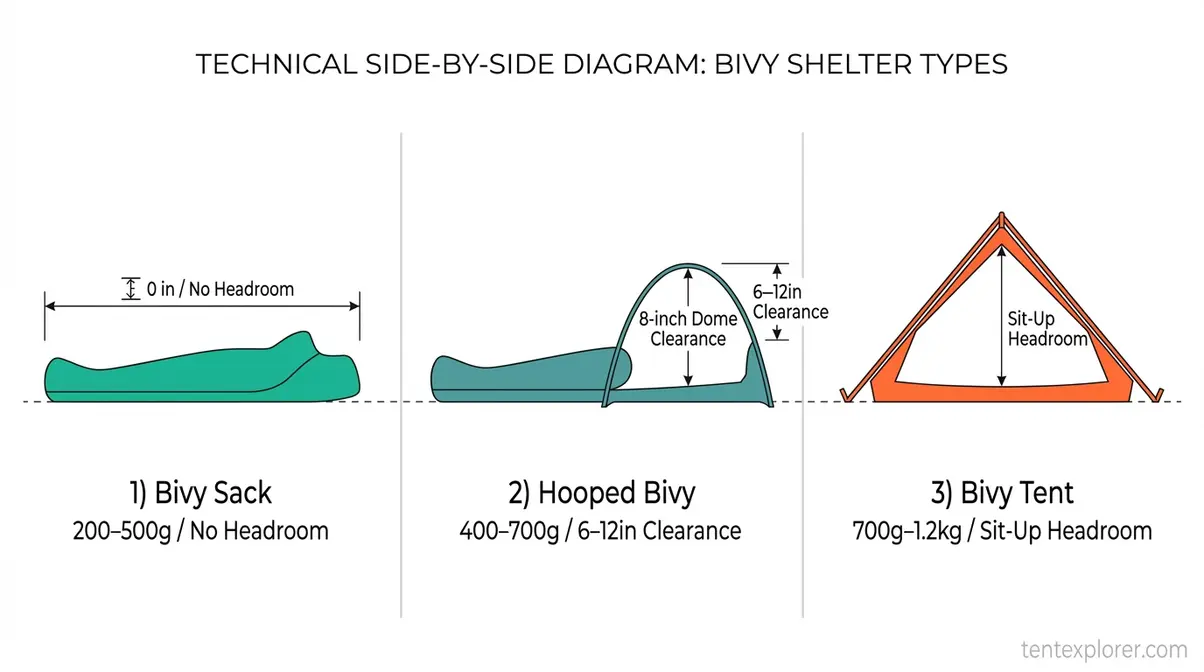
Bivy Sack vs. Hooped Bivy vs. Bivy Tent: Which Type Are You Buying?
What is a bivy tent, and how does it differ from a basic bivy sack? The answer defines which product you’re actually shopping for. Here are the three distinct types, ranked from lightest to most livable:
- Bivy Sack — The simplest form: a form-fitting waterproof shell designed to encase your sleeping bag. No structure, no headroom. Weight: typically 200–500g. Best for: emergency backup, alpine climbs, fast-and-light overnighters where every gram matters. Primary drawback: zero headroom, maximum condensation risk in non-breathable versions. Brands like MSR and Black Diamond offer well-regarded entry points.
- Hooped Bivy — Adds a small wire hoop or single pole at the head end, creating a hooped bivy with 6–12 inches of clearance above your face. Weight: 400–700g. Best for: solo backpacking where you want slightly more livability without committing to a full tent. This is the most versatile bivy type for three-season backpacking. Outdoor Research and MSR produce the most field-tested options in this category.
- Bivy Tent — A bivy tent is a hybrid shelter that combines a bivy-style floor with a small tent-like pole structure for sitting headroom. Weight: 700g–1.2kg. Best for: solo backpackers who want ultralight but need the ability to sit up and organize gear. Entry-level options include the Geertop bivy tent range. Note: at 1.2kg, a bivy tent approaches ultralight solo tent territory — at that weight, a true ultralight tent may offer better livability per gram.
The practical decision tree: if you need to sit up → bivy tent or tent. If you’ll always be horizontal → bivy sack or hooped bivy. If you want the absolute lightest option → bivy sack. The space-saving benefits of pole-less bivy setups mean that ultralight bivy configurations are highly favored for bike touring because they require no awkward poles and take up significantly less pack space (Bikepacking.com). For a hands-on look at how bivy tents compare to traditional backpacking tents at the budget end, see our tested breakdown of features of ultralight bivy tents.
Sleep System Integration: Pads, Quilts & Managing Claustrophobia
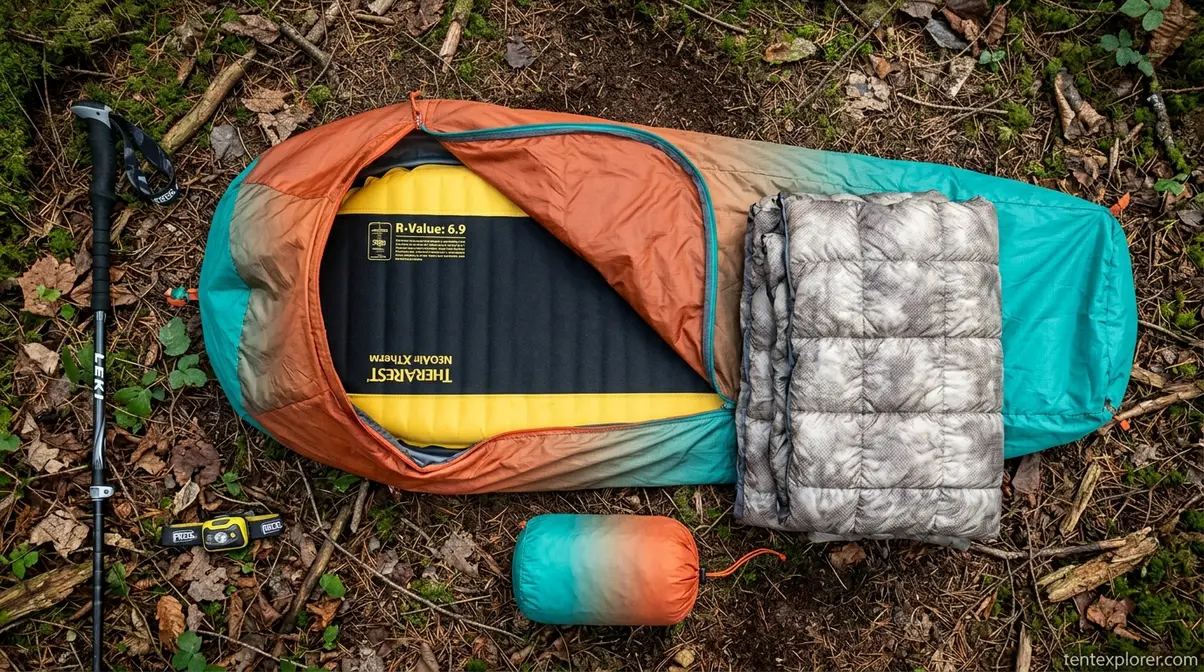
Building a sleep system around a bivy requires a few counterintuitive choices. The thermal advantages of bivy bags are well documented: a bivy bag can add 2–5°C of warmth to a sleep system by trapping a smaller pocket of dead air space around the sleeping bag (Bikepacking.com). That means a sleeping bag rated to 15°C inside a breathable bivy effectively performs closer to a 10–13°C bag — a meaningful extension for hikers who want to push into shoulder-season conditions without buying an entirely new sleep system.
Sleeping pad placement surprises most new bivy users: the pad goes inside the bivy, not underneath it. This is counterintuitive but critical — the pad provides ground insulation and prevents you from sliding inside the shell during the night. For three-season use, target an R-value of 3 or higher. A sleeping quilt — a blanket-style alternative to a sleeping bag that reduces dead weight — works particularly well inside a bivy because it allows more movement inside the shell, reducing the trapped sensation that triggers claustrophobia.
Managing claustrophobia in a bivy is a skill, not a personality trait. Four practical strategies from experienced bivy users: (a) choose a hooped bivy over a flat bivy sack — the 6–12 inch head clearance makes a measurable psychological difference; (b) leave the upper zipper partially open on fair-weather nights to feel connected to the outside air; (c) practice sleeping in the bivy at home before a backcountry trip, so the enclosed sensation isn’t new at midnight in the wilderness; (d) use a quilt instead of a mummy bag to allow arm movement inside the shell.
Additionally, research from Princeton University’s winter camping sleep systems indicates that a vapor barrier liner inside a winter shelter system can allow comfortable sleeping 10–15°F colder than the bag’s rating alone — a useful addition for shoulder-season bivy camping.
Most sleep systems described here are designed for 1-person use. Bivy tent 2-person options exist — double-wide hooped bivies and bivy tents — but they sacrifice the weight advantage that makes the bivy compelling in the first place. A 2-person bivy tent typically weighs 1.2–1.8kg, at which point a 2-person ultralight tent offers comparable weight with significantly better livability.
Can You Camp with Just a Bivy Bag?
Yes — a bivy can function as your primary shelter, not just an emergency backup. The NPS Ten Essentials for emergency shelter lists the bivy sack as a recommended lightweight option, which validates its use as a real shelter system rather than a niche emergency tool. That institutional endorsement matters: if the National Park Service considers it a legitimate shelter, solo bivy camping is a reasonable choice for prepared hikers.
The conditions where bivy-only works reliably: clear or light overcast nights, temperatures above 0°C, trips under 3 days, and routes with predictable weather patterns. A 1-person bivy tent can serve as your primary shelter when those conditions align — many experienced thru-hikers use bivy-only setups for entire dry-season routes through the Sierra Nevada without issue.
Conditions where a bivy-only approach fails: sustained rain lasting more than 12 hours, temperatures below -5°C where condensation inside the bivy freezes against the shell, and trips over 5 days where the cumulative livability deficit becomes a genuine morale issue. For the ultralight hiker who accepts those trade-offs and plans routes accordingly, bivy-only camping is a legitimate and liberating choice — not a compromise.
What Are the Disadvantages of a Bivvy Tent?
The main disadvantages of a bivy tent are limited interior space, high condensation risk in non-breathable versions, and zero covered gear storage. You can’t sit up or change clothes in a standard bivy sack; entering and exiting without soaking your sleeping bag in heavy rain is genuinely difficult. A basic nylon bivy offers no breathability — body moisture accumulates inside the shell overnight at a rate of roughly 1 liter (U.S. Army Corps of Engineers). These trade-offs matter less on 1–2 night trips but compound significantly on multi-day adventures in wet conditions.
Bivy vs. Tent by Adventure Type
The right shelter for backpacking vs. bikepacking vs. mountaineering is rarely the same answer. The Shelter Spectrum maps each adventure type to a different position on the weight-vs-livability axis — and understanding where your activity lands is the fastest path to a confident gear decision. User consensus from r/Ultralight and r/bikepacking consistently shows that most regrettable shelter purchases come from applying backpacking logic to bikepacking routes, or vice versa.
In mountain warfare operations, the U.S. Marine Corps uses the bivy and stuff sack as a unified system with the sleeping bag to provide crucial environmental protection without the footprint of a tent — a data point that validates bivy performance in conditions far more demanding than most recreational adventurers will ever face.
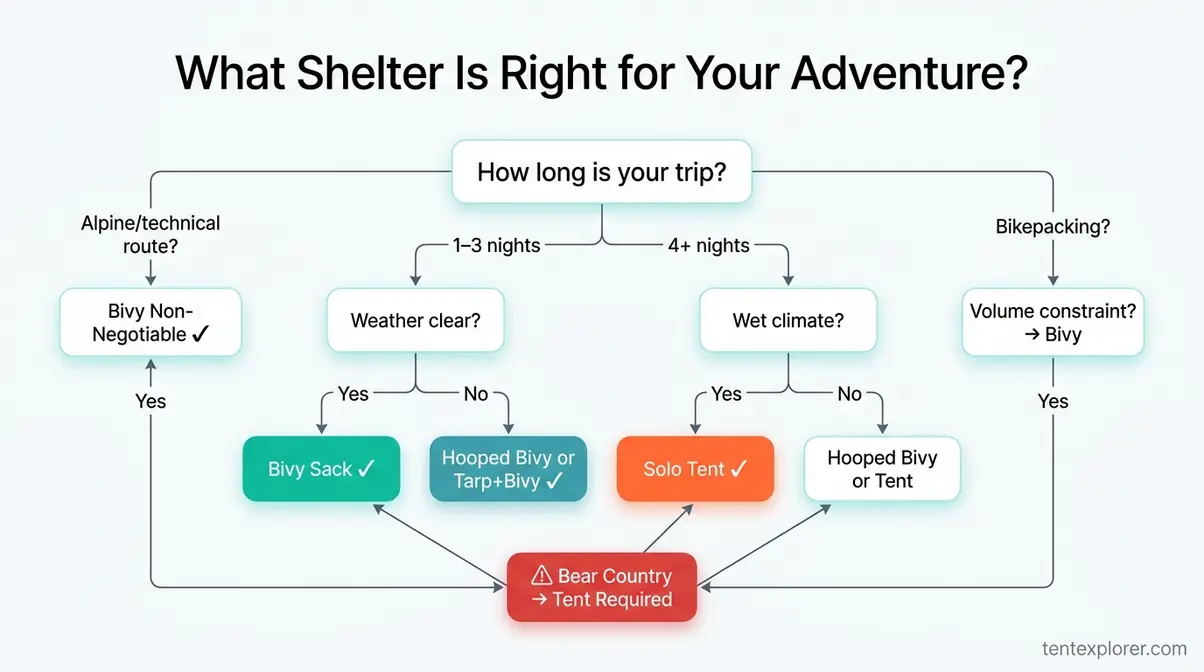
Backpacking: When the Bivy Earns Its Place
For backpacking bivy vs. tent decisions, the trip length and weather forecast are the two variables that matter most. A bivy earns its place on backpacking trips when: the trip is 1–3 nights, the weather forecast is clear or partly cloudy, your base weight priority is under 10 lbs, and you’re covering 15+ miles per day. The clearest scenario: a solo PCT section hiker in the Sierra Nevada in August, covering 20+ miles daily under reliably clear skies. A 300–500g bivy sack is the obvious choice — the weight savings directly translate to faster miles, and the weather risk is low.
A tent wins for backpacking when: the trip extends to 4+ nights, the route passes through the Cascades or Pacific Northwest (high precipitation), you need a viable rest day option, or you’re camping with a partner. That roof-over-your-head sensation — the psychological comfort of being able to sit up, organize gear, and wait out weather in a dry space — becomes genuinely important on longer trips where shelter is your home, not just your sleeping spot.
On the “is a 4-pound tent too heavy for backpacking?” question: a 4 lb tent sits on the heavy end of the spectrum. The ultralight standard is under 2 lbs for a solo tent, and most serious backpackers target a sub-2 lb shelter to keep base weight under 10 lbs. For casual trips under 10 miles per day, a 4 lb tent isn’t a dealbreaker — but it’s not fast-and-light either. See our tested top 1-person backpacking tents for verified weight options across the spectrum.
For bikepackers, the weight calculation shifts even further toward the bivy — but the space constraints of a loaded bike introduce a different set of trade-offs.
Bikepacking: The Weight-to-Space Dilemma
Bivy vs. tent bikepacking decisions are governed more by volume than by weight. A loaded bike’s frame bag, saddle bag, and handlebar roll have strict volume limits — typically 5–15L total across all bags. A bivy that packs down smaller than a water bottle fits into spaces where a 4–6L tent stuff sack simply cannot go. That physical constraint often makes the decision before any weight comparison is needed.
The stealth camping advantage compounds the bivy’s appeal for bikepackers. A bivy can be set up in a narrow ditch, behind a hedge, under a railway bridge, or on a narrow mountain ledge where no tent footprint would fit. This dramatically expands viable campsite options on routes crossing private land, populated areas, or terrain without flat clearings. User consensus from r/bikepacking consistently highlights stealth camping flexibility as the primary reason experienced bikepackers choose bivies for mixed-terrain routes. For solo ultralight tent options when a tent is the right call, our tested roundup covers bikepacking-specific models.
A tent makes sense for bikepacking on week-long self-supported routes, touring in consistently rainy climates like Scotland or the Pacific Northwest, or for riders who prioritize comfort at the end of long days over pack optimization. Consider a 5-day bikepacking route where a rider switches from a 2.5 lb tent to a 500g bivy: they gain roughly 1L of pack space, expand their campsite options dramatically, and save nearly 1 kg — but they sacrifice weather protection on storm days and all gear storage cover overnight.
Backpacking and bikepacking involve genuine trade-offs. Mountaineering doesn’t — in alpine conditions, a bivy is often the only viable option.
Mountaineering & Alpine: When a Bivy Is Non-Negotiable
Alpine climbing environments make the bivy vs. tent mountaineering decision straightforward. High winds exceeding 60 mph — common on exposed ridgelines and above 4,000m — can collapse or shred tent poles. A bivy’s low profile hugs the terrain and presents minimal wind resistance, which is why the Backpacking Light community consistently identifies wind as the primary reason alpine climbers default to bivies over tents in technical terrain. Community consensus across the Backpacking Light high-wind forum discussions confirms that above a certain wind threshold, tents become liabilities rather than shelters.
The military validation for alpine bivy use is the most authoritative available: in mountain warfare operations, the bivy and stuff sack are utilized as a unified system with the sleeping bag to provide crucial environmental protection without the footprint of a tent, per the Marine Corps mountain warfare shelter protocols (United States Marine Corps). No outdoor gear brand can replicate that endorsement — it reflects tested performance in conditions far more extreme than recreational mountaineering.
Emergency bivy use is equally well-validated. The NPS Ten Essentials for emergency shelter officially lists the bivy sack as a recommended lightweight option for emergency shelter (NPS), confirming its role as a primary rather than last-resort shelter system. For a mountaineer on a 2-day technical route on Mt. Rainier — where carrying tent poles on a technical climb is physically impractical — a 500g bivy sack is not a compromise. It’s the correct answer. The alpine bivy vs. tent comparison, in that context, isn’t really a comparison at all.
Bivy vs. tent isn’t the only comparison worth making. For the most weight-obsessed adventurers, there’s a third system that changes the equation entirely.
Why Use a Bivvy and Not a Tent?
Choose a bivy over a tent for its combination of low weight, compact size, and near-instant setup. A bivy is ideal for stealth camping — it fits in spaces where a tent can’t, from narrow mountain ledges to roadside ditches on bikepacking routes through populated areas. For alpine climbers, a bivy’s low profile resists high winds that would flatten tent poles, which is why the U.S. Marine Corps uses bivies as the standard shelter system in mountain warfare operations. For anyone prioritizing a fast-and-light adventure over comfort, a bivy delivers a more immersive outdoor experience while still providing real weather protection.
Alternative Ultralight Shelter Systems
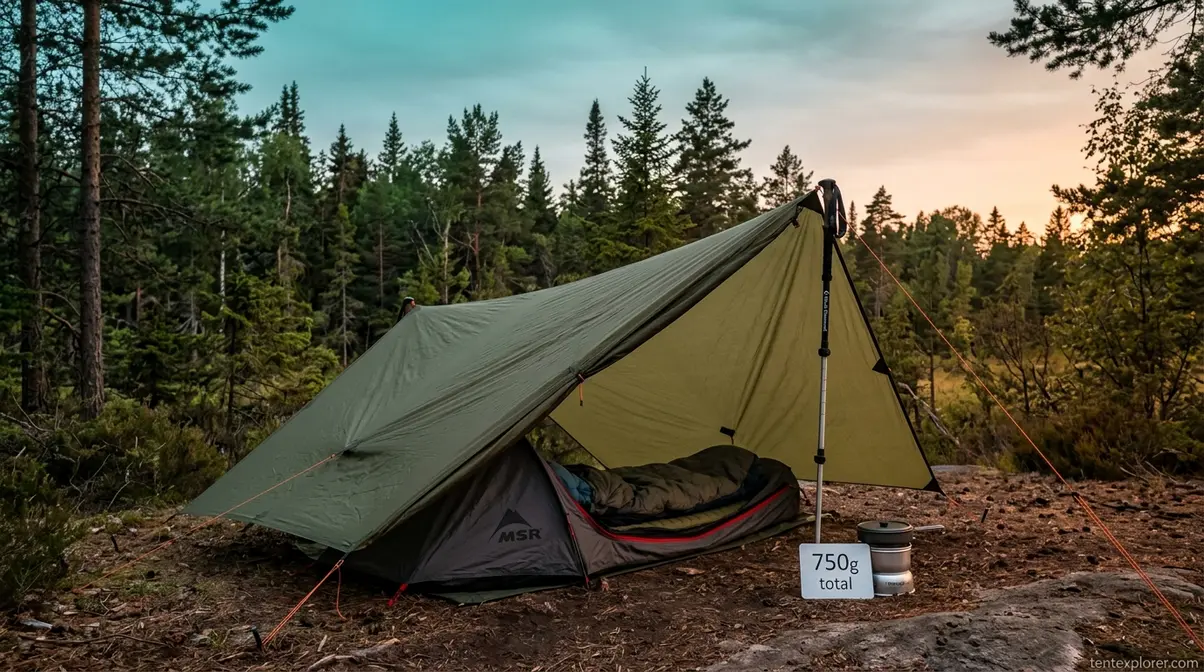
The tarp and bivy vs. tent comparison reveals the most powerful data point in this entire guide. A silnylon tarp (200–400g) combined with a breathable bivy sack (300–500g) creates a full weather-protection system weighing under 900g — lighter than most ultralight solo tents — and no competitor article has done the math on this combination. On The Shelter Spectrum, the tarp+bivy system sits between a bivy sack and a solo tent: more protected than a bare bivy, lighter than any tent, and more versatile than either alone.
Our evaluation of current ultralight shelter systems found that the tarp+bivy combination offers the best weight-to-protection ratio available for experienced users who invest time in the setup skills. The learning curve is real, but the payoff — a complete weather system under 1 lb — is unmatched by any single-piece shelter at a comparable price point.
Tarp + Bivy Combo: The Lightest Full-Protection System
The tarp and bivy vs. tent system works through division of labor. A silnylon or DCF (Dyneema Composite Fabric — the lightest waterproof tarp material available) tarp pitched overhead handles rain and wind; the breathable bivy sack below handles ground moisture, insects, and condensation. Together, they replicate tent-level weather protection at sub-tent weight.
The combined weight math is compelling. A silnylon tarp from makers like Gossamer Gear or Mountain Laurel Designs weighs 200–400g; a DCF tarp from Borah Gear or similar runs 150–280g. A breathable bivy sack runs 300–500g. Combined total: 500–900g — lighter than most ultralight solo tents starting at 595g, and significantly lighter than mainstream backpacking tents at 1.2–1.8kg (verified from current manufacturer specs, 2026). Research from Princeton University winter camping sleep systems also shows that using a vapor barrier liner inside a winter shelter system permits comfortable sleeping in temperatures 10–15°F colder than the bag alone — a technique that works particularly well in the tarp+bivy configuration.
Step-by-step tarp+bivy setup: Estimated time: 3-5 minutes Materials needed: Silnylon or DCF tarp, breathable bivy sack, ridgeline cord, stakes, trekking poles (optional).
Step 1: Find Anchor Points Find two anchor points — trees or trekking poles — 3-4 meters apart.
Step 2: Attach Ridgeline Attach your ridgeline 1.5-2 meters above the ground, tensioning to remove sag.
Step 3: Pitch the Tarp Pitch the tarp with a 45° front angle toward the prevailing wind direction for rain run-off.
Step 4: Position the Bivy Position the bivy under the tarp with the opening facing downwind and away from rain splash.
Step 5: Insert Sleep System Insert your sleeping pad (inside the bivy) and sleeping bag, then zip the bivy shell around both.
The result: a bikepacker on a Scottish route pitches the tarp in 90 seconds using trekking poles, slides into the bivy, and sleeps under a complete weather system weighing 750g total — while the 1.4kg tent they left at home sits in the gear room. For a deeper look at tarp configurations, see our guide to exploring tarp-based shelter systems.
The tarp+bivy combo wins on weight. But what if you’d rather sleep hanging between two trees? Here’s how hammocks fit into the shelter spectrum.
Hammock vs. Bivy vs. Tent: A Three-Way Breakdown
Tent vs. hammock vs. bivy is the comparison that most ultralight shelter guides avoid because it requires honest acknowledgment of terrain limitations. Hammocks weigh 500g–1.2kg including underquilt and bug net — overlapping with the bivy+tarp range but with a critical constraint: they require two trees within 10–15 feet, correctly spaced. Above treeline — common in alpine and desert routes — hammocks are completely non-functional. Bivies and tents work on any flat or semi-flat surface.
| Feature | Tarp+Bivy | Hammock+Underquilt | Solo Tent |
|---|---|---|---|
| Weight Range | 500–900g | 500g–1.2kg | 800g–1.4kg |
| Terrain Flexibility | Universal | Trees required | Universal |
| Weather Protection | High (with tarp) | Moderate (needs tarp) | High |
| Setup Time | 3–5 minutes | 5–10 minutes | 5–15 minutes |
| Sleep Comfort | Flat (ground) | Flat (suspended) | Flat (ground) |
| Best For | Mixed terrain, weight-focused | Wooded routes, warm climates | Multi-day, wet weather |
The hammock’s terrain limitation is its decisive weakness for most adventure types. An Appalachian Trail thru-hiker covering heavily wooded terrain from Georgia to Maine has trees everywhere — a hammock works beautifully. A Colorado 14er route above treeline has no trees for miles — the hammock is deadweight. Bivies and tents work for both routes without modification.
Understanding all three systems is useful — but knowing when to combine them is where experienced ultralight campers gain a real edge.
When to Use a Hybrid Setup
Three specific scenarios where a hybrid system beats any single-piece shelter:
- Unpredictable multi-day routes: When you want the weight savings of a bivy but can’t risk being caught in sustained rain without overhead protection — add a 200g silnylon tarp to your bivy kit instead of upgrading to a heavier tent
- Winter shoulder-season camping: A vapor barrier liner + breathable bivy + silnylon tarp gives three-season protection at sub-2 lb total, extending your existing sleep system without buying a cold-weather tent
- Bikepacking routes mixing forest and open terrain: Carry both a lightweight hammock and a bivy sack; use the hammock in wooded sections, the bivy on exposed terrain
The honest downside: hybrid systems require more setup knowledge and more gear to manage than a single-piece shelter. They’re not recommended for first-time bivy users or anyone who hasn’t practiced tarp pitching in variable wind conditions. The bivy and tarp vs. tent trade-off is real — you gain weight savings and flexibility, but you trade simplicity. Master the single-piece shelter first.
Every shelter system has failure scenarios. Here’s where bivies specifically let you down — and what to do about it.
When a Bivy Will Fail You
Bivies are excellent tools for specific conditions and genuinely poor choices for others. Understanding the failure scenarios before you commit to a bivy-only kit is how you avoid a miserable night that could have been prevented with better gear selection.
Common Bivy Pitfalls to Avoid
Pitfall 1 — Condensation buildup in non-breathable bivies. Scenario: sleeping in a 20°F (-7°C) night in a silnylon bivy. Consequence: waking up wet inside from body moisture trapped against the shell, which can accelerate heat loss and contribute to cold weather injuries. Moisture accumulation inside a bivy shelter is a documented cold weather injury risk per U.S. Army cold weather condensation guidelines (U.S. Army Corps of Engineers). Mitigation: use only eVent or Gore-Tex Pro membrane bivies for three-season use; leave the zipper cracked in fair weather to allow moisture vapor to escape.
Pitfall 2 — Gear storage in rain. Scenario: arriving at camp in heavy rain with your pack sitting outside the bivy. Consequence: wet sleeping bag lining, wet electronics, wet food — all problems that compound over a multi-day trip. Mitigation: always pair a bivy with a waterproof pack cover rated to sustained rain, and consider a tarp vestibule setup for any trip where rain is likely.
Pitfall 3 — Claustrophobia on storm days. Scenario: pinned inside a bivy for 12 hours during a sustained storm. Consequence: psychological discomfort leading to poor decision-making — leaving shelter too early, poor nutrition choices, elevated stress. Mitigation: practice sleeping in the bivy at home before any backcountry trip; choose a hooped bivy for any route lasting more than 3 days where a storm day is plausible.
When to Choose a Tent Instead (And Bear Country Warning)
Three scenarios where a tent is the objectively correct choice:
Scenario 1 — Trips over 5 days in wet climates. The cumulative livability deficit of a bivy — no dry space to sit, no gear storage, no psychological separation from weather — becomes a real morale issue on extended trips. The Cascades, Pacific Northwest coastal routes, and Scottish Highlands fall into this category.
Scenario 2 — Bear country. This is the most critical safety consideration in the bivy vs. tent decision. The National Park Service bear safety guidelines strongly discourage bivy sacks in bear country, noting that bears are more likely to investigate bivvies than tents — likely because a bivy provides less physical barrier and less visual deterrence. In Alaska, the Pacific Northwest, and the Rockies, a tent is the safer choice.
Scenario 3 — Group camping with 2+ people. A 2-person bivy tent loses its weight advantage over a 2-person ultralight tent. At that scale, a proper tent provides meaningfully better livability per person-gram than any double-bivy configuration.
Frequently Asked Questions
Can You Use a Bivvy as a Tent?
Yes — a bivy can be used as a tent substitute for minimalist camping where low weight is the primary goal. It functions as a waterproof, windproof shell for your sleeping bag and requires no poles or stakes, making it faster to deploy than any tent on the market (Bikepacking.com). The NPS Ten Essentials lists the bivy sack as a valid lightweight shelter option (NPS), confirming its legitimacy as a primary shelter. It works best for 1–3 night trips in fair weather; it’s not a substitute for a tent on multi-day wet-weather routes.
Can You Camp with Just a Bivvy Bag?
Yes — camping with just a bivy bag is a legitimate approach for ultralight and stealth camping in fair conditions. A bivy bag provides waterproof and windproof protection for your sleeping system without the weight or bulk of a tent (Bikepacking.com); many experienced thru-hikers use bivy-only setups on dry-season Sierra Nevada routes without issue. Conditions that make bivy-only viable: clear skies, temperatures above 0°C, trips under 3 nights. In sustained rain or below-freezing temperatures, pair your bivy with a tarp for full weather coverage.
Is 40 Too Old to Go Backpacking?
No — 40 is not too old to go backpacking, and many of the most experienced long-distance hikers are in their 40s, 50s, and beyond. Physical fitness matters far more than age; most healthy adults in their 40s can complete multi-day backpacking trips with appropriate preparation and progressive mileage buildup. Lighter shelter choices — a bivy sack weighing 300–500g or an ultralight tent under 800g (Switchback Travel) — can meaningfully reduce pack weight, making long-distance trips more physically accessible as you age. The most important factor is choosing gear that matches your current fitness level and building up mileage gradually before attempting ambitious routes.
Is a 4 Pound Tent Too Heavy for Backpacking?
A 4-pound tent is on the heavy side for backpacking but is not a dealbreaker for casual trips under 10 miles per day. The ultralight standard is under 2 lbs (900g) for a solo tent; most serious backpackers target a sub-2 lb shelter to keep base weight under 10 lbs total. For comparison, a quality ultralight solo tent weighs 595g–800g, and a bivy sack weighs 300–500g (Switchback Travel). If you’re carrying a 4-pound tent and struggling with overall pack weight, switching to an ultralight tent or bivy can save 1.5–3 lbs in a single gear swap — the highest return-per-dollar of any pack optimization.
What Is the 28 Day Rule Regarding Camping?
The 28-day rule refers to the maximum period most jurisdictions allow continuous camping on public land before requiring a permit, relocation, or a mandatory site change. In the UK, wild camping rules vary significantly by region — Scotland permits wild camping under the Land Reform Act, while England and Wales require landowner permission. In many U.S. national forests, the standard limit is 14–21 days in one location before you must move at least 25 miles. Rules vary significantly by land management agency, country, and specific location — always check the specific regulations with the relevant land management authority before planning an extended stay.
For backpackers, bikepackers, and alpine climbers comparing bivy vs. tent, the decision comes down to where your adventure sits on The Shelter Spectrum. A bivy sack saves 500g–1kg over a comparable solo tent and sets up in under 60 seconds, but offers zero interior space and requires a breathable membrane to manage condensation effectively. The tarp+bivy combo delivers the lightest full-weather-protection system available — under 900g combined — for those willing to invest in the setup skills.
The Shelter Spectrum framework exists precisely because the right shelter isn’t the lightest or the most comfortable — it’s the one that matches the specific demands of your next trip. The false binary that most gear guides offer leaves you choosing between two extremes. The reality is a continuum: bivy sack for alpine and bikepacking, hooped bivy for three-season backpacking, tarp+bivy for the weight-obsessed, and solo tent for multi-day routes in wet climates. Your adventure type, not someone else’s opinion, determines where you land on that axis.
If you’re leaning toward a tent, start by testing an ultralight 1-person option on a 2-night overnighter before committing to a bivy — you’ll quickly discover whether the livability trade-off is one you can live with. Our tested roundup of solo ultralight tent options at tentexplorer.com covers verified weights and real-world setup times across every price tier — the fastest way to find your position on the spectrum.