
This blog post may contain affiliate links. As an Amazon Associate I earn from qualifying purchases.
📋 Table of Contents
- Campfire Safety: Step-by-Step Procedures
- Check Local Restrictions First
- Build and Maintain Your Fire Safely
- The “Drown, Stir, Feel” Method
- Emergency Preparation
- Campfire Safety for Kids and Groups
- Simple Rules Kids Can Remember
- The Fire Safety Bubble in Practice
- First Aid for Burns and Accidents
- Fire Safety Rules Explained
- What Is the 10 a.m. Fire Rule?
- What Is the 30/30 Lightning Rule?
- The 4 Golden Rules of Campfire Safety
- The 5 E’s of Fire Safety
- Free Printable Safety Resources
- Campfire Safety PDF Checklist
- Kids and Scout Safety Worksheet
- Common Mistakes and When Not to Light a Fire
- Common Pitfalls to Avoid
- When to Skip the Campfire Entirely
- Frequently Asked Questions
- What are 5 campfire safety tips?
- What is the 30/30/30 rule for fire?
- What are the 7 fire safety rules?
- The 4 Golden Rules of Fire Safety
- What is the 10 a.m. fire rule?
- Final Thoughts on Campfire Safety
Recently, local fire departments responded to an estimated 1.38 million fires in the United States, resulting in approximately 3,920 civilian deaths (NFPA) — the vast majority preventable. Here’s what that number doesn’t tell you: a campfire handled with genuine knowledge and attention is one of the safest outdoor activities you can plan. The danger lives almost entirely in the gaps between what most campers think they know and what official guidance actually says.
⚠️ Important Safety Notice: Fire laws and burn restrictions change frequently and vary by location. Always check for local fire restrictions with your local land management agency — such as the Bureau of Land Management or your state’s DNR — before starting any campfire. Never start a fire during a Burn Ban.
“Build campfires at least 25 feet away from tents, shrubs and anything that can burn.”
— U.S. Fire Administration
This guide draws on official procedures from Tier-1 sources including the U.S. National Park Service, U.S. Fire Administration, and Bureau of Land Management. It is reviewed semi-annually to reflect current fire regulations and seasonal burn conditions. You’ll find exactly how to prepare your site, build and manage your fire, extinguish it completely, and keep children safe — along with plain answers to the specific rule-based questions that almost every other campfire guide ignores.
Key Takeaways: Campfire Safety Tips at a Glance
Safe campfires require three non-negotiables: the right site (at least 25 feet from tents and trees), constant supervision, and a complete “Drown, Stir, Feel” extinguishment every time.
- Check first: Always verify local Burn Bans before lighting any fire.
- The Fire Safety Bubble: Maintain a 25-foot cleared perimeter — your invisible safety zone — around every campfire. This is a core campfire safety tip for preventing accidental spread.
- Never leave it unattended: Not even for a minute.
- Extinguish fully: Cold to the touch = truly out (U.S. NPS).
- Kids rule #1: No running near the fire, ever.
Campfire Safety: Step-by-Step Procedures
The five most important campfire safety tips aren’t buried in fire-management manuals; they’re the same principles Tier-1 agencies have emphasized for decades. Before diving into each one in detail, here’s the at-a-glance list that directly answers the question most campers ask first:
5 Essential Campfire Safety Tips (At a Glance)
- Verify that campfires are permitted — check for Burn Bans before you pack.
- Choose a cleared site at least 25 feet from tents, shrubs, and low-hanging brush.
- Keep the fire small, manageable, and attended at all times.
- Never use accelerants (lighter fluid, gasoline) to start or grow your fire.
- Extinguish completely using the “Drown, Stir, Feel” method until the ash is cold to the touch.
Here’s exactly how to execute all five.
According to the U.S. Fire Administration, campfires should be built at least 25 feet away from tents and anything that can burn, with the fire itself never exceeding a manageable size. Our team has reviewed this guidance alongside official procedures from the U.S. National Park Service and the Bureau of Land Management, the primary agency for fire restrictions on federal public lands.
Check Local Restrictions First
Your first campfire safety tip begins before you leave home. Checking for Burn Bans isn’t a formality—it’s your legal and moral obligation as an outdoor user.
The Bureau of Land Management (BLM) administers fire restrictions to reduce wildfire risk. What many campers don’t realize is that restrictions aren’t simply “on” or “off.” The BLM operates a tiered system:
- Restriction Level I: Campfires permitted in designated fire rings only.
- Restriction Level II: Campfires prohibited in most areas; cooking fires in enclosed devices only.
- Restriction Level III: All fires prohibited, including stoves in some cases.
To check your specific area, visit the official BLM site, search ” fire restrictions,” or call your local ranger station for real-time conditions. You can also check the CALFIRE safety conditions for California.
Weather conditions are just as critical. Gusty winds can carry an ember 25 feet or more. Red Flag Warning days, issued by the National Weather Service when humidity is low and winds are high, are the clearest signal that a campfire is a bad idea, even where technically permitted. Taking 10 minutes to verify these conditions is the most important of all campfire safety tips.
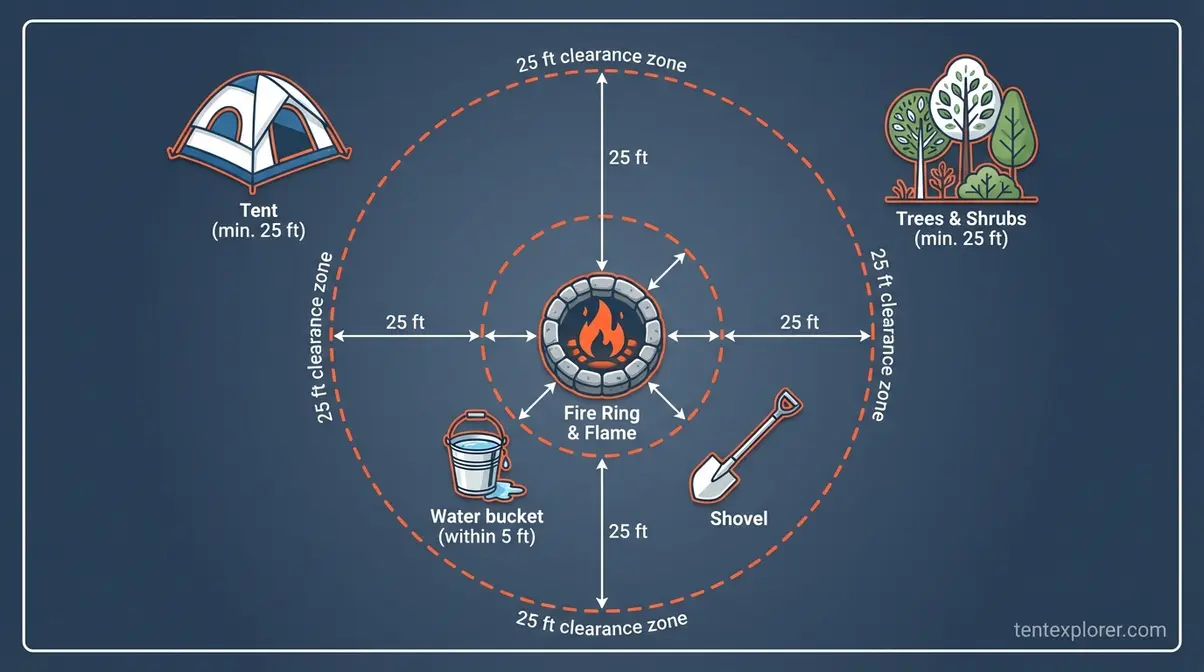
Caption: The 25-foot clearance zone — what camping communities call your Fire Safety Bubble — is the single most important spatial rule for campsite layout.
Build and Maintain Your Fire Safely
Site preparation is key. The U.S. National Park Service provides foundational guidance on how to safely build campfires. Their core rule is simple: use an existing fire ring whenever one is available. Never dig a new pit when a designated ring already exists.
If no ring exists and fires are permitted, clear a 10-foot diameter area down to bare mineral soil, removing all leaves, needles, and roots.
Keep your fire small and manageable, fitting it comfortably inside the fire ring, never exceeding one foot in height. Smaller fires produce fewer embers and are easier to extinguish.
Never use accelerants. Lighter fluid and gasoline can cause flash ignition, a leading cause of preventable campfire injuries.
- Never burn these materials:
- Lighter fluid, gasoline, or any petroleum product
- Treated, painted, or pressure-treated wood
- Garbage, plastic, or foam
- Green or wet wood
- Large logs that extend beyond the fire ring
“Roast with Care” — Cooking Protocols (NFPA)
Campfire cooking creates specific hazards. The National Fire Protection Association’s campfire tip sheet covers these protocols:
- Use long-handled roasting sticks of at least 30 inches.
- Keep fire sticks pointed down when not in use to prevent eye injuries.
- Never hold food directly over an open flame with short utensils.
- Set hot metal skewers on a rock to cool, not in someone’s hand.
Building the fire correctly is important, but maintaining constant supervision is what prevents emergencies.
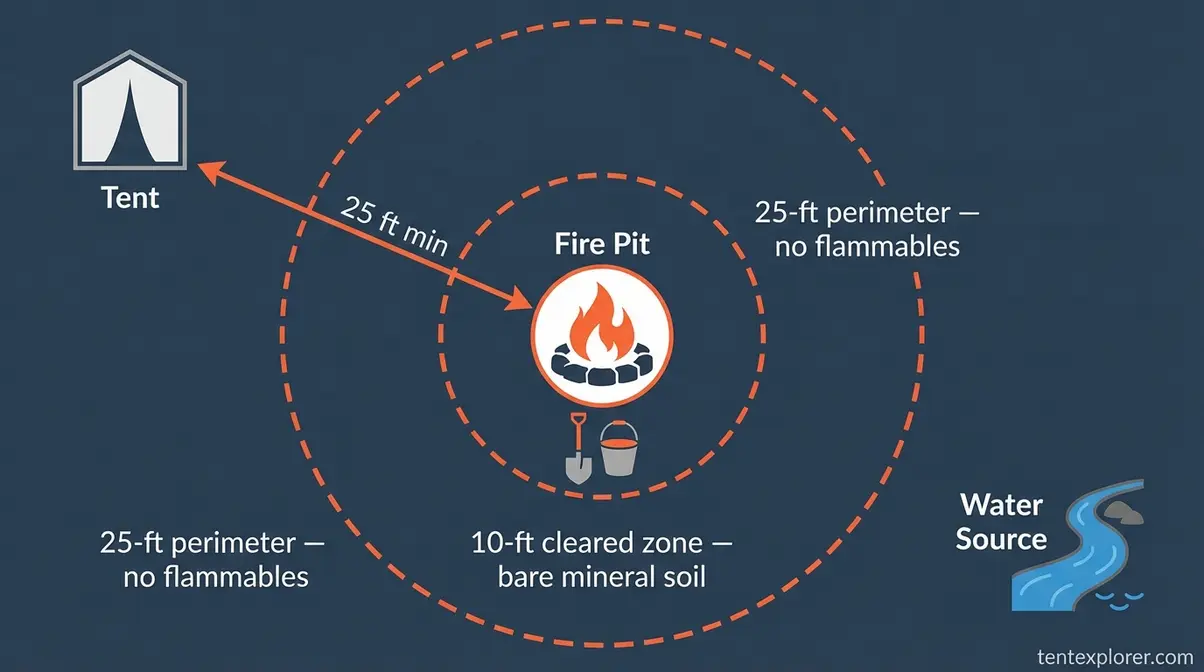
Caption: A proper campsite layout keeps the fire ring at the center of a cleared 10-foot zone, with sleeping areas and tents no closer than 25 feet in any direction.
The “Drown, Stir, Feel” Method
“Looks extinguished” is not the same as “is extinguished.” This distinction is critical. The U.S. Fire Administration recommends campfires be completely extinguished and cold to the touch before leaving the site, per their USFA fire safety guidance.
A buried ember can reignite hours later. These late-reignitions are responsible for a significant share of campfire-caused wildfires.
Follow this four-step procedure every time:
- Drown: Pour water slowly over all embers, coals, and ash. Use significantly more water than you think you need. The ash should be visibly wet.
- Stir: Use a stick or shovel to mix wet ash with the remaining coals, exposing hidden hot spots.
- Drown again: Pour more water. The ash should no longer hiss. Hissing means heat remains.
- Feel: Hold the back of your hand 6 inches above the ash. Any warmth means you repeat steps 1 through 3. The fire is only truly out when the ash is cold to the touch.
Smokey Bear’s official guidance uses a similar four-word phrase, but this numbered procedure is more explicit in execution. Either approach works if you never skip the final “Feel” test.
If no water is available, use dry dirt or sand—never bury the fire. Burying hot coals seals in heat and creates an invisible underground smolder risk.
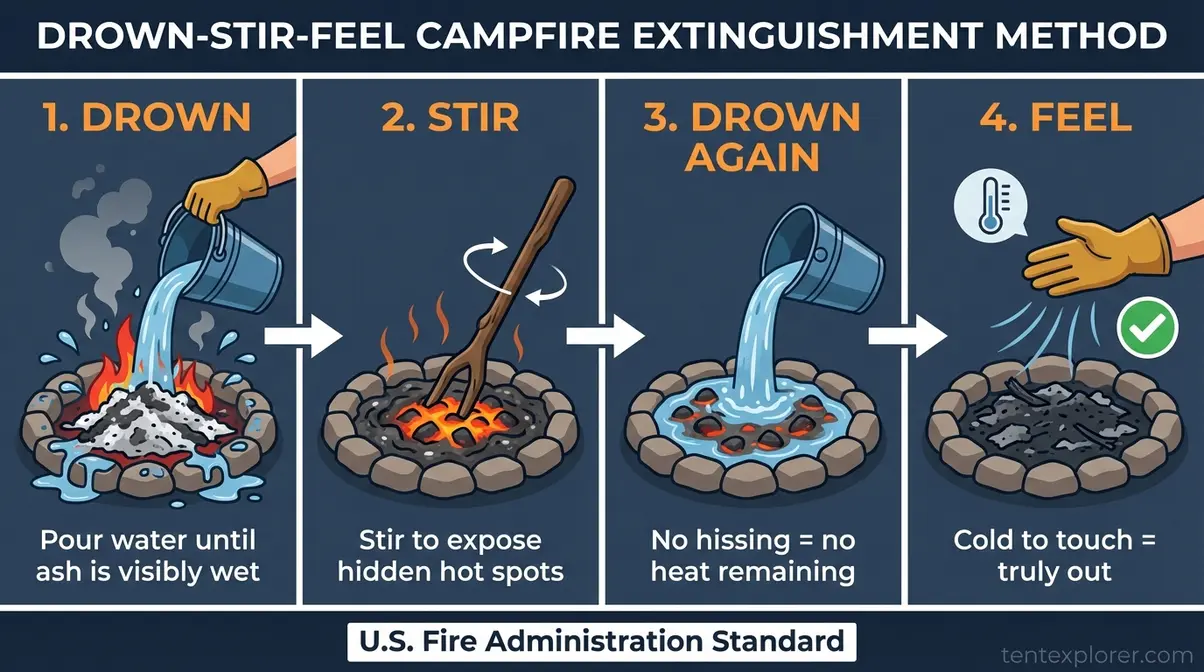
Caption: The Drown, Stir, Feel method — not complete until ash is cold to the back of your hand at a 6-inch distance.
For a step-by-step guide covering everything from firewood sourcing to site cleanup, visit our complete guide to campfire safety.
Emergency Preparation
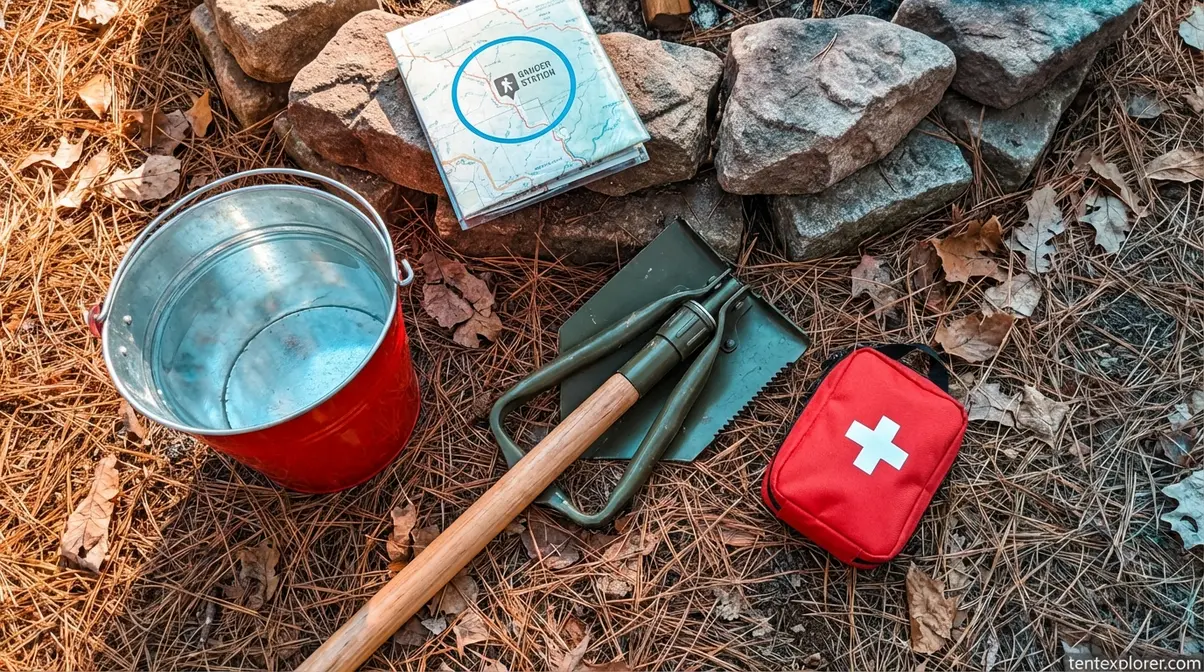
Emergency gear should be within arm’s reach of the fire. Your two non-negotiable tools are a bucket of water and a shovel, kept within five feet of the fire ring at all times.
Before your first fire, establish your location. If you’re in a cell-dead zone:
- Identify the nearest ranger station on your map.
- Note the closest paved road and its name.
- Tell someone your planned GPS coordinates and return date.
If gusty winds or dropping humidity develop, begin extinguishment immediately.
If a fire gets out of control:
- Attempt suppression only if the fire is small and spreading slowly.
- If fire spreads beyond your control, evacuate immediately—do not retrieve belongings.
- Call 911 and report your location.
For burn injuries, see the “First Aid for Burns and Accidents” section below.
Campfire Safety for Kids and Groups
Group campfires with children require a second layer of planning. Children under 12 need active, constant adult supervision within arm’s reach of the fire at all times, not merely within eyesight.
The Fire Safety Bubble framework, introduced below, is the most effective mental model for group fire safety because it converts abstract distance rules into a physical, enforceable zone that children can understand.
Simple Rules Kids Can Remember
The best campfire rules for children are short, concrete, and repeatable.
Four rules that work for ages 5 and up:
- No running near the fire. Ever. This is the single most common cause of child burns at campfires—a running child trips and falls toward the flame. Make this rule absolute.
- Fire sticks stay pointed down. Roasting sticks raised at shoulder height are an eye-injury risk. Enforce the downward-point rule even when sticks are being carried.
- Stay on your seat. Designate seats—a log, chair, or blanket—and instruct children to stay in them when near the fire.
- Ask an adult before getting close. Children should not approach the fire without permission.
For scout leaders and youth group organizers, Scouting America’s campfire safety guidelines reinforce these rules and prohibit all chemical additives and color-changing products.
Caption: Simple, visual rules are far more effective than lengthy explanations for children ages 5–12 near an active campfire.
The Fire Safety Bubble in Practice
The Fire Safety Bubble is the mental model at the heart of this guide. The concept is simple: every campfire is surrounded by an invisible 25-foot bubble of cleared ground and constant supervision.
In practice, the Fire Safety Bubble works like this:
- The 25-foot perimeter is your cleared zone. No tents, chairs, or flammable gear should be closer than 25 feet to the fire ring. This matches the conservative USFA/FEMA federal standard.
- The supervision zone is an inner ring—roughly 6 feet from the fire’s edge—where no child should be without an adult hand on their shoulder.
- The bubble is dynamic. In gusty winds, the effective bubble expands as embers travel farther.
Teaching children about the Fire Safety Bubble converts an abstract safety concept into a spatial game. Ask them: “Are we inside the bubble?” before they approach. This framework works because it replaces a list of rules with a single spatial question, reducing the cognitive load for parents and leaders.
Caption: The Fire Safety Bubble — a 25-foot perimeter of cleared ground and constant supervision that separates a safe campfire from a dangerous one.
First Aid for Burns and Accidents
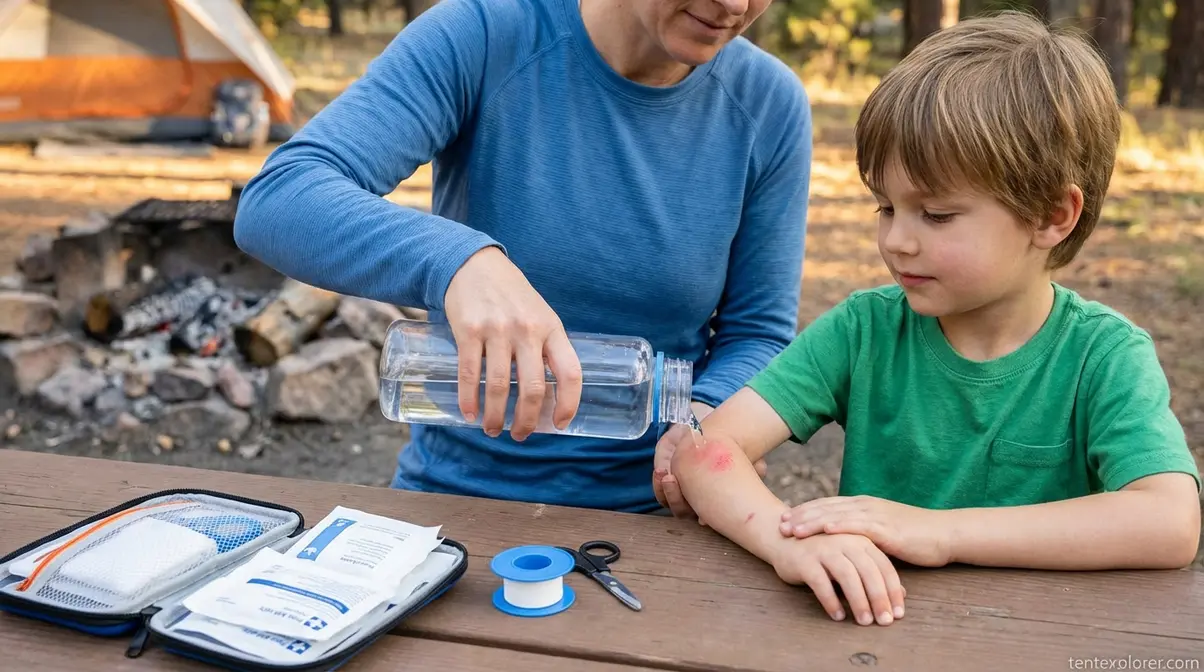
Most campfire burn injuries involving children are minor, but responding incorrectly in the first 60 seconds can worsen the injury. According to the American Burn Association and the American Academy of Pediatrics, the correct sequence for minor burns is:
- Cool immediately. Run cool (not cold or icy) water over the burn for at least 5 minutes. Cold water and ice can worsen tissue damage.
- Remove jewelry and loose clothing from the area if they come off easily. Never forcibly remove anything stuck to a burn.
- Cover loosely with a clean, dry bandage. Do not apply butter, toothpaste, or oils, as these trap heat and increase infection risk.
- Manage pain with age-appropriate over-the-counter medication.
- Monitor for severity. A burn larger than a child’s palm, or any burn on the face, hands, feet, or genitals, requires emergency medical attention.
Call 911 immediately if: the burn is extensive, involves smoke inhalation, the child loses consciousness, or the burn is full-thickness (white or charred appearance). Do not attempt to treat severe burns at a campsite; evacuate and call for help.
Keep a first aid kit with sterile gauze, bandages, and burn gel at every campsite.
Fire Safety Rules Explained
Several specific fire safety rules generate consistent confusion. This section gives each one a clear, direct answer.
What Is the 10 a.m. Fire Rule?
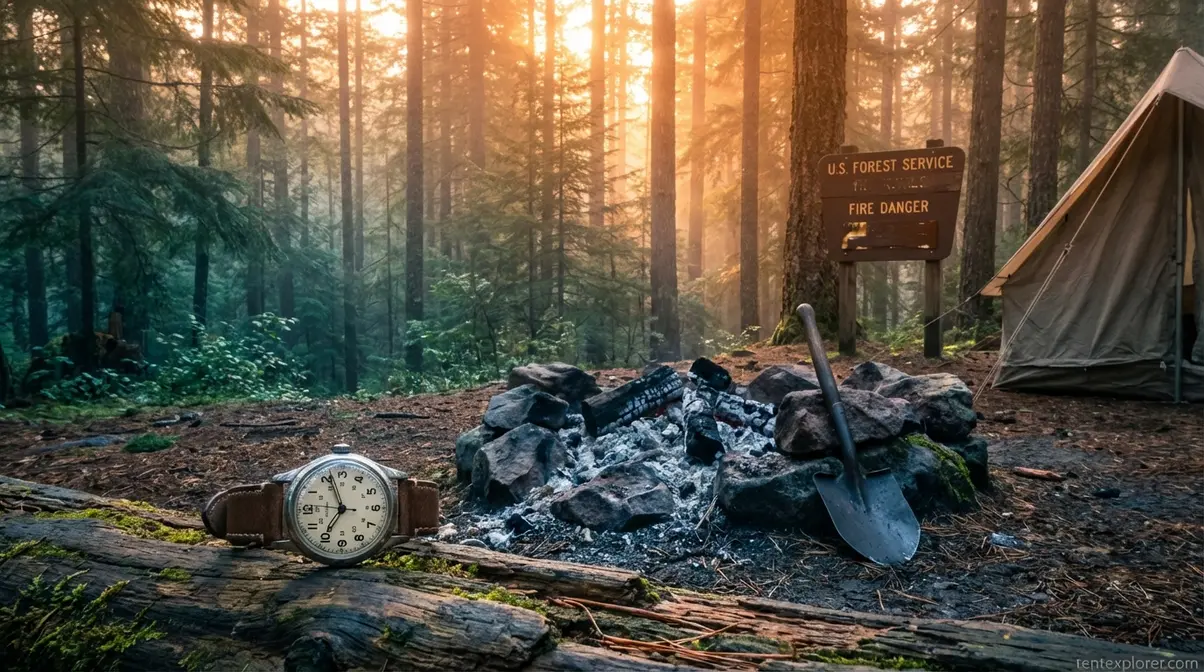
The 10 a.m. rule—formally, the U.S. Forest Service’s “10 a.m. policy”—is a historical wildfire suppression directive from 1935, not a rule for recreational campers. It required every wildfire to be contained by 10 a.m. the day after detection.
The policy emerged from the catastrophic 1910 Big Burn and remained the dominant U.S. wildfire management framework until the late 1970s.
What this means for campers: The 10 a.m. rule doesn’t apply to your campfire directly. However, it explains why many land managers are highly restrictive. The institutional memory of large fire losses shapes policy to this day. In a practical sense, “have your fire out before 10 a.m.” is sound advice on dry, windy days, as fire conditions often worsen mid-morning.
What Is the 30/30 Lightning Rule?
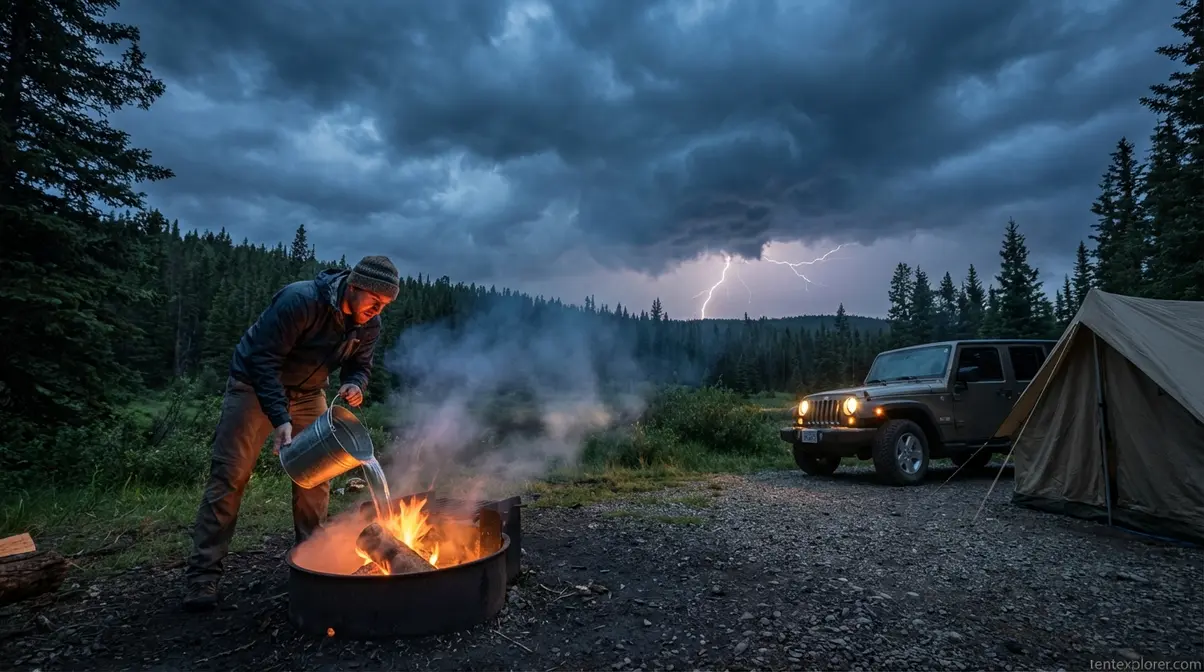
The 30/30 rule is a lightning safety guideline, not a campfire rule. A developing thunderstorm is an underestimated campfire hazard, creating both a lightning risk and a fire escalation risk from unpredictable winds.
The rule works as follows:
- 30 seconds: If you count fewer than 30 seconds between a lightning flash and thunder, the storm is within 6 miles. Seek shelter immediately.
- 30 minutes: After the last lightning flash, wait at least 30 minutes before resuming outdoor activities.
According to the National Weather Service, tents offer no protection from lightning. If a thunderstorm develops, extinguish the campfire, then move to a hard-top vehicle or a substantial building.
The campfire connection: When you see lightning and begin your count, that is also your signal to start extinguishing your fire. The 30/30 rule gives you enough warning to Drown, Stir, and Feel before seeking cover.
The 4 Golden Rules of Campfire Safety
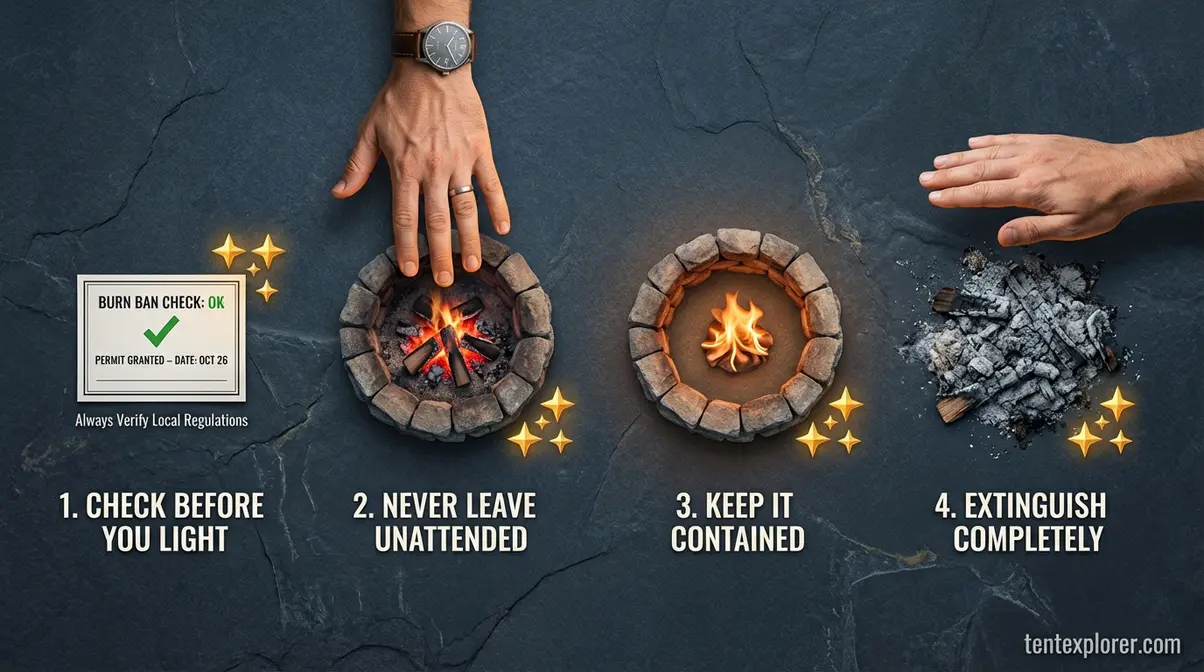
No single federal agency has formally published a list titled “4 Golden Rules of Campfire Safety,” but the principles are consistent across all Tier-1 sources.
The 4 Golden Rules, synthesized from official guidance:
- Check before you light. Verify that fires are permitted. Burn Bans and restriction levels change daily.
- Never leave a campfire unattended. If every adult needs to step away, extinguish the fire first.
- Keep it contained and controlled. Use an existing fire ring and keep the fire small.
- Extinguish completely. Cold to the touch, not just visually “out.”
These four rules define responsible campfire practice and reflect a genuine cross-organizational consensus.
The 5 E’s of Fire Safety
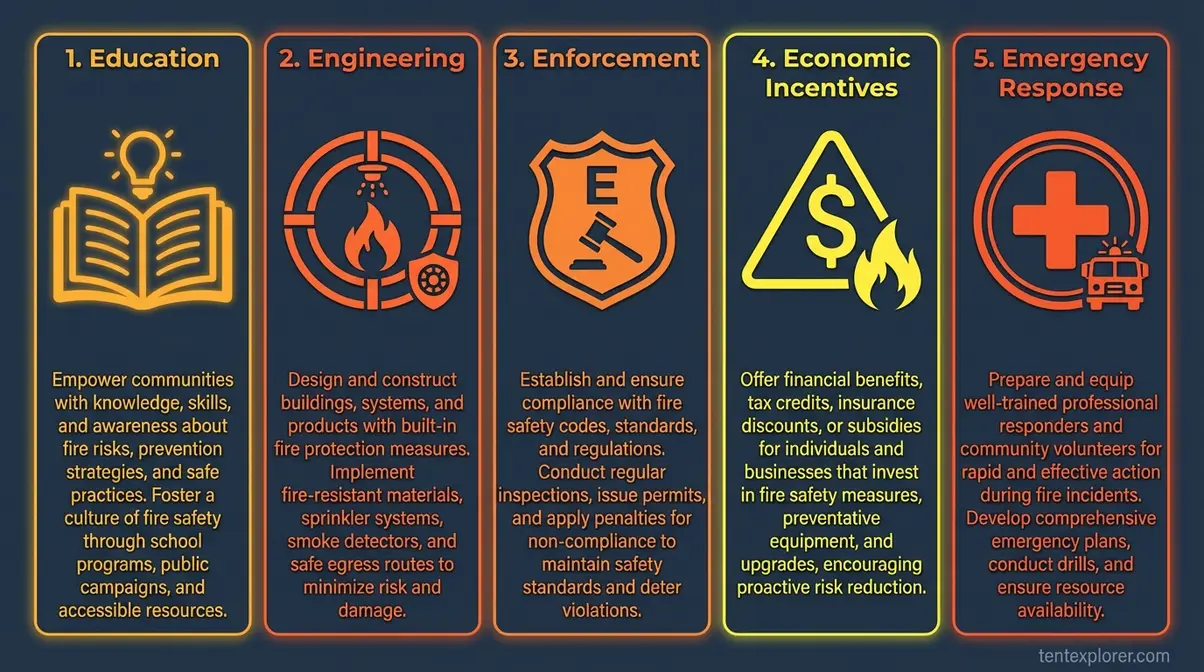
The 5 E’s of Fire Safety is a fire prevention education framework used by fire safety educators and community outreach programs.
| E | Principle | Application to Campfires |
|---|---|---|
| Education | Learn correct procedures before you go | Read official guidance (NPS, USFA, BLM) |
| Engineering | Use physical controls and structures | Use fire rings and cleared zones |
| Enforcement | Know and follow all laws and restrictions | Check Burn Bans and restriction levels |
| Economic Incentives | Understand the cost of non-compliance | Wildfire liability fines can exceed $100,000 |
| Emergency Response | Know what to do when something goes wrong | Have a bucket, shovel, and evacuation plan |
This framework is primarily a teaching tool, but it maps cleanly onto campfire preparation.
Free Printable Safety Resources
Taking your campfire safety knowledge into the field is crucial in areas without cell service. A printed checklist can be the difference between a well-managed fire and a forgotten step.
Campfire Safety PDF Checklist
Caption: A printable campfire safety checklist — designed for off-grid use when cell service isn’t available to verify procedures.
This single-page checklist covers the complete campfire lifecycle:
- Pre-Trip
- [ ] Burn Ban status confirmed for destination
- [ ] Fire restriction level confirmed
- [ ] Weather forecast reviewed (no Red Flag Warnings)
- [ ] First aid kit and emergency contacts packed
- [ ] Bucket and shovel in vehicle
- Site Setup
- [ ] Existing fire ring identified and used
- [ ] 10-foot diameter area clear of organic material
- [ ] 25-foot perimeter clear of flammable gear
- [ ] Water bucket filled and within 5 feet of fire ring
- [ ] Shovel within reach
- During Fire
- [ ] Fire remains inside the ring and under 1 foot high
- [ ] No accelerants used
- [ ] Attended by an adult at all times
- [ ] Children in designated seats; no running
- Extinguishment (Drown, Stir, Feel)
- [ ] Water poured over all ash until no hissing
- [ ] Ash stirred to expose all coals
- [ ] Second water application completed
- [ ] Back-of-hand test passed—ash is cold to the touch
Kids and Scout Safety Worksheet
Caption: A printable activity sheet that turns campfire safety rules into an engaging exercise for children ages 6–14 and scout groups.
This worksheet is designed for scout leaders and parents. It includes:
- Rule Matching Activity: Match the safety rule to its reason.
- Draw Your Fire Safety Bubble: Children draw a campsite, marking the 25-foot zone.
- The Campfire Pledge: A short, kid-readable pledge covering the four key rules.
- Emergency Contact Fill-In: Space for campsite location and an emergency number.
Scouting America recommends pre-trip safety education for youth groups, and this worksheet satisfies that recommendation.
Common Mistakes and When Not to Light a Fire
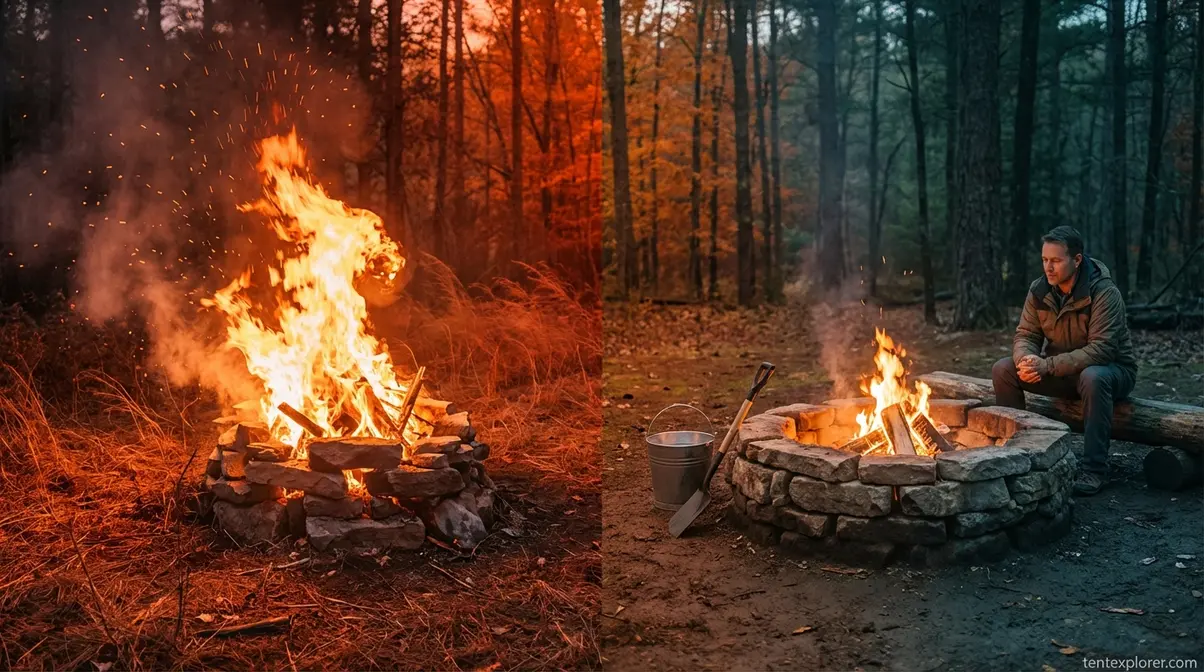
Even experienced campers make predictable errors, not from carelessness, but from habits that feel safe. Understanding these common pitfalls is as valuable as knowing the correct procedures.
Common Pitfalls to Avoid
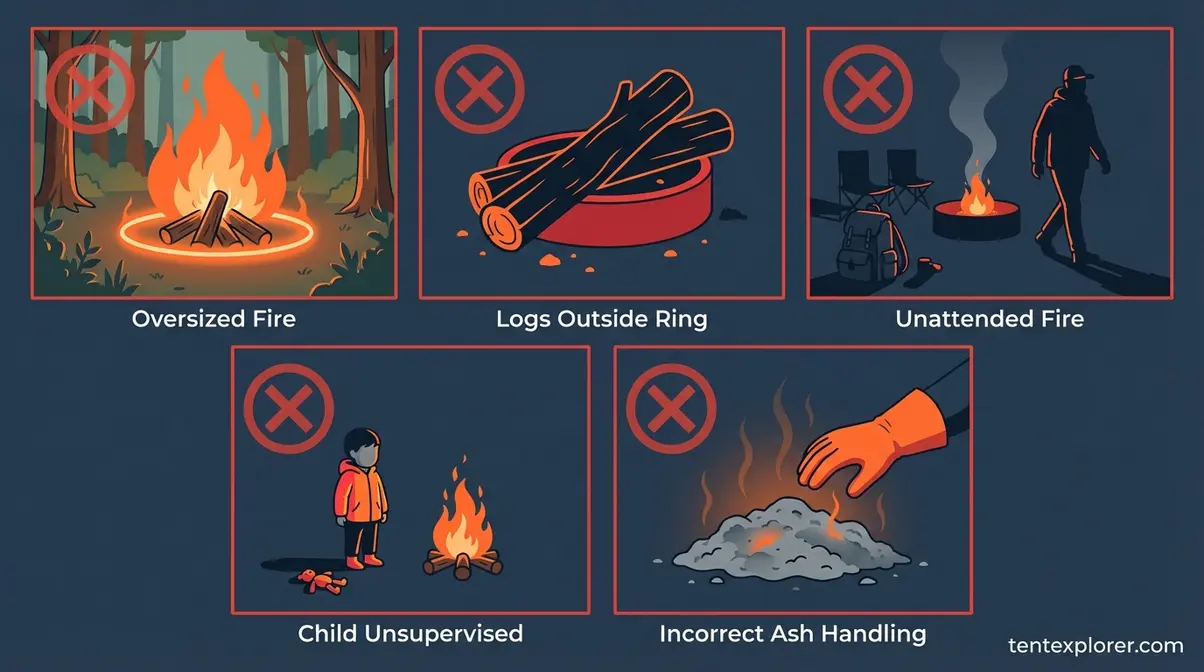
- Trusting appearances over the Feel test. A fire that looks gray can hide a live coal over 200°F. The back-of-hand test is non-negotiable. If you feel any warmth, the fire is not out.
- Building fires too large for the ring. Every inch a flame exceeds the ring multiplies the ember travel radius. Keep the fire contained to the interior of the ring.
- Using the “no wind right now” logic. Wind conditions can change in minutes. If gusty winds develop, begin extinguishment immediately.
- Assuming a designated campsite means no restrictions. A physical fire ring is not permission. The local restriction level determines what’s allowed. Always check current conditions.
- Leaving children “near” the fire but unattended. A parent simultaneously cooking and watching a child is not providing adequate supervision. Designate one adult as the dedicated fire watcher.
When to Skip the Campfire Entirely
Sometimes, the correct answer is no campfire, regardless of whether a Burn Ban is in effect. Skip the fire under these conditions:
- Active Red Flag Warning: When humidity is below 15% and winds exceed 25 mph, embers travel farthest. No campfire is worth the risk.
- Gusty winds above 20 mph: Consistent high winds create ember-travel distances that exceed the 25-foot standard.
- Extremely dry fuel: If tinder on the ground snaps when you step on it, the landscape is primed for rapid fire spread.
- You’re unsure of your location: If you cannot accurately tell a 911 dispatcher where you are, you should not manage an open fire.
- Your group is distracted or impaired: A campfire requires an alert supervisor. Fatigue and impairment are significant factors in accidents.
- A Burn Ban is in effect: This is non-negotiable. Starting a fire during a Burn Ban is illegal and makes you liable for any resulting damage.
Frequently Asked Questions
What are 5 campfire safety tips?
The five essential campfire safety tips are: check for Burn Bans before lighting, choose a site at least 25 feet from tents, keep the fire small and attended, never use accelerants, and extinguish it completely with the Drown, Stir, Feel method until the ash is cold to the touch. These five steps reflect the consistent guidance of every Tier-1 fire safety agency and are the standard for responsible outdoor recreation.
What is the 30/30/30 rule for fire?
The 30/30 lightning rule states: if thunder follows a lightning flash by 30 seconds or less, the storm is within 6 miles—seek shelter immediately. Then, wait 30 minutes after the last flash before resuming outdoor activity. A “30/30/30 rule” for fire safety does not exist as an official guideline. For campfires, the correct framework is Drown, Stir, Feel. When lightning triggers the shelter protocol, extinguish your campfire first.
What are the 7 fire safety rules?
No single federal agency publishes an official “7 fire safety rules” list, but a comprehensive framework synthesized from top agencies produces these seven principles: (1) check restrictions, (2) use designated fire rings, (3) maintain a 25-foot cleared perimeter, (4) keep fires small and attended, (5) prohibit accelerants, (6) supervise children within arm’s reach, and (7) extinguish completely until cold to the touch.
The 4 Golden Rules of Fire Safety
The 4 golden rules of campfire safety, as reflected across USFA, NPS, and NFPA guidance, are: (1) check before you light by verifying Burn Ban status; (2) never leave a campfire unattended; (3) keep it contained in a fire ring and controlled in size; and (4) extinguish it completely using the Drown, Stir, Feel method until it’s cold to the touch. These four principles are the minimum baseline for responsible campfire practice.
What is the 10 a.m. fire rule?
The 10 a.m. rule is a historical U.S. Forest Service wildfire suppression policy from 1935 requiring all wildfires to be controlled by 10 a.m. the day after detection—it is not a recreational campfire guideline. For campers, the practical takeaway is that mornings often bring dangerous fire conditions (rising temperatures, dropping humidity), making early extinguishment a sound practice on dry, windy days.
Final Thoughts on Campfire Safety
Across more than a century of fire safety guidance, the core requirements haven’t changed: the right site, a fire that stays inside its boundaries, an attentive adult, and an extinguishment that doesn’t stop until the ash is cold. Every major Tier-1 agency agrees on these fundamentals because the physics of fire don’t change.
The Fire Safety Bubble is the framework that ties these requirements into a single mental model. When you ask “Is my Fire Safety Bubble intact?”—is the 25-foot zone clear, is a responsible adult supervising, and is the fire completely out—you’ve covered the full checklist.
Your next campfire trip is the right moment to put this into practice. Run the pre-trip checklist, check the local restriction level, fill your water bucket, and don’t leave camp until the ash passes the Feel test.
For a deeper walkthrough of every element, you can explore other resources on tentexplorer.com that pair with the printable checklists above for a complete field reference.