
This blog post may contain affiliate links. As an Amazon Associate I earn from qualifying purchases.
Your first camping trip is two weeks away, and you’re staring at a blank packing list wondering if you’re forgetting something important. That feeling is completely normal — and it’s exactly why this beginner camping checklist exists.
Most online lists leave you with more questions than answers. REI’s checklist skips the can opener. The NPS page doesn’t mention what happens when your phone dies in the woods. Beginners who rely on those sparse resources often arrive at the campsite missing the small, obvious things — not the tent, but the lighter. Not the sleeping bag, but the extra batteries. One incomplete list can turn an exciting first trip into a frustrating one.
By the end of this guide, you’ll have a complete, categorized beginner camping checklist covering shelter, food, clothing, safety, and the rules every first-timer needs to know — plus a free printable PDF to take with you. We’ve organized everything by category so you can check off each section, skip what doesn’t apply to your trip style, and arrive at the trailhead feeling genuinely ready.
A complete beginner camping checklist covers five core categories: shelter, cooking, clothing, safety, and campsite extras — and knowing which items are Must-Haves vs. Nice-to-Haves helps you pack smart without overspending.
- Shelter is non-negotiable: Tent, sleeping bag, sleeping pad, and headlamp are your survival essentials
- Most forgotten items include a can opener, extra batteries, and toilet paper — not glamorous, but critical
- The Must-Have vs. Nice-to-Have Rule separates survival gear from comfort upgrades at every category, so beginners can prioritize on a budget without second-guessing every purchase
- Download the free printable PDF version of this checklist to take on your trip
- Camping style matters: Tent, car, family, and RV camping each have different gear requirements
Your Complete Beginner Camping Checklist
This section contains the core beginner camping checklist organized into five essential categories. Every item is labeled (M) Must-Have — a survival essential you genuinely cannot camp safely without — or (N) Nice-to-Have — a comfort upgrade that improves the experience but isn’t critical. This Must-Have vs. Nice-to-Have Rule is the organizing principle of this entire guide. It helps you prioritize on a budget, avoid overpacking, and make confident decisions when you’re standing in the gear aisle wondering what actually matters.
As one first-time camper put it before their trip:
“Here are some of the few things that you would need when you go camping: Tent, sleeping bag, water bottle, fire starter, first aid kit, food, and a pocket knife…”
That instinct is exactly right. This checklist starts there and builds out everything else you actually need — organized so nothing gets left behind.
⛺ Shelter & Sleeping Essentials
Your tent camping checklist starts here — because if your shelter fails, nothing else matters. Our team evaluated gear across multiple camping styles and found that shelter mistakes cause more miserable first trips than any other category.
What to pack and why:
- (M) Tent — Buy a tent rated for one more person than your group size. A 2-person tent for a solo camper gives you room to store gear inside. Practice setting it up at home before the trip — in the dark, an unfamiliar tent becomes a 45-minute ordeal.
- (M) Sleeping bag — Choose a bag rated at least 10°F below the lowest expected overnight temperature. A summer night that hits 50°F will feel brutal in a bag rated for 60°F. Your sleeping bag packs into a stuff sack (the compression bag it rolls into) — keep this accessible.
- (M) Sleeping pad — This is the insulated mat that goes between you and the cold ground. Its purpose isn’t just comfort — ground contact pulls heat from your body faster than cold air does. Look for an R-value rating: the higher the R-value, the warmer you’ll sleep.
- (M) Headlamp — A headlamp beats a flashlight every time because it leaves your hands free for setting up camp, cooking, and finding the bathroom at 2 AM. Pack extra batteries alongside it.
- (M) Tent stakes — Wind is unpredictable. Stakes keep your tent grounded.
- (N) Tent footprint — The groundsheet that goes under your tent to protect the floor from rocks and moisture. Not critical for a weekend trip, but it extends the life of your tent significantly.
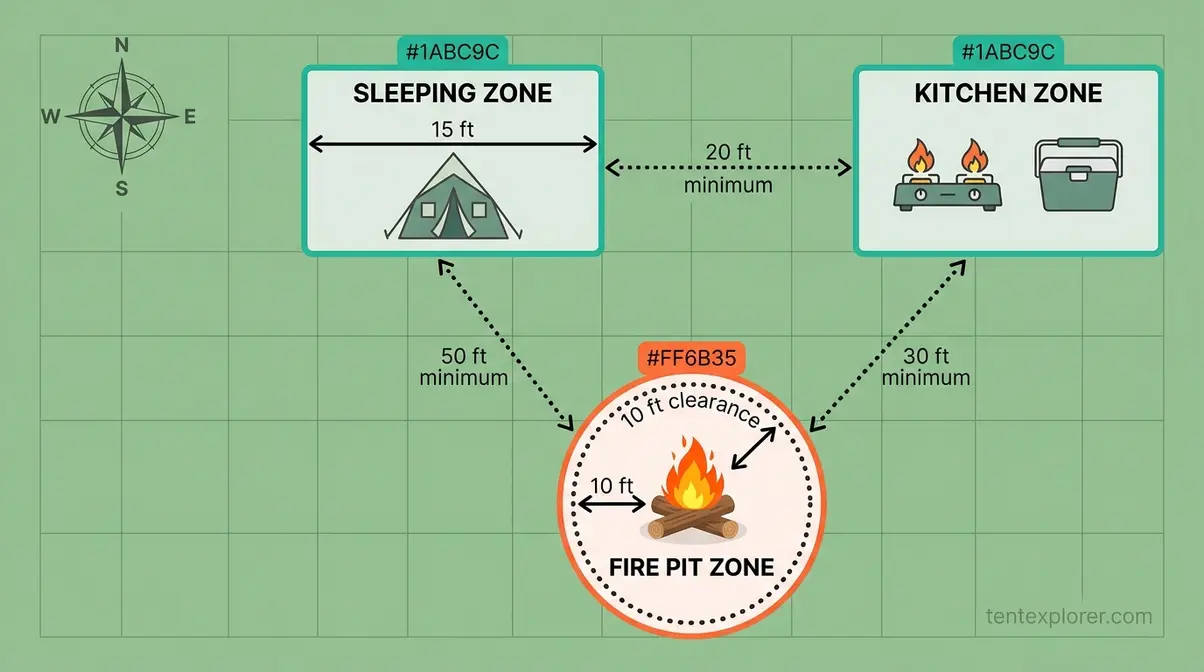
California State Parks recommends setting up your tent at least 15 feet upwind from grills and fires — a simple habit that keeps sparks away from your sleeping area (California State Parks).
Once your shelter is sorted, the next question every beginner asks is: what do I actually cook with out there?
🍳 Camp Kitchen & Cooking Gear
A functional camp kitchen doesn’t require expensive equipment — it requires the right equipment. The camping beginner checklist for the kitchen is shorter than most people expect, and most of it you probably already own in some form.
- (M) Camp stove + fuel canister — For car camping, a simple 2-burner propane stove is the most beginner-friendly option. Check whether your campground allows fuel canisters before you leave.
- (M) Cooler — Use a 2:1 ice-to-food ratio for best cold retention. Keep raw meat on the bottom, away from ready-to-eat items. A 50-quart cooler handles a 3-day trip for two people comfortably.
- (M) Basic cookware set — A pot, a pan, and a mess kit (an all-in-one cooking set) covers most meals and reduces the number of items to remember.
- (M) Can opener — This is the single most universally forgotten kitchen item. If you’re bringing canned beans, soup, or vegetables, a can opener is non-negotiable.
- (M) Utensils — Spatula, camp plates and bowls, and biodegradable camp soap for washing up.
- (M) Food storage — If camping in bear country, check whether a bear canister (a hard-sided container that prevents bears from smelling your food) is required by the campground. Always follow the “pack it in, pack it out” principle: every wrapper, food scrap, and piece of trash leaves with you.
- (N) Specialized camp cookware — Titanium pots and ultralight sets are great for backpacking, but unnecessary for a first car camping trip.
With shelter and food covered, the clothing you pack — and how you layer it — will determine whether you sleep warm or shiver through the night.
👕 Clothing, Hygiene & Personal Care
Experienced campers consistently report that clothing is where beginners make their most costly mistakes — not because they pack the wrong brands, but because they don’t understand the layering system.
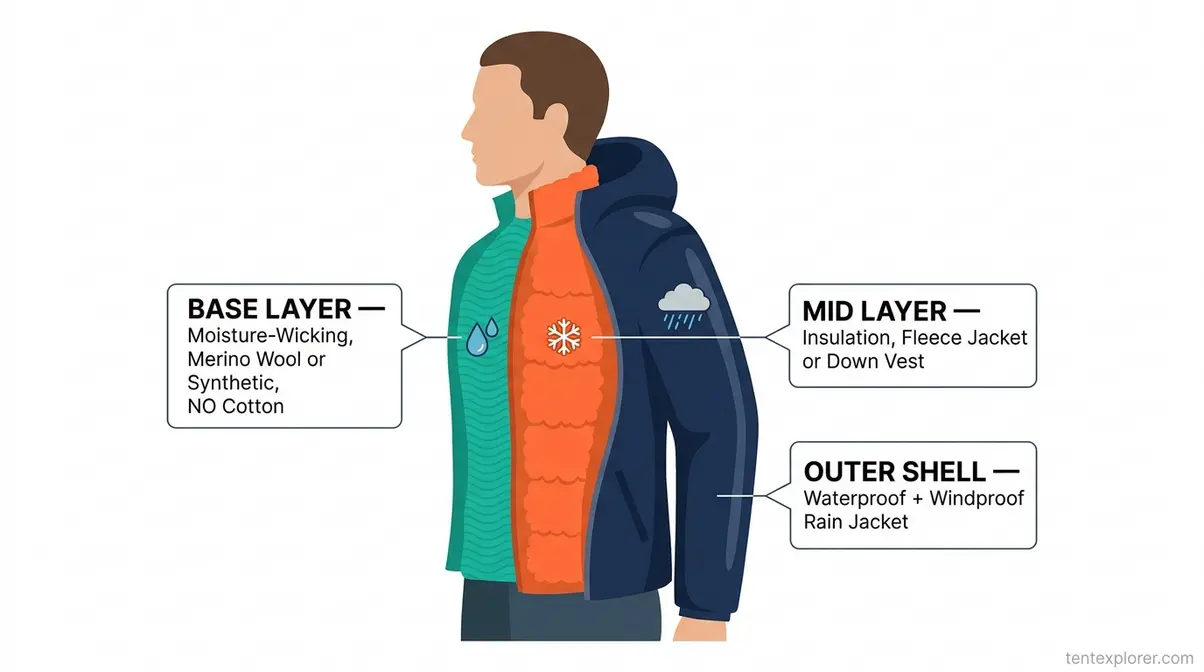
The 3-layer system (label the whole system M):
- Base layers — The moisture-wicking layer worn directly against your skin. Cotton is the enemy here; it holds moisture and accelerates heat loss. Choose synthetic or merino wool.
- Mid layer — The insulation layer. A fleece jacket or down vest traps body heat. This is what you’ll wear around the campfire on cool evenings.
- Outer layer/shell — The waterproof and windproof layer. Even a sunny summer forecast can turn rainy. The USDA Forest Service warns that wet clothes contribute to heat loss, making a waterproof outer layer essential even in summer (USDA Forest Service). Pack one more layer than you think you’ll need — nights are always colder than days outdoors.
Additional clothing and hygiene items:
- (M) Rain jacket — Even if the forecast looks perfect.
- (M) Biodegradable soap and toilet paper — Biodegradable means the soap breaks down naturally in the environment, which is required near water sources under Leave No Trace principles. Pack toilet paper in a sealed ziplock bag.
- (N) Camp towel — Microfiber camp towels are compact and fast-drying. A regular towel also works; most campgrounds have showers.
- (N) Portable camp shower — A solar shower bag is a practical upgrade for multi-day trips without shower facilities.
Shelter, food, and clothing form the survival core. Now let’s look at the safety and tool items that could genuinely save your trip — or your life.
🔦 Safety, Tools & Navigation
This is where the best camping checklist earns its value — by being honest about what’s truly essential versus what sounds essential.
- (M) First aid kit — Buy a pre-built kit rather than assembling one from scratch. At minimum, it should include blister treatment, pain relievers, antihistamine, and an assortment of bandages. Treating a blister on day one instead of day three changes the entire trip.
- (M) Fire starter — Carry a lighter AND waterproof matches as a backup. One backup isn’t enough. According to emergency room doctors at UAB Medicine, clearing a 10-foot area around the fire pit of dry leaves and flammable materials is a critical safety step that most beginners skip (UAB Medicine).
- (M) Pocket knife or multi-tool — Versatile enough for food prep, gear repair, and emergency use. A multi-tool adds pliers and a screwdriver for roughly the same weight.
- (M) Navigation tools — Cell service disappears in many campgrounds. Download an offline map via AllTrails or Gaia GPS before you leave home, and carry the campground’s paper map in your pack.
- (M) Whistle and emergency contact card — A whistle carries farther than a shout and uses no battery. Write your campsite number and emergency contact information on a card and keep it in your pocket.
The Must-Have items are now covered. Here’s where the Nice-to-Haves come in — the extras that transform a functional campsite into a comfortable one.
🪑 Camp Comfort & Optional Extras (Nice-to-Haves)
These items won’t save your life, but they’ll make you want to go camping again.
- (N) Camp chairs — Highly recommended for car camping, where weight is irrelevant. REI and Coleman both list these as car camping essentials, and they’re right.
- (N) Lantern — If you have a headlamp, you have light. A lantern lights up the entire campsite for social evenings around the table.
- (N) Hammock — Check campground regulations before hanging one; some prohibit tree hammocks. Use tree straps, not rope, to avoid bark damage.
- (N) Camp pillow — A stuff sack filled with tomorrow’s clothes is a free alternative that works surprisingly well.
Quick rule: if it fits in your car and costs under $30, bring it. If it costs more, ask whether you’ll use it on more than one trip. For a deeper breakdown of what to pack for your specific setup, see this detailed tent camping gear checklist.
📋 Get the Free Printable Checklist: Download a beautifully formatted, one-page PDF of this entire beginner camping checklist — all 5 categories, labeled Must-Have vs. Nice-to-Have. [Download Free PDF →]
The Top 10 Most Forgotten Camping Items
Most beginner camping disasters aren’t caused by forgetting the tent — they’re caused by the small items nobody thinks to list. Campground experts at Jellystone Park, a national network of family campgrounds with data on common camper mistakes, consistently identify consumables and small tools as the items most frequently left behind. Think of this section as your pre-departure rescue list: run through it the night before you leave, not the morning of.
Why Beginners Always Miss These
Beginners spend their mental energy on the big, expensive items — tent, sleeping bag, sleeping bag pad — and assume the small stuff will somehow take care of itself. It doesn’t. Consumables like batteries, matches, and toilet paper are left off most gear lists because they seem too obvious to mention. They are not obvious at 6 AM when you’re loading the car.
According to experienced Scout volunteers, some of the most frequently forgotten but highly useful camping items include nightlights and space-saving gadgets — the kind of thing you’d never think to add to a traditional packing list (The Scouts Association, 2024). The pattern is consistent: the last thing you grab is the first thing you forget. The lighter from the kitchen drawer and the batteries from the junk drawer are classic examples of items that never quite make it into the bag.
Crucially, nearly every item on this list is a Must-Have under the Must-Have vs. Nice-to-Have Rule — not a comfort upgrade. That’s what makes forgetting them so consequential.
Here’s the list to run through the night before you leave.
The Forgotten Items Rescue List
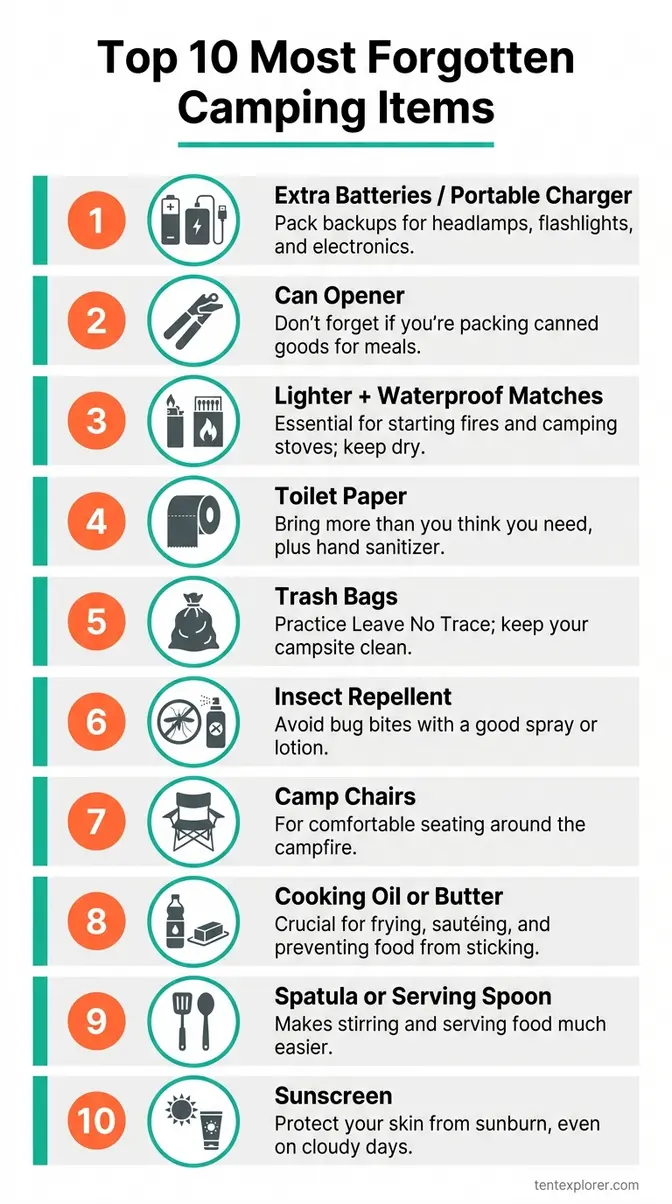
Campground experts identify extra batteries, portable chargers, reusable water bottles, and insect repellent as the items campers most frequently forget to pack (Jellystone Park, 2025).
- Extra batteries / portable charger — Headlamps die mid-trip. Phones need charging for navigation and emergencies. Pack both.
- Can opener — If you’re bringing canned food, this is non-negotiable. It’s also universally forgotten.
- Lighter AND waterproof matches — One backup isn’t enough. Carry both; store matches in a waterproof container.
- Toilet paper — Campground bathrooms run out. Pack your own in a sealed ziplock bag.
- Trash bags — “Pack it in, pack it out” requires bags. Most campgrounds don’t supply them.
- Insect repellent — Feels optional until the mosquitoes arrive at dusk.
- Camp chairs — Often forgotten because they’re stored in the garage rather than with camping gear.
- Cooking oil or butter — Everything sticks to camp cookware without it. A small travel-size container is enough.
- Spatula or serving spoon — Most camp cookware sets don’t include these.
- Sunscreen — Tree cover does not equal SPF protection. Pack it even for forest camping.
Now that you know what to double-check, let’s look at how your checklist changes depending on your camping style.
Camping Checklists for Every Style
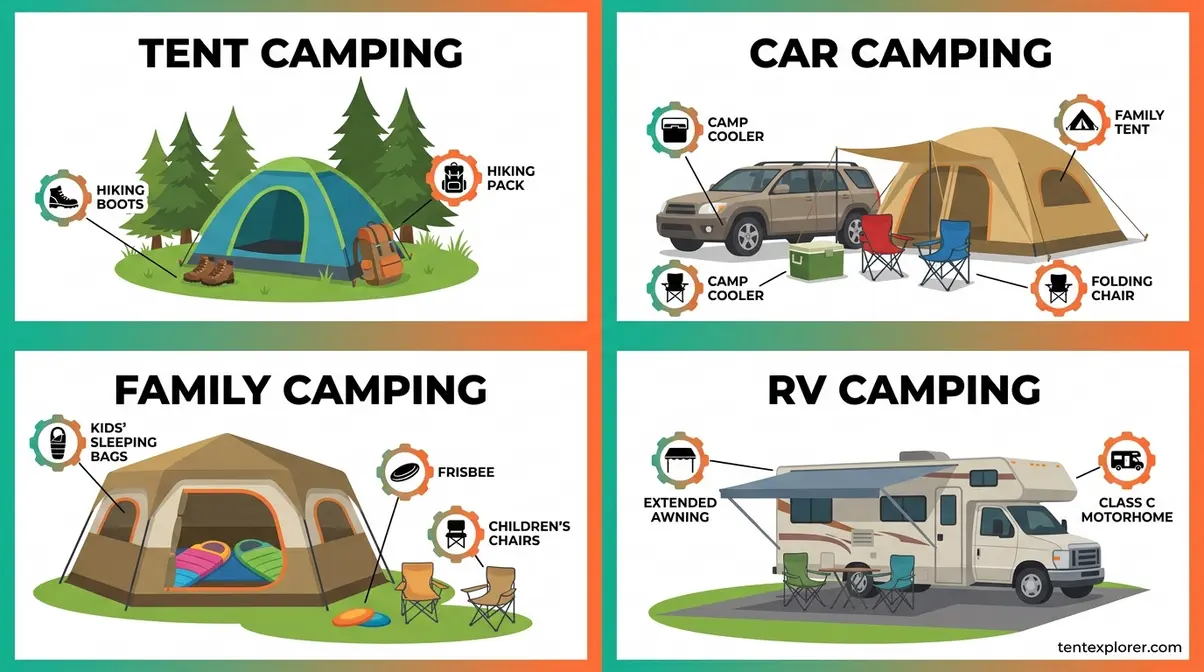
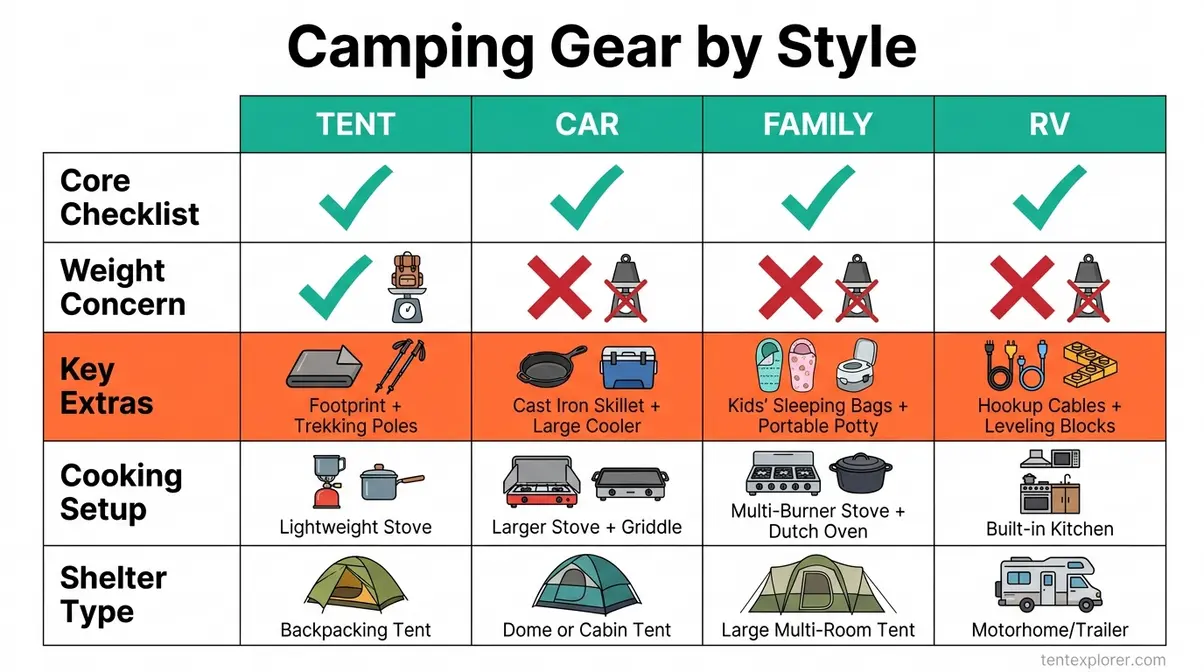
A tent camper and a car camper both need the core essentials from the checklist above — but their gear lists diverge significantly after that. Think of this section as the customization layer: same foundation, different additions based on how you’re traveling and who’s coming with you.
| Camping Style | Core Checklist Applies? | Key Extras | Weight Concern? |
|---|---|---|---|
| Tent Camping | ✅ Yes | Footprint, extra stakes, lightweight cookware | Yes |
| Car Camping | ✅ Yes | Camp chairs, larger cooler, cast iron skillet | No |
| Family Camping | ✅ Yes | Kids’ sleeping bags, entertainment, safety items | Somewhat |
| RV Camping | Partial (no tent) | Hookup cables, leveling blocks, water hose | No |
Tent Camping: Your Core Setup List
Your tent camping checklist differs from car camping primarily in one word: weight. Every item you add has to be carried, packed, or justified.
- (M) Tent footprint — The groundsheet that goes under your tent floor. For tent camping specifically, this protects against moisture and sharp rocks that would otherwise wear through the tent floor.
- (M) Extra tent stakes and guy lines — Wind is unpredictable. Practice staking the tent at home before the trip; KOA specifically recommends this as one of the top preparation steps for first-time campers.
- (M for backpacking / N for drive-in) Lightweight cookware — If you’re driving to the campsite, a basic pot and pan set works fine. If you’re hiking in, every ounce counts.
- (N) Trekking poles — Skip these for drive-in tent camping. They’re valuable for hike-in sites with uneven terrain.
Pro tip: Set up your tent in your backyard at least once before the trip. A 10-minute practice run at home prevents a 45-minute struggle in the dark after a long drive.
Car camping removes the weight constraint entirely — which changes everything about what you can bring.
Car Camping: What Changes?
Car camping — driving your vehicle directly to a campsite, where weight and bulk are no concern — is the most beginner-friendly camping style. When you’re not carrying your gear on your back, the Nice-to-Have column shrinks considerably. Many items that are optional for backpackers become practical must-haves for car campers.
- (M) Camp chairs and folding table — No weight penalty means no reason to leave these behind. Both REI and Coleman highlight these as car camping essentials.
- (M) Larger cooler (50+ quart) — Fits more food and ice for multi-day trips. The 2:1 ice-to-food ratio still applies.
- (N) Cast iron skillet — Heavy, but produces better cooking results than lightweight camp pans. A worthwhile upgrade once you’ve done a trip or two.
- (N) Portable camp shower — A solar shower bag heats water using sunlight and provides a genuine hot shower at your campsite.
For finding the right tent for car camping, this guide to best tents for car camping covers the key differences in size, setup, and durability.
Organization tip: Pack all your camping gear into one large plastic bin. It protects items from condensation, prevents things from rolling around in the trunk, and makes loading and unloading significantly faster.
Add kids to the equation, and your checklist grows by a dozen more items.
Family Camping with Kids: Extra Gear You’ll Need
Family camping with kids — which requires additional safety gear, entertainment, and comfort items — is one of the most rewarding camping experiences, and one of the most demanding to plan. The core checklist applies to everyone; here’s what gets added.
- (M) Kids’ sleeping bags — Adult sleeping bags don’t fit children safely. A bag that’s too large won’t retain heat properly. Match the temperature rating to the expected overnight low, not the daytime high.
- (M) Child-specific safety items — Kid-sized life jackets if you’re camping near water, clip-on glow lights for nighttime visibility, and DEET-free insect repellent for children under 12.
- (M) Children’s first aid additions — Children’s pain reliever, children’s antihistamine, and kid-sized bandages. The standard adult first aid kit won’t cover these.
- (M) Portable potty or toilet training seat — Essential for toddlers when campground bathrooms are a walk away in the dark.
- (N) Entertainment — Frisbee, a deck of cards, a simple scavenger hunt list, and coloring books for rainy afternoons. These feel optional until it rains.
REI’s family camping checklist includes a small broom and dustpan for keeping the tent floor clean — a practical tip that no other major camping resource explains, but any parent who’s camped with a 4-year-old will immediately understand.
For shelter options that fit the whole family, this comparison of top family tents for groups covers capacity, setup time, and weather resistance.
RV camping is a different world — here’s what to add and what to leave behind.
RV Camping: The Beginner Basics
The beginner RV camping checklist overlaps significantly with car camping in comfort level. The main difference is hookup management — connecting your RV to campground utilities rather than relying on built-in tanks.
- No tent needed — But consider a screen room or pop-up awning for outdoor sitting.
- (M) Fresh water hose — Use a white drinking-water-safe hose specifically. A standard garden hose is not food-safe and can affect water taste and safety.
- (M) Sewer hose — Required for connecting to the campground’s sewer system.
- (M) Electrical adapter — Know whether your RV uses a 30-amp or 50-amp connection before you arrive. Most campgrounds offer both, but you need the right adapter.
- (M) Leveling blocks — An unlevel RV affects sleep quality, appliance operation, and slide-out function. Stack these under the low-side tires until the RV sits level.
Apply the 3-3-3 rule (covered in the next section) to your travel schedule — it’s the single best pacing strategy for first-time RV campers.
Whether you’re tent camping or RVing, knowing the rules of the campground — and the outdoor ethics every camper should follow — makes the difference between a good trip and a great one.
The 7 C’s of Camping, Leave No Trace & Essential Rules
What are the rules every beginner camper needs to know? There are three frameworks that answer this: the 7 C’s (what to bring), Leave No Trace (how to behave), and the travel pacing rules (3-3-3 and 2-2-2). Together, they form the behavioral layer that sits on top of your gear list — the difference between someone who camps and someone who camps well.
What Are the 7 C’s of Camping?
The 7 C’s of Camping — Cutting tool, Combustion, Cover, Container, Cordage, Candling, and Compass — form the survival core of any camping kit. This is a mnemonic device used by survival educators to remember the minimum viable camping kit. Every item represents a category of need, not a specific product — which makes it flexible enough to apply across all camping styles.
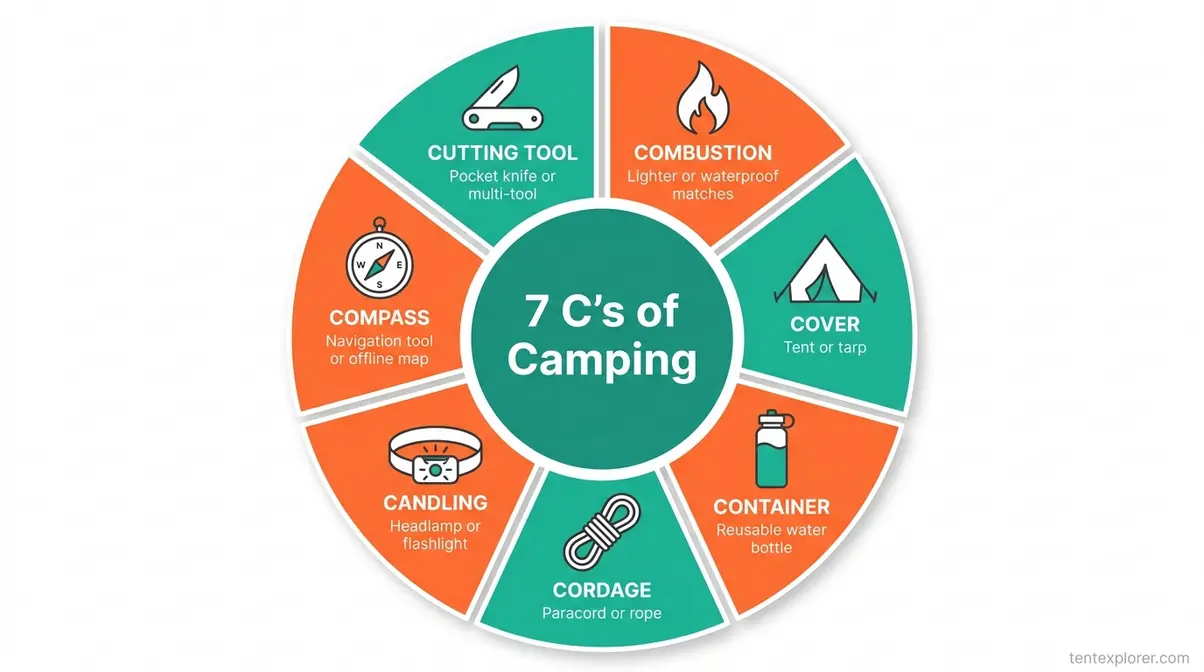
Here’s each C with a practical explanation:
- Cutting tool — A pocket knife or multi-tool for food prep, gear repair, and emergency use
- Combustion device — A lighter or waterproof matches for starting a fire and cooking
- Cover — A tent or tarp to protect you from weather overnight
- Container — A reusable water bottle for hydration and water carrying
- Cordage — Rope or paracord for securing gear, hanging food bags, and emergency tent repairs
- Candling — A headlamp or flashlight for nighttime navigation and campsite use
- Compass — A navigation tool; a downloaded offline map is a practical modern complement
Notice that every 7 C item is labeled Must-Have in the core checklist above — no coincidence. The 7 C’s are Must-Haves by definition. If you have all seven, you have the foundation for a safe camping trip regardless of style.
The 7 C’s tell you what to bring. Leave No Trace tells you how to behave once you’re there.
Leave No Trace: The 3 Rules Every Beginner Must Know
Leave No Trace is the outdoor ethics framework used by the National Park Service and outdoor educators worldwide — not just a bumper sticker slogan, but a set of 7 principles for minimizing human impact on natural spaces. Beginners don’t need to memorize all 7 on their first trip. Focus on these three:
- Pack it in, pack it out — Every piece of trash leaves with you. This includes food scraps, orange peels, and coffee grounds — items that feel “natural” but disrupt local ecosystems.
- Leave what you find — No picking wildflowers, moving rocks, or taking “souvenirs” from the campsite. Leave the site exactly as you found it.
- Respect wildlife — Store food in a bear canister or hang it at least 200 feet from your tent. Never feed animals, even small ones — human food disrupts their natural foraging behavior.
The biodegradable soap from the Clothing section connects directly to Leave No Trace: use it at least 200 feet from any water source to prevent contamination of streams and lakes. For a deeper look at staying safe while following these principles, these essential camping safety rules and tips cover the most common scenarios beginners encounter.
Beyond LNT, there are two travel pacing rules that every beginner camper — especially RV beginners — should know before hitting the road.
Campground Rules & Etiquette: 3-3-3, 2-2-2, and FF Explained
The 3-3-3 rule for camping: The 3-3-3 rule suggests driving no more than 300 miles per day, arriving at your campsite by 3 PM, and staying for a minimum of 3 nights. According to Cruise America, this pacing guideline — most commonly used for RV travel — helps make road trips more relaxing by reducing the time spent driving versus enjoying the destination (Cruise America). Arriving by 3 PM specifically ensures you have daylight to set up camp before dark. It’s a guideline, not a hard rule — adjust based on your group’s needs and driving comfort.
The 2-2-2 rule: A lighter version of the same concept — drive no more than 200 miles per day, arrive by 2 PM, and stay for at least 2 nights. This pacing works particularly well for families with young children or first-time road trippers who need more time at each stop. Less driving, more camping.
What does FF mean at a campground? The most widely used and verified term for a fully-serviced campsite is FHU (Full Hookup) — a site that provides electrical, water, and sewer connections for RV camping. According to RV industry sources including RV LIFE and Campgroundviews.com, FHU is the standard campground abbreviation. Some booking platforms also use FF informally, but FHU is the term you’ll see most consistently. Contrast with: E (electric only), W/E (water and electric, no sewer), and primitive (no hookups — you rely entirely on your own tanks and battery). When booking, look for “FHU” or “Full Hookup” in the site description if you want all three connections.
Even with the perfect checklist and the right rules, first-time campers make predictable mistakes. Here’s how to avoid the most common ones.
Common Beginner Camping Mistakes to Avoid
The most common beginner camping mistake isn’t forgetting gear — it’s bringing too much of the wrong gear and too little of the right stuff. Experienced campers report that overpacking comfort items while underpreparing on safety essentials is the pattern that turns first trips into last trips.
The Gear Mistakes That Ruin First Trips
- Buying the cheapest tent available — A $30 tent that leaks in light rain creates a miserable first night that may discourage you from camping again. Spend at least $80–100 on a tent with a full rainfly. Entry-level options from Coleman, REI Co-op, and Kelty offer reliable weather protection without a large investment.
- Relying on phone GPS without a backup — Cell service drops in many campgrounds, including popular ones. Download an offline map via AllTrails or Gaia GPS before you leave home, and carry the campground’s paper map in your pocket.
- Skipping the home test — Setting up an unfamiliar tent for the first time in the dark, after a long drive, is one of the most common sources of first-trip frustration. KOA specifically recommends practicing tent setup at home before the trip — 10 minutes in your backyard prevents an hour of confusion at the campsite.
- Choosing a 32°F sleeping bag for summer camping — Overnight temperatures in the mountains or forests regularly drop lower than campers expect. A bag rated to 32°F may leave you shivering at 45°F. Always choose a bag rated at least 10°F below the lowest expected overnight temperature.
When to Simplify Your Setup
You might be tempted to research every piece of gear thoroughly before your first trip. That instinct is useful — up to a point. If the planning feels overwhelming, that’s a signal to simplify, not to buy more.
A tent, sleeping bag, sleeping pad, headlamp, and a cooler of food is genuinely enough for a successful first camping trip. Everything else is a bonus.
When in doubt, choose a campground with amenities — showers, a camp store, electricity hookups — rather than a primitive site. Amenity-rich campgrounds immediately remove 5–10 items from your checklist. You don’t need a portable shower, a camp lantern, or a water filter when the campground provides these.
If you’re camping in bear country, near open water, or in extreme temperatures for the first time, contact the campground’s ranger station before your trip. Rangers will tell you exactly what’s required for your specific site — and that information is far more reliable than any generic online list.
Frequently Asked Questions
What Do I Need for Camping as a Beginner?
For a first camping trip, beginners need five essential categories of gear: shelter and sleeping (tent, sleeping bag, sleeping pad), cooking (camp stove, cooler, basic utensils), clothing (layered system with rain jacket), safety (first aid kit, fire starter, headlamp), and personal care (biodegradable soap, toilet paper). A sleeping bag rated at least 10°F below the lowest expected overnight temperature is the single most important gear decision a beginner makes. Start with the five core categories, add the most forgotten items from the rescue list above, and download a free printable PDF checklist to make sure nothing gets left behind.
What Is the 2-2-2 Rule for Camping?
The 2-2-2 rule is a travel pacing guideline primarily used for RV camping: drive no more than 200 miles per day, arrive at your campground by 2 PM, and stay for a minimum of 2 nights. This pacing prevents travel fatigue and ensures you have enough daylight to set up camp comfortably. It’s especially practical for families with young children or first-time road trippers who need more time at each destination. Think of it as a lighter version of the 3-3-3 rule — same principle, more manageable distances.
What Is the Most Forgotten Item When Camping?
The most commonly forgotten camping items include extra batteries, a can opener, a lighter or waterproof matches, and toilet paper — items so mundane that most gear lists skip them entirely. Insect repellent and a portable phone charger are also frequently left behind, often because they live in different places at home rather than with the camping gear. Campground experts identify these small consumables as the items that cause the most frustration once you’re on-site. The fix is straightforward: run through a pre-departure checklist the night before you leave, not the morning of.
What Is the 3-3-3 Rule Camping?
The 3-3-3 rule for camping suggests driving no more than 300 miles per day, arriving at your campsite by 3 PM, and staying for a minimum of 3 nights. This pacing guideline — most commonly associated with RV travel — helps make road trips more relaxing by reducing the time spent driving versus actually enjoying the destination. Arriving by 3 PM gives you enough daylight to set up camp before dark, which is especially important for beginners who need more time for tent setup and site organization. It’s a guideline, not a strict rule — adjust based on your group’s pace and energy.
What Are the 7 C’s of Camping?
The 7 C’s of Camping is a survival preparedness mnemonic covering seven essential gear categories: Cutting tool (knife or multi-tool), Combustion device (lighter or matches), Cover (tent or tarp), Container (water bottle), Cordage (rope or paracord), Candling (headlamp or flashlight), and Compass (navigation tool). Together, these seven items form the minimum viable survival kit for any camping trip. Every one of the 7 C’s appears as a Must-Have item in a complete beginner camping checklist — the frameworks align exactly. Modern campers often add a downloaded offline map as a practical complement to a physical compass.
What Does FF Mean at a Campground?
FHU at a campground stands for Full Hookup — a campsite that provides electrical, water, and sewer connections for RV camping. Some booking platforms informally use FF to mean the same thing, but FHU is the verified industry-standard abbreviation confirmed by RV industry sources including RV LIFE and Campgroundviews.com. Full hookup sites are the most amenity-rich option and eliminate the need for a water tank refill, generator, or dump station visit during your stay. Contrast with E (electric only), W/E (water and electric, no sewer), and primitive (no hookups at all).
Wrapping Up Your First Trip Plan
For first-time campers, a complete beginner camping checklist covers five core categories: shelter, cooking, clothing, safety, and campsite extras. Campground experts consistently identify extra batteries, can openers, lighters, and toilet paper as the items that cause the most frustration when forgotten — not the tent, but the small consumables nobody thinks to list. The most important single decision is your sleeping bag’s temperature rating: choose a bag rated at least 10°F below the lowest expected overnight temperature, and you’ll sleep warm on even a cool summer night. Apply the Must-Have vs. Nice-to-Have Rule to every item, and your packing list becomes a decision framework rather than a source of anxiety.
That framework doesn’t expire after your first trip. The Must-Have vs. Nice-to-Have Rule is a mental model that grows with you — as your experience increases, your checklist gets shorter because you know instinctively which items actually matter. The framework stays the same whether you’re packing for a one-night tent camping trip or a two-week RV adventure. It connects directly back to the anxiety that brought you here: the fear of forgetting something critical. Now you know the difference between critical and comfortable.
Your next step is concrete: download the free printable PDF checklist, set up your tent in the backyard this weekend, and book a campground with full amenities for your first trip — electricity, showers, and a camp store on-site removes at least 10 items from your must-pack list immediately. A fully-serviced first trip builds the confidence to go more primitive next time. [Download the Free PDF Checklist →] and check off your essential camping gear for beginners before you leave home.