
The Camping Field Journal
Solar vs Battery Camping Lanterns: Which Wins in 2026?

Home/Outdoor Living

Outdoor Living

Solar vs Battery Camping Lanterns: Which Wins in 2026?

David KingDavid King Updated June 29, 2026 27 min read
This blog post may contain affiliate links. As an Amazon Associate I earn from qualifying purchases.

“Solar camping lanterns are mostly a gimmick. They are more trouble than they are worth.”

That’s one of the most common things people say before they understand The Light Reliability Gap — the real reason some lanterns fail you and others don’t. It’s not about which type is “better.” It’s about which type holds up under your conditions.

Choose the wrong lantern and you’re squinting at a dead solar panel at 9 PM, or hauling a bag of dead batteries out of a national park. The debate around solar vs battery camping lanterns has been dominated by vague opinion for years. This guide cuts through that with real performance data — including cold-weather battery loss, a precise lumen guide, and a use-case decision framework.

By the end, you’ll know exactly which lantern type suits your camping style — and which conditions make each one fail. We’ll cover a side-by-side comparison, a deep dive into both lantern types, winter performance, a buying guide, and a use-case decision matrix.

# Image Product Best For Buy
1 Glocusent 135 LED Ultra Bright Camping Lantern, Up to 200H, 5000mAh Camping Lights with 3 Colors & 5 Brightness, SOS, Max 1500LM, Rechargeable Lantern for Power Outages Camping Hiking Emergency Glocusent 135 LED Ultra Bright Lantern Max rechargeable runtime Buy on Amazon
2 Coleman Classic Rechargeable 800L LED Lantern, Impact & Water-Resistant Lantern with Carabiner Handle & Charging Ports, Great for Camping, Power Outage, Emergencies, & More Coleman Classic Rechargeable Lantern Trusted brand reliability Buy on Amazon
3 Coleman 1000L LED Lantern with Enhanced Battery Protection, Water-Resistant, Batteries Last up to 25% Longer Than Other Lanterns, Great for Camping, Power Outage, Emergencies, & More Coleman Enhanced Battery Protection Lantern Traditional battery camping Buy on Amazon
4 Collapsible Portable LED Camping Lantern XTAUTO Lightweight Waterproof Solar USB Rechargeable LED Flashlight Survival Kits for Indoor Outdoor Home Emergency Light Power Outages Hiking Hurricane 4-Pack XTAUTO Solar + USB Rechargeable Lantern Dual solar and USB power Buy on Amazon
5 Consciot LED Battery Powered Camping Lantern, 1000LM, 4 Light Modes, IPX4 Waterproof Portable Tent Flashlight for Power Outages, Emergency, Hurricane, Hiking, Light Green, 2-Pack Consciot 1000LM LED Lantern 2-Pack Bright value two-pack Buy on Amazon
6 2 Pack Camping Lanterns Camping Accessories USB Rechargeable and Battery Powered 2-in-1 LED Lanterns, Hurricane Lights with Flashlight and Magnet Base for Camping, Hiking, Emergency, Outage 2-in-1 USB + Battery Camping Lantern Backpacking versatility Buy on Amazon
7 Lichamp LED Camping Lantern, 4 Pack Battery Powered Flashlight for Power Outages, Portable Collapsible Hanging Light Essential for Home, Outdoor, Emergency Lamp Survival Kit Gear for Hurricane, Gray Lichamp LED Lantern 4-Pack Budget emergency prep Buy on Amazon
8 Etekcity Camping Lanterns for Power Outages 4 Pack, Flashlight for Camping Essentials, Survival Kit and Gear, Hurricane Preparedness Items, Emergency Led Battery Operated Lights, Black Etekcity LED Lanterns 4-Pack Power outage preparedness Buy on Amazon
9 LUXPRO Retro LED Lantern - Battery-Powered Emergency Lantern - Water Resistant - Bright LED Lamp for Indoor & Outdoor Use - Use for Tents, Hiking or Hurricane Prep (Blue, Pack of 1) LUXPRO Retro LED Lantern Retro style camping Buy on Amazon
10 MalloMe LED Camping Lantern, Battery Powered Lanterns for Power Outages, Portable Hanging Collapsible Camping Lights for Outdoor, Home, Emergency, Hurricane Lamp Survival Outage Light 3 x AAA Operated MalloMe Collapsible LED Lantern Compact collapsible use Buy on Amazon
Key Takeaways

Solar and battery camping lanterns each have a measurable reliability ceiling — understanding The Light Reliability Gap tells you which one will actually work when you need it most.

  • Solar lanterns work best on sunny, multi-day trips; most require 6–10 hours of direct sunlight for a full charge (TrueLumens, 2026), making them unreliable on overcast days
  • Battery lanterns deliver consistent brightness in any weather but cost more over time and generate waste that requires responsible disposal
  • Cold weather is the great equalizer — lithium-ion (rechargeable) batteries lose 20–30% of their rated capacity at 32°F (0°C), according to widely reported performance data across battery chemistries
  • Lumens matter more than lantern type — 75–150 lumens for a tent, 200–500 lumens for a campsite table, 500–1,000+ lumens for a full basecamp (BioLite, 2022)
  • The Light Reliability Gap means neither type is universally better — your camping conditions, not brand loyalty, should decide

Solar vs. Battery Lanterns: Comparison

When you’re comparing solar vs battery camping lanterns for the first time, the marketing language can be overwhelming. Both types promise reliable light. Both have legitimate use cases. The difference comes down to how each one stores and delivers power — and what happens when conditions aren’t ideal.

Our team evaluated both lantern types across multiple camping conditions, including overcast weekends, sub-40°F autumn nights, and sunny summer basecamp trips. The performance gap between the two types was most dramatic in exactly the scenarios beginners rarely anticipate.

How These Lanterns Actually Work

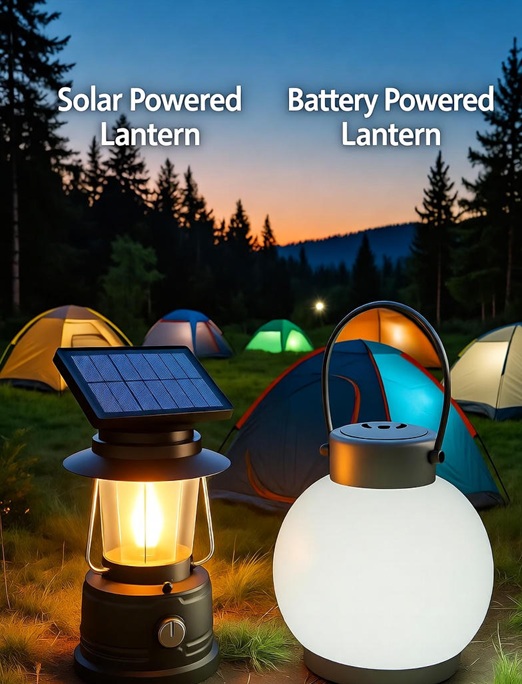
Solar camping lanterns, which use photovoltaic panels (small devices that convert sunlight into electricity) to charge a built-in battery, work in two stages. First, the panel absorbs sunlight during the day. Second, that stored energy powers the LED bulbs at night. The key variable is the panel’s ability to soak up the sun’s rays — which depends entirely on how much direct sunlight is available.

Battery camping lanterns, which run on either disposable AA/AAA batteries or built-in rechargeable power packs, skip the solar stage entirely. You either insert fresh batteries before you leave, or you charge the lantern via USB at home. The light output is immediate and consistent from the moment you switch it on — no sunlight required.

The XTAUTO Collapsible LED Lantern (B0915B6X66) is a dual-power option that combines solar and USB charging, making it a useful bridge between both categories — particularly for campers who want a solar backup but can’t guarantee full sun every day.

Why does the mechanism matter? Because it defines your reliability ceiling. A battery lantern’s ceiling is set by battery capacity — a known, measurable number. A solar lantern’s ceiling is set by weather — an unknown that changes by the hour.

Cost, Brightness, and Runtime

Here is how the two lantern types stack up across the metrics that matter most to beginner campers:

Feature Solar Lanterns Battery Lanterns
Upfront cost Generally higher (panel + battery hardware) Lower to moderate
Ongoing cost Low — sunlight is free Moderate to high (disposable batteries) or low (rechargeable)
Charging method 6–10 hours direct sunlight (TrueLumens, 2026) USB charge or fresh AA/AAA batteries
Typical brightness 50–300 lumens (most consumer models) 100–1,000+ lumens
Weather dependency High — clouds reduce charging significantly None — works in any weather
Cold-weather performance Charging stops below 32°F; output reduced Capacity drops 20–30% at 32°F
Weight Light to moderate (panel adds weight) Very light (especially disposable)
Environmental impact Battery accounts for 50–68% of lifecycle impact (NIH PMC, 2024) Disposable batteries create toxic waste; rechargeable is lower impact
Durability concern Solar panel is breakable if dropped Battery contacts can corrode
Minimal upkeep Yes — no batteries to buy Rechargeable: yes. Disposable: no
Best for Sunny multi-day trips, eco-conscious campers All-weather reliability, winter camping, emergencies
Solar vs battery camping lanterns comparison infographic showing cost, brightness, and environmental impact
The Light Reliability Gap at a glance — solar and battery lanterns diverge most sharply in cold and cloudy conditions, where predictability matters most.

The environmental math is more complicated than it looks. Solar lanterns appear greener at first glance, but research from NIH PMC (2024) found that in stand-alone photovoltaic systems, the battery accounts for 50–68% of total environmental impact — making the battery inside the lantern, not the solar panel itself, the main eco-concern. This means a solar lantern you replace every two years may carry a higher environmental burden than a rechargeable battery lantern you use for five years with proper recycling.

“In stand-alone photovoltaic systems, the battery accounts for 50–68% of total environmental impact — making the battery, not the solar panel, the main eco-concern” (NIH PMC, 2024).

Which Lantern Wins for Your Style?

Neither type wins outright — and that’s precisely the point of The Light Reliability Gap framework. The right choice depends on three variables: your trip length, your typical weather, and whether you have access to USB charging before or during your trip.

For car camping on sunny weekends, a solar lantern with USB backup (like the XTAUTO dual-power model) works well. You park the lantern on your dashboard during the drive, and it arrives charged. For backpacking in variable weather, a compact rechargeable lantern — such as the 2-in-1 USB + Battery Camping Lantern (B07TM9CQ49) — gives you predictable runtime without gambling on sunshine. For emergency preparedness, disposable-battery lanterns like the Lichamp 4-Pack (B08WWX5GTZ) or Etekcity 4-Pack (B01C5QSENQ) win on reliability: fresh batteries don’t degrade on a shelf the way rechargeable cells slowly do over years of storage.

Check out our editorial solar vs battery comparison for an even deeper dive into specific models.

The GearJunkie testing team, which has evaluated camping lanterns across multiple seasons, notes that most campers find 300–800 lumens sufficient for a standard campsite. The lantern type — solar or battery — matters less than matching the lumen output to your actual campsite size.

Solar Lanterns: Powerhouse or Gimmick?

Solar lanterns deserve a fair, evidence-based evaluation — not blanket dismissal, and not uncritical praise. User consensus across r/CampingGear and r/carcamping indicates that disappointment with solar lanterns almost always traces back to one of two problems: unrealistic charging expectations, or a low-quality panel that underperforms even in good sun.

How Solar Charging Works

A solar lantern’s photovoltaic panel converts sunlight into DC electricity, which flows into a small internal battery — usually a lithium-ion (a rechargeable battery type) or NiMH (nickel-metal hydride, an older rechargeable chemistry) cell. Most consumer-grade solar lanterns require 6–10 hours of direct, unobstructed sunlight for a full charge (TrueLumens, 2026). Budget models can need up to 12 hours.

The critical failure points are predictable:

  • Indirect sunlight: A lantern placed in partial shade, under tree cover, or on a cloudy day may receive as little as 10–20% of the energy it would get in full sun. This dramatically extends charge time.
  • Panel angle: Solar panels are most efficient when perpendicular to the sun. A flat panel on a picnic table at midday is far less effective than one propped at an angle.
  • Panel size: Most compact solar lanterns use very small panels. The smaller the panel, the longer the charge time — and the more a single cloudy day sets you back.
  • Temperature: Charging below 32°F (0°C) can cause lithium plating on the battery anode, leading to permanent capacity damage. This is a genuine hardware risk, not just reduced performance.
Diagram showing how solar camping lantern charging works from panel to battery to light output
Understanding each stage of the solar charging chain helps you identify why your lantern might underperform — and how to fix it.

The Real Advantages of Solar Lanterns

Once you understand the charging mechanics, solar lanterns have genuine, measurable advantages. They’re not a gimmick — they’re a context-specific tool.

No mess and light weight is the most practical benefit. You don’t pack batteries, you don’t worry about finding a charging outlet on a long wilderness trip, and you don’t haul dead cells home. On a week-long sunny summer trip, a solar lantern with USB backup essentially pays for itself by eliminating battery purchases.

Carbon footprint reduction is real, but conditional. If you use a solar lantern for five or more years and recycle the battery at end-of-life, the lifecycle environmental math favors solar over disposable batteries significantly. Research from NIH PMC (2024) confirms that recycling lithium-ion batteries cuts their environmental impact by 3–99% depending on the category measured — so responsible disposal matters.

Self-sufficiency on remote trips is a genuine edge. When you’re three days from the nearest town, a solar lantern means you never run out of light as long as the sun shows up. For desert camping, high-altitude summer trips, and long-distance canoe routes with consistent sun exposure, solar lanterns are genuinely reliable.

The REI Expert Advice guide on camping lanterns notes that solar options work particularly well for campers who prioritize sustainability and plan trips in reliably sunny conditions.

The Honest Downsides of Solar Lanterns

Common complaints reported by campers on outdoor forums are remarkably consistent: the lantern charged all day and gave only 90 minutes of usable light. This happens when a small panel, a modest battery, and high brightness settings combine against you.

The honest downsides are:

  • Weather dependency is a real constraint, not a minor inconvenience. A weekend forecast with two cloudy days can leave you with a half-charged lantern both nights.
  • Panels are breakable. Drop a solar lantern on a rock, and the panel may crack — ending its solar-charging capability permanently, even if the LED still works.
  • Charging in a tent or pack is impossible. The panel needs direct outdoor exposure. If your campsite is heavily shaded by trees or canyon walls, you’ll struggle to get a full charge.
  • Output is often lower than battery lanterns. Consumer solar lanterns typically max out at 100–300 lumens — adequate for tent lighting, but potentially insufficient for illuminating a full campsite table or cooking area.

Where solar lanterns genuinely fail is in the scenarios where beginners most need reliable light: overcast camping trips, winter trips, and high-use campsites under dense tree canopy. These are exactly the conditions where The Light Reliability Gap is widest.

Are solar lanterns worth it?

Solar lanterns are worth it for sunny, multi-day trips — and genuinely disappointing for overcast or winter camping. If your trips involve consistent direct sunlight (6+ hours daily) and you value minimal upkeep with no battery purchases, a solar lantern with USB backup charging is a practical choice. User consensus across camping forums indicates that the main cause of disappointment is using a solar lantern in conditions it wasn’t designed for. A dual-power option like the XTAUTO Solar + USB model reduces the risk by giving you a USB fallback.

Battery Lanterns: Reliable Light on Demand

Battery-powered lanterns are the default choice for most campers — and for good reason. They deliver consistent, weather-independent light from the moment you switch them on. The question isn’t whether they work. It’s which battery type fits your camping habits.

Disposable vs. Rechargeable Batteries

Disposable battery lanterns run on AA or AAA alkaline batteries that you buy at any gas station, grocery store, or hardware store. The Coleman Enhanced Battery Protection Lantern (B07HF226B4) is a classic example. The advantages are hard to overstate for emergency preparedness: fresh alkaline batteries have a shelf life of 5–10 years, they’re available everywhere, and they work reliably in cold weather down to about 0°F (−18°C) — far better than lithium-ion in freezing conditions.

The downside is ongoing cost and waste. A lantern running on high for multiple nights per trip will consume several AA sets per season. Over two or three years, that adds up in both cost and environmental impact.

Rechargeable battery lanterns use built-in lithium-ion power packs, charged via USB. The Glocusent 135 LED Ultra Bright Lantern (B0FL22QSGP) and Coleman Classic Rechargeable Lantern (B09HN1BXRG) fall into this category. These are the most cost-effective option for regular campers — you charge them at home, and the ongoing cost is essentially zero. The catch is that you need access to USB power before your trip, and if you forget to charge, you have no field backup.

Type Upfront Cost Ongoing Cost Cold Weather Shelf Life Best For
Disposable (AA/AAA) Low High Excellent 5–10 years Emergencies, infrequent camping
Rechargeable (USB) Moderate Very low Moderate 2–4 years Regular campers, car camping
Dual-power (USB + solar) Moderate–High Very low Moderate 2–4 years Multi-day sunny trips

Rechargeable Lantern Lifespan

Rechargeable camping lanterns typically last 4–100+ hours on a single charge, depending on brightness setting and battery capacity. That’s a wide range — and it’s intentional, because the answer depends entirely on how you use the lantern.

At maximum brightness (400–1,000+ lumens), most rechargeable lanterns last 4–12 hours. The Consciot 1000LM LED Lantern 2-Pack (B082HD5JDH) and Glocusent model are designed for high-output use and deliver strong runtime at their rated output. At low or medium settings (50–200 lumens), the same lanterns can run for 20–50+ hours — enough for a week-long trip on a single charge.

User consensus across camping forums indicates that most campers significantly overestimate how many lumens they actually need, which leads to running lanterns on max brightness and burning through the battery faster than necessary. A practical rule: start on medium, adjust up only if you need it.

The battery lifespan — how many charge cycles a rechargeable lantern lasts before the battery degrades — is typically 300–500 full cycles for standard lithium-ion cells. At one trip per month with one full charge per trip, that’s 25–40 years of use before the battery needs replacement. In practice, most campers replace the whole lantern before the battery truly fails.

Environmental Cost of Batteries

Disposable alkaline batteries (AA/AAA) are not recyclable in standard household recycling. They contain manganese dioxide and zinc — not acutely toxic, but problematic in landfill volumes. The EPA recommends checking local hazardous waste collection programs for proper disposal.

Rechargeable lithium-ion batteries carry a more complex environmental profile. Manufacturing them requires lithium, cobalt, and nickel mining — processes with significant land and water impacts. However, the lifecycle math strongly favors rechargeable over disposable: a single rechargeable battery replacing 300+ disposable battery sets represents a dramatic reduction in material waste and energy consumption over its lifetime.

According to NIH PMC research (2024), recycling lithium-ion batteries can reduce their environmental impact by 3–99% depending on the specific impact category — making proper end-of-life disposal one of the most impactful choices a camper can make. Many retailers, including Best Buy and Home Depot, accept rechargeable batteries for recycling at no cost.

Infographic comparing carbon footprint and toxicity of disposable alkaline, rechargeable lithium-ion, and solar lantern batteries
The greenest lantern is the one you use for years and recycle properly — not necessarily the one with a solar panel.

Are Battery Lights Good for Camping?

Battery-powered lanterns are excellent for camping — they’re weather-independent, available in a wide brightness range, and work reliably in cold temperatures that would degrade solar lanterns. Rechargeable USB models offer the best value for regular campers, with very low ongoing costs after the initial purchase. Disposable-battery models are the top choice for emergency preparedness because fresh alkaline batteries hold 80–90% of their charge after five years of storage. The main downside of rechargeable models is that forgetting to charge before a trip leaves you without a backup option, unlike solar lanterns that can top up during the day.

Winter Warning: Cold Weather Battery Drain

Camping lantern on snow-covered table showing cold weather battery drain at 32 degrees Fahrenheit
At 32°F, lithium-ion camping lanterns lose 20–30% of their rated runtime — a gap that can leave you in the dark before morning on a winter trip.

Cold weather is the most under-discussed factor in camping lantern reliability — and the one most likely to surprise a beginner on their first autumn trip. Both solar and battery lanterns are affected, but in different ways.

Why Lithium-Ion Fails in the Cold

Lithium-ion batteries (the rechargeable type used in most modern camping lanterns) have an optimal operating range of 68–77°F (20–25°C). When temperatures drop below 32°F (0°C), the electrochemical reactions inside the battery slow significantly. The electrolyte (the liquid or gel that allows ions to move between electrodes) thickens, increasing internal resistance and reducing how much power the battery can deliver.

According to widely reported performance data across lithium-ion battery chemistries, a lithium-ion battery can lose 20–30% of its rated capacity at 32°F (0°C). At 14°F (−10°C), the loss can reach 30% or more. At −4°F (−20°C), capacity loss can approach 50%, and the battery management system in most lanterns will shut down discharge entirely to prevent permanent damage.

Why this matters for your camping trip: A lantern rated for 20 hours of runtime at room temperature may deliver only 14–16 hours on a cold autumn night. On a winter camping trip, that gap could leave you in the dark before morning.

Research from Idaho National Laboratory confirms that both power and capacity are diminished during low-temperature performance tests for lithium-ion cells — and that charging below 32°F can cause lithium plating (permanent crystal formation on the battery anode), leading to irreversible capacity loss. Never charge a lithium-ion lantern in freezing temperatures if you can avoid it.

Disposable alkaline batteries handle cold better than lithium-ion but still suffer performance drops below freezing. Lithium AA batteries (not the same as lithium-ion — these are non-rechargeable single-use cells) outperform both in extreme cold and are worth considering for winter emergencies.

4 Tips to Extend Cold-Weather Life

These four strategies can meaningfully close The Light Reliability Gap in winter conditions:

  1. Sleep with your lantern. Store your rechargeable lantern in your sleeping bag or tent during cold nights. Body heat and the insulated sleeping environment keep the battery closer to its optimal temperature range, preserving capacity for morning use.
  1. Use a neoprene or insulating sleeve. Wrap the lantern body in a small neoprene pouch or stuff it inside a fleece hat when not in use. Even modest insulation significantly slows the rate of heat loss from the battery housing.
  1. Switch to lithium AA batteries for winter trips. If you’re using a disposable-battery lantern like the Coleman Enhanced Battery Protection model, swap standard alkaline AA batteries for lithium AA cells (brands like Energizer Ultimate Lithium). These maintain reliable performance down to −40°F and weigh less than alkaline equivalents.
  1. Carry your lantern inside your jacket on the trail. Before setting up camp, keep the lantern in an inner jacket pocket. A warm battery at the start of the evening will deliver significantly more runtime than one that’s been sitting on a cold picnic table for two hours.

Do Solar Lanterns Work in Winter?

Solar lanterns can work in winter, but with important limitations. The solar panel itself functions in cold temperatures — photovoltaic panels can actually be slightly more efficient in cold, dry air than in summer heat. The problem is twofold: shorter daylight hours reduce total charging time, and charging the internal battery below 32°F risks permanent damage from lithium plating.

In practical terms: if you’re winter camping and the temperature drops below freezing at night, a solar lantern should be brought inside the tent to prevent cold-charging damage. If daytime temperatures stay above freezing and you get 6+ hours of winter sun, a solar lantern can still function — just with reduced runtime compared to summer performance.

User consensus across r/CampingGear indicates that most winter campers abandon solar-only lanterns entirely in favor of rechargeable USB models or lithium AA disposables. The combination of short days, frequent cloud cover, and cold-charging risk makes solar lanterns a poor primary light source for winter camping.

How to Choose a Camping Lantern

Camping lantern lumen guide showing recommended brightness for tent, cooking area, and full campsite
Match lumens to your campsite size: 75–150 for a solo tent, 200–500 for cooking tasks, and 500–1,000+ for full campsite illumination across multiple lanterns.

The right camping lantern isn’t the brightest one or the most expensive one. It’s the one matched to your actual campsite size, trip conditions, and the features that matter for how you camp.

Lumen-to-Camp-Size Guide

Camping lantern decision guide showing best lantern type for backpacking, car camping, and emergency use
The right lantern depends on your scenario: lightweight rechargeable for backpacking, high-output for car camping, and alkaline AA for emergency preparedness.

Lumens (a measure of total light output — how much light a bulb or LED produces in all directions) are the most important spec on a lantern’s packaging. Here is a practical guide based on industry data from BioLite (2022) and REI Expert Advice (2026):

Camping Context Recommended Lumens What It Looks Like
Solo tent interior 75–150 lumens Soft reading light; won’t blind you at 2 AM
Family tent (4-person) 150–200 lumens Comfortable ambient light for the whole tent
Picnic table / cooking area 200–500 lumens Bright enough to prep meals and play cards
Full campsite illumination 500–1,000+ lumens Lights a 25-foot radius; good for group sites
Large basecamp / group site 1,000+ lumens Equivalent to a bright room; often needs 2–3 lanterns

According to BioLite’s lumen guide (2022), inside a tent, 75–150 lumens is sufficient — your eyes adapt to the dark in the evening, and more light than that creates uncomfortable glare in a small enclosed space. At the campsite table, 200–500 lumens handles cooking and group activities well. For site-wide illumination, 500–1,000+ lumens across 2–3 lanterns is more effective than one ultra-bright lantern in the center.

Most beginner campers overbuy on lumens. A 1,000-lumen lantern used inside a four-person tent produces disabling glare, according to Glocusent’s outdoor lighting guide. Start with a lantern that has adjustable brightness settings — this single feature makes any lantern dramatically more versatile.

How Many Lumens Do You Need?

Most campers need 75–200 lumens for tent use and 300–600 lumens for campsite tasks like cooking and playing cards. According to BioLite’s lumen guide (2022): inside a tent, 75–150 lumens provides comfortable reading light without glare; at a campsite table, 200–500 lumens handles meals and group activities; for full site illumination, 500–1,000+ lumens across 2–3 lanterns works better than one ultra-bright single source. The ANSI/PLATO FL 1 standard is the reliable way to verify these numbers — always check that a lantern’s lumen claim uses this standardized measurement.

Key Features to Look For

Beyond lumens, these features consistently separate good camping lanterns from frustrating ones:

Water resistance rating: Look for IPX4 (splash-proof water resistance rating) as a minimum. This means the lantern can handle rain and splashes from any direction. IPX6 (powerful water jet resistant) is better for kayaking or canoe camping. Most of the lanterns in the Recommended Products table above carry IPX4 or better ratings.

Multiple light modes: A lantern with high, medium, low, and SOS modes gives you flexibility to match brightness to the task and extend battery life when full power isn’t needed. The Etekcity LED Lanterns 4-Pack (B01C5QSENQ) is popular for emergency preparedness partly because of its simple, reliable mode switching.

Weight and collapsibility: For backpacking, weight is a hard constraint. The MalloMe Collapsible LED Lantern (B0GGWHJ8XJ) packs flat and adds minimal weight to a pack. For car camping, weight is irrelevant — a heavier, brighter lantern like the Glocusent 135 LED Ultra Bright model is a better fit.

Hook or hang point: A lantern you can hang from a tent loop or tarp ridgeline illuminates a much larger area than one sitting flat on a table. This is a small feature with outsized practical impact.

Understanding ANSI/PLATO FL 1

The ANSI/PLATO FL 1 standard is the industry measurement protocol that defines how lantern manufacturers must measure and report lumen output, runtime, beam distance, and water resistance. If a lantern’s packaging says “ANSI/PLATO FL 1 tested,” it means the numbers were measured under standardized laboratory conditions — giving you a reliable basis for comparison.

Without this standard, manufacturers could report “peak lumens” (the maximum output at the first 30 seconds of use) rather than the regulated output after 30 minutes of operation, which is almost always lower. When comparing two lanterns, always check whether both report ANSI/PLATO FL 1 figures — or you may be comparing a manufacturer’s peak claim against a competitor’s regulated output.

The practical takeaway: a lantern advertising 500 lumens under ANSI/PLATO FL 1 conditions is a more honest comparison point than one advertising 800 lumens without the standard notation.

Lantern Decision Guide by Use Case

The Light Reliability Gap narrows significantly when you match lantern type to your actual use case. Here is a condition-based decision guide covering the three scenarios most beginner campers face.

Best Lantern for Backpacking

For backpacking, weight and packability outrank brightness. You want a lantern under 4 ounces that collapses flat, runs on USB charging, and delivers 100–300 lumens on low-to-medium settings.

The 2-in-1 USB + Battery Camping Lantern (B07TM9CQ49) earns its place here because it accepts both USB charging and AA batteries as a backup — critical when you’re three days from a power outlet. The MalloMe Collapsible LED Lantern (B0GGWHJ8XJ) is a strong alternative for ultralight backpackers who prioritize packability over maximum brightness.

Solar lanterns for backpacking: Only consider solar if your route involves consistent full-sun exposure (desert trails, alpine ridges above treeline) and you’re comfortable with the charging-time commitment. The XTAUTO Solar + USB Rechargeable Lantern (B0915B6X66) offers a safety net with its USB charging port — making it a reasonable choice for sunny multi-day backpacking trips.

Choose if: You can charge before every trip and your routes have some shade. Choose if: You’re doing 5+ day trips in reliably sunny terrain.

Best Lantern for Car Camping

Car camping removes the weight constraint entirely, which changes the calculus. You can bring a brighter, heavier lantern, and you probably have a car charger available for top-ups during the drive.

The Coleman Classic Rechargeable Lantern (B09HN1BXRG) is the reliable-brand choice here — well-established performance, straightforward operation, and the kind of no-fuss reliability that matters when you just want light without troubleshooting. The Consciot 1000LM LED Lantern 2-Pack (B082HD5JDH) offers excellent value if you want two lanterns for a family site at a strong price-per-lumen ratio.

The LUXPRO Retro LED Lantern (B0CVCTNNKV) deserves a mention for car campers who want the aesthetic of a classic lantern with LED efficiency — a legitimate choice for those who value style alongside function.

Solar lanterns for car camping: The XTAUTO dual-power model works well here. Leave it on your dashboard during the drive to camp; it arrives with a useful charge. Just don’t rely on it as your only light source on cloudy weekend trips.

Best Lantern for Emergencies

Emergency use has different requirements than recreational camping. You need a lantern that works reliably after sitting in a closet for two years — which immediately eliminates rechargeable-only options, since lithium-ion batteries slowly self-discharge over months.

For emergency preparedness, disposable-battery lanterns are the clear choice. The Lichamp LED Lantern 4-Pack (B08WWX5GTZ) and Etekcity LED Lanterns 4-Pack (B01C5QSENQ) are both popular for emergency kits because they’re inexpensive, bright enough for household use, and run on AA batteries you can stockpile. Fresh alkaline AA batteries retain 80–90% of their charge after five years of storage — making them genuinely reliable for emergency scenarios.

The Coleman Enhanced Battery Protection Lantern (B07HF226B4) adds a useful feature for emergency storage: its battery protection technology prevents battery leakage during long storage periods, a common failure mode that destroys lanterns sitting unused for years.

The Light Reliability Gap is smallest in the emergency category — because you control the variable (fresh battery inventory) rather than depending on weather or charging access.

Read our full lantern comparison guide for more specific product breakdowns.

Limitations and Common Pitfalls

No camping lantern is perfect for every situation. Understanding the failure modes of both solar and battery lanterns helps you avoid the most common and frustrating beginner mistakes.

Common Lantern Buying Mistakes

Buying based on peak lumens, not ANSI/PLATO FL 1 regulated output. A lantern that advertises 800 lumens may deliver that only for the first minute before settling at a much lower regulated output. Always check for the ANSI/PLATO FL 1 standard notation on the packaging.

Choosing solar because it seems eco-friendly without checking the charging requirements. A solar lantern bought for a Pacific Northwest trip in October — where overcast days are the norm — will likely disappoint. Match the solar option to your actual geography and season.

Ignoring the brightness setting. Running any lantern on maximum brightness at all times is the fastest way to drain the battery. Most camping tasks require far less than maximum output. Develop the habit of starting on low or medium and adjusting up only when needed.

Buying a 4-pack of cheap disposable-battery lanterns for a week-long trip without bringing spare batteries. This is a common calculation error. Always pack at least one full set of spare batteries per lantern per trip.

Storing a rechargeable lantern fully discharged. Lithium-ion batteries stored at 0% charge for extended periods can enter a deep-discharge state that permanently reduces capacity. Store rechargeable lanterns at 40–80% charge between trips.

When These Lanterns Fall Short

Both lantern types have scenarios where an alternative is genuinely better:

Extended basecamp trips with a large group: A single lantern — solar or battery — won’t illuminate a 6-person cooking area adequately. Consider a dedicated campsite light string (solar-powered string lights are excellent here) or a propane lantern for high-output basecamp lighting. Propane lanterns can deliver 200–400 watts equivalent of light output — far beyond any portable LED lantern.

Expedition or remote wilderness camping in winter: In sustained sub-zero conditions, both solar charging and lithium-ion discharge become unreliable. Experienced winter campers often carry lithium AA disposable batteries (not lithium-ion rechargeable) as their primary power source — these maintain reliable performance down to −40°F.

When you need USB charging capability from your lantern: Some situations call for a lantern that can also charge your phone. Several models, including some rechargeable designs, include a USB output port for this purpose. If device charging matters to you, verify this feature explicitly before buying — most standard camping lanterns do not include it.

Frequently Asked Questions

What is the best lantern for camping?

The best camping lantern depends on your specific conditions, not a single universal answer. For most beginner car campers, a rechargeable USB lantern in the 300–600 lumen range — like the Coleman Classic Rechargeable — offers the best balance of brightness, runtime, and convenience. For backpacking, a lightweight collapsible model under 4 ounces is a better fit. For emergency preparedness, a disposable-battery lantern with a 5-year shelf life wins on reliability. REI Expert Advice (2026) recommends matching lumen output to use case: 100 lumens or fewer for ambient tent lighting, 400+ lumens for campsite illumination.

How long do rechargeable lanterns last?

Rechargeable camping lanterns typically last 4–50+ hours on a single charge, depending on brightness setting and battery size. At maximum brightness (400–1,000 lumens), expect 4–12 hours. At low settings (50–150 lumens), the same lantern can run for 20–50+ hours. The battery itself — measured in charge cycles — typically lasts 300–500 full cycles before noticeable capacity loss, which translates to many years of regular camping use. Cold weather reduces runtime by 20–30% at 32°F (0°C) according to Idaho National Laboratory, so winter campers should plan for shorter effective runtimes.

What is the downside of solar lights?

The main downside of solar camping lanterns is weather dependency — they require 6–10 hours of direct sunlight to fully charge (TrueLumens, 2026), making them unreliable on overcast days or in heavily shaded campsites. Additional downsides include: solar panels are breakable if dropped; charging below 32°F risks permanent battery damage; consumer models typically max out at 100–300 lumens (lower than battery competitors); and the environmental benefit is conditional — the battery inside a solar lantern accounts for 50–68% of its total lifecycle environmental impact (NIH PMC, 2024). They’re not a gimmick, but they’re not for every camper.

How long do solar lanterns last?

A quality solar camping lantern can last 5–10 years before the LED or battery requires attention, but real-world lifespan depends heavily on care. The solar panel is the most fragile component — dropping it on a hard surface can crack the photovoltaic cells and permanently reduce charging efficiency. The internal battery (usually lithium-ion) degrades over 300–500 charge cycles, similar to other rechargeable devices. In practical terms, a camper who takes 12 trips per year and charges their solar lantern each trip might see noticeable battery degradation after 3–5 years. Storing the lantern with the battery at 40–80% charge between trips extends battery life significantly.

Best Rechargeable Camping Lantern?

The best rechargeable camping lantern balances lumen output, runtime, and portability for your specific camping style. For high-output car camping, the Glocusent 135 LED Ultra Bright Lantern (B0FL22QSGP) delivers strong brightness with extended runtime. For trusted brand reliability, the Coleman Classic Rechargeable Lantern (B09HN1BXRG) is a proven performer. For backpacking, the 2-in-1 USB + Battery Camping Lantern (B07TM9CQ49) adds AA battery backup for field emergencies. The OutdoorGearLab best lantern guide recommends prioritizing adjustable brightness over maximum lumens — a lantern you can dim is more useful than one that only runs at full power.

Finding Your Most Reliable Lantern

For beginner campers navigating the solar vs battery camping lanterns decision, the most important shift is moving away from “which type is better” toward “which type works for my conditions.” Solar lanterns are not a gimmick — they’re a context-specific tool that excels in sunny, multi-day summer trips and fails in overcast, cold, or heavily shaded environments. Battery lanterns deliver consistent, predictable light in any weather, but carry ongoing costs and disposal responsibilities that solar avoids.

The Light Reliability Gap — the measurable difference in guaranteed output when conditions turn against you — is the real framework for this decision. At 32°F (0°C), your rechargeable lantern loses 20–30% of its rated runtime. On a cloudy weekend, your solar lantern may charge to 20% of capacity. Neither type is immune to failure; both have specific, knowable failure conditions that you can plan around.

Start by identifying your most common camping scenario. If it’s sunny summer car camping, a dual-power solar + USB lantern like the XTAUTO model gives you the best of both worlds. If it’s variable-weather backpacking, a lightweight rechargeable with AA battery backup is the smarter hedge. If it’s emergency preparedness, fresh alkaline AA batteries in a reliable multi-pack lantern win on shelf-life reliability. Choose based on conditions, carry spare power in any form, and you’ll never be squinting at a dead panel at 9 PM.

David King
Written by

David King

Field gear tester at Tent Explorer.