
This blog post may contain affiliate links. As an Amazon Associate I earn from qualifying purchases.
📋 Table of Contents
- Step 1: Calculate Your Base Space Per Guest
- Space Requirements by Seating Style
- Formula Application: 3 Examples
- Safety Codes and Why They Matter
- How to figure out your tent size?
- Step 2: Add Space for Event Features
- Dance Floor Space: How Much Is Enough?
- Bar, Buffet, and Stage Allowances
- 3 Complex Event Examples
- Step 3: Find Your Tent Size by Guest Count
- Standard Tent Sizes and Capacities
- Tent Sizes for 50 to 200 Guests
- What size tent for 30 guests?
- How many fit in a 40×60 tent?
- How Event Style Changes Tent Size
- Use the Interactive Tent Size Calculator
- Camping and Grow Tent Sizing
- Camping Tents: “4-Person” Myth
- Grow Tent Fan Size Calculator
- Common Tent Sizing Mistakes to Avoid
- The 5 Most Common Sizing Errors
- When to Size Up or Use Two Tents
- Frequently Asked Questions
- Cost to rent a 40×60 tent?
- Capacity of a 30×60 tent?
- Capacity of a 30×50 event tent?
- Capacity of a 30×30 tent?
- Capacity of a 40×20 tent?
- Conclusion
Choosing the right tent size comes down to one formula: base square footage per guest, plus space for any extras like a dance floor or buffet. Get the math wrong by even 20%, and guests spend the evening bumping elbows.
“The questions below will help you ‘guesstimate’ your tenting needs for budgetary purposes and to make sure the required tent will fit in the space available.”
Most tent size guides give you a single number and stop there. They don’t tell you that a 40×60 tent can hold 160 seated guests or 300 standing — a difference that determines whether your event feels spacious or claustrophobic. By the end of this guide, you’ll have the exact square footage for your event, a size recommendation matched to standard tent dimensions, and the confidence to book without second-guessing.
We’ll walk through the three-step Comfort Layer Method, then give you a quick-reference capacity chart, an interactive tent size calculator, and answers to the most common tent sizing questions.
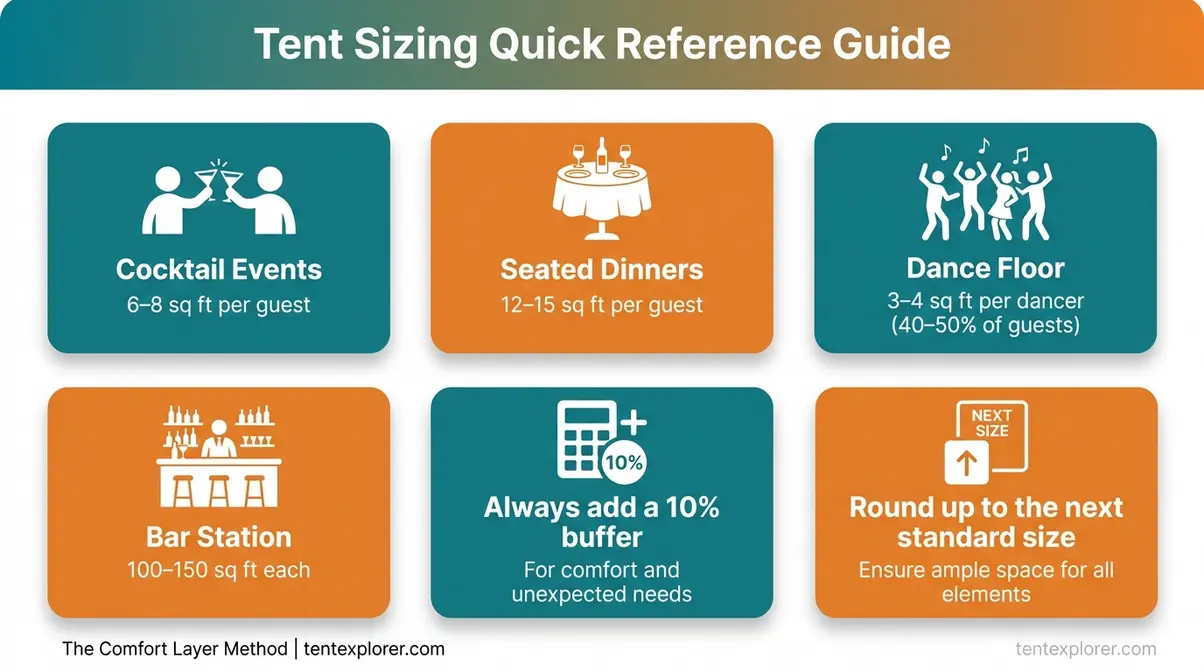
The right tent size calculator uses three layers: base guest space (6–15 sq ft/person by seating style), plus functional zone additions (100 sq ft for a bar, 3–4 sq ft/guest for a dance floor), plus a 10% safety buffer — the Comfort Layer Method.
- 1. Cocktail/standing events need 6–8 sq ft per guest; seated dinners need 12–15 sq ft
- 2. Dance floors add 3–4 sq ft per dancing guest (typically 40–50% of total guest count)
- 3. Bars and buffet tables each require 100–150 sq ft of dedicated tent space
- 4. A 40×60 tent (2,400 sq ft) seats ~160 for dinner or fits ~300 for a cocktail reception
- 5. Always size up to the next standard tent dimension — it’s cheaper than a tent that’s too small
- Estimated Time: 10-15 minutes
- Tools/Materials Needed:
- Guest count estimate
- Event layout preferences (dance floor, bar, buffet)
- Calculator
Step 1: Calculate Your Base Space Per Guest
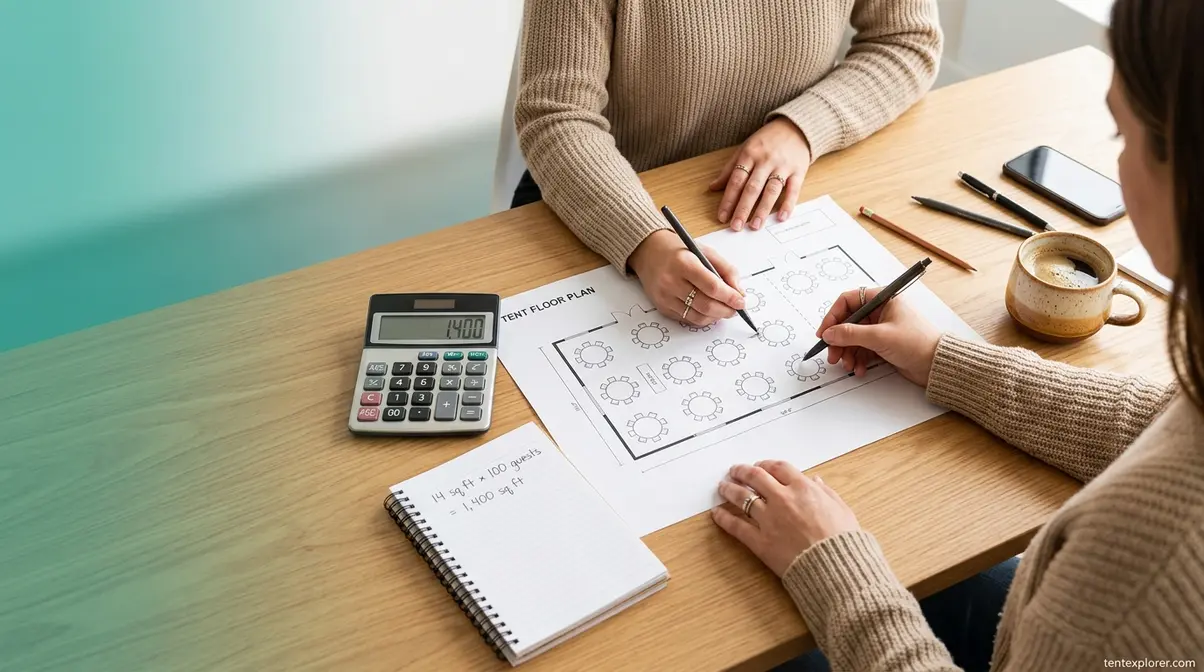
Calculating event tent size starts with one number: the square footage each guest needs based on how they’ll be seated. Standards range from 6 sq ft per person for standing cocktail events to 15 sq ft per person for seated dinners with tables and chairs, per NFPA occupant load factors (NFPA Table 7.3.1.2, 2020). Getting this base number right is Layer 1 of the Comfort Layer Method — everything else builds on it. Any reliable event tent size calculator should start here before adding a single feature.
To understand tent capacity ratings in full detail, the underlying math is straightforward: Total Sq Ft = Guests × Sq Ft Per Person. The variable is the sq ft figure, which changes based on how your guests will actually spend their time.
Space Requirements by Seating Style
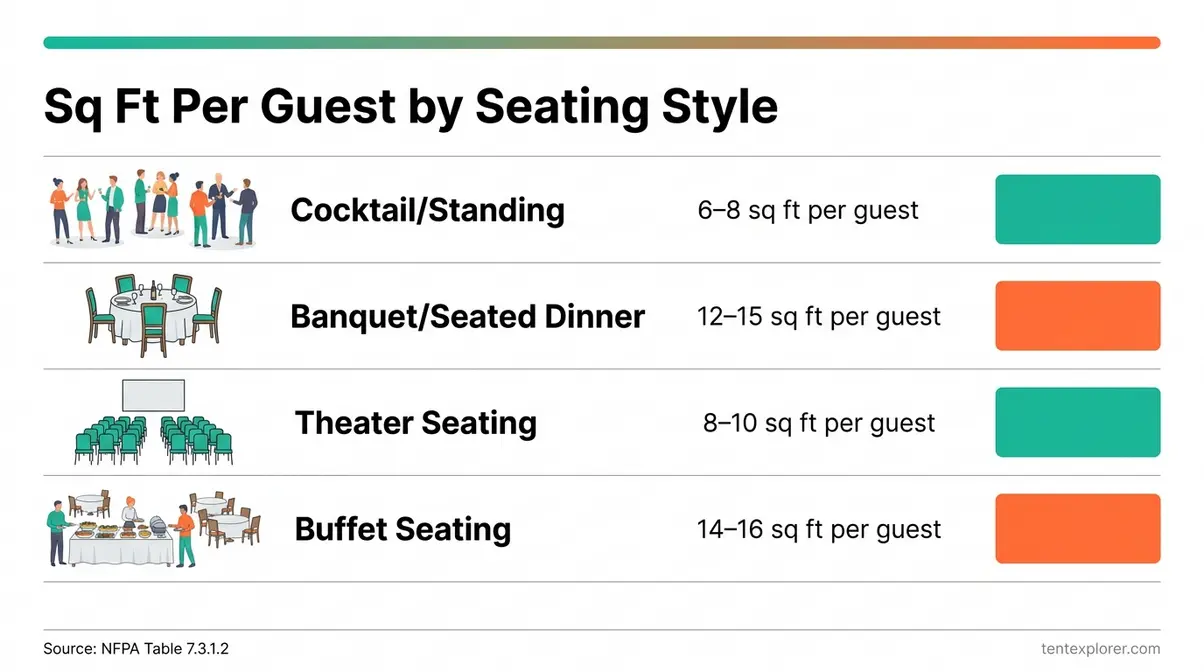
Use this tent size chart as your starting point — the numbers come from NFPA occupant load standards and university event safety guidelines, not arbitrary industry estimates.
| Seating Style | Sq Ft Per Guest | Best For | Example: 100 Guests |
|---|---|---|---|
| Standing/Cocktail | 6–8 sq ft | Receptions, networking events | 600–800 sq ft |
| Banquet/Seated Dinner | 12–15 sq ft | Weddings, galas, sit-down dinners | 1,200–1,500 sq ft |
| Theater (chairs only) | 8–10 sq ft | Ceremonies, presentations | 800–1,000 sq ft |
| Buffet (guests seated) | 14–16 sq ft | Corporate events, family reunions | 1,400–1,600 sq ft |
Sources: NFPA occupant load factors, Table 7.3.1.2 (2020); University of Rochester event safety guidelines (2026)
The ranges exist for a practical reason. Cocktail guests circulate and mingle — they need less personal floor space because they’re rarely all standing in one spot simultaneously. Seated dinner guests stay put for hours, surrounded by chairs, table edges, and service aisles. Buffet seating runs higher than standard banquet because guests leave their seats to return to the serving line, requiring clear circulation lanes between tables.
“Event fire codes require a minimum of 15 square feet per person for seated events with tables and chairs (University of Rochester event safety guidelines, 2026) — the same benchmark used by professional event planners for comfortable seated dinners.”
For a 75-person cocktail party: 75 × 7 sq ft = 525 sq ft minimum. A 20×30 tent (600 sq ft) fits comfortably with room for a small bar.
Note: “These are comfort targets. Fire codes set the legal floor — see Safety Codes below.”
Event rental professionals consistently recommend targeting the upper end of these ranges — 15 sq ft for seated events — to avoid the most common complaint: guests feeling cramped.
Now that you have the right number for your guests, the next question is whether your event includes extras — and those extras change your tent size significantly.
Formula Application: 3 Examples
These three examples show the Layer 1 calculation in action. When using a wedding tent size calculator for ceremony seating, Example 3 is especially relevant — theater-style arrangements are far more space-efficient than banquet layouts.
- Example 1 — Simple Cocktail Party (50 guests):
- Math: 50 guests × 7 sq ft = 350 sq ft
- Add 10% buffer: 350 × 1.1 = 385 sq ft
- Tent recommendation: 20×20 (400 sq ft) — gives a 15 sq ft buffer for entry/exit flow
- Note: “The 20×20 is the most common party tent and a reliable choice for cocktail events under 60 guests.”
- Example 2 — Seated Dinner (100 guests):
- Math: 100 guests × 14 sq ft = 1,400 sq ft
- Add 10% buffer: 1,400 × 1.1 = 1,540 sq ft
- Tent recommendation: 30×60 (1,800 sq ft) — the next standard size up, gives comfortable headroom for serving staff
- Example 3 — Wedding Ceremony (150 guests, theater seating):
- Math: 150 guests × 9 sq ft = 1,350 sq ft
- Add 10% buffer: 1,350 × 1.1 = 1,485 sq ft
- Tent recommendation: 30×60 (1,800 sq ft) — same tent as Example 2, illustrating how seating style affects density
Notice that a 100-person seated dinner and a 150-person ceremony can use the same tent. This is why seating style is the most important variable in any party tent size calculator — and why the Comfort Layer Method treats it as the foundation.
These three examples cover the base calculation — Layer 1 of the Comfort Layer Method. If your event includes a dance floor, bar, or buffet, you need to add those zones separately. That’s Step 2.
Safety Codes and Why They Matter
Fire safety codes set the legal minimum occupant load for tent events. The NFPA and local fire departments use specific sq-ft-per-person figures that establish the floor — not the comfort target. Per standard occupancy load calculations from UNC Greensboro building code guidelines (2026), the legal minimums are 5 sq ft per person (standing only) and 7 sq ft per person (seating without tables). These are hard floors, not recommendations — “comfortable event planning targets roughly double these figures.”
Any reliable event tent size calculator should use comfort targets, not code minimums. A 100-person seated event meets the legal minimum at 700 sq ft (7 sq ft × 100) but requires 1,200–1,500 sq ft for a genuinely comfortable experience. Large events of 100 or more guests often require a permit — consult tent floor plan safety requirements from Cornell EHS, which specifies exactly what your floor plan must show for approval.
With your base space calculated and the safety context clear, the next step is accounting for everything that isn’t a guest — the features that can add hundreds of square feet to your tent requirement.
How to figure out your tent size?

To find the right tent size, multiply your guest count by the square footage per person based on seating style: 6–8 sq ft for standing events, or 12–15 sq ft for seated dinners. Then add dedicated space for any event features, such as 100–150 sq ft for each bar and 3–4 sq ft per dancing guest for a dance floor (Victory Party Rental, 2026). Apply a 10% buffer to the total, then round up to the next standard tent dimension. For a 100-person seated dinner with a dance floor and bar, this calculation typically results in a 40×60 tent.
Step 2: Add Space for Event Features
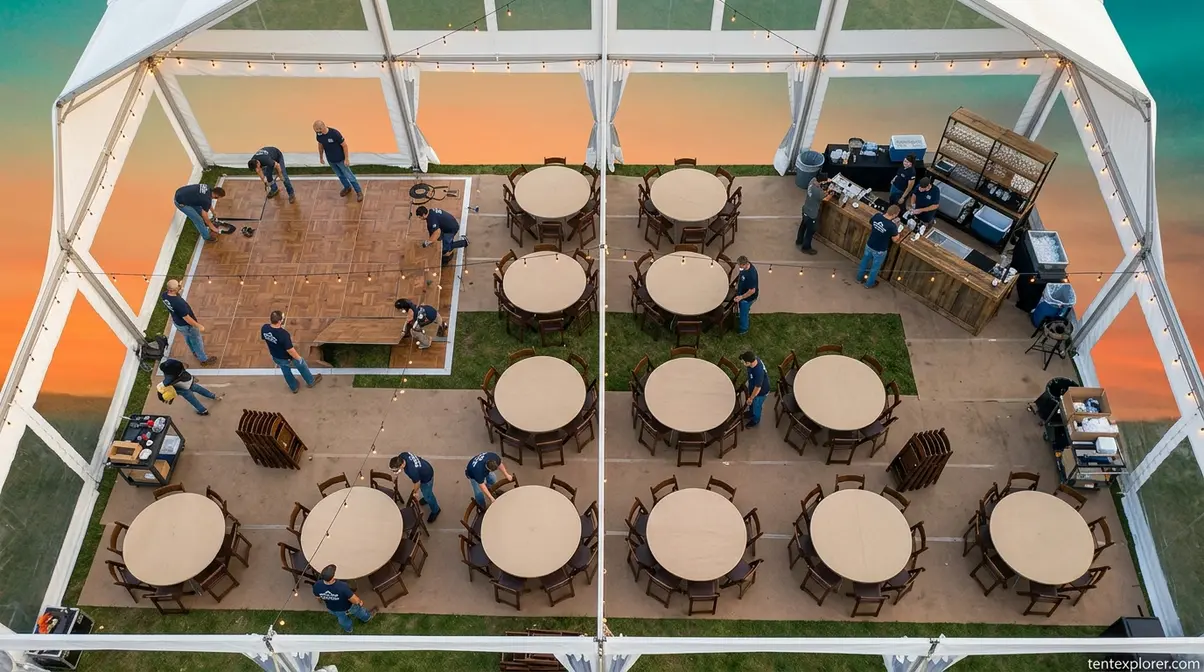
A 100-guest event with a dance floor needs significantly more tent space than one without — the dance floor alone can add 200–300 square feet to your requirement. Layer 2 of the Comfort Layer Method accounts for every feature beyond the guests themselves. To plan tent size with extras, you need specific figures for each add-on — not vague guidance to “add some extra space.”
Here are the standard space requirements for common event features:
- Dance Floor: 3–4 sq ft per dancing guest (estimate 40–50% of guests for weddings; 20–30% for corporate events)
- Bar Area: 100–150 sq ft per bar station (includes bar structure + guest queue space)
- Buffet Table: 100 sq ft per buffet station (includes table + guest circulation lane)
- Stage/Band: 200–400 sq ft (small DJ setup: 100 sq ft; 4-piece band: 300–400 sq ft)
- Gift/Sign-in Table: 50 sq ft
- Photo Booth: 100 sq ft
“A bar area requires a minimum of 100–150 square feet of dedicated tent space (wedding marquee tent size guide, 2026), separate from guest seating — undersizing this zone creates crowding and lines that spill into the dining area.”
Once you’ve added all your feature zones to the Layer 1 base space, apply a 10% buffer for aisles and unexpected crowding — that’s Layer 3, the final step of the Comfort Layer Method. Then round up to the next standard tent dimension.
Dance Floor Space: How Much Is Enough?
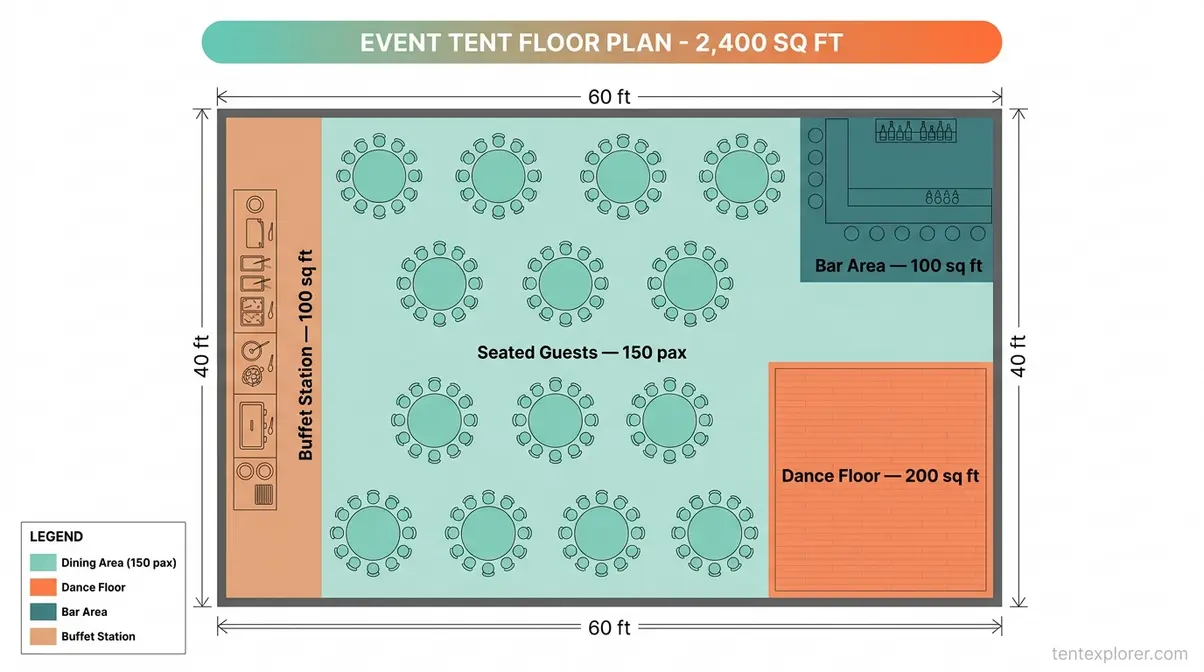
The formula for dance floor sizing is: Dance Floor Sq Ft = (Guest Count × Dance %) × 3–4 sq ft. The percentage varies by event type — weddings run 50–60%, birthday parties around 40%, and corporate events 20–30%. This “40–50% of guests use the dance floor” assumption is the hidden variable that causes the most sizing errors.
The sq-ft-per-dancer figure (3–4 sq ft) is lower than the seated guest figure because dancers move. Less personal space is needed per person, but the aggregate floor area must accommodate peak simultaneous use — the moment when your biggest group hits the floor at once. Dance floors are also typically rented as 3×3 ft panels, so your final number should round to a multiple of 9 sq ft.
For a 100-person wedding where you’re asking what size tent for 100 guests with a dance floor: 100 × 50% = 50 dancers × 4 sq ft = 200 sq ft of dance floor. That’s approximately a 15×14 ft floor. Add 200 sq ft to your base tent calculation. According to the Victory Party Rental tent calculator, dance floor space runs 2–4 sq ft per guest in the active event zone.
With your dance floor space calculated, the next add-on to account for is the bar — which has a fixed minimum regardless of guest count.
Bar, Buffet, and Stage Allowances
Fixed-space add-ons follow consistent rules regardless of guest count:
- Bar Area: Minimum 100–150 sq ft per bar station. This covers the bar structure (typically 6–8 ft long), the bartender workspace, and the guest queue. Two bars for events of 150 or more guests prevents bottlenecking at peak service times.
- Buffet Station: 100 sq ft per station — this includes the table, the guest circulation lane on both sides, and the chafing dish service space. A standard buffet for 100 guests uses 2 stations = 200 sq ft.
- Stage/Band: DJ setup: 100 sq ft. 4-piece band: 300–400 sq ft. Include the speaker stack footprint (often overlooked — adds 20–40 sq ft on each side of the stage).
For a wedding asking what size tent for 150 guests with a dance floor and full production: a 4-piece band + 2 bars + 2 buffet stations adds 350 + 200 + 200 = 750 sq ft to the base calculation. That single addition can push a 30×60 tent requirement up to a 40×60.
Now you have all the components for a complete Comfort Layer Method calculation. The three worked examples below show how to combine all layers for real-world scenarios.
3 Complex Event Examples
- Example 4 — Backyard Wedding: 50 guests + dance floor + bar:
- Base: 50 × 14 sq ft = 700 sq ft (seated dinner)
- Dance floor: 50 × 50% × 4 = 100 sq ft
- Bar: 100 sq ft
- 10% buffer: (700 + 100 + 100) × 1.1 = 990 sq ft
- Tent recommendation: 20×50 (1,000 sq ft) — perfect fit with minimal waste
- Example 5 — Corporate Party: 150 guests + buffet + stage:
- Base: 150 × 10 sq ft = 1,500 sq ft (theater-style, no dance floor)
- Buffet (2 stations): 200 sq ft
- Stage (DJ setup): 100 sq ft
- 10% buffer: (1,500 + 200 + 100) × 1.1 = 1,980 sq ft
- Tent recommendation: 30×80 (2,400 sq ft) — next standard size up, covers all zones comfortably
- Example 6 — Large Wedding: 200 guests + dance floor + bar + buffet (what size tent for 200 guests with a dance floor and full setup):
- Base: 200 × 14 sq ft = 2,800 sq ft
- Dance floor: 200 × 50% × 4 = 400 sq ft
- Bar (2 stations): 200 sq ft; Buffet (2 stations): 200 sq ft
- 10% buffer: (2,800 + 400 + 200 + 200) × 1.1 = 3,960 sq ft
- Tent recommendation: 40×100 (4,000 sq ft) — or two 40×60 tents with a connecting tunnel
Per fire permit capacity guidelines from Everett, WA, fire permit rules require 15 sq ft per person for events with tables and chairs vs. 7 sq ft without tables — confirming that the Comfort Layer Method’s seated dinner targets align with regulatory requirements.
These examples show how the Comfort Layer Method produces a specific tent size recommendation — not a vague range. The next step is matching that square footage to a standard tent dimension using the capacity chart.
Step 3: Find Your Tent Size by Guest Count
Standard tent sizes come in fixed dimensions — 20×20, 20×40, 30×60, 40×60, and so on. The chart below maps each dimension to its guest capacity for both seated dinners and standing cocktail events, so you can match your Step 1 square footage to an available tent. To calculate event tent capacity by guest count with full context, review Step 1 first — the chart below reflects Layer 1 (base guest space) only.
“A 40×60 tent provides 2,400 square feet — enough for 160 guests at a seated dinner or up to 300 guests at a standing cocktail reception (GetTent 40×60 tent guide, 2026), making it the most versatile size for events of 100–200 guests.”
This chart reflects base capacity — Layer 1 of the Comfort Layer Method. If your event includes a dance floor or bar, add those square footages from Step 2 before selecting your tent size.
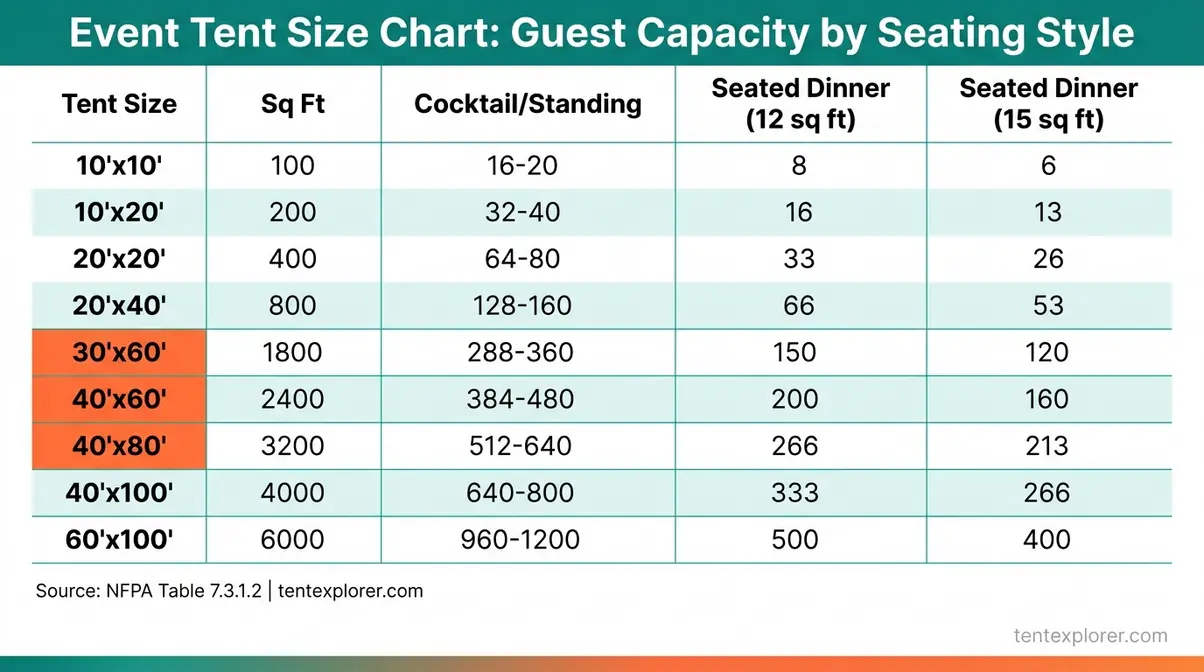
For even faster sizing, use the interactive tent size calculator below — it applies all three layers automatically.
Standard Tent Sizes and Capacities
Use this tent size chart to match your calculated square footage to a standard tent dimension. The “12 sq ft” column is the comfort target for most events; “15 sq ft” is the fire-code standard and recommended for events with serving staff moving between tables.
| Tent Size | Sq Ft | Cocktail/Standing | Seated Dinner (12 sq ft) | Seated Dinner (15 sq ft) |
|---|---|---|---|---|
| 10×10 | 100 | 12–16 | 8 | 6 |
| 20×20 | 400 | 50–65 | 33 | 26 |
| 20×30 | 600 | 75–100 | 50 | 40 |
| 20×40 | 800 | 100–130 | 66 | 53 |
| 30×30 | 900 | 112–150 | 75 | 60 |
| 30×60 | 1,800 | 225–300 | 150 | 120 |
| 40×60 | 2,400 | 300–400 | 200 | 160 |
| 40×80 | 3,200 | 400–530 | 266 | 213 |
| 40×100 | 4,000 | 500–660 | 333 | 266 |
Source: GetTent 40×60 tent guide (2026); industry standards per NFPA Table 7.3.1.2
You may see different 40×60 capacity figures across the web — the range is 160 to 300 because those numbers assume different seating styles. This chart shows both. The 12 sq ft column is standard for most event planners; the 15 sq ft column is what fire codes and formal events with waitstaff require.
With the full chart as a reference, here’s how the most common guest counts translate to specific tent size recommendations.
Tent Sizes for 50 to 200 Guests
20–30 guests: A 20×20 (400 sq ft) handles a seated dinner comfortably; a 10×20 (200 sq ft) works for cocktail-only events. “The 20×20 is the most rented party tent size — versatile, affordable, and fits most backyard spaces.”
Tent size for 50 guests: A 20×30 (600 sq ft) for a seated dinner; a 20×20 covers cocktail events with room to spare. If adding a small bar or DJ, size up to a 20×40. Per the capacity chart above, a 20×30 seats 40 guests at 15 sq ft — so 50 guests are tighter than they appear; the 20×40 is the safer call for any dinner with extras.
Tent size for 100 guests: A 30×40 (1,200 sq ft) for a cocktail event; a 30×60 (1,800 sq ft) for a seated dinner. Critical note: for 100 guests with a dance floor, a 40×60 is the minimum comfortable size — apply Step 2 before finalizing. Standard round tables seat 8–10 guests and have a 60-inch diameter, requiring roughly 30 sq ft of total floor space per table (table + chairs + aisle clearance). For 100 guests at round tables: 100 ÷ 8 = 13 tables × 30 sq ft = 390 sq ft for tables alone, plus circulation space.
Tent size for 150 guests: A 40×60 (2,400 sq ft) for a seated dinner with no extras — this is the most common wedding tent size range. Add a dance floor and bar, and a 40×80 (3,200 sq ft) becomes the right call.
Tent size for 200 guests: A 40×80 for a seated dinner (tight, workable); a 40×100 or two 40×60 tents for full comfort with a dance floor, bar, and buffet. Two-tent configurations offer the added benefit of zone separation — one tent for dining, one for dancing.
What size tent for 30 guests?
For 30 guests at a seated dinner, you need approximately 360–450 square feet, making a 20×20 tent (400 sq ft) the standard recommendation (Best Tents and Events, 2026). A 20×20 provides comfortable space for 8–10 round tables of 3–4 guests each, with room for a small serving area. If you’re adding a bar or small dance floor, a 20×30 (600 sq ft) provides comfortable headroom.
How many fit in a 40×60 tent?
A 40×60 tent provides 2,400 square feet and fits approximately 160 guests for a seated dinner or up to 300 guests for a standing cocktail reception. This size is the most common choice for large weddings and corporate events of 100–200 guests. The wide capacity range reflects different seating styles, not errors in different sources (GetTent, 2026). With a dance floor (200 sq ft) and bar (100 sq ft), comfortable seated capacity drops to approximately 140 guests. Always confirm whether a vendor’s quoted capacity assumes standing or seated arrangements before booking.
How Event Style Changes Tent Size
Weddings tend toward the upper end of sq-ft-per-person ranges (14–15 sq ft) because of formal table arrangements, serving staff aisles, and the expectation of comfort. When using a wedding tent size calculator, always target the upper range — weddings typically include dance floors, bars, and head tables with extra clearance. These add-ons are standard, not optional.
Birthday and backyard parties are more flexible. Cocktail-style events can use lower sq-ft targets (6–8 sq ft). A party tent size calculator for a casual backyard birthday can reasonably drop to 7 sq ft per person if no formal dining is planned. Often there’s no stage or formal buffet — a single bar and some high-top tables are sufficient.
Corporate events often include a stage or AV setup (200–400 sq ft) but smaller dance floors. Theater seating (8–10 sq ft) is common for presentations. A 100-person wedding needs a 40×60 tent (with dance floor and bar). A 100-person corporate cocktail party can use a 30×40 (1,200 sq ft). Same guest count, very different tent.
Now that you have your target square footage and a standard tent size in mind, use the interactive calculator below to confirm your recommendation — it applies all three layers of the Comfort Layer Method automatically.
Use the Interactive Tent Size Calculator
Our free tent size calculator applies the Comfort Layer Method automatically — enter your guest count, select your seating style, and add any event features (dance floor, bar, buffet, stage). The calculator outputs your required square footage and the recommended standard tent dimension.
- How to use it:
- Enter your total guest count
- Select your primary seating style (cocktail, seated dinner, theater, buffet)
- Check any event features you’re including
- Review your recommended tent size
Not sure which seating style applies? Review Step 1 above for the full breakdown. This tent size calculator updates instantly as you adjust inputs — no page reload required.
For camping trips or indoor growing setups, tent sizing works differently. The next section covers both specialized use cases.
Camping and Grow Tent Sizing
Event tent sizing and camping tent sizing use completely different rules. Camping tents are rated by manufacturer capacity — which consistently overstates comfortable occupancy. Grow tents require fan sizing based on volume, not people. Here’s how to calculate both correctly.
To explore camping tent size charts in detail, or to find the best 6-person family tent for your next trip, those resources go deeper than what this section covers. The principles below will orient you quickly.
Whether you’re camping or growing, the key principle is the same as event planning: manufacturer ratings are starting points, not gospel. Your comfort and safety depend on applying the right calculation for your specific use case.
Before finalizing your tent size for any use case, review the common sizing mistakes below — they consistently lead to under-sized or over-sized tent bookings.
Camping Tents: “4-Person” Myth
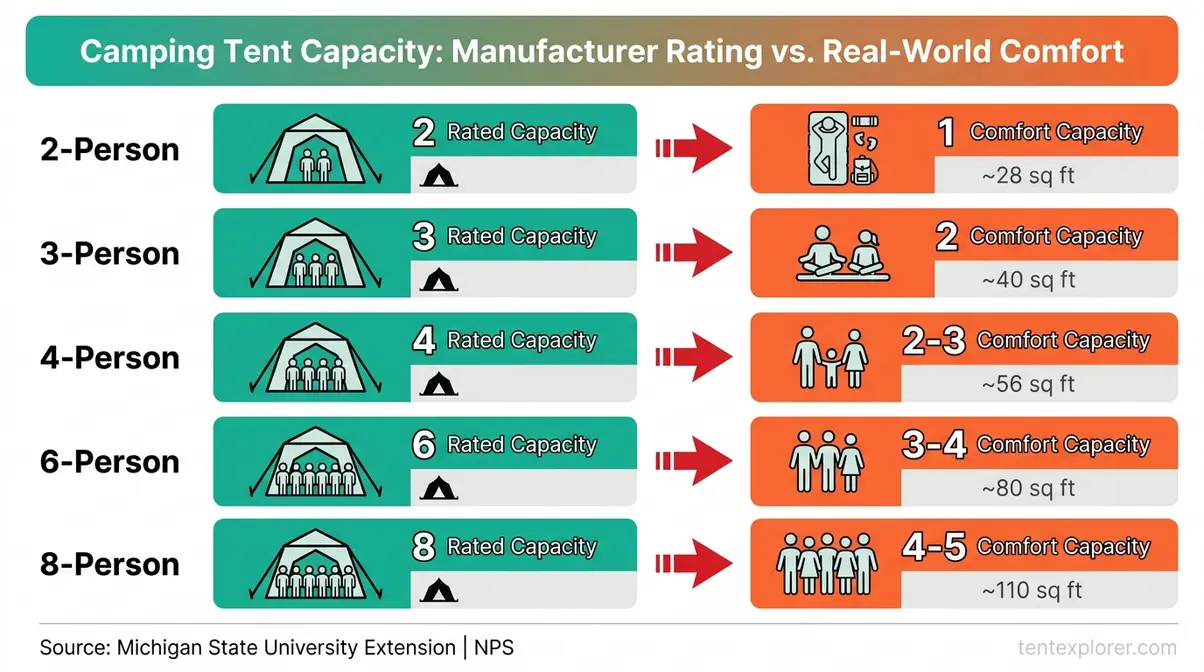
Manufacturers rate tents on maximum body count lying side-by-side with no gear. Real-world comfortable camping requires 25–30 sq ft per person — enough for a sleeping bag, pad, gear bag, and the ability to turn over without elbowing your tentmate. “For optimal comfort and safety, camping experts recommend keeping occupants below the tent’s maximum stated capacity — using a 3-person tent for 2 people and a 4-person tent for 3 (camping tent capacity best practices, Michigan State University Extension, 2026).”
Use this camping tent size chart to find the right fit:
| Manufacturer Rating | Comfortable Capacity | Floor Area (typical) | Best For |
|---|---|---|---|
| 2-person | 1 person (solo with gear) | ~28 sq ft | Solo backpacking |
| 3-person | 2 people | ~40 sq ft | Couples with gear |
| 4-person | 3 people | ~55 sq ft | 2 adults + 1 child |
| 6-person | 4 people | ~80 sq ft | Small family |
| 8-person | 5–6 people | ~100 sq ft | Family of 4–5 |
Sources: Michigan State University Extension (2026); National Park Service campsite tent limits
NPS campsites at federal parks typically allow one large tent or two small tents per site, with strict occupant limits for safety. For a family of 4 with gear, choose a 6-person tent (80 sq ft ÷ 4 people = 20 sq ft each — comfortable with room for packs).
For indoor growers, tent sizing follows a completely different logic — it’s about airflow volume, not people.
Grow Tent Fan Size Calculator
The formula for grow tent ventilation: Required CFM = Tent Volume (L × W × H in feet) × Air Exchange Rate.
- Standard air exchange rates by grow type:
- 1x/min: Passive growing, low-heat environments
- 2x/min: CO2 supplementation or moderate humidity
- 3x/min: High-heat or high-humidity environments
A 4x4x6.5 ft grow tent = 104 cubic feet. At 2 air exchanges per minute: 104 × 2 = 208 CFM minimum fan. Round up to the next available fan size (typically 225 or 240 CFM). Per state regulations for camping tent capacity, ventilation and occupancy standards vary by jurisdiction — always verify local codes for permanent grow setups.
Whether you’re sizing a grow tent or a wedding tent, the biggest risk is the same: undersizing due to avoidable calculation errors. Here’s what to watch for.
Common Tent Sizing Mistakes to Avoid
The most expensive tent sizing mistake isn’t choosing the wrong size — it’s choosing the wrong size after doing the math. These five errors account for the majority of “tent too small” complaints from event planners.
The 5 Most Common Sizing Errors
1. Forgetting the Dance Floor Scenario: 100-person wedding, calculated 1,400 sq ft (14 sq ft/person), booked a 30×60. Problem: 200 sq ft dance floor + 100 sq ft bar leaves only 1,100 sq ft for 100 guests — 11 sq ft each, well below comfort targets. Fix: Calculate all add-ons before selecting the tent, not after.
2. Using Standing Capacity for a Seated Event Scenario: A vendor lists a tent as “seats 100” — but that’s cocktail capacity. Actual seated dinner capacity is 40–50% lower. Fix: Always confirm whether a quoted capacity assumes standing, theater, or banquet seating before booking.
3. Ignoring Serving Staff Aisles Scenario: 12 sq ft per person is correct for guest space, but serving staff need 36-inch minimum aisle clearance between tables. A room-filling table arrangement may seat 100 guests but make service impossible. Fix: Use 15 sq ft per person (the fire code standard with service aisles) for any formal sit-down event.
4. Forgetting the 10% Buffer Scenario: Calculated exactly 1,800 sq ft, booked a 30×60 (1,800 sq ft). The tent is 100% full at capacity with zero margin for unexpected guests or vendor equipment. Fix: Always apply the 10% buffer — Layer 3 of the Comfort Layer Method — before selecting your tent size.
5. Assuming Manufacturer Tent Ratings Are Event Capacities Scenario: A tent listed as a “10-person tent” is actually a camping tent rated for bodies lying side-by-side. Event tents are sold by dimensions, not person-count labels. Fix: Always work from square footage and dimensions, never from person-count marketing labels.
If your event is unusually complex — 300+ guests, multi-zone layouts, or challenging terrain — these are the scenarios where professional guidance pays for itself.
When to Size Up or Use Two Tents
Size Up When: Your calculation puts you within 10% of a standard tent’s maximum capacity; you have uneven terrain that reduces usable floor space; or your RSVP rate is uncertain (add 15% buffer for RSVPs under 70% confirmed).
Two Tents When: Guest count exceeds 300, you want separate zones (a dining tent and a lounge tent), or the venue layout prohibits a single large footprint. Two 40×60 tents with a connecting tunnel is a common solution for large weddings.
Professional Help When: Guest count exceeds 400, the event requires HVAC, a local permit requires a stamped engineer’s drawing, or the site involves sloped or uneven terrain.
With your tent size confirmed, here are the answers to the most common questions event planners ask.
Frequently Asked Questions
Cost to rent a 40×60 tent?
Renting a 40×60 tent typically costs $1,400–$3,600 for a single-day event, depending on tent style, region, and whether setup and delivery are included. Frame tents tend to run $1,800–$3,600, while pole tents start lower at $1,400–$2,800 (American Tent, 2026). Regional cost variation is significant, with urban markets and peak wedding season (May–October) adding 20–40% to base rates. Always request itemized quotes from at least three local tent rental companies, specifying the tent style, setup/teardown, and any included sidewalls or flooring.
Capacity of a 30×60 tent?
A 30×60 tent provides 1,800 square feet and comfortably holds 120 guests for a seated dinner (at 15 sq ft/person) or up to 225 guests for a standing cocktail event (Aztec Tent, 2026). It’s the smallest tent size that allows a comfortable dance floor (150–200 sq ft) alongside seated dining for around 100 guests. For events near the upper end of capacity, size up to a 40×60 to avoid a cramped feel.
Capacity of a 30×50 event tent?
A 30×50 tent provides 1,500 square feet and accommodates approximately 100 guests for a seated dinner or 187 guests for a standing cocktail event. This is a less common standard dimension, as more rental companies stock the 30×40 or 30×60 sizes. Confirm availability with your local tent rental company before planning around this specific footprint. With a small dance floor and bar, comfortable seated capacity drops to approximately 86 guests (Omni Calculator, 2026). If your local vendor doesn’t offer a 30×50, a 30×60 provides a comfortable upgrade at minimal additional cost.
Capacity of a 30×30 tent?
A 30×30 tent provides 900 square feet and fits approximately 60 guests for a seated dinner or 112 guests for a standing cocktail event (Best Tents and Events, 2026). This size suits small weddings, birthday parties, and corporate luncheons of 40–75 guests, providing enough room for 7-8 round tables. If your event includes multiple add-ons like a dance floor or buffet, a 30×60 is the next practical upgrade.
Capacity of a 40×20 tent?
A 40×20 tent (800 square feet) accommodates approximately 53 guests for a seated dinner or up to 100 guests for a standing cocktail event. This rectangular footprint is popular for backyard parties and corporate receptions where space is limited. The narrow 20-foot width limits table arrangement options, so round tables work better than long banquet tables in this configuration (American Tent, 2026). With a small bar station, comfortable seated capacity drops to approximately 46 guests.
Conclusion
For event planners and hosts, a reliable tent size calculator works best when it applies all three layers of the Comfort Layer Method: base guest space (6–15 sq ft per person by seating style, per NFPA Table 7.3.1.2), functional zone additions for dance floors, bars, and buffets, and a 10% safety buffer. Getting all three layers right is the difference between a tent that feels spacious and one where guests spend the evening apologizing for bumping elbows. A 40×60 tent (2,400 sq ft) is the most versatile size for 100–200 guests — accommodating 160 at a seated dinner or 300 at a standing reception (GetTent, 2026).
The Comfort Layer Method gives you a repeatable answer — not a guess — for any event size or configuration. Whether you’re planning a 50-person backyard wedding or a 200-person corporate gala, the same three-step framework applies. Use it once, and you’ll never need to second-guess a tent booking again.
Use the interactive tent size calculator above to confirm your recommendation, then request quotes from at least three local tent rental companies — specifying your exact square footage requirement, preferred tent style, and event date. Getting three quotes typically saves 15–25% on final rental cost. On TentExplorer, you’ll find additional resources for understanding tent capacity ratings if you want to go deeper on any of the standards covered here.