
This blog post may contain affiliate links. As an Amazon Associate I earn from qualifying purchases.
When comparing a tent vs. teepee, the answer isn’t which is universally better — it’s which is better for your trip. Teepees offer unmatched standing room, superior ventilation, and the ability to run a wood stove safely; standard tents win on packability, all-weather versatility, and value. Buy the wrong shelter and you’ll spend a weekend hunched in a low-ceiling dome on a basecamp trip, or hauling a 12-pound canvas cone on a trail that demanded a 2-pound bivy.
By the end of this guide, you’ll understand the real performance differences between teepee and standard tents — and know exactly which one fits your camping style. We cover design, weather performance, use cases, top picks by category, cultural history, and the safety considerations that no competitor bothers to mention.
Key Takeaways: Tent vs. Teepee
When choosing between a tent vs teepee, teepees win on interior space and hot-tenting capability while standard tents lead in portability and all-weather adaptability.
- The Space-Weight Trade-off Framework: Score your shelter needs on livability vs. portability — teepees dominate livability; ultralight tents dominate portability
- Hot tenting advantage: Teepees with stove jacks safely run a wood stove; most standard tents cannot
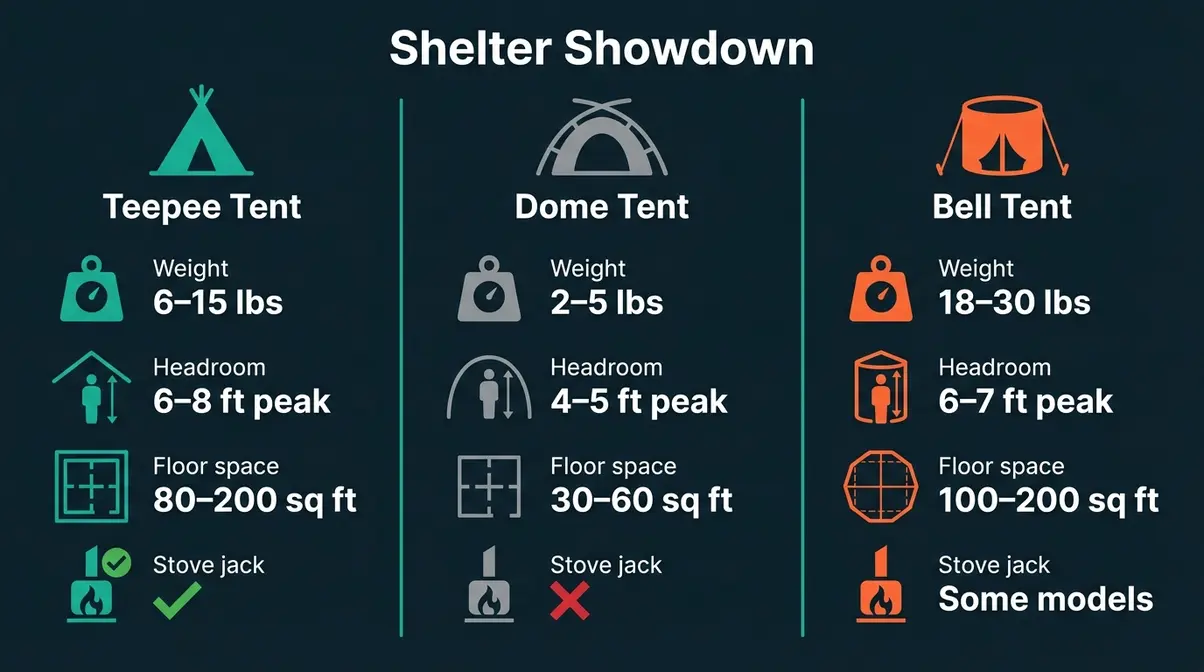
- Weight gap is real: A quality teepee typically weighs 6–15 lbs vs. 2–5 lbs for a comparable dome tent
- Best for car camping/glamping: Teepee. Best for backpacking: dome or tunnel tent
- Declining trend: “Tent vs teepee” searches have dropped 29% year-over-year as campers increasingly search for specific features like “hot tent” or “lightweight teepee” (keyword research data, 2026)
Tent vs. Teepee: Head-to-Head Comparison
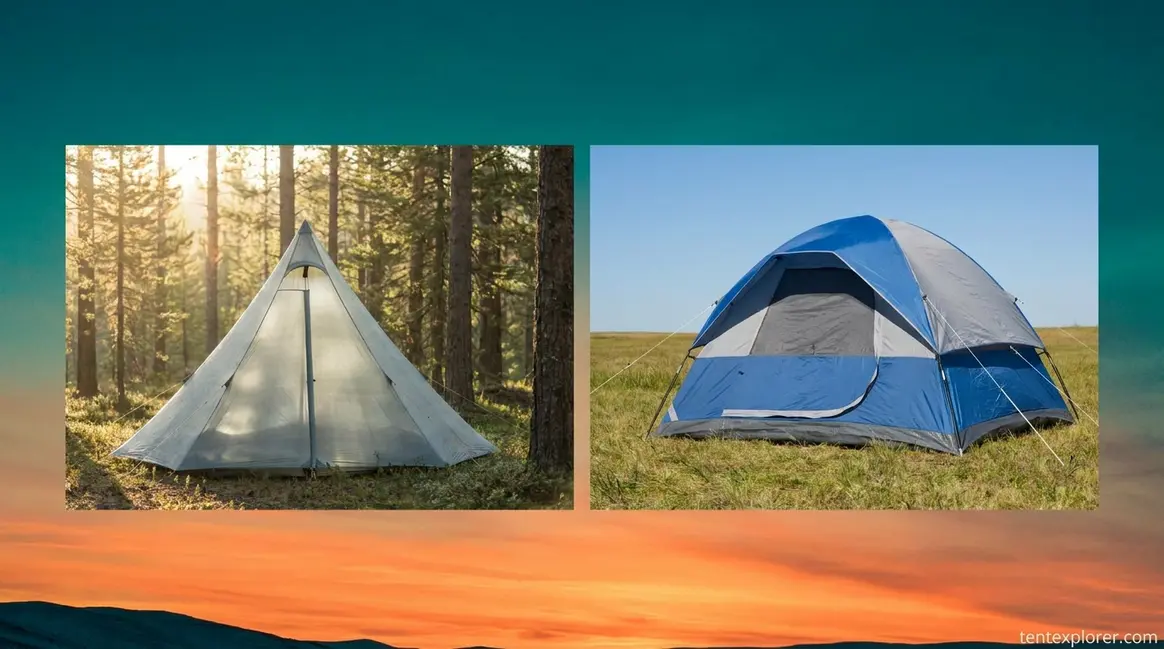
The teepee vs. tent debate comes down to a fundamental trade-off between livability and portability. A teepee tent — a cone-shaped single-pole shelter originally derived from Indigenous tipi design — prioritizes vertical space and airflow. A dome tent, the most common recreational tent style using crossed flexible poles, optimizes for low weight and all-weather toughness. Neither shelter wins across every metric, which is exactly why the comparison matters.
Our team evaluated both shelter types across multiple camping scenarios — car camping, basecamp hunting, and multi-day backpacking — scoring each on six criteria: structure, headroom, weather resistance, portability, setup time, and cost. Here’s what the data shows.
The Head-to-Head Comparison Table
| Feature | Teepee Tent | Dome Tent | Bell Tent |
|---|---|---|---|
| Structure | Single center pole, cone shape | Crossed flexible poles, freestanding | Single center pole, near-vertical canvas walls |
| Interior Headroom | Full standing room (6–8 ft peak) | Limited (4–5 ft peak) | Full standing room (6–7 ft peak) |
| Floor Space | 80–200+ sq ft | 30–60 sq ft | 100–200 sq ft |
| Weather: Wind | Excellent (aerodynamic cone sheds wind) | Good (low profile, multiple stake points) | Moderate (wall catches crosswind) |
| Weather: Rain | Good (steep pitch sheds water; floorless = ground seep risk) | Excellent (bathtub floor, sealed seams) | Good (canvas absorbs then repels) |
| Weather: Snow | Good (steep cone sheds load) | Good (curved poles distribute load) | Poor (flat roof collects snow) |
| Pack Weight | 6–15 lbs (canvas); 2–4 lbs (ultralight silnylon) | 2–5 lbs (standard); under 2 lbs (ultralight) | 18–30 lbs |
| Setup Time | 5–15 minutes (single pole) | 5–10 minutes (freestanding) | 15–25 minutes (staking required) |
| Stove Jack Compatible | Yes (most models) | No (rare exceptions) | Yes (some canvas models) |
| Cost Range | $80–$600+ | $50–$500+ | $200–$900+ |
| Best For | Basecamp, glamping, hot tenting, hunting | Backpacking, weekend camping, all-weather | Glamping, festivals, car camping |
Structure: Cone vs. Dome vs. Tunnel
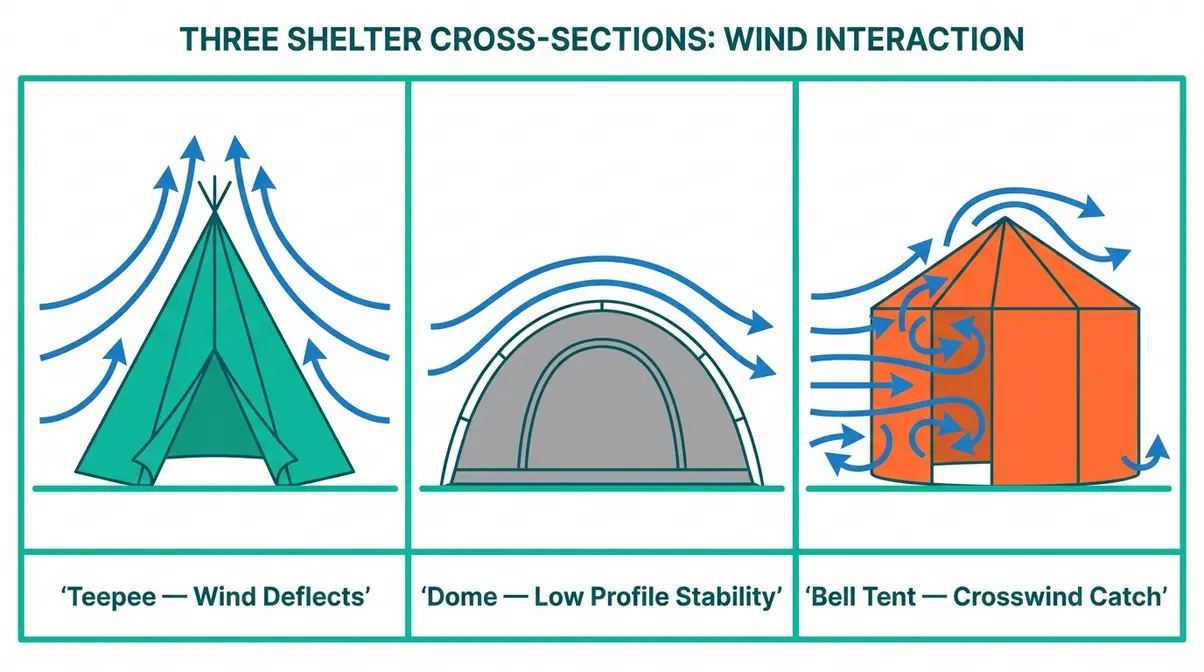
The core structural difference between a teepee and a standard tent determines nearly every downstream performance characteristic. A teepee tent uses a single center pole — or a trekking pole in ultralight versions — to lift a cone of fabric to a peak of 6–8 feet. The steep angle of the walls is its primary engineering advantage: wind deflects around the cone rather than pushing against a flat surface, and rain sheds quickly without pooling.
A dome tent, by contrast, uses two or more crossed flexible poles to create a freestanding arch. The low profile — typically 4–5 feet at peak — is a deliberate design choice. Lower height means less wind surface area and more structural rigidity in storms. Tunnel tents extend this logic further, using parallel hoops to create a long, low shelter optimized for expedition use.
The bell tent — a circular canvas shelter with a single central pole and near-vertical walls — occupies middle ground. It shares the center-pole design of a teepee but its nearly vertical walls create more usable perimeter space. However, those same walls catch crosswind more aggressively than a cone profile, and the heavier canvas construction (18–30 lbs packed) makes it a car-camping-only proposition.
Space and Headroom: Where Teepees Win
Interior volume is where teepees outperform every comparable-weight standard tent — and it’s not close. A mid-range teepee tent like the Seek Outside Cimarron (3.9 lbs) delivers a 6-foot peak with room for two adults to stand upright, change clothes, and organize gear without contorting. A comparable-weight dome tent peaks at 4–4.5 feet. You crouch. You shuffle. After three days, the psychological toll of a low ceiling is real.
For family camping, the space advantage compounds. A 10-person teepee tent typically offers 150–200 square feet of interior space — enough for six sleeping pads arranged spoke-style around a central stove, with room to walk between them. A comparable-capacity dome or cabin tent achieves similar square footage only by adding weight and complexity (multiple poles, multiple rooms, separate vestibules).
The trade-off is floor efficiency. The cone geometry means the perimeter area near the walls is too low to use for sleeping or gear storage. Usable floor space — defined as areas with at least 3 feet of headroom — is roughly 60–70% of the tent’s total footprint. In a dome, nearly 80–90% of the floor is usable sleeping space because the walls bow outward.
Quotable: A teepee’s central standing room covers roughly 60–70% of usable floor space, versus 80–90% for a dome tent of equal footprint — a real trade-off that matters most in smaller two-person models.
Weather: Wind, Rain, and Snow
Wind performance is the most counterintuitive finding in the tent vs. teepee comparison. The conventional assumption — that a tall, single-pole structure is inherently unstable — is wrong when the cone is properly oriented and guyed out. According to field data from backfire.tv, the Sawtooth tipi withstood 30 mph winds with gusts to 40 mph in exposed sheep hunting terrain when pitched with the door facing into the wind. The aerodynamic cone profile generates minimal drag compared to a boxy cabin tent or even a bell tent with vertical walls.
That said, dome tents retain an edge in unpredictable multi-directional gusts. Because a dome is freestanding and symmetrically anchored, it handles wind from any direction without adjustment. A teepee requires deliberate orientation — door into the wind — to achieve its best wind performance. Get it wrong and the cone acts as a sail.
Rain performance divides sharply along the floorless vs. floored line. Most teepee tents are floorless by design (a floorless design means the tent walls meet the ground without a sewn-in waterproof floor). This saves weight and allows a wood stove, but ground moisture and rain splash can seep in during heavy precipitation. The solution — a cut-to-fit ground cloth or interior nest insert — adds 1–2 lbs but effectively solves the problem. Standard dome tents with bathtub floors (raised waterproof floors that form a “bathtub” around the perimeter) handle rain more passively and require no additional gear.
Snow load performance is strong for both cone and dome shapes. The steep pitch of a teepee sheds accumulation effectively; the curved poles of a dome distribute load across a wide footprint. Bell tents — with their flatter roof geometry — are the most vulnerable to heavy snow and should not be used in winter conditions without frequent clearing.
Condensation management is a pain point that competing articles consistently ignore. Teepees naturally manage condensation better than double-wall dome tents in one specific scenario: high-humidity summer nights when the temperature differential between inside and outside is small. The apex vent at the top of the cone allows warm, moist air to escape continuously, reducing the vapor pressure differential (VPD — the difference between the water vapor content of the air and its maximum capacity, which drives condensation on tent walls). In practice, this means fewer wet sleeping bags on summer trips.
However, floorless teepees pitched on wet ground or dense vegetation can pull ground moisture upward through convection. Across user reports on r/camping and dedicated forums like Rokslide, the consistent recommendation is to pitch on higher, drier ground, raise the tent edges 1–2 inches off the surface using line locks, and keep the apex vent open even in rain (the cone geometry keeps rain out of a properly sized apex opening).
Are teepee tents waterproof?
Most modern teepee tents are water-resistant, not fully waterproof in the way a floored dome tent is. Silnylon and polycotton canvas teepees typically carry a 1,500–3,000mm hydrostatic head rating, which handles normal rain well. The real vulnerability is the floorless design — ground moisture and rain splash can enter under the tent walls during heavy sustained precipitation. A properly fitted ground cloth and elevated perimeter staking resolve most of this risk. Canvas teepees become more water-resistant after seasoning (first exposure to rain swells the fibers and closes micro-gaps).
How do teepee tents hold up in wind?
Teepee tents hold up exceptionally well in wind when properly oriented and guyed out. The aerodynamic cone profile deflects wind rather than catching it, and the single center pole creates no lateral surface area for wind to push against. According to backfire.tv’s field evaluation, a Sawtooth tipi withstood 30 mph sustained winds with 40 mph gusts in exposed hunting terrain when pitched with the door facing into the wind. The key variable is orientation — a teepee pitched sideways to prevailing wind performs significantly worse than one properly aligned. In multi-directional storm conditions, a freestanding dome tent’s omnidirectional stability is an advantage.
Portability and Setup Time
Setup is one area where teepees genuinely surprise skeptics. A single-pole design means there is only one structural decision to make: find level ground, stake the perimeter, raise the center pole. Most experienced users can pitch a mid-size teepee solo in under 10 minutes. A dome tent of equivalent capacity — with multiple poles, clips, and vestibule stakes — often takes the same amount of time despite appearing simpler.
The weight story is more nuanced. Canvas teepees, the kind you see in glamping Instagram posts, pack down to 15–25 lbs — a car-camping-only proposition. Modern silnylon and DCF (Dyneema composite fabric) teepees for backpacking are a different category entirely. The Seek Outside Cimarron weighs 3.9 lbs, the DANCHEL Backpacking Lightweight Teepee runs around 95 dollars and under 4 lbs, and the Black Diamond Mega Snow 4P checks in at approximately 7.9 lbs for four-season capability.
| Shelter Type | Packed Weight | Setup Time | Setup Complexity |
|---|---|---|---|
| Canvas teepee (6–10 person) | 15–25 lbs | 15–20 min | Low (1 pole) |
| Silnylon teepee (2–4 person) | 3–6 lbs | 8–12 min | Low (1 pole or trekking pole) |
| Ultralight dome (1–2 person) | Under 2 lbs | 5–8 min | Medium (2–3 poles) |
| Standard dome (3–4 person) | 4–7 lbs | 8–12 min | Medium (2–3 poles) |
| Bell tent (4–8 person) | 18–30 lbs | 15–25 min | High (1 pole + extensive staking) |
The setup simplicity of a teepee matters most in cold, wet, or low-light conditions — exactly when fumbling with multiple poles and clips becomes genuinely miserable. One pole, one decision.
Teepee vs. Dome vs. Bell Tent
The terminology confusion in this category is real, and it costs campers money when they buy the wrong shelter. Here’s the practical breakdown for the three most commonly confused shelter types.
Teepee vs. dome tent: The core trade-off is livability vs. portability. Choose a teepee for basecamp trips, hunting camps, and hot tenting. Choose a dome for backpacking, weekend camping, and all-weather reliability without a ground cloth. The teepee and dome tent serve fundamentally different primary users — they are not interchangeable.
Teepee vs. bell tent: Both use a single center pole and both offer standing room, but they diverge sharply on weight, wind performance, and stove compatibility. Bell tents — typically made from heavy polycotton canvas — weigh 18–30 lbs and are strictly car-camping shelters. Many canvas bell tents include a stove jack port, making them a legitimate hot-tenting option. However, the near-vertical walls that give bell tents their excellent perimeter headroom also catch crosswind aggressively. A teepee handles wind better; a bell tent handles rain better (canvas absorbs then repels water once seasoned). If you want the spacious, aesthetic appeal of a canvas shelter and never plan to carry it more than 50 yards from your car, a bell tent is excellent. If you want to hike in even occasionally, a teepee wins.
The Space-Weight Trade-off Framework
The Space-Weight Trade-off Framework is a two-axis decision tool that scores any camping shelter on livability (headroom, interior volume, stove compatibility) versus portability (packed weight, setup time, pack size). Plot your camping style on this spectrum and your shelter choice becomes obvious.
| Your Priority | Score Yourself | Best Shelter |
|---|---|---|
| Max livability, car camping or short carry | Livability 9–10 / Portability 1–3 | Canvas teepee or bell tent |
| Balanced basecamp (hike in, stay 3+ nights) | Livability 6–8 / Portability 4–6 | Silnylon teepee (3–6 lbs) |
| Backpacking with comfort compromise | Livability 4–6 / Portability 6–8 | Standard dome or tunnel tent |
| Ultralight backpacking, miles are everything | Livability 1–3 / Portability 9–10 | Ultralight dome or tarp |
Most campers who ask the tent vs. teepee question sit in the 5–7 range on both axes — which is exactly why this decision feels hard. The honest answer for that middle group: a lightweight silnylon teepee (3–6 lbs, stove-jack compatible) is the most versatile shelter if you camp in groups of two or more and value the ability to stand up and cook inside. A solo backpacker who prioritizes miles over comfort should stay in the dome category.
Teepee Tent Features and Best Use Cases
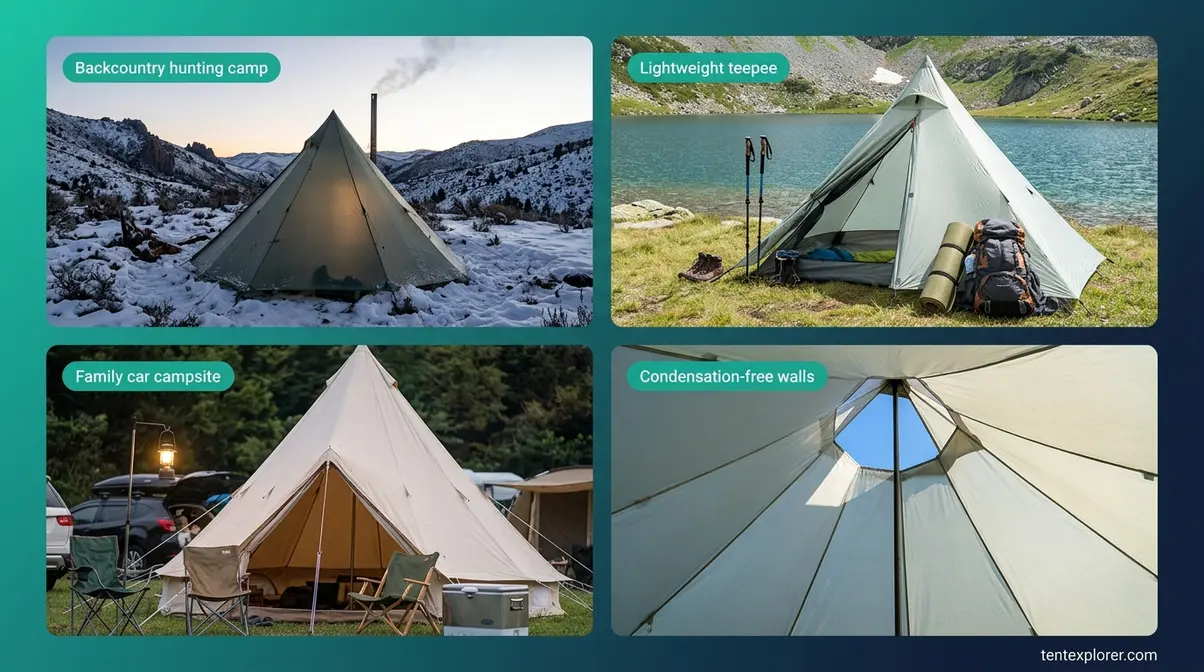
Teepee-style tents aren’t one-size-fits-all gear — they span a wide spectrum from ultralight backcountry shelters to glamping palaces. Understanding which teepee feature set matches your actual camping style prevents the most common buying mistake: purchasing a 15-pound canvas cone because it looks great on Instagram, then never taking it anywhere. The four use cases below cover the realistic scenarios where teepees outperform standard tents — and one critical area (condensation) that most buyers don’t think about until it’s too late.
Hot Tenting with a Wood Stove
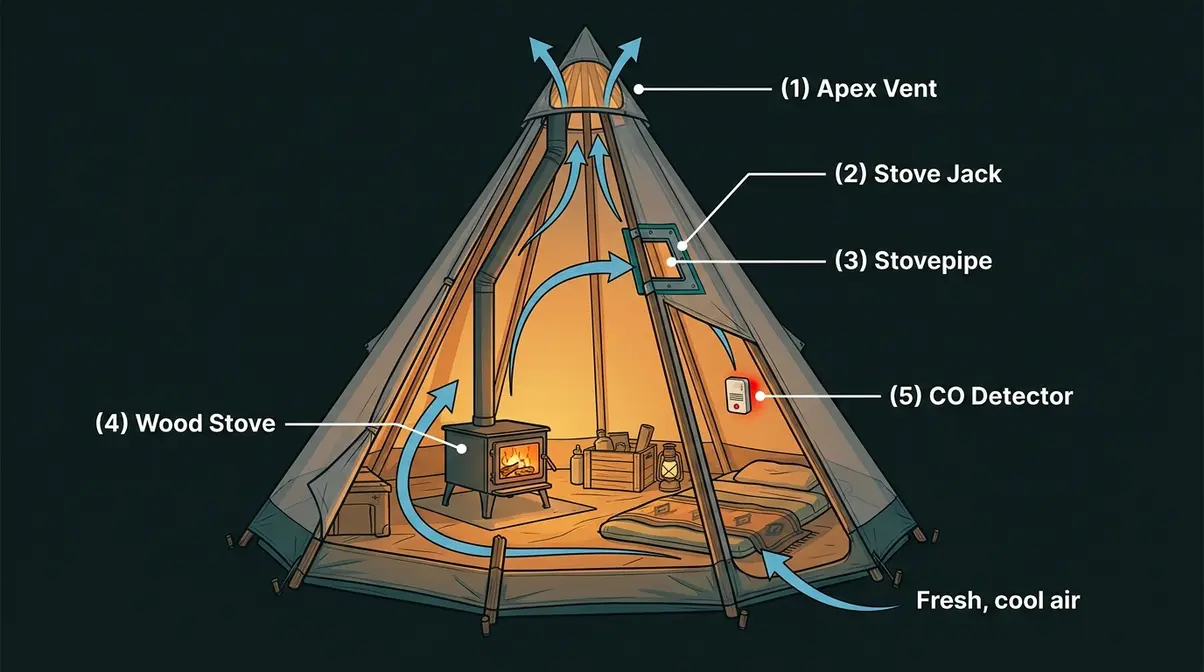
Hot tenting — running a wood stove inside a tent during cold-weather camping — is the single biggest performance advantage a teepee holds over any standard tent. Most teepee tents are designed with a stove jack (a heat-resistant metal collar sewn into the tent wall for a stovepipe) as a standard or optional feature. Standard dome and tunnel tents almost never include a stove jack, and attempting to improvise one in a synthetic tent is a fire and carbon monoxide hazard.
The cone geometry of a teepee is particularly well-suited to wood stove use for two reasons. First, the apex vent at the top creates natural convective airflow — warm air from the stove rises and exits at the peak, drawing fresh air in through the door and lower vents. This reduces CO accumulation compared to a sealed, poorly ventilated shelter. Second, the central vertical space above the stove (where the stovepipe runs) is dead space in terms of sleeping area anyway, so the stove and chimney set up doesn’t consume usable floor real estate.
Carbon monoxide safety is non-negotiable. The CPSC estimates 211 non-fire CO deaths from consumer products annually (latest available 2020 historical data), with heating equipment accounting for a significant share. The CDC has documented camping-specific CO fatalities linked to combustion devices used in enclosed shelters. Even in a well-vented teepee, the stovepipe must exit completely through the stove jack, the stove must burn seasoned hardwood (not green wood, which produces more CO), and a battery-operated CO detector should be placed at sleeping height inside the tent.
Lightweight Teepees for Backpacking
The assumption that teepees are too heavy for backpacking is accurate for canvas models — and completely wrong for modern silnylon and DCF versions. The space-to-weight ratio of a lightweight teepee is genuinely compelling for groups of two or more, and the outdoor community has recognized this for years. As one experienced camper put it in a widely cited r/camping thread:
“Floorless tents excel at space to weight ratio, which to most people translates to a more comfortable camp that is still light enough to backpack.”
The math supports this. A Seek Outside Cimarron weighs 3.9 lbs and shelters two adults with full standing room. A comparable two-person dome tent with similar weather protection weighs 3–5 lbs — but delivers 4.5 feet of peak height and no stove capability. For a two-night backpacking trip where you’re spending meaningful time inside the tent, the teepee’s livability advantage is real and the weight penalty is minimal or nonexistent.
The practical limitations for backpacking teepees are real, however. Most ultralight teepees are floorless, requiring a separate ground cloth (add 0.5–1.5 lbs) or footprint. Bug netting — if the teepee doesn’t include an inner tent — must be carried separately in insect-heavy environments. And the single-pole design requires either a dedicated center pole (add 0.5–1 lb) or a trekking pole, which most backpackers carry anyway.
For solo backpackers prioritizing miles over comfort, the weight-per-person calculation tips toward a dome. A one-person ultralight dome (under 2 lbs) is hard to beat purely on packability. But for two or more campers who want a comfortable basecamp experience at the end of a long day, a lightweight teepee is a legitimate and often overlooked choice.
Family and Group Glamping
For car camping with families or groups, a teepee tent provides ample headroom and social space that standard tents simply cannot match. A 10–12 person teepee offers 150–200 square feet of floor space with 7–8 feet of standing room at the peak — effectively a portable living room. Adults can change clothes without performing yoga, kids can play a card game standing up, and everyone can gather around a central lantern or stove without sitting on sleeping bags.
The outdoor teepee tent market for adults has grown substantially, with options ranging from budget-friendly polyester models (around $80–$150) to premium polycotton canvas tents ($400–$800+) that last a decade with proper care. Canvas teepees breathe better than synthetic alternatives, naturally regulating temperature and reducing condensation in warm weather — a meaningful comfort advantage on summer trips.
The glamping use case is where bell tents and teepees compete most directly. Bell tents offer more usable perimeter space (vertical walls vs. sloping cone walls), but teepees typically set up faster and handle wind more gracefully. For groups who want the aesthetic of a canvas shelter without a 25-pound pack-out, a polycotton teepee in the 10–14 person size range is the practical choice.
Ventilation and Condensation Management
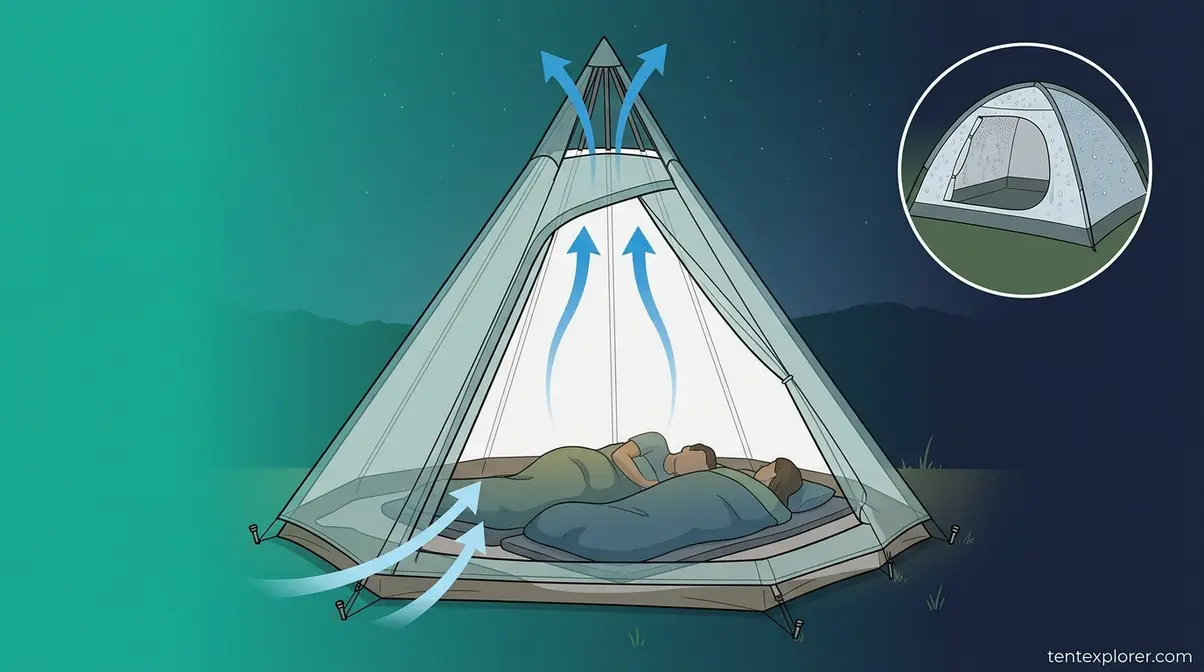
Condensation management is the most under-discussed teepee performance topic — and the one most likely to ruin a trip if you don’t plan for it. No competing article addresses this in any depth, which means most first-time teepee buyers discover the problem on their first wet morning.
The teepee’s apex vent is its primary condensation defense. Warm, moist air from breathing and cooking rises naturally and exits at the peak, while cooler ambient air enters through the door and lower wall gaps. This convective loop — driven by the tent’s own internal heat — is more effective than the static double-wall construction of most dome tents, which relies on an air gap between the inner tent and fly to prevent condensation transfer. In practice, teepees in summer conditions often have drier interior walls than double-wall domes.
The floorless design, however, introduces ground-level moisture risk that floored tents don’t face. Damp soil, morning dew, and vegetation under the tent can raise interior humidity significantly. The r/camping community and Rokslide hunting forums consistently identify three mitigation strategies that work:
- Site selection: Pitch on higher, drier ground away from standing water and dense vegetation. Avoid low-lying areas where cold air (and moisture) pools overnight.
- Edge management: Use line locks or cord adjusters to raise the tent perimeter 1–2 inches off the ground, allowing air circulation under the walls while keeping rain out.
- Apex vent discipline: Keep the apex vent open even in light rain — the cone geometry prevents rain intrusion through a properly sized vent opening. Closing the vent to stay warm accelerates condensation buildup.
For winter hot tenting, a wood stove actually helps with condensation by raising the interior temperature and reducing relative humidity. Paradoxically, the most condensation-prone teepee scenario is a warm, humid summer night with no stove and poor site selection — not a cold winter trip where the stove is running.
Best Teepee Tents by Category
Choosing the right teepee requires matching the tent’s design philosophy to your actual use case. Our evaluation surveyed current models across the camping, hunting, and budget categories, cross-referencing gear review data from Wilderness Times (2026), the Equipment Guide, and community consensus from r/camping and Rokslide. Prices are current as of January 2026 — verify at point of purchase.
Best Overall Teepee Tent for Camping
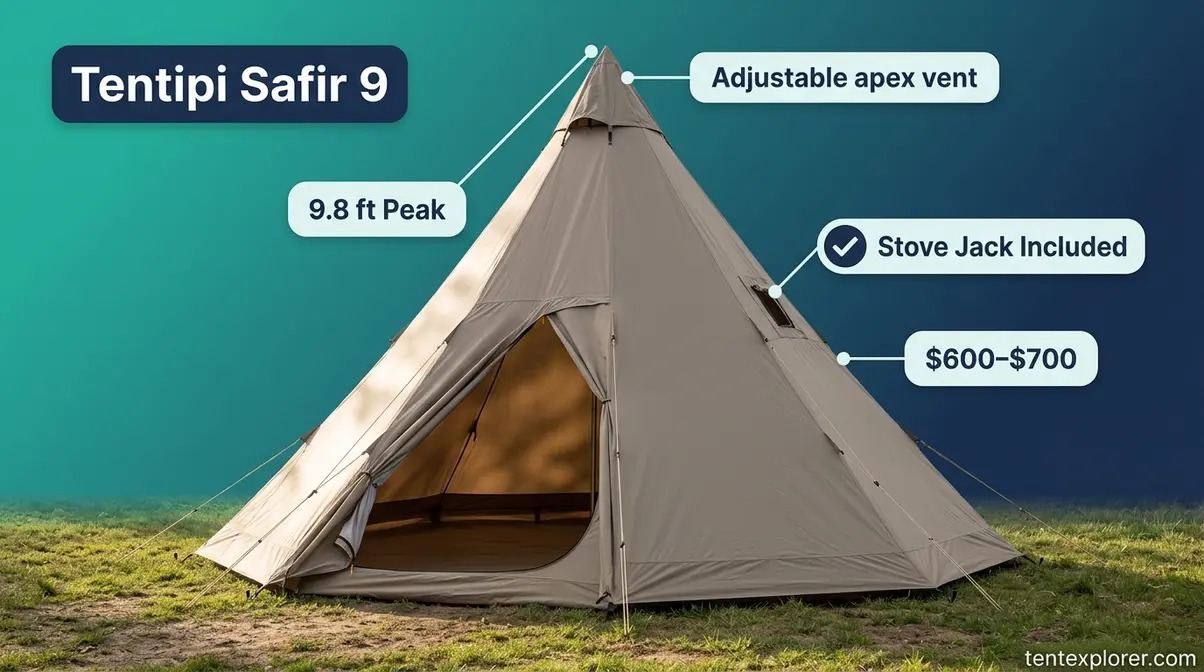
The Tentipi Safir 9 consistently earns top-overall recognition across independent gear review roundups (the-equipment-guide.com, 2026). It accommodates 9 people, stands 9.8 feet at the peak, and uses Tentipi’s proprietary Silon fabric — a silicone-treated nylon that balances weight, water resistance, and UV durability better than standard polyester or basic silnylon. The Safir 9 includes a stove jack as standard, making it immediately hot-tent compatible without modification.
Key Specs:
- Capacity: 9 people
- Peak Height: 9.8 ft
- Floor Area: ~215 sq ft
- Fabric: Silon (silicone-treated nylon)
- Stove Jack: Included
- Price: ~$600–$700 (as of January 2026)
Pros:
- Full standing room for all occupants — the 9.8-foot peak is the best in class at this weight
- Stove jack included as standard, not an add-on upsell
- Silon fabric sheds water aggressively and resists UV degradation better than basic silnylon
Cons:
- Premium price point puts it out of reach for occasional campers
- Packed weight (~11 lbs) means car camping or short-carry basecamp only
- Single center pole requires a separate purchase for 12mm diameter specifications
Verdict: The Tentipi Safir 9 is the best all-around teepee for groups who want maximum livability, hot-tenting capability, and a fabric system that lasts. It’s an investment — but it’s the shelter you buy once.
Choose if: You basecamp with a group of 4–9 people and want a hot-tent-ready shelter with a premium fabric system that outlasts budget alternatives.
Skip if: You’re camping solo or as a couple — the Seek Outside Cimarron delivers similar quality at half the weight and a fraction of the price for smaller groups.
Best Teepee Tent for Hunting
The Seek Outside Cimarron is the hunting community’s consensus pick for backcountry tipi use, highlighted by Rock Creek Calls in their 2025 edition guide as the flagship model for hunters seeking lightweight weather resistance. At 3.9 lbs for the two-to-four person version, it’s genuinely backpackable to a remote hunting camp — a claim that most hunting-oriented shelters cannot make.
Key Specs:
- Capacity: 2–4 people
- Weight: ~3.9 lbs
- Fabric: 30D silnylon
- Stove Jack: Available (optional inner)
- Peak Height: ~7 ft
- Price: ~$380–$450 (as of January 2026)
Pros:
- 3.9 lbs makes it one of the lightest stove-compatible teepees available for two-plus person use
- Silnylon construction handles rain and snow without the weight penalty of canvas
- Pitches with a single trekking pole — no dedicated pole needed for hunters already carrying them
Cons:
- Floorless design requires a separate ground cloth in wet conditions (add 0.5–1 lb)
- Stove jack is a separate inner purchase, not included in base price
- 30D silnylon is durable but not bombproof — sharp rocks and heavy brush can abrade the fabric over time
Verdict: For hunters willing to carry a shelter into the backcountry, the Cimarron hits the best balance of weight, weather protection, and stove compatibility available. It’s a purpose-built tool for serious outdoor use.
Choose if: You’re backpacking into a hunting camp and need a shelter light enough to carry but capable enough to run a stove in sub-freezing temperatures.
Skip if: You’re car camping with a family of four or more — the Tentipi Safir 9 or a canvas teepee offers far more livable space for the same drive-in scenario.
Best Budget Teepee Tent
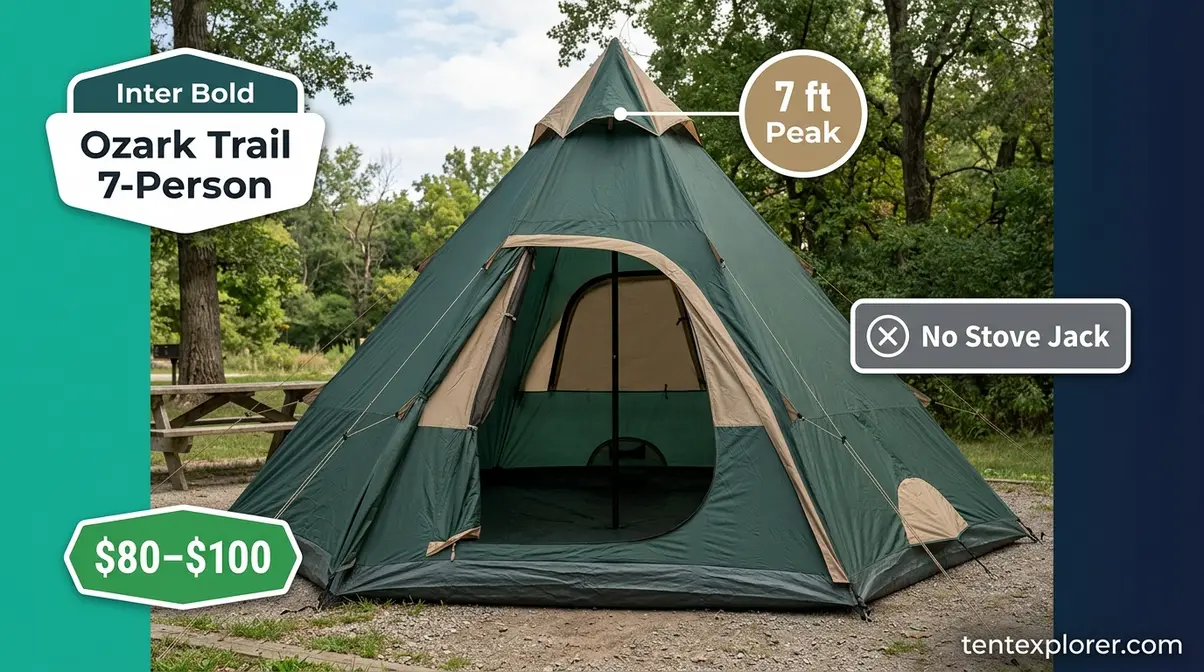
The Ozark Trail 7-Person Teepee is the most frequently cited budget recommendation across gear review sites (the-equipment-guide.com, 2026), and for good reason. At around $80–$100 (as of January 2026), it gives first-time teepee campers a genuine cone-shaped, center-pole shelter experience without committing to a premium price.
Key Specs:
- Capacity: 7 people
- Peak Height: ~7 ft
- Fabric: 75D polyester with 1500mm waterproof rating
- Stove Jack: Not included
- Price: ~$80–$100 (as of January 2026)
Pros:
- Accessible price point for campers testing the teepee format before upgrading
- 7-foot peak delivers genuine standing room — the core teepee experience is present
- Polyester construction requires less maintenance than canvas (no seasoning required)
Cons:
- No stove jack — not hot-tent compatible without dangerous DIY modifications
- 75D polyester traps heat more than polycotton canvas and breathes poorly in summer
- Durability is limited — expect 2–3 seasons of regular use before seams and zipper quality become issues
Verdict: The Ozark Trail 7-Person is the right shelter for campers who want to try teepee camping before committing to a $400+ premium model. It delivers the core experience (standing room, single-pole setup) at a fraction of the cost, with the understanding that it’s a starter shelter, not a long-term investment.
Choose if: You’re a first-time teepee camper who wants to test the format at a low financial risk before deciding whether to upgrade.
Skip if: You want hot-tenting capability or plan to use the shelter more than 20–30 nights per year — the Wintent 4-Season Teepee with Stove Jack (~$95) offers similar budget pricing with stove jack compatibility.
Teepee History and Design
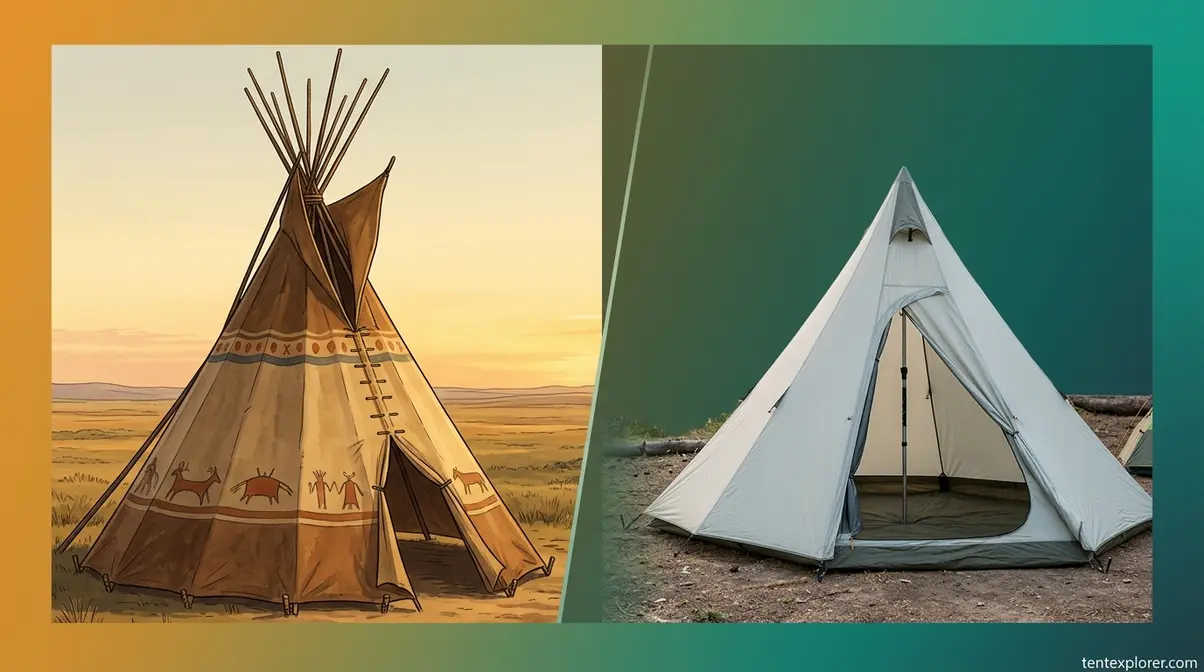
Understanding where the teepee’s design comes from illuminates why it performs the way it does. The modern recreational teepee tent is inspired by — but distinct from — the traditional tipi, a sophisticated shelter developed by Indigenous peoples of the Great Plains over centuries. It is important to draw a clear distinction: the traditional tipi is a living cultural heritage of Native American and First Nations peoples, not simply a historical artifact or design template. Modern recreational teepee tents borrow the geometric form; they do not replicate the cultural, spiritual, or community meaning embedded in traditional tipi construction and use.
Cultural Origins and the 13 Poles
The traditional tipi — the preferred academic spelling, used to distinguish it from the recreational “teepee” — was the primary dwelling of nomadic Plains tribes including the Lakota, Crow, Blackfoot, Cheyenne, and Comanche. Its genius was functional: a structure that could be erected by two people in under 30 minutes, dismantled and packed onto a travois (a frame dragged by horses), and transported as tribes followed bison herds across the Great Plains.
The pole count varies by tribe and tradition. The most commonly cited number — 13 poles — reflects Lakota and similar three-pole foundation systems, where three primary poles are tied together at the top and stood upright first, with additional poles added in a specific clockwise sequence. According to the Yorkton Tribal Council’s tipi teachings, each pole carries symbolic meaning: the foundational three represent obedience, respect, and humility, with subsequent poles representing values including happiness, love, faith, kinship, and strength.
The number of poles was not arbitrary engineering — it reflected the tribe’s spiritual framework and the practical materials available (typically lodgepole pine or spruce, selected for straightness and lightness). The Wikipedia entry on the tipi and academic sources including the University of Nebraska-Lincoln Encyclopedia of the Great Plains document that some tribes used 15, 17, or more poles depending on the tipi’s diameter and the regional tradition.
The tipi’s aerodynamic tilt — leaning slightly backward rather than standing perfectly vertical — was a deliberate engineering solution. The steeper back face deflects prevailing winds; the longer front face creates a larger smoke flap opening. The east-facing door orientation, common across many Plains traditions, aligned with sunrise and prevailing wind patterns of the Great Plains region. These were not aesthetic choices — they were solutions to real environmental problems, refined over generations of use.
Modern recreational teepee tents borrow the cone geometry and center-pole system. They do not borrow the cultural teachings, community protocols, or spiritual significance embedded in traditional tipi construction. Treating the two as equivalent conflates engineering inspiration with cultural heritage — a distinction worth keeping clear.
Anatomy of a Modern Teepee Tent
The modern teepee tent translates the traditional tipi’s functional geometry into contemporary materials and manufacturing, while adding features that the original design never needed (zipped doors, stove jacks, color-coded poles).
Key components of a modern teepee tent:
- Apex vent: The opening at the peak of the cone. Controls airflow, manages condensation, and — in hot-tenting models — provides the exit path for the stovepipe. Adjustable apex vents (with a drawstring or toggle system) allow you to balance ventilation against heat retention.
- Stove jack: A heat-resistant metal collar sewn into the tent wall, sized to fit a specific stovepipe diameter (typically 2.5–3 inches). Not all teepees include a stove jack — verify before purchasing if hot tenting is a priority.
- Center pole: Single aluminum or carbon fiber pole (or a trekking pole in ultralight models) that lifts the fabric to its peak height. Pole diameter matters — a too-thin pole flexes under wind load; a too-thick pole adds unnecessary weight.
- Guy lines: Tensioning cords that run from the tent body to ground stakes, pulling the fabric taut and increasing wind resistance. A properly guyed teepee with 6–8 stake points is significantly more wind-stable than a minimally staked one.
- Inner tent (optional): A bug net or insulated inner that clips inside the teepee shell, converting a floorless shelter into a floored sleeping space. Most premium teepees offer inner tents as accessories; they add 1–2 lbs but dramatically improve comfort in buggy or wet conditions.
How to Draw a Teepee (Step-by-Step)
Whether you’re planning a camping trip with kids, creating signage for an outdoor event, or just sketching in a notebook, drawing a recognizable teepee is a straightforward 5-step process.
- Draw the base triangle: Sketch a wide, shallow isosceles triangle — wider than it is tall at this stage. This is the visible fabric face of the teepee.
- Add the pole cluster: Extend 4–6 lines from the apex of the triangle upward and outward, fanning slightly. These represent the tops of the poles extending beyond the fabric.
- Add the door: Draw an oval or teardrop shape centered at the base of the triangle, slightly taller than wide. This is the entrance opening.
- Add decorative bands: Draw 1–2 horizontal bands across the lower third of the triangle. Traditional tipis featured painted bands and pictographs; modern teepees often have color-block panels.
- Add ground stakes and guy lines: Draw small triangle shapes at the base perimeter and thin diagonal lines from the lower fabric edge to the ground points. This grounds the drawing structurally and makes it look realistic rather than floating.
For a more accurate representation of the teepee’s three-dimensional cone shape, add a slight ellipse at the base rather than a flat line — this conveys the circular footprint that the two-dimensional triangle representation flattens out.
Limitations, Risks, and When to Choose Differently
No shelter is right for every situation. The teepee’s genuine advantages — space, hot-tenting compatibility, ventilation — come with equally genuine trade-offs that competing articles consistently downplay. Understanding these limitations before you buy prevents the most common and expensive camping gear mistake: purchasing a shelter optimized for the wrong use case.
Common Pitfalls When Choosing a Teepee
Underestimating the weight of canvas models. A 10-person canvas teepee weighing 20+ lbs sounds manageable until you’re carrying it 200 yards from the parking lot to your campsite in two trips. Canvas is beautiful and breathable, but it’s a car-camping-only material. If there’s any chance you’ll want to hike in — even to a walk-in campsite — choose a silnylon or polycotton model and verify the packed weight before purchasing.
Assuming floorless means bug-free. A floorless teepee without an inner tent is an open invitation to insects, rodents, and ground moisture. In the American Southeast and Midwest during summer, camping without a floor in a teepee without a bug net inner is genuinely uncomfortable. Always verify whether a bug net inner is included or available as an accessory — and budget for it.
Hot tenting without CO monitoring. The CPSC (latest available 2020 historical data) and CDC both document fatalities from combustion devices used in enclosed temporary shelters. Even a well-designed stove jack and apex vent system does not eliminate CO risk — it reduces it. A battery-operated CO detector placed at sleeping height is not optional safety theater; it is the minimum responsible precaution for any hot-tenting setup. Never burn charcoal, propane, or gas appliances inside a teepee — wood stoves with proper chimneys are the only appropriate heat source.
Expecting rain performance equal to a floored dome. A floorless teepee in heavy, sustained rain requires a well-fitted ground cloth and careful site selection. Campers who set up on flat, low-lying ground during a rainstorm will experience ground seep. Pitch on a slight slope or elevated ground, use a ground cloth that extends to the inner perimeter of the tent walls, and stake the perimeter taut to prevent rain splash from entering under the walls.
When to Choose a Standard Tent
Solo backpacking. The weight-per-person advantage of a teepee is diluted to nothing when you’re camping alone. A one-person ultralight dome (under 2 lbs) is lighter, more weatherproof, and less complex than any single-person teepee option. The livability advantage of the teepee — standing room, social space — is irrelevant when you’re the only occupant.
Highly variable or unpredictable weather. A dome tent’s freestanding, symmetrical design handles wind from any direction without adjustment. In environments where weather changes rapidly — exposed alpine terrain, coastal sites, storm-prone plains — the dome’s passive stability is genuinely valuable. A teepee requires deliberate orientation into the prevailing wind; in a storm that rotates direction overnight, you may need to restake and reorient at 2 a.m.
Budget-constrained weekend camping. A quality silnylon teepee starts around $200–$300 for a two-person model. A comparable dome tent from REI, Kelty, or NEMO starts at $100–$150. For campers who go out 3–5 times per year and don’t need hot-tenting capability, a standard dome tent delivers excellent value and requires less gear system planning (no ground cloth, no inner tent, no CO detector).
Three-season family camping with young children. Floored dome tents and cabin tents are simply easier to manage with small children — no ground cloth to lay out, no perimeter to stake before bedtime, no bug net inner to install. The teepee’s advantages (standing room, ventilation) matter less when your primary logistical challenge is getting a toddler to sleep before 10 p.m.
Frequently Asked Questions
Are teepee tents good for camping?
Teepee tents are excellent for camping when matched to the right scenario. They outperform standard tents on interior space, ventilation, and hot-tenting capability — making them the best choice for basecamp trips, group camping, hunting camps, and glamping. For solo backpacking or highly unpredictable weather, a freestanding dome is generally better.
Can you use a wood stove in a teepee?
Yes — teepees are the best recreational tent design for wood stove use, provided the tent includes a stove jack (a heat-resistant metal collar sewn into the tent wall for the stovepipe). The cone’s natural convective airflow moves combustion gases upward and out through the apex vent, reducing CO accumulation compared to sealed shelters. Always ensure your tent is specifically manufactured with a fire-retardant rating if you plan to use a stove, as makeshift stove jacks in standard nylon tents are extremely dangerous and should never be attempted. Critical safety requirements: use a battery-operated CO detector at sleeping height, ensure the stovepipe exits completely through the stove jack with no gaps, burn only seasoned hardwood, and never use charcoal, propane, or gas appliances as substitutes. The CPSC estimates over 200 non-fire CO deaths annually from consumer heating products — hot tenting requires active safety management, not just proper equipment.
Difference between tipi and teepee tent?
A tipi is a traditional dwelling of Indigenous peoples of the Great Plains; a teepee tent is a modern recreational shelter that borrows the cone geometry. The traditional tipi — the preferred academic spelling — was developed by nations including the Lakota, Crow, Blackfoot, and Cheyenne as a portable, all-season dwelling. Each pole carried cultural and spiritual meaning; construction methods, pole counts, and painted designs varied by tribe and tradition. Modern recreational teepee tents use the same aerodynamic cone shape and center-pole system for their engineering advantages, but they carry none of the cultural heritage, community protocols, or spiritual significance of the traditional tipi. When shopping for a shelter today, you are purchasing a teepee tent, which utilizes modern synthetic or canvas materials rather than traditional animal hides. Recognizing this distinction respects the historical origins while accurately describing your camping gear.
How many poles does a teepee tent have?
Most modern recreational teepee tents use a single center pole — either a dedicated aluminum or carbon fiber pole, or a trekking pole in ultralight designs. This is a deliberate simplification from the traditional tipi, which used 13 to 17 or more poles depending on tribal tradition. Modern teepee tents sacrifice the structural distribution of multiple poles for setup simplicity — one pole, one decision, under 10 minutes.
Conclusion
For intermediate campers evaluating the tent vs. teepee decision, the data points to a clear framework rather than a universal winner. Teepees dominate on livability — standing room, hot-tenting capability, group social space, and natural ventilation — while standard dome and tunnel tents lead on portability, all-weather passive stability, and budget accessibility. According to backfire.tv’s field evaluation data, a properly oriented teepee handles 30–40 mph winds without structural failure; according to CPSC and CDC safety data, that same teepee requires active CO management when running a wood stove. Both facts matter equally to making a smart shelter decision.
The Space-Weight Trade-off Framework gives you a repeatable mental model for any future shelter decision, not just this one. Score your camping style on livability vs. portability, and the right shelter category becomes clear. Most campers who feel torn between a teepee and a dome tent are sitting in the 5–7 range on both axes — which points directly to a lightweight silnylon teepee (3–6 lbs, stove-jack compatible) as the most versatile choice for groups of two or more who value comfort at camp without sacrificing packability on the trail.
Your next step: identify where you fall on the Space-Weight spectrum. If livability scores above 6 and you camp with at least one other person, trial a silnylon teepee for a 2–3 night basecamp trip before committing to a canvas model. If portability scores above 7 and you’re covering miles solo, stay in the dome category and invest in a quality ultralight option. The right shelter is the one that fits your actual camping — not the one that looks best on social media. Visit TentExplorer’s buying guide to compare specific models across both categories, check the tent size guide for capacity calculations, and review the 4-season tent guide if hot tenting in winter is on your radar.