
This blog post may contain affiliate links. As an Amazon Associate I earn from qualifying purchases.
A dome tent is a freestanding camping shelter built around two or more flexible poles that cross at the apex — creating a curved, aerodynamic profile that handles wind and rain more efficiently than any flat-walled alternative in the same price range. That curved shape is not a coincidence. It is an engineering decision, and once you understand it, choosing the right tent becomes a much simpler problem.
Most beginners pick a tent by size alone, only to discover their new cabin tent behaves like a sail in a 20 mph gust. A dome tent’s geometry solves that problem by design. For this guide, our team reviewed current camping industry standards, peer-reviewed textile research, and authoritative sources including Stanford University’s geodesic dome archives and the U.S. Consumer Product Safety Commission’s tent safety standards.
By the end of this guide, you will understand exactly how dome tents work, what separates a standard model from a geodesic expedition shelter, and which type matches your camping style. We cover everything from tent anatomy and materials to specialized variations, commercial structures, and a step-by-step setup walkthrough.
A dome tent is a freestanding shelter built around two or more flexible poles that cross at the apex — creating a curved, aerodynamic profile that resists wind better than flat-walled designs.
- The Geometry of Shelter: A dome’s curved shape distributes wind force across the entire structure, not against a flat wall — the core engineering principle behind every dome tent made
- Freestanding design: Stands without stakes, so you can reposition it after pitching — a practical advantage no tunnel tent offers
- 3-season versatility: Handles spring rain, summer heat, and autumn wind reliably for most recreational campers
- Weight advantage: Standard dome tents typically weigh 20–40% less than cabin tents of equivalent sleeping capacity
- Setup speed: Most 2–3 person dome tents pitch in 10–20 minutes solo, with no second person required
What Is a Dome Tent? Definition and Structure
A dome tent is a freestanding camping shelter built around two or more flexible poles that cross at the apex, creating a curved profile that distributes wind force across the entire structure rather than against a flat surface. The result is a shelter that stands on its own without guy lines, packs down to roughly the size of a sleeping bag, and performs reliably across three camping seasons. For most campers buying their first tent, a dome is the right starting point — and understanding why requires a quick look at the pole system inside it.
Our research across camping communities consistently shows that the number one thing first-time campers get wrong is conflating tent size with tent performance. A larger cabin tent feels like more tent, but in exposed conditions, it often means more problems. The dome’s geometry is its primary defense.
“Choosing a dome tent means you get a lot of room for your gear. It is often lighter to carry than other styles of tents.”
Key Terms Before You Read
- Freestanding: Stands without stakes or guy lines — you can move it after assembly
- Crossover pole structure: Two or more flexible poles that cross at the tent’s peak, forming the dome shape
- Rainfly: The waterproof outer layer that sits over the inner tent body
- Geodesic: A design using multiple intersecting poles to form triangulated panels — maximizes structural strength
- Double-wall design: A separate inner sleeping area and outer rainfly with an airspace between them for condensation management
Understanding these five terms covers roughly 80% of the jargon you will encounter when shopping for a dome tent.
How the Crossover Pole System Works
The mechanical heart of a dome tent is deceptively simple. Two flexible poles — typically made from aluminum or fiberglass sections connected by an internal shock cord — thread through fabric sleeves or clip onto attachment points along the tent body. They then cross at the apex of the tent. The resulting tension bends each pole into an arc, and those two arcs create the dome shape without any center support poles getting in the way of your sleeping space.
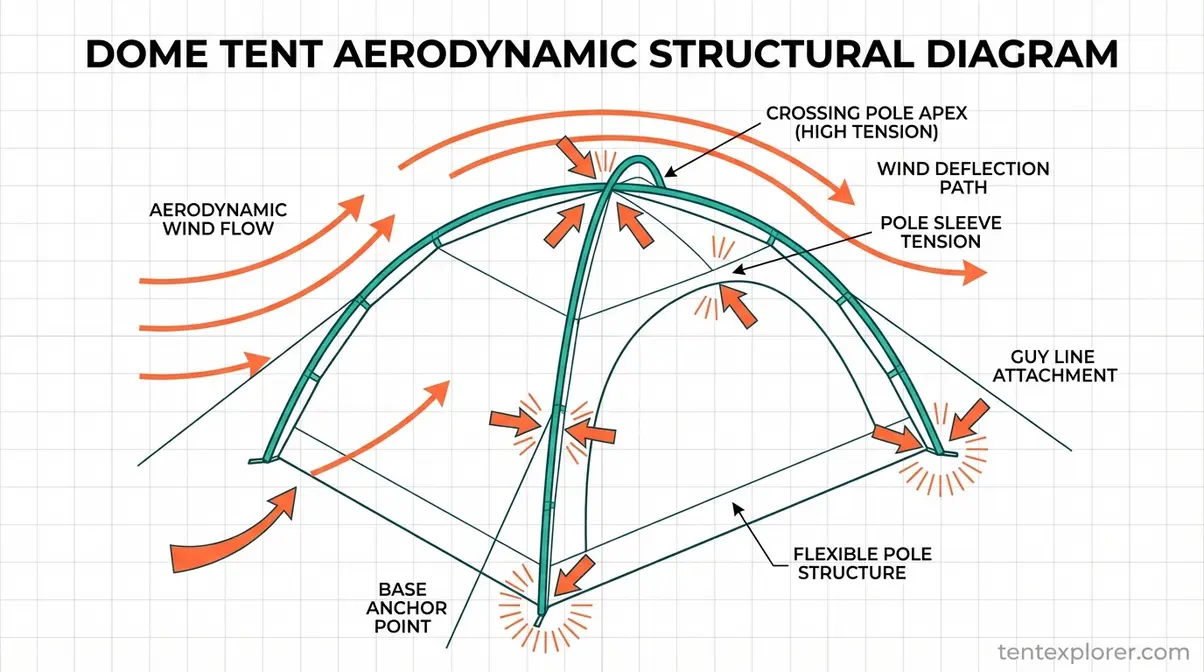
Caption: Two flexible poles crossing at the apex create the dome’s self-supporting tension — no center pole required.
The aerodynamic benefit follows directly from this geometry. Wind force is governed by the principle F = ½ ρ v² A Cd, where A is the cross-sectional area the wind acts upon and Cd is the drag coefficient. A curved dome surface minimizes both values simultaneously — the rounded profile presents a smaller effective cross-section to oncoming wind, and the curved shape deflects gusts at an angle rather than catching them head-on. A flat-walled cabin tent, by contrast, maximizes both A and Cd, which is why it shakes violently in the same conditions that a dome tent handles with a flex and a creak.
This structural principle has deep historical roots. According to the National Museum of American History, the first large-span geodesic dome erected in North America — Buckminster Fuller’s “Weatherbreak” structure in 1950 — demonstrated that dome geometry could withstand extreme weather conditions that would flatten conventional rectangular buildings. Modern camping tent designers apply the same insight at a much smaller scale.
A standard 2-person dome tent uses two poles — one running front-to-back, one side-to-side. Where they cross at the peak is the tent’s highest and strongest point. In a sustained 30 mph gust, that crossing point acts as a controlled pivot, allowing the tent to flex slightly rather than resist rigidly. Rigid structures break. Flexible, curved ones bend and recover.
Key Characteristics of a Dome Tent
A dome tent, also known as a freestanding tent or crossover pole tent, has five defining characteristics that separate it from every other shelter style:
- Freestanding: The tent holds its shape from internal pole tension alone. You can pitch it, pick it up, shake the debris out, and reposition it — without re-threading a single pole. Tunnel tents collapse the moment you remove their stakes.
- Compact storage: Because the poles are flexible and the fabric compresses, a 2-person dome tent typically packs into a cylindrical stuff sack roughly the size of a sleeping bag — around 18–22 inches long and 6–8 inches in diameter.
- 3-season versatility: Standard dome tents are rated for spring, summer, and autumn camping. They handle moderate rain (1,500–3,000 mm hydrostatic head) and wind up to approximately 30–40 mph reliably. Winter camping in exposed terrain requires a 4-season geodesic design, covered in the next section.
- Naming conventions: “What is a portable dome shaped tent called?” — it goes by several names: freestanding tent, crossover pole tent, or simply dome tent. The name always refers to the shape of the finished structure, not a brand or a feature.
- Capacity reality check: Tent capacity ratings are optimistic. A “3-person” dome tent comfortably sleeps 2 adults with their gear. A “4-person” model sleeps 3 comfortably. When buying, size up by one person from your actual group size.
According to Stanford University‘s R. Buckminster Fuller Collection, a geodesic dome is defined as a spherical structure constructed from interconnecting lines rather than curved surfaces — the foundational principle behind modern dome tent design. Even a basic 2-pole camping dome applies the same mathematical insight: a sphere distributes structural stress more evenly than any other shape.
This is what we call “The Geometry of Shelter” — the engineering principle that a dome tent’s curved profile and intersecting pole system are not aesthetic choices, but structural decisions that maximize wind resistance, interior volume, and freestanding stability per unit of material weight. Understanding this concept explains every trade-off you will encounter when comparing dome tents to their alternatives.
Dome vs. Cabin vs. Tunnel Tents
The comparison below covers the four criteria that matter most for recreational campers. Populate your decision from the row that matches your primary concern:
| Feature | Dome Tent | Cabin Tent | Tunnel Tent |
|---|---|---|---|
| Wind Resistance | High — curved profile deflects gusts | Low — flat walls act as a sail | Medium — low profile helps, but requires staking |
| Setup Time | 10–20 min solo | 20–40 min (often needs 2 people) | 15–25 min (requires staking to stand) |
| Peak Headroom | Good (center only — tapers toward walls) | Excellent (near-vertical walls, full standing room) | Good (along the length, tapers at ends) |
| Weight | Light to medium | Heavy | Light to medium |
| Freestanding? | Yes — stands without stakes | Usually yes | No — collapses without stakes |
| Best For | Backpacking, all-weather camping, exposed sites | Family car camping, comfort-focused trips | Weight-sensitive hiking, wind-sheltered sites |
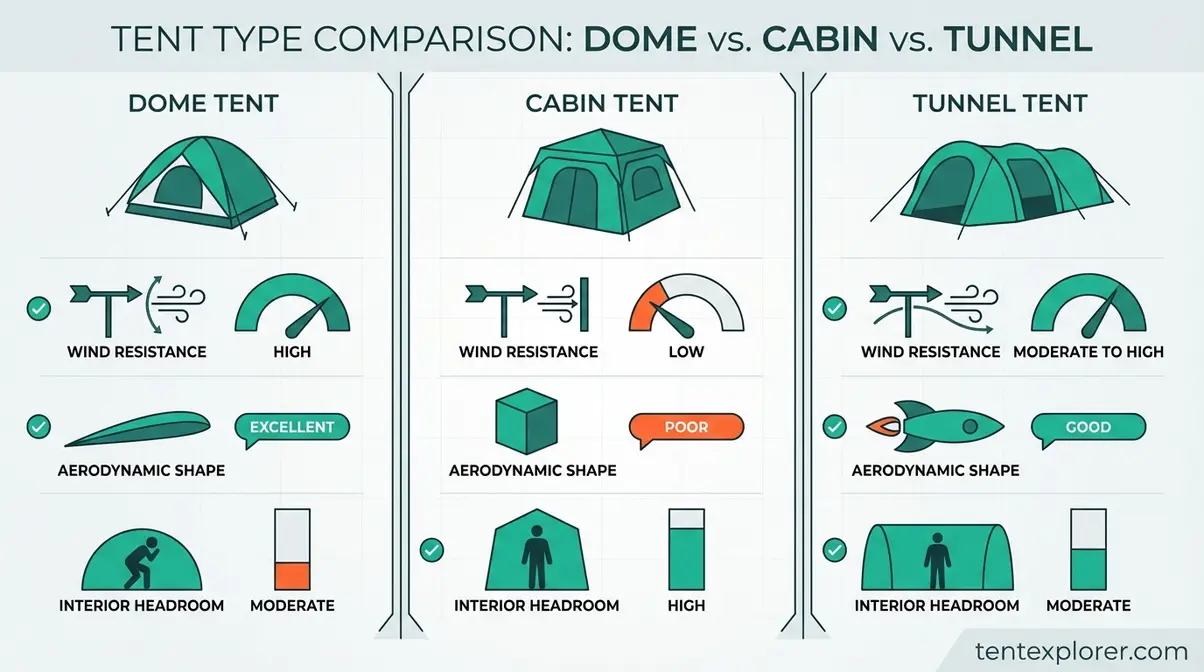
Caption: The dome’s curved profile, the cabin’s vertical walls, and the tunnel’s parallel hoops each solve the shelter problem differently.
The key trade-off is comfort versus performance. Cabin tents win on standing room and livability for car camping trips where weather is mild. Dome tents win on weather resistance and portability for backpacking or exposed campsites. Tunnel tents split the difference — lighter than cabins but not freestanding, which limits where you can pitch them.
Most dome tents also include a sewn-in bathtub floor — a waterproof groundsheet that extends several inches up the tent walls, keeping ground moisture out. Some ultralight dome models use a separate footprint instead, which saves weight but requires an extra purchase.
If you are car camping with family and headroom is your priority, a cabin tent is the right call. If you are backpacking, camping in exposed locations, or simply want a tent that handles whatever the weather brings, a dome tent’s wind performance justifies the reduced headroom at the tent walls.
To understand how dome tents fit into the broader picture of outdoor shelter, see our complete guide to the vital role of tents in camping.
Dome Tent Anatomy: Parts, Materials & Function
The materials inside a dome tent’s curved shell determine how long it lasts and how well it performs in real weather. Three primary material categories — nylon, polyester, and canvas — each offer distinct trade-offs. Choosing the wrong material for your climate is one of the most common and costly mistakes first-time tent buyers make.
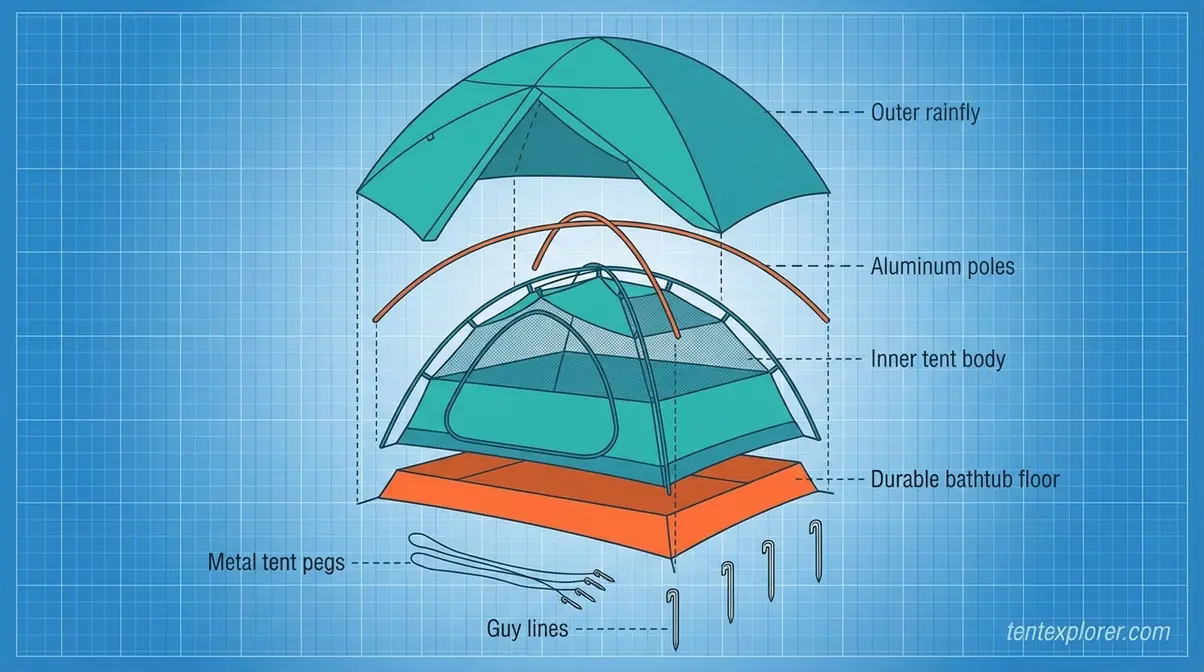
Caption: The rainfly, inner tent, crossover poles, bathtub floor, and tent pegs work together as an integrated weather-management system.
The diagram above labels each component covered in this section. Note how the curved pole structure from the previous section creates the geometric frame that every other component depends on — this is the Geometry of Shelter at the material level. A tent with poor UV resistance will degrade at the pole attachment points first, precisely where geometric tension is highest.
Tent Fabrics: Nylon, Polyester & Canvas
Tent material — also called the tent shell or tent fabric — comes in three main types, each suited to different camping conditions:
Nylon is a synthetic fabric valued for its high strength-to-weight ratio. Ripstop nylon (woven with a reinforcing grid) resists tearing even at low weights of 20–70 denier (D). One practical drawback: nylon absorbs slightly more moisture than polyester, which can reduce tensile strength when wet. Manufacturers address this with a DWR (Durable Water Repellent) coating applied to the outer face. Nylon is the standard choice for backpacking and ultralight dome tents where every gram counts.
Polyester is more UV-resistant than nylon, making it a better long-term choice for tents used frequently in high-sun environments. It holds its shape better in heat and does not sag as much as nylon when wet. Typical denier: 75D–190D. Polyester is the standard for car camping and festival dome tents — it ages more gracefully under prolonged sun exposure.
Canvas (cotton) is heavy, breathable, and excellent at managing condensation — the airspace inside a canvas dome tent stays drier than inside a synthetic model in cold conditions. However, canvas adds significant weight (a 2-person canvas dome can weigh 8–15 lbs versus 3–5 lbs for a comparable nylon model). Canvas is used primarily in hot tents and glamping structures, not backpacking.
| Fabric | Weight | UV Resistance | Best Climate | Typical Use |
|---|---|---|---|---|
| Nylon | Light | Moderate | Temperate, wet | Backpacking, hiking |
| Polyester | Medium | High | Sunny, hot | Car camping, festivals |
| Canvas | Heavy | High | Cold, high-humidity | Hot tents, glamping |
Under ASTM F3431-21 standards set by the CPSC tent flammability standards, tent fabrics sold in the U.S. must meet specific flammability resistance thresholds — a safety requirement that applies regardless of material type. Always check that a tent you purchase carries this compliance, particularly for children’s camping gear.
Additionally, peer-reviewed tent fabric research confirms that modern camping tents must balance tensile strength, UV resistance, and hydrostatic waterproofing to remain durable in outdoor environments (SciTechnol, 2023). The hydrostatic head (HH) rating tells you how much water pressure the fabric resists: 1,500 mm handles light rain, 2,000 mm handles moderate rain, and 3,000 mm or above handles heavy rain and storm conditions. Most quality dome tents fall in the 2,000–3,000 mm range.
For a deeper look at how these materials compare across brands and price points, explore different tent materials in our dedicated buying guide.
Full Fly vs. Partial Fly Rainflies
The rainfly is the waterproof outer layer that drapes over the inner tent body, leaving an air gap between the two layers. This double-wall design — inner tent plus airspace plus rainfly — is the standard configuration for quality dome tents. The airspace prevents condensation from your breath inside the tent from wicking through to the sleeping surface.
Full fly (full coverage): Extends from the apex of the dome down to near ground level on all sides, covering the vestibule areas and blocking wind-driven rain from entering at the base. A full fly is the right choice for exposed campsites, wet climates, and 3-season use. Most quality dome tents include a full fly as standard.
Partial fly: Covers only the upper dome portion, leaving mesh panels on the lower sides exposed. This increases ventilation and allows stargazing from inside the tent, but reduces rain protection significantly. A partial fly works well for dry, warm climates and summer festival camping where rain is unlikely.
The practical rule: if you camp in the Pacific Northwest, the UK, Scandinavia, or any reliably wet environment, a full fly is non-negotiable. If you camp primarily in dry, warm conditions and value airflow and views, a partial fly is a reasonable choice.
To maintain your rainfly’s waterproofing over time, see our guide to the best sprays to waterproof a tent — reapplying DWR treatment every 1–2 seasons extends your fly’s effective lifespan significantly.
Tent Pegs, Poles, and Valances
Three components that beginners commonly overlook — and regret ignoring in the field:
A tent peg — also called a stake — is the metal or plastic spike driven into the ground to anchor the tent and guy lines. Aluminum pegs are lighter and stronger than plastic; they are the standard for quality dome tents and essential for exposed or windy campsites. Plastic pegs bend in hard ground and snap in frozen soil. Bring more pegs than the tent includes — manufacturers typically pack the minimum count.
Tent poles in quality dome tents are almost always aluminum (lightweight, strong, field-repairable with a sleeve patch). Budget tents use fiberglass poles, which are cheaper but heavier, more brittle in cold temperatures, and harder to repair in the field. If you camp in temperatures below 20°F (-7°C), aluminum poles are worth the price premium.
A valance (also called a snow skirt) is a fabric skirt at the base of the tent or rainfly that can be staked down or weighted with rocks and snow. Valances block drafts and wind-driven rain from entering at ground level. They are standard on 4-season and winter dome tents, and optional on 3-season models. If you camp in shoulder seasons with cold overnight temperatures, a valance adds meaningful comfort.
Now that you understand how a dome tent is built and what it is made of, the next question is which variation matches your specific camping goals — because the basic dome is just the starting point.
Types of Dome Tents for Every Camping Style
The standard dome tent is just one point on a wide spectrum — from ultralight quarter domes weighing under 1 kg to 6-pole geodesic expedition shelters rated for Antarctic conditions. Knowing which variation suits your camping style prevents the two most common mistakes: buying a tent that is too heavy for backpacking, or too fragile for exposed winter campsites.
Here is a quick orientation before the deep dives:
- Standard 3-Season Dome — the default choice for most recreational campers
- Geodesic / Semi-Geodesic — for exposed terrain or extreme weather conditions
- Hot Tent — for winter camping with a wood stove inside
- Quarter Dome / Ultralight — for weight-conscious backpackers
- Sun Dome / Beach Shelter — for warm-weather shade without weather protection
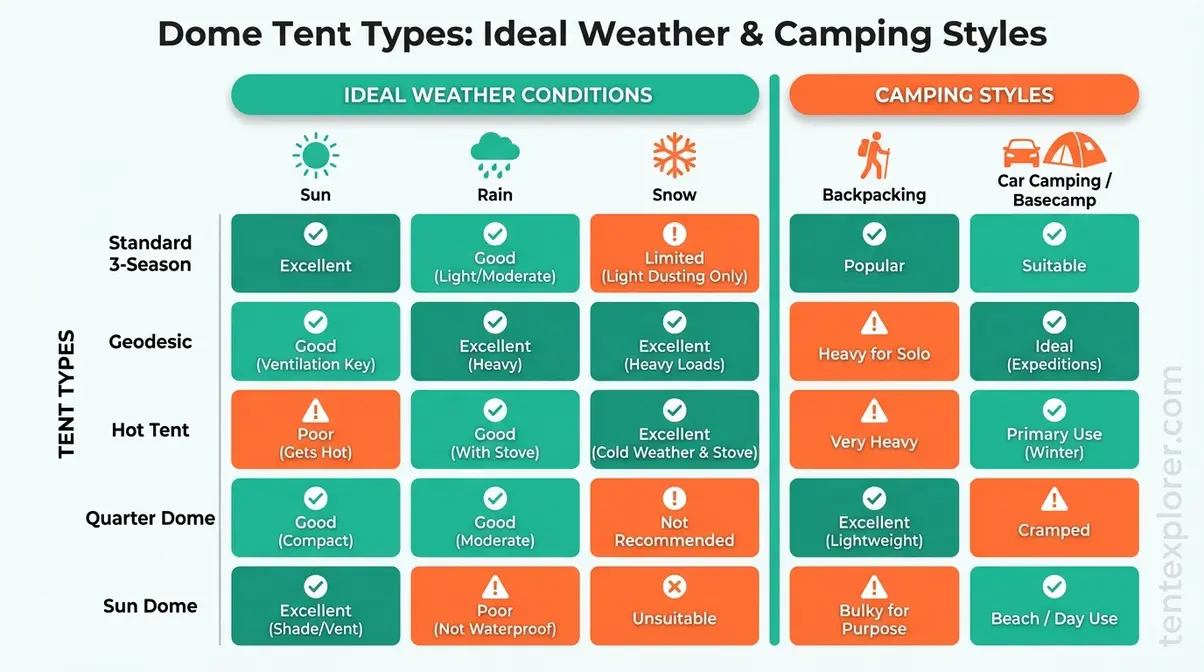
Caption: Each dome tent variation is optimized for a specific weather window — matching tent type to season prevents the most costly beginner mistakes.
Standard 3-Season Dome Tents
A standard 3-season dome tent is the most widely sold camping shelter in the recreational market, and for good reason — it handles the conditions most campers actually encounter. Designed for spring, summer, and autumn use, a standard dome uses two crossover poles (occasionally three for larger models), a polyester or nylon fly rated at 1,500–3,000 mm hydrostatic head, and a bathtub floor for ground moisture protection.
Real-world examples from our 2026 review of the dome tent market include the Kelty Grand Mesa 4 (4-person, 7 lbs 7 oz, 55-inch peak height) and the Coleman Sundome 4 (4-person, 8 lbs 8 oz, 59-inch peak height) — both solid benchmarks for what a standard 3-season dome delivers at the $80–$150 price point (Wilderness Times, 2026).
The standard dome’s main limitation is that it is not designed for sustained winds above 40–45 mph or snowfall accumulation. If your camping takes you to exposed ridgelines, above treeline, or into winter conditions, the geodesic design below is the appropriate upgrade.
Standard 3-season dome tents are the right choice if you camp at established campgrounds with some wind protection, primarily in spring through autumn, and want a tent that sets up solo in under 20 minutes.
Geodesic and Semi-Geodesic Dome Tents
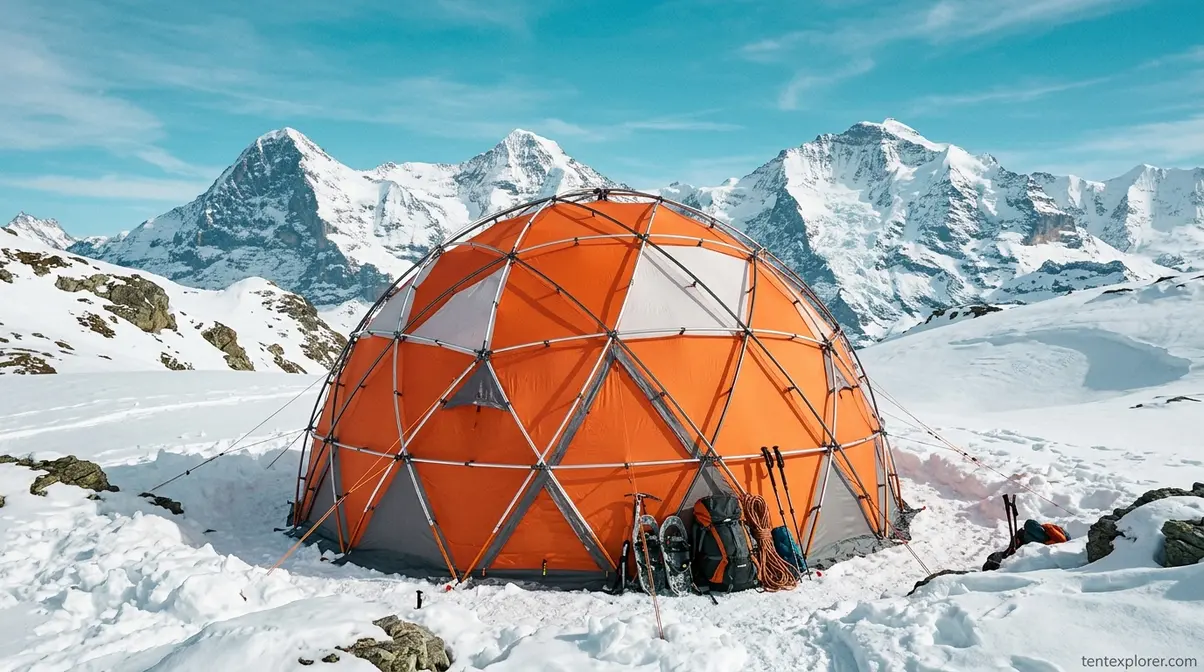
Geodesic dome tents use triangulated pole networks — typically 4 to 6 or more intersecting poles — to distribute structural stress across every joint simultaneously, making them the most wind-resistant tent design available for recreational camping. This is the Geometry of Shelter taken to its logical extreme: instead of 2 crossing poles, a geodesic tent uses a complex intersecting framework that creates dozens of triangulated panels, each sharing the structural load equally.
Wolfram MathWorld defines geodesic geometry as the triangulation of a polyhedron — a mathematical approach to distributing stress that makes geodesic structures inherently more rigid than any equivalent non-triangulated design (Wolfram MathWorld, 2024). Applied to camping tents, this means a 4-season geodesic tent can withstand sustained winds of 60–80 mph and several inches of snow accumulation that would collapse a standard dome.
The trade-offs are real. Geodesic tents are heavier than standard domes due to the additional poles, and their setup is more complex — expect 25–40 minutes for a first-time pitch. They are also significantly more expensive, typically starting at $400–$600 for quality models from brands like MSR and Hilleberg.
Semi-geodesic designs use 3–4 intersecting poles rather than the full geodesic network, offering a middle ground: more wind resistance than a standard dome, less weight and complexity than a full geodesic. Semi-geodesic tents are a strong choice for backpackers who camp in exposed conditions but cannot justify the weight of a full 4-season model.
A brief note on “himbo domes” — a term that circulates on social media for oversized geodesic glamping domes (typically 16–30 feet in diameter) used for luxury outdoor events. These are geodesic structures at a commercial scale, not camping tents, and are covered in the commercial tent section below.
Hot Tents for Winter Camping
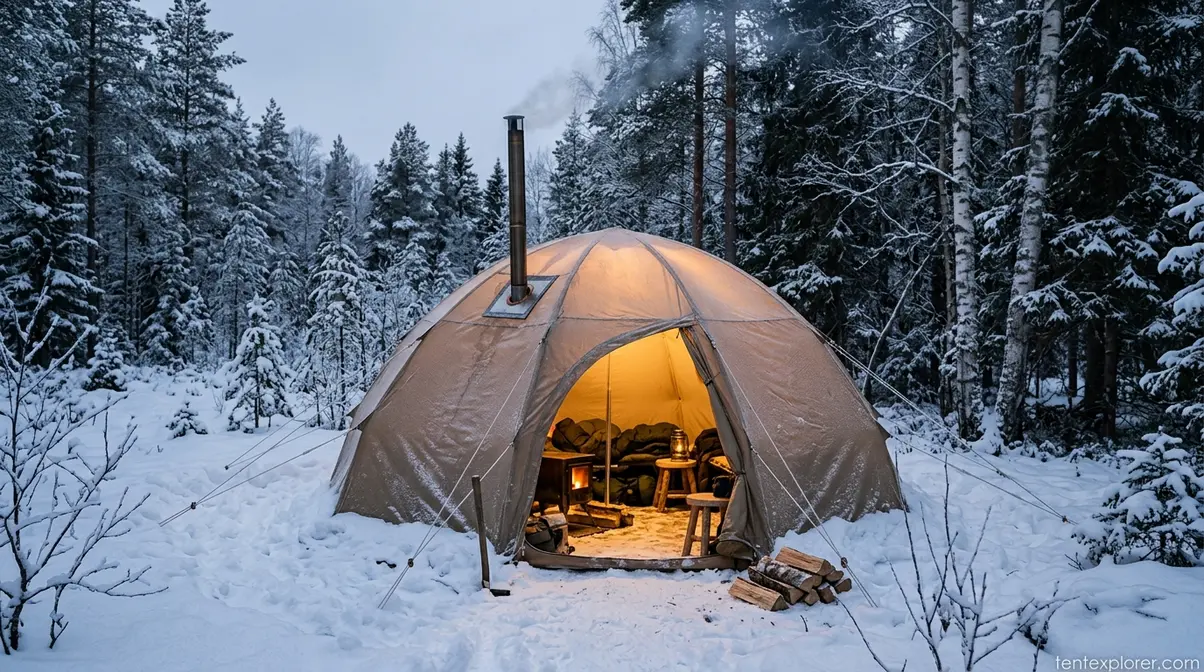
A hot tent is a dome tent (or tipi-style tent) with a stove jack — a reinforced, heat-resistant port in the fabric through which a wood stove pipe exits the tent. The stove jack allows you to run a wood-burning stove inside the tent for heating, extending the practical camping season deep into winter without relying on sleeping bag ratings alone.
Hot tents are typically made from canvas or polycotton (a cotton-polyester blend) rather than pure nylon or polyester, because natural fibers handle sustained radiant heat better without degrading. A polycotton hot tent for winter camping — such as the Robens Klondike-style designs — typically weighs 14–18 kg, making them strictly car camping or sled-hauling options rather than backpacking tents.
Carbon monoxide safety is non-negotiable with hot tents. A wood stove burning inside a tent produces CO — a colorless, odorless gas that is lethal in enclosed spaces. Every hot tent setup requires a CO detector placed at head height (not near the stove), adequate ventilation through roof vents and a cracked door or window, and the practice of never sleeping with an active fire inside (Life inTents, 2026; Anevay Stoves, 2026). This is not a precaution to skip.
For product recommendations and a full safety checklist, see our guide to the best hot tent setups for winter camping.
Quarter Dome and Ultralight Options
A quarter dome tent is a minimalist backpacking design that covers roughly the upper quarter of a standard dome’s geometric arc — meaning the tent sits very low to the ground, with a peak height of 36–44 inches in most models. The REI Half Dome SL 2+ is a well-known benchmark: 2-person, 3-season, 4 lbs 11.5 oz, 42-inch peak height (OutdoorGearLab, 2026). The reduced geometry translates directly to reduced weight.
The term “light tent” in backpacking refers to any dome tent targeting sub-2 kg (4.4 lbs) total packed weight. Ultralight models push below 1 kg by using thinner fabrics (10–20D nylon), fewer poles, and minimalist vestibule designs. The trade-off is durability — thinner fabrics are more susceptible to punctures, UV degradation, and pole-sleeve wear over time.
Quarter dome and ultralight tents are the right choice if you cover significant daily mileage, where every pound in your pack has a real cost in energy and speed. They are not ideal for group camping, wet climates requiring large vestibules, or campers who prioritize headroom.
Sun Domes and Beach Shelters
A sun dome is an open-sided or mesh-dominant dome shelter designed for shade and ventilation rather than weather protection. Sun domes typically have no sewn-in floor, minimal or no rainfly, and rely on UV-blocking fabric rather than waterproof coatings. They are the right tool for beach camping, festival shading, and day-use shelter in hot, dry climates.
Sun domes are not suitable for rain or wind. Their open design — which is their primary advantage for ventilation — becomes a liability the moment conditions deteriorate. Think of a sun dome as a beach umbrella that happens to be dome-shaped, not as a weather-capable camping shelter.
Whether you need a lightweight shell for a weekend hike or a reinforced geodesic tent for a winter expedition, there is a dome tent variation engineered for your specific conditions. The key is matching the design to the environment, not the other way around.
How to Set Up a Dome Tent (Step-by-Step)

Setting up a standard dome tent for the first time takes most beginners 15–20 minutes. With practice, the same setup drops to 10 minutes or less. The steps below follow the standard 2-pole crossover system used by the majority of recreational dome tents.
What you need: The tent bag (body, poles, pegs, rainfly), a flat site roughly the size of the tent footprint, and about 15 minutes.
Step 1: Choose and clear your site (~2 minutes) Select a flat area free of rocks, roots, and sharp debris. A slight slope is acceptable — position the tent so your head will be uphill. Clear any sticks or stones that could puncture the floor.
Step 2: Lay out the footprint and tent body (~2 minutes) Spread the tent footprint (or a lightweight tarp cut to size) on the ground. Unfold the tent body over it, oriented with the door facing your preferred direction. Loosely stake the four corners at 45-degree angles to hold the body in position while you work.
Step 3: Assemble the poles (~2 minutes) Remove the poles from the bag and connect the sections — the internal shock cord guides each section into the next. Most 2-person dome tents have two poles of identical length. Lay them alongside the tent body before threading.
Step 4: Thread and clip the poles (~4 minutes) Slide each pole through the corresponding fabric sleeve running diagonally across the tent body, from one corner to the opposite corner. On clip-style tents, clip each attachment point as you feed the pole through. The two poles will cross at the apex of the tent.
Step 5: Raise the tent (~2 minutes) Insert each pole end into the grommets at the tent corners. The poles will flex, the tent body will rise, and the dome shape will appear. If the tent body is not taut, adjust the corner stake positions slightly outward.
Step 6: Attach the rainfly and final stakes (~3 minutes) Drape the rainfly over the dome and attach it at the pole ends and any clip points. Stake out the rainfly corners and guy line attachment points at 45-degree angles, pulling the fly taut. In wind, stake all guy lines before sleeping.
| Step | Action | Time |
|---|---|---|
| 1 | Choose and clear site | ~2 min |
| 2 | Lay out footprint + body | ~2 min |
| 3 | Assemble poles | ~2 min |
| 4 | Thread/clip poles | ~4 min |
| 5 | Raise tent | ~2 min |
| 6 | Rainfly + final stakes | ~3 min |
| Total | First-time pitch | ~15 min |
One practical tip from across camping communities: practice the setup once in your backyard before your first trip. Discovering a missing pole section or a broken clip at the trailhead is a preventable problem.
Beyond Camping: Event and Commercial Tent Types
Dome geometry does not stop at recreational camping. The same structural principles that make a backpacking dome tent aerodynamically stable also underpin large-scale commercial tent structures — from elegant wedding pavilions to military field installations. These structures share the dome’s fundamental logic (curved or arched geometry distributing load across a frame) but are engineered at a completely different scale and specification level.
Understanding these commercial categories matters for two reasons. First, you will encounter these terms when searching for event tent rentals or large outdoor structures. Second, they illustrate the full range of what dome-derived geometry can accomplish — from a 3-pound backpacking shelter to a 10,000-square-foot temporary building.
Sailcloth and Sail Tents
Sailcloth tents are elegant event structures made from translucent, woven polyester fabric that allows natural light to filter through the tent walls, creating a warm, glowing interior at night. They are not dome tents in the crossover-pole sense, but they share the dome’s principle of fabric-over-frame construction and are commonly categorized alongside dome-derived event structures.
Sailcloth tents are the premium choice for outdoor weddings, garden parties, and upscale events where aesthetics are as important as weather protection. The fabric is typically a tight-weave polyester that is water-resistant (though not fully waterproof in heavy rain without additional treatment), and the structures are supported by a combination of center poles and perimeter cables rather than a freestanding geodesic frame.
For a curated list of the best outdoor event structures for celebrations, see our guide to structural wedding and marquee tents. For larger party setups, our roundup of best outdoor event tents covers structures from 20-person garden parties to 200-person corporate events.
Clear Span and Sprung Tent Structures
A clear span tent structure is a modular, engineered temporary building featuring an aluminum frame with no interior support poles — providing 100% unobstructed interior floor space. According to the Advanced Textiles Association, clear span structures use an assembled framework of box beam arches to eliminate internal columns, allowing unobstructed floor plans ranging from 33 to 164 feet wide and expandable to any length (Advanced Textiles Association, 2024).
The practical implication for event planners: a 60 × 100-foot clear span tent delivers 6,000 square feet of completely usable floor space with no poles to route guests around, no columns to block sightlines, and no restrictions on furniture layout. Standard eave heights of 11–13 feet accommodate most production lighting and AV rigs.
Sprung structures are a variant that uses arched aluminum frames covered with a tensioned fabric membrane, creating a semi-permanent building suitable for year-round use. Sprung structures are common as temporary warehouses, sports facilities, and military staging areas — they combine the speed of tent installation with the structural integrity of a permanent building frame.
SCIF Tents and Military Shelters
SCIF tents (Sensitive Compartmented Information Facility tents) are specialized military and intelligence field structures designed to prevent electromagnetic signal leakage and protect classified operations in the field. They are engineered to meet strict government specifications for radio frequency shielding, physical security, and environmental isolation.
According to the Defense Logistics Agency, military tent specifications cover a range of specialized soft-wall and hybrid shelters including SCIF configurations, tactical operations centers, and medical facilities — all of which use dome-derived or arch-frame geometry for rapid deployment and structural stability in field conditions (Defense Logistics Agency, 2024).
SCIF tents are relevant here primarily as an illustration of how far dome-derived geometry extends beyond recreational camping. The same structural logic that makes your 2-person dome tent stable in a rainstorm underpins structures that protect national security operations in remote field locations.
Awning Tents and Hybrid Shelters
An awning tent is a hybrid structure that attaches to a vehicle, RV, or building wall and extends outward to create covered outdoor living space. The awning component — a fabric panel supported by one or two poles — creates a sheltered area adjacent to the main shelter rather than replacing it.
Awning tents are common in overlanding and car camping setups where the vehicle itself serves as one wall of the shelter. They are not freestanding in the dome tent sense (they require attachment to a vehicle or structure), but they use the same pole-and-fabric tension system in a simplified form. Think of an awning tent as a half-dome attached to your vehicle’s roof rack or side door.
The commercial tent categories above share one common thread with the recreational dome tent at the start of this guide: they all use geometry — curved arches, intersecting frames, or tensioned fabric — to do structural work that flat walls cannot do efficiently. The Geometry of Shelter scales from a 3-pound backpacking tent to a 10,000-square-foot event pavilion.
Dome Tent Limitations and When to Switch
A dome tent is the right choice for most campers in most conditions — but it is not the right choice for all campers in all conditions. Honest assessment of limitations is more useful than blanket recommendations.
Common Dome Tent Pitfalls to Avoid
Pitfall 1 — Buying too large a dome for exposed conditions. Standard dome tents become less stable as they scale up. A 6-person dome tent has significantly more surface area for wind to act on than a 2-person model, and the structural benefit of the curved geometry diminishes at large sizes. For exposed sites, keep dome tent capacity at 4 persons or fewer, or upgrade to a geodesic design (Pitchup.com, 2026; Decathlon, 2026).
Pitfall 2 — Ignoring condensation in cold weather. In cold, humid conditions, the temperature differential between the warm air inside a dome tent and the cold fly outside creates condensation on the inner fly surface. This is normal and manageable — leave vents partially open even in rain to maintain airflow. Closing all vents in cold weather to “stay warmer” is the most common cause of wet sleeping bags in a dry-weather tent.
Pitfall 3 — Skipping the guy lines. Most dome tents ship with guy lines that campers leave in the bag. In calm conditions, this is fine. In sustained wind, an unstaked dome tent without taut guy lines can deform significantly or, in extreme cases, uproot entirely. Stake out all guy lines any time the forecast includes wind above 20 mph.
Pitfall 4 — Using a 3-season dome in winter. A standard dome tent’s poles, fabric weight, and overall geometry are not designed for snow load or sustained sub-zero temperatures. Using one in genuine winter conditions risks pole failure and inadequate insulation. Winter camping requires a 4-season geodesic tent or a hot tent with appropriate heating.
When to Choose a Cabin Tent Instead
A cabin tent is the better choice in three specific scenarios:
Scenario 1 — Family car camping with children or elderly campers. Near-vertical cabin tent walls provide full standing room (typically 6–7 feet of peak height), making dressing, organizing gear, and moving around significantly more comfortable for multi-day trips. A dome tent’s tapered walls mean you can only stand upright in the center.
Scenario 2 — Extended basecamp trips in calm conditions. If you are setting up camp for 3–5 nights at a protected campground with tree cover and minimal wind exposure, a cabin tent’s superior interior volume and livability outweigh its wind performance disadvantage. The wind resistance trade-off only matters when wind is actually a factor.
Scenario 3 — Large groups (6+ people). As noted above, large dome tents lose structural stability. A cabin tent designed for 8–10 people maintains its structural integrity at scale because its near-vertical walls and rigid frame geometry are inherently stable in calm conditions, even at large sizes.
If none of these scenarios match your camping style, a dome tent is almost certainly the right choice. For most solo, couple, and small-group campers who move between sites and camp across multiple seasons, the dome’s combination of weather resistance, portability, and solo setup capability is unmatched in its price range.
Frequently Asked Questions
What are the disadvantages of dome tents?
Dome tents have three main disadvantages compared to cabin-style alternatives: reduced headroom at the tent walls (the curved profile means you can only stand upright in the center), condensation buildup in cold and humid conditions when ventilation is inadequate, and reduced stability at large sizes (6-person models are notably less wind-resistant than 2–4 person versions). For family groups prioritizing standing room, or for large basecamp setups in calm conditions, a cabin tent offers better livability. However, for weather performance and portability, dome tents consistently outperform cabin alternatives.
What is a dome tent used for?
A dome tent is used for recreational camping across three seasons — spring, summer, and autumn. It is the standard shelter for backpacking trips (where weight matters), weekend car camping at established campgrounds, and festival camping. Specialized variants extend its use further: hot tents with stove jacks are used for winter camping, geodesic dome tents are used for expedition mountaineering, and sun domes are used for beach and day-use shade. The core use case is any camping situation where weather resistance, solo setup, and portability are priorities.
What are the 4 types of tents?
The four primary tent types are dome tents, cabin tents, tunnel tents, and geodesic tents. Dome tents use two crossover poles to create a freestanding, aerodynamic curved structure — the most common type for recreational camping. Cabin tents use near-vertical walls for maximum headroom and interior space. Tunnel tents use parallel hoops to create a long, low-profile shelter requiring staking. Geodesic tents use 4–6 or more intersecting poles for maximum structural strength in extreme weather. Additional specialized categories — hot tents, bivy sacks, tipi tents — are variants or subsets of these four foundations.
Are dome tents better in the wind?
Yes — dome tents perform significantly better in wind than cabin tents of equivalent size. The curved profile reduces the effective cross-sectional area (A) that wind acts upon, and the rounded shape deflects gusts at an angle rather than catching them head-on. In practical terms, a standard 2-person dome tent handles sustained winds of 30–40 mph reliably; a cabin tent of the same size will flex, shake, and potentially deform in those same conditions. For the most wind-resistant option, a geodesic dome tent — with its triangulated pole network distributing stress across every joint — outperforms a standard dome in extreme conditions above 40 mph.
How long does a dome tent last?
A well-maintained dome tent typically lasts 5–10 years with regular recreational use. Lifespan depends primarily on UV exposure (the leading cause of fabric degradation), storage conditions (never store wet — mold degrades fabric faster than UV), and pole care (aluminum poles last longer than fiberglass, and sleeve-style pole attachment wears more slowly than clip-style). Reapplying DWR waterproofing treatment every 1–2 seasons and storing the tent loosely (not compressed in a stuff sack long-term) extends lifespan meaningfully. High-quality nylon and polyester dome tents from reputable brands show a 30% increase in lifespan compared to budget fabric constructions (Bolin Tents, 2026).
Conclusion
For beginner and intermediate campers, a dome tent delivers the best combination of weather resistance, portability, and solo setup capability available in recreational camping. The curved crossover pole structure — the Geometry of Shelter — is not a stylistic choice. It is an engineering decision that minimizes wind load, maximizes interior volume relative to material weight, and creates a freestanding structure you can pitch in under 20 minutes without a second pair of hands. Whether you choose a standard 3-season dome for weekend camping or a geodesic expedition model for alpine conditions, every dome tent in existence applies the same fundamental principle that Buckminster Fuller demonstrated with the Weatherbreak structure in 1950.
The Geometry of Shelter explains why dome tents dominate the recreational market and why the principle scales from a 3-pound ultralight backpacking shell to a 10,000-square-foot commercial event pavilion. Understanding the geometry means understanding the trade-offs — and those trade-offs are what this guide has mapped across every dome tent variation, from the basic 2-pole crossover to the SCIF military shelter.
Your next step is to match the dome tent type to your specific camping context. Start with the comparison table in Section 1 — if wind resistance and portability are your priorities, a standard 3-season dome is your answer. If you camp in winter or exposed terrain, move to geodesic. If you want a warm shelter with a wood stove, explore our guide to the best hot tent setups for winter camping. Pick the geometry that fits your conditions, and TentExplorer will help you find the specific model that fits your budget.