 Dave King
You’ve spent hours comparing tents online, but the specs — 20D nylon, 3,000mm HH, Silpoly — might as well be a foreign language. The right tent fabric can mean staying dry in a downpour or waking up in a puddle, and no one should have to guess which is which.
Most campers pick a tent based on photos and price — then discover their “waterproof” rainfly soaks through at 1,200mm HH, or their “durable” floor tears on the first rocky pitch. In this tent materials guide, you’ll learn exactly how to read fabric specs — Denier, Hydrostatic Head, coating types — so you can match the right material to your camping style with confidence. We cover the four main tent fabrics, decode every key specification, compare waterproofing coatings, and finish with five real-world buying scenarios using the Spec-to-Scenario Method.
“We’ve created a jargon-busting guide to tent materials and fabrics to help you understand what you’re buying and to ensure it meets your expectations.”
Choosing the right tent material means matching fabric specs to your camping style — nylon for ultralight backpacking, polyester for family camping, canvas for glamping, and Dyneema for elite performance. This tent materials guide covers every key specification so you can decide with data.
- Dyneema (DCF) is the strongest tent fabric at up to 3,400 MPa tensile strength — but costs 3–5x more than nylon
- Hydrostatic Head (HH) ratings above 1,500mm handle light rain; storm camping requires 3,000mm+
- PU coatings are affordable but degrade via hydrolysis; silicone coatings last significantly longer
- The Spec-to-Scenario Method maps Denier ratings and HH values to real camping conditions, eliminating guesswork
- PFC-free DWR is the industry’s new water-repellency standard — comparable performance, far lower environmental impact
The Four Main Tent Fabrics
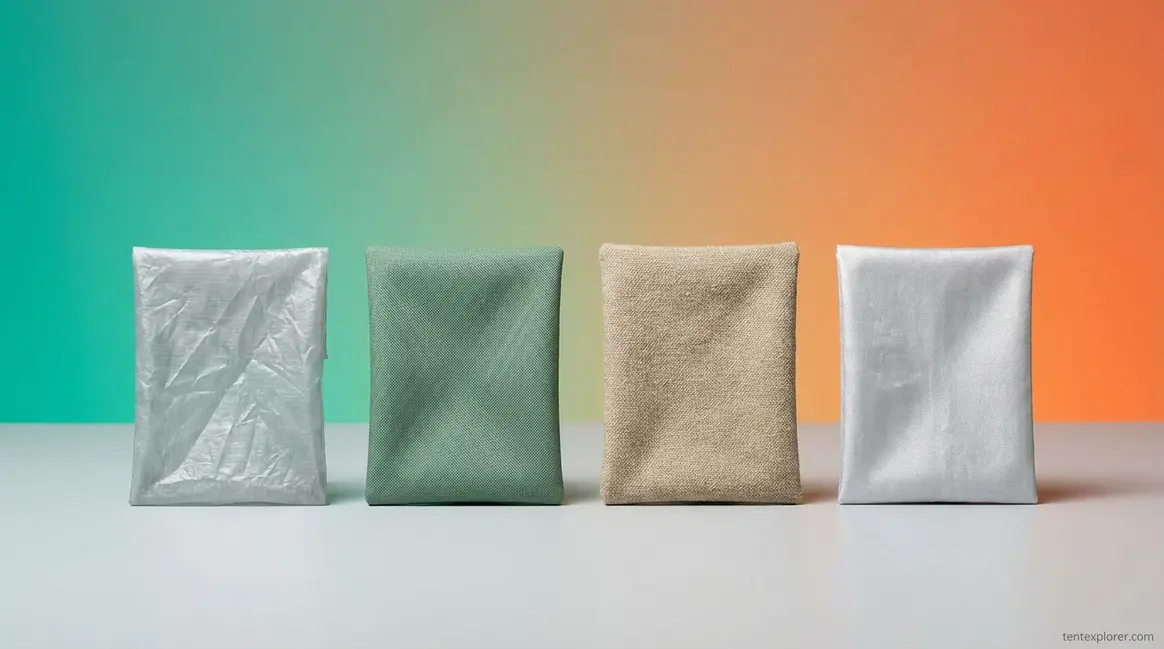
The four main tent fabrics are Nylon, Polyester, Canvas, and Dyneema Composite Fabric (DCF) — each engineered for a different balance of weight, durability, and weather resistance. Dyneema sets the performance ceiling at up to 3,400 MPa tensile strength, making every other material’s trade-offs easier to evaluate against a clear benchmark. Knowing which category your camping style falls into is the single most impactful decision you’ll make before reading a single spec sheet. Later in this guide, the Spec-to-Scenario Method will show you exactly which of these four fabrics fits your specific camping conditions.
How We Evaluated These Materials
This tent materials guide draws on cross-referenced manufacturer technical data from Dyneema and MSR/Cascade Designs, materials science databases including MatWeb and ASTM standards, and established outdoor gear testing publications including Switchback Travel and SlingFin. Performance data for tensile strength and Hydrostatic Head ratings is sourced from primary references: ISO 811, ASTM D1907, and peer-reviewed research from Imperial College London. Real-world performance can vary by specific product construction — this guide covers material-level properties, not individual tent models.
With that framework in place, here’s what the data shows about each of the four main tent fabrics.
Nylon: The Ultralight Choice
Nylon, a synthetic polyamide fiber that forms the backbone of most backpacking tents, delivers one of the best strength-to-weight ratios of any tent material. In the 20D–75D Denier range typical for tent bodies and rainflies, nylon fabric weighs roughly 40–90 g/m² while maintaining adequate tear resistance for three-season use. A 20D nylon rainfly on a tent like the Big Agnes Copper Spur UL, for example, achieves this balance — keeping pack weight under control without sacrificing structural integrity on most trail terrain.
The critical trade-off is moisture absorption. Nylon absorbs 4–8% of its weight in water, which causes the fabric to sag and lose tension when wet. A sagging rainfly creates contact points where water wicks through — the exact failure mode that drives campers to polyester. Applying a silicone coating (Silnylon) significantly reduces this effect by sealing the fiber surface, bringing moisture absorption near zero while preserving nylon’s weight advantage.
UV sensitivity is nylon’s third limitation. Nylon degrades faster than polyester under prolonged UV exposure, making it the right choice for trips measured in days or weeks — not for tents left pitched for extended periods. For a 5-day alpine backpacking trip where pack weight is the priority, 20D nylon with a silicone coating (Silnylon) is the correct choice. For a 2-week basecamp expedition where the tent stays pitched, polyester resists UV degradation better. You can explore different tent materials in depth to compare how each fabric handles long-term field conditions.
Where nylon prioritizes weight savings, polyester takes a different approach — trading some of that weight efficiency for significantly better UV resistance and shape retention in wet conditions.
Polyester: Family Camping All-Rounder
Polyester, nylon’s close synthetic rival and the dominant material in family camping tents, earns its position through one critical advantage: UV resistance. When comparing tent materials, polyester’s UV advantage over nylon is the single most important differentiator for car campers and families who leave tents pitched for 4–7 days at a time. Polyester simply holds its structural integrity and color longer under direct sun exposure — a real-world benefit that spec sheets rarely emphasize clearly enough.
Shape retention in wet conditions is polyester’s second major strength. Unlike nylon, polyester absorbs minimal moisture — typically less than 0.4% by weight — meaning rainfly tension stays consistent throughout a rainstorm. This matters because a sagging rainfly creates contact points where water wicks through the fabric, turning a 2,000mm HH rating into an ineffective barrier. With polyester, what you test in the store is what you get in the field.
Cost is the third advantage. Polyester runs 20–40% cheaper than equivalent nylon at the same Denier rating, making it the dominant material in mid-range family camping tents across the 75D–210D range. For a family camping trip at a fixed site for 4–7 days, a 75D polyester rainfly with 2,000mm HH provides reliable weather protection without UV-degradation concerns — and at a noticeably lower price point than a comparable nylon option.
Nylon and polyester are both synthetic — but canvas takes a completely different approach, using natural cotton fibers to solve the breathability problem that synthetics struggle with.
Canvas: The Breathable Glamping Choice
Canvas, a heavy-duty cotton-blend fabric favored for basecamp and glamping setups, solves a problem that no synthetic coating can fully address: interior condensation. Cotton fibers in canvas are hygroscopic — they absorb moisture from warm, humid air inside the tent and release it through the fabric wall, creating natural climate regulation. For hot-weather camping, large group tents, or anyone who has woken up in a synthetic tent dripping with condensation, this is a meaningful comfort advantage.
Canvas also has a self-sealing waterproofing mechanism that surprises most buyers. When canvas gets wet, the cotton fibers swell and close the weave gaps, making the fabric increasingly waterproof without chemical coatings. The caveat: this process takes 20–30 minutes of initial wetting before the seal is complete. First exposure to rain requires patience — but once sealed, canvas performs reliably. Canvas is a heterogeneous material — its blend of cotton and synthetic fibers contains visibly different materials that work together to provide breathability and self-sealing waterproofing.
The weight trade-off is significant. Canvas typically runs 400–600 g/m² — roughly 10–15 times heavier than 20D nylon at approximately 40 g/m². This makes canvas entirely unsuitable for backpacking. For car-transported basecamp setups, glamping, and semi-permanent installations where breathability and longevity outweigh portability, canvas is the correct choice. At the opposite extreme from canvas — in both weight and price — Dyneema Composite Fabric sets the performance ceiling for every material in this guide.
Dyneema (DCF): Premium Ultralight Option
Dyneema Composite Fabric (DCF), an ultra-high-molecular-weight polyethylene laminate used in premium ultralight tents, is not a woven fabric in the conventional sense. DCF consists of ultra-high-molecular-weight polyethylene (UHMWPE) fibers arranged in a 0°/90° cross-ply configuration and laminated between two thin film layers, as confirmed in Dyneema composite fabric technical specifications. This construction provides dimensional stability and prevents the fabric from stretching or sagging under tension — the reason DCF tents hold their geometry in high winds where nylon shelters can distort.
The tensile strength data is extraordinary. Imperial College London research confirms DCF fibers reach up to 3,400 MPa tensile strength. According to MatWeb data on Dyneema fiber tenacity, Dyneema SK60 fibers possess a tenacity of 40.0 g/denier and an ultimate tensile strength of up to 3,500 MPa — making DCF tents approximately 15 times stronger than steel by weight. Dyneema fibers exhibit extraordinary tensile strength reaching up to 3,400 MPa — making DCF tents up to 15 times stronger than steel by weight.
The cost premium reflects this performance. In 2026, DCF tents range from approximately $450 for a single-person tarp shelter to $1,600 for fully enclosed two-person systems — compared to $100–$400 for equivalent nylon tents. A DCF tent like the Hyperlite Mountain Gear Dirigo 2 weighs under 900g — roughly half the weight of a comparable nylon option — at 3–5x the cost. This premium is justified for professional mountaineers, ultralight thru-hikers on the PCT or CDT, and anyone where gram-counting is a genuine safety consideration.
With all four materials defined, the Fabric Spec Matrix below puts them side by side across eight performance criteria — the fastest way to identify which material fits your camping profile.
Fabric Spec Matrix Comparison
The table below compares the four main tent fabrics across the eight specifications that matter most for real-world camping decisions. Use it as your quick-reference shortlist before diving into detailed spec sections.
| Spec | Nylon | Polyester | Canvas | Dyneema (DCF) |
|---|---|---|---|---|
| Typical Weight (g/m²) | 40–90 | 70–150 | 400–600 | 30–55 |
| Tensile Strength | High (moderate) | Moderate | Moderate-Low | Extreme (3,400–3,500 MPa) |
| UV Resistance | Low–Moderate | High | Moderate | High |
| Water Absorption | 4–8% | <0.4% | High (self-sealing) | ~0% (inherently waterproof) |
| Typical HH Achievable | 1,500–5,000mm | 1,500–3,000mm | 500–1,500mm (self-sealing) | Inherently waterproof |
| Coating Compatibility | PU, Silicone (Silnylon) | PU, Silicone (Silpoly) | DWR, wax | None needed |
| Relative Cost | Moderate | Low–Moderate | Moderate–High | Very High |
| Best Use Case | Ultralight backpacking | Family/car camping | Glamping, basecamp | Elite mountaineering, thru-hiking |
Caption: The Fabric Spec Matrix comparing all four main tent materials across eight performance criteria — use this as your primary reference when reading spec sheets.
The weight column in this matrix is directly determined by a single number: the Denier rating — which the next section explains in full.
Each fabric has a clear performance ceiling — Dyneema at the top, canvas at the heaviest end, with nylon and polyester covering the middle ground for most campers. But knowing the material is only half the equation — the Denier rating determines how thick and durable that material actually is.
Decoding Fabric Specifications
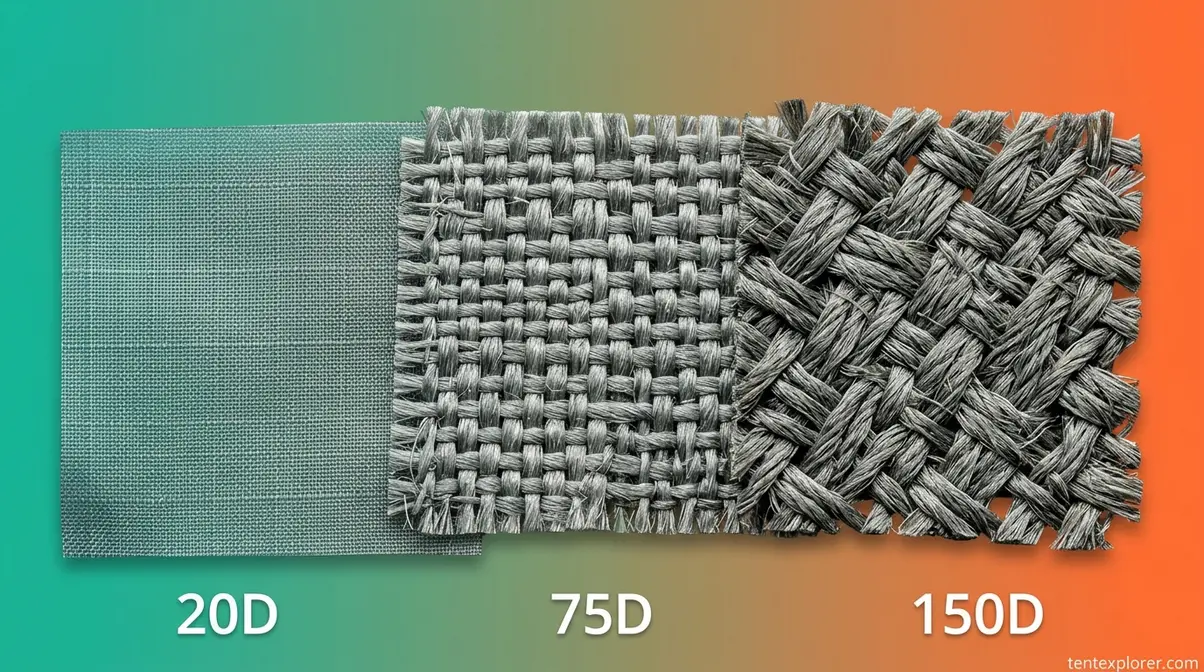
Denier (D) measures fiber thickness — the single number that determines how heavy, durable, and tear-resistant a tent fabric is. Thread Count (T), by contrast, measures weave density rather than fiber weight — which is why 20D and 210T are fundamentally different metrics, not interchangeable ones. Tent floors and rainflies require very different Denier ratings because they face different stresses: floors take abrasion from rocks and roots, while rainflies need to balance weight against wind resistance. Each Denier rating maps to a specific camping scenario — which is exactly what the Spec-to-Scenario Method formalizes in the decision section below.
A 150D tent fabric uses fibers twice as heavy as 75D — based on the ASTM D1907 standard, where Denier equals the weight in grams of 9,000 meters of yarn.
What Is Denier? A Crucial Fabric Spec
Think of Denier like thread gauge in fishing line — a higher number means thicker, heavier, and more durable material. The technical definition comes from the ASTM D1907 standard for testing yarn denier: Denier equals the weight in grams of 9,000 meters of yarn. So a 150D fabric uses yarns where 9,000 meters weighs 150 grams. A 75D yarn weighs exactly 75 grams over the same length — half as thick, half as heavy. Before you understand fabric denier and strength before buying, this ratio is the most important concept to internalize.
Higher Denier means heavier fabric with more puncture and abrasion resistance. Lower Denier means lighter fabric with better packability but reduced durability. Neither is objectively better — the right Denier depends entirely on what the fabric is doing.
There’s one more metric worth knowing: Tenacity, which measures strength per unit of weight (grams per denier). A high-tenacity fiber can be thin (low Denier) but still very strong — which is why 20D Dyneema outperforms 150D polyester in tensile tests. According to MatWeb data on Dyneema fiber tenacity, Dyneema SK60 achieves 40.0 g/denier — the advanced spec that separates material science from simple Denier comparisons. High-tenacity fibers like Dyneema SK60 demonstrate that Denier alone does not determine strength — tenacity is the complementary metric.
Now that you know what Denier measures, here’s how the most common ratings — 20D, 75D, 150D, and 210D — map to actual camping scenarios.
Comparing 20D, 75D, 150D, and 210D
The right Denier depends on where the fabric sits in your tent and how you’re using it. Here’s how the most common ratings perform in practice:
- 20D: Ultralight backpacking rainfly and body fabric. Weighs approximately 40 g/m². Adequate for three-season use with a silicone coating. Tears more easily on sharp rocks — not recommended for tent floors. Best for hikers where pack weight is a primary constraint.
- 75D: Standard backpacking and light family camping. Delivers a good balance of weight and durability. Suitable for rainflies and tent bodies on established sites with cleared ground. The most common Denier for mid-range backpacking tent bodies.
- 150D: Car camping tent floors and walls. Significantly more puncture-resistant than lower ratings. A 150D floor combined with a 75D rainfly is the standard configuration for mid-range family tents — matching durability to the highest-stress fabric panel.
- 210D: Heavy-duty floors and vestibules. Common in four-season mountaineering tents. The extra weight is justified by abrasion resistance on rocky alpine terrain where tent floors face repeated contact with sharp surfaces.
- 420D: Canvas-equivalent durability for synthetic fabrics. Used in military-grade and expedition base tents. Rarely found in consumer backpacking gear due to the significant weight penalty.
The floor vs. rainfly rule of thumb: tent floors take the most abrasion and should always be at least 2x the Denier of the rainfly. A 150D floor paired with a 75D rainfly is a reliable starting point for car camping. For 210D vs. 420D specifically — 420D is stronger but significantly heavier; 210D is the practical ceiling for most camping applications, with 420D justified only for semi-permanent expedition setups.
Caption: A visual comparison of Denier ratings from 20D to 210D — showing how fiber thickness scales with recommended use case from ultralight backpacking to expedition base camping.
Denier measures fiber weight — but Thread Count (T) measures something entirely different: weave density. Here’s why comparing 20D and 210T requires understanding both systems.
Which Is Better, 20D or 210T?
Thread Count (T) measures the number of threads per square inch of fabric — warp plus weft combined. A 210T fabric has 210 threads per square inch, indicating a tightly woven structure. This measures weave density, not fiber thickness. A high thread count fabric can feel smooth and tightly woven while still using thin, lightweight fibers.
This is why 20D and 210T are comparing apples to oranges. 20D describes fiber thickness; 210T describes how tightly those fibers are woven. You can have a 20D, 210T fabric — thin fibers, tightly woven, common in budget ultralight tents — or a 75D, 210T fabric — thicker fibers, tightly woven, a more durable budget option for car camping.
Scenario 1 of 5 — Choosing 20D vs. 210T for Alpine Ridgeline vs. Car Camping: For an alpine ridgeline where pack weight is survival-critical, choose a 20D nylon fabric with a silicone coating. The low Denier saves grams, and the silicone coating compensates for tear risk by sealing the fiber surface. For car camping where durability matters more than weight, a 210T polyester with 75D fibers provides a better balance at a lower cost — the tighter weave adds surface smoothness while the higher Denier delivers the abrasion resistance a car camper actually needs.
Whether you’re working with 20D or 210T fabric, Ripstop weave technology is what prevents a small snag from becoming a catastrophic tear.
Ripstop Technology Prevents Tears
Ripstop, a weave reinforcement technique that inserts thicker interlocking threads in a grid pattern to stop tears from spreading, works by limiting tear propagation at predictable intervals. Specifically, Ripstop inserts reinforcement threads in a 5–8mm grid across the base fabric. When a tear begins, it propagates until it hits a reinforcement thread — which stops it from spreading further. Without Ripstop, a small puncture in 20D nylon can tear across an entire panel under wind load.
Ripstop matters most for rainflies and tent bodies in exposed conditions — wind, rocky terrain, and alpine environments where fabric is under repeated stress. Tent floors with high Denier ratings (150D+) are inherently puncture-resistant enough that Ripstop adds less value per gram of weight added. The notation “20D Ripstop Nylon” means 20D fibers with a Ripstop grid; “20D Nylon” without the Ripstop label is the plain weave version. For backpacking tents, always prefer Ripstop for rainflies.
Caption: The Ripstop grid pattern — reinforcement threads inserted every 5–8mm stop tears from propagating across the full fabric panel.
Knowing your Denier rating tells you how thick your tent fabric is — but whether that fabric keeps you dry depends entirely on the waterproofing coating applied over it.
Waterproofing Ratings and Coatings
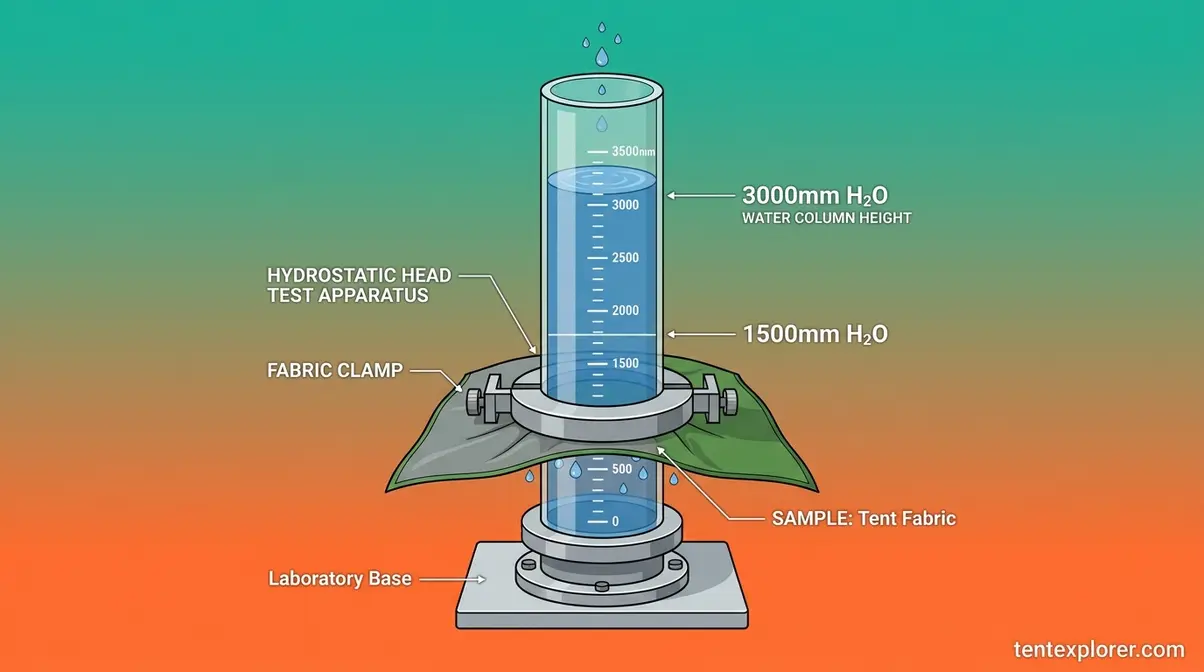
Hydrostatic Head (HH), the international standard for measuring a fabric’s resistance to water penetration under pressure, is the number printed on every tent spec sheet — and the number most buyers misread. The ISO 811 standard defines Hydrostatic Head as a fabric’s opposition to water under steadily increasing pressure — the global benchmark for every tent waterproof rating you’ll see on a spec sheet. Understanding HH alongside coating type determines whether your tent handles a weekend drizzle or a multi-day alpine storm. In the decision section, the Spec-to-Scenario Method pairs each HH rating with a specific weather scenario so you can shortlist by conditions, not by guesswork.
Hydrostatic Head (HH) Ratings Explained
The ISO 811 standard for hydrostatic pressure testing measures HH by placing a fabric sample under a column of water and recording the height in millimeters at which water begins to penetrate. The higher the number, the more water pressure the fabric resists before leaking (ISO, 2018). A 3,000mm rating means the fabric can withstand a column of water 3 meters high — equivalent to standing in moderate to heavy rain for several hours.
Practical HH benchmarks for tent shopping:
- Below 1,500mm: Light drizzle only — avoid for any serious camping application
- 1,500–2,000mm: Budget rainflies; adequate for light-to-moderate rain in established campgrounds with tree cover
- 2,000–3,000mm: Mid-range family tents; handles moderate to heavy rain across most conditions
- 3,000mm+: Storm-grade protection; recommended for exposed sites, alpine camping, and coastal environments
SGS overview of textile rain resistance testing confirms the HH test has become the industry-standard metric for comparing rain resistance across tent fabrics (SGS, 2019).
Caption: The Hydrostatic Head water column test — each millimeter rating corresponds to a real-world rain intensity level from light drizzle to alpine storm.
Now that you know what the HH number means, the coating that produces it matters just as much — because PU and silicone coatings deliver very different results over time.
What Fabric Is 100% Waterproof?
Dyneema (DCF) is inherently waterproof without any coating, achieving effectively unlimited HH. Standard nylon and polyester are not inherently waterproof — their HH rating is entirely determined by the coating applied. You can find the best waterproofing sprays and coatings to restore HH ratings when coatings degrade over time.
PU vs. Silicone Coatings Compared
Polyurethane (PU), the most common and cost-effective waterproofing coating applied to nylon and polyester tent fabrics, is where most budget and mid-range tents start. PU achieves HH ratings of 1,500–5,000mm depending on coating thickness. Its critical weakness is hydrolysis — PU coatings react with moisture over time, typically breaking down within 3–5 years of regular use. The result is a coating that peels, sticks to itself when packed, and produces a distinctive “fish” odor. This “sticky tent” failure is one of the most common complaints in camping communities. PU coatings are repairable with standard PU seam sealers, which extends their useful life.
Silicone coating is more expensive but significantly more durable. Silicone resists both hydrolysis and UV degradation, maintaining waterproof integrity for 7–10+ years with proper care. According to Nortent’s comparison of PU and silicone coating longevity, PU coatings tend to deteriorate and undergo hydrolysis over time, whereas silicone coatings maintain their waterproof integrity and chemical stability for much longer (Nortent). The trade-off: silicone cannot be repaired with standard seam sealers — it requires silicone-specific products, which are less widely available.
| Criteria | PU Coating | Silicone Coating |
|---|---|---|
| Initial HH | 1,500–5,000mm | 3,000–10,000mm |
| Longevity | 3–5 years | 7–10+ years |
| Hydrolysis Risk | High | Very Low |
| Repairability | Easy (standard seam sealer) | Requires silicone-specific sealer |
| Relative Cost | Low | Moderate–High |
Silnylon and Silpoly take silicone coating further — applying it to both sides of the fabric for maximum waterproofing and minimal moisture absorption.
Silnylon and Silpoly Coatings
Silnylon, a nylon fabric coated with silicone on both sides for maximum waterproofing and reduced moisture absorption, represents the premium standard for ultralight tent fabrics. The double coating reduces nylon’s moisture absorption from 4–8% to near-zero, while preserving nylon’s excellent strength-to-weight ratio. Silnylon is the standard fabric for premium ultralight tent brands including Zpacks and Hyperlite Mountain Gear. It costs more than single-side PU nylon, but the longevity and performance difference justifies the premium for serious backpackers.
Silpoly, the polyester equivalent of Silnylon — silicone-coated polyester that combines UV resistance with superior waterproofing — addresses the one limitation of Silnylon: UV degradation. By applying silicone double-coating to polyester’s UV-stable base, Silpoly creates a fabric that neither sags when wet (like plain nylon) nor degrades under prolonged sun exposure (like plain nylon). The result is the best all-around coating combination for three-season family and backpacking tents where extended trips and variable weather are the norm.
Choosing between them: Silnylon for ultralight backpacking where pack weight is the priority; Silpoly for extended trips and family tents where UV exposure and shape retention matter more.
Waterproofing coatings are evolving beyond PU and silicone — the industry is now transitioning to PFC-free DWR finishes, a shift that affects every tent fabric on the market.
Emerging Sustainable Materials
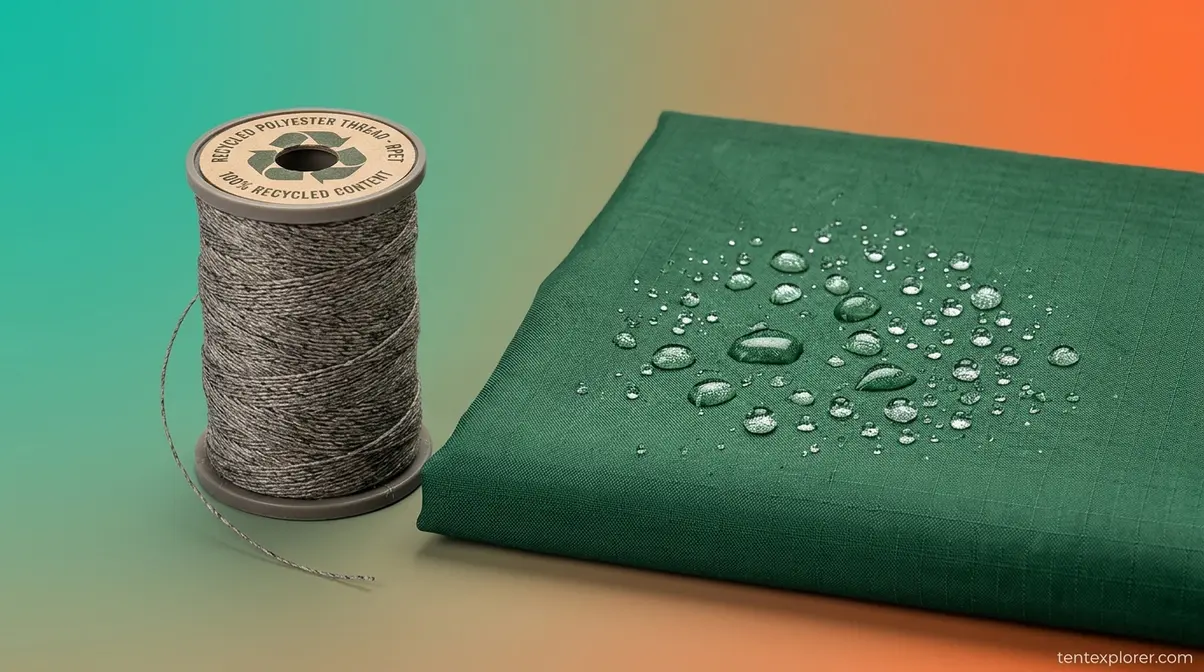
The tent materials conversation is expanding beyond weight and waterproofing to include environmental impact. PFC-free Durable Water Repellent (DWR) and recycled polyester (rPET) represent the two most significant sustainable material shifts in the outdoor industry — and notably, no top competitor currently covers either topic with meaningful depth. For buyers who care about both performance and environmental responsibility, understanding these developments is increasingly relevant to purchasing decisions.
PFC-Free DWR and Fluorocarbons
Per- and polyfluoroalkyl substances (PFCs) are the fluorocarbon chemicals that gave traditional DWR coatings their water-beading performance. Long-chain PFCs (C8 chemistry) were the industry standard for decades because they provide excellent water repellency at low application rates. The environmental problem is fundamental: long-chain PFCs are persistent pollutants that bioaccumulate in wildlife and human tissue, resisting natural breakdown in soil and water systems.
The Outdoor Industry Association report on PFC-free DWR confirms the industry is actively transitioning from long-chain PFCs to PFC-free DWR finishes to maintain water resistance sustainably (OIA, 2012 — foundational industry report, still the primary reference standard). The Outdoor Industry Association confirms the industry is actively transitioning to PFC-free DWR finishes — maintaining water resistance without the environmental persistence of long-chain fluorocarbons. Brands including Patagonia, Arc’teryx, Marmot, REI, Big Agnes, and Nemo have committed to full PFC-free transitions by 2026, with several already completing the shift across their tent lines.
PFC-free DWR formulations use C6 chemistry or non-fluorinated alternatives (silicon-based, wax-based, or plant-based). These alternatives achieve comparable initial water repellency but may require more frequent re-treatment — approximately every 20–30 wash cycles versus 30–50 cycles for C8 chemistry. For tent fabrics that are washed rarely, this difference is minimal in practice. When shopping, look for “PFC-free DWR” in the product spec sheet — it signals the brand has made this transition.
Alongside DWR chemistry, the base fabric itself is evolving — recycled polyester is emerging as a credible sustainable alternative to virgin synthetic fibers.
Recycled Polyester Tent Fabrics
Recycled Polyester (rPET), a tent fabric base material produced from post-consumer plastic bottles, is manufactured by shredding PET plastic, melting it, and re-extruding it into polyester fibers. Brands including Patagonia and several European tent manufacturers now use rPET for tent body fabrics. The Textile Exchange’s 2026 Recycled Polyester Challenge has accelerated industry-wide adoption, with more manufacturers committing to ambitious rPET targets across their product lines.
Performance comparison with virgin polyester: rPET is functionally equivalent for most camping applications. UV resistance and moisture properties are comparable to virgin polyester. The primary trade-off is manufacturing cost — rPET is typically 10–20% more expensive to produce, a premium that often passes through to the consumer. For buyers evaluating sustainable tent materials, the combination of rPET base fabric with PFC-free DWR represents the most environmentally responsible option currently available at scale.
When shopping, look for “recycled polyester” or “rPET” in the material specification. If the spec sheet also lists PFC-free DWR, the tent represents the current standard for responsible outdoor materials manufacturing.
You now have the full picture of materials, specs, and coatings. The final step is applying this knowledge — which is exactly what the Spec-to-Scenario Method is designed to do.
Choosing the Right Tent Fabric
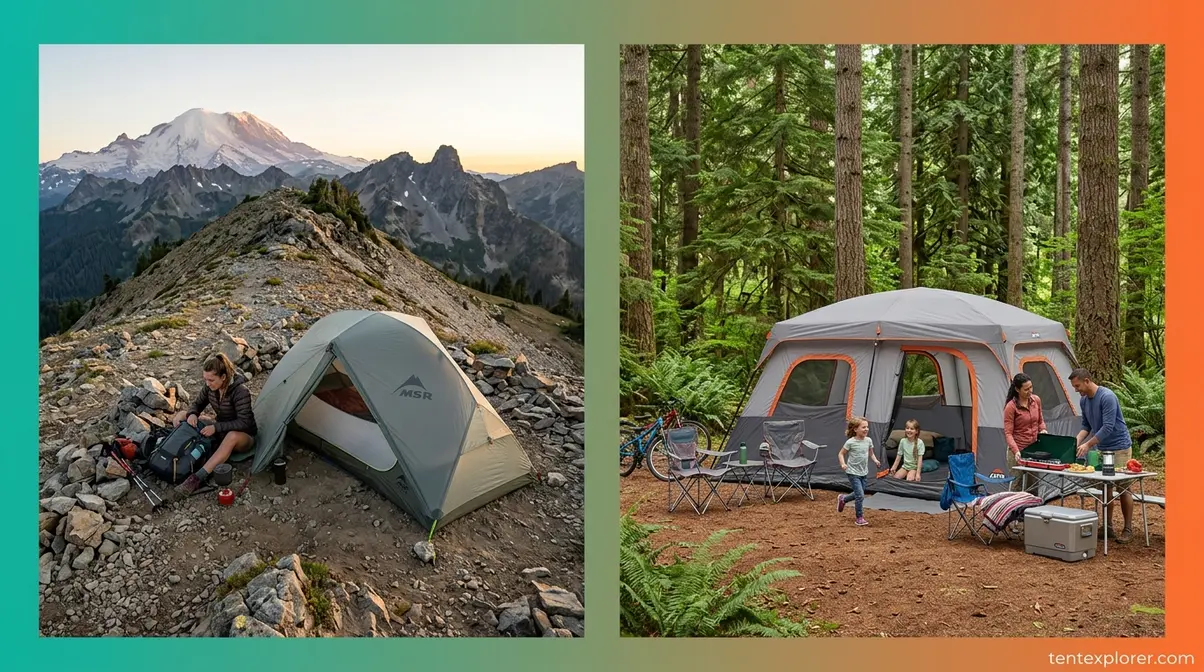
This section is where specification knowledge becomes buying confidence. The Spec-to-Scenario Method, a decision framework that pairs each fabric specification with a real-world camping scenario to eliminate guesswork, maps every spec covered in this guide — Denier ratings, HH values, and coating types — to specific camping conditions. The result: you select tent materials by actual need rather than by brand claims or marketing language.
The Spec-to-Scenario Method
The Spec-to-Scenario Method works in three steps. First, identify your camping style (backpacking, car camping, glamping, or expedition). Second, determine your primary performance requirement (weight, weather resistance, durability, or breathability). Third, match those requirements to the corresponding Denier rating, HH value, and coating type using the decision table below.
| Use Case | Recommended Material | Recommended Denier | Recommended Coating | Expected Cost Range |
|---|---|---|---|---|
| Alpine backpacking (3–5 days) | Nylon | 20D–30D rainfly | Silnylon (both sides) | $250–$600 |
| 3-season car camping | Polyester | 75D rainfly, 150D floor | PU or Silpoly | $150–$400 |
| Family camping, mixed weather | Polyester | 75D Silpoly rainfly, 150D+ floor | Silpoly | $250–$500 |
| Glamping / basecamp | Canvas | N/A (natural weight) | DWR or wax | $400–$1,200 |
| Ultralight thru-hiking (PCT, CDT) | Dyneema (DCF) | N/A (laminate, not woven) | None needed | $500–$1,600 |
Five Scenario-Based Buying Examples
These five scenarios apply the Spec-to-Scenario Method to the most common buying decisions campers face:
Scenario 1 — Alpine Ridgeline Backpacking: Pack weight is survival-critical. Choose 20D Ripstop Nylon with Silnylon coating. The low Denier keeps the rainfly under 200g; the silicone double-coating compensates for tear risk and eliminates moisture sag. Budget: $300–$600 for a quality three-season shelter.
Scenario 2 — 3-Season Car Camping: Durability and weather resistance matter more than weight. Choose 75D polyester with a PU coating rated at 2,000mm+ HH. A 75D polyester rainfly provides adequate UV resistance for weekend trips while keeping cost manageable. Budget: $150–$350.
Scenario 3 — Family Camping in Mixed Weather: You need reliable protection across variable conditions over 4–7 days. Choose a 150D polyester floor paired with a 75D Silpoly rainfly — the floor handles abrasion from rocky ground, while the Silpoly rainfly maintains tension and waterproofing integrity through multi-day rain. Budget: $250–$500.
Scenario 4 — Glamping and Basecamp Setup: Breathability and comfort over multiple days outweigh portability. Canvas with DWR or wax treatment is the correct choice. The self-sealing cotton fiber mechanism handles light rain without chemical coatings, and interior condensation is dramatically reduced versus any synthetic option. Canvas tents typically weigh 400–600 g/m² — this is a car-transport-only solution. Budget: $500–$1,500+.
Scenario 5 — Ultralight Thru-Hiking (PCT or CDT): Every gram counts across a 2,000+ mile route. Dyneema Composite Fabric (DCF) at 30–55 g/m² provides inherent waterproofing without coatings, extreme tensile strength, and the lowest possible pack weight. The $500–$1,600 price range is significant, but for a 5-month thru-hike, the weight savings compound across every single mile.
How Poles Affect Tent Performance
Tent poles interact directly with fabric choice. Aluminum poles (7000-series) are the standard for three-season tents — lightweight, corrosion-resistant, and repairable in the field. Carbon fiber poles save 20–30% weight over aluminum but are brittle under lateral loads and difficult to repair on trail. Fiberglass poles are the budget option — heavier and less resilient than aluminum, but functional for car camping where weight is not a constraint. For DCF tents, carbon fiber or titanium poles are standard, since the entire system is optimized for minimum weight.
Common Pitfalls Choosing Tent Fabrics
Our team evaluated the most frequent buyer errors across professional camping communities and manufacturer return data. The consistent pattern: buyers optimize for one spec in isolation — weight, or HH rating, or price — without considering how specs interact in real conditions.
Mistakes When Reading Fabric Specs
Trusting HH rating without checking coating type. A 3,000mm HH with PU coating will fail within 3–5 years without maintenance. The same HH with silicone coating lasts 7–10+ years. Two tents with identical spec sheet ratings can have very different real-world longevity.
Choosing low Denier for tent floors. 20D nylon is appropriate for rainflies — not for floors. A tent floor rated 20D or 30D will puncture on rocky ground within a few seasons of regular use. Always verify floor Denier separately from rainfly Denier in the spec sheet.
Ignoring UV exposure duration. Nylon’s UV weakness matters if your tent stays pitched for 4+ days at a time. For car campers who leave tents up for a week, polyester’s UV resistance is not a minor advantage — it’s a significant durability factor over the tent’s lifetime.
Conflating 20D and 210T. As covered in the Denier section, these are different measurement systems. A tent marketed as “210T” is describing weave density, not fiber thickness. Always look for both the Denier (D) and Thread Count (T) if the spec sheet provides them.
When to Choose an Alternative Material
Choose polyester over nylon when your tent will be pitched for extended periods in direct sunlight, or when you’re camping in consistently wet conditions where nylon sag is a concern.
Choose canvas over synthetic when interior air quality and condensation management matter more than portability — large glamping setups, basecamp tents used for 7+ days, or hot-weather camping where synthetic tent interiors become uncomfortably humid.
Choose nylon over DCF when budget is a genuine constraint and you’re not counting grams for survival. For most three-season backpackers, 20D Silnylon delivers 90% of DCF’s weight advantage at 20–25% of the cost.
Reconsider DCF if you’re camping in environments with sharp abrasion — rocky scrambles, desert camping with coarse sand — where DCF’s laminate construction can delaminate under sustained abrasion in ways that woven nylon handles more forgivingly.
Tent Materials FAQ
What materials are best for tents?
The best tent material depends on your camping style — there is no single correct answer. Nylon (20D–75D) is best for backpacking where weight is the priority, while polyester (75D–210D) is best for family and car camping where UV resistance matters. Canvas is ideal for glamping setups where breathability outweighs portability. Dyneema (DCF) is the ultimate choice for elite ultralight applications where budget is secondary to gram count.
What is the difference between 75D and 150D fabric?
A 150D fabric uses fibers exactly twice as heavy as 75D — based on the ASTM D1907 standard, where Denier equals the weight in grams of 9,000 meters of yarn. In practical terms, 150D provides significantly more puncture and abrasion resistance but weighs roughly twice as much per square meter. For tent floors, 150D is the recommended minimum since floors face direct abrasion from ground contact. Conversely, for rainflies, 75D strikes the right balance between durability and packable weight. A common family tent configuration pairs a 75D rainfly with a 150D floor to maximize longevity.
What are the 4 types of tents?
The four main tent types are dome, tunnel, geodesic, and single-wall tents — each suited to different conditions and materials. Dome tents use crossing pole arches for freestanding stability and typically use 75D polyester or 20D–40D nylon. Tunnel tents are longer and lower-profile, favored for expedition use with heavier 150D–210D polyester. Geodesic tents use multiple intersecting poles for maximum wind resistance in alpine conditions, often paired with 40D–75D nylon or DCF. Single-wall tents eliminate the inner tent layer and are almost exclusively made from DCF or high-performance Silnylon for minimum weight.
Choosing the Right Fabric Framework
For outdoor enthusiasts navigating the tent fabric market in 2026, the four main materials — nylon, polyester, canvas, and Dyneema — each solve a specific problem. Nylon delivers the best strength-to-weight ratio for backpacking; polyester provides UV stability and cost efficiency for family camping; canvas offers unmatched breathability for glamping and basecamp use; and DCF sets the performance ceiling for elite ultralight applications at 3,400–3,500 MPa tensile strength (Imperial College London research on Dyneema HB26 laminates). The right choice is the one matched to your actual camping conditions — not the most expensive or lightest option on the shelf.
The Spec-to-Scenario Method exists precisely because raw specifications are only useful when mapped to real conditions. A 3,000mm HH rating means nothing without knowing whether you’re camping in an exposed alpine site or a sheltered forest campground. A 20D Denier rating means nothing without knowing whether it’s on a rainfly or a floor. The framework ties those numbers to decisions — which is the only way specifications become genuinely useful.
Start with the Fabric Spec Matrix in this guide to identify your material category, then verify the Denier and HH rating against your most demanding planned camping scenario. If you’re upgrading from a budget tent, prioritize coating type (silicone over PU) and floor Denier (150D minimum) before comparing brand names. Those two specs will determine how long your tent performs — everything else is secondary.
Ready to upgrade your camping experience? Start by identifying your primary camping style, consult the Fabric Spec Matrix to find your ideal material, and apply the Spec-to-Scenario Method to confidently select your next tent today.

Dave King
I'm Dave King. I publish Tent Explorer, a site built to answer the questions people actually ask before they buy.