
This blog post may contain affiliate links. As an Amazon Associate I earn from qualifying purchases.
You’ve been there — fumbling with a flashlight at the campsite while trying to cook dinner, the beam blinding whoever you glance at and leaving half the table in shadow. Understanding why use camping lanterns comes down to a single, practical insight: a flashlight is a tool for pointing light at things, while a lantern creates an entire lit environment around you.
That difference matters more than most campers expect. A flashlight forces a constant trade-off between seeing your task and seeing your surroundings. A lantern eliminates that trade-off entirely — freeing your hands, protecting your night vision, and giving everyone at the campsite comfortable, even illumination at the same time.
In this guide, you’ll discover exactly why camping lanterns outperform flashlights for campsite use, how to choose between LED, propane, and liquid-fuel options based on brightness and runtime, and the critical safety rules that every camper needs to know before lighting up — including the carbon monoxide risk that most camping gear guides skip entirely.
Camping lanterns provide 360-degree ambient illumination that no directional flashlight can replicate — making them essential for group campsite activities, hands-free cooking, and safe navigation after dark.
- 360-Degree Coverage: Lanterns illuminate your entire campsite simultaneously; flashlights create a narrow beam that blinds campmates and leaves gaps in your field of view
- Safety Warning: Fuel-burning lanterns (propane, liquid fuel) produce carbon monoxide and must never be used inside sealed tents or enclosed shelters
- The Campsite Lighting Triangle: Every lantern choice balances three factors — coverage, safety, and sleep comfort — and understanding all three leads to better gear decisions
- Brightness Guidance: Most campsites need 150–300 lumens for comfortable ambient light; the U.S. Department of Energy defines lumens as the standard measure of total visible light output
- LED Advantage: High-quality LED lanterns consume at least 75% less energy than comparable incandescent alternatives (LED Lighting Supply, 2025) — making them safer, cheaper to run, and increasingly feature-rich
Why Camping Lanterns Beat Flashlights: The Core Benefits
Camping lanterns — portable light sources designed to emit light in all directions simultaneously — provide a fundamentally different lighting experience than any directional flashlight. According to broad campsite illumination data from OutdoorGearLab, the best camping lanterns deliver omnidirectional output that can effectively light an entire campsite or serve as a reliable power backup during emergencies. That 360-degree coverage is the reason experienced campers treat lanterns as essential gear, not optional accessories.
The diagram below illustrates why lanterns create a fundamentally different lighting environment than flashlights.
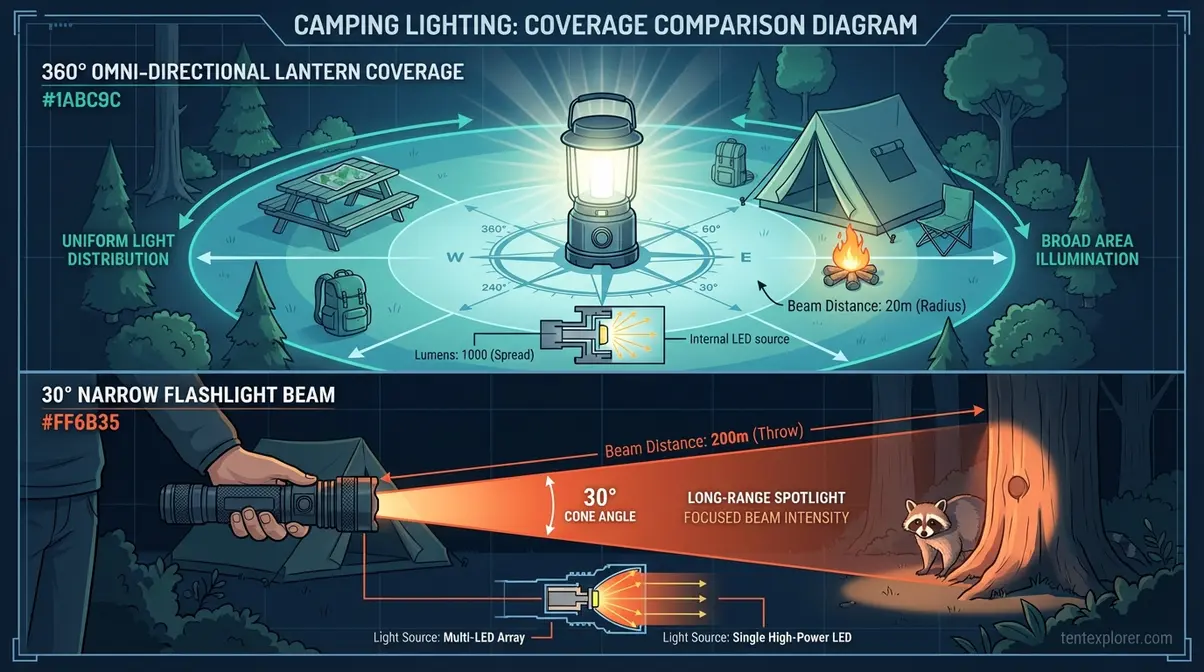
Caption: A camping lantern’s omnidirectional output covers an entire campsite simultaneously — the defining advantage over any directional flashlight beam.
For a visual walkthrough of how lantern and flashlight light patterns differ at a real campsite, watch the video below.
360-Degree Coverage: Lighting Your Entire Campsite at Once
The core reason to use a camping lantern is coverage. A lantern emits light equally in all directions, so every person at a picnic table, every corner of a tent interior, and every item on a camp stove is visible at the same time — without anyone needing to aim anything at anyone else.
Consider two specific scenarios where this makes a measurable difference.
Scenario 1 — Playing cards at a picnic table: With a lantern hung overhead or placed in the center of the table, all four to six players see their cards equally. With a flashlight, one person’s hand is lit while others sit in shadow, and every time someone reaches for the light, someone else loses their view.
Scenario 2 — Group storytelling or conversation around a camp table: Ambient 360-degree light creates a comfortable social environment where everyone can read expressions and see the food they’re sharing. A flashlight creates a spotlight — it forces attention in one direction and puts everyone else in relative darkness.
The Ten Essentials for outdoor safety from the U.S. National Park Service officially classifies lanterns and headlamps as part of the Ten Essentials for outdoor survival — not as optional accessories. That classification reflects decades of backcountry safety experience: consistent, reliable campsite illumination is a safety requirement, not a comfort upgrade.
Explore our guide to dedicated camping lights for tents if you’re also looking for lighting solutions designed specifically for the tent interior.
Hands-Free Convenience for Cooking, Setup, and Games
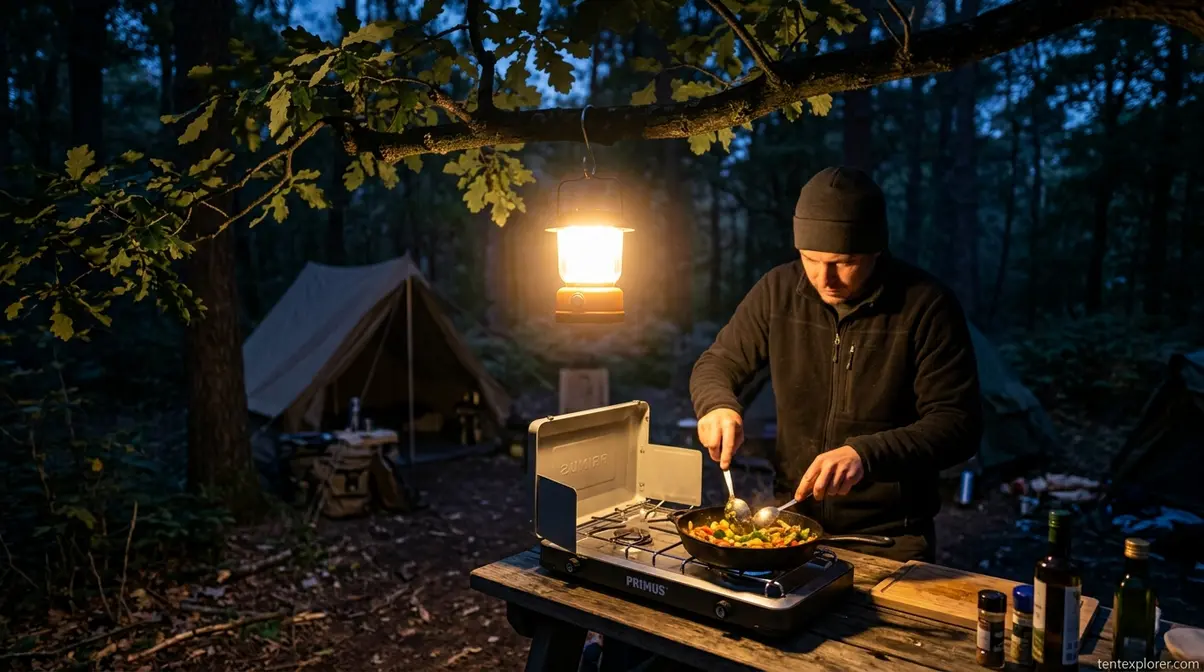
A lantern set on a table or hung from a tent loop frees both hands for every task that requires them. A flashlight requires one hand to hold it — which means half your working capacity is gone the moment you need it most.
Three specific scenarios show why this matters in practice:
- Cooking dinner over a camp stove: Chopping vegetables, stirring a pot, and managing utensils all require two hands and steady attention. A lantern placed nearby illuminates the entire cooking area with broader and brighter light than a held flashlight — and it stays put while you work.
- Setting up a tent after dark: Threading tent poles, driving stakes into hard ground, and clipping rain fly attachments all require both hands and good spatial awareness. A lantern hung from a nearby branch or set on the ground provides consistent area coverage that moves with your work zone, not with your gaze.
- Sorting gear inside a tent: Finding a sleeping bag liner, reading a map, or organizing a pack in a small space benefits from soft, even ambient light rather than a beam that creates harsh shadows in every corner.
Modern LED lanterns are specifically designed for hands-free versatility. The Goal Zero Lighthouse 600 (approximately $60–$80 as of early 2026, per retailer listings at REI and Backcountry) includes collapsible legs for stable table placement, a built-in hanging hook, and a 5,200 mAh lithium-ion battery — making it a hands-free lighting solution in virtually any campsite configuration.
Preserving Night Vision with Soft, Even Illumination
The human eye takes 20–30 minutes to fully adapt to darkness — a process called dark adaptation. A single bright white flashlight beam can interrupt this process significantly, making it harder to see the surrounding environment when you look away from the beam. For campers who need to navigate between the tent and the campfire, or who want to observe the night sky, this matters.
Camping lanterns help preserve night-adapted vision in two ways. First, their soft, even and comfortable illumination — spread across a wide area at lower intensity — is less disruptive to dark adaptation than a concentrated directional beam. Second, quality lanterns offer adjustable brightness and warm-toned or red-light modes. Red-wavelength light (approximately 620–750nm) does not significantly impair night-adapted vision, making it ideal for tent use in the hour before sleep.
As one camper put it in widely shared outdoor community feedback:
“It allows your eyes to stay adjusted to the darkness and you don’t blast your campmates with bright white light when you look at them.”
The U.S. National Park Service reinforces this in its guidelines for protecting night vision: warm light colors (2,700K color temperature or lower) and shielded light sources are recommended for outdoor settings precisely because they minimize disruption to dark-adapted vision. Choosing a lantern with a 2,700K warm white setting or a dedicated red-light mode is a direct application of this principle.
When a Flashlight or Headlamp Is Still the Right Choice
Lanterns are the clear winner for stationary campsite use. But fairness — and useful gear advice — requires acknowledging where directional light still wins.
Flashlights excel for: Hiking a trail at night, searching for a lost item in the brush at a distance, signaling for help, or focusing on a specific object beyond arm’s reach. The concentrated beam projects further and with more intensity at a point than any lantern can.
Headlamps outperform lanterns for: Personal, hands-free directional tasks — reading a book inside your sleeping bag without lighting up the whole tent, navigating a trail without stopping, or performing a repair that requires looking directly at a specific spot.
The practical recommendation from broad campsite illumination research at OutdoorGearLab is to carry both: a lantern for campsite environments and a headlamp for individual directional tasks. They complement each other rather than compete. A lantern creates the campsite environment; a headlamp or flashlight handles the task outside it.
The core argument for why use camping lanterns comes down to this: flashlights are tools for pointing light at things, while lanterns create environments. When your campsite needs to function as a living space after dark — cooking, socializing, reading, navigating — a lantern is the right tool. Now the question is which type.
Camping Lantern Types: LED, Propane, and Liquid Fuel Compared
Camping lanterns fall into three main categories — LED (battery or rechargeable), propane, and liquid fuel — each with distinct trade-offs in brightness, runtime, safety, and cost. The U.S. Department of Energy defines lumens as the total amount of visible light emitted by a source, with a higher lumen count indicating greater brightness. Understanding these differences helps you select the right lantern for your specific trip conditions, whether that’s a weekend family campsite or an extended off-grid expedition.
Use the lumen chart below as a starting point for your brightness decision before comparing fuel types.
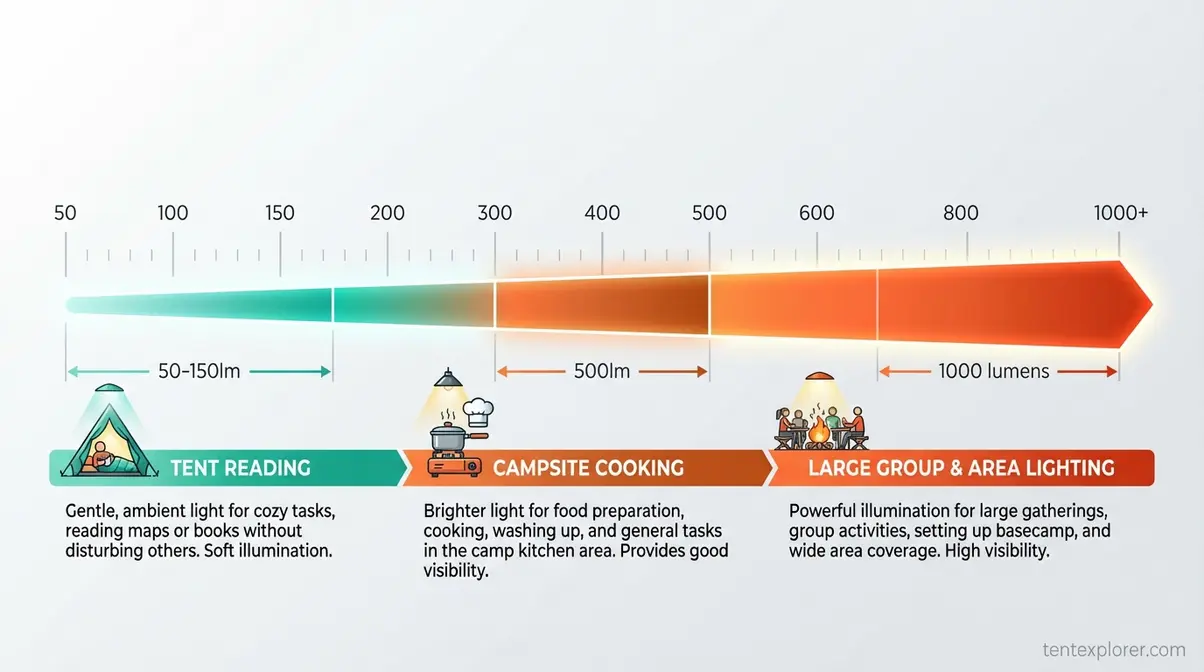
Caption: Lumen requirements vary significantly by campsite size — a 2-person tent needs as little as 50–100 lumens, while a large group site benefits from 400 lumens or more.
This comparison draws on manufacturer specifications, hands-on testing data from OutdoorGearLab’s 2025 lantern review, REI’s expert advice series, and the U.S. Department of Energy’s energy efficiency resources. Specific models are cited as representative examples, not paid endorsements.
LED Lanterns: Efficient, Safe, and Built for Modern Camping
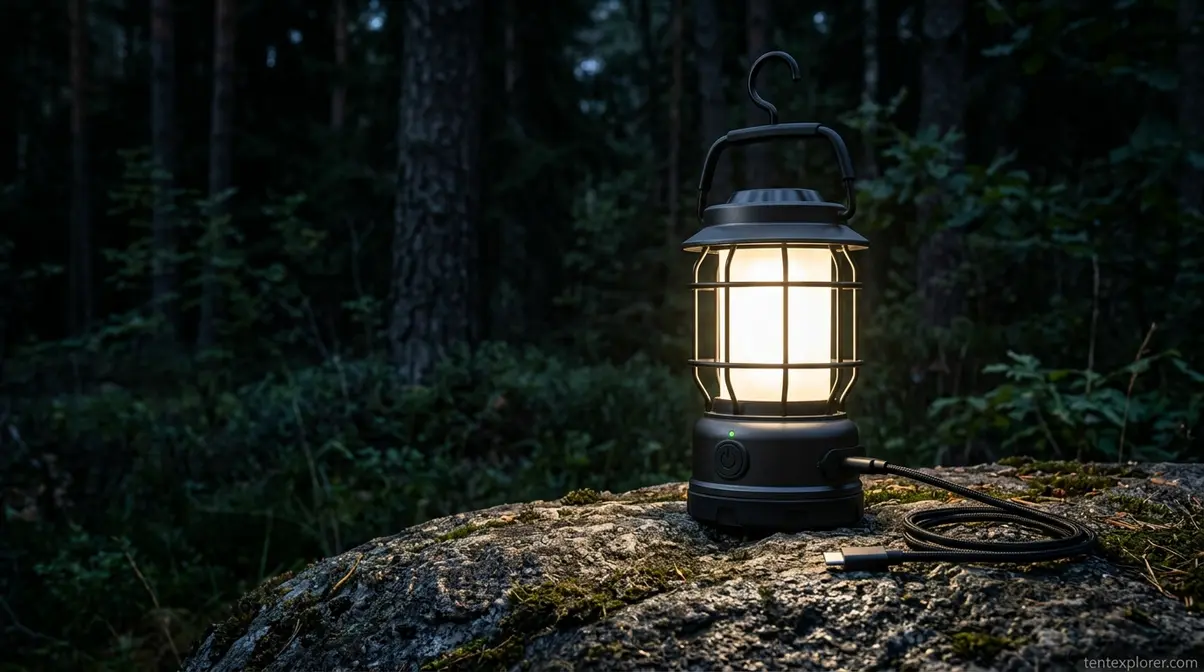
An LED lantern is a battery-powered or rechargeable camping light that uses light-emitting diode technology to produce bright, adjustable illumination with no open flame and no combustion. That last point is critical: LED lanterns produce zero carbon monoxide, carry no fire risk, and are safe to use in tent vestibules and shelters where fuel-burning lanterns are genuinely dangerous.
High-quality LED lanterns consume at least 75% less energy than comparable incandescent alternatives (LED Lighting Supply, 2025), and the efficiency gap widens further compared to propane and liquid-fuel lanterns when you account for the full cost of fuel canisters over a season of camping.
The Goal Zero Lighthouse 600 is OutdoorGearLab’s top-rated lantern for 2025–2026, and it illustrates what modern LED design offers:
- 600 lumens maximum output, adjustable down to low settings for tent use
- 5,200 mAh lithium-ion battery with USB-A output (5V/1.5A) for charging phones, headlamps, or GPS devices
- Hand-crank backup — one minute of cranking provides approximately 10 minutes of light on low
- Runtime: Up to 320 hours on one side at low setting; 2.5 hours at full output on both sides
- Weight: 1.1 lbs (498g)
- Price: Approximately $60–$80 (as of early 2026, per REI and Backcountry listings)
Scenario — Charging devices at camp: The Lighthouse 600’s 5,200 mAh battery can charge a typical smartphone once to twice on a single charge, making it a dual-purpose tool for car campers who bring electronics. This “emergency power station” capability is increasingly the deciding factor for family campers — and it’s a feature no fuel-burning lantern can offer.
One important cold-weather note: lithium-ion batteries maintain strong performance at temperatures as low as -20°C. Standard alkaline battery lanterns lose 50% or more of their capacity below 0°C — a critical distinction for winter or high-altitude camping.
The energy efficiency of LED lighting documented by the U.S. Department of Energy confirms that for most campers — especially families, car campers, and anyone camping near a tent — LED is the recommended starting point.
Propane and Liquid-Fuel Lanterns: Bright but Demanding
A propane lantern is a fuel-burning camping light that runs on pressurized propane canisters, while a liquid-fuel lantern (like the Coleman Dual Fuel lantern) burns Coleman fuel or unleaded gasoline. Both types can output 400–1,000+ lumens, making them capable of illuminating a large open-air group campsite in a way that even the brightest LED lanterns struggle to match at the same price point. Propane lanterns also generate a small amount of radiant heat — a welcome side effect on cool evenings.
However, the pros and cons of gas lanterns tilt decisively toward disadvantages for most recreational campers:
- ❌ Produce carbon monoxide — must be used outdoors in open-air settings only (never inside tents or vehicles)
- ❌ Require fragile glass mantles that crack during transport
- ❌ Fuel canisters and liquid-fuel tanks add significant weight and bulk
- ❌ Open flame creates fire risk near dry brush, tent fabric, and sleeping bags
- ❌ Require priming, pumping, or valve adjustment — more complex to operate than switching on an LED
The Coleman Dual Fuel lantern remains a reliable option for extended car camping trips where recharging isn’t possible and maximum brightness is the priority — but it must always be used in well-ventilated, open-air conditions, with no exceptions.
Here’s how the three fuel types compare across the metrics that matter most:
| Feature | LED Lantern | Propane Lantern | Liquid-Fuel Lantern |
|---|---|---|---|
| Max Brightness | 100–600+ lumens | 400–1,000+ lumens | 400–1,000+ lumens |
| Carbon Monoxide Risk | None | High — outdoors only | High — outdoors only |
| Fire Risk | None | Moderate | Moderate |
| Fuel / Power Source | Battery or rechargeable | Propane canister | Coleman fuel / gasoline |
| Best For | Most campers; tent-adjacent use | Large open-air group sites | Extended off-grid trips |
| Cold-Weather Performance | Excellent (lithium-ion) | Good above -10°C | Excellent |
| Weight | Light to moderate | Moderate to heavy | Heavy |
| Modern Features | USB charging, dimming, hand crank | Radiant heat output | Dual-fuel flexibility |
The Department of Energy definition of lumens establishes lumens as the universal standard for measuring visible light output — the same metric that applies across all three lantern types.
Understanding Lumens: How Bright Does Your Campsite Need to Be?
Lumens (lm) measure the total amount of light a source emits in all directions. Higher lumens equal a brighter light. Understanding this number — rather than watt ratings, which reflect energy consumption rather than output — is the key to choosing a lantern that actually matches your campsite’s needs.
Approximate lumen guidance for common camping scenarios:
- 50–100 lumens: Reading inside a 2-person tent, personal task lighting, low-ambience use
- 100–200 lumens: Small tent interior (2–4 person), intimate campfire-adjacent lighting
- 200–400 lumens: Standard campsite picnic table, family tent (4–6 person), cooking area
- 400–1,000+ lumens: Large group campsite, open-air dining shelter, emergency signaling
Most recreational campers are well-served by a lantern that adjusts between 50 and 400 lumens. A model with multiple brightness settings — like the Goal Zero Lighthouse 600’s adjustable output — is more versatile than a fixed-output design because you can dial down to 50 lumens for tent use and up to 400+ lumens when you need to see the entire campsite.
Light intensity vs. lumen output: It’s worth distinguishing between lumens (total light output) and light intensity — the concentration of light at a specific point, measured in lux. A lantern’s 360-degree dispersion spreads its lumens across a wider area than a flashlight does. This means a 300-lumen lantern can feel noticeably brighter inside a tent than a 300-lumen flashlight aimed at the ceiling, because the lantern distributes its output evenly rather than concentrating it in one direction. The DOE’s energy efficiency resources confirm that lumen output — not watt ratings — is the correct metric for comparing light sources across different technologies.
Burn Time, Cold-Weather Performance, and Modern Features
Runtime is where the three lantern types diverge most sharply in practical use. Here’s what to expect:
- LED lanterns (lithium-ion): 20–320 hours depending on brightness setting. The Goal Zero Lighthouse 600 runs 320 hours on one side at low, 2.5 hours at maximum output on both sides.
- Propane lanterns: Approximately 4–8 hours per canister at full brightness, depending on canister size and valve setting.
- Liquid-fuel lanterns: Approximately 7–14 hours per tank at full output.
Cold-weather performance creates a significant split between LED and fuel options. Lithium-ion batteries in modern LED lanterns maintain 80–90% of their rated capacity at temperatures as low as -20°C. Standard alkaline batteries lose more than 50% of their capacity below 0°C. Propane lanterns can struggle to pressurize and ignite reliably below -10°C, because propane’s vapor pressure drops significantly in extreme cold.
Scenario — Winter camping in sub-freezing temperatures: A lithium-ion LED lantern maintains reliable, predictable performance when a propane canister may fail to ignite at all. For winter campers, this is often the deciding factor between fuel types.
Modern LED lanterns have also added features that redefine what a camping lantern can do. USB power-bank output — available on the Goal Zero Lighthouse 600 and similar models — lets you charge phones, headlamps, and GPS devices directly from the lantern’s battery. This dual-purpose capability turns a lantern into an emergency power station, a feature particularly valued by family and car campers who bring multiple devices.
For a deeper comparison of rechargeable options, compare solar and battery-powered lantern performance in detail on TentExplorer.
Before you commit to any fuel type, though, there’s one more topic that most camping gear guides skip entirely — and it could save your life.
Camping Lantern Safety: Carbon Monoxide Risks, Drawbacks, and Smart Practices
⚠️ NEVER use fuel-burning lanterns (propane, liquid fuel) inside a sealed tent, vehicle, or enclosed shelter. They produce carbon monoxide, an odorless, colorless gas that can be fatal.
Beyond this critical hazard, camping lanterns carry several practical drawbacks worth understanding — from weight and fragility to sleep disruption from ambient light. This section covers both the life-safety risks and the everyday disadvantages of lantern use, so you can make a fully informed gear decision.
Carbon Monoxide: The Silent Danger of Fuel-Burning Lanterns
Carbon monoxide (CO) is an odorless, colorless gas produced by the incomplete combustion of fuel — including the propane and liquid fuel that power gas camping lanterns. Because CO has no smell and no visible presence, it provides no warning before it becomes dangerous. In a confined space like a tent, CO can accumulate to hazardous concentrations within minutes.
Gas camping lanterns produce carbon monoxide as a byproduct of normal operation. The U.S. Consumer Product Safety Commission (CPSC) has specifically warned that portable camping equipment — including fuel-burning lanterns and stoves — used inside tents and enclosed spaces is a documented source of CO poisoning incidents. The CDC reinforces this: never use a portable gas camp stove or fuel-burning lantern indoors, and the same rule applies to any enclosed tent or vehicle (CDC carbon monoxide guidance, updated 2026).
CO poisoning symptoms — headache, dizziness, nausea, confusion — can be mistaken for altitude sickness or exhaustion. If you or anyone in your group experiences these symptoms while camping with a fuel-burning lantern nearby, move immediately to fresh air and call emergency services. Do not re-enter the tent until the space has been fully ventilated.
Preventive measures for fuel-burning lanterns:
- Always use propane and liquid-fuel lanterns in fully open-air, well-ventilated outdoor settings
- Never bring a fuel-burning lantern inside a tent, even briefly, even with the door partially open
- Consider carrying a portable CO detector rated for camping environments (tested for vibration and humidity per travel safety standards)
- Switch to an LED lantern for any enclosed or semi-enclosed space
This is where The Campsite Lighting Triangle becomes most useful as a decision framework: fuel lanterns score high on coverage but critically low on safety. For any campsite situation that involves a tent or enclosed space, LED lanterns are the only option that satisfies all three vertices of the triangle.
Other Drawbacks: Weight, Fragility, and Sleep Disruption
Carbon monoxide is the most serious concern, but the disadvantages of lanterns extend to several practical issues that affect every camping trip, regardless of fuel type.
Weight and bulk: Propane and liquid-fuel lanterns are significantly heavier than LED alternatives. A Coleman Dual Fuel lantern weighs approximately 2–3 lbs without fuel; add a propane canister or liquid fuel tank and the total approaches 4–5 lbs. For backpackers counting ounces, this is a dealbreaker. Even LED lanterns like the Goal Zero Lighthouse 600 weigh 1.1 lbs — heavier than a headlamp, though lighter than any fuel-burning alternative.
Fragility: Gas lanterns use glass or ceramic mantles — the mesh components that glow when heated — which are notoriously fragile during transport. A single drop or rough pack can crack a mantle and render the lantern inoperable until you replace it. Carrying spare mantles is standard practice for propane lantern users.
Sleep disruption: This is a drawback that applies to all lantern types, including LED. Research published in the Proceedings of the National Academy of Sciences (PNAS, 2022) found that a single night of moderate light exposure — just 100 lux during sleep — increases nighttime heart rate and impairs cardiometabolic function in healthy adults. The NIH study on sleeping with light exposure (National Heart, Lung, and Blood Institute, 2022) confirms that sleeping with even a small amount of light in the room can harm heart health and increase blood insulin levels.
Scenario — Sleep disruption: Leaving a lantern on inside a tent while sleeping — even at low output — is genuinely unhealthy based on this research on light exposure during sleep. The practical solution is to switch to a lantern’s red-light mode or lowest lumen setting 30–60 minutes before sleep, then turn it off completely. Red-wavelength light has significantly less impact on melatonin suppression and sleep quality than white light at equivalent brightness. For tips on optimizing your sleep environment at camp, see our guide on how to improve sleep camping naturally.
Safe Lantern Practices for Every Campsite
Applying a few consistent habits eliminates the most common lantern-related mistakes. Consider this a practical checklist for every camping trip:
- For all lantern types:
- Place lanterns on stable, flat surfaces away from tent fabric, sleeping bags, and dry brush
- Never leave a fuel-burning lantern unattended while lit
- Turn off all lanterns before sleeping — use a red-light mode or headlamp for any nighttime navigation needs
- Keep lanterns away from children’s reach when lit
- For fuel-burning lanterns specifically:
- Always operate in open-air, well-ventilated outdoor settings — no exceptions
- Store fuel canisters separately from the lantern during transport
- Carry spare mantles for propane and liquid-fuel models
- Allow the lantern to cool completely before packing
- Common mistakes to avoid:
- ❌ Cracking the tent door “just a little” and assuming ventilation is sufficient for a fuel lantern — it isn’t
- ❌ Using a propane lantern in a screen-house or canopy shelter — enclosed on three sides is still enclosed enough for CO buildup
- ❌ Leaving any lantern on all night inside a tent, even an LED model — the light disrupts sleep quality based on peer-reviewed research
- ❌ Storing fuel canisters inside the tent during cold weather to keep them warm — this creates both fire and CO risk
For a broader framework on campsite safety practices, our tent camping safety tips guide covers shelter setup, fire management, and carbon monoxide risks in tents in greater detail.
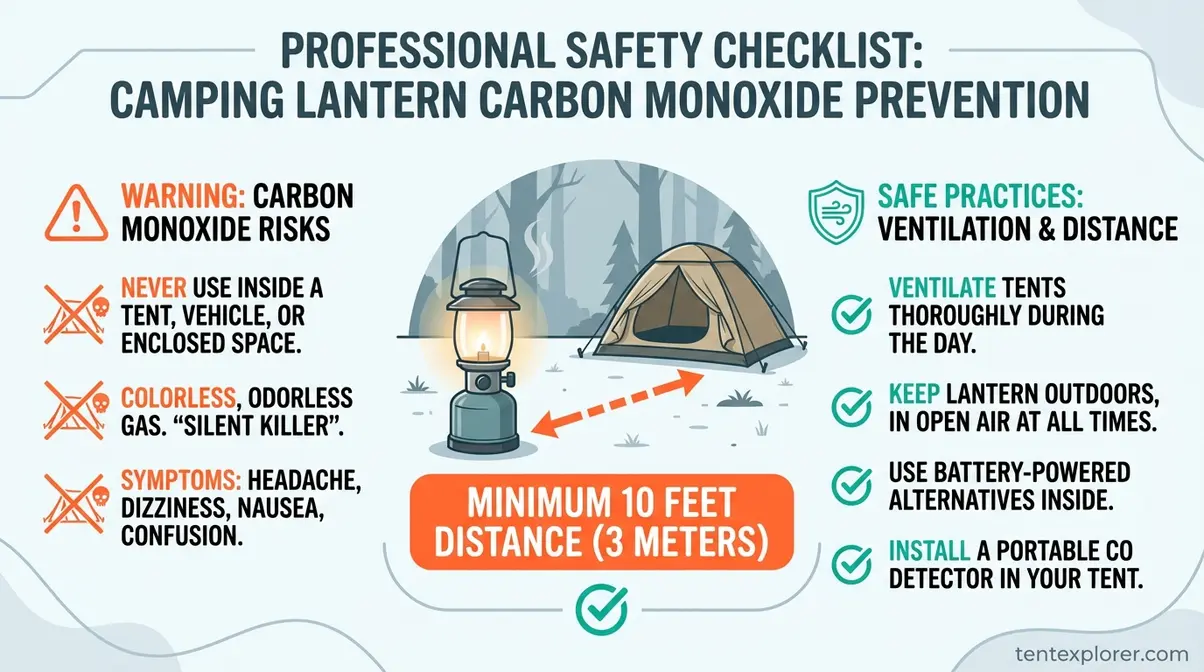
Caption: Follow these safety rules every trip — the carbon monoxide risk from fuel-burning lanterns in enclosed spaces is the most frequently overlooked hazard in recreational camping.
Frequently Asked Questions About Camping Lanterns
What is the use of a camping lantern?
A camping lantern is a portable light source designed to emit illumination in all directions simultaneously, providing ambient light for an entire campsite, tent interior, or outdoor work area. Unlike a flashlight’s narrow directional beam, a lantern’s 360-degree output means multiple people can see clearly at once without anyone aiming light at anyone else. Camping lanterns are used for cooking, socializing, reading, navigating a campsite after dark, and — in modern LED versions — charging devices via USB. The U.S. National Park Service classifies lanterns as part of the Ten Essentials for outdoor survival, reflecting their status as foundational campsite gear rather than optional accessories.
What are the disadvantages of camping lanterns?
The main disadvantages of camping lanterns are weight, fragility, and — for fuel-burning models — serious safety risks. Propane and liquid-fuel lanterns produce carbon monoxide and must never be used in enclosed spaces; their glass mantles are fragile during transport, and fuel canisters add significant pack weight. Even LED lanterns are heavier than a headlamp. Additionally, research published in PNAS (2022) found that sleeping with as little as 100 lux of light exposure increases nighttime heart rate and impairs cardiometabolic function — meaning any lantern left on inside a tent while you sleep carries a documented health cost. The practical solution is turning lanterns off before sleep and using a headlamp for any overnight navigation.
What are the pros and cons of gas lanterns?
Gas lanterns (propane and liquid fuel) produce 400–1,000+ lumens of bright output and generate useful radiant heat, but carry significant safety and maintenance demands. On the positive side, they deliver exceptional brightness for large open-air group campsites, work well at moderate temperatures, and don’t require charging infrastructure. On the negative side, they produce carbon monoxide — making them strictly outdoor-only tools — require fragile mantles that break during transport, add substantial weight via fuel canisters, and involve more complex operation (priming, valve adjustment) than LED alternatives. For most recreational campers, the safety trade-offs make LED lanterns the better default choice; gas lanterns are best reserved for extended off-grid trips where recharging isn’t possible.
Do lanterns produce carbon monoxide?
Fuel-burning camping lanterns — including propane and liquid-fuel models — do produce carbon monoxide (CO) as a byproduct of combustion. CO is an odorless, colorless gas that reduces blood oxygen levels and can cause dizziness, nausea, unconsciousness, or death if it accumulates in an enclosed space. The CDC explicitly warns against using portable gas camp equipment inside tents or vehicles (CDC, updated 2026). LED lanterns, which run on batteries or rechargeable power and produce no combustion, generate zero carbon monoxide and are safe for use in tent-adjacent spaces. If you use a propane or liquid-fuel lantern, it must remain in fully open-air, well-ventilated outdoor settings at all times — no exceptions.
Should I use a lantern or a flashlight for camping?
For stationary campsite use, a lantern is the better choice; for on-the-go directional tasks, a flashlight or headlamp is more effective. Lanterns provide 360-degree ambient illumination that covers cooking areas, picnic tables, and tent interiors simultaneously, freeing both hands and preserving everyone’s night vision. Flashlights and headlamps project a concentrated beam that travels further and is better suited for hiking a trail, searching for objects at a distance, or reading in a sleeping bag without lighting up the whole tent. Most experienced campers carry both — a lantern for the campsite environment and a headlamp for individual tasks — because the two tools complement rather than replace each other.
Making the Right Lantern Choice for Your Next Trip
For most campers — families, weekend car campers, and anyone sharing a campsite with others — a quality LED lantern in the 200–400 lumen range is the single most impactful lighting upgrade they can make. LED lanterns consume at least 75% less energy than incandescent alternatives (LED Lighting Supply, 2025), carry zero carbon monoxide risk, and increasingly serve as emergency power banks for devices. The Goal Zero Lighthouse 600, at approximately $60–$80, represents the current standard for what a well-designed camping lantern can do.
The Campsite Lighting Triangle — balancing coverage, safety, and sleep comfort — is the framework that makes this decision straightforward. LED lanterns score well on all three vertices. Propane and liquid-fuel lanterns score high on coverage but require careful outdoor-only use and disciplined sleep hygiene practices to avoid compromising the other two. Understanding where your specific camping conditions fall within that triangle tells you which fuel type fits your trip.
Start with an LED lantern, add a headlamp for directional tasks, and apply the safety practices in this guide for fuel-burning options if you need the extra brightness. Check our tent camping safety tips before your next outing for a complete pre-trip safety checklist — including the CO risks in tents that most gear guides still don’t mention.