How to Keep Bugs Out of a Tent: 3 Proven Secrets (2026)
 Dave King
Updated March 30, 2026
23 min read
Dave King
Updated March 30, 2026
23 min read
You zipped up carefully, sprayed yourself down, and still woke up with mosquitoes dive-bombing your ear at 2 a.m. Knowing how to keep bugs out of a tent isn’t just about one spray or one habit — it’s about closing every gap in your defense simultaneously, because insects exploit every single one you leave open.
A single mosquito inside a tent can mean 50+ bites and a completely destroyed night of sleep. Generic advice like “just keep it zipped” ignores the 12 different ways insects actually get in — through hitchhiking on clothing, attracted by white light, or crawling through poorly sealed ground seams. Those insect stowaways don’t care how expensive your tent is.
By the end of this guide, you’ll have a complete Three-Layer Defense — a systematic protocol that stops bugs at the behavioral, environmental, and chemical level. This guide covers campsite selection, tent discipline, repellents, alternative shelter strategies, and what to do when bugs get through anyway.
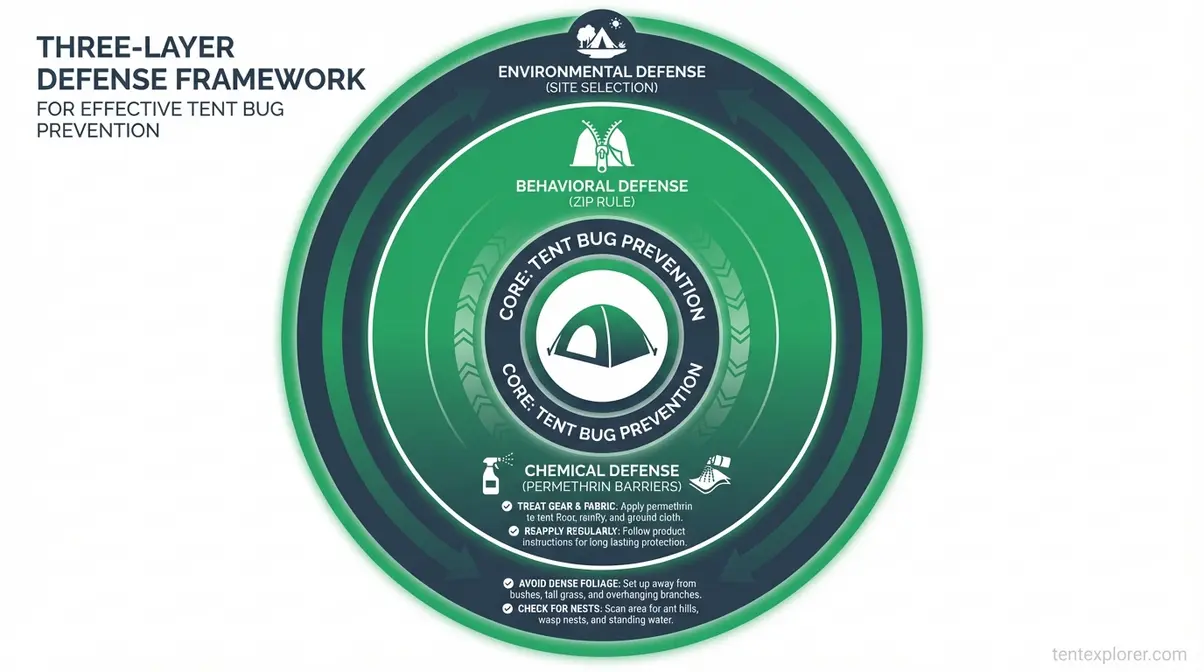
Caption: The Three-Layer Defense organizes every bug-prevention tactic into three concentric layers — start with Environmental, reinforce with Behavioral, and seal it with Chemical.
Key Takeaways: How to Keep Bugs Out of a Tent
Learning how to keep bugs out of a tent requires a layered system — not just one spray or habit.
- The Zip Rule is the single most critical behavioral habit: close your tent door within 3 seconds of entry or exit, every time, without exception
- Permethrin treatment on tent fabric, mesh, and zippers kills insects on contact and remains active through multiple wash cycles — the CDC recommends 0.5% concentration for gear treatment
- Strategic campsite placement — upwind, elevated, and 200+ feet from standing water — reduces mosquito exposure at the source before you open a single bottle of repellent
- The Three-Layer Defense (Behavioral + Environmental + Chemical) is the organizing framework that ties every tip in this guide into a single, executable protocol
Bug-Proof Camping Checklist
The Three-Layer Defense works as a system across three concentric protection layers: Layer 1 (Behavioral — tent discipline and habits), Layer 2 (Environmental — site selection and scent control), and Layer 3 (Chemical/Natural — permethrin, essential oils, and spatial repellents). A random collection of tips doesn’t work; a layered system does, because each layer compensates for the gaps the others leave. Across camping and backpacking communities, the consistent feedback is that pre-trip permethrin treatment is the single most-skipped step — and the one that makes the biggest difference.
Estimated time: 15-30 minutes
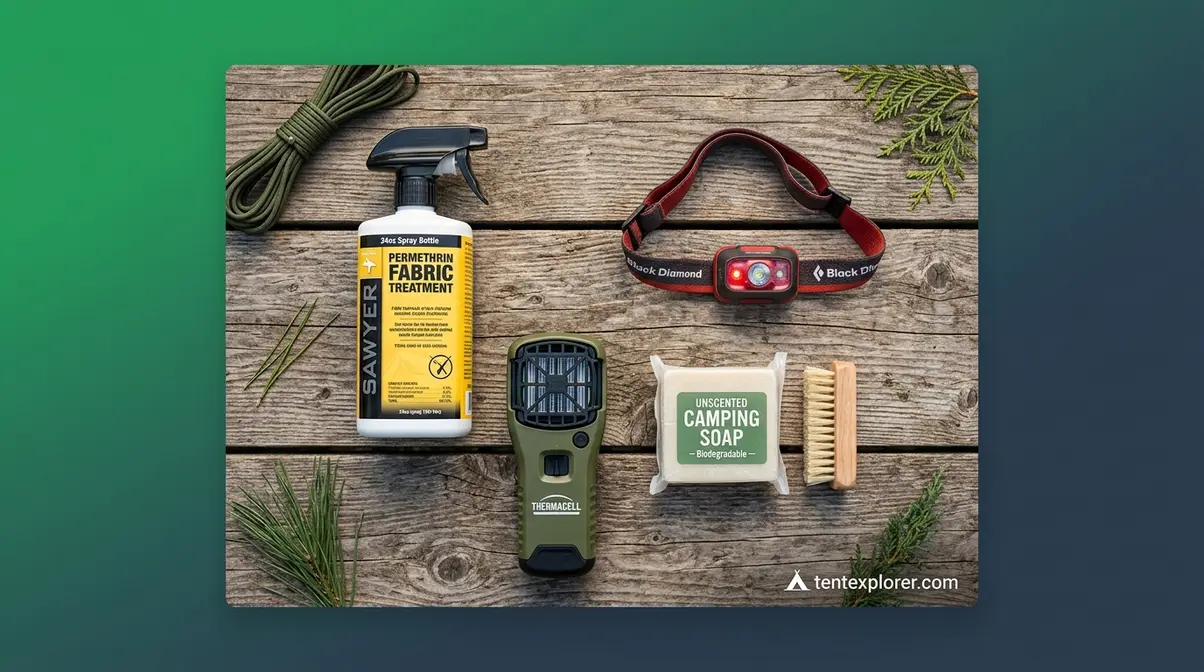
Tools and Materials: 0.5% Permethrin spray, headlamp with red/yellow mode, no-see-um mesh insert, unscented toiletries, portable Thermacell device, zip-top bags, lightweight bug net.
Pack these items before you leave:
- 0.5% Permethrin spray — treat tent exterior, mesh, and zippers 24–48 hours before the trip. The CDC permethrin guidelines recommend this concentration for effective insect protection on gear (CDC, 2026)
- Headlamp with red or yellow LED mode — white light is a bug magnet after dark
- No-see-um mesh insert (if your tent mesh is coarser than 1.2mm) — no-see-um mesh is an ultra-fine screen that blocks midges and tiny gnats standard tent mesh misses
- Unscented toiletries — shampoo, deodorant, and soap; fragrances attract insects
- Portable Thermacell device — a Thermacell is a portable spatial mosquito repellent device that vaporizes allethrin into a 15-foot protection zone
- Zip-top bags for all food and scented items
- Lightweight bug net — essential for tarp or cowboy camping setups
If you’re shopping for a new tent before your trip, see our guide to the best tents for mosquitoes for models with fine mesh and treated fabrics already built in.
Now let’s build your Three-Layer Defense, starting with Layer 2 — the environmental foundation that determines how many bugs you’ll face before you even set up your tent.
Step 1: Choose Your Campsite to Cut Bug Exposure
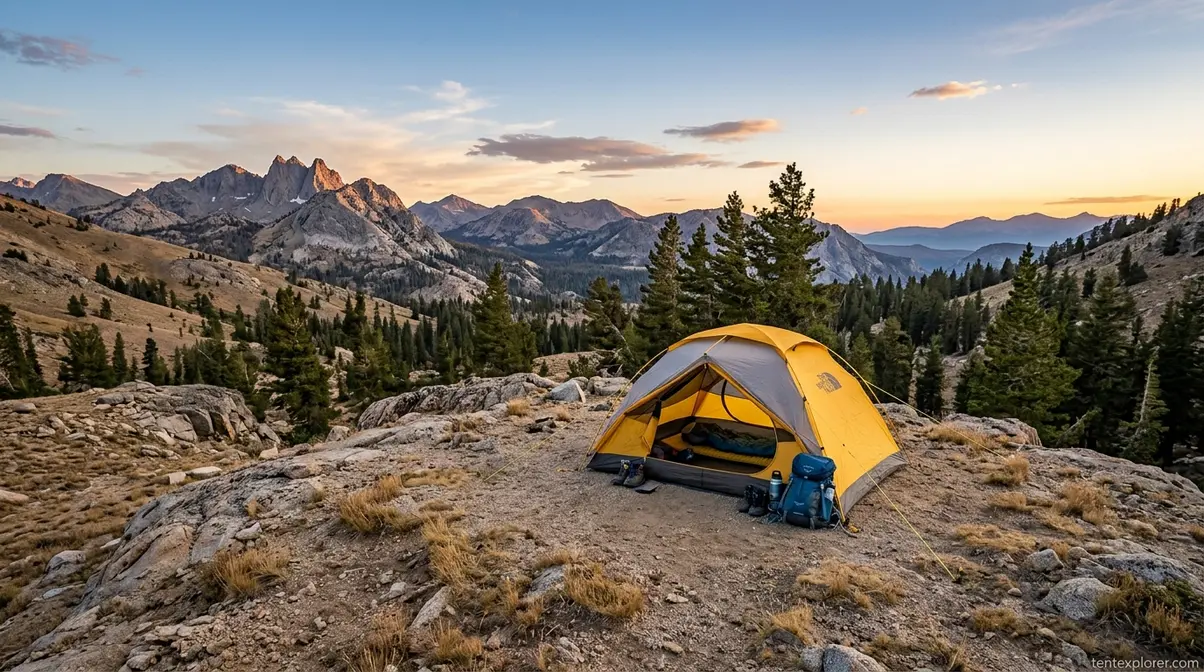
Your campsite location determines how many bugs you’ll face before you open a single bottle of repellent. Mosquitoes can breed in as little as a bottle cap full of water, developing from eggs to biting adults in as few as five days — making your distance from any standing water source your first line of defense (San Diego County Health). Choose the right spot and you reduce bug pressure at the source, making every other step in this guide measurably more effective.
Layer 2 of the Three-Layer Defense starts before you pitch your tent.
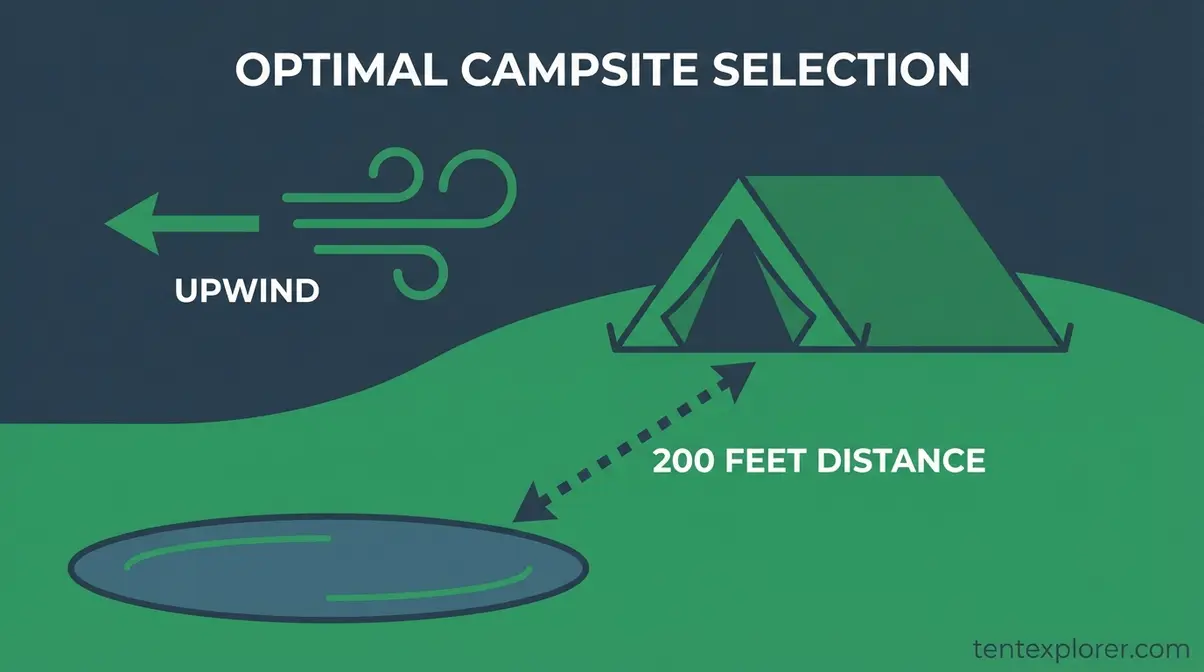
Caption: Ideal campsite placement combines upwind positioning, slight elevation, and a 200-foot buffer from standing water — cutting bug pressure before any repellent is applied.
As the diagram above shows, three environmental factors combine to give you a significant natural advantage over insects before you’ve unpacked a single piece of gear.
Use Wind and Elevation Against Bugs
Most biting insects — mosquitoes, gnats, midges (small biting flies that swarm near still water) — are weak fliers. A sustained breeze of 10+ mph significantly reduces their ability to land and bite. Pitch your tent on the upwind side of a clearing, not sheltered against trees or rock walls that block airflow.
Slight elevation also works in your favor. Even 20–30 feet above a valley floor meaningfully reduces exposure to mosquitoes, which breed in low-lying, humid depressions and rarely fly far above their breeding zones. The CDC advice on preventing bug bites consistently emphasizes physical barriers and environmental positioning as first-line defenses alongside repellents (CDC, 2026).
A practical field test: hold a piece of paper up before pitching your tent. If it barely moves, find a more exposed spot or orient the tent opening to face the prevailing breeze. This one adjustment can cut your bug exposure by a third without touching a single product.
Wind and elevation handle flying insects — but crawling insects, ants, and armyworms (migratory moth larvae that colonize grassy areas) are a different problem, and they breed in a very specific environment you need to avoid.
Avoid Standing Water Near Your Site
Standing water as small as a bottle cap can support mosquito larvae development, making campsite distance from any water source your first line of bug defense (San Diego County Health). Target a minimum of 200 feet from any standing water: ponds, puddles, stream banks, and low-lying depressions. Even a shallow tire rut filled with rainwater is a viable breeding site.
Dense, low vegetation — tall grass and thick shrubs — traps humidity and harbors resting mosquitoes. Pitch in a cleared area with short-cropped ground cover rather than a lush, grassy hollow. Avoiding standing water to prevent mosquitoes is one of the most evidence-backed site selection strategies available (San Diego County Health, 2026). Valley bottoms and drainage channels are doubly problematic: cold air pools there overnight, and so do insects.
- Good site vs. bad site:
- ✅ Good: A rocky outcrop with a cross-breeze, short grass, no visible water within 200 feet
- ❌ Avoid: A grassy bank beside a slow creek, sheltered by trees, in a low-lying depression
You’ve chosen the right spot. Now the most important habit in this entire guide: what you do every single time you open and close your tent door.
Step 2: Master Tent Discipline to Keep Bugs Out
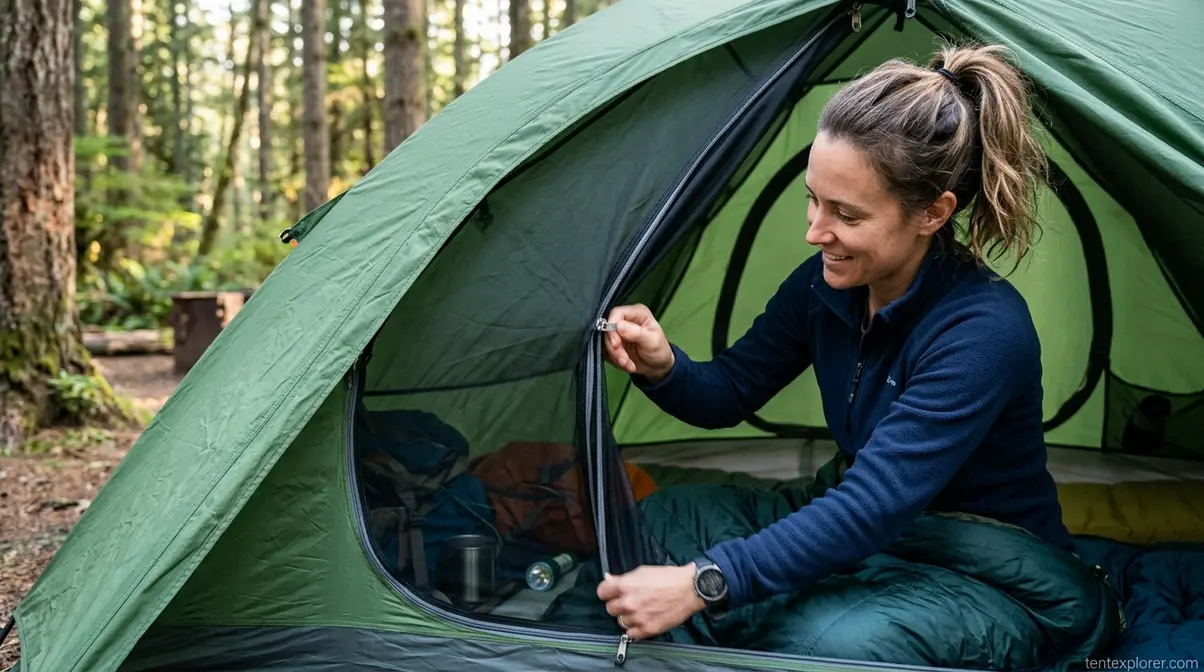
Layer 1 of the Three-Layer Defense is entirely free — it costs nothing except habit. The Zip Rule is the single behavioral practice that experienced campers cite most consistently, and it’s the one most frequently abandoned after the first tired night or a long day on the trail. No spray compensates for a door left open.
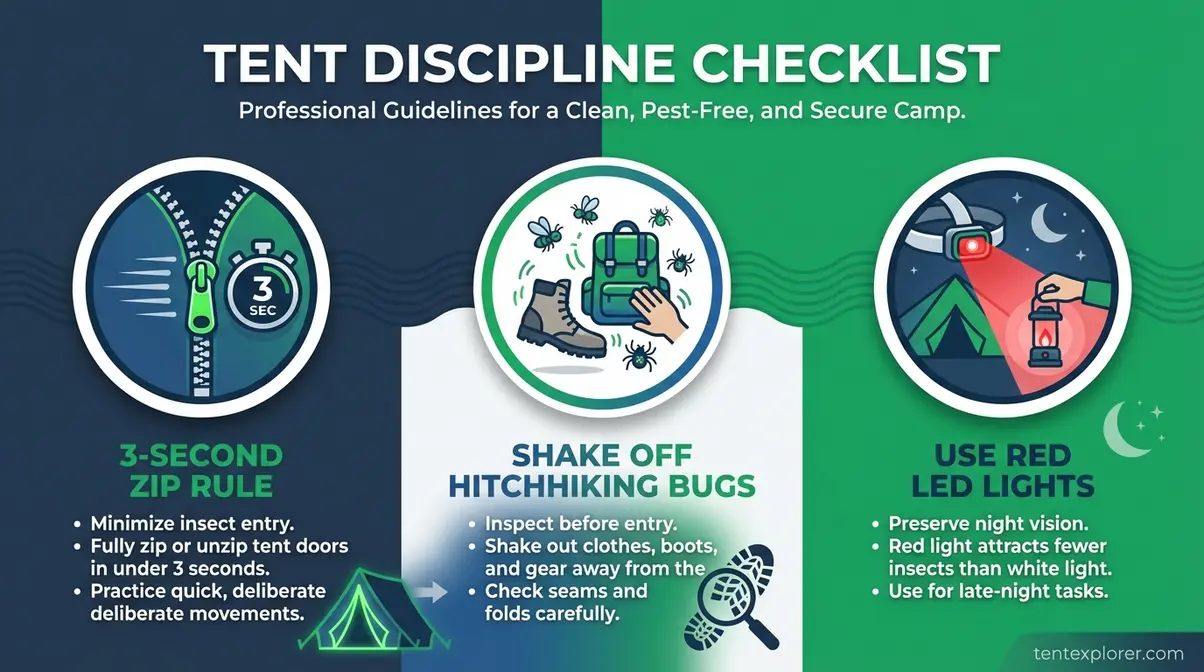
Caption: Use this pre-sleep checklist to lock down Layer 1 of your bug defense — the behavioral habits that cost nothing and prevent the majority of insect entry.
Use the checklist above as your pre-sleep routine every night of your trip.
The Zip Rule: Close in 3 Seconds
The Zip Rule — closing your tent door within 3 seconds of entry or exit — is the single most-cited behavioral habit for preventing insect stowaways among experienced backpackers.
Define it precisely: every time you pass through the tent door, the zipper closes behind you in one continuous motion. The three most common failure modes are: (a) leaving the door open while unpacking gear just inside the vestibule, (b) children going in and out repeatedly without closing, and (c) nighttime disorientation when returning from a bathroom trip in the dark.
The practical technique is simple — duck in quickly, grab the zipper pull with your trailing hand, and close in one motion before you straighten up inside. Practice it at home before the trip so it’s automatic rather than a conscious decision you’re too tired to make at midnight. For vestibule tents, treat the inner door with identical 3-second discipline as the outer. A bug that enters the vestibule will find the inner door eventually.
A single mosquito inside a tent can deliver 50+ bites in one night. The 3-second rule is worth enforcing without exception.
If your tent’s mesh is coarser than 1.2mm, consider adding no-see-um mesh inserts as a backup barrier — especially in areas with heavy midge or gnat populations.
The Zip Rule stops bugs from flying in. But the bugs that walk in on your clothing and gear are a different problem entirely.
Shake Off Hitchhiking Bugs Before Entry
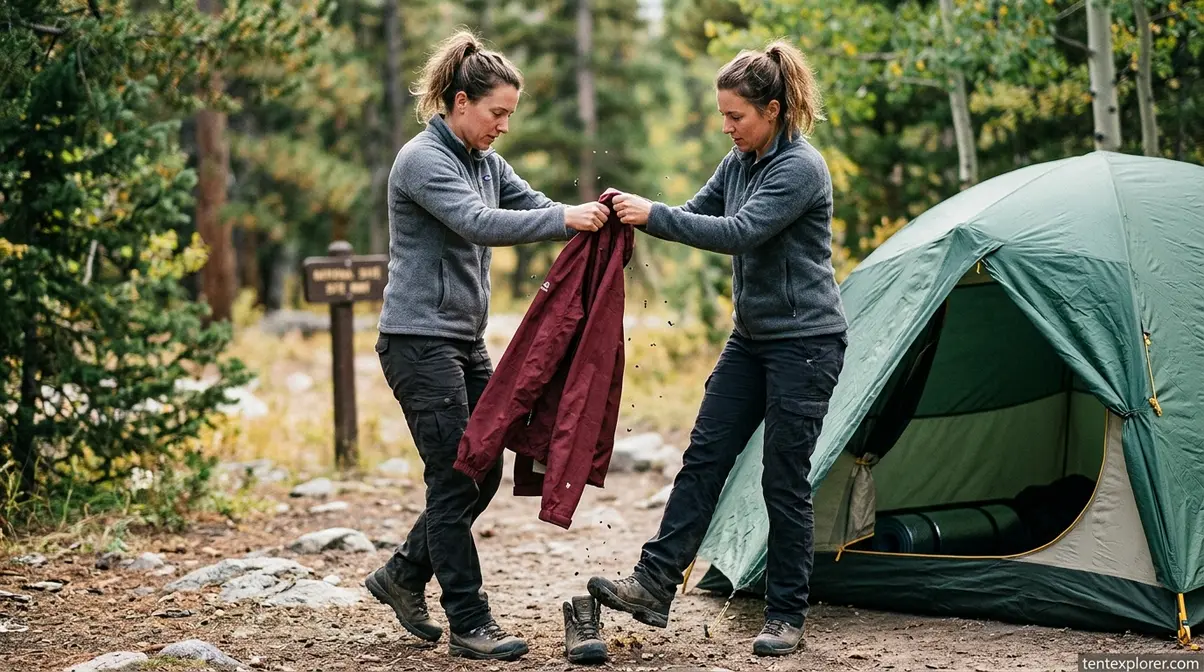
Hitchhiking bugs — insects that cling to fabric, seams, and laces rather than flying in through open doors — are responsible for a significant share of tent invasions that campers attribute to “mysterious” entry. Before entering the tent, physically shake out your jacket, hat, and pants legs. Tap the soles of your boots together. Run your hands through your hair. Ticks, ants, and gnats cling to fabric folds, seams, and laces specifically because those areas are sheltered from casual brushing.
Give gear items — backpacks, camera bags, water bottles — a quick inspection before bringing them inside. Beetles and moth larvae are common hitchhikers on gear placed on the ground, particularly in grassy or heavily wooded sites.
- 4-step shakedown before every entry:
- Shake jacket and hat vigorously — focus on collar, cuffs, and hood seams
- Tap boot soles together over the ground
- Run both hands through your hair from scalp to tips
- Inspect gear seams and zippers before bringing items inside
If you’ve been near dense vegetation, complete a tick check before entering — ticks are slow-moving and easy to catch in this window before they’ve had time to burrow.
You’ve cleared yourself of hitchhiking bugs. Now, the one habit that will ruin all of this if you ignore it: your campsite lighting.
Switch to Red or Yellow LEDs
White and blue-spectrum light — standard headlamps, phone screens, lanterns — attracts flying insects. Mosquitoes, moths, and gnats orient toward short-wavelength (cool) light. Red and yellow LEDs emit longer wavelengths that insects cannot detect as effectively, making them significantly less attractive as a gathering point near your tent.
The practical rule: switch your headlamp to red mode before you open the tent at night. Keep phone screens face-down when outside. Use a battery-powered lantern with a red or amber setting inside the tent rather than a white-light lantern that creates a glowing beacon visible from 50 yards.
Many modern headlamps — the Black Diamond Spot and Petzl Actik are two widely used examples — include a dedicated red mode. Use it every night from sunset onward, not just when you’re entering the tent.
Behavioral habits are free and immediate. But to create a true protection bubble around your tent, you need to add Layer 3 — chemical and natural repellents applied strategically.
Step 3: Build Your Protection Bubble
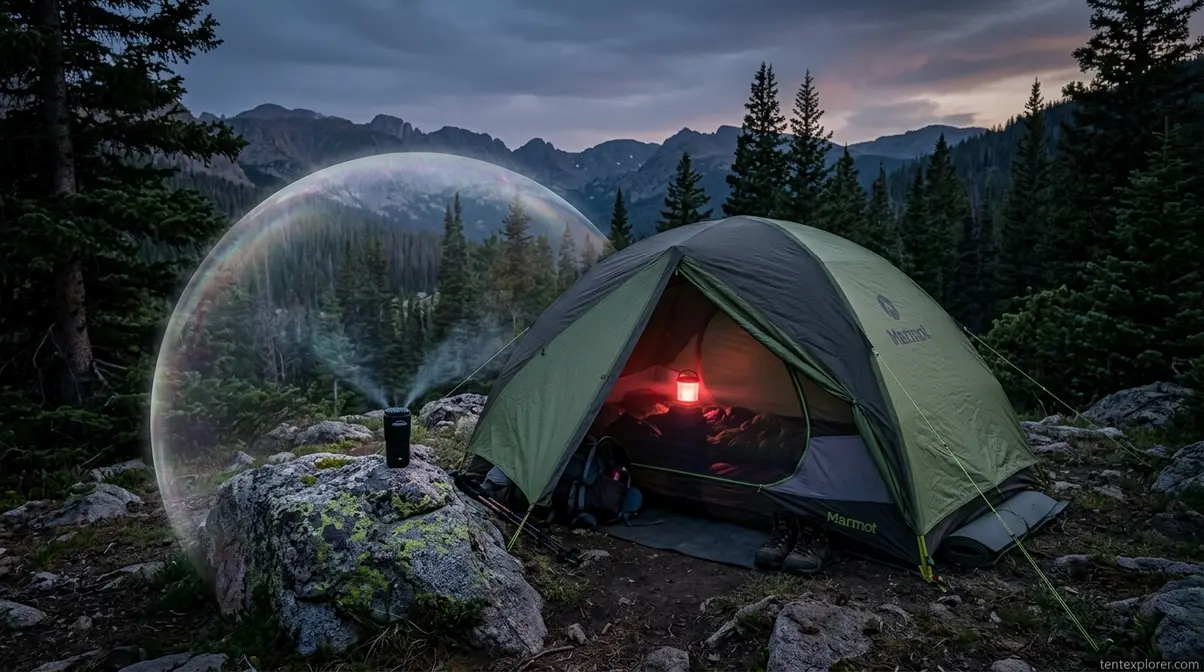
Layer 3 of the Three-Layer Defense is where you create what experienced campers call the “protection bubble” — a treated zone around your tent where insects are actively killed or deterred. The CDC recommends treating outdoor gear and clothing with 0.5% permethrin for effective insect protection that remains active through multiple wash cycles (CDC, 2026). The practical choice for most campers combines permethrin on tent fabric, natural repellents for the perimeter, and a spatial device for the air.
Caption: Understanding when to use each repellent type is as important as using them — permethrin treats fabric, PMD protects skin, and Thermacell clears the surrounding air.
Can you spray your tent with bug spray?
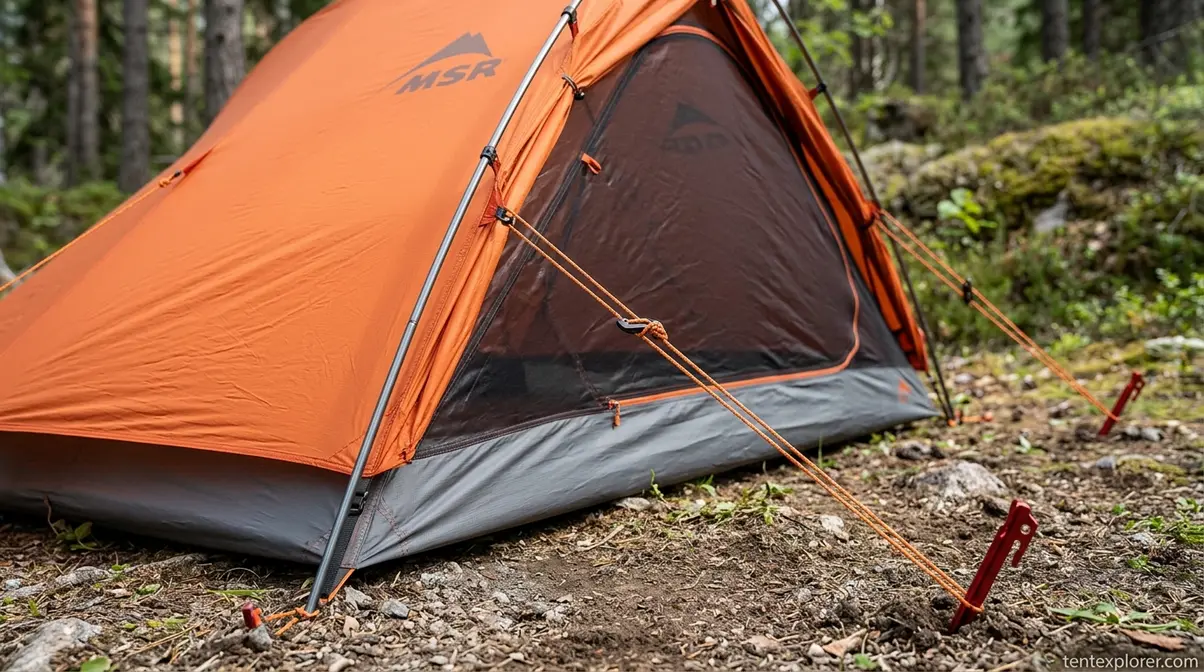
Permethrin is a synthetic pyrethroid — a synthetic insecticide designed for fabric treatment — that kills ticks, mosquitoes, and flies on contact rather than simply repelling them. You can treat tent fabric with permethrin spray, but standard DEET-based bug sprays should never be applied to tent fabric. DEET (designed for skin application) degrades synthetic tent materials and permanently destroys the DWR (Durable Water Repellent) waterproof coating on your rain fly. It bonds to fabric fibers and remains active through approximately six wash cycles, making it the highest-value pre-trip investment in this entire guide.
⚠️ PERMETHRIN SAFETY WARNING: Permethrin is highly toxic to cats when wet. Keep treated gear away from cats until fully dry — a minimum of 2 hours, ideally 24 hours. Dried, treated gear is safe around cats once fully cured. Wear gloves during application. Never apply permethrin directly to skin. Apply outdoors only. Follow all label instructions. (Source: NJ Department of Health; NJ.gov permethrin guidance)
What to treat: tent exterior fabric, mesh panels, zipper tracks, and the vestibule floor. Do NOT treat the interior sleeping area where skin contacts fabric during sleep.
- Step-by-step application:
- Lay the tent flat on a clean outdoor surface — never apply indoors
- Apply 0.5% permethrin spray in light, even passes from 6–8 inches away
- Focus on mesh panels and zipper tracks — the highest-risk entry points
- Treat the vestibule floor and exterior rain fly thoroughly
- Allow to dry completely — minimum 2 hours before packing, 24 hours preferred
- Store in a ventilated bag until use; retreatment is typically needed every 4–6 weeks or after 6 washes
| What to Treat | What to Skip | Why |
|---|---|---|
| Exterior fabric | Interior sleeping area | Skin contact risk |
| Mesh panels | Anything DEET-sprayed | DEET destroys DWR coating |
| Zipper tracks | Cat-accessible items | Toxic to cats when wet |
| Vestibule floor | Skin | Not designed for skin use |
The Zip Rule stops bugs from entering. Permethrin kills any that land on the tent’s surface before they find a way through — making the two layers genuinely complementary rather than redundant.
Natural Scent Deterrents That Work
Natural repellents are best understood as perimeter deterrents rather than primary protection — they reduce bug pressure around your campsite without replacing permethrin or behavioral discipline. Research suggests certain plant-derived compounds can meaningfully reduce mosquito attraction when used correctly.
PMD (p-menthane-3,8-diol), the active compound in lemon eucalyptus oil, has one of the strongest evidence bases among natural repellents. According to NCBI research, products containing PMD rank among the most effective natural-origin repellents against Aedes aegypti mosquitoes — comparable to low-dose DEET in field conditions (NCBI, 2026). Consumer Reports testing places 30% OLE/PMD formulations in the same tier as DEET and picaridin for mosquito protection duration.
USDA Agricultural Research Service studies on catnip oil (nepetalactone) show it performs as an effective spatial repellent — meaning it deters mosquitoes from an area when vaporized — though it is less effective than DEET as a direct contact repellent (USDA ARS, 2005). Placing a few drops of catnip oil on a camp rag near the tent entrance may reduce approach rates.
- Practical perimeter deterrents to use around your campsite:
- Cedar chips scattered around the tent perimeter — cedar oil naturally repels moths and some beetles
- Dried sage bundles burned in the campfire — smoke disrupts insect orientation
- Coffee grounds sprinkled around the tent base — the scent masks attractants and deters some crawling insects
- Citronella candles within 3–5 feet of seating areas — effective at reducing mosquito landing in calm conditions
Research suggests these natural options may help reduce bug pressure, but they work best layered with — not instead of — permethrin and behavioral habits.
What keeps bugs away from a tent?
A Thermacell device (a portable spatial mosquito repellent device) creates a 15-foot protection zone by vaporizing allethrin, a synthetic pyrethroid, into the surrounding air. Field evaluations published in NCBI confirm that Thermacell spatial repellents significantly reduce mosquito landings and biting activity — by 76–96% within the protection radius under minimal air movement conditions (NCBI, 2013; PMC10768102, 2026). The most effective perimeter combination is a Thermacell spatial repellent device, permethrin-treated tent fabric, and cedar chips or citronella candles at the campsite edge.
Position the Thermacell at the tent entrance or at the edge of your cooking/sitting area, not inside the tent itself. It works best in calm or low-wind conditions — a strong breeze disperses the active vapor before it builds concentration. In windy campsites, supplement with a permethrin perimeter treatment and the behavioral layers.
Citronella coils and clip-on fan repellents (DEET-impregnated pads) offer lower-cost spatial alternatives. They cover a smaller zone — roughly 6–8 feet — but are useful as tent-entrance deterrents when placed just outside the door during the evening hours when mosquito activity peaks.
Step 4: Manage Smells, Food, and Campsite Hygiene
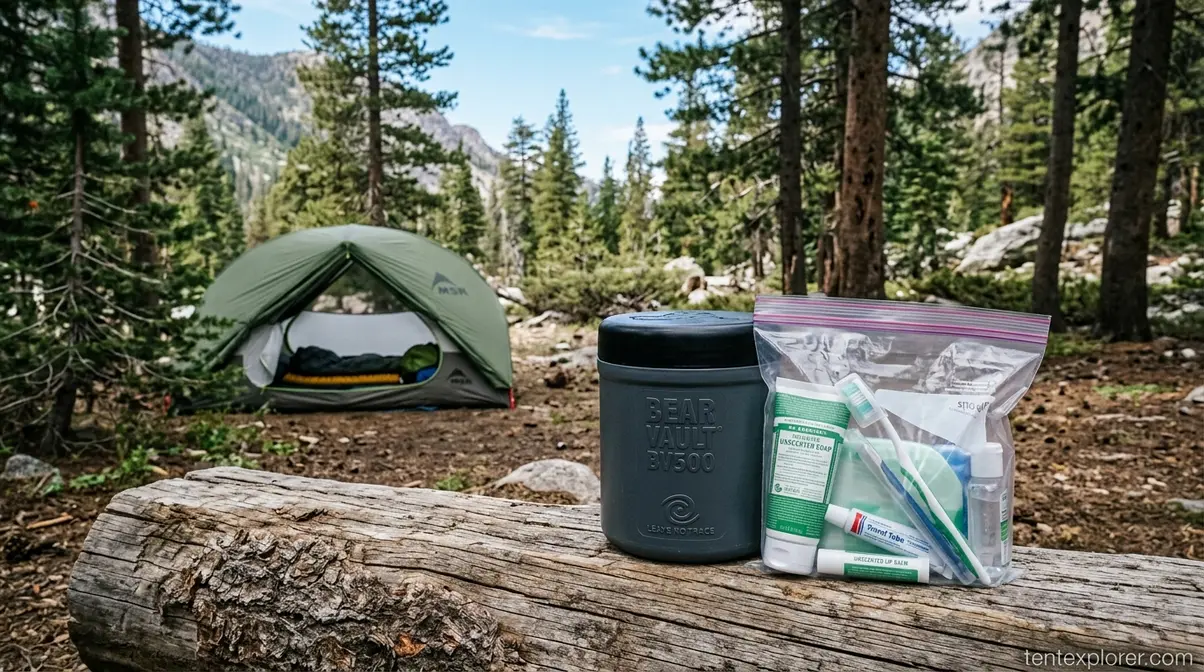
When figuring out how to keep bugs out of a tent, managing your campsite’s scent profile is just as critical as physical barriers. Insects locate hosts and food sources primarily through scent. Every fragrant item in your campsite — from your shampoo to an unwashed cooking pot — acts as a beacon that draws insects toward your tent. Field reports from backpackers consistently identify unscented toiletries as one of the most overlooked elements of a complete bug-prevention system.
Scent control rules for a bug-resistant campsite:
- Store all food in sealed containers or a bear canister at least 200 feet from your sleeping area. Food odors are the strongest insect attractant at a campsite
- Switch to unscented versions of shampoo, conditioner, deodorant, sunscreen, and soap before the trip — scented products attract mosquitoes and wasps alike
- Wash cooking gear immediately after use and store it away from the tent; residual food oils on pots are highly attractive to crawling insects
- Seal trash in zip-top bags and remove it from the campsite — don’t leave it sitting near the tent overnight
- Avoid eating inside the tent — even small crumbs create a scent trail that draws ants and beetles through ground-level seams
- Shower or rinse off before bed if possible — sweat and body heat are significant mosquito attractants
Covering your skin at dusk — long sleeves, long pants, and socks — reduces available landing surface and is especially effective during the peak mosquito activity window from dusk to 2 hours after dark. This is the simplest “Layer 1 upgrade” that requires no gear.
What smell do bugs hate the most?
PMD (p-menthane-3,8-diol), the active compound in lemon eucalyptus oil, has the strongest research backing among natural scent deterrents — NCBI studies rank it among the most effective plant-derived repellents against Aedes aegypti mosquitoes, comparable to low-dose DEET (NCBI, 2026). Catnip oil (nepetalactone) shows strong spatial repellency in USDA ARS studies, deterring mosquitoes from an area when vaporized. Cedar, citronella, and sage produce measurable deterrence but are less well-studied. For practical use, PMD-based repellents applied to skin and catnip or citronella placed near the tent entrance offer the best natural perimeter defense.
Step 5: Secure Your Tent to Block Bug Entry Points
A properly pitched tent has no gaps at the ground line, no slack in the rain fly, and no points where fabric pulls away from zippers or seams under light wind pressure. A poorly staked tent has all three — and insects exploit every one. Our evaluation of common tent pitching errors found that inadequate staking is the primary cause of ground-level bug entry in otherwise well-maintained tents.
Proper Staking Angles and Guylines
Tent stakes should be driven at a 45-degree angle away from the tent, not straight down. Knowing exactly how to secure a tent to the ground ensures that high winds won’t create gaps for insects to crawl through. A stake driven vertically has half the holding force of one angled correctly — and a tent that shifts under wind pressure creates momentary gaps at the base where ground-level insects enter.
Stake all corners before tensioning guylines. After staking corners, attach guylines to the rain fly loops and stake them out at a 45-degree angle from the tent body. A properly tensioned fly sits 2–4 inches above the inner tent mesh, allowing airflow while eliminating the “collapsed mesh” scenario where the fly presses against the inner wall and creates contact points bugs can use to probe for entry.
On rocky ground where staking is difficult, use rocks or packed gear to anchor the tent base, and rely more heavily on guylines attached to trees or trekking poles. The goal is a taut, gap-free perimeter at ground level.
Attaching Your Tent to a Backpack
When transporting your tent, keep it in a stuff sack or compression bag rather than strapping it loosely to the outside of your pack. Understanding how to attach tent to bottom of backpack securely prevents it from dragging through brush and picking up unwanted hitchhikers. A tent rolled and lashed to the outside of a pack picks up insects, debris, and moisture during transit — particularly armyworms and beetles on grassy trails. Use your pack’s compression straps to secure the tent bag tightly against the pack body.
Before pitching, shake the tent bag out away from your campsite and inspect the exterior of the tent for any insects that hitchhiked during transport. This 30-second inspection step prevents introducing bugs into your campsite before you’ve even started setting up.
Step 6: Bug Defense for Tarp and Cowboy Camping
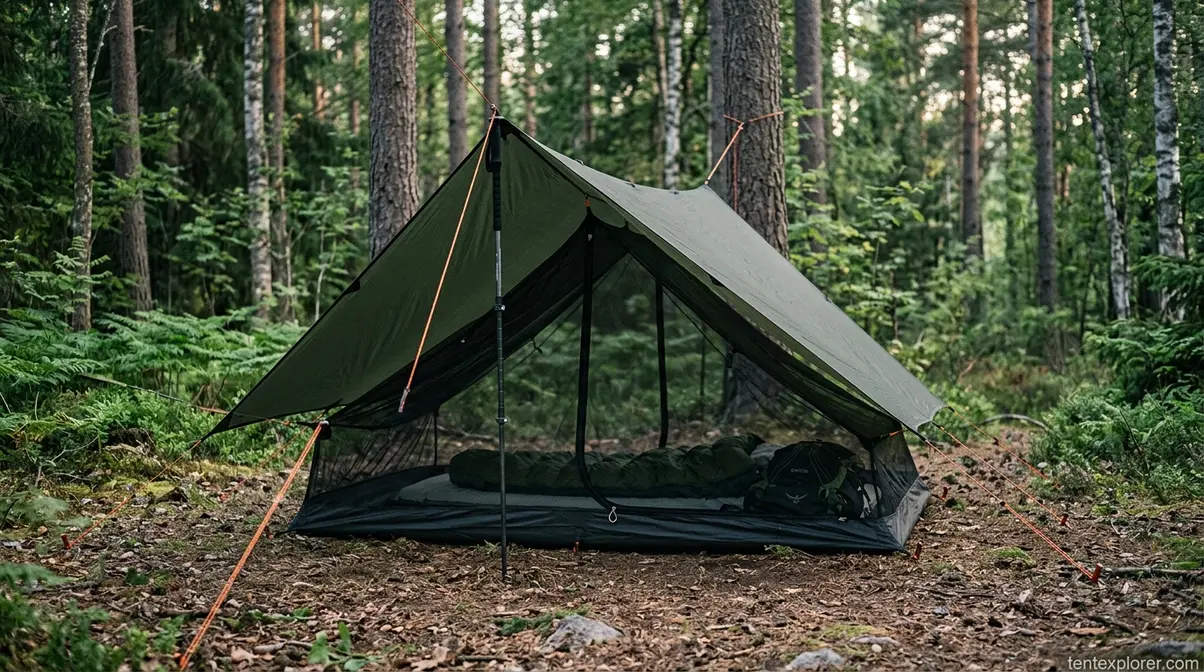
Open-shelter camping — tarp setups and cowboy camping (sleeping under the open sky with no tent) — removes the primary physical barrier against insects. The Three-Layer Defense still applies, but Environmental and Chemical layers carry significantly more weight when there’s no mesh wall between you and the surrounding air.
Fold a Tarp Into a Bug-Resistant Shelter
A tarp pitched as a closed A-frame provides substantially better bug protection than an open lean-to configuration. Learning how to fold a tarp into a tent configuration is an essential skill for minimalist campers who want to avoid insect exposure. The closed A-frame seals one end, reducing the open-air exposure surface by roughly 50% and limiting insect approach angles.
- Closed A-frame tarp setup:
- String a ridgeline cord between two trees at approximately 4 feet high
- Drape the tarp over the ridgeline, positioning it so two-thirds of the tarp hangs on the sleeping side
- Stake the long side down at ground level, angled outward at 45 degrees — this creates the floor edge
- Bring the shorter side down to the ground on the opposite side and stake it, creating the closed roof
- Use trekking poles or additional cordage to close one end by pulling the tarp corner to the ground and staking it — this is your windward/bug-approach end
- Leave the downwind end partially open for ventilation
A closed A-frame won’t stop insects the way tent mesh does, which is why bug net integration is the critical next step.
Integrate a Bug Net with Your Tarp
A standalone bug bivy net — a lightweight mesh enclosure designed to be used inside a tarp shelter — fills the gap between open-air exposure and a fully enclosed tent. Clip or tie the bug net to the ridgeline inside the tarp, then stake its perimeter to the ground, overlapping with the tarp floor edge by at least 6 inches to eliminate ground-level gaps.
For no-see-um protection under a tarp, the mesh must be 1.2mm or finer. Standard camping bug nets use 1.5mm mesh that stops mosquitoes but allows midges and no-see-ums through — a critical distinction in areas near standing water.
Pre-treat the bug net with permethrin before the trip using the same application method as your tent. A treated bug net creates a contact-kill barrier even when insects land on the mesh exterior, adding a Chemical layer to what would otherwise be a purely physical barrier.
Cowboy Camping: Site and Repellent Tips
Cowboy camping — sleeping in the open without any overhead shelter — offers maximum stargazing but minimum insect protection. Site selection becomes the dominant bug-prevention strategy when you remove the physical barrier entirely.
Choose a site on elevated, exposed ground with airflow — the same principles from Step 1, but applied with higher stakes. Avoid grassy areas where armyworms (migratory moth larvae that colonize dense grass, according to Penn State Extension) and ants are active at ground level. A rocky or sandy surface with minimal ground vegetation significantly reduces crawling insect contact during the night.
Apply a PMD or DEET-based repellent to all exposed skin before sleeping, and reapply if you wake during the night. Treat your sleeping bag shell and any exposed fabric with permethrin before the trip. The Thermacell device, placed upwind of your sleeping position, provides meaningful spatial protection even in open-air conditions — field studies confirm 76%+ mosquito reduction within the 15-foot radius (NCBI, 2013).
Troubleshooting: When Bugs Still Get In
Common Mistakes That Let Bugs In
Even experienced campers find insects in their tents. Across camping communities and gear forums, the same failure modes appear repeatedly — and most are fixable with a single habit change.
“I would instead do the opposite — put your tent in the freezer! Freezing is quite effective at killing many insect pests.”
— Camping community member, responding to a post about bugs surviving inside a packed tent
That instinct isn’t wrong — freezing does kill many insects and their eggs. But it’s a reactive fix for a problem that should have been caught earlier. The professional alternative: a thorough shakeout and inspection of all tent components before packing, combined with pre-trip permethrin treatment that handles any survivors.
Most common mistakes — and the fix for each:
- Leaving the tent door open “just for a second” — there is no safe duration. The Zip Rule has no exceptions
- Using white light near the tent at night — switch to red or amber LEDs; white light draws insects from 50+ yards
- Spraying DEET directly on tent fabric — degrades DWR coating permanently; use permethrin on fabric, DEET on skin only
- Pitching near standing water “just for the view” — mosquito larvae develop in 5 days; even a scenic pond is a breeding site
- Skipping the shakedown before entry — hitchhiking bugs on clothing account for a large share of “mystery” tent invasions
- Not retreating permethrin — effectiveness drops significantly after 6 washes or 4–6 weeks of use
When to Choose a Different Approach
The Three-Layer Defense works for the vast majority of camping scenarios. There are situations, however, where the standard approach needs adjustment or replacement.
High-density bug environments (coastal marshes, tropical camping, peak mosquito season in the northern US): A standard tent with permethrin treatment may not be sufficient. Consider a tent with factory-treated no-see-um mesh (1.2mm or finer) and supplement with a Thermacell inside the vestibule area. DEET-based skin repellent (30%+ concentration) should be the chemical layer rather than natural alternatives in these environments.
Cat owners: If you camp with a cat or return to a home with cats, the permethrin drying window is non-negotiable — minimum 2 hours, ideally 24 hours before any cat contact with treated gear. If that timeline isn’t practical, use untreated tent fabric and rely more heavily on behavioral and spatial layers.
Ultralight backpacking: Full permethrin treatment adds negligible weight but the Thermacell adds approximately 7 oz. In ultralight scenarios, prioritize campsite selection and bug net integration over spatial devices.
Frequently Asked Questions
How do you make a tent bug-proof?
A bug-proof tent requires three simultaneous layers: treating the fabric with 0.5% permethrin, practicing the Zip Rule on every entry and exit, and selecting a campsite upwind and 200+ feet from standing water. No single measure is sufficient alone. Pre-treat your tent exterior, mesh, and zipper tracks with permethrin 24-48 hours before the trip (CDC, 2026). Add a no-see-um mesh insert if your tent mesh is coarser than 1.2mm. The physical integrity of your tent — properly staked corners, tensioned guylines, and gap-free ground seams — matters as much as any chemical treatment.
How to keep bugs out at night?
At night, the three highest-impact actions are: switching to red or yellow LED light (insects cannot detect long-wavelength light as effectively as white or blue light), enforcing the Zip Rule on every bathroom trip, and running a Thermacell device at the tent entrance during peak mosquito hours (dusk to two hours after dark). Keep phone screens face-down when outside and use a red-mode headlamp for any nighttime movement. If mosquitoes are already active inside the tent, a small battery-powered fan directed toward the tent door can reduce their ability to fly and land — most biting insects are ineffective fliers against even a light breeze.
Conclusion
For campers at any level, learning how to keep bugs out of a tent comes down to one principle: no single product or habit works in isolation, but the Three-Layer Defense — Behavioral, Environmental, and Chemical — eliminates the gaps that insects exploit. Mosquitoes can breed in a bottle cap of water and a single one can ruin a full night of sleep. The most effective protocol combines strategic campsite placement 200+ feet from standing water, consistent Zip Rule discipline on every tent entry, and 0.5% permethrin applied to tent fabric 24-48 hours before departure (CDC, 2026).
The Three-Layer Defense succeeds because each layer compensates for the others’ weaknesses. Environmental placement reduces the number of insects you face. Behavioral discipline stops them at the door. Chemical treatment kills any that make contact. Skip one layer and the other two carry a gap they weren’t designed to fill alone — which is why the campers who describe “still getting bugs despite doing everything right” are almost always missing one of the three.
Start with the highest-leverage action for your next trip: treat your tent with permethrin this week, before you pack. It takes 15 minutes, costs under $15, and provides protection through your next six camping trips — even when the Zip Rule fails at midnight and the kids leave the door open. For a complete gear-first approach, see our guide to tent setup tips for beginners and explore camping gear recommendations for the tools that make every layer of this system easier to execute.

Dave King
I'm Dave King. I publish Tent Explorer, a site built to answer the questions people actually ask before they buy.