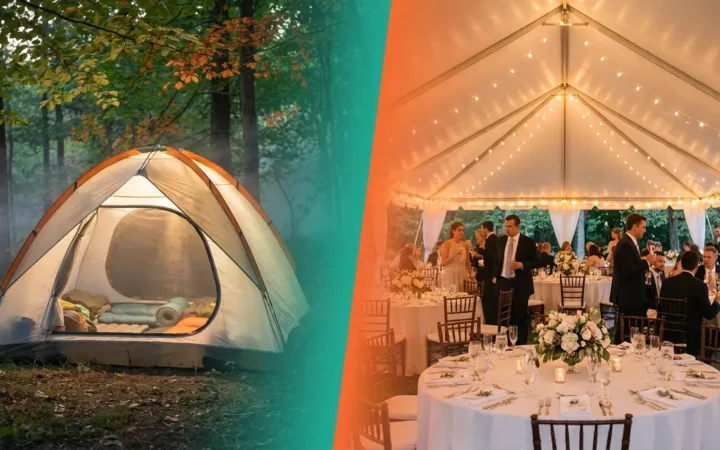
 Dave King
You bought a 3-person tent. Two people slept in it. Someone’s elbow was in someone else’s face all night. This is tent capacity ratings explained in one camping trip: the number on the box is real, but it doesn’t mean what you think. Manufacturers rate tents using a shoulder-to-shoulder density standard based on average adult body width — not comfort, not gear storage, and not the reality of actually camping.
Getting this wrong isn’t just inconvenient. For campers, it means a miserable, cramped trip where nobody sleeps well. For event planners, it can mean a fire code violation that shuts down your event before it starts. The confusion around tent capacity ratings is widespread and ongoing — and no single resource currently explains both the camping and event sides of the problem.
By the end of this guide, you’ll know exactly how to calculate the right tent size for any scenario — camping trip or outdoor event — so you can stop guessing and start planning with confidence. We cover manufacturer capacity standards, practical sq ft formulas, technical waterproofing ratings, and event tent fire codes — all in one place.
Tent manufacturer ratings use a shoulder-to-shoulder standard that systematically ignores gear, movement, and comfort — creating a predictable gap between what the box says and what you actually need.
- The Capacity Gap is the 1–2 person difference between a tent’s rated capacity and its comfortable real-world capacity.
- Rated vs. comfortable: Real comfort requires 25–30 sq ft per person — significantly more than the manufacturer’s ~13 sq ft minimum (ISO 5912:2020)
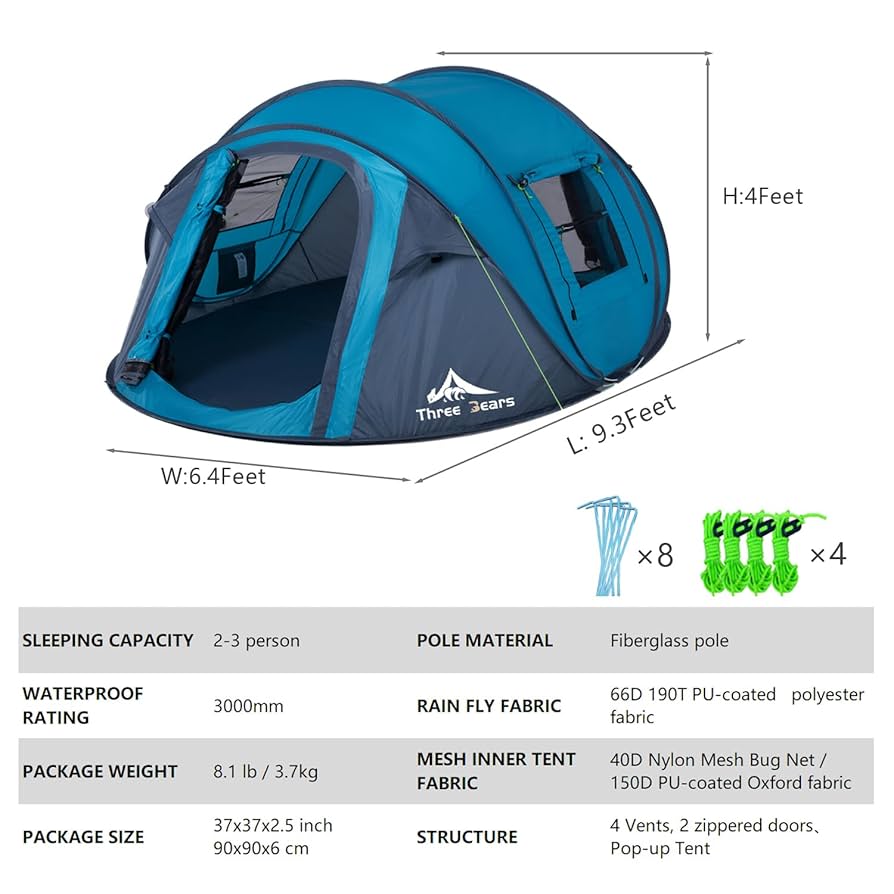
- Waterproofing baseline: 1,500mm hydrostatic head (HH) is the minimum for 3-season rain protection; 2,000–3,000mm provides reliable coverage in heavy rain
- Event tents: NFPA 101 fire codes require 7–15 sq ft per person depending on layout — a completely different system from camping capacity math
- The fix: Always size up by 1–2 people from the manufacturer’s rated capacity when buying for camping comfort
What Tent Capacity Ratings Actually Mean
You’ve probably noticed that tent capacity ratings explained on the box rarely match what the tent feels like inside. That disconnect has a specific, measurable cause — and once you understand it, every tent label you read will make immediate sense.
“Always remember that tent manufacturers tend to rate capacity based on the number of average-sized adults who can sleep closely together.”
This is the industry baseline. It’s not a comfort standard, not a gear-inclusive figure, and not a recommendation for how many people should sleep in the tent. It’s a maximum density test — and understanding that distinction is the foundation of smart tent shopping.
Our team cross-referenced ISO 5912:2020, NFPA 101, and the U.S. Federal Camping Data Standard to compile the capacity figures in this guide. Across r/camping and outdoor forums, the consistent feedback mirrors what the standards confirm: a rated 3-person tent comfortably sleeps two, and a rated 4-person tent is genuinely comfortable for three.
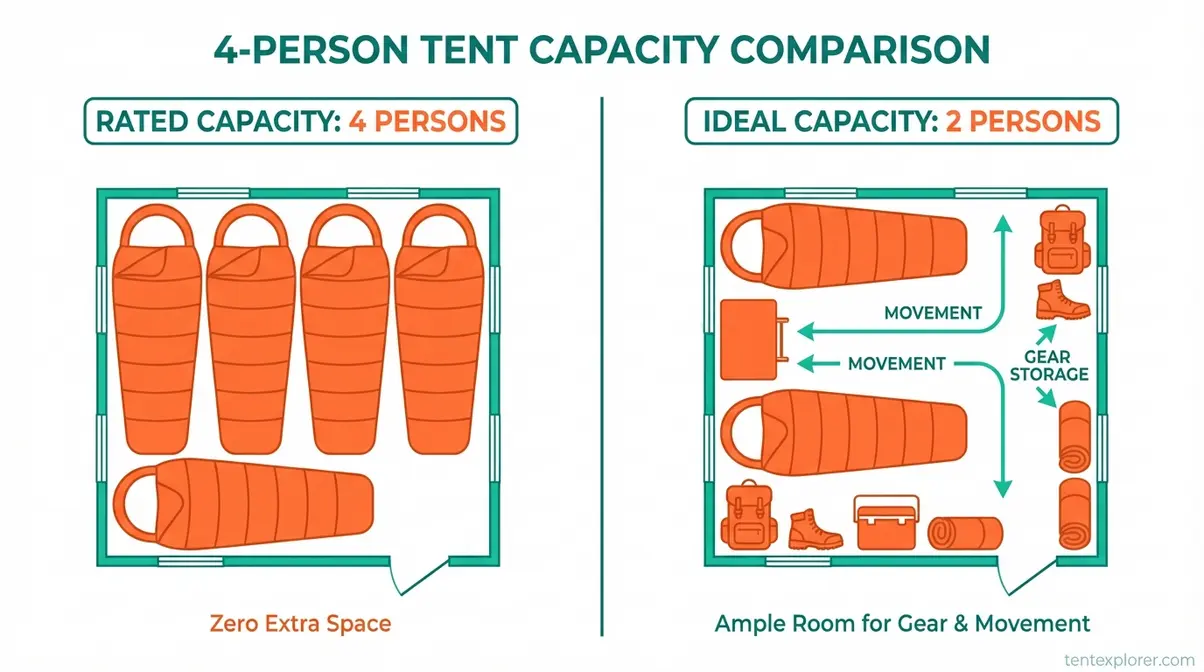
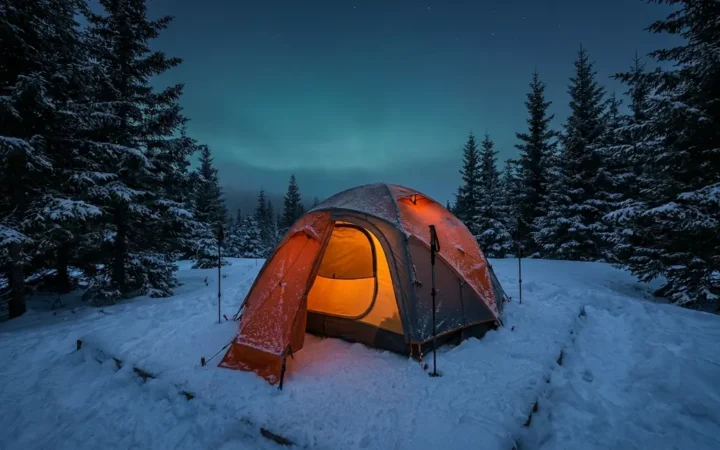
Caption: A 4-person tent at rated capacity fits four sleeping bags edge-to-edge — leaving zero room for boots, packs, or movement.
The Industry Standard: What “Shoulder-to-Shoulder” Really Means
The shoulder-to-shoulder testing method is exactly what it sounds like. Manufacturers calculate rated capacity by fitting sleeping bags side by side, allowing approximately 60 cm (roughly 2 feet) of width per person. This is not a comfort measurement — it is a maximum density test designed to establish a standardized figure across the industry.
ISO 5912:2020, the international standard specifying camping tent requirements and sleeping capacity calculations, defines a test area of 200 cm × 60 cm per person for Category B tents (ISO, 2020). Convert that to imperial: approximately 6.6 ft × 2 ft per person, or roughly 13.1 sq ft. That figure includes no allowance for sleeping bag thickness, personal items, gear, or any form of movement. It is a static body outline — nothing more.
Here’s the analogy that makes that number visceral: a standard yoga mat measures approximately 68 in × 24 in, or about 11.3 sq ft. The ISO test area per person is almost exactly the size of a yoga mat. Manufacturer capacity ratings assume you sleep like a yoga mat — perfectly flat, with nothing beside you.
Apply that math to a “4-person tent” rated under this standard: approximately 52 sq ft of floor space (4 × 13 sq ft). That’s a 7 ft × 7.4 ft rectangle — enough for four sleeping bags with no room to sit up, store boots, or place a single backpack. The rating is technically accurate. It is just not what most people mean when they say “fits four people.”
ISO 5912 camping tent standards define sleeping capacity using a test area of 200 cm × 60 cm per person for Category B tents (ISO, 2020).
This shoulder-to-shoulder standard explains the gap — but it doesn’t tell you how big that gap actually is. That’s where The Capacity Gap framework comes in.
Rated Capacity vs. Ideal Capacity: Understanding the Capacity Gap
The Capacity Gap is the measurable difference between a tent’s manufacturer-rated capacity and the number of people who can sleep in it comfortably with their gear. For recreational camping, The Capacity Gap is consistently 1–2 persons — not random variation, but a predictable consequence of the shoulder-to-shoulder testing method described above.
Rated capacity — the number printed on the tent’s packaging — reflects the ISO maximum density test. Ideal capacity — the number of people who can sleep comfortably with their gear — is what you should actually plan for. The rule of camping math is simple: always size up by 1–2 people from the manufacturer’s rated capacity.
Here’s what that looks like in practice:
| Rated Capacity | Comfortable For | Ideal Capacity |
|---|---|---|
| 2-person | 1 person + gear | 1 |
| 4-person | 2–3 people comfortably | 2–3 |
| 6-person | 4–5 people comfortably | 4–5 |
A solo backpacker using a 2-person tent gets enough floor space for a sleeping pad, a pack, and actual movement. A couple in a 3-person tent has room for two sleeping pads, two packs, and two pairs of boots without overlapping. A family of four needs a 5–6 person tent to move around comfortably and store their gear without stacking it on top of each other.
Why do manufacturers rate this way? One brief, honest answer: they rate for maximum occupancy — a marketing-friendly number that maximizes apparent value — not for comfort. This is not deceptive in any illegal sense; it’s a defined standard. The problem is that buyers interpret “4-person” as “comfortable for 4,” which is not what the standard measures. Knowing The Capacity Gap exists — and that it’s consistently 1–2 persons — means you can decode any tent label with a single mental adjustment.
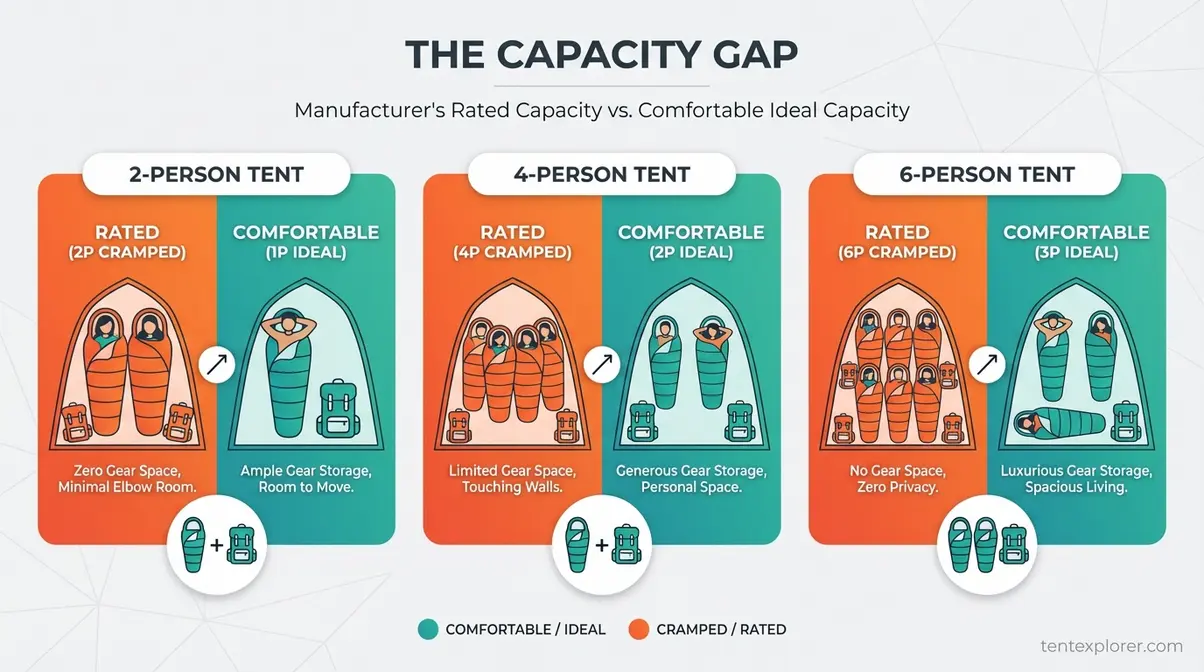
Caption: The Capacity Gap — consistently 1–2 persons across tent sizes — is the predictable result of the ISO shoulder-to-shoulder testing method.
What the ISO 5912 Standard Actually Measures
ISO 5912:2020 is the international standard specifying camping tent requirements and test methods, published in its fifth edition in March 2020 (ISO, 2020). It covers everything from structural safety and pole load to fabric waterproofing and — critically — sleeping capacity calculations. No other article currently ranking for tent capacity topics cites this standard by name or number. That’s a significant gap, because the standard is the source of every capacity figure on every tent box you’ve ever read.
The standard classifies tents into categories. Category B tents — the freestanding dome and cabin tents most recreational campers use — use the 200 cm × 60 cm test area per berth. The sleeping capacity is calculated by counting how many non-overlapping test areas fit within the tent’s inner floor at a measurement height of 5 cm (to account for floor material).
“ISO 5912:2020 defines manufacturer tent capacity using a test area of just 200 cm × 60 cm per person — roughly 1.3 sq ft of shoulder width — with no allowance for gear, movement, or sleeping bag thickness” (ISO, 2020).
That 1.3 sq ft figure refers specifically to the width dimension (60 cm × 22 cm effective shoulder zone in the standard’s calculation), not the full test area. The full test area is 13.1 sq ft — but the critical insight is that even this larger figure excludes every practical variable that makes camping livable.
Now that you understand why the gap exists, you need practical formulas to translate it into square footage numbers you can compare when shopping. Learn how to determine the right tent capacity before you make your next purchase.
How Much Space Do You Actually Need?
The Capacity Gap tells you to size up — but by exactly how much? This section translates the gap into specific square footage numbers, a full 1–8 person size chart, and the physical factors that shrink your usable space before you ever unzip the door.
The 25–30 Sq Ft Rule: Your Baseline for Comfort
25–30 sq ft per person is the practical baseline for comfortable camping — roughly double the ISO test area of 13.1 sq ft per person. At 25 sq ft per person, two campers have room for sleeping pads, a small gear pile, and enough clearance to change clothes without performing a contortionist act. At 30 sq ft per person, there’s space for a cot, a larger pack, and a dog.
REI’s expert camping tent advice confirms this logic: their product pages explicitly note that tent capacities “assume a close fit” and recommend sizing up for gear, dogs, or extra comfort (REI, 2026). Their actual tent floor areas reinforce the numbers — the REI Co-op Half Dome 2 provides 31.8 sq ft for two people, while the Half Dome 3 offers 43.7 sq ft for three (approximately 14.6 sq ft per person at rated capacity, and a comfortable 21.9 sq ft per person at ideal 2-person use).
Across outdoor forums and r/camping, the consistent feedback is that a rated 3-person tent comfortably sleeps two. That community consensus aligns precisely with the 25–30 sq ft rule: a typical 3-person tent offers 38–44 sq ft, which works out to 19–22 sq ft per person at rated capacity — below the comfort threshold — and a comfortable 38–44 sq ft per person if used as a solo tent, or 19–22 sq ft per person for two. The sweet spot is two people in a 3-person tent, which yields approximately 19–22 sq ft per person — close to the comfort baseline, especially when gear is stored in a vestibule.
Here’s the practical formula: multiply your group size by 25–30 sq ft to find your minimum comfortable floor area. Then find a tent that meets or exceeds that number.
| Group Size | Minimum Comfortable Floor Area | Recommended Rated Capacity |
|---|---|---|
| 1 person | 25–30 sq ft | 2-person tent |
| 2 people | 50–60 sq ft | 3-person tent |
| 3 people | 75–90 sq ft | 4–5 person tent |
| 4 people | 100–120 sq ft | 6-person tent |
Camping Tent Size Chart: 1-Person to 8-Person
The following size chart was compiled by cross-referencing ISO 5912:2020 test area calculations with real-world tent floor areas from major manufacturers including REI, and validated against the Sportsman’s tent size guide (Sportsman’s, 2025). Rated sq ft reflects the manufacturer’s floor area; ideal capacity applies The Capacity Gap rule.
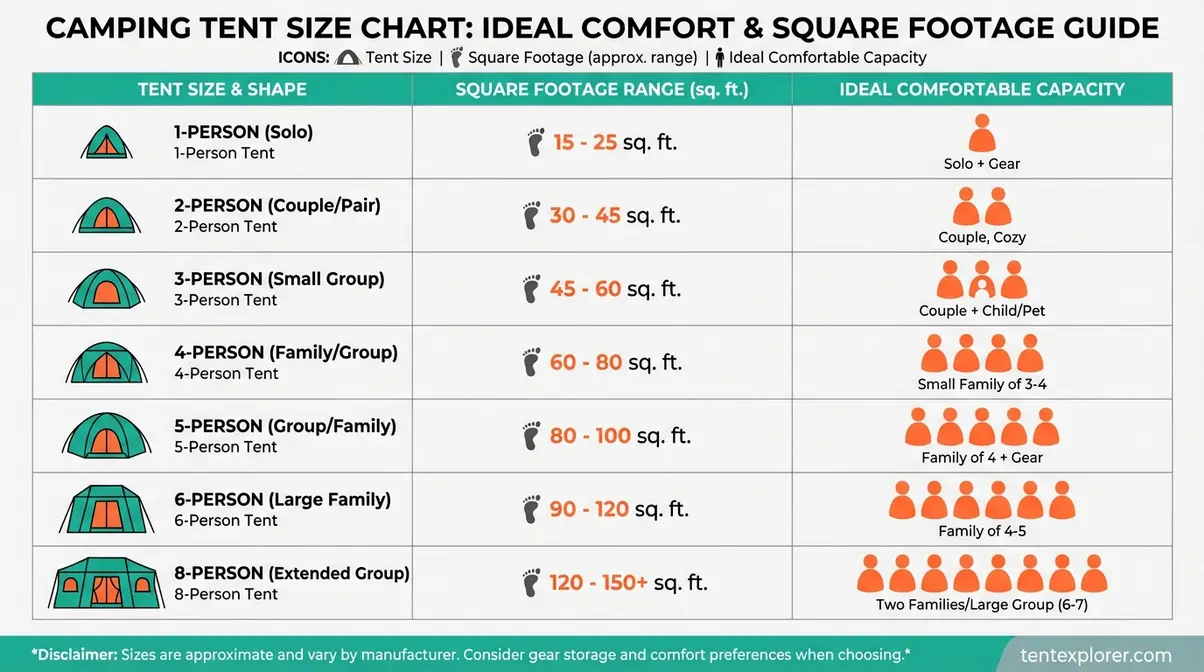
Caption: The Capacity Gap in action — every tent size, with rated vs. ideal capacity and the exact square footage you need for real comfort.
| Tent Rating | Typical Floor Area (sq ft) | Sq Ft Per Person (rated) | Ideal Capacity | Best For |
|---|---|---|---|---|
| 1-person | 18–25 sq ft | 18–25 | 1 person | Solo backpacking, minimal gear |
| 2-person | 28–35 sq ft | 14–17 | 1 person + gear, or 2 minimalists | Couples backpacking, ultralight solo |
| 3-person | 38–48 sq ft | 13–16 | 2 people comfortably | Couples car camping, solo with gear |
| 4-person | 50–65 sq ft | 13–16 | 2–3 people comfortably | Small families, 3 adults |
| 5-person | 65–80 sq ft | 13–16 | 3–4 people comfortably | Family of 3, group of 4 light packers |
| 6-person | 80–100 sq ft | 13–17 | 4–5 people comfortably | Family of 4, group of 5 |
| 8-person | 100–130 sq ft | 13–16 | 6–7 people comfortably | Large families, base camp groups |
Methodology note: Sq ft per person at rated capacity consistently falls in the 13–17 sq ft range across all sizes — a direct reflection of the ISO shoulder-to-shoulder standard. The ideal capacity column applies The Capacity Gap rule (size down by 1–2 from rated capacity) and assumes gear is stored inside the tent. If you have a vestibule for gear storage, you can often use the middle of the ideal capacity range rather than the lower end.
Factors That Shrink Your Usable Space
The floor area number on a tent spec sheet is not the space you’ll actually use. Several physical factors reduce usable interior space — and failing to account for them is one of the most common tent-sizing mistakes.
Gear and equipment is the biggest culprit. A standard 65L backpack takes up roughly 4–5 sq ft of floor space when lying flat. A pair of hiking boots claims another 1–2 sq ft. A camp chair, a lantern, and a small cooler can easily consume 8–10 sq ft in a car-camping setup. For a family of four in a 6-person tent, gear alone can reduce effective sleeping space by 15–20 sq ft — pushing the tent from “comfortable for 4” toward “cramped for 3.”
Sleeping surface type matters significantly. A standard 20 in × 72 in sleeping pad occupies 10 sq ft. A queen-size air mattress (60 in × 80 in) takes up 33 sq ft — more than a rated 2-person tent’s entire floor. If you’re car camping with air mattresses, add the mattress footprint to your calculation before choosing a tent size.
Cots amplify the problem further. A standard camping cot is approximately 25–30 in × 75 in, consuming 13–16 sq ft. Two cots in a 4-person tent (52 sq ft) leave approximately 20–26 sq ft for everything else — gear, walkways, and a second person’s cot.
The practical rule: for every piece of gear you plan to keep inside, subtract its floor footprint from your usable space before evaluating whether a tent is large enough. Our complete gear-to-tent sizing guide walks through this calculation for common camping setups.
Tent Shape and Sloping Walls: The Hidden Capacity Thief
Floor area alone doesn’t tell the whole story. Tent shape dramatically affects how much of that floor area is actually usable — and this is where elbow room becomes the critical variable.
Dome tents — the most common style — have walls that slope inward from the floor. The floor area might be 50 sq ft, but the area where you can sit upright (where headroom exceeds 24 in) is often 30–35% smaller. A person sleeping near the wall of a dome tent is partially under a sloping surface, meaning their effective usable width is narrower than the floor measurement suggests.
Cabin tents solve this problem with near-vertical walls. A 6-person cabin tent with 90 sq ft of floor space uses almost all of that area as usable sleeping and living space. The trade-off is weight and packed size — cabin tents are heavier and bulkier, making them better suited to car camping than backpacking.
Tunnel tents fall between dome and cabin designs. They offer better vertical wall height than domes along the central axis but slope sharply at both ends, reducing elbow room for anyone sleeping near the tent’s extremities.
The practical implication: when comparing two tents with identical floor areas, the cabin-style tent will feel meaningfully larger. If maximum usable space is your priority and weight isn’t a constraint, prioritize vertical wall height over raw floor area numbers. See our tent shape comparison guide for a full breakdown of dome vs. cabin vs. tunnel geometry.
Decoding Technical Tent Ratings: Waterproofing and Beyond

Tent capacity isn’t the only number manufacturers use that requires decoding. The waterproofing rating — expressed as a hydrostatic head (HH) value — is equally misunderstood, and equally consequential. Getting it wrong means a wet sleeping bag at 2 a.m.
What Is Hydrostatic Head (HH)?
Hydrostatic head (HH) is the measure of how much water pressure a tent fabric can withstand before water begins to penetrate — expressed as the height of a water column in millimeters. If a fabric is rated at 1,500mm HH, it can resist the pressure of a 1,500mm (approximately 59 in) column of water pressing against it before leaking (SlingFin, 2026).
The test is straightforward: a fabric sample is sealed in a tube, water is added and pressurized, and the point at which water passes through is recorded as the HH rating. Higher numbers mean greater waterproofing resistance. The test is standardized under ISO 811, which means HH ratings are comparable across manufacturers — unlike capacity ratings, which vary slightly in interpretation.
Here’s the practical HH scale for tent shopping:
| HH Rating | Waterproofing Level | Best For |
|---|---|---|
| Under 1,000mm | Light weather only | Summer fair-weather camping |
| 1,000–1,500mm | Light to moderate rain | 3-season camping, dry climates |
| 1,500–3,000mm | Moderate to heavy rain | 3-season camping, most conditions |
| 3,000–5,000mm | Heavy rain, sustained exposure | Serious 3-season, shoulder season |
| 5,000mm+ | Extreme conditions | 4-season, alpine, expedition |
Rainfly ratings are typically higher than floor ratings because the floor faces ground moisture and abrasion. A well-designed 3-season tent will have a rainfly rated at 1,500–3,000mm and a floor rated at 3,000–5,000mm. Section Hiker’s hydrostatic head explainer provides a detailed breakdown of HH test methodology for readers who want deeper technical context (SectionHiker, 2025).
What Does a 1,500mm Tent Rating Mean?
A 1,500mm HH rating is the industry-recognized minimum for 3-season rain protection. It means the fabric can withstand light to moderate rainfall under normal conditions — gravity-driven rain on a reasonably pitched tent. For most spring, summer, and fall camping in temperate climates, 1,500mm is adequate but not generous.
The limitation becomes clear under two conditions. First, wind-driven rain creates significantly more pressure on tent fabric than gravity alone — a sustained wind of 20 mph can effectively multiply the water pressure on your rainfly, pushing a 1,500mm-rated fabric toward its threshold. Second, sustained exposure — camping in multi-day rain rather than passing showers — allows moisture to work through even well-rated fabrics over time, particularly at seams.
For most 3-season campers, a 2,000–3,000mm HH rating provides meaningfully better protection without the weight penalty of extreme-condition fabrics. If you regularly camp in the Pacific Northwest, the Scottish Highlands, or anywhere with predictable heavy rainfall, treat 1,500mm as a floor — not a target.
The static vs. dynamic distinction is worth understanding here: static pressure is what the HH test measures — a column of water pressing straight down. Dynamic pressure is what wind-driven rain creates — lateral force that can exceed the static rating significantly. A tent rated at 2,000mm HH may effectively perform at 1,200–1,500mm under strong lateral wind load. This is why taut pitching matters so much (covered in the next section).
Taut Pitching: How Setup Affects Both Waterproofing and Space
Taut pitching — the practice of tensioning your rainfly and inner tent firmly during setup — has a direct impact on both waterproofing performance and interior volume. A slack rainfly allows fabric to sag, which creates pooling points where water pressure concentrates and can eventually breach the seam or coating. A properly tensioned rainfly channels water cleanly off the tent’s surface, reducing localized pressure and extending the effective life of the waterproof coating.
The interior volume effect is less obvious but equally real. A dome tent with a slack inner tent loses 10–15% of its usable floor area to fabric bunching along the walls. The same tent pitched taut creates cleaner vertical wall lines, pushing the sleeping area perimeter outward and recovering that space. For a tent already operating at the edge of The Capacity Gap, this difference is meaningful.
The practical steps for taut pitching: stake all four corners before raising the poles, use all available guylines (not just the primary corners), and re-tension after the first night — tent fabric stretches slightly as it settles. Most modern tents include adjustment sliders on their guylines precisely because taut pitching is a maintenance task, not a one-time setup.
Static vs. Dynamic Pressure: Why Wind Changes Everything
The static vs. dynamic pressure distinction goes beyond waterproofing — it affects structural integrity as well. Static pressure is the weight of rain or snow pressing uniformly on the tent surface. Dynamic pressure is the variable, directional force of wind — gusts, lateral loads, and the oscillating stress that causes pole flex.
Most recreational tent certifications test static load capacity, not dynamic performance. A tent rated to handle a certain snow load may perform very differently in a high-wind scenario because the force vectors are entirely different. This is why ISO 5912:2020 includes separate test methods for wind resistance (dynamic) versus precipitation resistance (static), and why high-altitude and 4-season tents specify wind-load ratings separately from HH ratings (ISO, 2020).
For most 3-season campers, the practical implication is campsite selection: pitching in a wind-sheltered location (behind a treeline, in a low depression, with the tent’s narrowest profile facing the prevailing wind) is more effective than chasing a higher HH rating. For alpine or exposed-ridge camping, dynamic load ratings become a primary purchase criterion rather than a secondary consideration.
Event and Canopy Tent Capacities: A Different Set of Rules
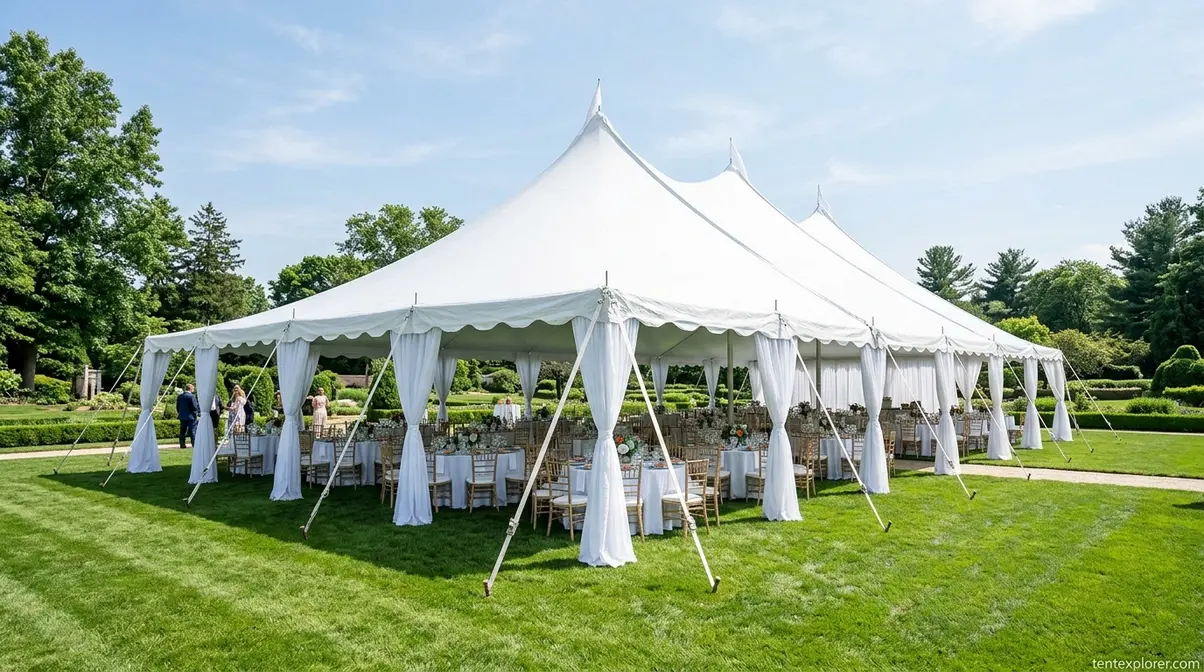
Event tent sizing operates on an entirely different logic from camping tent capacity. Where camping capacity is about sleeping bodies per floor area, event capacity is about standing or seated guests per sq ft — governed not by manufacturer standards but by fire codes and local building regulations. Confusing the two systems is how event planners end up either dangerously overcrowded or unnecessarily over-tented.
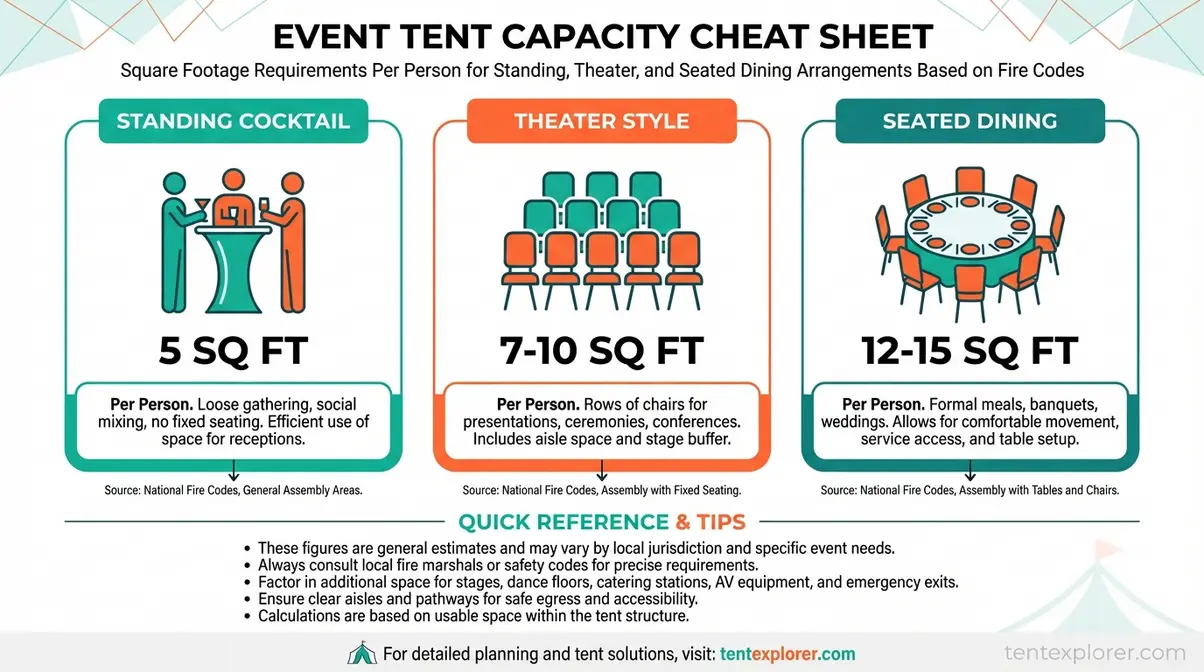
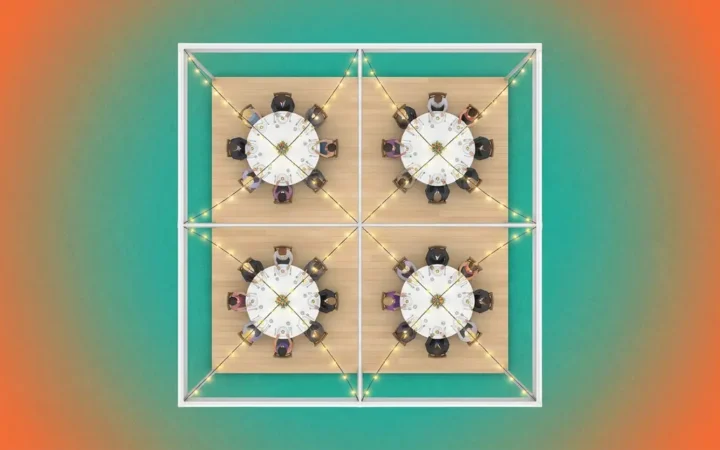
Caption: Event tent capacity follows NFPA 101 fire code rules — a completely different system from camping sq ft math.
How Many People Can a 40×20 Tent Hold?
A 40×20 tent covers 800 sq ft of floor area. How many people it holds depends entirely on your event layout — and the NFPA 101 Life Safety Code sets the framework for calculating that number legally and safely (NFPA, 2024).
- Under NFPA 101 assembly occupancy guidelines, the standard occupant load factors are:
- Standing/cocktail: 7 sq ft per person → approximately 114 guests
- Theater/reception seating: 10–12 sq ft per person → approximately 67–80 guests
- Seated dining with tables: 12–15 sq ft per person → approximately 53–67 guests
In practice, event rental companies typically rate a 40×20 tent at 80–100 guests for cocktail-style events and 48–60 guests for seated dining with round tables (American Tent, 2025). The gap between the theoretical maximum and the practical recommendation accounts for bar areas, buffet tables, dance floors, and the circulation space guests actually need to move comfortably.
For events triggering NFPA 101 compliance — tents over 200 sq ft with walls, or canopies over 400 sq ft — exit signs are required when occupant load exceeds 50 persons, and the tent fabric must be NFPA 701 flame-retardant certified (NFPA, 2024).
How Many People Can a 40×60 Tent Hold?
A 40×60 tent provides 2,400 sq ft — three times the floor area of a 40×20. At NFPA 101 standing occupancy rates, the maximum theoretical load is approximately 343 guests (7 sq ft per person). For practical event planning, the standard breakdown is:
- Standing/cocktail: 300–340 guests
- Theater/church seating: 200–240 guests
- Seated dining (round tables): 160–200 guests
- Seated dining with dance floor: 130–160 guests
At this size, a 40×60 tent is a full event venue. Additional infrastructure requirements — staging (100–200 sq ft minimum), a bar setup (approximately 100 sq ft), and a dedicated dance floor (4–6 sq ft per dancer) — typically reduce the effective guest capacity by 15–20% from the raw sq ft calculation (Skyline Tent Company, 2025). Budget for these deductions before finalizing your guest list.
Event Tent Capacity Reference Table
The following table provides a practical planning reference for the most common event tent sizes. All capacity figures apply NFPA 101 assembly occupancy load factors and reflect real-world industry practice (American Tent, 2025; Best Tents and Events, 2026).
| Tent Size | Sq Ft | Standing/Cocktail | Theater Seating | Seated Dining (Rounds) | Seated Dining + Dance Floor |
|---|---|---|---|---|---|
| 20×20 | 400 | 57 | 33–40 | 27–33 | 20–25 |
| 20×40 | 800 | 100–114 | 67–80 | 48–60 | 35–45 |
| 30×40 | 1,200 | 150–171 | 100–120 | 80–100 | 60–80 |
| 40×40 | 1,600 | 200–228 | 133–160 | 107–133 | 80–100 |
| 40×60 | 2,400 | 300–343 | 200–240 | 160–200 | 130–160 |
| 40×80 | 3,200 | 400–457 | 267–320 | 213–267 | 170–213 |
All figures based on NFPA 101 assembly occupancy load factors: 7 sq ft/person (standing), 10–12 sq ft/person (theater), 12–15 sq ft/person (seated dining). Actual permitted occupancy depends on local authority jurisdiction.
A 30×40 tent (1,200 sq ft) — one of the most frequently searched event tent sizes — comfortably seats 80–100 guests for a dinner with round tables, or accommodates 150–171 guests at a standing cocktail reception. For a seated dinner with a dance floor, budget for 60–80 guests in a 30×40 footprint.
Event vs. Camping Sizing: Why They’re Completely Different
The fundamental difference between event and camping capacity comes down to what you’re measuring. Camping capacity counts sleeping bodies per total floor area — a static, horizontal use of space. Event capacity counts mobile guests per usable floor area — a dynamic, vertical use of space where circulation, service infrastructure, and safety egress all compete for the same square footage.
A camping tent rated for 6 people at 80 sq ft provides approximately 13 sq ft per sleeping person. Under NFPA 101 seated dining rules, that same 80 sq ft would legally accommodate just 5–6 seated guests — nearly the same number. The math converges at seated dining, but diverges sharply for standing events: 80 sq ft of event tent space holds 10–11 standing guests under fire code, nearly double the sleeping capacity.
The critical mistake event planners make is applying camping tent logic to event tent decisions — or worse, applying the tent manufacturer’s rated capacity (which assumes sleeping bodies) to a standing cocktail reception. These are incompatible systems. Always use sq ft per person calculations based on your specific event layout, and always verify against your local fire marshal’s requirements before finalizing tent size. Explore our complete event tent planning guide for a venue-by-venue breakdown.
Common Tent Sizing Mistakes and When to Rethink Your Choice
Even with the Capacity Gap decoded and the sq ft formulas in hand, specific mistakes consistently cause campers and event planners to choose the wrong tent. Recognizing these pitfalls before you buy saves you from returning a tent — or worse, suffering through a trip in the wrong one.
Common Pitfalls When Choosing Tent Size
Pitfall 1: Rating the tent, not the trip. The most common mistake is choosing a tent based solely on the number of people sleeping in it, without accounting for the trip type. A 3-day backpacking trip where gear stays in a pack is a completely different sizing scenario than a 3-day car camping trip where everything comes inside. Always add gear floor area to your sleeping area calculation before selecting a size.
Pitfall 2: Ignoring vestibule area. Many tent spec sheets list both floor area and vestibule area. The vestibule — the covered porch-like area between the inner tent and outer rainfly — can store boots, packs, and wet gear without consuming sleeping space. A tent with 40 sq ft of floor area and a 15 sq ft vestibule is functionally larger than a tent with 50 sq ft of floor area and no vestibule. Always check vestibule dimensions when comparing tents.
Pitfall 3: Trusting the event tent manufacturer’s rated capacity. Some event tent suppliers list a “maximum capacity” figure that reflects bare floor area divided by a minimum sq ft figure — often without accounting for tables, staging, or circulation space. This figure is not the same as the NFPA 101 permitted occupancy for your specific layout. Always verify with your local fire marshal or use the NFPA load factor table for your event type.
Pitfall 4: Not testing the tent before the trip. Across outdoor forums, one of the most common post-trip complaints is discovering a tent is smaller than expected after arriving at the campsite. Set up your tent in the backyard before the trip, put your gear inside, and lie down. The Capacity Gap is much easier to account for before you’ve driven four hours to a trailhead.
When to Choose a Different Tent Type
Sometimes the right answer isn’t a larger tent — it’s a different category of tent entirely.
Choose a cabin tent when you’re car camping with a family, need to stand upright inside, or plan to spend significant time in the tent during bad weather. Cabin tents sacrifice packability for livable vertical space and near-vertical walls that maximize every sq ft of floor area.
Choose a 4-season tent when you’re camping in winter, above treeline, or in any environment with heavy snow load or sustained high winds. The static vs. dynamic load distinction matters here: 3-season tents are not rated for snow accumulation and can collapse under heavy snowfall. A 4-season tent uses heavier poles, fewer mesh panels, and a more aerodynamic geometry to handle dynamic wind loads that 3-season designs cannot.
Choose a backpacking tent (2-person for 1 camper, 3-person for 2) when weight and packed size are primary constraints. Accept The Capacity Gap as the price of packability — and use the vestibule aggressively for gear storage. See our guide to tent types and seasonality for a full decision framework.
Are There Campsite Tent Size Restrictions?
Yes — and they’re more common than most campers realize. Many established campgrounds, particularly those managed by the National Park Service and U.S. Forest Service, specify maximum tent dimensions per site. The Federal Camping Data Standard (Recreation.gov) classifies campsite size categories and specifies maximum equipment footprints for each — typically expressed as a maximum tent pad dimension (e.g., 12 ft × 12 ft or 14 ft × 14 ft) rather than a person count.
Before booking a site for a large tent, check the campsite’s listed “max tent size” or “equipment length” specification on Recreation.gov or the managing agency’s reservation system. A large family cabin tent measuring 14 ft × 10 ft may technically exceed the permitted footprint at a standard single-family site, requiring you to book a group site instead. This is especially relevant for popular national park campgrounds where site dimensions are strictly enforced. Check campsite size requirements on Recreation.gov before finalizing your tent selection.
Frequently Asked Questions
How many people can a 40×20 tent hold?
A 40×20 tent holds 80–114 people depending on event layout. At standing cocktail density (7 sq ft per person per NFPA 101), the maximum is approximately 114 guests. For seated dining with round tables (12–15 sq ft per person), the practical capacity drops to 48–60 guests. For a buffet-style reception, plan for 67–80 guests (10 sq ft per person). Always deduct space for bars, buffet tables, and circulation when calculating your actual guest count (NFPA, 2024; American Tent, 2025).
What is the 200 rule for camping?
The “200 rule” for camping is not a universal standard but refers in some contexts to the Leave No Trace principle of camping at least 200 feet (about 70 steps) from water sources, trails, and other campers. In tent sizing contexts, some campsite regulations specify that tents over 200 sq ft with walls — or canopies over 400 sq ft — trigger full NFPA 101 fire code compliance, including occupant load calculations and exit sign requirements (NFPA, 2024). If you’ve seen “200 rule” referenced in a campground’s rules, check whether it refers to LNT spacing or a site-specific equipment size restriction.
What is a 1,500 tent rating?
A 1,500mm hydrostatic head (HH) rating means the tent fabric can withstand a 1,500mm column of water pressure before moisture penetrates — the industry-recognized minimum for 3-season rain protection (SlingFin, 2026). Under normal gravity-driven rainfall, 1,500mm HH is adequate for most spring, summer, and fall camping. However, it approaches its limit under wind-driven rain or sustained multi-day exposure. For heavier or more unpredictable rainfall, a 2,000–3,000mm HH rating provides meaningfully better protection. The rating applies to the rainfly; tent floors are typically rated higher (3,000–5,000mm) due to ground moisture pressure.
What are the 4 types of tents?
The 4 primary tent types by seasonality and use are: (1) 3-season tents — the most versatile category, covering spring, summer, and fall camping with mesh panels for ventilation and a rainfly for moderate rain; (2) 4-season tents — built for winter and alpine conditions with heavier poles, minimal mesh, and geometry designed to shed snow loads; (3) backpacking tents — lightweight, compact 3-season models optimized for pack weight over interior space; and (4) family/cabin tents — large-capacity car-camping tents with near-vertical walls, multiple rooms, and high headroom. Some classifications add a 2-season (summer-only) category for ultralight fair-weather shelters (REI, 2026).
How many people can a 40×60 tent fit?
A 40×60 tent (2,400 sq ft) fits 160–200 guests for seated dining with round tables, or 300–340 guests at a standing cocktail reception, based on NFPA 101 assembly occupancy load factors (NFPA, 2024; American Tent, 2025). For a seated dinner with a dance floor, staging, and bar area, plan for 130–160 guests after deducting infrastructure space. At 2,400 sq ft, a 40×60 is a full event venue requiring professional installation, NFPA 701 flame-retardant certification, and — depending on jurisdiction — a temporary structure permit. Always confirm permitted occupancy with your local fire marshal before the event.
How many people does a 30×40 tent hold?
A 30×40 tent (1,200 sq ft) holds 80–100 guests for a seated dinner with round tables (12–15 sq ft per person), or 150–171 guests at a standing cocktail reception (7 sq ft per person per NFPA 101) (NFPA, 2024; Best Tents and Events, 2026). For a seated dinner with a dance floor, the practical capacity is 60–80 guests. The 30×40 is one of the most popular event tent sizes for weddings, corporate events, and community gatherings — large enough for a meaningful seated dinner, compact enough to fit in most residential properties. Confirm local fire code requirements before finalizing your guest list.
Choosing the Right Tent Starts With Decoding the Number
For campers and event planners alike, tent capacity ratings explained through The Capacity Gap framework deliver a single, reliable rule: the number on the box is not the number you should plan for. ISO 5912:2020 defines manufacturer tent capacity using a test area of just 200 cm × 60 cm per person — roughly the width of your shoulders — with no allowance for gear, movement, or comfort. For camping, that translates to a consistent 1–2 person gap between rated and ideal capacity. For events, NFPA 101 fire codes replace manufacturer ratings entirely with layout-specific sq ft calculations ranging from 7 sq ft per person (standing) to 15 sq ft per person (seated dining).
The Capacity Gap is not a flaw in tent manufacturing — it’s a predictable consequence of a defined standard that measures maximum density, not livable space. Understanding that distinction means you can apply the rule of camping math (size up by 1–2 people), use the 25–30 sq ft per person comfort baseline, and read event tent capacity tables with confidence rather than confusion.
Your next step is simple: take your group size, multiply by 25–30 sq ft for camping or by your event’s NFPA layout factor, and find a tent that meets or exceeds that number. If you’re shopping for a camping tent, start with our complete tent buying guide to apply these formulas to specific models. If you’re planning an event, use our event tent planning guide to match tent size to your guest count, layout, and local fire code requirements — before you sign a rental contract.

Dave King
I'm Dave King. I publish Tent Explorer, a site built to answer the questions people actually ask before they buy.