
This blog post may contain affiliate links. As an Amazon Associate I earn from qualifying purchases.
📋 Table of Contents
- Do You Need a Tent Footprint?
- What Exactly Is a Tent Footprint?
- Is It Worth Getting a Tent Footprint?
- Tent Footprint vs. Tarp Comparison
- Footprint vs. Tarp Comparison
- When to Choose a Footprint
- When a Tarp Makes More Sense
- Decision Framework
- Using a Tarp as a Tent Footprint
- Can You Use a Tarp as a Footprint?
- The Bathtub Effect and Tarp Size
- How to Fold Your Tarp
- DIY Tyvek and Polycro Alternatives
- Tyvek: Durable and Cheap
- Polycro: Ultralight Secret Weapon
- Four-Way Material Comparison
- Material Specs: Denier and Mils
- What “Denier” Means for Tent Floors
- What Thickness Tarp Should I Use?
- When to Skip a Tent Footprint
- Common Ground Cover Mistakes
- When to Skip the Footprint
- Tent Footprint and Tarp FAQs
- Best Material for a Footprint?
- Best Footprint Alternatives?
- Can I Just Use a Tarp?
- How Thick Should a Footprint Be?
- Does a Footprint Go Inside or Outside?
- Can I Use a Different Tent’s Footprint?
- Do I Need a Footprint for Car Camping?
- The Right Ground Cover for You

- Specifically designed to protect the ALPS Mountaineering Lynx 1-Person tent floor
- Made of durable polyester fabric with grommet/male buckle corner attachments
- This abrasion resistant floor saver provides a moisture and dirt barrier, giving you a quick and easy clean up
- Cut slightly smaller than the tent floor dimensions, to ensure you don’t have to worry about any water going underneath your shelter, creating a wet mess underneath you
- Dimensions: 7'3 x 2'5, Weight: 8 oz., Color: Navy
Last update on 2026-06-21 / Affiliate links / Images from Amazon Product Advertising API

- Universal tent footprint for 2-person MSR tents
- Fits the MSR Hubba Hubba 2, MSR Free Lite 2, MSR Carbon Reflex 2, MSR Access 2, and MSR Thru Hiker Mesh House 2 tents or any similarly sized tent
- Provides increased protection from water and wear and tear
- Lightweight, durable construction
- Weighs . 44 pounds with 82-inch length and 48-inch width; packaged length of 10 inches, with 10-inch width, and 1-inch height
Last update on 2026-06-21 / Affiliate links / Images from Amazon Product Advertising API

- To extend the life of your Big Agnes Copper Spur UL tent floor we recommend using a Big Agnes footprint.
- The Big Agnes footprint also enables you to pitch a lightweight, Fast Fly shelter while leaving the tent body behind. The Fast Fly configuration requires the footprint, tent fly, poles, and stakes.
- Weighs 5 oz.
- Packed Size 7.5 x 4.5 x 1.5 inches
Last update on 2026-06-21 / Affiliate links / Images from Amazon Product Advertising API

- Item Weight: 19.84 lb
- Country of Origin: United States
- Brand name: DuPont
- Item Dimensions: 5.0"L x 3.0"W x 3.0"H
Last update on 2026-06-21 / Affiliate links / Images from Amazon Product Advertising API

- MAXIMUM WEIGHT EFFICIENCY: The premier choice for ultralight duos. Provides expansive coverage at a fraction of the weight of Tyvek or tarps. Perfect for gram-counting thru-hikers and backpackers.
- 2-PERSON TENT COVERAGE: Sized at 96" x 48" to fit the Haven Tarp, Haven NetTent, and Lunar Duo. For solo 1-person shelters, search for our Small Polycro Footprint to optimize your pack weight.
- HIGH-STRENGTH POLYOLEFIN: Tougher than it looks. This transparent moisture barrier offers great puncture resistance for its thickness, shielding your tent floor from mud, dampness, and light debris.
- VERSATILE 2-PACK BUNDLE: Includes two large footprints. Use one for your main shelter and save the second for a lightweight picnic tarp, emergency shelter, or a footprint for your next thru-hike.
- CUSTOMIZABLE FIT: Easily trim with scissors for any 2-person tent geometry. For high-abrasion environments or rocky ground, check out our rugged Large Tyvek Footprint for maximum durability.
Last update on 2026-06-21 / Affiliate links / Images from Amazon Product Advertising API

- FINISHED SIZE - The marked size is the exact finished size. When you choose your size, you will get the exact size tarps.
- 100% VIRGIN POLYETHYLENE—This heavy duty tarp uses pure, virgin, non-recycled polyethylene, that's why our multipurpose tarp is super sturdy and won’t tear, rip or rot.
- SUPERIOR DURABILITY—This extra heavy duty tarp has a density of 260 GSM and a 16x16 weave count.
- UV RESISTANT, WATERPROOF AND WEATHERPROOF —This extra heavy duty tarp can be used in harsh weather conditions such as rain, wind, snow, etc. The superior materials has functions of wind and rain resistance, waterproofing, and UV protection, reducing the impact of extreme weather conditions on objects.
- WIDELY USED —The tarp can be used to cover your truck, car, motorcycle, roof, yard, cabin, outdoor furniture or swimming pool, wood, firewood, and anything else. It can also be used for camping and picnics.
Last update on 2026-06-21 / Affiliate links / Images from Amazon Product Advertising API
You bought a quality tent. Now someone at the gear shop is telling you to spend another $60 on a “footprint” — a purpose-cut piece of fabric that goes underneath it. Before you pull out your wallet, ask yourself: is a branded footprint actually better than a $12 tarp from the hardware store?
Most campers fall into one of two traps. They either overpay for a custom footprint they don’t really need, or they grab a cheap tarp and wake up in a puddle because the sizing was completely wrong. Both mistakes are entirely avoidable. This guide breaks down the full tent footprint vs tarp debate — covering cost, weight, water protection, and correct sizing — so you can choose confidently and protect your gear investment without overspending. We also cover DIY ultralight alternatives like Tyvek and Polycro, and the material specs (denier, mils, hydrostatic head) you actually need to understand. By the end, you’ll know exactly which ground cover suits your camping style.
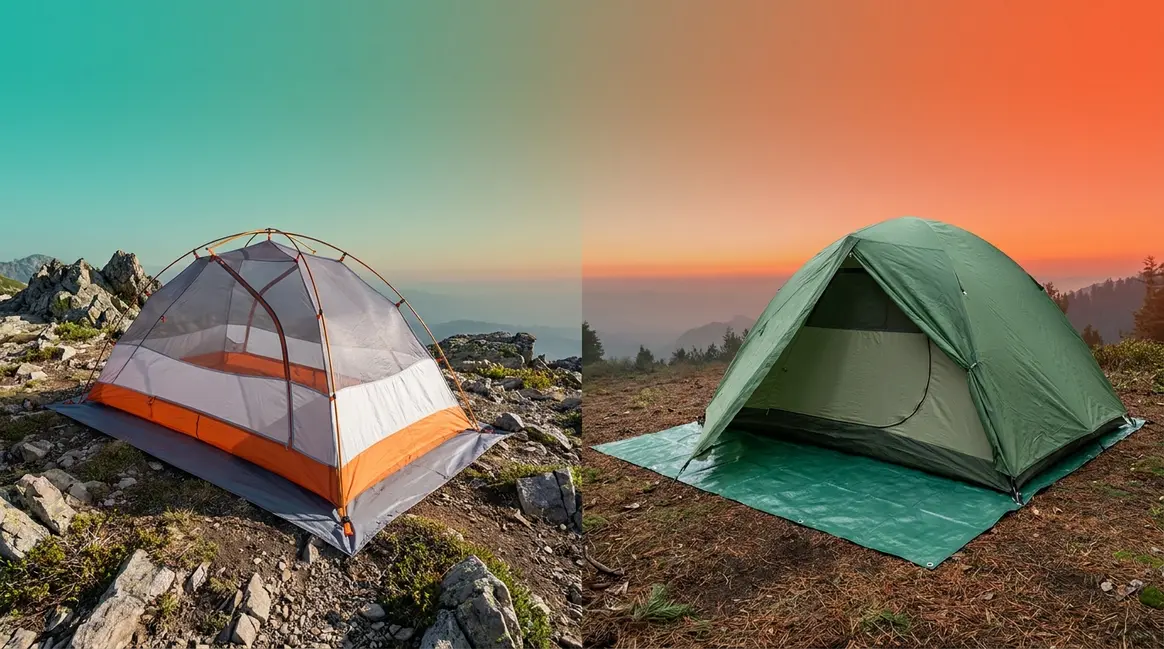
In the tent footprint vs tarp debate, both options protect your tent floor from abrasion and moisture — but the right choice depends on your camping style and budget. The Fit-First Rule: any ground cover must sit smaller than your tent floor, or it channels rain water directly underneath you.
- Tent footprints offer a perfect pre-cut fit and low weight — ideal for backpackers who value convenience
- Tarps cost 60–80% less ($10–$20 vs. $40–$80) but require careful sizing to work correctly
- Tyvek and Polycro are ultralight DIY alternatives that cost under $10 and weigh almost nothing
- The Fit-First Rule applies to every option: an oversized ground cover = a wet sleeping bag
Do You Need a Tent Footprint?
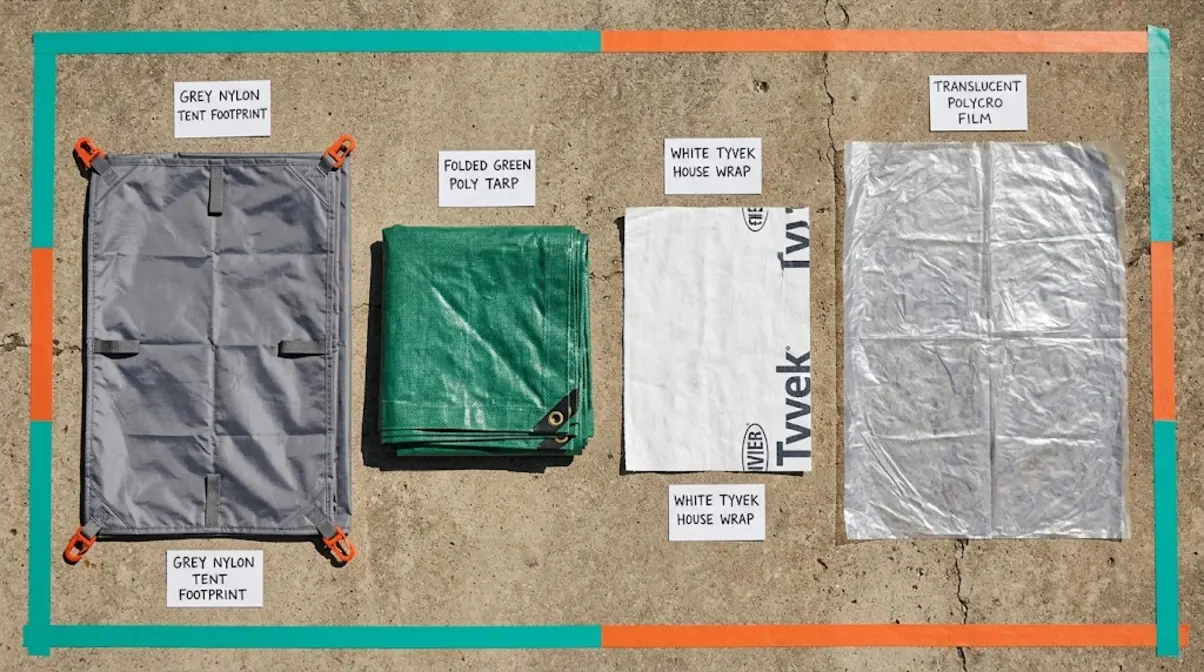
A tent footprint is a purpose-built ground cloth cut to match the exact floor dimensions of a specific tent model. It sits between the tent floor and the ground, acting as a protective barrier against abrasion, sharp rocks, and moisture. According to REI’s guide to tent footprints, footprints protect against abrasion and moisture while adding minimal weight to your pack. Whether you end up using a branded footprint or a $12 poly tarp, understanding why ground protection matters will save you from a very soggy night.

What Exactly Is a Tent Footprint?
A tent footprint is a ground cloth designed to match the exact floor dimensions of a specific tent model. Most are made from durable nylon or polyester fabrics rated between 150 and 300 denier (denier measures how thick the individual threads are — the higher the number, the more durable the fabric). They typically weigh between 3 and 12 ounces, depending on the tent size and material.
Many tent manufacturers — including REI, MSR, and Big Agnes — sell matching footprints engineered specifically for their tent models. These are often called OEM footprints (Original Equipment Manufacturer), and they frequently include attachment points that clip directly to the tent pole corners. No folding, no guesswork. Currently, OEM footprints typically retail between $40 and $80, depending on the brand and tent size. A standard poly tarp from a hardware store, by contrast, runs $10–$20 for a comparable coverage area at current pricing.
The key difference at this stage isn’t the material — it’s the fit. An OEM footprint is pre-sized. A tarp requires you to size it yourself. That distinction is the foundation of everything that follows in this guide.
Transition: So why would anyone use a cheap tarp instead of a perfectly fitted footprint? The answer almost always comes down to one thing: cost.
Is It Worth Getting a Tent Footprint?
A tent footprint is worth the cost if you own an ultralight tent or camp frequently in rocky conditions. For tents with 15–20 denier floors, a footprint is close to essential — the floor is thin enough that a single sharp rock can cause a puncture. For mid-range tents with 40–70 denier floors, a $12 poly tarp or DIY Tyvek footprint provides equivalent protection at a fraction of the cost. The OEM footprint’s main advantages are weight savings and the convenience of a clip-in fit — both genuinely valuable for backpackers, less so for car campers.
Is it a good idea to put a tarp under a tent? Yes — for three distinct reasons that apply whether you’re car camping in a state park or thru-hiking in the backcountry.
Reason 1 — Abrasion Protection Tent floors are not indestructible. On rocky, gravelly, or root-covered ground, every night of camping creates microscopic tears in the floor fabric. Those tears compound over time, eventually leading to leaks and costly repairs. A ground cover acts as a sacrificial layer — it absorbs the wear and tear so your tent floor doesn’t have to. Replacing a $15 tarp every season is far cheaper than patching or replacing a $400 tent.
Reason 2 — Puncture Prevention Ultralight tent floors are especially vulnerable. Backpacker Magazine’s gear analysis notes that ultralight tents with 15- to 20-denier floors require a footprint to prevent punctures on rocky terrain — and many popular backpacking tents fall squarely in that range. Even mid-range tents with 68-denier floors benefit from the added buffer when camping on loose gravel or embedded roots.
Reason 3 — Moisture Barrier Ground moisture is a silent problem. Cold, damp soil transfers moisture upward through tent floors even on dry nights — and on wet mornings, the effect is dramatically worse. A ground cover adds a critical layer of resistance. Leave No Trace principles for camping recommend camping on durable surfaces like rock and gravel, which increases tent floor abrasion and moisture transfer risk — making a ground cover especially valuable in established campgrounds.
Think of a ground cover like the screen protector on your phone: cheap insurance for an expensive investment.
Transition: Now you know why you need a ground cover. The bigger question is whether to spend $60 on a branded footprint or grab a $12 tarp from the hardware store. Let’s compare them properly.
Tent Footprint vs. Tarp Comparison
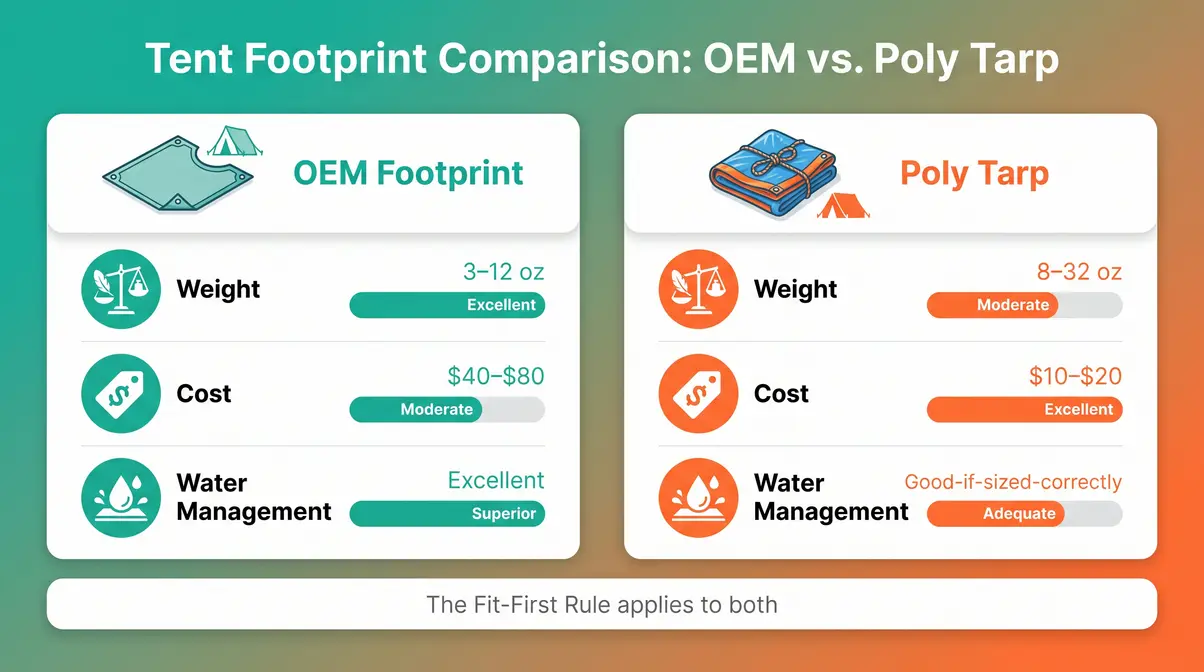
When looking at the tent footprint vs tarp comparison, both options can protect your tent floor effectively — but they make very different trade-offs across five key dimensions. Based on our evaluation of community feedback across r/camping, r/CampingGear, and r/backpacking, plus current market pricing data, here’s how they stack up.
Footprint vs. Tarp Comparison
| Feature | Tent Footprint (OEM) | Standard Poly Tarp |
|---|---|---|
| Fit | Pre-cut to exact tent dimensions | Requires manual cutting or folding |
| Weight | 3–12 oz (purpose-built) | 8–32 oz (heavier, material-dependent) |
| Cost | $40–$80 | $10–$20 |
| Water Management | Excellent — sized correctly by default | Excellent if sized correctly; poor if oversized |
| Versatility | Tent-specific only | Shelter, sun shade, emergency cover |
| Durability | High (150–300 denier nylon/polyester) | Moderate (varies by mil thickness) |
| Setup Ease | Clip-in — no adjustment needed | Requires folding/cutting to size |
| Best For | Backpackers, ultralight users | Car campers, budget-conscious campers |
Pricing is approximate and subject to change. Check current listings before purchasing.
The table makes one thing immediately clear: cost is the defining trade-off. A poly tarp covers the same square footage for 60–80% less money. The catch is that a tarp only performs as well as a footprint when it’s correctly sized — which is where most beginners go wrong.
When to Choose a Footprint
A tent footprint earns its price tag in specific scenarios. If you’re a backpacker counting every ounce, a purpose-built footprint typically weighs 3–8 oz — noticeably lighter than a comparable poly tarp. The clip-in attachment system also eliminates setup hassle on tired legs after a 15-mile day.
Footprints also make sense when you’re using a high-end ultralight tent with a 15–20 denier floor. At that thickness, the floor is essentially a glorified nylon bag — and a snag on a sharp rock can mean a $50 repair kit and a ruined trip. The OEM footprint is engineered to match the floor exactly, so there’s no risk of oversizing.
Finally, if you camp frequently in wet climates or on rocky alpine terrain, the convenience factor of a pre-fitted footprint is worth the premium. You set it up once, it works every time, and you never have to think about sizing.
Footprint is the right pick if: You’re a backpacker, you own an ultralight tent, or you camp in wet/rocky conditions frequently and want zero setup friction.
When a Tarp Makes More Sense
For car campers and weekend warriors who aren’t counting ounces, a standard poly tarp is an excellent choice. You can pick up a quality 8×10 ft poly tarp at any hardware store for $12–$18 at current retail prices, cut or fold it to the right size at home, and have a ground cover that performs identically to an OEM footprint — as long as it’s correctly sized.
Tarps also win on versatility. That same $15 tarp can shade a picnic table, serve as an emergency rain fly, cover firewood, or protect gear in the back of your truck. An OEM footprint does exactly one job. Campers across Reddit consistently note that a multipurpose tarp justifies its place in the car camping kit even if it never goes under a tent.
Tarp is the right pick if: You’re car camping, you’re on a tight budget, or you want a multipurpose piece of kit that does more than one job.
Decision Framework
| Your Situation | Best Choice | Why |
|---|---|---|
| Ultralight backpacker | OEM Footprint | Weight savings + pre-fitted for ultralight tent floors |
| Weekend car camper | Poly Tarp | 60–80% cheaper; versatile; weight doesn’t matter |
| Budget backpacker | Tyvek or Polycro | Even lighter than footprints; under $10 (see H2 4) |
| Thru-hiker | Polycro | Sub-1 oz options available; disposable after season |
| Frequent wet-weather camper | OEM Footprint | Guaranteed fit eliminates water management risk |
| First-time camper | Poly Tarp | Low cost to learn; easy to replace if sizing is wrong |
Editorial note: This guide does not include affiliate links. Recommendations are based on community research and material testing data only.
Transition: Both footprints and tarps can work perfectly — but only if they’re the right size. That’s the single most important variable in this entire debate, and most guides gloss over it. Here’s exactly how to get it right.
Using a Tarp as a Tent Footprint
Can You Use a Tarp as a Footprint?
Yes, a tarp works effectively as a tent footprint — with one critical condition. The tarp must be trimmed or folded to sit 2–3 inches smaller than your tent floor on all sides. A poly tarp from a hardware store costs $10–$20 and performs identically to an OEM footprint when correctly sized. Campers across r/camping consistently report that a properly sized tarp provides equivalent protection to a branded footprint at a fraction of the cost. The only scenario where a tarp falls short is ultralight backpacking, where the weight difference (8–32 oz vs. 3–8 oz for a footprint) becomes significant over long distances.
Using a tarp as a footprint is one of the smartest budget moves in camping — but it comes with one non-negotiable rule. The tarp must be smaller than your tent floor. Not the same size. Smaller. This is The Fit-First Rule, and it’s the reason some campers wake up dry while others wake up swimming.
The Bathtub Effect and Tarp Size
Here’s what happens when a tarp is too large: rain hits the ground around your tent, runs along the surface, and gets channeled directly under your tent floor by the overhanging tarp edges. The tarp acts like a collection basin — a bathtub — funneling water to the worst possible place: directly beneath where you’re sleeping.
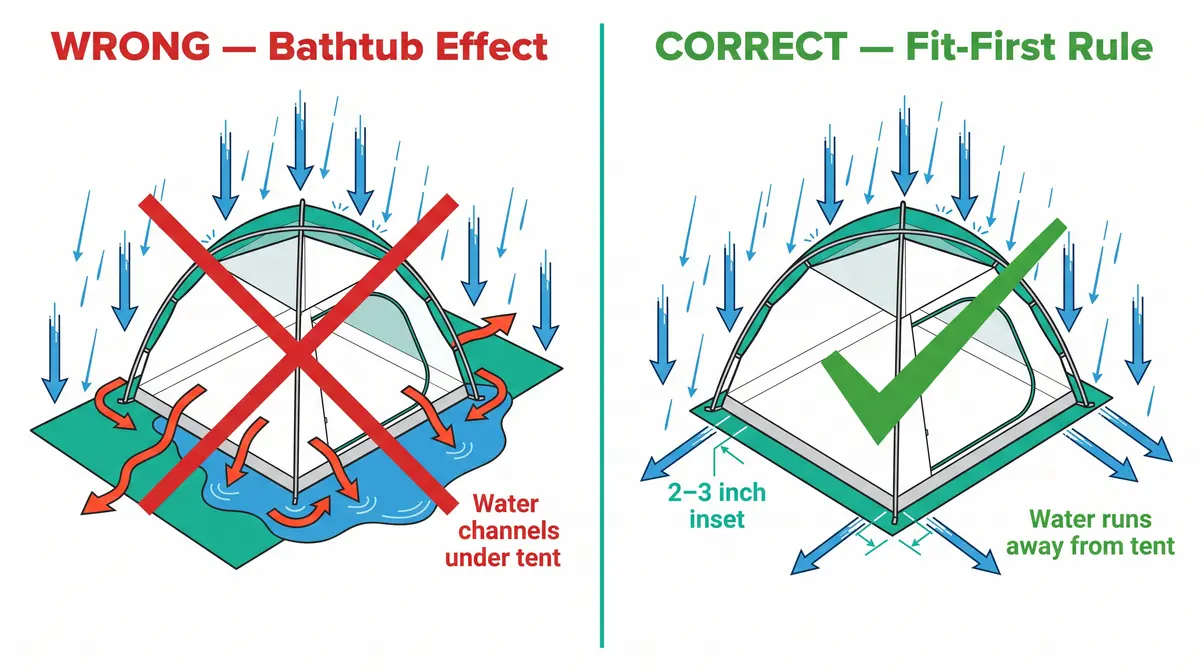
This is the core insight behind The Fit-First Rule: the material you choose (footprint, tarp, Tyvek, Polycro) matters far less than whether it’s sized correctly. Campers across Reddit’s r/camping community consistently report that this single mistake — using an oversized tarp — is responsible for nearly every “I woke up in a puddle” story. As one experienced backpacker put it:
“As long as the tarp doesn’t stick out beyond the tent floor, it doesn’t matter.”
That’s the whole rule. Everything else — brand, material, denier, mils — is secondary.
How to Fold Your Tarp
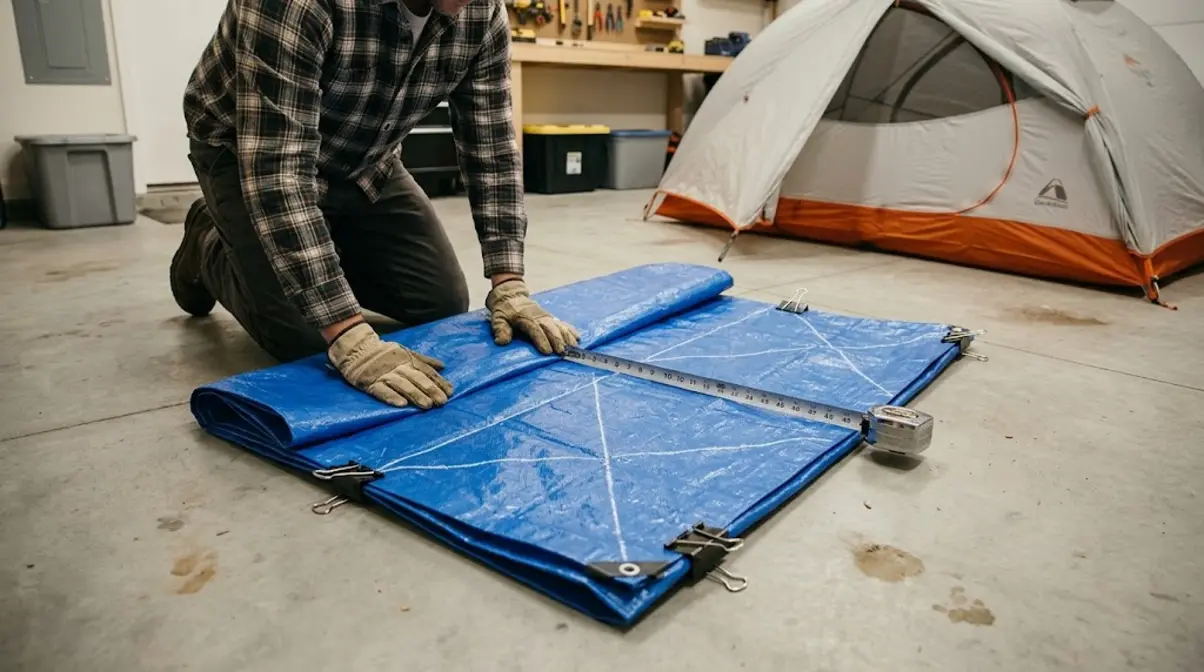
You don’t need scissors to resize a tarp for your first camping trip. Folding works just as well, and it lets you reuse the same tarp for different tent sizes. Here’s how to do it correctly.
You’ll need: Your tent (or its floor dimensions from the manual), your tarp, a marker or chalk line, and 15 minutes. Scissors or a utility knife are optional for a permanent cut.
Total estimated time: 15 minutes at home before your trip.
- Lay your tarp flat on a clean surface indoors. Smooth out all wrinkles so you’re working with an accurate shape.
- Find your tent floor dimensions. Check the tent’s stuff sack label or manufacturer website. You need length × width in inches or centimeters. Example: a 2-person tent might be 88 in × 52 in (224 cm × 132 cm).
- Subtract 2–3 inches (5–7 cm) from each dimension. This creates the critical inset that prevents the bathtub effect. Your target tarp size for the example tent: approximately 85 in × 49 in.
- Mark the fold lines on your tarp using a chalk line or a strip of masking tape. Fold the excess material under the tarp — not over the top, where it could still catch rain.
- Fold the excess edges under and press flat. Secure with binder clips or small rocks at the corners during setup if needed.
- Test the fit before your trip. Pitch your tent on the tarp in the backyard. Walk around all four sides and confirm no tarp edge extends beyond the tent footprint. If you can see tarp, fold it under more.
- Optional — make a permanent cut. Once you’ve confirmed the correct dimensions, use scissors or a utility knife to trim the tarp permanently. Apply a strip of duct tape along each cut edge to prevent fraying.
| Step | Action | Expected Outcome |
|---|---|---|
| Measure | Get tent floor dimensions | Accurate target size |
| Subtract | Remove 2–3 in per side | Inset that prevents bathtub effect |
| Fold | Tuck excess under tarp | No overhanging edges |
| Test | Pitch tent on tarp | Zero visible tarp beyond tent floor |
| Cut (optional) | Trim permanently | Reusable, correctly sized ground cover |
Transition: Folding a standard poly tarp works well for car camping. But if you’re heading into the backcountry, there are two ultralight materials that outperform both footprints and tarps on weight — and cost less than a fast-food meal.
DIY Tyvek and Polycro Alternatives

For weight-conscious backpackers, the tent footprint vs. tarp debate has a third — and sometimes fourth — option. Tyvek and Polycro are DIY footprint materials that have developed devoted followings in the ultralight backpacking community, particularly among thru-hikers on the PCT and AT. Our evaluation of community feedback across r/ultralight and r/AppalachianTrail finds both materials consistently praised for their cost-to-performance ratio.
Tyvek: Durable and Cheap
Tyvek is a synthetic material manufactured by DuPont, originally designed as house wrap for construction. It’s made from high-density polyethylene fibers that are spun and bonded together — the result is a material that’s simultaneously lightweight, waterproof, and highly resistant to tearing. You can find Tyvek at hardware stores or online in rolls for $10–$20, which yields enough material for multiple footprints.
A cut-to-size Tyvek footprint for a 2-person tent typically weighs 3–5 oz — comparable to a mid-range OEM footprint at a fraction of the price. Tyvek’s hydrostatic head (the pressure at which water pushes through the material) exceeds 200 cm H₂O, making it genuinely waterproof for ground use. New Tyvek is sometimes crinkly and noisy underfoot, but it softens noticeably after a few nights of use and a run through the washing machine.
- Pros of Tyvek:
- Costs $3–$5 per footprint when bought in bulk rolls
- Highly durable — resists tears and punctures better than poly tarps
- Genuinely waterproof; bonds don’t degrade over time
- Can be washed and reused for multiple seasons
- Cons of Tyvek:
- Noisy when new (crunching sound underfoot)
- Requires cutting and hemming for best results
- Heavier than Polycro (see below) — not the lightest ultralight option
How to cut Tyvek to size: Measure your tent floor, subtract 2–3 inches per side (The Fit-First Rule applies here too), and cut with scissors or a rotary cutter. Fold the edges over by ½ inch and use a hot glue gun or iron-on seam tape to create a clean hem that won’t fray. Total cutting and hemming time: approximately 20–30 minutes.
ultralight backpacking gear guide
Transition: Tyvek is a fantastic all-rounder for backpackers who want durability without the OEM price tag. But if you’re obsessed with cutting every gram, there’s a material that takes ultralight to its logical extreme.
Polycro: Ultralight Secret Weapon
Polycro is a brand name for a type of biaxially oriented polyethylene film — essentially a very thin, very light plastic sheeting material. It’s the same material used in window insulation kits, and it’s become the go-to footprint material for serious ultralight backpackers and thru-hikers. A Polycro footprint for a 2-person tent can weigh as little as 0.5–1.5 oz — making it up to 10 times lighter than a standard poly tarp.
The trade-off is durability. Polycro is thinner and more fragile than Tyvek or a poly tarp. On sharp rocky terrain, it can develop small punctures over time, which is why many thru-hikers treat it as a semi-disposable item — cheap enough to replace mid-trail if it wears out. A roll of Polycro large enough for several footprints costs around $8–$12 online.
- Pros of Polycro:
- Extremely lightweight — 0.5–1.5 oz per footprint
- Very packable; compresses to almost nothing
- Inexpensive — under $5 per footprint from a roll
- Completely silent underfoot (unlike new Tyvek)
- Cons of Polycro:
- Less durable than Tyvek or OEM footprints
- Can tear on sharp rocks with heavy use
- Not ideal for car camping or frequent use on rough terrain
How to cut Polycro to size: The process is identical to Tyvek — measure, subtract 2–3 inches per side, and cut with scissors. Because Polycro is so thin, skip the iron-on hem and simply fold the edges under during setup. It doesn’t fray the way fabric does. Total prep time: under 10 minutes.
ultralight tent comparison guide
Four-Way Material Comparison
| Material | Typical Weight | Cost per Use | Durability | Setup Ease | Best For |
|---|---|---|---|---|---|
| OEM Footprint | 3–12 oz | $40–$80 (reusable) | High | Clip-in, instant | Backpackers, ultralight tent owners |
| Poly Tarp | 8–32 oz | $10–$20 (reusable) | Moderate | Fold/cut required | Car campers, budget campers |
| Tyvek (DIY) | 3–5 oz | $3–$5 (bulk roll) | High | Cut once, reuse | Budget backpackers, thru-hikers |
| Polycro (DIY) | 0.5–1.5 oz | $2–$4 per sheet | Low–Moderate | Cut and fold | Ultralight backpackers, thru-hikers |
Weights based on typical 2-person tent floor dimensions (~88 in × 52 in).
The four-way comparison makes the value proposition of DIY alternatives undeniable. Tyvek and Polycro both outperform a standard poly tarp on weight, and they cost a fraction of an OEM footprint. The only real trade-off is the 20–30 minutes of prep work required to cut them to size — which is a worthwhile investment for any serious backpacker.
Transition: Now that you know which material to choose, it’s worth understanding the numbers behind the specs. Terms like “denier,” “mils,” and “hydrostatic head” appear on every product listing — and once you know what they mean, you can evaluate any ground cover with confidence.
Material Specs: Denier and Mils
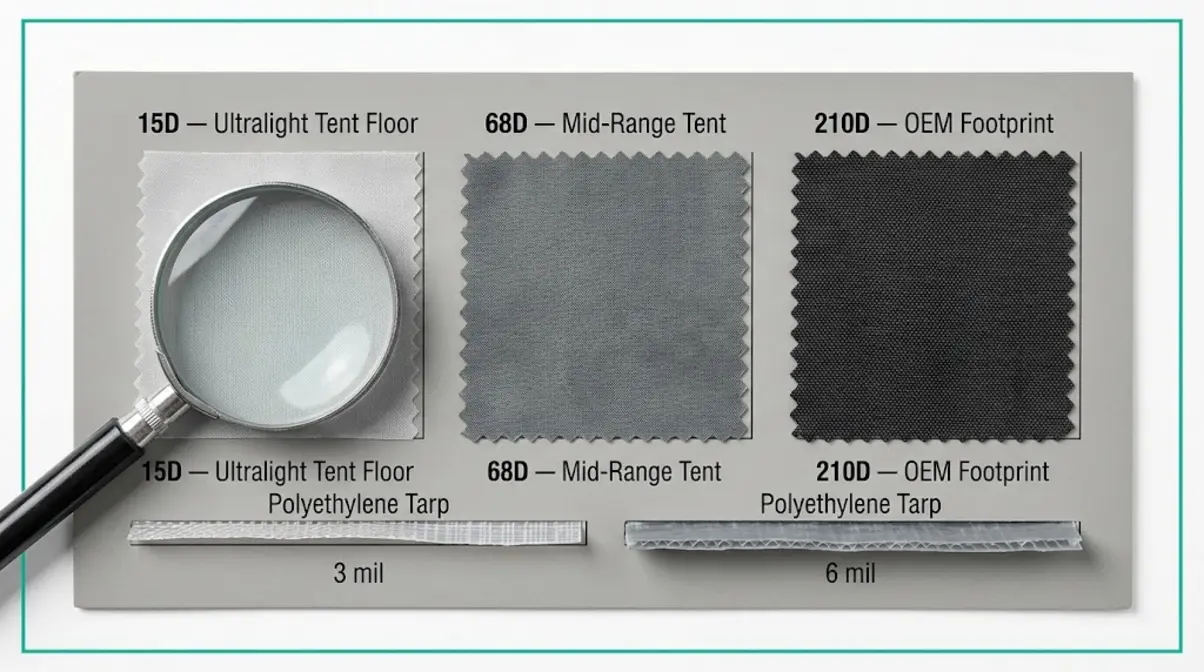
Material specifications tell you how a ground cover will perform before you ever take it outside. Most beginner campers skip this section entirely — and then feel confused when one tarp performs completely differently from another that looks identical. Here’s what the numbers actually mean.
What “Denier” Means for Tent Floors
Denier (abbreviated D) is a unit of measurement for the linear mass density of fibers — in plain English, it tells you how thick and heavy the individual threads in a woven fabric are. Higher denier = thicker threads = more durable, heavier fabric. Lower denier = thinner threads = lighter but more fragile.
For tent floors and footprints, denier ranges matter significantly:
| Denier Range | Common Use | Durability | Weight |
|---|---|---|---|
| 15–20D | Ultralight tent floors | Low — needs footprint | Very light |
| 40–70D | Mid-range tent floors | Moderate | Light–medium |
| 150–300D | OEM footprints, heavy-duty tents | High | Moderate–heavy |
Ultralight tents with 15–20 denier floors are especially vulnerable to puncturing on rocky terrain — which is exactly why Backpacker Magazine’s footprint guide specifically recommends a footprint for tents in this denier range. A 150D OEM footprint protects a 15D tent floor by absorbing all the abrasion and impact before it reaches the tent.
Note that denier applies to woven fabrics like nylon and polyester — it doesn’t apply to tarps, Tyvek, or Polycro, which use a different measurement system entirely.
What Thickness Tarp Should I Use?
For tent footprint use, choose a poly tarp rated 4–6 mils thick. A 3-mil tarp is adequate for soft ground camping but may develop wear points after several trips on gravel or rocky terrain. An 8-mil or heavier tarp is unnecessarily heavy for this application — the added durability doesn’t benefit you under a tent. For backpacking, skip the poly tarp altogether and use Tyvek or Polycro instead, since even a 4-mil tarp weighs significantly more than either DIY alternative.
For poly tarps and film materials like Polycro, thickness is measured in mils — not millimeters, but thousandths of an inch. A 1-mil tarp is 0.001 inches thick. A 6-mil tarp is 0.006 inches thick. This sounds tiny, but the difference in durability between a 3-mil and a 6-mil tarp is dramatic.
Here’s why the 4–6 mil range is ideal:
| Tarp Thickness | Performance | Best Use |
|---|---|---|
| 1–2 mil | Very thin; tears easily | Short-term emergency cover only |
| 3 mil | Light; adequate for soft ground | Occasional car camping on grass |
| 4–6 mil | Balanced durability and weight | Recommended for tent footprint use |
| 8–12 mil | Very durable; heavy | Truck bed covers, tarping lumber |
Hydrostatic head is the related waterproofing metric — it measures how many centimeters of water pressure a material can withstand before leaking. For a tent footprint, you want a minimum of 1,500 mm H₂O. Most 4–6 mil poly tarps exceed this threshold significantly. Tyvek’s hydrostatic head exceeds 200 cm H₂O (equivalent to 2,000 mm), making it more waterproof than many budget tent floors. Polycro, being a continuous film rather than a woven fabric, is essentially impermeable to water under normal camping conditions.
Quotable benchmark: A 4-mil poly tarp rated at 1,500 mm hydrostatic head will resist ground moisture effectively in all standard camping conditions, including overnight rain on saturated soil.
Transition: You now have the material science to evaluate any ground cover on a shelf or product listing. Before wrapping up, it’s worth being honest about when you might not need a footprint at all — and the most common mistakes that make even the best ground cover useless.
When to Skip a Tent Footprint
Honest gear advice means acknowledging when not to buy something. A ground cover is valuable in most camping situations — but there are specific scenarios where it’s either unnecessary or where the wrong approach creates more problems than it solves.
Common Ground Cover Mistakes
Even experienced campers make these errors. Knowing them in advance saves a frustrating night.
Mistake 1 — Using an oversized tarp. This is the bathtub effect described in H2 3. It’s the single most common ground cover mistake. The Fit-First Rule exists specifically to prevent this: always size your ground cover 2–3 inches smaller than your tent floor on all sides.
Mistake 2 — Placing the tarp shiny-side up on slippery terrain. Many poly tarps have a smooth, slick surface. On a sloped campsite, this can cause your sleeping pad to slide toward the tent wall overnight. Place the rougher side up, or use a textured material like Tyvek.
Mistake 3 — Forgetting to account for vestibule area. Some campers size their tarp to the full tent footprint including the vestibule (the covered area outside the inner tent door). The footprint only needs to match the sleeping area floor — not the vestibule. Oversizing for the vestibule creates overhang at the sides.
Mistake 4 — Skipping the ground cover on sandy beaches. Sand is actually quite gentle on tent floors compared to gravel or rock. On a clean, soft sandy beach, a ground cover may add more hassle (sand gets trapped underneath) than protection. This is one situation where skipping it is reasonable.
When to Skip the Footprint
A ground cover is genuinely unnecessary in a few specific situations:
- Established campground platforms — Many modern campgrounds provide wooden tent platforms or smooth gravel pads. These surfaces pose minimal abrasion risk, and a tarp may actually trap moisture underneath rather than preventing it.
- Hammock camping — If your tent never touches the ground, neither does the problem. Hammock campers have zero use for a footprint.
- Short-term family camping on soft grass — A single weekend on a well-maintained grass campsite with a mid-range tent (40D+ floor) poses minimal puncture or abrasion risk. The ground cover adds setup time without meaningful protection benefit.
If you’re unsure whether your campsite warrants a ground cover, the practical test is simple: kneel on the ground where you plan to pitch your tent. If you feel discomfort from rocks, roots, or gravel within 30 seconds, use a ground cover. If the surface is soft and forgiving, it’s optional.
Tent Footprint and Tarp FAQs
Best Material for a Footprint?
The best material depends on your camping style. For backpackers prioritizing weight, Polycro (0.5–1.5 oz per footprint) is the lightest option available and costs under $5 per use. For backpackers wanting durability, Tyvek (3–5 oz, $3–$5 per footprint) is the better choice — it resists tears and lasts multiple seasons. For car campers, a 4–6 mil poly tarp ($10–$20) offers the best value. OEM footprints (3–12 oz, $40–$80) make sense only when the clip-in fit or ultralight weight justifies the premium over DIY alternatives.
Best Footprint Alternatives?
Tyvek is the best all-around alternative to a branded tent footprint. It matches the durability of most OEM footprints, costs 85–90% less when purchased as a bulk roll, and is waterproof enough for all standard camping conditions. Polycro is the best alternative specifically for ultralight backpackers who prioritize weight above all else. A standard poly tarp is the best alternative for car campers — versatile, cheap, and widely available. All three alternatives require correct sizing per The Fit-First Rule to perform as well as an OEM footprint.
Can I Just Use a Tarp?
Yes — a tarp works as a tent footprint as long as it’s sized correctly. This is one of the most practical budget moves in camping. Buy a 4–6 mil poly tarp from any hardware store, measure your tent floor dimensions, subtract 2–3 inches from each side, and fold or cut the tarp to that size. The result is a waterproof ground cover that performs identically to an OEM footprint. The only meaningful trade-off is weight: poly tarps are heavier than purpose-built footprints, making them better suited for car camping than backpacking.
How Thick Should a Footprint Be?
A tent footprint should provide at least 150 denier of fabric thickness for woven materials, or 4–6 mils for poly tarps. Most OEM footprints use 150–300 denier nylon or polyester — thick enough to absorb abrasion and resist punctures on rocky terrain. For DIY alternatives, a 4-mil poly tarp is the minimum recommended thickness for ground use. Tyvek and Polycro don’t use the denier or mil measurement system, but both exceed the waterproofing threshold (1,500 mm hydrostatic head) needed for effective ground moisture protection.
Does a Footprint Go Inside or Outside?
A tent footprint always goes outside, directly on the ground beneath the tent floor. Placing a footprint inside the tent defeats its primary purpose, which is to act as a sacrificial layer that absorbs abrasion from rocks and roots before they can damage the tent floor fabric.
Can I Use a Different Tent’s Footprint?
Yes, you can use a footprint from a different tent model, provided it follows the Fit-First Rule. The footprint must be slightly smaller than your tent’s floor dimensions on all sides. If the alternative footprint is larger than your tent, you must fold the excess material underneath to prevent the bathtub effect from channeling rainwater under your sleeping area.
Do I Need a Footprint for Car Camping?
While not strictly mandatory, a footprint or tarp is highly recommended for car camping. Because weight is not a concern when car camping, bringing a $15 poly tarp is an easy way to protect your expensive tent from sharp gravel and ground moisture commonly found in established campground pads.
The Right Ground Cover for You
Ultimately, the tent footprint vs tarp decision comes down to two factors: how much you want to carry and how much you want to spend. A standard poly tarp costs 60–80% less than an OEM footprint and performs identically when correctly sized. Backpackers who need to cut weight will find that Tyvek and Polycro offer the best of both worlds — lighter than a poly tarp and far cheaper than a branded footprint. The Fit-First Rule applies universally: no matter which material you choose, it must sit 2–3 inches inside your tent floor perimeter or it will funnel rain directly beneath you.
The Fit-First Rule is the insight that cuts through all the gear jargon: the brand on the label matters far less than the size on the ground. A $10 tarp sized correctly outperforms a $70 OEM footprint sized incorrectly — every single time. That’s the principle that should guide every ground cover decision you make.
Your next step is simple: measure your tent floor tonight, grab a 4–6 mil poly tarp or a roll of Tyvek from the hardware store, and apply The Fit-First Rule before your next trip. If you’re heading into the backcountry with an ultralight tent, order a roll of Polycro instead — it weighs almost nothing and costs less than your campsite fee. Either way, your tent floor will thank you for years to come.
Verify current pricing before purchasing.