First Time Camping Tips: 5 Essential Steps (2026 Guide)
 Dave King
Updated April 3, 2026
28 min read
Dave King
Updated April 3, 2026
28 min read
To prepare for your first camping trip, follow these 5 steps: choose a developed campground close to home, pack a basic tent/bag/pad-combo, set up camp before dark, keep food below 40°F, and follow Leave No Trace principles. Most beginners are fully ready within 1–2 weeks of planning. Start with a developed campground that has flush toilets and running water — it eliminates the hardest variables on trip one.
Most experienced campers started exactly where you are — wondering whether a cabin might be the safer first choice. That instinct is sound. As one r/camping community member put it:
“Start with day trips into the countryside, then visit national parks/etc. and rent a cabin before getting a basic tent/bag/pad-combo that’s all you really need …”
— r/camping community member
The gap between that cabin stay and your first tent trip is smaller than it looks. The real problem is that most first time camping tips guides hand you a 50-item packing list and wish you luck. They skip the anxious questions: What does “FCFS” mean on Recreation.gov? Is the food in your cooler actually safe? What time should you arrive?
This guide gives you a 5-step system — The Tent Camper’s 3-3-3 Framework — that takes you from zero experience to a confident first night under canvas. Beyond the core steps, you’ll find tailored advice for tent, RV, and family setups, a section on camping with dogs, and a troubleshooting guide for the mistakes beginners make most often.
Key Takeaways: First Time Camping Tips
First-time camping success comes down to five steps: choosing the right site, packing smart, setting up before dark, keeping food safe, and following campground rules.
- The Tent Camper’s 3-3-3 Framework: Arrive by 3 PM, stay 3 nights, camp within 30 miles of home on your first trip
- Essential gear: A tent, sleeping bag (temperature-rated), sleeping pad, and headlamp cover the basics
- Food safety: Keep perishables below 40°F — bacteria multiply rapidly above that threshold (University of Maine Cooperative Extension)
- Book ahead: Recreation.gov releases campsite reservations 6 months in advance on a rolling basis — popular summer weekends fill fast
- Beginner win: Developed campgrounds with flush toilets and running water eliminate the hardest variables on your first trip
What You’ll Need Before Your First Camping Trip
Before you book a campsite or plan a menu, check that your core gear is sorted. Across experienced camper communities, the consensus is clear: beginners who show up unprepared almost always trace the problem to one missing item — not a lack of skill.
Gear You Should Have Ready Before You Start
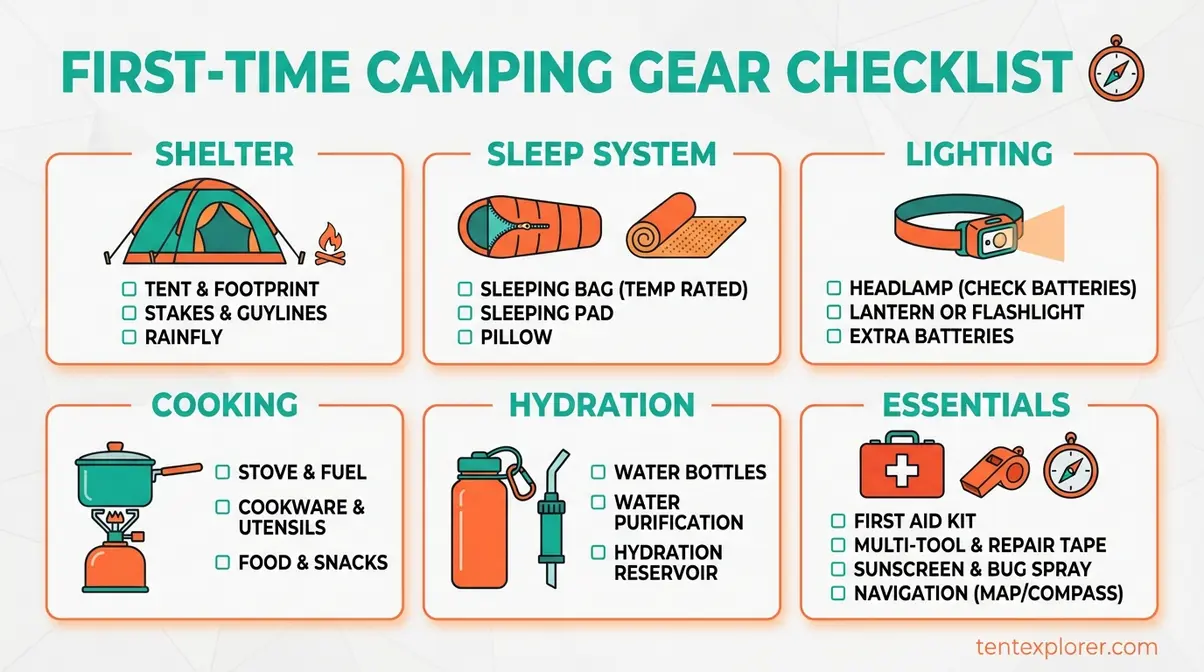
These first time camping tips start with a minimum viable kit. The University of Colorado Boulder confirms that every beginner’s shelter setup must include a tent with a footprint and stakes, a sleeping bag, and a sleeping pad for insulation (2026). You don’t need a full outdoor store — you need these:
- Tent — with a footprint (ground cloth) and stakes
- Sleeping bag — temperature-rated to at least 10°F below expected overnight lows
- Sleeping pad — for insulation from the cold ground, not just comfort; sleeping directly on the earth wicks body heat away regardless of air temperature
- Headlamp — with a spare set of batteries
- First aid kit — pre-assembled kits work fine for a first trip
- Water bottles or a water filter — plus purification tablets as a backup
- Cooler with ice packs — for any perishable food
- Multi-tool or knife
The USDA Forest Service, the federal agency managing national forests and campgrounds, recommends laying all gear out at home and physically checking each item off a written list before loading the vehicle. That single habit prevents most forgotten-item problems. Once you’ve run through this list, you’re ready to use your first-time camping checklist to verify everything before the trip.
With your core gear identified, the first real decision is where you’re going.
Step 1: Choose and Book the Right Campsite
The best first campsite is a developed campground within 30 miles of home — one with flush toilets, running water, and designated fire pits. Recreation.gov, the official U.S. federal campground booking platform, releases reservations 6 months in advance on a rolling basis (Outdoorithm, 2026). That means a July 4th weekend campsite opens for booking on January 4th. Staying close to home means if anything goes wrong, you’re never more than an hour from your own bed — removing the biggest source of beginner anxiety.
Start Close to Home: How to Find Your First Campground
Learning how to go camping for the first time is easier when you narrow the search. Use Recreation.gov to filter for developed campgrounds with flush toilets and running water. KOA (Kampgrounds of America), a national network of beginner-friendly campgrounds, is another reliable option — their sites offer consistent amenities and are specifically designed for campers at the beginner end of the experience spectrum.
“Stay close to home” isn’t just common advice — it’s a genuine anxiety reducer. If setup takes longer than expected or weather turns, you can retreat without a 4-hour drive home. Search for ” state park campground with flush toilets” on Recreation.gov, and filter for campgrounds rated 4+ stars with “developed” in the listing description.
Understanding Campground Jargon: FCFS, FF, and Reservations
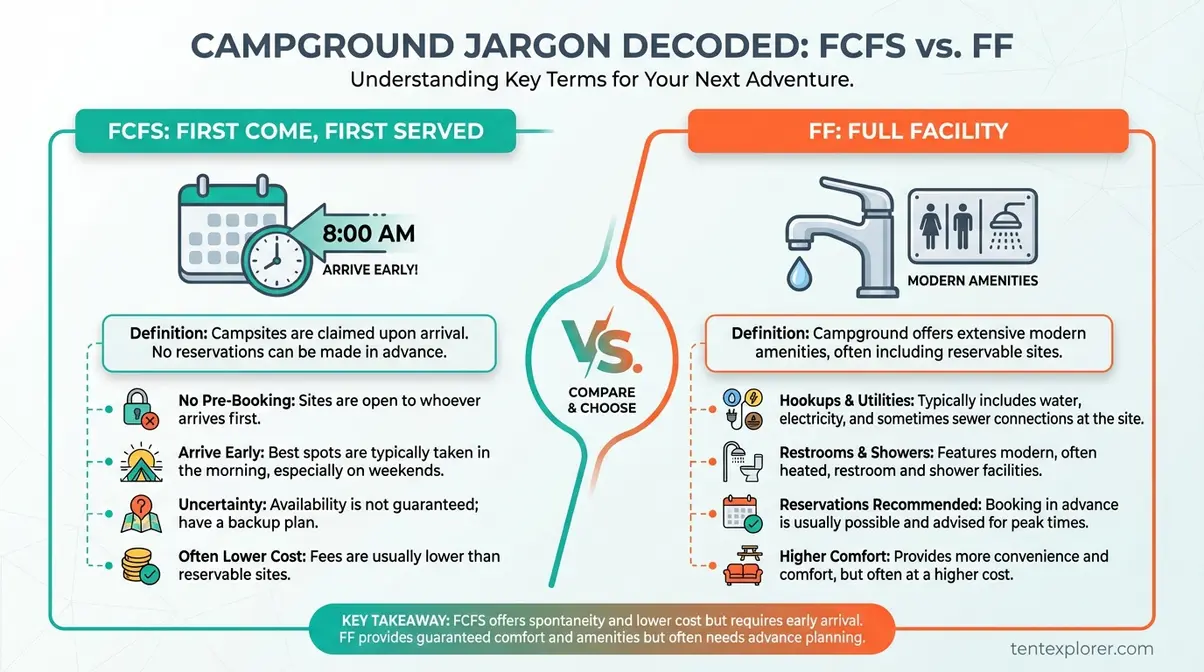
For first-time camping, the jargon on booking sites is one of the most common points of confusion. Here’s what the key terms actually mean:
| Term | Meaning | Beginner Strategy |
|---|---|---|
| FCFS | First Come, First Served — no reservation, take whatever site is open | Arrive Thursday or early Friday; summer sites fill by Friday afternoon |
| FF | Full Facility — flush toilets, showers, and running water | Always choose FF on your first trip |
| Developed | Designated tent pads, fire rings, and nearby amenities | Preferred over dispersed or primitive sites |
Reservation windows matter. Recreation.gov opens bookings 6 months in advance on a rolling daily basis — so for a popular summer weekend, reservations open exactly 6 months prior at 10 a.m. ET. State parks typically open 3–6 months ahead. Book as early as possible for any Friday or Saturday night in summer.
The Tent Camper’s 3-3-3 Framework
The Tent Camper’s 3-3-3 Framework is the organizing principle for this entire guide. It adapts the RV world’s “3-3-3 rule” — drive 300 miles max, arrive by 3 PM, stay 3 nights — and calibrates it specifically for first-time tent campers:
- Arrive by 3 PM — enough daylight to pitch your tent without rushing
- Stay 3 nights — one night isn’t enough to find your rhythm; three nights is enough to stop feeling awkward and start actually enjoying it
- Camp within 30 miles of home — close enough to abort if needed, without being restrictive
Each element targets a specific anxiety. A first-timer driving 25 miles to a state park, arriving at 2:30 PM Friday, and leaving Monday morning — that’s the 3-3-3 Framework in action. Tips for camping for the first time get far more useful when they’re organized around a concrete structure like this rather than a generic checklist.
Checkpoint: You should now have a campsite reserved (or FCFS plan confirmed), arrival time set for before 3 PM, and trip duration of at least 3 nights.
With your campsite booked and your timeline set, the next step is making sure you have everything you need — without overpacking or overspending.
Step 2: Pack the Right Gear — The Beginner’s Checklist
Picture arriving at your campsite at 7 PM, in the dark, trying to read tent instructions on your phone. That’s what happens when you skip the gear check. First-time campers need far less gear than most packing lists suggest. A functional kit covers five categories: shelter, sleep system, light, water, and first aid. The USDA Forest Service recommends laying all gear out at home and physically checking each item off a written list before loading your vehicle — the simplest way to avoid forgetting essentials. The Tent Camper’s 3-3-3 Framework’s 3-night minimum also enforces proper preparation: you can’t cut corners on gear for three nights the way you might for a single overnight.
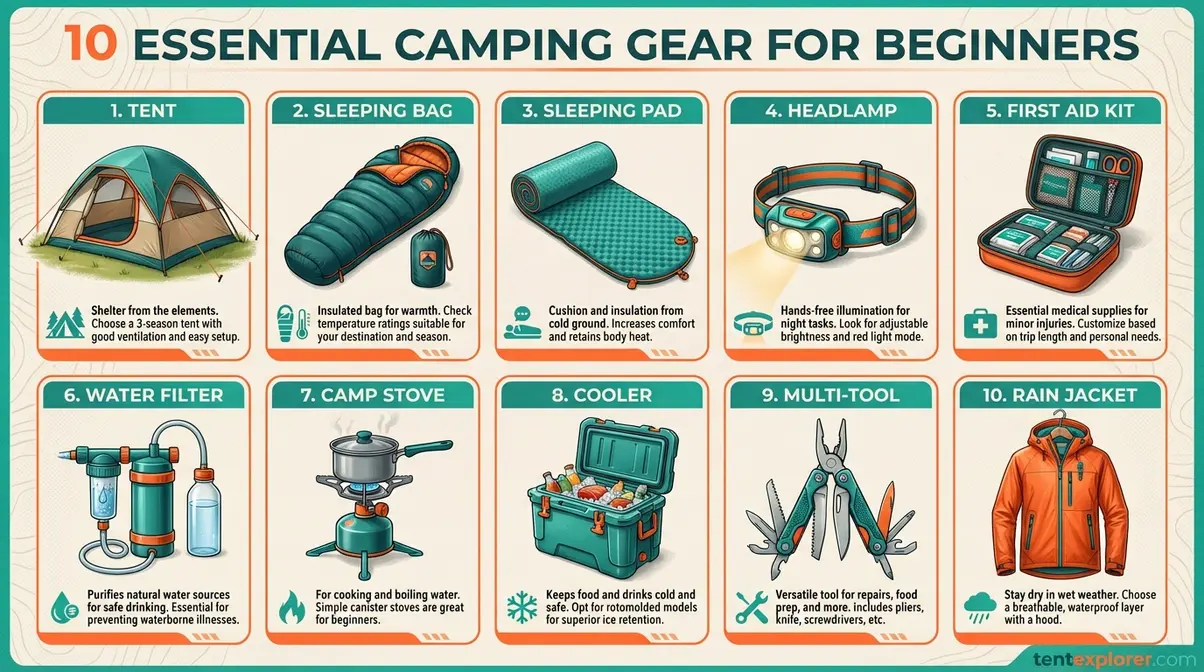
The 10 Essential Items Every First-Time Camper Needs
These first time camping tips for gear start with the non-negotiables. The USDA Forest Service advises first-time campers to physically check each item off a written list before packing. Based on that guidance and community consensus from essential camping tips for beginners, here’s the minimum viable kit:
- Tent with footprint and stakes
- Sleeping bag rated 10°F below expected overnight low
- Sleeping pad — insulation from the ground, not just cushioning
- Headlamp with spare batteries
- First aid kit
- Water bottles plus filter or purification tablets
- Camp stove with fuel
- Cooler with ice packs
- Multi-tool
- Rain gear and layered clothing for all weather conditions
The sleeping bag temperature rating is the single most important spec for beginners. A bag rated for 20°F used in a 40°F night will leave you sweating; a bag rated for 40°F used in a 30°F night will leave you miserable. Always choose a bag rated colder than your expected conditions. The University of Colorado Boulder confirms that a tent with footprint and stakes, sleeping bag, and sleeping pad are the non-negotiables for any beginner’s shelter system (2026).
Rent or Borrow Before You Buy
Tips for first time camping almost universally include one piece of financial advice: don’t buy everything before your first trip. Renting gear from REI, the outdoor gear cooperative, for a first trip costs $30–$80 versus $200–$500 to buy outright. If camping isn’t for you, you’ve spent almost nothing. If you love it, you’ll know exactly which features matter before committing to a purchase.
What to rent: tent (most expensive to buy, easy to rent at ~$30/night) and sleeping bag (~$15/night). What to buy: sleeping pad (hygiene reasons) and headlamp (inexpensive to own). What to borrow: cooler and camp stove from a friend or neighbor. REI’s rental program means a full weekend kit costs less than a single piece of budget gear. Borrowing from friends first — the approach most often recommended across r/camping threads — is even better.
Clothing and Weather Prep: Dress for Two Seasons
Clothing for all weather conditions is arguably the most overlooked part of a beginner’s camping kit. The layering system works like this: a moisture-wicking base layer, a fleece or down mid-layer for warmth, and a waterproof outer shell. Pack for two seasons — even summer nights at elevation can drop to 40°F after sunset.
The most important item most beginners forget: a clean, dry set of clothes and socks specifically for sleeping. Camp clothes absorb smoke, sweat, and food smells throughout the day. Sleeping in them guarantees a cold, uncomfortable night. A minimal clothing kit covers two base layers, one fleece, one rain jacket, two pairs of quick-dry pants, and four pairs of socks — including one pair dedicated to sleep. Always pack rain gear even if the forecast looks clear; camping first time tips about weather should be taken seriously because conditions shift faster outdoors than in the city.
Checkpoint: You should now have a gear checklist verified at home, clothing layers packed for temperature swings, and a decision made on renting versus buying.
You’ve got your gear packed and your campsite reserved. Now comes the part most beginners underestimate: setting up camp efficiently before dark.
Step 3: Set Up Camp Safely and Efficiently
Arriving before 3 PM isn’t just a suggestion — it’s the difference between a calm setup and a panicked one. The 3-3-3 Framework’s first rule exists precisely because tent setup in daylight takes 10–20 minutes; tent setup in the dark takes 45 minutes and involves at least one misplaced stake.
How to Pick the Perfect Tent Spot
Tips for camping for the first time always emphasize site selection, but few explain the specific criteria. California State Parks, the state agency managing California’s campgrounds and parks, recommends pitching your tent at least 15 feet upwind from grills and fires, with a 3-foot clear area around the tent — a safety standard no competitor guide covers. Use four criteria when evaluating any tent spot:
- Level — no slope greater than 5 degrees; even a slight tilt disrupts sleep
- Dry — avoid low-lying areas where water collects during rain
- Clear — no rocks, roots, or sharp debris under the footprint
- Safe — away from dead branches overhead (“widow makers”) and at least 15 feet from any fire pit or grill
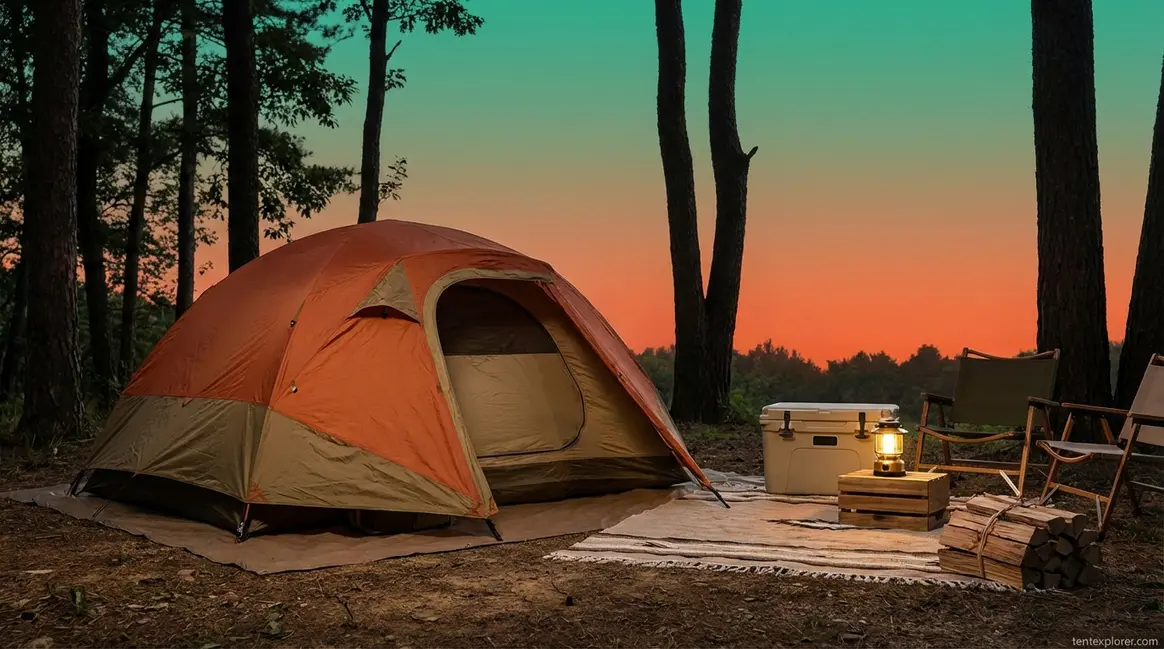
The footprint (a ground cloth placed under the tent) protects the tent floor from punctures and moisture — always use one on rocky or damp ground. If your assigned site has a slight slope, position your sleeping area so your head is uphill; sleeping with feet elevated above your head disrupts both sleep and circulation.
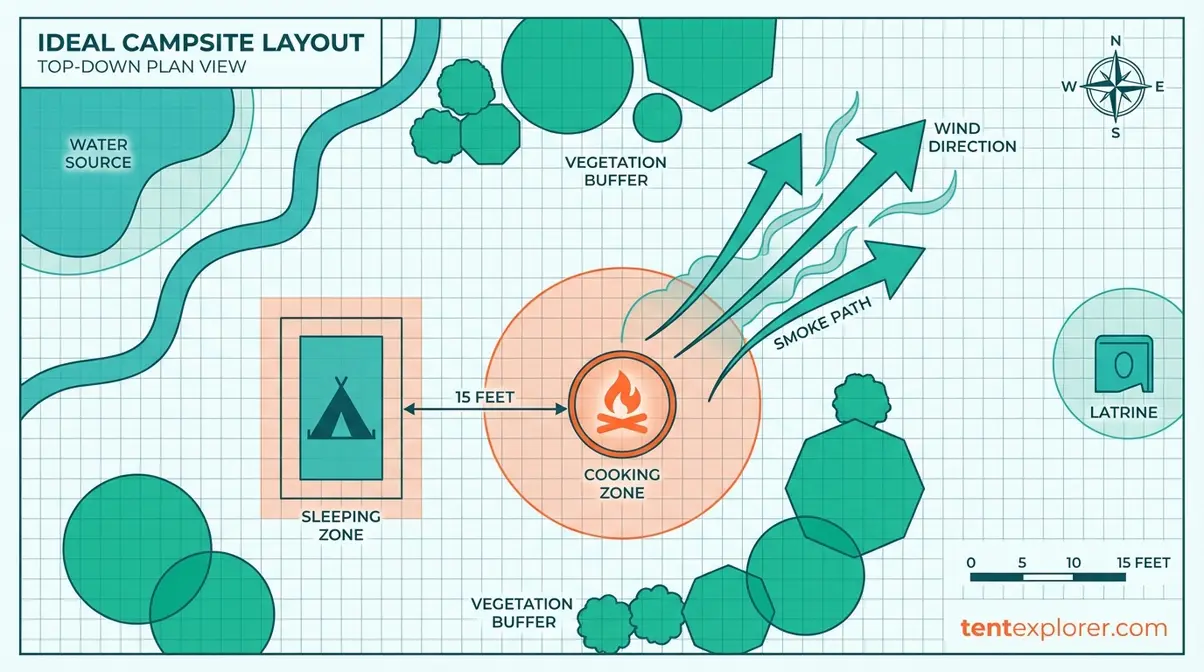
The California State Parks safety guidelines make this explicit: tent placement relative to the fire area is a safety requirement, not a preference.
Tent Setup Step-by-Step
Once you’ve chosen your spot, the setup sequence matters. Practice makes the difference between a 10-minute setup and a 45-minute ordeal — and the single highest-ROI preparation step any first-time tent camping tips guide can give you is this: pitch your tent at home before your trip. Most beginners discover a missing stake or broken pole in their backyard, not at the campsite at 6 PM.
The 5-step setup sequence:
- Lay out the footprint — smooth it flat, no wrinkles
- Stake all four corners loosely — position before committing
- Assemble poles and thread through sleeves — follow the color-coding on most modern tents
- Clip and tension the rainfly — fly should be taut, not sagging
- Tighten stakes and guy lines — check all four corners and midpoints
After setup, push on all four corners — the tent should feel taut, not floppy. A floppy tent pools water in rain. One more thing worth knowing before you go: canvas is not soundproof. Your tent will feel smaller and noisier than expected. Knowing this ahead of time eliminates surprise and helps you pack accordingly (earplugs are worth adding to your kit). The University of Colorado Boulder recommends the tent-with-footprint-and-stakes setup as the non-negotiable shelter foundation for beginners (2026).
Checkpoint: You should now see a tent standing, fly taut, all stakes in the ground, and tent positioned at least 15 feet from the fire pit.
Camp is set up. Now the part beginners most often get wrong: food.
Step 4: Plan Your Meals and Stay Food-Safe
What’s the most common reason a camping trip turns into a miserable experience? It’s not bad weather. It’s bad food management. First time camping tips for food safety address the gap that zero competitor guides cover — and it’s the gap with the most serious consequences.
The Food Safety Danger Zone (40–140°F)
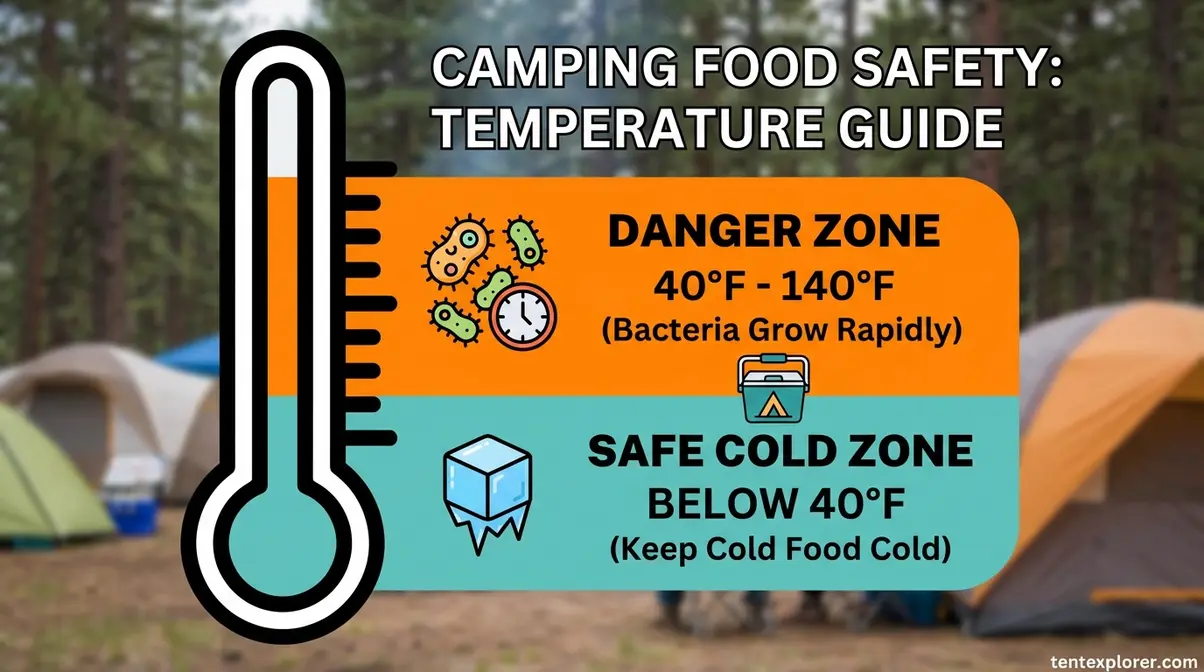
Keep perishable foods below 40°F to prevent foodborne illness — bacteria multiply rapidly between 40°F and 140°F, the “danger zone” (University of Maine Cooperative Extension, a federally funded food safety research program). This isn’t a suggestion; it’s a government-established standard that applies every time you open your cooler at a campsite.
Practical cooler management: pack ice in the bottom, food on top. Block ice lasts significantly longer than cubed ice. A 20°F morning can be deceptive — a cooler left in a sunny car will exceed 40°F within two hours even in cool ambient temperatures. Use a small thermometer to verify cooler temperature at least twice per day. The University of Maine Extension is explicit: keep cold foods at or below 40°F and hot foods at or above 140°F with no exception for outdoor conditions.
For water, FoodSafety.gov, the U.S. government’s official food safety resource, warns that water in streams and rivers is untreated and not safe for drinking — always bring bottled or purified water, or use a filter rated for backcountry use. A practical dual-purpose hack: freeze water in jugs before your trip. They keep the cooler cold and, as they melt, provide clean drinking water.
Easy First-Night Meal Ideas for Beginners
The first-night rule is simple: cook the simplest possible meal on Night 1. You’ll be tired from setup, your camp kitchen isn’t organized yet, and it’s not the time to experiment. Foil packet meals — vegetables and protein wrapped in foil and cooked on the grate — require zero cooking skill and zero cleanup.
A practical 3-night meal plan for camping first time:
- Night 1: Foil packets or pre-made sandwiches
- Night 2: One-pot pasta or canned chili heated on the camp stove
- Night 3: Whatever’s left, plus s’mores
- Breakfast: Instant oatmeal or scrambled eggs
- Lunch: Wraps, trail mix, or peanut butter on bread
What NOT to bring on a first trip: raw chicken (high contamination risk in a beginner’s cooler), anything requiring exact timing, and glass containers (break risk on uneven surfaces). One of the most commonly forgotten camp kitchen items is a tin opener — add it to your checklist right now (Jellystone Park Akron Canton, 2025). Camping first time tips that skip the small-item reminders are the ones that leave you eating cold soup.
Checkpoint: You should now have a cooler packed with ice, perishables below 40°F, drinking water confirmed safe, and a 3-night meal plan written out.
With your campsite set up and meals planned, the last step before your trip is understanding the rules — so you don’t accidentally become that camper.
Step 5: Follow Camping Rules and Leave No Trace
Camping etiquette isn’t optional. Recreation.gov’s guidelines for first-time tent campers center on one rule: pack out everything you pack in, leaving no trace of your stay. Tips for first time camping that skip the rules section leave beginners vulnerable to warnings, fines, and — more importantly — contributing to campground closures that affect everyone.
Leave No Trace: The 7 Principles Every Camper Must Know
Leave No Trace (LNT), a nonprofit organization whose 7 principles define responsible outdoor behavior, provides the ethical foundation for all camping. The Recreation.gov guidelines for first-time tent campers emphasize following these principles above all else:
- Plan Ahead & Prepare — research regulations, pack proper gear, minimize waste before you leave
- Travel & Camp on Durable Surfaces — use designated tent pads and established trails
- Dispose of Waste Properly — pack out all trash; campground bins are for emergencies, not your full bag of garbage
- Leave What You Find — no removing rocks, plants, or natural features
- Minimize Campfire Impacts — use established fire rings only; keep fires small
- Respect Wildlife — observe from a distance; never feed animals
- Be Considerate of Other Visitors — keep noise down, yield on trails, honor quiet hours
The most common LNT violation by beginners: leaving food scraps at the fire pit. Wildlife associates human food with campsites, creating safety hazards for future campers and increasing the likelihood of campground restrictions.
Fire Safety and Campground Quiet Hours
First time camping tips for fire safety start with one non-negotiable: always check for fire bans before you arrive. Fire ban status is posted at the campground entrance and updated on Recreation.gov. Never leave a fire unattended. To confirm a fire is fully extinguished, pour water over the coals, stir, and pour again — if you can touch the coals with your bare hand, it’s out.
Quiet hours at most campgrounds run from 10 PM to 6 AM. No loud music, no generator use, and voices at a conversational level. Remember: canvas is not soundproof. Your neighbors will hear everything, and they were there first.
Wildlife food storage applies everywhere — not just bear country. Store all food in your vehicle or a bear canister overnight. Raccoons, squirrels, and other animals will destroy your gear for a granola bar. A practical quiet hours setup: a battery-powered lantern (no generator needed) and a Bluetooth speaker with volume capped low.
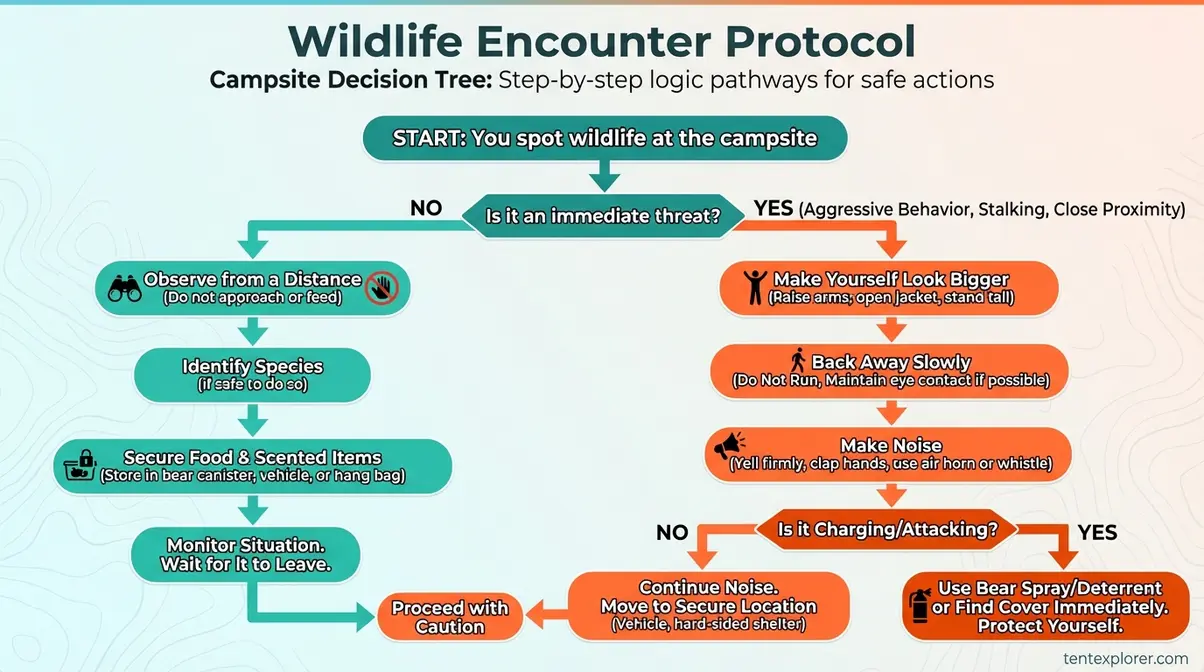
Checkpoint: You should now know the 7 LNT principles, your campground’s fire ban status, quiet hours times, and wildlife food storage rules.
Those are the 5 core steps. Now let’s customize them for your specific camping setup.
First-Time Camping by Type: Tent, RV, and Family
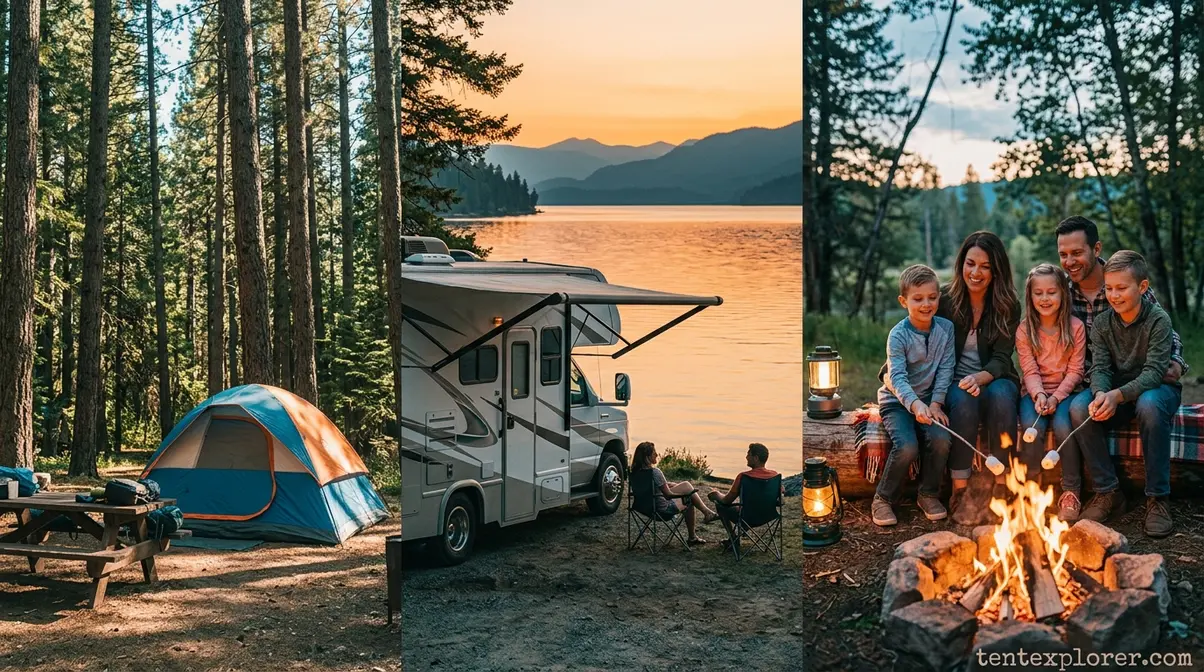
The 5 steps above apply to all camping types. However, tent, RV, and family camping each carry one or two unique considerations that can make or break a first trip. Putting all three in one place — with clear guidance on what changes and what stays the same — is something no competitor in this space currently offers.
First-Time Tent Camping Tips
For first-time tent camping, the most important gear decision is tent selection. Choose a 3-season, 3-person tent even if you’re camping for two — the extra space is worth the modest weight and cost increase. Freestanding tents are easiest for beginners because they stand up without staking, giving you flexibility to reposition before committing.
Always choose a developed campground for your first tent trip — designated tent pads, fire rings, and nearby flush toilets make the experience manageable. Dispersed camping (camping on public land without designated sites) is for experienced campers only; the lack of infrastructure adds complexity that a first trip doesn’t need. For tent selection guidance, see our roundup of the best tents for beginner campers. Practice pitching at home remains the single highest-ROI preparation step.
First-Time RV and Travel Trailer Tips
RV camping follows a different pacing rule. The 4-4-4 rule for RV travel — drive 400 miles or less per day, arrive before 4 PM, stay at least 4 nights — provides more relaxed pacing than the tent 3-3-3 Framework (KOA, koa.com). The extra margin accounts for the added complexity of maneuvering and setting up a large vehicle.
For first-time RV setup, request a full-hookup site (water, electric, sewer) to eliminate gray water management entirely on your first trip. Level the RV before connecting anything — an unlevel RV stresses the refrigerator and makes sleeping uncomfortable. If you’re pulling a travel trailer, practice hitching and unhitching in a parking lot before your trip. This is the step most first-time travel trailer campers skip, and nearly all of them regret it.
First-Time Family Camping Tips
First-time family camping tips diverge from the adult framework on one key point: trip length. For families with children under 8, start with a 1-night trip rather than the 3-3-3 Framework’s 3-night recommendation. Young children have lower frustration thresholds on first trips — a successful 1-night experience builds enthusiasm for longer trips far better than a difficult 3-night slog.
Pack a boredom kit for children: glow sticks, a deck of cards, a field guide to local birds or insects, and a flashlight for each child. Bored kids at 4 PM are the number-one reason family camping trips end early. Assign each child a simple camp job — collecting kindling, setting up the kitchen area, or serving as “fire safety monitor.” Ownership increases engagement and keeps everyone invested in the trip’s success.
Where first-time tent camping focuses on shelter and personal gear, family camping layers in child-specific logistics. One specific scenario deserves its own section: bringing your dog.
Taking Your Dog Camping for the First Time
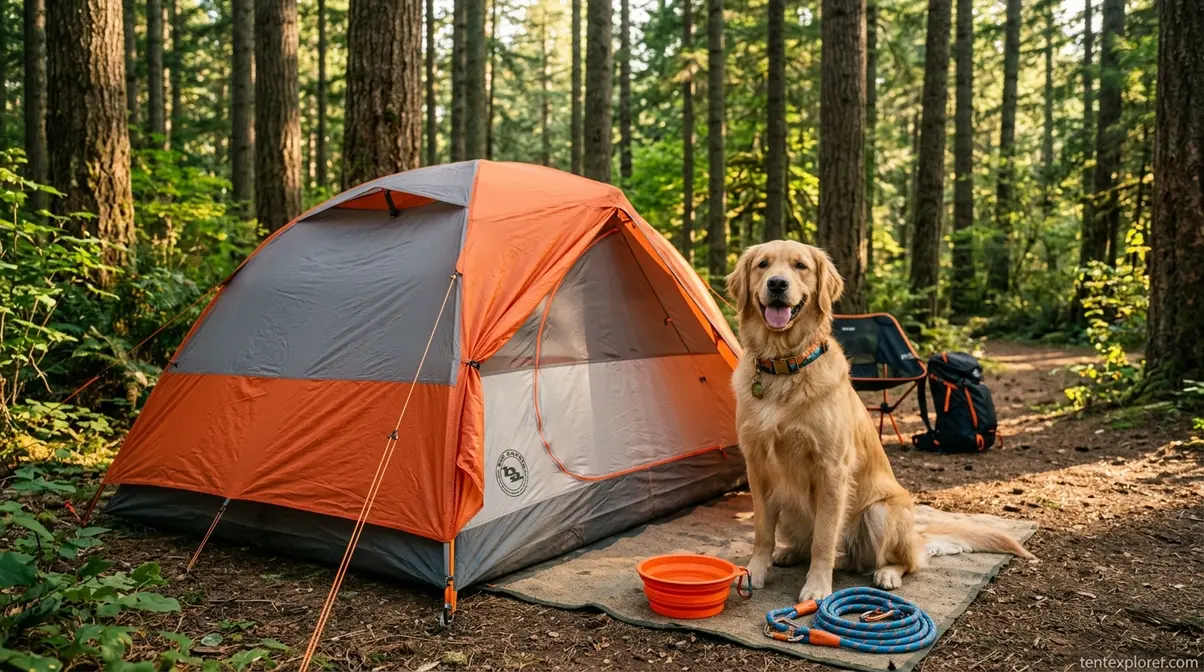
Tips for taking your dog camping for the first time involve three layers most beginners don’t anticipate: gear, campground rules, and wildlife safety. The most common scenario: a dog owner arrives at a campground and discovers leash requirements they didn’t check in advance.
Essential Gear for Camping with Your Dog
The dog camping gear list builds on your standard kit with seven additions:
- Leash — 6-foot maximum for most campgrounds
- Collapsible water bowl — lightweight and packs flat
- Dog-specific first aid kit — include tweezers for tick removal
- Stake-and-cable tie-out — for campsite use when you need hands free
- Dog sleeping pad or blanket — ground is cold and damp overnight
- Dog food and treats in a sealed, scent-proof container
- Poop bags — mandatory in all campgrounds without exception
For a puppy’s first camping trip, choose a quieter mid-week campground rather than a summer Friday night. First trips are high-stimulation for puppies — new smells, sounds, and strangers. A lower-traffic environment reduces overwhelm and makes the experience positive. Search Recreation.gov with the “pets allowed” filter, then click through to the individual campground page to confirm leash length requirements and any breed restrictions.
Campground Rules and Safety for Dogs
Across experienced camper communities, three dog-related rules account for the majority of campground warnings and expulsions:
- Off-leash in a leash-required area — even for a friendly, well-trained dog, this results in a warning or removal from the campground
- Dog barking during quiet hours — consistently the top complaint filed against other campers
- Dog waste not bagged and disposed of properly — treat this identically to waste disposal in a city park
Wildlife safety adds another layer. Dogs should never be left unattended at a campsite — not in a tent, not on a tie-out overnight. Wildlife attracted to dog food smell (raccoons, coyotes, and bears in some regions) can injure an unattended dog. Most developed campgrounds require dogs to be on a leash of 6 feet or less at all times — confirm the specific policy on Recreation.gov before booking, as some campgrounds also charge a pet fee or restrict certain breeds.
Even with the best preparation, first-time campers make predictable mistakes. Here’s how to avoid the most common ones.
Common First-Time Camping Mistakes to Avoid
Our evaluation of beginner camping resources found that most guides list mistakes without explaining why they happen or how to fix them. The data from experienced camper communities tells a different story than most people expect — setup errors rank lower than planning and food management failures.
The 5 Most Common Setup Mistakes
According to Eastern New Mexico University, the three biggest mistakes beginner campers make are going without a solid plan, forgetting adequate water, and leaving without a first aid kit. These first time camping tips for mistake avoidance follow a Problem → Fix format:
- Arriving after dark. Why it happens: underestimating drive time and setup duration. Fix: Apply the 3-3-3 Framework — leave early enough to arrive by 3 PM.
- Skipping the home tent practice. Why it happens: assuming setup is intuitive. Fix: Pitch your tent at home the week before your trip, ideally twice.
- Forgetting the first aid kit. Why it happens: “I probably won’t need it” reasoning. Fix: Pack it first — it goes in the car before anything else (Eastern New Mexico University).
- Overpacking. Why it happens: anxiety drives over-preparation. Fix: Use the 10-item minimum kit, then add only items you’ll use every single day.
- No water plan. Why it happens: assuming water will be available at the campground. Fix: Bring more than you think you need — at minimum 2 liters per person per day — plus a filter for backup.
The USDA Forest Service technique of laying all gear out at home and checking it off before loading prevents most forgotten-item problems. Use it every trip, not just the first.
Food and Safety Oversights That Ruin Trips
Beyond the 40°F cooler rule, several food and safety oversights consistently derail first trips. According to Jellystone Park Akron Canton (2025), the most forgotten camping items include extra batteries and chargers, reusable water bottles, insect repellent, and a tin opener — items that seem obvious until you’re standing at the campsite without them.
The “it’s just one night” mindset is the deeper problem. Beginners who plan a 1-night trip often skip the first aid kit, water filter, and rain gear. The 3-3-3 Framework’s 3-night minimum forces proper preparation — you genuinely can’t cut corners for three nights the way you can for one. Most experienced campers admit their first trip involved at least one forgotten item. The goal isn’t perfection; it’s having the critical items (water, first aid, rain gear) and improvising the rest.
Before we close with FAQs, a word from the camping community about what they wish they’d known.
What Real Campers Wish They Knew
First time camping tips from Reddit consistently surface the same four pieces of advice across r/camping threads — the same insights that beginners search for but rarely find in standard guides. Utah State University Extension notes that a growing number of people are discovering the physical and mental health benefits of camping and spending time outdoors — which explains why so many first-timers are searching for honest, practical guidance rather than aspirational gear ads.
Among the first-time camping quotes that resonate most with the Reddit community: “Your first night will be weird, your second night will be better, and by your third night you’ll wonder why you waited so long.” That’s the 3-3-3 Framework’s 3-night recommendation confirmed by community experience.
The four most consistent pieces of advice from r/camping:
- Overestimate setup time. Everything takes twice as long the first time. Buffer your arrival.
- Underprepare the menu. Simple food cooked well beats ambitious food cooked badly.
- Bring more layers than you think you need. Night temperatures surprise almost every first-timer.
- Talk to your campsite neighbors. Experienced campers are almost universally willing to help a beginner — and they often have the tool or tip you need.
One final section before your trip: knowing when camping might not be the right choice yet.
When Camping Might Not Be the Right First Step
Balanced advice builds trust. Some people genuinely shouldn’t start with tent camping — and saying so directly is more useful than pretending the experience suits everyone equally.
When to Choose a Cabin or Glamping Instead
If you have mobility limitations, children under 4, or significant sensitivity to cold and damp conditions, a cabin or glamping setup eliminates the highest-friction elements of tent camping while still delivering the outdoor experience. Glamping — furnished tent cabins with real beds — is a legitimate and respected entry point.
The r/camping community quote at the top of this guide captures this perfectly: starting with a cabin before a tent/bag/pad-combo is not a compromise, it’s a strategy. KOA’s cabin network is specifically designed for this stepping-stone approach — their cabins offer the campground environment with none of the gear complexity. Arriving at a KOA cabin to test whether you enjoy campground life before investing in gear is exactly the kind of low-risk experiment that leads to confident tent camping later.
When to Join a Guided Trip Before Going Solo
If you’re planning to camp in bear country, at elevation above 8,000 feet, or in a remote area more than 30 miles from the nearest town, a first guided trip is strongly recommended before going solo. These environments add variables — altitude acclimatization, wildlife protocols, weather severity — that a first-time camper shouldn’t manage alone.
REI Outdoor School and local hiking clubs offer beginner camping trips led by experienced guides, providing real-world learning with a safety net. The framing that matters: solo tent camping in a developed campground 20 miles from home is the right first step for most people. Everything beyond that warrants more experience first.
Frequently Asked Questions
What Are the 7 C’s of Camping?
The 7 C’s of camping are Cover, Cooking, Comfort, Clothing, Cleanliness, Care, and Communication. Cover refers to your shelter system; Cooking to food preparation equipment; Comfort to your sleep system; Clothing to layered, weather-appropriate apparel; Cleanliness to hygiene supplies; Care to your first aid kit; and Communication to emergency devices or signaling tools. Experienced campers use this framework as a final packing checklist before any trip. It works particularly well as a cross-check against a written gear list.
What Are Some Beginner Camping Tips?
Beginner camping tips start with one principle: keep it simple. Choose a developed campground with flush toilets and running water within 30 miles of home. Arrive before 3 PM to set up in daylight. Pack a basic tent, sleeping bag (temperature-rated), sleeping pad, headlamp, and first aid kit. Practice pitching your tent at home before the trip. One or two nights is enough to build confidence before longer trips — don’t start with a 5-night backcountry adventure.
What Is the 3-3-3 Rule for Camping?
The 3-3-3 rule for camping originally applied to RV travel: drive 300 miles or less per day, arrive by 3 PM, and stay at least 3 nights. For tent campers, this adapts to the Tent Camper’s 3-3-3 Framework: arrive by 3 PM, stay 3 nights, and camp within 30 miles of home on your first trip. Each element reduces a specific beginner anxiety — setup time, adjustment period, and the need for a safety net if something goes wrong.
What Is the 4-4-4 Rule Camping?
The 4-4-4 rule is an RV camping guideline: drive 400 miles or less per day, arrive at your destination before 4 PM, and stay at each destination for at least 4 days. This promotes a more relaxed travel pace and reduces driver fatigue on long RV trips. It is specifically designed for RV and travel trailer campers, not tent campers. Tent campers use the 3-3-3 Framework instead, which is calibrated for the shorter distances and simpler setup of a first tent trip.
What Is the Most Forgotten Item When Camping?
The most commonly forgotten camping items include extra batteries and chargers, reusable water bottles, insect repellent, a tin opener, and hand sanitizer (Jellystone Park Akron Canton, 2025). First aid kits are also frequently left behind despite being critical for safety. The simplest prevention: lay every item out on the floor at home and check each one off a written list before loading the car — the same technique the USDA Forest Service recommends for all campers.
What Does FF Mean at a Campground?
FF stands for Full Facility in campground listings — it indicates a campground with flush toilets, running water, and often showers. FF campgrounds are the best choice for first-time campers because they eliminate the need for portable toilets, water filtration, and hygiene improvisation. When searching on Recreation.gov, filter for “flush toilets” or look for “FF” in the campground description. FCFS (First Come, First Served) is a separate term meaning no reservation is required — you show up and take whatever site is available.
How Do I Choose the Right Campsite for My First Trip?
Choose a developed campground with flush toilets, running water, and designated fire pits within 30 miles of home for your first camping trip. Look for a flat, dry tent spot clear of rocks and debris, positioned at least 15 feet from any fire pit per California State Parks safety guidelines. Reserve in advance — Recreation.gov opens reservations 6 months ahead on a rolling basis, and popular summer weekends fill quickly. Avoid backcountry or dispersed camping until you have at least 3–5 camping trips of experience.
What Essential Gear Do I Need for My First Camping Trip?
Essential first-time camping gear covers five categories: shelter (tent with footprint and stakes), sleep system (temperature-rated sleeping bag and sleeping pad), light (headlamp with spare batteries), water (bottles plus filter or purification tablets), and safety (first aid kit and multi-tool). A camp stove, cooler with ice packs, and rain gear round out the kit. Consider renting the tent and sleeping bag from REI before committing to a purchase — a full weekend rental typically costs less than a single piece of budget gear.
Your First Camping Trip Starts Here
For first-time campers, success comes down to five decisions: where you camp, what you pack, how you set up, how you manage food, and how you treat the environment around you. Keeping perishables below 40°F isn’t optional — bacteria multiply rapidly in the 40–140°F danger zone (University of Maine Cooperative Extension). The best approach combines a close-to-home developed campground, a verified gear checklist, and the Tent Camper’s 3-3-3 Framework to structure your timeline.
The Tent Camper’s 3-3-3 Framework collapses what feels like an overwhelming planning process into three decisions: arrive by 3 PM, stay 3 nights, camp within 30 miles of home. That structure addresses the anxiety that stops most beginners from booking the trip in the first place. Practice makes the difference — and your first trip is where that practice starts.
Head to Recreation.gov, search for a developed campground within 30 miles of home, and book your first 3-night trip for this season. Download the first-time camping checklist from tentexplorer.com to verify your gear before you leave. The campsite is waiting — the only thing left to do is reserve it.

Dave King
I'm Dave King. I publish Tent Explorer, a site built to answer the questions people actually ask before they buy.