 Dave King
The right tent weight depends entirely on whether you’re packing it on your back or anchoring it to the ground — and getting that math wrong means either a punishing shoulder on the trail or a canopy cartwheeling across a parking lot. This tent weight guide gives you the exact numbers for both scenarios in one place.
Most guides cover backpacking tent weights or canopy ballasting — never both. That forces you to piece together advice from four different sites before you can make a single confident decision. By the end of this guide, you’ll know exactly how much your backpacking tent should weigh per person, what weight classes mean in practical terms, and how many pounds per leg your canopy tent needs to stay safely anchored. We cover backpacking weight fundamentals first, then car camping benchmarks, then canopy ballasting safety standards — with a FAQ section answering the 8 most common questions on the topic.
Whether you’re a weekend backpacker, a long-distance hiker trimming base weight, or an event planner setting up a 10×10 canopy on concrete, this guide has your numbers.
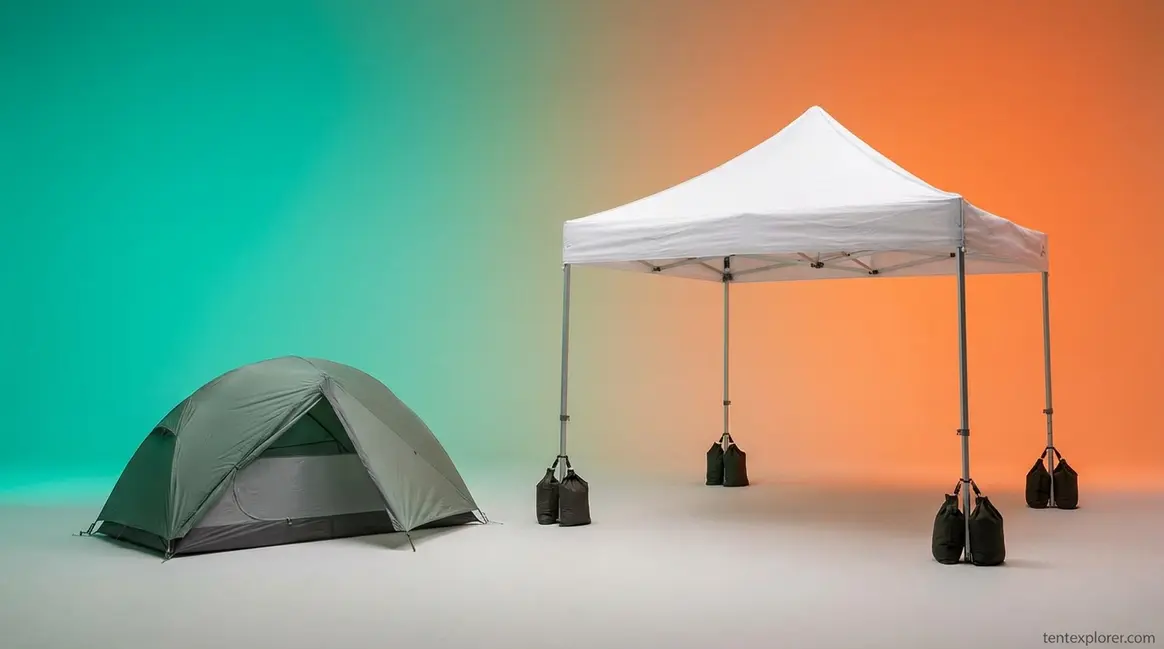
This tent weight guide covers two opposite rules: for backpacking, minimize what you carry (ultralight under 2 lbs, standard 2-person: 3–5 lbs); for canopy events, maximize your anchoring weight (40+ lbs per leg for a 10×10 tent in calm conditions).
- Trail weight (body + fly + poles only) is the accurate comparison metric — not packaged weight
- Ultralight: under 2 lbs | Lightweight: 2–3 lbs | Traditional: 3–5 lbs | Heavyweight: 5+ lbs
- 10×10 canopies need 40 lbs per leg minimum; 50–100 lbs in windy conditions
- The Dual Weight Rule: backpacking = lighter is better; canopy events = heavier is safer
Backpacking Tent Weight Explained: Trail Weight vs. Packaged Weight
“I think 5-6 lbs is reasonable with two people, where you can distribute the weight. After a lot of the replies, I’m thinking I might need a much lighter tent.” — r/CampingGear community
That instinct is right — and the confusion usually starts with which weight number to look at. Most retail listings show packaged weight, which is higher than what you’ll actually carry. Here’s what each number means and which one to use when comparing tents.
Ultralight backpacking tents weigh under 2 pounds, while traditional 2-person models average 3–5 pounds — a difference that can determine whether you finish a 15-mile day feeling strong or defeated.
Based on industry weight standards and municipal safety guidelines reviewed for this tent weight guide, the single most common mistake intermediate backpackers make is evaluating tents by the wrong number. Once you know which figure to trust, every gear comparison becomes clearer.
Trail Weight vs. Packaged Weight
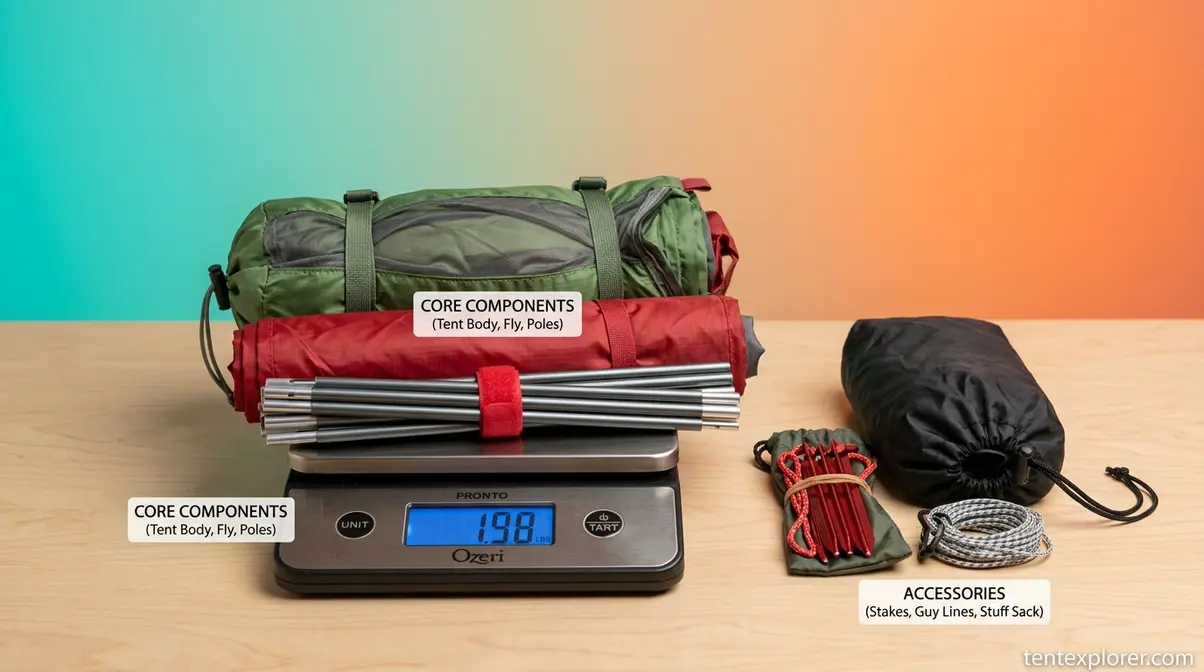
Trail weight — also called minimum weight — includes only the tent body, rainfly, and poles. This is what actually goes on your back. It’s the honest comparison number when you’re evaluating two shelters side by side, and it’s the figure serious backpackers use when building their gear spreadsheets.
Packaged weight, by contrast, is everything in the retail box: the tent body, fly, poles, stakes, guy lines (the tensioned cords that anchor the fly and poles to the ground), stuff sacks, and a repair kit. This is what you’ll see on most Amazon listings and manufacturer spec pages — and it’s what most beginners mistakenly compare.
The practical implication: packaged weight is typically 10–20% heavier than trail weight. If you’ve been comparing tents using the packaged weight listed on retail sites, you’re likely overestimating your load. A tent listed at 4.5 lbs packaged weight might carry a trail weight of 3.8 lbs — a 0.7 lb difference that compounds meaningfully on a 10-mile day. The difference between trail weight and packed weight is clearly documented by the Appalachian Mountain Club, which notes that packed weight reflects what you purchase, not necessarily what you carry (AMC Outdoors). For a deeper look at how this distinction affects your overall kit, see the difference in weight between backpacking and camping tents.
The diagram below shows exactly which components count toward each measurement.
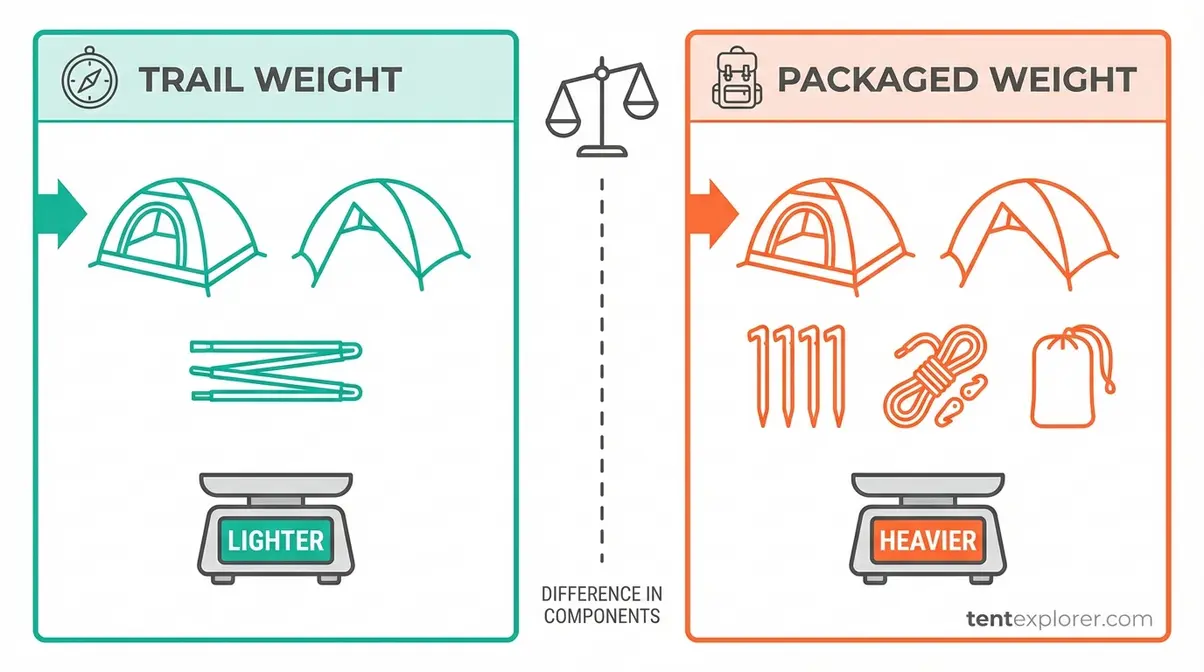
Caption: Trail weight strips away stakes, guy lines, and stuff sacks — leaving only what you’ll actually shoulder on the trail.
Now that you know which weight number to trust, here’s what those numbers actually mean — and where your current tent falls on the spectrum.
Backpacking Tent Weight Classes: Ultralight to Heavyweight
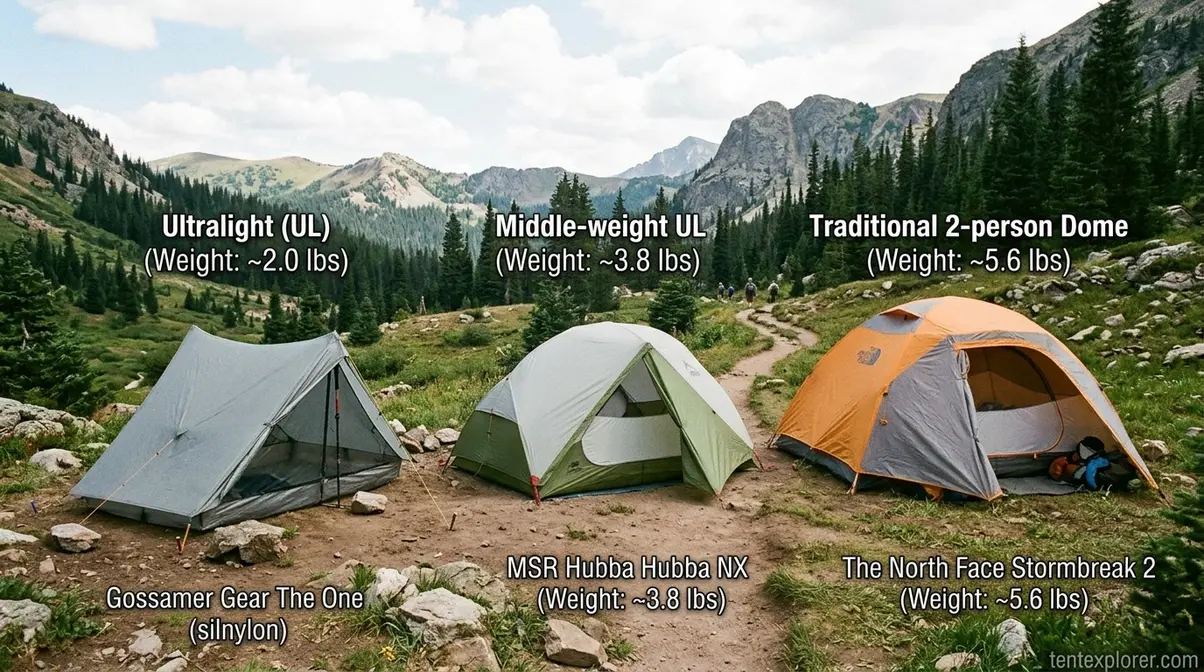
Four weight classes define the backpacking shelter market, and each represents a deliberate set of trade-offs between comfort and carry burden.
| Class | Trail Weight | Best For | Trade-offs |
|---|---|---|---|
| Ultralight | Under 2 lbs | Solo thru-hikers, 15+ mi/day | Smaller vestibule, thinner fabric, fewer poles |
| Lightweight | 2–3 lbs | Experienced backpackers, weekend trips | Moderate livability, good durability |
| Traditional | 3–5 lbs | Most backpackers, 3-season use | Comfortable, heavier on long climbs |
| Heavyweight | 5+ lbs | Short trips, base camping | Maximum comfort, punishing on elevation gain |
The “1 lb per person” ultralight benchmark is real — experienced thru-hikers on the PCT and Appalachian Trail actively target it — but it’s aspirational rather than a hard rule for most people. Achieving sub-1 lb per person usually means accepting a single-wall design, minimal pole structure, and a vestibule barely large enough for a pair of boots.
Most intermediate backpackers carry tents in the 3–5 lb traditional range — and that’s completely reasonable unless you’re covering 15+ miles per day regularly (Switchback Travel, 2024). The trade-off for ultralight shelters is real: thinner fabrics condense moisture faster, and fewer poles mean less structural integrity in a windstorm.
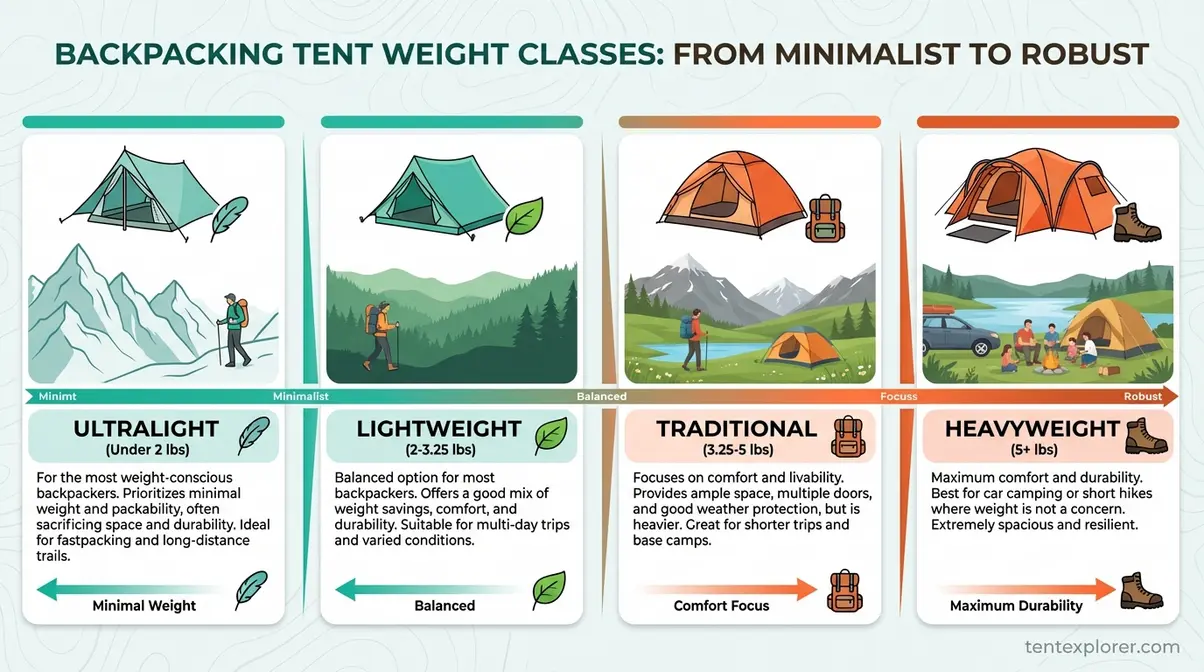
Caption: The four backpacking tent weight classes — each step up in weight buys measurable comfort but costs you on long ascents.
The infographic above summarizes these categories for quick reference — save it for your next gear comparison.
Knowing your weight class is step one. Step two is knowing how much your specific tent should weigh based on how many people it needs to shelter — and whether a 5-pound tent is actually too heavy for your trips.
How Much Should Your Backpacking Tent Weigh?
The standard per-person rule of thumb: target 2.5–3 lbs per person for the tent alone. For a 2-person tent, that means a 5–6 lb shelter splits to 2.5–3 lbs each — squarely in the traditional range and perfectly acceptable for most weekend and moderate-distance trips.
Is a 5-pound tent too heavy for backpacking? Not categorically. A 5-pound tent is manageable if you’re splitting it between two people or doing shorter trips under 8 miles per day. It becomes a real burden on solo long-distance hiking, where every ounce compounds across elevation gain and multi-day mileage. That same answer applies directly to “Is a 5-pound tent too heavy to hike with?” — context determines the answer more than the number itself.
Is 50 lbs too heavy for backpacking? That depends on your body weight, not just your pack weight. General backcountry guidelines recommend keeping total pack weight at 20–25% of your body weight for comfortable multi-day hiking (National Parks Conservation Association). For a 150 lb hiker, that’s 30–37.5 lbs. At 50 lbs, you’re at 33% of body weight — not impossible to carry, but significantly above the comfortable range and associated with increased injury risk on uneven terrain, particularly to knees and ankles. A 150 lb hiker targeting a 25–30 lb total pack should allocate no more than 5–7 lbs to the entire shelter system (tent + sleeping bag + sleeping pad combined) to stay in a comfortable range.
Per-person rules of thumb for your base weight planning:
- Solo hiker: Target under 2.5 lbs trail weight for a genuine ultralight setup; 3–4 lbs is a practical lightweight goal
- 2-person tent: 5–6 lbs total splits to 2.5–3 lbs each — the sweet spot for most trips
- Group of 3+: Consider two lightweight 2-person tents rather than one large shelter; weight distribution matters more than tent count
For specific models that hit the 3–5 lb range, see our roundup of lightweight 2-person backpacking tents.
Once you know your weight class target, the next question is context. If you’re driving to the campsite instead of hiking to it, the math changes completely — and carrying weight becomes irrelevant.
Car Camping Tent Weights: When Heavier Is Fine
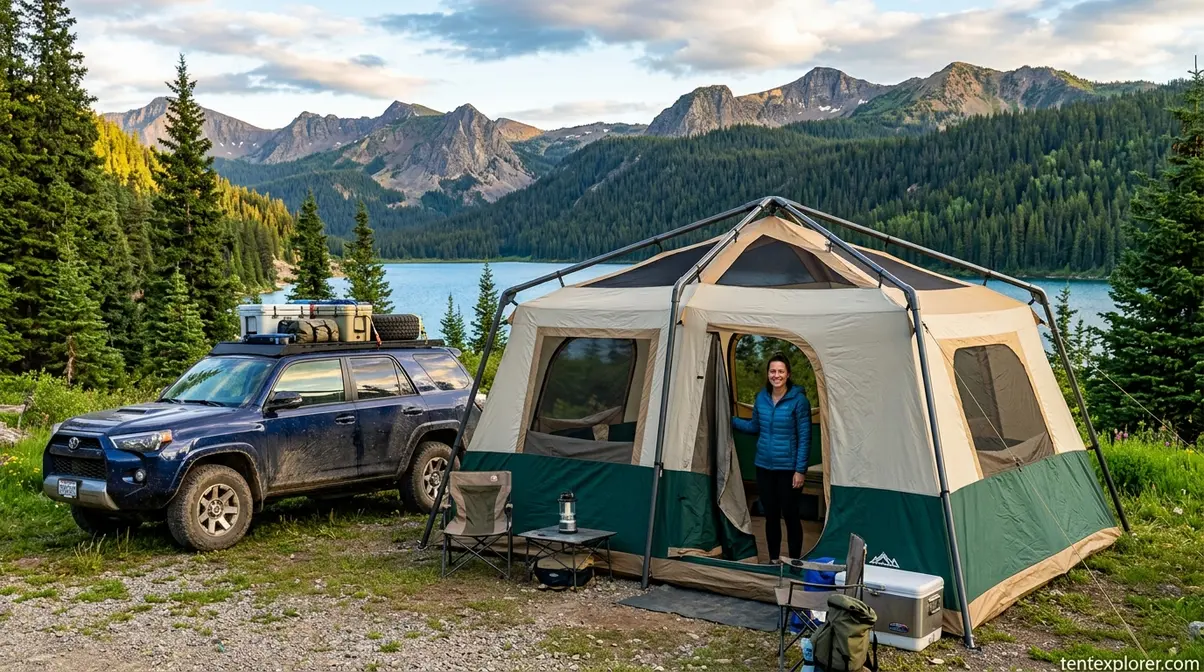
Car camping tents are intentionally, unapologetically heavy. A 6-person car camping shelter weighing 15–32 lbs is not a defect — it’s the expected result of heavier aluminum poles, thicker waterproof fabric, larger floor footprints, and structural features optimized for durability over portability. Since the tent travels in a vehicle rather than on a back, every pound that would be a penalty on the trail is simply a non-factor at the trailhead parking lot.
A 6-person car camping tent can weigh 15 to 32+ pounds — up to 16 times heavier than an ultralight backpacking shelter — but since it never leaves the vehicle, that weight is completely irrelevant to trail performance.
This is why The Dual Weight Rule Rule #1 (minimize carried weight) doesn’t apply here. The tent never touches your back.
Why Car Camping Tents Weigh More
Three factors drive the weight gap between backpacking and car camping shelters. First, pole systems: backpacking tents use thin, flexible carbon fiber or lightweight aluminum; car camping tents use thicker steel or heavy-gauge aluminum poles that can withstand wind without guy lines tensioned by a hiker’s hand. Second, fabric weight: backpacking shelters use 15–20 denier ripstop nylon; car camping tents commonly use 68–190 denier polyester — two to ten times the fabric weight per square foot, with correspondingly better abrasion resistance and longevity. Third, floor footprint: a 2-person backpacking tent might cover 28–32 square feet; a 6-person car camping tent typically covers 60–100 square feet.
The result is a shelter that can withstand years of weekend use without seam failures — and that requires a vehicle to move it. For car camping tent options across different capacities, weight is rarely the deciding factor.
Cabela’s Instinct Alaskan Guide 6-Person: A Real-World Example
The Cabela’s Instinct Alaskan Guide 6-Person tent — a heavy-duty car camping shelter built for durability over portability — illustrates the car camping weight category precisely. The tent weighs approximately 28–32 lbs depending on configuration (Cabela’s official listing: ~31 lbs 15 oz; Bass Pro Shops listing: ~28 lbs 6 oz as of March 2026). Its geodesic dome frame, 2000mm-rated fly, and 3000mm-rated floor account for much of that weight — features that would be excessive for a backpacker but are exactly right for hunters, family campers, and anyone setting up a semi-permanent base.
For a 6-person capacity, that works out to roughly 4.7–5.3 lbs per person — comparable to a heavyweight backpacking tent per person, but distributed across a much larger, more livable space. See our roundup of 6-person tents for family camping for a direct comparison against competing models in this weight class.
Where backpacking tents reward every ounce saved, car camping tents take the opposite approach — and for good reason. But when a tent needs to stay anchored to the ground rather than the ground of a vehicle, the weight equation flips again entirely.
Canopy Tent Ballasting: How Much Weight Do You Need?
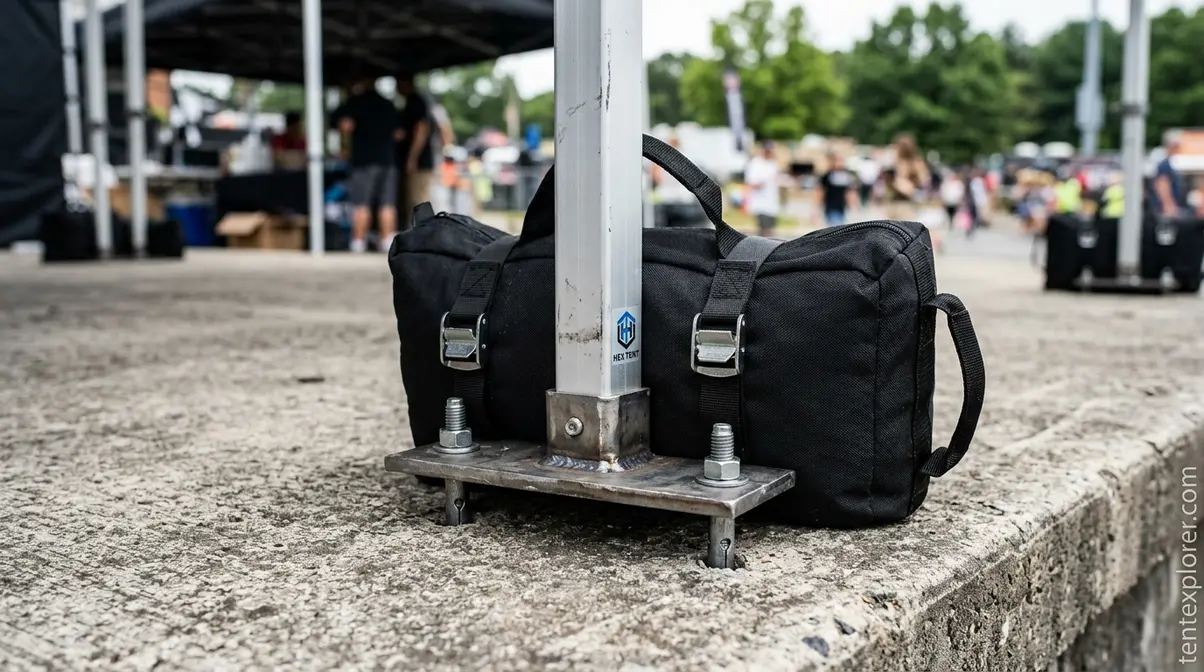
Tent ballasting (the practice of adding weight to each canopy leg to anchor the structure against wind uplift) follows the opposite logic of backpacking weight: more is safer. A 10×10 pop-up canopy with no ballast can become a projectile in a 20 mph gust — a documented hazard at outdoor markets, sporting events, and festivals. Industry guidelines and university safety offices consistently recommend minimum weights per leg, and those minimums increase sharply with wind exposure.
⚠️ Safety Disclaimer: The weight figures in this section are industry benchmarks — they are not a substitute for assessing your specific site conditions. Always consult your tent manufacturer’s ballasting specifications before setup. Local wind conditions, surface type, and event permit requirements vary by location. The City of San Diego Fire-Rescue Department requires permits for tents over 200 sq ft at public events and mandates that structures resist a minimum wind pressure of 20 lbs per square foot (City of San Diego, Special Event Guidelines). Check your local municipal requirements before any public event setup.
Our evaluation of municipal safety guidelines, university event safety documents, and industry ballasting standards for this guide found a clear consensus: 40 lbs per leg is the industry-standard minimum for a 10×10 canopy in calm conditions — and that number climbs significantly when wind enters the picture.
The 40-Pound Rule for 10×10 Canopies
The 40 lbs per leg standard for 10×10 canopies is the most widely cited benchmark across municipal safety documents and university event guidelines. UC Irvine’s Environmental Health & Safety office states directly: “In absence of specific manufacturer’s weighting equipment or guidelines, it is recommended to utilize 40 lbs per canopy leg for a 10′ x 10′ structure and 50+ lbs for larger structures” (UCI EHS, Canopy Safety Best Practices).
That 40-lb figure applies to calm conditions on a hard surface where staking is not an option — concrete plazas, asphalt parking lots, and indoor event floors. On grass where stakes are permitted, stakes provide the primary anchor and ballast requirements decrease, but weights on each leg remain a recommended secondary system.
In windy conditions, the minimum doubles. Industry sources consistently recommend 75–125 lbs per leg for a 10×10 canopy in gusty or exposed conditions (Sheltent, 2024). At 40 lbs per leg, a 10×10 canopy has 160 lbs of total ballast — adequate for calm weather but insufficient once sustained winds exceed 15–20 mph.
A properly ballasted 10×10 canopy requires a minimum of 40 lbs per leg in calm conditions and 75–125 lbs per leg in windy or exposed settings — figures supported by university safety guidelines and industry rental standards.
For PAA clarity: How much weight is needed to hold down a 10×10 canopy? A minimum of 40 lbs per leg (160 lbs total) in calm conditions; 75–125 lbs per leg (300–500 lbs total) in wind-exposed locations.
Weight for Larger Tents: 20×40 Sizes
Scaling from a 10×10 to a 20×40 canopy isn’t a linear math problem — it’s an engineering calculation. A 20×40 tent has 800 square feet of surface area compared to 100 square feet for a 10×10, meaning wind uplift forces increase by a factor of 8 or more depending on canopy height and roof pitch.
Industry sources and rental companies indicate that 20×40 frame tents typically require 6–8 sets of 350 lb concrete blocks depending on wind exposure and setup configuration — translating to roughly 260–460 lbs per leg for full wind-load scenarios. The American Rental Association’s ballasting charts show minimum ballasting requirements for frame tents at 50 mph wind ratings often exceeding 1,800–2,400 lbs total across all anchor points (ARA Tent Ballasting Charts, 2022).
For 20×40 tents at permitted public events, structural engineering review is typically required by municipal authorities — not just ballasting weights. The City of San Diego, for example, requires Fire-Rescue Department permits for all tents over 200 square feet used at outdoor events (City of San Diego Fire-Rescue, 2026).
| Tent Size | Calm Conditions (per leg) | Windy Conditions (per leg) | Notes |
|---|---|---|---|
| 10×10 | 40 lbs | 75–125 lbs | UCI EHS minimum standard |
| 10×20 | 75–100 lbs | 125–185 lbs | Proportional to surface area |
| 20×20 | 75–100 lbs | 150–200 lbs | Industry rental standard |
| 20×40 | 260+ lbs | Engineering review required | ARA charts; permit required |
Surface Type Adjustments: Grass, Concrete, and Sand
Surface type changes your ballasting strategy significantly — and in some cases, it determines whether ballast is your primary or secondary anchor system.
Concrete and asphalt: Staking is not an option. Ballast weights are your only anchor. Use a minimum of 40 lbs per leg for a 10×10; increase to 50 lbs per leg on exposed rooftops or open plazas. Water-filled weight bags work on concrete but should not release water into storm drains — a requirement explicitly stated in San Diego’s event guidelines (City of San Diego, Special Event Guidelines).
Grass and soil: Stakes are your primary anchor — and a properly staked canopy is significantly more secure than a ballasted one. Stakes driven at a 45-degree angle into firm soil can achieve holding power of several hundred pounds each. Add ballast weights as a secondary system when wind conditions are uncertain.
Sand: Sand provides poor holding power for standard stakes. Use sand-screw anchors or auger-style stakes designed for loose soil, and supplement with ballast weights on every leg. Standard tent stakes will pull out of dry sand under moderate wind loads.
Guy Lines, Footplates, and DIY Weight Options
Guy lines — tensioned cords running from the canopy frame to ground anchors — extend your effective anchoring footprint and reduce the per-leg ballast requirement. A canopy secured with guy lines to four staked anchor points can tolerate higher wind loads than the same canopy relying solely on leg weights.
Footplates (flat base plates that distribute leg load across a wider ground contact area) prevent legs from puncturing soft surfaces like gym floors or artificial turf, and improve stability on uneven ground. Most commercial canopy manufacturers sell footplates as accessories — they’re worth including for any event on non-concrete surfaces.
For DIY ballast options, the most practical solutions are:
- Sandbags: Inexpensive, easy to adjust, and can reach 40–50 lbs per bag. Secure directly to each leg with a hook or strap.
- Water jugs: A standard 5-gallon jug weighs approximately 41.7 lbs when full. Practical for grass setups; avoid on concrete where tipping risk is higher.
- Concrete blocks / cinder blocks: A standard 8x8x16 cinder block weighs approximately 28–35 lbs. Use two per leg to reach the 40 lb minimum, secured with strapping to prevent sliding.
- Commercial canopy weight bags: Designed to hang from leg frames, typically sold in 10–25 lb increments. Stack to reach your target weight per leg.
Note: The City of Salina, KS, explicitly advises against 50–55 gallon plastic water barrels as ballast due to their top-heavy profile and tendency to slide on hard surfaces (City of Salina Tent Anchoring Requirements). The same caution applies generally — any cylindrical water container that can roll should be secured with strapping or avoided on slopes.
Limitations & Safety: When to Get Expert Help
Safety Caveats for Canopy Ballasting

⚠️ Safety Disclaimer: The benchmarks in this guide reflect industry consensus and published municipal guidelines as of 2026. They are minimum starting points — not engineering certifications. Wind conditions, local codes, and tent manufacturer specifications must be assessed independently for every setup.
The 40-lbs-per-leg figure is a starting point, not a ceiling. Several conditions require exceeding it significantly:
- Elevated or exposed locations (rooftops, hilltops, open fields without windbreaks) can experience wind loads 2–3x higher than ground-level sheltered sites
- Events with walls or sidewalls attached to the canopy dramatically increase wind resistance and therefore ballasting requirements — a fully walled 10×10 canopy can require 75+ lbs per leg even in moderate wind
- Tents left unattended overnight should be over-ballasted or taken down entirely — wind conditions change, and an unmanned canopy has no one to collapse it before a gust arrives
Always consult your tent manufacturer’s ballasting specifications first. The UCI Environmental Health & Safety office recommends using manufacturer guidelines as the primary reference, with the 40-lb standard applying only when manufacturer specifications are unavailable (UCI EHS, Canopy Safety Best Practices).
When Standard Weight Formulas Don’t Apply
Standard formulas break down in three common scenarios that this guide’s benchmarks cannot cover:
Non-standard tent geometries. A standard 10×10 square canopy with a flat roof behaves predictably in wind. A 10×10 hex canopy with a high-peak roof or a canopy with a curved profile generates different lift forces — requiring manufacturer-specific ballasting data, not generic per-leg minimums.
Permitted public events. Most municipalities require a structural engineering review for tents above a certain size (typically 200–400 sq ft) at public gatherings. The City of San Diego requires Fire-Rescue Department permits for all tents over 200 sq ft at public events, with compliance documentation required (City of San Diego Fire-Rescue, 2026). If you’re setting up at a permitted farmers market, festival, or public event, check local requirements before relying on this guide’s figures.
Extreme weather regions. Coastal areas, mountain passes, and plains environments regularly see sustained winds above 35 mph. At those wind speeds, even well-ballasted 10×10 canopies should be taken down rather than weighted down — no practical ballast amount safely anchors a pop-up canopy in sustained 40+ mph wind. If you’re in a high-wind environment, consult a structural engineer or licensed tent rental company before your event.
Frequently Asked Questions
Is a 5-pound tent too heavy for backpacking?
A 5-pound tent is not too heavy for most backpacking trips — the answer depends on how you’re using it. Split between two people, a 5-lb tent means 2.5 lbs per person, which falls in the traditional weight class and is manageable on trips under 10 miles per day. Solo hikers covering 15+ miles daily will feel a 5-lb shelter as a real burden, particularly on elevation gain. For thru-hiking, target under 3 lbs solo; for weekend trips with a partner, 5–6 lbs is a practical and comfortable range.
What is a good weight for a 2-person backpacking tent?
A good weight for a 2-person backpacking tent is 3–5 lbs trail weight, which splits to 1.5–2.5 lbs per person. Lightweight options in the 2–3 lb range exist but typically sacrifice vestibule space and weather protection. The 3–5 lb traditional range offers the best balance of comfort, durability, and pack weight for most backpackers. If you’re on a tight base weight budget, prioritize trail weight over packaged weight when comparing specs — the difference is often 10–20%.
How much weight is needed to hold down a 10×10 tent?
A 10×10 canopy tent requires a minimum of 40 lbs per leg — 160 lbs total — in calm conditions on a hard surface where staking isn’t possible, according to UCI Environmental Health & Safety guidelines (UCI EHS, Canopy Safety Best Practices). In windy or exposed conditions, that minimum rises to 75–125 lbs per leg (300–500 lbs total). On grass where stakes are permitted, stakes serve as the primary anchor; add ballast weights as a secondary system. Always check your tent manufacturer’s specifications first.
How much weight is needed to hold down a 20×40 tent?
A 20×40 canopy tent typically requires 260+ lbs per leg in moderate conditions, with full wind-load scenarios requiring structural engineering review rather than simple per-leg weight formulas. Industry sources indicate 6–8 sets of 350-lb concrete blocks for a standard 20×40 frame tent depending on configuration (ARA Tent Ballasting Charts, 2022). Most municipalities require a structural engineering permit for tents of this size at public events. Contact a licensed tent rental company for site-specific ballasting requirements — generic benchmarks are insufficient at this scale.
What is the difference between trail weight and packaged weight?
Trail weight includes only the tent body, rainfly, and poles — what you actually carry on your back. Packaged weight adds everything in the retail box: stakes, guy lines, stuff sacks, and a repair kit. Packaged weight is typically 10–20% higher than trail weight. A tent listed at 4.5 lbs packaged might have a trail weight of 3.8 lbs. When comparing tents for backpacking, always use trail weight. Packaged weight reflects what you purchase; trail weight reflects what you carry (AMC Outdoors).
Is 50 lbs too heavy for backpacking?
At 50 lbs, most hikers are carrying more than is comfortable or safe for multi-day backcountry travel. General backcountry guidelines recommend keeping total pack weight at 20–25% of your body weight. For a 150-lb hiker, that’s 30–37.5 lbs. A 50-lb pack puts a 150-lb hiker at 33% of body weight — above the recommended range and associated with increased knee and ankle injury risk on uneven terrain. It’s physically possible to carry 50 lbs, but it significantly degrades daily mileage and recovery time on back-to-back days.
Is a 5-pound tent too heavy to hike with?
A 5-pound tent is not too heavy to hike with in most contexts. For two people splitting the weight, it’s 2.5 lbs each — a manageable addition to a well-optimized kit. For a solo hiker doing short to moderate trips (under 8 miles per day), a 5-lb tent is workable but not ideal. Where it becomes genuinely burdensome: solo thru-hiking with 15+ mile days and significant elevation gain, where cumulative fatigue makes every pound matter. In that context, targeting a 2–3 lb ultralight or lightweight option pays dividends by day three.
How much weight is needed to hold down a 10×10 canopy?
A 10×10 canopy needs at least 40 lbs per leg on hard surfaces in calm conditions — a standard validated by UCI Environmental Health & Safety and consistent with industry rental guidelines (UCI EHS, 2026). That’s 160 lbs of total ballast across four legs. On concrete or asphalt where staking isn’t permitted, this is your minimum starting point. In gusty or wind-exposed conditions, increase to 75–125 lbs per leg. Never rely on a single anchor method — combine ballast weights with guy lines where possible for maximum stability.
Choosing the Right Tent Weight for Your Setup
For backpackers, this tent weight guide delivers one clear directive: use trail weight as your comparison metric, target 2.5–3 lbs per person for your shelter, and choose your weight class based on your daily mileage. A traditional 3–5 lb tent is the right call for most weekend hikers. Ultralight options under 2 lbs make sense only when you’re consistently covering 15+ miles per day and have optimized every other item in your kit.
The Dual Weight Rule captures the core insight of this guide: backpacking and canopy tenting follow opposite optimization strategies. For backpacking, every pound you remove from your shelter system is a pound your knees and shoulders thank you for at mile 12. For canopy events, every pound you add to each leg is a margin of safety between your setup and the next gust of wind. Applying the wrong rule to the wrong tent type is how gear decisions go wrong — and how canopies end up airborne.
Start with your use case, apply the right rule, and use the benchmarks here as your baseline. For backpacking, check trail weight on the manufacturer’s spec sheet before you buy. For canopy events, verify your surface type, check local permit requirements, and default to your manufacturer’s ballasting specifications — using the 40-lb-per-leg minimum only when manufacturer data isn’t available. Both decisions are straightforward once you know which direction to optimize.

Dave King
I'm Dave King. I publish Tent Explorer, a site built to answer the questions people actually ask before they buy.