What to Wear Camping: The 3-Layer System Guide
 Dave King
Updated May 5, 2026
21 min read
Dave King
Updated May 5, 2026
21 min read
“Hello! I’ve recently acquired camping and hiking as a hobby, and I love it.”
That feeling — excited, enthusiastic, and just a little anxious about packing the wrong thing — is exactly where most new campers start. Figuring out what to wear when camping shouldn’t require an engineering degree. Yet a quick scroll through outdoor forums reveals the same recurring fear: showing up underprepared, getting soaked, and spending the whole trip cold and miserable.
The good news? You don’t need an enormous duffel bag of gear or a wardrobe full of expensive technical clothing. You need a system. This guide introduces the 3-3-3 Camping Capsule Wardrobe — a practical, science-backed framework built around 3 base layers, 3 mid layers, and 3 outer pieces that cover you from dawn hikes to midnight campfire sessions, across every season. Whether you’re planning a summer weekend at a lakeside site or a crisp autumn trip in the mountains, this guide will leave you confident and correctly packed.
Knowing what to wear when camping comes down to one principle: the 3-3-3 Camping Capsule Wardrobe — 3 base layers, 3 mid layers, and 3 outer/shell pieces that cover any condition.
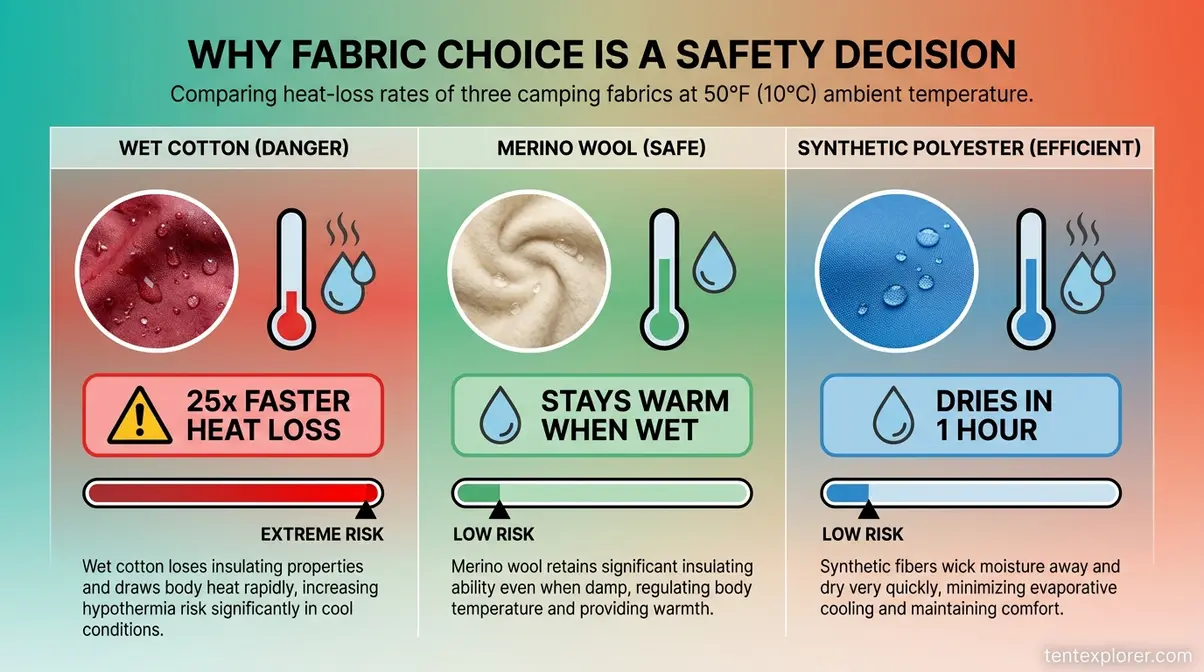
- Avoid cotton: Wet cotton conducts heat away from your body up to 25 times faster than dry air, raising hypothermia risk even above freezing.
- Layer strategically: The 3-layer system (base, mid, shell) lets you add or remove clothing as temperatures swing from morning chill to afternoon warmth.
- Don’t forget the forgotten five: Dry sleep base layers, extra socks, a beanie, camp shoes, and insect-treated clothing are the items most campers leave at home.
- Seasonal adjustments matter: Summer camping prioritises sun protection and quick-dry fabrics; cold-weather camping demands insulated mid layers and waterproof shells.
Table of Contents
- Camping Clothes: Fabrics & the 3-Layer System
- The 3-3-3 Camping Capsule Wardrobe
- What to Wear Camping by Season
- Extremities: Head, Hands, and Feet
- Top 5 Forgotten Camping Clothing Items
- Insect Protection and Sun Safety
- Common Mistakes and When to Upgrade Gear
- Frequently Asked Questions
Camping Clothes: Fabrics & the 3-Layer System {#fabrics-and-layering}
What kind of clothes should I wear for camping?
Wear moisture-wicking, quick-dry fabrics in a 3-layer system: a base layer (merino wool or synthetic) next to your skin, a mid layer (fleece or insulated jacket) for warmth, and a waterproof shell for wind and rain protection. Avoid cotton in cold or wet conditions — it absorbs moisture and loses insulating properties when damp, raising hypothermia risk. For a 3-night trip, the 3-3-3 Camping Capsule Wardrobe (3 base layers, 3 mid layers, 3 outer pieces) covers every scenario from morning hikes to cold campfire evenings.
The single most important thing you can learn before packing for a camping trip has nothing to do with brand names or price tags. It’s about fabric science — understanding how different materials behave when you sweat, when it rains, and when temperatures drop after sunset. Before diving into fabrics, ensure you have reviewed an essential tent camping gear checklist to cover your broader equipment needs.
Before you start: You don’t need to memorise technical specs. You need to understand three fabric families and one simple system. Everything else follows naturally.
Why Cotton Is Dangerous When Camping
Cotton is comfortable, affordable, and perfectly fine for everyday life. On a camping trip — especially in cold or wet conditions — it becomes a genuine hazard.
Here’s the science: cotton fibres absorb moisture into their structure rather than pushing it away from your skin. According to outdoor fabric research cited by SectionHiker and field experts, wet cotton conducts heat away from your body up to 25 times faster than dry air — the same principle that makes a wet cotton T-shirt feel brutally cold even on a 50°F (10°C) day. The National Park Service consistently warns hikers and campers about hypothermia risk from wet cotton clothing, noting that the condition can develop at temperatures well above freezing. This risk is compounded by cotton’s notoriously slow drying time: a soaked cotton hoodie might still be damp the following morning.
Experienced campers consistently report that switching from cotton to moisture-wicking synthetic or wool fabrics is the single biggest comfort upgrade they’ve made. The phrase you’ll hear at every trailhead: “Cotton kills” — and while that’s a blunt way to say it, the underlying physics are real.
“Cotton absorbs moisture, insulates poorly when wet, and dries slowly — in cold, wet, or windy environments, it becomes dangerous.” (Field Mag, 2026)
What to wear instead: Merino wool, polyester, or nylon — all covered in the Fabric Science section below.
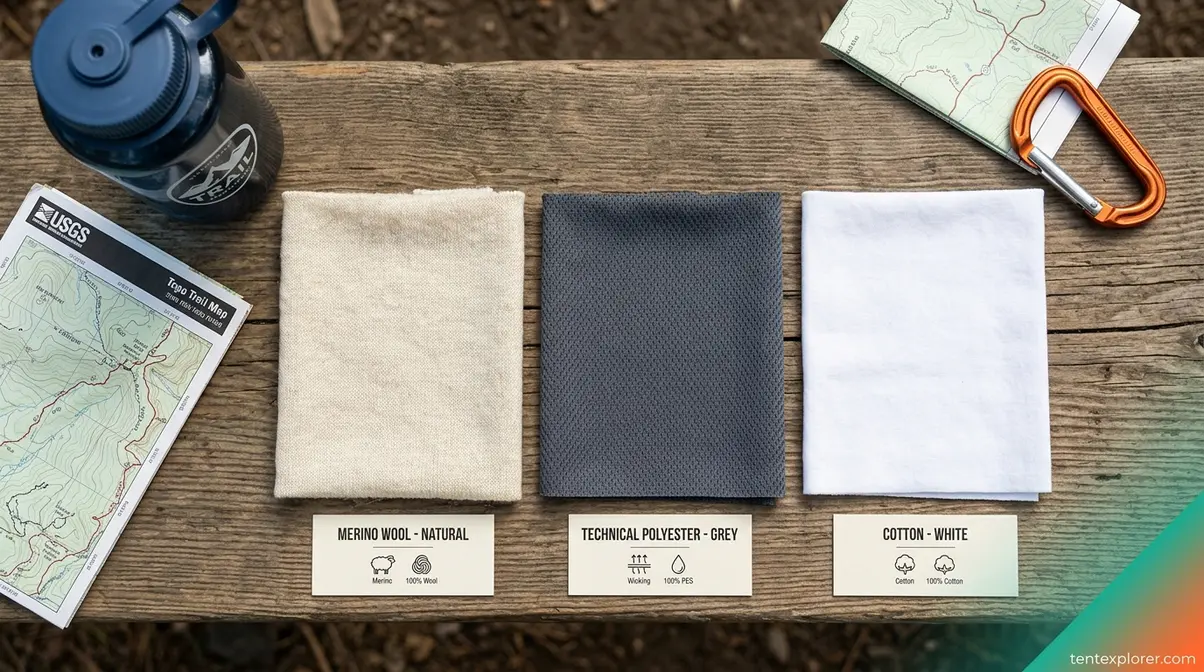
Merino, Synthetic, and Cotton Compared
Understanding the three main fabric families lets you make smart choices at any budget level.
Merino wool (a natural fibre prized for temperature regulation and odour resistance) is the gold standard for camping base layers. Texas A&M AgriLife Research found that wool can effectively regulate body temperature in both hot and cold conditions — a property that makes it genuinely multi-season. Woolmark’s CSIRO-backed wearer trials confirmed that merino wool socks were preferred over synthetic alternatives for both odour control and moisture comfort after extended wear. Merino can absorb up to 35% of its weight in moisture vapour while still feeling dry against your skin. A merino base layer like those from Smartwool or Icebreaker will cost more upfront, but it can be worn for multiple days without washing — a real advantage when you’re packing light.
Synthetic polyester and nylon fabrics are the quick-dry, budget-friendly workhorses of camping clothing. They wick moisture away from skin efficiently, dry fast (often within an hour of getting wet), and hold their insulating properties even when damp. The trade-off: they hold odour more readily than merino, so a multi-day trip may require more frequent washing or an odour-resistant treatment.
Cotton — as covered above — is the fabric to minimise in your camping wardrobe, particularly for anything touching your skin in cold or wet conditions. A cotton T-shirt on a warm, dry summer afternoon is fine. A cotton base layer on a rainy autumn night is a problem.
| Fabric | Moisture Wicking | Dries Quickly | Odour Resistance | Insulates When Wet | Best For |
|---|---|---|---|---|---|
| Merino Wool | ✅ Excellent | ✅ Good | ✅ Excellent | ✅ Yes | Base layers, socks, beanies |
| Synthetic (Polyester/Nylon) | ✅ Excellent | ✅ Excellent | ⚠️ Moderate | ✅ Yes | Base layers, shells, mid layers |
| Cotton | ❌ Poor | ❌ Slow | ✅ Good (when dry) | ❌ No | Camp-only casual wear (dry conditions) |
| Wool Blend | ✅ Good | ✅ Good | ✅ Good | ✅ Yes | Versatile mid layers |
The 3-Layer System: Base, Mid & Shell
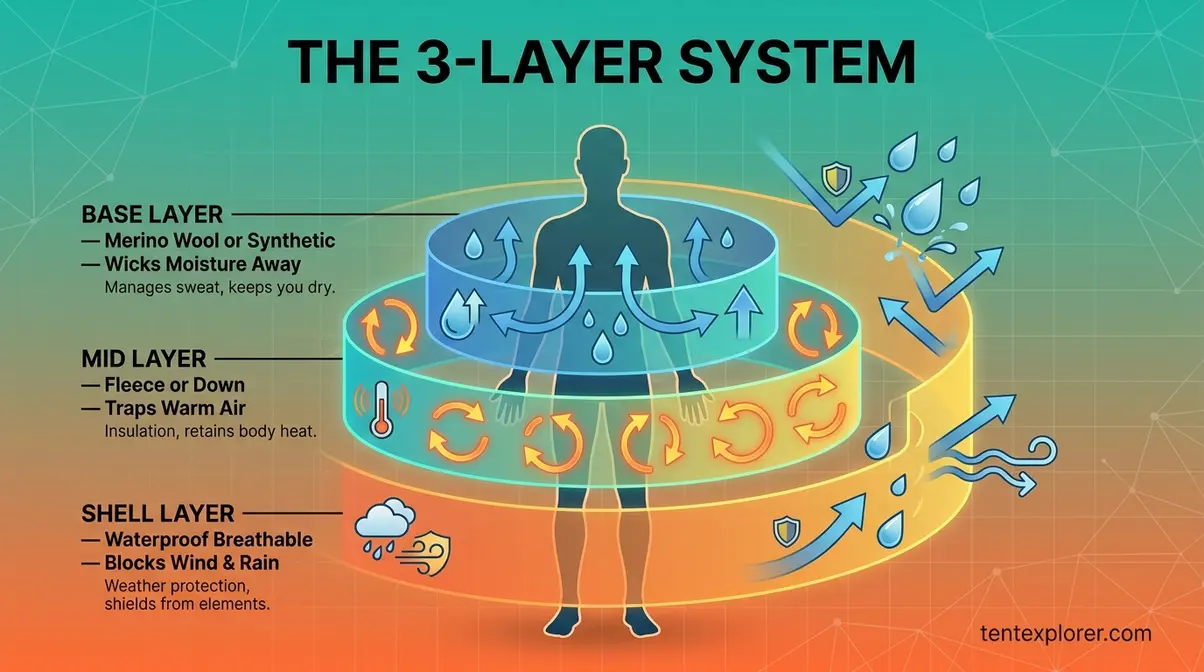
The 3-layer system is the foundational framework that REI’s expert layering guide — and virtually every serious outdoor organisation — recommends for managing body temperature across changing conditions. Think of it as adjustable climate control for your body.
Each layer has a specific job:
1. Base Layer (Next-to-Skin)
The base layer’s job is to move sweat away from your skin and keep you dry. It should fit snugly (not tightly), cover your torso and legs in cold conditions, and be made from merino wool or a moisture-wicking synthetic. This is the layer you never want to skip, and it’s the layer where cotton causes the most problems.
2. Mid Layer (Insulation)
The mid layer traps warm air close to your body. Fleece jackets, down vests, synthetic-fill jackets, and wool jumpers all qualify. This is your temperature dial — add it when temperatures drop, remove it during a sunny afternoon hike. For most three-season camping, a midweight fleece is the most versatile choice.
3. Shell Layer (Weather Protection)
The shell layer is your defence against wind and rain. A waterproof-breathable hardshell jacket (Gore-Tex or similar membranes) is the most protective option. A softshell offers more breathability for active movement but less rain resistance. At minimum, every camping pack needs some form of waterproof outer layer — weather changes faster outdoors than any forecast can predict.
The 3-3-3 Camping Capsule Wardrobe {#333-wardrobe}
The 3-3-3 Camping Capsule Wardrobe is our original framework for packing camping clothing confidently and efficiently. Rather than a long generic checklist, it gives you a structure: exactly 3 items in each of the 3 clothing layers, covering every scenario from early-morning trail walks to cold-night campfire sessions.
This framework is designed for 2-5 night camping trips. For longer trips, the same structure applies — you simply add one extra base layer for hygiene.
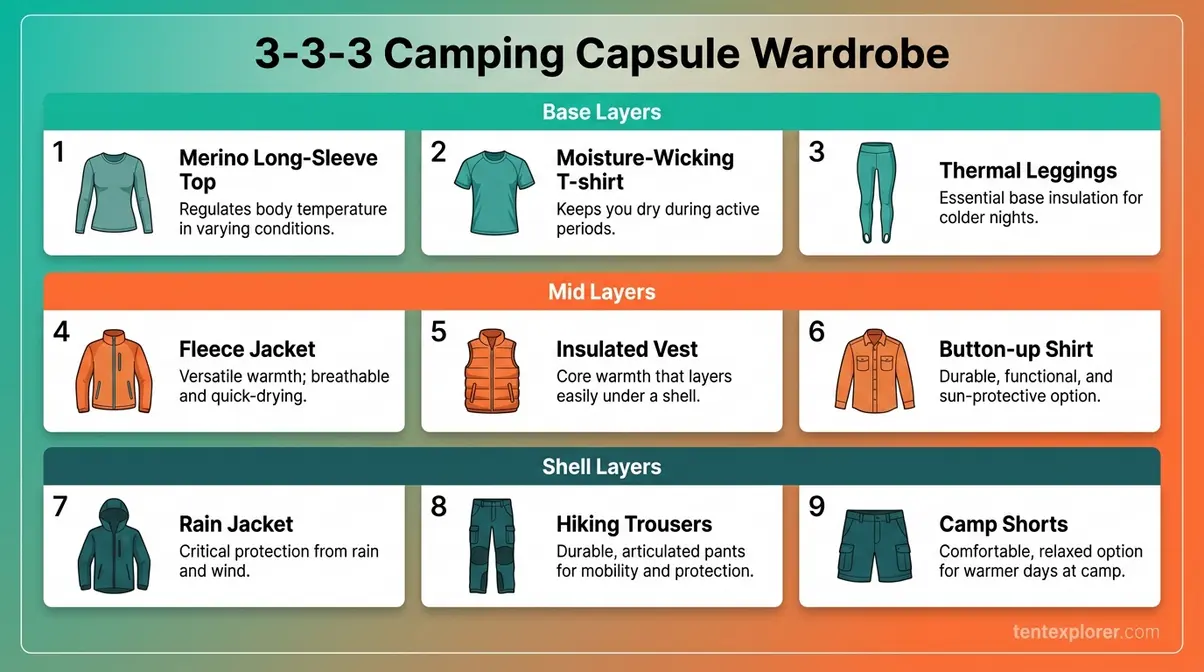
The 3 Base Layers
Your base layers are the foundation. Choose moisture-wicking fabrics for all three.
- Merino wool long-sleeve top — worn directly against skin; regulates temperature in both cool mornings and warm afternoons; odour-resistant enough for multi-day wear without washing.
- Moisture-wicking short-sleeve T-shirt — your active-day layer for warmer conditions or high-output activities like hiking; pairs with the long-sleeve when temperatures drop.
- Lightweight thermal leggings or base layer bottoms — essential for cold evenings and sleeping; merino or synthetic blend. These double as your sleep layer at night.
The 3 Mid Layers
Mid layers are your insulation options. You mix and match based on temperature.
- Midweight fleece jacket — the most versatile mid layer for three-season camping; breathable, packable, and effective even when slightly damp. Brands like Patagonia (Synchilla) and REI Co-op offer excellent options at multiple price points.
- Lightweight insulated vest or down jacket — adds core warmth without restricting arm movement; perfect for cool evenings around the campfire or as a sleep layer on colder nights.
- Long-sleeve merino or synthetic button-up shirt — functions as both a casual camp shirt and a light mid layer; versatile enough to wear on a day hike or into a nearby town.
The 3 Outer/Shell Pieces
Your outer layers protect against wind, rain, and unexpected weather drops.
- Waterproof-breathable rain jacket (hardshell) — non-negotiable for any camping trip regardless of the forecast; pack this even in summer. Look for taped seams and a hood.
- Quick-dry hiking trousers or convertible pants — durable, fast-drying bottoms that work for hiking, camp chores, and casual wear; nylon or polyester blend; convertible zip-off legs add versatility.
- Camp shorts or lightweight active shorts — for warm afternoons, beach access, or around-camp comfort; quick-dry fabric.
Complete 3-3-3 Camping Capsule Wardrobe at a Glance:
| Layer Type | Item 1 | Item 2 | Item 3 |
|---|---|---|---|
| Base (3) | Merino long-sleeve top | Moisture-wicking T-shirt | Thermal leggings |
| Mid (3) | Midweight fleece jacket | Insulated vest/down jacket | Merino/synthetic button-up |
| Shell (3) | Waterproof rain jacket | Quick-dry hiking trousers | Camp shorts |
This nine-piece framework packs into roughly half a duffel bag, covers temperatures from 35°F to 85°F (2°C–30°C), and eliminates the “what if” anxiety that causes most new campers to over-pack.
What to Wear Camping by Season {#by-season}
The 3-3-3 framework stays constant across seasons — what changes is the weight of each item and a few seasonal additions. According to season-specific camping packing guides reviewed by Tent and Lantern, the base-mid-shell structure applies year-round; only the insulation level shifts.
Summer Camping Clothing
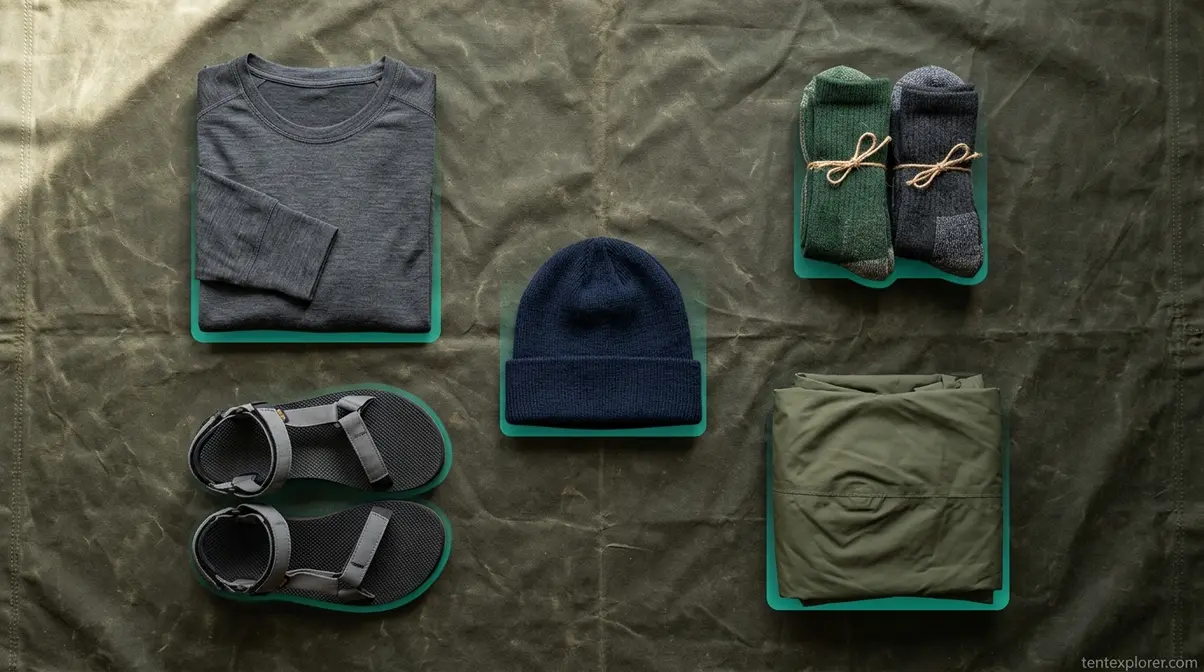
Summer camping is about managing heat and sun, not cold. Your priorities shift: lighter fabrics, sun protection, and quick-dry everything.
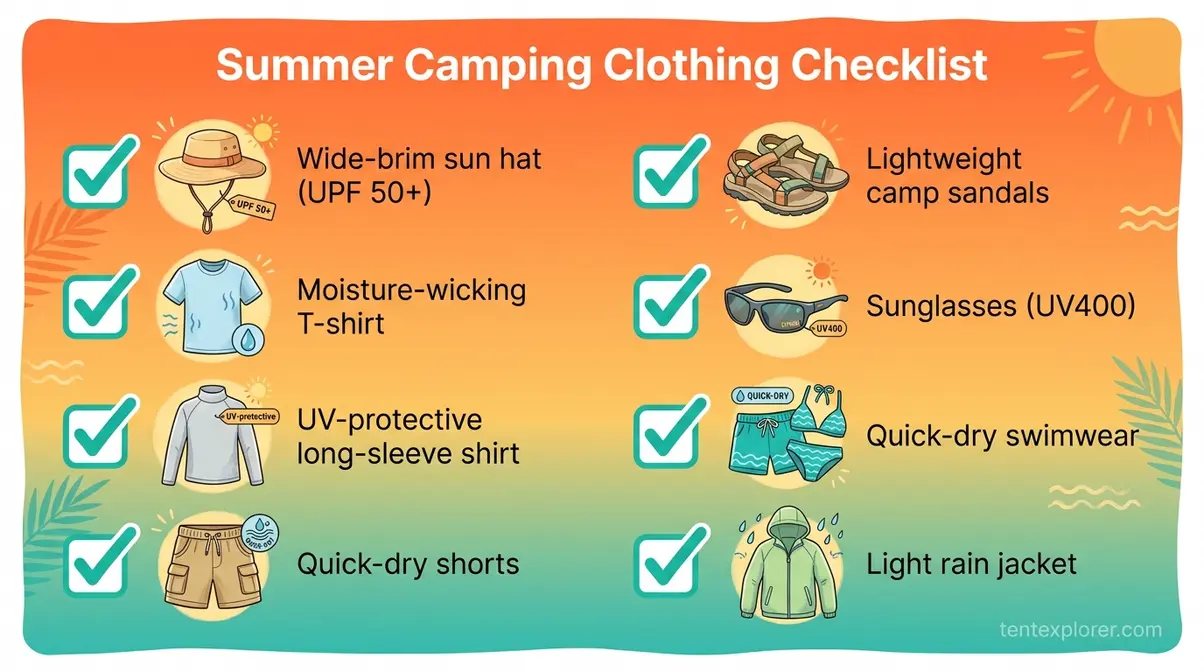
- Summer-specific additions to the 3-3-3:
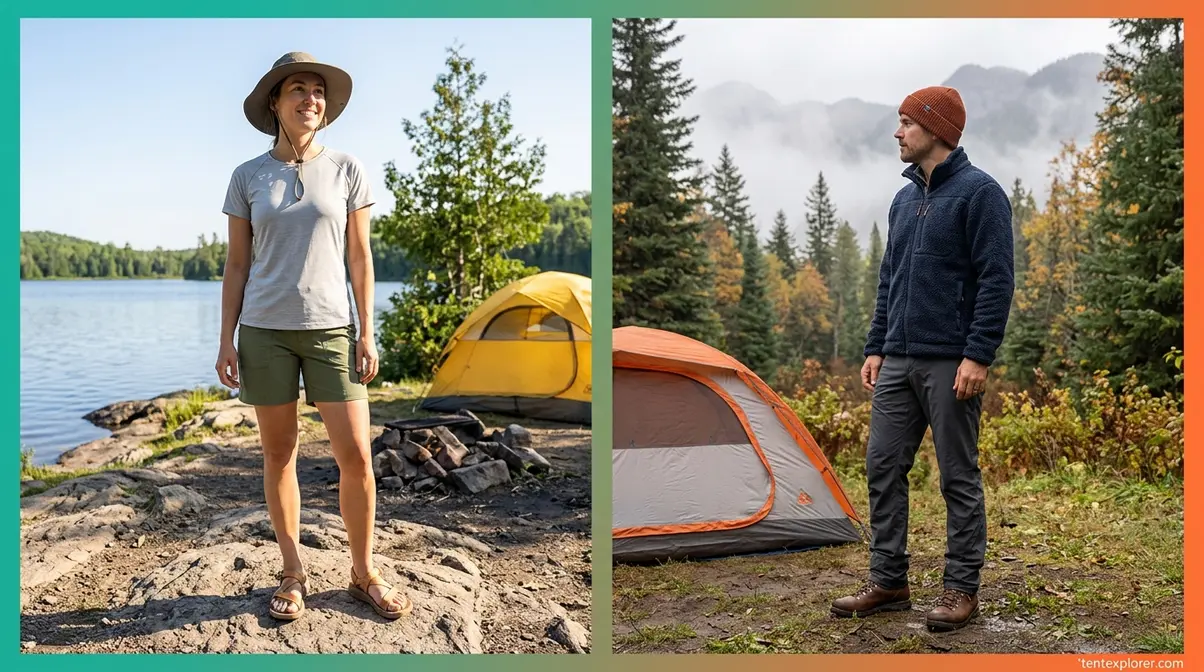
- Wide-brim sun hat — protects face, neck, and ears from UV exposure during long hike days
- UV-protective long-sleeve shirt — counterintuitively cooler than bare arms in direct sun; blocks UV rays while moisture-wicking
- Swimwear — if your site has water access, pack a quick-dry swimsuit or board shorts
- Lightweight camp sandals — for around-camp comfort when you want to rest your feet from hiking boots
- Sunglasses with UV400 protection
Summer fabric priorities: Lightweight polyester or nylon for everything. Keep cotton to a minimum even in summer — a sweaty cotton T-shirt on a warm-to-cold evening transition is uncomfortable and slow-drying.
Fall and Spring Camping Clothing
Fall and spring are the trickiest seasons for camping attire because temperature swings are dramatic. Mornings and evenings can be genuinely cold (near freezing in many regions), while midday may feel pleasantly mild. This is where the layering system truly earns its keep.
- Key additions for fall/spring:
- Heavier mid layer — upgrade from a lightweight fleece to a midweight insulated jacket
- Waterproof hiking trousers or rain pants — more critical than in summer, as wet leaves and mud are constant
- Wool or synthetic beanie — temperatures at camp can drop 20°F+ after sunset
- Lightweight gloves — for morning hikes when fingers stiffen in the cold
- Extra pair of wool socks — damp socks in cool conditions are a recipe for cold feet and low morale
Cold Weather & Winter Camping Clothes
Cold-weather camping demands a more serious approach to layering. Hypothermia is a genuine risk when temperatures drop below 40°F (4°C), particularly when combined with wind and moisture.
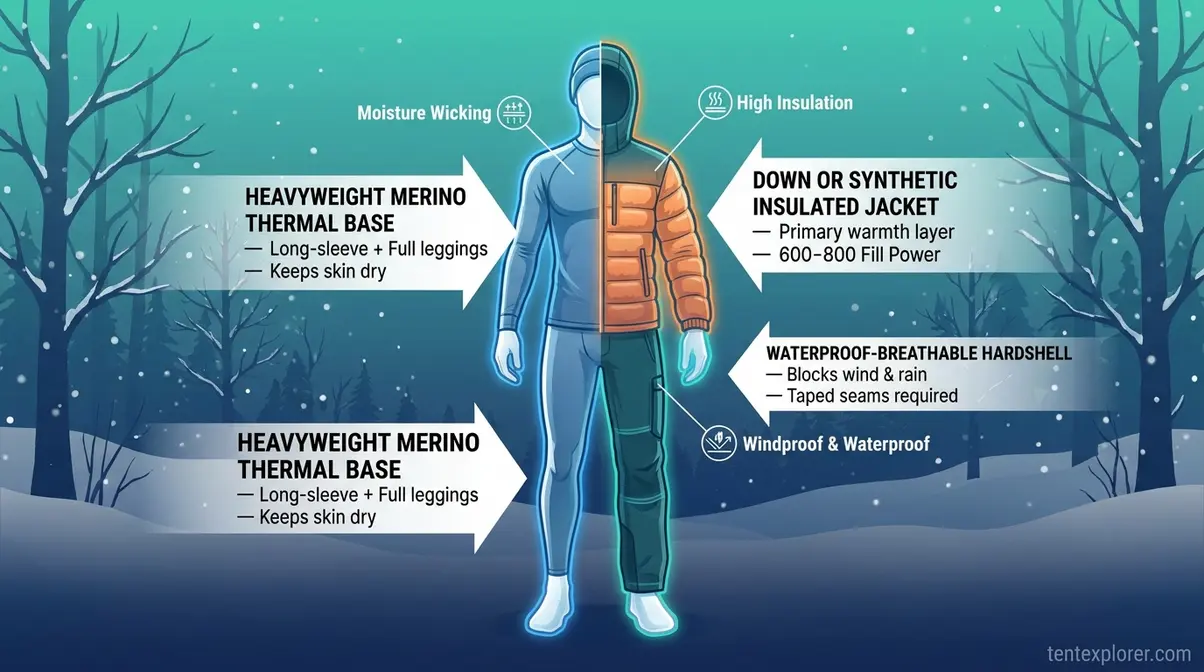
- Cold-weather clothing essentials:
- Heavyweight merino or synthetic thermal base layer — long-sleeve top and full-length bottoms; this is the most important upgrade from three-season camping
- Down or synthetic-fill insulated jacket — your primary warmth layer; down is lighter and more packable, but loses insulation when wet; synthetic-fill is safer in wet conditions
- Waterproof-breathable hardshell — non-negotiable; wind chill dramatically increases heat loss
- Waterproof over-trousers — worn over your base layer in rain or snow
- Insulated waterproof gloves — not just lightweight gloves; full insulation
- Wool or fleece neck gaiter — covers the gap between jacket collar and hat
- Wool balaclava or beanie — significant heat loss occurs through an uncovered head
Experienced campers consistently report that sleeping warm in cold conditions is mostly about what you wear to bed, not just the sleeping bag rating. A clean, dry merino base layer worn only for sleeping — never worn during the day — makes a measurable difference in overnight warmth.
Extremities: Head, Hands, and Feet {#extremities}
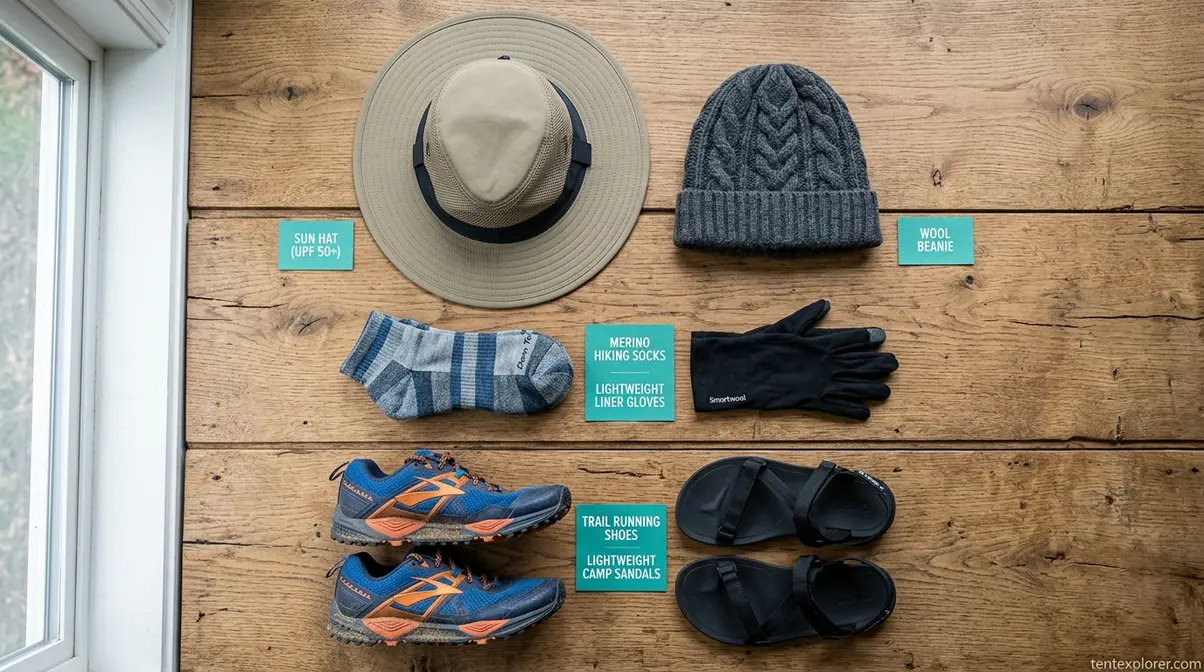
Most camping clothing guides focus on torso layers and forget that your extremities — head, hands, and feet — are where comfort is won or lost fastest. According to the National Park Service’s Olympic National Park visitor guidance, significant body heat is lost through an uncovered head, making a hat or beanie one of the most effective warmth tools available.
Hats and Head Coverage
For warm weather: A wide-brim sun hat (full brim, not just a cap brim) protects against sunburn on the face, neck, and ears — areas commonly burned during long trail days. Choose a lightweight, packable design with UPF 50+ rating.
For cold weather: A wool or synthetic beanie that covers your ears is essential. For very cold conditions, a fleece or wool balaclava offers neck and face coverage. Don’t rely on a jacket hood alone — hoods reduce peripheral vision and come off easily.
Gloves
Lightweight liner gloves work well for fall and cool spring mornings. For cold or wet conditions, waterproof insulated gloves or mittens are necessary. Mittens are warmer than gloves (fingers share heat) but offer less dexterity. A practical solution: wear thin liner gloves inside waterproof shell mittens — you get warmth and the ability to manage tent zips and stove controls.
Socks and Footwear
Your feet deserve the most careful attention of any body part you’ll pack for. Wet, cold feet derail a camping trip faster than almost anything else.
- Sock rules for camping:
- Always pack at least one extra pair beyond what you think you’ll need
- Choose wool or wool-blend socks — merino regulates temperature, resists odour, and stays warm even when damp
- Never wear cotton socks on trail — cotton socks become cold, wet compresses when your feet sweat or encounter stream crossings
- Pack dedicated sleep socks — a clean, dry pair worn only in the sleeping bag dramatically improves overnight warmth
- Footwear:
- Hiking boots or trail runners for on-trail use; waterproof if your terrain involves stream crossings or wet trails
- Camp sandals or lightweight slip-ons for around-camp use — your feet need to breathe after a long hiking day
- Gaiters for muddy, snowy, or brush-heavy terrain — keep debris and moisture out of boot tops
Top 5 Forgotten Camping Clothing Items {#forgotten-items}
What is the most forgotten item when camping?
A dedicated dry sleep base layer is the most impactful forgotten clothing item, based on consistent reports from experienced campers and camping community surveys. Many campers wear their day hiking base layer to bed — but that layer has accumulated sweat and moisture, reducing sleeping bag efficiency. Beyond sleep layers, extra socks and a beanie or warm hat are the most commonly forgotten clothing items, along with waterproof rain trousers for the lower body. Pack at least one extra pair of socks beyond your planned count.
Our review of camping packing resources and community camping forums consistently surfaces the same five clothing items that new campers forget — and then regret. Every single one of these items is small, lightweight, and disproportionately important to your comfort.
1. Dry Sleep Base Layer
This is the most impactful forgotten item. Many campers wear their hiking base layer to bed — a mistake. Your hiking base layer accumulates sweat, body oils, and moisture throughout the day. Sleeping in it means sleeping in that moisture. Pack a dedicated set of clean, dry base layers (top and bottoms) worn only for sleeping. Your sleeping bag works by trapping the heat your body generates; damp clothing reduces that efficiency measurably. Pairing dry clothes with strategies on how to improve sleep camping naturally ensures you wake up rested.
2. Extra Socks (Multiple Pairs)
Camping Kiddos’ analysis of forgotten camping items and community survey data from hundreds of campers consistently rank extra socks near the top of the forgotten list. Pack one pair of socks per day, plus two additional pairs as backup. Wet socks from a stream crossing or unexpected rain shouldn’t mean cold, blistered feet for the rest of your trip.
3. A Beanie or Warm Hat
Campers planning warm-weather trips often skip the beanie entirely — then discover that campfire evenings at altitude drop to near-freezing temperatures after sunset. A lightweight merino or fleece beanie weighs almost nothing and packs into a jacket pocket. It’s one of the highest warmth-per-gram items you can add to any camping bag.
4. Camp Shoes or Sandals
After 8 hours on trail in hiking boots, your feet need relief. Lightweight camp sandals (like Crocs or Chaco sandals) weigh very little and make the hours around camp dramatically more comfortable. They also serve as shower shoes if your site has communal facilities.
5. A Dedicated Rain Layer for Legs
Most campers remember a rain jacket. Very few pack waterproof trousers or rain pants. When it rains properly — not a light drizzle but a sustained downpour — your lower body gets soaked from rain, wet vegetation, and splashing. Lightweight packable rain pants fold to the size of a water bottle and can transform a miserable wet-weather day into a manageable one.
Insect Protection and Sun Safety {#insect-sun}
Camping clothing isn’t just about temperature regulation. Two environmental hazards — insects and UV radiation — require specific clothing strategies that many new campers overlook.
Clothing for Insect Protection
The CDC recommends treating camping clothing with 0.5% permethrin as an effective measure against mosquitoes and ticks. Permethrin is an insecticide applied to fabric — not to skin — that kills or repels insects on contact and remains effective through multiple washes.
- How to use permethrin safely:
- Purchase a 0.5% permethrin spray designed for clothing (available at most outdoor retailers)
- Treat clothing outdoors in a well-ventilated area; lay flat to spray
- Allow to dry completely before wearing — typically 2-4 hours
- Apply to shirts, trousers, socks, and even tent walls and mosquito nets
- Reapply after 5-7 washes, as directed on the product label
- Never apply permethrin directly to skin — it is a fabric treatment only
For tick-prone areas, treat the lower legs and socks particularly thoroughly. Tuck treated trousers into treated socks for maximum coverage.
Clothing for Sun Protection
UV radiation at altitude and in open terrain is significantly stronger than in urban environments. Your camping clothing can serve as your first line of sun defence.
- Sun protection clothing essentials:
- Long-sleeve shirts rated UPF 30+ (ultraviolet protection factor) block significantly more UV than standard cotton
- Dark or bright colours generally offer more UV protection than pale colours
- Tightly woven synthetic fabrics (nylon, polyester) provide better UV protection than loosely woven natural fibres
- A wide-brim hat (minimum 3-inch brim) protects the face, ears, and neck — areas frequently missed by sunscreen
The combination of UPF clothing + sunscreen on exposed skin + a wide-brim hat is the most effective sun protection strategy for a full day of outdoor activity.
Common Mistakes and When to Upgrade Gear {#limitations}
Even the best packing framework has limits. Understanding where the 3-3-3 Camping Capsule Wardrobe falls short — and what to do about it — is part of making genuinely informed decisions.
Common Mistakes New Campers Make
Packing too much of the wrong thing. The most common error isn’t under-packing — it’s bringing six cotton T-shirts and no rain jacket. The 3-3-3 framework solves this by giving you a structure to fill, not just a list to check.
Wearing new gear for the first time on the trip. New hiking boots, fresh trail runners, or an unworn base layer can cause blisters, chafing, or unexpected comfort issues. Always wear new camping clothing on a short local walk before a multi-day trip.
Skipping the sleep layer. As covered in the Forgotten Items section, sleeping in day-worn base layers is one of the most consistent causes of poor overnight warmth — even when the sleeping bag is rated for the temperature.
Ignoring the forecast’s low temperature. Campers consistently pack for the average temperature they expect, not the overnight low. In most outdoor environments, overnight temperatures drop 15-25°F below afternoon highs. Pack for the coldest number on the forecast, not the most comfortable one.
Underestimating how wet you’ll get. Rain, stream crossings, morning dew on vegetation, and camp chores all introduce moisture. Experienced campers consistently report that having more dry layers in reserve — not fewer — is the difference between a comfortable trip and a miserable one.
When These Recommendations Don’t Apply
The 3-3-3 framework is designed for standard 2-5 night camping trips in temperate conditions. It is not appropriate as a standalone guide for:
- Winter mountaineering or snow camping below 20°F (-7°C): These conditions require specialist layering systems, vapour barrier techniques, and insulation levels beyond the scope of this guide. Consult a certified mountain guide or organisation like the American Alpine Club.
- Jungle or tropical camping: Humidity management and insect protection take priority over thermal layering. Lightweight, permethrin-treated clothing and fast-dry fabrics are essential, but the layering logic changes significantly.
- Ultralight backpacking: The 3-3-3 framework prioritises versatility over minimum pack weight. Ultralight backpackers typically use a more aggressive cut-down strategy.
When to Seek Expert Help
If you’re planning a camping trip that involves technical terrain (glacier travel, alpine routes, or extended remote wilderness), speak with a qualified outdoor instructor or guide before finalising your clothing kit. The REI Outdoor School offers free layering guides and in-person classes at many locations — a practical starting point for anyone moving beyond frontcountry camping.
Frequently Asked Questions {#faq}
What is the 3-3-3 rule for camping?
The 3-3-3 Camping Capsule Wardrobe is a structured packing framework that organises camping clothing into three groups of three: 3 base layers (moisture-wicking next-to-skin pieces), 3 mid layers (insulating fleece, down, or wool pieces), and 3 outer/shell pieces (rain jacket, hiking trousers, and camp shorts). This nine-piece system covers temperatures from 35°F to 85°F (2°C–30°C) for a standard 2-5 night trip, eliminating the over-packing anxiety that affects most new campers. It’s not an official outdoor industry standard — it’s a practical framework developed to simplify camping clothing decisions.
What is the 200 rule for camping?
The “200 rule” in camping typically refers to campsite etiquette and Leave No Trace principles rather than clothing. Specifically, the guideline from Leave No Trace states you should camp at least 200 feet (about 70 steps) from water sources, trails, and other campers to minimise environmental impact. It is unrelated to clothing or layering systems.
What is the 4-4-4 rule for camping?
The “4-4-4 rule” is not a standard, widely recognised camping guideline — it doesn’t appear in major outdoor organisation guidance. You may encounter it in informal camping communities as a packing shorthand (e.g., 4 shirts, 4 pairs of socks, 4 days of supplies), but it lacks a consistent definition.
What does FF mean for camping?
“FF” in camping most commonly stands for “Fill Power” — a measurement of down insulation quality in sleeping bags and insulated jackets. Fill power (measured in cubic inches per ounce) indicates how much loft a given weight of down provides: higher fill power means lighter, more packable insulation. A jacket rated 800 FF (fill power) is warmer per ounce than one rated 550 FF, according to outdoor insulation standards. For camping clothing, look for 600-800 FF down jackets as mid layers for three-season use.
Your Camping Wardrobe, Confidently Packed
For beginner and intermediate campers, knowing what to wear when camping comes down to one durable principle: the 3-3-3 Camping Capsule Wardrobe gives you a clear, manageable structure that covers any condition across any season. Choose moisture-wicking fabrics — merino wool or synthetic polyester — for your base layers, insulating fleece or down for your mid layers, and a waterproof-breathable shell as your outer defence. The evidence is clear: wet cotton conducts heat away from your body up to 25 times faster than dry air (SectionHiker, 2026), making fabric choice a genuine safety decision, not just a comfort preference.
The 3-3-3 Camping Capsule Wardrobe works because it mirrors how experienced campers actually think about clothing — not as a long list to check off, but as a layered system to build. When you understand why each layer exists and what each fabric does, you stop second-guessing every item and start packing with confidence. Add the five forgotten items (dry sleep base layers, extra socks, a beanie, camp shoes, and rain trousers), treat your clothing with 0.5% permethrin for insect protection, and pack for the overnight low — not the comfortable afternoon high.
Your next step: use the 3-3-3 framework as your packing template before your next trip. Lay out three base layers, three mid layers, and three outer pieces — then check them against the seasonal additions for your destination. If you’re moving beyond frontcountry camping into alpine or winter terrain, consider an REI Outdoor School course or a session with a certified outdoor instructor before committing to a kit. A well-packed camping wardrobe isn’t about spending more — it’s about understanding the system. Now you do.

Dave King
I'm Dave King. I publish Tent Explorer, a site built to answer the questions people actually ask before they buy.