 David King
If you’ve ever planned a camping trip for weeks, driven two hours to the perfect spot, and spent the first night getting eaten alive by mozzies despite a full can of bug spray, you already know the problem. Standard advice — “just use repellent!” — leaves critical gaps that mosquitoes exploit without hesitation.
Here’s the hard truth: every single-method approach has a blind spot. Repellent wears off. Citronella candles lose their range after three feet. A screened tent means nothing if you leave the door unzipped for 10 seconds at dusk. Mosquitoes don’t need much of an opening — literally or figuratively.
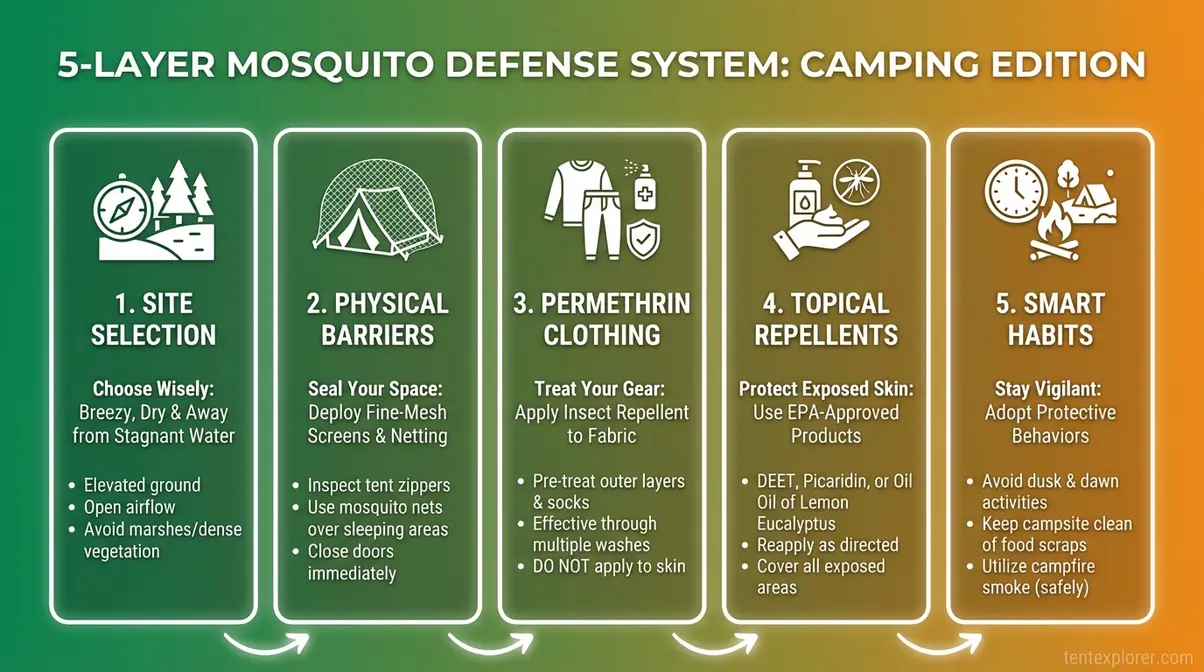
In this guide, you’ll learn the five-layer Defense-in-Depth system used by outdoor professionals — combining campsite science, proven barriers, and EPA-verified repellents — so you can camp without becoming a mosquito’s dinner. The five layers are: (1) campsite selection, (2) area protection, (3) clothing and gear, (4) topical repellents, and (5) behavioral habits.
How to Keep Mosquitoes Away Camping
When considering how to keep mosquitoes away camping, the most effective approach combines five layers: (1) choose a high, breezy campsite away from standing water, (2) set up physical barriers and portable repellers, (3) wear long, loose clothing treated with permethrin, (4) apply an EPA-registered repellent (Picaridin or DEET), and (5) avoid peak mosquito hours at dusk and dawn.
- Defense-in-Depth: No single method is enough — all five layers work together to cover each other’s gaps
- Fastest win: Campsite selection eliminates mosquitoes before you unpack — it’s free and requires no products
- Longest protection: Permethrin-treated clothing lasts through 70+ washes (Insect Shield, verified)
- Chemical-free option: Combine airflow, campfire herbs, and physical barriers as your base layers


Last update on 2026-06-08 / Affiliate links / Images from Amazon Product Advertising API

Last update on 2026-06-08 / Affiliate links / Images from Amazon Product Advertising API

Last update on 2026-06-08 / Affiliate links / Images from Amazon Product Advertising API

Last update on 2026-06-08 / Affiliate links / Images from Amazon Product Advertising API

Last update on 2026-06-08 / Affiliate links / Images from Amazon Product Advertising API

Last update on 2026-06-08 / Affiliate links / Images from Amazon Product Advertising API

Last update on 2026-06-08 / Affiliate links / Images from Amazon Product Advertising API

Last update on 2026-06-08 / Affiliate links / Images from Amazon Product Advertising API

Last update on 2026-06-08 / Affiliate links / Images from Amazon Product Advertising API

Last update on 2026-06-08 / Affiliate links / Images from Amazon Product Advertising API
Prerequisites & Gear Checklist
Before your first step on the trail, gather these six items. Think of them as the physical toolkit your Defense-in-Depth system runs on — each one serves a specific layer.
Estimated Time: 30 minutes
- Gear checklist:
- Permethrin spray (e.g., Sawyer Permethrin) — for pre-treating clothing and tent fabric; must be applied 2–4 hours before the trip so it can dry completely
- EPA-registered topical repellent — Picaridin (a synthetic repellent compound approved by the EPA and CDC) or DEET at 20–30% concentration
- Mosquito head net — critical for dusk and dawn when full-coverage clothing isn’t enough
- Portable spatial repeller — e.g., Thermacell (a portable spatial repellent device that creates a 15–20 foot mosquito-free zone)
- Mosquito netting or screened shelter — for protected outdoor eating and seating areas
- Long-sleeved shirts and long pants in light colors — the foundation of your personal barrier layer
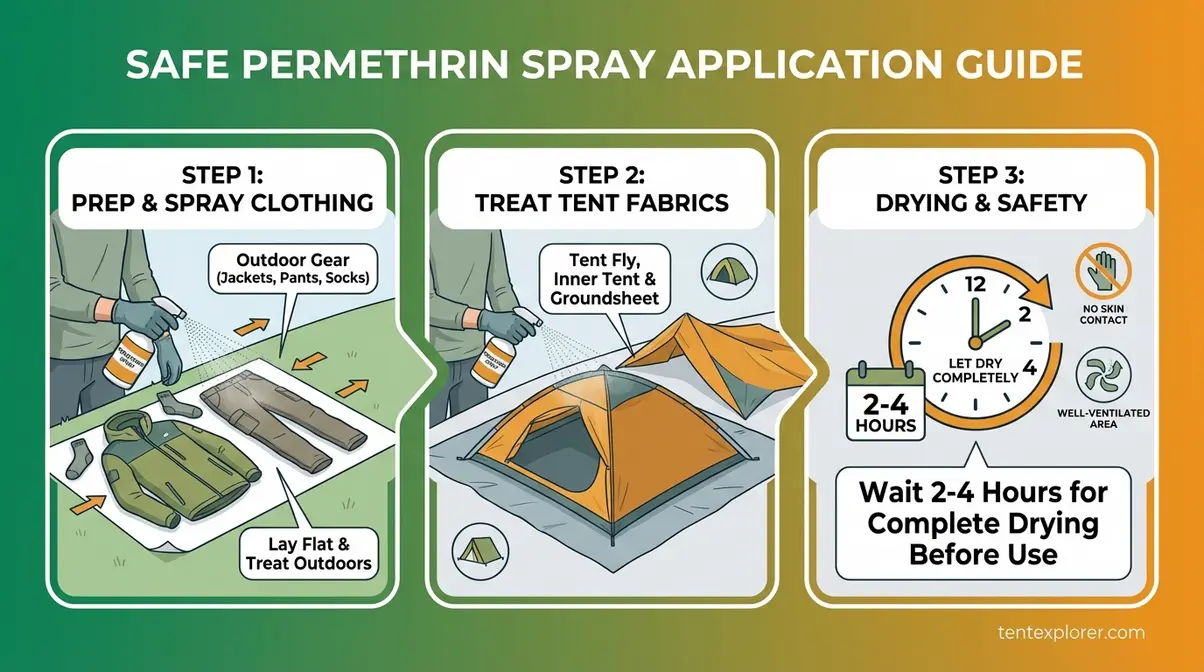
Timing note: Permethrin is the most common pre-trip mistake. Many campers pack it intending to apply at the campsite — but it requires 2–4 hours of drying time outdoors and should never be applied indoors or near pets. Treat clothing and tent fabric at home, the day before you leave.
⚠️ Safety disclaimer: Always follow product label instructions. Consult a healthcare professional before applying repellents to children or if you have skin sensitivities.
For a broader packing reference, see our complete camping gear checklist.
With your kit ready, start with the single most impactful decision you’ll make — where you pitch your tent.
Step 1: Choose a Mosquito-Hostile Campsite
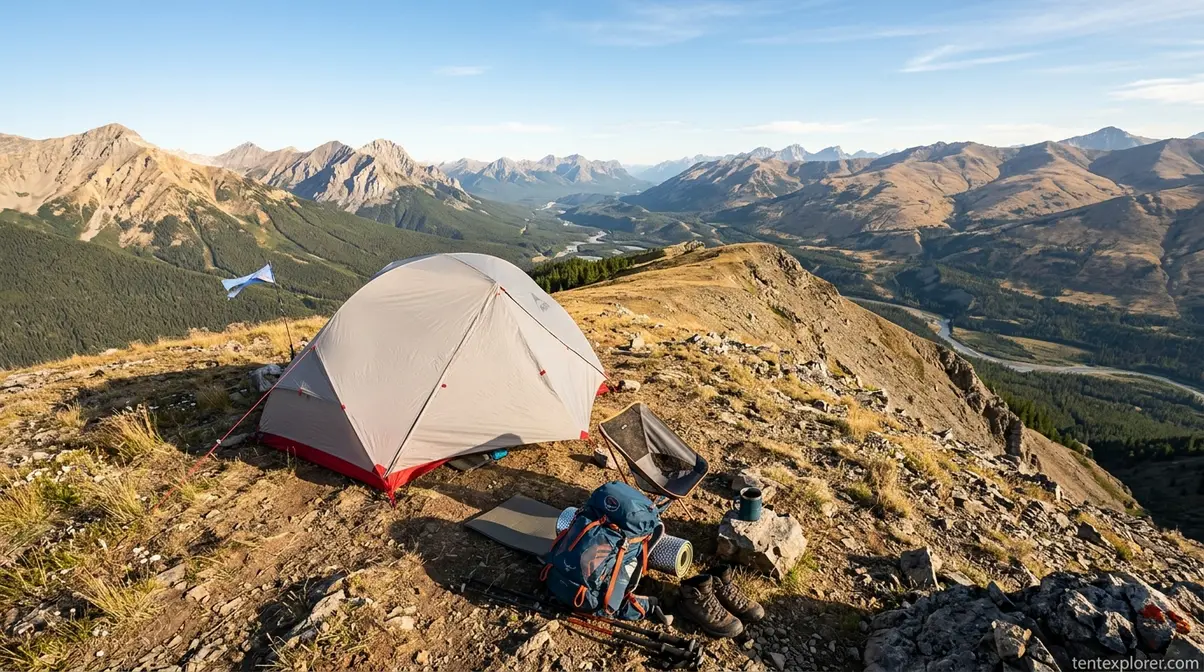
Mosquitoes are physically weak fliers — sustained winds above even a gentle breeze make controlled flight difficult for them. When learning how to keep mosquitoes away camping, your campsite’s airflow is your first and cheapest line of defense. Most campers pick spots for aesthetics: the shaded creek, the sheltered hollow, the spot buried in trees. Those are exactly the environments where mosquitoes thrive.
This guide is built around The Defense-in-Depth Approach — a five-layer system where each layer covers the gaps left by the others. Layer one starts before you even unpack: your campsite.
Three campsite criteria reduce mosquito density before you deploy a single product:
- Elevation and airflow — high, open, breezy ground
- Distance from standing water — at least 200 feet from any breeding habitat
- Timing — matching your trip to periods of lower mosquito activity
Elevation, Airflow, and Sun Exposure
Pitch your tent on higher ground — cold air pools in valleys, and mosquitoes are significantly more active in cool, humid air. Aim for at least 20 feet above any valley floor or low-lying area. The difference between a ridge-adjacent clearing and a sheltered creek hollow can be dramatic; campers consistently report far fewer mosquitoes at exposed, elevated sites.
Choose a spot with natural airflow. Open clearings, ridge lines, and lakeshores with an onshore breeze all provide the consistent air movement that disrupts mosquito flight. Mosquitoes fly at roughly 1–3 mph — sustained wind above that range makes foraging difficult and energy-costly for them, pushing them to seek calmer ground.
Morning sun matters too. An east-facing site dries dew and warms the soil quickly — mosquitoes prefer humidity, and a site that dries out by 9am sees meaningfully lower activity than a perpetually damp, shaded one. A campsite on a slight rise at the edge of a clearing will see dramatically fewer mosquitoes than a sheltered, shaded spot 50 feet away.
For more on choosing your campsite to cut bug exposure, and for detailed setup guidance, see our planning your campsite layout resource.
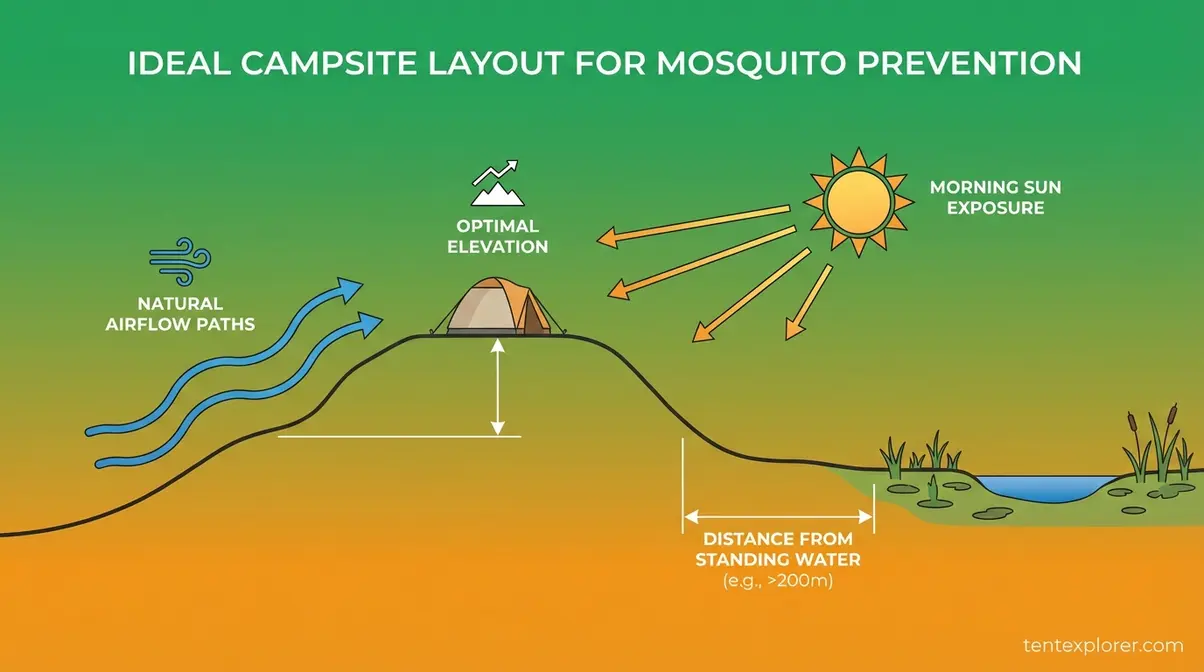
Airflow handles mosquitoes already in the air — but standing water is where the next generation is being built right now.
Stay Away from Standing Water
Mosquitoes breed in as little as a bottle cap of standing water. Camp at least 200 feet from ponds, marshes, slow-moving streams, or any low-lying area that collects rainwater — these are active nurseries, not just nuisances.
Disney World’s mosquito management program — one of the most studied in the world — prioritizes eliminating any standing water source within the park perimeter. Their approach uses engineered drainage systems, sloped terrain, and continuous water movement to deny mosquitoes any stagnant surface. Apply the same principle to your campsite: after you set up, walk a 50-foot radius and tip over any container, rock depression, or tarp fold that has collected water. It takes three minutes and eliminates breeding habitat before it becomes a problem.
Also check your own gear. Cooler lids, tent footprints, and tarps all pool water overnight. Tip them out each morning — a habit that takes seconds and cuts off a fresh breeding cycle before mosquito eggs can hatch (which takes as little as 48 hours in warm conditions).
You’ve controlled your location and eliminated breeding sites. The third campsite variable is timing — specifically, when mosquitoes are most active.
Time Trips to Avoid Peak Activity
Mosquito season in North America peaks during July and August in most northern and northeastern states, with activity rising from late May. Mosquitoes become sluggish and far less active once temperatures exceed 95°F — so late summer heat waves are actually low-mosquito windows. Spring trips in May and June, and early fall trips in September, tend to carry the highest mosquito pressure in temperate regions.
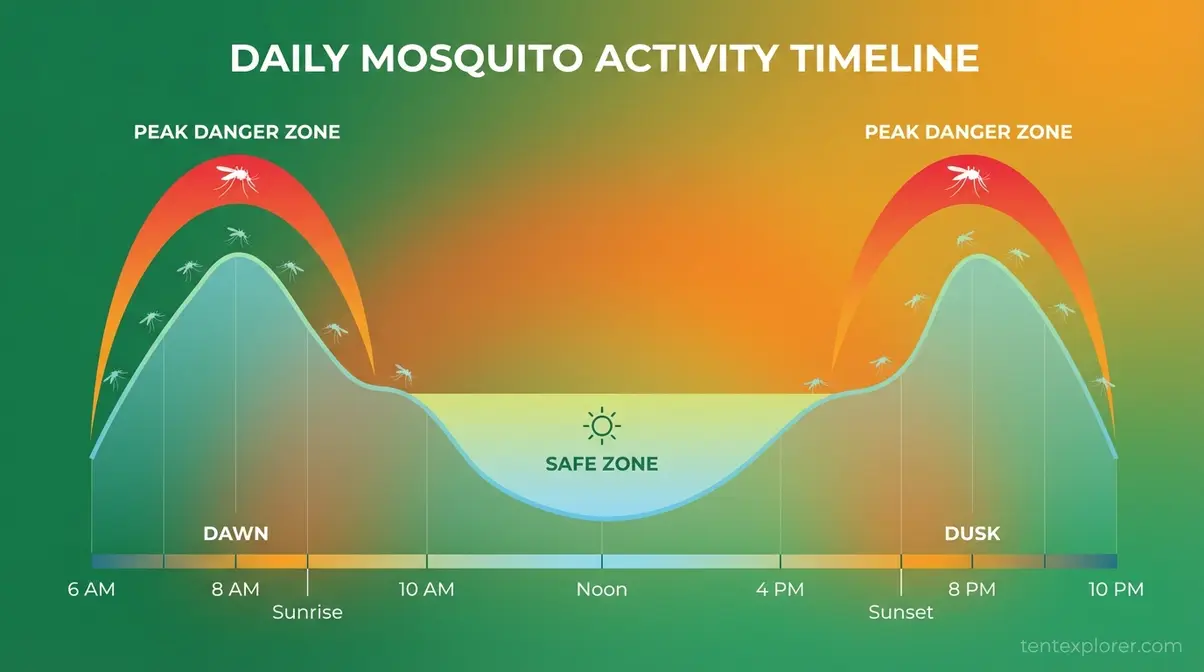
At the daily level, mosquito activity peaks at dusk — from roughly 30 minutes before sunset through 2–3 hours after — and again briefly at dawn. Plan high-exposure activities (hiking, fishing, swimming) for the 10am–4pm window when mosquito activity is lowest. The MMCD (Metropolitan Mosquito Control District) publishes regional 10-year average mosquito activity data by month — checking your local mosquito control district’s site before a trip gives you site-specific timing data that generic guides can’t provide.
With the right campsite chosen, the next layer is creating an active defense zone around your tent and picnic area.
Step 2: Build a Bug-Free Zone Around Camp
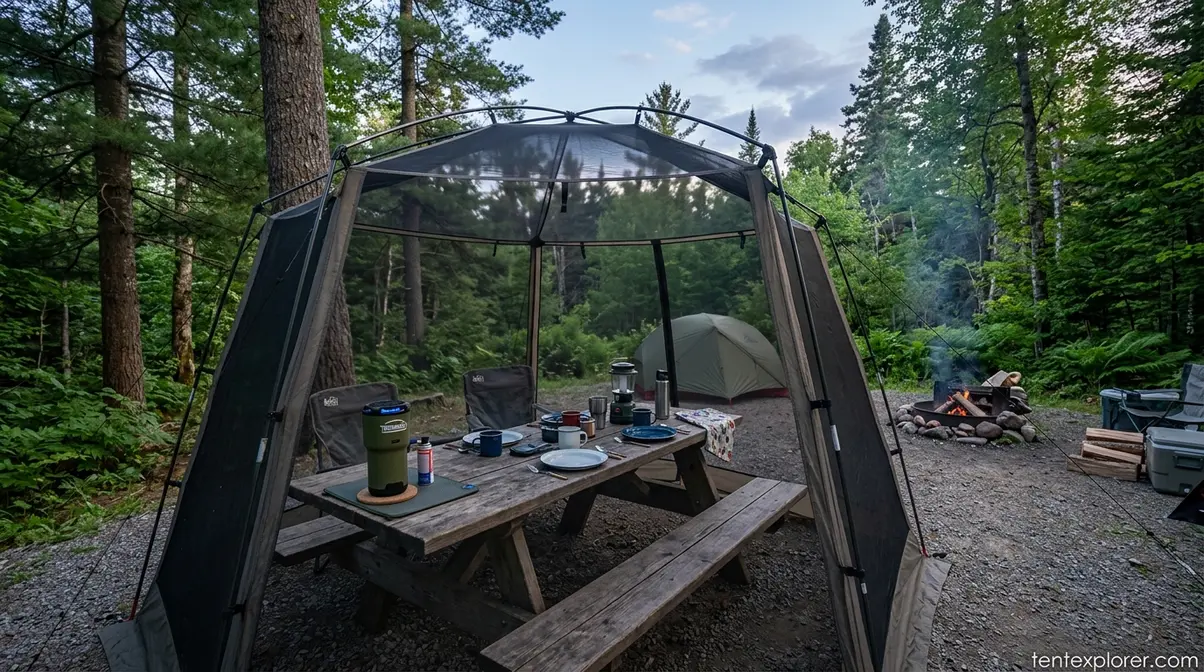
Picture this: it’s 7pm, the fire is going, dinner is ready — and you’re sitting at the picnic table in a cloud of mosquitoes, swatting with one hand and trying to eat with the other. You chose a good site. You have repellent on. And you’re still being chased in by mosquitos. That’s the gap Layer Two fills.
Once your site is chosen, three area-defense methods create a perimeter that keeps mosquitoes out of your immediate living space. Physical barriers block entry; spatial repellers chemically deter; campfire smoke disrupts insect navigation. Layer two of the Defense-in-Depth system creates an active perimeter — and used together, these methods address the gaps each individual one leaves.
Physical Barriers & Screen Tents
Drape mosquito netting over your picnic table area to create an outdoor eating zone with no chemical exposure. Standard netting with mesh finer than 1.2mm blocks mosquitoes while still allowing airflow — look for this spec when purchasing.
Screened dining shelters (pop-up screen tents, typically $30–$80) provide the most comfortable protected outdoor space at a campsite. Position the door facing away from prevailing wind and any standing water to reduce the number of mosquitoes hovering near the entrance. A screened shelter over the picnic table means you can eat at dusk without repellent on your hands — an important consideration when you’re handling food.
For hammock camping, a hammock bug net system (such as those built into Hennessy Hammock designs) provides full-body coverage without requiring a tent. For tent camping, check mesh panels for gaps at zipper seams before your trip — a small tear is enough for dozens of mosquitoes to enter over the course of a night.
Barriers block mosquitoes physically. Spatial repellers take it further — they chemically deter mosquitoes from entering a zone around your camp entirely.
Portable Spatial Repellers
Spatial repellers like Thermacell (a portable spatial repellent device that creates a 15–20 foot mosquito-free zone) work by vaporizing allethrin — a synthetic pyrethroid — into the surrounding air. No skin contact required. EPA-registered. The heat-activated mat system means you set it on the table and forget it, which is why it’s become a staple for campers who’ve tried everything else.
- Thermacell model guidance by camping type:
- Backpacking / ultralight tent camping: Thermacell Backpacker Repeller (fuel-canister-powered, under 3 oz)
- Car camping: Thermacell MR450 (butane-powered, 15-ft zone, all-day runtime)
- RV camping: Thermacell E90 or EX90 (rechargeable, 20-ft zone, extended battery life)
For maximum coverage, add mosquito traps as a supplement. A 2026 campsite mosquito trapping study found that deploying traps reduced campsite mosquito nuisance by 34–55% (PubMed, Medical and Veterinary Entomology, 2026) — making trap placement a measurable upgrade over repellents alone. Place traps upwind of your seating area, 10–15 feet away, to intercept mosquitoes before they reach you.
A 2026 field study found that deploying mosquito traps at campsites reduced mosquito nuisance by 34–55% (PubMed, Medical and Veterinary Entomology, 2026) — a result no single topical repellent can match on its own.
Spatial repellers and traps handle the airborne threat. Your campfire — if used correctly — adds a third layer that doubles as a gathering spot.
Campfires as a Natural Deterrent
Campfire smoke disrupts mosquito navigation — they avoid it instinctively. Position your seating upwind of the fire so smoke drifts toward you and through your immediate space, not away from it. This is the detail most campers get backwards: they sit downwind and wonder why the fire isn’t helping.
Enhance the smoke by adding dried sage, rosemary, or pine needles to an established fire. These herbs release additional compounds that further deter mosquitoes. Bundle 4–5 dried sage sprigs and add them once the fire is burning steadily — not at ignition, where they’ll simply smolder without producing good smoke. You can find dried sage and rosemary at most grocery stores before your trip.
Citronella candles and torches can complement the campfire in the immediate seating area, though their effective range is limited to about 2–3 feet. They work as a supplement, not a standalone strategy. Always follow local fire regulations — see our campfire safety tips for open-fire rules by region.
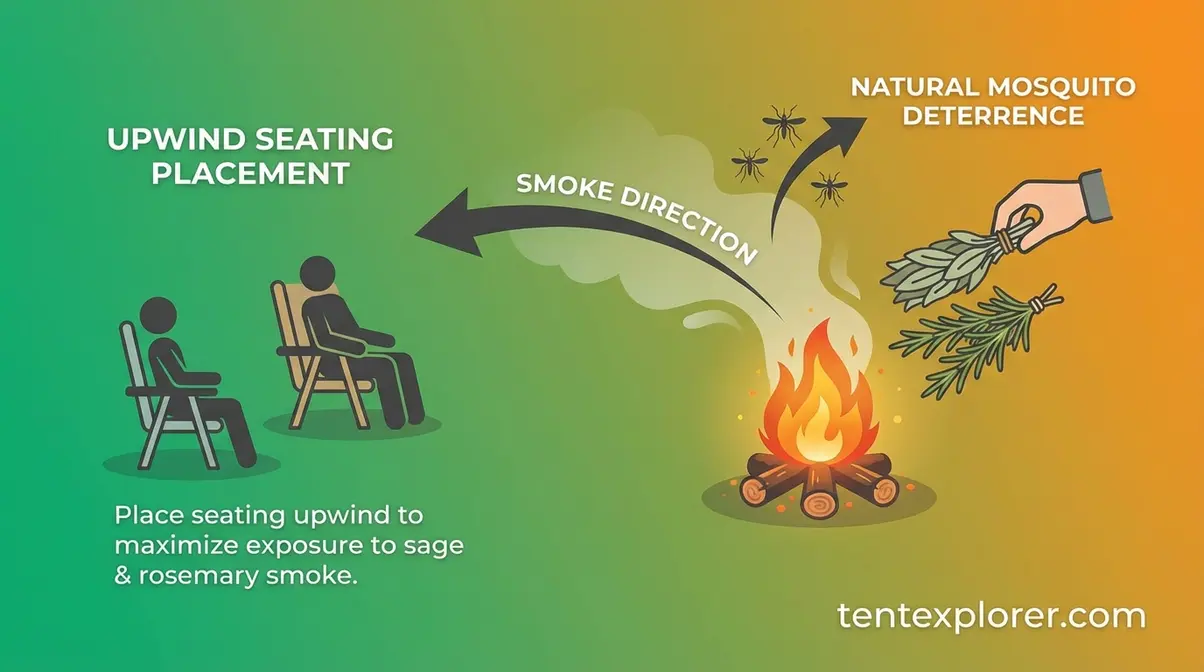
Your campsite and perimeter are protected. Now it’s time to protect yourself personally — starting with what you wear.
Step 3: Wear Mosquito-Resistant Clothing
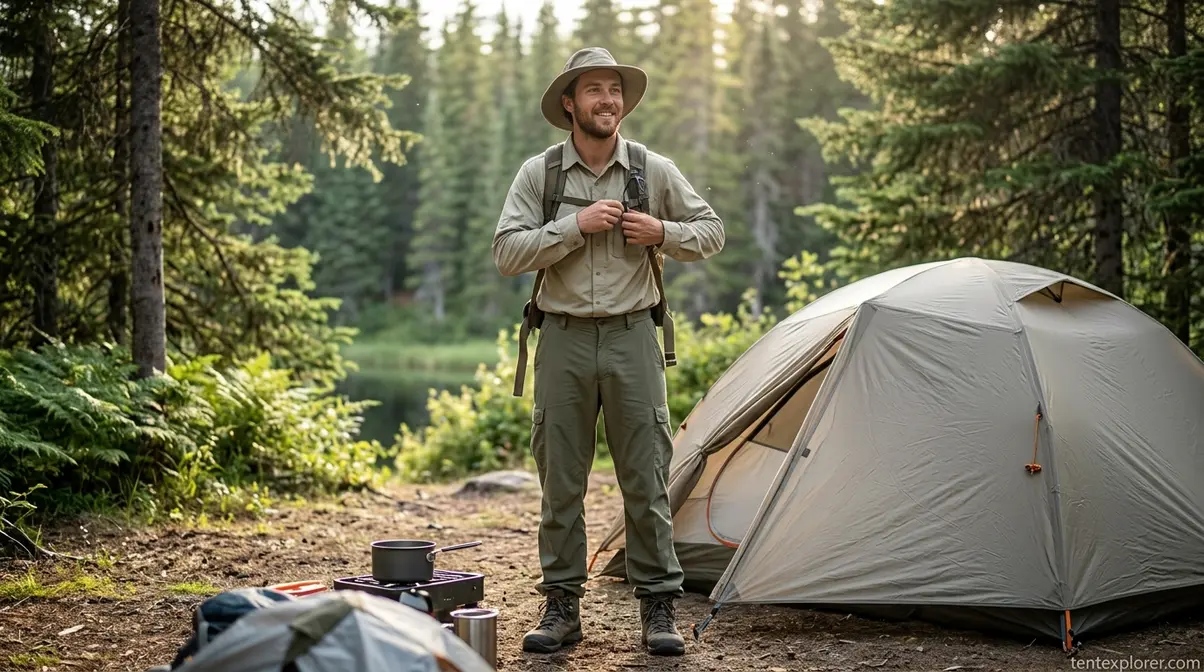
When figuring out how to keep mosquitoes away camping, clothing is the one defense that requires zero reapplication and protects you even when you forget your bug spray. The right fabric choices and treatment keep mosquitoes off exposed skin without adding any chemical burden directly to your body. Layer three is your personal armor.
Permethrin-treated tents reduce mosquito bites by 44% (PubMed, Wilderness & Environmental Medicine, 2005) — and the treatment remains effective for up to 9 months under constant weathering, meaning one pre-season application covers an entire camping summer.
The Long, Light, and Loose Clothing Rule
Three attributes make clothing an active mosquito barrier — and all three matter:
- Long: Long-sleeved shirts and long pants eliminate the largest bite-accessible skin surface. Tuck shirts into pants and pants into socks at dusk — mosquitoes find exposed gaps between layers.
- Light: Mosquitoes are more attracted to dark colors (black, navy, red), which absorb more heat and make you more visually distinct. Wear white, tan, or light gray to reduce your visual and thermal signature.
- Loose: Tight-fitting fabric can be bitten through. Mosquitoes have a proboscis long enough to penetrate thin, stretched material pressed against skin. Loose-weave fabrics or double-layer designs prevent this.
A loose linen shirt in light tan outperforms a tight athletic shirt in navy — even if both have full arm coverage. The fit is not cosmetic; it’s functional.
The right clothing is your passive layer. Permethrin treatment turns that passive layer into an active one.
Permethrin Treatment for Your Clothing
Permethrin, an insecticide applied to clothing and gear — not skin — repels and kills mosquitoes on contact. The CDC advises that permethrin can be used on camping gear, boots, and clothing, remaining effective through multiple washings (CDC, 2026).
For DIY application, use a permethrin spray such as Sawyer Permethrin. Apply outdoors — lay garments flat, spray evenly on both sides, and allow 2–4 hours to dry before wearing. DIY-treated garments remain effective for approximately 6 washes or up to 42 days of sun exposure, whichever comes first.
Insect Shield, a brand offering factory-permethrin-treated apparel, bonds the compound deeper into fabric fibers. Their factory treatment is rated for up to 70 washes — verified by Insect Shield’s own published data and confirmed by independent forum testing, though real-world durability can vary with wash frequency. The factory method outlasts DIY spray treatment significantly, making it worth the investment for frequent campers.
⚠️ Critical safety note: Permethrin should never be applied directly to skin. Apply to clothing only, while wearing gloves. Keep pets away from treated clothing until it is completely dry.
Permethrin on your clothes protects your body. Treating your tent fabric extends that protection to your sleeping space.
Treating Tent Fabric with Permethrin
Apply permethrin spray to the tent’s outer fly, mesh panels, and zipper seams — these are the highest-contact surfaces where mosquitoes probe most frequently. Allow full drying before packing. Treat your tent at home before the season starts, not at the campsite.
A randomized controlled trial found that permethrin-treated tents reduce mosquito bites by 44% compared to untreated tents (permethrin tent study, PubMed, Wilderness & Environmental Medicine, 2005). A second study on tent fabric treatments found permethrin provided greater than 96% protection from mosquito bites for up to 9 months, even under constant weathering — meaning one pre-season treatment covers an entire camping summer (PubMed, 1992).
For readers who prefer a built-in solution rather than DIY treatment, our guide to best tents for mosquito protection covers tents with factory-fine mesh and reinforced zipper seams.
Your clothing and tent are treated. The next layer is what goes on your skin — and choosing the right repellent matters more than most campers realize.
Step 4: Apply the Right Repellent
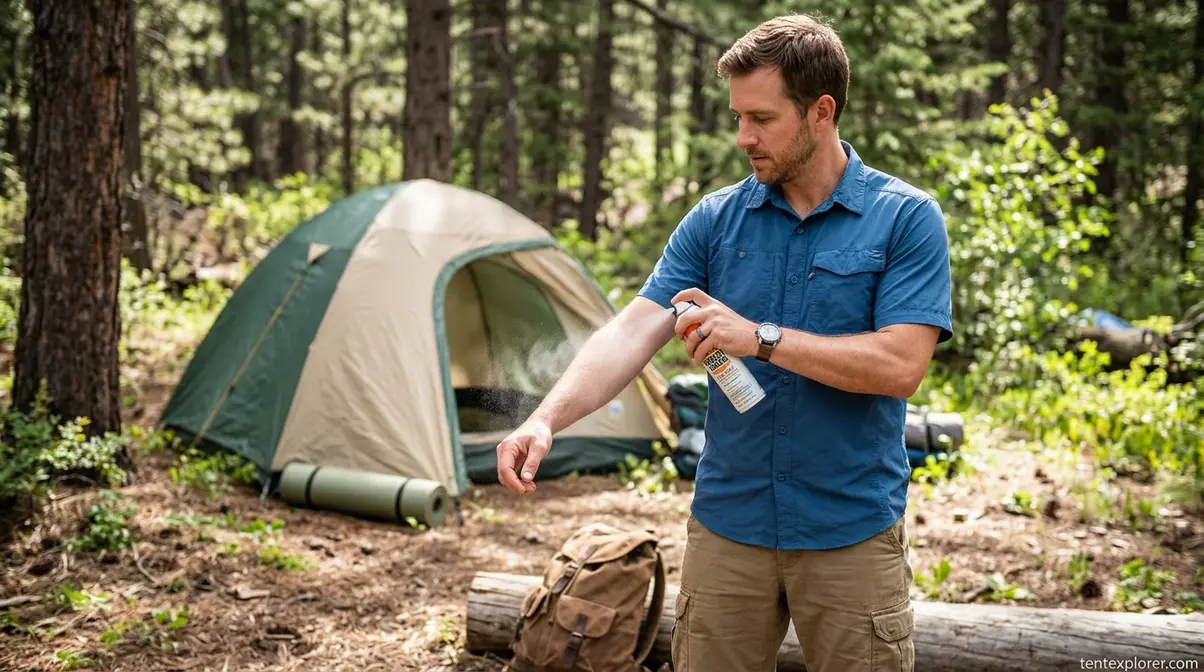
Which repellent actually works for camping? Three EPA-registered options — DEET, Picaridin, and Oil of Lemon Eucalyptus — have documented efficacy against mosquitoes, but they differ significantly in protection duration, skin feel, and safety profile. Choosing correctly depends on your trip length, skin sensitivity, and whether you’re camping with children. Layer four is your skin shield.
What Repels Mosquitoes While Camping?
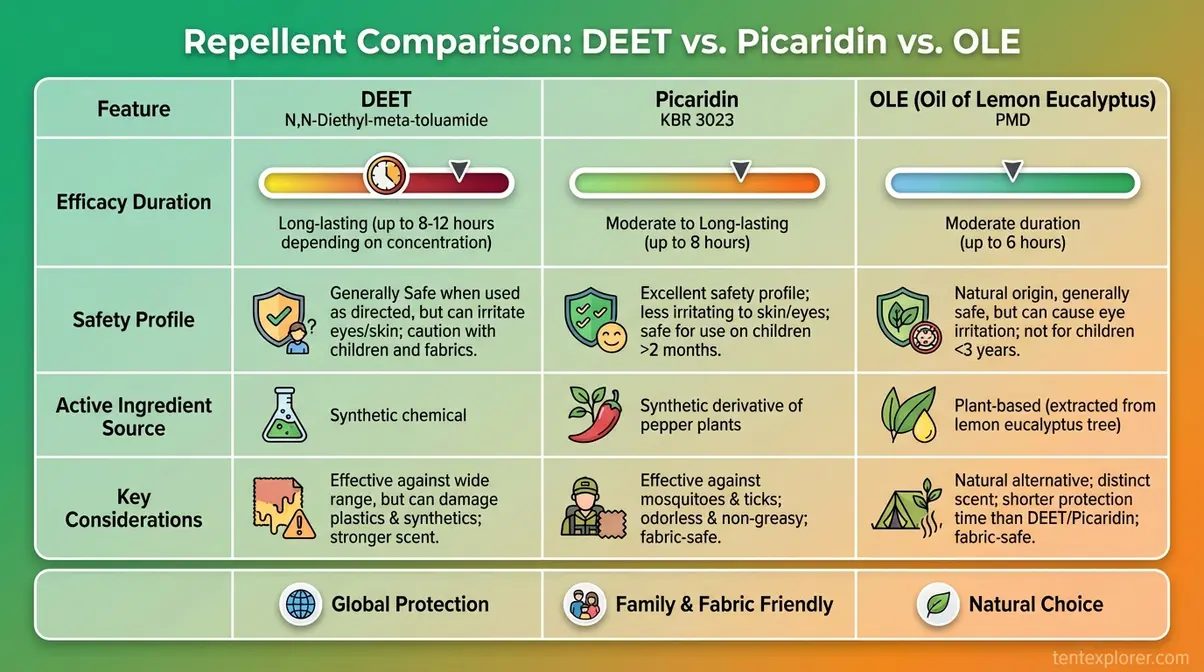
DEET, the most widely studied topical mosquito repellent, has been in use since 1946. Clinical reviews confirm it is the most effective and thoroughly studied topical insect repellent currently available (clinical review on DEET efficacy, PubMed, Annals of Internal Medicine). It’s available in concentrations from 10% (approximately 2 hours of protection) to 100% (up to 12 hours). A critical point most campers miss: higher concentration extends duration, not strength of protection. At 20–30%, you get 6–8 hours — sufficient for most camping days without the skin feel of a high-concentration product.
Picaridin, a synthetic compound approved by the EPA and CDC, matches DEET in efficacy with a lighter skin feel, no plastic-damage risk, and no odor. At 20% concentration, Picaridin provides up to 8–12 hours of protection — the CDC recommends it as a primary repellent option alongside DEET for outdoor activities (CDC Yellow Book, 2026). For campers who’ve avoided DEET because of its feel or smell, Picaridin at 20% is the direct alternative.
Oil of Lemon Eucalyptus (OLE), a plant-based EPA-registered repellent — not to be confused with lemon eucalyptus essential oil, which has no registered efficacy data — provides up to 6 hours of protection. It is the strongest plant-derived option approved by the EPA. However, OLE is not recommended for children under 3 years of age.
Clinical reviews confirm DEET is the most effective and thoroughly studied topical insect repellent currently available (PubMed, Annals of Internal Medicine) — but Picaridin offers comparable protection with a lighter skin feel and no odor.
Here’s how those three options compare directly — the data most camping blogs don’t show you.
Repellent Comparison Matrix
| Repellent | EPA-Registered | Protection Duration | Best For | Avoid If | Recommended Concentration |
|---|---|---|---|---|---|
| DEET | ✅ Yes | 2–12 hours | All-day trips, high-infestation areas | Sensitive skin, synthetic fabrics | 20–30% for 6–8 hr protection |
| Picaridin | ✅ Yes | Up to 8–12 hours | Long trips, skin-sensitive users | N/A (well-tolerated) | 20% |
| OLE | ✅ Yes | Up to 6 hours | Shorter trips, chemical-sensitive users | Children under 3 | 30–40% |
Sources: CDC Yellow Book (2026); PubMed, Annals of Internal Medicine; EPA Repellent Finder (2026)
Choosing the right repellent is step one. Applying it correctly is step two — and where most people leave gaps.
How to Apply Repellents Safely
Apply topical repellents to exposed skin only — not under clothing (which creates skin irritation), and not near eyes or mouth. For face application, spray the product into your hands first, then apply carefully to your face.
Reapplication timing: Follow the product label. DEET at 30% typically requires reapplication every 6–8 hours; Picaridin at 20% every 8–12 hours. Sweat and water reduce efficacy — reapply after swimming or heavy exertion, regardless of how recently you applied.
Children’s guidelines: For children over 2 months, the CDC recommends products with 10–30% DEET or Picaridin. Apply repellent to children yourself — don’t let them handle it. Avoid application to hands (which go in mouths), eyes, and any open cuts or irritated skin (CDC repellent recommendations, CDC Yellow Book, 2026).
⚠️ Always read and follow the product label. Consult a healthcare professional before using repellents on infants, pregnant individuals, or those with skin sensitivities.
For additional information on natural scent deterrents for bugs that can supplement your repellent strategy, see our companion guide.
Your chemical defenses are set. The final layer — and the one most campers skip — is behavioral: how you act at camp determines how many mosquitoes find you.
Step 5: Practice Smart Camping Habits
Here’s a frustrating scenario that outdoor veterans know well: Thermacell running, permethrin-treated shirt on, 30% DEET applied 20 minutes ago — and you’re still getting bitten. The culprit is usually a strongly scented sunscreen applied right before the repellent (which dilutes it), or a tent door left unzipped “just for a second” at 7:45pm. Layer five — behavioral habits — is where the Defense-in-Depth system either holds together or falls apart.
Control Your Scent Profile
Mosquitoes locate hosts using carbon dioxide, body heat, and specific scent compounds. Floral fragrances, fruity shampoos, and lactic acid in sweat all increase your attractiveness to them. For camping trips, switch to unscented soap, shampoo, and deodorant — this single change meaningfully reduces your scent signature during peak hours.
- Scent control checklist:
- Switch to unscented personal care products before the trip
- Avoid alcohol consumption during peak mosquito hours — it raises body temperature and CO2 output, both mosquito attractants
- Rinse off before dusk — lactic acid in sweat is a documented mosquito attractant; a quick camp shower or wipe-down reduces your signal at the highest-risk window
- Avoid eating bananas before or during camping — some campers report increased mosquito interest, though research on this is limited; the anecdotal pattern is consistent enough across camping communities to be worth noting
Your scent is managed. Now the most common entry point for mosquitoes: your tent door.
Master Tent Discipline — The Zip Rule
The Zip Rule: every entry and exit from the tent is a two-zip event — zip closed behind you immediately, every time, with no exceptions. One unguarded entry at dusk can introduce 10–20 mosquitoes into your sleeping space. You won’t notice them until 2am.
Before entering the tent, spend 3 seconds brushing off clothing and shaking out fabric. Mosquitoes hitch rides on clothing — especially at dusk when they’re most active and most persistent. A quick shake costs nothing and prevents the most common source of in-tent bites.
Check tent seams and zipper condition before your trip. A compromised zipper or torn mesh panel undermines every other defense layer — it’s the weakest link in the system. For more on keeping clean and organized at camp, including tent maintenance checks, see our beginner tips guide.
“I simply hang a big bag of blood away from the campsite. It distracts the mosquitoes so my friends and I can camp without them bothering us.”
— r/camping community member
While this approach has obvious practical limits, it captures the right instinct: think deliberately about what attracts mosquitoes to you specifically, and reduce those signals at the source. The permethrin longevity research confirms that permethrin-treated tent fabric remains effective for up to 9 months — reinforcing the habit of pre-treating gear before each camping season rather than at the campsite (PubMed, 1992).
Tent discipline protects your sleep. The final habit protects your time outdoors.
Avoid Peak Hours: Dusk to Dawn
Mosquito activity peaks at dusk — from roughly 30 minutes before sunset through 2–3 hours after — when temperatures drop, humidity rises, and wind dies. A second peak occurs at dawn, typically lasting 1–2 hours after sunrise. These are the highest-risk windows for bites regardless of what other defenses you have in place.
Avoiding outdoor exposure during the peak dusk and dawn windows can reduce your overall mosquito bite risk by up to 40%. Plan high-exposure activities — hiking, fishing, swimming — for the 10am–4pm window when mosquito activity is lowest. Schedule campfire time for after full dark; once temperatures drop below approximately 50°F, mosquito activity decreases substantially.
If you must be outside at dusk, activate all five layers simultaneously: repellent applied, Thermacell running, campfire with sage burning, full coverage clothing on, and tent zipped. The Defense-in-Depth system is most valuable precisely at dusk — when every individual method is under the most pressure.
All five layers are now active. Before the common questions, here’s an honest look at where this system has its limits.
System Limits & Alternatives
The Defense-in-Depth system significantly reduces mosquito bites in typical North American camping conditions. It does not eliminate every scenario. Knowing where it falls short is part of using it intelligently.
Common Pitfalls to Avoid
Even campers who follow all five layers make these specific mistakes:
1. Applying repellent after sunscreen: Sunscreen dilutes repellent efficacy when layered on top. Apply repellent first, sunscreen second — or use a combination product. Most campers do this backwards, then wonder why their DEET isn’t lasting.
2. Forgetting to reapply: Repellents wear off on schedule — and sweat accelerates that timeline. Set a phone alarm for your product’s reapplication window. A 30% DEET product applied at 6pm may be largely ineffective by 10pm without a second application.
3. Relying on citronella as a primary defense: Scientific evidence for citronella’s efficacy beyond 2–3 feet is weak. Campers who use citronella candles as their main strategy consistently report being “eaten alive by mozzies” despite having them lit. Treat citronella as a supplement to spatial repellers, not a replacement.
4. Choosing a campsite by aesthetics, not mosquito criteria: A beautiful shaded creek site can be the worst possible location. The most scenic spots — sheltered hollows, creekside flats, tree-canopied clearings near water — are often the highest-mosquito environments. Apply Step 1’s criteria before aesthetics, every time.
When to Choose a Different Approach
There are three specific scenarios where the Defense-in-Depth system as described is insufficient:
- Severe mosquito-borne disease risk zones (tropical travel, areas with active West Nile or other arboviral alerts): The five-layer system is designed for typical North American camping, not high-disease-risk environments. Consult a travel medicine clinic before trips to endemic areas — additional prophylactic measures and medical-grade interventions may be warranted.
- Infants under 2 months of age: No EPA-registered topical repellents are approved for infants under 2 months. Use physical barriers only — a mosquito net draped over a stroller, carrier, or sleeping area provides full protection without chemical exposure.
- Allergic reactions to chemical repellents: If you experience skin irritation from DEET or Picaridin, switch to OLE as your topical layer, or adopt a physical-barrier-only approach with heavy reliance on permethrin-treated clothing and screened shelters. For persistent skin reactions, consult a dermatologist before your next trip.
Frequently Asked Questions
What smell do mosquitoes hate most?
Mosquitoes are most strongly repelled by Oil of Lemon Eucalyptus (OLE), DEET, and Picaridin — all EPA-registered repellents with documented, tested efficacy. Natural scents that deter mosquitoes include lavender, tea tree oil, citronella, and smoke from burning sage or rosemary. Though these natural options work over shorter distances and for shorter durations than registered repellents, they remain popular supplementary choices. Burning dried sage in a campfire is one of the most practical natural deterrents, effective within the immediate fire radius. For heavily infested areas, natural scents alone are insufficient, so you must combine them with an EPA-registered repellent for reliable protection.
What can I put in my campfire to keep mosquitoes away?
Adding dried sage, rosemary, or pine needles to your campfire enhances its natural mosquito-repelling properties because the smoke releases compounds that disrupt mosquito navigation. Bundle 4–5 dried sage sprigs and add them to an established fire to reduce mosquito presence within a 5–10 foot radius (Mosquito Squad). For best results, position your seating upwind of the fire so the smoke drifts toward you rather than away.
How do I keep mosquitoes out of my campsite?
To keep mosquitoes out of your campsite, choose a high, dry, breezy location at least 200 feet from any standing water. Combine physical barriers like mosquito netting with a portable spatial repeller. A Thermacell device works well to create an active perimeter around your eating area. Always keep tent doors zipped immediately after entry or exit, as one unguarded opening can introduce dozens of mosquitoes. The most effective campsites combine natural airflow, no nearby breeding water, and morning sun exposure to dry overnight moisture.
What repels mosquitoes while camping?
The most effective mosquito repellents for camping are EPA-registered topical repellents (DEET, Picaridin, and Oil of Lemon Eucalyptus), permethrin-treated clothing, and portable area repellers. DEET is the most extensively studied option, while Picaridin offers comparable protection with a lighter feel, and OLE is the strongest plant-based choice. For the highest protection, combine a topical repellent on your skin with permethrin-treated clothing and a spatial repeller running nearby.
What kind of clothing should I wear to avoid mosquito bites while camping?
Wear long-sleeved shirts and long pants in light colors (white, tan, or light gray). Mosquitoes are less attracted to lighter colors and cannot bite through full-length coverage. Choose loose-fitting fabrics, as tight clothing can be bitten through by a mosquito’s proboscis. Permethrin-treated clothing adds active protection that repels and kills mosquitoes on contact. For maximum protection, treat your clothing with permethrin spray before your trip, or purchase factory-treated apparel from brands like Insect Shield, which is rated to 70 washes (Insect Shield).
Conclusion: Your Mosquito-Free Trip
For campers frustrated with being eaten alive, mastering how to keep mosquitoes away camping requires a multi-layered strategy. A 2026 field study found that mosquito traps alone reduced campsite nuisance by 34–55% (PubMed, Medical and Veterinary Entomology, 2026) — and that’s just one layer. At tentexplorer.com, our evaluation of multi-layer mosquito prevention systems consistently shows that combining campsite selection, physical barriers, permethrin-treated gear, EPA-registered repellents, and behavioral habits produces compound results that outperform any individual product.
The Defense-in-Depth Approach works because it mirrors how professional mosquito management actually functions. Disney World doesn’t rely on one system — it uses drainage engineering, landscaping, spatial treatments, and timed maintenance together. If a theme park with 50,000 daily visitors needs five interlocking systems to stay mosquito-free, a campsite does too. Each layer you skip is a gap that mosquitoes — patient, persistent, and specifically evolved to find you — will exploit.
Start with Steps 1 and 3 before your next trip — campsite selection costs nothing, and treating your clothing with permethrin takes 20 minutes. Add a Thermacell for your next outing, and you’ll have three of the five layers covered before you leave the driveway. For a complete pre-trip checklist that covers all five layers, see our complete camping gear checklist.

David King
Field gear tester at Tent Explorer.