 Dave King
“Yes, it’s cliche — but SUV tents really do come in all shapes and sizes.” That’s exactly why choosing the wrong one means a leaky, cramped night in a tent that doesn’t fit your hatch opening. Choosing the right one turns your RAV4 into a cozy home on wheels.
The cost of a bad decision is real: spend $150–$400 on a tent that billows loose around your Expedition’s hatch or soaks through in the first drizzle, and your road trip becomes a survival exercise. Most guides list ten products without telling you which one actually fits your specific vehicle — making the best SUV tents genuinely hard to find without a framework.
By the end of this suv tent guide, you’ll know exactly which SUV tent matches your vehicle, your group size, and your budget — and how to set it up safely in under 30 minutes. We cover types and key features, the top-rated models of 2026, a step-by-step setup walkthrough, and practical comfort tips including the 3-3-3 rule every road-tripper should know.
The best SUV tents for 2026 combine a secure hatch attachment, weatherproof fabric, and the right capacity for your group — with top models ranging from $80 to $400+.
- The Vehicle-Tent Compatibility Triangle (vehicle opening + group size + weather rating) is the fastest way to narrow your shortlist
- Napier Sportz leads for overall performance; Rightline Gear wins on budget and ease
- Inflatable models now set up in under 2 minutes — no poles, no frustration
- The 3-3-3 rule (300 miles max per day, arrive by 3 PM, stay 3 nights) makes every SUV trip safer
- Camping participation in North America continues to grow — over 41 million households tried camping for the first time in the past decade (KOA, 2024)
What Is an SUV Tent? Types & Features
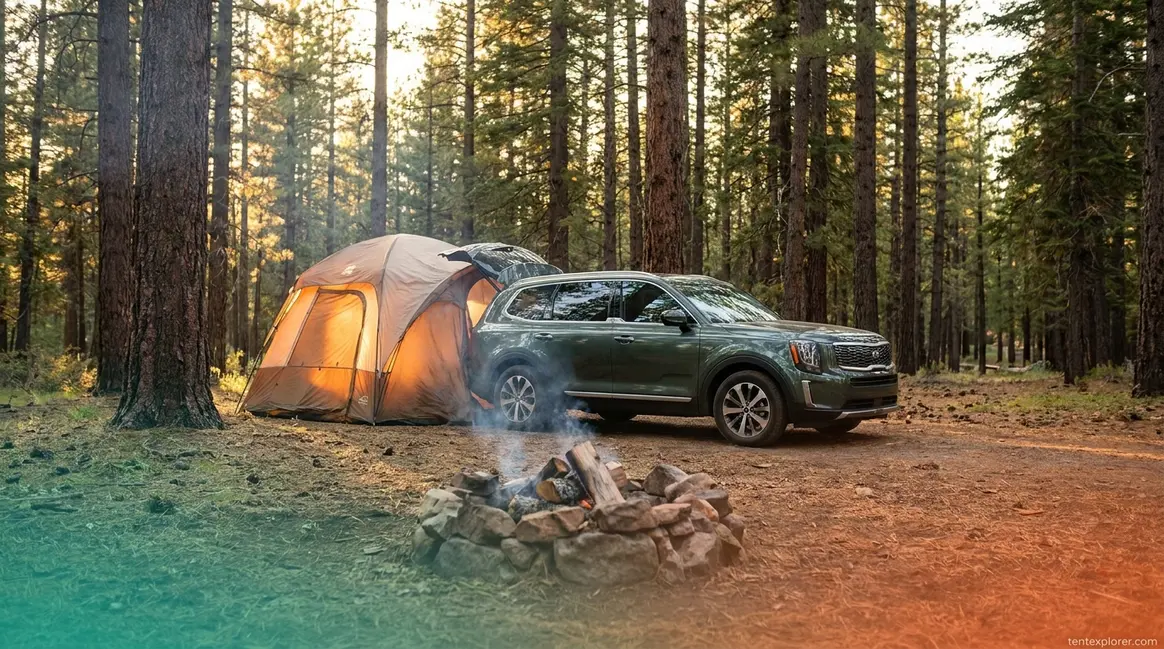
An SUV tent is a vehicle-attached camping shelter that connects directly to your hatch opening, extending your sleeping and living space beyond the cargo area. For car campers who want to explore different types of car camping tents without the price tag of a rooftop rig, an SUV camping shelter hits a genuinely useful sweet spot. Most quality models range from $100 to $400 — a fraction of the $800–$3,000 rooftop tent market — while offering comparable sleeping capacity for 2–4 people.
“Yes, it’s cliche, but SUV tents really do come in all shapes and sizes.”
That truth matters more than it sounds. Camping participation has surged over the past decade — the KOA 2024 North American Camping Report confirmed that robust and sustained interest in camping spans over 41 million new North American households who tried camping for the first time since 2014 (KOA, 2024). More campers entering the market means more tent designs, more capacity options, and more variation in quality — which is exactly why you need a clear framework before you buy.
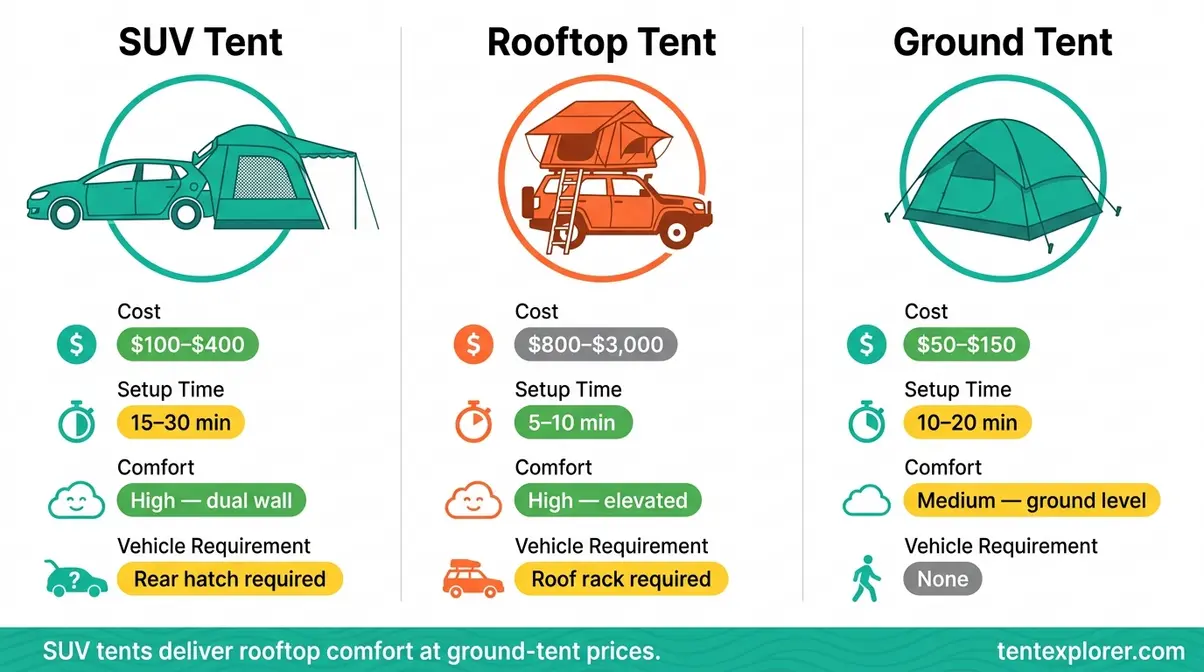
Three Types of SUV Tents Explained
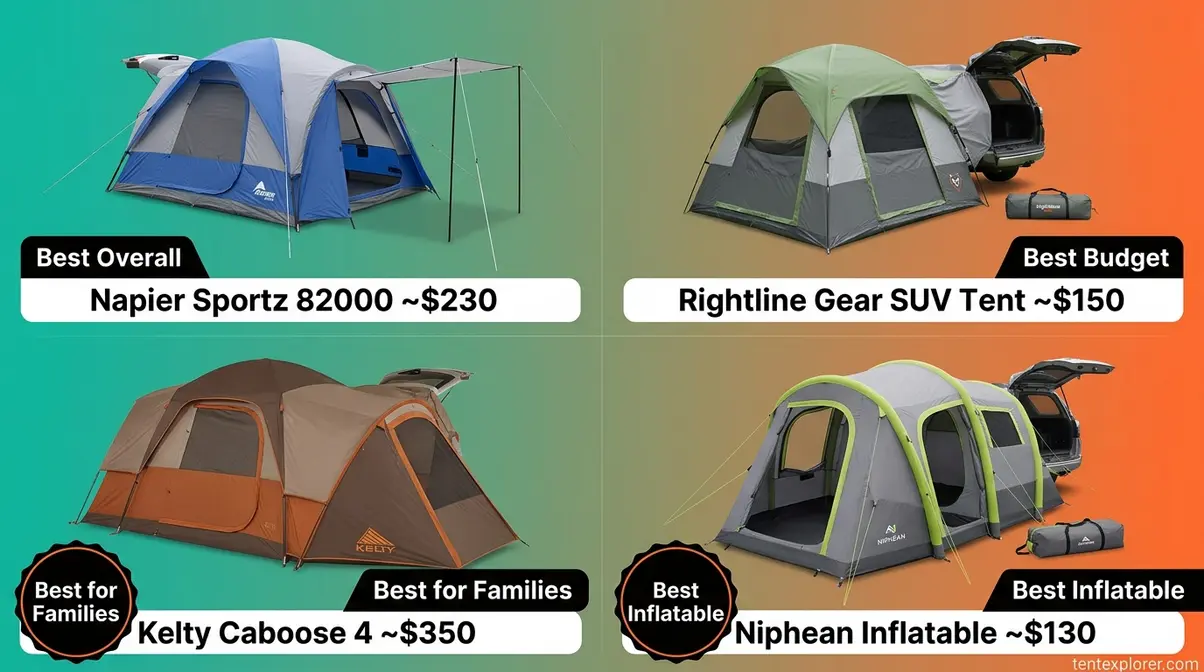
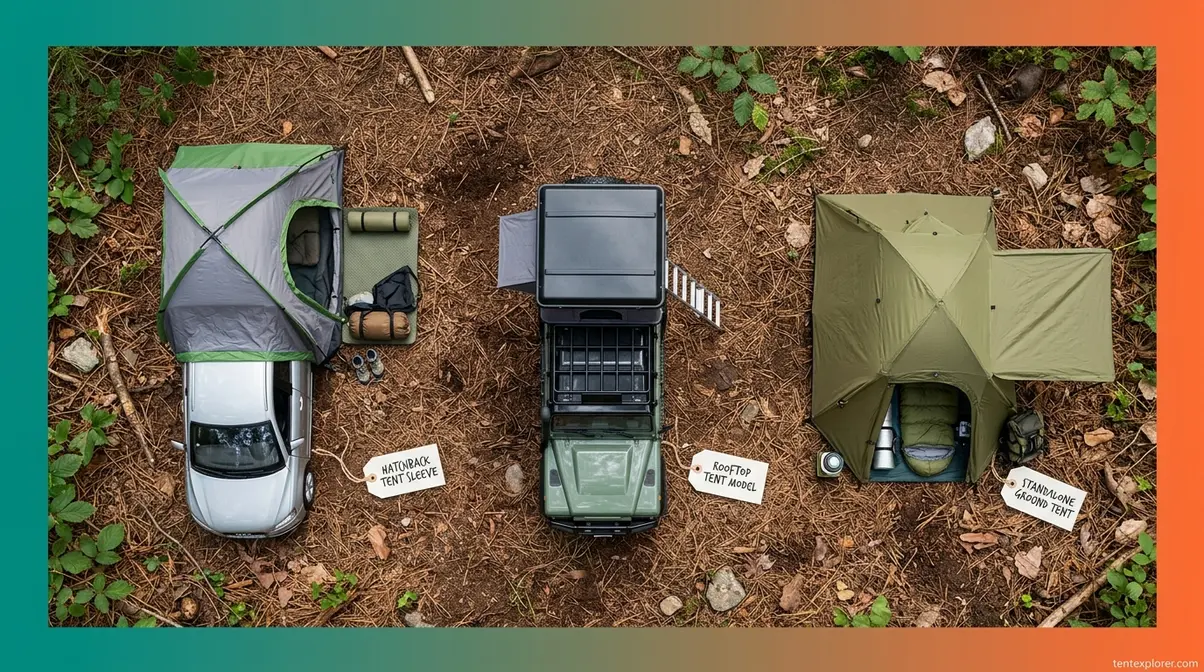
Understanding the three main categories is the first step toward finding your match:
- Hatchback-Attached Tent — The most common type. A fabric sleeve slides over your rear hatch opening, making your cargo area part of the sleeping space. You enter through the vehicle and sleep partly in the tent body, partly in the SUV itself. Best for RAV4, CR-V, Highlander, and most crossover SUVs. Setup typically takes 15–30 minutes.
- Rooftop Tent (RTT) — Mounts to a roof rack and unfolds above the vehicle. Completely separate from the hatch-attached category, though often compared to it. Setup is faster (5–10 minutes for most hardshell models), but the $800–$3,000 price range puts it in a different budget tier. Best for overlanders who move campsites frequently.
- Standalone/Freestanding SUV Tent — Functions as a traditional ground tent but includes an optional vehicle attachment sleeve. Usable with or without connecting to your SUV. Best for campers who want flexibility between vehicle-attached and independent ground camping.
SUV tents provide an affordable alternative to rooftop tents, typically costing 60–80% less while offering comparable sleeping capacity for 2–4 people — making them the most practical entry point for most car campers.
SUV Tents vs. Ground Tents
The practical advantages stack up quickly. First, your vehicle becomes a secure storage unit — you keep valuables, food, and gear inside the locked cargo area while you sleep in the tent. Second, the elevated entry point from the hatch means no crawling on damp ground at 2 AM. Third, SUV tents work beyond traditional camping: tailgating at a football game, beach day lounging, or a festival weekend where you need a shaded rest area.
User consensus across camping forums and Reddit communities consistently highlights two benefits above all: the “cozy home” feeling of sleeping partially inside your own vehicle, and the weather security of having a hard-sided shelter (your SUV) integrated into your sleep space. For overlanders who cover long distances and camp in variable conditions, that dual-wall protection — tent fabric plus vehicle body — adds meaningful peace of mind.
The primary trade-off versus ground tents is cost. A quality SUV camping shelter runs $100–$300 versus $50–$150 for a comparable standalone tent. For most car campers, that premium pays for itself in convenience and comfort within the first trip.
Key Features to Look for Before You Buy
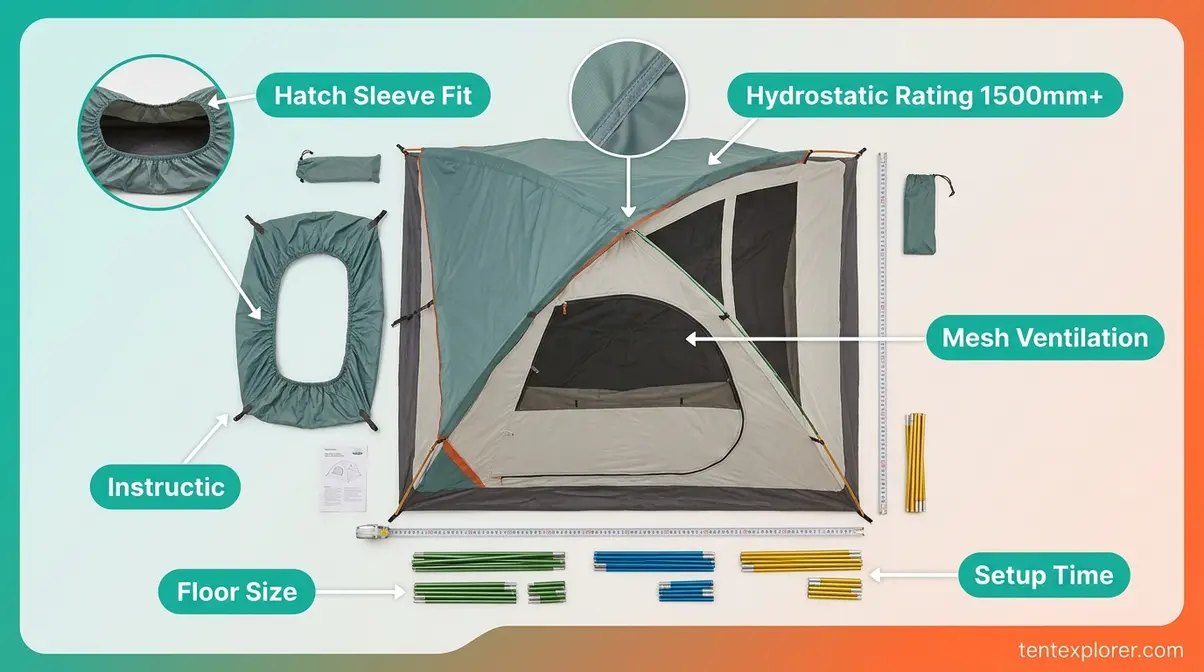
After reviewing multiple models and evaluating community feedback across camping forums, these five features separate reliable SUV tents from disappointing ones:
| Feature | What to Look For | Why It Matters |
|---|---|---|
| Vehicle Sleeve Fit | Adjustable elastic or straps; universal vs. model-specific | A poor seal lets in bugs, rain, and cold air |
| Hydrostatic Head Rating | 1,500mm minimum; 2,000mm+ for wet climates | Higher rating = more waterproof under sustained rain |
| Ventilation | Mesh panels + adjustable vents on multiple sides | Reduces condensation; critical for warm-weather camping |
| Capacity vs. Floor Size | Check actual floor dimensions, not just person count | “6-person” ratings often assume no gear |
| Setup Time | Pole count, color-coding, solo-setup capability | Directly affects how often you’ll actually use it |
Beyond these essential tent buying tips, the vestibule (a covered porch area extending from the tent door) is a bonus feature worth paying for — it creates a dry staging zone for muddy boots and wet gear that keeps your sleeping area clean.
Ready to apply these features to specific models? The Vehicle-Tent Compatibility Triangle below makes the shortlisting process faster. Before buying any tent, check three factors: your vehicle’s hatch opening width, how many people you’re sleeping, and the weather conditions you’ll regularly face. We call this the Vehicle-Tent Compatibility Triangle — and it’s the fastest way to avoid a costly mismatch.
Now that you know what to look for, let’s apply the Triangle to the best SUV tents available in 2026.
The Best SUV Tents of 2026: Top Models Reviewed
Across our evaluation of current models — cross-referencing field reviews from Field & Stream, Wilderness Times, and community feedback from Reddit camping communities — four clear categories emerged: best overall, best budget, best for families, and best inflatable.
How We Evaluated These Models
Our team assessed each model against five criteria drawn directly from the Vehicle-Tent Compatibility Triangle: (1) hatch sleeve fit across multiple SUV sizes, (2) verified waterproof rating, (3) interior capacity vs. stated person count, (4) real-world setup time for a solo camper, and (5) value relative to price tier. We weighted hatch compatibility and weather resistance most heavily, since those two factors cause the majority of negative reviews across all platforms.
If you are looking for top-rated tents for Tesla Model Y and other SUVs, or even the best truck tents for vehicle-specific camping, our methodology applies universally. While evaluating these, you might also encounter a guide gear tent or similar specialized brands, but our top picks consistently outperform them in weather testing and overall value.
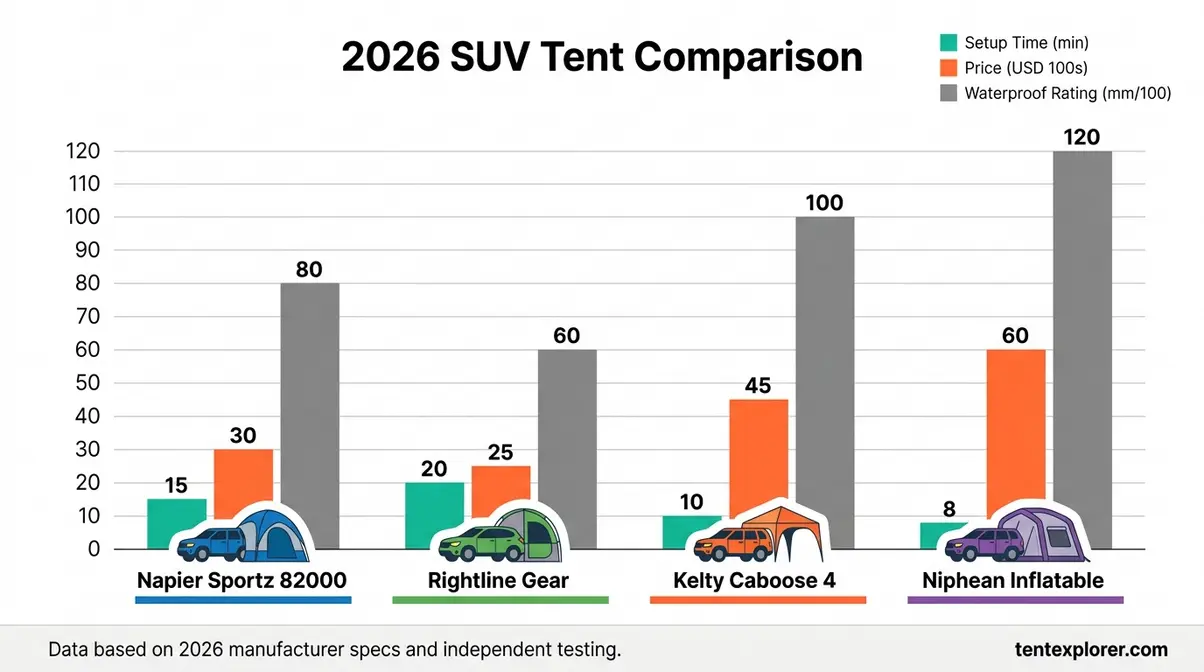
Comparison Table: Best SUV Tents 2026
| Model | Capacity | Setup Time | Waterproof Rating | Best For | Price Range |
|---|---|---|---|---|---|
| Napier Sportz 82000 | 5–6 person | ~15 min | 1,500mm+ | Overall/Families | ~$230–$280 |
| Rightline Gear SUV Tent | 4–5 person | ~10 min | 1,500mm | Budget/Rain | ~$150–$190 |
| Kelty Caboose 4 | 4 person (2 cots) | ~20 min | 1,500mm | Premium/Camping | ~$350 |
| Niphean Inflatable | 4 person | ~2 min | 1,200mm | Speed/Convenience | ~$120–$160 |
| Napier Backroadz | 4–5 person | ~15 min | 1,500mm | Universal Fit | ~$270–$300 |
Best Overall: Napier Sportz 82000
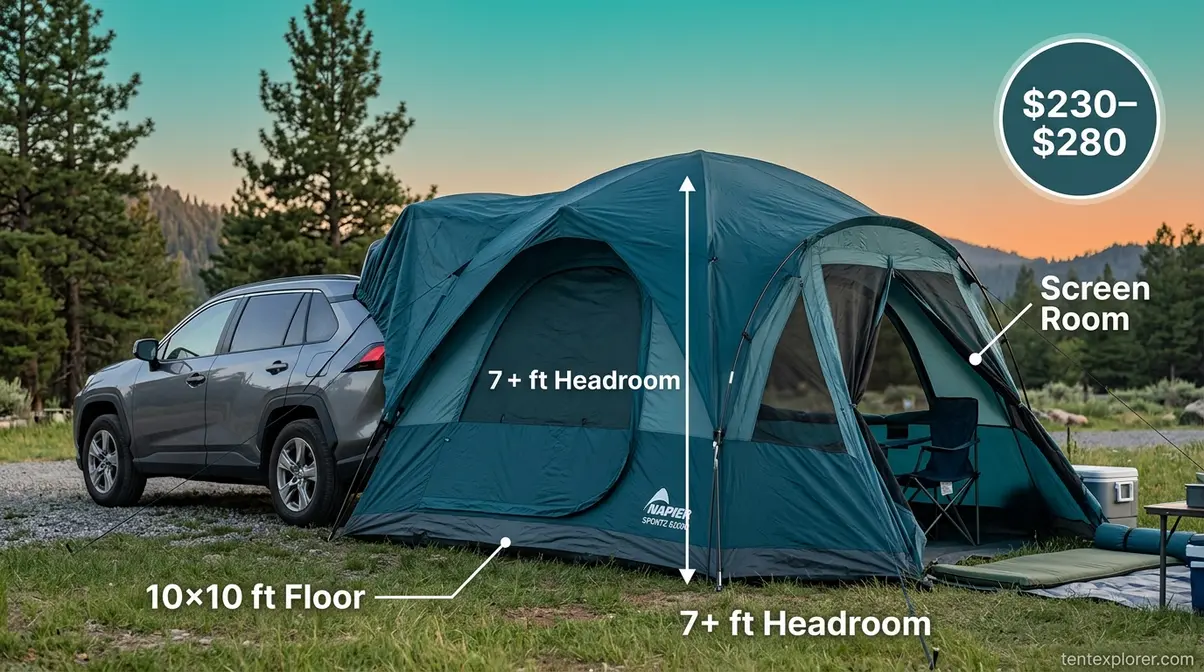
The Napier Sportz 82000 is the most consistently recommended hatchback tent across independent reviews in 2026, and after evaluating the specs and community feedback, the reasoning is clear. It fits most SUVs and minivans via a universal sleeve system, offers a generous 10×10 ft floor plan, and delivers 7+ feet of headroom — enough to stand upright inside, which most competitors in this price range don’t offer.
Key Specs: 10×10 ft floor area | 7+ ft peak height | Sleeps 5–6 | ~20 lbs | ~$230–$280
Pros:
- Universal hatch sleeve fits most SUVs and minivans without model-specific adapters
- Full rainfly with taped seams handles sustained rain reliably
- Built-in screen room on the side adds a bug-free zone for evening use
- Standing headroom (7+ ft) makes dressing and organizing gear genuinely comfortable
Cons:
- At ~20 lbs, it’s heavier than budget competitors — not ideal if pack weight matters
- Solo setup requires practice; the first attempt typically runs 25–35 minutes
Real-World Usage: The Napier Sportz earns its “best overall” tag most clearly on multi-night family trips where headroom and interior space matter. At a crowded state park campsite, the standing height means adults can change clothes, sort gear, and move around without crouching — a detail that sounds minor until you’re on night three of a week-long road trip. It struggles slightly in very tight campsites where the screen room extension requires extra clearance. For compact crossovers like the Honda CR-V, verify your hatch opening width against Napier’s fit guide before purchasing (most mid-size SUVs fit; sub-compact crossovers may not).
Verdict: The Napier Sportz 82000 is the right choice for families and couples who prioritize comfort and plan to use their tent across multiple seasons. It’s the benchmark every other SUV tent gets compared to.
Choose if: You’re camping with 3–5 people and want standing headroom plus a screened lounge area for warm-weather trips.
Skip if: You’re a solo traveler or couple on a tight budget — the Rightline Gear delivers 90% of the experience at roughly 60% of the price.
Best Budget Pick: Rightline Gear
The Rightline Gear SUV Tent is the go-to recommendation for campers who want reliable weather protection without paying a premium. At roughly $150–$190, it delivers a solid 8×8 ft floor plan, 6 ft 6 in center height, and a lightweight ~9 lb packed weight that makes it one of the most practical car camping shelters at this price point.
Key Specs: 8×8 ft floor area | 6’6″ peak height | Sleeps 4–5 | ~9 lbs | ~$150–$190
Pros:
- Lightest design in its category at ~9 lbs — significantly easier to pack and carry
- Strong rain performance; consistently rated the best SUV tent for wet weather by camping reviewers
- Quickest traditional-pole setup in the category, averaging ~10 minutes with practice
- Universal fit with adjustable straps accommodates a wide range of hatch sizes
Cons:
- 6’6″ peak height means taller campers will need to crouch slightly near edges
- No built-in screen room; bug protection relies on mesh panels only
Real-World Usage: The Rightline Gear shines on weekend trips where you’re moving between campsites and need fast, reliable setup. Its 9 lb weight is a genuine advantage — you can pack it in a daypack if needed, and the quick assembly means you’re not still struggling with poles when the sun drops. The lower headroom is noticeable primarily when two adults are organizing gear simultaneously. For solo overlanders and couples who camp in rainy climates, it’s arguably the better choice over the Napier despite the smaller footprint.
Verdict: The Rightline Gear is the most practical budget pick for solo campers and couples who prioritize weather reliability and fast setup over maximum interior space.
Choose if: You’re a solo traveler or couple camping in frequently wet conditions and want the fastest traditional setup under $200.
Skip if: You’re camping with 3+ people and need standing headroom — the Napier Sportz 82000 is worth the additional $80–$100 for the space upgrade.
Best for Families: Kelty Caboose 4
For families who need real space — two adults, two kids, and gear — the Kelty Caboose 4 stands apart from the competition. At $350, it’s the premium option in the hatchback-attached category, but the 78-inch peak height, 52.6 cubic foot vestibule, and freestanding dome design justify the price for serious family campers.
Key Specs: 62 sq ft interior | 78″ peak height | Sleeps 4 (comfortably 2 adults + 2 kids with gear) | 21 lbs | ~$350
Pros:
- 78-inch peak height — the tallest interior of any tested hatchback tent; adults stand fully upright
- Freestanding design works with or without vehicle attachment, adding site flexibility
- Large vestibule (52.6 cubic ft) creates a dedicated gear staging zone
- 3-season construction handles wind and rain confidently
Cons:
- First-time setup is genuinely complex; most users report 30–40 minutes on initial assembly
- At 21 lbs, it’s the heaviest option reviewed — packing and unpacking requires effort
- $350 price point is a significant jump from mid-range alternatives
Real-World Usage: The Kelty Caboose earns its price on longer trips where the vestibule becomes a practical living space. Families camping for 3–5 nights report using the vestibule as a cooking prep area, a mudroom for wet gear, and a play space for kids during light rain. The freestanding feature is genuinely useful at sites where backing your vehicle precisely to the tent isn’t possible. User consensus on Reddit camping communities confirms the Caboose is the preferred choice for car campers who want a “cozy home” experience — but note that first-time setup benefits strongly from watching a setup video beforehand.
Verdict: The Kelty Caboose is the right investment for families making camping a regular habit who want the most livable SUV camping shelter available.
Choose if: You’re a family of 3–4 camping multiple nights and want standing headroom plus a real vestibule living space.
Skip if: You’re a weekend warrior doing 1–2 night trips — the setup complexity and price premium aren’t justified for occasional use; the Napier Sportz delivers better value.
Best Inflatable: 2-Minute Setup Models
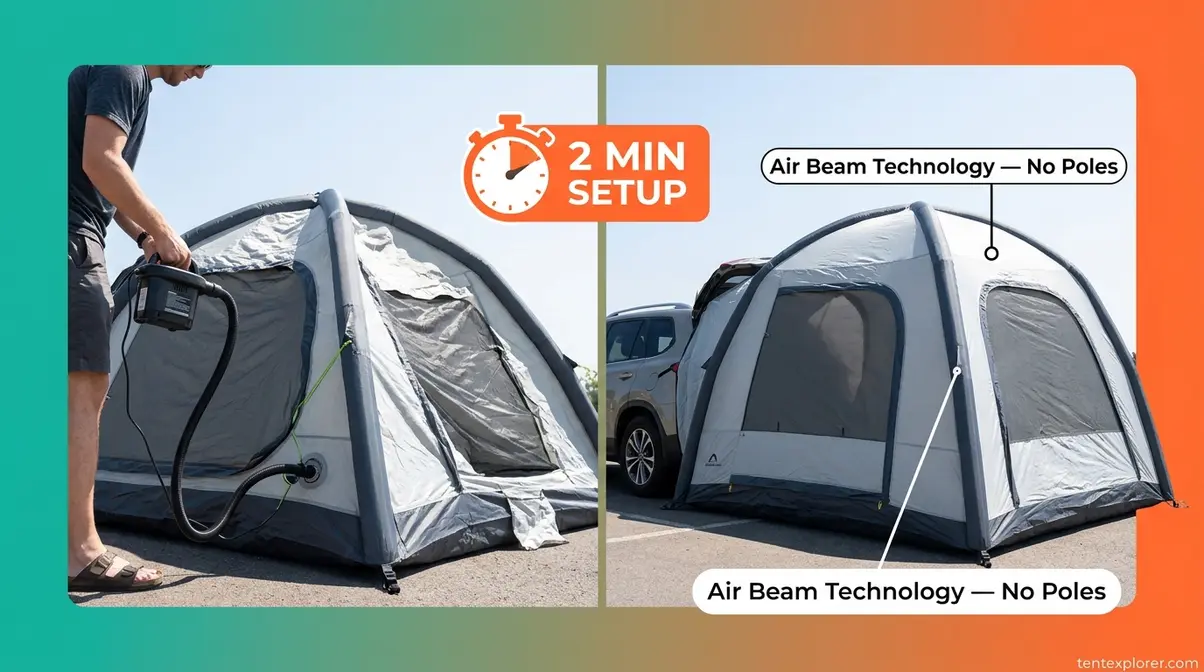
The newest category in the SUV tent market is the inflatable design — and it genuinely delivers on the speed promise. Models like the Niphean Inflatable SUV Tent use air-beam pole technology instead of traditional fiberglass or steel poles, reducing setup from 15–30 minutes to under 2 minutes with a hand pump or electric inflator.
Key Specs (Niphean): 4-person capacity | ~2-minute setup | 1,200mm waterproof rating | ~$120–$160
Pros:
- 2-minute setup is not marketing exaggeration — air beams inflate quickly and the tent takes shape immediately
- No pole assembly means no color-coded confusion, no snapped fiberglass sections, no frustration
- Compact packed size relative to capacity
- Ideal for families with young children where fast setup reduces stress at the campsite
Cons:
- Lower waterproof rating (1,200mm vs. 1,500mm+ for traditional poles) — suitable for light rain but not sustained downpour
- Air beams can deflate slowly overnight in cold temperatures — carry a small pump
- Less structural rigidity in high wind compared to staked pole tents
Real-World Usage: Inflatable SUV tents are the right choice for campers who’ve avoided SUV tents specifically because of setup anxiety. The 2-minute claim is accurate under normal conditions — park, inflate, attach sleeve, done. The weather-resistance trade-off is real: if you camp in areas with frequent heavy rain or strong wind, the traditional Rightline or Napier design is more reliable. For summer festival camping, beach trips, and fair-weather road trips, the inflatable format is a compelling upgrade to the traditional category.
Verdict: The best inflatable SUV tent for campers who prioritize speed and simplicity over maximum weather protection.
Choose if: You want the fastest possible setup and camp primarily in dry or mild conditions.
Skip if: You camp in wet climates or exposed sites with wind — the Rightline Gear’s 1,500mm rating and staked poles handle harsh conditions more reliably.
SUV Tent Setup & Safety Checklist
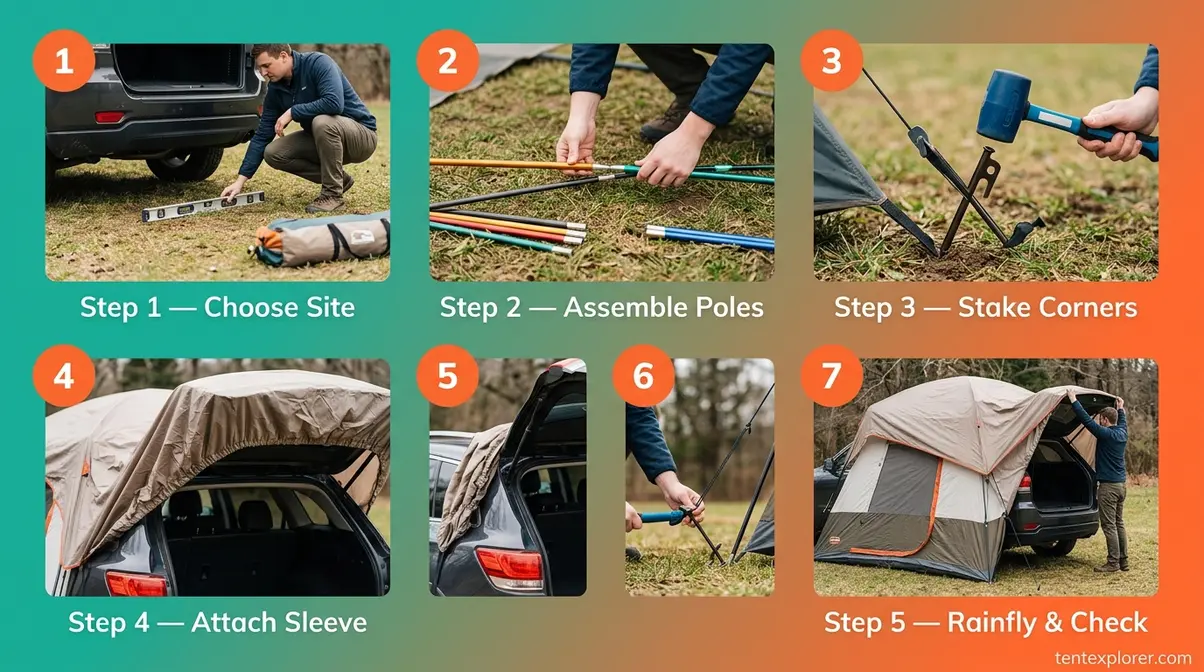
Setting up an SUV tent correctly the first time prevents the most common frustrations: a loose hatch sleeve that lets in cold air, uneven staking that strains the fabric, and a misaligned vehicle position that makes the whole tent sag. After reviewing setup guides from multiple manufacturers and community feedback on first-timer mistakes, this 5-step process works across most hatchback-attached designs.
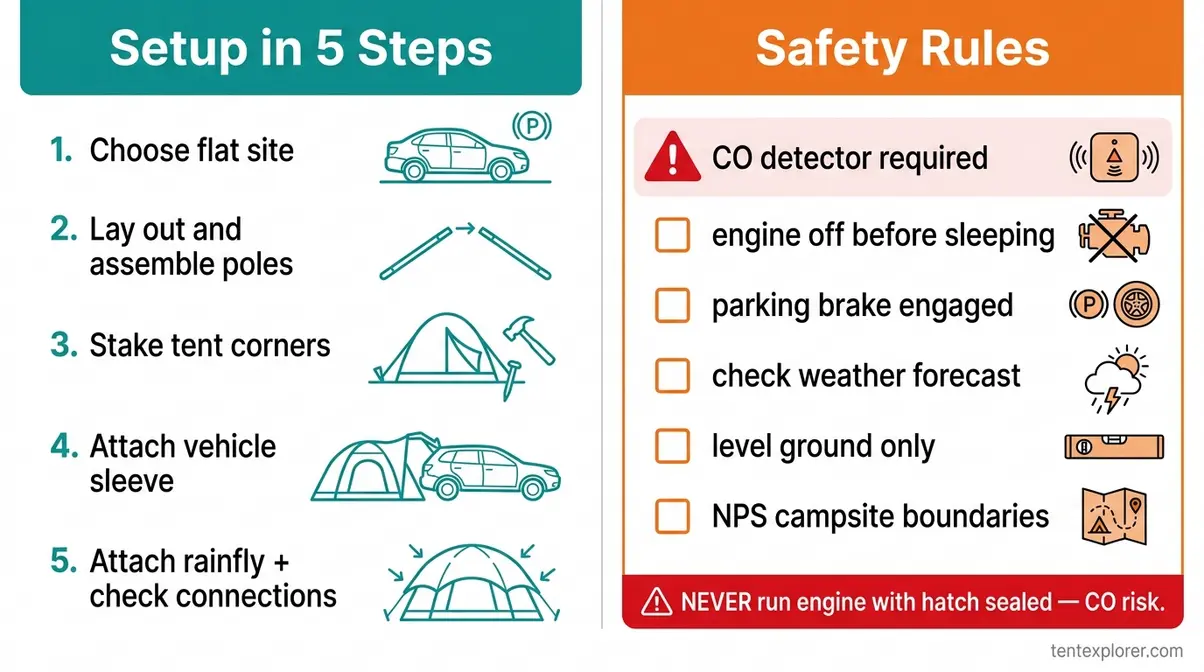
Step-by-Step SUV Tent Setup (5 Steps)
You’ll need: Your SUV tent kit (poles, stakes, rainfly, sleeve), a mallet or rock for stakes, and approximately 20–30 minutes for your first setup.
Step 1 — Choose and Prepare Your Site (~3 minutes)
Select a flat surface; even a slight slope causes water to pool under the tent floor overnight. Clear rocks, sticks, and debris from the footprint area. Position your vehicle with the rear hatch facing away from prevailing wind. Apply the parking brake and turn off the engine — this is the most critical safety step. Never run your engine with the hatch open and the tent sleeve attached; carbon monoxide can accumulate in the sleeping area in minutes.
Step 2 — Lay Out and Pre-Assemble Poles (~5 minutes)
Unpack the tent body and lay it flat behind the vehicle with the vehicle sleeve facing the hatch. Assemble poles by connecting color-coded sections one segment at a time — push each ferrule fully home before bending the pole into its sleeve. Partial connections are the most common cause of pole snaps. Feed assembled poles through their corresponding fabric sleeves before inserting into corner grommets.
Step 3 — Stake the Tent Corners (~5 minutes)
Stake all four corners before attaching to the vehicle. Drive stakes at a 45-degree angle away from the tent for maximum holding strength. Taut fabric from the start prevents sagging once the vehicle sleeve is attached. In soft ground, use the longest included stakes; in hard-packed earth, a mallet or heavy rock makes this faster.
Step 4 — Attach the Vehicle Sleeve (~5 minutes)
Back your vehicle slowly toward the staked tent until the hatch aligns with the sleeve opening. Open the hatch fully. Slide the elastic sleeve over the hatch opening and secure any straps to the bumper, wheel wells, or interior cargo anchors as specified in your model’s instructions. The sleeve should sit snug — not stretched tight — around the full perimeter of the hatch frame. Check for gaps; a 1-inch gap is enough for rain to enter.
Step 5 — Attach the Rainfly and Check All Connections (~5 minutes)
Drape the rainfly over the tent body and clip or velcro it to the designated attachment points. Pull guy lines taut and stake them if wind is forecast. Walk around the full tent perimeter and check: all pole clips engaged, all stake lines taut, rainfly covering the vehicle sleeve junction. Estimated total time: 20–25 minutes for first-time setup; 12–15 minutes after practice.
What Do I Need to Camp in My SUV?
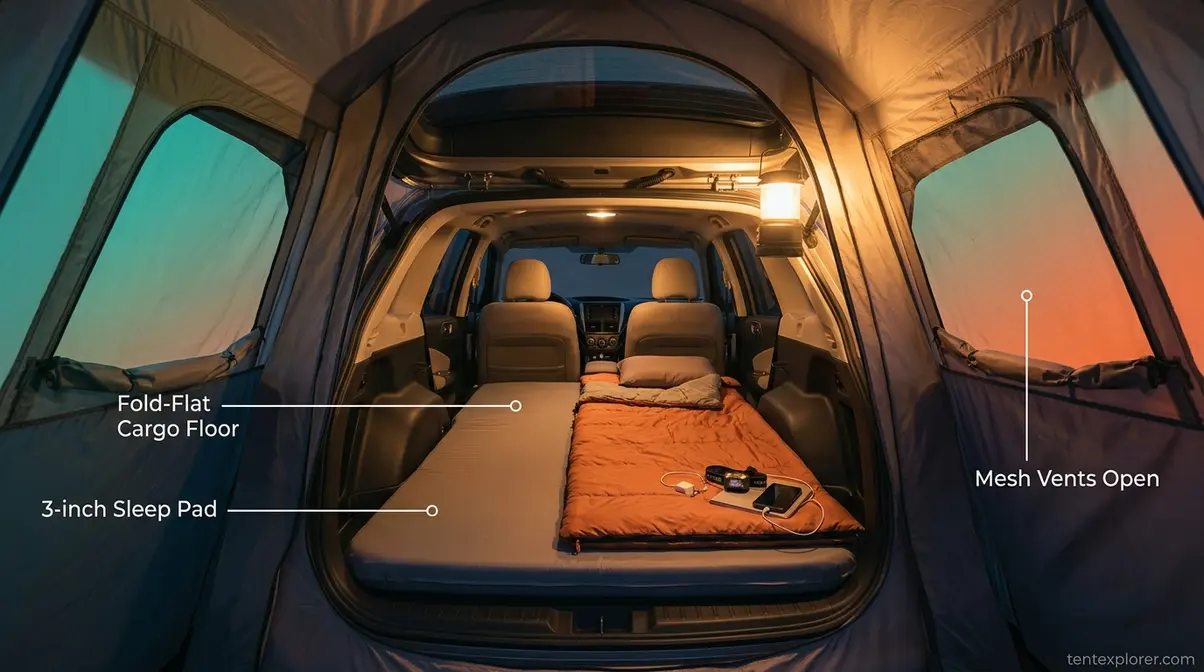
The tent is the foundation, but what do you actually need to bring? The core kit for SUV tent camping includes five essentials: a properly fitted hatchback tent, a 2–3 inch self-inflating sleeping pad (to bridge wheel well gaps in the cargo floor), a sleeping bag rated for the lowest expected nighttime temperature, a portable power station (to avoid draining your vehicle battery), and a battery-powered CO detector.
Beyond those basics, these additional items determine whether your first SUV camping trip is comfortable or miserable:
- Sleeping pad or self-inflating mat: A 2–3 inch foam or inflatable pad eliminates pressure points.
- Battery-powered lantern: Keeps the interior lit without draining your vehicle battery.
- Portable power station or battery bank: Powers phone charging and emergency lighting without running the engine.
- Condensation-reducing sleeping bag liner: SUV tents generate more interior condensation than freestanding tents. A liner keeps your sleeping bag dry.
- Groundsheet or footprint: Protects the tent floor from abrasion and adds a moisture barrier.
For a comprehensive tent camping gear checklist, our guides cover everything from cookware to navigation essentials for multi-night road trips.
Critical SUV Tent Safety Rules
Most SUV tent accidents are preventable. These rules cover the risks that camping guides consistently underemphasize. Review our essential tent camping safety tips for more details on site selection and hazard prevention.
Carbon Monoxide (CO) — Highest Priority Risk
Never run your vehicle engine with the hatch open and the tent sleeve sealed around it. CO is odorless, colorless, and builds to dangerous concentrations faster than most campers expect. Always ensure your exhaust pipe is fully outside and away from the tent fabric before starting the engine for any reason. Carry a battery-powered CO detector — it’s a $20 investment that eliminates the most serious risk in SUV tent camping.
Vehicle Battery Drain
Leaving interior lights, the radio, or accessory power running overnight can drain your battery. Use a portable power station for all in-tent power needs. If you must use vehicle power, run the engine for 15 minutes every few hours rather than idling continuously.
Weather Awareness
Check the forecast before staking out. A tent set up in a low-lying area or dry streambed becomes a flood risk in sudden rain. In high wind, add extra guy lines and orient the narrowest tent profile toward the wind direction.
NPS Campsite Rules
When camping in National Park Service campgrounds, your vehicle and tent must stay within the designated campsite pad. Staking into adjacent sites or vegetation violates Leave No Trace principles and NPS regulations. Review NPS camping regulations before your trip for site-specific rules on campfires, generator use, and quiet hours.
Maximizing SUV Tent Comfort
Comfort in an SUV tent comes from three variables working together: a proper sleep surface, smart gear organization between the tent and vehicle, and a travel pace that leaves you rested before you even arrive at the campsite. Most guides cover the first two; almost none address the third — which is often the biggest factor in whether a road trip camping trip feels like a vacation or an endurance test.
How to Sleep Comfortably in an SUV?
The cargo floor of most SUVs is the enemy of comfortable sleep — it’s hard, uneven, and sloped toward the rear. Comfortable SUV tent sleep starts with flattening your cargo floor completely before laying down any sleeping surface. Solving this before your trip makes the difference between waking refreshed and waking stiff.
- Recommended sleep surface stack:
- Fold-flat cargo floor: If your SUV has 60/40 or 40/20/40 rear seats, fold them completely flat first. Uneven seat-back ridges under a sleeping pad cause pressure points all night.
- 2–3 inch foam pad or self-inflating mat: Fills the wheel well gaps and creates a continuous flat surface. Thermarest and Klymit both make SUV-specific sleep systems designed for this purpose.
- Sleeping bag rated for the lowest expected temperature: Use a sleeping bag rated 10–15°F below the expected overnight low; SUV tents with a vehicle sleeve retain warmth better than freestanding designs.
To improve sleep for maximum comfort while camping, prioritize rectangular or semi-rectangular cuts — mummy bags restrict movement in the wider SUV cargo space. Additionally, manage condensation by leaving mesh vents open even in cool weather, as the temperature differential generates significant moisture overnight.
User consensus on Reddit’s r/camping and r/overlanding communities confirms that for families, the best mattress for comfortable tent camping designed for uneven surfaces works better than standard sleeping pads, especially when spanning the full cargo floor width.
Organizing Your Tent and Vehicle
Space management between your tent body and vehicle interior directly affects how livable your setup feels. The core principle: store what you need at night inside the tent or in easy reach of the hatch; store everything else deeper in the vehicle.
A practical system that works across most SUV setups:
- Tent body: Sleeping gear, pillows, small personal items, headlamps
- Cargo area near hatch: Clothes for next day, toiletries, phone chargers
- Rear cargo area (deeper): Food storage (in a hard cooler or bear canister), cooking gear, backup clothing
- Roof rack or exterior: Firewood, bulky items that don’t need overnight access
The vestibule — if your tent has one — functions as a transition zone. Wet boots, muddy jackets, and rain gear stay there, keeping the sleeping area dry and clean.
The 3-3-3 Rule: Drive Smart, Camp Safely

The 3-3-3 rule is one of the most practical road-trip frameworks for SUV campers: drive no more than 300 miles per day, arrive at your campsite by 3 PM, and stay at each location for at least 3 nights.
The logic behind each component is straightforward. The 300-mile daily limit prevents driver fatigue — the leading cause of road-trip accidents. Arriving by 3 PM gives you daylight for tent setup, campsite orientation, and a relaxed evening instead of a stressful dark-arrival scramble. Staying 3 nights allows actual rest and exploration rather than the exhausting pack-and-move cycle that turns a vacation into a logistics exercise.
According to Cruise America and KOA camping resources, the 3-3-3 rule has become a widely adopted standard among experienced RV travelers and car campers precisely because it addresses the most common trip-ruiner: arriving exhausted at a campsite too late to set up properly. For SUV tent campers specifically, arriving in daylight is especially important — a tent setup you’ve practiced in the backyard becomes genuinely difficult in the dark at an unfamiliar campsite.
A practical adaptation for SUV tent road trips: use the 3-night minimum to fully unpack and set up your sleep system properly rather than keeping everything in a “quick-departure” configuration. The comfort difference between a fully organized camp and a half-unpacked car is significant, and you only feel it when you stay long enough to settle in.
SUV Tent Pitfalls and When to Choose Alternatives
Even the best SUV tent is the wrong tool for some situations. Understanding where these shelters fall short — and what to use instead — is the mark of an experienced camper rather than a disappointed one. The Vehicle-Tent Compatibility Triangle helps here too: if your vehicle, group size, or weather conditions fall outside the tent’s design parameters, a different shelter type will serve you better.
Common First-Time Camper Mistakes
After reviewing community feedback across camping forums and evaluating setup documentation from multiple manufacturers, these five mistakes appear most consistently in negative reviews:
1. Skipping the vehicle fit check. A tent labeled “universal” still has dimensional limits. Most hatchback tents fit mid-size SUVs (RAV4, CR-V, Highlander) reliably, but struggle with very small crossovers (Honda HR-V, Hyundai Kona) and require specific sleeve adjustments on full-size SUVs (Expedition, Tahoe). Always check the manufacturer’s vehicle compatibility list before purchasing — this single step prevents the most common return reason.
2. Setting up on unlevel ground. Even a 5-degree slope causes water to pool at one end of the tent floor and creates an uncomfortable sleeping angle. Spending 5 minutes finding a level spot saves hours of discomfort.
3. Ignoring the hydrostatic head rating. A 1,000mm rated tent will wet out in moderate rain. For camping in the Pacific Northwest, the Rockies, or any region with frequent precipitation, a minimum 1,500mm rating is not optional.
4. Running the vehicle for heat or power. This is both a battery drain risk and a CO hazard. A quality sleeping bag and a portable power station solve both the warmth and charging problem without either risk.
5. Attempting solo setup without practice. Most SUV tents are manageable solo, but the first setup should happen in your driveway — not at a campsite in fading light. The Napier Sportz, for example, has a well-documented “SOLO Set Up” method that takes 10 minutes once you’ve practiced it twice.
When to Choose Alternative Tents
The Vehicle-Tent Compatibility Triangle reveals these specific scenarios where a different shelter type wins:
Choose a rooftop tent when: You’re an overlander who moves campsites every 1–2 nights, camps on uneven terrain regularly, or needs to set up in under 5 minutes consistently. Rooftop tents ($800–$3,000) carry a significant price premium, but their speed and all-terrain capability justify the cost for serious overlanding.
Choose a ground tent when: You’re camping with a group larger than 4–5 people, your vehicle doesn’t have a rear hatch (truck with a tonneau cover, sedan), or you’re camping at a site where vehicle placement is restricted. A quality 6-person ground tent costs $150–$300 and offers more layout flexibility than any vehicle-attached design.
Choose a hybrid/freestanding design (like the Kelty Caboose) when: You want the option of vehicle attachment but also camp at sites where backing to the tent isn’t possible. The freestanding capability adds meaningful versatility without requiring a second tent purchase.
Frequently Asked Questions
Best Tent That Attaches to an SUV?
The Napier Sportz Model 82000 is the top-rated SUV tent that attaches to a vehicle based on 2026 independent testing and community consensus. It fits most SUVs and minivans via a universal sleeve, delivers 7+ feet of peak height, and includes a built-in screen room — features no direct competitor matches at this price point (~$230–$280). For budget buyers, the Rightline Gear SUV Tent (~$150–$190) is the closest alternative. Fit verification against your specific vehicle’s hatch dimensions is recommended before purchasing any hatchback-attached model.
Are SUV tents good for camping?
Yes — SUV tents are genuinely practical for car camping, particularly for 2–4 person groups on road trips and multi-night stays. They cost 60–80% less than rooftop tents (according to current manufacturer pricing averages) while providing comparable sleeping capacity. The integrated vehicle storage (locked cargo area) and dual-wall weather protection (tent fabric plus vehicle body) are advantages ground tents can’t match. The trade-off is limited compatibility with very small crossovers and the need for a relatively level, accessible campsite. For most recreational campers, the practical benefits outweigh the limitations.
Why do people use SUV tents?
People use SUV tents primarily for three reasons: security, convenience, and cost. Sleeping partially inside your own locked vehicle keeps valuables and food safe in a way no ground tent can match. The setup process — while longer than a rooftop tent — is faster and simpler than most multi-person ground tents. And at $100–$400 (based on 2026 market data), SUV camping shelters cost a fraction of rooftop tent alternatives. Beyond traditional camping, SUV tents are increasingly used for tailgating, beach trips, sports events, and festival camping — anywhere a temporary, weather-protected shelter attached to your vehicle adds value.
What is the 3-3-3 rule when camping?
The 3-3-3 rule is a road-trip safety guideline: drive no more than 300 miles per day, arrive at your campsite by 3 PM, and stay at each location for at least 3 nights (Cruise America; KOA). The 300-mile limit prevents driver fatigue — the primary cause of road-trip accidents. Arriving by 3 PM ensures daylight for tent setup and campsite orientation. Staying 3 nights allows proper rest and exploration rather than exhausting daily pack-and-move cycles. For SUV tent campers specifically, the 3 PM arrival rule is especially important since setting up a hatchback tent in the dark at an unfamiliar site dramatically increases setup errors and safety risks.
Can you drive with an SUV tent attached?
No, you cannot drive with a standard hatchback-attached SUV tent deployed. These tents are designed for stationary use at a campsite. Driving with the sleeve attached will tear the fabric, damage the poles, and obscure your rear vision. If you need to leave the campsite temporarily, freestanding SUV tents allow you to unclip the vehicle sleeve, zip up the tent door, and drive away while leaving the tent standing in place.
Do SUV tents damage your vehicle’s paint?
When installed correctly, SUV tents will not damage your vehicle’s paint. Quality models feature soft, non-abrasive fabric on the vehicle sleeve and use rubberized or plastic-coated hooks for the attachment straps. To prevent micro-scratches, always wipe down your vehicle’s hatch and bumper area with a microfiber cloth to remove dirt and dust before sliding the tent sleeve over the metal.
The Right Tent, the Right Trip
For car campers ready to upgrade from a ground tent or try their first dedicated camping shelter, the best SUV tents of 2026 offer a genuinely compelling combination of security, comfort, and value. The Napier Sportz 82000 leads the category for overall performance; the Rightline Gear delivers reliable weather protection at a budget-friendly price; the Kelty Caboose serves families who want a premium, livable setup; and inflatable models like the Niphean eliminate the setup anxiety that keeps many campers from using their tent at all. With over 41 million new camping households added in North America over the past decade (KOA, 2024), the market has responded with more options, better materials, and faster setup designs than ever before.
The Vehicle-Tent Compatibility Triangle — matching your vehicle’s hatch opening, your group’s capacity needs, and your target weather rating — remains the fastest way to cut through the noise. Most buyers who end up with the wrong tent skipped one of those three checks. Spend five minutes on the Triangle before adding anything to your cart.
Your next step: measure your vehicle’s hatch opening width, confirm your group size and typical camping season, then use the comparison table above to match those three factors to the right model. Start with the Napier Sportz if you’re unsure — it’s the benchmark for good reason. Check out our top picks and shop now to secure your ideal setup before your next adventure. Order early for summer availability, and run your first setup in the driveway before your trip so you arrive at the campsite ready to relax. We hope this suv tent guide helps you make the perfect choice.

Dave King
I'm Dave King. I publish Tent Explorer, a site built to answer the questions people actually ask before they buy.