

 David King
You’re about to spend weeks — maybe months — sleeping in a tent, and suddenly you’re staring at product listings full of “camping cots,” “sleeping pads,” and “air mattresses,” wondering what any of it actually means. Buy the wrong thing and you’ll spend every night on cold, lumpy ground, wishing you’d done five minutes of research first.
This guide answers the question “what is a camping cot?” from the ground up — no assumed knowledge, no gear-bro jargon. By the end, you’ll know exactly what a cot is, why it works, when you need one, and how to choose the right type for your trip without wasting money on gear that doesn’t fit your situation.
We’ll cover the definition and anatomy, the key benefits (including the surprising physics of why sleeping off the ground keeps you warmer), the main cot types and costs, the US vs. UK terminology confusion, and when a sleeping pad is the smarter choice instead.
If you are wondering exactly what is a camping cot, it is a portable, elevated folding bed designed for outdoor use — and sleeping on one instead of the ground can be the difference between waking up rested and waking up sore.
- Elevated sleep: Cots lift you 6–12 inches off the ground, avoiding rocks, roots, moisture, and insects
- The Ground Effect: Cold air circulating beneath a cot can actually steal body heat faster than ground contact — a sleeping pad fixes this
- No mattress required, but recommended: A cot alone works in warm weather; add a sleeping pad in temperatures below 60°F
- Cost range: Basic cots start under $100; ultralight backpacking models can exceed $500
- Terminology note: In the UK, a “cot” is a baby’s crib — what Americans call a camping cot, the British call a “camp bed”
What Is a Camping Cot? Core Definition

A camping cot is a portable folding bed designed for outdoor use. It consists of a collapsible metal frame — usually aluminum or steel — with a taut fabric surface stretched across it, lifting you roughly 6 to 12 inches off the ground. Its core purpose is simple: keep you away from cold, damp, uneven terrain so you can actually sleep.
Think of it as a portable bed frame for the outdoors. Instead of legs bolted to a bedroom floor, it has a collapsible frame that folds completely flat, slides into a carry bag, and sets up at your campsite in minutes. It is not a sleeping pad (a thin insulated mat placed directly on the ground), and it is not an air mattress (an inflatable cushion). A camping cot is its own distinct category — a rigid, elevated sleeping platform.
This elevation also neutralizes what we call “The Ground Effect” — the way cold, damp ground silently drains your body heat while you sleep. More on that in the next section.
The Basic Anatomy of a Camping Cot
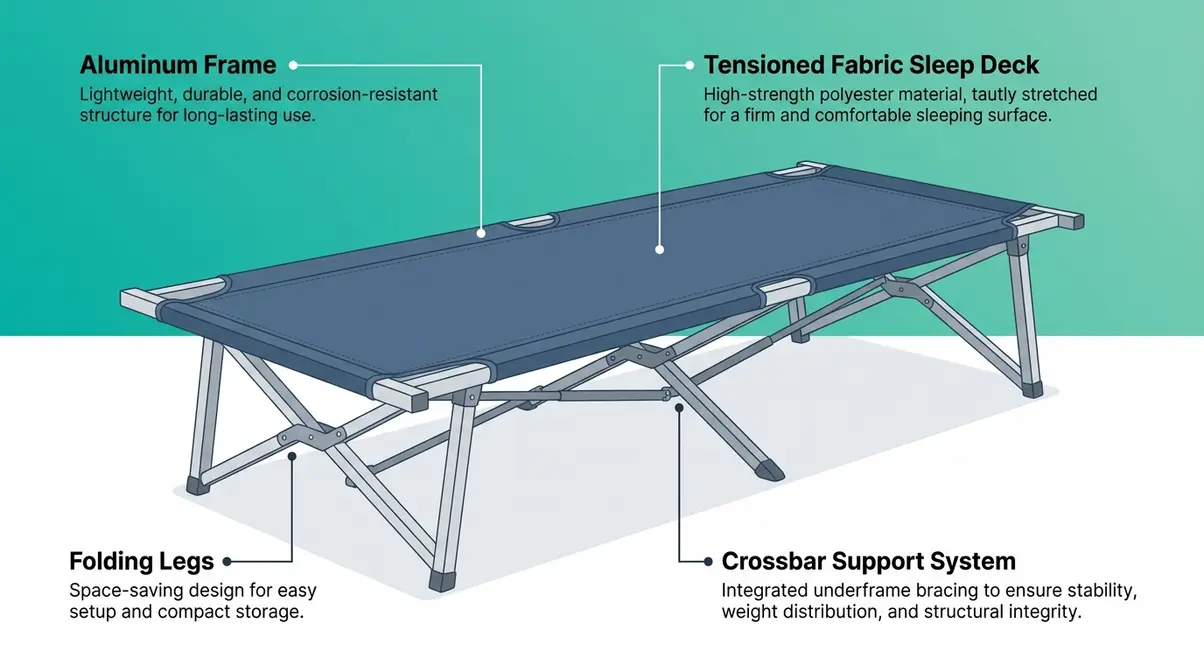
As the diagram above shows, a camping cot has three main components working together:
The frame is typically made from aluminum or steel. Aluminum is lightweight and rust-resistant — the right choice if you’re carrying the cot any distance. Steel is heavier but more durable and usually cheaper, making it ideal for car camping where weight isn’t a concern. Popular Mechanics notes that modern camping cots utilize tensioned fabric stretched over an aluminum or steel frame to provide a firm, flat sleeping surface (Popular Mechanics, 2026).
The tensioned fabric surface — sometimes called the “sleep deck” — is usually woven polyester or ripstop nylon pulled taut across the frame. It needs to be firm enough to support your weight without sagging into a hammock shape. Most standard cots support 250–300 lbs, while heavy-duty models handle up to 600 lbs.
The legs and crossbars form the collapsible support structure underneath. They lock into place when you set up and fold flat when you pack down. Most cots use a simple hinged or locking mechanism that clicks into position — no tools required.
Premium models often add storage pockets along the sides, integrated cup holders, or insulated pads sewn into the sleep deck. These are nice extras, not necessities. If you’re shopping for your first camping cot, focus on frame material, weight, and packed size before anything else. Some cots are also designed to fit inside specific tent systems — our expert picks for best camping cot tents can help you match the right cot to the right shelter.
History: Military Beds to Modern Gear
The camping cot didn’t appear overnight. Portable elevated beds date back to ancient Egypt and Rome, where soldiers and travelers needed to sleep off the ground in unfamiliar, often hostile terrain. A raised sleeping surface meant protection from insects, moisture, and the cold — the same problems you face on a camping trip today.
By the 18th and 19th centuries, the folding camp bed had become standard issue for officers in the Napoleonic Wars and later the American Civil War. Military planners understood something practical: soldiers who slept better fought better. Keeping troops dry, insulated from cold ground, and protected from insects improved battlefield readiness. The design was simple — a canvas surface stretched over a collapsible wooden or iron frame — but it worked.
The real shift to civilian camping came after World War II. Surplus folding cots flooded the civilian market, and Boy Scout troops, hunters, and road-trippers quickly adopted them. Over the following decades, manufacturers swapped heavy iron for aircraft-grade aluminum and replaced canvas with ripstop nylon, making cots dramatically lighter and more packable.
The same problems that plagued soldiers — cold ground, dampness, crawling insects — are exactly what today’s camping cot solves. The materials have changed; the physics haven’t.
Cot vs. Camp Cot: Any Difference?
Short answer: no. In the US, “cot” and “camp cot” mean exactly the same thing — a portable folding bed for outdoor use. “Camp cot” is simply the more descriptive version of the term, useful for clarifying that you mean a camping bed, not a hospital cot or a baby’s sleeping surface.
The confusion exists because “cot” carries different meanings depending on context. In camping and outdoor gear, a cot is a folding camp bed. In British English, a cot is a baby’s crib. In institutional settings like hospitals or emergency shelters, a cot is any simple narrow bed. So what is a cot for camping? It’s the folding, elevated sleeping platform — that’s the definition that matters when you’re shopping for gear.
This gets especially confusing for international shoppers. If you search “buy a cot” on a UK-based website, you’ll get baby furniture, not camping gear. That’s not a glitch — that’s the terminology gap in action. We cover the full US vs. UK breakdown in the Types and Terminology section below.
For now, just know: camping cot, camp cot, and folding cot all refer to the same thing in an American outdoor gear context. Use whichever term feels natural.
What is the point of a camping cot?
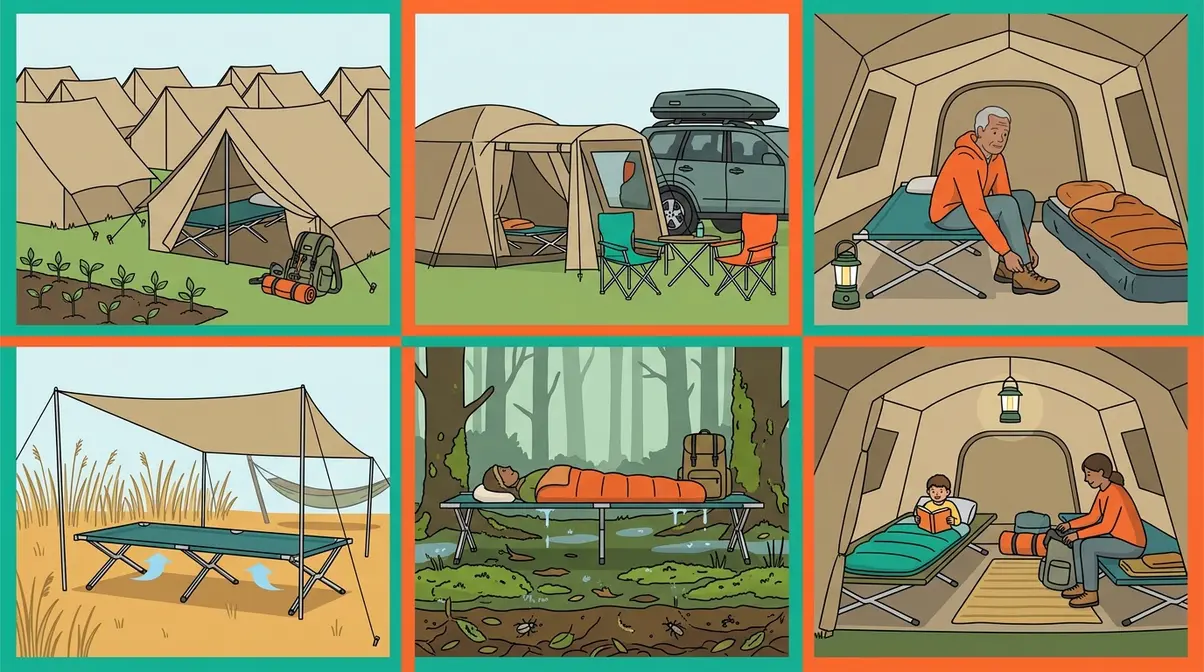
A camping cot’s primary purpose is to lift you off the ground so you sleep on a firm, flat, elevated surface instead of directly on cold, uneven, or damp terrain. Beyond comfort, elevation protects you from ground moisture, insects, and rocks that disrupt sleep. The under-cot space also doubles as storage for gear. For extended camping trips — especially base-camp setups lasting weeks — a cot transforms tent living from an endurance exercise into something genuinely restful.
Now that you know what a camping cot is and where it came from, the more important question is: why should you actually use one? The answer involves a bit of physics — and a concept we call “The Ground Effect.”
Why Use a Camping Cot? Key Benefits
Can you sleep on a camping cot? Absolutely — and for most car campers and extended-trip sleepers, it’s a significantly better experience than sleeping on the ground. A cot delivers three core benefits: it protects your body, regulates your temperature, and keeps your campsite organized. Here’s how each one works.
Comfort: Why Your Back Will Thank You
Sleeping directly on the ground is hard on your body. Even with a sleeping pad underneath you, ground-level sleep means contending with rocks, roots, and uneven terrain pressing against your pressure points — hips, shoulders, lower back — throughout the night.
A camping cot lifts you onto a firm, flat surface that distributes your weight evenly across the tensioned fabric. There’s no pressure point digging into your hip because your weight is spread across the entire sleep deck, not concentrated on a single spot. For people with back pain, arthritis, or joint stiffness, this matters enormously. Harvard Health Publishing notes that sleeping on unsupportive or uneven surfaces can worsen musculoskeletal discomfort and disrupt sleep quality — particularly for adults over 40 (Harvard Health Publishing, 2026).
Getting in and out of bed matters too. Climbing up from ground level after a long, physically demanding day — like tree planting or hiking — is genuinely hard on your knees and back. A cot at 12 inches off the ground functions more like a low bench: you sit on the edge, swing your legs in, and lie down. No floor gymnastics required.
“I’m going tree planting this summer and that means sleeping in a tent for months. Seeing lots of different options for sleeping arrangements and hoping to figure out what actually works for long-term tent living…”
— Beginner camper, r/camping community thread
That quote captures exactly what a camping cot is designed for. When you’re sleeping in a tent for months at a stretch, every night of poor sleep compounds. A cot is the piece of gear that makes the difference between surviving the experience and actually recovering from it.
The Ground Effect: Preventing Heat Loss
Here’s the physics most beginner guides skip entirely. Sleeping off the ground sounds warmer — after all, you’re not touching the cold dirt. But there’s a catch: The Ground Effect.
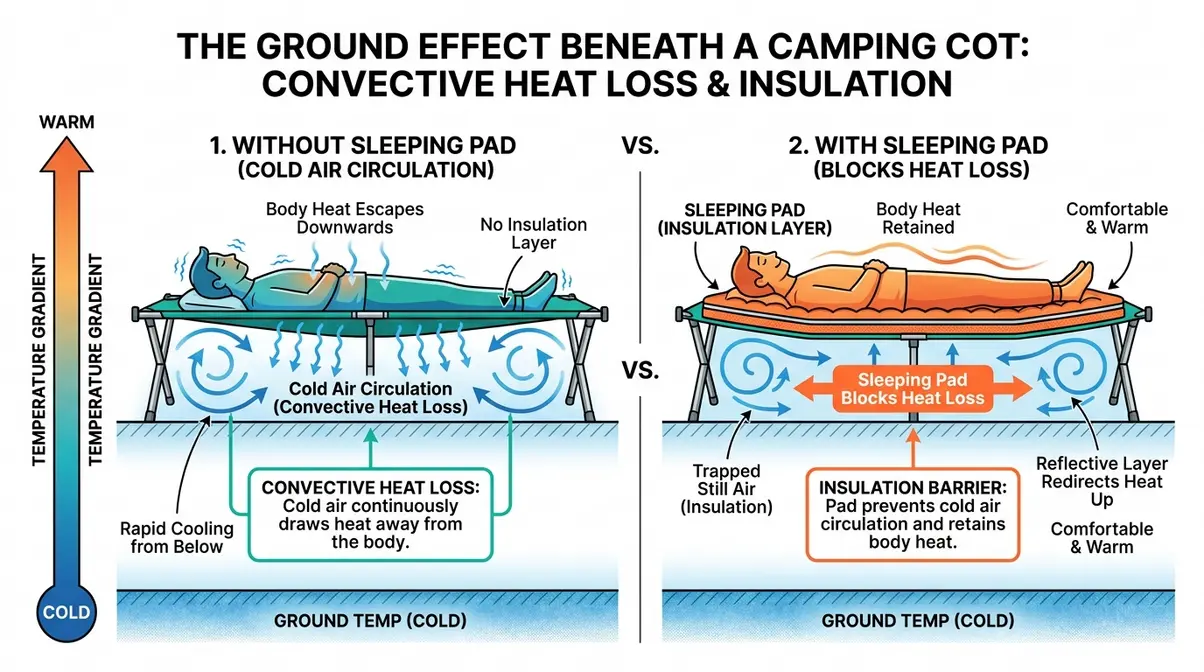
When you sleep on the ground with a sleeping pad, the pad blocks conductive heat loss (heat flowing directly from your body into the cold earth). But when you sleep on a cot, you’ve created an open air gap beneath you. Cold air circulates freely under the cot’s fabric surface. That moving cold air pulls heat away from your body through convection — and it can do so faster than direct ground contact.
Think of the cot’s air gap like the space between two panes of glass in a double-paned window. When that air is sealed and still, it insulates. When it’s moving freely — as cold night air does under a cot — it becomes a heat drain instead.
This is why REI and most gear experts recommend adding a sleeping pad on top of your cot whenever temperatures drop below 60°F. The sleeping pad’s R-value (a number that measures how well a material resists heat transfer — higher is warmer) blocks the convective heat loss that the cot alone cannot stop. REI Co-op’s guidance suggests an R-value of at least 2 for mild conditions and R-4 or higher for cold-weather camping (REI Co-op, 2026).
The Ground Effect in plain terms: A cot without a pad can actually leave you colder than sleeping on the ground with a good pad. Add a sleeping pad and you get the best of both worlds — elevation and insulation.
Extra Storage and Campsite Organization
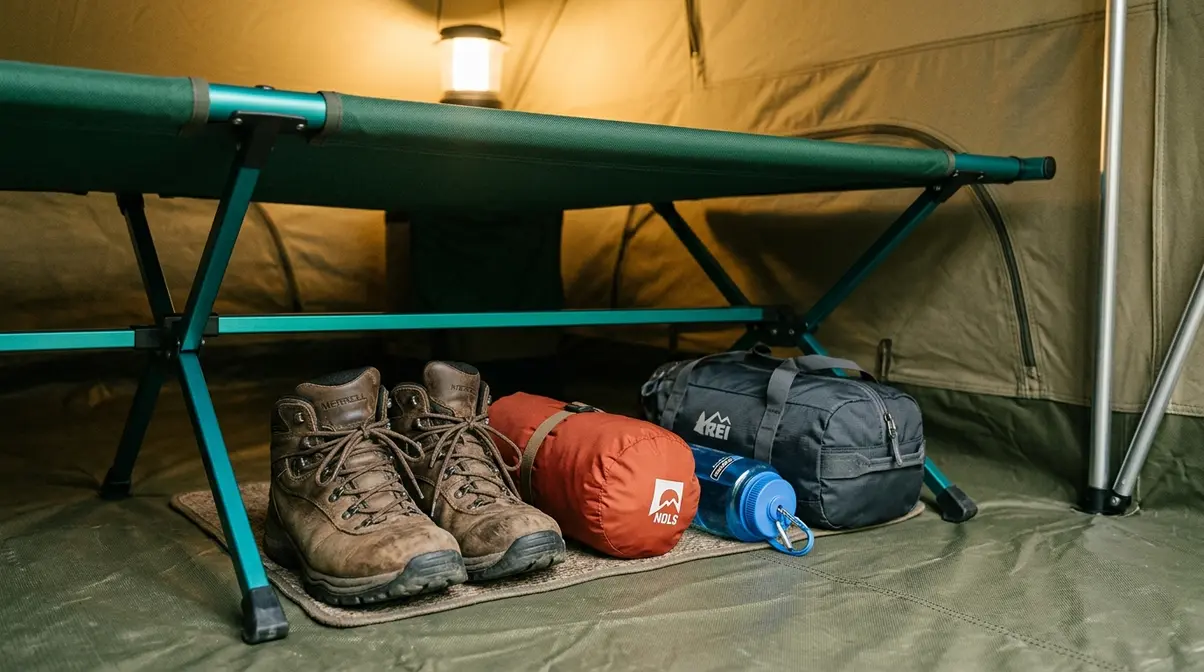
One underrated benefit of a camping cot is the space it creates underneath. That 6–12 inch gap between the cot and the ground becomes instant storage: boots, a duffel bag, a camp chair, a lantern, rain gear. In a small tent, this transforms what would be floor clutter into organized, out-of-the-way storage.
This matters more than it sounds. A cramped, cluttered tent makes a long camping trip feel smaller and more stressful. Keeping your gear organized and off the floor also protects it — items stored on the ground are vulnerable to condensation, insects, and accidental kicks in the dark.
For extended trips — tree planting camps, festival camping, hunting season — this organizational benefit compounds over weeks. Across camping forums and gear communities, the consistent feedback is that campers who switch from ground sleeping to a cot report feeling less claustrophobic in the same tent, simply because the floor space becomes usable storage rather than a sleeping obstacle.
Does a Camping Cot Need a Mattress?
The honest answer is: it depends on the temperature.
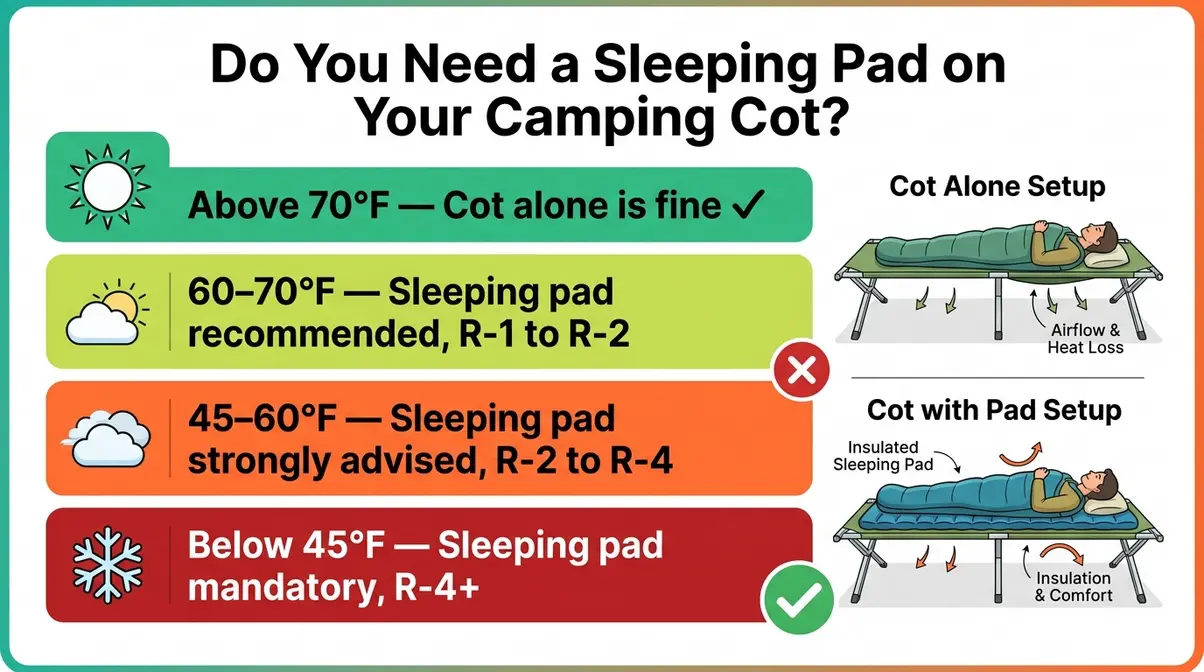
Here’s a clear breakdown:
| Nighttime Temperature | Cot Alone? | Sleeping Pad Needed? | R-Value Target |
|---|---|---|---|
| Above 70°F | ✅ Yes — comfortable | Optional | None needed |
| 60–70°F | ✅ Probably fine | Recommended | R-1 to R-2 |
| 45–60°F | ⚠️ Cold risk | Yes — strongly | R-2 to R-4 |
| Below 45°F | ❌ Not sufficient | Yes — mandatory | R-4 or higher |
A sleeping pad (a thin insulated mat that sits between you and the cot’s fabric surface) solves The Ground Effect by blocking convective heat loss through the open air gap. In warm summer weather above 70°F, a cot alone is perfectly comfortable — the fabric is firm, breathable, and supportive. In shoulder-season or cold-weather camping, skipping the pad means waking up cold at 3 a.m.
You do not need a thick mattress or an air mattress on top of a cot. A standard closed-cell foam pad or an inflatable sleeping pad works well. The goal is insulation, not additional cushioning — the cot’s tensioned fabric already provides a firm, supportive surface. If you decide that insulation is necessary for your trip, choosing the right mattress for your tent camping setup is the next logical step.
Bottom line: No mattress required, but a sleeping pad is strongly recommended for any camping below 60°F.
Types of Camping Cots and Costs
When exploring what is a camping cot, you will find that they come in several distinct styles, span a wide price range, and go by completely different names depending on which country you’re shopping in. Here’s what you need to know before you buy.
Common Cot Types: Folding to Ultralight
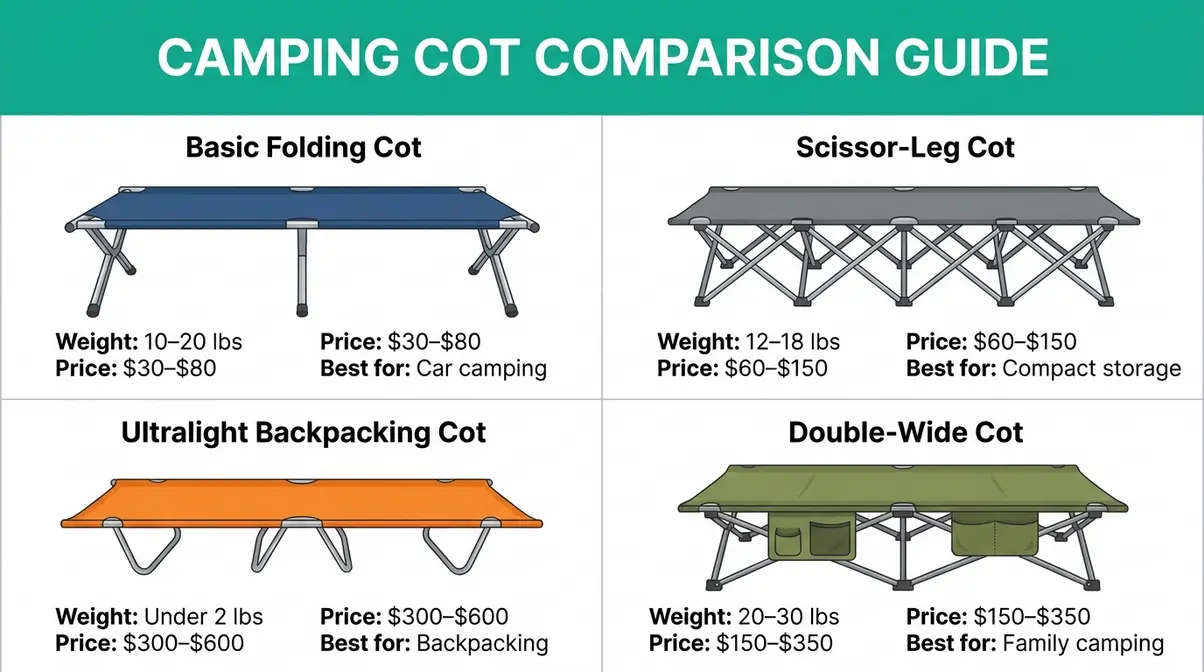
Most camping cots fall into one of four categories:
Basic folding cots are the classic style — a rectangular frame with a fabric surface, folding legs, and a carry bag. They’re simple, reliable, and affordable. Setup takes under two minutes. This is the right choice for car camping, festival camping, or extended base-camp trips like tree planting. Weight typically runs 10–20 lbs.
Scissor-leg cots use an X-shaped leg structure instead of straight legs. They tend to be more stable on uneven ground and often pack into a smaller bundle, though they can be slightly trickier to assemble the first time. A solid mid-range option for car campers who want a more compact packed size.
Ultralight backpacking cots are engineered for weight-obsessed hikers. Made from carbon fiber or aerospace aluminum, the best models weigh under 2 lbs. They sacrifice some comfort and weight capacity for portability. According to GearJunkie’s cot roundup, ultralight cots typically support 250–300 lbs despite their minimal weight (GearJunkie, 2026).
Double-wide and oversized cots are built for comfort-focused car campers. They’re wider (30–40 inches vs. the standard 25 inches), often include side storage pockets, and some models include a built-in frame for hanging a canopy. Not packable for backpacking, but excellent for family camping or long-term base camps.
How Much Does a Camping Cot Cost?
Camping cot prices vary widely depending on materials, weight, and features. Here’s a realistic breakdown based on current retail pricing:
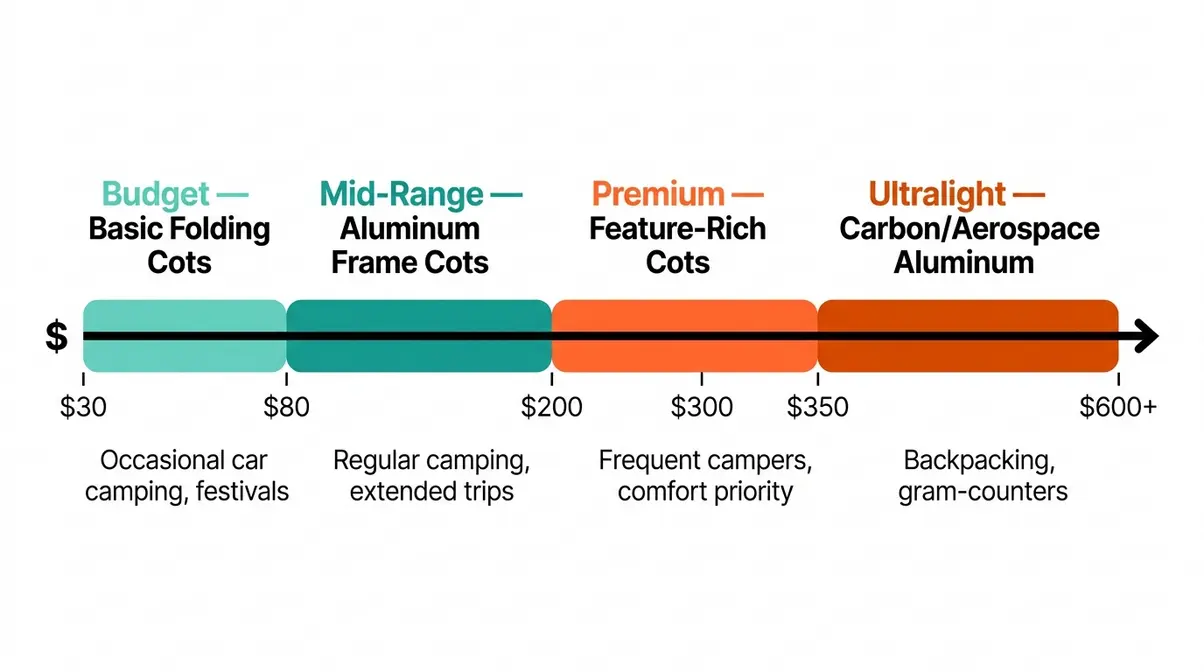
| Cot Category | Price Range | Best For |
|---|---|---|
| Budget folding cots | $30–$80 | Occasional car camping, festivals |
| Mid-range cots | $80–$200 | Regular car camping, extended trips |
| Premium cots | $200–$350 | Frequent campers, comfort priority |
| Ultralight backpacking cots | $300–$600+ | Backpacking, gram-counting hikers |
According to REI Co-op’s cot category, the majority of popular camping cots for car camping fall in the $80–$200 range — enough to get a quality aluminum frame with a decent weight capacity (REI, 2026). Budget cots under $50 exist but often use heavier steel frames and thinner fabric that sags or tears after a season of regular use.
For a first camping cot, the $80–$150 sweet spot delivers the best value: aluminum or quality steel frame, 250–300 lb capacity, a carry bag, and a setup time under three minutes. Spend more only if ultralight weight or a specific feature (double-wide, integrated insulation) is a genuine priority for your trip.
US vs. UK: The Terminology Difference
This is the terminology confusion that catches almost every international shopper off guard — and it’s worth understanding before you search for gear online.
In American English, a “cot” in an outdoor context means a portable folding bed for camping. It’s also sometimes called a “camp cot,” “camping cot,” or “folding cot.” All four terms refer to the same product. When an American says “I slept on a cot,” they mean an elevated folding bed — not a baby’s sleeping surface.
In British English, the word “cot” means something entirely different. According to the Cambridge Dictionary, a cot in British English is “a small bed with high sides for a baby or young child” — what Americans call a crib. The Cambridge Dictionary also defines the camping version separately: in American English, a cot is “a light, narrow bed, usually made of canvas, that can be folded up” (Cambridge Dictionary, 2026).
What Americans call a camping cot, the British call a camp bed. If you’re shopping on a UK website like Argos or Decathlon UK and you type “cot,” you’ll get baby furniture. Type “camp bed” and you’ll find the camping gear you’re looking for.
Here’s a quick reference:
| Term | US Meaning | UK Meaning |
|---|---|---|
| Cot | Portable folding camp bed | Baby’s crib |
| Camp bed | Rarely used | Portable folding camp bed |
| Camping cot | Portable folding camp bed | Not commonly used |
| Crib | Baby’s sleeping enclosure | Not commonly used |
This distinction matters if you’re buying internationally, reading gear reviews from UK-based publications, or searching for camping gear while traveling in Europe. Always check the site’s regional context before assuming a product description matches what you expect.
When a Camping Cot Is the Right Choice
A camping cot is a genuinely useful piece of gear — but it’s not the right tool for every situation. Here’s how to decide.
6 Scenarios Where a Cot Is Best
Our team evaluated cot use cases across camping communities and gear forums, identifying the six scenarios where a cot consistently outperforms ground sleeping:
1. Extended base-camp trips (tree planting, seasonal work, festival camping)
When you’re sleeping in the same tent for weeks or months, the cumulative effect of poor sleep is significant. A cot’s consistent, flat, elevated surface prevents the gradual physical wear that comes from repeated nights on the ground.
2. Car camping with ample tent space
If you’re driving to your campsite and have a 4-person or larger tent, a cot takes up floor space but gives you a proper bed. Weight and packed size are irrelevant when you’re loading a vehicle.
3. Camping with back pain, arthritis, or joint issues
Getting up from the floor is genuinely difficult with joint problems. A cot at 12 inches off the ground functions like a low bench — you sit on the edge and stand, rather than rolling to your knees and pushing yourself up.
4. Hot-weather camping where airflow matters
In summer heat, sleeping on the ground traps warmth and reduces airflow. A cot’s elevated position allows air to circulate underneath and around you — the same air gap that causes The Ground Effect in cold weather becomes a cooling advantage in warm weather.
5. Camping in areas with insects, snakes, or moisture
Elevation is protection. Ants, beetles, and moisture don’t reach a cot surface the way they reach a ground-level sleeping pad. In areas with heavy dew, rain, or known insect pressure, a cot is a clear upgrade.
6. Family camping with young children or older adults
Children can roll off a ground pad and barely notice. Older adults can struggle to stand from a sleeping bag on the floor. A cot solves both problems simultaneously: it’s safer for kids (contained surface, visible location) and more accessible for adults.
What is the 3-3-3 rule for camping?
The 3-3-3 rule is a campsite selection guideline, not a sleep gear rule. It recommends: arrive at your campsite by 3 p.m. (enough daylight to set up), camp at least 3 miles from the trailhead (to reduce crowded areas), and stay for no more than 3 nights in one spot (to minimize environmental impact). It’s a Leave No Trace-adjacent principle popular in hiking communities. It doesn’t directly affect your choice of sleeping gear, but arriving early gives you time to properly set up a cot before dark.
When to Choose a Sleeping Pad Instead
A camping cot isn’t always the answer. According to Outside Magazine’s gear coverage, the sleeping pad remains the preferred choice for specific use cases where a cot’s bulk and rigidity are liabilities (Outside Magazine, 2026).
Choose a sleeping pad when:
- You’re backpacking. Even ultralight cots weigh 1.5–2 lbs and pack into a bundle that’s awkward to carry in a backpack. A quality sleeping pad weighs 10–18 oz and rolls to the size of a water bottle. For any trip where you’re carrying your gear on your back, a sleeping pad wins on practicality.
- Your tent is small. A standard camping cot is 25 inches wide and 75 inches long. In a two-person backpacking tent, that leaves almost no floor space for anything else. A sleeping pad lies flat and takes up exactly as much space as your body.
- You’re camping in below-freezing temperatures. In extreme cold, a high-R-value sleeping pad on the ground can outperform a cot with a lower-rated pad. Ground temperature at depth is often warmer than ambient air temperature — the ground insulates, while cold air circulates freely under a cot.
- Budget is the primary constraint. A quality sleeping pad costs $25–$60. A quality cot costs $80–$200. If you’re equipping yourself for a first trip on a tight budget, a sleeping pad gets you sleeping off the rocks for a fraction of the cost.
The right choice isn’t “cot vs. pad” as a permanent decision — many experienced campers own both and choose based on the trip. For beginners building a first kit, start with a sleeping pad. Add a cot when you know you’ll be spending extended time at a base camp.
Frequently Asked Questions
Can you sleep on a camping cot?
Yes — camping cots are specifically designed for sleeping. The tensioned fabric surface distributes body weight evenly, providing a firm and flat sleep platform comparable to a firm mattress. Most standard cots support 250–300 lbs. The main caveat: in temperatures below 60°F, add a sleeping pad on top to block the convective heat loss created by the air gap beneath the cot. In warm weather, a cot alone is completely comfortable for a full night’s sleep.
What is a cot called in the US?
In the US, the outdoor sleeping version is simply called a “cot,” “camping cot,” or “camp cot.” All three terms refer to the same product: a portable folding bed with a tensioned fabric surface and a collapsible metal frame. The term “cot” in an American context defaults to the camping/outdoor meaning unless specified otherwise (e.g., “hospital cot”). When shopping on US-based sites like REI or Coleman, searching “cot” will return camping gear, not baby furniture.
Difference Between Cot and Camp Cot?
There is no functional difference — in American English, “cot” and “camp cot” are interchangeable terms for the same product: a portable folding bed for outdoor use. “Camp cot” is simply more descriptive, clarifying that the cot is for camping rather than institutional use (hospitals, shelters). Some manufacturers use “camp cot” in product names to avoid confusion with baby furniture. When you see either term on a US outdoor gear site, they refer to the same elevated folding sleeping platform.
What do British call a cot?
British English speakers call the camping version a “camp bed.” In the UK, the word “cot” refers to a baby’s crib — a small enclosed bed with raised sides for infants. According to the Cambridge Dictionary, the British term for a portable folding outdoor bed is “camp bed,” while “cot” in American English covers both the camping bed and (historically) the baby’s sleeping surface. If you’re shopping on a UK website and searching for camping gear, use “camp bed” — searching “cot” will return baby furniture instead.
How to Set Up a Camping Cot: Step-by-Step
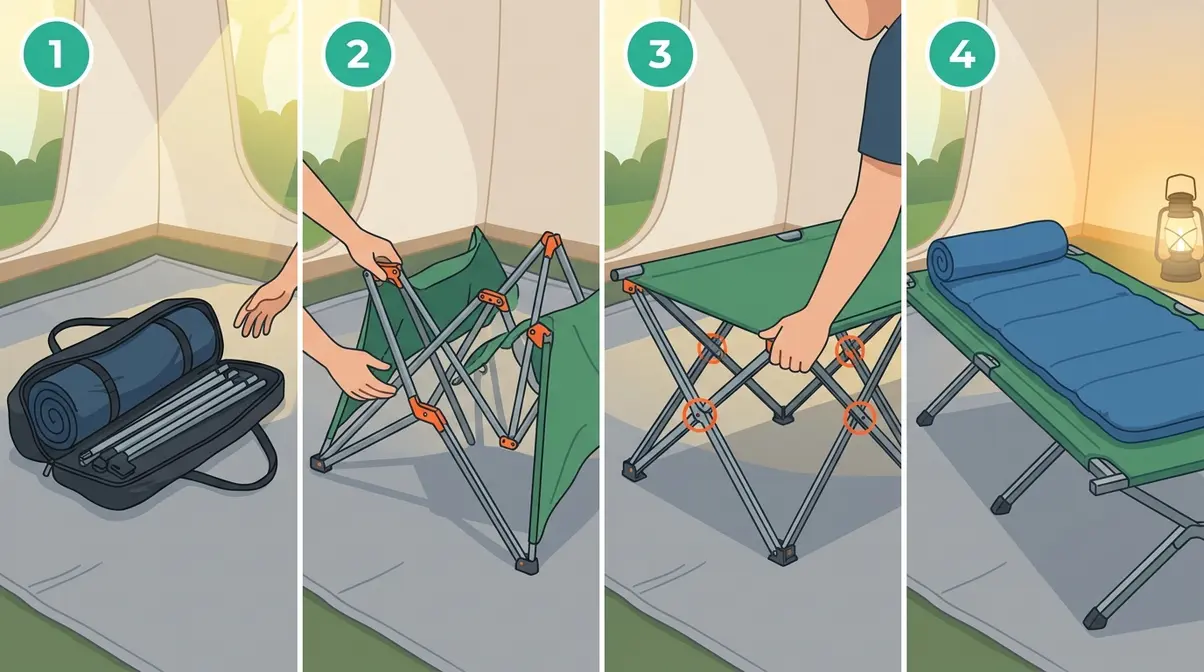
Setting up a camping cot for the first time takes about two minutes once you know the sequence. Here’s exactly how it works for a standard folding cot:
What you’ll need: Your cot and its carry bag. No tools required. Estimated time: 90 seconds to 3 minutes.
Follow these simple steps to get your cot ready for the night:
- Remove the cot from its carry bag and lay it flat on the ground at your campsite. If the ground is uneven, identify the flattest available spot first — a cot doesn’t self-level.
- Unfold the main frame by pulling the two ends of the cot apart. The hinged center section will open outward. You’ll feel it click or lock into the open position.
- Deploy the legs by flipping them downward from the frame. On most folding cots, the legs are attached to the frame and simply rotate into position. Press each leg down until it locks — you’ll hear or feel a click.
- Check stability by pressing down on the center of the sleep deck with your hand before putting your full weight on it. All four legs should be in firm contact with the ground. If one leg wobbles, check that it’s fully locked.
- Place your sleeping pad (if using one) on top of the tensioned fabric surface. Position it so it covers the full length of the deck. Add your sleeping bag on top.
- Test with full body weight by sitting on the edge first, then lying down. The fabric will have a small amount of flex — this is normal. It should not sag significantly toward the ground.
Packing down reverses the process: remove bedding, fold legs up, collapse the frame inward, and roll or fold into the carry bag. Most cots pack down to roughly 40 inches long — about the length of a golf bag.
Limitations and Honest Alternatives
Common Pitfalls to Avoid
Buying a cot that’s too heavy to carry. Steel-frame cots weigh 15–25 lbs. If you assumed you’d carry your cot from a parking lot to a remote campsite, that weight adds up fast. Always check packed weight before buying.
Skipping the sleeping pad in cold weather. The Ground Effect is real. Campers who bring a cot but no sleeping pad to a cold-weather trip consistently report waking cold in the early morning hours — typically between 2–4 a.m. when temperatures hit their overnight low. An R-2 sleeping pad costs $25–$40 and eliminates this problem entirely.
Choosing a cot that doesn’t fit your tent. A standard camping cot is 25 inches wide and 75 inches long. Before buying, measure your tent’s interior floor space. In a two-person backpacking tent (typically 84 inches × 50 inches), a cot leaves almost no room for gear or a second sleeper.
When to Choose Alternatives
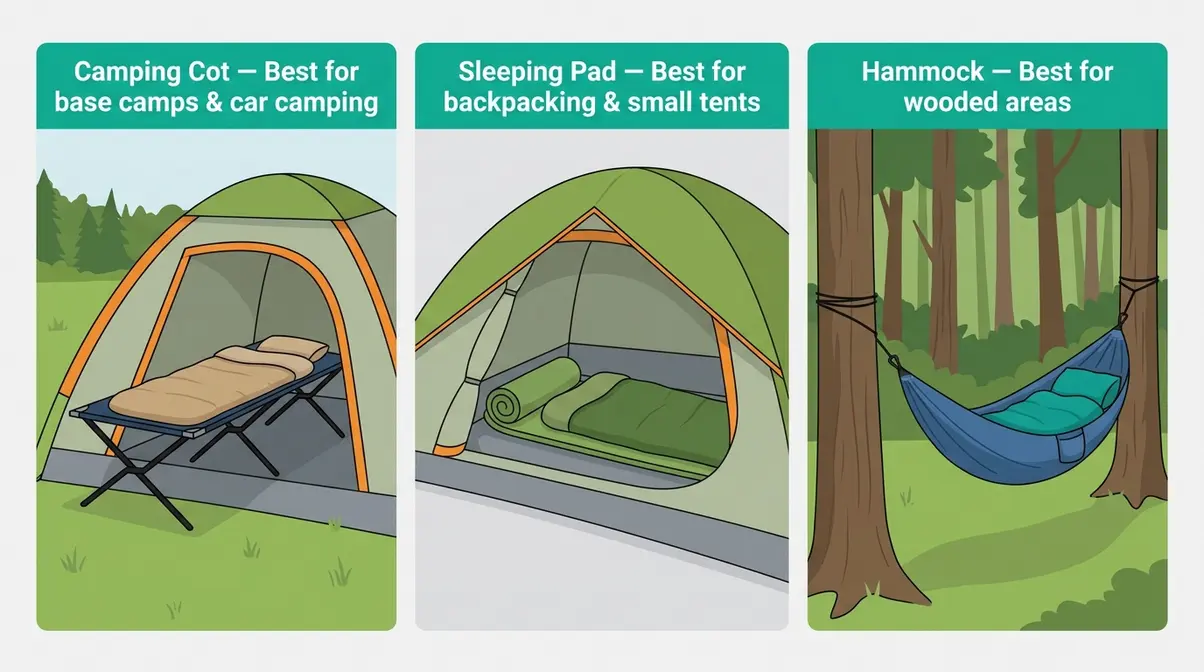
Choose a sleeping pad if you’re backpacking, working with a tight budget, or camping in a small tent. A closed-cell foam pad (R-value ~2) costs under $30 and weighs under a pound — hard to beat for minimalist trips.
Choose an air mattress if maximum comfort is the priority and weight doesn’t matter. A double-height air mattress in a large family tent delivers hotel-like softness, though it requires a pump and is vulnerable to punctures.
Choose a hammock if you’re camping in a wooded area with suitable trees, prefer a cocoon-like sleeping position, and want to skip tent floor space entirely. Hammock camping has its own learning curve and gear requirements, but it solves the ground contact problem differently.
When to Seek Expert Help
If you’re camping in genuinely extreme cold (below 20°F), managing a medical condition that affects sleep or circulation, or outfitting a large group for an extended expedition, it’s worth consulting with a gear specialist at an outdoor retailer like REI before purchasing. Sleeping system decisions in cold-weather or medical contexts have real consequences — a knowledgeable advisor can match gear to your specific situation.
Wrapping Up: Your Cot Decision
When someone asks, “what is a camping cot?” the answer is simple: it is a portable, elevated folding bed — and for the right trip, it’s one of the most impactful pieces of gear you can bring. It keeps you off cold, damp, uneven ground, gives you a firm and supportive sleep surface, and turns the dead space under your bed into usable storage. For extended base-camp trips, car camping, or any situation where you’ll sleep in the same tent for days or weeks at a stretch, a cot is worth every dollar.
The key insight to carry forward is The Ground Effect: a cot alone isn’t automatically warmer than sleeping on the ground. Add a sleeping pad in temperatures below 60°F and you get the full benefit — elevation and insulation working together. Skip the pad in cold weather and you’ll lose body heat faster than you’d expect.
Start with a mid-range aluminum-frame cot in the $80–$150 range, pair it with an R-2 or higher sleeping pad for shoulder-season use, and you’ll have a sleep system that serves you well across dozens of trips. If you’re ready to match your cot to the right shelter, our expert picks for the best camping cot tents are a practical next step.

David King
Field gear tester at Tent Explorer.