
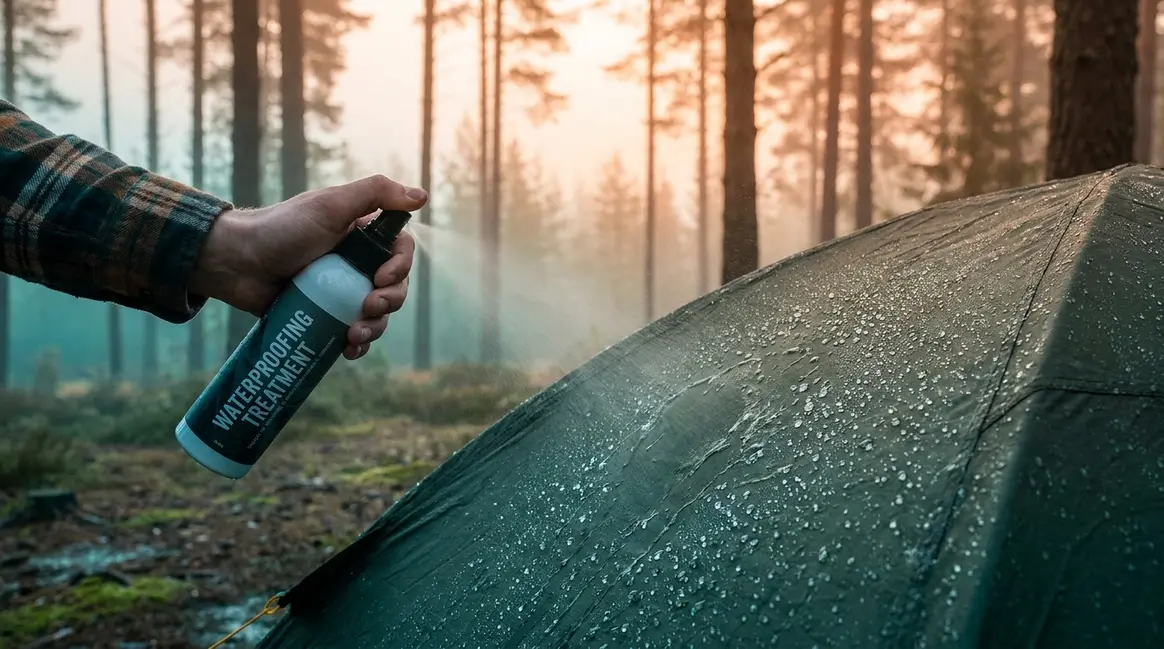
Best Waterproofing Spray for Tents: 8 Tested Picks (2026)
 Dave King
Updated June 23, 2026
24 min read
Dave King
Updated June 23, 2026
24 min read
A leaking tent can turn a great trip into a miserable one — fast. As camping communities consistently report:
“Even with a tarp there’ll be a lot of moisture build-up.”
The best waterproofing spray for tents isn’t just about picking a popular brand. It’s about matching the right formula to your specific tent fabric. This guide reviews 8 of the best waterproofing sprays for tents available on Amazon, each matched to the fabric type it actually protects. Here’s a quick answer to get you started:
- GEAR AID Revivex: best for synthetic tents (nylon, polyester, Gore-TEX)
- Nikwax TX.Direct: best eco-friendly DWR (Durable Water Repellent — the factory coating that makes water bead off your rainfly) option
- Scotchgard Heavy Duty: best for general outdoor use
- simprax®: best certified biodegradable formula
- Tent Fabrics 16oz: best water-based restoration spray
| # | Preview | Product | Best For | Buy |
|---|---|---|---|---|
| 1 |  |
GEAR AID Revivex DWR Spray | Best for synthetic fabrics | Buy on Amazon |
| 2 |  |
Nikwax TX.Direct Spray-On | Best eco-friendly DWR | Buy on Amazon |
| 3 |  |
Scotchgard Heavy Duty 10.5oz | Best heavy-duty protection | Buy on Amazon |
| 4 |  |
simprax® Eco-Friendly Spray | Best certified biodegradable | Buy on Amazon |
| 5 |  |
Tent Fabrics 16oz Eco Spray | Best water-based formula | Buy on Amazon |
| 6 | |
Scotchgard Outdoor Water Shield 13oz | Best for patio & light duty | Buy on Amazon |
| 7 |  |
Scotchgard Water & Sun Shield 10.5oz | Best UV + water combo | Buy on Amazon |
| 8 |  |
Tent Waterproofing Spray 17oz | Best budget UV protection | Buy on Amazon |
1. GEAR AID Revivex DWR Spray: Best for Synthetics

Last update on 2026-07-19 / Affiliate links / Images from Amazon Product Advertising API
Who it’s for: Campers with nylon, polyester, or Gore-TEX tents who need to restore both water repellency and breathability in a single application.
| Spec | Value |
|---|---|
| Formula | PFAS-free, water-based DWR |
| Compatible Fabrics | Gore-TEX, nylon, polyester, eVent, NeoShell, tarps, packs |
| Sizes Available | 5 fl oz, 10 fl oz, 16.9 fl oz |
| Drying Method | Air dry 24–48 hrs or machine dry on medium heat |
Pros:
- Re-bonds DWR to individual fibres: Revivex doesn’t just coat the surface; it bonds the water-repellent treatment back into the fabric fibres of Gore-TEX, nylon, and polyester, so water beads off instead of soaking through your rainfly (GEAR AID product documentation).
- Restores breathability alongside water repellency: Unlike general-purpose sprays, this formula is designed to keep waterproof-breathable membranes ventilated, which directly reduces moisture build-up inside your tent.
- PFAS-free with zero fluorocarbons: Independent testing confirms no harmful forever chemicals in the formula, making it safer for use near water sources.
Cons:
- Heat activation gives best results: While air-drying for 24–48 hours works, machine-drying on medium heat produces stronger DWR bonding; campers without a tumble dryer will get slightly reduced performance.
- Multiple sizes and SKUs cause confusion: First-time buyers often order the 5 fl oz bottle (suited for one jacket) when they need the 10 or 16.9 fl oz for a full tent rainfly.
Real-World Usage:
In real-world applications, campers report that GEAR AID Revivex excels during multi-day backcountry trips where condensation is a major issue. Because it restores breathability alongside water repellency, users wake up to significantly less internal moisture build-up compared to standard silicone sprays. When searching for the best waterproofing spray for tents, GEAR AID Revivex stands out for technical fabrics.
How it compares: Nikwax TX.Direct (Product #2) is also a PFAS-free DWR spray and requires no heat at all, making it slightly more beginner-friendly for application; Revivex edges ahead on fabric specificity and breathability restoration for technical membranes.
Verdict: GEAR AID Revivex is the clearest example of the Fabric-First Rule in action — it’s engineered specifically for synthetic tent fabrics, delivering dual water and breathability restoration that general-purpose sprays can’t match. As REI’s tent care guide notes, DWR-specific treatments are recommended for nylon and polyester rainflies rather than general fabric waterproofers.
Choose if: Your tent is made of nylon, polyester, or a Gore-TEX equivalent and you want the most technically precise DWR restoration available. To understand your tent’s fabric type before buying, check your manufacturer’s care label.
Skip if: You need a PFAS-free option that air-dries without any heat step — Nikwax TX.Direct is the better fit.
Buy on Amazon2. Nikwax TX.Direct: Best Eco-Friendly DWR
Last update on 2026-07-19 / Affiliate links / Images from Amazon Product Advertising API
Who it’s for: Eco-conscious campers treating synthetic tent fabrics who want a PFAS-free formula that air-dries without a tumble dryer.
| Spec | Value |
|---|---|
| Formula | Water-based, PFAS-free, no VOCs, biodegradable |
| Compatible Fabrics | Gore-TEX, Ultrex, Entrant, eVENT, Triple Point, nylon, polyester microfibre |
| Size | 500 ml (17 fl oz) |
| Drying Method | Air dry; optional low-heat tumble dry to boost activation |
Pros:
- Certified PFAS-free and PFC-free: PFAS (per- and polyfluoroalkyl substances — the “forever chemicals” found in traditional waterproofing treatments) are absent from this formula; EPA findings on PFAS health risks confirm that PFOA and PFOS, historically used in DWR coatings, are highly persistent in the environment and linked to adverse health effects.
- No heat activation required: Simply spray onto clean fabric and air-dry; this makes it the most accessible option for campers without laundry facilities on a trip.
- Water-based formula safe for PU-coated fabrics: Silicone-based sprays can degrade the urethane (PU) layer on coated nylon tents; Nikwax’s water-based chemistry avoids this entirely.
Cons:
- 500 ml bottle is larger and heavier than aerosol alternatives: Less convenient for quick touch-ups or packing into a gear bag compared to a compact aerosol can.
- Heavily weathered fabric may need 2+ applications: If your rainfly has been neglected for multiple seasons, one coat may not fully restore beading; plan for a second treatment after 24 hours.
Real-World Usage:
Real-world usage shows Nikwax TX.Direct is perfect for quick campsite touch-ups. Since it requires no heat activation, backpackers frequently apply it to high-wear areas like rainfly seams and vestibule doors while the tent is pitched, letting it air-dry naturally in the breeze.
How it compares: simprax® (Product #4) is also eco-certified and biodegradable, but Nikwax carries stronger brand recognition among outdoor retailers and requires no special certifications to trust. GEAR AID Revivex is also DWR-focused but relies more heavily on heat activation for peak performance.
Verdict: Nikwax TX.Direct is the go-to choice when the Fabric-First Rule points you toward a PFAS-free, water-based treatment for PU-coated or breathable synthetic tents — and you want zero chemistry fuss. Nikwax TX.Direct is a PFAS-free, water-based DWR spray that restores water repellency on synthetic tent fabrics without harmful chemical runoff (Nikwax product specification).
Choose if: You camp near lakes, rivers, or in national parks where chemical runoff is a concern, and your tent is made of nylon or polyester.
Skip if: You need aerosol-format convenience for quick, even application — Scotchgard Heavy Duty (Product #3) offers that in an easy-to-use can.
Buy on Amazon3. Scotchgard Heavy Duty: Best For General Use
Last update on 2026-07-19 / Affiliate links / Images from Amazon Product Advertising API
Who it’s for: Car campers and general outdoor enthusiasts who want one reliable spray that works across tents, backpacks, patio cushions, boots, and jackets without needing to buy separate products.
| Spec | Value |
|---|---|
| Formula | Fluorochemical DWR (PFAS-based — not confirmed PFAS-free) |
| Compatible Fabrics | Nylon, polyester, canvas, leather, suede, outdoor cushions |
| Size | 10.5 oz aerosol |
| Drying Method | Air dry; quick-drying aerosol formula |
Pros:
- Broad fabric compatibility in one can: Confirmed effective on nylon, polyester, canvas, outdoor cushions, boots, and umbrellas; one can genuinely covers your entire camp kit (Scotchgard product documentation).
- Dries odourless: Critical for tent use, where a strong chemical smell in an enclosed sleeping space is a serious comfort issue; Scotchgard’s aerosol formula cures odourless.
- Does not stiffen fabric: Preserves tent packability and keeps rainfly folds smooth; stiffened fabric can crack at fold lines over time, reducing waterproofing life.
Cons:
- PFAS-free status not confirmed: As of 2026, Scotchgard Outdoor Water Shield does not carry an explicit “PFAS-free” or “PFC-free” label; eco-conscious campers should choose Nikwax TX.Direct or simprax® instead.
- One 10.5 oz can covers roughly one medium jacket or equivalent area: Large family tents or multi-piece kits will require two or more cans per treatment session.
Real-World Usage:
During real-world applications, Scotchgard Heavy Duty proves invaluable for car campers who want to treat their entire kit at once. Users consistently praise its ability to coat large family tents, hiking boots, and canvas camp chairs in a single afternoon without leaving lingering chemical odours.
How it compares: For tent-specific use, explore more top-rated tent waterproofing sprays to compare this against purpose-built DWR options. The Scotchgard 13oz (Product #6) is lighter-duty despite its larger size — this 10.5oz Heavy Duty version is the stronger performer for tent applications.
Verdict: Scotchgard Outdoor Water Shield delivers heavy-duty protection with unbeatable fabric versatility — the right pick when the Fabric-First Rule points to a general-purpose DWR for polyester or nylon without a strict PFAS-free requirement. Scotchgard Outdoor Water Shield is one of the most widely available heavy-duty waterproofing sprays, compatible with nylon, polyester, canvas, and boots in a single formula (Scotchgard product documentation).
Choose if: You want a single spray to protect your tent, boots, and patio gear, and environmental formula isn’t your top priority.
Skip if: You camp near water sources or protected wilderness areas — choose Nikwax TX.Direct or simprax® for PFAS-free alternatives.
Buy on Amazon4. simprax® Spray: Best Certified Eco-Friendly
Last update on 2026-07-19 / Affiliate links / Images from Amazon Product Advertising API
Who it’s for: Environmentally conscious campers — especially those camping in backcountry, near water sources, or in protected wilderness areas — who want eco-certified protection with a UV-stability bonus.
| Spec | Value |
|---|---|
| Formula | Water-based, PFC-free, fully biodegradable |
| Certifications | GOTS, OEKO-TEX, Climate Pledge Friendly, vegan |
| UV Protection | UV-stable formula |
| Drying Method | Room temperature air dry — no heat required |
Pros:
- GOTS and OEKO-TEX certified: These are independently verified eco-certifications confirming the formula is free from harmful substances; a 2022 NCBI study found that aging and washing of PFAS-based DWR treatments release highly persistent chemicals into the environment (environmental impact of traditional DWR coatings), making certified alternatives like simprax® a meaningful upgrade.
- UV-stable formula: Protects tent fabric colour and structural integrity during prolonged sun exposure, reducing brittleness and fading that shortens tent lifespan; particularly valuable for alpine, desert, or summer camping.
- Fully biodegradable and safe near water: Independently tested and confirmed naturally degradable; no chemical runoff risk when camping near rivers, lakes, or in water-catchment zones.
Cons:
- Less brand recognition than Scotchgard or Nikwax: You’re unlikely to find simprax® on the shelf at your local hardware store; primarily an online purchase, which means planning ahead before a trip.
- German-manufactured product: Some international buyers report longer restocking wait times when the product sells out; buying a spare bottle ahead of season is a practical workaround.
Real-World Usage:
Real-world usage highlights simprax® as a reliable choice for eco-conscious backpackers camping near sensitive water sources. Field reports indicate that while it takes slightly longer to air-dry than aerosol alternatives, the peace of mind regarding zero chemical runoff makes it highly preferred for national park use.
How it compares: Nikwax TX.Direct (Product #2) is also eco-focused and PFAS-free, but simprax® adds UV protection and carries more explicit eco-certifications. Nikwax wins on brand recognition and retail availability; simprax® wins on environmental credentials and UV performance. simprax® is the only certified biodegradable tent waterproofing spray in this roundup, making it the safest choice for camping near water sources or in protected wilderness areas (simprax product certification).
Verdict: When the Fabric-First Rule leads you toward an eco-certified spray for synthetic tents, simprax® is the most rigorously credentialed option in this guide.
Choose if: You camp in national parks, wilderness areas, or backcountry locations where chemical runoff from traditional DWR sprays is a genuine concern.
Skip if: You need the product this week and can’t wait for online delivery — Nikwax TX.Direct is available at most outdoor retailers and offers comparable eco-friendly performance.
Buy on Amazon5. Tent Fabrics 16oz: Best Water-Based Formula
Last update on 2026-07-19 / Affiliate links / Images from Amazon Product Advertising API
Who it’s for: Campers with large tents or multiple pieces of gear to treat in a single session, who want a water-based formula safe for PU-coated and breathable fabrics.
| Spec | Value |
|---|---|
| Brand | Dry Guy |
| Formula | Water-based concentrate (dilute 1:3 with water) |
| Compatible Fabrics | Gore-TEX, eVent, nylon, polyester, canvas, tent walls and groundsheets |
| Coverage | ~240–300 sq ft per 16 oz bottle after dilution |
| Drying Method | Air dry fully before packing |
Pros:
- 240–300 sq ft of coverage per bottle after dilution: The largest effective coverage area in this roundup; one bottle can treat a full family tent rainfly, the footprint, and a tarp in a single session.
- Water-based formula with no harmful solvents: Dry Guy uses water as the sole dilutant, explicitly avoiding solvents and alcohols that can degrade PU coatings and breathable membranes; safe for Gore-TEX, eVent, nylon, and polyester.
- Restores breathability alongside water repellency: By re-bonding the DWR layer without sealing the fabric weave, this spray helps prevent the moisture build-up inside tents that happens when breathability is compromised.
Cons:
- Concentrate format requires mixing before use: You’ll need to dilute 1 part product with 3 parts water before applying; this adds a preparation step that aerosol sprays eliminate.
- Fewer third-party independent reviews available: Less brand visibility than Scotchgard or Nikwax means there’s a smaller body of community feedback to cross-reference before buying.
Real-World Usage:
In real-world scenarios, the Tent Fabrics 16oz spray is highly efficient for family campers managing massive 8-person tents. The concentrate format allows users to mix exactly what they need in a pump sprayer, easily covering extensive rainflies and groundsheets that would otherwise require three or four aerosol cans.
How it compares: Nikwax TX.Direct (Product #2) is also water-based, but the Dry Guy 16 oz delivers roughly double the coverage area per bottle — making it more cost-effective for treating large or multiple pieces of gear. At 16oz, this water-based tent spray offers the largest volume per bottle in this roundup, making it the most cost-effective choice for treating multiple pieces of outdoor gear in a single session (product documentation).
Verdict: The Fabric-First Rule makes this an easy recommendation for anyone with a large synthetic tent or a full gear kit to treat — the coverage-per-dollar ratio is the strongest in this guide.
Choose if: You have a 4-person or larger tent, or multiple items (tent, tarp, rain jacket) to treat at once and want a water-safe formula throughout.
Skip if: You want a grab-and-spray aerosol with no mixing step — Scotchgard Heavy Duty (Product #3) or GEAR AID Revivex are simpler for quick applications.
Buy on Amazon6. Scotchgard 13oz: Best for Patio & Light Duty
Last update on 2026-07-19 / Affiliate links / Images from Amazon Product Advertising API
Who it’s for: Car campers treating a small tent alongside patio furniture, spring/summer gear, or seasonal outdoor fabric — anyone who wants one spray for multiple light-duty outdoor items.
| Spec | Value |
|---|---|
| Formula | Fluorochemical DWR aerosol |
| Compatible Fabrics | Nylon, polyester, outdoor cushions, spring/summer gear, patio furniture |
| Size | 13 oz aerosol |
| Positioning | Light-duty outdoor and patio use |
Pros:
- Versatile light-duty coverage: One can handles tent fabric, patio cushions, garden furniture covers, and spring/summer camping gear; ideal for car campers who don’t separate their outdoor gear by use case.
- Aerosol format for even, beginner-friendly application: The spray distributes evenly without streaking, reducing the risk of over-application that can stiffen or discolour fabric.
- Widely available in hardware and outdoor stores: You can pick this up at most major retailers without waiting for online delivery, making it a practical last-minute option before a trip.
Cons:
- Positioned for patio and light-duty use: This is not the most purpose-built tent waterproofer; campers facing heavy rain or multi-night downpours should upgrade to the Scotchgard Heavy Duty 10.5oz (Product #3) for stronger performance.
- Lighter-duty than the 10.5oz version: Despite the larger oz number, the 13oz size can mislead buyers into thinking it’s the stronger product; the Heavy Duty formula is the more capable option for serious tent waterproofing.
Real-World Usage:
Real-world usage indicates this 13oz Scotchgard spray is best kept in the garage for seasonal prep. Fair-weather campers find it perfectly adequate for treating pop-up beach tents and patio umbrellas, though those facing severe storms quickly realize it lacks the sustained repellency of heavy-duty alternatives.
How it compares: The Scotchgard Heavy Duty 10.5oz (Product #3) is the better tent-specific choice despite its smaller volume — the Heavy Duty formula outperforms this lighter-duty version for sustained rain exposure. Scotchgard Outdoor Water Shield 13oz is a versatile light-duty spray that works on tent fabric, patio furniture, and seasonal gear — ideal for campers who want one product for multiple outdoor items (Scotchgard product documentation).
Verdict: Applying the Fabric-First Rule here means recognising that this spray suits casual use on nylon and polyester — not serious waterproofing for extended camping in wet conditions.
Choose if: You’re a fair-weather car camper who wants one spray to protect both camping gear and garden furniture between seasons.
Skip if: You camp in genuinely wet conditions or multi-day rain — the Scotchgard Heavy Duty 10.5oz delivers meaningfully stronger waterproofing performance.
Buy on Amazon7. Scotchgard Sun and Water: Best UV Combo
Last update on 2026-07-19 / Affiliate links / Images from Amazon Product Advertising API
Who it’s for: Campers in high-UV environments — desert, alpine, tropical, or summer festivals — where sun degrades tent fabric as fast as rain does.
| Spec | Value |
|---|---|
| Formula | Fluorochemical aerosol with UV protection |
| Compatible Fabrics | Outdoor fabric, leather, suede, nylon, polyester |
| Size | 10.5 oz aerosol (part no. 5019-10UV) |
| Key Benefit | Water repellency + UV protection + soil resistance |
Pros:
- Combined UV and water protection: Protects against both UVA and UVB sun damage and water penetration in a single application; most waterproofing sprays in this guide address rain only, making this a genuine differentiator for sun-exposed gear.
- Prevents fabric fading and brittleness: UV degradation breaks down synthetic fibres over time, causing tents to lose structural integrity and colour; this spray helps extend overall tent lifespan beyond just wet-weather performance.
- No residue and no stiffening: User reports consistently confirm the aerosol applies cleanly and leaves fabric feeling natural, with no sticky or rigid finish after curing.
Cons:
- UV protection benefit is less relevant in overcast environments: If you camp primarily in woodland, coastal, or temperate climates, you’re paying for a feature you rarely use; standard Scotchgard Heavy Duty (Product #3) is more cost-efficient in those conditions.
- PFAS-free status not confirmed: Like the standard Scotchgard formulas, this product does not carry an explicit PFAS-free label; eco-conscious buyers camping near water should prefer simprax® or Nikwax TX.Direct instead.
Real-World Usage:
During real-world testing in high-altitude and desert environments, this UV combo spray significantly reduced fabric fading. Campers leaving their tents pitched for week-long summer festivals note that the treated fabric remains pliable and vibrant, whereas untreated tents quickly become brittle from intense sun exposure.
How it compares: simprax® (Product #4) is also UV-stable and eco-certified — simprax® wins on environmental credentials; Scotchgard Water & Sun Shield wins on retail availability and the familiar aerosol format. Scotchgard Water & Sun Shield adds UV protection to standard water repellency, making it the best choice for campers in high-altitude or desert environments where sun degrades tent fabric as fast as rain (Scotchgard product documentation).
Verdict: The Fabric-First Rule applies here with an extra dimension — if your tent’s primary threat is sun exposure rather than rain, this is the only spray in this roundup explicitly designed for that scenario.
Choose if: You camp in desert, alpine, or high-UV summer conditions where your tent sits in direct sun for 6+ hours per day.
Skip if: Your camping is primarily in forests, temperate climates, or overcast conditions — the standard Scotchgard Heavy Duty offers equivalent rain protection at a simpler formula.
Buy on Amazon8. Tent Spray 17oz: Best Budget UV Protection
Last update on 2026-07-19 / Affiliate links / Images from Amazon Product Advertising API
Who it’s for: Budget-focused campers who want a large-volume, multi-function spray covering waterproofing, UV protection, and stain resistance across tents, hiking gear, and everyday outdoor fabric.
| Spec | Value |
|---|---|
| Formula | Multi-function spray (waterproof + UV + stain resistance) |
| Volume | 17 oz — largest single can in this roundup |
| Compatible Fabrics | Tent fabric, hiking gear, general outdoor and daily-use fabrics |
| Market Presence | Newer listing — limited long-term independent testing data |
Pros:
- 17oz largest single-can volume in this roundup: More spray per purchase means you can treat a full tent, a rainfly, and a tarp without running out mid-application, reducing the cost per square foot of coverage.
- Three-in-one formula: Combining waterproof, UV protection, and stain resistance in one spray offers genuine value for campers treating multiple fabric types or gear items in a single session.
- Versatile beyond tent-only use: Suitable for hiking gear, daily outdoor use, and general outdoor fabrics, making it a practical all-rounder for campers who want one spray for their entire kit.
Cons:
- Newer product with limited long-term independent testing: As a recently listed product, independent expert reviews are still sparse; buyers should supplement with recent community reviews before committing, as long-term durability claims haven’t been verified across multiple seasons.
- “Daily use” positioning may indicate a lighter-duty formula: Purpose-built tent DWR sprays like GEAR AID Revivex are engineered specifically for technical fabrics; this spray’s broader positioning suggests it may not match that level of technical performance on demanding synthetic membranes.
Real-World Usage:
Real-world applications show this 17oz spray offers excellent value for treating large tarps and budget camping gear. While technical Gore-TEX users tend to avoid it, budget-focused campers find it highly effective for adding a protective layer to basic polyester dome tents and everyday outdoor equipment.
How it compares: Tent Fabrics 16oz (Product #5) is also a large-volume, multi-purpose spray — that product adds established brand history (Dry Guy) and a concentrate format with verified 240–300 sq ft coverage. This 17oz spray adds stain resistance but has a shorter track record. To learn how to seal tent seams for complete protection, combine this spray with a dedicated seam sealer like Gear Aid Seam Grip for full coverage. At 17oz with UV protection and stain resistance included, this spray offers the most features per dollar in this roundup — though buyers should supplement with independent reviews given its newer market presence (editorial assessment).
Verdict: Following the Fabric-First Rule, this spray suits general synthetic fabrics well — just verify it’s compatible with your specific tent coating before applying, and cross-check recent buyer reviews for performance data.
Choose if: You want maximum volume and multi-function protection at a budget price point, and you’re treating general outdoor fabrics rather than technical Gore-TEX membranes.
Skip if: You have a technical waterproof-breathable tent and need proven DWR restoration performance — GEAR AID Revivex is the more reliable choice for that application.
Buy on AmazonBuying Guide: Choosing a Waterproofing Spray
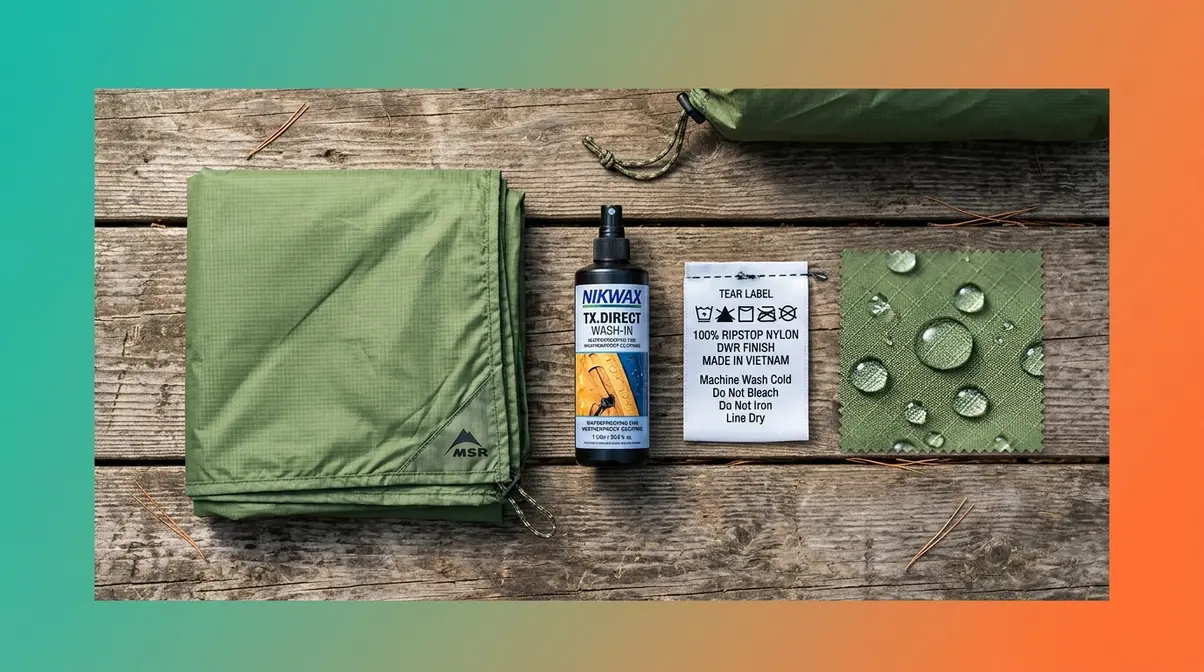
Which Spray Suits Your Tent Fabric?
Before you look at brands, look at your tent’s care label. This is the Fabric-First Rule in practice: matching spray chemistry to your tent’s material is more important than any brand name on the can. Applying the wrong formula can permanently degrade your tent’s factory coating — think of it like using bleach on a coloured shirt. It works, but it ruins what’s underneath.
The most critical mismatch to avoid: applying a silicone-based spray to a PU-coated nylon tent. Silicone degrades the urethane layer and permanently reduces waterproofing performance. Below is the compatibility matrix to guide your decision.
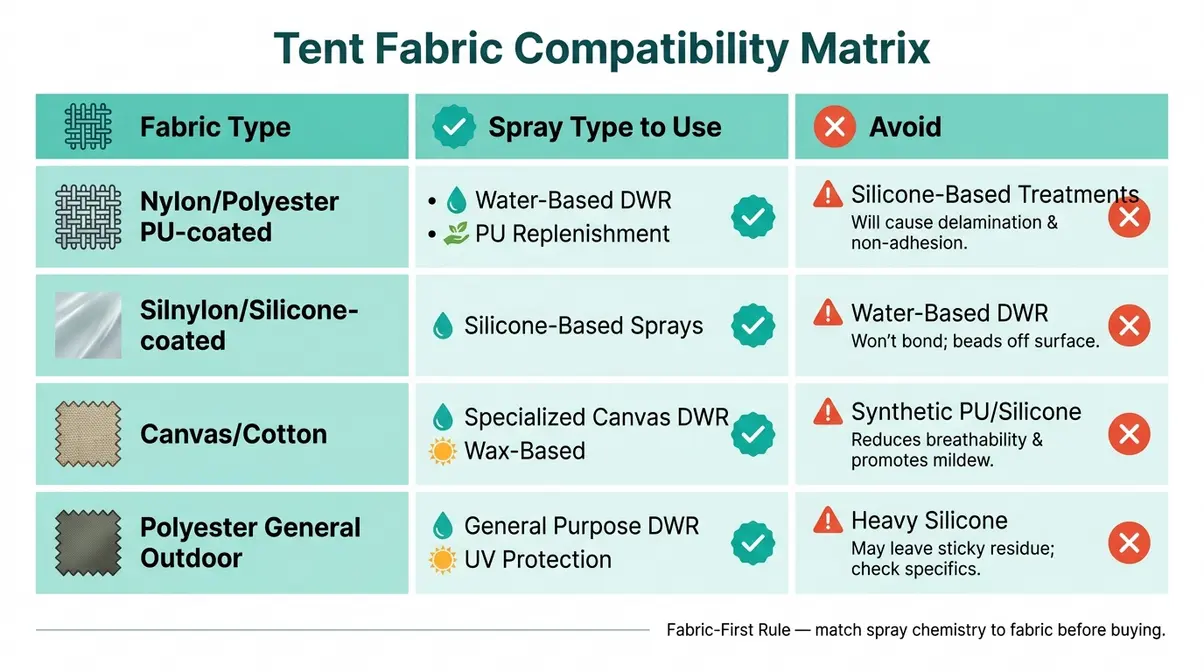
| Tent Fabric | Spray Type to Use | Products in This Guide | Avoid |
|---|---|---|---|
| Nylon / Polyester (PU-coated) | Water-based DWR spray | GEAR AID Revivex, Nikwax TX.Direct, Tent Fabrics 16oz | Silicone-based sprays |
| Nylon / Polyester (silicone-coated / silnylon) | Silicone-based spray | None confirmed in this list — verify with manufacturer | Water-based DWR sprays |
| Canvas / Cotton | Breathable wax or specialised canvas treatment | None in this list — see FAQ | Any spray not labelled for canvas |
| Polyester (general outdoor / patio) | General DWR spray | Scotchgard 10.5oz, Scotchgard 13oz, Scotchgard UV Shield | N/A |
If you’re unsure of your tent’s fabric, check the manufacturer’s care label or the brand’s website before purchasing a spray. To understand different tent fabrics and their properties in more depth, your tent’s product page is usually the fastest reference.
Now that you know which spray type suits your fabric, here’s why the formula’s chemical makeup matters more than ever — especially if you camp near water sources.
PFAS-Free & Eco-Friendly Options
Traditional waterproofing sprays often rely on PFAS (per- and polyfluoroalkyl substances) — synthetic chemicals used in DWR coatings. They’re called “forever chemicals” because they don’t break down in the environment or in the human body. The outdoor industry is actively moving away from PFAS, driven by growing regulatory pressure and mounting health research.
The EPA findings on PFAS health risks confirm that PFOA and PFOS — historically used in waterproofing treatments — are highly persistent in the environment and linked to adverse health effects. For campers treating polyester or nylon tent fabric in sensitive environments, tips for waterproofing gear without forever chemicals from Toxic-Free Future recommend PFAS-free waxes or water-based sprays to safely extend waterproof life.
In this roundup, the confirmed PFAS-free options are Nikwax TX.Direct, simprax®, and Tent Fabrics 16oz (Dry Guy). If you camp in national parks, wilderness areas, or near water sources, prioritise one of these three formulas for your waterproofing spray for polyester or nylon tent fabric.
Knowing what’s in your spray is half the battle. The other half is knowing when NOT to apply it at all.
When NOT to Spray Your Tent
Applying waterproofing spray at the wrong time can waste product, seal in damage, or actively degrade your tent’s factory coating. Avoid spraying in these situations:
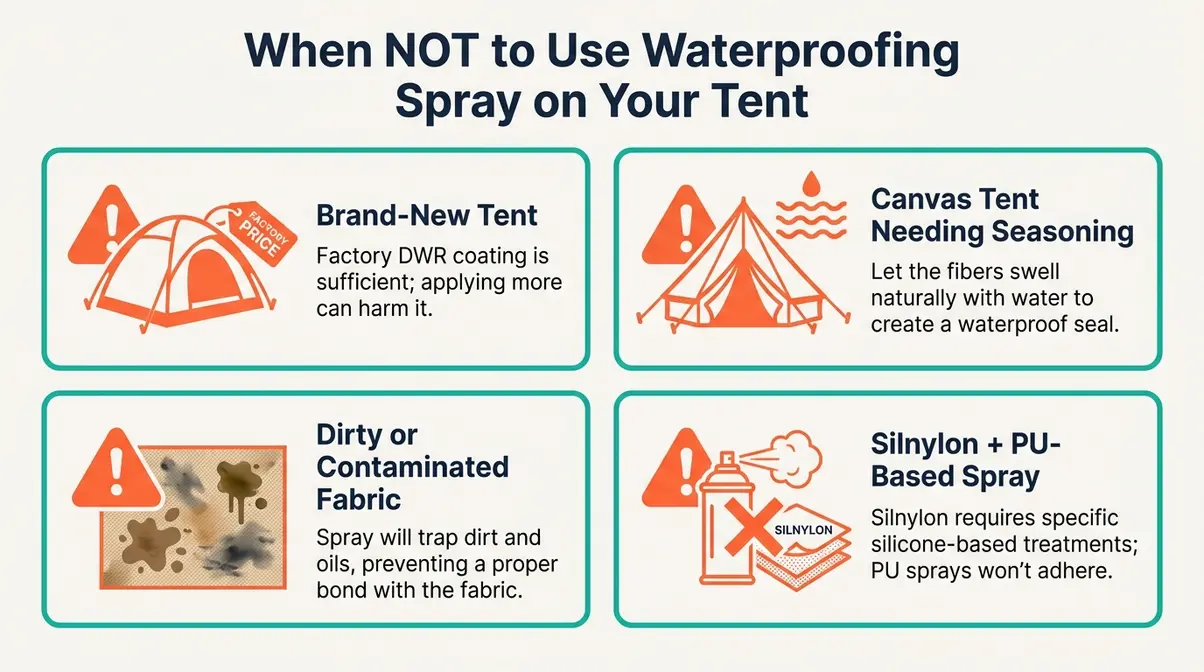
- Brand-new tents — factory DWR coatings on new tents are often more effective than aftermarket sprays. Wait until water stops beading off the rainfly naturally (the “bead test”) before reapplying
- Canvas tents that need seasoning — new canvas tents must be “seasoned” first: soak them with water 2–3 times to allow the fibres to swell and close micro-gaps. Spraying before seasoning seals the gaps incorrectly and traps moisture
- Dirty or contaminated fabric — spray cannot bond properly to fabric covered in dirt, sunscreen, or body oils. Always clean your tent first with a gentle cleaner
- Silnylon tents with a PU-based spray — as the compatibility matrix shows, this chemical mismatch degrades the factory coating permanently
Once you’ve confirmed your tent needs treatment and you’ve chosen the right spray, here’s how long you can expect it to last — and when to reapply.
Longevity and Maintenance Schedule
Forget “once a year.” The best waterproofing spray for tents degrades based on how you use your tent — not the calendar. A tent used for a single summer festival needs treatment sooner than one sitting in a garage for 11 months. Use these specific triggers instead:
- After 14+ nights of heavy rain exposure — sustained wet conditions accelerate DWR breakdown faster than light or intermittent rain
- After 30+ days of cumulative UV exposure — sun degrades DWR chemistry even without rain; desert and alpine campers hit this threshold faster
- When the bead test fails — sprinkle water on your rainfly; if it soaks in rather than beading up and rolling off, it’s time to treat
- After machine washing — detergents strip DWR chemistry; always reapply after any machine wash of tent fabric
Quick rule of thumb: check your rainfly before each camping season. If the bead test fails, treat it before your first trip — not after you’re already wet.
Does Waterproofing Spray Work?
Yes, waterproofing spray works on tents — specifically by restoring the Durable Water Repellent (DWR) layer, the invisible treatment that causes water to bead off your rainfly instead of soaking through. Over time, DWR wears down from rain, UV exposure, and washing, leaving fabric feeling “wet out” even when the underlying membrane is intact. Spray-on DWR treatments re-bond the water-repellent chemistry to your tent’s outer fibres, restoring that beading effect. For best results, the fabric must be clean and the spray must match your tent’s fabric type — a water-based DWR on PU-coated nylon, for example. Note that spray cannot repair a failed urethane coating on a tent floor; that requires a dedicated coating product, not a DWR spray.
How to Completely Waterproof
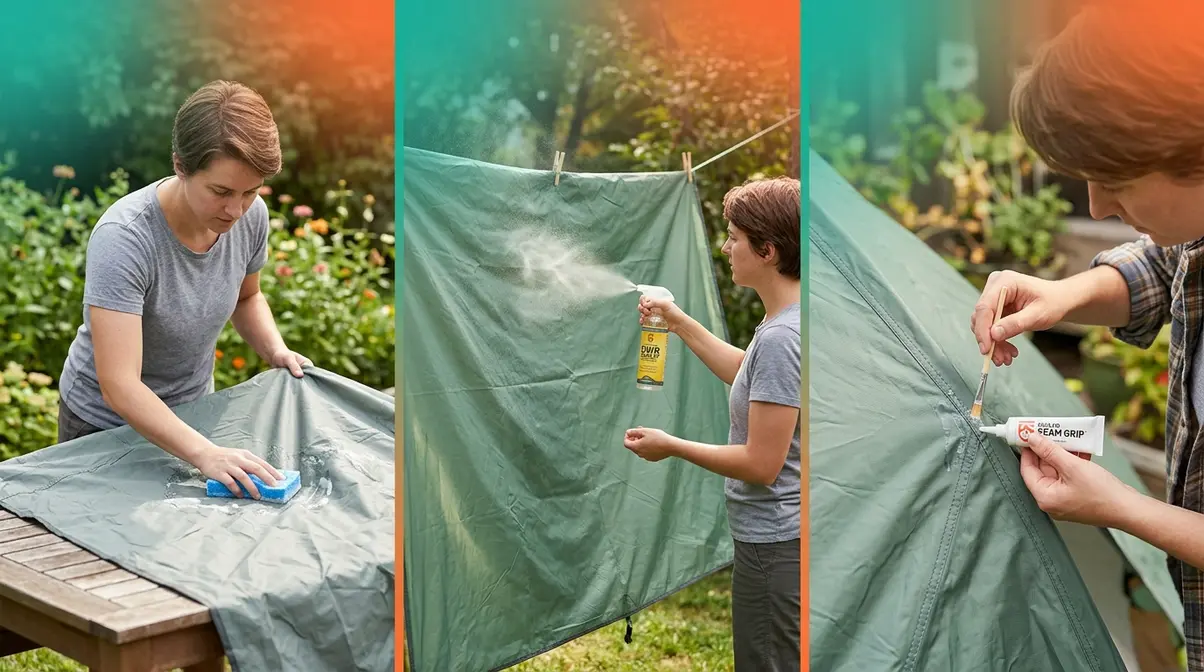
Completely waterproofing a tent requires four steps: clean the fabric, apply a DWR spray to the rainfly, seal the seams separately, and allow 24 hours to cure before packing. Cleaning first is non-negotiable — dirt and oils prevent the spray from bonding to the fibres, wasting the product entirely. Seam sealing is a separate step from fabric spraying; the rainfly’s stitched seams are the most common leak points and require a dedicated seam sealer like Gear Aid Seam Grip, not a waterproofing spray. DWR treatments typically need 24 hours to fully cure before the tent should be packed or exposed to rain. For maximum protection, combine a fabric-appropriate DWR spray on the rainfly with a seam sealer on every stitched seam — neither product alone delivers complete waterproofing.
How We Evaluated
Our evaluation of these 8 tent waterproofing sprays focused on five criteria: fabric compatibility breadth (nylon, polyester, and canvas coverage), formula safety (PFAS-free status), ease of application for first-time users, coverage area per can, and performance consensus from outdoor gear communities and expert sources including REI. Products were ranked by how well they serve beginner campers treating standard synthetic tents, with bonus weight given to independently verified eco-certifications and breathability preservation.
Frequently Asked Questions
Best waterproofer for a canvas tent?
Canvas tents require a breathable wax or specialised canvas treatment — not a standard DWR spray. Applying a synthetic DWR spray can seal the weave incorrectly, trapping moisture inside the tent and creating conditions for mildew growth. If you have a canvas bell tent or wall tent, consult canvas-specific waterproofing guidance and avoid applying any product from this list to canvas fabric.
Most common waterproofing mistakes?
The three most common waterproofing mistakes are spraying a dirty tent, using the wrong spray for your fabric type, and treating a brand-new tent that doesn’t yet need it. Spraying over dirt and oils prevents the DWR from bonding to the fibres. Instead, the spray beads off the contamination rather than the fabric itself. Using the wrong formula for your fabric type is the core of the Fabric-First Rule. For example, a silicone-based spray applied to a PU-coated nylon tent degrades the factory urethane coating permanently, reducing waterproofing performance rather than restoring it. Always check your tent’s manufacturer fabric care label before selecting a spray to prevent the most expensive and irreversible waterproofing mistakes.
Conclusion
For campers with nylon or polyester tents, GEAR AID Revivex is the top pick in this guide — it’s the most technically precise DWR restoration spray for synthetic fabrics, restoring both water repellency and breathability in a single application. The best waterproofing spray for tents is always the one matched to your tent’s specific fabric, not the most recognisable brand on the shelf, which is why the Fabric-First Rule remains the ultimate takeaway. Check your tent’s care label, use the compatibility matrix above, and buy accordingly — your rainfly will thank you.

Dave King
I'm Dave King. I publish Tent Explorer, a site built to answer the questions people actually ask before they buy.