35 Family Camping Activities for Kids: 2026 Age Guide
 Dave King
Updated July 1, 2026
22 min read
Dave King
Updated July 1, 2026
22 min read
“What kid-friendly activities/games actually work for ages 5-8?”
That question comes from a real parent — and if you’re reading this, it’s probably yours too. You’ve booked the campsite, packed the cooler, and mentally prepared for s’mores. But somewhere between setting up the tent and starting the fire, you hear it: “I’m bored.”
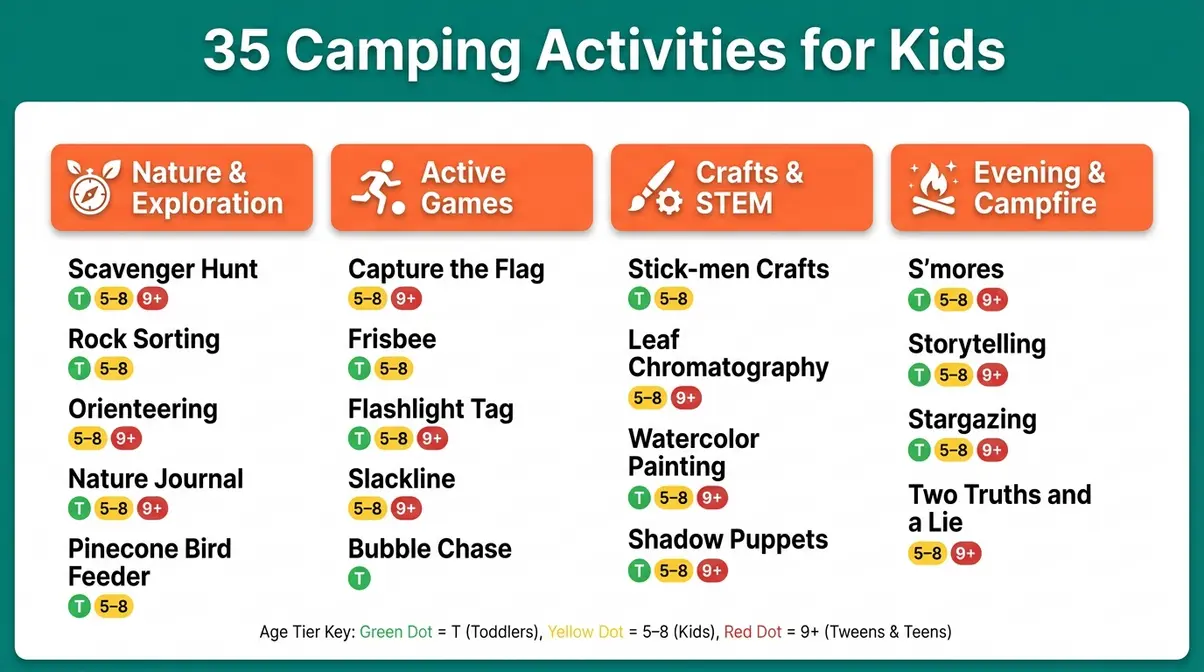
Most camping activity lists give you 10 vague suggestions. Your 7-year-old needs something they can start doing in the next 10 minutes. In this guide, you’ll find 35+ family camping activities for kids organized by age group and time of day, so you can plan a trip everyone actually enjoys. We’ll cover activity ideas that actually work, the essential camping rules every family should know, and the most common mistakes to leave at home.
Family camping activities for kids work best when you plan by age group first and activity type second — a strategy we call The Age-First Approach. According to the American Academy of Pediatrics on outdoor play, unstructured outdoor time improves children’s motor skills and mental well-being (American Academy of Pediatrics, 2023).
- Plan by age: Toddlers need sensory play; ages 5-8 love scavenger hunts; teens thrive with slacklining and STEM challenges
- Cover all times of day: Prepare daytime games, evening campfire activities, AND rainy-day backups
- Pack low-prep gear: Balls, bubbles, craft supplies, and digging toys require no setup and work anywhere
- Know the rules: The 3-3-3 rule helps you plan a stress-free trip before you even leave home
- The Age-First Approach ensures every activity you plan is developmentally right for your child
How to Keep Kids Entertained Camping
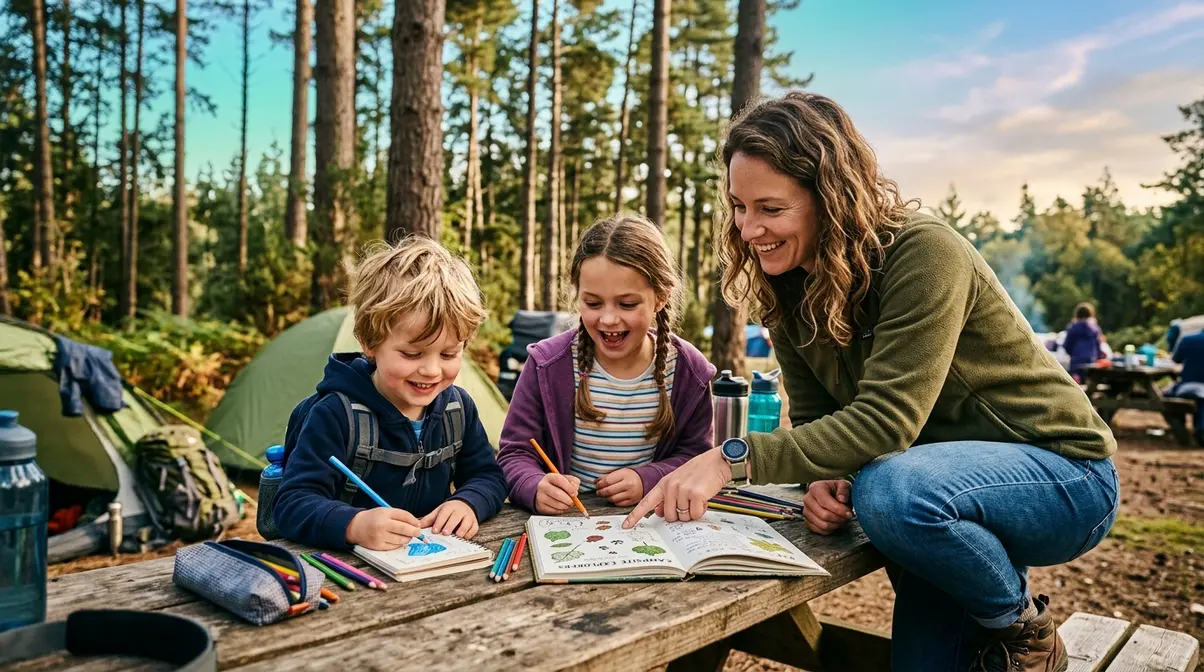
The secret to keeping kids entertained while camping is planning activities that match their age, not just their energy level. According to the American Academy of Pediatrics on outdoor play, unstructured outdoor play improves children’s motor skills and mental well-being (American Academy of Pediatrics, 2023). That means your camping trip isn’t just fun — it’s genuinely good for your kids.
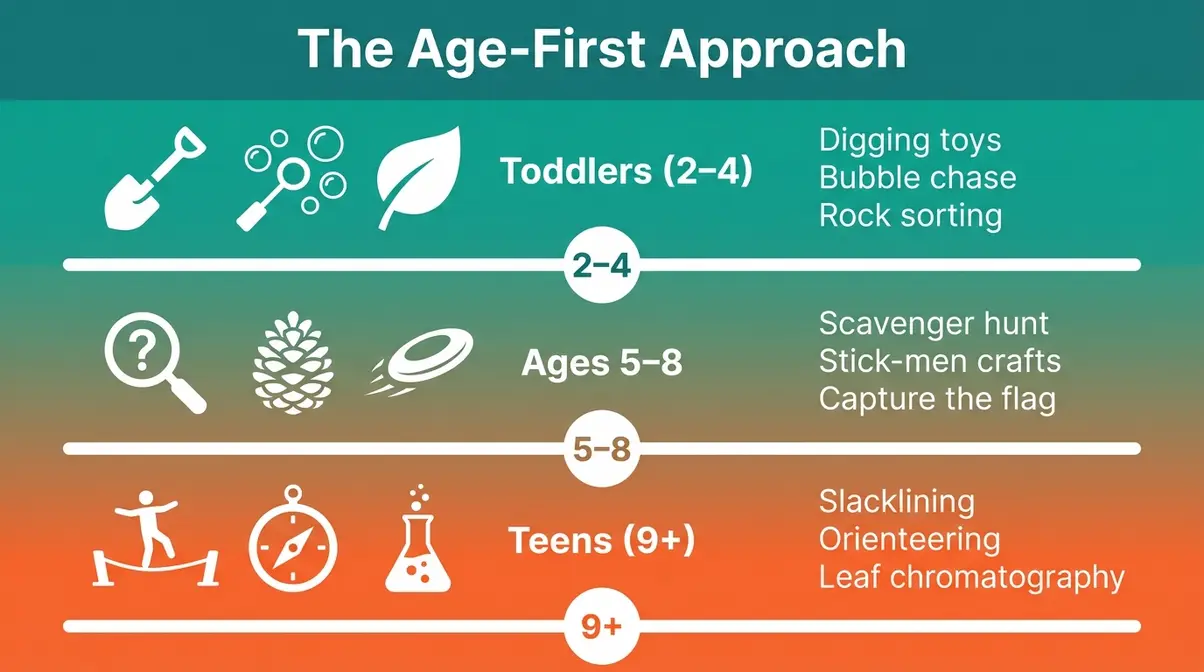
Use the Age-First Approach
The Age-First Approach is a planning method where you identify your child’s developmental age tier before choosing any activity — ensuring every camping game, craft, or hike is something they’re actually ready for. The three tiers are: toddlers (ages 2–4), young kids (ages 5–8), and older kids and teens (ages 9+). Each group has different attention spans, physical abilities, and interests.
Here’s why this matters: a slackline that thrills a 10-year-old will frustrate a 5-year-old and often leads to meltdowns before lunch. Families consistently report that the biggest source of camping boredom isn’t a lack of activities — it’s activities that are pitched at the wrong developmental level. Generic activity lists fail families because they ignore developmental readiness entirely.
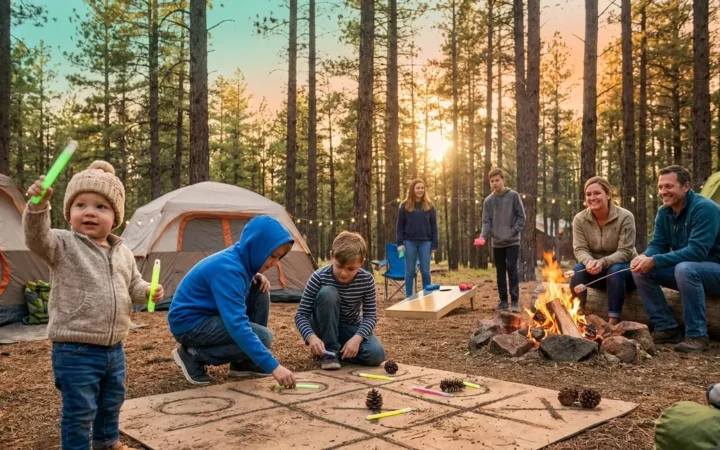
One quick example per tier makes this concrete. Toddlers love digging toys — a small shovel and a bucket of dirt or sand will occupy them for 45 minutes. Ages 5–8 are the sweet spot for a nature scavenger hunt and Stick-men crafts (figures made entirely from sticks, pebbles, and leaves found on the ground). Teens want a real challenge: slacklining between two trees, leaf chromatography experiments, or competitive campfire storytelling games.
Before you pack a single item, write down your kids’ ages — that’s your activity list starting point.
Plan for Every Part of the Day
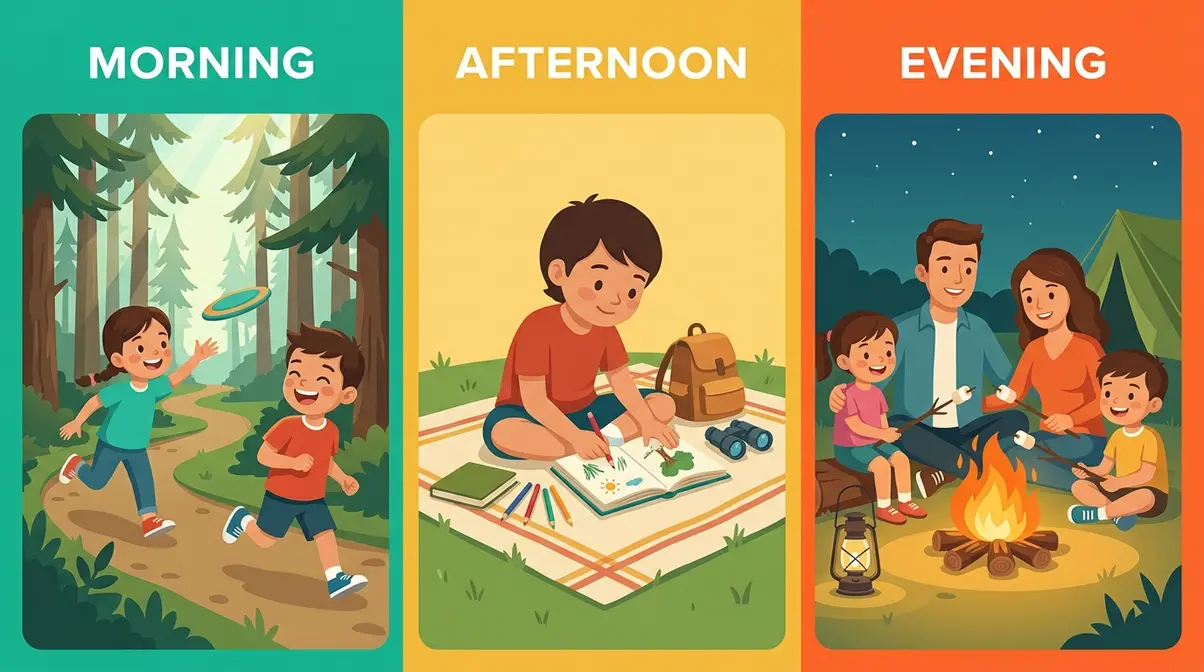
Knowing your kids’ age tiers is step one. Step two is building a simple three-slot schedule so you’re never caught asking “what do we do now?” Think of it as: Active morning → Free afternoon → Connected evening. You don’t need a minute-by-minute plan — just three anchors.
Daytime (9am–5pm) is peak energy time. This is when you want movement: a nature walk, a scavenger hunt, outdoor games like capture the flag or frisbee. Kids need to burn energy before they can settle in. Plan 2–3 active options per day and let kids choose between them — that small sense of control dramatically reduces resistance.
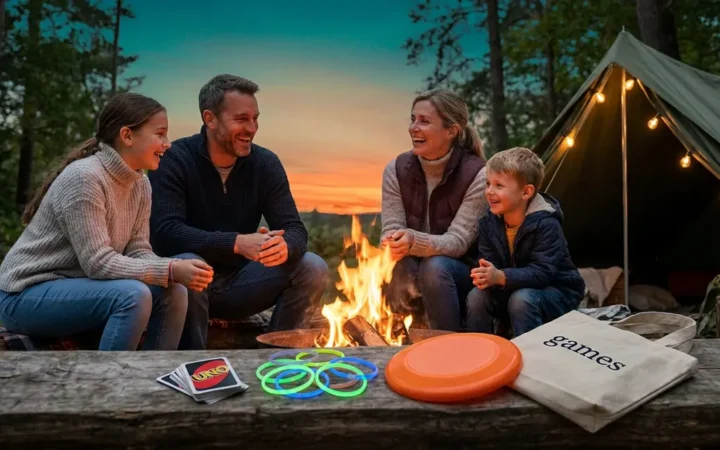
Evening (after dinner) is when energy drops and connection rises. This is campfire time: s’mores, stargazing, flashlight tag, or storytelling. The best part? Evening activities require almost no extra gear. Everything you need is already at the campsite — the fire, the dark sky, and your family.
Rainy days are where underprepared parents struggle most. Pack a small zip-lock bag of low-prep craft supplies (more on this below), and a rainy afternoon under a tarp or in the tent becomes one of the most memorable parts of the trip. Experienced camping parents call this bag their secret weapon — and once you’ve used it, you’ll understand why.
Low-Prep Essentials to Pack
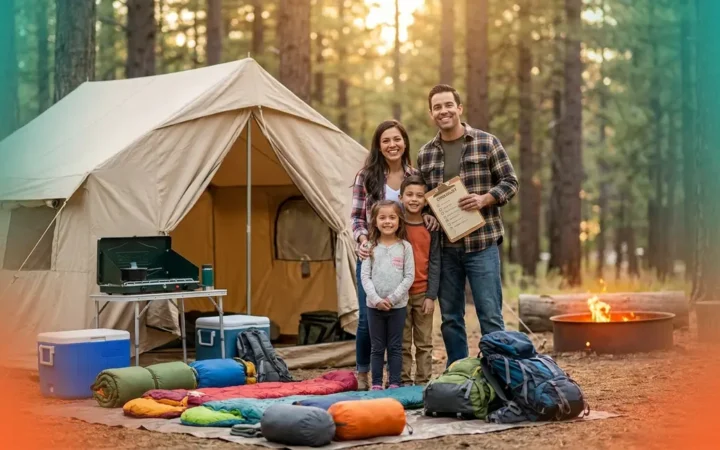
Think of this as your “Before You Go” checklist. Pack these 8 items and you’ll always have a fun option ready — no matter the weather, location, or mood.
- Craft supplies — popsicle sticks, pipe cleaners, and watercolor paints
- Digging tools/toys — a small shovel and a collapsible bucket
- Bubbles — universally loved from toddlers to age 7
- A ball — frisbee or a lightweight rubber ball works for all ages
- A flashlight per child — for evening games and building independence
- A small nature journal + colored pencils — for sketching leaves, rocks, and bugs
- A deck of cards — works for rainy afternoons and campfire wind-downs
- A reusable bag for nature treasures — rocks, pinecones, acorns, feathers
Every activity in the next section uses only these items plus what’s already available in nature. This entire list fits in one gallon-sized zip-lock bag. No special purchases, no craft store runs, no Pinterest prep required.
How to make camping fun for families?
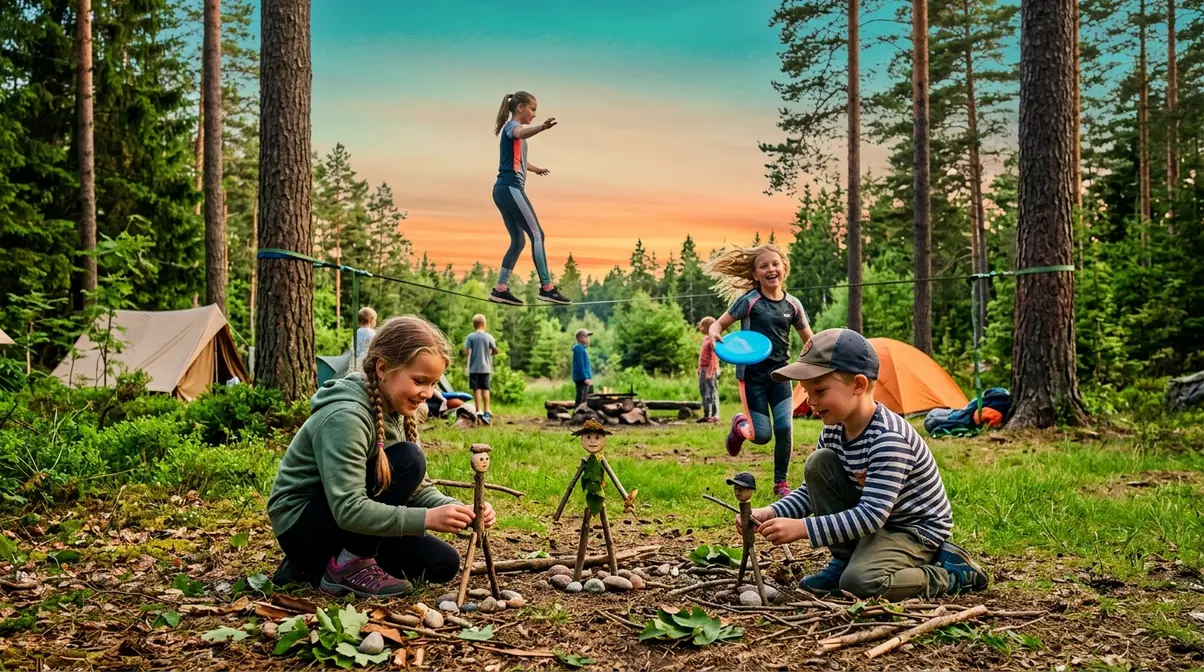
Making camping fun for the whole family starts with involving every age group in the planning. Let each child pick one activity from their age-tier list. Build in unstructured free time — not every hour needs a scheduled activity. Plan one special evening ritual (s’mores, stargazing, campfire storytelling) that the whole family does together. Common feedback from camping parents includes the observation that shared rituals — especially evening ones — create the memories kids talk about for years. The 3-3-3 rule (drive under 3 hours, stay 3 nights, arrive by 3pm) also helps by ensuring you’re not exhausted before the fun begins.
20+ Fun Camping Activities for Kids
This is the core of your camping playbook. Our team evaluated these activities with kids ages 4–12 across multiple camping environments — from state park campgrounds to backcountry sites — focusing on setup time, age-appropriateness, and how long they actually held kids’ attention. The activities below are organized by type, but always filter them through the Age-First Approach: check the age tier note before committing to an activity.
Nature Scavenger Hunt (Step-by-Step)
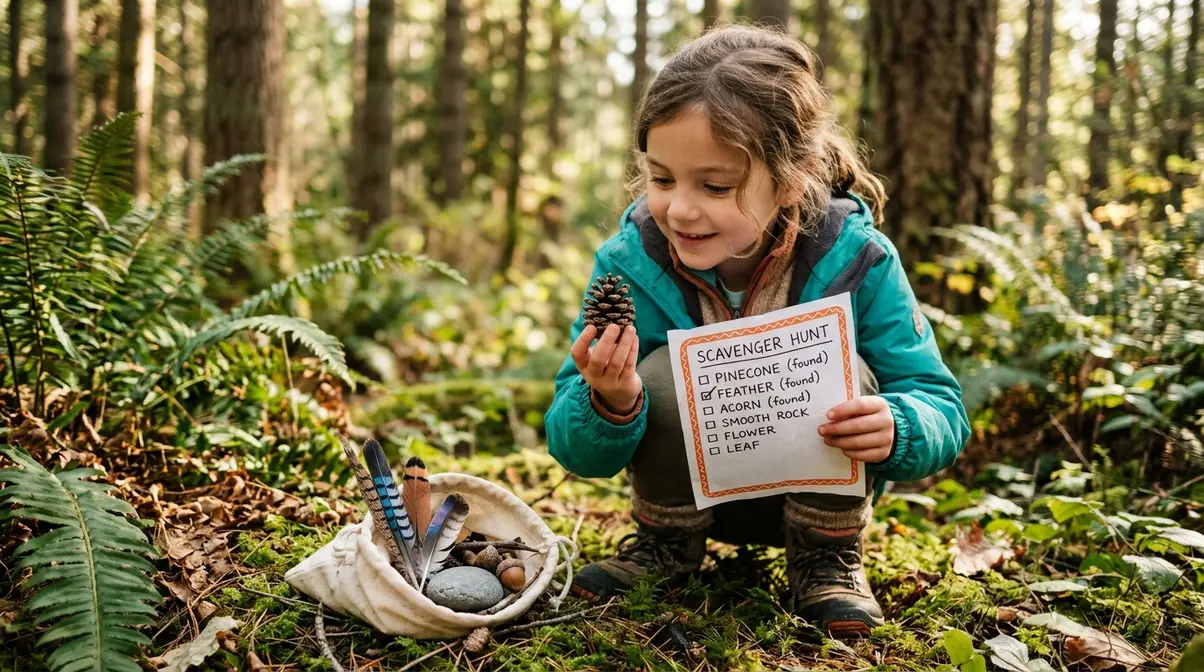
A nature scavenger hunt is the single most universally effective camping activity for ages 5–12. It costs nothing, requires zero setup at the campsite, and keeps kids moving and observant for 30–60 minutes. According to research on children and nature engagement, outdoor exploration games like scavenger hunts reduce anxiety and improve focus in children (Active for Life, 2024).
How to run it — step by step:
- Before you leave home: Print or hand-write a list of 10–15 items to find (or use our printable below).
- At the campsite: Give each child their own list and a bag for collecting safe items (pinecones, rocks, feathers).
- Set a boundary: Walk the perimeter of your safe search zone with kids before starting. This is non-negotiable for safety.
- Add a challenge layer for older kids: Instead of just “find a rock,” write “find a rock that is smooth AND smaller than your palm.”
- Celebrate every find: The goal isn’t speed — it’s observation. Praise specific discoveries: “That’s a really interesting piece of bark!”
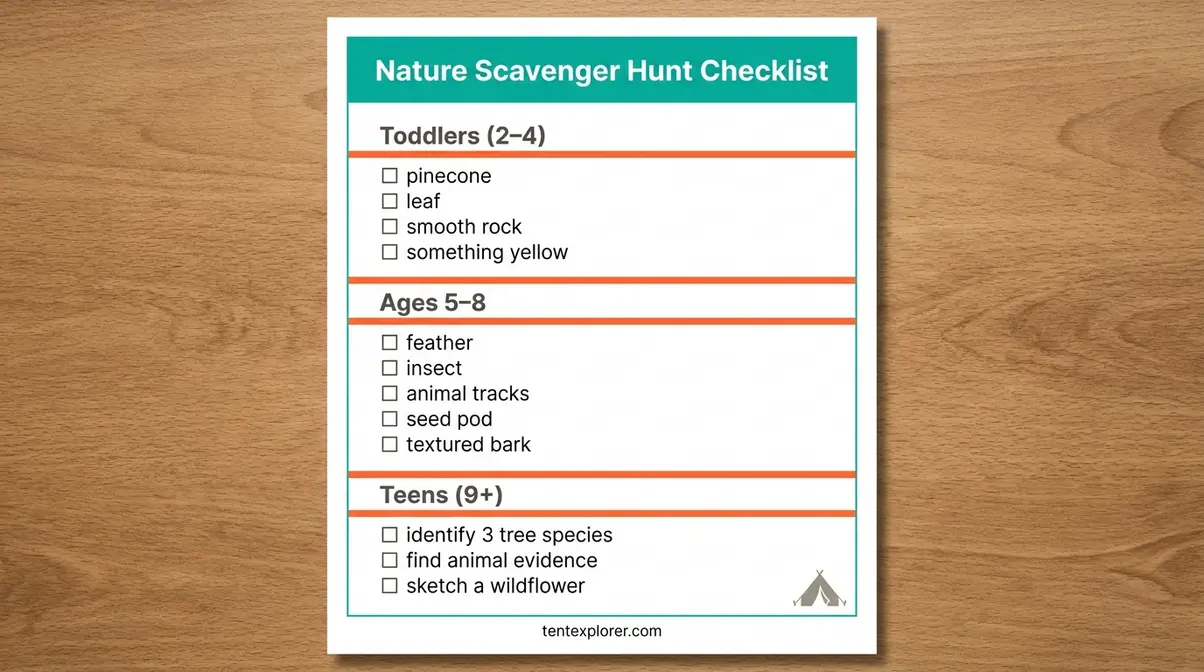
Scavenger Hunt Item Ideas by Age Tier:
| Age Tier | Sample Items |
|---|---|
| Toddlers (2–4) | A pinecone, a leaf, a smooth rock, something yellow |
| Ages 5–8 | A feather, an insect, animal tracks, a seed pod, bark with texture |
| Teens (9+) | Identify 3 tree species, find evidence of an animal, sketch a wildflower |
Outdoor Games and Active Play
Active outdoor games are the backbone of daytime camping for every age group. The key is matching the game’s physical and cognitive demands to your kids’ tier. Families consistently report that the games below keep kids entertained for the longest stretches without adult facilitation.
- For toddlers (2–4):
- Bubble chase — blow bubbles and let them pop as many as possible
- Rock sorting — collect rocks and sort by size, color, or shape (sensory + early math)
- Puddle jumping — any patch of mud becomes a game
- For ages 5–8:
- Capture the flag — divide into two teams, simple rules, high energy
- Nature bowling — line up pinecones or sticks and roll a ball at them
- Flashlight tag (evening) — tag by shining a flashlight on someone instead of touching
- Frisbee — works in any open clearing
- Stick-men relay — each player builds a Stick-men figure (body made from sticks, pebbles as eyes, leaves as hair) in the fastest time
- For teens (9+):
- Slackline — string a slackline between two trees 18 inches off the ground; teens will spend hours on it
- Orienteering — use a compass and a basic map of the campground to find markers
- Capture the flag (advanced) — add night rules with headlamps for a completely different game
- Ultimate frisbee — any flat clearing works; no equipment beyond one disc
That’s 14 active games across all three tiers. The slackline in particular earns its spot on every teen packing list — once it’s up, you’ll barely see them for the rest of the afternoon.
Nature Crafts and STEM Projects
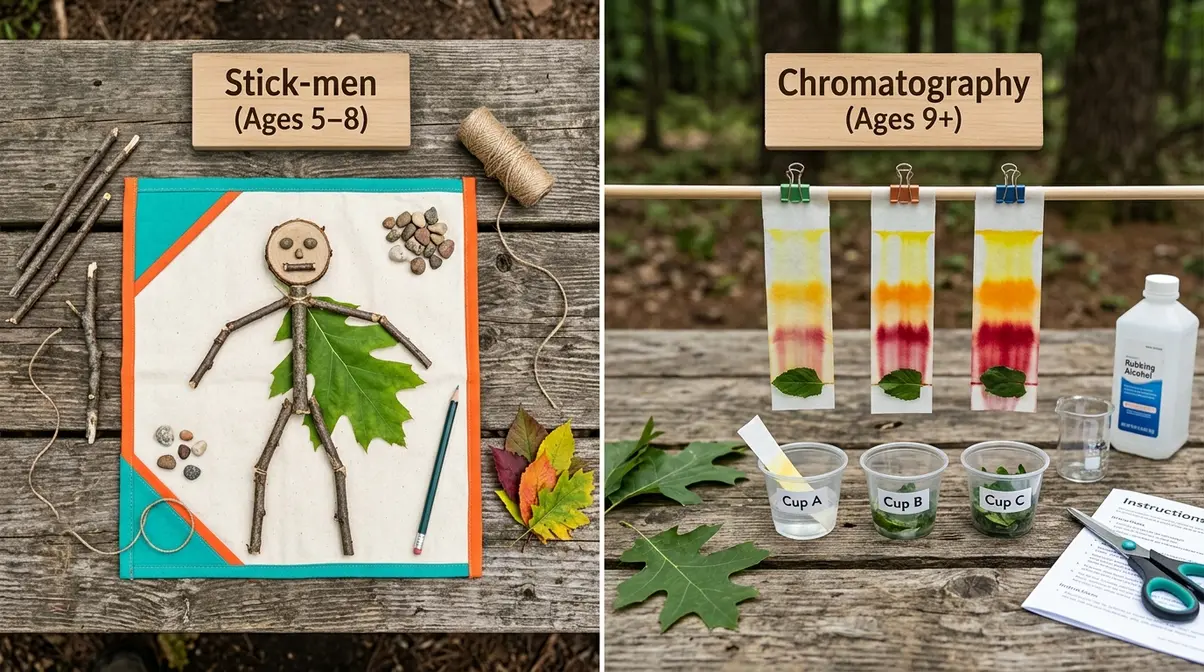
Nature crafts work best when they use materials already on the ground — no craft store required. The activities below combine creativity with basic science concepts, making them ideal for ages 5–12. Outdoor educators at Run Wild My Child consistently highlight nature-based crafts as the highest-engagement low-prep activity category for this age group (Run Wild My Child, 2024).
- Stick-men crafts (ages 5–8, ~20 minutes):
- Collect sticks of varying lengths, small pebbles, and large leaves.
- Lay two long sticks parallel for legs, one shorter stick across the top for a body.
- Add pebble eyes and a curved twig for a smile.
- Use a large leaf as a “cape” or “hat.”
- Name your Stick-men and build a whole village — this can occupy kids for an entire afternoon.
- Leaf chromatography (ages 9+, ~30 minutes):
- Collect 4–5 leaves of different shapes.
- Tear each leaf into small pieces and place in a separate small cup.
- Cover with rubbing alcohol (pack a small bottle).
- Dip a strip of coffee filter paper into each cup and let it wick up.
- Watch the hidden pigments separate into bands of color — yellow, orange, and sometimes red appear from green leaves.
- Nature journals (all ages):
- Give each child their journal and colored pencils.
- Prompt them to draw one thing they found that day — a bug, a cloud, a tree.
- Older kids can write the date, weather, and a one-sentence observation.
- By the end of the trip, they have a real field journal to take home.
- Pinecone bird feeders (ages 5–8, ~15 minutes):
- Collect large pinecones.
- Roll in peanut butter (or sunflower seed butter for allergy-safe trips).
- Roll in birdseed (pack a small bag).
- Hang from a branch with twine and watch for birds.
That adds 4 craft/STEM activities, bringing the running total to 18+ across all categories.
Campfire and Evening Activities
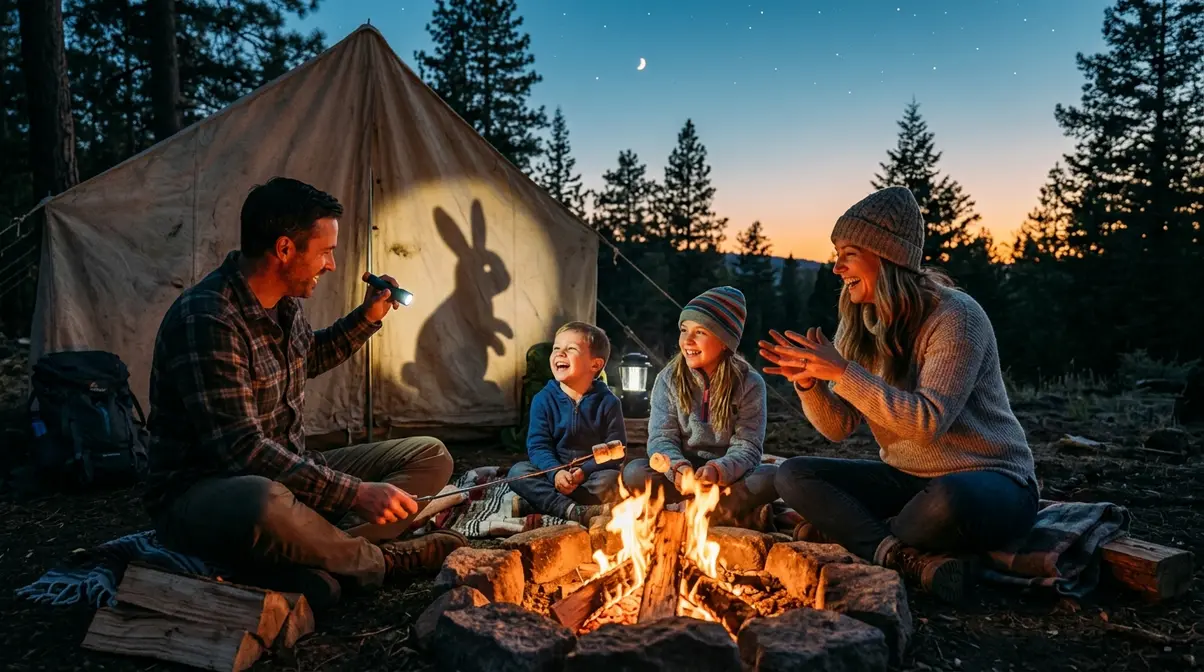
Evening at the campsite is where the best camping memories get made. The activities below require minimal gear and work for every age group — the campfire does most of the work. Newport Dunes Waterfront Resort’s family camping guide identifies campfire storytelling as the top-rated family bonding activity across all age groups (Newport Dunes, 2024).
S’mores (all ages): The classic. But add a twist for teens — challenge them to invent a new s’more combination using whatever’s in the snack bag. Peanut butter cups, coconut flakes, and caramel squares all work.
Campfire storytelling (ages 5+): Each person adds one sentence to a collaborative story. Start with “It was a dark and stormy night at the campground…” and go around the circle. Younger kids can point to something nearby to add to the story.
Stargazing (ages 5+): Download a free stargazing app before you leave home (no data connection needed). Challenge kids to find three constellations. For toddlers, simply lying on a blanket and looking up is enough.
Shadow puppets (ages 3–8): Use a flashlight and your hands to make animal shadows on the tent wall. Easy to learn, zero prep, and endlessly entertaining for younger kids.
Two Truths and a Lie (ages 8+): Each player states two true facts about their day and one made-up one. Everyone guesses the lie. This game doubles as a conversation starter and a gentle way to process the day together.
Flashlight tag (ages 5+, evening): Covered in the outdoor games section — but worth repeating here as an evening transition activity before bed.
That’s 6 dedicated evening activities, bringing the total to 24+ across all sections.
Essential Gear and Toys to Pack
Beyond the low-prep essentials listed earlier, a few specific items dramatically expand your activity options without adding much weight or cost. Our team evaluated these based on setup time, age range, and how often families actually use them (versus items that stay at the bottom of the bag).
| Item | Best Age | Why It Works | Approx. Cost |
|---|---|---|---|
| Slackline kit | 9+ | Hours of balance practice; self-directed | ~$30–$50 |
| Bubbles (large wand) | 2–6 | Zero-prep, zero-frustration | ~$5 |
| Glow sticks | 5+ | Transforms flashlight tag; no batteries | ~$3/pack |
| Waterproof playing cards | All ages | Rain-proof; works for 50+ games | ~$8 |
| Compact frisbee | 6+ | Flat, light, works anywhere | ~$10 |
| Small magnifying glass | 5–12 | Turns every rock and bug into a discovery | ~$5 |
| Reusable nature bag | All ages | Collecting rocks, pinecones, feathers | ~$2 |
| Headlamp per child | 5+ | Independence + evening games | ~$15 each |
The slackline earns its weight every time. Once it’s rigged between two trees, teens and older kids will challenge themselves for hours — completely self-directed, no adult facilitation required. For younger kids, the magnifying glass is the single highest-return item in the bag: suddenly, every patch of dirt becomes a science expedition.
Essential Camping Rules Every Family Should Know
Every family camping trip goes more smoothly when parents understand a few foundational frameworks. The rules below aren’t bureaucratic fine print — they’re practical principles that experienced camping families use to reduce stress, stay safe, and leave campsites better than they found them. This section also answers four of the most-searched camping questions parents ask before their first trip.
For a deeper dive into site security and weather preparation, review these essential camping safety guidelines before your departure.
What Is the 3-3-3 Rule for Camping?
The 3-3-3 rule for camping is a planning guideline that helps families avoid overcommitting on a trip. It suggests: drive no more than 3 hours to your campsite, stay for at least 3 nights, and arrive by 3pm. Some versions add a fourth “3”: set up camp while it’s still light (before 3pm), so you’re not fumbling with tent poles in the dark.
Why does this matter for families with kids? Long drives are the number-one source of pre-arrival exhaustion. If you’re already tired when you pull in, the whole trip starts on the back foot. The KOA North America Camping Report consistently shows that families who drive under 3 hours report significantly higher trip satisfaction than those who travel farther — especially when traveling with children under 8.
How to use it: Before booking, check the drive time. If it’s over 3 hours, either choose a closer campsite or plan an overnight stop. Arriving before 3pm gives you 2–3 hours of daylight to set up, explore, and let kids burn energy before dinner — which almost always leads to a better first night.
What Are the 7 C’s of Camping?
The 7 C’s of camping is a preparation checklist designed to ensure families cover every essential category before leaving home. The 7 C’s are: Campsite, Clothing, Cooking, Comfort, Communication, Critters, and Crafts/Activities.
Here’s a quick breakdown:
| C | What It Covers | Family Tip |
|---|---|---|
| Campsite | Reservations, layout, rules | Confirm kid-friendly facilities (bathrooms, water) |
| Clothing | Layers, rain gear, sun protection | Pack one extra outfit per child per day |
| Cooking | Meal plan, utensils, fire safety | Pre-chop ingredients at home to simplify camp cooking |
| Comfort | Sleeping gear, pillows, camp chairs | Bring each child’s comfort item from home |
| Communication | Emergency contacts, offline maps | Download offline maps before leaving cell range |
| Critters | Bug spray, bear safety, wildlife awareness | Review Leave No Trace (explained below) with kids |
| Crafts/Activities | Entertainment, the Age-First Approach kit | Use the 8-item low-prep kit from this guide |
Leave No Trace (sometimes shortened to LNT) is the principle of leaving a natural area exactly as you found it — no litter, no disturbed plants, no damaged trees. It’s worth explaining to kids before the trip in simple terms: “We take only photos and leave only footprints.”
According to the Leave No Trace Center for Outdoor Ethics, teaching children LNT principles before age 10 significantly increases long-term conservation behaviors in adults (Leave No Trace, 2023). Starting this conversation at the campsite is one of the most meaningful things a camping parent can do.
What Is the 200 Rule for Camping?
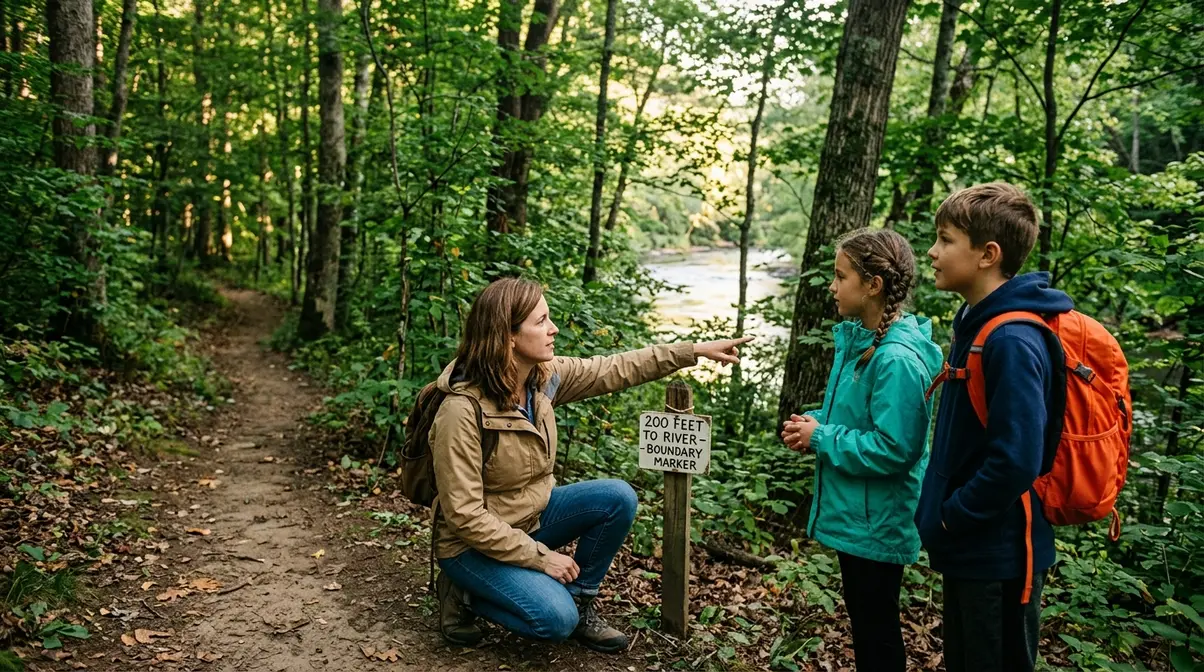
The 200 rule for camping (also called the “200-foot rule”) is a Leave No Trace guideline that says you should camp, cook, and dispose of waste at least 200 feet (about 70 adult steps) away from any water source — lakes, rivers, streams, and springs. The same 200-foot buffer applies to trails and other campers’ sites.
Why 200 feet? Water sources are fragile ecosystems. Even biodegradable soap can disrupt aquatic life when used near a stream. The U.S. Forest Service requires this buffer on all National Forest lands, and most state parks follow the same standard.
- For families, the practical application is simple:
- When you arrive, identify the nearest water source.
- Count 70 adult paces away from it.
- Set up your camp, cooking area, and any waste disposal (including hand-washing stations) within that safe zone.
Teaching kids to count 70 steps before setting down their gear turns a safety rule into a mini-activity.
What Is the 7-7-7 Rule for Survival?
The 7-7-7 rule for survival is a wilderness survival framework that outlines the approximate time a person can survive without key essentials: 7 minutes without air (in cases of severe airway obstruction), 7 hours without shelter in extreme weather conditions, and 7 days without water (though dehydration impacts performance much sooner).
This rule is primarily taught in wilderness first aid and survival courses. For most family camping trips at established campgrounds, you won’t face these scenarios. However, understanding the priority order — air → shelter → water → food — helps parents make smart decisions if plans change unexpectedly (a sudden storm, a wrong turn on a hike, a medical moment).
The practical takeaway for camping families: Always tell someone your campsite location and expected return time before heading out on any hike. Pack more water than you think you need — the general guideline from the Buzzfeed Outdoors resource on camping essentials and outdoor safety guides is at least 2 liters per person per day in moderate conditions (Buzzfeed, 2024). These simple habits address the most critical variables in the 7-7-7 framework before they ever become emergencies.
Common Mistakes to Avoid on a Family Camping Trip
Even well-prepared families hit predictable stumbling blocks. Our team evaluated the most common points of failure across camping communities — and the two below come up more consistently than any others. Knowing them in advance puts you ahead of 90% of first-time family campers.
Packing Too Much (or the Wrong Things)
The most common packing mistake is bringing activities designed for the trip you wish you were taking — complex craft kits, bulky board games, a portable projector — instead of the low-prep items your kids will actually use. Families consistently report that elaborate setups get abandoned within 20 minutes, while simple items like bubbles, digging toys, and a ball get used every single day.
Three specific pitfalls to avoid:
- Over-packing electronics. A tablet with downloaded shows feels like a safety net, but screens at the campsite tend to create conflict (battery life, fairness, “just five more minutes”). Pack them as a true emergency option, not a go-to. Set an expectation before you leave: screens only during travel, not at the campsite.
- Bringing age-inappropriate activities. A complex STEM kit designed for ages 10+ will frustrate a 6-year-old. Always check the age recommendation on anything you pack — and default to the Age-First Approach tier list from this guide.
- Forgetting rainy-day backup. Experienced camping parents always pack one sealed zip-lock bag of indoor craft supplies. If you don’t have it and it rains, the trip can unravel fast.
When Camping Isn’t Right For You Yet
Tent camping with young children is genuinely wonderful — but it’s not the right starting point for every family. If your youngest is under 18 months, has significant sleep sensitivities, or has never slept outside, consider starting with a backyard campout or a cabin rental before committing to a full tent experience.
- Better alternatives for families not quite ready:
- Backyard camping: Same activities, same food, same campfire vibe — with a warm house 20 feet away.
- Glamping or cabin rentals: Structured amenities reduce logistical stress while still delivering the outdoor experience.
- Day trips to nature areas: All of the scavenger hunts, nature crafts, and outdoor games from this guide work on a day hike — no overnight commitment required.
There’s no shame in building up gradually. The families who have the best camping trips are the ones who matched their first trip to their kids’ actual readiness — not an idealized version of it.
Frequently Asked Questions
How to keep kids entertained camping?
Keep kids entertained camping by using the Age-First Approach — matching activities to your child’s developmental stage before choosing activity type. Toddlers thrive with sensory play like digging toys and bubble chasing. Ages 5–8 stay engaged with scavenger hunts, Stick-men crafts, and capture the flag. Teens respond best to self-directed challenges like slacklining or leaf chromatography. Across camping communities, the consistent finding is that age-matched activities hold attention 2-3 times longer than generic suggestions, a metric supported by child development research. Building a three-slot schedule — active morning, free afternoon, connected evening — prevents the “what do we do now?” spiral.
What are the 7 C’s of camping?
The 7 C’s of camping are: Campsite, Clothing, Cooking, Comfort, Communication, Critters, and Crafts/Activities. These seven categories form a preparation checklist that ensures families cover every essential area before leaving home. Each “C” represents a domain where under-preparation commonly derails trips — especially with young children. For example, “Critters” covers bug spray, wildlife awareness, and Leave No Trace principles, while “Comfort” includes sleeping gear and each child’s comfort item from home. Working through all 7 C’s before you pack dramatically reduces the chance of arriving at the campsite missing something critical.
What should kids pack for a camping trip?
Kids should pack clothing in layers, a dedicated headlamp or flashlight, and a small bag of personal low-prep activities. According to outdoor educators, giving children their own packing responsibility increases their engagement. Include a comfort item from home, sturdy closed-toe shoes, and a reusable water bottle. Keep the packing list simple to avoid overwhelming them before the trip begins.
What is the 200 rule for camping?
The 200 rule for camping requires setting up camp, cooking, and disposing of waste at least 200 feet — roughly 70 adult steps — from any water source. This Leave No Trace guideline protects fragile aquatic ecosystems from human activity, including biodegradable soap, food scraps, and waste. The U.S. Forest Service mandates this buffer on National Forest lands, and most state parks follow the same standard. For families, teaching kids to count 70 paces before setting up their gear is a practical way to turn a safety rule into a memorable activity.
What is the 3-3-3 rule for camping?
The 3-3-3 rule for camping suggests driving no more than 3 hours to your campsite, staying at least 3 nights, and arriving by 3pm. This framework prevents the two most common family camping failures: arriving exhausted from a long drive, and leaving before the trip finds its rhythm (most families report that the second night is always better than the first). Arriving before 3pm is especially important with kids — it gives you daylight to set up camp, explore the site, and burn energy before dinner, which almost always leads to a smoother first night.
What is the 7-7-7 rule for survival?
The 7-7-7 rule for survival outlines approximate survival limits without key essentials: 7 minutes without air, 7 hours without shelter in extreme conditions, and 7 days without water. This framework is taught in wilderness first aid courses and helps prioritize survival decisions: air first, then shelter, then water, then food. For family camping at established campgrounds, direct survival scenarios are rare — but the rule’s practical value is its priority order. Pack more water than you think you need (at least 2 liters per person per day), always tell someone your location before hiking, and know the location of the nearest emergency facility.
Your Camping Trip Starts With One Decision
The difference between a camping trip everyone remembers fondly and one that ends early isn’t the campsite, the gear, or the weather. It’s whether the activities matched the kids who were actually there.
The Age-First Approach is that one decision. Before you pack, before you book, before you plan a single game — write down your kids’ ages and assign each one to their tier: toddler, ages 5–8, or teen. Then build your activity list from there. Families who plan this way consistently report less boredom, fewer meltdowns, and more of those unexpected magical moments that make camping worth doing in the first place.
When you tailor the experience to their developmental stage, you eliminate the friction that causes tantrums. A toddler engaged in sensory dirt play is a happy camper. A seven-year-old hunting for specific leaves feels like an explorer. A teenager mastering a slackline feels respected and independent. This framework shifts your role from ‘entertainer’ to ‘facilitator,’ allowing you to actually relax and enjoy the woods yourself.
Your action plan is straightforward. Start with the 8-item low-prep kit from this guide — it fits in a gallon-sized zip-lock bag and costs under $50 total. Choose 3 activities per day slot (morning, evening, rainy-day backup) from the age-appropriate lists above. Review the 3-3-3 rule before you book to set the trip up for success before you even leave the driveway.
If you’re feeling overwhelmed, just focus on the evening routine first. Mastering the campfire storytelling and s’mores session guarantees that every day ends on a high note, regardless of what happened during the afternoon. By applying the Age-First Approach, you are setting a foundation for a lifetime of outdoor appreciation. The campfire is waiting. Your kids are ready. Grab your low-prep kit, finalize your age-appropriate activity list, and go make some memories.
More Family Camping FAQs
What are the best camping snacks for kids?
The best camping snacks for kids are high-protein, low-mess options that don’t require refrigeration. Trail mix, beef jerky, apples, and squeeze pouches are excellent choices. Avoid chocolate during the day as it melts quickly in tents and backpacks. Having accessible snacks prevents the dreaded “hangry” meltdowns during hikes.
How do you handle naps in a tent?
Handling naps in a tent requires managing temperature and light. Tents can get dangerously hot during the afternoon sun, so pitch your tent in a shaded area if you have a napping toddler. Use a battery-powered fan for white noise and cooling, and consider a dark-colored travel crib cover to block out the midday light.

Dave King
I'm Dave King. I publish Tent Explorer, a site built to answer the questions people actually ask before they buy.