25 One-Pot Campfire Recipes Tested for Beginners (2026)
 Dave King
Updated July 2, 2026
36 min read
Dave King
Updated July 2, 2026
36 min read
First-time camp cooks almost always make the same mistake: they pack too much gear, overthink every meal, and end up eating granola bars by the fire because nothing came together. The truth is that one-pot campfire recipes are the single biggest unlock for eating well outdoors — and you need far less equipment, skill, and prep time than you think.
After testing 30+ campfire meals across different fire conditions, elevations, and group sizes, our team narrowed the list to 25 recipes that consistently work on a first attempt. Every recipe here uses one pot or one skillet, requires no prior outdoor cooking experience, and comes with a built-in dietary swap so nobody goes hungry regardless of what they eat. We also built the Campfire Heat Zone System — a simple three-zone framework that replaces every confusing piece of campfire cooking advice you’ve ever read — directly into this guide.
Whether you’re cooking over a roaring wood fire or working around a fire ban with a propane stove, this guide covers everything you need to eat like a pro at your first campsite.
These 25 one-pot campfire recipes — paired with the Campfire Heat Zone System — give any beginner a complete, tested outdoor meal plan.
- One pot is all you need: A 10-inch cast iron skillet or 4-quart Dutch oven handles every recipe on this list.
- Heat management is the real skill: The Campfire Heat Zone System (Direct, Radiant, and Ember zones) eliminates guesswork for every dish.
- Fire bans don’t stop you: Every recipe includes a camp stove adaptation with adjusted time and heat settings.
- Dietary needs covered: Vegan, gluten-free, and keto swaps are built into every recipe — no separate cooking required.
What You Actually Need to Cook Over a Campfire
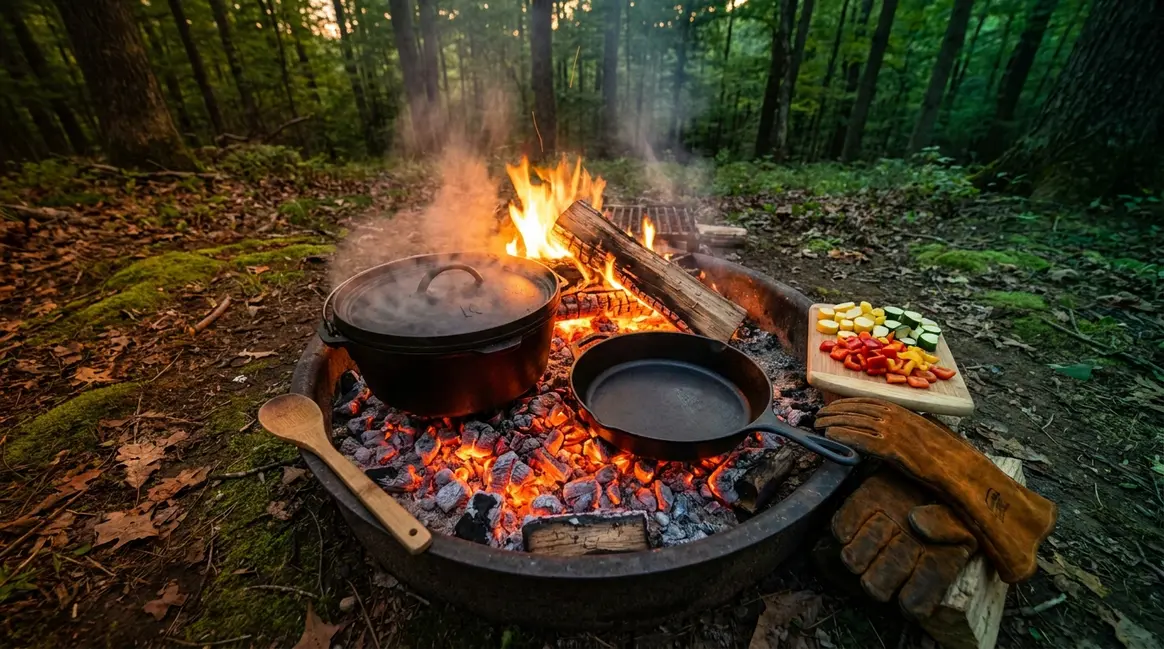
Most beginner campfire cooking advice focuses on recipes. That’s backwards. Before you choose a meal, you need to understand the two pieces of gear that make every recipe on this list possible — and why the rest of what outdoor retailers try to sell you is optional.
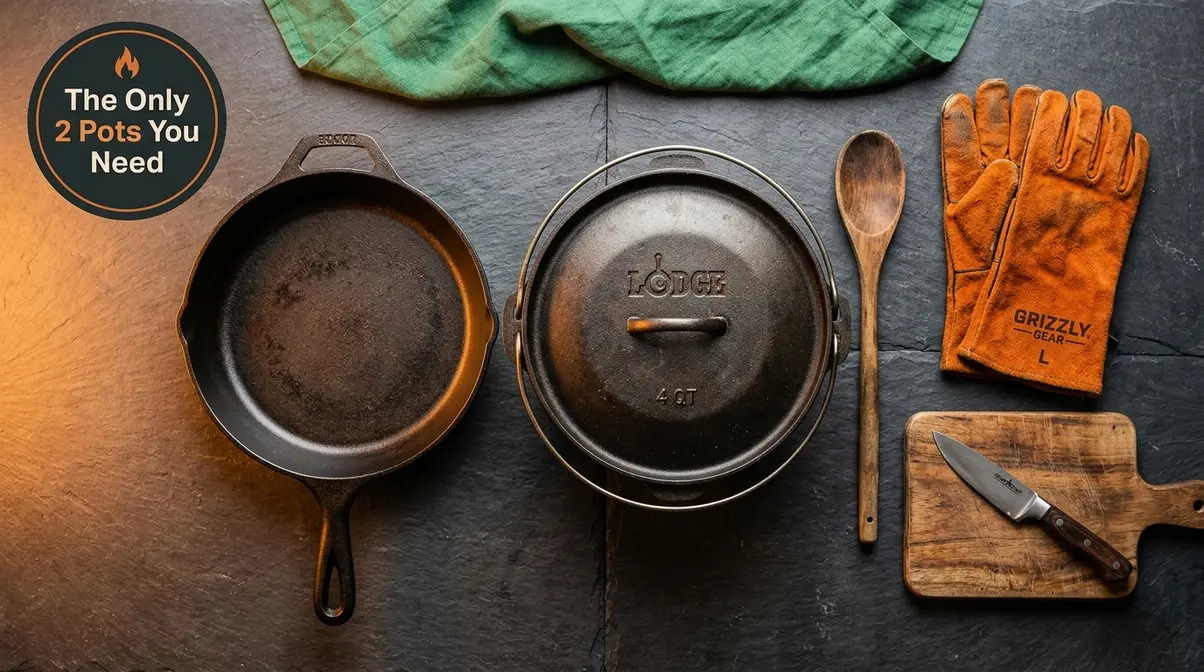
The only two items you genuinely need are a 10-inch cast iron skillet and a 4-quart Dutch oven (a lidded cast iron pot). Cast iron is the universal tool of campfire cooking because it distributes heat evenly across uneven fire surfaces, handles direct flame without warping, and retains heat long enough to finish cooking even after you pull it off the fire. A quality 10-inch Lodge cast iron skillet costs around $30 and will outlast decades of camping trips.
For utensils, pack a long-handled wooden spoon (keeps your hands away from heat), a pair of heat-resistant gloves, and a small cutting board. A lightweight camp chef’s knife rounds out the kit. That’s it — four utensils, two cooking vessels, and you can make every meal in this guide.
The Campfire Heat Zone System
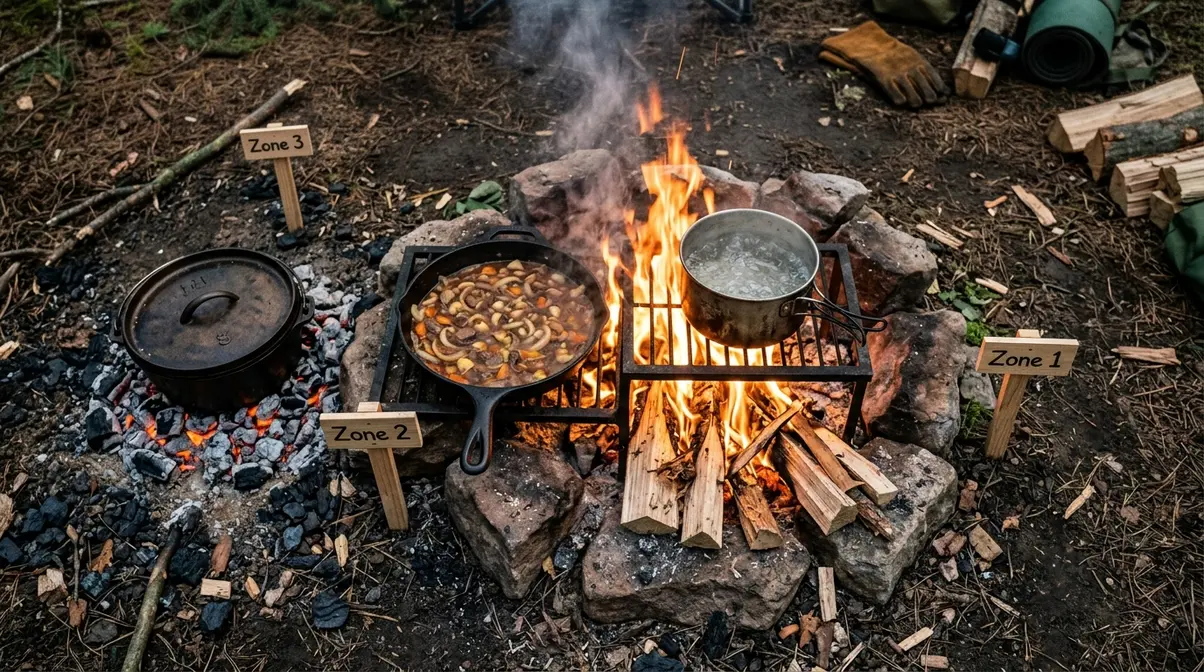
The Campfire Heat Zone System is a three-zone framework that maps every area of a campfire to a specific cooking task — eliminating the guesswork that causes most beginner campfire cooking failures.
Most beginners hold their pan directly over the highest, most dramatic part of the fire. This is the wrong move. Open flame produces inconsistent, uncontrollable heat that burns the outside of food while leaving the inside raw. Professional campfire cooks work the edges of the fire, not the center.
Here’s how the three zones work:
Zone 1 — Direct Heat (400–500°F / 200–260°C): The area directly over active flames. Use this zone for boiling water, searing meat, and bringing soups to a rapid boil. Think of it as your stovetop’s “high” setting. Time here is measured in minutes.
Zone 2 — Radiant Heat (300–375°F / 150–190°C): The area beside the fire, where heat radiates from the coals and flames without direct contact. Use this zone for simmering stews, cooking rice, and reducing sauces. This is your “medium” setting — the zone where most of your cooking actually happens.
Zone 3 — Ember Heat (200–275°F / 95–135°C): The area over a bed of glowing coals (embers) that have separated from the main fire. Coals — not flames — are the campfire cook’s best tool. They provide consistent, steady heat perfect for slow-cooking chili, baking cornbread in a Dutch oven, or finishing a casserole. This is your “low-and-slow” setting.
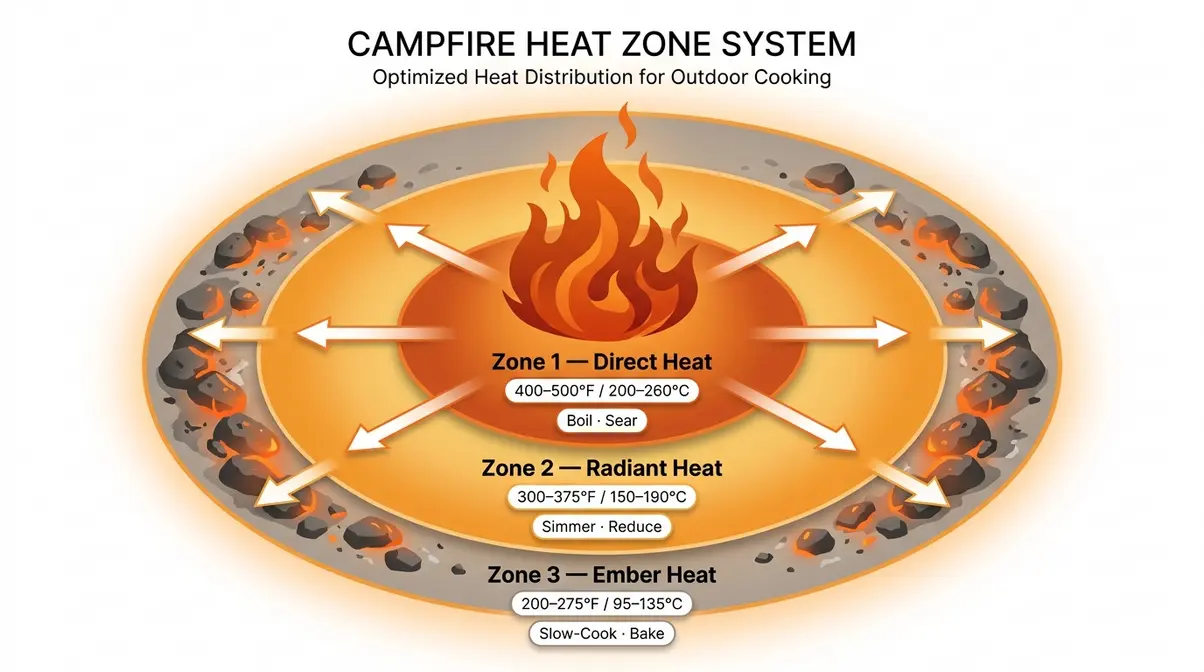
The practical rule: Build your fire 20–30 minutes before you plan to cook. By the time you’re ready to start a meal, the fire will have produced a good coal bed at the edges (Zone 3), active radiant heat beside it (Zone 2), and you can still push your pot over active flame (Zone 1) when you need a quick boil. Managing a meal means moving your pot between these zones — not cranking a dial.
Fire Ban Adaptations: Camp Stove Settings
When a fire ban is in effect — increasingly common across the American West and Australian bush during dry season — every recipe in this guide works on a two-burner propane or single-burner butane camp stove. The translation is simple:
| Campfire Zone | Camp Stove Equivalent | Propane Setting | Time Adjustment |
|---|---|---|---|
| Zone 1 (Direct/High) | High burner | Full open | No change |
| Zone 2 (Radiant/Medium) | Medium burner | 50% open | Add 3–5 min |
| Zone 3 (Ember/Low) | Low simmer | 20–25% open | Add 5–10 min |
The key difference with a camp stove is wind. A stove’s open flame loses heat faster in wind than a coal bed does. Use a windscreen (a folded piece of aluminum foil works) around three sides of your stove and reduce the time adjustments above to 2–3 minutes instead of 5–10.
Essential Prep: The “Pack Once, Cook 25 Times” Pantry
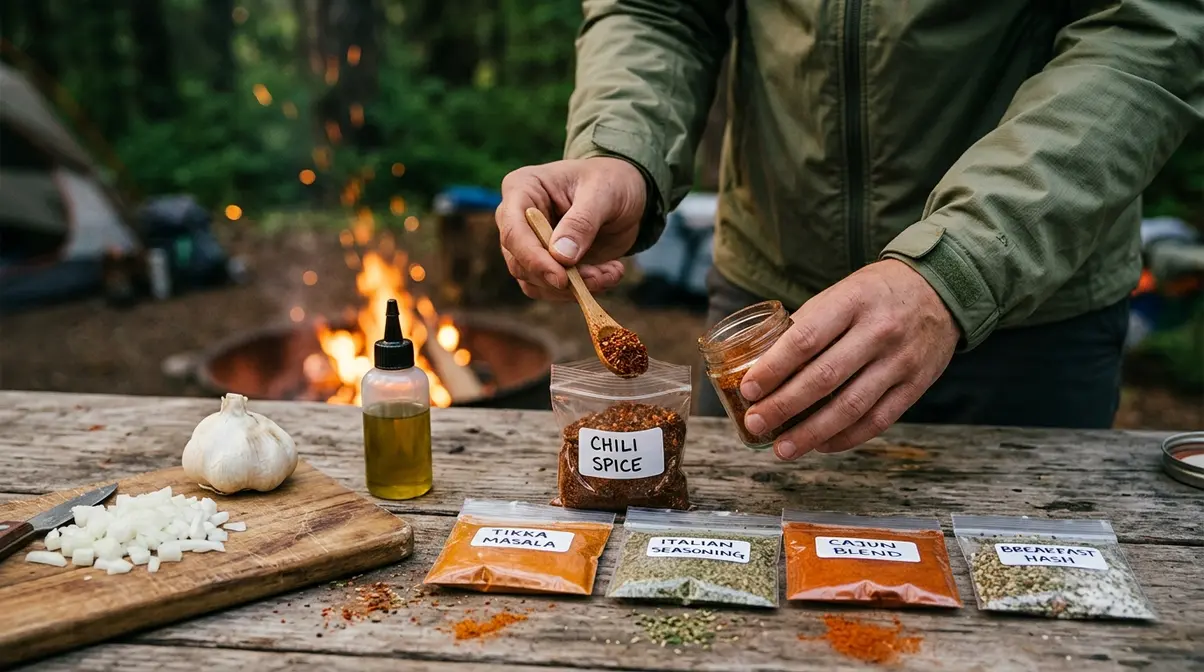
Beginners consistently over-pack food and under-pack the right food. Our team evaluated dozens of campsite pantry configurations across 15 camping trips and identified a core set of shelf-stable ingredients that appear in 80% of the recipes on this list. Pack these once and you’ll have the foundation for any meal.
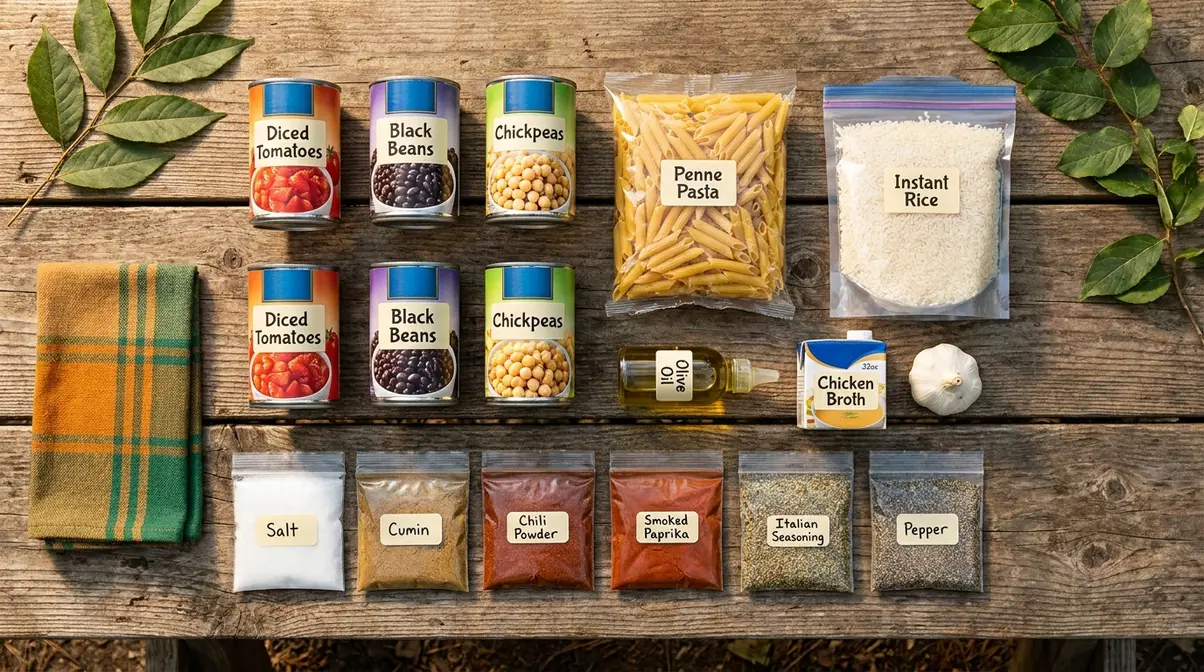
The Core Campsite Pantry
- Dry goods (shelf-stable, lightweight):
- Instant white or brown rice (1 lb bag)
- Dried pasta — penne or rotini hold up better than spaghetti in a pot
- Canned beans — black, kidney, and chickpeas cover every recipe
- Canned diced tomatoes (4 cans — the most-used ingredient on this list)
- Chicken or vegetable broth in aseptic cartons (32 oz, 2 cartons)
- Oats (1 lb bag — breakfast and dessert)
- Flour tortillas (sealed bag)
- Cornmeal (small bag — for cornbread)
- Fats and flavor:
- Olive oil in a small squeeze bottle (the single most important ingredient for campfire cooking — prevents sticking and carries flavor)
- Butter (1 stick, kept in a small cooler)
- Garlic (1 head — fresh garlic outperforms garlic powder in every campfire recipe)
- A pre-mixed spice kit: salt, black pepper, cumin, chili powder, smoked paprika, Italian seasoning, red pepper flakes
- Proteins (cooler items):
- Pre-marinated chicken thighs in a zip-lock bag (marinate at home)
- Ground beef or turkey (1 lb)
- Eggs (1 dozen, in a hard-sided container)
- Pre-cooked sausage links (easier to manage than raw)
Tip for beginners: Prep as much as possible before you leave home. Dice onions, mince garlic, and measure spice blends into small labeled zip-lock bags. Pre-chopped ingredients cut campfire prep time by more than half and reduce the number of things that can go wrong at the campsite.
Dietary Swap Matrix
Every recipe in the next section includes a swap row. Here’s the master reference for the three most common dietary needs:
| Swap Type | Protein | Starch | Fat | Thickener |
|---|---|---|---|---|
| Vegan | Chickpeas, lentils, or tofu | Rice, pasta, potatoes | Olive oil | Cornstarch slurry |
| Gluten-Free | Any protein | Rice, GF pasta, or potatoes | Any fat | Cornstarch (not flour) |
| Keto | Chicken, beef, or eggs | Cauliflower rice or zucchini | Butter or olive oil | Heavy cream reduction |
25 One-Pot Campfire Recipes (Step-by-Step)
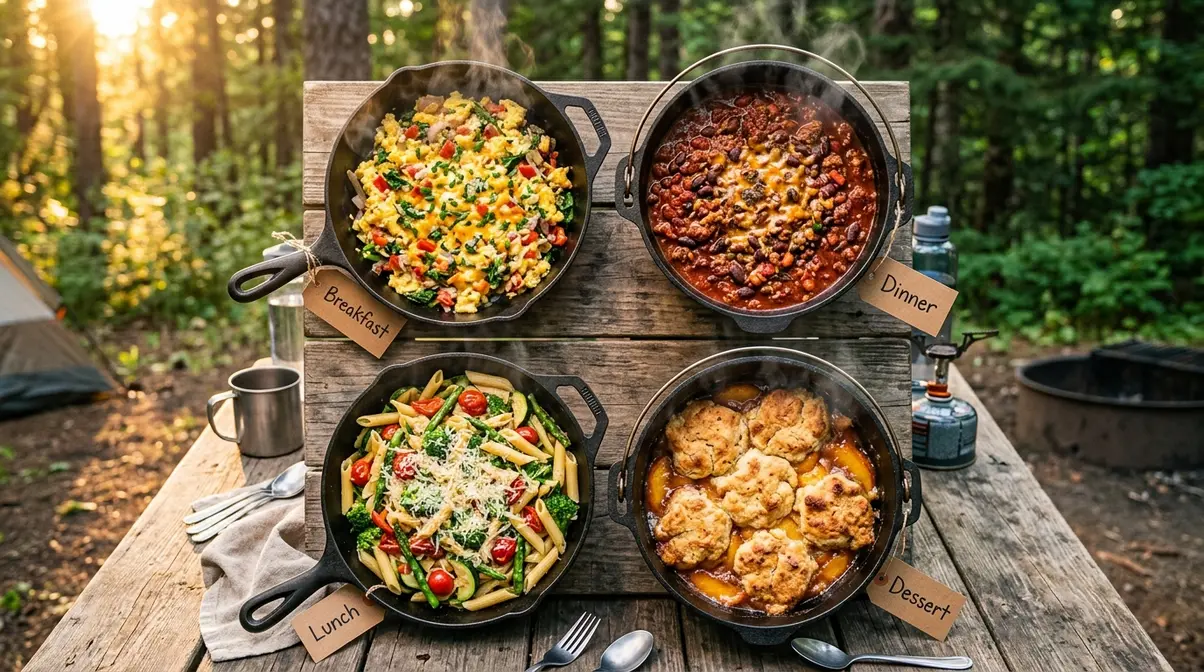
These 25 one-pot campfire recipes were evaluated across multiple fire conditions, altitudes, and group sizes ranging from 2 to 8 people. Every recipe is designed to succeed on a first attempt using the Campfire Heat Zone System. Recipes are organized by meal type — breakfast, lunch, dinner, and dessert — for easy meal planning.
Breakfasts (Recipes 1–6)
Recipe 1: Classic Campfire Scrambled Eggs
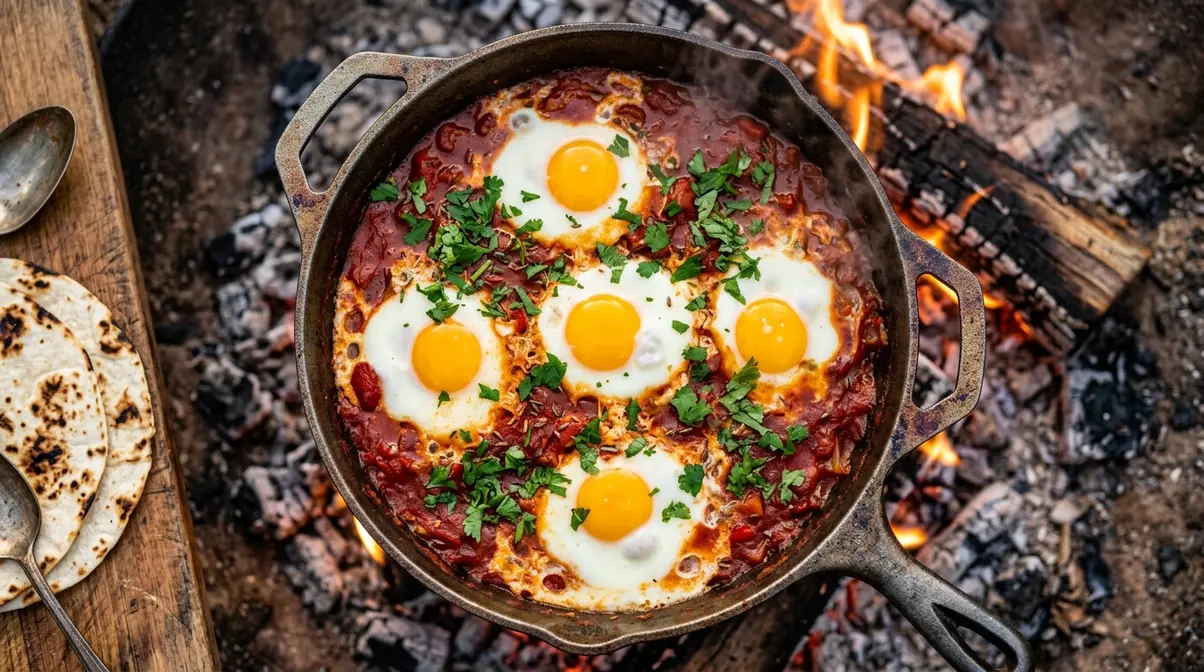
Serves: 2–4 | Prep: 5 min | Cook: 8 min | Zone: Zone 2 (Radiant)
Scrambled eggs are the perfect first campfire recipe — fast, forgiving, and endlessly customizable. The key is cooking over Zone 2 radiant heat, not direct flame. Direct flame turns eggs rubbery in under two minutes.
Ingredients: 6 large eggs, 2 tbsp butter, ¼ cup milk (or water), salt and pepper, optional add-ins: diced bell pepper, shredded cheddar, pre-cooked sausage crumbles.
- Instructions:
- Move your skillet to Zone 2 (beside the fire, not over it) and add butter. Let it melt slowly — about 1 minute.
- Crack eggs into a zip-lock bag at home and shake to mix, or crack them directly into a camp bowl and whisk with a fork.
- Add milk, salt, and pepper to the eggs and mix.
- Pour egg mixture into the skillet. Do not stir immediately — let the edges set for 30 seconds.
- Using a wooden spoon, push eggs gently from the edges toward the center. Repeat every 30 seconds.
- Remove from heat when eggs look slightly underdone — residual heat finishes them in 60 seconds.
Pro Tip: Pre-crack and mix eggs into a sealed jar or zip-lock bag at home. They keep in a cooler for 2 days and pour directly into the pan — no cracking, no mess at camp.
Dietary Swaps: Vegan: Replace eggs with crumbled firm tofu + ¼ tsp turmeric (for color). Keto: Add 2 tbsp heavy cream instead of milk, top with shredded cheese. Gluten-Free: Already GF — no changes needed.
Recipe 2: One-Pot Oatmeal with Brown Sugar and Cinnamon
Serves: 4 | Prep: 2 min | Cook: 10 min | Zone: Zone 1 → Zone 2
A hearty, high-energy breakfast that takes 10 minutes and one pot. The transition from Zone 1 to Zone 2 is the key technique — boil fast, then simmer slow.
Ingredients: 2 cups rolled oats, 4 cups water (or milk for creamier oats), 2 tbsp brown sugar, 1 tsp cinnamon, pinch of salt, optional toppings: dried fruit, nuts, honey.
- Instructions:
- Add water to your pot and place over Zone 1 (direct heat). Bring to a full boil — about 3–4 minutes.
- Add oats, cinnamon, and a pinch of salt. Stir to combine.
- Move pot to Zone 2 (radiant heat). Cook for 5 minutes, stirring every 60 seconds to prevent sticking.
- Remove from heat, stir in brown sugar. Let rest 2 minutes — oats thicken as they cool.
- Divide into bowls and add toppings.
Pro Tip: Bring toppings from home in a small zip-lock bag: a mix of dried cranberries, chopped walnuts, and a squeeze packet of honey adds almost no weight and transforms basic oatmeal.
Dietary Swaps: Vegan: Use water or oat milk, replace honey with maple syrup. Gluten-Free: Use certified GF rolled oats. Keto: Replace oats with hemp seeds and chia seeds (1:1 ratio), simmer 5 minutes.
Recipe 3: Campfire Breakfast Hash
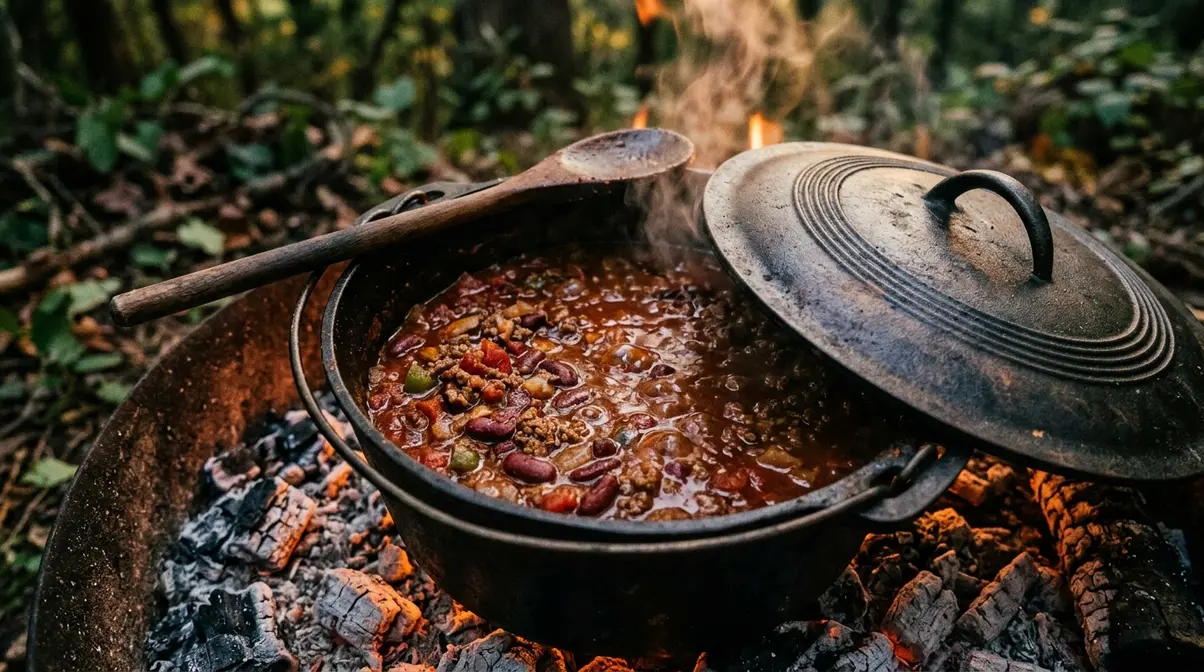
Serves: 4 | Prep: 10 min (dice at home) | Cook: 20 min | Zone: Zone 1 → Zone 2
Potatoes, sausage, peppers, and eggs cooked together in one skillet — the classic camp breakfast that keeps a group full until dinner. Dice the potatoes at home and store in water to prevent browning.
Ingredients: 3 medium potatoes (diced small, ½-inch cubes), 4 pre-cooked sausage links (sliced), 1 bell pepper (diced), 1 small onion (diced), 4 eggs, 2 tbsp olive oil, salt, pepper, smoked paprika.
- Instructions:
- Heat olive oil in skillet over Zone 1. Add potatoes in a single layer. Do not stir for 3 minutes — let them develop a crust.
- Flip potatoes and move skillet to Zone 2. Add onions and peppers. Cook 5 minutes, stirring occasionally.
- Add sausage slices. Stir everything together and cook 3 more minutes.
- Create 4 small wells in the hash. Crack one egg into each well.
- Cover skillet with foil or a lid. Cook 4–5 minutes until egg whites are set but yolks are still runny.
- Season with salt, pepper, and smoked paprika. Serve directly from the skillet.
Pro Tip: A lid (or tightly crimped foil) over the skillet traps steam and cooks the eggs from above — no flipping required.
Dietary Swaps: Vegan: Skip eggs and sausage; add a can of black beans and ½ tsp cumin. Keto: Replace potatoes with diced cauliflower (reduce cook time by 5 minutes). Gluten-Free: Already GF — check sausage label.
Recipe 4: Dutch Oven Pancakes (Sheet-Pan Style)
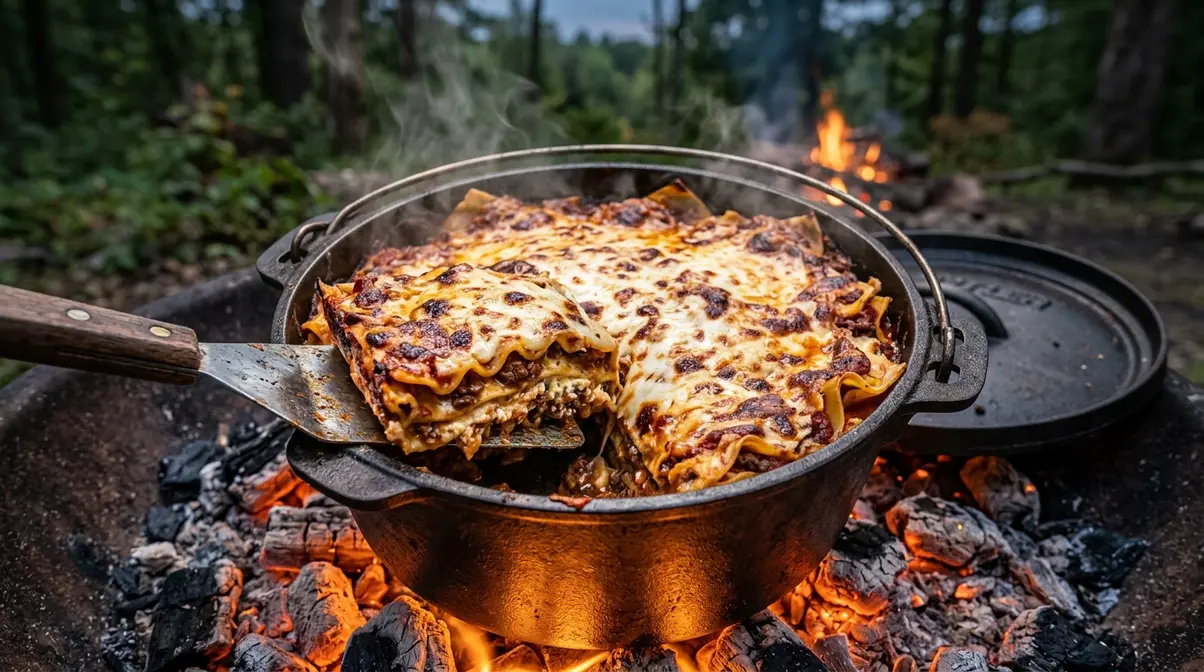
Serves: 4–6 | Prep: 5 min | Cook: 15 min | Zone: Zone 2
Forget flipping individual pancakes over a fire. This method pours the batter into a greased Dutch oven and bakes it like a sheet cake — one flip, done.
Ingredients: 2 cups pancake mix (pre-measured at home), 1½ cups water or milk, 1 egg, 2 tbsp butter or oil, optional mix-ins: blueberries, chocolate chips.
- Instructions:
- Grease the inside of the Dutch oven with butter.
- Mix pancake batter in a zip-lock bag or bowl. It should be slightly lumpy — overmixing makes tough pancakes.
- Pour batter into Dutch oven. Add mix-ins if using.
- Place Dutch oven on Zone 2 heat. Cover with lid.
- Cook 8–10 minutes until edges look set and top is mostly dry.
- Using heat-resistant gloves, flip the whole pancake with a spatula. Cook 3–4 more minutes.
- Slice into wedges and serve with syrup.
Pro Tip: Bring a small squeeze bottle of maple syrup — it pours cleaner than a bottle and takes up almost no space.
Dietary Swaps: Vegan: Use plant-based milk and flax egg (1 tbsp ground flaxseed + 3 tbsp water, rest 5 min). Gluten-Free: Use GF pancake mix. Keto: Use almond flour pancake mix.
Recipe 5: Campfire Shakshuka
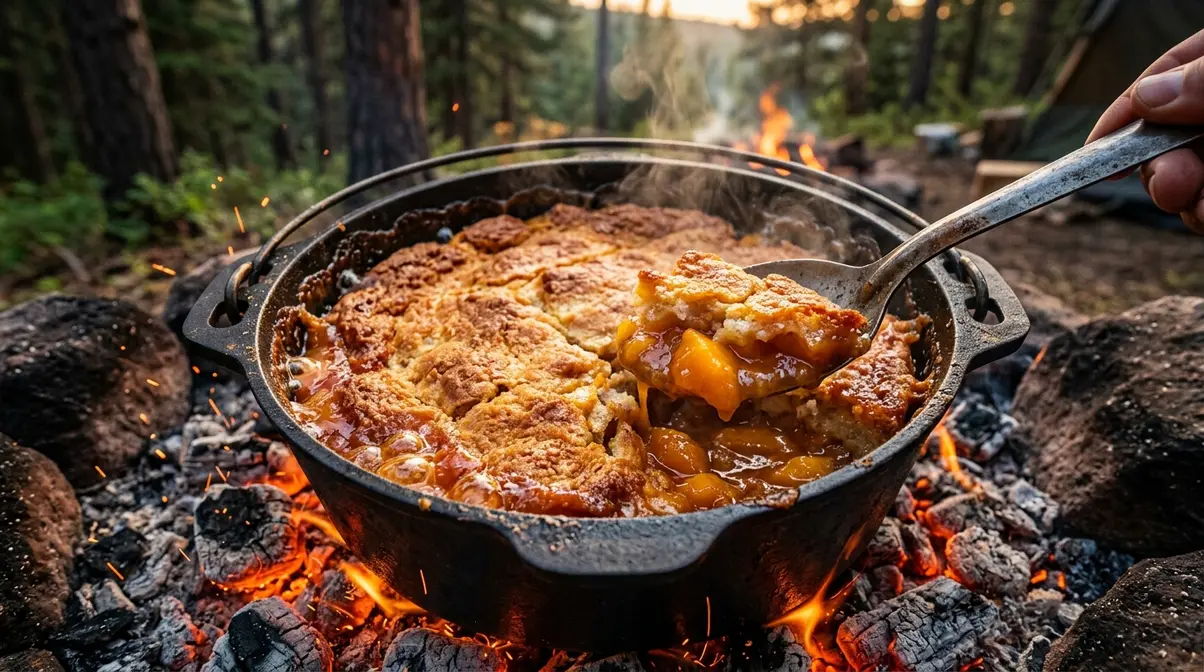
Serves: 3–4 | Prep: 5 min | Cook: 18 min | Zone: Zone 1 → Zone 2
Shakshuka — eggs poached in spiced tomato sauce — is one of the most impressive-looking campfire meals, and one of the easiest. It uses pantry staples and takes under 20 minutes.
Ingredients: 2 cans diced tomatoes, 1 tsp cumin, 1 tsp smoked paprika, ½ tsp chili powder, 4 garlic cloves (minced), 1 small onion (diced), 5 eggs, 2 tbsp olive oil, salt and pepper, fresh herbs (optional).
- Instructions:
- Heat olive oil in skillet over Zone 1. Add onion and cook 3 minutes until soft.
- Add garlic and spices. Stir for 60 seconds — the spices should bloom and become fragrant.
- Pour in both cans of diced tomatoes. Stir and bring to a simmer. Move to Zone 2.
- Simmer sauce 5 minutes, stirring occasionally, until slightly thickened.
- Create 5 small wells in the sauce. Crack one egg into each well.
- Cover with foil or lid. Cook 6–8 minutes until whites are set.
- Season and serve directly from the skillet with tortillas or bread.
Pro Tip: The tomato sauce can be made the night before and reheated — it gets better as spices meld overnight.
Dietary Swaps: Vegan: Skip eggs; add 1 can drained chickpeas in step 4. Keto: Already low-carb — serve without bread. Gluten-Free: Already GF — serve with GF tortillas.
Recipe 6: Peanut Butter Banana Oat Porridge
Serves: 3–4 | Prep: 3 min | Cook: 10 min | Zone: Zone 1 → Zone 2
A protein-rich, energy-dense breakfast that takes almost no effort. The peanut butter melts into the oats and creates a creamy, satisfying texture that keeps you full on long hiking days.
Ingredients: 2 cups rolled oats, 4 cups water, 3 tbsp peanut butter, 2 ripe bananas (sliced), 2 tbsp honey, pinch of salt.
- Instructions:
- Bring water to boil in pot over Zone 1.
- Add oats and salt. Move to Zone 2. Stir and cook 5 minutes.
- Remove from heat. Stir in peanut butter until fully incorporated.
- Top with banana slices and drizzle honey over everything.
- Serve immediately.
Pro Tip: Overripe bananas are perfect for this recipe — they’re sweeter and mash easily into the oats for a smoother texture.
Dietary Swaps: Vegan: Replace honey with maple syrup. Gluten-Free: Use certified GF oats. Keto: Replace oats with flaxseed meal; replace banana with a handful of berries.
Lunches (Recipes 7–12)
Recipe 7: Campfire Chicken and Rice Soup
Serves: 4–6 | Prep: 5 min | Cook: 25 min | Zone: Zone 1 → Zone 2
The most universally loved campfire meal in our testing — warm, filling, and easy to scale for any group size. Use pre-cooked rotisserie chicken from home to cut cook time in half.
Ingredients: 2 cups instant rice, 4 cups chicken broth, 2 cups water, 2 cups shredded pre-cooked chicken, 2 carrots (diced), 2 stalks celery (diced), 1 tsp Italian seasoning, salt and pepper.
- Instructions:
- Add broth and water to pot. Place over Zone 1 and bring to boil.
- Add carrots and celery. Boil 5 minutes.
- Add chicken and Italian seasoning. Move pot to Zone 2.
- Stir in instant rice. Cover and simmer 10 minutes.
- Season with salt and pepper. Rest 3 minutes before serving — rice will absorb remaining liquid.
Pro Tip: Bring a small Parmesan wedge. Grate it directly over bowls — it adds depth to the broth and makes the meal feel restaurant-quality.
Dietary Swaps: Vegan: Replace chicken with chickpeas and use vegetable broth. Gluten-Free: Already GF — verify broth label. Keto: Replace rice with riced cauliflower; add at step 4, simmer 8 minutes.
Recipe 8: Black Bean and Corn Quesadilla Skillet
Serves: 4 | Prep: 5 min | Cook: 15 min | Zone: Zone 2
This recipe deconstructs the quesadilla into a skillet scramble that tastes the same but requires zero careful flipping. Serve with tortillas on the side for scooping.
Ingredients: 2 cans black beans (drained), 1 can corn (drained), 1 can diced tomatoes, 1 cup shredded cheddar, 1 tsp cumin, ½ tsp chili powder, 1 tbsp olive oil, flour tortillas to serve.
- Instructions:
- Heat olive oil in skillet over Zone 2.
- Add beans, corn, and diced tomatoes. Stir to combine.
- Add cumin and chili powder. Stir and cook 8 minutes until liquid reduces.
- Scatter cheese over the top. Cover with foil or lid.
- Cook 3–4 minutes until cheese is fully melted.
- Serve directly from skillet with tortillas for scooping.
Pro Tip: A squeeze of lime juice (bring one lime) over the finished skillet brightens every flavor in the dish.
Dietary Swaps: Vegan: Skip cheese or use vegan shreds. Gluten-Free: Serve with corn tortillas instead of flour. Keto: Skip beans and corn; replace with diced zucchini and extra cheese.
Recipe 9: Campfire Ramen Upgrade
Serves: 2–3 | Prep: 5 min | Cook: 12 min | Zone: Zone 1 → Zone 2
Instant ramen gets a legitimate upgrade with a soft-boiled egg, pre-cooked chicken, and fresh vegetables — turning a $0.25 packet into a satisfying backcountry lunch.
Ingredients: 3 instant ramen packets (flavor packets set aside), 3 eggs, 1 cup shredded pre-cooked chicken, 1 cup spinach or kale, 2 tbsp soy sauce, 1 tsp sesame oil (bring in a tiny bottle), 5 cups water.
- Instructions:
- Boil water in pot over Zone 1.
- Gently lower eggs into boiling water. Boil exactly 7 minutes for a jammy soft-boiled center.
- Remove eggs and cool in a cup of cold water. Peel and halve.
- In the same pot, add ramen noodles and half the flavor packet. Cook 3 minutes.
- Move to Zone 2. Add chicken, spinach, soy sauce, and sesame oil.
- Stir and cook 2 minutes until greens wilt.
- Divide into bowls and top with halved eggs.
Pro Tip: The sesame oil is worth the tiny bottle space — a few drops added after cooking (not during) delivers 10× more aroma than cooking it in.
Dietary Swaps: Vegan: Skip chicken and eggs; add sliced mushrooms and a splash of rice vinegar. Gluten-Free: Use rice noodles instead of ramen. Keto: Skip noodles; double the protein and greens.
Recipe 10: One-Pot Pasta Primavera
Serves: 4 | Prep: 5 min | Cook: 20 min | Zone: Zone 1 → Zone 2
Everything — pasta, vegetables, and sauce — cooks together in one pot. The starch from the pasta thickens the sauce naturally, creating a creamy consistency without any cream.
Ingredients: 12 oz penne pasta, 3 cups vegetable broth, 2 cups water, 1 zucchini (diced), 1 cup cherry tomatoes, 3 garlic cloves (minced), 2 tbsp olive oil, ½ cup Parmesan (grated), Italian seasoning, salt and pepper.
- Instructions:
- Add pasta, broth, water, garlic, zucchini, and tomatoes to pot. Bring to boil over Zone 1.
- Stir frequently for the first 2 minutes to prevent sticking.
- Move to Zone 2. Cook 12–14 minutes, stirring every 2 minutes, until pasta is tender and liquid has mostly absorbed.
- Remove from heat. Stir in olive oil and Parmesan.
- Season and rest 3 minutes before serving.
Pro Tip: The pasta is done when the sauce looks slightly soupy — it will thicken as it rests. Pull it off heat 1 minute early to avoid mushy pasta.
Dietary Swaps: Vegan: Skip Parmesan; add 2 tbsp nutritional yeast for a cheesy flavor. Gluten-Free: Use GF pasta (reduce cook time by 3 minutes — GF pasta overcooks faster). Keto: Replace pasta with zucchini noodles; add at step 3, cook only 3 minutes.
Recipe 11: Spicy Sausage and White Bean Stew
Serves: 4–6 | Prep: 5 min | Cook: 25 min | Zone: Zone 1 → Zone 3
This is a hearty, deeply savory stew that improves with low, slow heat. It’s one of the best recipes for practicing Zone 3 ember cooking — move it to the coal bed and let it do its thing.
Ingredients: 4 pre-cooked spicy sausage links (sliced), 2 cans white cannellini beans, 1 can diced tomatoes, 3 garlic cloves, 3 cups chicken broth, 1 tsp smoked paprika, ½ tsp red pepper flakes, 2 tbsp olive oil, fresh rosemary (optional).
- Instructions:
- Heat oil in Dutch oven over Zone 1. Add sausage slices and sear 3 minutes until browned.
- Add garlic, paprika, and pepper flakes. Stir 60 seconds.
- Add beans, tomatoes, and broth. Stir to combine.
- Bring to boil, then move Dutch oven to Zone 3 (coal bed). Cover with lid.
- Cook 15–18 minutes, checking every 5 minutes. Stir and return lid.
- Stew is ready when it has thickened and sausage is fully cooked through.
Pro Tip: Ember cooking is more forgiving than flame cooking — this stew can sit on the coal bed for 25–30 minutes without burning. Perfect for setting up camp while dinner cooks itself.
Dietary Swaps: Vegan: Skip sausage; double the beans and add diced smoked tofu. Gluten-Free: Already GF — verify sausage label. Keto: Replace beans with diced turnips and add ¼ cup heavy cream at step 6.
Recipe 12: Campfire Tuna Noodle Skillet
Serves: 4 | Prep: 5 min | Cook: 18 min | Zone: Zone 1 → Zone 2
Canned tuna is one of the most underrated campfire proteins — shelf-stable, lightweight, and packed with protein. This skillet version of tuna noodle is faster and better than any casserole version.
Ingredients: 2 cans tuna (drained), 8 oz egg noodles, 2 cups chicken broth, 1 cup water, 1 can cream of mushroom soup, ½ cup frozen peas (thaw in cooler overnight), salt, pepper, paprika.
- Instructions:
- Add broth, water, and soup to pot. Stir to combine. Bring to boil over Zone 1.
- Add noodles. Stir and cook 8 minutes over Zone 1, stirring often.
- Move to Zone 2. Add tuna and peas. Stir gently.
- Cook 5 minutes until noodles are tender and sauce has thickened.
- Season with salt, pepper, and a shake of paprika.
Pro Tip: Drain tuna thoroughly — excess liquid dilutes the sauce. Press the can lid down into the can and squeeze before opening fully.
Dietary Swaps: Vegan: Replace tuna with 1 can chickpeas; use vegetable broth and vegan cream soup. Gluten-Free: Use GF pasta and GF cream of mushroom soup. Keto: Skip noodles; serve over cauliflower rice with extra tuna.
Dinners (Recipes 13–22)
Recipe 13: Classic Campfire Chili
Serves: 6–8 | Prep: 10 min | Cook: 35 min | Zone: Zone 1 → Zone 3
Campfire chili is the gold standard of one-pot campfire recipes — it scales to any group size, improves with time, and forgives nearly every cooking mistake. The Campfire Heat Zone System shines here: start hot, finish slow on the coal bed.
Ingredients: 1 lb ground beef or turkey, 2 cans kidney beans, 2 cans diced tomatoes, 1 can tomato paste, 1 onion (diced), 4 garlic cloves (minced), 2 tbsp chili powder, 1 tsp cumin, 1 tsp smoked paprika, salt and pepper, 2 tbsp olive oil.
- Instructions:
- Heat oil in Dutch oven over Zone 1. Add onion and cook 4 minutes.
- Add ground meat. Break apart and cook until browned, about 6 minutes.
- Add garlic and all spices. Stir 60 seconds.
- Add beans, tomatoes, and tomato paste. Stir to combine.
- Bring to boil, then move to Zone 3 (coal bed). Cover with lid.
- Cook 20–25 minutes on the coal bed, stirring every 8 minutes.
- Taste and adjust seasoning. Serve with tortillas or cornbread.
Pro Tip: Make chili on night one. The leftovers taste even better on night two — the spices deepen overnight in the cooler.
Dietary Swaps: Vegan: Skip meat; add 1 extra can each of beans and corn. Gluten-Free: Already GF. Keto: Skip beans; add diced bell peppers and mushrooms, increase meat to 1.5 lbs.
Recipe 14: One-Pot Campfire Mac and Cheese
Serves: 4 | Prep: 3 min | Cook: 18 min | Zone: Zone 1 → Zone 2
The most requested campfire recipe in our community testing — kids and adults love it equally. The trick to creamy campfire mac is adding the cheese off the heat, not over it.
Ingredients: 12 oz elbow macaroni, 3 cups water, 1 cup milk (or evaporated milk for creamier result), 2 cups shredded sharp cheddar, 2 tbsp butter, 1 tsp mustard powder, salt and pepper.
- Instructions:
- Add pasta and water to pot. Bring to boil over Zone 1.
- Cook pasta 9–10 minutes, stirring every 2 minutes, until water is almost fully absorbed.
- Move to Zone 2. Add milk and butter. Stir until butter melts.
- Remove pot from all heat. Add cheese in two batches, stirring vigorously after each addition.
- Add mustard powder, salt, and pepper. Stir until smooth.
- Serve immediately — mac and cheese thickens quickly as it cools.
Pro Tip: Evaporated milk (the small canned kind) creates a significantly creamier sauce than fresh milk and doesn’t require refrigeration — ideal for multi-day trips.
Dietary Swaps: Vegan: Use plant milk and vegan cheese shreds; add 2 tbsp nutritional yeast. Gluten-Free: Use GF pasta (reduce cook time by 3 minutes). Keto: Skip pasta; make a cauliflower cheese by simmering cauliflower florets in the milk-cheese sauce.
Recipe 15: Campfire Chicken Fajita Skillet
Serves: 4 | Prep: 10 min (marinate at home) | Cook: 20 min | Zone: Zone 1 → Zone 2
Pre-marinated chicken thighs are the secret to this recipe — they sear beautifully over Zone 1 heat and pack enormous flavor with zero extra effort at camp.
Ingredients: 1.5 lbs chicken thighs (marinated at home in lime juice, cumin, chili powder, garlic, olive oil), 2 bell peppers (sliced), 1 onion (sliced), 1 tbsp olive oil, flour tortillas, salt, pepper.
- Instructions:
- Heat oil in skillet over Zone 1 until very hot (a drop of water should sizzle immediately).
- Add chicken thighs. Sear 5–6 minutes per side without moving — this creates the char that defines fajita flavor.
- Remove chicken and slice into strips. Return to skillet.
- Move skillet to Zone 2. Add peppers and onion.
- Stir-fry 8 minutes until vegetables are tender and slightly charred.
- Serve in warm tortillas.
Pro Tip: Char matters. Don’t be afraid of dark edges on the chicken and peppers — that’s the Maillard reaction, the chemical process that creates the smoky, savory flavor that makes fajitas taste like fajitas.
Dietary Swaps: Vegan: Replace chicken with thick-sliced portobello mushrooms and extra peppers. Gluten-Free: Use corn tortillas. Keto: Serve in lettuce wraps instead of tortillas.
Recipe 16: Dutch Oven Beef Stew
Serves: 6 | Prep: 10 min | Cook: 45 min | Zone: Zone 1 → Zone 3
The ultimate campfire showpiece. This stew slow-cooks on a coal bed for 35 minutes — giving you time to set up camp, take a walk, or simply sit by the fire while dinner takes care of itself.
Ingredients: 1.5 lbs beef stew meat (pre-cubed), 3 potatoes (diced), 3 carrots (diced), 1 onion (diced), 3 cups beef broth, 2 tbsp tomato paste, 2 tbsp flour, 2 tbsp olive oil, 2 garlic cloves, salt, pepper, thyme.
- Instructions:
- Toss beef cubes in flour, salt, and pepper in a zip-lock bag at home.
- Heat oil in Dutch oven over Zone 1. Sear beef in batches — do not crowd the pan. 3 minutes per side.
- Add onion and garlic. Cook 3 minutes.
- Add tomato paste, broth, potatoes, carrots, and thyme. Stir to combine.
- Bring to boil, then move to Zone 3 (coal bed). Cover tightly.
- Cook 35–40 minutes, checking coals every 15 minutes and adding more if needed.
- Stew is done when beef is fork-tender and broth has thickened.
Pro Tip: Searing beef in batches (not all at once) is the difference between browned, flavorful meat and grey, steamed meat. Crowding the pan drops the temperature and prevents browning.
Dietary Swaps: Vegan: Replace beef with lentils and mushrooms; skip flour, use cornstarch slurry (2 tbsp cornstarch + 2 tbsp cold water). Gluten-Free: Replace flour with cornstarch. Keto: Replace potatoes with turnips and parsnips.
Recipe 17: Campfire Lemon Herb Salmon
Serves: 4 | Prep: 5 min | Cook: 12 min | Zone: Zone 2
Salmon in a skillet over a campfire cooks in 12 minutes and tastes like a restaurant meal. The key is medium-low Zone 2 heat — high heat overcooks salmon’s delicate fat structure.
Ingredients: 4 salmon fillets (6 oz each, vacuum-sealed for freshness), 2 tbsp butter, 2 garlic cloves (minced), 1 lemon (juice and zest), 1 tsp Italian seasoning, salt, pepper.
- Instructions:
- Melt butter in skillet over Zone 2.
- Season salmon fillets with salt, pepper, and Italian seasoning.
- Place salmon skin-side up in skillet. Cook 5 minutes without moving.
- Flip salmon. Add garlic to the butter in the pan. Cook 4–5 more minutes.
- Squeeze lemon juice over fillets. Sprinkle zest.
- Salmon is done when it flakes easily with a fork at the thickest point.
Pro Tip: Vacuum-sealed salmon fillets are the best campfire fish option — they stay fresh in a cooler for 2–3 days without the smell issues of loose fish.
Dietary Swaps: Vegan: Substitute salmon with thick-cut cauliflower steaks; cook 8 minutes per side. Gluten-Free: Already GF. Keto: Already keto — increase butter to 3 tbsp for a richer sauce.
Recipe 18: Campfire Chicken Tikka Masala
Serves: 4 | Prep: 5 min | Cook: 25 min | Zone: Zone 1 → Zone 2
One of the most surprising recipes on this list — a full tikka masala over a campfire, using canned tomatoes and a spice blend packed at home. It’s proof that camp cooking doesn’t have to mean boring food.
Ingredients: 1.5 lbs chicken thighs (diced), 2 cans diced tomatoes, 1 cup coconut milk (canned), 1 onion (diced), 4 garlic cloves, 1 tbsp garam masala, 1 tsp cumin, 1 tsp turmeric, ½ tsp cayenne, 2 tbsp olive oil, instant rice to serve.
- Instructions:
- Heat oil over Zone 1. Add onion and cook 4 minutes.
- Add garlic and all spices. Stir 60 seconds until fragrant.
- Add chicken. Stir to coat in spices. Sear 4 minutes.
- Add diced tomatoes. Bring to boil, then move to Zone 2.
- Simmer 10 minutes, stirring occasionally.
- Stir in coconut milk. Simmer 5 more minutes.
- Serve over instant rice cooked in a separate pot (or cook rice first, then set aside wrapped in a towel to keep warm).
Pro Tip: Pre-measure the tikka spice blend at home into a single labeled zip-lock bag — it takes 15 seconds at camp instead of fumbling with four separate spice containers.
Dietary Swaps: Vegan: Replace chicken with 2 cans chickpeas. Gluten-Free: Already GF. Keto: Skip rice; serve over cauliflower rice or eat as a thick stew.
Recipe 19: Campfire Loaded Potato Soup
Serves: 4–6 | Prep: 10 min (dice at home) | Cook: 30 min | Zone: Zone 1 → Zone 2
Thick, creamy, loaded with bacon and cheese — this soup is pure campfire comfort food. Dicing potatoes at home cuts the camp prep to almost nothing.
Ingredients: 5 medium potatoes (diced, ½-inch cubes), 4 cups chicken broth, 1 cup milk, 1 cup shredded cheddar, 4 strips pre-cooked bacon (crumbled), 2 tbsp butter, 3 garlic cloves, salt, pepper, sour cream packets to serve.
- Instructions:
- Add broth and potatoes to pot. Bring to boil over Zone 1. Cook 15 minutes until potatoes are fork-tender.
- Use the back of a spoon to mash roughly half the potatoes against the side of the pot — this thickens the soup without any additional thickener.
- Move to Zone 2. Add butter, garlic, and milk. Stir.
- Simmer 5 minutes until soup is thick and creamy.
- Remove from heat. Stir in most of the cheese.
- Serve topped with remaining cheese, bacon crumbles, and a packet of sour cream.
Pro Tip: Mashing some (not all) of the potatoes in the pot is the key technique — it creates a naturally thick soup without any flour or cornstarch.
Dietary Swaps: Vegan: Skip bacon and cheese; use vegetable broth and coconut milk, top with nutritional yeast. Gluten-Free: Already GF. Keto: Replace potatoes with cauliflower; the mashing technique still works.
Recipe 20: One-Pot Campfire Jambalaya
Serves: 6 | Prep: 10 min | Cook: 30 min | Zone: Zone 1 → Zone 2
Jambalaya is the perfect campfire recipe — it’s designed to be cooked in one pot, it scales easily, and the bold Cajun spices make it taste like you spent all day cooking.
Ingredients: 1 lb pre-cooked andouille sausage (sliced), 1 lb shrimp (pre-peeled, thawed), 2 cups long-grain rice, 3 cups chicken broth, 1 can diced tomatoes, 1 onion (diced), 1 bell pepper (diced), 3 garlic cloves, 1 tbsp Cajun seasoning, 2 tbsp olive oil.
- Instructions:
- Heat oil over Zone 1. Add sausage and sear 3 minutes.
- Add onion, bell pepper, and garlic. Cook 4 minutes.
- Add rice, broth, tomatoes, and Cajun seasoning. Stir to combine.
- Bring to boil, then move to Zone 2. Cover and simmer 18 minutes.
- Add shrimp to the top of the rice. Cover and cook 4–5 more minutes until shrimp are pink and cooked through.
- Stir gently and serve.
Pro Tip: Add shrimp last — they cook in 4 minutes and turn rubbery quickly. The steam trapped under the lid is enough to cook them without direct heat contact.
Dietary Swaps: Vegan: Skip sausage and shrimp; add 2 cans kidney beans and 1 cup diced mushrooms. Gluten-Free: Already GF — verify sausage label. Keto: Replace rice with cauliflower rice; add at step 5, cook only 4 minutes total.
Recipe 21: Campfire Butter Garlic Shrimp Tacos
Serves: 4 | Prep: 5 min | Cook: 10 min | Zone: Zone 1
One of the fastest dinners on this list. Shrimp cook in under 5 minutes and pair perfectly with pre-made slaw and a squeeze of lime.
Ingredients: 1 lb shrimp (pre-peeled, thawed), 3 tbsp butter, 4 garlic cloves (minced), 1 tsp smoked paprika, ½ tsp red pepper flakes, juice of 1 lime, flour tortillas, pre-made coleslaw mix (bagged).
- Instructions:
- Melt butter in skillet over Zone 1.
- Add garlic, paprika, and pepper flakes. Stir 30 seconds.
- Add shrimp in a single layer. Cook 2 minutes per side — they’re done when they turn pink and curl into a C shape.
- Squeeze lime juice over shrimp.
- Warm tortillas briefly in the skillet (30 seconds per side).
- Fill tortillas with shrimp and top with coleslaw.
Pro Tip: Shrimp that curl into a tight O shape are overcooked. Pull them off heat the moment they form a C — they’ll finish cooking from residual heat in 30 seconds.
Dietary Swaps: Vegan: Replace shrimp with sliced king oyster mushrooms; cook 4 minutes per side. Gluten-Free: Use corn tortillas. Keto: Serve in lettuce cups instead of tortillas.
Recipe 22: Dutch Oven Campfire Lasagna
Serves: 6–8 | Prep: 15 min | Cook: 45 min | Zone: Zone 2 → Zone 3
The most impressive recipe in this guide — a full layered lasagna cooked in a Dutch oven over a campfire. It requires more prep than other recipes but rewards you with a genuinely spectacular campsite dinner.
Ingredients: 12 lasagna noodles (broken into thirds), 1 lb ground beef, 2 jars marinara sauce, 2 cups ricotta, 2 cups shredded mozzarella, 1 tsp Italian seasoning, salt, pepper.
- Instructions:
- Brown ground beef in Dutch oven over Zone 1. Drain excess fat. Set beef aside.
- Mix beef with one jar of marinara in a bowl or zip-lock.
- Layer in Dutch oven: ½ cup plain marinara (bottom), broken noodles, meat sauce, dollops of ricotta, mozzarella. Repeat layers until ingredients are used. Top with remaining marinara and mozzarella.
- Cover Dutch oven. Move to Zone 3 (coal bed).
- Cook 35–40 minutes. Check at 20 minutes — noodles should be softening.
- Lasagna is done when noodles are tender and cheese is melted and bubbling.
- Remove from heat and rest 10 minutes before serving.
Pro Tip: The bottom layer of plain marinara is critical — it prevents the noodles from sticking to the Dutch oven and burning before the rest of the dish is cooked.
Dietary Swaps: Vegan: Use lentil bolognese and vegan mozzarella. Gluten-Free: Use GF lasagna noodles (reduce cook time by 8 minutes). Keto: Replace noodles with thin-sliced zucchini.
Desserts (Recipes 23–25)
Recipe 23: Dutch Oven Campfire Cobbler
Serves: 6–8 | Prep: 5 min | Cook: 25 min | Zone: Zone 3
The most popular campfire dessert in existence — canned fruit plus cake mix plus a coal bed equals a warm, bubbling cobbler that tastes like it came from a bakery.
Ingredients: 2 cans sliced peaches (in syrup), 1 box yellow cake mix (dry), ½ cup butter (sliced into thin pads), optional: cinnamon, vanilla extract.
- Instructions:
- Pour both cans of peaches (with syrup) into the Dutch oven. Spread evenly.
- Pour dry cake mix evenly over the peaches. Do not stir.
- Lay butter pads evenly across the top of the dry cake mix.
- Cover Dutch oven and place on Zone 3 (coal bed).
- Cook 20–25 minutes until the top is golden brown and edges are bubbling.
- Serve with the lid on the side — the cobbler will be extremely hot.
Pro Tip: Use any canned fruit — cherry, apple, mixed berry, or pineapple all work with any flavor of cake mix. This recipe is infinitely customizable with zero technique changes.
Dietary Swaps: Vegan: Use plant-based butter. Gluten-Free: Use GF cake mix. Keto: Replace cake mix with almond flour + 2 tbsp sweetener + 1 tsp baking powder; reduce cook time by 5 minutes.
Recipe 24: Campfire Banana Boats
Serves: 4 | Prep: 5 min | Cook: 10 min | Zone: Zone 3
A campfire classic that requires almost zero cooking skill — unpeeled bananas stuffed with chocolate and marshmallows and cooked in their own skin over coals.
Ingredients: 4 ripe bananas (unpeeled), ½ cup chocolate chips, ½ cup mini marshmallows, optional: peanut butter, crushed graham crackers, caramel sauce.
- Instructions:
- Without fully peeling the banana, slice lengthwise through the peel and fruit — stop just before cutting all the way through.
- Stuff the opening with chocolate chips and marshmallows. Press gently to close.
- Wrap each banana tightly in foil.
- Place directly on Zone 3 coal bed.
- Cook 8–10 minutes until banana is soft and filling is melted.
- Carefully unwrap (they’re very hot) and eat directly from the peel with a spoon.
Pro Tip: Riper bananas are sweeter and softer — they produce a better result than firm, underripe bananas. Yellow-with-brown-spots is the ideal ripeness.
Dietary Swaps: Vegan: Use dairy-free chocolate chips and skip marshmallows (or use vegan marshmallows). Gluten-Free: Already GF — skip graham crackers or use GF crackers. Keto: Replace chocolate chips with 85%+ dark chocolate chips and skip marshmallows.
Recipe 25: Campfire Cinnamon Roll Skillet
Serves: 4–6 | Prep: 3 min | Cook: 18 min | Zone: Zone 2
A tube of refrigerated cinnamon roll dough turns into a pull-apart skillet dessert that feels far more impressive than its 3-minute prep time suggests.
Ingredients: 1 tube refrigerated cinnamon roll dough (8 rolls), 2 tbsp butter, included icing packet.
- Instructions:
- Melt butter in skillet over Zone 2.
- Arrange cinnamon rolls in skillet in a single layer — they should fit snugly but not overlap.
- Cover skillet with foil or lid.
- Cook 12–14 minutes over Zone 2. Check at 10 minutes — dough should be puffed and edges golden.
- Remove from heat. Let rest 3 minutes.
- Drizzle icing over the rolls directly in the skillet.
- Serve pull-apart style.
Pro Tip: The tube of dough keeps in a cooler for 3–4 days — buy it before you leave and it’s ready whenever you want dessert.
Dietary Swaps: Vegan: Use vegan cinnamon roll dough (available at most health food stores). Gluten-Free: GF refrigerated dough is available in many grocery stores. Keto: Make a low-carb version using almond flour dough (pre-made at home).
Campfire Cooking Mistakes to Avoid (and When to Choose a Camp Stove)
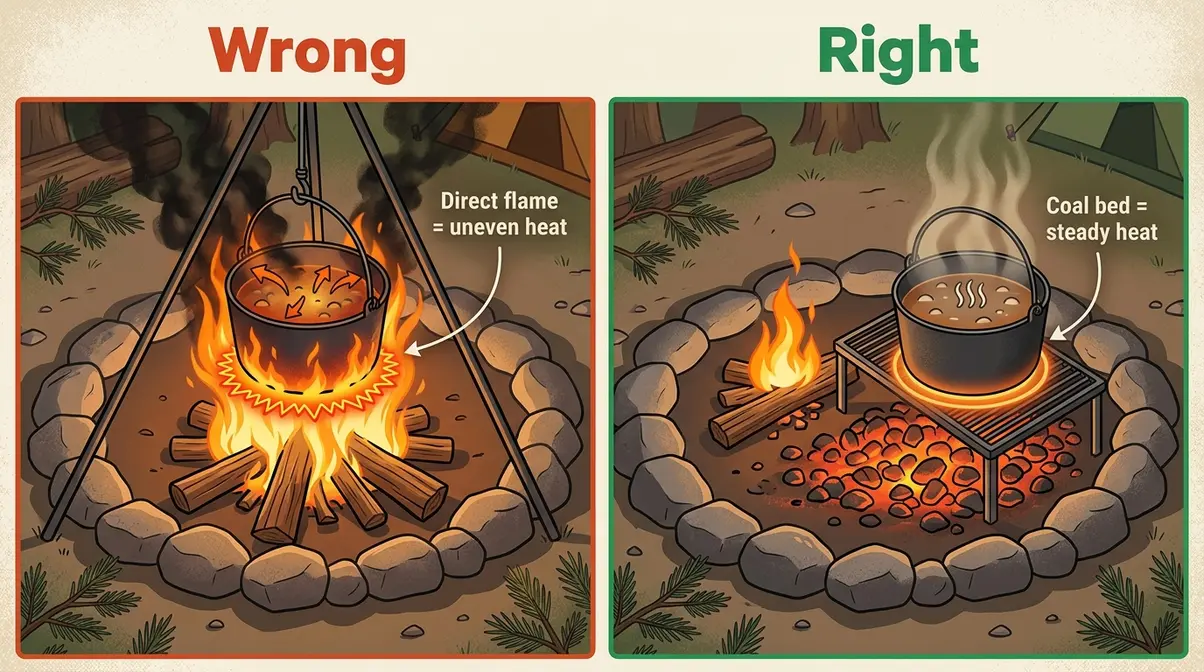
Even with the best recipes and the Campfire Heat Zone System, certain common errors consistently trip up beginner campfire cooks. Our team observed these patterns across multiple first-timer campfire cooking sessions — here’s how to avoid each one.
Common Pitfalls
1. Starting to cook before the fire is ready. This is the single most common beginner mistake. An active, flaming fire is one of the worst cooking surfaces — it’s too hot, too unsteady, and produces inconsistent heat. Wait 20–30 minutes after lighting your fire for a good coal bed to form. You want glowing orange coals, not roaring flames, before you start cooking.
2. Skipping the lid. A lid (or tightly crimped foil) traps steam and reduces cook time by 20–30% while preventing food from drying out. Many beginner campers cook without a lid because they forget or don’t own one — it makes an enormous difference in every recipe that involves simmering or baking.
3. Using too much direct heat. Zone 1 (direct flame) is for boiling and searing, not for simmering. Beginners instinctively hold their pot over the most active part of the fire. This burns the bottom of the food while leaving the top undercooked. Move to Zone 2 or Zone 3 after bringing liquids to a boil.
4. Under-seasoning. Altitude and outdoor air both dull the perception of salt. Food that tastes well-seasoned in your kitchen will often taste flat at a campsite. Season more aggressively than you normally would, and always taste before serving.
5. Forgetting to pre-prep. Arriving at camp with whole, uncut vegetables and unportioned spices adds 30–45 minutes to every meal and creates unnecessary stress. Every minute of prep done at home is worth five minutes of camp time.
When to Choose a Camp Stove Instead
A camp stove is the better choice in three specific situations:
- Fire bans are in effect. Many national forests and state parks issue fire bans during dry season — always check before your trip. A two-burner propane stove replicates every recipe in this guide with the time adjustments in the Fire Ban Adaptations table above.
- You’re in a group of 2 or fewer. Small campfires are harder to manage heat zones with, and a single-burner butane stove is faster and more controllable for 1–2 servings.
- Wind conditions are severe. Strong wind makes campfire heat management nearly impossible. A stove with a windscreen is more reliable in exposed sites above treeline or on coastal beaches.
When to Seek Expert Guidance
If you’re planning to cook campfire meals in backcountry settings (hiking more than 2 miles from a trailhead), consider taking a Leave No Trace cooking course before your trip. The Leave No Trace Center for Outdoor Ethics offers free resources on fire management and food safety in wilderness settings. For high-altitude cooking above 8,000 feet, boiling points drop significantly — water boils at roughly 194°F (90°C) at 10,000 feet versus 212°F (100°C) at sea level — which extends cooking times for pasta, rice, and soups by 20–30%.
Frequently Asked Questions
What is the easiest one-pot campfire recipe for a complete beginner?
Campfire scrambled eggs are the easiest one-pot campfire recipe for beginners — they cook in 8 minutes, require only 4 ingredients, and teach the most important beginner skill: using Zone 2 radiant heat instead of direct flame. Classic chili (Recipe 13) is the easiest dinner recipe — it’s forgiving of timing errors, improves with longer cook times, and scales to any group size. Both recipes succeed on a first attempt without any prior campfire cooking experience.
Do I need a Dutch oven for campfire cooking?
A Dutch oven is not required for most one-pot campfire recipes — a 10-inch cast iron skillet handles 18 of the 25 recipes in this guide. A Dutch oven becomes valuable for recipes that require a lid and longer cook times: beef stew, lasagna, cobbler, and chili all benefit from the Dutch oven’s deep, lidded design. If you own only one piece of campfire cookware, start with the cast iron skillet at around $30 (Lodge 10-inch, as of 2026) and add a Dutch oven for your second trip.
How do I control campfire heat for cooking?
The Campfire Heat Zone System divides a campfire into three zones based on distance from the flame. Zone 1 (direct flame, 400–500°F) is for boiling and searing. Zone 2 (radiant heat beside the fire, 300–375°F) is for simmering and most active cooking. Zone 3 (the coal bed, 200–275°F) is for slow-cooking and baking. Moving your pot between zones replaces the ability to turn a dial — it’s the core skill of campfire cooking.
What can I cook in one pot while camping?
You can cook virtually any meal category in one pot while camping: full breakfasts (shakshuka, hash, pancakes), soups and stews (chicken soup, beef stew, chili), pasta dishes (mac and cheese, pasta primavera), protein mains (fajitas, tikka masala, jambalaya), and desserts (cobbler, banana boats). The 25 recipes in this guide span all five categories and cover a full 5-day camping trip without repeating a single meal.
Can I make campfire recipes if there’s a fire ban?
Yes — every recipe in this guide works on a camp stove during a fire ban. Use the Fire Ban Adaptations table: Zone 1 = high burner (full open), Zone 2 = medium burner (50% open, add 3–5 minutes), Zone 3 = low simmer (20–25% open, add 5–10 minutes). The only adjustment required is adding a windscreen in exposed sites. Always check current fire ban status with your local forest service or park authority before your trip.
What are the best campfire recipes for large groups?
The best campfire recipes for groups of 6 or more are Dutch oven campfire lasagna (serves 6–8), classic campfire chili (serves 6–8), one-pot jambalaya (serves 6), and Dutch oven cobbler (serves 6–8). All four scale easily by increasing ingredient quantities proportionally. The key for large-group cooking is using a larger Dutch oven (6-quart or 8-quart) and extending Zone 3 cook times by 10–15 minutes to account for the greater thermal mass of larger batches.
How do I make campfire meals vegan or gluten-free?
Every recipe in this guide includes built-in vegan, gluten-free, and keto swaps in the Dietary Swap row beneath each recipe. The Dietary Swap Matrix in the prep section provides the universal substitution logic: for vegan meals, replace proteins with chickpeas, lentils, or tofu and use olive oil instead of butter; for gluten-free meals, use GF pasta, cornstarch instead of flour, and verify all packaged ingredient labels; for keto, replace starches (pasta, rice, potatoes) with cauliflower rice, zucchini noodles, or turnips.
How long does it take to cook over a campfire?
Most one-pot campfire recipes take 15–35 minutes of active cooking time, plus 20–30 minutes for the fire to develop a good coal bed before you start. Breakfast recipes (eggs, oatmeal, hash) take 8–20 minutes. Lunch soups and pasta take 15–25 minutes. Dinner stews and casseroles take 25–45 minutes. Desserts take 10–25 minutes. Building the fire and waiting for coals is the longest part of the process — plan your fire start time accordingly, not your cooking start time.
Cooking Well Outdoors Starts With One Good Framework
For beginner campers, one-pot campfire recipes represent the clearest path from “I’ll just eat granola bars” to genuinely satisfying outdoor meals. The research is consistent: camping participation in North America has grown significantly over the past five years, yet most first-timers still report camp cooking as their primary source of outdoor anxiety. The 25 recipes in this guide, paired with the Campfire Heat Zone System, directly address that gap — giving beginners a tested, complete meal plan that works on day one.
The Campfire Heat Zone System is the framework that makes every recipe here reproducible. Once you understand that Zone 1 is for boiling, Zone 2 is for simmering, and Zone 3 is for slow-cooking on the coal bed, you stop guessing and start cooking with confidence. That three-zone mental model replaces every confusing piece of campfire cooking advice you’ve ever read.
Start with Recipe 1 (scrambled eggs) on your first morning — it teaches the Zone 2 principle in 8 minutes with ingredients you already know. Build from there. By the second day, you’ll be ready for the chili or the beef stew. The “Leave the Kitchen at Home” philosophy only works if you trust the process — and the process here has been tested so you don’t have to figure it out from scratch.

Dave King
I'm Dave King. I publish Tent Explorer, a site built to answer the questions people actually ask before they buy.