Why Use a Camping Lantern: 5 Benefits Every Camper Needs
 David King
Updated July 8, 2026
14 min read
David King
Updated July 8, 2026
14 min read
You’re three hours into your first camping trip when you realize your phone flashlight illuminates exactly one thing at a time — and your campsite has about fifty things that need light simultaneously. The cutting board, the pot on the stove, the tent zipper, the trail to the bathroom, the card game your kids are demanding you play. One beam. Fifty problems.
That’s the moment most new campers understand why use a camping lantern matters. A headlamp solves your problem — but leaves everyone else in the dark, turns cooking into a neck-craning exercise, and does nothing for the trip hazards scattered around your site. Without the right light source, safety risks multiply and group activities fall apart before 9 p.m.
In this guide, you’ll discover exactly why a camping lantern is the one piece of gear that transforms a functional campsite into a genuinely comfortable one — and how to choose, use, and maintain it. We’ll cover its core benefits over flashlights, the real science behind bugs and light, and practical maintenance steps that keep your lantern running trip after trip.
Recommended Products
| # | Image | Product | Best For | Buy |
|---|---|---|---|---|
| 1 |  |
Coleman Classic Rechargeable Lantern | Versatile camping & emergencies | Buy on Amazon |
| 2 |  |
LuminAID Solar Inflatable Lantern | Eco-conscious backpackers | Buy on Amazon |
| 3 |  |
Glocusent 135 LED Ultra Bright | Long-duration group camping | Buy on Amazon |
| 4 |  |
Telescopic Rechargeable Camping Lantern | Warm ambient campsite use | Buy on Amazon |
| 5 |  |
Dual Lantern & Night Light | Multi-use tent & camp | Buy on Amazon |
| 6 |  |
Etekcity 4-Pack Battery Lanterns | Emergency preparedness kits | Buy on Amazon |
| 7 |  |
Lichamp LED Lantern 4-Pack | Budget family camping | Buy on Amazon |
| 8 |  |
MalloMe Collapsible LED Lantern | Lightweight budget pick | Buy on Amazon |
| 9 |  |
Consciot Waterproof LED 2-Pack | Waterproof hiking trips | Buy on Amazon |
| 10 |  |
XTAUTO Solar USB 4-Pack Lanterns | Solar off-grid camping | Buy on Amazon |
Understanding why use a camping lantern is simple: it provides 360° ambient light that no flashlight or headlamp can replicate — making it essential for cooking, group activities, and campsite safety. Research shows warm-toned LEDs attract significantly fewer insects than cool white lights (NIH PubMed, 2016).
- 360° flood lighting illuminates your entire campsite, not just one spot
- Hands-free design lets you cook, play cards, or navigate without holding anything
- The 360° Campsite Blueprint uses the 200-lumen rule to zone your camp lighting strategically
- Warm amber LEDs reduce bug attraction compared to bright white or blue-spectrum lights
- Fuel-powered lanterns require mantle maintenance and must NEVER be used inside a tent
Lanterns vs. Flashlights and Headlamps
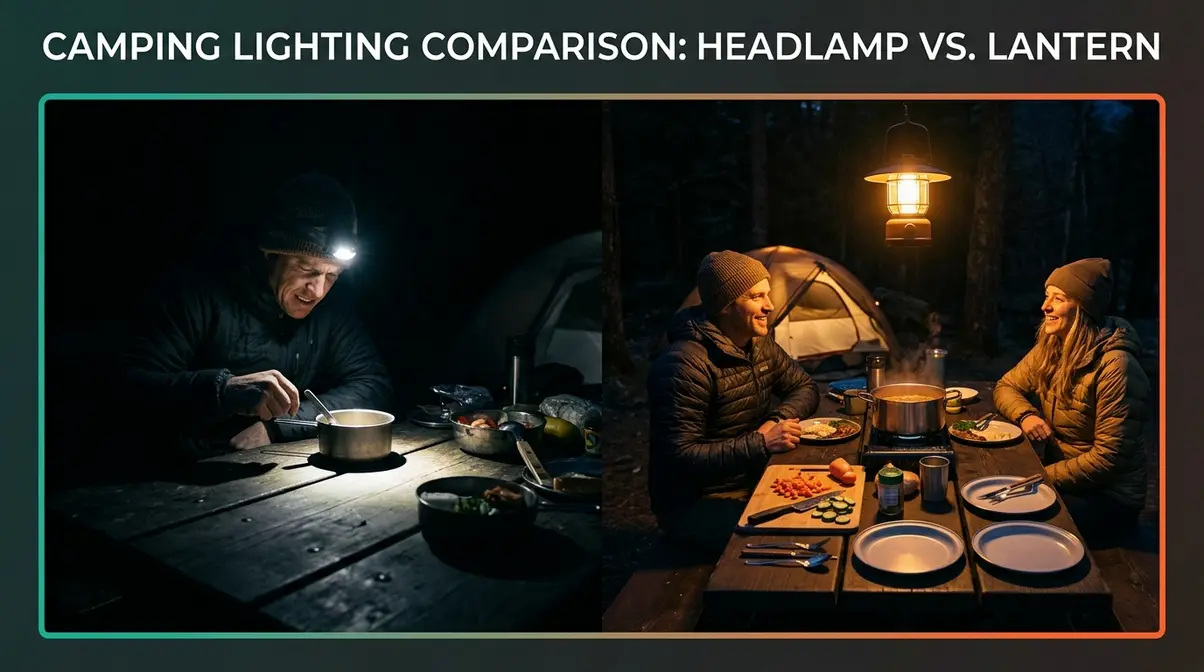
A camping lantern produces diffuse, omnidirectional light that illuminates an entire campsite — something no headlamp or flashlight can replicate. When people ask why use a camping lantern, the answer always comes back to this 360-degree coverage. A quality 200-lumen lantern floods a 10-to-12-foot radius with usable light, while a flashlight concentrates those same lumens into a narrow cone roughly two feet wide. That physical difference transforms how your campsite functions: instead of a series of lit spots you have to actively aim at, you get a genuinely comfortable, workable space. Understanding the benefits of camping lanterns starts with understanding exactly why that difference matters.
360-Degree Light vs. Directional Beams
To understand the comparison, two terms are worth defining up front. Lumens are the unit that measures total light output — how much light a bulb actually produces. Beam angle describes how wide that light spreads. A flashlight, which casts a narrow, directional cone of light, throws close to 100% of its lumens in a single direction. A lantern distributes those same lumens outward in all directions simultaneously.
Think of it this way: a flashlight is a spotlight on a stage — intense in one place, dark everywhere else. A lantern is the overhead light in a room — lower intensity in any single direction, but the whole space is usable.
This produces what gear experts call diffuse, omnidirectional light — light that wraps around objects instead of creating harsh shadows. When you hang a lantern above a camp table, every face at that table is visible. Every item on the cooking surface is lit. There’s no blind spot behind the pot. REI’s expert lantern guide confirms that lanterns designed for campsite use prioritize wide light distribution over throw distance — the opposite of what a flashlight or headlamp is built for (REI, 2023).
A headlamp, the popular strap-on light that directs a focused beam wherever you look, shares this directional limitation. It illuminates what you look at — but the moment you look away, everyone else is in the dark. That’s the single most persuasive argument for lantern ownership in a group setting: a headlamp solves one person’s problem; a lantern solves the whole group’s problem simultaneously.
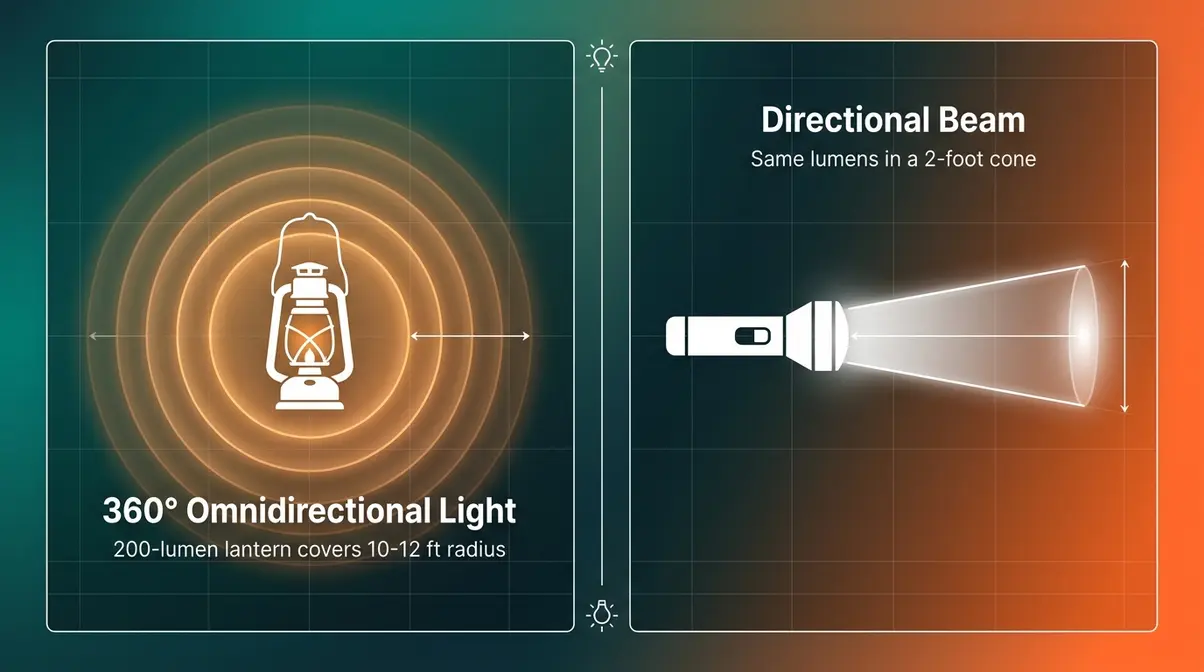
Knowing why the light is different is step one. Step two is seeing exactly when that difference changes your trip.
5 Scenarios Where Lanterns Win
Across camping communities, the consistent feedback is that the lantern’s superiority becomes obvious the moment a specific task requires more than one thing lit at a time. Here are five scenarios that answer the question “do you need a lantern for camping?” with hard evidence from real campsite use:
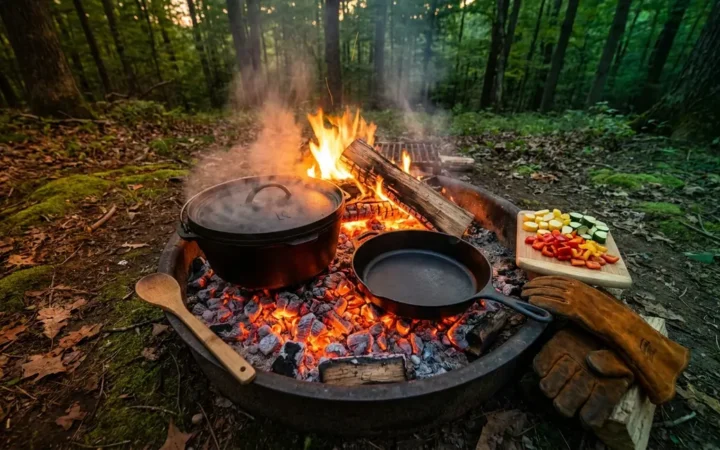
- Camp Kitchen (Cooking Prep): You’re chopping vegetables and managing two pots simultaneously. A headlamp forces you to look directly at whichever task you’re doing — the moment you glance at the pot, the cutting board disappears into shadow. A 200-300 lumen lantern hung at head height over the cooking area illuminates the entire kitchen setup at once. No neck craning. No missed cuts.
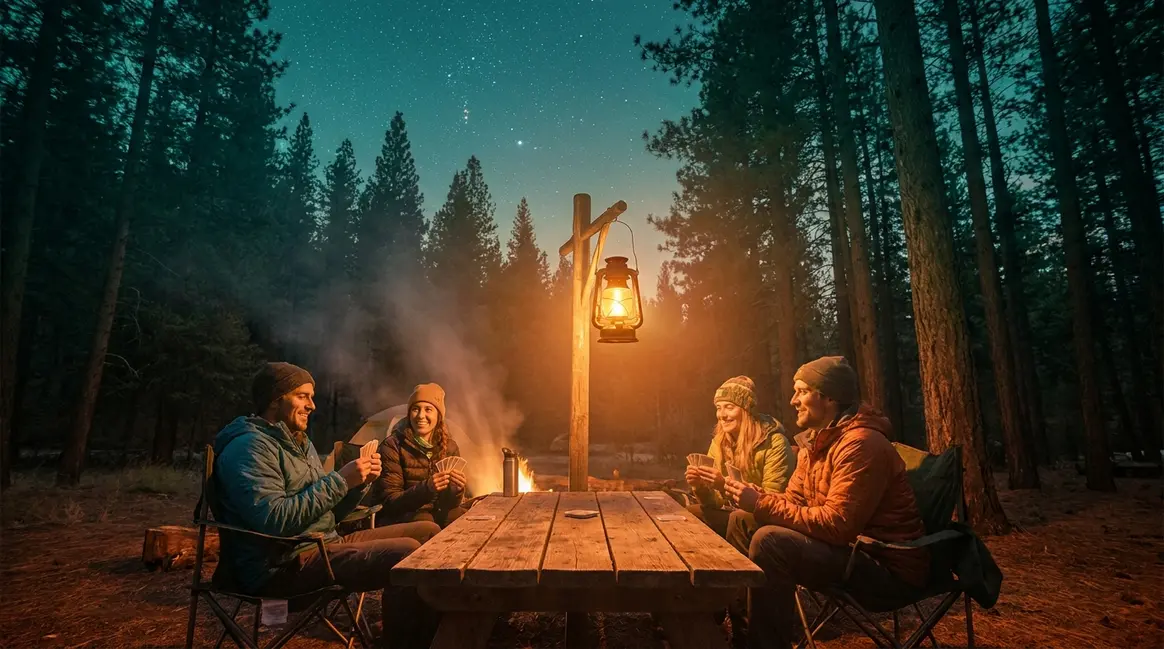
- Group Card Game or Board Game: Multiple players need to see the table simultaneously. A headlamp only lights what one person faces, creating an uneven experience where half the group squints. A lantern placed centrally illuminates a good deal of space, serving every player equally. Runtime matters here too — modern LED lanterns run 30-100+ hours on a single charge, so you won’t lose light mid-game.
- In-Tent Reading and Ambient Lighting: A lantern set on the floor or clipped to the tent loop fills the entire interior with soft, even light. A headlamp creates direct glare, disturbs tent-mates trying to sleep, and requires you to hold your head at an uncomfortable angle to read. A 50-100 lumen setting is ideal for tent interiors — bright enough to read, dim enough not to destroy everyone’s night vision. For a full comparison of in-tent lighting options, see our guide to the best camping lights for tents.
- Campsite Perimeter Safety: Tent stakes, exposed roots, and gear scattered around the site are genuine trip hazards in the dark. A centrally placed lantern with 200+ lumens can cover a 15-20 foot radius, passively illuminating perimeter hazards without anyone having to actively point a beam. A flashlight requires constant attention; a lantern just works.
- Emergency Signaling: Many modern LED lanterns — including the Glocusent 135 LED and the Telescopic Rechargeable Lantern in our product table — include SOS flash modes. A lantern’s 360° visibility makes it far more effective as a distress signal than a directional flashlight, which only signals in the direction it’s pointed. If you’re still asking whether you need a lantern for camping, these five scenarios answer that question definitively.
The 360° Campsite Blueprint
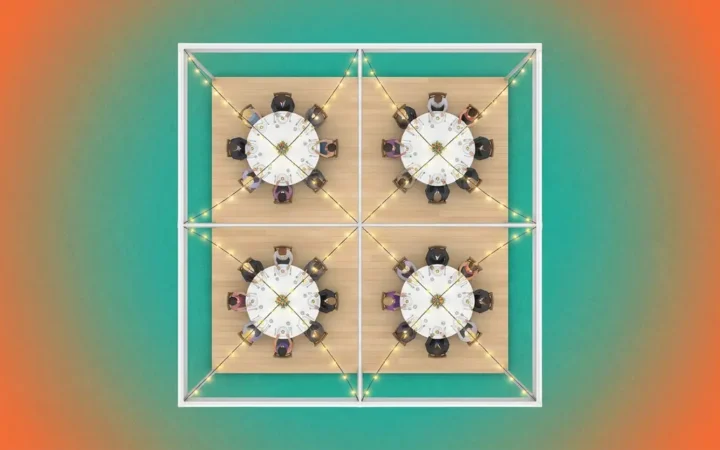
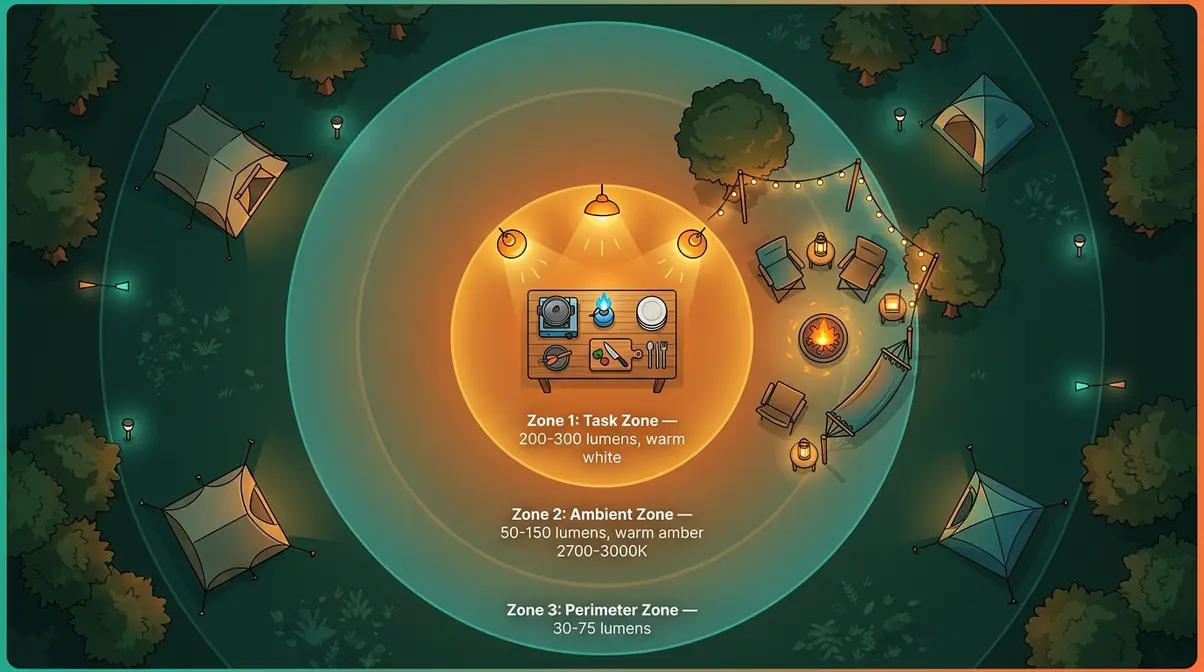
One of the most practical benefits of camping lanterns is how strategically you can deploy them across a campsite. The 360° Campsite Blueprint is a zone-based lighting framework that assigns specific lumen targets and light positions to three distinct areas of your campsite:
Zone 1 — Task Zone (cooking and eating area): 200-300 lumens, warm white or neutral color temperature. This is your highest-output zone. Hang the lantern at shoulder height (approximately 5 feet) for maximum coverage — at that height, a 200-lumen lantern covers roughly a 12-15 foot diameter circle.
Zone 2 — Ambient Zone (seating and social area): 50-150 lumens, warm amber (2700-3000K). Lower output keeps the atmosphere comfortable and, critically, reduces insect attraction — more on that in the next section.
Zone 3 — Perimeter Zone (tent entrances and pathways): 30-75 lumens, any color. Small, low-output lanterns or lanterns on their lowest setting work perfectly here. The goal is hazard visibility, not brightness.
A quick note on the “200 rule” you may have encountered in camping forums: that phrase most commonly refers to the National Park Service guidelines on the 200-foot rule — the Leave No Trace principle of camping at least 200 feet from water sources to protect waterways (NPS, 2023). The “200-lumen rule” in the Blueprint above is this article’s own coined framework for task zone lighting — a practical target, not an official standard. Both are worth knowing; they serve entirely different purposes.
“When you need to light up the entire campsite, you can’t beat the lumens put out by a gas lantern.”
That instinct is right — and the Blueprint gives you a system for putting those lumens exactly where they’ll do the most good. Of course, more light can mean more visitors of the six-legged variety, which is why the type of light you choose matters as much as the brightness.
Do Camping Lanterns Attract Bugs?
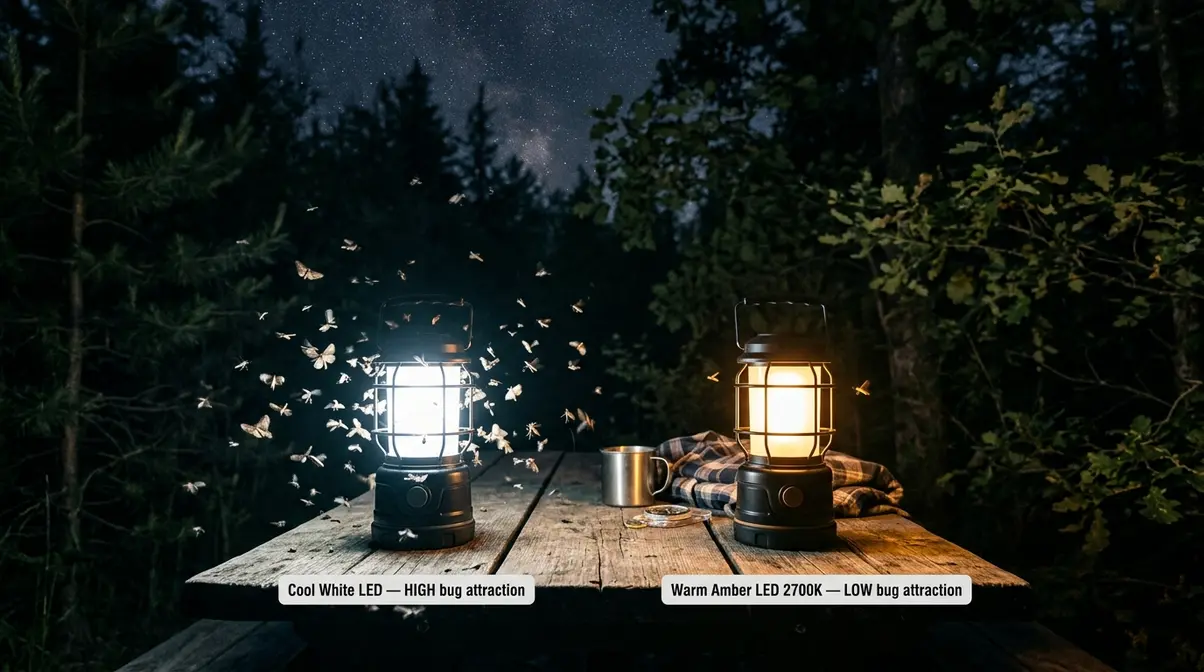
Many camping lanterns do attract insects — but the fuel type isn’t the reason. The light wavelength is. Research published in PLOS ONE found that artificial lights emitting UV and blue spectra attract significantly more nocturnal insects, while warm-colored LED lanterns reduce bug attraction considerably (NIH PubMed, 2016). The practical implication is straightforward: choosing a warm-toned LED lantern and positioning it strategically can dramatically reduce the number of insects sharing your evening.
Why Insects Are Drawn to Certain Lights
The mechanism behind this is called phototaxis — the biological instinct that drives insects toward light sources. Most nocturnal insects navigate using celestial light (the moon and stars), and artificial lights disrupt this orientation system, causing them to spiral toward the source.
What matters most is not brightness but wavelength. Insects are most sensitive to ultraviolet (UV) and blue-spectrum light in the 300-500 nanometer range. Nanometers are the unit used to measure light wavelength — lower numbers mean shorter wavelengths, which carry more energy and are more visible to insect eyes. Cool white LEDs and traditional gas lanterns with bright white mantles both emit significant amounts of blue-spectrum light, which is why they attract more insects.
Warm amber LEDs with a color temperature (a measure of how “warm” or “cool” a light appears, measured in Kelvin) of 2700-3000K emit far less blue and UV light — making them significantly less attractive to most nocturnal insects. Studies on how light spectrums attract insects confirm this wavelength preference is consistent across multiple insect species (NIH PubMed, 2016).
A propane lantern, a gas-powered light that burns fuel to produce a bright white mantle glow, does attract insects — but it’s the bright white light wavelength, not the propane fuel itself, that’s responsible. A propane lantern fitted with a warm-tinted globe attracts fewer bugs than a cool white LED at equivalent brightness.
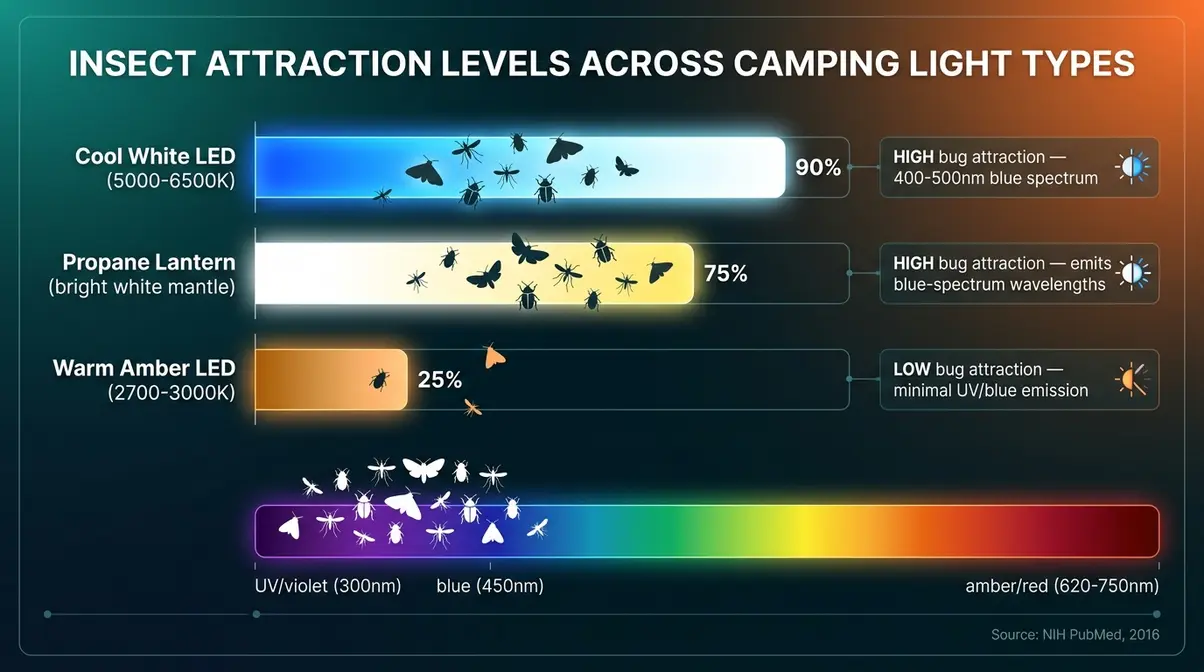
Insects are significantly more attracted to UV and blue-spectrum light than to warm amber LEDs — making lantern color temperature a critical choice for bug-free camping (NIH PubMed, 2016).
How to Minimize Bug Attraction
Now that you understand what attracts bugs, here are four specific steps to reduce insect congregation around your site:
- Choose a warm-toned LED lantern. Look for “2700K-3000K” on the product spec sheet — this is the color temperature range that produces warm amber light. The Telescopic Rechargeable Camping Lantern and the Glocusent 135 LED in our Recommended Products table both offer adjustable color temperature modes, letting you dial in warm amber when you want fewer bugs.
- Use the lowest brightness setting that’s still functional. Fewer photons emitted equals fewer insects attracted. The Ambient Zone in the 360° Campsite Blueprint (50-150 lumens, warm amber) is specifically designed with this principle in mind — comfortable light that doesn’t turn your seating area into an insect convention.
- Position the lantern away from your seating area. Place it 10-15 feet from where people are sitting. Insects will gather near the light source itself — not near you. This single placement change makes a noticeable difference on summer evenings.
- Use a red or amber mode after dark. Several modern LED lanterns include a red light mode, originally designed for night vision preservation. Red light falls at the far end of the visible spectrum (around 620-750 nanometers) and is nearly invisible to most insects. As a bonus, low-lumen warm lights also minimize disruption to nocturnal wildlife, aligning directly with Leave No Trace principles.
Do propane lanterns attract bugs?
Propane lanterns do attract insects, but the fuel type isn’t the cause — the light wavelength is. Propane mantles produce a bright white light that emits blue-spectrum wavelengths, which nocturnal insects are most sensitive to. Research confirms that UV and blue-spectrum light attracts significantly more insects than warm amber light (NIH PubMed, 2016). A propane lantern fitted with a warm-tinted globe, or positioned 10-15 feet from your seating area, will attract far fewer bugs than one placed directly at the camp table.
Can camping lamps attract bugs?
Yes, camping lamps can attract bugs — but the degree depends almost entirely on the light’s color temperature. Cool white LEDs and gas lanterns with bright white mantles emit blue-spectrum light (400-500 nanometers) that insects are highly sensitive to. Warm amber LEDs (2700-3000K) emit far less of this spectrum and attract significantly fewer insects (NIH PubMed, 2016). Positioning your lantern 10-15 feet from your seating area — regardless of color temperature — further reduces insect congregation near people.
Camping Lantern Maintenance Guide
A well-maintained camping lantern lasts for years. A neglected one fails on the second night of a five-night trip. If you are wondering why use a camping lantern despite the upkeep, the reliability of a well-maintained unit is unmatched. Whether you’re running an LED rechargeable, a classic gas-powered model, or comparing solar vs battery powered lanterns for camping, a small investment in routine care pays back enormously. OutdoorGearLab’s lantern testing methodology consistently finds that runtime, brightness consistency, and reliability over multiple trips are the top performance factors separating great lanterns from frustrating ones (OutdoorGearLab, 2024).
How to Pre-Burn a Lantern Mantle
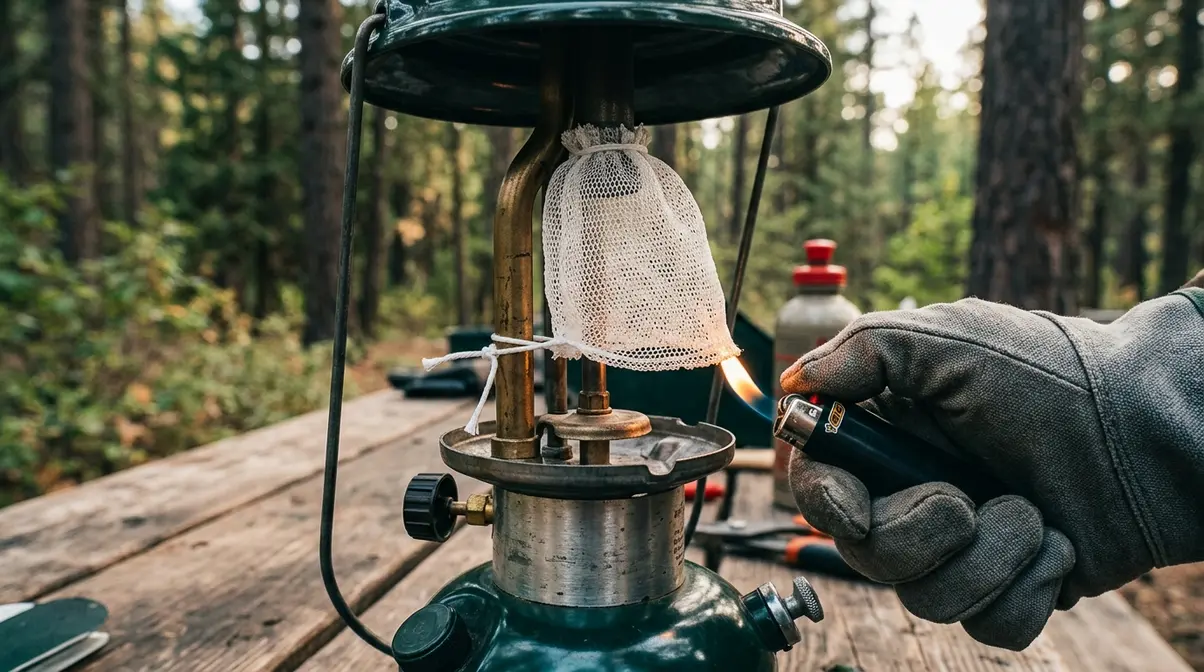
A mantle is the mesh sock that sits over the burner in a gas lantern and glows when heated — it’s what actually produces the light. New mantles must be “pre-burned” before their first use to convert the fabric into a fragile ash structure that glows efficiently. Skipping this step produces uneven, dim light and a mantle that falls apart quickly.
You’ll need: A new lantern mantle, the gas lantern (with fuel), a lighter or matches, and approximately 5 minutes.
Step 1: Tie the new mantle securely onto the burner tip. Ensure the drawstring or tie is snug — a loose mantle will fall during burning and is a fire hazard. Most mantles come pre-tied; verify the fit before proceeding.
Step 2: Move to a well-ventilated outdoor area away from flammable materials. Never pre-burn indoors.
Step 3: Light the mantle with a lighter or match while the gas is OFF. The fabric will catch and burn rapidly — this is normal and expected. Stand back slightly.
Step 4: Allow the mantle to burn completely until the entire fabric has converted to a white or grey ash structure. This takes approximately 60-90 seconds. Do not touch or disturb it during this process.
Step 5: Let the ash mantle cool completely — at least 3-5 minutes. The ash is extremely fragile; touching it at this stage will crumble it.
Step 6: Turn on the gas and light the lantern normally. The ash mantle will glow brightly when heated. It is now ready for regular use.
How long do mantles last? Under normal use, a single mantle typically lasts 50-100 hours of burn time, or several camping trips. Mantles degrade faster if the lantern is knocked, transported without a protective case, or if the flame is turned on and off repeatedly with rough handling. Keep 2-3 spare mantles in your kit.
Do you have to pre-burn mantles?
Yes — pre-burning a new mantle is a required step before first use, not optional. An unburned mantle is made of fabric that produces dim, uneven light and disintegrates quickly. Pre-burning converts the fabric into a fragile ash structure that glows efficiently and evenly when heated. The process takes about 5 minutes: tie the mantle securely, light it with the gas OFF, allow it to burn completely to ash, let it cool for 3-5 minutes, then light the lantern normally. Skipping this step is the most common reason new gas lantern users report poor light output.
Fixing Common Lantern Problems
Flickering light, dim output, and ignition failures are the three most common complaints across camping communities. Most have simple causes and fixes:
| Common Problem | Likely Cause | Fix |
|---|---|---|
| Flame flickers or goes out | Low fuel pressure or clogged generator | Check fuel level; replace or clean the generator tube |
| Dim light despite full fuel | Old or damaged mantle | Replace the mantle (pre-burn the new one first) |
| Igniter clicks but won’t light | Faulty igniter or wet striker | Use a lighter directly on the mantle; dry the igniter overnight |
| Hissing sound without ignition | Gas leaking past the valve | Close valve fully, check o-ring seal; replace if cracked |
| Uneven or patchy glow | Mantle damaged in transport | Replace mantle; store lantern in a padded case |
| LED lantern dims rapidly | Low battery or failing cell | Recharge fully; replace batteries if runtime is <50% of rated |
| LED lantern won’t turn on | Corroded battery contacts | Clean contacts with a dry cloth or pencil eraser |
Common Coleman Lantern Problems
The most common Coleman lantern problems are dim output, ignition failure, and flame flickering — all of which have straightforward fixes. Dim output usually means a worn mantle or low fuel; replace the mantle and verify fuel pressure. Ignition failure is typically a faulty piezo igniter or wet striker — use a lighter directly on the mantle as a backup. Flickering flames often indicate a clogged generator tube, which is the brass vaporizing component inside the lantern. Coleman replacement generators are widely available and take about 10 minutes to swap. Carrying spare mantles and a backup lighter eliminates most field failures.
Essential Lantern Safety Rules
This is the section where we have to be direct, because the consequences of getting it wrong are serious.
Fuel-powered lanterns — including propane, white gas, and kerosene models — must NEVER be used inside a tent, camper van, or any enclosed space. The reason is carbon monoxide (CO), an odorless, colorless gas produced by fuel combustion. CO displaces oxygen and can cause unconsciousness and death within minutes in a confined space. The U.S. Consumer Product Safety Commission (CPSC) reports that hundreds of campers are treated for CO poisoning annually from improper use of fuel-burning equipment in enclosed spaces (CPSC, 2023).
Additional safety rules for fuel-powered lanterns:
- Always use outdoors or in a fully open shelter — a screen tent with all panels open is borderline; a closed tent is never acceptable.
- Keep away from flammable materials — maintain at least 12 inches of clearance from tent fabric, sleeping bags, and clothing.
- Never leave a gas lantern unattended while burning.
- Transport with fuel disconnected — propane canisters should be removed before packing in a vehicle.
- Check mantles before each use — a cracked or crumbled mantle can cause uneven burning and flame irregularities.
LED lanterns carry none of these risks and are the only safe choice for use inside a tent. If you want light in your sleeping space, use an LED lantern on a low setting — not a gas model, under any circumstances.
When a Lantern Isn’t the Right Tool
A camping lantern is essential for group campsites and car camping — but it isn’t always the right choice. Even if you know exactly why use a camping lantern for group settings, it isn’t always the right choice. Understanding when to leave it home makes you a more efficient packer and a smarter camper.
When a Headlamp Serves You Better
Solo backpacking on technical trails is the clearest case. A headlamp weighs 2-4 ounces versus a lantern’s 8-24 ounces, and when you’re navigating switchbacks or scrambling terrain after dark, directional light exactly where you’re looking is more valuable than ambient coverage. Most ultralight backpackers carry a headlamp only and accept the trade-off.
Nighttime bathroom trips are another headlamp win. Walking 200 feet from camp to a cathole site in the dark is a task-specific, directional need — the lantern stays at camp.
When a Flashlight Serves You Better
A high-powered flashlight with long throw distance (150+ meters) is the right tool for scanning a dark trailhead, checking for wildlife at the perimeter of camp, or signaling across large distances. Lanterns sacrifice throw distance for coverage — that’s the deliberate trade-off.
The Balanced Recommendation
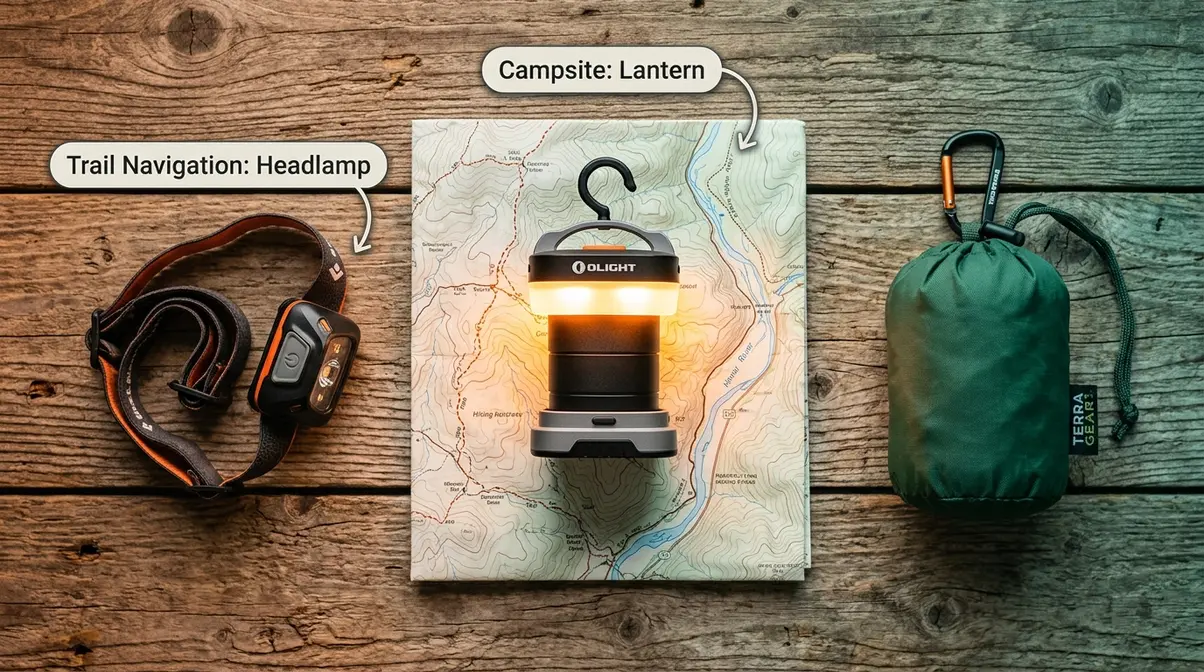
Across camping communities, the consistent advice is to carry both: a lantern for campsite use and a headlamp for personal navigation. They solve different problems. If weight is a hard constraint — say, a 25-pound pack limit for a multi-day trip — a compact collapsible lantern like the MalloMe Collapsible LED Lantern adds minimal weight while still covering group lighting needs. Backcountry’s lantern buying guide recommends this dual-tool approach for any trip involving more than one person (Backcountry, 2023).
Frequently Asked Questions
Do you need a lantern for camping?
You don’t technically need a lantern for camping, but you’ll notice its absence the moment campsite activities require more than one person to see at once. A headlamp solves individual lighting — cooking, reading, navigating — but leaves everyone else in the dark. For group camping, family trips, or any campsite where cooking and socializing happen after sunset, a lantern is the single piece of gear that makes the whole site functional rather than frustrating. Solo backpackers on weight-strict trips can reasonably skip it; everyone else benefits significantly.
How long do mantles last in lanterns?
Lantern mantles typically last 50-100 hours of burn time under normal use, which translates to several camping trips for most users. Mantles degrade faster when the lantern is knocked or transported without protection — the ash structure is fragile. Rough handling, repeated ignition cycles, and high-output burning all reduce lifespan. Carry 2-3 spare mantles on any trip longer than a weekend. A mantle that produces patchy, uneven light is past its useful life and should be replaced before your next outing.
What are the benefits of using lanterns?
The core benefits of using a camping lantern are 360° ambient coverage, hands-free operation, and group utility. Unlike a flashlight, a lantern distributes light in all directions simultaneously, making an entire campsite usable rather than a series of aimed spots. Modern LED lanterns run 30-100+ hours per charge, require no fuel management, and offer adjustable brightness from a dim 10-lumen nightlight to a bright 300-400 lumen task light. Many models include SOS flash modes, USB charging ports, and collapsible designs that pack flat — making them genuinely multi-purpose gear.
What is the 200 rule for camping?
The “200 rule” in camping most commonly refers to the Leave No Trace principle of camping at least 200 feet from water sources, trails, and other campsites to protect ecosystems and water quality. This is an official National Park Service guideline (NPS, 2023). It is distinct from the “200-lumen rule” introduced in this article’s 360° Campsite Blueprint, which is a practical framework for task zone lighting intensity — not an official standard. Both are worth knowing; one protects the environment, the other optimizes your campsite lighting.
The Lantern That Changes Your Campsite
A camping lantern isn’t a luxury add-on for seasoned campers — it’s the piece of gear that determines whether your campsite is genuinely livable after dark. The 360° Campsite Blueprint puts that light to work systematically: 200-300 lumens for the task zone, warm amber at 50-150 lumens for the social area, and low-output perimeter lights to eliminate trip hazards. That framework, combined with warm-toned LED selection to reduce insect attraction, covers every practical lighting challenge a campsite presents. Research confirms that warm amber LEDs attract significantly fewer nocturnal insects than cool white or gas lanterns — a meaningful quality-of-life difference on any summer trip (NIH PubMed, 2016).
The 360° Campsite Blueprint works because it treats your campsite like a room — with task lighting where work happens, ambient lighting where people gather, and safety lighting at the edges. That’s the shift from “I have a light” to “my campsite works.”
Start with one lantern in the 150-300 lumen range with adjustable color temperature — the products in the Recommended Products table above cover every budget and use case. Try the Blueprint on your next trip, position the lantern at shoulder height over the cooking area, and drop it to warm amber mode when the meal is done. You’ll understand within the first evening why every experienced camper considers this the one piece of gear they’d never leave behind.

David King
Field gear tester at Tent Explorer.