 David King
You’ve finally booked your first camping trip. Now comes the question almost every beginner asks: why do you need a tent for camping, or can you get away with something simpler — a tarp, a hammock, or just sleeping under the stars?
Here’s the uncomfortable truth: skipping the tent is one of the most common mistakes new campers make. Imagine waking up at 2 a.m. to thunder cracking overhead, rain hammering the ground, and nothing between you and the storm but a thin sheet of plastic. Or picture settling in for the night, only to realize that every mosquito within a half-mile has found you. These aren’t edge cases — they’re exactly what campers without tents experience, often on their very first trip.
By the end of this guide, you’ll know exactly why a tent is your most important piece of camping gear — and how to use it correctly from day one. You’ll learn the core benefits, how to set up your tent properly (including whether you need a tarp underneath), the rules every beginner should know, and the essential gear you shouldn’t leave home without.
If you are wondering why do you need a tent for camping, the answer is simple: it provides physical shelter, keeps insects and wildlife out, and creates the enclosed environment your brain needs for quality sleep outdoors — the Shelter-Safety-Sleep Triangle.
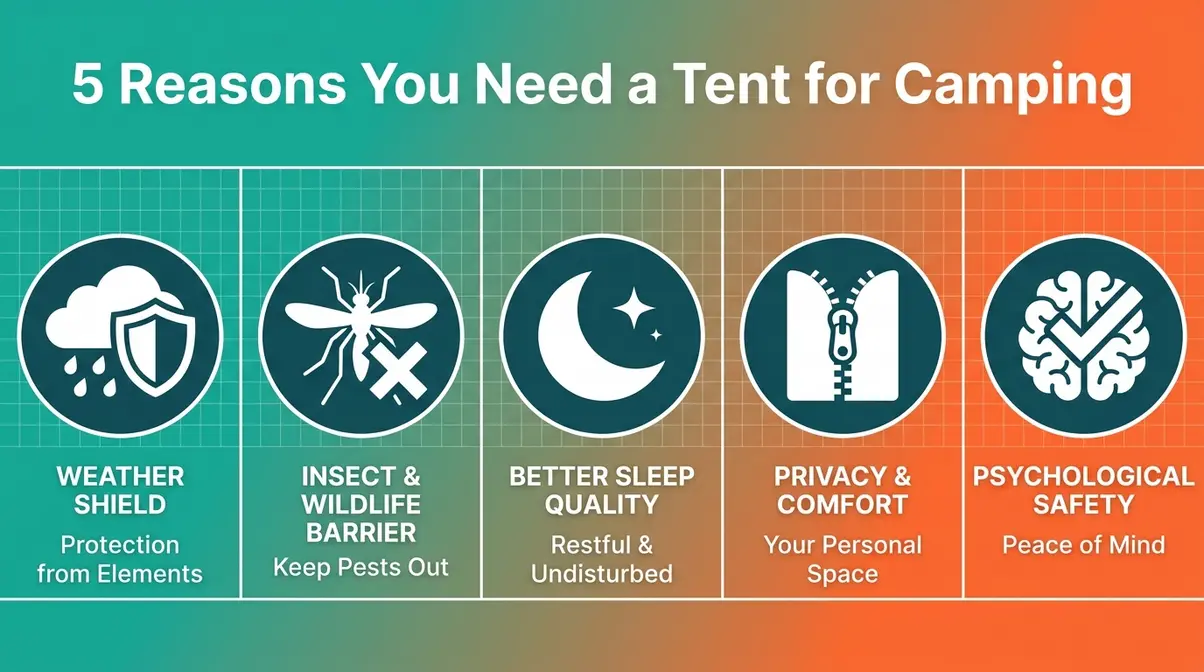
- Weather protection: A tent shields you from rain, wind, and sun when conditions change unexpectedly.
- Wildlife and insect barrier: Mesh walls and a sealed floor prevent mosquitoes, ticks, and curious animals from reaching you.
- Better sleep: Research shows that sleeping outdoors in a natural light environment — as a tent encourages — can help reset your circadian rhythm (your body’s internal sleep clock), with artificial light reduction playing a key role (PubMed, 2017).
- The Shelter-Safety-Sleep Triangle: A tent is the only gear item that addresses all three needs simultaneously — making it non-negotiable for beginners.
Why You Need a Tent for Camping
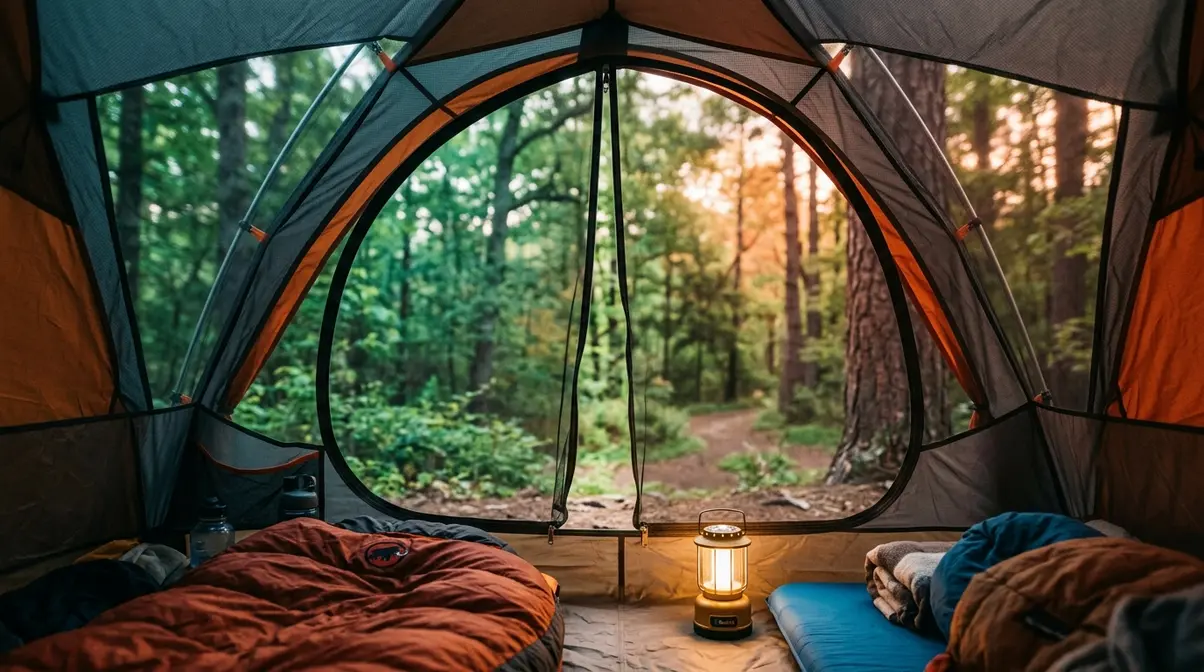
A camping tent is the only piece of gear that simultaneously protects you from weather, wildlife, and poor sleep — making it non-negotiable for every beginner camper. A camping tent (a portable, weatherproof shelter designed for outdoor sleeping) does far more than keep rain off your head. It creates a sealed, private, climate-buffered space that nothing else on the market fully replicates for beginners.
Core Benefits: Shelter, Safety, Privacy
Every beginner camper faces the same core fears: getting wet, getting bitten, and feeling exposed. A tent addresses all three directly.
Weather protection is the most obvious benefit. Even on a clear-sky forecast, temperatures can drop 20–30°F overnight in many regions — a phenomenon the US Forest Service flags as a leading cause of hypothermia in inexperienced campers. A tent’s rainfly (the waterproof outer layer) keeps moisture out, while the tent walls trap body heat and block wind. In a surprise rainstorm scenario — say, a fast-moving thunderstorm at 11 p.m. — campers in tents stay dry and warm. Campers under tarps manage, but those with no shelter at all consistently report dangerous chills and sleepless nights.
Safety from wildlife and insects is the benefit beginners underestimate most. A tent’s mesh inner walls (fine-woven screens that allow airflow but block insects) stop mosquitoes, ticks, and biting flies from reaching you while you sleep. A sealed tent floor — called a bathtub floor because it curves up the sides — prevents ground-level insects and small animals from crawling in. In campgrounds with active raccoon or bear activity, a zipped tent also removes you as an obvious, accessible target. It won’t stop a determined bear, but it significantly reduces casual investigation.
Privacy and comfort matter more than most beginners expect. Changing clothes, storing valuables, and having a defined personal space all become easier inside a tent. Experienced campers consistently report that even a simple two-person tent transforms a campsite from a bivouac (a rough temporary camp) into something that actually feels like home for the night.
Ready to choose your first tent? See our essential tent camping tips for beginners for a step-by-step setup guide.
Psychological Safe Zone for Beginners
This is the benefit no competitor article talks about — and it may be the most important one for first-timers. When beginners ask why do you need a tent for camping, they often overlook this crucial psychological aspect.
Your brain processes “safety” partly through environmental cues. An open sleeping bag on a forest floor sends your nervous system a very different signal than a zipped, enclosed tent. Research published in PNAS (PubMed, 2017) found that sleeping in natural outdoor light conditions — away from artificial light sources — can meaningfully reset circadian rhythms (your body’s internal 24-hour sleep-wake clock). A tent contributes to this by creating a dim, enclosed space that mimics the darkness your brain associates with deep sleep.
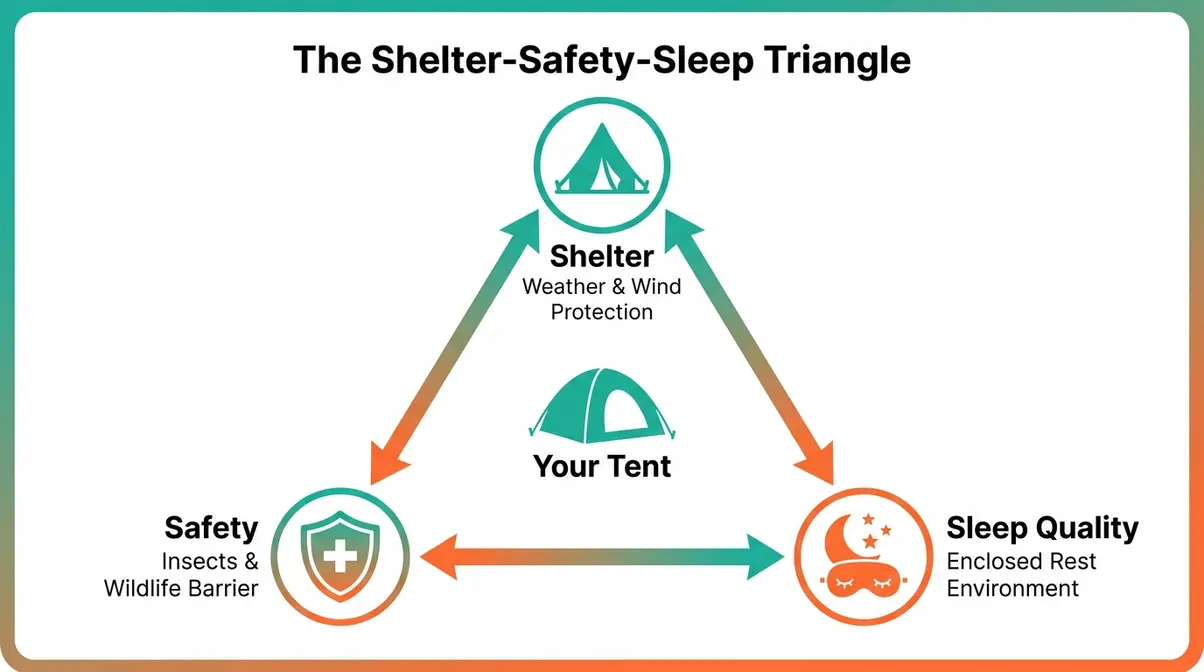
Beyond the science, there’s a practical reality: beginners who sleep in tents on their first night report feeling significantly more rested and less anxious than those who attempt open-air sleeping. The Shelter-Safety-Sleep Triangle captures this perfectly — physical shelter, environmental safety, and sleep quality are not three separate benefits. They are one interconnected system. Remove any corner of the triangle and the whole structure weakens.
Think of it this way: your tent is less a piece of fabric and more a portable bedroom. Your brain knows the difference.
Can I go camping without a tent?
Some experienced campers do sleep without tents, leading many to ask: can I go camping without a tent? Here’s an honest look at the alternatives — and why none of them are right for beginners.
| Shelter Option | Weather Protection | Insect Barrier | Privacy | Sleep Quality | Skill Required |
|---|---|---|---|---|---|
| Camping Tent | ✅ Full | ✅ Full (mesh + floor) | ✅ Full | ✅ Best | Low |
| Tarp | ⚠️ Partial (no sides) | ❌ None | ❌ None | ⚠️ Fair | High |
| Hammock | ⚠️ Partial (with rain fly) | ⚠️ Partial (with bug net) | ❌ None | ⚠️ Fair | Moderate |
| Bivy Sack | ✅ Good | ⚠️ Limited | ❌ None | ⚠️ Fair (claustrophobic) | Low–Moderate |
A tarp (a flat waterproof sheet used as a minimalist shelter) requires knot-tying skills and correct rigging to stay up in wind — skills most beginners don’t have yet. A hammock needs two trees the right distance apart and a separate bug net. A bivy sack (a lightweight waterproof sleeve that wraps around your sleeping bag) offers no sitting space, no gear storage, and can feel suffocating.
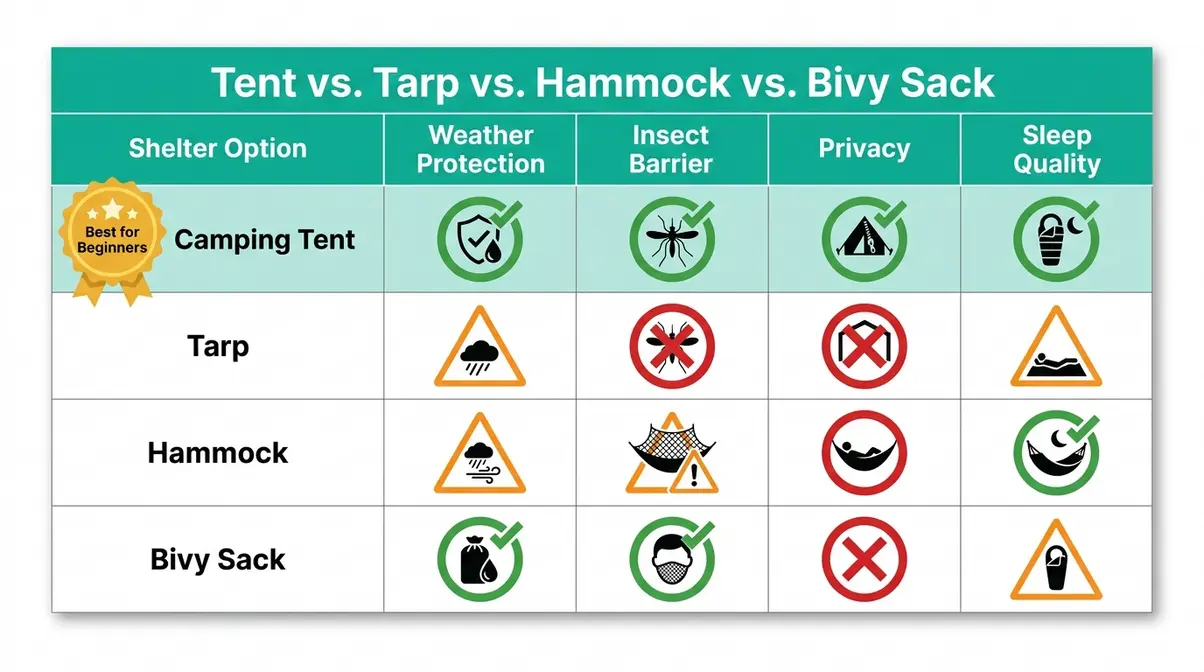
According to the National Park Service, beginner campers benefit most from gear that reduces decision-making and physical skill requirements so they can focus on enjoying the experience. A tent is the only shelter option that checks every box without demanding advanced outdoor skills.
Tent Setup: Tarps, Stakes, and Terrain
“Tarp or no tarp under tent? Please help. I have very little experience in camping. Thank you!”
This question — posted by a real beginner on a camping forum — gets asked constantly. You’re not alone in weighing the benefits of each layer of your outdoor shelter setup. Let’s break it down clearly.
Why You Put a Tarp Under Your Tent
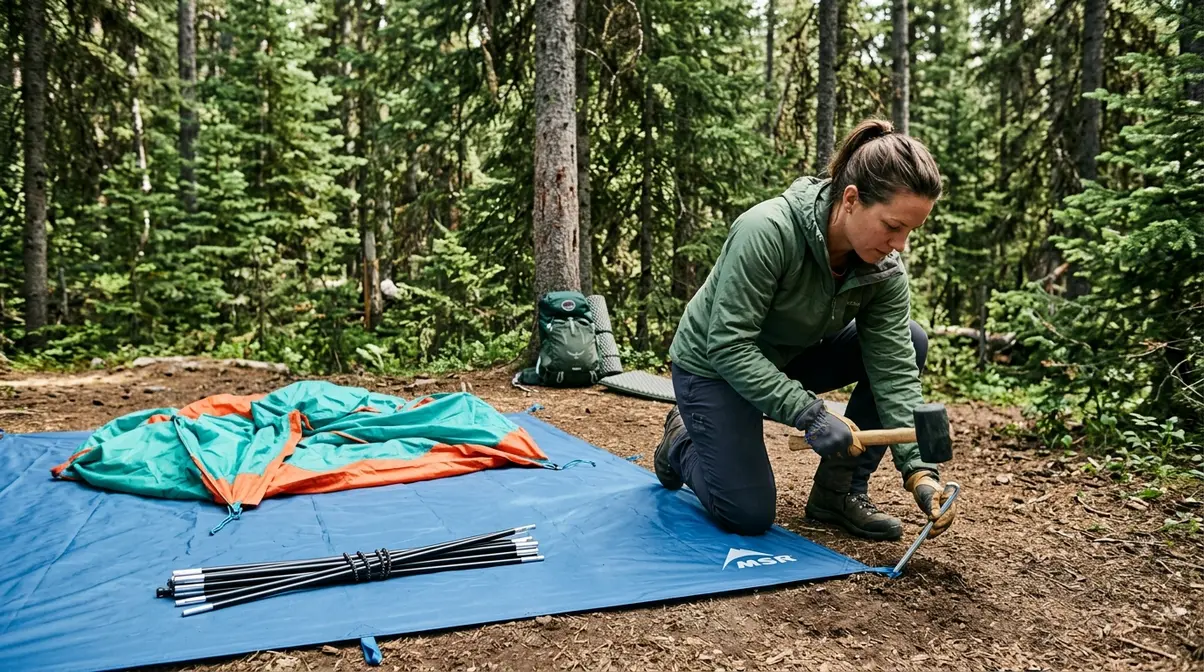
A tarp under your tent is called a footprint (a ground cloth cut to match your tent’s floor dimensions). It serves two purposes that beginners often don’t discover until after their first trip — when they flip their tent over and find a wet, muddy, or punctured floor.
First, it protects your tent floor from abrasion. Rocks, roots, and rough ground gradually wear through even durable tent floors. A footprint takes that damage instead, extending your tent’s life by years.
Second, it adds a moisture barrier. Even waterproof tent floors can allow ground moisture to seep through on wet nights. A footprint blocks that path. For more detail on choosing the right footprint, see our guide on tent footprints and tarps.
- The setup is simple:
- Clear your tent site of sharp rocks and sticks.
- Lay the footprint flat — it should be slightly smaller than your tent floor (if it’s larger, fold the edges under so rainwater doesn’t pool between footprint and tent).
- Pitch your tent on top of the footprint as normal.
REI’s family camping tent guide recommends always using a footprint for base camp setups, especially in wet or rocky conditions.
Why Tent Stakes Matter for Safety
Stakes (the metal or plastic pegs that anchor your tent to the ground) are the part of tent setup most beginners skip — and then regret. A tent without stakes is a kite waiting to happen.
In moderate wind, an unstaked tent can shift, collapse, or blow away entirely. In a storm, it becomes a genuine safety hazard. Experienced campers consistently report that proper staking is the single setup step that separates a comfortable night from a miserable one.
- Here’s the basic staking process:
- Stake your tent’s corners first, pulling each corner taut before driving the stake at a 45-degree angle away from the tent.
- Add mid-wall stakes next, keeping the tent fabric taut between corners.
- Stake out your rainfly’s guylines (the cords attached to the fly) at 45-degree angles away from the tent.
For a deeper look at stake types and techniques, our tent stakes guide covers every terrain scenario in detail.
Staking in Sand and Soft Ground
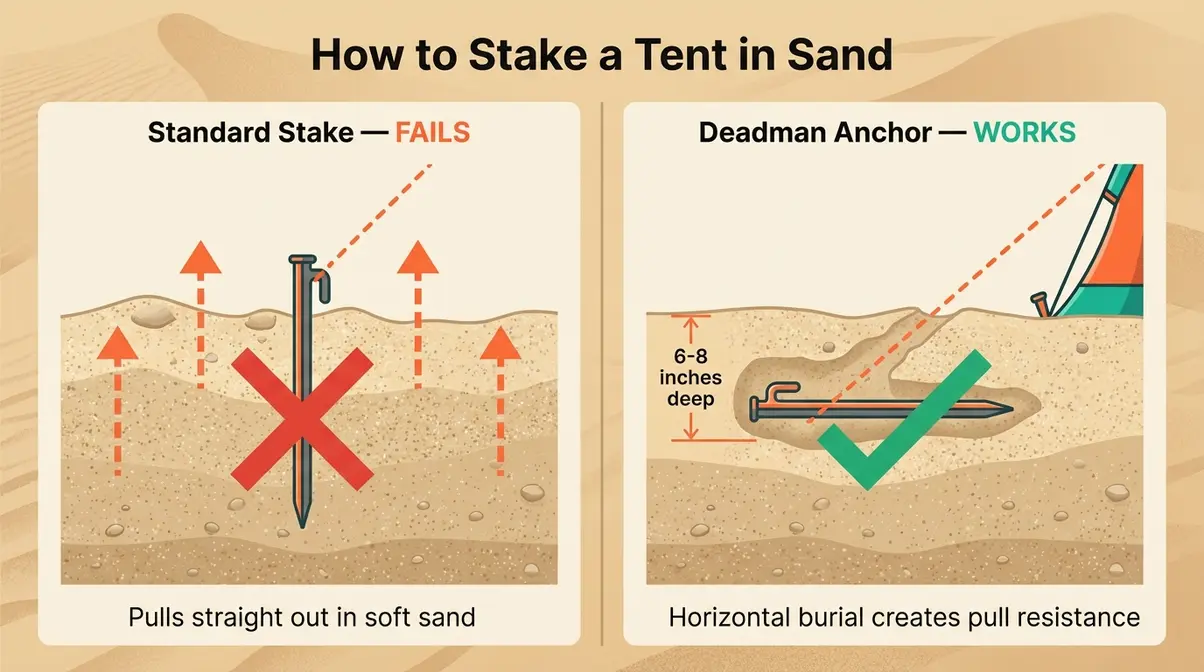
Standard stakes don’t hold in soft sand — they pull straight out. If you’re camping on a beach or in a desert, you need a different approach.
The Bureau of Land Management (BLM) recommends deadman anchoring for soft-ground camping: bury a stake horizontally (parallel to the ground surface) about 6–8 inches deep, then attach your guyline to it. The horizontal stake creates resistance against being pulled upward, which vertical stakes can’t provide in loose soil.
Sand-specific stakes — wider, flatter, and designed to maximize surface area — are also available at most outdoor retailers. In a pinch, a stuff sack (a small bag used to compress sleeping bags or clothing) filled with sand and buried works as an improvised anchor.
Camping Activities, Rules, and Frameworks
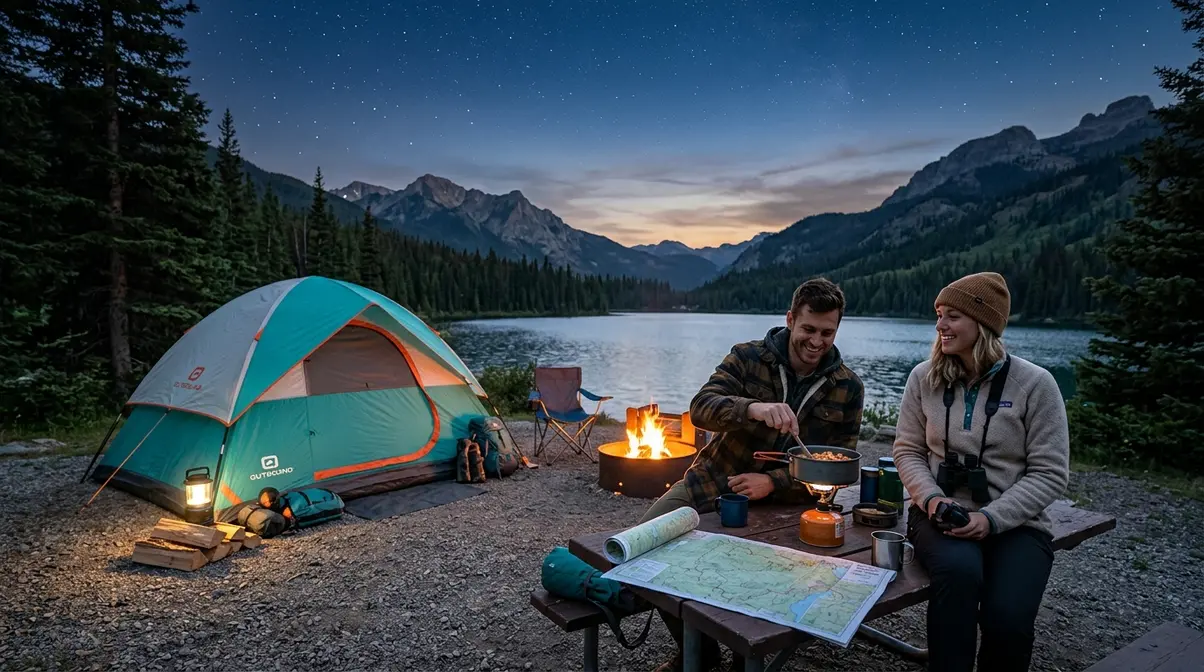
Knowing why you need a tent is the first step. Knowing how to camp well once you’re there is the second. This section covers the rules, frameworks, and activities that make your first trip safe, enjoyable, and Leave No Trace (LNT) compliant — meaning you leave the campsite in the same condition you found it.
Fun Camping Activities for Beginners
A camping trip without a plan can feel surprisingly long. Here are activities that work well for beginners with little experience:
- Nature walks and easy hiking: Start with marked trails under 3 miles. Bring water, a trail map, and tell someone your route.
- Stargazing: Campgrounds away from city lights offer views most people never see. A free stargazing app (like SkySafari or Star Walk) turns an open sky into a guided tour.
- Camp cooking: Learning to cook a simple meal over a camp stove — scrambled eggs, pasta, or a foil packet dinner — is one of camping’s most satisfying experiences.
- Wildlife observation: Binoculars and a field guide turn any campsite into a birdwatching station. Keep a respectful distance from all animals.
- Campfire stories and card games: Evenings around a fire are the social heart of any camping trip. Pack a waterproof deck of cards or plan some fun camping activities and games as backup entertainment.
According to the National Park Service, structured activities during the day significantly improve first-time campers’ overall satisfaction and reduce anxiety about nighttime camping.
What is the 3-3-3 rule when camping?
If you are wondering what is the 3-3-3 rule when camping, it is a simple framework experienced campers use to keep trips safe and manageable. It works like this:
- Drive no more than 3 hours to your campsite per day.
- Arrive by 3 p.m. so you have daylight to set up your tent, find your bearings, and locate water and restrooms.
- Stay for at least 3 nights to give yourself time to actually relax and settle in.
Why does this matter? Arriving after dark is one of the most common beginner mistakes. Setting up a tent by headlamp, on unfamiliar ground, in a campground you’ve never seen is stressful and leads to errors — a tent pitched on a slope, stakes missed, a rainfly attached backwards. The 3-3-3 Rule eliminates that scenario entirely.
For solo campers or families with young children, this framework is especially valuable: it builds in buffer time for the unexpected without overcomplicating your planning.
The 200-Foot Rule: Leave No Trace
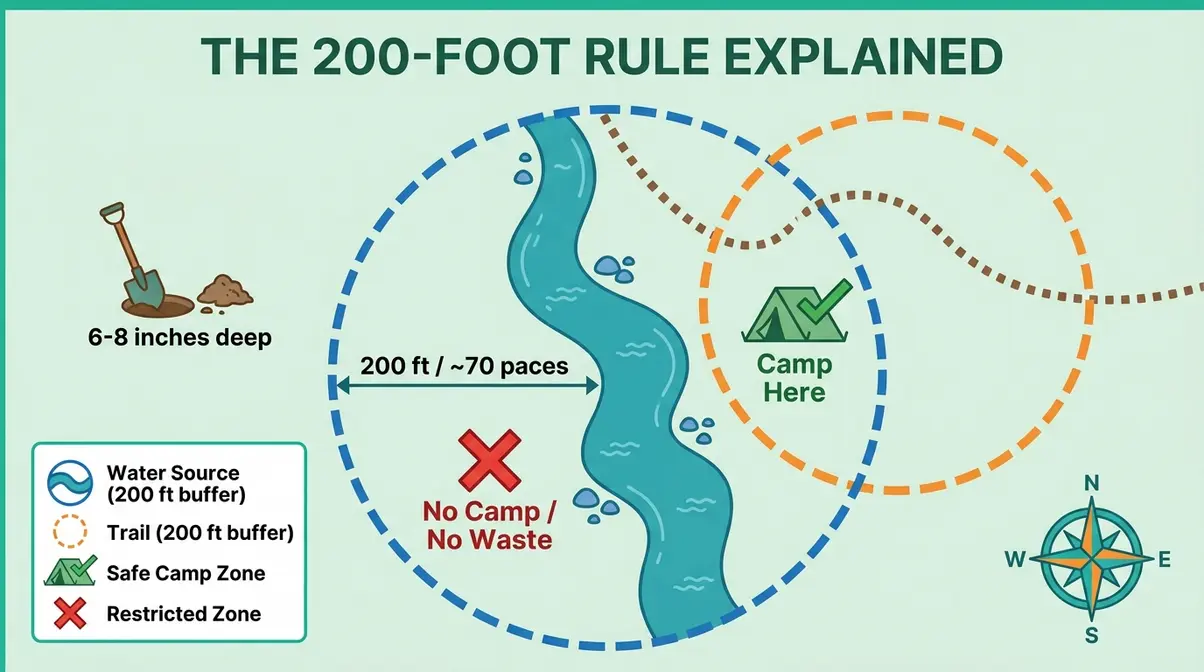
The 200-foot rule (approximately 70 adult paces) is one of the core Leave No Trace principles governing where you set up camp, where you go to the bathroom, and where you dispose of waste. Specifically:
- Camp at least 200 feet from lakes, rivers, and streams to protect water sources from contamination and erosion.
- Dig catholes (small holes for human waste) at least 200 feet from water, trails, and camp — and bury waste 6–8 inches deep.
- Pack out all trash — Leave No Trace guidelines state that “if you pack it in, pack it out.”
Leave No Trace guidelines are maintained by the Leave No Trace Center for Outdoor Ethics and are endorsed by the US Forest Service and National Park Service. Following them isn’t just good etiquette — it’s often required by campground permit conditions.
The 7 C’s of Camping Checklist
The 7 C’s of Camping is a survival-oriented checklist used by outdoor educators to ensure beginners don’t leave critical items behind. Each “C” represents a category of essential gear:
| C | Category | Example Items |
|---|---|---|
| Cutting | Blade tools | Knife, multi-tool |
| Combustion | Fire-starting | Lighter, waterproof matches |
| Cover | Shelter | Tent, emergency bivy, rain gear |
| Container | Water storage | Water bottle, filtration system |
| Cordage | Rope/line | Paracord, guylines |
| Cotton | First aid/cloth | Bandanas, gauze, bandages |
| Compass | Navigation | Compass, trail map, GPS |
For beginners, the most commonly forgotten C is Combustion — people assume their phone lighter app or a single match will be enough. It won’t be in wet conditions. Carry at least two fire-starting methods on every trip.
Essential Camping Gear Not to Forget
Even experienced campers occasionally leave critical items at home. For beginners weighing the benefits of what to pack, a structured checklist makes all the difference.
The Most Forgotten Camping Items
Based on community reports from camping forums and gear retailers, the most commonly forgotten items fall into three categories:
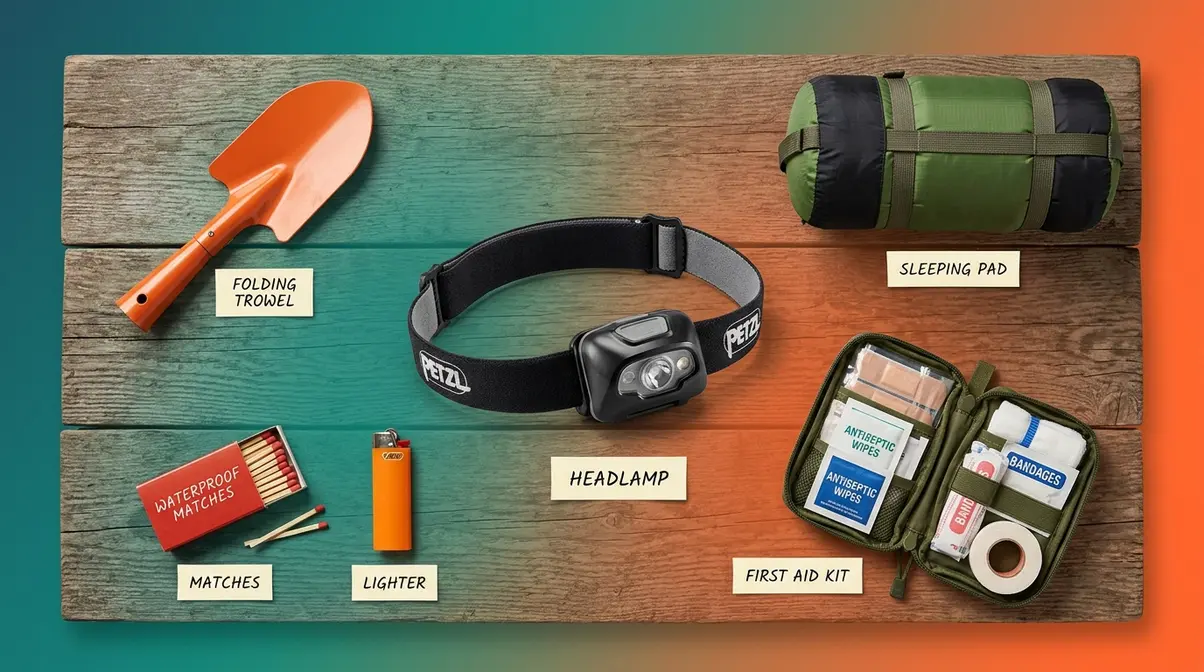
Lighting: A headlamp (a hands-free flashlight worn on your forehead) is the single most forgotten item. Phones die. Flashlights roll away. A headlamp with fresh batteries is irreplaceable at 3 a.m. when you need to find the restroom. For more details on illumination, consider choosing the right camping lights.
Sleep comfort: Sleeping pad (an insulated mat that goes beneath your sleeping bag to insulate you from cold ground) is frequently left behind. A sleeping bag alone, without a pad, leaves you losing body heat directly into the ground — a fast path to a cold, miserable night.
First aid kit: Blisters, cuts, and insect stings happen on virtually every camping trip. A basic kit with bandages, antiseptic wipes, blister pads, and antihistamine tablets covers 90% of beginner first aid scenarios.
The simplest system: Pack your gear the night before using the 7 C’s as your checklist framework. Lay everything on your living room floor before it goes in the bag — visual confirmation beats mental lists every time.
See our complete camping gear checklist for beginners for a printable version you can take on every trip.
Why You Need a Shovel for Camping
A small folding shovel (also called a trowel or e-tool) is one of the least glamorous but most important pieces of camping gear. Here’s why you need it:
For Leave No Trace compliance: As covered above, the 200-foot rule requires burying human waste in a cathole 6–8 inches deep. You cannot dig a proper cathole without a trowel. Attempting to dig with a stick or your boot is ineffective and unhygienic.
For campsite safety: A shovel lets you clear rocks and roots from your tent footprint area, dig a small drainage trench around your tent in heavy rain, and safely extinguish a campfire by covering it with dirt.
For emergency situations: In a sudden storm, a shovel lets you quickly dig drainage channels to redirect water away from your tent. Experienced campers report this skill has saved many a tent floor from flooding.
A lightweight folding trowel weighs under 3 ounces and costs less than $15 — one of the highest value-to-weight ratios in your entire pack.
Limitations and Risks: When a Tent Isn’t Enough
A tent is your most important piece of camping gear — but it isn’t invincible. Understanding its limitations helps you prepare properly and stay safe.
Common Tent Setup Mistakes
Pitching on a slope: Even a gentle slope causes you to slide toward the downhill end of your sleeping bag all night. Always find the flattest ground available, even if it means moving 20 feet from your preferred spot.
Skipping the rainfly: Many beginners set up the inner tent only on clear nights, then scramble to add the fly when rain starts. The rainfly (the waterproof outer shell) takes 5 minutes to add correctly and 20 panicked minutes in the dark during a storm. Always pitch it from the start.
Ignoring lightning risk: A tent provides no protection from lightning. The National Weather Service advises that during a lightning storm, you should leave your tent and seek shelter in a hard-topped vehicle or a substantial building. Never shelter under tall isolated trees.
Overpacking the tent: Cramming too much gear inside a tent restricts airflow, increases condensation (moisture that forms on tent walls from your breath), and reduces sleeping space. Store bulky gear in your car or a weatherproof bag outside.
Choosing Other Shelter Alternatives
A tent is the right choice for 95% of beginner camping situations. However, there are specific scenarios where alternatives make sense — once you’ve built experience:
- Ultralight backpacking (multi-day hikes where every ounce counts): A bivy sack or ultralight tarp system reduces pack weight significantly. This is appropriate only after you’re comfortable with weather reading and campsite selection.
- Established hammock camping in wooded areas: If trees are plentiful and well-spaced, a hammock with a rain fly and bug net is a comfortable alternative for experienced campers who prefer sleeping off the ground.
- Car camping with a canopy or easy-up shelter: A canopy (a portable shade structure with open sides) works well as a daytime gathering space alongside your tent — not as a replacement for it. You still need walls and a floor for sleeping.
For beginners, the recommendation is clear: start with a tent. Master the basics. Then explore alternatives from a position of knowledge and confidence. Our tent vs. alternatives comparison guide covers advanced shelter options in detail.
Frequently Asked Questions
Do you really need a tent for camping?
Yes, beginners genuinely need a tent for camping. A tent provides weather protection, an insect and wildlife barrier, and the enclosed sleeping environment your brain needs for quality rest outdoors. Without one, you’re exposed to rain, biting insects, and the psychological discomfort of sleeping in open air — all of which consistently ruin first camping trips. Experienced campers may occasionally sleep under tarps or in bivies, but those require skills that take time to develop.
What is the 200 rule for camping?
The 200-foot rule requires camping, waste disposal, and water use at least 200 feet (roughly 70 adult paces) from lakes, rivers, and trails. This Leave No Trace principle protects water sources from contamination, reduces erosion along stream banks, and keeps wildlife corridors undisturbed. Specifically, you should dig waste catholes at least 200 feet from any water source and bury them 6–8 inches deep. The rule is endorsed by both the US Forest Service and the National Park Service.
What are the 7 C’s of camping?
The 7 C’s of camping are Cutting, Combustion, Cover, Container, Cordage, Cotton, and Compass — a survival-oriented checklist covering the essential gear categories every camper needs. Cutting means a knife or multi-tool; Combustion means fire-starting tools; Cover means shelter (your tent); Container means water storage; Cordage means rope or paracord; Cotton means first aid cloth; and Compass means navigation tools. Using this checklist before every trip helps beginners avoid leaving critical gear behind.
Can I pee outside while camping?
Yes, urinating outdoors is generally acceptable when camping, but location matters. Follow the 200-foot rule: move at least 200 feet (about 70 paces) from any water source, trail, or campsite before urinating. Urine disperses quickly in most environments and has minimal ecological impact when spread across a wide area rather than concentrated in one spot. In high-use areas or fragile ecosystems, some parks require waste to be packed out — check your specific campground’s regulations before your trip.
What is the most forgotten item when camping?
A headlamp is consistently the most forgotten camping item. Unlike a flashlight, a headlamp keeps both hands free — essential for setting up camp after dark, cooking, or navigating to the restroom at night. Phones make poor substitutes because their batteries drain quickly and they can’t be worn hands-free. Other commonly forgotten items include a sleeping pad, a first aid kit, and a fire-starting backup (waterproof matches or a lighter). Packing the night before using the 7 C’s checklist prevents most of these omissions.
The Case for Your Tent: A Final Word
For beginner campers, a tent is not optional equipment — it is the foundation of a safe, comfortable, and genuinely enjoyable outdoor experience. Understanding exactly why do you need a tent for camping is the first step toward a successful trip. The Shelter-Safety-Sleep Triangle explains why: shelter from the elements, safety from insects and wildlife, and the enclosed sleeping environment that supports real rest outdoors. These three benefits are inseparable. A tarp gives you one. A bivy gives you one and a half. Only a tent gives you all three, without requiring advanced outdoor skills.
The 3-3-3 rule, the 200-foot rule, and the 7 C’s checklist all work best when you’re starting from the secure base that a properly pitched tent provides. Every framework in this guide assumes you have a place to retreat to, sleep in, and store your gear safely.
Your next step: pick a beginner-friendly tent (a three-season, two-person freestanding tent is the right starting point for most people), review our camping gear checklist for beginners, and book that first trip. Set up your tent in the backyard the night before you leave — once. That single practice run eliminates 80% of first-night setup anxiety. You’ve got this.

David King
Field gear tester at Tent Explorer.