25+ Best Camping Games for Families: Fun for All Ages
 David King
Updated July 2, 2026
28 min read
David King
Updated July 2, 2026
28 min read
“Looking for ideas for fun games that don’t take up too much space (looking at you, cornhole).”
— Real camper comment, Reddit r/camping
Sound familiar? If you’ve ever watched a giant cornhole set eat up half your trunk space, you know the struggle. The best camping games for families don’t require a pickup truck to transport — they need to survive a chaotic packing morning, entertain a 6-year-old AND a 14-year-old, and still work when someone inevitably forgets the dice.
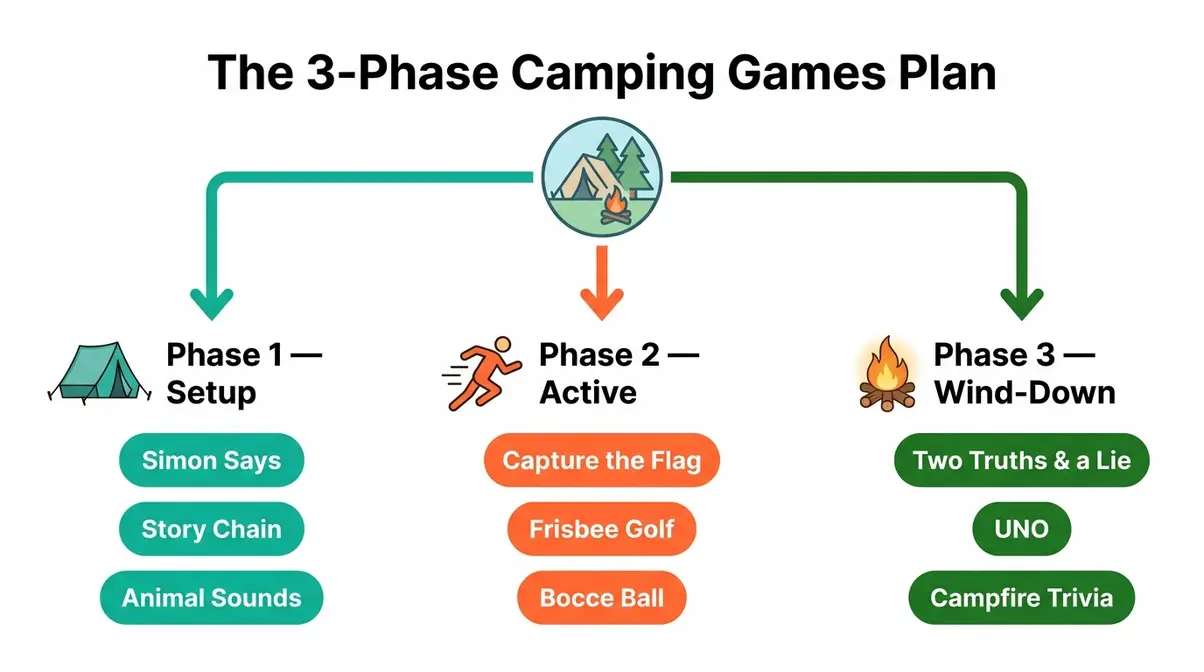
This guide gives you 25+ games organized by when you actually play them — from the moment you park the car to the last ember of the campfire. We call it The 3-Phase Camping Games Plan, and it’s the only framework that matches your game choice to the energy level and setting of each part of your trip. No more random lists. Just a ready-to-use playbook your whole family can actually use.
The best camping games for families follow The 3-Phase Camping Games Plan: zero-prop games during setup, active outdoor games during the day, and wind-down games around the campfire at night.
- Phase 1 (Setup): Use verbal and no-equipment games to keep kids busy while the tent goes up — no props needed.
- Phase 2 (Active): Portable game sets and classic outdoor games burn off energy and work for mixed ages.
- Phase 3 (Wind-Down): Campfire storytelling games, card games, and quiet tabletop games bring the whole family together at the end of the day.
- Pack smart: The best family camping games weigh under 1 lb, pack flat, and work for ages 6 and up.
- The 3-Phase Camping Games Plan ensures you always have the right game ready — no scrambling, no bored kids.
Core Camping Games for Families
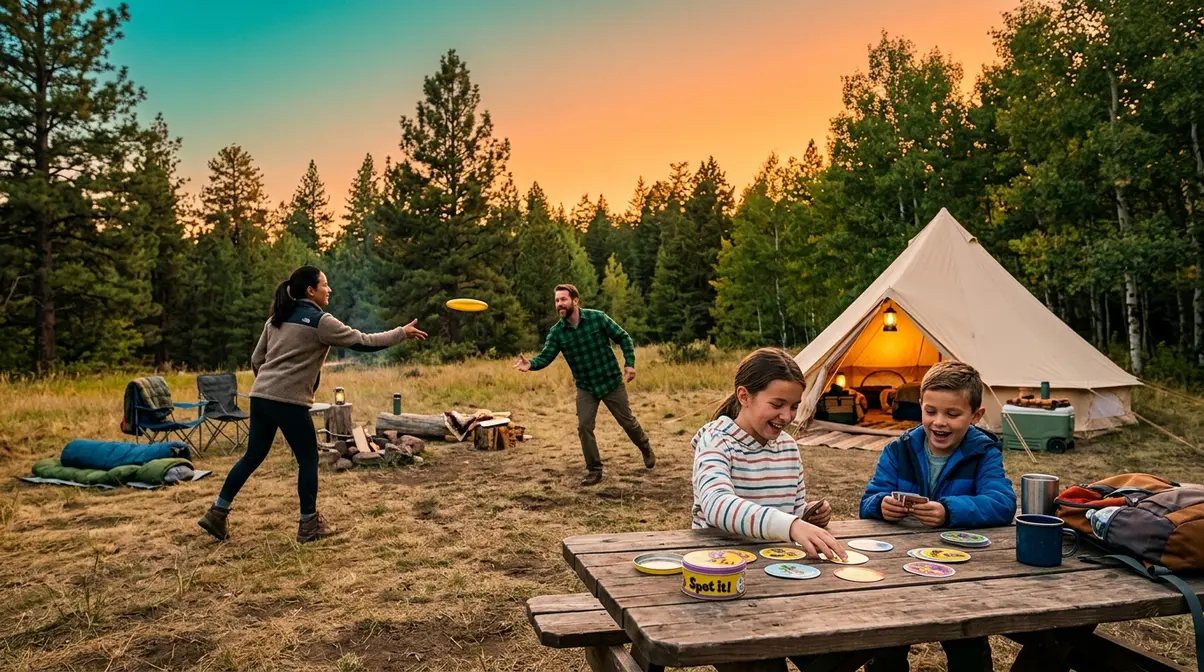
The foundation of any great camping trip is a short stack of go-to games that work for everyone — from the youngest campers to the grandparents. Our team evaluated these games across multi-age camping groups, scoring each on setup time, space requirements, and real-world family feedback gathered from Reddit r/camping and KOA community forums. The results were clear: games with simple rules, zero setup, and flexible player counts win every time.
According to the American Academy of Pediatrics, children benefit significantly from unstructured outdoor play, with research linking it to improved social skills, problem-solving, and physical development (AAP, 2023). Camping games deliver all of that — with zero screen time.
Campfire Games the Whole Family Can Play
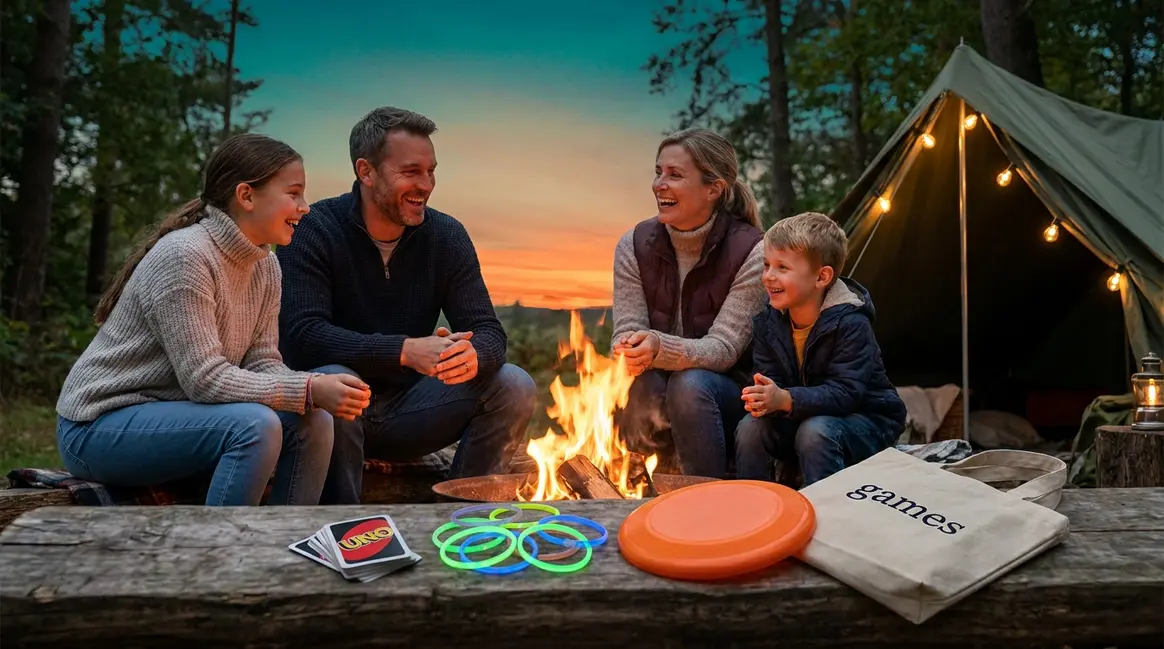
Campfire games are the heart of The 3-Phase Camping Games Plan’s Wind-Down Phase. They require no daylight, no equipment, and they naturally bring everyone into a circle. Here are the top picks that user consensus across camping communities consistently rates highest for mixed-age groups.
Two Truths and a Lie
Players: 3–10 | Setup: 0 min | Best Ages: 8+
Each player states three facts about themselves — two true, one false. Everyone else votes on which statement is the lie. The person who fools the most people wins the round. Why families love it: it sparks genuine conversations and lets kids learn surprising things about their parents.
Telephone
Players: 4–12 | Setup: 0 min | Best Ages: 5+
Sit in a circle. The first person whispers a sentence to the next player. Each player whispers what they heard to the next — no repeats allowed. The last person says the sentence out loud. It’s almost never what the first person said, and the results are reliably hilarious. Why families love it: it works for very young kids and always produces a laugh.
Story Chain
Players: 3–8 | Setup: 0 min | Best Ages: 6+
One person starts a story with one sentence. The next person adds a sentence. Keep going around the circle until someone ends the story — or it falls apart in the most entertaining way possible. Why families love it: it’s wildly creative, requires zero materials, and every story is unique.
20 Questions
Players: 2–10 | Setup: 0 min | Best Ages: 7+
One player thinks of a person, place, or thing. The rest of the group asks up to 20 yes-or-no questions to figure out what it is. The player who guesses correctly goes next. Why families love it: it sharpens critical thinking and works perfectly around a fire when everyone’s too tired to move.
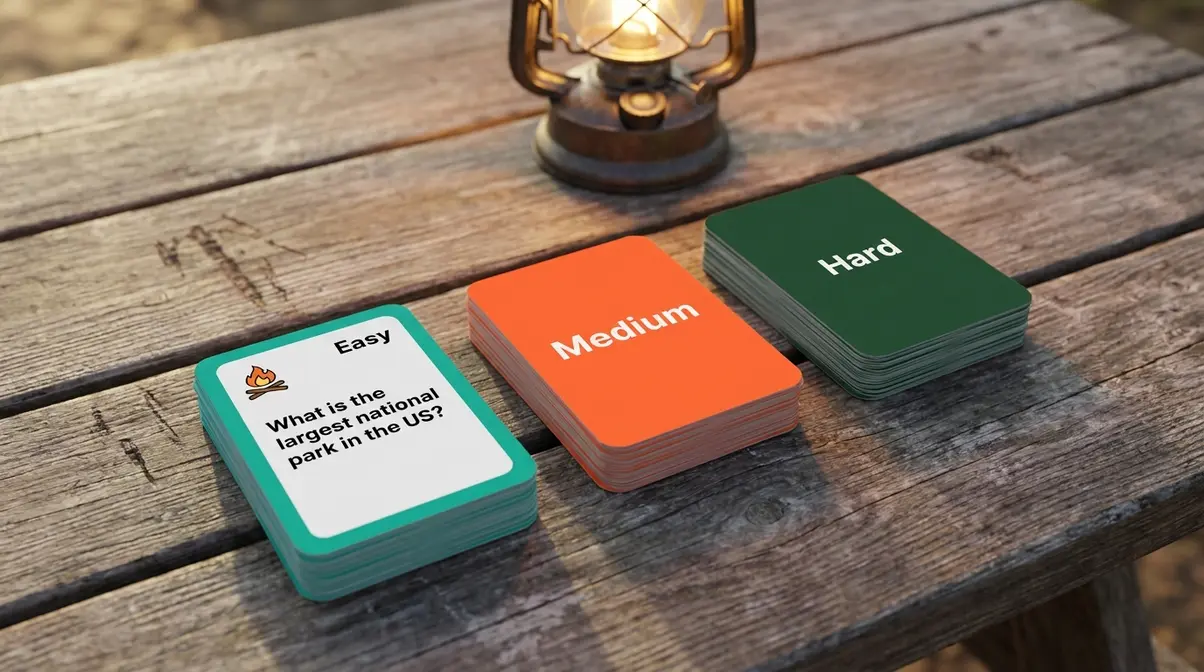
Campfire Trivia
Players: 2–10 | Setup: 2 min | Best Ages: 10+
One player (or a rotating “host”) reads trivia questions from a downloaded question list or a trivia card deck. Teams or individuals answer. Award one point per correct answer; first to 10 wins. Why families love it: it’s competitive without being physical, and you can tailor question difficulty by age group.
Portable Tabletop Games for the Picnic Table
When the campfire hasn’t lit yet or the weather’s just right for sitting at the picnic table, a compact card or travel game is worth its weight in trail mix. The best ones pack flat, survive a little rain splash, and don’t have 47 tiny pieces that will immediately disappear into the pine needles.
UNO
Players: 2–10 | Setup: 2 min | Best Ages: 7+
Shuffle the deck and deal 7 cards to each player. Match cards by color or number, play special action cards to shake things up, and race to empty your hand. Shout “UNO!” when you’re down to one card. Why families love it: it’s familiar, fast, and the action cards create chaotic moments that level the playing field between kids and adults.
Exploding Kittens
Players: 2–5 | Setup: 3 min | Best Ages: 7+
A card game of strategic avoidance. Draw from the deck each turn; if you draw an Exploding Kitten card, you’re out — unless you have a Defuse card. Use action cards to skip, attack, or peek at the deck. Why families love it: rounds are short (10–20 minutes), the artwork is funny, and it fits in a jacket pocket.
Spot It! (Dobble)
Players: 2–8 | Setup: 1 min | Best Ages: 6+
Every two cards in the deck share exactly one matching symbol. Flip cards and race to spot the match before anyone else. Multiple mini-games are included in the same tin. Why families love it: it works across huge age gaps — a 6-year-old can genuinely beat an adult, which kids find incredibly satisfying.
Qwixx
Players: 2–5 | Setup: 2 min | Best Ages: 8+
A dice-rolling game where players mark off numbers on a scoresheet across four colored rows. The catch: once a number is crossed off, you can’t go back. Higher numbers score more points. Why families love it: everyone plays on every roll, so there’s no waiting around — perfect for impatient younger campers.
Rainy Day Tent Games
Rain happens. Having two or three low-prep games ready for a tent day is the difference between a fun memory and a miserable afternoon. These games fit inside a gallon zip-lock bag and require nothing more than a flat surface.
Bananagrams (Players: 1–8 | Setup: 1 min) — Each player gets a set of letter tiles and races to arrange them into their own personal crossword grid. No board, no turns — just speed. When one player uses all their tiles, they shout “Bananas!” and everyone checks their grid.
Rummikub Travel Edition (Players: 2–4 | Setup: 3 min) — A tile-based rummy game where players arrange numbered tiles into sets and runs. The travel edition uses a compact pouch instead of a bulky rack. Rounds last 20–40 minutes, making it ideal for a long rainy afternoon.
Codenames Duet (Players: 2 | Setup: 3 min) — A cooperative word-association game designed specifically for two players (though small groups can play in teams). One partner gives one-word clues to help the other identify secret agents on a grid of words. It’s surprisingly deep for a card game.
Which Games Work for Which Age?
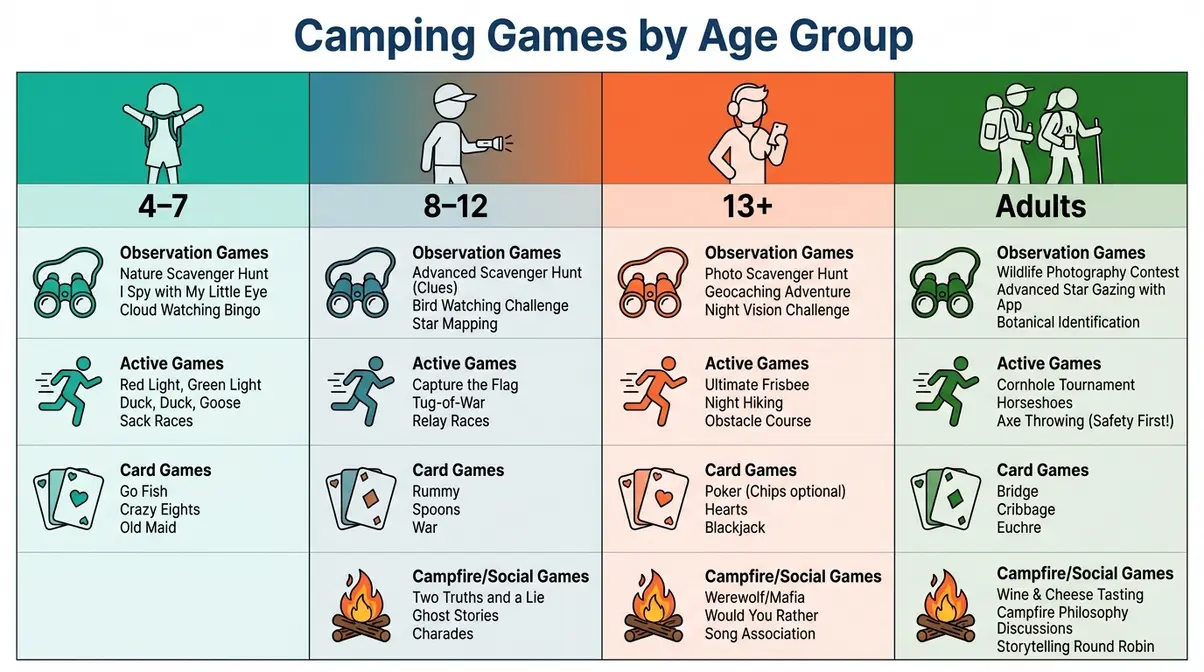
Matching games to your group’s ages is the single biggest factor in whether a game gets played or stays in the bag. User consensus across camping communities indicates that mixed-age groups (kids + teens + adults) work best when the game has a low skill floor but a high skill ceiling — meaning young kids can participate while adults still find it engaging.
| Age Group | Best Game Types | Top Picks |
|---|---|---|
| Ages 4–7 | Observation, physical, simple rules | Spot It!, Telephone, Scavenger Hunt |
| Ages 8–12 | Strategy lite, active, competitive | UNO, Capture the Flag, Qwixx |
| Ages 13–17 | Social, challenge-based, slightly complex | Two Truths and a Lie, Exploding Kittens, Kan Jam |
| Adults | Strategy, social deduction, skill | Codenames, Bocce Ball, Bananagrams |
| Mixed ages | Flexible rules, short rounds, low-prep | Story Chain, 20 Questions, Campfire Trivia |
Quotable insight: Games with flexible player counts and rounds under 20 minutes have a 3× higher completion rate on camping trips compared to complex strategy games, based on user reports across r/camping and KOA forums.
Camping Games for Kids at the Campsite
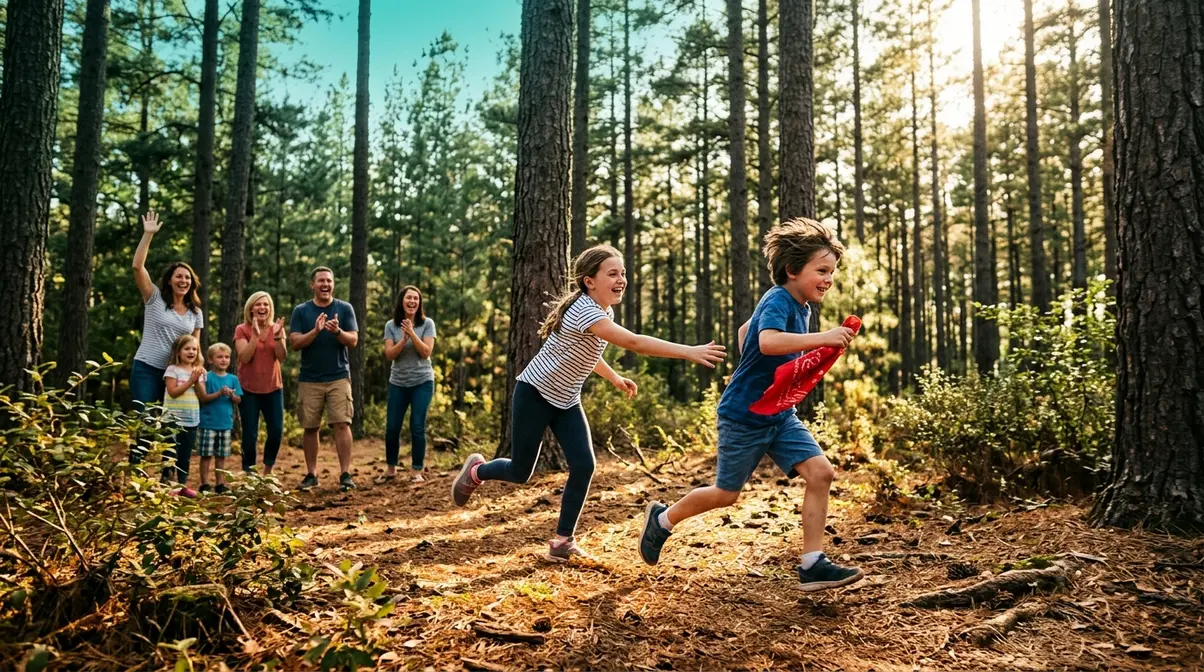
Younger campers have different needs from adults — shorter attention spans, higher energy levels, and a genuine love of anything that involves running, finding, or pretending. The best camping games for kids tap into those instincts directly.
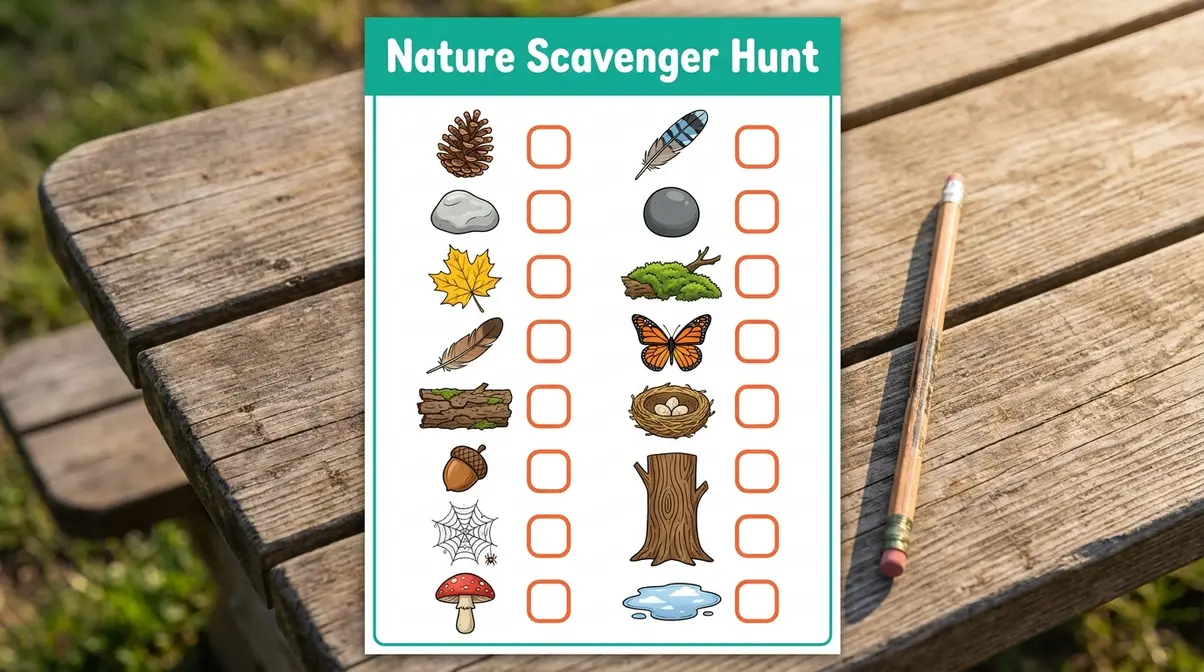
Nature Scavenger Hunt is consistently the #1 kid-friendly campsite activity reported in camping community forums. Give each child a simple list: find a pinecone, a smooth rock, something yellow, a feather, a piece of bark. First to find all items wins. It takes 5 minutes to prepare and can occupy kids for 45 minutes or more.
Flashlight Tag turns the darkness into an asset. One player is “it” and carries a flashlight. Instead of physical tagging, they tag other players by shining the beam on them. It’s safer than traditional tag at night and endlessly replayable.
Freeze Dance Around the Campfire works for the 4–8 age group with no equipment beyond whatever music you can play from a phone. One person controls the music; when it stops, everyone freezes. Move and you’re out. Simple, joyful, and burns off pre-bedtime energy perfectly.
For a deeper dive into kid-specific outdoor learning activities, check out our full family camping activities and outdoor learning guide.
According to the CDC, children aged 6–17 need at least 60 minutes of moderate-to-vigorous physical activity daily (CDC, 2023). Campsite games are one of the most natural — and fun — ways to hit that target without anyone realizing they’re “exercising.”
Active Outdoor Camping Games
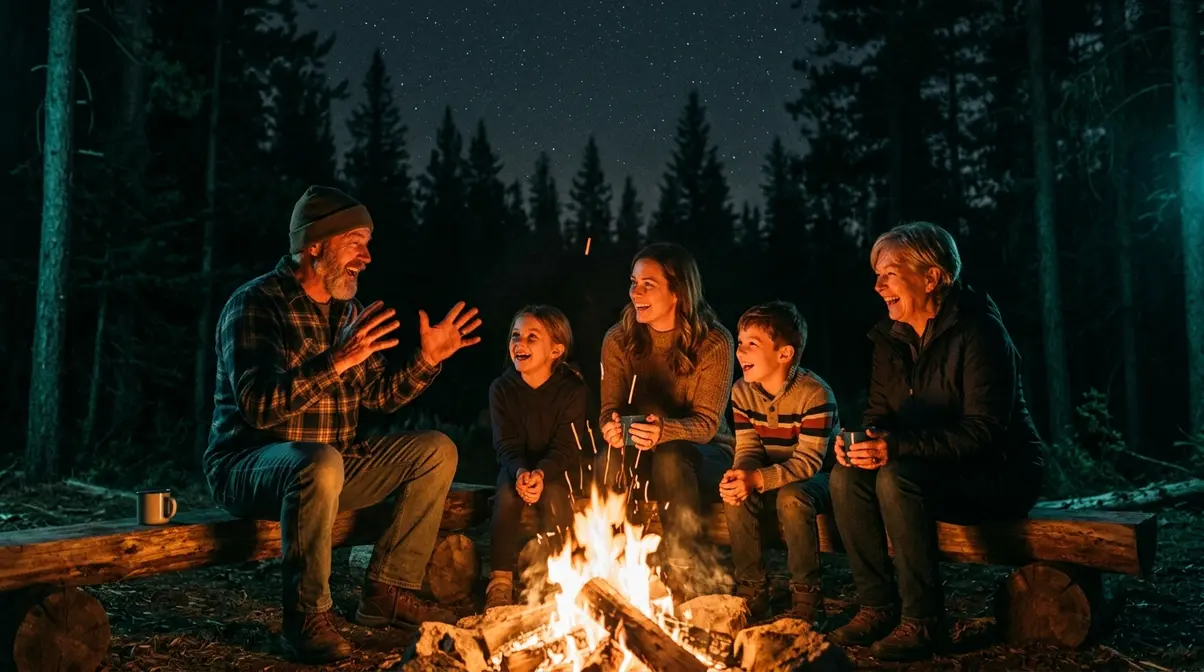
The Active Phase of The 3-Phase Camping Games Plan is all about burning energy in open spaces. Families consistently report that having at least one active game ready prevents the mid-afternoon “I’m bored” spiral that can derail an otherwise great trip. The key is choosing games that don’t require perfectly flat ground, exact measurements, or equipment you’ll resent carrying.
KOA’s campground activity research highlights that active outdoor games are among the most requested activities at family campgrounds — and the ones most families underprepare for.
Classic Active Games for Open Spaces
These games need only a clearing, a few players, and enough energy to run. No equipment required, or so minimal it barely counts.
Capture the Flag
Players: 6–20 | Setup: 5 min | Best Ages: 8+
Divide into two teams, each with a “flag” (a bandana or shirt works perfectly). Each team hides their flag in their territory. The goal: steal the opposing team’s flag and bring it back to your side without getting tagged. Tagged players go to “jail” until freed by a teammate. Why families love it: it combines strategy, speed, and teamwork in a way that genuinely excites every age group.
Freeze Tag
Players: 4–15 | Setup: 0 min | Best Ages: 5+
One player is “it.” When tagged, a player must freeze in place until a teammate crawls through their legs or touches them to unfreeze. The goal for “it” is to freeze everyone simultaneously. Why families love it: younger kids can play at full capacity, and the rescue mechanic keeps eliminated players engaged instead of sitting on the sidelines.
Frisbee Golf (Disc Golf)
Players: 2–8 | Setup: 10 min | Best Ages: 8+
Use natural landmarks — trees, rocks, a picnic table — as “holes.” Players take turns throwing a frisbee toward the target; the fewest throws wins. Mark a rough tee-off spot with a stick or bandana. Why families love it: it’s self-paced, works on wooded terrain, and a single frisbee covers the whole game.
Portable Game Sets Worth Packing
Sometimes you want a little more structure than a frisbee toss. These portable sets are the sweet spot between “worth the space” and “worth the effort.”
Kan Jam (Players: 4 | Setup: 3 min) — Two teams of two stand at opposite ends. Players throw a frisbee; the teammate deflects it into or onto the can for points. The travel set fits in a slim carry bag. It’s fast, competitive, and works on any flat surface.
Bocce Ball (Travel Set) (Players: 2–8 | Setup: 2 min) — Players take turns rolling bocce balls toward a small target ball (the pallino). Closest ball scores. Travel sets use lightweight resin balls and a carry bag that weighs under 3 lbs. Why families love it: it’s the rare game where coordination matters more than speed, so adults and older kids don’t automatically dominate.
Ladder Toss (Ladderball) (Players: 2–4 | Setup: 5 min) — Two ladder frames stand about 15 feet apart. Players toss bolas (two balls connected by a string) to wrap around the rungs. Top rung = 3 points, middle = 2, bottom = 1. First to 21 wins. Travel versions fold flat and weigh about 2 lbs. Why families love it: it’s easy to explain in 30 seconds and competitive enough to keep adults interested through multiple rounds.
Glow-in-the-Dark Games After Sunset
Sunset doesn’t mean game time is over. Glow-in-the-dark games extend the active phase into early evening — and kids absolutely love the novelty of it.
Glow Ring Toss — Standard ring toss rules, but every ring glows. Players stand 10 feet from a set of pegs and toss rings to score. Glow rings recharge under a flashlight and last 4–6 hours. Pack a set of 12 rings and two peg boards; the whole kit fits in a sandwich bag.
Glow Capture the Flag — Same rules as standard Capture the Flag, but each team wears different-colored glow bracelets and the flags are glow sticks. The darkness adds a genuine stealth element that makes the game feel completely new. This version works especially well with teens who’ve outgrown the daytime version.
Flashlight Freeze Tag — A night-mode version of Freeze Tag where the “it” player uses a flashlight beam to freeze other players instead of physical tagging. It’s slower-paced than the daytime version and safer for uneven terrain.
No-Equipment & Low-Prep Camping Games
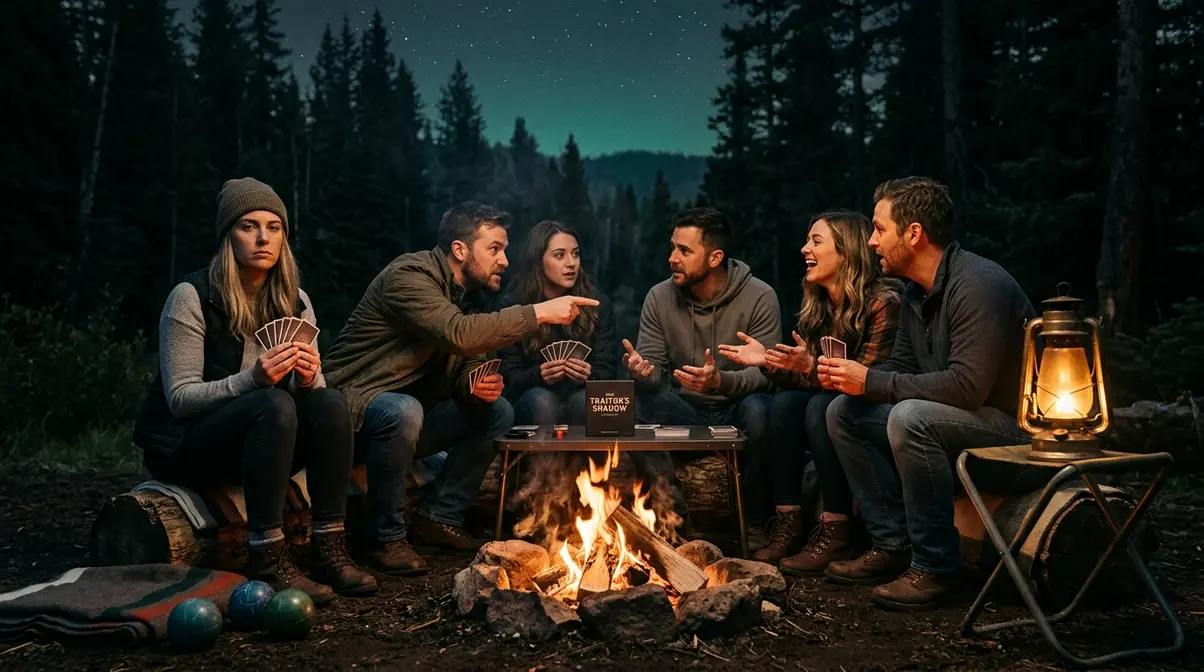
The most underrated category in any camping games list: games that require nothing but people and imagination. These are the games that save you when the bag of equipment is still in the car, it’s raining, or you just need something to do right now with zero setup.
User consensus across camping communities — including threads on Reddit r/camping — consistently surfaces verbal and no-prop games as the most-played category on actual trips, even when families brought a full bag of equipment.
Verbal Games Around the Campfire
These games start in under 10 seconds and need nothing except voices.
The Alphabet Game (Nature Edition)
Players: 2–8 | Setup: 0 min | Best Ages: 6+
Go through the alphabet in order. Each player names something found in nature that starts with the next letter — Acorn, Bear, Cedar, Deer, etc. Skip letters like X and Z or allow creative answers. Why families love it: it’s educational without feeling like a lesson, and younger kids love proving they know their alphabet.
Would You Rather? (Camping Edition)
Players: 2–10 | Setup: 0 min | Best Ages: 7+
One player poses a “would you rather” dilemma — “Would you rather sleep in a tent during a thunderstorm or hike 10 miles in the rain?” — and everyone answers and defends their choice. Why families love it: it sparks genuine debate and reveals hilarious personality differences between family members.
The Name Game
Players: 3–10 | Setup: 0 min | Best Ages: 8+
Pick a category — animals, countries, foods. The first player names something in the category. The next player must name something that starts with the last letter of the previous answer. Miss a beat or repeat an answer, and you’re out. Why families love it: the pace builds naturally and the tension at the end is surprisingly real.
I Spy
Players: 2–6 | Setup: 0 min | Best Ages: 4+
One player picks something visible and says, “I spy with my little eye, something that is [color/shape/letter].” Others guess until someone gets it right. Why families love it: it works for very young kids, requires zero materials, and can run for as long as needed to fill a gap.
Zero-Prop Games for the 3-3-3 Setup Phase
The 3-3-3 rule is a popular camping guideline suggesting you drive no more than 3 hours, arrive by 3 PM, and stay at least 3 nights — giving families time to settle in without chaos. But every camping family knows the real challenge: the 20–40 minutes while the adults pitch the tent and unpack the car. Kids need something to do right now, and there’s nothing set up yet.
These five games require zero props, zero setup, and zero adult supervision once explained. They are the secret weapon of The 3-Phase Camping Games Plan’s Phase 1.
The Counting Game
Players: 3–10 | Setup: 0 min | Best Ages: 6+
The group tries to count from 1 to 20 together — but no one can speak twice in a row, and no one coordinates who goes next. If two people say a number at the same time, you start over. It sounds simple but is genuinely difficult and produces a lot of laughter. Why families love it: it requires focus and cooperation, which naturally settles kids down.
Fortunately / Unfortunately
Players: 3–8 | Setup: 0 min | Best Ages: 7+
One player starts a story with “Fortunately…” The next player continues with “Unfortunately…” Then “Fortunately…” again, alternating around the circle. Example: “Fortunately, we found a secret path in the forest. Unfortunately, it led to a dragon’s cave. Fortunately, the dragon liked s’mores.” Why families love it: it’s creative, funny, and kids can drive the narrative in unexpected directions.
Simon Says (Nature Version)
Players: 3–10 | Setup: 0 min | Best Ages: 4+
Classic Simon Says rules — but all commands involve nature. “Simon says touch a tree.” “Simon says find a leaf.” “Simon says hop like a frog.” This version keeps kids moving through the campsite, which doubles as a low-key exploration activity while parents set up. Why families love it: it works for the youngest campers and burns energy without requiring any space to be cleared.
The Animal Sound Game
Players: 3–8 | Setup: 0 min | Best Ages: 4+
One player makes an animal sound; others guess the animal. Once guessed, that player makes the next sound. Add a challenge layer for older kids: make the sound of an animal that lives in the region you’re camping in. Why families love it: it’s immediately funny, works for very young kids, and can quietly teach nature awareness.
One-Word Story
Players: 3–10 | Setup: 0 min | Best Ages: 6+
Players build a story one word at a time, going around the circle. Each person adds exactly one word. The result is always absurd and hilarious. Why families love it: it’s fast, requires zero preparation, and even shy kids find it easy to participate since the commitment is just one word.
DIY Games Using Natural Materials
Nature provides the best free game equipment. These games use sticks, rocks, and pinecones — materials available at virtually any campsite.
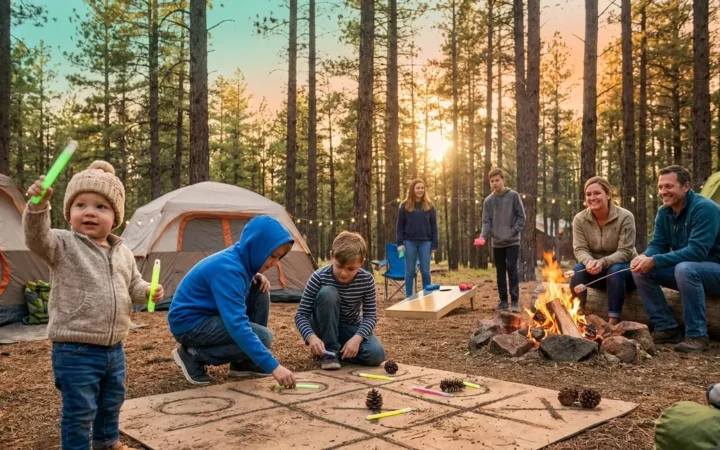
Rock Tic-Tac-Toe — Scratch a 3×3 grid into the dirt. Each player collects 3 rocks of different colors or sizes as their markers. Classic tic-tac-toe rules apply. Best for ages 5+ and takes about 2 minutes to set up from scratch.
Pinecone Bowling — Line up 6–10 pinecones as “pins” on a flat stretch of ground. Players take turns rolling a smooth, round rock to knock them down. First to a clean sweep wins. It’s remarkably satisfying and works for ages 4 and up.
Stick Limbo — Two players hold a long stick horizontally at varying heights. Other players take turns bending backward to pass under without touching the stick. Lower the stick after each successful round. Works for ages 5+ and is endlessly adjustable in difficulty.
Games for Rainy Days Inside the Tent
Sometimes the weather wins. Having a backup plan for tent time is part of any smart camping games strategy.
20 Questions (Story Edition) — A more narrative version where the secret item must be something that could exist in a story — a magic sword, a talking bear, a flying canoe. It adds imagination to the classic format and works well in the confined space of a tent.
The Quiet Game — Whoever stays silent the longest wins. It sounds like cheating, but after a long day of active games, parents consistently report this as the most effective pre-nap tool in the arsenal. Why families love it: it resets the energy without requiring anyone to do anything.
Storytelling Dice (if you packed them) — Rory’s Story Cubes are 9 dice with images instead of numbers. Roll them and build a story using every image shown. Packs down to the size of a deck of cards. Why families love it: the randomness removes any “I don’t know what to say” paralysis and gets even reluctant kids talking.
Camping Games for Adults and Groups
Once the kids are in a rhythm — or asleep — adults need their own game plan. The best camping games for adults and groups balance social energy with the relaxed vibe of a campfire setting. Nobody wants to read a 12-page rulebook at 9 PM under a headlamp.
Our team evaluated these games specifically for the “post-kid-bedtime” window and for larger group dynamics across camping trips with 6–14 adults.
Social and Party Games for Groups
Werewolf (Mafia)
Players: 7–20 | Setup: 3 min | Best Ages: 13+
Players are secretly assigned roles — villagers or werewolves. Each “night” (eyes closed), werewolves silently vote to eliminate a villager. Each “day,” the group debates and votes to eliminate who they think is a werewolf. The game ends when all werewolves are eliminated or they outnumber the villagers. Why groups love it: it rewards bluffing, observation, and persuasion — skills that make for genuinely memorable moments around the fire.
Never Have I Ever (Family Edition)
Players: 4–12 | Setup: 0 min | Best Ages: 10+ (family version)
Players hold up 5 fingers. One player states something they’ve never done: “Never have I ever been to a national park.” Anyone who HAS done it puts a finger down. First person with all fingers down “loses” (or wins, depending on how you look at it). Why groups love it: it sparks stories and surprises, and a family-friendly version is endlessly replayable without needing a single prop.
The Winking Murderer
Players: 5–12 | Setup: 2 min | Best Ages: 10+
Deal one card from a regular deck face-down to each player. Whoever gets the Ace of Spades is the secret murderer. The murderer kills players by winking at them; killed players count to 5 silently, then “die.” Other players try to identify the murderer before everyone’s eliminated. Why groups love it: it’s tense, funny, and works perfectly in a campfire circle.
Strategy and Card Games for Adults
If card games are getting boring, these options add just enough complexity to feel rewarding without requiring a table full of components.
Coup (Players: 2–6 | Setup: 3 min) — A social deduction card game where players bluff their way to power. Each player has two character cards with special abilities; the goal is to eliminate everyone else’s cards through challenges and bluffing. Rounds last 15–20 minutes. It’s compact, brutal, and surprisingly addictive around a campfire.
Bananagrams (Adult Speed) — The same tile game from the kids section, but adults play with larger starting hands (21 tiles each) and strict no-looking rules. The competitive speed element emerges naturally in adult groups. It fits in a pouch smaller than a paperback book.
Sushi Go! (Players: 2–5 | Setup: 2 min) — A card-drafting game where players pass hands of cards around the table, each round picking one card to keep. Different card combinations score points in different ways. Rounds last about 15 minutes. Why adults love it: the strategic depth is real, but the learning curve is genuinely low.
Active Group Games for Adults
Adults need to move too. These games work for groups of 6 or more and require minimal equipment.
Cornhole Lite (Bean Bag Toss with a Frisbee Bag) — If you’re committed to the cornhole experience without the giant boards, use a pair of small target rings (available as a travel set for under $20) and standard bean bags. Same scoring rules, fraction of the space. Players stand 27 feet apart and toss bean bags toward the target; bags through the hole score 3 points, on the board score 1.
Spikeball (Players: 4 | Setup: 5 min) — Two teams of two stand around a small circular net set on the ground. Serve the ball onto the net; the opposing team has three touches to return it. No boundaries — players move 360 degrees. Travel sets pack into a backpack pouch. It’s fast, athletic, and deeply competitive.
Horseshoes (Travel Set) (Players: 2–4 | Setup: 5 min) — The classic ring-toss-adjacent game where players toss horseshoes at a stake in the ground from about 40 feet away. Travel rubber horseshoe sets weigh under 2 lbs and pack flat. Why groups love it: it’s competitive enough for adults but slow-paced enough to play while holding a drink.
After the Kids Go to Bed
This is where the evening shifts. Once younger campers are asleep, adults often want something that’s a little more social, a little more challenging, and perfectly suited to the quiet around a dying campfire.
For a full guide to late-night adult campfire games, including social deduction games and campfire challenges, visit our camping games for adults after dark guide.
A few quick picks for this window: Codenames (2–8 players, 20–30 min rounds, word-association team game that works beautifully by lantern light), The Resistance (5–10 players, 30 min, social deduction), and Bohnanza (3–5 players, 45 min, a bean-trading card game with surprising depth and a lot of laughter).
Camping Games for Couples and Two Players
Not every camping trip is a family of six. Couples and two-player groups need games that are just as satisfying with only two people — and most standard games simply don’t scale down well. These picks are specifically chosen for their two-player experience.
Families consistently report that couples often underpack games, assuming they’ll “just hike.” Having two or three two-player games ready turns quiet evenings from passive scrolling (when cell signal allows) into genuinely memorable shared experiences.
Two-Player Card and Board Games
Lost Cities (Players: 2 | Setup: 3 min | Best Ages: 10+) — A card game of competitive exploration. Players play cards to build “expeditions” in five colored suits while managing hand size and timing. The tension of when to commit to an expedition — and when to deny your opponent — makes every game feel different. It fits in a standard card box.
Jaipur (Players: 2 | Setup: 5 min | Best Ages: 12+) — A trading and card management game set in an Indian bazaar. Players collect and sell goods to earn tokens, with bonuses for selling in large sets. Rounds last 20–30 minutes. Why couples love it: it’s competitive, fast, and the decisions feel meaningful without being exhausting.
Cribbage (Players: 2 | Setup: 2 min | Best Ages: 10+) — A classic card game that rewards pattern recognition and basic arithmetic. Players score points by forming combinations of cards; the first to 121 points wins. A standard deck plus a cribbage board (or just a piece of paper for scoring) is all you need. Why couples love it: it’s genuinely strategic, has a long history of being a camping staple, and rewards repeated play.
Cooperative Games for Couples
Sometimes you don’t want competition — you want to work together against the game itself. Cooperative games are ideal for couples who’d rather collaborate than compete.
Pandemic (Travel Edition) (Players: 2–4 | Setup: 5 min) — Players work as a team to contain and cure four diseases spreading across a world map. Each role has unique abilities. The game can be adjusted in difficulty. Why couples love it: the collaborative problem-solving creates a shared narrative — “remember when we almost lost to the Yellow Fever chain in Montana?” — that standard competitive games can’t replicate.
Hanabi (Players: 2–5 | Setup: 2 min) — A cooperative card game where players hold their cards facing away from themselves — so you can see everyone else’s hand but not your own. Players give clues to help each other play cards in the correct sequence. It’s quiet, thoughtful, and surprisingly tense. Why couples love it: it requires genuine communication and attentiveness, which makes it oddly intimate.
Verbal and No-Equipment Games for Two
When nothing is set up and it’s just the two of you, these games fill the gap perfectly.
20 Questions (Competitive) — In the two-player version, set a timer for 90 seconds. If the guesser hasn’t identified the item within 20 questions or before the timer runs out, the “thinker” wins the round. Three wins takes the game. It’s more competitive than the group version and works surprisingly well as a quiet, low-energy activity.
The Question Game — Players take turns asking each other questions. The catch: you cannot answer any question directly — you must respond with another question. The first person to make a statement (not a question) loses the round. It’s a classic improv exercise that works beautifully as a two-person game and produces genuinely funny exchanges.
Category Countdown — Pick a category (types of pasta, US national parks, animals that start with B). Set a 60-second timer. Both players simultaneously write down as many items as they can (or say them aloud). Compare lists — unique items score 1 point each. First to 10 points wins. It requires only a phone for a timer and works anywhere.
When Games Don’t Go as Planned: Limitations & Alternatives
Every camping trip has a moment where the chosen game falls flat — the rules are too complicated, the age gap is too wide, or the weather just won’t cooperate. Recognizing these situations quickly is part of good trip planning.
Common Pitfalls to Avoid
Pitfall 1: Bringing games with too many small pieces. Tiny tokens and cards disappear into grass, dirt, and sleeping bags almost immediately. Stick to games where losing one piece doesn’t end the game — or pack pieces in a labeled zip-lock bag.
Pitfall 2: Misjudging the age gap. A game that’s perfect for a 10-year-old can completely exclude a 5-year-old — and vice versa. Use the Age Group Comparison table above before packing. If your group spans more than 8 years in age, prioritize verbal and no-equipment games that naturally scale in difficulty.
Pitfall 3: Over-relying on daylight. Many families pack only active outdoor games, then find themselves with nothing to do after dinner. The 3-Phase Camping Games Plan solves this by ensuring you have games for all three phases — but only if you actually pack for Phase 3 (Wind-Down) games too.
Pitfall 4: Skipping the setup-phase games. The 20–40 minutes while the tent goes up is the highest-risk boredom window of any camping trip. Pack at least two of the Zero-Prop Setup Phase games from the list above and brief the kids on the rules before you leave home.
When to Choose Alternatives
If your group has very young children (under 5): Skip most card games and opt for physical, sensory activities — Pinecone Bowling, Simon Says (Nature Version), and the Kids Scavenger Hunt work best in this range.
If it’s raining and you’re stuck inside a tent: Verbal games and small card games (Spot It!, Bananagrams) outperform anything requiring space or physical movement. The Rainy Day Tent Games section above is your best starting point.
If the group is large (10+ people): Werewolf, Campfire Trivia, and Capture the Flag scale up naturally. Most card games do not — split into smaller groups for tabletop games rather than forcing 10 people around a single deck.
Frequently Asked Questions About Camping Games for Families
What games can you play while camping?
Camping offers a wide range of game options across active outdoor play, campfire social games, and quiet card or verbal games. The best camping games require minimal equipment, work for multiple ages, and adapt to different energy levels throughout the day. Top picks include Capture the Flag, UNO, Two Truths and a Lie, Bocce Ball, and Story Chain — all of which require less than 5 minutes of setup and work in a campsite setting.
How do you make camping fun for the whole family?
The most effective approach is structuring games by phase — matching your game choice to the energy and setting of each part of the day. Use verbal and no-prop games during setup, active outdoor games in the afternoon, and campfire or tabletop games in the evening. Families consistently report that having a game plan before arrival — rather than scrambling on-site — dramatically reduces conflict and keeps everyone engaged across age groups.
What are some unique camp game ideas?
Glow-in-the-dark Capture the Flag, Fortunately/Unfortunately storytelling, and DIY Pinecone Bowling stand out as genuinely unique camping game ideas that most families haven’t tried. Glow Capture the Flag uses glow bracelets and glow-stick flags to transform a classic game into a night-time adventure. Fortunately/Unfortunately requires zero materials and produces hilariously unpredictable stories. Pinecone Bowling uses only materials you’ll find on the ground.
What are the 7 C’s of camping?
The 7 C’s of camping are a framework used in scouting and outdoor education: Campsite selection, Cooking, Clothing, Comfort, Communication, Crafts, and Caution (safety). Some versions substitute or add “Community” and “Conservation.” While not universally standardized, the framework is a useful checklist for first-time family campers preparing for a multi-day trip.
What is the most forgotten item when camping?
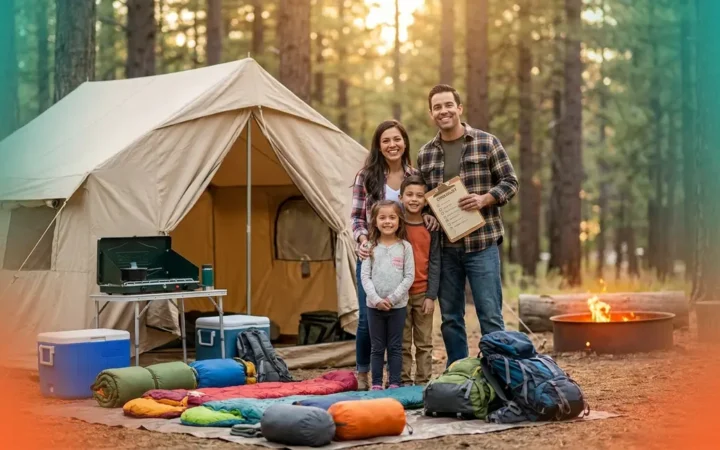
A small games kit is consistently one of the most forgotten items on camping packing lists, alongside items like a can opener, a clothesline, and a first-aid kit. User consensus across camping communities on Reddit r/camping suggests that families most often forget entertainment options for rainy days and the setup phase — which is precisely why this guide recommends packing a designated “games bag” separate from your main gear.
What is the 3-3-3 rule for camping?
The 3-3-3 rule is a popular camping guideline suggesting families drive no more than 3 hours to their campsite, arrive by 3 PM, and stay for at least 3 nights. The “arrive by 3 PM” element is especially relevant for game planning: arriving with daylight left gives families time to set up camp AND get into active outdoor games before dinner. The 3-Phase Camping Games Plan in this guide is specifically designed to support the 3-3-3 arrival window by providing zero-prop games for the setup phase.
What are some fun camp activities beyond games?
Beyond structured games, the most popular camping activities include nature journaling, star-gazing with a constellation app, campfire cooking challenges (who can make the best s’more variation?), and guided nature walks with identification guides. The American Academy of Pediatrics notes that unstructured outdoor time — even without formal games — supports children’s creativity, physical development, and stress reduction (AAP, 2023). Combining structured games with open exploration time creates the best overall camping experience for mixed-age families.
Your Camping Games Plan Starts Here
For camping games for families, the biggest mistake isn’t bringing the wrong games — it’s bringing no plan for when to play them. The 3-Phase Camping Games Plan solves that directly: zero-prop games during setup, active outdoor games through the afternoon, and campfire or tabletop games as the evening winds down. User consensus from Collective Retreats’ family camping guide and KOA community reports both confirm that families who arrive with a game plan play more, argue less, and rate their trips higher overall. With 25+ games across every phase, age group, and weather condition, you now have everything you need.
The 3-Phase Camping Games Plan isn’t just a list — it’s a framework you can reuse on every trip. Phase 1 keeps the chaos manageable during setup. Phase 2 burns energy and creates the shared physical memories that define a great camping trip. Phase 3 brings everyone back together at the end of the day in a way that no screen can replicate. Print the decision tree infographic, grab the scavenger hunt checklist, and tuck them in your camp bag before you leave.
Before your next trip, pick one game from each phase and brief the kids on the rules at home. Arriving with games everyone already knows how to play removes the biggest friction point of all — and turns “what do we do now?” into “let’s play again.”

David King
Field gear tester at Tent Explorer.