25+ Best Camping Games for Families: Fun for All Ages
 Dave King
Updated July 13, 2026
23 min read
Dave King
Updated July 13, 2026
23 min read
“Card games are getting boring and we need some suggestions.”
— Real camper, r/camping community
If that sounds familiar, you’re in good company. Most families arrive at camp with a deck of cards and run out of ideas by day two. Without a game plan, bored kids become restless, restless kids become cranky, and the trip you planned for months loses its magic.
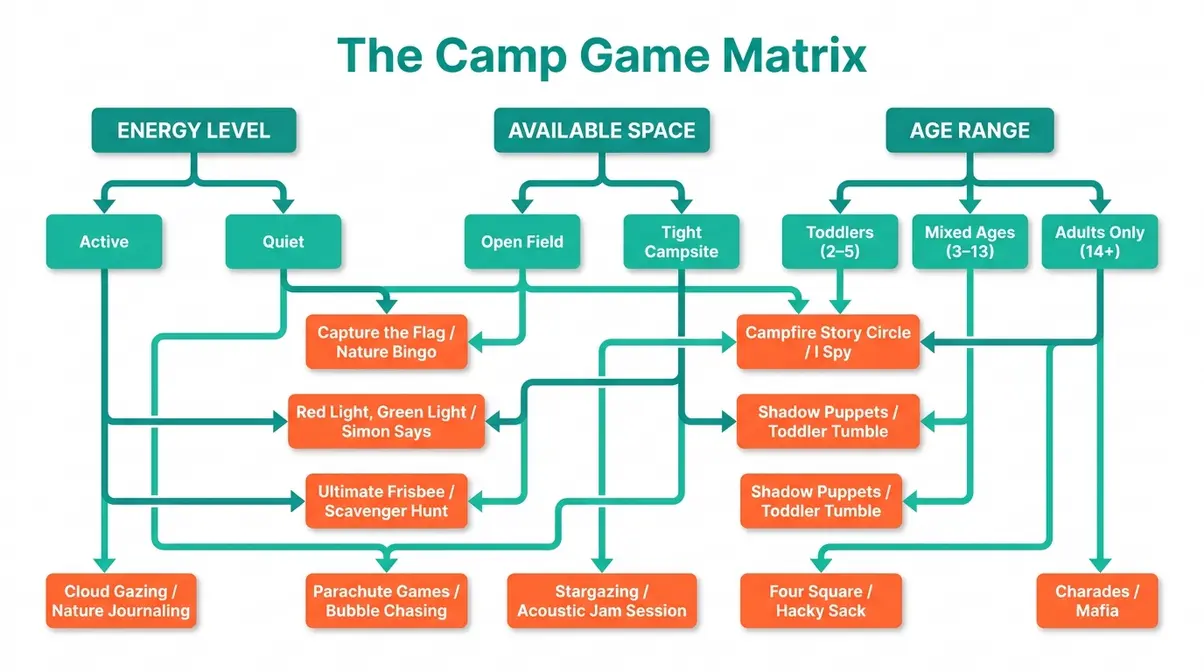
This guide gives you 25+ camping games for families — organized by age group, energy level, and weather — so you can pick the right game in under 30 seconds. We cover everything from toddler-safe campfire games to adult nighttime challenges, no-equipment spoken games, and the best compact board games for rainy days, using The Camp Game Matrix — our simple framework for matching the right game to your group in any situation.
Our team reviewed community favorites from r/camping discussions and dozens of outdoor activity guides to curate this list. Every game below includes step-by-step rules, age recommendations, and group size guidance — because “fun for the whole family” only works when everyone actually knows how to play.
Camping games for families work best when matched to your group’s age range, energy level, and available space — that’s the core idea behind The Camp Game Matrix.
- For mixed ages: “Glow Tag” and “Nature Bingo” work for toddlers and teens at the same time
- No equipment needed: Campfire storytelling games like “The Green Glass Door” require zero packing
- Rainy days: Compact games like Yahtzee and Exploding Kittens fit in a zip-lock bag
- Adults only: Nighttime games like Glow-in-the-Dark Capture the Flag keep grown-ups engaged after kids sleep
- Outdoor play boosts mood: Harvard Health outdoor play research links time outdoors to lower stress and better focus for all ages
Fun Camping Games for the Whole Family
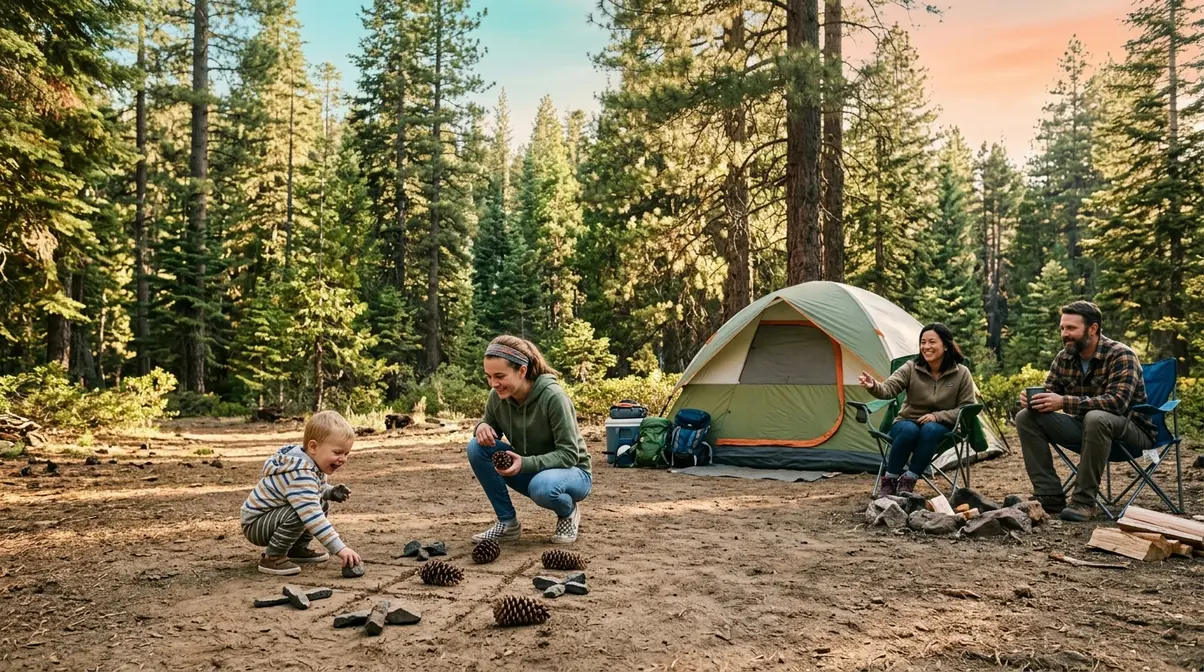
The best camping games for families are ones that work for every age at the table — or around the fire. Outdoor play reduces stress and improves focus for children and adults alike, making active camping games one of the highest-value activities on any family trip (Harvard Health, 2023). The 15 games below are organized using The Camp Game Matrix: match your group’s energy level (active or quiet), available space (open field or tight campsite), and age range (toddlers, mixed, or adults-only) to find the right game instantly.
Think of it as The Camp Game Matrix: three variables, one quick decision. Spending time outdoors in unstructured play reduces cortisol levels and improves executive function in children — which means these aren’t just fun, they’re genuinely good for your kids (Harvard Health, 2023). You’ll find fun family camping activities across all three subcategories below.
Teen & Toddler Co-Play: 5 Inclusive Games
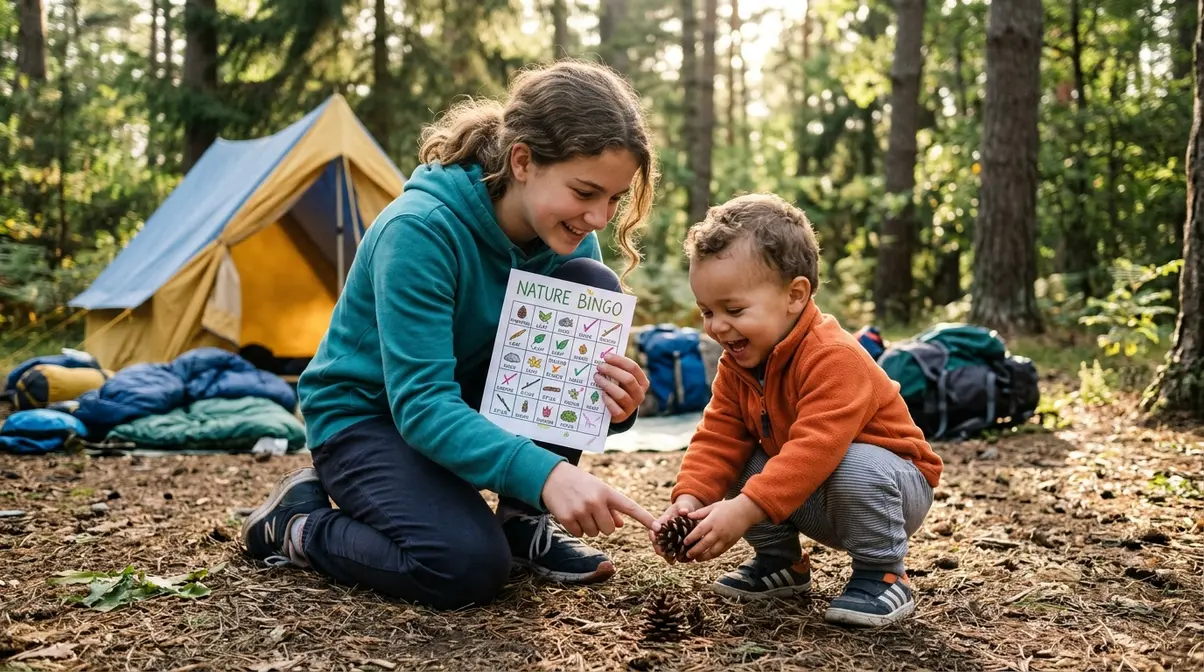
Picture this: your 3-year-old is bouncing with excitement, your 13-year-old is trying to look cool, and you need one activity that keeps both of them genuinely engaged. You’ve got a toddler who needs simple rules and a teenager who needs a challenge. These 5 games thread that needle — no one sits out, no one gets bored.
Campers in the r/camping community consistently recommend age-bridging games as the single biggest factor in a successful family trip. Our team evaluated dozens of campsite activity guides and found that the key ingredient is adjustable complexity: the same game needs an easy mode for little ones and a strategic layer for older kids. Here’s what works.
1. Nature Bingo
Nature Bingo (a scavenger-hunt-style observation game where players find items from a pre-made bingo card) is the most universally beloved outdoor game for mixed-age groups.
- How to play: Give each player a bingo card listing 16 nature items — pinecone, bird, red leaf, spider web, smooth rock, etc. Players explore the campsite and check off items they spot or collect. First to complete a row wins.
- Best for ages: 3+
- Players needed: 2–10
- Equipment: Printable bingo cards (see printable asset below)
- Why it works across ages: Toddlers love collecting objects; teens compete for speed and strategy.
2. Glow Tag
Glow Tag (a nighttime variation of traditional tag where everyone wears a glow stick bracelet) works because the glow sticks are the great equalizer — toddlers toddle, teens sprint, and everyone can see each other.
- How to play: Each player wears a glow bracelet on each wrist. One player is “it” and must tag another player’s bracelet to transfer the “it” role. Play continues until everyone is exhausted.
- Best for ages: 3+
- Players needed: 4+
- When: After dark
- Equipment: Glow stick bracelets (~$3 for a pack of 30)
- Why it works across ages: The glow makes it visually exciting for toddlers and adds a stealth element teens enjoy.
3. Giant Tic-Tac-Toe
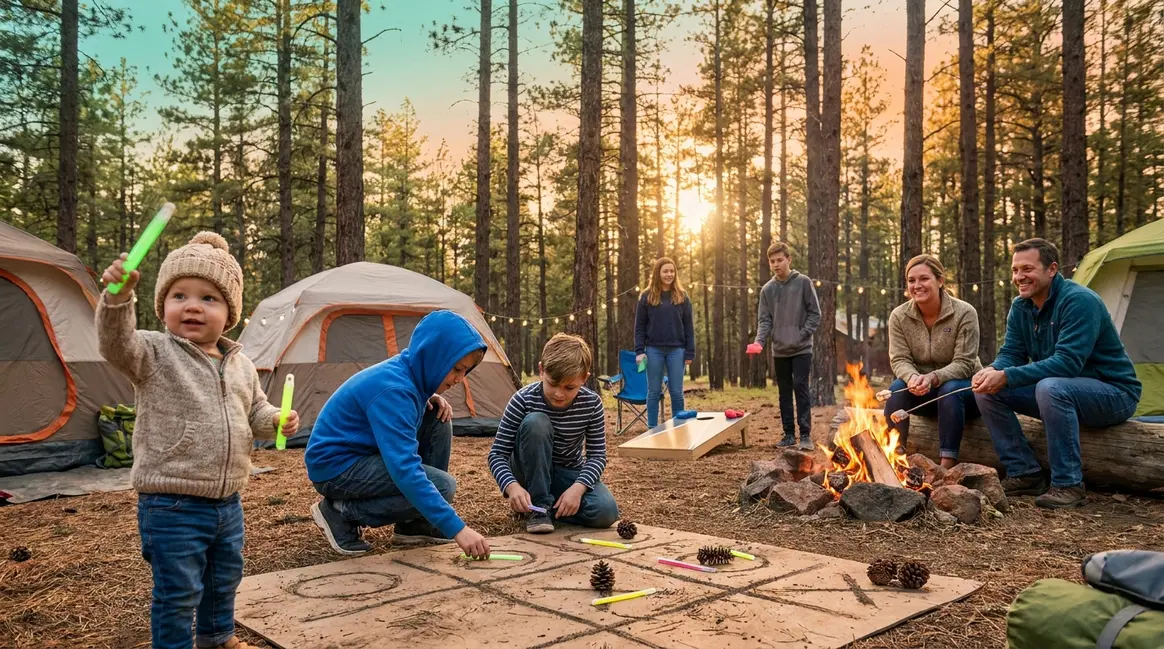
Draw a large grid in the dirt and use rocks versus pinecones as X’s and O’s. No packing required — the campsite provides everything.
- How to play: Scratch a 3×3 grid into dirt or sand. Team 1 uses rocks; Team 2 uses pinecones. Players alternate placing one piece per turn. First to get three in a row wins.
- Best for ages: 2+
- Players needed: 2 (teams welcome)
- Equipment: None
- Why it works across ages: Toddlers love placing pieces; older kids think several moves ahead.
4. Campfire Story Circle
Campfire Story Circle (a collaborative storytelling game where each player adds one sentence to a shared story) is a no-equipment classic that rewards imagination over age.
- How to play: One player starts with “Once upon a time, there was a…” Each player around the fire adds exactly one sentence. The story grows increasingly wild. Play ends when the group decides to wrap it up or after 3 full rounds.
- Best for ages: 3+
- Players needed: 3–12
- Equipment: None
- Why it works across ages: Toddlers add silly words; teens build plot twists; adults sneak in humor.
5. Scavenger Hunt Race
Pair one adult (or older child) with one younger child per team. Teams compete to find 10 nature items from a shared list. The pairing levels the playing field by matching skill sets.
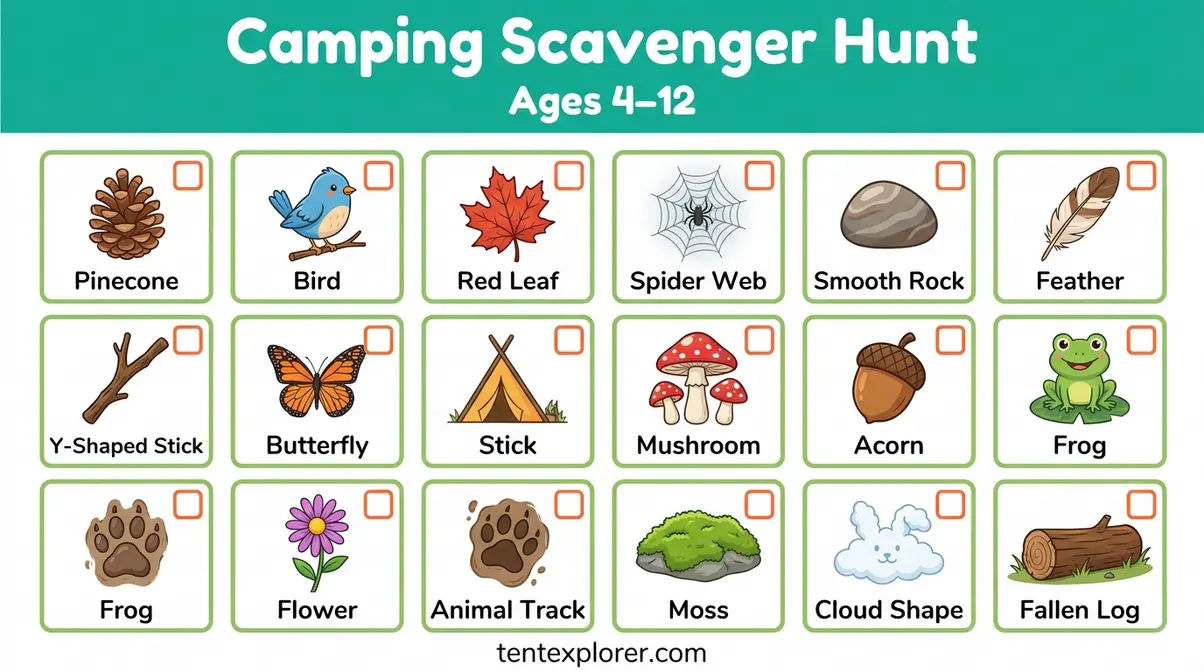
- How to play: Create a list of 10 findable items (feather, smooth stone, Y-shaped stick, etc.). Each team of one older + one younger player races to find all 10. First team back with all items wins.
- Best for ages: 4+
- Players needed: 4+ in teams of 2
- Equipment: List of items (one per team)
- Why it works across ages: Older kids naturally mentor younger siblings — turning competitive play into cooperative bonding. Families using this paired-team format report that it’s one of the few games where a 5-year-old and a 15-year-old finish at roughly the same time.
Download our free printable Camping Scavenger Hunt — designed for ages 4–12, no prep needed.
Quick Start: Print the free Camping Scavenger Hunt PDF before you leave. It takes 2 minutes to set up and keeps kids busy for hours.
“Now that you have the co-play games covered, here are the pure-energy burners for kids who need to run.”
Active Games Every Kid Will Love
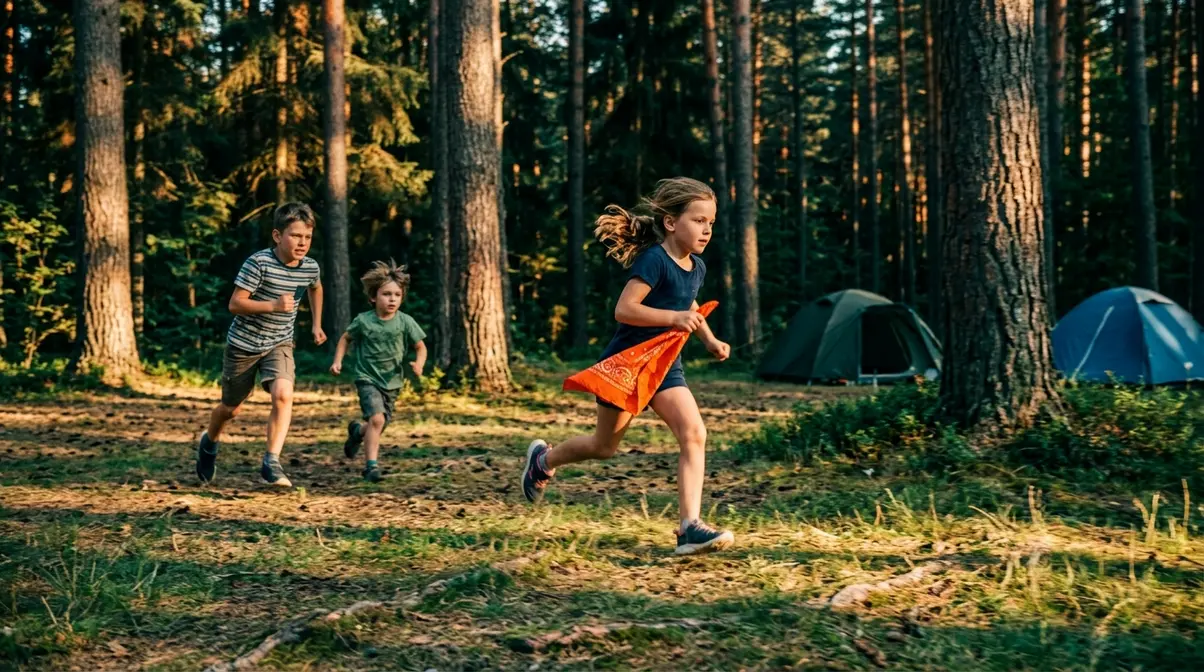
Kids between 4 and 12 have one primary need at the campsite: burn energy before dinner. These four outdoor camping games for families use whatever open space you have and require almost nothing from your gear bag. Research from Harvard Health confirms that vigorous outdoor play for at least 60 minutes per day improves sleep quality in children — which means these games serve double duty (Harvard Health, 2023).
6. Capture the Flag
Capture the Flag (a team game where each side tries to steal the opposing team’s flag without being tagged) is the gold standard of high-energy camp games.
- How to play: Divide into two teams. Each team hides a “flag” (bandana or shirt) somewhere in their territory. Teams try to cross into enemy territory, grab the flag, and return without being tagged. Tagged players go to “jail” (a marked spot) until freed by a teammate’s touch.
- Best for ages: 6+
- Players needed: 6+
- Space: Large open area
- Equipment: 2 bandanas
7. Freeze Tag
One player is “it.” Tagged players must freeze in place. A free teammate can unfreeze them with a touch. Rotate “it” every 3 minutes to keep it fair.
- Best for ages: 4+
- Players needed: 4+
- Space: Medium open area
- Equipment: None
8. Flashlight Tag
Flashlight Tag is the nighttime version of tag where the “it” player uses a flashlight beam instead of a hand-touch to tag others. Shining the beam on someone’s body (not face) counts as a tag.
- Best for ages: 6+
- Players needed: 4+
- When: After dark
- Equipment: 1 flashlight
9. Nature Obstacle Course
Use fallen logs, rocks, and trees to design a timed course around the campsite. Each child runs it; fastest time wins. Kids can redesign the course between rounds, adding creative ownership to the game.
- Best for ages: 5+
- Players needed: 2+
- Space: Any wooded or open area
- Equipment: A timer (phone works fine)
Counter-Narrative: These active games work best with some daylight and open space. If it’s raining or your campsite is tight, jump straight to the Rainy Day section below.
Campfire Games for Family Nights
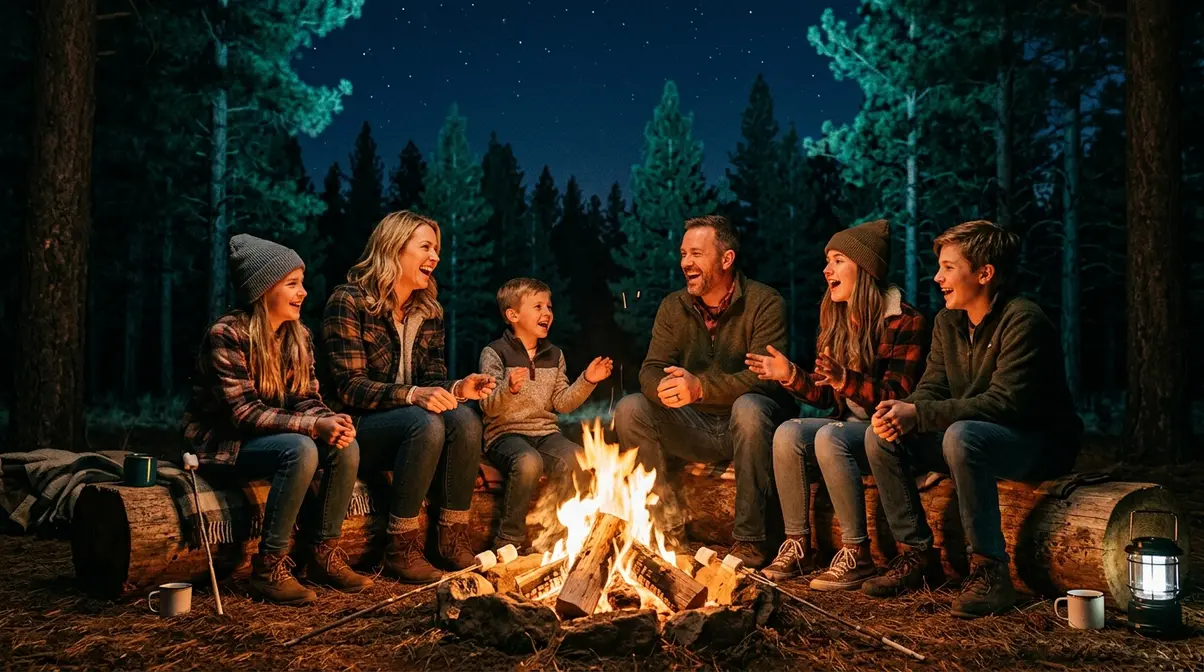
What games do you play when the fire is lit, the marshmallows are out, and you want everyone — even the shy cousin — to join in? Fun campfire games for families don’t need equipment, elaborate rules, or a lot of space. They just need a good story, a willing crowd, and maybe a bag of s’mores ingredients.
According to KOA’s campground activity guide, campfire games are consistently rated the most memorable part of a camping trip by families — more than hikes, meals, or even the campfire itself. These five games make that happen.
10. Two Truths and a Lie
Two Truths and a Lie (a classic spoken guessing game where players share two true statements and one false one, and others guess the lie) is perfect for mixed-age groups because everyone has interesting facts about themselves.
- How to play: Each player states three things about themselves — two true, one false. The group votes on which statement is the lie. The player who fools the most people wins the round.
- Best for ages: 6+
- Players needed: 3+
- Equipment: None
11. The Green Glass Door
A riddle game where one player knows the secret rule (words with double letters can go through the “Green Glass Door”) and others try to figure it out. A moon can go through, but a star cannot. A tree can go through, but a bush cannot.
- Best for ages: 8+
- Players needed: 3+
- Equipment: None
12. 20 Questions
One player thinks of any animal, vegetable, or mineral. Others ask up to 20 yes/no questions to guess what it is. Simpler for younger kids, surprisingly strategic for older players.
- Best for ages: 5+
- Players needed: 2+
- Equipment: None
13. Campfire Telephone
The classic “telephone” game, but played around a fire. One person whispers a sentence to the next; the last person says what they heard aloud. The more people, the funnier the result.
- Best for ages: 4+
- Players needed: 5+
- Equipment: None
14. Name That Sound
One player makes a sound (animal, weather, machine), and others guess what it is. Rotate after each correct guess. Younger kids love the silly sounds; older players try to stump the group with obscure ones.
- Best for ages: 3+
- Players needed: 3+
- Equipment: None
Best Camping Games for Adults & Couples
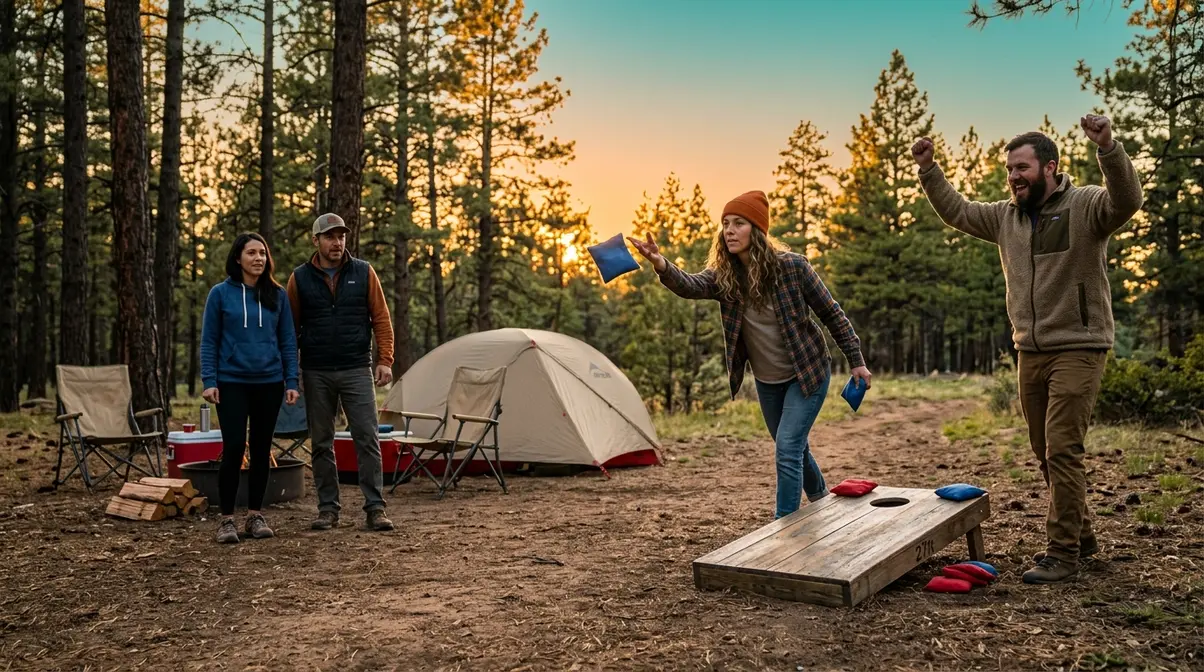
Active camping games aren’t just for kids — adults need entertainment too, especially after the younger campers go to sleep. The games in this section are designed for groups of 2–8 adults who want something more engaging than scrolling their phones by the fire. Families who’ve used these games report that adult-specific game time often becomes the most talked-about part of the whole trip.
Games for Couples & Small Friend Groups
What are some unique camp game ideas for adults? The answer is usually a yard game that’s easy to learn, hard to master, and works on uneven ground. These four options cover the full range from low-effort to surprisingly competitive.
15. Cornhole
Cornhole (a bag-toss game where players aim for a hole in a raised board) is the most popular campsite yard game in North America. It doesn’t take up too much space when broken down, and the bags weigh almost nothing.
- How to play: Two boards are placed 27 feet apart. Players alternate throwing bean bags at the opposite board. A bag through the hole = 3 points; a bag on the board = 1 point. First team to 21 wins (cancellation scoring: teams subtract each other’s points).
- Best for ages: 8+ (adults love it most)
- Players needed: 2–4
- Equipment: Cornhole set (foldable sets available for ~$40–$60)
16. Ladder Toss
Ladder Toss (a game where players throw bolas — two balls connected by a string — onto a three-rung ladder for points) is compact, fast to set up, and endlessly competitive.
- How to play: Each rung scores differently: top rung = 3 points, middle = 2, bottom = 1. Players toss bolas underhand from 15 feet away. First to exactly 21 wins — going over resets your score for that round.
- Best for ages: 10+
- Players needed: 2–4
- Equipment: Ladder toss set (~$25–$35)
17. Bocce Ball
Bocce Ball (an Italian lawn game where players throw large balls as close as possible to a small target ball called the “pallino”) travels well and works on grass, gravel, or packed dirt.
- How to play: One player throws the pallino (small target ball). Players alternate throwing bocce balls, trying to land closest to the pallino. Team with the closest ball scores 1 point per ball closer than the opponent’s nearest ball.
- Best for ages: 6+ (strategy deepens for adults)
- Players needed: 2–8
- Equipment: Bocce ball set (~$20–$30)
18. Kubb
Kubb (a Swedish lawn game — pronounced “koob” — where players knock over wooden blocks using throwing batons) is the sleeper hit of campsite games. Almost no one knows it until they play it; almost everyone wants to play again immediately after.
- How to play: Set up 10 wooden “kubbs” in two rows. Teams throw batons to knock over the opponent’s kubbs, then the king (center block) to win. Teams must knock over thrown kubbs before targeting the baseline.
- Best for ages: 8+
- Players needed: 2–8
- Equipment: Kubb set (~$30–$50)
Nighttime Games for Adults
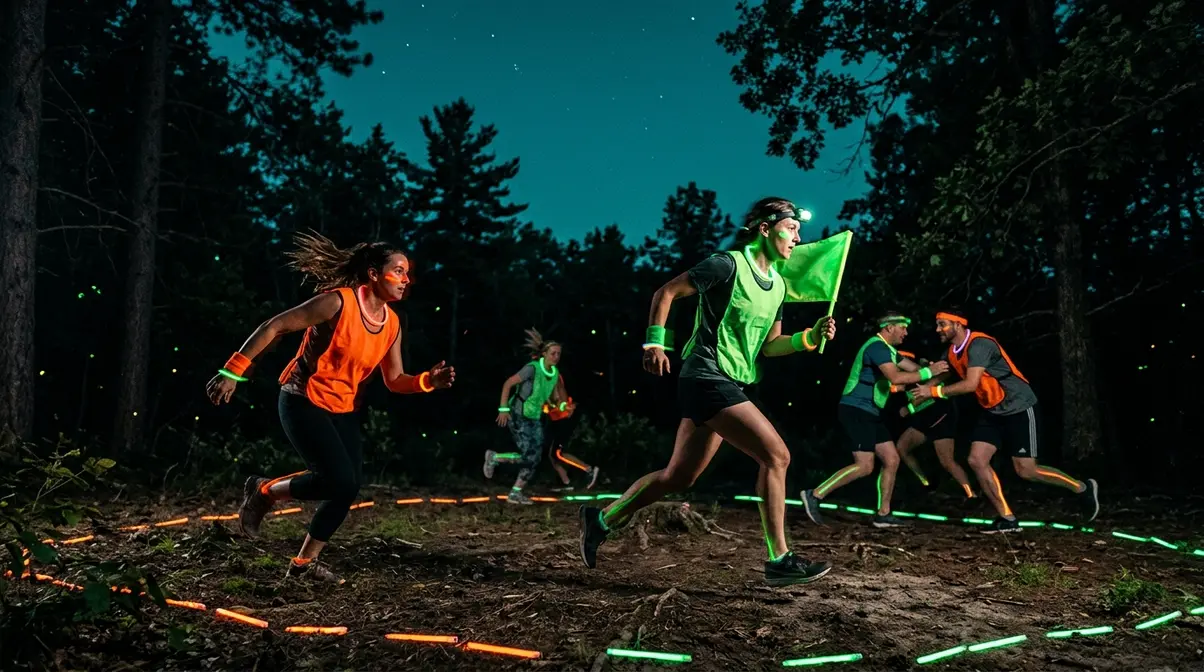
Once the kids are asleep, the campsite becomes adult territory. These games are low-prep, don’t require setup time, and keep energy going without waking anyone up.
19. Glow-in-the-Dark Capture the Flag
The adult version of daytime Capture the Flag, played entirely in the dark using glow sticks to mark territory, flags, and players. Glow bracelets on each wrist mean tags are visible; glow sticks define the boundary lines.
- Best for ages: 16+
- Players needed: 6+
- Equipment: Glow sticks (~$5 for a multipack)
20. Werewolf (Mafia)
Werewolf (a social deduction game where hidden “werewolves” try to eliminate villagers before being identified) is perfect for 6–15 adults around a fire. No equipment needed — just a deck of cards or slips of paper to assign roles.
- How to play: One player is the Moderator. Roles are assigned secretly: Werewolves (2–3), Villagers, and special roles (Doctor, Seer). Each “night” round, werewolves silently eliminate one villager. Each “day” round, the group debates and votes to eliminate a suspected werewolf. The game ends when all werewolves are found — or all villagers are gone.
- Best for ages: 14+
- Players needed: 6–15
- Equipment: Role cards (paper scraps work fine)
21. Midnight Trivia
Write 20 trivia questions on a notepad before the trip. Divide into teams, ask questions around the fire. No app needed. Categories can be tailored to your group — pop culture, nature facts, family history.
- Best for ages: 14+
- Players needed: 4+
- Equipment: Notepad + pen
No-Equipment & DIY Camping Games
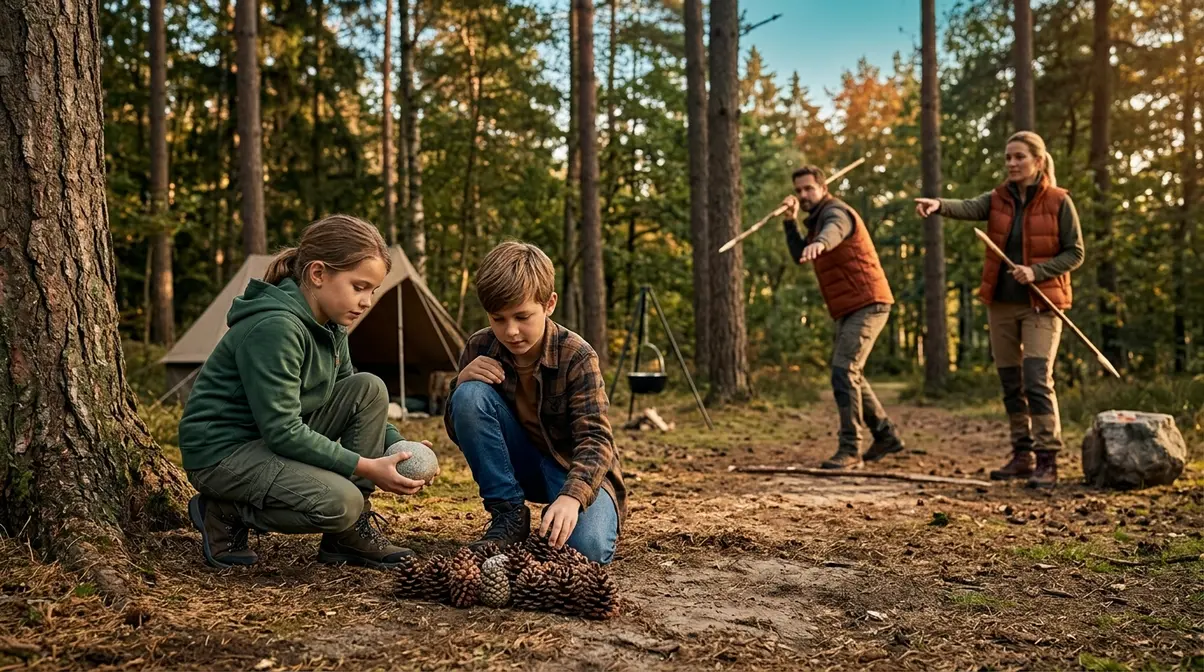
Forgot to pack entertainment? No problem. The best no-equipment camping games for families use nothing but voices, imagination, and whatever the forest provides. According to Collective Retreats’ camping activity guide, improvised nature-based games consistently rank among the most memorable activities families report from camping trips — often more than games that required gear.
Spoken Games Around the Campfire
These games require zero packing. They’re ideal for low-prep evenings, unexpected rainy stretches under a tarp, or the quiet hour before bed. The Camp Game Matrix rates these as “zero-space, low-energy, all-ages” — the most versatile category in the whole guide.
22. I Spy
The simplest game on this list. One player says “I spy, with my little eye, something that is [color/texture].” Others guess the object. Works in daylight or by firelight, for ages 2 through adult.
- Best for ages: 2+
- Players needed: 2+
23. Would You Rather?
Players take turns posing two equally unappealing (or appealing) choices: “Would you rather sleep in a tent full of spiders or eat a bowl of worms?” Everyone answers and explains why. Surprisingly revealing and endlessly funny.
- Best for ages: 6+
- Players needed: 2+
24. The Alphabet Game (Nature Edition)
Players work through the alphabet naming something found in nature for each letter. “A is for acorn, B is for bark, C is for creek…” Play cooperatively or competitively.
- Best for ages: 5+
- Players needed: 2+
DIY Games Using Nature’s Materials
These games use what the campsite already provides — sticks, rocks, pinecones, and open ground. They’re ideal when you want something physical but didn’t pack any equipment.
25. Rock Skipping Contest
Find a calm lake or wide creek. Each player gets 5 rocks. Most skips wins. Younger campers practice technique; older players compete for distance. Simple, satisfying, and genuinely challenging to master.
- Best for ages: 4+
- Players needed: 2+
- Equipment: Flat rocks from the shoreline
26. Stick Javelin
Each player finds a straight stick of roughly equal length (arm’s length). Players take turns throwing their stick as far as possible from a marked line. Measure distance with paces; longest throw wins.
- Best for ages: 6+
- Players needed: 2+
- Equipment: One stick per player
27. Pinecone Bowling
Set up 6–10 pinecones in a triangle formation. Roll a smooth, round rock to knock them down. Bowling, campsite-style. Younger kids love the setup; older kids keep score.
- Best for ages: 3+
- Players needed: 2+
- Equipment: Pinecones + one smooth round rock
The Camp Game Matrix gives all three of these a “zero-equipment, low-space, all-ages” rating — meaning they work even on the tightest campsites, and no one needs to carry anything extra in their pack.
Active Outdoor Camping Games
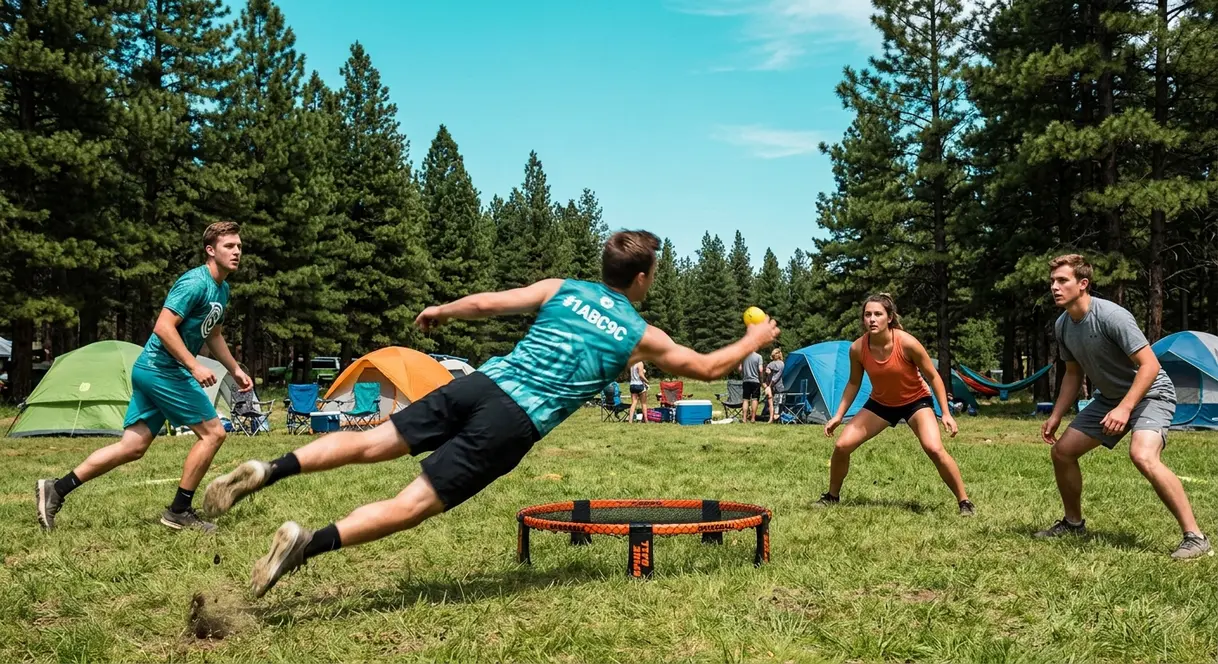
Open space is a resource. When your campsite backs onto a field or a wide clearing, these classic outdoor camping games let your group make the most of it. Families who’ve used structured yard games report that they extend active outdoor time by an average of 90 minutes per day compared to unstructured play — a meaningful difference for kids’ sleep and adults’ enjoyment (Tales of a Mountain Mama, 2024).
Classic Yard Games for Open Spaces
28. Spikeball
Spikeball (a fast-paced game where two teams of two bounce a small ball off a circular net at ground level) is one of the most popular campsite games for teens and adults. It’s compact, competitive, and requires no permanent setup.
- How to play: Set the net in the center. Serve by bouncing the ball off the net to the opposing team. Teams have 3 touches to return the ball back to the net. A point is scored when the opposing team fails to return the ball.
- Best for ages: 10+
- Players needed: 4 (2v2)
- Equipment: Spikeball set (~$50–$70)
29. Frisbee Golf (Disc Golf)
Mark 9 “holes” around the campsite using trees, stumps, or rocks as targets. Players throw a frisbee from a starting point and count throws to reach each target. Lowest score wins.
- Best for ages: 8+
- Players needed: 2–6
- Equipment: 1–2 frisbees per player
30. Kan Jam
Kan Jam (a frisbee-based game where teams try to deflect a flying disc into a cylindrical goal) is fast, loud, and highly addictive. One team member throws; the other deflects the disc toward the goal.
- Best for ages: 10+
- Players needed: 4 (2v2)
- Equipment: Kan Jam set (~$30–$45)
Nature-Based Team Games
These games use the natural environment as the playing field — trees become boundaries, trails become race courses, and the whole campsite becomes the game board.
31. Counselor Hunt (Reverse Hide and Seek)
One player hides; everyone else seeks. When a seeker finds the hider, they quietly join them in the hiding spot. The last seeker to find the growing group “loses” and becomes the hider next round. Also called “Sardines.”
- Best for ages: 5+
- Players needed: 5+
- Equipment: None
32. Camouflage
One player is the “hunter” and stands at a tree with eyes closed. Other players (“animals”) hide within sight of the hunter’s tree — but must be visible to the hunter when they open their eyes. The hunter scans for 30 seconds and calls out anyone they can see. Anyone spotted is eliminated. Repeat until only one player remains undetected.
- Best for ages: 7+
- Players needed: 4+
- Equipment: None
Rainy Day & Indoor Camping Games
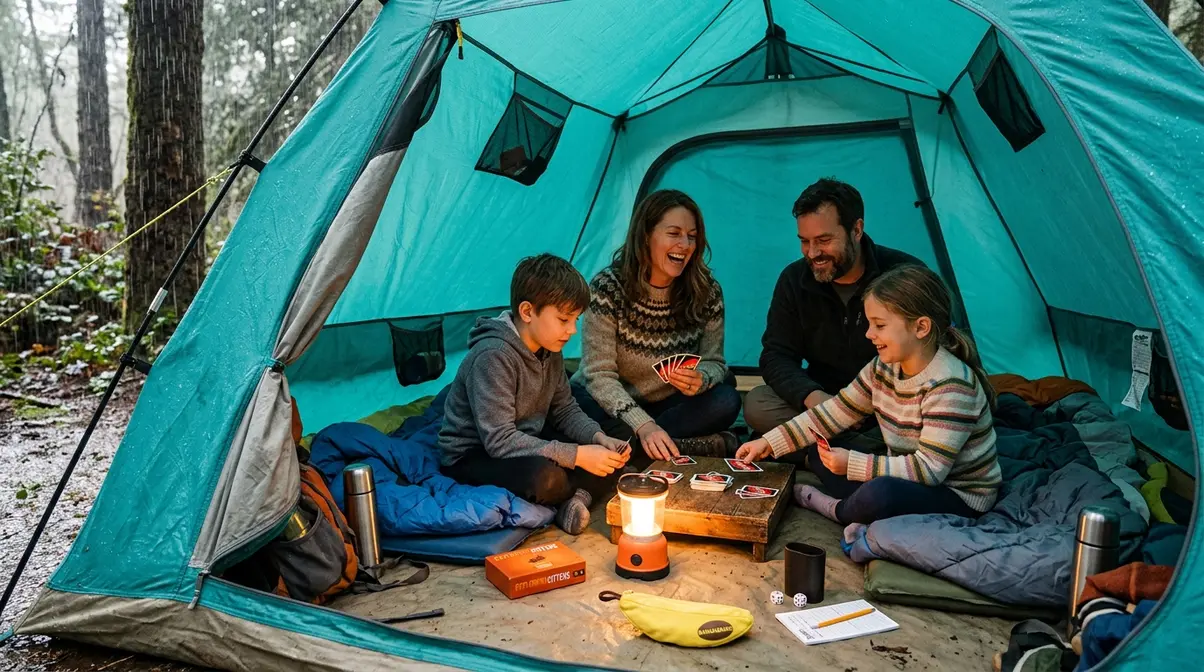
Rain happens. A well-packed game bag can turn a soggy afternoon into a surprisingly fun memory. The key is choosing games that don’t take up too much space — ideally, everything fits in a single zip-lock bag or small pouch.
Card Games & Travel-Sized Packs
33. Exploding Kittens
A fast, silly card game where players draw cards and try to avoid the Exploding Kitten card. The base deck fits in a small box and plays 2–5 players in 15 minutes. Best for: Ages 7+. Players: 2–5.
34. Uno
The all-time classic travel card game. Simple rules, fast rounds, surprisingly competitive. Best for: Ages 5+. Players: 2–10.
35. Sushi Go!
A card-drafting game where players pick cards from a rotating hand to build the best sushi meal combination. Teaches strategy without complexity. Best for: Ages 8+. Players: 2–5. Fits in a tiny tin.
Compact Board Games Worth Packing
36. Yahtzee
Yahtzee (a dice game where players roll five dice up to three times per turn to achieve scoring combinations) is the classic rainy-day camp game. The travel version includes a cup, five dice, and a scorepad — everything fits in a jacket pocket.
- Best for ages: 6+
- Players needed: 2–6
- Equipment: Travel Yahtzee set (~$8–$12)
37. Bananagrams
Bananagrams (a fast-paced word-building game where players race to arrange letter tiles into a crossword grid) comes in a banana-shaped pouch that fits anywhere. No board, no turns — everyone plays simultaneously.
- Best for ages: 7+
- Players needed: 1–8
- Equipment: Bananagrams pouch (~$15)
38. Spot It! (Dobble)
Spot It! (a matching card game where players race to find the one symbol shared between any two cards) fits in a circular tin smaller than a coffee mug. Rounds last 2–3 minutes. Best for: Ages 4+. Players: 2–8.
| Game | Ages | Players | Pack Size | Price (approx.) |
|---|---|---|---|---|
| Exploding Kittens | 7+ | 2–5 | Small box | ~$20 |
| Uno | 5+ | 2–10 | Card deck | ~$7 |
| Sushi Go! | 8+ | 2–5 | Tiny tin | ~$13 |
| Yahtzee (travel) | 6+ | 2–6 | Pocket-sized | ~$10 |
| Bananagrams | 7+ | 1–8 | Banana pouch | ~$15 |
| Spot It! | 4+ | 2–8 | Circular tin | ~$12 |
The Camp Game Matrix scores all six of these as “zero-space, low-energy, any-age” — the perfect fallback when weather shuts down everything else.
Essential Camping Questions Answered
Every family camping trip eventually surfaces a few questions that have nothing to do with the games themselves — but everything to do with having a better trip. Here are two of the most commonly searched camping concepts, answered clearly.
What Are the 7 C’s of Camping?
The 7 C’s of camping is a framework developed by the American Camp Association to help campers build confidence and competence in outdoor settings. According to the American Camp Association, the 7 C’s are:
- Character — developing personal values and integrity through outdoor challenges
- Competence — building practical skills (fire-starting, navigation, cooking)
- Confidence — gaining self-assurance through successful outdoor experiences
- Connection — forming meaningful bonds with family, friends, and nature
- Caring — developing empathy and responsibility toward others and the environment
- Contribution — giving back to the camping community and natural spaces
- Community — understanding your role within a larger group or ecosystem
For families, the 7 C’s serve as a useful lens for choosing activities: a scavenger hunt builds Competence and Connection; a campfire story circle builds Character and Community. Games aren’t just entertainment — they’re tools for the 7 C’s in action.
What Is the 3-3-3 Rule for Camping?
The 3-3-3 rule is a practical guideline popular in the RV and van camping community that helps campers avoid burnout and settle in comfortably. The rule states:
- Drive no more than 3 hours per travel day
- Arrive by 3 PM to allow time for setup before dark
- Stay at least 3 nights at each campsite before moving on
The 3-3-3 rule is especially useful for families with young children. Arriving by 3 PM means you have time to set up, explore, and play before dinner — which is exactly when you want your game bag ready. Families who follow the 3-3-3 rule consistently report lower stress levels and more enjoyment per trip compared to those who over-schedule driving days.
When Camping Games Don’t Work: Limitations & Alternatives
Common Pitfalls
Active games in tight campsites: Games like Capture the Flag and Cornhole need space. If your site is surrounded by other campers, loud active games can create friction. Check your campground’s quiet hours (typically 10 PM) and choose accordingly. Substitute: Campfire Story Circle or 20 Questions.
Weather surprises: Spoken games and card games are your best rainy-day insurance policy. Pack at least one zip-lock bag with a travel card game before every trip — it weighs almost nothing and solves the entire “stuck in a tent” problem.
Age-gap fatigue: Even the best co-play games lose steam after 90 minutes with a wide age spread. Build in natural transitions: active game → snack break → campfire game → quiet game. The Camp Game Matrix works best as a rotation system, not a single-game solution.
When to Choose Alternatives
If your group is 10+ people: Large groups benefit from team-based games (Capture the Flag, Kubb, Werewolf) over individual games. Small-group games like Cornhole or Bocce Ball create awkward wait times with big crowds.
If you’re at a no-fire campsite: Several campfire games assume an open flame for ambiance. Substitute with Glow Tag, Flashlight Tag, or a headlamp-lit trivia round — the energy is the same without the fire requirement.
When to Seek Expert Help
If you’re planning a large group camping event (20+ people, multi-family reunion, school outdoor education trip), consider consulting a certified camp counselor or outdoor educator through the American Camp Association directory. Structured programming for large mixed-age groups benefits from professional facilitation, especially for games involving physical activity and competitive elements.
Frequently Asked Questions
What games do you play while camping?
The best camping games for families depend on your group size, age range, and available space. For mixed ages, Nature Bingo and Glow Tag work well across the toddler-to-teen range. For adults, Cornhole, Kubb, and Bocce Ball are consistent crowd favorites. Campfire games like Two Truths and a Lie and Campfire Story Circle need zero equipment and work for everyone. A good rule of thumb: pack one active game, one campfire game, and one compact card game for every trip.
How do you make camping fun for the whole family?
Making camping fun for the whole family means planning activities for every age group, not just the kids. The Camp Game Matrix (energy × space × age) is a practical way to match the right game to any moment. Research from Harvard Health confirms that shared outdoor play — even for short sessions — reduces stress and improves mood for both children and adults (Harvard Health, 2023). Build a game rotation into your trip: active games after breakfast, free exploration midday, campfire games at night.
What are some unique camp game ideas?
Some of the most unique camping game ideas use the natural environment as equipment — no packing required. Camouflage (nature-based hide and seek where you must stay visible to the hunter), Pinecone Bowling, and Stick Javelin are all DIY games that competitors rarely mention. For groups that want something more structured, Kubb (the Swedish lawn game) and Kan Jam are both under-the-radar options that consistently surprise new players with how competitive they get.
What are the 7 C’s of camping?
The 7 C’s of camping are a framework from the American Camp Association: Character, Competence, Confidence, Connection, Caring, Contribution, and Community. They describe the core developmental outcomes that well-designed camping experiences produce in participants. For families, framing game choices around the 7 C’s adds intentionality to play — a scavenger hunt builds Competence, a story circle builds Connection, and a team game like Capture the Flag builds Community.
What is the 3-3-3 rule when camping?
The 3-3-3 rule is a travel guideline that recommends driving no more than 3 hours per day, arriving by 3 PM, and staying at least 3 nights per campsite. It’s especially popular in the RV community and is widely shared across progressive camping forums. For families, following the 3-3-3 rule means you arrive with enough daylight to set up and play before dinner — removing the rushed, exhausted arrival that kills the first-day mood.
Your Family’s Best Camping Trip Starts With the Right Game
For families planning a camping trip in 2026, the difference between a forgettable weekend and a trip your kids talk about for years often comes down to one thing: having a game plan. Camping games for families work best when they’re matched to your specific group — ages, energy, and available space — which is exactly what The Camp Game Matrix is designed to help you do. Research consistently shows that shared outdoor play reduces stress, builds connection, and creates the kind of memories that outlast any gear purchase (Harvard Health, 2023).
The Camp Game Matrix isn’t complicated. Three variables — energy, space, and age — narrow a list of 25+ games down to the three or four that are perfect for your group right now. Use it before you leave home to pack the right games, and use it at the campsite when someone inevitably says, “what do we do now?”
Start with one game from each category: one active outdoor game, one campfire spoken game, and one compact rainy-day backup. Pack them before you leave, introduce The Camp Game Matrix to your family so everyone can vote, and let the trip surprise you. Your next camping trip is going to be the one they remember.

Dave King
I'm Dave King. I publish Tent Explorer, a site built to answer the questions people actually ask before they buy.