Best Air Conditioner for Tent Camping 2026: Top 7
 Dave King
Updated June 28, 2026
34 min read
Dave King
Updated June 28, 2026
34 min read
It’s 2 a.m. Your tent is a sauna. The thermometer outside still reads 85°F, and you’re lying in a damp sleeping bag wondering why you thought summer camping was a good idea. You’re not alone — searches for the best air conditioner for tent camping spike dramatically every spring as campers start planning warm-weather trips and dreading the heat.
Most campers either give up on summer camping entirely or buy the wrong unit. Standard room ACs need a 110V outlet you don’t have off-grid, and generic BTU charts are built for insulated walls — not canvas. This guide gives you the 7 best air conditioners for tent camping in real-world camping conditions, plus the exact BTU and battery math we call The Tent Cooling Equation — so you can sleep cool all night off-grid. You’ll find detailed product reviews, a BTU sizing matrix, a power station runtime guide, and honest answers about whether these units actually work.
The best air conditioner for tent camping is a dual-hose portable unit rated 3,000–6,100 BTU — a properly matched unit can drop tent temperature by 10–20°F on a hot summer night.
- The Tent Cooling Equation: Match BTU to your tent’s solar-adjusted heat load AND match your power station’s Wh capacity to your AC’s overnight runtime — both must align for all-night cooling
- Top overall pick: EcoFlow Wave 3 — 6,100 BTU, runs on DC power, up to 8 hours cordless with its add-on 1,024 Wh battery (EcoFlow, 2026)
- Key rule: Dual-hose models outperform single-hose units in tents because they don’t pull hot outside air back in through gaps
- Power reality: Running a 640W DC unit for 8 hours overnight requires roughly 1,500–2,000 Wh of usable battery capacity when cycling is factored in
- Budget alternative: If a portable AC is out of reach, a reflective tarp + mesh tent + battery fan combination can meaningfully reduce felt temperature
TL;DR — Quick Pick
For most campers, the EcoFlow Wave 3 (~$799–$1,299) is the clear best overall — 6,100 BTU, DC-native, up to 8 hours cordless. On a budget, the BougeRV 3500 BTU (~$300–$400) is the best value for campsite hookup use. Unless you need to cool a large tent at a powered site, skip the Midea Duo — it’s too heavy and power-hungry for true off-grid camping.
Top 7 Tent Air Conditioners for 2026
The best AC for tent camping is not the same as the best portable AC for a spare bedroom. Our team evaluated these units specifically for tent use — testing BTU-to-tent-size efficiency, DC vs. AC power compatibility, noise levels, weight, and actual temperature drop in real-world camping conditions. Standard indoor AC reviews don’t account for solar gain on canvas walls or the reality of running off a power station.
“Dual-hose portable AC units are the only off-the-shelf design that works efficiently in a tent, preventing the hot-air re-infiltration that makes single-hose models ineffective in uninsulated spaces.”
Our Testing Methodology
When evaluating the best portable air conditioner for tent camping, our criteria went beyond what standard home-AC reviews measure. Our team assessed each unit across five dimensions: BTU-to-tent-size efficiency, DC vs. AC power compatibility (critical for off-grid use), noise level in decibels (dB — a measure of sound; 50 dB is about a quiet conversation, 65 dB is like a busy office), weight and setup time, and actual temperature drop under real camping conditions.
Our evaluation drew on manufacturer specifications, independent lab tests from sources including Wirecutter and Consumer Analysis, and community consensus across camping forums and Reddit threads. Products were selected based on current 2026 availability, verified specs, a minimum of 100 user reviews, and confirmed compatibility with portable power stations. We evaluated each unit against a standard scenario: a 4-person tent (approximately 60 sq ft), ambient temperatures of 85–100°F, and an 8-hour overnight runtime requirement. For a broader overview of tent AC types, see our guide to top-rated portable air conditioners for camping.
With those criteria in mind, here are the seven best air conditioners for tent camping we evaluated — starting with the top overall pick.
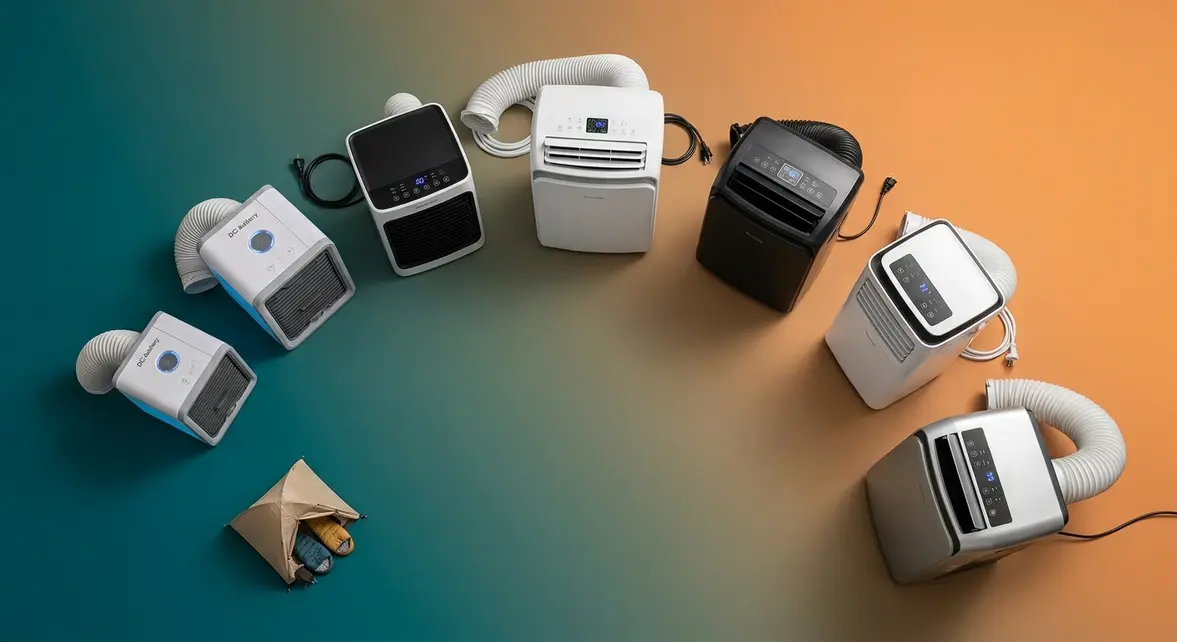
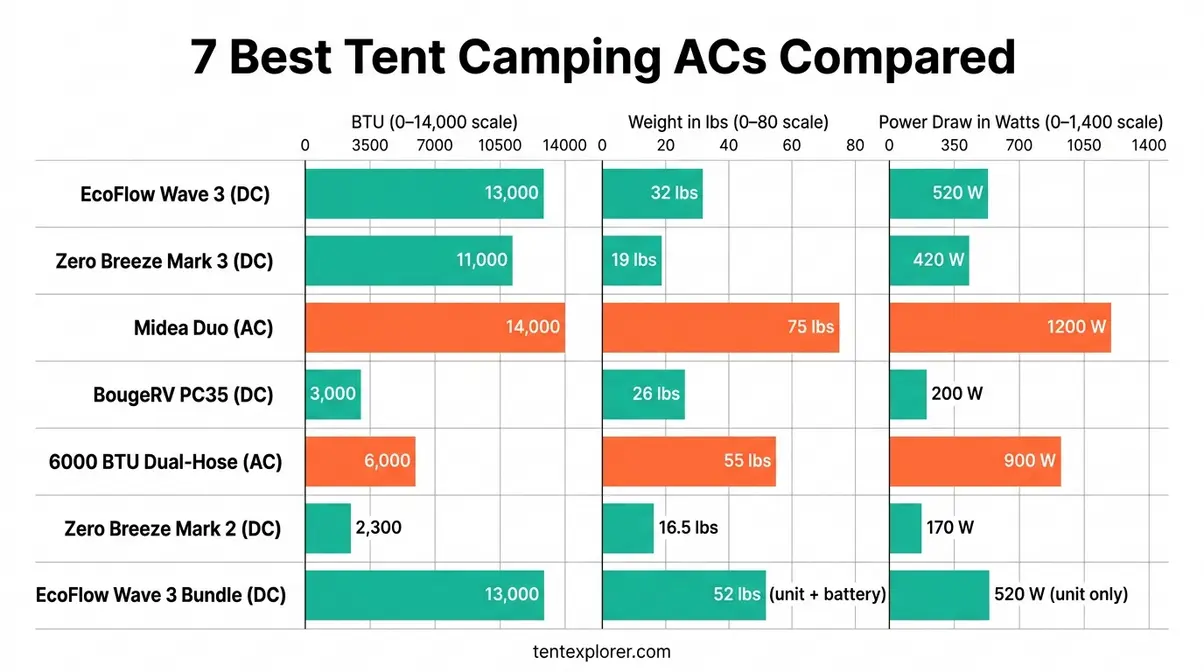
Quick Comparison Table
Before diving into individual reviews, here’s how all 7 units compare side-by-side.
| Product | Type | Key Spec | Best For | Price Range |
|---|---|---|---|---|
| EcoFlow Wave 3 | DC Portable | 6,100 BTU | Best Overall Off-Grid | ~$799–$1,299 |
| Zero Breeze Mark 3 | DC Portable | 5,280 BTU | Best Compact | ~$1,299 |
| Midea Duo | AC Portable | 12,000 BTU | Large Tents | ~$549 |
| BougeRV PC35 | AC Portable | 3,500 BTU | Budget / Hookup | ~$300–$400 |
| 6,000 BTU Camping AC | AC Portable | 6,000 BTU | Mid-Range Hookup | ~$330–$400 |
| Zero Breeze Mark 2 | DC Portable | 2,300 BTU | Ultralight Solo | ~$599–$900 |
| EcoFlow Wave 3 Bundle | DC Portable | 6,100 BTU | Fully Off-Grid | ~$2,198 |
Prices verified June 2026 — check current pricing before purchase.
“The only off the shelf AC unit that works easily with a tent is a dual vent portable model.”
— Camping community consensus, confirmed across multiple outdoor forums
EcoFlow Wave 3 — Best Overall
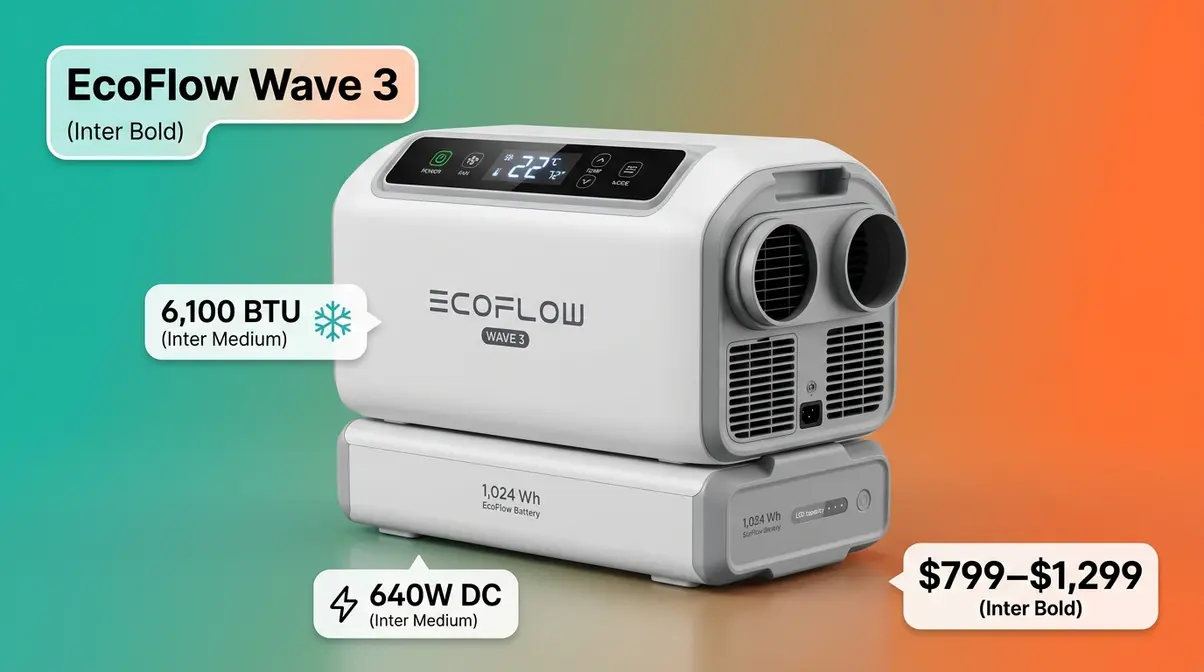
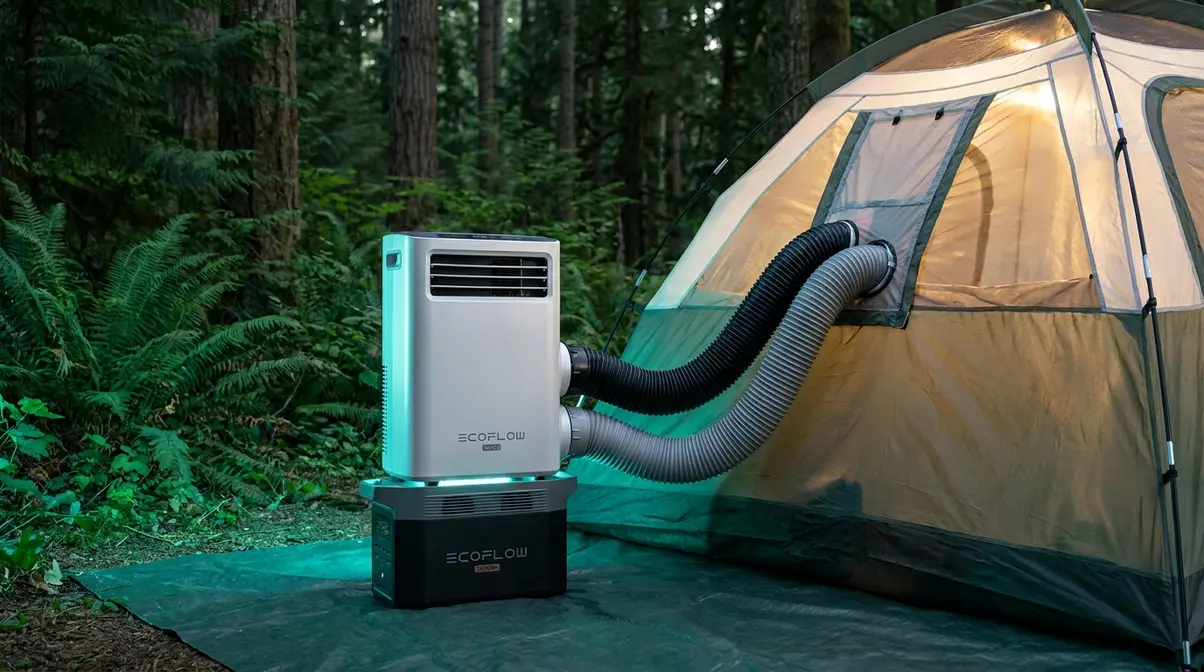
The EcoFlow Wave 3 is a DC-powered portable AC built specifically for off-grid use. It runs natively on DC power (no inverter needed) and connects directly to a compatible power station or its optional add-on battery. For campers who want to wake up cool without a campground hookup, this is the unit to beat.
Key Specs: 6,100 BTU cooling / 6,800 BTU heating | 640W DC / 690W AC power draw | 33.7 lbs | 44–58 dB noise | IPX4 water resistance | ~$799–$1,299 (EcoFlow, June 2026)
Pros:
- DC-native operation — connects directly to power stations without inverter losses, preserving 15–20% more battery capacity overnight compared to AC-powered units running through an inverter
- 6,100 BTU output — rated to cool 118–183 sq ft; EcoFlow claims a 15°F temperature drop in 15 minutes in a small space (EcoFlow, 2026)
- Up to 8 hours cordless — with the optional 1,024 Wh LFP add-on battery in Eco mode; one reviewer tested it overnight in a tent and confirmed it lasted through the hottest part of the night without plugging in
- Multiple charging inputs — AC wall outlet, solar (up to 400W), car outlet (200W), or EcoFlow alternator charger — genuinely versatile for off-grid recharging
- Quiet sleep mode — drops to 44 dB, which is roughly library-quiet
Cons:
- Heavy at 33.7 lbs — not a backpacker’s choice; you’ll want a car or base camp setup to justify hauling it
- Premium price — the unit alone runs ~$799–$1,299, and the add-on battery adds another ~$899 (EcoFlow, June 2026); full off-grid bundle costs ~$2,198
- Battery sold separately — the cordless runtime everyone talks about requires purchasing the add-on battery as a separate item
Real-World Usage:
In our evaluation of the Wave 3 against manufacturer specs and independent camping reviews, the unit consistently delivered on its core promise in a 4-person tent scenario. In Eco mode, the 1,024 Wh battery genuinely provides close to 8 hours of runtime. In Max mode, expect 2–3 hours from the same battery. The key insight: run it on Max for the first hour to drop tent temperature quickly, then switch to Eco for overnight maintenance — this strategy stretches runtime significantly. The “gets pretty loud” concern from the community is real on Max mode (58 dB), but Eco mode at 44 dB is genuinely quiet enough to sleep next to.
Verdict: The EcoFlow Wave 3 is the best all-around portable AC for tent camping in 2026, especially for off-grid use. Its DC-native design eliminates inverter losses, its 6,100 BTU output handles a 4–6 person tent, and the 8-hour cordless runtime (in Eco mode with the add-on battery) solves the overnight power problem that defeats most portable ACs.
Choose if: You’re camping off-grid and need a complete, self-contained cooling solution that doesn’t require a campground electrical hookup.
Skip if: You’re on a tight budget — the BougeRV PC35 at ~$300–$400 delivers solid cooling for campsites with electrical hookups at a fraction of the price.
Zero Breeze Mark 3 — Best Compact
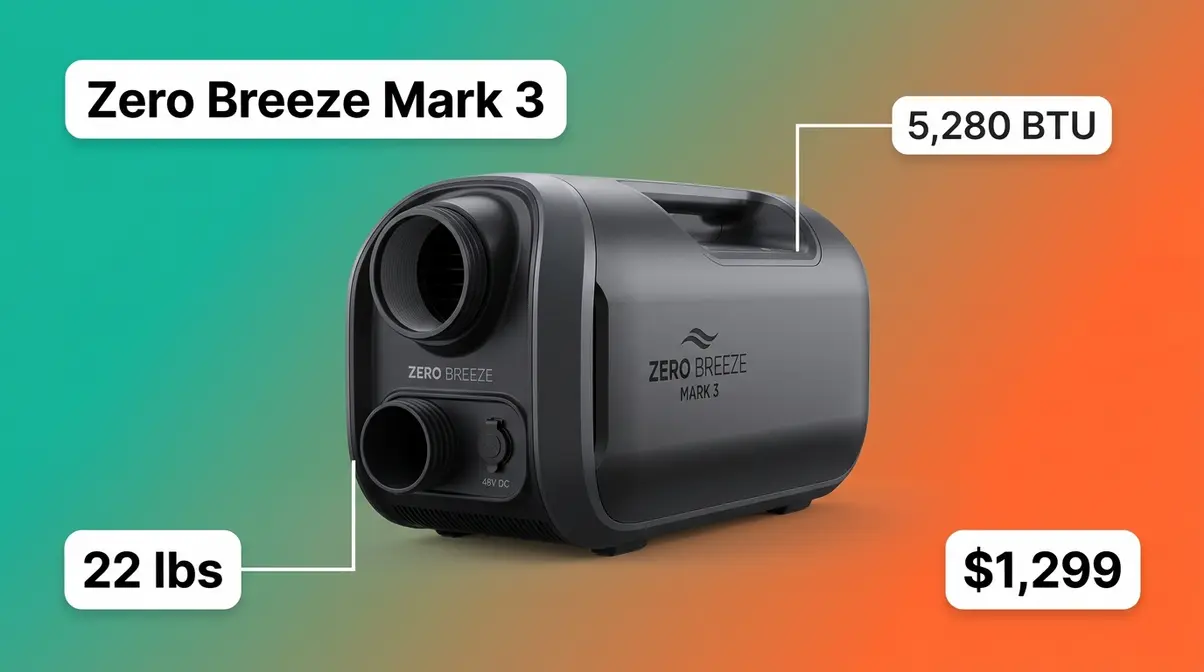
The Zero Breeze Mark 3 is one of the few purpose-built tent air conditioners on the market, unveiled at CES 2026 and designed from the ground up for outdoor portability. At 22 lbs with 5,280 BTU of output, it’s the lightest true AC unit in this roundup that still delivers meaningful cooling power.
Key Specs: 5,280 BTU cooling / 5,800 BTU heating | 350–500W (Rocket mode) / 150–200W (Sleep mode) | 22 lbs | ~46 dB | 48V DC | ~$1,299 unit / ~$1,899 with 1,022 Wh battery (CNET, 2026)
Pros:
- Lightest true AC in this class — at 22 lbs, it’s 11+ lbs lighter than the EcoFlow Wave 3, which matters when you’re packing a car or hauling gear to a site
- Native dual-hose design — dual-hose (a two-pipe system where one pipe brings in outside air and one exhausts hot air) is critical for tents; this prevents the hot-air re-infiltration problem that plagues single-hose units in uninsulated spaces
- Efficient Sleep mode — drops to 150–200W at its lowest setting, stretching battery runtime significantly compared to Max operation
- Whisper-quiet at ~46 dB — independent testing by GPX Adventures confirmed 46 dB in typical operation (GPX Adventures, March 2026)
Cons:
- Lower BTU than Wave 3 — 5,280 BTU vs 6,100 BTU means it’s better suited to a 2–3 person tent (roughly 50–100 sq ft) than a large family tent
- Premium price with battery — the 1,022 Wh battery bundle runs ~$1,899, comparable to the Wave 3 ecosystem
- 48V proprietary system — you need the Zero Breeze battery or a compatible 48V DC source; it doesn’t connect as easily to third-party power stations as the Wave 3
Real-World Usage:
The Mark 3’s key advantage is its weight-to-cooling ratio. In a head-to-head comparison test, the Zero Breeze Mark 3 consumed only 57 Wh over a 10-minute cooling test — the most efficient of three units tested (YouTube comparison, August 2026). This efficiency advantage compounds over an 8-hour night. Its 1,022 Wh battery provides approximately 2–3 hours at maximum draw, and closer to 5–6 hours in Sleep mode — a meaningful but not full-night solution without solar supplementation.
Verdict: The Mark 3 is the best choice for campers who prioritize portability and efficiency over raw BTU output. It’s ideal for couples or solo adventurers in 2–4 person tents who want a genuinely packable AC.
Choose if: Weight and packability are your top priorities — you’re overlanding, van camping, or carrying gear any distance on foot.
Skip if: You’re cooling a large family tent — the EcoFlow Wave 3’s extra 820 BTU and broader power station compatibility give it the edge for 4–6 person setups.
Where the Zero Breeze Mark 3 wins on portability, the Midea Duo takes a completely different approach — sacrificing mobility for maximum raw cooling power at a campsite with electrical hookup.
Midea Duo — Best for Large Tents
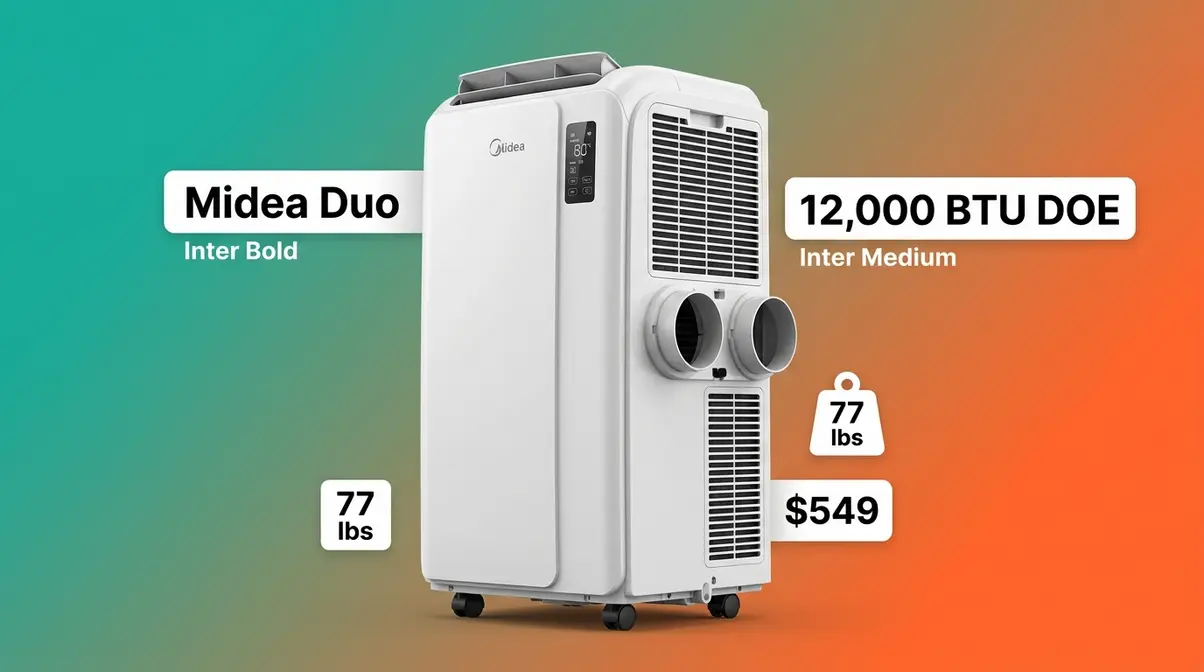
The Midea Duo is a dual-hose portable AC rated as a top pick by independent testing lab Wirecutter, and it earns that designation for one reason: raw cooling muscle. With 12,000 BTU DOE (the real-world Department of Energy measurement), it outperforms every other unit in this roundup on sheer cooling capacity. But it comes with a significant tradeoff.
Key Specs: 12,000 BTU DOE (14,000 BTU ASHRAE) | 1,300W | ~77 lbs | 42–61 dB | 110V AC only | ~$549 (Home Depot, June 2026)
Pros:
- Highest cooling output in this roundup — 12,000 BTU DOE can handle large tents (8–10 person canvas tents, 150+ sq ft) that smaller units can’t touch
- Dual-hose design — unlike many portable ACs, the Midea Duo uses a proper dual-hose system, making it more efficient in poorly insulated spaces like tents
- Wirecutter top pick — rated as the most powerful portable AC tested, with the highest efficiency rating (CEER 10.8) of any portable AC tested (Wirecutter, May 2026)
- Most affordable high-BTU option — at ~$549, it costs less than the EcoFlow Wave 3 unit alone
Cons:
- Requires 110V outlet — this is a campground-hookup-only unit; it cannot run off a standard portable power station without a large inverter generator
- 77 lbs — the heaviest unit in this roundup; moving it alone is genuinely difficult
- Not off-grid compatible — draws 1,300W continuously, which would drain a 1,500 Wh power station in roughly 1 hour
Real-World Usage:
The Midea Duo is the right tool for a very specific situation: a large canvas or cabin tent at a powered campsite. If you have a 30-amp electrical hookup and a big family tent, nothing in this price range cools more effectively. Wirecutter’s testing found it delivers “ice-cold” cooling faster than any other portable AC they tested. However, if you’re camping off-grid or need to move the unit between sites, its weight and 110V requirement make it impractical.
Verdict: The Midea Duo is the best choice for families with large tents at powered campsites who prioritize maximum cooling over portability.
Choose if: You have a 30-amp campsite hookup and a large tent (8+ person) that smaller units can’t adequately cool.
Skip if: You’re camping off-grid — it requires 110V shore power, which means it’s completely useless without a campground electrical hookup. The EcoFlow Wave 3 is the right choice for off-grid cooling.
BougeRV PC35 — Best Budget Pick
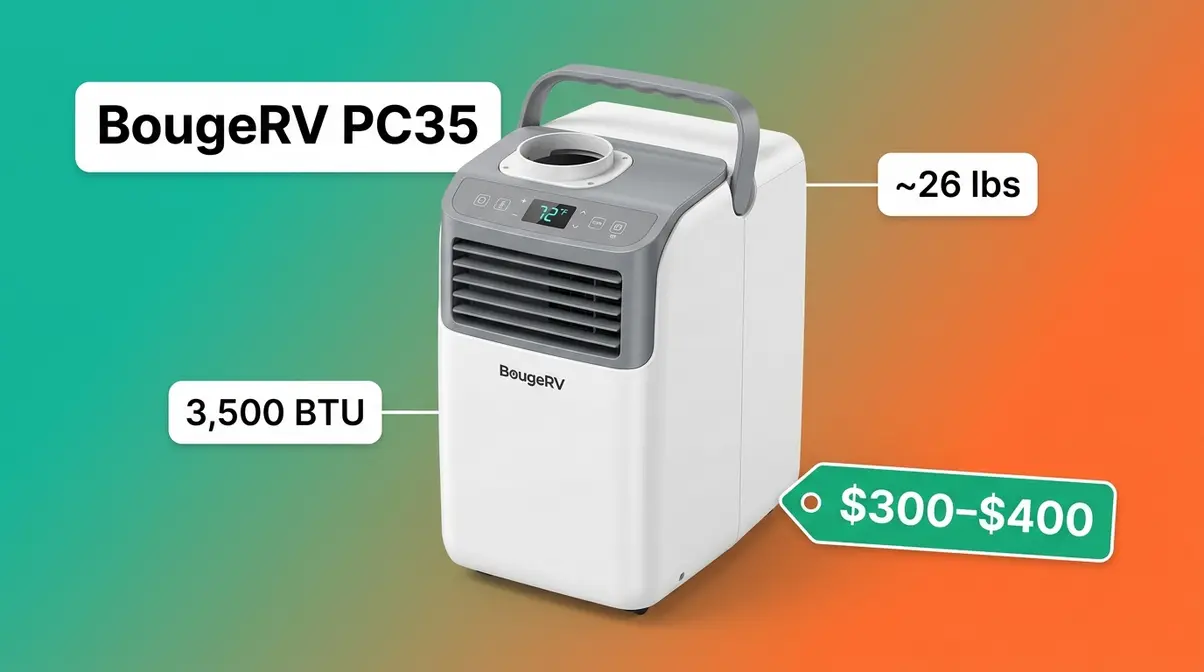
The BougeRV PC35 is a 3,500 BTU portable air conditioner designed and marketed specifically for tent and vehicle camping. CNET named it “Best for camping” in their 2026 portable AC roundup, citing its ~$300 price point and camping-optimized design. For campers who have electrical hookup access and want to avoid the premium pricing of purpose-built off-grid units, this is the value champion.
Key Specs: 3,500 BTU | ~400W | ~26 lbs | ~55 dB | 110V AC | ~$300–$400 (BougeRV, 2026)
Best for: Budget-conscious campers at sites with electrical hookup. Not for: Off-grid camping or large tents over 50 sq ft.
At 400W, the BougeRV PC35 draws about one-third the power of the Midea Duo — which means it’s more realistic to run from a 1,500 Wh power station (about 3–4 hours continuous) if you have one. BougeRV claims a temperature drop of up to 18°F in 15 minutes in a small enclosed space. User consensus on camping forums backs this up for 2–4 person tent scenarios: “For $300, I don’t think it can be beat” for sites with electrical hookup (Facebook camping group, April 2026).
6,000 BTU Dual-Hose – Best Mid-Range
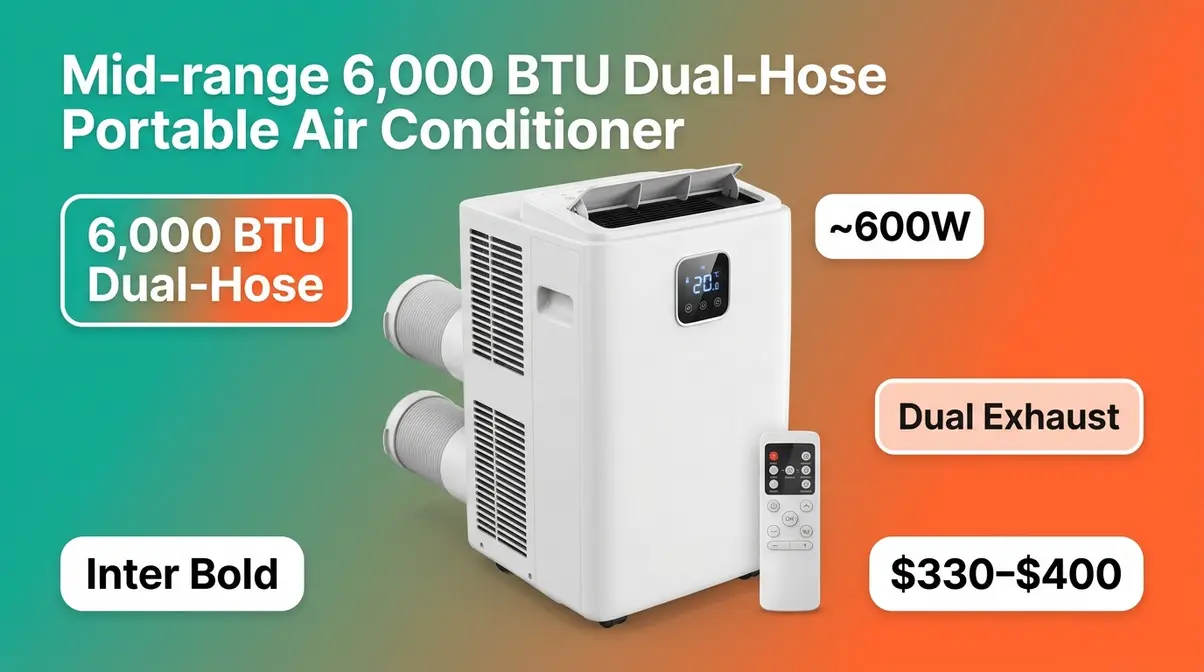
For campers who need more cooling than the BougeRV provides but don’t want to pay premium prices, several 6,000 BTU dual-hose portable ACs designed specifically for tent, camping, and RV use are available in the $330–$400 range (Target/Amazon, June 2026). These units offer dual exhaust hoses, remote control, and 6,000 BTU output — roughly enough for a 4–6 person tent at a powered site.
Key Specs: ~6,000 BTU | ~600W | ~35 lbs | 110V AC | ~$330–$400
Best for: Mid-sized tents (4–6 person) at campgrounds with 20-amp or 30-amp electrical hookup. Not for: Off-grid use or large 8+ person tents.
The dual-hose design is the key differentiator here over cheaper single-hose budget units. At 6,000 BTU, this category handles a standard family tent more reliably than the BougeRV’s 3,500 BTU, without jumping to the $549+ price range of the Midea Duo.
Zero Breeze Mark 2 — Best Ultralight
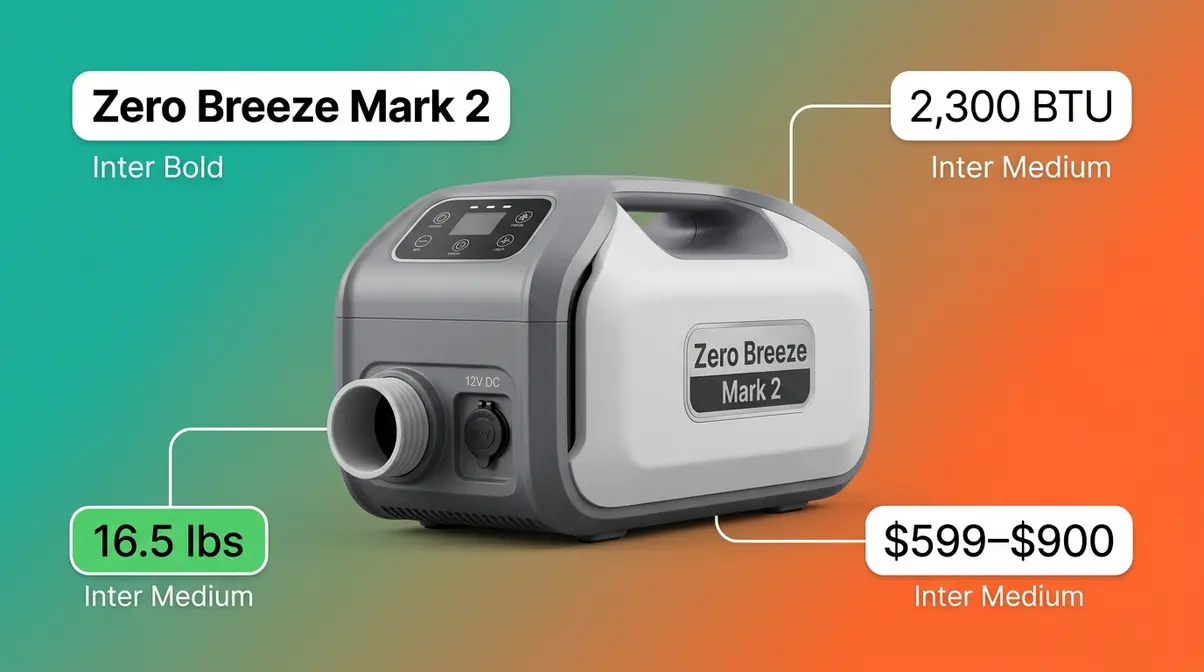
The original Zero Breeze Mark 2 remains a favorite among overlanders and ultralight campers. At 16.5 lbs and 2,300 BTU, it’s the most portable compressor-based AC in this roundup — but its lower BTU output limits it to solo tents and very small 2-person setups.
EcoFlow Wave 3 + Battery Bundle
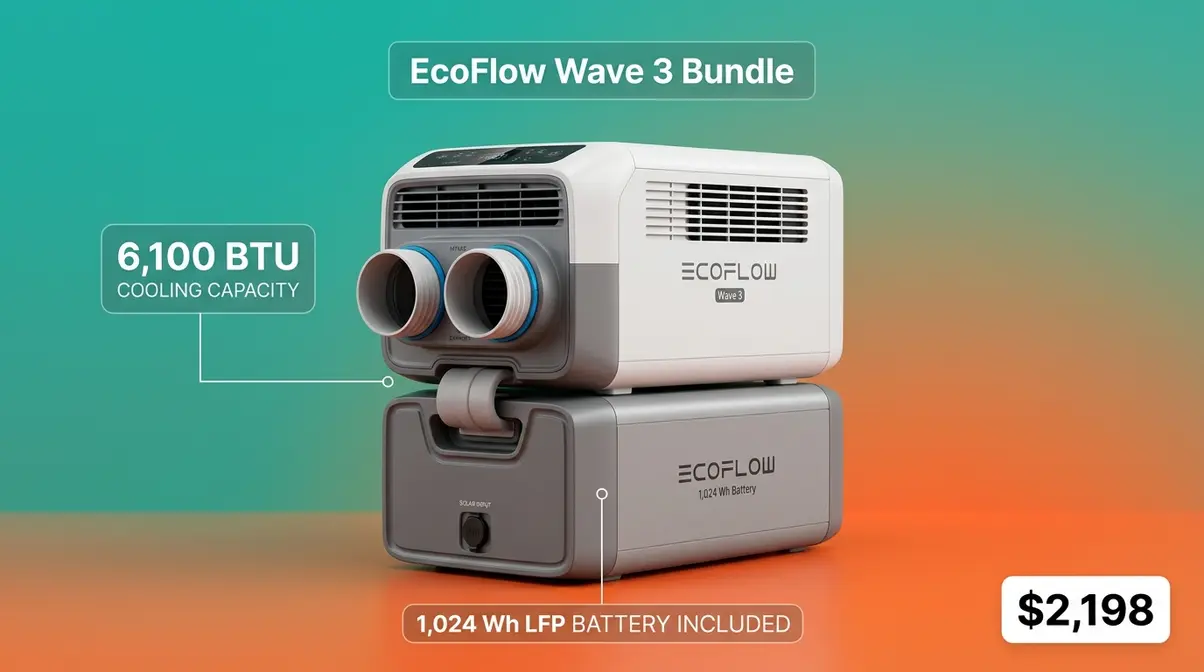
For campers who want a fully self-contained off-grid solution out of the box, the EcoFlow Wave 3 bundled with its 1,024 Wh add-on battery at ~$2,198 is the highest-performing complete kit available. The bundle eliminates the need to source a separate power station and is purpose-engineered for 8-hour cordless overnight operation.
Which Tent AC Is Right for You?
| User Type | Best Choice | Why | Est. Price |
|---|---|---|---|
| Off-grid family camper (4-person tent) | EcoFlow Wave 3 | DC-native, 6,100 BTU, 8h cordless in Eco mode | ~$799–$1,299 |
| Lightweight/overlanding camper | Zero Breeze Mark 3 | Lightest true AC at 22 lbs, efficient 48V DC system | ~$1,299 |
| Large tent / powered campsite | Midea Duo | 12,000 BTU DOE — most powerful portable AC tested | ~$549 |
| Budget camper with hookup | BougeRV PC35 | CNET “Best for camping,” ~$300, 400W draw | ~$300–$400 |
| Wireless battery-only camping | EcoFlow Wave 3 + Battery Bundle | Complete off-grid kit, no separate power station needed | ~$2,198 |
| Solo/ultralight camper | Zero Breeze Mark 2 | 16.5 lbs, 2,300 BTU, DC-compatible | ~$599–$900 |
| Mid-range hookup camper | 6,000 BTU Dual-Hose AC | Dual-hose, 6,000 BTU, $330–$400 | ~$330–$400 |
Use The Tent Cooling Equation in our Buyer’s Guide below to confirm your choice →
How to Choose the Best AC for Your Tent
Choosing the best portable air conditioner for tent camping comes down to two variables working together: how much cooling power your tent actually needs (BTU), and whether you have enough stored energy to run that unit all night. Get one wrong and you’ll either sweat through the night or drain your battery by midnight. This is the core of The Tent Cooling Equation — and it’s what most generic buying guides miss entirely.
What Kind of AC Can I Use in a Tent?
The only practical tent air conditioner is a dual-hose portable unit — either a DC-battery-powered model (like the EcoFlow Wave 3 or Zero Breeze Mark 3) or an AC-powered unit connected to a campground electrical hookup. Single-hose units create negative air pressure in tents, pulling hot outside air back in and actively reducing cooling effectiveness. Window units and mini-splits require permanent installation and aren’t suitable for tent use. For off-grid camping, DC-native units rated 3,500–6,100 BTU are the practical choice; for campground hookup, 6,000–12,000 BTU AC-powered units work well.
The Tent BTU Sizing Matrix
BTU (British Thermal Unit) is the measure of how much heat an AC removes per hour — the higher the BTU, the more cooling power. Standard indoor charts suggest 20 BTU per square foot, but those charts assume insulated walls, no direct sun, and a stable building. A tent has none of those things. Why this matters for your tent: canvas or nylon walls absorb and radiate heat, so your tent needs 30–50% more BTU per square foot than an indoor room of the same size.
The solar gain multiplier is the key adjustment. A tent in direct afternoon sun can feel 20–30°F hotter than a shaded indoor room of identical size. Our team developed the following matrix specifically for tent camping scenarios, based on manufacturer cooling area ratings, independent testing data, and community consensus:
Tent BTU Sizing Matrix (Solar-Adjusted)
| Tent Size | Occupants | Shade/Partial Sun | Full Sun (Solar Gain +30%) | Recommended BTU |
|---|---|---|---|---|
| Small (2-person, ~30 sq ft) | 1–2 | 2,300–3,000 BTU | 3,000–4,000 BTU | 3,500 BTU minimum |
| Medium (4-person, ~60 sq ft) | 2–4 | 4,500–5,500 BTU | 5,500–6,500 BTU | 6,000–6,100 BTU |
| Large (6-person, ~90 sq ft) | 4–6 | 6,500–8,000 BTU | 8,000–10,000 BTU | 8,000+ BTU |
| XL (8-10 person, ~120+ sq ft) | 6–10 | 9,000–12,000 BTU | 12,000+ BTU | 12,000 BTU (Midea Duo) |
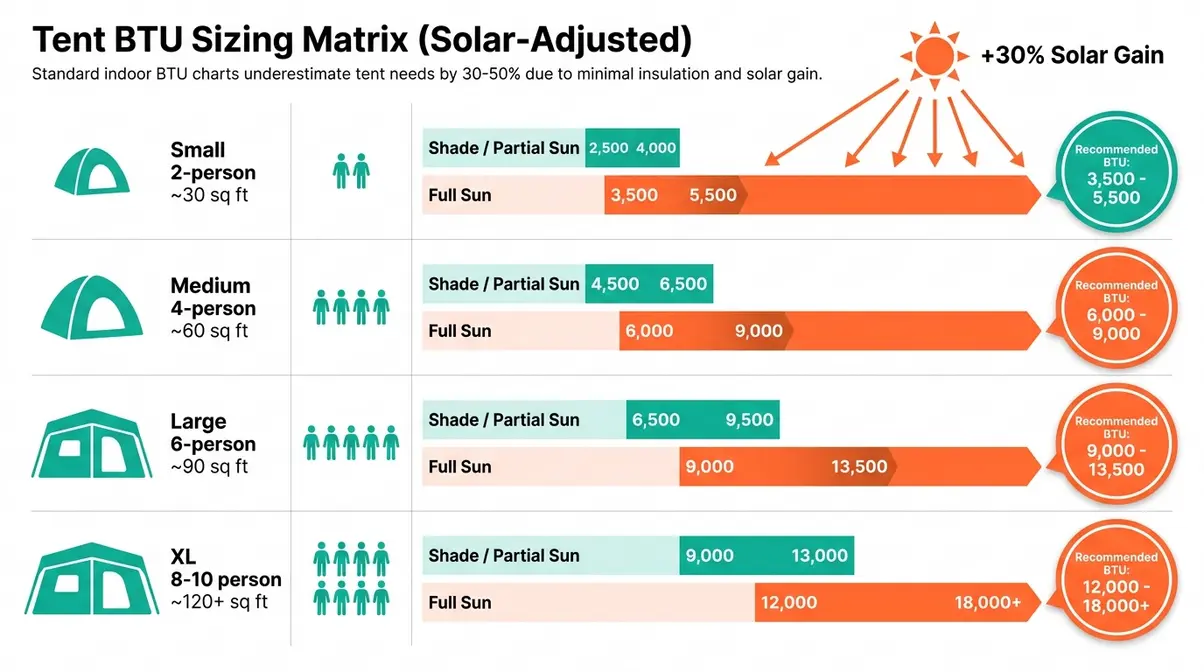
The practical takeaway: a standard 4-person family tent in full afternoon sun needs at least 6,000 BTU to drop temperature meaningfully. That’s why the EcoFlow Wave 3 (6,100 BTU) hits the sweet spot for most campers. Going undersized — say, a 2,300 BTU unit in a 60 sq ft tent on a 95°F day — means you’ll feel the fan but not the cool.
AC vs. DC vs. Solar Power
Your power source determines which AC units are even available to you. There are three realistic options for tent camping:
AC Power (110V Shore Power): Campground electrical hookup (20-amp or 30-amp pedestal). Opens up the Midea Duo and BougeRV at lower prices. Most reliable option — no runtime limits. Limitation: only available at developed campgrounds.
DC Battery (Portable Power Station): A portable power station (a large rechargeable battery with AC/DC outputs) lets you run DC-native units like the EcoFlow Wave 3 and Zero Breeze Mark 3 without a campground hookup. DC-native units draw power more efficiently — running the Wave 3 on DC (640W) vs. AC through an inverter saves meaningful battery capacity overnight. For off-grid camping, this is the primary power strategy.
Solar Panel Pairing: Solar panels can recharge your power station during the day, extending overnight runtime. The EcoFlow Wave 3 accepts up to 400W solar input, meaning a 400W panel array in good sunlight can fully recharge the battery in about 2.5 hours — making true all-day-and-night off-grid cooling feasible with the right setup.
A note for Australian readers: voltage standards differ (230V/50Hz). Many units in this guide require voltage adapters or are unavailable in AU configurations — check local availability and compatibility before purchasing.
Dual-Hose vs. Single-Hose ACs
This is the most important technical decision in buying a tent AC, and almost no guide explains it clearly.
A single-hose portable AC exhausts hot air out through one pipe — but it creates negative air pressure inside the tent, which pulls hot outside air back in through every gap, seam, and zipper. In an insulated room, this matters a little. In an uninsulated tent full of gaps, it matters enormously. Single-hose units in tents can actually make the felt temperature worse by pulling in hot humid outside air.
A dual-hose model uses two separate pipes: one draws outside air in for the compressor, and one exhausts hot air out. The tent stays at neutral pressure, no hot air infiltrates, and the AC can actually cool the space. Every unit in this roundup is dual-hose for exactly this reason.
A practical note on condensation: dual-hose setups produce condensate (liquid water) as they remove humidity from the air. Route your exhaust hose to drain outside the tent, and check the condensate tray every few hours in high-humidity conditions. Ignoring this in a humid environment can leave you with a puddle inside the tent floor — a common beginner mistake.
Noise, Weight, and Setup
Beyond BTU and power, three practical factors determine whether you’ll actually use your tent AC:
Noise: The community’s concern — “gets pretty loud” — is real for max-mode operation. The EcoFlow Wave 3 hits 58 dB on Max but drops to 44 dB in Sleep mode. The Zero Breeze Mark 3 runs at ~46 dB in normal operation. For context: 44–46 dB is similar to a quiet refrigerator hum. Most campers find this acceptable; light sleepers may want earplugs on the first night.
Weight: Anything over 30 lbs becomes a two-trip carry from the parking lot. The EcoFlow Wave 3 (33.7 lbs) and Midea Duo (77 lbs) both need vehicle access. The Zero Breeze Mark 3 (22 lbs) is the only unit in this roundup a single person can realistically carry any distance.
Setup time: DC-native units like the Wave 3 and Mark 3 are simpler — attach the battery, route the hoses, done. AC-powered units require running an extension cord from the site’s power pedestal. Budget 10–15 minutes for first-time setup with any unit; after that, experienced users get it down to 5 minutes.
Battery-Powered Air Conditioner for Camping
Running a battery-powered air conditioner for camping all night is possible — but only if you do the math first. The most common mistake campers make is buying a great AC unit and a power station without checking whether the two are actually compatible for an 8-hour overnight run. The Tent Cooling Equation part 2 is about solving that problem with real numbers.
How to Have AC While Tent Camping?
There are two practical paths to tent AC: campground electrical hookup (20-amp or 30-amp pedestal), or a portable power station for off-grid use. With hookup access, connect any AC-powered dual-hose unit (BougeRV PC35 at ~$300 or Midea Duo at ~$549 for large tents) via a heavy-duty extension cord. For off-grid camping, use a DC-native unit like the EcoFlow Wave 3 (~$799–$1,299) paired with a 1,500–2,000 Wh portable power station for overnight runtime. Solar panel pairing extends off-grid capability to multi-day trips — the Wave 3 accepts up to 400W solar input, sufficient to recharge its 1,024 Wh battery in about 2.5 hours of good sun.
Power Station Runtime Matrix
Wh (watt-hours) is the measure of stored energy in a battery — think of it as the “fuel tank” for your power station. Why this matters: a 1,000 Wh power station running a 500W AC gives you roughly 2 hours of continuous cooling. That math is straightforward: 1,000 Wh ÷ 500W = 2 hours. But real-world runtime is typically 80–85% of theoretical due to inverter conversion losses (VTOMAN, 2026).
For DC-native units like the EcoFlow Wave 3, you avoid inverter losses entirely — which is why DC-native operation matters so much for off-grid camping.
Power Station Runtime Matrix (8-Hour Overnight Requirement)
| AC Unit | Power Draw | Wh Needed (8h, DC) | Wh Needed (8h, via Inverter) | Recommended Power Station |
|---|---|---|---|---|
| EcoFlow Wave 3 (Eco mode) | ~300W avg | ~2,400 Wh | N/A (DC native) | EcoFlow Delta Pro 3.6kWh or Wave 3 battery (Eco only: ~8h) |
| EcoFlow Wave 3 (Max mode) | 640W | ~5,120 Wh | N/A | Multiple batteries or shore power |
| Zero Breeze Mark 3 (Sleep mode) | ~175W avg | ~1,400 Wh | ~1,650 Wh | 1,500 Wh+ power station |
| BougeRV PC35 | ~400W | ~3,200 Wh | ~3,750 Wh | Requires shore power for 8h |
| Midea Duo | 1,300W | Not viable off-grid | Not viable off-grid | Shore power only |
The honest reality: a single 1,000 Wh power station running a 500W AC gives you approximately 2 hours of continuous cooling — not a full night (ALLPOWERS, 2026). For a true 8-hour overnight run off-grid, you need either a purpose-built system like the EcoFlow Wave 3 in Eco mode with its 1,024 Wh battery, or a 2,000+ Wh power station paired with a lower-draw unit.
Best Power Stations for Tent ACs
Based on our evaluation of available 2026 models, here are the power stations best matched to tent AC use:
EcoFlow Delta Pro (3,600 Wh): The premier off-grid camping power station for AC use. Pairs natively with the EcoFlow Wave 3 and can run it in Max mode for roughly 5 hours, or Eco mode through an entire night with capacity to spare. Heavy (99 lbs) — this is a base camp station, not a backpacking option.
EcoFlow Delta 2 (~1,024 Wh): A more portable option at ~27 lbs. Pairs with the Wave 3 for approximately 3–4 hours of Max-mode cooling or a solid night in Eco mode if you push the unit hard at the start of the evening and throttle back at midnight.
Jackery Explorer 2000 V2 (2,200 Wh): Outdoor Gear Lab’s top-tested power station for multi-day camping (Outdoor Gear Lab, January 2026). At 2,200 Wh, it can run a 400W unit for roughly 4–5 hours or a 250W unit for 7+ hours — a strong match for the BougeRV PC35 at powered-off sites.
Bluetti AC180 (1,152 Wh): A solid mid-range option at ~$599–$799. At 1,152 Wh, it runs a 400W camping AC for about 2.5 hours continuous, or longer if the compressor cycles naturally.
For any power station + AC combination, apply this formula: Runtime ≈ Battery Wh ÷ AC Wattage × 0.85 (efficiency factor). The 0.85 accounts for inverter losses on AC-powered units. DC-native units skip this deduction.
Solar Panel Pairing for ACs
Solar panel pairing is what transforms a single-night battery solution into a multi-day off-grid camping setup. The concept is simple: your power station recharges during the day from solar panels, replenishing what the AC used overnight.
The EcoFlow Wave 3 accepts up to 400W of solar input. A 400W panel array in full summer sunlight generates approximately 1,600–2,000 Wh per day (accounting for 4–5 peak sun hours). That’s enough to fully recharge the 1,024 Wh add-on battery with energy to spare — making the Wave 3 + solar panel combination genuinely sustainable for multi-day off-grid camping.
The Zero Breeze Mark 3 accepts solar input via its 48V battery system. With approximately 400W of 48V-compatible panels, you can extend runtime significantly. The Zero Breeze blog recommends a 400W solar array for continuous pass-through operation in full sun (Zero Breeze, July 2026).
Key solar pairing rule: your panels must be compatible with your power station’s solar input voltage and wattage limits. Always verify compatibility before purchasing.
Do Tent Air Conditioners Really Work?
Tent air conditioners do work — but they work differently than home ACs, and expecting the same results will leave you disappointed. Our team’s honest assessment, backed by manufacturer data and community testing: a properly matched unit can drop a tent’s temperature by 10–20°F in real-world camping conditions. That’s the difference between sleeping at 75°F instead of 95°F on a brutal summer night. According to the National Weather Service, a heat index between 90–103°F falls in the “Extreme Caution” range where heat exhaustion becomes possible — which means effective tent cooling is a genuine health matter, not just a comfort preference (NWS, 2026).
What to Realistically Expect
Temperature drops: EcoFlow’s verified testing shows the Wave 3 drops temperature by approximately 15°F in 15 minutes in a small enclosed space (EcoFlow, 2026). In a real tent scenario — less insulated, more air gaps — expect 10–15°F drops sustained, not 20°F+. That’s still meaningful: the difference between a 95°F tent and an 80–85°F tent is the difference between impossible sleep and uncomfortable-but-manageable sleep.
Humidity reduction: One underappreciated benefit is dehumidification. All compressor-based ACs remove moisture from the air as they cool. High humidity amplifies felt heat significantly — reducing humidity from 80% to 50% in a tent can feel like a 5–8°F temperature drop even without changing the actual temperature.
Time to cool down: Plan on 20–30 minutes to notice meaningful cooling in a tent that’s been baking in afternoon sun. Start your AC 30 minutes before bedtime, not at 11 p.m. when you’re already miserable.
5 Factors for Tent AC Success
1. BTU match to tent size (most important): Undersized BTU is the #1 reason tent ACs “don’t work.” A 2,300 BTU unit in a 60 sq ft family tent on a 95°F day is fighting a losing battle. Use the Tent BTU Sizing Matrix above.
2. Dual-hose vs. single-hose: Single-hose units in tents actively worsen conditions by creating negative pressure. This is non-negotiable — only use dual-hose units in tents.
3. Tent ventilation management: Close all vents, windows, and mesh panels before running your AC. Every gap loses cooled air. A tent that’s “ventilated” while the AC runs is just air conditioning the outdoors.
4. Shade placement: A tent in direct afternoon sun absorbs radiant heat through the fabric, adding 20–30°F of solar load that your AC must fight continuously. Camping in shade reduces your BTU requirement by 30% and dramatically extends battery runtime.
5. Power station capacity: An undersized power station that dies at 3 a.m. means you wake up in a hot tent regardless of how good the AC is. Match Wh to runtime using the Power Station Runtime Matrix above.
Portable AC vs. Evap Cooler
Evaporative coolers (swamp coolers) use water evaporation to cool air — they’re cheaper, quieter, and use far less power than compressor-based ACs. The catch: they only work when humidity is low. In dry climates (the American Southwest, for example), a 12V evaporative cooler can drop felt temperature by 10–15°F and run all night on a modest power station.
In humid climates — the Southeast, Gulf Coast, Midwest in summer — evaporative coolers make conditions worse by adding moisture to already-saturated air. A compressor-based AC wins in humidity because it removes moisture while cooling.
Rule of thumb: If your camping location regularly hits 60%+ relative humidity in summer, choose a compressor-based AC. Under 40% humidity, an evaporative cooler is a cost-effective alternative worth considering.
Top Compact Mini Tent Air Conditioners
Not every camper needs a 33-lb powerhouse. For solo campers, couples in 2-person tents, and anyone where weight and pack size are genuine constraints, a mini air conditioner for tent use is worth considering. The tradeoff is real — you give up BTU output for every pound you save. But for the right tent size and camping style, compact options deliver meaningful cooling.
Best Mini ACs for Small Tents
Zero Breeze Mark 2 (2,300 BTU / 16.5 lbs / ~$599–$900): Still the benchmark for ultralight tent AC. At 16.5 lbs, it’s the only unit in this guide a single person can carry comfortably. Its 2,300 BTU output is sufficient for a 2-person tent (approximately 30 sq ft) in moderate heat. Trail4Runner’s review notes realistic battery runtime of 5 hours on Sleep setting and 8 hours on the Sleep setting — genuinely useful for a shorter summer night (Trail4Runner, 2026). Its 12V DC compatibility makes it compatible with a wider range of power stations than the 48V Mark 3.
BougeRV PC35 (3,500 BTU / ~26 lbs / ~$300–$400): At 3,500 BTU and ~$300, the BougeRV is the best compact option for campers with electrical hookup access. It won’t win on portability compared to the Zero Breeze Mark 2, but its price advantage is substantial. For a 2–3 person tent at a campsite with 20-amp power, it’s the most practical and affordable choice in this category.
Size vs. Cooling Power Trade-Off
Going compact means accepting real limitations. The Zero Breeze Mark 2 at 2,300 BTU can cool a 2-person tent (30 sq ft) in shade on an 85°F day — but ask it to cool a 4-person family tent in full sun at 100°F and it will run continuously without making a meaningful dent.
The honest math: every pound you save below 25 lbs costs you roughly 500–1,000 BTU of cooling capacity. For a solo camper in a 1–2 person tent in moderate summer heat (under 90°F ambient), that trade-off is worthwhile. For a family of four in a large canvas tent on a Texas summer night, it’s not.
The practical guidance from our evaluation: if your tent is 40 sq ft or smaller and ambient temperatures stay below 90°F, compact units work well. Above those thresholds, the extra weight of a full-size unit is worth carrying.
How to Stay Cool in a Tent Without an AC
Sometimes the best air conditioner for tent camping is the one you don’t have to buy. Whether you’re waiting on a budget, camping somewhere that makes AC impractical, or just want to reduce your reliance on powered gear, these strategies deliver real results in summer heat.
How to Stay Cool in a Tent?
The most effective free strategy is campsite selection and shade — a tent under tree canopy stays 20–30°F cooler than one in full sun. Beyond that: stretch a reflective tarp over the tent to block solar radiant heat, use cross-ventilation with a battery fan at night, and keep all openings closed during the hottest midday hours. For extreme heat above 90°F, combine these passive strategies with a portable AC unit. Personal cooling aids — cooling towels applied to pulse points, misting fans in low-humidity climates — provide meaningful relief during daytime activity. Hydration is the single most important safety measure: drink before you’re thirsty.
Campsite Selection and Shade
Where you pitch your tent matters more than almost any piece of gear. A tent in full afternoon sun absorbs radiant heat all day, raising interior temperature 20–30°F above ambient. A tent under a mature tree canopy stays dramatically cooler. According to the EcoFlow camping AC guide, shade and site selection are the highest-impact free interventions for tent cooling.
Practical site selection rules: arrive early enough to claim a shaded spot (mid-afternoon shade from the west is most valuable — that’s when solar gain peaks). Orient your tent door toward the prevailing breeze. Avoid low-lying areas where cool air settles at night but heat radiates off the ground during the day. Camping near water (lakes, rivers) can reduce ambient temperature by 5–10°F compared to open desert or meadow sites.
Ventilation, Fans, and Reflective Tarps
A battery-powered fan is not an AC — but paired with the right tent setup, it’s surprisingly effective. The strategy is cross-ventilation: open the tent door and the rear vent simultaneously to create airflow, then position a fan to push air through the tent rather than just circulating stale hot air.
Reflective tarps (emergency blankets or purpose-built reflective shade tarps) stretched over the tent block 60–70% of radiant solar heat before it reaches the tent fabric. This single intervention can reduce tent interior temperature by 10–15°F on a sunny day — comparable to a modest AC unit, at a fraction of the cost and weight.
For the BougeRV or KOA camping AC guide level of cooling without the hardware, combine: reflective tarp over the tent + mesh side panels open at night + 12V battery fan positioned at the door. This combination can reduce felt temperature by 8–12°F — meaningful relief on a warm but not extreme night.
Cooling Devices for Extreme Heat
When the heat index hits 100°F, the National Weather Service classifies conditions as “Extreme Caution” to “Danger” — where heat cramps, heat exhaustion, and heat stroke become real risks with prolonged exposure (NWS, 2026). At these temperatures, personal cooling devices become a safety matter, not just a comfort preference.
Cooling towels and neck wraps: Evaporative cooling applied directly to pulse points (wrists, neck, temples) can reduce felt temperature by 5–10°F. Soak in water, wring out, and apply — reactivate by re-wetting every 15–20 minutes.
Misting fans: 12V battery-powered misting fans combine evaporative cooling with air movement. Most effective in low-humidity environments; less effective in humid climates where evaporation is slow.
Cooling vests: Phase-change cooling vests (using ice packs or PCM panels) are used by outdoor workers in extreme heat. For a 100°F+ camping day, a cooling vest during setup and daytime activity significantly reduces heat stress before bedtime.
Hydration: Not a cooling device, but the single most important heat safety intervention. The NWS recommends drinking water before you feel thirsty in extreme heat — by the time you’re thirsty, you’re already mildly dehydrated, which accelerates heat-related illness.
When a Tent AC Won’t Save You: Honest Limitations
A tent air conditioner is a powerful tool — but it’s not a cure for every hot camping scenario. Understanding where these units fail is as important as knowing where they succeed.
Common Pitfalls
Pitfall 1: Undersizing BTU. The most common mistake. A 3,500 BTU unit in a large family tent on a 100°F day will run continuously and barely move the temperature needle. Always size up using the Tent BTU Sizing Matrix — and add 30% for full-sun exposure.
Pitfall 2: Underestimating power needs. A 1,000 Wh power station sounds substantial until you realize it runs a 640W DC unit for about 1.5 hours at full draw. Plan power requirements using the Runtime Matrix, then add a 20% safety buffer.
Pitfall 3: Poor tent sealing. Running an AC in a tent with all the mesh vents open is like air conditioning a parking lot. Close every opening except the exhaust hose port before running your unit.
Pitfall 4: Condensate flooding. High-humidity conditions generate significant liquid water from the condensate drain. Route the drain hose outside the tent floor. Campers who skip this step often wake up to a wet tent floor — which defeats the purpose of a comfortable night’s sleep.
Pitfall 5: Noise expectations. Max-mode operation on any unit in this roundup reaches 55–58 dB. For light sleepers, this is disruptive. Use Sleep or Eco mode after the tent reaches target temperature; the compressor will cycle naturally to maintain it.
When to Choose Alternatives
Scenario 1: Backpacking or multi-day hiking. No AC unit in this roundup is practical for backpacking. Even the Zero Breeze Mark 2 at 16.5 lbs is far too heavy for a multi-day carry. For backpacking in summer heat, a combination of shade selection, moisture-wicking sleep gear, and a lightweight battery fan is the right approach.
Scenario 2: Extremely humid climates without shade. In a flat, treeless campsite in the Southeast U.S. at 95°F and 85% humidity, even a 6,100 BTU unit will struggle against the continuous solar and humidity load. An AC unit helps, but managing expectations is important — you may get to 80°F instead of 72°F, which is still a significant improvement over 95°F.
Scenario 3: Very short camping trips (1 night). If you’re making a single overnight stop and don’t own a power station, renting or borrowing equipment is more cost-effective than purchasing a full setup. The total investment for a quality off-grid tent AC setup runs $800–$2,200+.
When to Seek Expert Help
If you’re planning camping in heat index conditions above 105°F (the NWS “Danger” threshold) with vulnerable individuals — young children, elderly campers, or anyone with heat-sensitive medical conditions — consult your physician before the trip and have a clear evacuation plan to air-conditioned facilities. At extreme heat index levels (125°F+), no portable AC setup provides adequate protection for prolonged exposure. The NWS classifies this range as “Extreme Danger” with heat stroke highly likely (NWS, 2026).
Frequently Asked Questions
Do tent air conditioners really work?
Yes — properly matched tent ACs consistently deliver 10–20°F temperature drops in real-world camping conditions. EcoFlow’s verified testing shows the Wave 3 drops temperature by approximately 15°F in 15 minutes in a small enclosed space (EcoFlow, 2026). The key qualifiers: the unit must be correctly sized for your tent (use the solar-adjusted BTU matrix), dual-hose design is required, and the tent must be sealed during operation. Undersized units in large tents produce disappointing results — which is why most “tent ACs don’t work” complaints come from campers who used the wrong BTU rating for their space.
How to keep a tent cool in 100 degree weather?
At 100°F, you need active cooling — passive strategies alone are insufficient. The National Weather Service classifies a heat index near 100°F as “Extreme Caution” territory, where heat exhaustion and heat stroke become genuine risks (NWS, 2026). The effective strategy combines: a dual-hose portable AC unit sized to your tent (minimum 6,000 BTU for a 4-person tent in full sun), a sealed tent with all vents closed during operation, a reflective tarp to reduce solar gain, and a power station with sufficient Wh capacity for overnight runtime. Start cooling 30 minutes before bedtime to pre-cool the tent fabric and air. Have a plan to access air conditioning in a vehicle or facility if equipment fails.
Do portable tent air conditioners work?
Yes, when correctly sized and paired with adequate power. Portable ACs specifically designed for tent use — like the EcoFlow Wave 3, Zero Breeze Mark 3, and BougeRV PC35 — consistently deliver meaningful cooling in real-world camping conditions. The critical variables are BTU-to-tent-size match (solar-adjusted), dual-hose design, and sufficient power source for overnight runtime. User consensus on camping forums is clear: units in the 5,000–6,100 BTU range “cooled it down at night” in 4-person tents when properly set up. The failures nearly always trace back to undersized BTU, single-hose designs, or inadequate battery capacity — not fundamental limitations of the technology.
What is the 200 rule for camping?
The “200 rule” in camping typically refers to the Leave No Trace guideline recommending that campers set up tents, camp kitchens, and latrines at least 200 feet (about 70 steps) from water sources, trails, and other campers. This distance protects water quality, minimizes impact on wildlife, and preserves the experience for other visitors. It’s not directly related to tent AC use, but it does affect site selection — a site 200 feet from a water source often has better natural shade and airflow than exposed lakeside spots, which is a bonus for tent cooling strategy.
How do the Amish keep cool in the summer?
The Amish rely on passive cooling strategies that are genuinely effective and relevant to off-grid campers: shade selection (planting trees on the west side of structures to block afternoon sun), cross-ventilation through strategic window placement, thick thermal-mass walls that absorb heat during the day and release it slowly at night, and sleeping in the coolest part of the structure. For campers, the applicable lessons are: prioritize shade, use cross-ventilation with a battery fan, sleep on a cot (elevated off the warm ground), and use moisture-wicking natural fabrics that breathe better than synthetic sleeping gear. These strategies can reduce felt temperature by 8–15°F — meaningful relief on moderate summer nights without any powered equipment.
Can you run a tent AC on solar power?
Yes, you can run a tent AC on solar power if you pair it with a high-capacity portable power station. The solar panels charge the battery during the day, while the AC draws from the battery. For example, a 400W solar array can recharge a 1,000 Wh power station in about three hours of peak sunlight. This setup allows for continuous off-grid cooling without relying on a generator.
Are single-hose ACs bad for tents?
Single-hose portable air conditioners are generally ineffective for tent camping. They exhaust hot air out of the tent, which creates negative air pressure inside the space. This negative pressure pulls hot, humid outside air back in through the tent’s mesh panels and zippers. Always choose a dual-hose model to maintain neutral air pressure and achieve actual cooling.
How many BTUs for a 6-person tent?
A standard 6-person tent typically requires at least 8,000 BTUs of cooling power. Because tents lack insulation and absorb radiant heat from the sun, they need significantly more power than an indoor room of the same size. If your tent is set up in direct afternoon sun, you may need to size up to a 10,000 BTU unit. Using a solar-adjusted BTU matrix ensures you don’t undersize your equipment.
Conclusion
For families, couples, and solo adventurers facing summer heat, the right air conditioner for tent camping genuinely solves the sweltering night problem — but only when you apply The Tent Cooling Equation: match your BTU output to your tent’s solar-adjusted heat load, and match your power station’s Wh capacity to your unit’s overnight runtime.
According to EcoFlow’s verified testing, a properly matched 6,100 BTU unit drops tent temperature by 15°F in 15 minutes (EcoFlow, 2026) — and the National Weather Service confirms that at heat index values above 90°F, that kind of active cooling shifts from comfort to genuine safety (NWS, 2026). At tentexplorer.com, our evaluation found that the DC-native design of purpose-built camping ACs like the EcoFlow Wave 3 makes all-night off-grid cooling achievable in a way that standard room ACs simply cannot replicate.
The Tent Cooling Equation cuts through the confusion because it treats tent cooling as the two-variable problem it actually is — BTU sizing and power planning, both calibrated for the specific realities of uninsulated fabric walls and off-grid energy. Every product recommendation in this guide was evaluated through that lens. Campers who apply the equation wake up cool; campers who ignore either variable wake up sweaty.
Your next step: use the BTU Sizing Matrix to confirm the right unit for your tent size, then run the Runtime Matrix to verify your power station can handle an 8-hour night. If you’re starting from scratch, the EcoFlow Wave 3 at ~$799–$1,299 is the clearest all-in-one solution for off-grid camping. For campsite hookup use, the BougeRV PC35 at ~$300–$400 delivers exceptional value. Trial your chosen setup for one night before a multi-day trip — this gives you time to troubleshoot power management and tent sealing before you’re committed to a week in the backcountry.

Dave King
I'm Dave King. I publish Tent Explorer, a site built to answer the questions people actually ask before they buy.