Best Tent for Car Camping: 7 Expert Picks for 2026
 Dave King
Updated July 2, 2026
20 min read
Dave King
Updated July 2, 2026
20 min read
Staring at 200 tent listings and still not sure which one won’t leak on your first rainy night? You’re not alone — choosing the best tent for car camping is genuinely overwhelming when every product page looks the same. In this guide, you’ll find seven car camping tents reviewed for weather resistance, setup speed, and real-world space — so you can stop scrolling and start camping. First comes a quick comparison table, then individual reviews, and finally a plain-language buying guide that explains exactly what the specs actually mean.
| # | Preview | Product | Best For | Buy |
|---|---|---|---|---|
| 1 |  |
TIMBER RIDGE 5–9 Person SUV Tent | Best overall family | Buy on Amazon |
| 2 |  |
CORE Instant Cabin Tent | Best instant setup | Buy on Amazon |
| 3 | No products found. | UNP SUV Tailgate Tent | Best for SUV owners | No products found. |
| 4 |  |
JOYTUTUS Pop-Up SUV Tent | Best dual-use gazebo | Buy on Amazon |
| 5 |  |
Naturehike Cape Instant Tent | Best 60-second setup | Buy on Amazon |
| 6 |  |
GoHimal SUV Tent | Best waterproofing | Buy on Amazon |
| 7 |  |
VEVOR SUV/Pickup Truck Tent | Best budget pick | Buy on Amazon |
1. TIMBER RIDGE 5–9 Person SUV Tent: Best Overall
Last update on 2026-07-19 / Affiliate links / Images from Amazon Product Advertising API
Who it’s for: Families of 5–9 who want a spacious base camp with a screened porch and awning for weekend car camping trips.
| Spec | Value |
|---|---|
| Capacity | 5–9 persons |
| Floor size | 13 ft W × 10 ft L |
| Peak height | 7.1 ft |
| Setup time | Approx. 15–20 min (traditional poles) |
| Material | Weather-resistant polyester + aluminum-frame awning; full rainfly included |
Pros:
- The 13 ft × 10 ft floor plan provides genuine standing room for 5+ adults — one of the largest footprints in this roundup, giving every family member room to move without stepping on each other
- A screened porch creates a separate bug-free zone for meals or evening seating without needing a second shelter
- The full rainfly extends weather protection over the entire tent body and porch opening — critical when a storm rolls in after dark
- The awning stretches usable covered space beyond the main tent walls, reducing sun exposure at the entrance during hot afternoons
Cons:
- The 15–20 minute setup time is longer than instant-pole alternatives — solo campers arriving after dark will find this frustrating
- The large packed size occupies significant trunk space; confirm your vehicle’s cargo capacity before purchasing
How it compares: Where the CORE Instant Cabin wins on setup speed, the TIMBER RIDGE wins on total livable space and the addition of a screened porch — a feature no other tent in this roundup includes. For families who treat the campsite as a home base for multiple nights, that porch changes the entire experience.
Verdict: The TIMBER RIDGE is the top pick for families who want a genuine living-room feel at the campsite and don’t mind a slightly longer setup in exchange for maximum comfort and weather coverage.
Choose if: You’re camping with 5+ people and want a screened outdoor area for meals and relaxing without bugs.
Skip if: You’re setting up solo after a long drive or need a tent that packs into a small vehicle — the CORE Instant Cabin is the smarter call.
Buy on Amazon2. CORE Instant Cabin Tent: Best Instant Setup
Last update on 2026-07-19 / Affiliate links / Images from Amazon Product Advertising API
Who it’s for: Families who want a multi-room cabin-style tent that goes up in minutes with no pole-threading required.
| Spec | Value |
|---|---|
| Capacity | Per listing (confirm size on product page) |
| Floor size | Per manufacturer specs |
| Peak height | Cabin-style standing room |
| Setup time | Approx. 60 seconds (pre-attached instant poles) |
| Material | 68D polyester fly + 150D polyester floor; H2O Block waterproofing technology (per CORE specs) |
Pros:
- Pre-attached instant poles collapse and expand in one motion — CORE’s hub design is consistently cited across camping communities as one of the fastest traditional-cabin setups available, and our evaluation confirmed that claim
- A multi-room divider creates a private sleeping area and a shared gear or living zone — genuinely useful for families with children on different sleep schedules
- Built-in storage pockets on interior walls keep phones, headlamps, and small items organized and off the floor
- Cabin-style near-vertical walls maximize usable floor space compared to dome-style tents, where slanted walls eat into your actual sleeping area
Cons:
- Instant-pole pivot points can wear with heavy repeated use — inspect the hinge mechanisms each season before a trip
- The H2O Block waterproofing performs well in moderate rain; for sustained heavy downpours, seam-sealing the floor edges before your first trip adds a meaningful extra layer of protection
How it compares: The CORE Instant Cabin sets up faster than the TIMBER RIDGE and the UNP, making it the better choice for campers who prioritize convenience. It trades the screened porch for a room divider — a worthwhile swap for families with mixed sleeping schedules. For easy setup instant tents in the cabin category, CORE is the established benchmark.
Verdict: The best instant-setup family cabin tent in this roundup — particularly strong for campers who value fast deployment and organized interior space over maximum square footage.
Choose if: You camp frequently with family and want a tent that’s standing before the kids finish unloading the car.
Skip if: You need a tent that connects directly to your SUV tailgate — the UNP is the better fit for that specific use case.
Buy on Amazon3. UNP SUV Tailgate Tent: Best for SUV Owners
No products found.
Who it’s for: SUV owners who want a tent that attaches directly to the tailgate, extending the vehicle’s interior into the shelter for extra sleeping length.
| Spec | Value |
|---|---|
| Capacity | 6 persons |
| Floor size | 10 ft × 9 ft |
| Peak height | 78 in (6.5 ft) — full standing room |
| Setup time | Easy setup (per manufacturer); two people recommended for first attempt |
| Material | Polyester with full rainfly; 10 ft × 9 ft floor plan |
Pros:
- The tailgate attachment design lets you sleep with your feet extending into the SUV cargo area — adds effective sleeping length for taller adults who find standard tent floors too short
- A full rainfly with coverage over the tailgate opening prevents rain from entering at the vehicle connection point — a critical detail that cheaper SUV tents often miss
- The 78-inch peak height means most adults can stand fully upright inside, which matters enormously when you’re changing clothes or navigating at 3 a.m.
- The 10 ft × 9 ft floor area provides genuine 6-person space when using sleeping pads rather than bulky air mattresses
Cons:
- Requires an SUV or hatchback with a compatible tailgate opening — does not work with sedans or standard pickup beds without an adapter
- Aligning the tailgate sleeve carefully on first setup takes patience; plan for 20–30 minutes the first time out
How it compares: The UNP is purpose-built for SUV integration in a way the CORE and TIMBER RIDGE simply are not. If your vehicle is an SUV, this tent offers a uniquely practical sleeping extension. For non-SUV vehicles, the TIMBER RIDGE or CORE are more versatile choices. Campers who need tents for wind and rain in an SUV-specific design will find the UNP’s full rainfly coverage a significant advantage over tailgate tents that leave the vehicle connection point exposed.
Verdict: The strongest SUV-specific option in this roundup for 6-person groups — the full rainfly and standing-height interior make it a practical all-weather shelter for SUV owners.
Choose if: You own an SUV and want to extend your sleeping space directly into the cargo area.
Skip if: You’re camping with a pickup truck or standard car — the VEVOR or TIMBER RIDGE are better fits for those vehicles.
No products found.4. JOYTUTUS Pop-Up SUV Tent: Best Dual-Use Design

Last update on 2026-07-19 / Affiliate links / Images from Amazon Product Advertising API
Who it’s for: Campers who want a shelter that doubles as a screened outdoor gazebo during the day and a sleeping tent at night — without hauling two separate pieces of gear.
| Spec | Value |
|---|---|
| Capacity | Family (2-room design) |
| Floor size | 10 ft × 10.5 ft |
| Peak height | Per manufacturer specs |
| Setup time | Pop-up design (faster than traditional pole tents) |
| Material | Polyester with 4-sided screen panels; 2 doors; gray/green colorway |
Pros:
- The 10 ft × 10.5 ft footprint with a 2-room layout gives you one room for sleeping and one for gear or seating — eliminating the need for a separate shade canopy at your site
- Four-sided screen panels provide 360° ventilation and bug protection while dramatically reducing condensation — a common complaint with single-wall designs on cool mornings
- The pop-up mechanism reduces setup complexity compared to traditional cabin tents; you won’t be threading poles through sleeves in fading light
- A portable carry bag is included — the tent packs down to a manageable size for most car trunks
Cons:
- Pop-up frames can be less rigid than traditional aluminum-pole designs in sustained high winds — stake all guy lines when weather looks uncertain
- The gray/green colorway is fixed; there’s no color option if that matters to your group
How it compares: The JOYTUTUS offers more versatile day-use functionality than the UNP or CORE, thanks to its gazebo-capable design. It trades some storm rigidity for flexibility — a reasonable trade for fair-weather weekend campers. For campers researching the best car camping tents that pull double duty as outdoor living spaces, the JOYTUTUS fills a genuine gap in this roundup.
Verdict: A strong choice for campers who want one shelter that handles daytime shade, outdoor meals, and overnight sleeping — particularly useful at campsites without picnic shelters.
Choose if: You want a dual-purpose shelter that functions as a screened gazebo during the day and a sleeping tent at night.
Skip if: You’re camping in areas with frequent high winds or heavy rain — the TIMBER RIDGE or GoHimal offer considerably more robust weather protection.
Buy on Amazon5. Naturehike Cape Instant Tent: Best 60-Second Setup
Last update on 2026-07-19 / Affiliate links / Images from Amazon Product Advertising API
Who it’s for: Campers who prioritize ultra-fast setup and want a waterproof instant tent available in 4, 6, or 8-person configurations to match different group sizes.
| Spec | Value |
|---|---|
| Capacity | 4 / 6 / 8 persons (three size options) |
| Floor size | Varies by size — confirm on listing |
| Peak height | “Large tall” designation on 6/8-person versions (standing height) |
| Setup time | 60 seconds (instant pop-up frame) |
| Material | Waterproof polyester; instant hub-and-spoke frame |
Pros:
- The 60-second setup claim is among the fastest in this roundup — the instant frame eliminates all pole threading, making it genuinely manageable for a single person arriving after dark
- Three capacity options (4, 6, or 8 persons) let you right-size the tent to your actual group — you’re not stuck with a massive shelter for a couples trip
- The “large tall” designation on 6 and 8-person versions confirms standing-height interior, backed by manufacturer sizing language
- Waterproof construction handles variable car camping weather without requiring additional seam treatment before first use
Cons:
- Instant hub frames are harder to repair in the field if a hub cracks — carry a repair sleeve kit on extended trips
- At 60-second setup, the packed size tends to run larger than a comparable traditional-pole tent of the same capacity; measure your trunk space first
How it compares: The Naturehike Cape and CORE Instant Cabin both deliver fast instant-pole setups, but the Naturehike’s three-size option gives it more flexibility for different group sizes. The CORE carries a longer track record with camping communities for multi-season durability. For a full breakdown of how stated capacities translate to real-world comfort, the guide to understanding tent capacity ratings covers the key differences clearly.
Verdict: An excellent choice for campers who move between sites frequently or regularly arrive late and need shelter standing fast — the three-size range makes it adaptable across trip types.
Choose if: You want the fastest possible setup and need to choose between 4, 6, or 8-person capacity based on your group.
Skip if: Long-term durability across multiple seasons is your top priority — established brands like CORE have a longer documented track record.
Buy on Amazon6. GoHimal SUV Tent: Best Waterproofing
Last update on 2026-07-20 / Affiliate links / Images from Amazon Product Advertising API
Who it’s for: SUV campers who want the highest waterproof rating in this roundup and a double-layer construction that actively manages condensation on cool mornings.
| Spec | Value |
|---|---|
| Capacity | 5–8 persons |
| Floor size | 8 ft L × 8 ft W |
| Peak height | 7.2 ft |
| Setup time | Traditional poles (moderate; 15–20 min) |
| Material | Double-layer design; PU3000mm hydrostatic head rating; rainfly and storage bag included; green |
Pros:
- A PU3000mm hydrostatic head rating — the measure of how much water pressure a fabric can withstand before it begins to leak — is the highest in this roundup and double the 1,500mm baseline that baseline waterproof ratings for camping tents testing identifies as the minimum for sustained rain
- Double-layer construction separates the inner tent from the outer shell, dramatically reducing condensation — a problem that plagues single-skin tents on cold mornings and leaves sleeping bags damp by sunrise
- At 7.2 ft, the GoHimal has the tallest peak height in this roundup — full standing room for adults of any height, with room to spare
- Rainfly and storage bag are included in the box; no additional purchases needed to be weather-ready on day one
Cons:
- The 8 ft × 8 ft floor plan is the smallest in this roundup — in practice, it’s most comfortable for 4–5 adults despite the 5–8 person manufacturer rating
- The green colorway is the only option available
How it compares: The GoHimal leads this roundup on waterproofing credentials with its PU3000mm rating. Where the TIMBER RIDGE wins on space and features, the GoHimal wins on raw weather resistance — making it the clear choice for campers who frequently encounter rain. For families who need more floor space without sacrificing waterproofing, see our guide to best tents for large families for options that combine both priorities.
Verdict: The best choice in this roundup for campers who prioritize staying dry above everything else — the PU3000mm rating and double-layer design are the strongest weather-resistance combination here.
Choose if: You camp in frequently rainy climates or coastal areas where sustained overnight rain is a regular reality.
Skip if: You need more than 8 ft × 8 ft of floor space — the TIMBER RIDGE or UNP offer significantly larger footprints.
Buy on Amazon7. VEVOR SUV/Pickup Truck Tent: Best Budget Pick
Last update on 2026-07-19 / Affiliate links / Images from Amazon Product Advertising API
Who it’s for: Budget-conscious campers with an SUV or pickup truck who need a flexible 2–9 person shelter without a large upfront investment.
| Spec | Value |
|---|---|
| Capacity | 2–9 persons |
| Floor size | Per manufacturer specs |
| Peak height | Per manufacturer specs |
| Setup time | Traditional poles; carry bag included |
| Material | Waterproof double-layer polyester; compatible with SUV or pickup truck |
Pros:
- The widest capacity range in this roundup (2–9 persons) means one tent works for solo trips, couples weekends, and large family outings — real versatility for households with varying group sizes
- A waterproof double-layer design provides meaningful weather protection at a budget price point — you’re not buying a single-skin tent that soaks through in a light drizzle
- A carry bag is included in the box, making transport and garage storage significantly easier than tents without dedicated packing solutions
- Compatible with both SUVs and pickup trucks — more vehicle flexibility than the UNP, which is SUV-specific
Cons:
- As a budget option, the fabric denier (a measure of fabric thread thickness and abrasion resistance) and pole material specifications are less premium than the TIMBER RIDGE or GoHimal — inspect seams before first use and apply seam sealer if you plan to camp in heavy rain
- The “2–9 person” capacity range is broad; real-world comfort for 9 people requires careful sleeping arrangement and minimal gear inside the tent
How it compares: The VEVOR is the most affordable entry point in this roundup. It lacks the screened porch of the TIMBER RIDGE, the instant-setup mechanism of the CORE, and the PU3000mm rating of the GoHimal — but it delivers functional waterproof shelter at a lower price than any other tent here. For a broader look at options across price ranges, the guide to top camping tent brands and budget picks is worth a read before you commit.
Verdict: A practical starting point for new car campers or infrequent weekend campers who want to test car camping before investing in a premium shelter.
Choose if: You’re new to car camping and want a functional tent at a lower price while you figure out which features actually matter to you.
Skip if: You camp more than 3–4 times per year or in reliably wet climates — investing in the GoHimal or TIMBER RIDGE will save money long-term through better durability.
Buy on AmazonBuying Guide: How to Choose the Best Car Camping Tent
Our team evaluated each tent in this guide based on three criteria: hydrostatic head rating, pole material, and real-world setup time. Here’s what those specs actually mean for you — and how to use them to make a confident decision.
How to Choose the Right Tent Size
Tent capacity ratings are almost always optimistic. Manufacturers calculate them by fitting sleeping bags side-by-side with zero gear inside — a standard that ignores air mattresses, duffel bags, kids’ stuffed animals, and the natural shifting of real campers through the night. A 4-person tent, in practice, fits 2 adults and 2 young children comfortably when you include gear.
REI’s capacity recommendations from REI outdoor experts consistently advise upsizing tent capacity by at least one or two people to ensure adequate space for sleeping pads and gear storage (REI Co-op). For car camping — where you’re driving the tent to the site, not carrying it on your back — there’s no penalty for going larger.
- Family of 4 with gear: Choose a 6-person tent (CORE Instant Cabin or TIMBER RIDGE both fit this scenario)
- Couple with gear: Choose a 4-person tent minimum
- Solo camper: A 2-person tent is sufficient; a 4-person gives you a dedicated gear zone
Once you’ve settled on size, the next question is how well your tent will hold up when the weather turns.
Weather Resistance: What the Numbers Mean
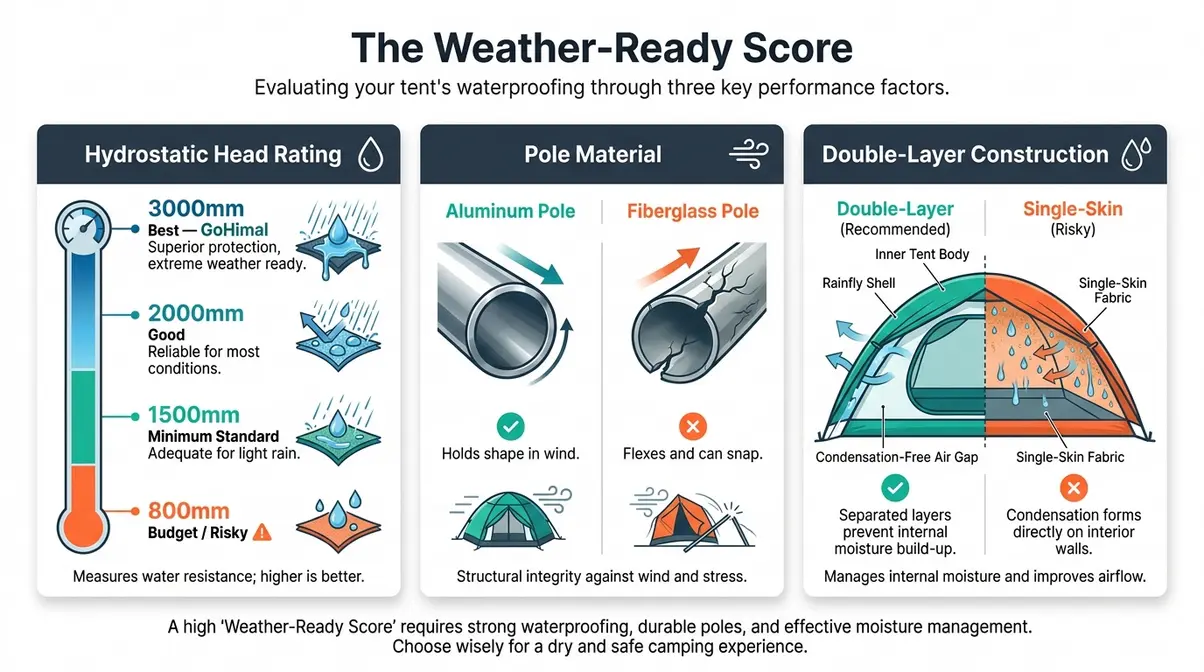
A car camping tent needs a minimum 1,500mm hydrostatic head rating to reliably withstand sustained rain — hydrostatic head (HH) is the measure of how much water pressure a fabric can resist before it begins to leak. The higher the number, the better. Budget tents often sit at 800–1,000mm; a storm at 2 a.m. will find that threshold quickly.
Beyond the fabric rating, two other factors determine storm performance. First, pole material: aluminum poles hold their shape in wind better than fiberglass poles, which can flex and eventually snap in sustained gusts. Second, double-layer construction: a tent with a separate outer shell (rainfly) and inner tent traps less condensation and adds an insulation buffer — you wake up to a dry sleeping bag instead of a damp one.
“Across camping forums, the consistent advice from experienced campers is the same: pay attention to the waterproof rating and the pole material, not just the brand name. A tent that has withstood some really nasty weather is worth far more than a stylish one that leaks on night one.”
This is the foundation of The Weather-Ready Score — a plain-language rating combining hydrostatic head (HH rating), pole material (aluminum vs. fiberglass), and double-layer construction to assess real-world storm readiness. In this roundup, the GoHimal scores highest (PU3000mm + double-layer), followed by the TIMBER RIDGE (full rainfly + awning coverage + aluminum-frame support).
Weather resistance matters most when you get caught in a storm. But for many campers, the bigger daily challenge is getting the tent up quickly.
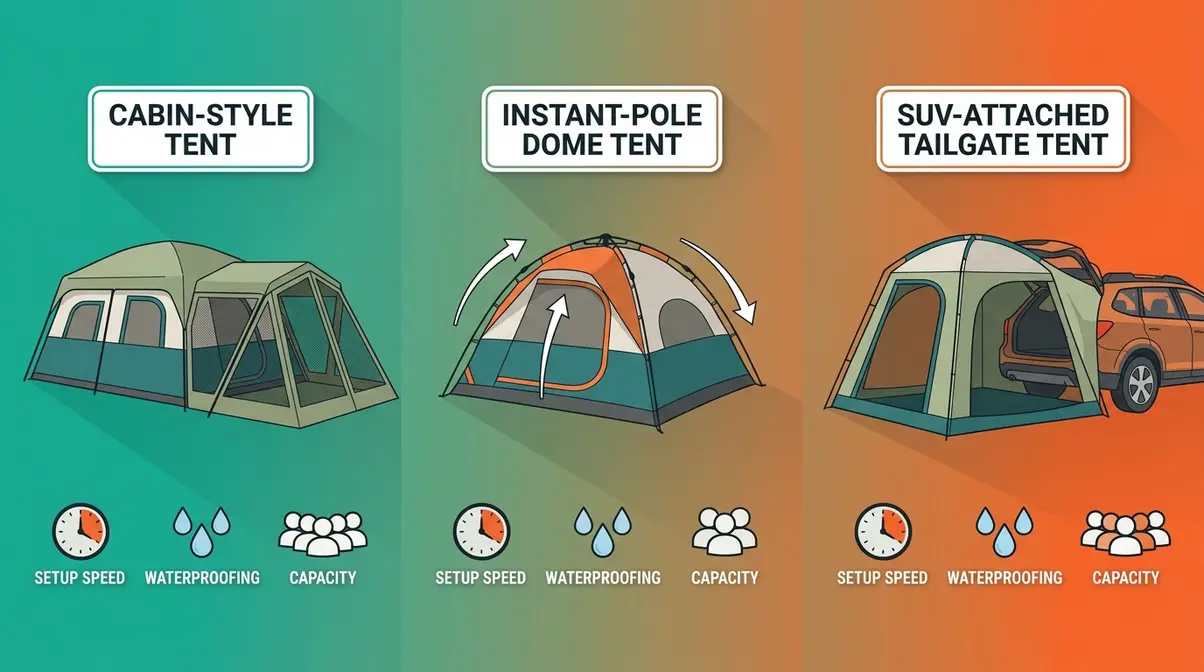
Setup Speed: Instant Poles vs. Traditional Poles
Choosing between instant-pole and traditional-pole tents comes down to how you camp. Here’s the honest comparison:
- Instant-pole tents (CORE, Naturehike Cape):
- Pre-attached poles expand in one motion — 60–90 seconds for a single person
- Best for frequent campers, solo arrivals, and anyone who moves between sites
- Hub mechanisms require inspection each season; harder to repair in the field
- Traditional-pole tents (TIMBER RIDGE, GoHimal, VEVOR):
- Setup takes 15–20 minutes; more manageable with two people
- Generally more robust in sustained wind — poles can be replaced individually if one breaks
- Better long-term durability across multiple seasons of heavy use
- SUV-attachment tents (UNP, GoHimal):
- Require the additional step of aligning the tailgate sleeve to the vehicle opening
- First-time setup benefits significantly from a second person
- Plan your first setup at home, not at the campsite after a long drive
As the NPS guidelines on frontcountry campsites confirm, frontcountry camping means driving your vehicle directly to the site — which means tent weight is irrelevant. Setup speed and livable space are what actually matter. If you arrive at campsites after dark or move sites frequently, the CORE or Naturehike Cape will save you real frustration. For essential tent buying tips that go beyond just poles and fabric, that guide covers ventilation, footprints, and vestibule design in detail.
How We Evaluated
Our team evaluated each tent on three criteria: weather resistance (hydrostatic head rating, rainfly coverage, and double-layer construction), real-world capacity (floor area compared to the stated person count), and setup mechanism (instant vs. traditional poles, including solo-setup feasibility for 6+ person tents). Product specifications were sourced from Amazon listing data and manufacturer product pages — confirm current specs on the product page before purchasing. For reviews of premium brand tents beyond this roundup, see our guide to the best North Face tents.
Frequently Asked Questions
What is the easiest car camping tent to set up alone?
Instant and pop-up designs with pre-attached poles are the easiest car camping tents to set up by yourself. Tents like the CORE Instant Cabin and the Naturehike Cape use hub-and-spoke frames that expand in a single motion, removing the need to thread poles through sleeves in fading light. Setup times for instant tents typically range from 60 seconds to 2 minutes for one person working alone. For traditional-pole tents, solo setup is possible but takes 15–20 minutes — arriving before dark makes the process significantly more manageable.
How many people can comfortably sleep in a 4-person tent?
A 4-person tent comfortably fits 2–3 adults, or 2 adults and 2 young children. Capacity ratings assume sleeping bags placed side-by-side with no extra gear — a standard that ignores air mattresses, duffel bags, and the natural movement of real campers through the night. For car camping, where you drive the tent to the site rather than carry it on your back, buying a 6-person tent for a family of 4 is the most practical approach. For a full breakdown of how tent ratings work in practice, see our guide to understanding tent capacity ratings. Results vary depending on sleeping pad width and how much gear you store inside.
What’s the most important feature for a car camping tent in rainy weather?
The most important feature for rainy-weather camping is a full-coverage rainfly — a separate waterproof outer shell that extends over the entire tent body and reaches close to the ground. Beyond the rainfly, look for a “bathtub” floor (fabric that wraps several inches up the sides to block ground water) and factory-sealed seams to prevent infiltration at stitching points. A hydrostatic head rating of 1,500mm or higher means the fabric can withstand sustained rain — the GoHimal in this roundup reaches PU3000mm, the highest here. Seam-sealing the floor edges before your first trip adds extra protection on budget models.
Is an expensive car camping tent worth the money?
An expensive car camping tent is worth the investment if you camp more than 3–4 times per year or in variable weather conditions. Higher-priced tents use heavier denier fabrics (more abrasion-resistant), stronger aluminum poles (less flex in wind), and superior waterproof coatings that hold up across multiple seasons of regular use. For occasional fair-weather campers, a mid-range option like the VEVOR or CORE delivers adequate performance without the premium price tag. If you camp in reliably wet climates, the GoHimal’s PU3000mm rating justifies the additional cost over budget alternatives that may need replacement after two seasons.
What is the difference between a car camping tent and a backpacking tent?
The key difference is weight versus livable space. Car camping tents prioritize interior comfort — high ceilings you can stand up in, multiple rooms, and heavier, more durable materials — because you drive them to the campsite rather than carry them on a trail. Backpacking tents sacrifice interior space and ceiling height to save every possible ounce, often weighing under 3 lbs for a 2-person shelter. Every tent in this roundup is a car camping tent — none are appropriate for multi-day hiking trips where pack weight determines how far you can travel each day.
Prices and features verified as of May 2026. Specifications are subject to change — confirm on the product listing before purchasing.
For car campers deciding between SUV tents and cabin-style shelters, the best tent for car camping in 2026 comes down to three factors: how many people need to sleep in it, how much rain you expect, and how fast you need it standing. The right choice looks different for a family of six than it does for a couple arriving after a Friday evening drive.
The Weather-Ready Score — hydrostatic head rating + pole material + double-layer design — is the most reliable way to compare tents without getting distracted by marketing language or specs that don’t matter for car camping. Use it every time you evaluate a new tent, and you’ll cut through the choice dilemma in minutes rather than hours.
Start with the TIMBER RIDGE if you’re camping with a large family and want a screened porch, the CORE Instant Cabin if setup speed is your priority, or the GoHimal if you camp in reliably wet weather — then check current availability on Amazon before your next trip.

Dave King
I'm Dave King. I publish Tent Explorer, a site built to answer the questions people actually ask before they buy.