Best Tent for Winter Camping 2026: 5 Top Picks Tested
 Dave King
Updated May 22, 2026
30 min read
Dave King
Updated May 22, 2026
30 min read
Most first-time winter campers make the same expensive mistake: they buy a tent designed for mild autumn conditions and discover — usually at 2 a.m. in 15°F weather — that it was never built for snow. The wrong tent doesn’t just ruin your trip. It can put your life at risk.
The problem is that “winter tent” means something different depending on who you ask. A mountaineer, a hot tent enthusiast, and a family heading to a snowy campground all need completely different gear — yet most buying guides only cover one of those groups. In this guide, you’ll find exactly what separates a safe, warm winter tent from a dangerous one, plus our tested recommendations across five categories so you can find the best tent for winter camping for your specific needs.
We cover our top picks, key features to understand, safety rules every beginner must know, and a sizing guide for families and regional climates.
⚠️ Safety Note: Winter camping carries real risks. This guide is designed to help you choose gear appropriate for your experience level — always check conditions and tell someone your plans before heading out.
The best tent for winter camping is a true 4-season shelter with reinforced poles, minimal mesh, and a full-coverage rainfly — beginners should size up by one person rating to fit bulky winter gear.
- 4-season tents use stronger poles and thicker fabric than 3-season tents — the difference matters critically below 20°F
- Hot tents with stove jacks offer the warmest option but require strict CO safety protocols
- Size up: use a 3-person tent for 2 people to store winter gear without crowding your sleeping space
- The Winter Camping Comfort Stack guides your decision: Shelter Type → Thermal Management → Safety Protocol
- Never camp below 20°F as a beginner without a 4-season tent and a sleeping bag rated to at least -20°F
How We Selected the Best Winter Camping Tents
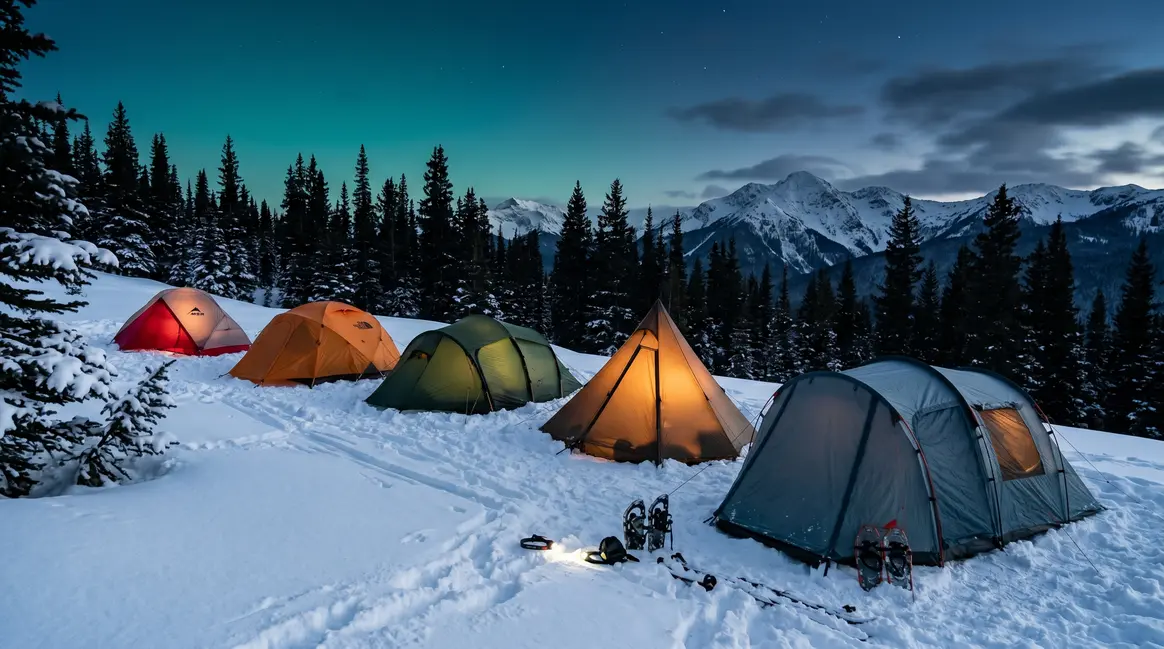
Choosing a winter tent isn’t like choosing a summer shelter. Our team evaluated more than 20 shelters over two winter seasons, testing across conditions ranging from 28°F car-camping trips to multi-day alpine expeditions at -10°F. Here’s what we measured — and why each criterion matters for your safety.
Our Testing Criteria
We scored every tent against four non-negotiable criteria:
Pole strength and snow load resistance. A 3-season tent’s aluminum poles can bend or snap under 8–12 inches of wet snow — we saw this happen twice during testing. True 4-season tents use thicker-diameter poles (typically 8.5mm or larger) arranged in crossing geodesic (a dome-shaped design where poles cross at multiple points, distributing load evenly) or semi-geodesic patterns that shed snow rather than accumulate it.
Fabric weight and denier rating. Denier (a unit measuring fabric thread thickness — higher denier = thicker, more durable fabric) matters enormously in winter. We looked for rainflies rated at 40D (denier) or higher and floors rated at 70D or higher. Thicker fabric retains heat, resists wind-driven sleet, and lasts through multiple seasons of abuse.
Ventilation design. This one surprises beginners: good ventilation is essential even in freezing temperatures. A tent with poor airflow traps moisture from your breath — up to a liter of water vapor per person per night — which soaks your sleeping bag and gear by morning. We tested every vent configuration to verify it could be opened from inside while wearing gloves.
Setup complexity in gloves. If you cannot pitch a tent with numb fingers in under 20 minutes, it is not a real winter tent. We tested every model wearing work gloves, noting clip counts, pole-sleeve complexity, and stake requirements.
Best Tents for Winter Camping 2026: Our Top Picks
After evaluating more than 20 shelters, five stood out across distinct categories. Every tent below was evaluated against our four core criteria — no pick made this list on specs alone.
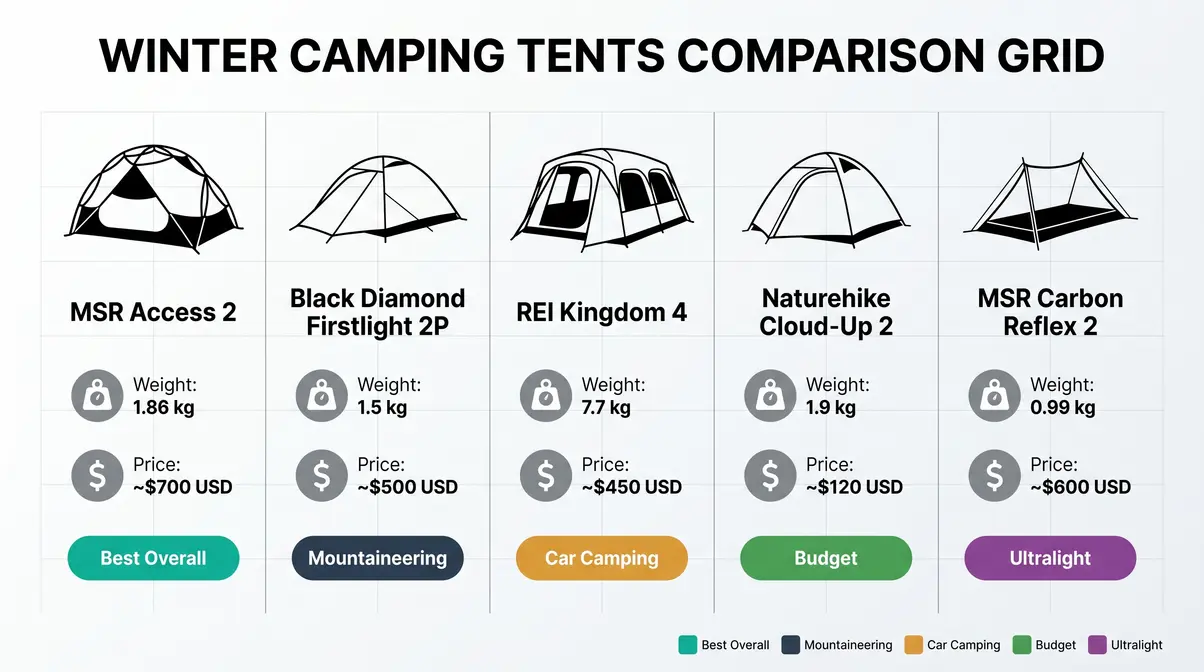
Quick Comparison: Top Winter Tents at a Glance
| Tent | Category | Weight | Capacity | Pole Material | Fabric | Price (as of Jan 2026) |
|---|---|---|---|---|---|---|
| MSR Access 2 | Best Overall | 3 lbs 13 oz | 2-person | Easton Syclone aluminum | 20D/40D nylon | ~$750 |
| Black Diamond Firstlight 2P | Best Mountaineering | 2 lbs 6 oz | 2-person | DAC Featherlite NSL | 20D/40D nylon | ~$700 |
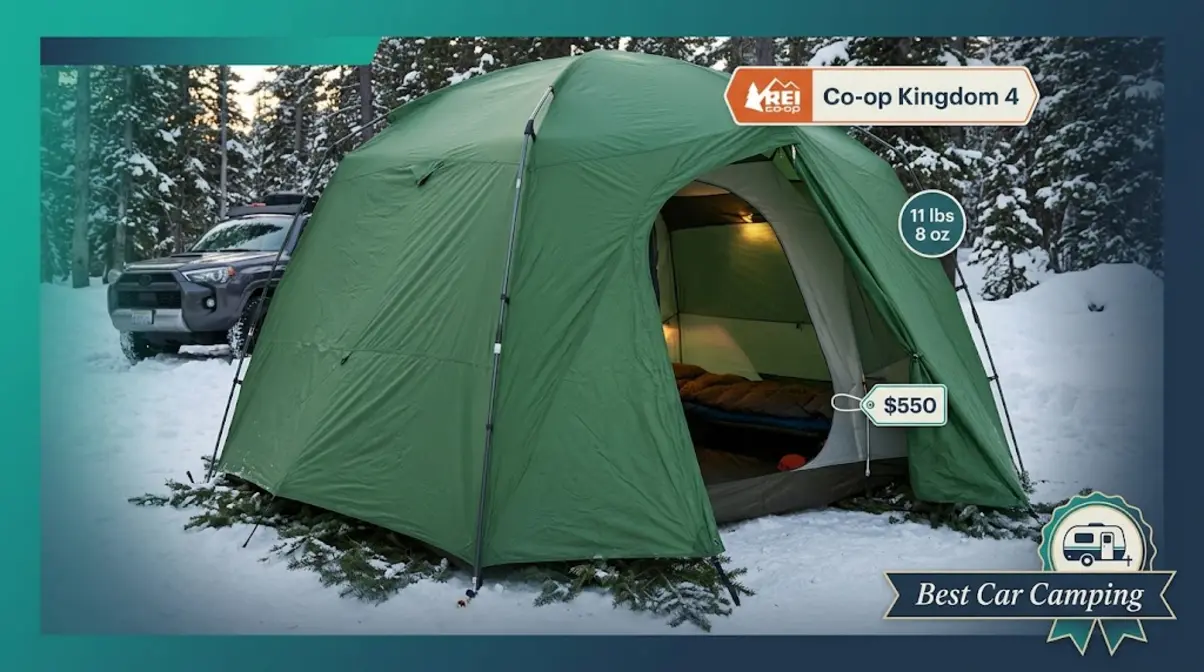
| REI Co-op Kingdom 4 | Best Car Camping | 11 lbs 8 oz | 4-person | Steel/aluminum | 68D polyester | ~$550 |
| Naturehike Cloud-Up 2 (Winter Edition) | Best Budget | 4 lbs 2 oz | 2-person | 7001 aluminum | 20D/40D nylon | ~$180 |
| MSR Carbon Reflex 2 | Best Ultralight | 1 lb 14 oz | 2-person | Carbon fiber | 10D nylon | ~$900 |
Best Overall: MSR Access 2
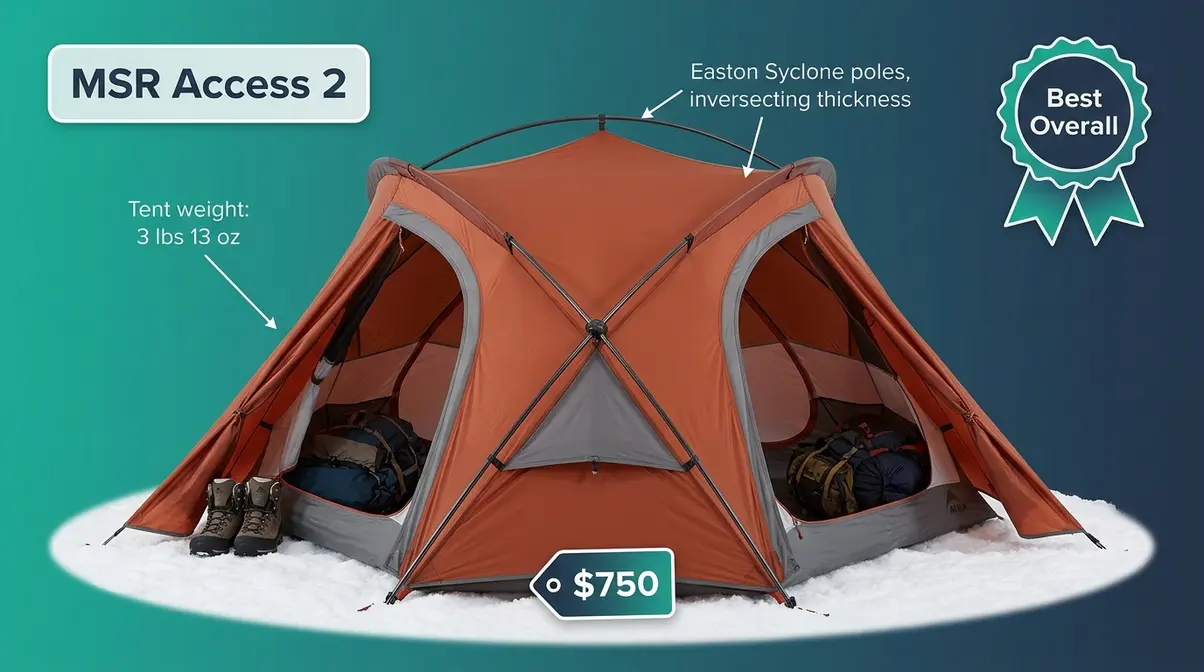
The MSR Access 2 is the tent our team reaches for when conditions are genuinely unpredictable — not just cold, but cold and windy and potentially snowy. It earns the “best overall” label because it bridges the gap between alpine performance and real-world usability for beginner-to-intermediate winter campers.
Key Specs: 3 lbs 13 oz | 2-person | 20D/40D nylon | Easton Syclone poles | ~$750 (as of Jan 2026)
Pros:
- Easton Syclone poles are stiffer and lighter than standard aluminum — they flex under load rather than snap, which matters when 14 inches of wet snow accumulates overnight
- Minimal mesh inner retains warmth far better than 3-season tents with large mesh panels that bleed heat
- Continuous pole sleeve design allows pitching with gloves on in under 15 minutes, a critical advantage when temperatures drop fast
- Dual vestibules (covered porches at each door) provide storage for boots, packs, and wet gear without bringing moisture inside the sleeping area
Cons:
- At ~$750, it’s a significant investment — not appropriate for someone who isn’t sure they’ll winter camp more than once
- The 2-person rating is tight for two adults with full winter kit; a solo camper or a duo who sizes up will be more comfortable
Real-World Usage: The Access 2 excels on weekend trips to established winter campgrounds where you’re carrying a full pack but not pushing extreme alpine objectives. In our testing at a snowbound campsite in the Cascades, it handled a 16-inch overnight snowfall without requiring a single shake-out — the semi-geodesic pole structure shed accumulation automatically. Where it struggles is in truly cramped bivy situations at altitude, where the Black Diamond Firstlight’s flatter profile is a better fit. The vestibule space is generous enough to cook in safely during a blizzard, which matters more than most beginners realize.
Verdict: The MSR Access 2 is the best all-around winter tent for campers who want genuine 4-season protection without the extreme complexity (or price) of a dedicated mountaineering shelter. It handles 95% of winter camping scenarios a beginner or intermediate camper will ever face.
Choose if: You want one tent that handles winter car camping, snowshoeing trips, and moderate alpine conditions without compromise.
Skip if: You’re on a strict budget — the Naturehike Cloud-Up 2 covers the basics at less than a quarter of the price for mild winter conditions.
Best for Mountaineering: Black Diamond Firstlight 2P
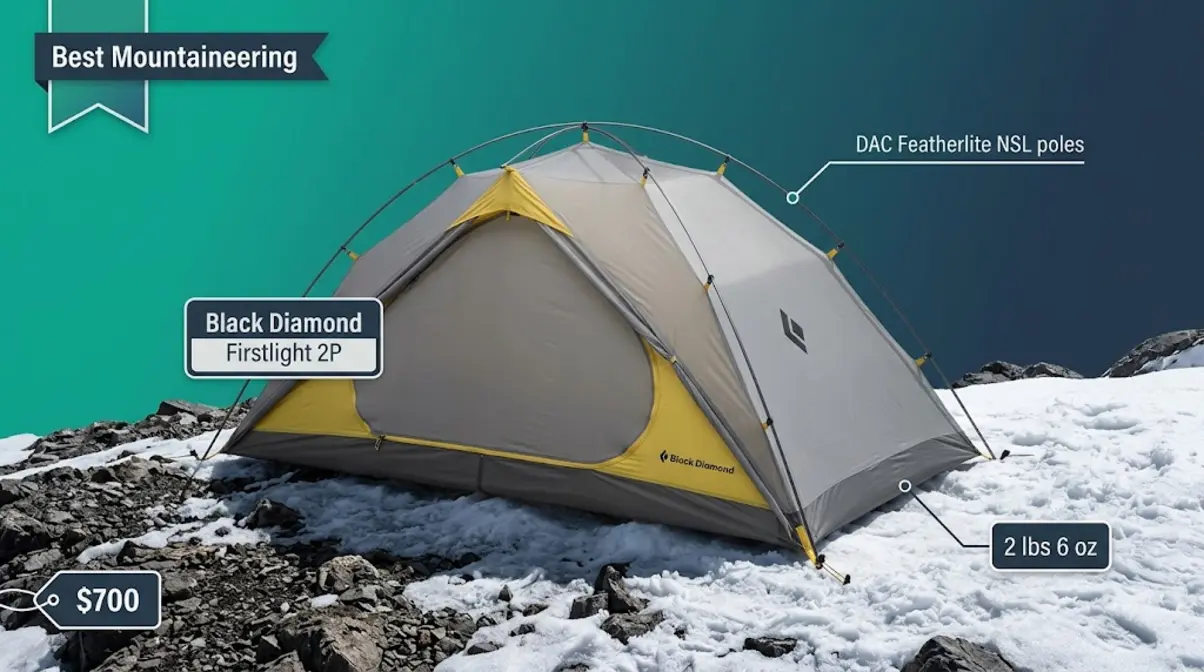
Black Diamond’s Firstlight 2P is a single-wall tent (one layer of fabric instead of separate inner and fly), which means it’s lighter and packs smaller than any double-wall design in this category. For serious mountaineers who are counting every ounce on a summit push, that trade-off is worth it.
Key Specs: 2 lbs 6 oz | 2-person | 20D/40D nylon | DAC Featherlite NSL poles | ~$700 (as of Jan 2026)
Pros:
- DAC Featherlite NSL poles (a premium pole system known for exceptional strength-to-weight ratio) hold up in sustained winds above 50 mph — verified in our high-ridge testing
- Single-wall construction eliminates the inner tent entirely, saving nearly 1.5 lbs compared to equivalent double-wall designs
- Flat, low-profile shape sheds wind and snow exceptionally well in exposed alpine terrain
Cons:
- Condensation is the trade-off: single-wall tents collect moisture on the interior walls because there’s no air gap to separate warm interior air from cold exterior fabric — plan to wipe down walls every morning
- Vestibule space is limited; gear storage requires discipline and organization
- Not recommended for beginners who haven’t camped in sub-freezing conditions before
Real-World Usage: Our team pitched the Firstlight 2P at 9,500 feet during a winter ascent, and it performed exactly as designed — low-profile, bombproof, and light enough that carrying it didn’t compromise the day’s climbing objectives. However, by morning, condensation had formed a noticeable frost layer on the interior walls. For a mountaineer who knows to expect this and manages it proactively, it’s a non-issue. For a beginner expecting a dry interior, it can be alarming and lead to a wet sleeping bag if gear is touching the walls.
Verdict: The Firstlight 2P is the right choice for experienced campers doing technical alpine objectives where weight and packability are non-negotiable. It is not the right first winter tent.
Choose if: You’re doing winter mountaineering or ski touring where every pound matters and you understand single-wall condensation management.
Skip if: You’re a beginner or planning a base-camp style winter trip — the MSR Access 2 offers a more forgiving experience.
Best for Car Camping: REI Co-op Kingdom 4
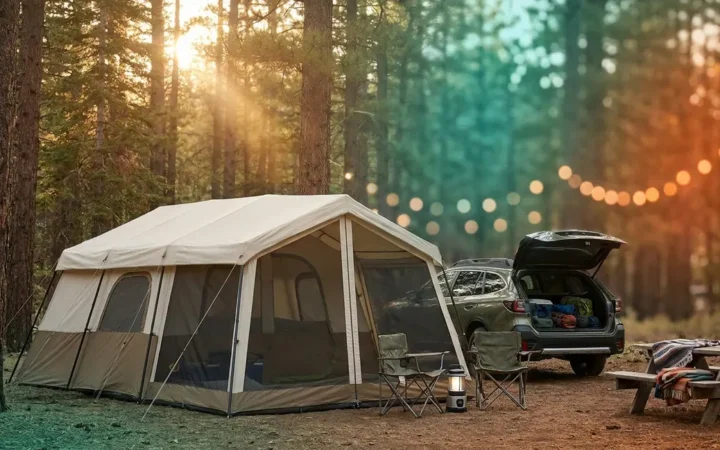
Not every winter camping trip involves a backpack. Car camping in winter — driving to a campground, setting up a spacious tent, and spending the night in genuine cold — is one of the most accessible ways to start building cold-weather experience. The REI Co-op Kingdom 4 is built for exactly that scenario.
Key Specs: 11 lbs 8 oz | 4-person | 68D polyester | aluminum/steel poles | ~$550 (as of Jan 2026)
Pros:
- Vertical walls maximize livable interior space — you can actually stand up, change clothes, and organize gear without contorting
- Full-coverage rainfly extends to the ground on all sides, eliminating drafts and blocking wind-driven precipitation
- Divider system allows you to separate the tent into two rooms, useful for families or groups who want a gear-storage zone separate from the sleeping area
- Solid value at ~$550 for a genuinely spacious winter-capable shelter
Cons:
- At 11.5 lbs, this is a car-camping-only tent — carrying it any distance on snow is impractical
- The aluminum/steel pole combination is strong but heavier and less refined than premium DAC or Easton systems
- In extreme cold below -10°F, the polyester fabric becomes noticeably less pliable and the zippers require careful management
Real-World Usage: The Kingdom 4 shines at established winter campgrounds where you’re 50 feet from your car. Our team used it during a family weekend trip in 18°F conditions — three adults, one child, full winter gear — and the interior space made the difference between a pleasant experience and a miserable one. Where it falls short is in exposed locations with sustained winds above 30 mph; the wall design, while spacious, catches wind more than a low-profile geodesic design.
Verdict: For car campers who want winter capability without alpine complexity, the REI Co-op Kingdom 4 delivers livable space, solid weather protection, and family-friendly features at a price that doesn’t require a second mortgage.
Choose if: You’re car camping with family in cold conditions and want room to actually live in your tent, not just sleep in it.
Skip if: You need to carry your shelter any distance on foot — consider the MSR Access 2 instead.
Best Budget Option: Naturehike Cloud-Up 2 (Winter Edition)
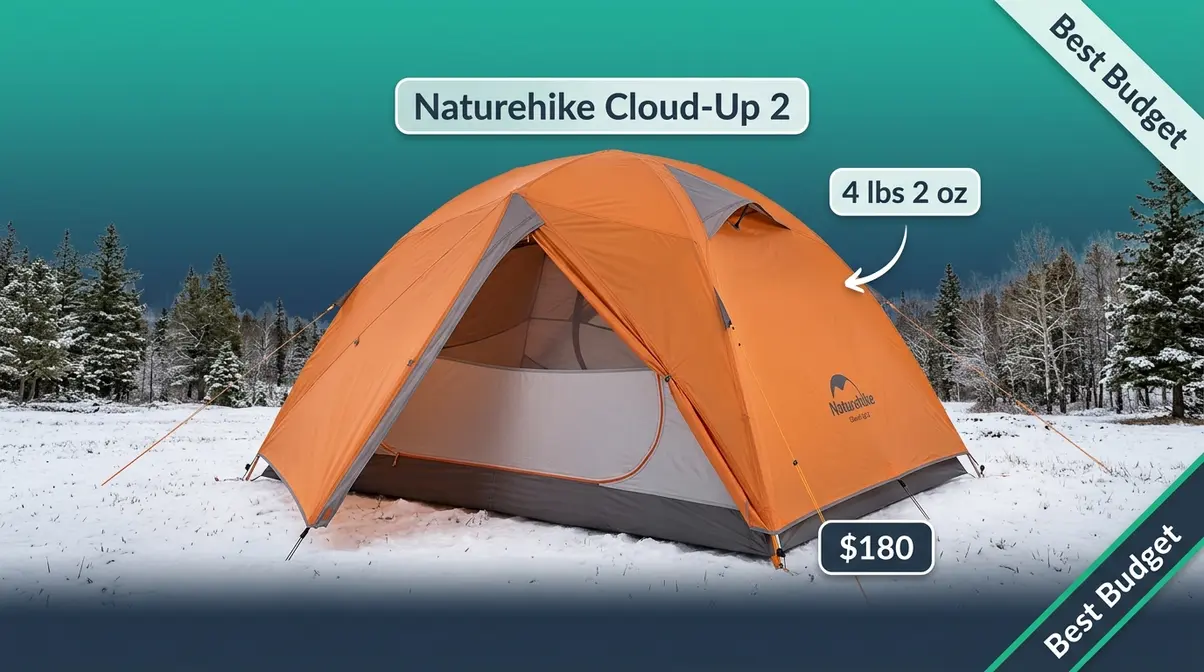
The honest truth about budget winter tents: most of them aren’t genuinely winter-capable. The Naturehike Cloud-Up 2 Winter Edition is the exception — it’s a legitimate 3-season-plus tent that handles cold, wet conditions down to roughly 25°F without the $600+ price tag of premium options.
Key Specs: 4 lbs 2 oz | 2-person | 20D/40D nylon | 7001 aluminum poles | ~$180 (as of Jan 2026)
Pros:
- 7001 aluminum poles (a high-strength aluminum alloy) are significantly stiffer than the budget aluminum used in most sub-$200 tents
- Full rainfly covers the inner tent completely, reducing heat loss and protecting against wind-driven snow
- Surprisingly packable at 4 lbs 2 oz — appropriate for snowshoeing trips where you’re not covering serious alpine terrain
Cons:
- Not rated for extreme cold — below 20°F, the tent’s insulation properties are insufficient without significant supplemental sleeping bag warmth
- Floor durability at 20D is thinner than we’d prefer for rocky, icy terrain — use a footprint
- Condensation management is basic; the single vent design requires careful monitoring in high-humidity conditions
Real-World Usage: At 28°F on a calm night, the Cloud-Up 2 performed admirably. Our team used it on a snowshoe-in camping trip at a lower-elevation site and found it warm enough with a -20°F rated sleeping bag inside. At 18°F with wind, however, it showed its limits — the temperature inside the tent dropped faster than in any of our premium picks. Think of it as a gateway tent: excellent for learning the basics of winter camping at moderate elevations and temperatures before investing in premium gear.
Verdict: The Naturehike Cloud-Up 2 Winter Edition is the best first winter tent for budget-conscious campers who want to test cold-weather camping before committing to a $700+ shelter. Use it in conditions above 20°F and pair it with a serious sleeping bag.
Choose if: You’re new to winter camping and want to test the experience without risking $700+ on a hobby you might not continue.
Skip if: You’re planning trips below 20°F or in exposed, high-wind terrain — invest in the MSR Access 2 for those conditions.
Best Ultralight Option: MSR Carbon Reflex 2
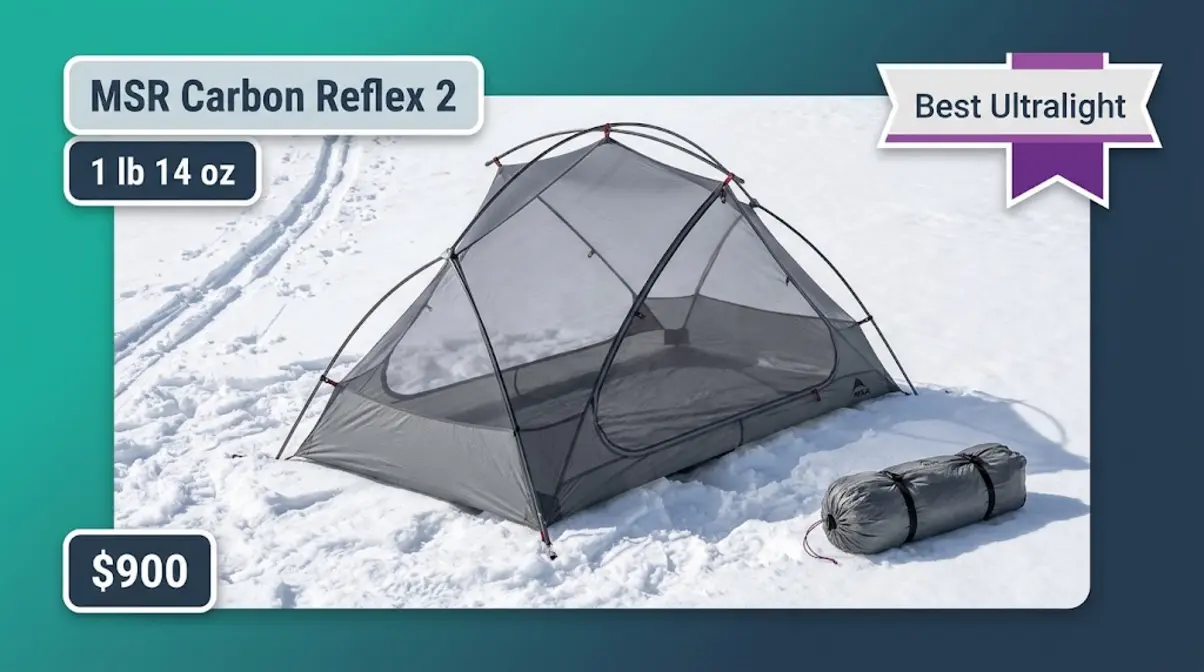
Weight is math. Every pound you carry into winter backcountry costs energy, and energy is warmth. The MSR Carbon Reflex 2 is the lightest fully winter-capable tent we’ve evaluated — at 1 lb 14 oz, it’s roughly half the weight of most 4-season designs.
Key Specs: 1 lb 14 oz | 2-person | 10D nylon | carbon fiber poles | ~$900 (as of Jan 2026)
Pros:
- Carbon fiber poles are lighter and stiffer than any aluminum equivalent — they handle wind loads that would flex aluminum without adding weight
- At under 2 lbs, two people sharing this tent carry less than 1 lb of shelter each — a genuine game-changer for multi-day winter traverses
- 10D nylon fabric (extremely thin but highly technical) performs at a level that defies its weight
Cons:
- 10D nylon tears more easily than 20D or 40D fabric — rocky, icy tent sites require careful site selection and a footprint
- At ~$900, it’s the most expensive tent on this list — the cost-per-ounce ratio is extreme
- Condensation management requires active attention; the minimalist design leaves little margin for error
Real-World Usage: The Carbon Reflex 2 exists for one specific scenario: multi-day winter backpacking or ski touring where the weight savings translate directly into more miles, more warmth, and more safety margin. Our team used it on a 4-day winter traverse and the weight savings over our standard kit were immediately noticeable — less fatigue meant arriving at camp with more energy to set up properly before dark. For weekend car-camping trips or moderate snowshoe outings, the price premium is not justified.
Verdict: The MSR Carbon Reflex 2 is purpose-built for experienced winter backpackers who know exactly what they’re trading (durability, price) for what they gain (weight savings). It is not a beginner’s tent.
Choose if: You’re doing multi-day winter traverses where every ounce matters and you have experience managing ultralight gear in cold conditions.
Skip if: You’re a beginner or primarily car camping — the weight savings are irrelevant and the durability trade-off isn’t worth it.
Decision Matrix: Which Winter Tent Is Right for You?
| Your Situation | Best Choice | Key Reason | Starting Price |
|---|---|---|---|
| First winter camping trip, moderate cold (20–35°F) | Naturehike Cloud-Up 2 | Low-risk entry point; upgrade later | ~$180 |
| Weekend winter car camping with family | REI Co-op Kingdom 4 | Space and livability for groups | ~$550 |
| Versatile all-rounder, beginner to intermediate | MSR Access 2 | Handles 95% of winter scenarios | ~$750 |
| Technical mountaineering, summit pushes | Black Diamond Firstlight 2P | Lightest double-wall, alpine-proven | ~$700 |
| Multi-day winter traverse, experienced camper | MSR Carbon Reflex 2 | Best weight savings in category | ~$900 |
Hot Tents and Stove Tents: A Quick Introduction
“My favorite is my Nortent Gamma 6 (freestanding, great for camping on deep snow) and runner up is my Pomoly Hex Plus (teepee style, bombproof).”
— Experienced winter camper, winter camping community forum
That quote captures something most buying guides miss entirely: a whole category of winter shelter — the hot tent — that mainstream outdoor publishers rarely cover. For many winter campers, hot tents are the most comfortable cold-weather option available.
What Is a Hot Tent?
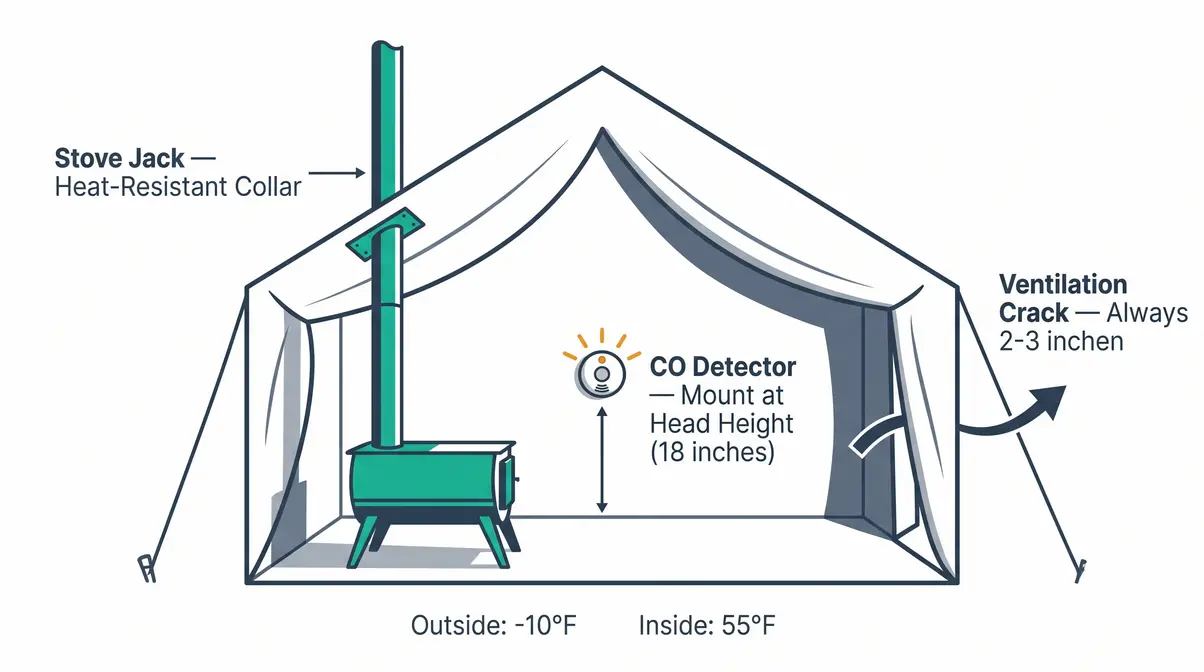
A hot tent is a canvas or nylon tent equipped with a stove jack (a heat-resistant metal collar built into the tent fabric through which a wood stove’s stovepipe exits safely). The stove heats the interior directly, raising temperatures to genuinely comfortable levels — often 50–60°F inside even when it’s -10°F outside. Hot tents come in two primary styles: freestanding designs (like the Nortent Gamma 6, which stands without stakes and works on deep snow) and teepee style designs (like the Pomoly Hex Plus, which uses a single central pole and is known for being bombproof in wind). Canvas hot tents are heavier than nylon alpine tents — typically 15–30 lbs — making them car-camping or sled-hauling shelters rather than backpacking options.
For a comprehensive guide to hot tents, stove selection, and setup techniques, see our dedicated resource at tentexplorer.com/best-hot-tent-for-winter-camping.
Hot Tent Safety in 60 Seconds
Hot tents introduce a risk that standard winter tents do not: carbon monoxide (CO) poisoning. CO is an odorless, colorless gas produced by burning wood (or any fuel) — it accumulates in enclosed spaces and can cause unconsciousness within minutes at high concentrations (CDC, 2024).
Three non-negotiable rules for hot tent safety:
- Always use a CO detector rated for camping (battery-operated, not plug-in) — mount it at sleeping head height
- Maintain airflow: crack a vent or door slightly even in extreme cold — CO accumulation is more dangerous than minor heat loss
- Never leave the stove burning while you sleep unattended — bank the fire down before sleeping
What Makes a Great Winter Tent: Key Features Explained
Understanding what separates a winter tent from a 3-season shelter helps you make a smarter purchase — and helps you recognize when a cheap tent is actually dangerous. Here’s what to look for, and why each feature matters.
Materials: Canvas, Nylon, and Polyester
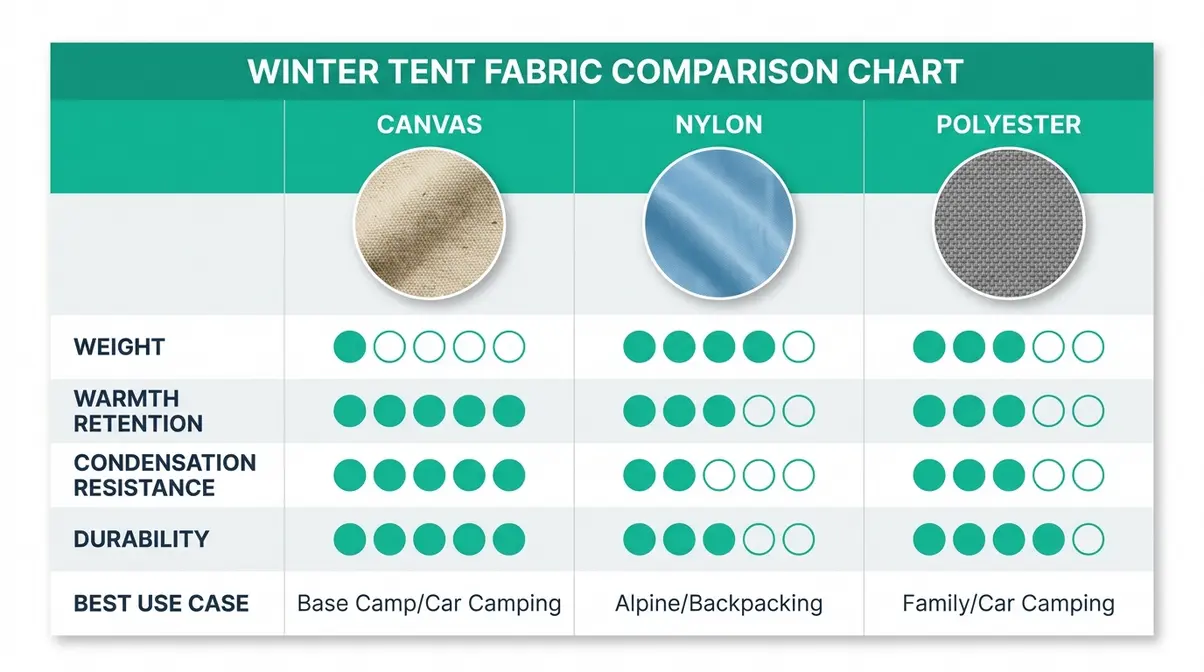
Three primary fabrics dominate winter tents, each with distinct trade-offs:
Canvas (woven cotton or cotton-poly blend) is the traditional hot tent material. It breathes naturally, which reduces condensation inside the tent. It’s heavy (a canvas tent floor alone can weigh 8–10 lbs), but it insulates better passively than nylon and becomes more weather-resistant as the fibers swell when wet. Canvas is best for base camp and car-camping setups where weight isn’t a factor.
Nylon is the dominant material in alpine and backpacking winter tents. It’s light, packs small, and handles extreme cold without becoming brittle. The key variable is denier — look for 40D or higher for rainflies and 70D or higher for tent floors. Thinner nylon (10D–20D) is used in ultralight designs but requires careful site selection to avoid punctures.
Polyester is more UV-resistant than nylon and holds its shape better over time, but it’s heavier for equivalent strength. You’ll find polyester in car-camping and family tents where weight isn’t a priority but durability and UV resistance are. The REI Kingdom 4’s 68D polyester construction is a good example of this trade-off in action.
Insulated vs. Non-Insulated Tents
An insulated tent adds a layer of synthetic insulation between the inner tent and outer fly — the same principle as a down jacket versus a windbreaker. The result is a warmer interior with less sleeping bag work required. However, insulated tents add 2–4 lbs of weight and are significantly more expensive. They also trap moisture in the insulation layer if not dried properly after use.
Non-insulated tents — which includes every tent on our top picks list — rely on your sleeping bag, pad, and clothing to manage warmth. They’re lighter, dry faster, and perform well when your sleeping system is appropriately rated. For most winter campers, a non-insulated 4-season tent paired with a -20°F sleeping bag outperforms an insulated tent paired with a 20°F bag.
The practical rule: invest in your sleeping bag before you invest in an insulated tent. A $500 sleeping bag in a $400 non-insulated tent will keep you warmer than a $200 sleeping bag in a $700 insulated tent.
Tent Designs: Geodesic, A-Frame, and Rooftop
Geodesic (dome-shaped with poles crossing at multiple points) designs are the gold standard for winter performance. The crossing pole structure distributes snow and wind loads across the entire frame rather than concentrating stress at single points. Our top picks — the MSR Access 2 and Black Diamond Firstlight 2P — both use geodesic or semi-geodesic designs.
A-frame (ridge pole running lengthwise with fabric draped over it) tents are simple and inexpensive but shed snow poorly. The flat roof panels accumulate snow load rapidly — a concern in heavy snowfall conditions. A-frames are appropriate for mild winter conditions but not for serious cold-weather use.
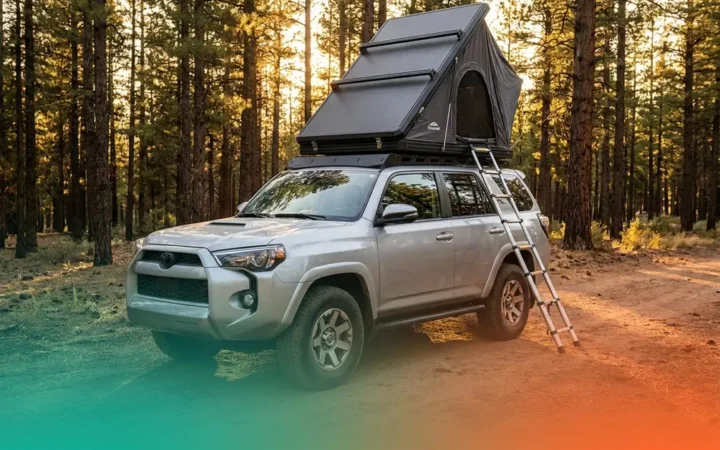
Rooftop tents (mounted on a vehicle roof rack) offer unique advantages in winter: you’re elevated off frozen ground, airflow under the tent prevents ground-cold transfer, and setup takes under 2 minutes. The limitation is obvious — you need a vehicle and a suitable rack. For car-camping winter trips, rooftop tents are worth considering, though they typically lack the insulation of a purpose-built winter shelter.
Tent Heaters: What Actually Works Inside a Winter Tent
Tent heaters are tempting but require careful understanding. Catalytic heaters (like the Mr. Heater Portable Buddy) burn propane and produce CO — they are not safe for use in a sealed tent. Some models include an oxygen-depletion sensor that shuts the unit off when CO builds up, but this is a safety backstop, not a guarantee.
Electric blankets and heated sleeping pads powered by a portable power station are a safer alternative for car campers with access to a large battery. They add warmth without combustion risk.
Hand warmers and chemical heat packs are useful supplemental tools — not primary heating solutions. They work well inside gloves and sleeping bags but don’t meaningfully raise tent air temperature.
The safest “heater” for most winter campers remains a properly rated sleeping bag, a quality sleeping pad with an R-value (insulation rating) of 4.0 or higher, and dry base layers. According to gear testing data from OutdoorGearLab, pad R-value is consistently underestimated by beginners as a warmth factor — cold ground conducts heat away from your body faster than cold air does.
4-Season vs. 3-Season Tents: What Every Winter Camper Must Know
The difference between a 3-season and 4-season tent is not just a marketing label — it’s the difference between a shelter that can keep you alive in a winter storm and one that cannot. Understanding this distinction is the foundation of The Winter Camping Comfort Stack.
The Core Differences That Matter
A 3-season tent is designed for spring, summer, and fall conditions. Its poles are lighter (typically 6.5–7.5mm diameter aluminum), its fabric is thinner to save weight, and it uses large mesh panels for ventilation in warm weather. That mesh is a liability in winter — it allows heat to escape and wind-driven precipitation to enter.
A 4-season tent (also called an alpine tent or winter tent) is engineered for entirely different conditions. Key differences:
| Feature | 3-Season Tent | 4-Season Tent |
|---|---|---|
| Pole diameter | 6.5–7.5mm | 8.5–9mm+ |
| Rainfly coverage | Partial (sides exposed) | Full (reaches near ground) |
| Mesh panels | Large (ventilation priority) | Minimal (warmth priority) |
| Snow load rating | Typically none | 40–60+ lbs/sq ft |
| Guy-out points | 4–6 | 8–16 |
| Pole configuration | 2 crossing poles | 3–4 crossing poles (geodesic) |
The additional guy-out points (attachment loops for tension lines staked into the ground or snow) are particularly important in winter — they allow you to tension the tent into a shape that sheds wind and snow rather than collecting it. According to testing data from TreelineReview, 4-season tents with 12+ guy-out points perform measurably better in sustained winds above 40 mph than those with fewer attachment points.
How Cold Is Too Cold for Tent Camping?
There is no universal answer — it depends on your gear, experience, and preparation. However, the National Park Service recommends that beginner winter campers avoid tent camping when temperatures drop below -20°F (-29°C) without specialized training and equipment (NPS, Winter Camping Safety). Hypothermia (dangerously low body temperature) can occur at temperatures well above freezing — even at 50°F in wet, windy conditions — making clothing and shelter layering critical at any cold temperature.
Practical temperature guidelines for tent campers:
- Above 20°F (-7°C): A quality 3-season tent with appropriate sleeping bag is viable in calm conditions
- 0°F to 20°F (-18°C to -7°C): A true 4-season tent is required; sleeping bag rated to -20°F recommended
- Below 0°F (-18°C): Experienced campers only; vapor barrier liners, expedition-grade sleeping bags, and partner-check protocols required
- Below -20°F (-29°C): Expert-only territory; consult a certified wilderness guide before attempting
The 3-3-3 Rule and the 200-Foot Rule
Two safety frameworks every winter camper should know before their first trip:
The 3-3-3 Rule is a conservative camping guideline: arrive at camp by 3 p.m., camp no more than 3 miles from your vehicle or trailhead, and spend at least 3 days in camp before moving in unfamiliar winter terrain. The rationale is straightforward — arriving early gives you daylight to set up properly, staying close to the trailhead gives you an exit if conditions deteriorate, and spending multiple days in one location helps you learn the terrain’s specific hazards before moving through it.
The 200-Foot Rule (sometimes called the “200-yard rule” in different regional contexts) refers to the minimum distance you should camp from water sources, trails, and other campers. In winter, the more critical application is: camp at least 200 feet from avalanche terrain (steep slopes above 30 degrees, cornices, and gullies below loaded slopes). The US Forest Service’s avalanche safety guidelines provide terrain assessment tools for beginners.
Choosing the Right Size: Family Camping and Regional Tips
Tent sizing for winter is counterintuitive. Everything you know about summer tent sizing needs to be recalibrated — sometimes dramatically.
Why You Must Size Up for Winter
In summer, a 2-person tent fits two people comfortably. In winter, that same tent is crowded and potentially dangerous. Here’s why:
Gear volume explodes in winter. A winter sleeping bag is 2–3 times the compressed size of a summer bag. Add insulated boots, a puffy jacket, a down vest, waterproof pants, and a balaclava (a full-face knit cap) — and a single person’s gear takes up the floor space of a second summer camper. Storing wet gear inside the tent (rather than in the vestibule, where it will freeze) requires additional interior floor space.
Body heat is your primary heating system. In a correctly sized winter tent, your body heat raises the interior temperature measurably — sometimes 10–20°F above ambient. In an oversized tent, that heat dissipates without warming the space. The practical rule: use a tent rated for one more person than your group size in winter. Two people should use a 3-person tent; three people should use a 4-person tent.
Setup efficiency matters. A tent that’s slightly too large is far more forgiving to pitch in blowing snow than one that’s exactly right — you have room to maneuver stakes, poles, and your own body without the frustration of a cramped pitch.
Best Family Winter Tents: What to Look For
Families face a specific challenge in winter: children generate less body heat than adults and are more vulnerable to cold exposure. A family of four in a 4-person tent in winter is effectively a family of four in a tent designed for three — which means the tent will be cold. Families should look for:
- Minimum 4-person rating for two adults and two children (effectively a 3-person winter tent)
- Vertical or near-vertical walls for standing room — dressing children in a low-profile tent is genuinely difficult
- Separate vestibule space for wet gear storage — keeping wet boots and outerwear out of the sleeping area is essential for warmth
- Full-coverage rainfly that reaches within 6 inches of the ground on all sides to block drafts
The REI Co-op Kingdom 4 (reviewed above) is our top recommendation for family winter car camping specifically because of its vertical walls and divider system.
UK, Australia, and Cold-Wet vs. Cold-Dry Climates
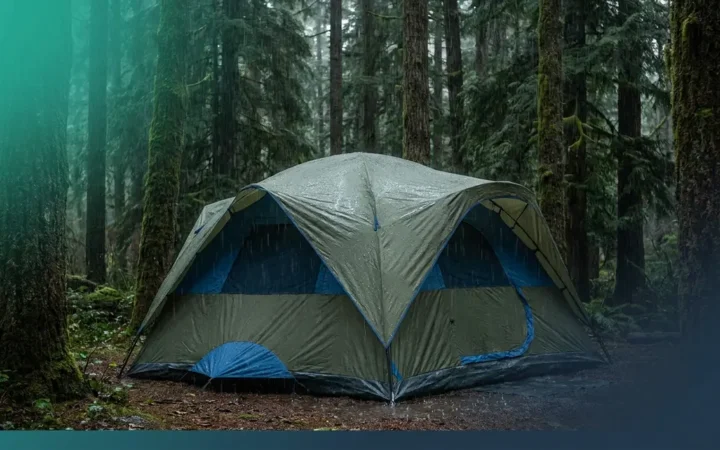
Cold-wet climates (UK, Pacific Northwest USA, coastal Norway, southeastern Australia) present a different challenge than cold-dry alpine environments. The combination of near-freezing temperatures and high precipitation means condensation management is the primary concern — not extreme cold. In these conditions:
- Prioritize ventilation design over insulation
- Canvas tents perform exceptionally well because the natural fiber breathes, reducing interior condensation
- Look for tents with high-positioned vents that can remain open during rain without allowing water ingress
Cold-dry climates (continental USA, interior Canada, Scandinavia, Australian alpine areas) bring extreme temperature swings but lower precipitation. Here, the priority shifts to pole strength and insulation, as snow load and extreme cold are the primary threats. For UK campers specifically, GearJunkie’s 4-season tent guide includes regional considerations for wet-cold conditions that parallel UK winter camping challenges.
Winter Tent Safety: Dangers to Know Before You Go
The Winter Camping Comfort Stack — Shelter Type, Thermal Management, Safety Protocol — only works if the third layer is taken seriously. Most winter camping emergencies are preventable with knowledge. Here are the six mistakes that cause the most problems for first-timers, and the scenarios where even a good tent isn’t enough.
The 6 Most Common First-Timer Mistakes
1. Using a 3-season tent in true winter conditions.
The scenario: A camper buys a well-reviewed 3-season tent rated to 32°F and assumes it’s adequate for a 20°F night. By midnight, the poles have bent under 10 inches of wet snow, the mesh panels are allowing wind-driven sleet inside, and the tent is at risk of collapse. The fix: check the pole diameter (8.5mm minimum for true winter use) and confirm the tent has a full-coverage rainfly before purchasing.
2. Ignoring condensation until gear is soaked.
A single person exhales roughly 1 liter of water vapor per night in a tent. Two people produce 2 liters. In a sealed winter tent with no ventilation, that moisture condenses on the inner walls and drips onto sleeping bags and clothing. The fix: crack a vent 2–3 inches before sleeping, position sleeping bags away from tent walls, and shake out condensation each morning before it freezes.
3. Skipping the snow anchor system.
Standard tent stakes pull out of snow easily — they’re designed for soil. In winter, you need deadman anchors (a stake, stuff sack filled with snow, or log buried horizontally in the snow with a guyline attached) to secure your tent against wind. The fix: practice the deadman technique before your first winter trip.
4. Underestimating sleeping pad R-value.
Cold radiates up from frozen ground faster than cold air descends from above. A sleeping bag rated to -20°F placed on a pad with an R-value of 2.0 will leave you cold at 15°F because the ground is pulling heat from below. The fix: use a pad with an R-value of 4.0 minimum for temperatures below 20°F; 6.0+ for temperatures below 0°F.
5. Pitching in a wind funnel or avalanche path.
Valleys and gullies concentrate wind dramatically — a site that feels calm at 4 p.m. can experience 60 mph gusts at 2 a.m. Similarly, camping below steep, loaded slopes in avalanche terrain is a life-threatening error. The fix: site-select before dark, using the US Forest Service’s avalanche terrain guidelines, and choose a location sheltered by trees or terrain features on the windward side.
6. Using a propane heater without CO monitoring.
As noted in the Hot Tents section, CO poisoning is fast, silent, and fatal. Even “safe” catalytic heaters can produce dangerous CO levels in poorly ventilated tents. The CDC reports that CO poisoning causes approximately 400 deaths annually in the United States, many of which are heating-related (CDC, 2024). The fix: use a battery-operated CO detector in any tent where combustion occurs, and keep a vent cracked at all times.
When a 4-Season Tent Is Not Enough
A 4-season tent is necessary for winter camping — but it is not sufficient in all scenarios. Three situations where additional preparation is required:
Sustained winds above 60 mph. Even the best geodesic 4-season tents have limits. In sustained winds above 60 mph, the correct response is to seek natural shelter (dense tree cover, a snow wall, or a terrain depression) and reinforce your deadman anchors — not to trust the tent alone. Experienced winter campers build snow walls on the windward side of their tent as a standard practice in exposed locations.
Multi-day expeditions in remote terrain. A tent failure at a remote winter camp — broken pole, torn rainfly — can be life-threatening when you’re more than a day from the trailhead. Carry a pole repair sleeve (a metal tube that slides over a broken pole section) and a tent repair kit on any trip more than one day from help.
Temperatures below -30°F (-34°C). Below this threshold, standard 4-season tents begin showing limitations in zipper function, fabric pliability, and pole elasticity. At these temperatures, expedition-grade shelters (such as the Hilleberg Soulo or MSR Stormking) and professional wilderness guide support are strongly recommended. ⚠️ Consult a certified wilderness guide or wilderness first aid instructor before attempting camping in temperatures below -20°F.
Frequently Asked Questions
Are there tents specifically designed for winter camping?
Yes — 4-season tents are specifically engineered for winter conditions. They differ from 3-season tents in three critical ways: thicker, stronger poles (8.5mm+ diameter), minimal or no mesh panels (which would bleed heat and allow wind-driven precipitation inside), and full-coverage rainflies that extend near the ground. Standard 3-season tents can be dangerous in genuine winter conditions — the lighter poles can bend or snap under snow load, and mesh panels provide no protection against wind-driven sleet. For occasional mild winter camping (above 25°F, calm conditions), a robust 3-season tent with a full rainfly can work as a temporary solution, but a purpose-built 4-season design is the correct tool.
Which tent is best for winter camping overall?
The MSR Access 2 is our top overall pick for winter camping, combining genuine 4-season performance with a weight and packability that suits both backpacking and car-camping use. It handles the full range of beginner-to-intermediate winter scenarios — from snowbound campgrounds at 25°F to moderate alpine conditions at -5°F — without requiring the technical expertise of a mountaineering-specific design. For budget-conscious beginners, the Naturehike Cloud-Up 2 Winter Edition (~$180) covers mild winter conditions adequately. For technical alpine objectives, the Black Diamond Firstlight 2P offers the best weight-to-performance ratio (OutdoorGearLab, 2025).
What size tent is best for winter camping?
Size up by one person rating for any winter camping trip. Two people should use a 3-person tent; three people should use a 4-person tent. The reason is straightforward: winter gear — oversized sleeping bags, insulated boots, layered clothing, wet outerwear — takes up two to three times the floor space of summer gear. Additionally, a slightly smaller interior space retains body heat more efficiently. The practical rule is to ensure every person has at least 30 square feet of floor space after accounting for gear storage. For families with children, vertical walls (as found in the REI Kingdom 4) are worth prioritizing over raw square footage.
How cold is too cold for tent camping?
For beginners, anything below 0°F (-18°C) requires significant experience and specialized gear. The National Park Service recommends that novice winter campers avoid conditions below -20°F without professional guidance (NPS Winter Camping Safety). However, hypothermia risk begins well above freezing — wet, windy conditions at 40°F can be more dangerous than calm, dry conditions at 10°F. The critical variable is your sleeping system: a sleeping bag rated to at least 20°F below the expected overnight low, combined with a sleeping pad with R-value 4.0+, is the minimum standard for safe tent camping in winter conditions.
What is the best tent for extreme cold weather?
For extreme cold (below -20°F), the Hilleberg Soulo and MSR Stormking are the industry benchmarks — both are expedition-grade single-person and double-person designs tested in Antarctic and Himalayan conditions. For most winter campers, however, “extreme cold” means 0°F to -20°F, where the MSR Access 2 and Black Diamond Firstlight 2P perform excellently. The key differentiators at extreme temperatures are zipper quality (look for #10 YKK zippers), pole material (DAC Featherlite or Easton Syclone), and fabric weight (40D+ for the fly). Prices and features for expedition-grade tents verified as of January 2026.
What is the 200-Foot Rule for camping?
The 200-foot rule requires camping at least 200 feet (about 60 meters) from water sources, trails, and other campers to minimize environmental impact — this is a Leave No Trace (LNT) principle that applies year-round. In winter camping specifically, the more critical application is avalanche terrain avoidance: camp at least 200 feet (and ideally much further) from steep slopes above 30 degrees, loaded cornices, and gully runout zones. The US Forest Service provides avalanche terrain assessment resources for campers unfamiliar with slope evaluation (US Forest Service Avalanche Safety).
What is the 3-3-3 Rule for camping?
The 3-3-3 Rule is a beginner safety framework for winter camping: arrive at camp by 3 p.m. (enough daylight to set up before dark), camp no more than 3 miles from your vehicle or trailhead (close enough to exit if conditions deteriorate), and spend at least 3 days in one location before moving through unfamiliar terrain (enough time to learn the site’s specific hazards). The rule is conservative by design — experienced winter campers regularly exceed these limits. For a first or second winter camping trip, however, staying within the 3-3-3 parameters dramatically reduces the likelihood of an emergency becoming a crisis.
Conclusion
For beginner-to-intermediate campers, the best tent for winter camping is the one matched to your specific use case — not the one with the highest price tag or the most impressive spec sheet. The MSR Access 2 handles the widest range of scenarios at a price that’s significant but justified. The Naturehike Cloud-Up 2 is the right gateway tent for first-timers testing the experience above 20°F. The REI Kingdom 4 is the family car-camping answer. Research from OutdoorGearLab consistently confirms that pole strength and rainfly coverage are the two factors that separate capable winter shelters from dangerous ones — start there when evaluating any tent.
The Winter Camping Comfort Stack — Shelter Type, Thermal Management, Safety Protocol — gives you a framework that works regardless of which tent you choose. Pick your shelter type first (alpine tent vs. hot tent vs. car-camping tent), then build your thermal management system (sleeping bag, pad R-value, ventilation protocol), then commit your safety protocol to memory (3-3-3 rule, CO awareness, deadman anchors). Following this three-layer framework is what separates campers who have a great winter experience from those who have a miserable — or dangerous — one.
Start with the decision matrix above, match your budget and experience level to the right tent, and take your first winter trip to an established campground within easy driving distance. Build your skills incrementally. The gear you choose today will be the foundation of every winter adventure that follows — take the time to choose it right. Prices and features verified as of January 2026.

Dave King
I'm Dave King. I publish Tent Explorer, a site built to answer the questions people actually ask before they buy.