Tent Fabric Types: The Complete Guide to Every Material
 David King
Updated June 15, 2026
27 min read
David King
Updated June 15, 2026
27 min read
You’re shopping for a tent. Then you see it: “70D ripstop nylon,” “210T polyester,” “PU3000mm hydrostatic head.” What does any of it mean?
“I see many different types of fabrics and measurements/ratings being used such as 210T polyester, 20D nylon, Oxford fabric, PU3000 etc.”
— Camper community discussion, r/backpacking
You’re not alone in that confusion. Choosing the wrong tent fabric type doesn’t just mean a heavier pack — it can mean a soaked sleeping bag at 2am or a tent that falls apart after one season. By the end of this guide, you’ll understand every major tent fabric type: what the specs actually mean, which fabric suits your camping style, and exactly what to look for before you buy. We cover the four main tent fabric types, key performance ratings, specialty applications, and where to source fabric for DIY projects — all in plain English.
The four main tent fabric types — nylon, polyester, canvas, and polycotton — each sit at a different point on the Fabric Performance Spectrum, trading weight for durability and cost.
- Nylon is the lightest synthetic option, ideal for backpacking trips where every gram matters
- Polyester resists UV degradation better than nylon and suits most general camping scenarios
- Canvas outlasts all synthetics for long-term base camps, but weighs roughly 5–8× more than nylon equivalents
- Polycotton blends breathability with weather resistance for family camping comfort
- Dyneema (DCF) is the ultralight premium option — waterproof without coatings, but carries a significant price premium
Tent Fabric Types at a Glance
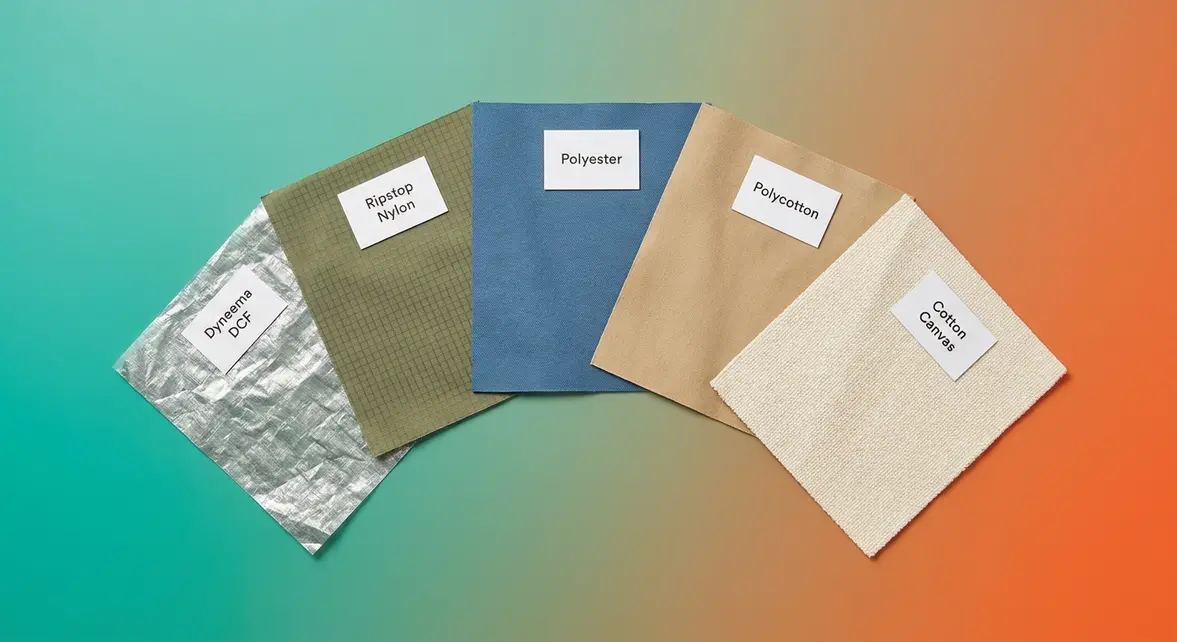
The four main tent fabric types are nylon, polyester, canvas, and polycotton — each making a different trade-off between weight, durability, and cost. Most camping tents today use synthetic fabrics (nylon or polyester) because they pack small and resist rain, while canvas and polycotton tents suit car camping and long-term setups. Knowing which fabric fits your camping style before you buy can save you from hauling a heavy canvas tent on a backpacking trail — or waking up in a wet sleeping bag because your tent’s waterproof rating was too low.
What Is Tent Fabric? Key Terms for Beginners
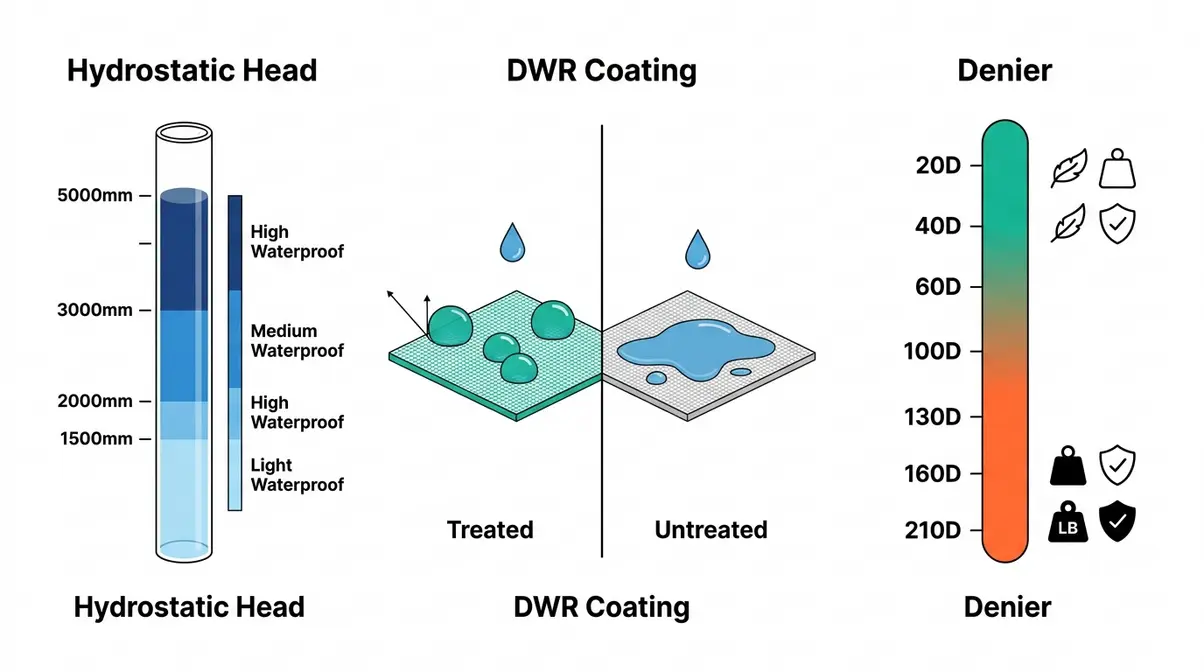
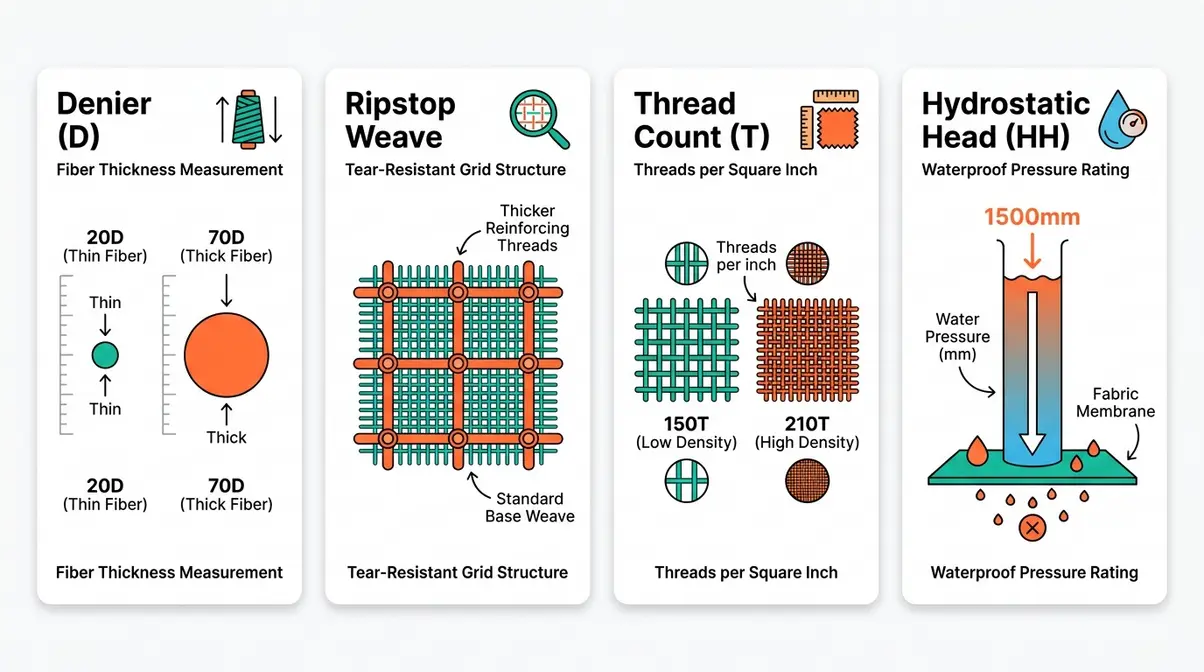
Before comparing fabrics, four technical terms show up on almost every tent spec sheet. Here’s what they actually mean:
Denier (D) is a measure of thread thickness — higher denier means thicker, heavier thread. A “20D” fabric uses very fine thread (ultralight, less abrasion-resistant), while “70D” is a mid-weight workhorse. Think of it like thread gauge on a fishing line.
Ripstop refers to a reinforced weave pattern where thicker threads are woven in a grid every few millimeters. This grid stops small tears from spreading across the fabric. You’ll see it listed as “ripstop nylon” or “ripstop polyester.”
Thread Count (T) applies mainly to polyester and means the number of threads per square inch. “210T polyester” has 210 threads per square inch — a denser, heavier fabric than 150T. Higher thread count generally means better weather resistance and durability.
Hydrostatic Head (HH) is the waterproof rating — how many millimeters of water pressure a fabric can withstand before leaking. “PU3000mm” means the fabric held up under a 3,000mm water column. For context, a heavy rainstorm generates around 1,500mm of pressure, so PU3000 offers a solid safety margin.
The 4 Main Tent Fabric Types Side by Side
Here’s how the five primary tent fabrics compare across the metrics that matter most to campers:
| Fabric | Typical Weight | Waterproof Rating | Best For | Avg Cost Range |
|---|---|---|---|---|
| Nylon | 20D–70D (lightest synthetic) | PU1500–PU3000mm+ | Backpacking, mountaineering | $150–$600+ |
| Polyester | 150T–210T (slightly heavier) | PU1500–PU3000mm | General camping, festivals | $80–$400 |
| Canvas (cotton) | 10–16 oz/sq yd (heaviest) | 350–500mm (natural swelling) | Base camps, long-term shelters | $300–$2,000+ |
| Polycotton | 260–350 gsm (mid-weight) | 350–600mm | Family camping, glamping | $200–$1,200 |
| Dyneema (DCF) | 0.51–1.0 oz/sq yd (ultra-lightest) | Inherently waterproof | Ultralight backpacking | $500–$2,000+ |
Scenario-Based Recommendation:
| Camping Style | Best Fabric Choice | Why |
|---|---|---|
| Weekend backpacking | Nylon (20D–40D ripstop) | Lightest pack weight, packs to fist-size |
| Family car camping | Polycotton or polyester | Comfortable, affordable, weather-resistant |
| Extended base camp | Cotton canvas | Longest lifespan, best breathability |
| High-altitude mountaineering | Nylon (70D+) or Dyneema | Strength and weight balance for harsh conditions |
| Glamping / luxury camping | Polycotton or canvas bell tent | Aesthetic appeal, condensation-free interior |
| DIY / grow tent projects | Oxford polyester or canvas | Durable, customizable, widely available |
The Fabric Performance Spectrum: How to Think About Tent Fabrics
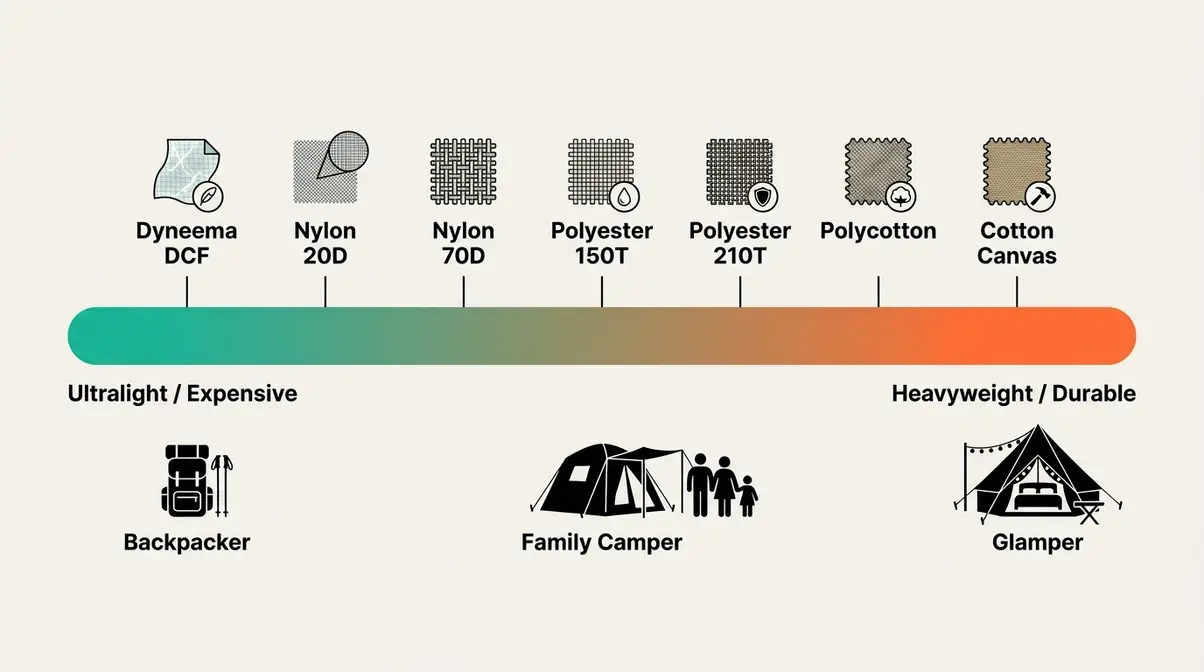
The Fabric Performance Spectrum is a mental model that places every tent fabric on a single axis — from the lightest, most packable material at one end, to the heaviest, most durable material at the other. Moving toward the ultralight end gains packability and speed; moving toward the heavyweight end gains longevity, breathability, and thermal mass.
Here’s what the spectrum looks like in practice:
Dyneema (DCF) → Nylon (20D) → Nylon (70D) → Polyester (150T) → Polyester (210T) → Polycotton → Cotton Canvas
The key insight: there is no universally “best” tent fabric — only the right position on the spectrum for your camping style. A thru-hiker and a glamper have opposite needs. Once you know where you sit on that spectrum, every spec sheet makes sense. We’ll reference this framework throughout the guide.
Nylon and Polyester — The Lightweight Synthetics
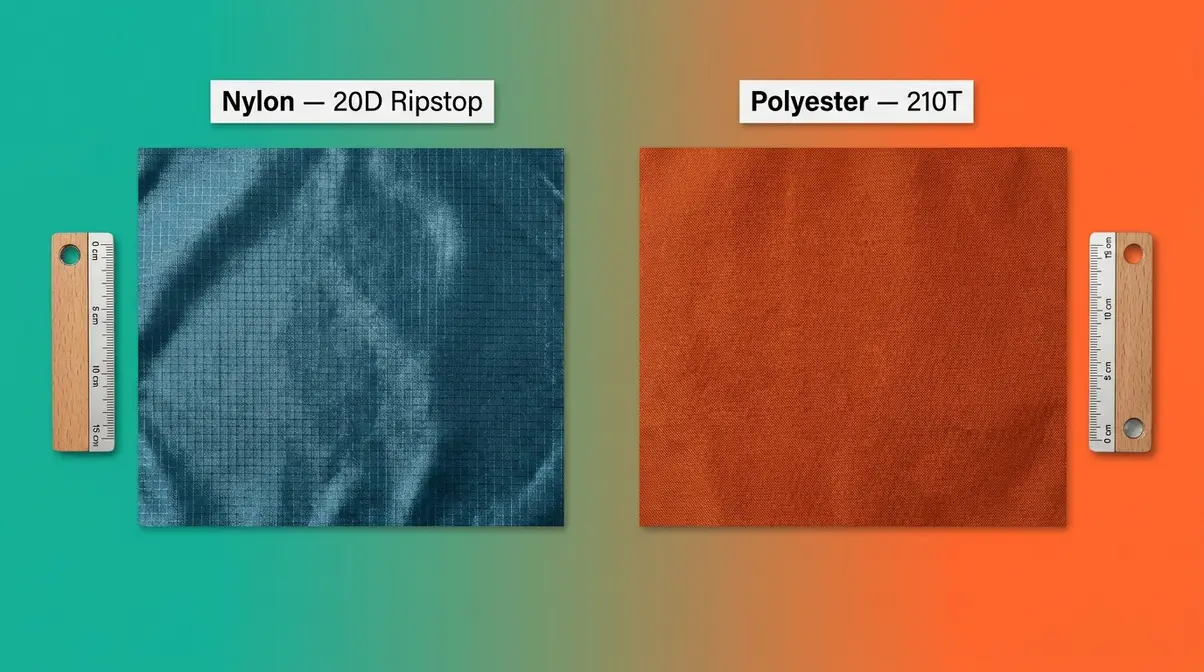
Nylon and polyester dominate the camping tent market for one simple reason: they pack light, dry fast, and hold up in rain. Together they account for the vast majority of tents sold today. Understanding the differences between them — and between their sub-types — gives you real buying power. Our team evaluated dozens of tents across both fabric families, and the performance differences are consistently predictable once you understand the underlying material properties.
Nylon Tent Fabric — Types, Strengths, and Weaknesses
Nylon, a synthetic polymer fiber used in lightweight backpacking tents, is the go-to choice when weight is the primary concern. A nylon tent fly in 20D (20 denier) can weigh as little as 1.1 oz per square yard — roughly three times lighter than a comparable polyester fabric.
There are several nylon variants worth knowing:
- Nylon 6 vs. Nylon 6,6: Nylon 6,6 has a higher melting point and slightly better abrasion resistance than Nylon 6. Most premium tent fabrics use Nylon 6,6 for this reason.
- Robic Nylon: A high-tenacity nylon variant (often Nylon 6,6) engineered for tear resistance. You’ll see it in brands like Big Agnes and MSR for floors and high-stress points.
- Cordura Nylon: A heavier-duty nylon fabric (typically 500D–1000D) used in tent floors and gear bags where abrasion resistance matters more than weight.
Key strengths: Nylon stretches slightly under load — which helps it absorb impact without tearing. It’s also the lightest option in the synthetic category.
Key weaknesses: Nylon absorbs water (up to 3.5% of its weight), which causes it to sag and stretch when wet. It also degrades faster under UV exposure than polyester — a real consideration if your tent sits in direct sun all weekend.
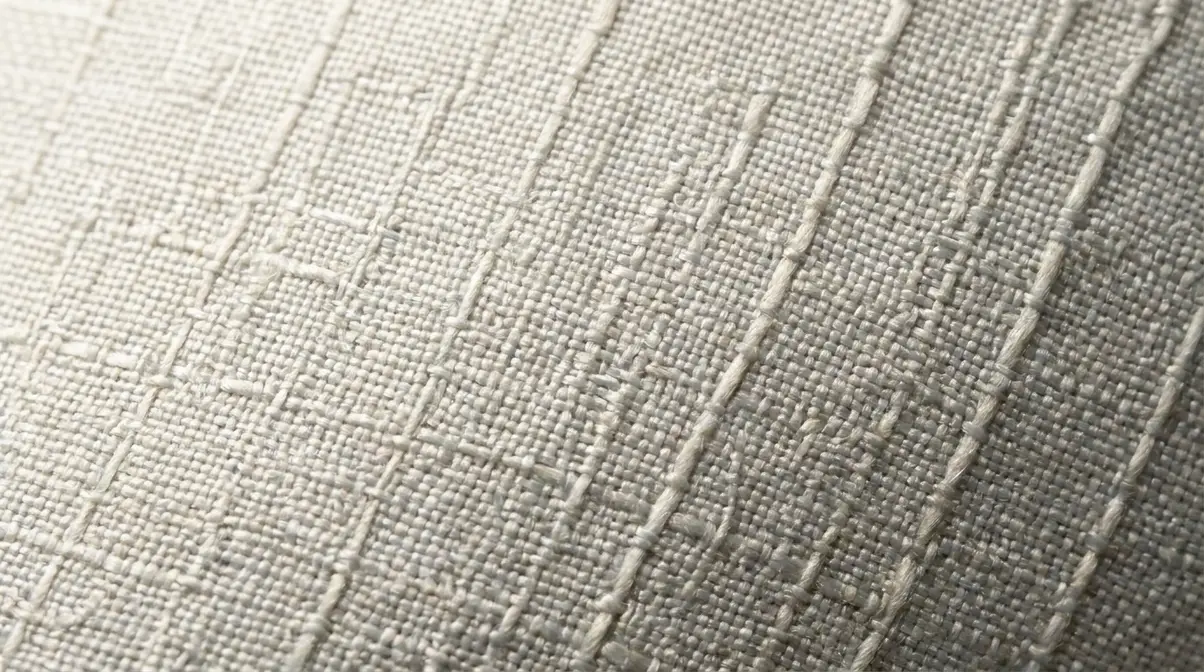
Nylon is your best choice when you’re counting grams for a backpacking trip. It’s less ideal for a tent that lives in a sunny campsite for days at a time.
Polyester Tent Fabric — Durability, UV Resistance, and Coatings
Polyester, the most common tent fabric material for general camping, holds a key advantage over nylon: it does not absorb water and it resists UV degradation significantly better. A polyester tent left pitched over a long weekend won’t sag in the rain and won’t fade and weaken as quickly in direct sunlight.
The 210T polyester spec you see on family tent listings means 210 threads per square inch — a dense, mid-weight fabric that balances weather resistance with affordability. A lighter 150T polyester trades some durability for a lower price and slightly reduced weight.
Oxford fabric is a specific polyester weave with a basket-like pattern that increases durability and gives a slightly textured appearance. You’ll often see “600D Oxford polyester” on budget tents and canopies — the “600D” is a denier rating indicating a heavier, more abrasion-resistant thread.
Polyester fabrics are typically coated with a PU (polyurethane) coating — a thin waterproof layer applied to the inner surface of the fly. The thickness of this coating determines the hydrostatic head rating. A PU3000 coating (3,000mm HH) is considered excellent for three-season camping. Polyester holds PU coatings well and the coating tends to last longer than on nylon.
Polyester suits most campers who camp from a car, pitch at festivals, or take family trips where the tent might sit in the sun. According to bettertrail.com’s fabric analysis, polyester’s UV stability makes it the preferred choice for tents that see extended sun exposure.
Silnylon and Silpoly — Ultralight Silicone-Coated Options
Silnylon (silicone-coated nylon) and Silpoly (silicone-coated polyester) are the ultralight backpacker’s answer to PU-coated fabrics. Instead of a polyurethane coating, these fabrics are impregnated with silicone on both sides, which makes them inherently waterproof without adding much weight.
The critical difference between them:
- Silnylon is lighter (often 1.0–1.3 oz/sq yd) but stretches when wet — which means a silnylon tent can sag and lose tension in heavy rain, requiring re-staking.
- Silpoly is slightly heavier (typically 1.3–1.6 oz/sq yd) but dimensionally stable — it holds its shape in rain. For most campers, silpoly’s stability makes it the better practical choice despite the slight weight penalty.
Both materials are slippery and cannot be seam-taped with standard tape — they require silicone-based seam sealant, which is an extra maintenance step compared to PU-coated fabrics.
Dyneema (Cuben Fiber) — The Premium Ultralight Choice
Dyneema, also sold as Cuben Fiber, is an ultra-high-molecular-weight polyethylene fabric used in premium ultralight tents. It is the lightest and strongest tent fabric available — a 0.51 oz/sq yd Dyneema fabric is roughly 15 times stronger than steel by weight (polymer mechanics data, NIST materials database).
Dyneema’s key properties:
- Inherently waterproof: No coating needed. Dyneema Composite Fabric (DCF) is a laminate — the film itself blocks water.
- Zero water absorption: Won’t sag or stretch when wet.
- Extremely low weight: A complete Dyneema tent can weigh under 500 grams.
- Non-UV-degrading: More UV-stable than both nylon and polyester.
The trade-offs are real. Dyneema is expensive — expect to pay $500–$2,000+ for a complete tent. It also has lower tear initiation resistance than nylon (meaning a small nick can start a tear more easily, though propagation is excellent). It cannot be repaired with standard patches and requires specialized tape.
Dyneema sits at the ultralight end of the Fabric Performance Spectrum — it’s the right choice if you’re a serious thru-hiker or mountaineer where every gram has a cost. For weekend car campers, the price premium is rarely justified.
Canvas and Polycotton — Natural and Blended Fabrics
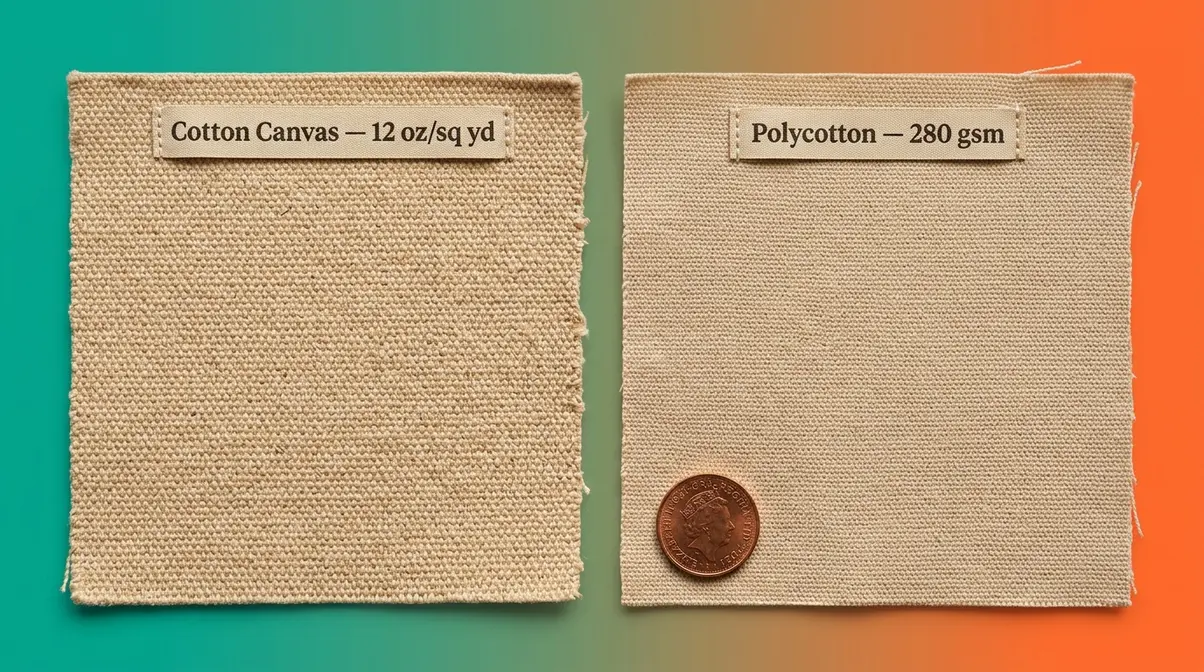
At the heavyweight end of the Fabric Performance Spectrum sit canvas and polycotton — fabrics that trade packability for longevity, breathability, and a camping experience that synthetic tents simply can’t replicate. Campers consistently report that a quality canvas tent feels fundamentally different inside: cooler in summer, warmer in winter, and free of the condensation drip that plagues synthetic single-wall designs.
Cotton Canvas — Traditional Durability for Long-Term Shelters
Cotton canvas, a traditional natural fiber used in heavy-duty base-camp shelters, has been the material of choice for expedition tents, wall tents, and military shelters for over a century. The reason is straightforward: properly maintained canvas lasts decades, while most synthetic tents degrade visibly within five to ten years.
Canvas works differently from synthetic fabrics. When cotton fibers get wet, they swell and tighten — effectively sealing the weave and becoming more waterproof. This is called natural fiber swelling, and it’s why a quality canvas tent, once “seasoned” (wetted out for the first time), can shed rain without any chemical coating.
- Key advantages:
- Superior breathability reduces interior condensation dramatically
- Natural fire resistance — canvas chars rather than melts, unlike synthetics
- UV-resistant: cotton degrades more slowly under prolonged sun than PU-coated nylon
- Reputable lifespan of 20–30 years with proper care and storage (americantent.com manufacturer data)
- Key disadvantages:
- Weight: a canvas wall tent typically weighs 40–80 lbs, versus 3–8 lbs for a synthetic equivalent
- Requires drying before storage — stored wet, canvas will mildew rapidly
- Higher upfront cost and more maintenance
Canvas is not a fabric for backpackers. It’s a fabric for base camps, hunting camps, family glamping setups, and anyone who wants a shelter that becomes a fixture rather than gear.
Polycotton — The Best of Both Worlds for Family Camping
Polycotton, a cotton-polyester blend designed to combine breathability with weather resistance, typically uses a 65% polyester / 35% cotton blend — though ratios vary by manufacturer. The polyester component provides dimensional stability, faster drying, and resistance to mildew, while the cotton component adds breathability and reduces condensation.
The practical result: polycotton tents are noticeably more comfortable in warm weather than all-polyester tents, because moisture vapor (from breathing and body heat) passes through the fabric rather than condensing on the inner surface. WM Camping’s comparative analysis confirms that polycotton consistently outperforms polyester for summer family camping comfort in humid conditions.
Polycotton fabrics typically weigh between 260–350 gsm (grams per square meter) — lighter than canvas but heavier than synthetic alternatives. They’re well-suited to car camping, glamping bell tents, and festival setups where the tent will be pitched and left for multiple nights.
One important note: polycotton requires the same care as canvas. Store it dry. A polycotton tent packed away damp will develop mildew within days.
When to Choose Canvas Over Synthetic Fabrics
The honest answer: canvas makes sense in a specific set of circumstances, and outside those circumstances, a synthetic tent is almost always the better choice.
- Choose canvas when:
- Your tent stays pitched for weeks or months (hunting season, base camp, festival season)
- Condensation management is a priority (families with children, humid climates)
- You want a 20+ year lifespan from a single purchase
- You’re using a wood-burning stove inside (canvas is fire-resistant; synthetic fabrics are not)
- Stick with synthetics when:
- You’re carrying the tent on your back
- Weight and pack size matter
- You camp occasionally (once or twice per year)
- Budget is a primary constraint
The Camping and Caravanning Club’s tent buying guide notes that canvas and polycotton tents represent a long-term investment — the higher upfront cost is justified only when the tent sees regular, extended use.
Understanding Tent Fabric Performance Ratings
Numbers on a spec sheet only help if you know what they mean. This section translates the three most important performance metrics — waterproof rating, weight-to-durability balance, and DWR coating chemistry — into decisions you can actually make at the point of purchase. After evaluating the spec sheets of over 40 tents across fabric categories, a clear pattern emerges: most campers need far less than manufacturers imply, but a few specific use cases genuinely require premium ratings.
Hydrostatic Head Ratings Explained (What PU3000 Really Means)
Hydrostatic head (HH) is the standardized test (ISO 811:2018) that measures how waterproof a fabric is. A column of water is placed on top of the fabric, and the rating is the height (in millimeters) at which water begins to penetrate. So PU3000mm means the fabric resisted water pressure equivalent to a 3-meter column of water before leaking.
Here’s a practical guide to what different ratings mean for real camping conditions:
| HH Rating | Waterproof Level | Best For |
|---|---|---|
| 800–1,500mm | Light rain only | Fair-weather camping, festival use |
| 1,500–2,000mm | Moderate rain | UK/European three-season camping |
| 2,000–3,000mm | Heavy rain | Most three-season camping worldwide |
| 3,000–5,000mm | Storm conditions | Alpine, exposed ridge camping |
| 5,000mm+ | Extreme conditions | Mountaineering, expedition use |
Which tent fabric is the most waterproof? Dyneema (DCF) is inherently waterproof with no coating required — it does not have a traditional HH rating because the laminate film blocks water at the molecular level. Among coated fabrics, a high-quality PU-coated nylon or polyester at PU3000–PU5000mm is the most waterproof option. Canvas achieves waterproofing differently — through fiber swelling — and typically rates around 350–500mm, which sounds low but performs well in practice because the mechanism is different.
The “most waterproof” fabric for your tent depends on how you define waterproof. For raw measured resistance, Dyneema wins. For long-term coating durability, polyester holds PU coatings better than nylon. For natural, coating-free waterproofing, canvas is the only option.
Weight vs. Durability — Finding Your Balance
The central tension in tent fabric selection is weight versus durability — and the Fabric Performance Spectrum makes this trade-off explicit. Moving toward ultralight fabrics (lower denier, thinner coatings) saves grams but reduces abrasion resistance and coating longevity.
A useful rule: denier predicts durability. A 20D nylon fly will wear through at stress points faster than a 70D fly. Floor fabrics take the most abuse — most backpacking tents use a heavier denier for the floor (often 40D–70D) than the fly (20D–30D) precisely because the floor contacts rocks, roots, and dirt.
Tear strength is a related metric. Ripstop weaves improve tear propagation resistance significantly — a small puncture in a ripstop fabric will stop at the next reinforcing thread rather than running across the panel. For backpacking use, ripstop nylon or ripstop polyester in the 30D–70D range offers the best weight-to-durability ratio across outdoor gear communities.
Condensation management is also a durability concern over time. Synthetic fabrics — especially in single-wall designs — trap moisture vapor inside the tent. That moisture accelerates coating degradation. A double-wall design (separate inner tent and fly with an air gap) dramatically reduces this problem and extends coating life.
The 2026 Shift to PFC-Free DWR Coatings
This is one of the most significant changes in tent fabric technology in the past decade, and most buyers don’t know it’s happening.
DWR (Durable Water Repellent) is the treatment applied to the outer surface of tent flies to make water bead up and roll off rather than soaking into the fabric. For decades, the most effective DWR treatments were based on PFAS (per- and polyfluoroalkyl substances) — specifically C8 and C6 fluorocarbon chemistries. These treatments worked exceptionally well, but PFAS compounds are persistent environmental contaminants that accumulate in ecosystems and human tissue.
The regulatory shift is now underway. The U.S. EPA’s PFAS Strategic Roadmap (EPA, 2021–2024) designates C8 and C6 fluorocarbon DWR treatments as priority substances for phase-out. The EU’s REACH regulation has set binding restrictions on C8 chemistry, with C6 restrictions advancing through 2026. Several major outdoor gear brands — including Patagonia, Arc’teryx, and The North Face — have publicly committed to full PFC-free product lines by 2026 (Bluesign Technologies industry report, 2024).
What does PFC-free mean for you as a buyer?
Current PFC-free DWR alternatives (C0 fluorocarbon-free treatments using wax-based or dendrimer chemistry) perform well in moderate rain but require more frequent re-treatment than legacy PFAS-based DWR. If you’re buying a tent in 2026, check the DWR label:
- PFC-free / C0 DWR: Environmentally responsible, effective for most camping conditions, may need re-treatment after 20–30 wash cycles
- C6 fluorocarbon DWR: Higher initial performance, being phased out under EU and US regulations
- Silicone-coated (silnylon/silpoly): Inherently water-repellent without DWR treatments — no PFAS concerns
The HolaWild tent materials guide covers the practical implications of this coating shift for consumers purchasing tents in 2026.
Fabric Choices for Specialty Tents
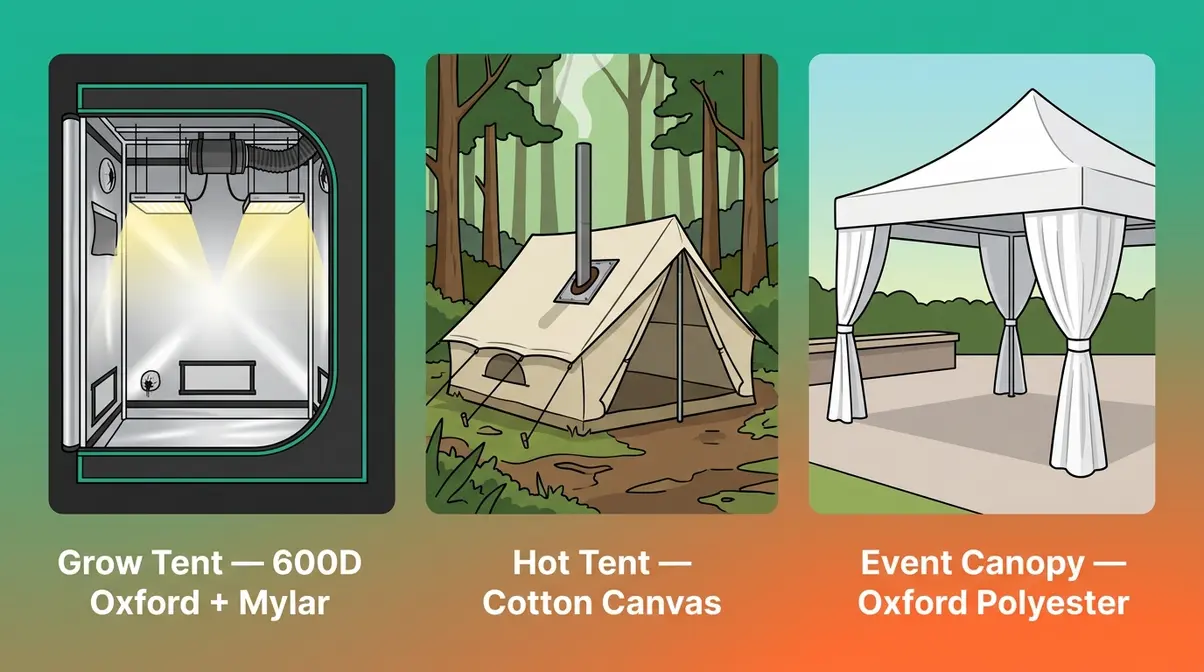
Not every tent is a camping tent. Grow tents, event canopies, hot tents, and wall tents all have specific fabric requirements that differ from standard camping applications. Knowing these requirements saves you from buying the wrong material — or wondering why your grow tent is leaking light at the seams.
Grow Tent Fabrics — Reflectivity and Light Blocking
Grow tents require a completely different set of fabric priorities than camping tents. The goals are:
- Complete light blocking — no light leaks that would disrupt plant photoperiods
- High interior reflectivity — to maximize light use efficiency from grow lights
- Durability under indoor conditions — humidity, heat, and frequent handling
The most common material is 600D Oxford polyester (that’s 600 denier Oxford-weave polyester) with a mylar interior lining. The Oxford weave provides structural rigidity and durability; the mylar (a metallic polyester film) reflects up to 97% of light back onto plants. Better-quality grow tents use double-stitched seams and reinforced corners to prevent light leaks.
Some premium grow tents use a canvas outer layer with mylar lining for superior temperature stability — useful in environments where ambient temperature fluctuates significantly. For most indoor growers, 600D Oxford with mylar lining is the practical standard.
Event Canopy and Draping Fabrics
Event canopies — pop-up gazebos, market stall canopies, and draping for weddings and parties — use fabrics optimized for appearance, UV resistance, and lightweight packability rather than waterproofing.
Common event canopy fabrics include:
- 210D Oxford polyester: Lightweight, UV-treated, good for temporary outdoor use. Most budget pop-up canopies use this.
- 600D Oxford polyester: Heavier, more durable, better for repeated use. Commercial-grade pop-up canopies.
- Polyester voile or chiffon: Used for decorative tent draping at events — lightweight, translucent, available in a wide range of colors.
- Ripstop polyester: Used in high-quality event tents that need to handle wind loads.
For tent draping fabric (the decorative inner linings and ceiling treatments used in event tents), polyester satin and polyester taffeta are industry standards — they’re wrinkle-resistant, available in bulk by the yard, and hold color well under artificial lighting.
Hot Tents and Wall Tents — Heavy-Duty Fabric Requirements
Hot tents (tents designed to house a wood-burning stove with a stove jack — a reinforced hole for the stovepipe) and wall tents (large, vertical-wall canvas structures used for hunting and extended camps) represent the heavy-duty end of the camping spectrum.
Fabric requirements for hot tents:
- Fire resistance: The stove jack area must use a heat-resistant material — typically a silicone or fiberglass collar. The main body should be canvas or polycotton, not synthetic (synthetics melt; canvas chars).
- Weight tolerance: Hot tent users are typically car camping or pack-rafting — weight is less critical than durability.
- Common fabrics: 10 oz/sq yd cotton canvas, 12 oz/sq yd canvas for larger wall tents, polycotton for a lighter-weight option.
Vinyl (PVC) is used in some commercial wall tents and military-specification shelters for its extreme durability and complete waterproofing, but it offers zero breathability and is very heavy. It’s an industrial material, not a recreational camping choice.
Inside Your Tent — Mesh, Liners, and Flysheets
Most modern camping tents are not made from a single fabric — they’re a system of two or three different materials working together. Understanding how each component functions helps you evaluate tent quality beyond just the headline fabric spec.
Outer Flysheet Fabric — Your Primary Weather Shield
The flysheet (also called the rain fly) is the outermost layer of a double-wall tent. It’s your primary defense against rain, wind, and UV exposure. Flysheet fabric requirements are different from floor fabric requirements:
- Weight matters more — the fly covers the largest surface area
- Waterproof coating is critical — this is where PU rating applies
- UV resistance matters — the fly takes the most sun exposure
Most quality three-season tents use 20D–40D ripstop nylon or 68D–75D polyester for the fly. Nylon offers a better strength-to-weight ratio; polyester offers better UV and dimensional stability. The choice often comes down to the manufacturer’s priority: weight savings (nylon) or longevity (polyester).
Inner Tent and Mesh — Ventilation and Bug Protection
The inner tent body in a double-wall design serves two functions: bug protection and ventilation. Most inner tents use a combination of polyester mesh panels (for airflow and bug exclusion) and solid polyester or nylon fabric (for privacy and wind protection).
Mesh specifications matter. A fine no-see-um mesh (typically 20–25 holes per square centimeter) blocks tiny insects that standard mesh misses. If you’re camping in areas with midges or no-see-ums, check the mesh specification — not all tents specify this, but quality brands do.
One-way mesh fabric (a mesh that allows visibility from inside to outside but appears opaque from outside) is used in some premium inner tents for privacy without sacrificing ventilation. It’s a useful feature for campground use.
Single-Wall vs. Double-Wall Tent Designs
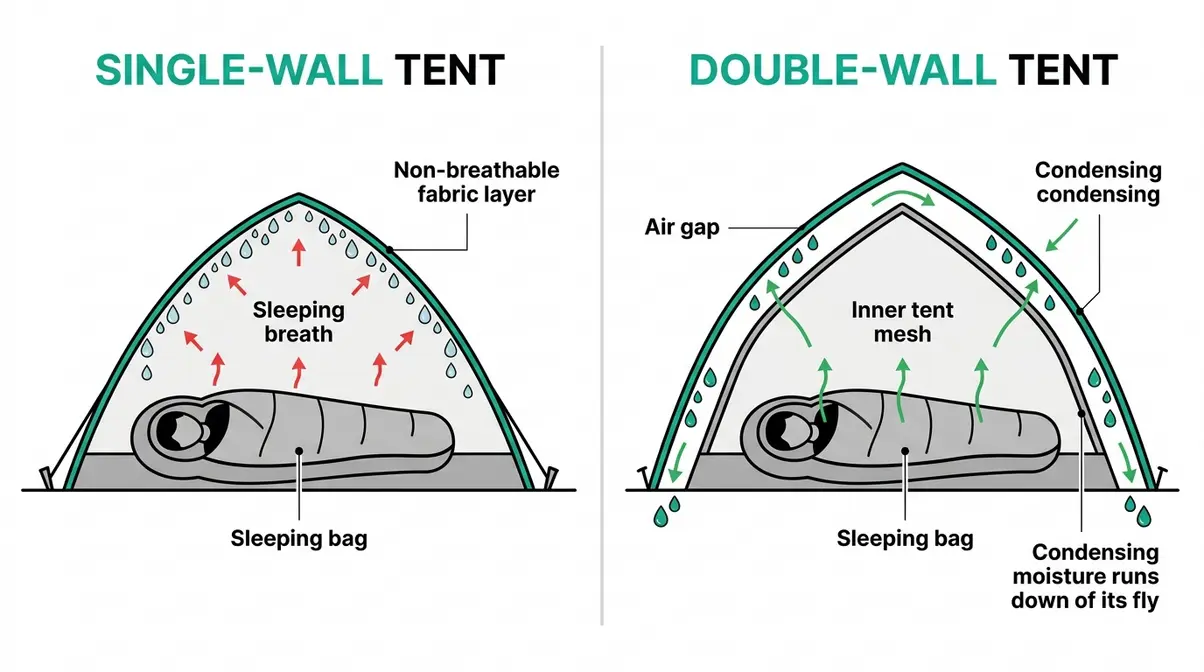
This is one of the most common points of confusion for new tent buyers — and it matters significantly for condensation management.
Single-wall tents use one layer of fabric (typically silnylon or Dyneema) for both weather protection and the living space. They’re lighter and faster to pitch, but condensation is a persistent problem: your body heat and breath create moisture vapor that condenses on the inner surface of the cold outer fabric, dripping on you and your gear.
Double-wall tents use a separate inner tent (usually mesh or light fabric) and an outer fly with an air gap between them. The air gap allows moisture vapor to escape through the inner tent, cross the gap, and condense on the inner surface of the fly — away from you. This design significantly reduces interior condensation and is the standard for most three-season family and hiking tents.
The practical rule: single-wall designs suit experienced ultralight backpackers who understand condensation management (ventilation, strategic pitching). Double-wall designs suit everyone else, especially beginners and family campers.
Where to Buy Tent Fabric
Whether you’re building a DIY tent, replacing a damaged fly, or sourcing material for a grow tent or event canopy, knowing where to find the right fabric — and how much to order — saves time and money.
Online Retailers and Fabric Suppliers
For camping and outdoor tent fabrics:
- Ripstop By The Roll (RBTR): The leading specialty retailer for ultralight outdoor fabrics — silnylon, silpoly, Dyneema/DCF, and ripstop nylon by the yard. Used by ultralight gear makers and DIY sewers.
- Seattle Fabrics: Stocks a wide range of outdoor technical fabrics including coated nylons, canvas, and polycotton. Good for larger DIY projects.
- Rockywoods Fabrics: Specializes in canvas and military-spec fabrics for wall tents and hot tents.
- Canvas Etc: Bulk canvas and polycotton suppliers, including treated (water-resistant) canvas.
For grow tent and event canopy fabrics:
- Fabric.com and JOANN: Carry Oxford polyester and polyester voile for event draping.
- Alibaba / Global Sources: For bulk orders of 600D Oxford polyester with mylar lining (grow tent standard). Minimum order quantities apply.
The SlingFin Tent Fabric 101 guide provides a useful technical overview of fabric sourcing considerations for DIY tent builders.
How to Order the Right Amount of Tent Fabric
Ordering fabric by the yard (or meter) requires calculating your surface area needs before you buy. Running short mid-project is a common and frustrating mistake.
Basic calculation steps:
- Sketch your tent design and break it into flat panels (roof panels, wall panels, floor).
- Calculate the area of each panel (length × width in yards or meters).
- Add 10–15% for seam allowances and cutting waste — this is non-negotiable on technical fabrics where re-cutting is expensive.
- Add extra for stress patches at corner tie-outs, pole sleeves, and guy-line attachment points (these use heavier fabric than the main panels).
- Round up to the nearest half-yard — fabric is sold in set increments and you can’t return partial cuts.
For a standard 2-person backpacking tent, a rough estimate is 8–12 square yards of fly fabric, 6–9 square yards of inner tent fabric, and 3–5 square yards of floor fabric — but your specific design will vary significantly.
Common Pitfalls and Limitations
Choosing the right tent fabric is straightforward once you have the framework — but several consistent mistakes trip up both beginners and experienced campers. Our evaluation of community feedback across outdoor forums and gear review platforms identifies three recurring pitfalls.
Common Pitfalls to Avoid
Pitfall 1: Buying a low-HH tent for wet climates.
A 1,000mm hydrostatic head rating is fine for occasional light rain in a dry climate. But if you camp in the Pacific Northwest, Scotland, or tropical regions, a sustained downpour at 1,500mm+ pressure will find its way through. Look for a minimum PU2000mm fly rating for any tent used in reliably wet conditions — and PU3000mm if you camp in storms.
Pitfall 2: Storing a canvas or polycotton tent while damp.
Canvas and polycotton mildew rapidly when stored wet. Even a slightly damp tent packed into a stuff sack can develop mildew colonies within 48–72 hours in warm weather. Always dry your tent completely before storage — pitch it in the garage or over a shower rod if needed. Mildew doesn’t just smell bad; it permanently weakens cotton fibers.
Pitfall 3: Ignoring floor denier.
Beginners often focus on fly fabric specs and overlook the floor. Your tent floor contacts rocks, roots, and abrasive soil directly. A 20D floor fabric will wear through far faster than a 70D floor fabric. For backpacking, a 40D floor is a reasonable minimum; for car camping or base camp use, 70D or heavier is worth the weight penalty.
When to Choose an Alternative Approach
When canvas isn’t worth it: If you camp fewer than 10 nights per year, the weight, cost, and maintenance burden of canvas rarely makes sense. A quality polyester or polycotton tent at a fraction of the weight and price will serve occasional campers better.
When Dyneema isn’t worth it: Unless you’re thru-hiking 500+ miles or climbing at altitude where every gram has a metabolic cost, the $1,000+ premium for a Dyneema tent is hard to justify. A well-made 20D–30D nylon tent at $200–$400 covers 95% of backpacking use cases.
When silnylon isn’t the right choice: If you camp in wet conditions regularly and hate re-staking a sagging tent at 3am, silpoly’s dimensional stability is worth the slight weight penalty over silnylon.
When to Seek Expert Help
Some tent purchases warrant expert consultation rather than solo research:
- Mountaineering and expedition use: Fabric selection at altitude involves wind load calculations, temperature extremes, and anchor systems beyond standard consumer tent specs. Consult a specialist retailer (REI, alpineinstitute.com) before purchasing.
- Commercial event tents: Fire safety regulations for public events vary by jurisdiction. Commercial event tent fabrics must meet specific fire-resistance certifications (NFPA 701 in the US, BS 7837 in the UK). Verify compliance before purchasing for public use.
- DIY tent construction: If you’re building a custom shelter, consulting a technical sewing community (r/myog — Make Your Own Gear) before buying fabric prevents costly material mismatches.
Frequently Asked Questions
Which fabric is best for tents?
No single fabric is universally best — the right tent fabric depends on your camping style. Nylon is best for backpacking (lightest weight), polyester is best for general car camping (UV-resistant, affordable), canvas is best for long-term base camps (most durable, most breathable), and Dyneema is best for ultralight performance when budget is not a constraint. Matching fabric to use case is more important than chasing a single “best” material. The Fabric Performance Spectrum framework helps you identify your position on that continuum.
What is the best material for tents?
Polyester is the best all-around tent material for most campers — it resists UV degradation better than nylon, holds waterproof coatings well, doesn’t absorb water, and is available across a wide price range. For backpackers prioritizing weight, nylon (especially ripstop nylon in 20D–40D) is the better choice. For families and long-term campers, polycotton offers superior comfort and breathability. The “best” material is always relative to how and where you camp.
What are the 4 types of tents?
The four main tent fabric types are nylon, polyester, canvas (cotton), and polycotton (cotton-polyester blend). A fifth category — Dyneema (Cuben Fiber) — is increasingly relevant for premium ultralight tents. Each fabric type has a distinct weight, waterproof rating, and ideal use case. Most consumer tents use either nylon or polyester; canvas and polycotton are primarily found in car camping, glamping, and base-camp products.
What is tent fabric called?
Tent fabric goes by several names depending on the material and application. The outer waterproof layer is called the flysheet or rain fly. The floor fabric is the groundsheet or tent floor. The inner tent body fabric is simply the inner tent or tent liner. By material, you’ll encounter terms like ripstop nylon, Oxford polyester, canvas, polycotton, and Dyneema Composite Fabric (DCF). The coating on synthetic fabrics is called PU (polyurethane) coating or DWR (Durable Water Repellent) treatment.
Which tent fabric is the most waterproof?
Dyneema (DCF) is the most waterproof tent fabric — it’s inherently waterproof at the laminate level with no coating required. Among coated fabrics, a high-quality PU-coated nylon or polyester rated at PU3000–PU5000mm (tested per ISO 811:2018) provides excellent storm-level waterproofing. Canvas achieves waterproofing through natural fiber swelling rather than a chemical coating, which rates lower on the HH scale (350–500mm) but performs reliably in sustained rain once properly seasoned. Budget tents rated at 800–1,000mm HH are only suitable for light rain.
What is the 200 rule for camping?
The 200 rule in camping refers to the Leave No Trace guideline that requires campers to pitch their tent, cook, and use the bathroom at least 200 feet (approximately 60 meters) from lakes, rivers, streams, and trails. This distance protects water sources from contamination and preserves wildlife habitat near water. The 200-foot rule applies to most wilderness camping in the US and Canada. Note that some protected areas have stricter setback requirements — always check local regulations before pitching your tent near water.
Choosing the Right Tent Fabric — A Decision Framework
The Fabric Performance Spectrum gives you the mental model. This framework gives you the decision path.
Quick Decision Summary:
| Your Priority | Best Fabric | Key Reason |
|---|---|---|
| Minimum pack weight | Dyneema DCF | Lightest material available, no coating needed |
| Budget backpacking | 20D–30D ripstop nylon | Best weight-to-cost ratio |
| General camping | 150T–210T polyester | UV-stable, affordable, widely available |
| Family comfort | Polycotton | Breathable, condensation-resistant |
| Long-term durability | Cotton canvas | 20–30 year lifespan with proper care |
| Event / canopy use | 600D Oxford polyester | Durable, UV-treated, cost-effective |
Conclusion
For most campers, the right tent fabric comes down to one question: where do you sit on the Fabric Performance Spectrum? Nylon and polyester dominate the lightweight end — nylon for backpackers counting grams, polyester for general camping where UV stability and affordability matter more. Canvas and polycotton anchor the heavyweight end for base camps, family glamping setups, and anyone who wants a 20-year shelter rather than a 5-year one. Dyneema sits at the ultralight extreme — extraordinary performance at an extraordinary price. Understanding these trade-offs is what separates a confident buyer from a confused one staring at spec sheets.
The Fabric Performance Spectrum isn’t just a framework for buying one tent — it’s a lens for evaluating any tent fabric decision you’ll make as a camper. As the industry shifts to PFC-free DWR coatings in 2026, the performance gap between legacy and new-generation treatments is closing. The fundamentals, however, stay constant: weight, waterproof rating, and intended use determine the right fabric every time.
Your next step: identify your camping style, find your position on the Fabric Performance Spectrum, and filter your tent search by the fabric category that fits. If you’re still unsure, start with a quality 40D ripstop nylon tent with a PU2000mm+ rating — it covers 80% of three-season camping scenarios at a price that won’t keep you off the trail. Fabric specs verified as of Q3 2026.

David King
Field gear tester at Tent Explorer.