30+ Campfire Games for All Ages: Zero-Prep Fun Guide
 David King
Updated June 14, 2026
24 min read
David King
Updated June 14, 2026
24 min read
Here are 30+ campfire games for all ages — zero prep, zero gear, all fun. Whether your group spans toddlers to grandparents, this guide has you covered with campfire games for all ages that everyone can actually play.
“Looking for fun family games for around the campfire or just during the day, we’ve got kiddos in our family from ages 2–9 so adult and kiddo game ideas welcome!”
Most campfire game lists give you ten generic names and zero instructions. They don’t tell you which games work for a five-year-old, which ones click for a room full of adults, and which ones fall flat when half the group is half-asleep. This guide fixes that. By the end, you’ll have 30+ specific, ready-to-play games sorted by age and energy level, so everyone — from the youngest kiddos to the adults — walks away with lasting memories around the fire. You’ll find games by age group, classic no-prep options, genuinely unique ideas, and essential campfire safety tips.
Key Takeaways: Campfire Games for All Ages
The best campfire games for all ages require zero prep — just people, a fire, and a few simple rules. Research from the National Institutes of Health (2021) shows outdoor group activities like these significantly reduce stress and strengthen intergenerational bonds.
- Use The Campfire Game Matrix: Match every game to Age + Energy Level + Group Size for instant success
- 30+ games covered: Sorted by age group — kiddos, school-age, families, and adults
- Zero prep required: Every game on this list needs no equipment, no setup, and no experience
- Safety first: Always follow the “cool to touch” rule before leaving a campfire unattended
- Unique games included: Three campfire game ideas your group has never tried
- Game Night Preparation Overview:
- Estimated Time: 10–30 minutes per game.
- Tools and Materials: None required! Every game on this list is completely zero-prep.
Campfire Games for Every Age
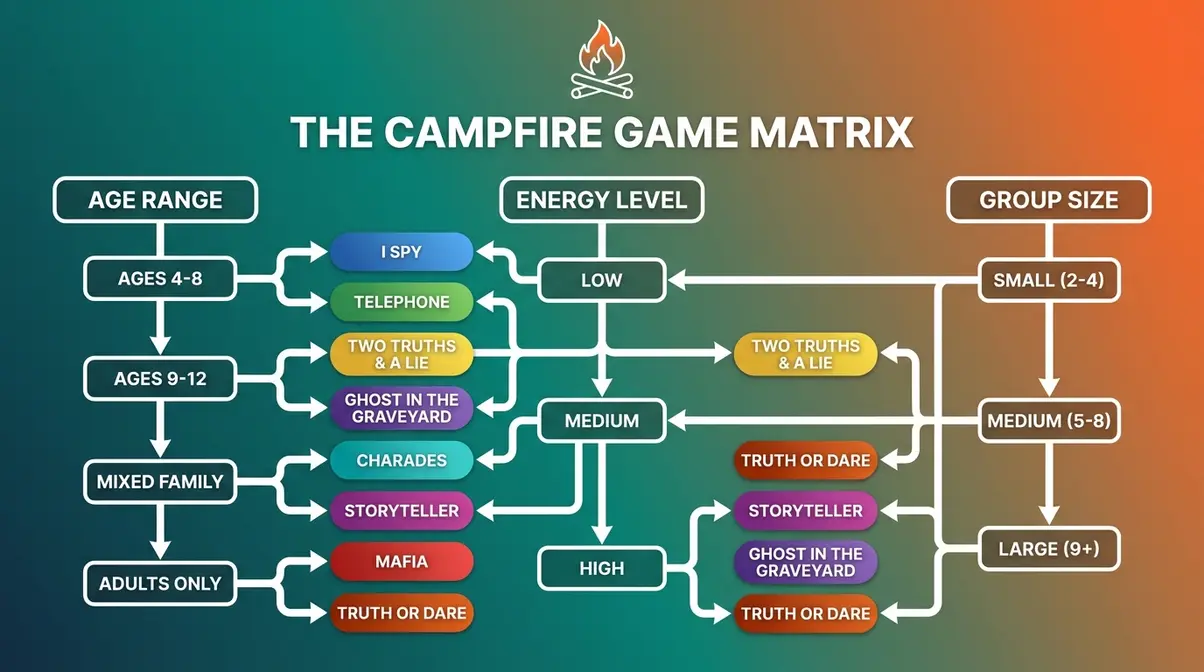
The best campfire games for all ages are ones where nobody sits out. That’s why we built The Campfire Game Matrix — our simple framework for matching every game to three variables: who’s playing (Age Range), how much energy they have (Energy Level), and how many people are in the group (Group Size). Use the flowchart below to find your game in under 30 seconds, then dive into the age-sorted list.
“Looking for fun family games for around the campfire or just during the day, we’ve got kiddos in our family from ages 2–9 so adult and kiddo game ideas welcome!”
If that sounds like your group, you’re in exactly the right place. Here’s how to find your perfect game. National Institutes of Health research confirms that outdoor social activities like campfire games significantly reduce stress and promote intergenerational bonding (NIH, 2021) — so the games you pick tonight matter more than you might think.
For fun campfire games for adults and families, keep reading — every age group has its own section below.
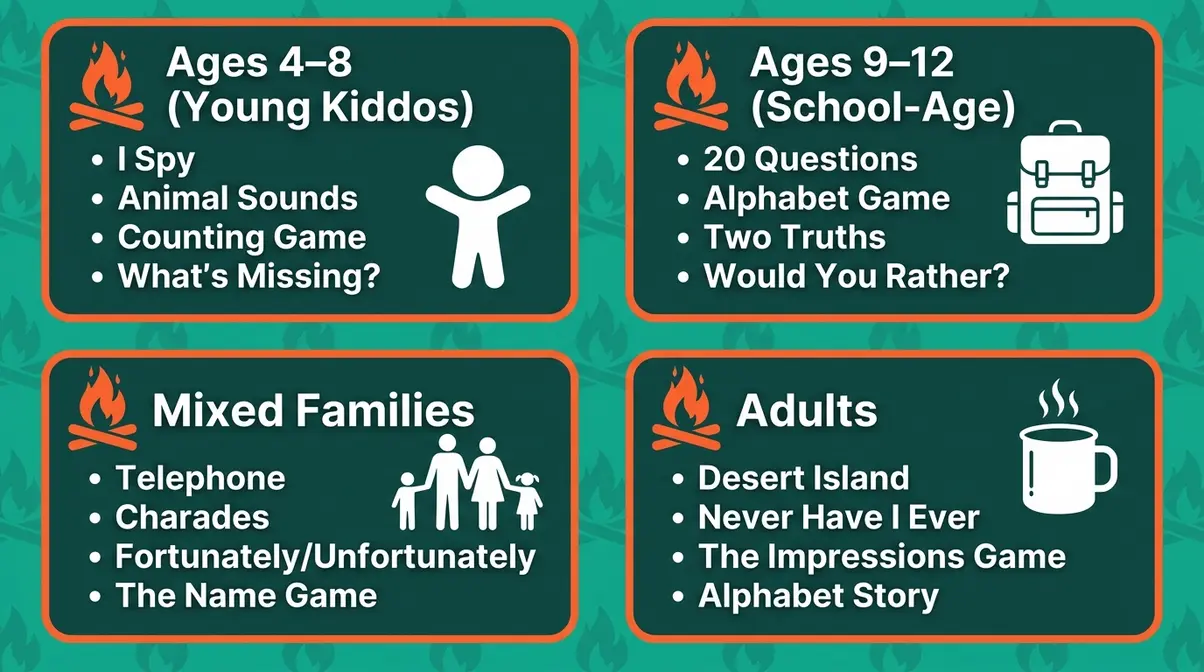
Young Kiddos (Ages 4–8)
Young kiddos aged 4–8 do best with simple, turn-based games that keep them seated and engaged. These campfire games for young kiddos are low-energy, giggle-heavy, and completely equipment-free. Always ensure young kiddos are seated at least 3 feet from the fire ring during these games.
Game 1 — I Spy
I Spy is a classic guessing game where one player secretly picks an object they can see and gives a color or shape clue.
- One player says, “I spy with my little eye something .”
- Other players take turns guessing what the object might be.
- Whoever guesses correctly takes the next turn.
Why it works: No reading required, plays perfectly in firelight, and keeps kiddos safely seated while their eyes do all the work.
Game 2 — Animal Sounds
Animal Sounds is a simple game where one player mimics an animal noise and everyone else tries to name it.
- One player secretly picks an animal and makes its sound.
- All other players shout out their guesses at once.
- First correct guess wins the next turn.
Why it works: Toddler-friendly, produces endless silliness, and camping-specific animals (owls, bears, wolves) make it feel extra outdoorsy.
Game 3 — The Campfire Counting Game
Players take turns counting upward from one. Anyone who hesitates, laughs, or skips a number is out.
- The first player says “one.”
- Each player adds the next number in sequence.
- Hesitate, laugh, or skip — and you’re out. Last player standing wins.
Why it works: Builds number confidence for younger kiddos, keeps energy low, and the pressure of not laughing always makes everyone laugh.
Game 4 — What’s Missing?
What’s Missing? is an observation game where players try to remember a set of small objects after one is secretly removed.
- Arrange 5–6 small objects (pinecones, sticks, rocks) on a blanket.
- Everyone studies the objects for 30 seconds, then closes their eyes.
- One player removes one object. Everyone opens their eyes and guesses what’s gone.
Why it works: Sharpens observation skills, works for mixed ages, and gentle competition keeps things calm near the fire.
Once your youngest campers are happily playing, the school-age kids are ready for something with a bit more strategy.
School-Age Kids (Ages 9–12)
School-age kids aged 9–12 thrive on games with a bit of friendly competition and mental challenge. These thought games keep school-age minds sharp around the fire — and several of them are just as fun for the adults in the group.
Game 5 — 20 Questions
20 Questions is a deduction game where one player secretly picks a person, place, or thing, and everyone else asks yes/no questions to figure it out.
- One player thinks of something (a famous person, an animal, a camping item) and announces the category.
- Other players ask yes/no questions — up to 20 total.
- Whoever guesses correctly before the 20th question wins the next round.
Why it works: Builds deductive reasoning, works for any group size, and the silent-friendly format keeps the campfire atmosphere peaceful.
Game 6 — The Alphabet Game (Camping Edition)
Players take turns naming camping-related items in alphabetical order, racing against a 10-second time limit.
- The first player names a camping item starting with A (axe, air mattress).
- The next player names one starting with B (backpack, bug spray).
- Anyone who blanks for more than 10 seconds or repeats an item is out.
Why it works: Educational, competitive, and instantly engaging — no supplies needed, no setup required.
Game 7 — Two Truths and a Lie
Two Truths and a Lie is a campfire classic where each player states two true facts about themselves and one fiction, and others vote on which is the lie.
- One player announces two true statements and one false one about themselves (in any order).
- Everyone else votes on which statement they think is the lie.
- The player reveals the lie — whoever voted correctly scores a point.
Why it works: Encourages real conversation, reveals surprising personal stories, and works just as well for adults who join in.
Game 8 — Would You Rather? (Camping Edition)
One player poses a dilemma between two camping-themed options and everyone votes.
- One player asks, “Would you rather sleep in a tent during a thunderstorm or hike 10 miles with a heavy pack?”
- Everyone holds up a hand for their choice.
- The player with the most unique answer explains their reasoning.
Why it works: Sparks conversation, has no wrong answers, and scales instantly to any group size.
These thought games work brilliantly for adults too — which is exactly why the next section covers games the whole group can enjoy together.
Family Campfire Games for Mixed Ages
The best family campfire games are ones where a five-year-old and a fifty-year-old are equally likely to win. These are the games that create the lasting memories people talk about for years — adult and kiddo game ideas that genuinely include everyone. Campers consistently report that mixed-age games produce the most memorable moments of any camping trip.
Game 9 — Telephone (Whisper Down the Lane)
Telephone is a chain-whispering game where a message travels around the circle and hilariously transforms by the end.
- One player whispers a sentence to the person beside them.
- Each player whispers what they heard to the next person.
- The last player announces the message aloud — compare it to the original.
Why it works: The garbled result always produces endless silliness, zero skill is required, and every age group contributes equally.
Game 10 — Fortunately/Unfortunately
Players build a collaborative story by alternating between fortunate and unfortunate plot twists.
- One player starts: “Fortunately, we found a treasure map in the woods.”
- The next player adds: “Unfortunately, it led straight to a beehive.”
- Continue around the circle — no wrong answers, no ending required.
Why it works: Collaborative storytelling means no one can lose, kiddos and adults contribute equally, and the story always goes somewhere wonderfully strange.
Game 11 — Charades (Camping Edition)
Charades is the classic acting game where players mime camping-themed words or phrases without speaking.
- One player draws a camping concept from a mental list (setting up a tent, catching a fish, roasting s’mores) and acts it out silently.
- Others shout guesses until someone gets it right.
- The correct guesser takes the next turn.
Why it works: Physical acting keeps energy up, and difficulty scales naturally — adults can mime complex ideas while kiddos stick to simple ones.
Game 12 — The Name Game
One player says any name (celebrity, animal, or fictional character). The next player must say a name that starts with the last letter of the previous name.
- Player one says a name: “Simba.”
- Player two must say a name starting with A: “Anna.”
- Anyone who hesitates more than five seconds or repeats a name is out.
Why it works: Fast-paced, zero equipment, and equally challenging for ages 5 to 55.
Note: Two Truths and a Lie (Game 7) and Would You Rather? (Game 8) from the school-age section are perfect bridge games — add them to any mixed-age round and watch the adults become just as competitive as the kids.
Fun Campfire Games for Adults
Adults around the campfire don’t need complexity — they need games that spark real conversation, friendly rivalry, and the occasional roar of laughter. These campfire activities for every age lean toward adult enjoyment while still being safe enough around the fire.
Game 13 — Two Truths and a Lie (Adult Edition)
Same rules as Game 7, but adults are encouraged to share genuinely surprising truths. The more unexpected the truth, the better the game.
Why it works: Adults reveal stories they’d never share in normal conversation — the competitive element creates a surprisingly intimate atmosphere.
Game 14 — The Alphabet Story
Players build a story together where each sentence must begin with the next letter of the alphabet.
- Player one starts: “A bear wandered into our campsite last Tuesday.”
- Player two continues: “Before we could react, it sat down by the fire.”
- Continue until you reach Z — or someone gets stumped.
Why it works: Requires enough mental effort to feel like a real challenge, but the absurdity of the constraints always produces comedy.
Game 15 — Never Have I Ever (Camping Edition)
Each player holds up five fingers. One player makes a statement starting with “Never have I ever…” Anyone who HAS done that thing puts a finger down.
- Players sit in a circle, each holding up five fingers.
- Take turns making “Never have I ever…” statements — keep them camping-themed to stay inclusive.
- First player to put all five fingers down loses — or wins, depending on how you look at it.
Why it works: Reveals shared experiences, generates stories, and the camping-specific theme keeps it appropriate for all adults present.
Game 16 — The Impressions Game
One player secretly picks a celebrity or well-known character and performs a brief impression. Others guess.
- One player announces “I’m thinking of someone famous” and begins their impression.
- Others shout guesses whenever they like.
- Correct guesser takes the next turn.
Why it works: Low-pressure, high-laughter, and watching reserved adults attempt celebrity impressions is entertainment in itself.
Game 17 — Desert Island
Each player must name three items they’d bring to a desert island — and defend their choices.
- One player announces their three items.
- The group debates and challenges each choice.
- Everyone votes on whose list is most logical (or most creative).
Why it works: Sparks genuine debate, reveals personality, and there are no right answers — making it endlessly replayable.
Classic No-Prep Campfire Games
The classic no-prep campfire games that stand the test of time all share one feature: they need nothing but willing players. Camping games for every age tend to live in three categories — word games, storytelling chains, and guessing challenges. Each type plays differently around the fire, and knowing which to pull out when is half the battle.
Word Games and Brain Teasers

Word games and brain teasers are the quiet backbone of any campfire night. These thought games require zero noise, zero movement, and zero equipment — just focused minds and a willingness to be stumped.
Game 18 — Ghost
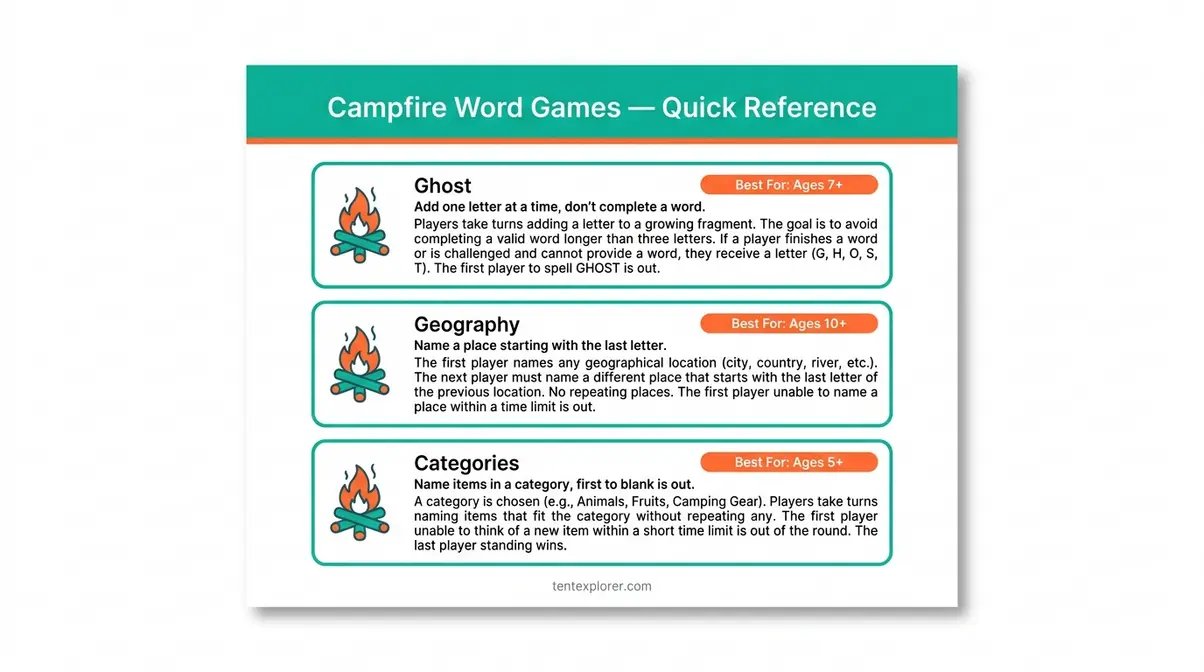
Ghost is a word-building game where players add one letter at a time to a growing string, trying not to complete a real word.
- Player one says a letter: “S.”
- Player two adds a letter, aiming toward a word but not completing one: “T.”
- Anyone who completes a word — or can’t think of a valid continuation — loses the round.
Why it works: Deceptively simple, mentally engaging, and works for any group size.
Game 19 — Geography
One player names a place (city, country, river). The next names a place starting with the last letter of the previous one.
- Player one: “Canada.” Player two must name a place starting with A: “Australia.”
- Continue around the circle with a five-second time limit.
- Repeats or blanks mean you’re out.
Why it works: Educational, competitive, and genuinely challenging for adults and older kids alike.
Game 20 — Categories
One player names a category (types of pizza, things found in a tent, animals that start with B). Players take turns naming items — first to blank is out.
- Name a category.
- Go around the circle, each player adding a valid item.
- Hesitate or repeat — and you’re eliminated.
Why it works: Infinitely customizable, works for every age with the right category choice, and rounds last exactly as long as the group wants.
Research from the American Psychological Association suggests that word-based group games stimulate working memory and improve social cohesion — making campfire word games genuinely good for your brain as well as your evening (APA, 2022).
Storytelling and Chain Games
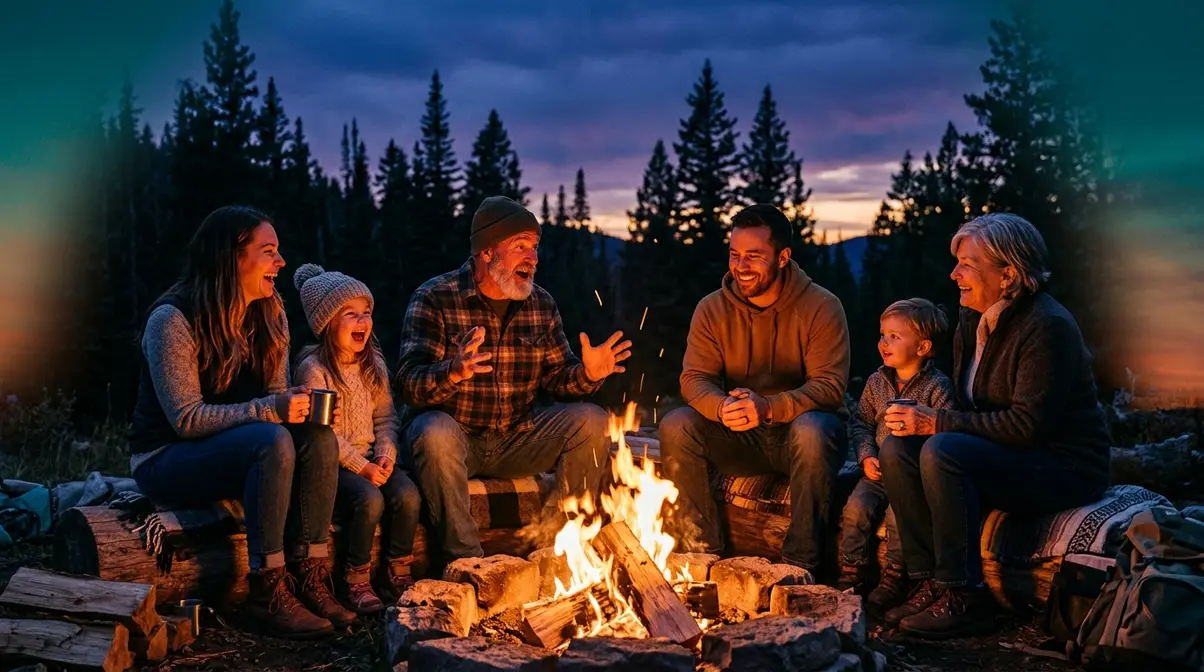
Storytelling games are the campfire’s natural partner — firelight and shared imagination have gone together since humans first gathered around a flame. These games create the collaborative memories that outlast any planned activity.
Game 21 — Once Upon a Time (Chain Story)
Players build a story one sentence at a time, with each person adding the next plot development.
- Player one opens: “Once upon a time, a family of campers found a glowing stone in the forest.”
- Each player adds one sentence — it can go anywhere.
- After 10 rounds, the last player must wrap up the story in one sentence.
Why it works: No wrong answers, no preparation needed, and the collaborative nature means kiddos and adults contribute equally.
Game 22 — Scary Story Circle
Each player contributes one sentence to a building horror story — ideal for older kids and adults after the young kiddos are asleep.
- Agree on a spooky opening line together.
- Take turns adding one sentence each, building tension.
- One designated player ends the story — the scarier the ending, the better.
Why it works: Creates atmosphere, encourages creativity, and the campfire setting does half the work for you.
Game 23 — The Rhyming Story
Players tell a story where every other sentence must rhyme with the one before it.
- Player one: “A raccoon crept into our camp last night.”
- Player two must rhyme: “It stole our marshmallows, then vanished from sight.”
- Non-rhyming players are eliminated — or the group just laughs and continues.
Why it works: The constraint forces creativity, produces accidental comedy, and works beautifully for school-age kids who love wordplay.
Campfire storytelling and game ideas from Cool of the Wild offer additional inspiration if your group exhausts this list.
Guessing Games for All Ages
Guessing games are the most universally loved fire-side games for all — they require listening, lateral thinking, and just enough competition to keep everyone leaning forward.
Game 24 — What Am I?
One player secretly picks an object (a camping item works best). Others ask yes/no questions to identify it.
- One player thinks of an object and says “I’m thinking of something you’d find at a campsite.”
- Others ask yes/no questions: “Is it bigger than a shoe?” “Is it made of metal?”
- Whoever guesses correctly in the fewest questions wins.
Why it works: Simple enough for young kiddos, engaging enough for adults, and completely adaptable to any theme.
Game 25 — Wink Murder
One player is secretly designated as the “murderer” and eliminates others by winking at them without being caught.
- One person is secretly chosen as the murderer (by a passed note or whispered selection).
- The murderer winks at players one at a time. Winked players “die” dramatically after a few seconds.
- Players can accuse the murderer — two wrong accusations and you’re out.
Why it works: Creates suspense, rewards observation, and the dramatic “deaths” produce endless silliness around the fire.
Game 26 — The Emoji Game
One player describes a movie, song, or book using only sounds and gestures (no words). Others guess.
- Player one acts out a title using sounds, gestures, and facial expressions — no words allowed.
- Others shout guesses until someone gets it right.
- Correct guesser takes the next turn.
Why it works: Combines the best of Charades with a modern twist, and camping-themed titles (The Revenant, Wild, Into the Wild) add extra atmosphere.
More campfire game ideas sorted by category are available at Discovering a New, including printable versions for group trips.
Unique & Creative Campfire Game Ideas
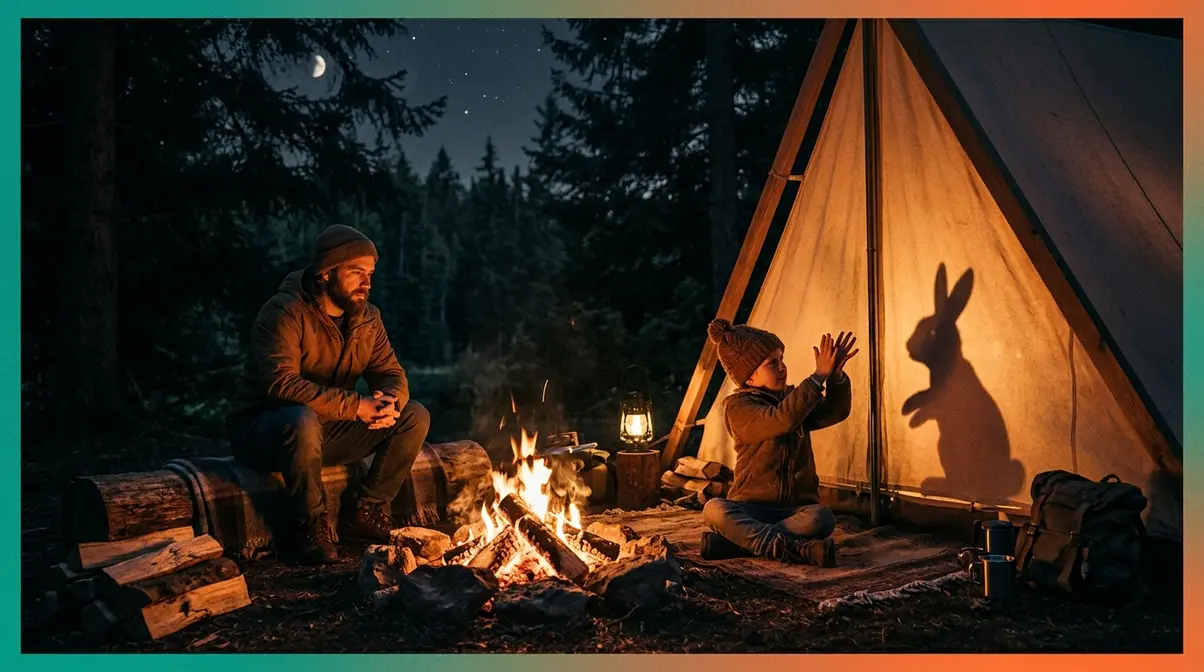
Most campfire game lists recycle the same ten titles. These three games are different — your group almost certainly hasn’t played them before, and each one uses the campfire setting in a genuinely creative way.
Three Campfire Games You’ve Never Tried
Game 27 — The Spark Story
Players watch the fire together for 60 seconds. Each player must then tell one sentence of a story inspired by what they saw in the flames. The catch: every sentence must connect logically to the previous one.
- Everyone stares into the fire in silence for 60 seconds.
- Player one starts with a sentence inspired by what they saw: “The spark that flew upward was actually a tiny firebird escaping the logs.”
- Each player continues the story, connecting to the previous sentence. Anyone who breaks the chain logic is challenged by the group.
Why it works: The campfire itself becomes part of the game. Outdoor recreation guides consistently note that fire-gazing naturally primes the imagination — this game channels that into a shared creative experience.
Game 28 — Campfire Confessions (G-Rated)
Each player writes (or mentally prepares) one totally harmless, amusing confession about themselves. The group votes on which confessions are true and which are invented.
- Each player thinks of one funny, G-rated confession (real or invented): “I once talked to a squirrel for 10 minutes because I was lonely on a solo hike.”
- Players take turns sharing their confession.
- The group votes: true or invented? The player with the most fooled votes wins.
Why it works: Creates genuine laughter, builds group intimacy, and the G-rated constraint keeps it safe enough around the fire for mixed-age groups.
Game 29 — The Shadow Puppet Challenge
Using the firelight, players create shadow puppets on a flat surface (tent wall, large rock, or a sheet). Others guess what creature or scene is being depicted.
- One player positions their hands between the fire and a flat surface to create a shadow puppet.
- Others guess what animal or scene it represents.
- Points for the most creative puppet — voted by the group.
Why it works: Uses the campfire setting as a prop, works for all ages, and gives younger kiddos a physical activity that keeps them engaged and safely away from the flames.
Game 30 — The Campfire Symphony
Each player is assigned a sound (crickets, wind, crackling fire, a distant owl). Together, they perform a “nature symphony” — the conductor points to players to start and stop their sounds.
- Assign each player a nature sound.
- One player acts as conductor, pointing to players to start or stop.
- Build layers of sound into a “symphony” — then challenge players to recreate a specific nature scene.
Why it works: Wildly creative, completely silent-friendly, and the results range from hauntingly beautiful to hilariously chaotic. Campers consistently report this game as the most memorable activity of the trip.
More unique campfire game ideas for groups of all sizes can be found at Reserve America’s camping activity guide.
Campfire Safety & Bonfire Fun
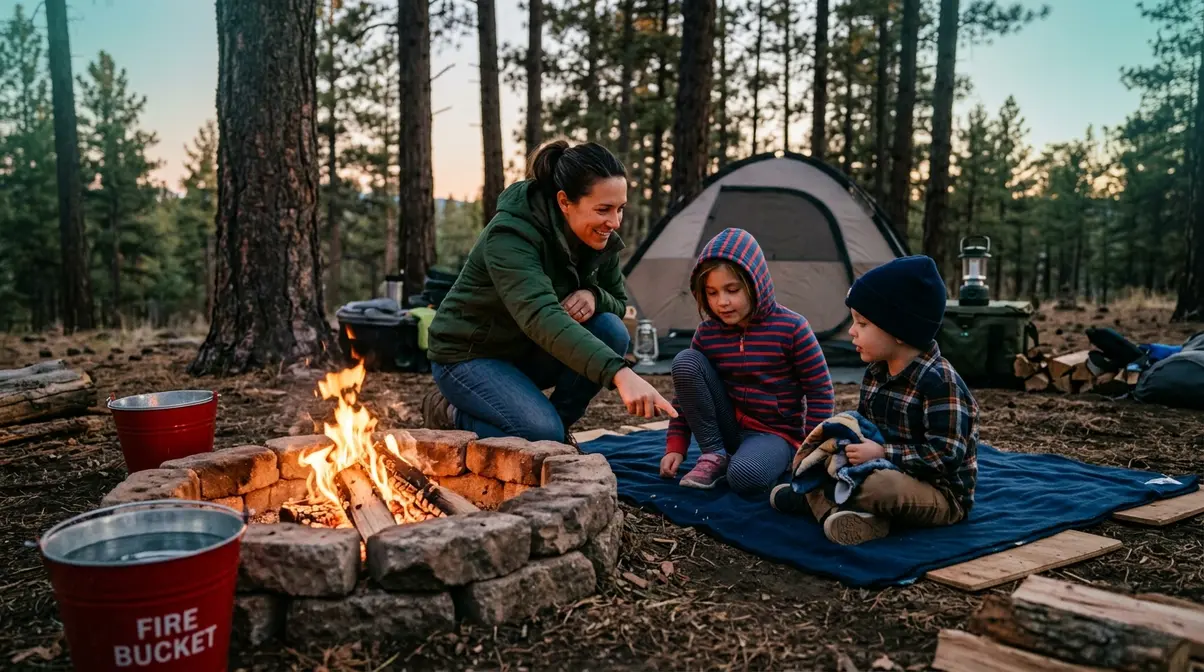
A campfire night is only as good as the safety habits around it. This section covers the essential campfire safety tips that keep everyone — especially kiddos — safe, answers the popular 3-3-3 camping rule question, and shares practical ways to make your bonfire atmosphere genuinely special.
Essential Campfire Safety Rules
Campfire safety is non-negotiable — especially when kiddos are in the group. The U.S. Forest Service (USFS) and the National Park Service (NPS) both publish clear guidelines that every camper should know before striking a match.
Core campfire safety rules:
- Maintain a 3-foot safety zone: Keep all players — especially young kiddos — at least 3 feet from the fire ring at all times during games. The U.S. Forest Service recommends clearing a 10-foot radius around any campfire from flammable materials.
- Never leave a fire unattended: An adult must supervise the fire at all times. Rotate supervision duties if the game involves everyone.
- Use the “cool to touch” rule: Before leaving a campsite, douse your fire completely with water, stir the ashes, and repeat until everything is cool to the touch. The National Park Service states that a fire is only truly out when the ash is cold enough to touch with bare hands.
- Keep water nearby: Always have a bucket of water or a shovel within arm’s reach of the fire during any group activity.
- No running near the fire: Establish this rule before games begin — especially for energetic games like Charades that involve movement.
- Fire size matters: Keep campfires small and manageable. A fire the size of a dinner plate provides enough light for games without creating a safety hazard.
- Check local fire restrictions: Before lighting any campfire, check current fire restrictions with your local ranger station or via Recreation.gov.
Campers consistently report that establishing these rules before games begin — not during — prevents accidents and keeps the atmosphere relaxed rather than anxious.
What Is the 3-3-3 Rule for Camping?
The 3-3-3 rule for camping is a popular planning framework — not a fire safety rule — designed to help campers pace their trips sustainably and avoid exhaustion or overcommitment.
The three elements are:
- Drive no more than 3 hours to your campsite per travel day — keeping drives manageable for families with kiddos.
- Stay for at least 3 nights — giving your group enough time to relax, explore, and actually enjoy the campfire games you planned.
- Arrive by 3 p.m. — leaving daylight hours for setting up camp, exploring the area, and getting comfortable before dark.
Why it matters: The 3-3-3 rule exists because rushed camping trips are stressful camping trips. Arriving early means your kiddos have time to run off energy before the evening campfire — making them far more receptive to calm, seated games once the sun goes down. It’s practical trip architecture, not just a catchy number.
How to Make Your Bonfire More Fun
Games are one piece of the puzzle. The atmosphere around your fire shapes the whole experience — and a few small additions turn a good campfire night into one your group talks about for years.
Practical ways to upgrade your campfire experience:
- Build a game rotation: Use The Campfire Game Matrix to pre-select three games for the night — one for early evening with kiddos, one for mixed ages, and one for adults after the younger ones are asleep.
- Create a snack station: S’mores are the classic, but popcorn over the fire, hot chocolate, or fruit skewers give people something to do with their hands between game rounds.
- Use ambient sound: A small portable speaker with a “forest sounds” playlist adds atmosphere without overpowering conversation.
- Designate a storyteller: Assign one adult the role of “campfire host” for the evening — they introduce games, keep energy flowing, and call time on rounds that drag.
- Dim other light sources: Turn off lanterns and phone screens during games. Firelight creates natural intimacy and makes everything feel more immersive.
- Plan a “grand finale” game: End the night with a group favorite — Telephone, the Chain Story, or the Campfire Symphony — so the evening has a satisfying conclusion rather than just fading out.
“Outdoor group activities like campfire games significantly reduce stress and promote intergenerational bonding, according to research published in the National Library of Medicine (NIH, 2021).” The atmosphere you create around the fire is the delivery mechanism for that benefit — games are the tool, but the warmth, the light, and the shared attention are what make the memory stick.
Frequently Asked Questions About Campfire Games
Fun campfire games for adults?
Fun campfire games for adults include Two Truths and a Lie, Never Have I Ever (Camping Edition), Desert Island, and The Alphabet Story. These games work best because they spark genuine conversation rather than just competition. Adults tend to enjoy games that reveal personality — Two Truths and a Lie consistently produces the most laughter because real truths are often stranger than any invented lie. For groups of four or more, Never Have I Ever (Camping Edition) is the easiest to run with no setup at all. Avoid overly complex rules after dark — simple games always outperform elaborate ones around a campfire.
Camping games for all ages?
The best camping games for all ages are Telephone, Charades (Camping Edition), Fortunately/Unfortunately, and The Name Game. These work across age groups because they require no reading, no equipment, and no prior experience. Campers consistently report that Telephone produces the most cross-generational laughter — the message always comes out hilariously garbled by the end. The Campfire Game Matrix (Age × Energy × Group Size) is the fastest way to match the right game to your specific group. Any game that requires only listening, speaking, and imagination qualifies as a solid all-ages pick.
What to play around a campfire?
Around a campfire, the best games are low-movement, voice-based activities like 20 Questions, Ghost, Once Upon a Time, and Categories. Firelight limits visibility, so games that don’t require reading cards, writing, or precise physical coordination work best. Word games and storytelling chains are ideal because the fire itself creates the atmosphere — you don’t need to manufacture tension or excitement. Start with a warm-up game like I Spy for younger kiddos, then transition to word games as the evening deepens and energy settles.
What are some unique camp game ideas?
Three genuinely unique campfire games most groups have never tried: The Spark Story, Campfire Confessions (G-Rated), and The Shadow Puppet Challenge. The Spark Story uses the fire itself as inspiration — players watch the flames for 60 seconds and build a collaborative story from what they see. Shadow Puppet Challenge turns firelight into a game prop. Campfire Confessions builds group intimacy through harmless, funny revelations. Each game takes under two minutes to explain and requires zero preparation — just a willing group and an open fire.
How do you make a bonfire more fun?
Make a bonfire more fun by using The Campfire Game Matrix to pre-plan three games, building a snack station, designating a campfire host, and dimming all other light sources. The atmosphere matters as much as the games themselves. Research from the NIH (2021) shows that outdoor group activities reduce stress — but only when participants feel relaxed and included. A rotating game schedule (kiddos’ games first, mixed-age games next, adult games last) keeps everyone engaged through the whole evening rather than losing the youngest or oldest members early.
What is the 3-3-3 rule for camping?
The 3-3-3 rule for camping means: drive no more than 3 hours, stay for at least 3 nights, and arrive by 3 p.m. It’s a trip-planning framework, not a fire safety rule. The logic is practical — shorter drives reduce travel fatigue, longer stays give your group time to relax and actually play the games you planned, and early arrivals leave daylight for setup. For families with kiddos, arriving by 3 p.m. is especially valuable: it gives children time to burn off energy before the campfire evening, making seated games far more successful after dark.
What are some fun campfire games?
The most consistently fun campfire games across all age groups are I Spy (kiddos), Two Truths and a Lie (school-age and adults), Telephone (mixed ages), and The Spark Story (unique and memorable). Fun at a campfire is less about the game itself and more about the match between game and group — which is exactly what The Campfire Game Matrix is designed to solve. Zero-prep games always outperform games with equipment because setup time breaks the atmosphere. Start with one simple game, build momentum, and let the group vote on what comes next.
Your Campfire Game Night Starts Here
For families and groups with kiddos from 2 to 92, campfire games for all ages don’t have to be complicated. The 30+ games in this guide are zero-prep, zero-equipment, and immediately playable — the only thing your group needs is a willingness to play. Research from the National Institutes of Health (NIH, 2021) confirms what campers already know: outdoor group games reduce stress and build genuine connection across generations.
The Campfire Game Matrix makes the selection process simple. Match your group’s age range, energy level, and size to the right game category — then pick one from the list and start. That’s it. No planning, no materials, no awkward silences. By categorizing activities based on who is playing and how much energy they have, you eliminate the guesswork that usually derails group activities.
Imagine how your evening could flow: You might start with low-energy rounds of I Spy while the youngest kiddos are still awake, transition into a hilarious game of Telephone that gets the whole family laughing, and finish the night with The Spark Story once the fire burns down to embers. This natural progression keeps everyone engaged without feeling forced or overly structured.
The true magic of a campfire isn’t just the warmth of the flames; it’s the shared attention and the stories you create together. When you remove the need for props, boards, or complex rules, you allow genuine human connection to take center stage.
Tonight, pull up the Campfire Game Selector flowchart, pick your first game from the age-sorted list, and let the fire do the rest. Save this guide for your next camping trip, share it with your fellow trip organizers, and get ready to create your group’s most memorable camping night yet. It really is just one game away.

David King
Field gear tester at Tent Explorer.