DIY Tent Door Magnet Security: Step-by-Step Guide
 David King
Updated June 29, 2026
26 min read
David King
Updated June 29, 2026
26 min read
Picture this: it’s 3 a.m., the wind is picking up, and your tent door is flapping open for the third time tonight. You’re fumbling with a stiff zipper in the dark, half-asleep, fingers cold and clumsy. Your tent door won’t stay shut — and that low-level feeling of being exposed keeps pulling you out of sleep.
Traditional zippers wear out, toggles take two hands, and the door still billows in a gust. Every time that flap opens, you lose heat, invite bugs, and feel that nagging sense of vulnerability. Tent door magnet security offers a real solution: a silent, zipperless closure you can open with one hand in complete darkness. In this guide, you’ll learn exactly how to install a magnetic closure on your tent door — which magnets work, which fabrics are compatible, and — critically — what magnets honestly cannot protect against. We’ll cover five installation steps, a materials primer, a full comparison of closure types, and an honest look at real security limits.
Before upgrading your door, review these general tent security measures to understand the full picture of campsite safety.
Last update on 2026-06-29 / Affiliate links / Images from Amazon Product Advertising API
Last update on 2026-06-29 / Affiliate links / Images from Amazon Product Advertising API
Last update on 2026-06-29 / Affiliate links / Images from Amazon Product Advertising API
Last update on 2026-06-29 / Affiliate links / Images from Amazon Product Advertising API
Last update on 2026-06-29 / Affiliate links / Images from Amazon Product Advertising API
Last update on 2026-06-29 / Affiliate links / Images from Amazon Product Advertising API

Last update on 2026-06-29 / Affiliate links / Images from Amazon Product Advertising API
Recommended Products
| # | Image | Product | Best For | Buy |
|---|---|---|---|---|
| 1 |  |
Neodymium Screen Weights (4 Pairs) | Windy campsite door sealing | Buy on Amazon |
| 2 |  |
Garage Magnetic Screen Door 8x7Ft | Large shelter or garage | Buy on Amazon |
| 3 |  |
Yotache Magnetic Screen Door 48×80 | Walk-through screen doors | Buy on Amazon |
| 4 |  |
Magnetic Screen Door 25×80 White | Hands-free entry door use | Buy on Amazon |
| 5 |  |
Heavy Magnetic Tent Hook (2 Sets) | Hanging gear inside tent | Buy on Amazon |
| 6 | |
Neodymium Screen Weights (4 Pairs) | Windy campsite door sealing | Buy on Amazon |
| 7 |  |
Reversible Magnetic Screen Door 30×82 | Reversible left/right opening | Buy on Amazon |
| 8 | |
Garage Magnetic Screen Door 8x7Ft | Large shelter or garage | Buy on Amazon |
| 9 | No products found. | Heavy Duty Magnetic Screen Door White | Bug-free hands-free entry | No products found. |
Tent door magnet security works best as a convenience and weather-sealing upgrade — not a theft deterrent. Neodymium (rare-earth) magnets provide the strongest grip-to-weight ratio for any tent fabric project.
- Neodymium magnets are the only type strong enough for reliable tent door closure — N52-grade is the recommended minimum
- DCF (Dyneema) fabric accepts stick-on magnets; silicone-treated fabrics (silnylon) require sew-in or silicone-adhesive installation
- The Convenience-Security Spectrum places magnetic closures at “weather resistance and convenience” — not “theft prevention”
- Multiple magnet pairs spaced 6–8 inches apart along the seam dramatically improve wind resistance
- Keep your original toggles as a backup for severe weather or any situation requiring a more positive lock
What You Need Before You Start
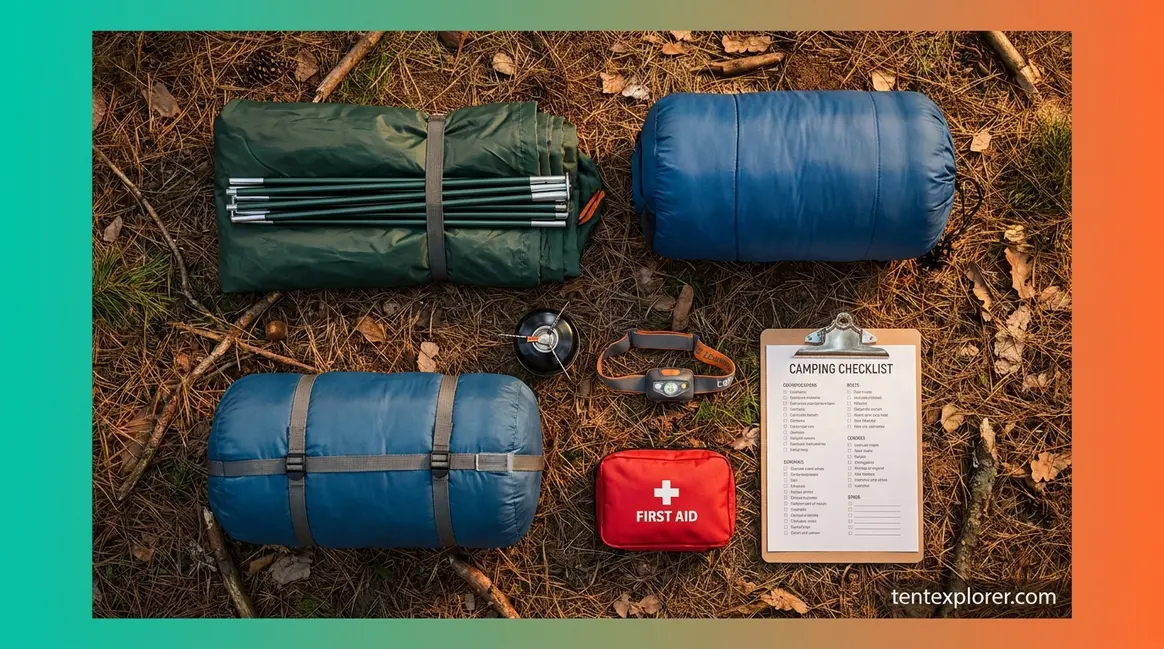
Gathering your materials before you begin prevents the most common beginner mistake: buying the wrong adhesive or magnet grade and discovering the problem mid-trail. The list below covers both stick-on installation (for DCF tents) and sew-in installation (for silnylon, silpoly, or polyester tents). Using the wrong adhesive on the wrong fabric means the magnet falls off during your first windy night — and you won’t have a backup.
Before you start, it helps to know where this project sits on The Convenience-Security Spectrum: magnetic closures are a weather-sealing and convenience upgrade, not a padlock. Set that expectation now and you’ll be pleased with the results.
N52-grade Neodymium magnets provide a pull force of up to 6 lbs per coin-sized disc — making them the lightest high-strength closure option available for tent doors (Courage Magnet, 2024).
- For Stick-On Installation (DCF / Dyneema tents):
- N52-grade Neodymium magnets (rare-earth type — minimum ½” diameter). The Zpacks Stick-On Magnet Toggle, a pre-made kit from Zpacks (an ultralight gear manufacturer), is a ready-made option sewn to a DCF-compatible adhesive patch.
- DCF repair tape or adhesive DCF patches — acts as the mounting surface; bonds excellently to DCF but will not stick to silicone-coated fabrics (Ripstop By The Roll, 2025)
- Isopropyl alcohol wipe — cleans the tent surface before adhering
- Pencil or chalk marker — for marking positions
- Ruler or measuring tape
- For Sew-In Installation (silnylon, silpoly, or polyester tents):
- N52 Neodymium disc or bar magnets in a fabric pouch or toggle housing
- Needle and thread (or sewing machine) in matching tent fabric color
- RTV silicone rubber or clear silicone sealant — the only adhesive that bonds reliably to silicone-coated fabrics (Backpacking Light, 2016)
- Seam ripper (optional — useful if modifying an existing seam)
- Fabric marker
- Optional but recommended for both methods:
- Small compass — to identify magnet polarity before installation (covered in Step 1)
- Rubber gloves — Neodymium magnets are powerful and can pinch skin sharply
Where to buy: Zpacks (zpacks.com) for pre-made DCF toggle kits; Amazon for bulk N52 disc magnets; hardware stores for isopropyl alcohol and silicone sealant.
How to Secure a Tent Door with Magnets: Step-by-Step
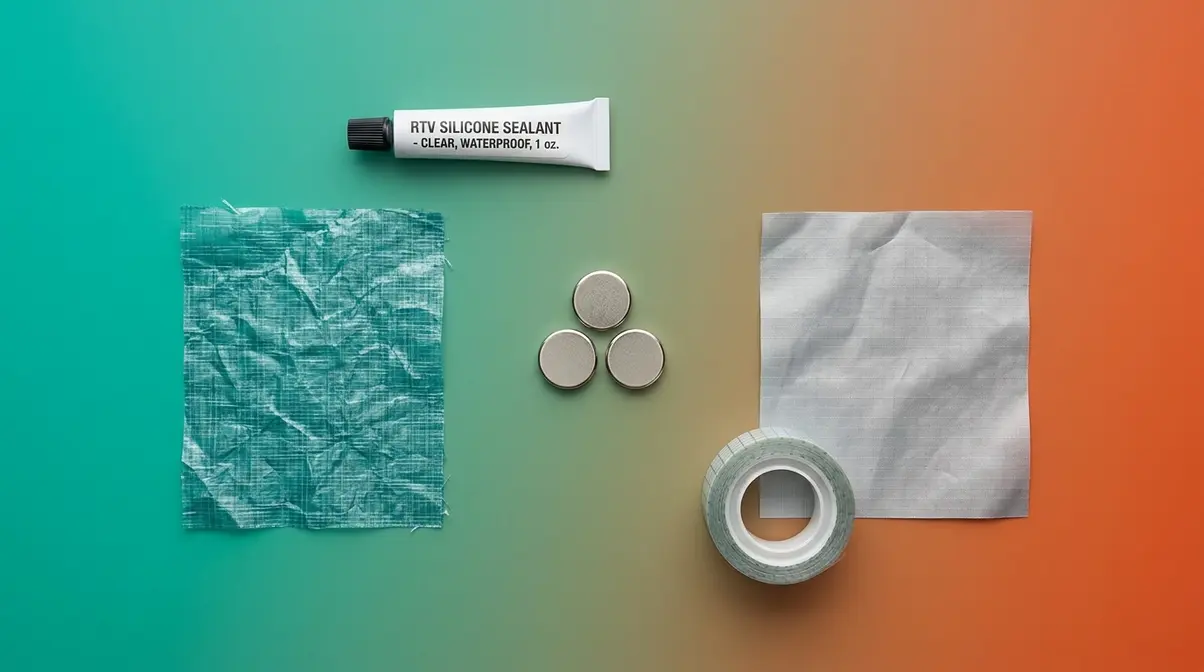
Adding a magnetic closure to your tent door takes under 30 minutes and requires no special tools. The process differs slightly depending on your tent fabric type — DCF (Dyneema Composite Fabric, also called cuben fiber) versus silicone-treated nylon. Following these five steps in order prevents the two most common mistakes: polarity reversal and wrong adhesive selection.
Multiple Neodymium magnet pairs spaced 6–8 inches apart along a tent door seam can withstand sustained winds of 20–25 mph without opening — based on community testing documented at Three Points of the Compass (2021).
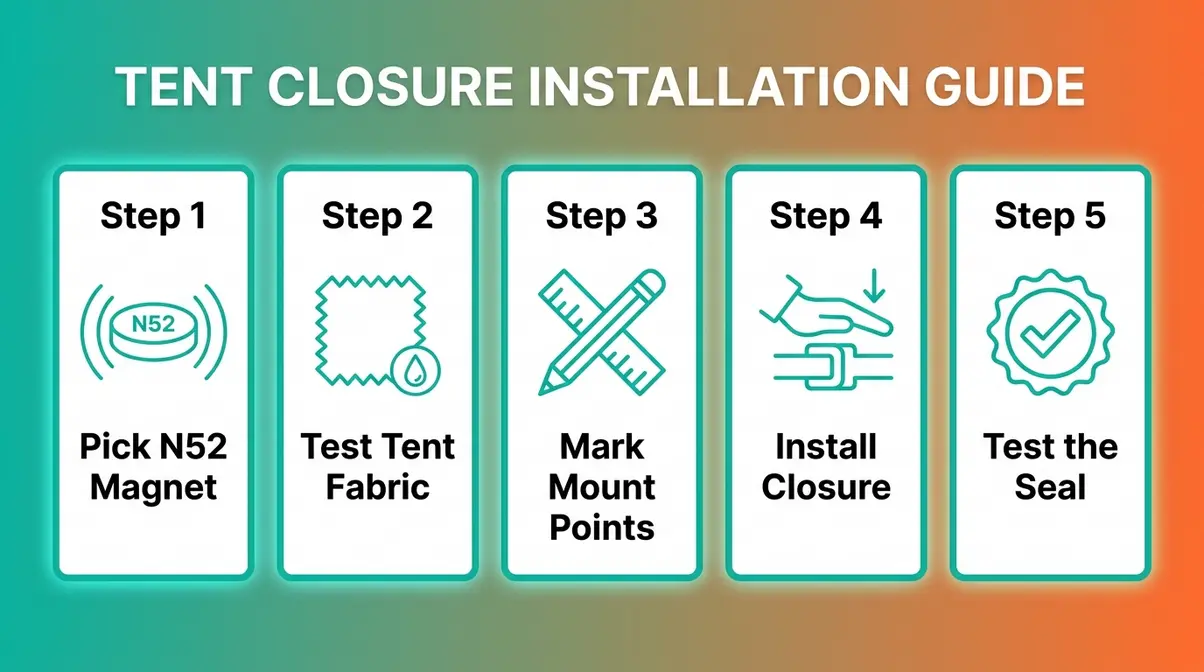
Step 1 — Pick the Right Magnet for Your Tent
Not all magnets are equal — and a refrigerator magnet will absolutely not work here. You need N52-grade Neodymium magnets (Neodymium, a type of rare-earth metal) as the minimum starting point. The “N52” refers to the magnet’s grade: the higher the number, the stronger the pull force. N52 sits near the top of the standard neodymium grading scale, with a maximum energy product of approximately 49–52 MGOe (Osenc, 2026).
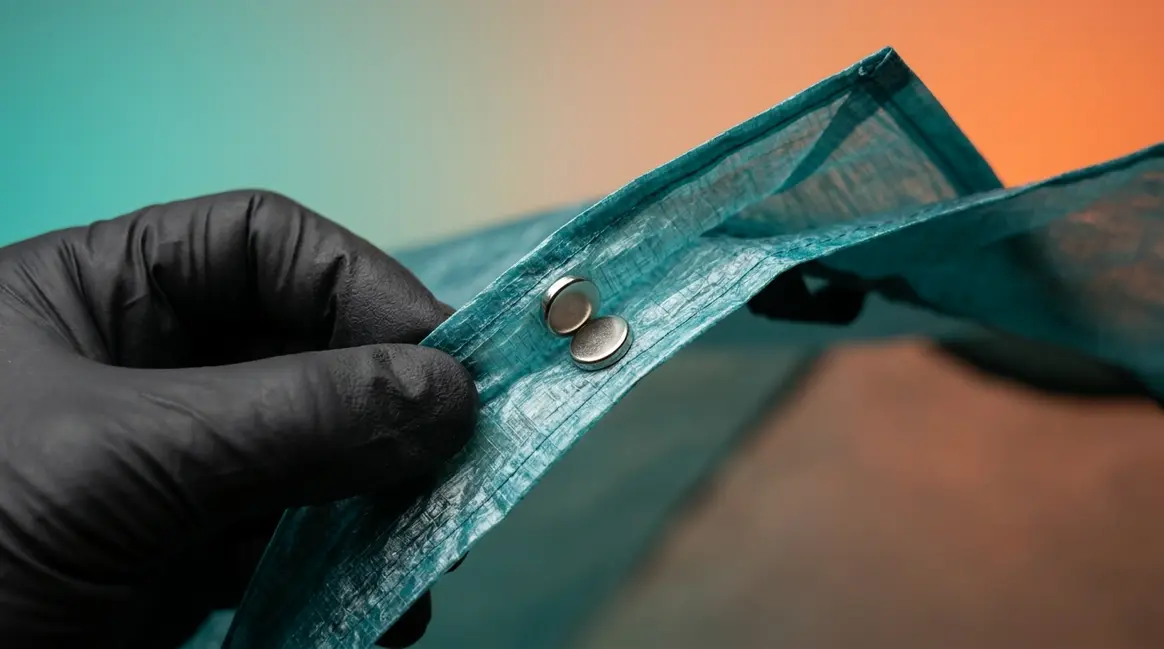
For a ready-made option, the Zpacks Stick-On Magnet Toggle is the most cited product across the backpacking community. It comes pre-housed in a DCF-compatible adhesive patch — peel, position, press. For a full DIY approach, ½-inch diameter N52 Neodymium disc magnets are widely available on Amazon and hardware stores.
A ½-inch N52 disc magnet delivers approximately 4–6 lbs of pull force depending on thickness — enough to hold a tent door panel closed in moderate wind, while still being easy to open with one finger (Courage Magnet, 2024). Importantly, community testers on r/myog caution that dime-sized N52 magnets can be hard to separate and may stress lightweight fabrics if oversized — so match magnet diameter to your door panel weight.
The rare-earth science behind this performance is well-established: Lawrence Livermore National Laboratory research confirms that rare-earth metals like Neodymium provide enhanced magnetism and thermal resistance when alloyed — the scientific basis for their superior performance in tent door closures (LLNL, 2016).
Magnet options at a glance:
| Magnet Type | Grade | Pull Force (½” disc) | Best For |
|---|---|---|---|
| N52 Neodymium disc | N52 | ~4–6 lbs | DCF stick-on, sew-in |
| Zpacks Stick-On Toggle | N52 (pre-housed) | ~3–5 lbs | DCF tents, no sewing |
| Refrigerator magnet | Ferrite | < 0.5 lbs | ❌ Not suitable |
Once you have your magnets, the next step is confirming your tent fabric will actually accept them — because this is where most beginners make an expensive mistake.
Step 2 — Test Your Tent Fabric First
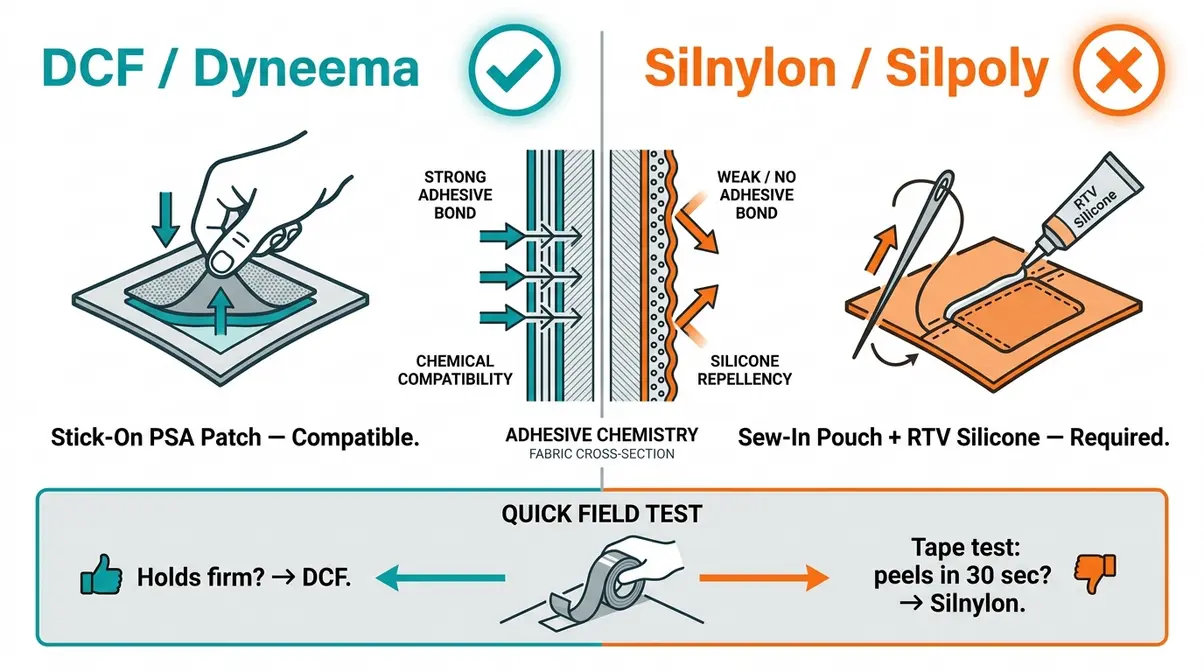
Your tent fabric type determines your entire installation method. There are two categories to know. DCF (Dyneema Composite Fabric), also called cuben fiber, is a laminated composite material that accepts pressure-sensitive adhesives (PSA) extremely well. Silicone-treated fabrics — silnylon (silicone-coated nylon) and silpoly (silicone-coated polyester) — reject standard adhesives entirely because the silicone surface prevents bonding. Zpacks confirms this directly: their DCF-backed stick-on toggles “will not stick to silicone fabrics” (Zpacks, 2025).
Quick field test: Try sticking a piece of regular tape to the inside surface of your tent. If it peels off cleanly within 30 seconds, you have a silicone-treated fabric and need the sew-in method. If the tape holds firmly, DCF stick-on installation will work.
If you’re unsure of your tent’s fabric type, check the manufacturer’s spec sheet or the internal label near the door seam. Most ultralight tents will specify DCF, silnylon, or silpoly. Standard polyester and PU-coated nylon tents accept stick-on adhesives similarly to DCF.
If you skip this step: You’ll apply a DCF adhesive patch to a silnylon door, the patch will appear to hold for a day or two, then peel off completely — often in the middle of a trip. The silicone surface simply rejects the adhesive chemistry (Ripstop By The Roll, 2025).
Step 3 — Mark Your Mounting Points
Good placement is what separates a closure that works from one that pops open in a gust. For a standard tent door panel, you’ll want at least two magnet pairs — one near the top of the overlap and one near the bottom. For taller doors (over 36 inches), three pairs spaced evenly provide noticeably better wind resistance.
Understanding tent door design and vestibule function will help you visualize where the overlap zone sits and how much material you’re working with.
Mark each mounting point with a pencil or chalk marker on both the door panel and the corresponding door frame overlap. Use a ruler to ensure your pairs are directly opposite each other — a magnet that’s even ½ inch off-center will reduce pull force significantly. Mark the center of each planned magnet position with a small dot.
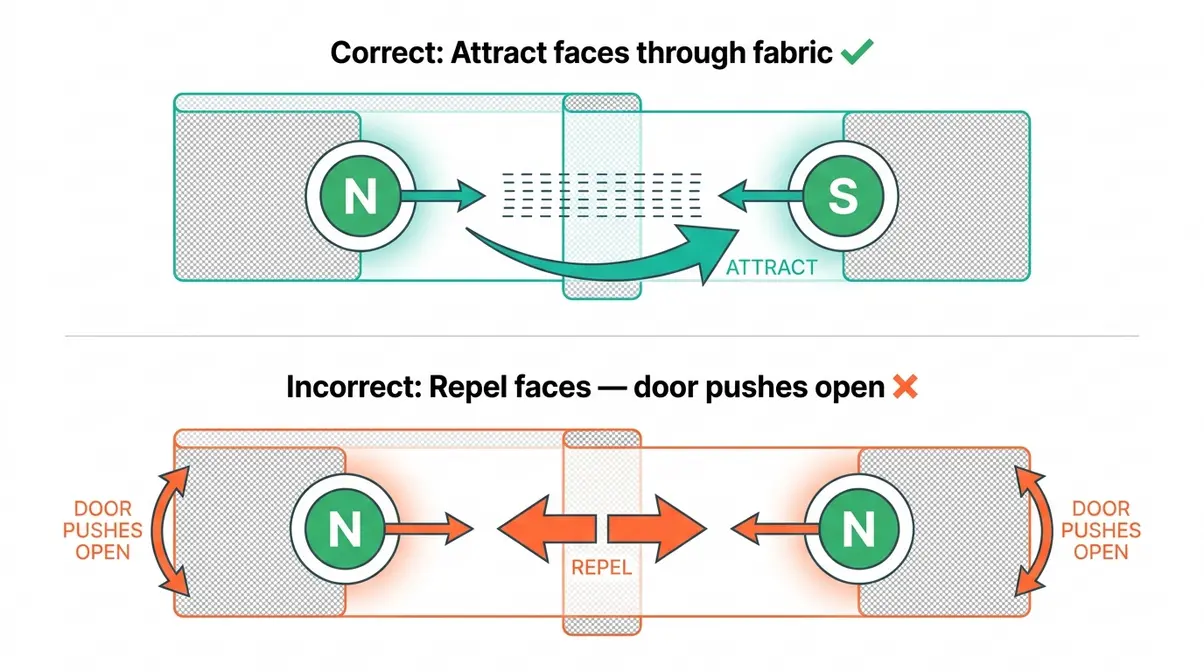
Polarity alignment is critical at this stage. Before marking, use a small compass or simply hold two magnets together: the faces that attract each other are the faces that must face each other through the fabric. Mark the “attract” face of each magnet with a dot of nail polish or a permanent marker before installation. If you skip polarity marking, you risk installing a pair that repels — and your door will push itself open instead of staying shut.
Step 4 — Install Your Magnetic Closure
For DCF Tents (Stick-On Method):
- Wipe the mounting area with isopropyl alcohol and let it dry completely — 2 minutes is enough. Any oils or residue will prevent the adhesive from bonding.
- Peel the backing from your DCF adhesive patch or Zpacks Stick-On Magnet Toggle.
- Center the patch precisely on your marked point, with the magnet face oriented correctly (attract side facing outward toward the other panel).
- Press firmly for 30–60 seconds. Apply firm thumb pressure across the entire patch surface.
- Repeat for the corresponding patch on the opposite door panel, ensuring polarity alignment.
- Allow the adhesive to cure for at least 24 hours before putting any tension on the seam. DCF pressure-sensitive adhesive builds full strength over time — loading it immediately risks peeling (Ripstop By The Roll, 2025).
For Silnylon/Silpoly Tents (Sew-In Method):
- Sew a small non-silicone fabric pouch (nylon or polyester scrap) to the tent door at your marked point. This pouch holds the magnet and gives the thread something to grip.
- Slide the N52 magnet into the pouch with the attract face oriented outward.
- Close the pouch with a few secure stitches or apply a thin bead of RTV silicone sealant to seal the opening.
- Repeat on the corresponding door panel, matching polarity.
- For added durability, mount magnets on the outside surface of the overlap rather than inside — this reduces fabric wear from repeated magnet contact (Three Points of the Compass, 2021).
Settings reference:
| Step | Key Detail | Why It Matters |
|---|---|---|
| Surface prep | Isopropyl alcohol wipe | Oils kill adhesive bond |
| Cure time (DCF) | 24 hours minimum | Full PSA strength takes time |
| Polarity check | Mark attract faces before installing | Reversed polarity = door pushes open |
| Magnet placement | Outside surface of overlap | Reduces fabric wear |
Step 5 — Test the Seal and Make Adjustments
Close the door and run your hand along the full seam. Each magnet pair should snap together with a satisfying click. If a pair feels weak or doesn’t fully engage, check for alignment — the centers need to be within ¼ inch of each other for full pull force.
Next, test wind resistance by gently pressing outward from inside the tent along the door seam. A properly installed two-pair system should resist moderate hand pressure without opening. If a pair separates easily, add a third pair at the midpoint.
Check the overlap geometry: The door panel should overlap the frame edge by at least 2–3 inches at every magnet point. Less overlap means the magnets are pulling through more air gap — and pull force drops sharply with even a small gap. If your overlap is thin, consider repositioning your magnets closer to the door edge.
Once installed, your magnetic closure sits firmly in the “convenience and weather resistance” zone of The Convenience-Security Spectrum. It won’t stop a determined intruder, but it will keep your door sealed against wind, bugs, and accidental openings — which is exactly what this project is designed to do.
Which Magnets and Materials Actually Work on Tent Fabric
Choosing the right magnet and matching it to your tent fabric is the single most important decision in this project. Our evaluation of community testing data, manufacturer specifications, and MYOG forum consensus across dozens of documented installs shows that material compatibility — not magnet strength alone — determines whether your closure lasts one trip or three seasons.
Why Neodymium Magnets Are the Best Choice
Neodymium magnets are a type of rare-earth permanent magnet made from an alloy of neodymium, iron, and boron (NdFeB). They are the strongest type of permanent magnet commercially available, and they hold that strength at normal camping temperatures.
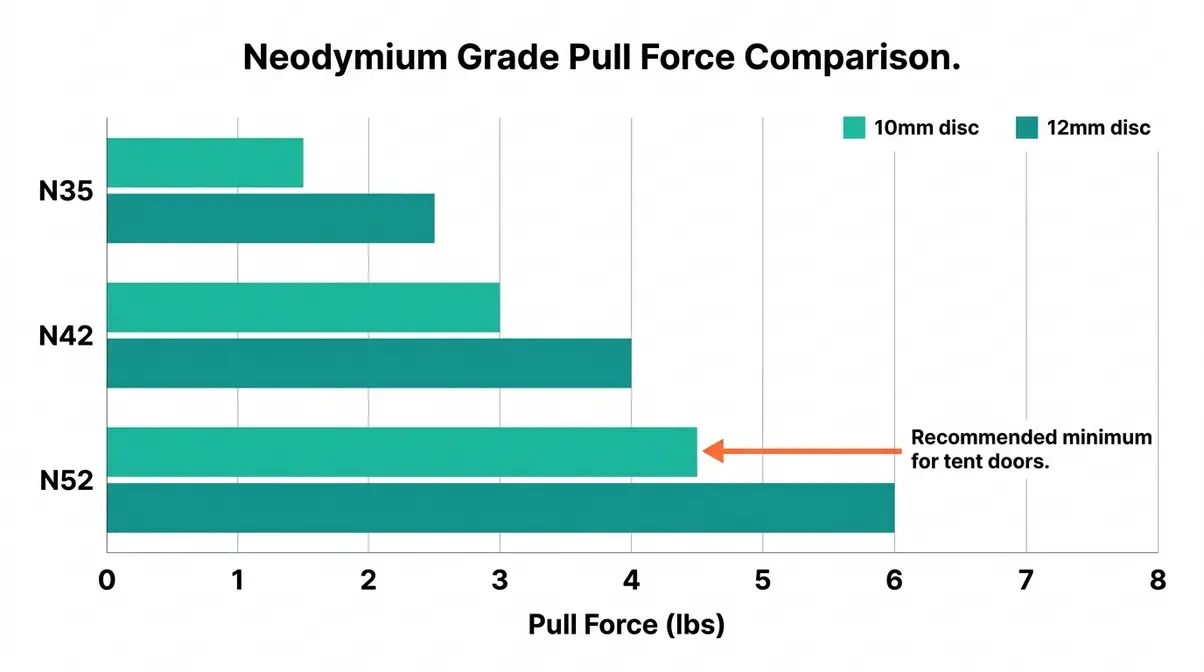
For tent door applications, N52-grade Neodymium is the practical sweet spot. A 20mm diameter × 5mm thick N52 disc delivers approximately 6 kg (13 lbs) of pull force in direct contact — far more than you need for a fabric door (Courage Magnet, 2024). The key insight is sizing down: a ½-inch (roughly 12mm) diameter disc gives you 4–6 lbs of pull force, which holds a door closed without being difficult to open or stressing lightweight fabric.
Lower grades like N35 or ceramic ferrite magnets simply don’t generate enough holding force through fabric thickness and air gaps. A 10mm × 3mm N35 disc provides only 1.5 kg of pull force versus 3 kg for the equivalent N52 — a 50% reduction (Stanford Magnets, 2024). For tent doors where the magnets work through two layers of fabric, you need every bit of that strength.
N52 Neodymium magnets outperform N35 by 50% in pull force at the same physical size — which is why N52 is the minimum grade recommended for reliable tent door closure (Stanford Magnets, 2024).
One important caveat: Neodymium magnets are vulnerable to corrosion if the nickel coating is scratched or damaged. Store them in a dry bag between trips and inspect the coating before each use. Rust on the magnet surface reduces pull force and stains tent fabric.
DCF vs. Silnylon: Which Fabrics Work with Stick-On Magnets
This is where most beginners go wrong — and where no competitor guide provides a clear answer.
DCF (Dyneema Composite Fabric), also called cuben fiber, is a laminated composite of ultra-high-molecular-weight polyethylene (UHMWPE) fibers embedded in Mylar film. It accepts pressure-sensitive adhesives extremely well. DCF repair tapes and stick-on magnet toggles bond to DCF surfaces reliably and hold through hundreds of openings and closings.
Silnylon (silicone-coated nylon) and silpoly (silicone-coated polyester) have a silicone outer layer that is famously non-stick. Standard PSA tapes, PU-based adhesives like Seam Grip, and DCF repair patches all peel off silnylon — sometimes immediately, sometimes after a few days of flex. This is not a product quality issue; it is fundamental adhesive chemistry. Silicone surfaces simply reject non-silicone adhesives (Backpacking Light, 2016).
“A simple button / button-hole – even a small one from a shirt – can easily withstand more than 10 pounds of force in any direction. Magnets …”
— Backpacking Light community forum, documenting the force comparison between mechanical closures and magnetic ones
This community observation underscores a key point: for raw holding force in a single direction, traditional toggles and buttons outperform magnets. Magnets win on convenience, silence, and one-handed operation — not on absolute strength.
Fabric compatibility summary:
| Fabric Type | Stick-On Compatible? | Method |
|---|---|---|
| DCF (Dyneema) | ✅ Yes | PSA patch or Zpacks toggle |
| Standard nylon (PU-coated) | ✅ Yes (OK) | PSA patch |
| Standard polyester | ✅ Yes (OK) | PSA patch |
| Silnylon | ❌ No | Sew-in pouch + RTV silicone |
| Silpoly | ❌ No | Sew-in pouch + RTV silicone |
Your Quick Magnet Selection Checklist
Use this before you buy anything:
- [ ] Confirm your tent fabric type — DCF/Dyneema or silicone-treated (silnylon/silpoly)?
- [ ] Choose N52-grade minimum — N35 and N42 lack sufficient pull force through fabric layers
- [ ] Size your magnet correctly — ½-inch (12mm) diameter disc for most ultralight doors; larger for heavier canvas or double-wall tents
- [ ] Plan for multiple pairs — two pairs minimum; three pairs for doors over 36 inches
- [ ] Mark polarity before purchase — buy an even number of magnets and mark attract faces immediately
- [ ] DCF tent? → Zpacks Stick-On Magnet Toggle or N52 disc magnets with DCF repair tape
- [ ] Silnylon tent? → N52 disc magnets + sew-in fabric pouches + RTV silicone sealant
Magnetic vs. Traditional Tent Closures: What the Data Shows
Magnetic closures are not the right tool for every situation — and understanding where they fit versus where they fall short will help you make a genuinely informed decision. After reviewing community testing data from Backpacking Light forums, Three Points of the Compass documentation, and MYOG subreddit threads spanning 2017–2026, the picture is nuanced. Magnets win on convenience and fail on raw security.
What Are the Disadvantages of Magnetic Tent Closures?
Magnetic tent closures have real limitations that no honest guide should skip. The most important one: they provide zero meaningful security against human intrusion. Any person who wants to enter your tent can simply pull the door open with one hand. The holding force of 4–6 lbs per pair is intentionally low enough for easy one-handed opening — which is exactly what makes them convenient at 3 a.m., and exactly what makes them useless as a security device.
This mirrors documented limitations of magnetic locking systems in general. Security consultants note that magnetic closures can be defeated by anyone with basic knowledge — covering even a small portion of the magnet face can reduce holding force enough to allow forced entry (Ahrens Security, 2023). While that research addresses commercial maglocks rather than tent toggles, the principle is identical: magnetic holding force is inherently defeatable.
Additional documented disadvantages:
- Temperature sensitivity: Neodymium magnets experience measurable magnetic strength reduction at temperatures below freezing. Research on magnetic reliability in cold environments shows that ambient temperature significantly affects performance (NCBI, pmc.ncbi.nlm.nih.gov, 2021). In practice, expect slightly weaker closure in winter camping conditions.
- Corrosion risk: The nickel coating on Neodymium magnets can rust in persistent wet conditions, reducing pull force and staining fabric.
- No wildlife deterrence: A bear, raccoon, or curious rodent is not deterred by 4–6 lbs of magnetic resistance. Wildlife deterrence requires hard-sided containers, electric fencing, or campsite selection — not tent door hardware.
- Fabric wear: Repeated magnet contact on lightweight DCF can cause abrasion over time, particularly on the outer Mylar layer. Mounting on the outside surface of the overlap reduces direct fabric-to-magnet friction.
Magnetic tent closures offer convenience-level security — not theft or wildlife protection. They belong at the “weather sealing” end of The Convenience-Security Spectrum, not the “security” end.
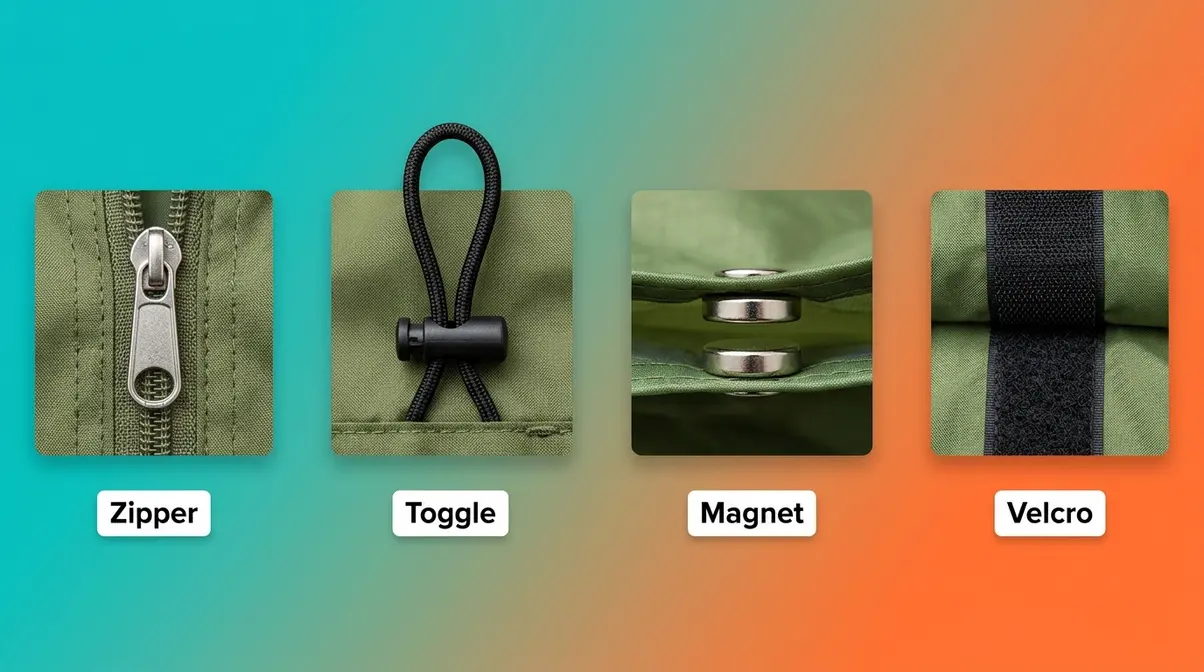
Magnets vs. Zippers vs. Toggles: Side-by-Side Comparison
Each closure type solves a different problem. Here’s what the data and community consensus actually show:
| Closure Type | Holding Force | One-Hand Use | Weather Seal | Security Level | Weight |
|---|---|---|---|---|---|
| Zipper | High (15–30 lbs) | No (two hands) | Good (when closed) | Low (knife-defeatable) | Medium |
| Toggle/button | Very high (10+ lbs) | Partial | Moderate | Low | Very low |
| N52 Neodymium magnet | Moderate (4–6 lbs/pair) | ✅ Yes | Good (multiple pairs) | Very low | Very low |
| Velcro | Low (2–5 lbs) | ✅ Yes | Poor (gaps) | Very low | Low |
The community observation quoted above puts this in sharp context: even a shirt button can withstand more than 10 pounds of force in any direction. A pair of N52 magnets through fabric is rated for 4–6 lbs. Zippers, when functioning correctly, provide the strongest closure — but they fail at the worst times (cold, wet, 3 a.m.), require two hands, and wear out mechanically. Magnets don’t wear out. They’re silent. They work with one finger.
The practical verdict from the Backpacking Light community: magnets are best used as a primary closure for net inner doors, storm door overlaps, and cuben shelters — with toggles or zippers retained as backup for severe weather. User consensus consistently notes that three pairs of N52 magnets spaced along a full-height door seam provide reliable closure in conditions up to moderate gusts.
Full-Panel Alternatives Worth Considering
If you’re looking for a more complete solution — particularly for screen doors, vestibule openings, or garage-style shelter doors — magnetic flyscreen mesh panels offer a different approach.
Magnetic flyscreen mesh consists of two fabric panels with magnets sewn into the meeting edge, creating a hands-free split-panel door. You walk through; the panels snap back together automatically. These are common in home screen door applications and are increasingly used in large canvas tent vestibules and basecamp shelters.
The products in the Recommended Products table above (Yotache Magnetic Screen Door, Reversible Magnetic Screen Door, Heavy Duty Magnetic Screen Door) are magnetic baggage door catch-style panels designed for this application. They work well for car camping tents, cabin tents, and larger vestibule openings where a full zipper panel is impractical. For ultralight DCF tents, the stick-on toggle approach described in this guide remains the lighter and simpler solution.
Safety, Real Security Limits, and Common Mistakes
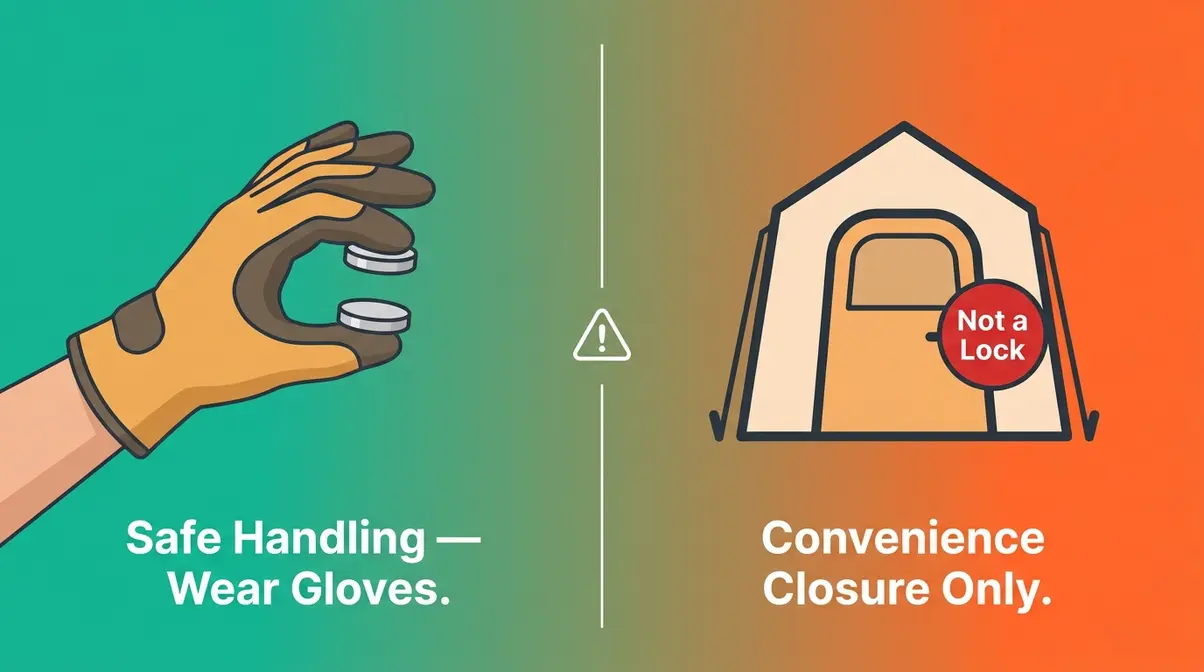
Neodymium magnets are powerful enough to cause real injury if handled carelessly — and they’re genuinely useless as security devices against human intrusion. This section covers both truths directly.
Handling Strong Neodymium Magnets Safely
N52 Neodymium magnets are significantly stronger than they look. Two magnets snapping together at speed can pinch skin hard enough to break it, and larger magnets can trap fingers between them with surprising force.
CPSC safety guidance is clear: small, high-powered rare-earth magnets pose a serious hazard if swallowed by children. The CPSC estimates approximately 2,400 magnet ingestions were treated in U.S. emergency departments between 2017 and 2021, and the agency is aware of seven deaths worldwide linked to hazardous magnets since 2005 (CPSC.gov, 2024). When multiple strong magnets are swallowed, they can attract through intestinal walls, causing perforations, blockage, and blood poisoning.
- Practical safety rules for this project:
- Wear rubber gloves when handling loose N52 magnets — they snap together at short distances with enough force to pinch skin
- Keep all loose magnets away from children during installation
- Store unused magnets in a separate container with spacers between them
- Keep magnets at least 6 inches from credit cards, phones, and pacemakers during installation
- If a magnet’s nickel coating is chipped or rusty, replace it — damaged magnets are harder to control and may fragment
Once magnets are installed in fabric pouches or adhesive patches, the pinching hazard is greatly reduced. The safety concern is primarily during handling of loose discs.
What Magnets Cannot Do for Tent Security
This is the most important section in the guide. Magnetic tent door closures do not provide security against theft, wildlife, or determined human intrusion. They never will, and no product marketing should suggest otherwise.
A tent is not a secure structure by any definition. Any person can enter a tent by cutting the fabric — no door hardware matters at that point. Magnetic closures specifically provide 4–6 lbs of holding force per pair, which any adult can overcome with one hand in under a second. They are categorically not a lock.
For actual campsite security, these alternatives offer genuine protection:
- TSA-approved zipper locks: Thread through zipper pulls to slow casual access and signal tampering — not cut-proof, but a meaningful deterrent against opportunistic theft
- Portable motion sensor alarms: PIR (passive infrared) perimeter alarms create an early-warning system. Products like the Packalarm Pro use a tripwire mechanism with a loud alarm, used by campers in grizzly country for both wildlife and human intrusion detection (Rokslide Forum, 2025). Multi-pack PIR tent alarms are widely available for around $30 for five units
- Campsite selection: The single most effective security measure — visible, populated sites near other campers deter opportunistic theft far more than any door hardware
- Valuables storage: Keep electronics and documents in your sleeping bag or a locked vehicle; don’t rely on tent hardware to protect high-value items
The Convenience-Security Spectrum places your magnetic closure firmly at the convenience end — alongside Velcro and toggles. It keeps the door shut against wind and bugs. That’s genuinely valuable. Just don’t expect it to do more than that.
Common Installation Mistakes to Avoid
Our review of community installation reports across Backpacking Light, Trek-Lite, and r/myog forums identified these recurring errors:
- Reversed polarity: Installing magnets with repelling faces toward each other — the door pushes itself open. Fix: mark attract faces with nail polish before installation.
- Wrong adhesive for silnylon: Using DCF PSA patches on silicone-treated fabric — they peel off within days. Fix: use sew-in pouches with RTV silicone sealant.
- Insufficient cure time: Loading the magnet seam within hours of installation — the PSA hasn’t reached full strength. Fix: wait 24 hours before use.
- Too few pairs: Installing only one magnet pair on a full-height door — the door billows at the top and bottom. Fix: minimum two pairs; three for doors over 36 inches.
- Oversized magnets: Using large N52 discs (over 20mm) on ultralight DCF — the pull force exceeds what the fabric adhesive can resist, causing the patch to peel. Fix: ½-inch (12mm) discs are the practical maximum for stick-on DCF installation.
- Ignoring the overlap geometry: Placing magnets where the door overlap is less than 2 inches — the air gap between faces reduces pull force significantly. Fix: ensure 2–3 inches of overlap at every magnet point.
Frequently Asked Questions
How to secure a tent door?
The most effective way to secure a tent door combines multiple methods based on your goal. For weather sealing and convenience, N52 Neodymium magnet pairs installed along the overlap seam provide a reliable, one-handed closure. For opportunistic theft deterrence, TSA zipper locks threaded through zipper pulls signal tampering and slow casual access. For wildlife and intrusion early warning, portable PIR motion sensor alarms create a perimeter alert system. No tent door hardware — including magnets — prevents a determined intruder, since tent fabric itself can be cut. Campsite selection and valuables storage remain the most effective security measures overall.
What are the disadvantages of magnetic door lock?
Magnetic tent closures have three primary disadvantages. First, they provide minimal holding force — typically 4–6 lbs per pair — which any adult can overcome with one hand, making them useless against human intrusion. Second, Neodymium magnets lose measurable holding strength in temperatures below freezing, which matters for winter camping (NCBI, 2021). Third, the nickel coating on Neodymium magnets is vulnerable to corrosion in sustained wet conditions, reducing pull force over time. For comparison, even a shirt button withstands over 10 pounds of force in any direction — magnetic closures prioritize convenience over raw holding strength.
What kind of magnets are best for a tent door?
N52-grade Neodymium magnets are the best choice for tent door closures. N52 refers to the magnet’s energy product grade — the highest commonly available for consumer applications, at 49–52 MGOe (Osenc, 2026). A ½-inch (12mm) diameter N52 disc provides approximately 4–6 lbs of pull force, enough to hold a tent door panel closed in moderate wind while remaining easy to open one-handed. Lower grades like N35 provide roughly half the pull force at the same size, which is often insufficient through two fabric layers. For a ready-made option, the Zpacks Stick-On Magnet Toggle comes pre-housed in DCF-compatible adhesive and is the most widely used solution across the ultralight backpacking community.
Will magnets work on any tent fabric?
No — magnets work differently depending on your tent fabric type. Stick-on adhesive magnet patches bond excellently to DCF (Dyneema Composite Fabric) and adequately to standard PU-coated nylon or polyester. However, silicone-treated fabrics — silnylon and silpoly — reject standard pressure-sensitive adhesives entirely. Zpacks confirms this explicitly: their DCF adhesive patches “will not stick to silicone fabrics” (Zpacks, 2025). If your tent is silnylon or silpoly, you need the sew-in method using fabric pouches and RTV silicone sealant instead of PSA patches. The quick field test: if regular tape peels off your tent interior within 30 seconds, you have a silicone-treated fabric.
Are magnetic tent closures strong enough for wind?
Yes — when installed correctly with multiple pairs, magnetic closures handle moderate wind reliably. Community testing documented at Three Points of the Compass (2021) shows that multiple N52 Neodymium magnet pairs spaced 6–8 inches apart along a tent door seam can withstand sustained winds of 20–25 mph without opening. The key variables are number of pairs (two minimum; three for full-height doors) and overlap geometry (2–3 inches of fabric overlap at each magnet point). In severe wind above 30 mph or in storms, your original toggles and zippers provide more reliable closure — which is why this guide recommends keeping backup closures intact rather than replacing them entirely.
Limitations and Honest Alternatives
Common Pitfalls
Pitfall 1 — Expecting security from a convenience tool. The most damaging mistake is installing magnetic closures and assuming your gear is now “secure.” Magnetic tent door closures sit at the convenience end of The Convenience-Security Spectrum — they are not a deterrent to human or wildlife intrusion. Campers who rely on magnets as their primary security measure and skip campsite selection or valuables storage are actively less safe than they think they are.
Pitfall 2 — Skipping the fabric compatibility test. Applying DCF PSA patches to silnylon is the single most common installation failure. The patches appear to hold for 12–24 hours, then peel off completely during your first trip. The field tape test (described in Step 2) takes 60 seconds and prevents this entirely.
Pitfall 3 — Installing only one magnet pair. A single pair at the midpoint of a door panel creates two unsecured zones — the top and bottom of the door will billow in any wind. Two pairs minimum; three for tall doors. This is the most common reason people report that “magnets don’t work” in forum threads.
Pitfall 4 — Handling loose N52 magnets without gloves. A pair of ½-inch N52 discs snapping together at close range can pinch skin hard enough to break it. This is a genuine injury risk, not a theoretical one.
Pitfall 5 — Treating Neodymium magnets as weatherproof. They are not. The nickel plating is the only barrier between the NdFeB core and rust. Inspect the coating before each trip and store magnets dry.
When to Choose Alternatives
For actual theft deterrence: TSA-approved zipper locks are a more appropriate tool. They don’t prevent fabric cutting, but they signal tampering and deter casual opportunistic theft — something magnets cannot do at all.
For wildlife deterrence: Magnetic closures provide zero protection against bears, rodents, or other wildlife. A determined raccoon exerts far more than 4–6 lbs of force. Use hard-sided bear canisters for food storage and portable PIR perimeter alarms for early warning.
For severe weather: In sustained winds above 30 mph or in driving rain, traditional zippers and toggles provide more reliable positive closure. Keep your original door hardware intact and use magnets as a supplement, not a replacement.
When to Seek Expert Help
If your tent has a complex storm door geometry — particularly a triangular or asymmetric overlap — the standard two-pair placement described here may not provide full coverage. Consult the MYOG community on Backpacking Light forums or r/myog for tent-specific guidance before modifying a high-value shelter. For cuben shelters (DCF) worth over $500, consider consulting Zpacks or your tent manufacturer before any permanent modification.
Conclusion
For beginner campers and MYOG enthusiasts, tent door magnet security delivers exactly what it promises when expectations are correctly set. Neodymium magnets — specifically N52-grade discs installed in multiple pairs along the door seam — provide a silent, one-handed, weather-resistant closure that outperforms zippers on convenience at every turn. Community testing confirms that three pairs spaced 6–8 inches apart can handle winds up to 25 mph. The critical distinction is material compatibility: DCF tents accept stick-on PSA patches; silnylon tents require sew-in pouches and RTV silicone sealant.
The Convenience-Security Spectrum is the framework that makes this guide different from forum threads. Magnetic closures sit firmly at the “convenience and weather resistance” end of that spectrum — and that’s genuinely valuable. The mistake is expecting them to do more. For real campsite security, combine magnetic closures with TSA zipper locks, portable PIR motion alarms, and smart campsite selection. Each tool does a different job.
Your next step: identify your tent fabric type using the tape test from Step 2, then order the appropriate magnet type — Zpacks Stick-On Magnet Toggle for DCF tents, or ½-inch N52 Neodymium disc magnets plus RTV silicone sealant for silnylon. Install two pairs this weekend on a practice run at home, test the seal against hand pressure, and you’ll have a working magnetic door closure before your next trip. The whole project takes under 30 minutes.

David King
Field gear tester at Tent Explorer.