Tent V-Stakes: How to Secure Your Shelter With Confidence
 Dave King
Updated June 28, 2026
26 min read
Dave King
Updated June 28, 2026
26 min read
The tent stakes bundled with your shelter are not strong enough. That’s not a rumor — it’s a design reality. A standard 20×20-foot tent in 45 mph winds requires a minimum holding force of 5,400 pounds, and safety engineers recommend anchors capable of 1.5 to 2 times that expected load (City of Flagstaff, AZ, 2026). The thin wire pegs in your tent bag provide a fraction of that capacity.
Picture it: guylines going slack at 2 a.m., fabric flapping incessantly against the poles, and the sinking feeling of a tent collapsing around you. That scenario is preventable — and it starts with understanding why tent V-stakes perform so differently from the pegs you’ve been relying on.
This guide walks you through the fundamentals of holding power, a step-by-step staking technique for any soil, strategies for difficult terrain, and a practical buyer’s guide. By mastering these principles and choosing the right tent v-stakes, secure your shelter with confidence no matter what the forecast brings.
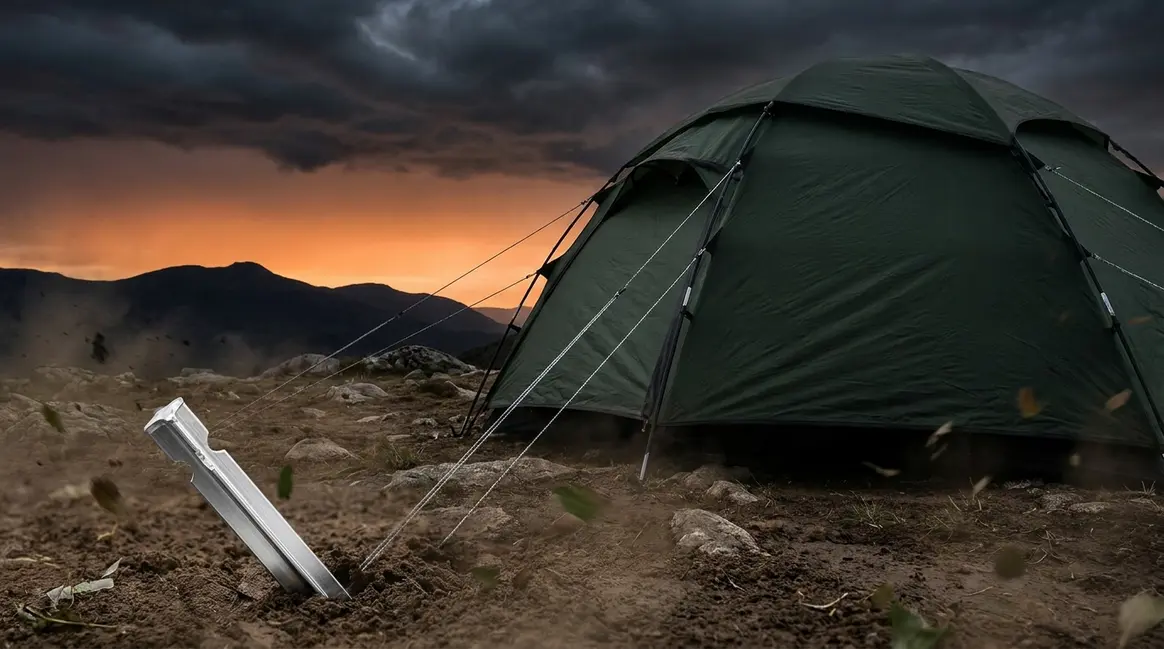
With tent v-stakes, secure your shelter with confidence; their V-shaped profile creates up to twice the soil friction of standard wire stakes, making them the best bet for any camper who has lost a shelter to wind.
- The Holding Power Triangle determines stake security: Shape (V-profile surface area), Soil Type (friction), and Insertion Angle — master all three and stake failure becomes rare
- Drive stakes at roughly 45° to 60° angled away from the tent, not straight down — this meaningfully increases pull-out resistance in most soil conditions
- Deadman anchoring turns V-stakes into sand and snow anchors by burying them horizontally, perpendicular to the guyline
- Aluminum V-stakes (7075-grade) are the best all-around choice; titanium is for ultralight backpackers willing to pay a premium
- At least two-thirds of each stake must be fully driven into the ground for proper security
Prerequisites: What You Need
Successful staking starts before the first stake hits the ground. Two preparation steps separate campers who sleep soundly from those who spend the night re-tensioning guylines: assembling the right tools and reading the terrain. Skipping either one is the most common reason stakes pull out — and it’s entirely avoidable.
Equipment You’ll Need
Estimated time: 10-15 minutes
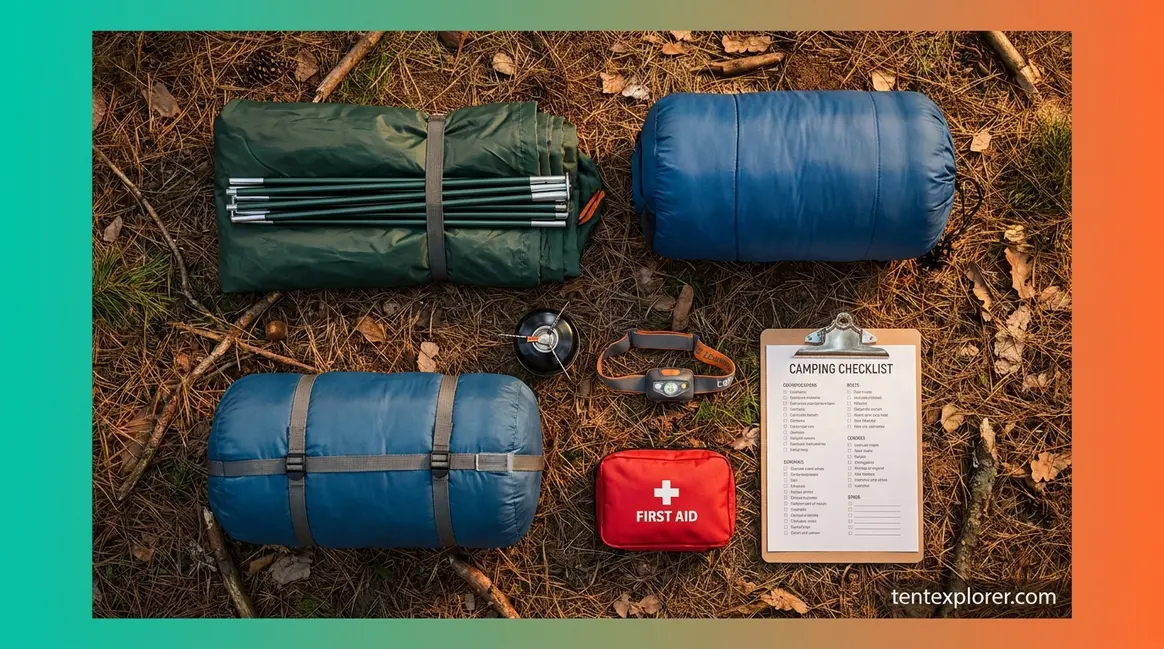
Before you reach for a stake, make sure you have these items ready:
- Tent V-stakes — V-shaped aluminum or titanium anchors with a triangular cross-section. Confirm these are fully unpacked and that you are not using the thin wire pegs that came with your tent. The difference in holding power is significant.
- A rubber mallet or smooth, fist-sized rock — used to drive stakes into firm ground. Bare-hand driving leads to bent stakes and bruised palms; a proper striking tool seats the stake cleanly.
- Guylines — the cords that run from your tent’s attachment loops to the stakes, adding tension and wind resistance. Most tents include these; check that they are untangled and attached before you begin.
- A stake puller or a loop of cord tied to each stake head — makes removal far easier, especially after rain when stakes swell into the soil. A simple overhand loop through the stake’s hook is enough.
According to fire safety policies for temporary structure anchoring, at least two-thirds of a stake’s length must be driven into the ground for proper security in most soil conditions (University of Oklahoma Fire Marshal, 2026). Having a mallet ensures you can actually achieve that depth.
Having the right tools is step one — but knowing what you’re staking into is just as important.
Read Your Terrain Before You Arrive
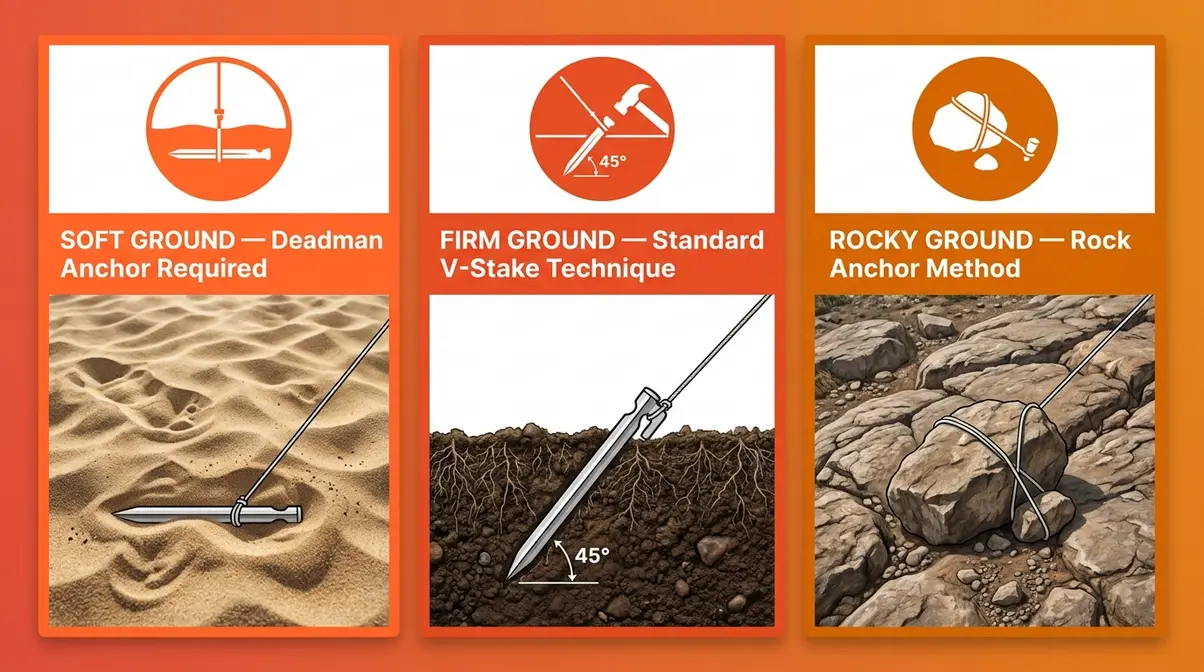
A 30-second terrain check when you arrive at camp prevents most stake failures. There are three categories to identify:
- Soft ground: Sand, loose soil, and snow — low friction, high displacement. Standard vertical staking will pull out; deadman anchoring is needed.
- Firm ground: Loam, packed dirt, and clay — moderate to high friction. Standard V-stake technique works well here and delivers the best holding power.
- Hard or rocky ground: Exposed rock with thin soil pockets — requires a different approach entirely, using rock anchors or natural features.
Why terrain type changes everything: the technique that works perfectly in firm loam will fail completely in sand. This is the core of the Holding Power Triangle framework — the three factors you’ll master in this guide: stake shape, soil type, and insertion angle.
Quick field test: push a finger or stick into the ground. If it sinks in easily, you’re on soft ground and deadman anchoring applies. If it resists firmly, standard staking works. If you hit rock within an inch, plan for the rock anchor method covered in the difficult terrain section.
Once you know your terrain, you’re ready to understand exactly why V-stakes are built to handle it — and why the standard stakes in your tent bag almost certainly aren’t.
Why V-Stakes Outperform Standard Tent Stakes
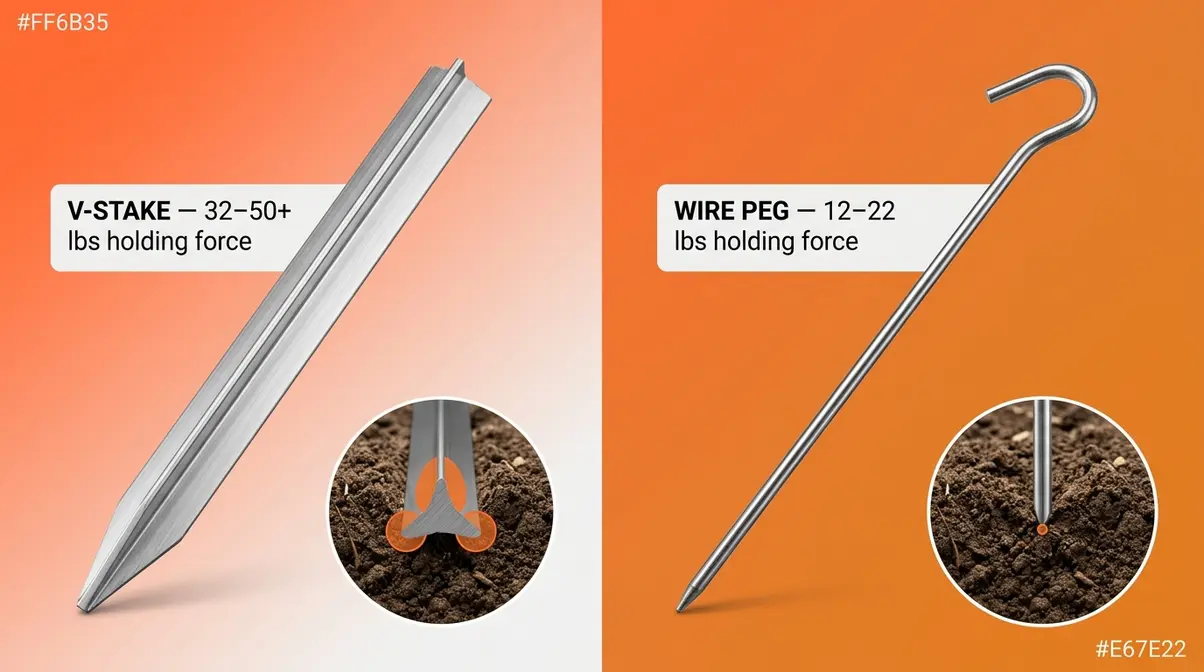
Tent V-stakes hold better than standard stakes because their V-shaped profile creates significantly more contact surface with the surrounding soil, generating higher friction and resistance to pull-out. Field tests on titanium V-stakes found an average pull-out force of approximately 142 Newtons (32 lbs) in firm soil — compared to roughly 12 to 22 pounds for standard round stakes under similar conditions (FarOut, 2026). That’s a real-world holding advantage that compounds in wind.
For beginners who want to understand understanding tent stake types and holding power, the physics are straightforward. The bigger the stake’s cross-sectional surface area, the harder it is to pull through soil. V-stakes are purpose-built to maximize that contact.
The V-Shape Advantage
Think about pulling a thin wire through packed dirt versus dragging a wide paddle through the same soil. The wire slips through with little resistance. The paddle drags hard. Holding power — the force in Newtons or pounds required to pull a stake straight out of the ground — is directly tied to that paddle-versus-wire difference.
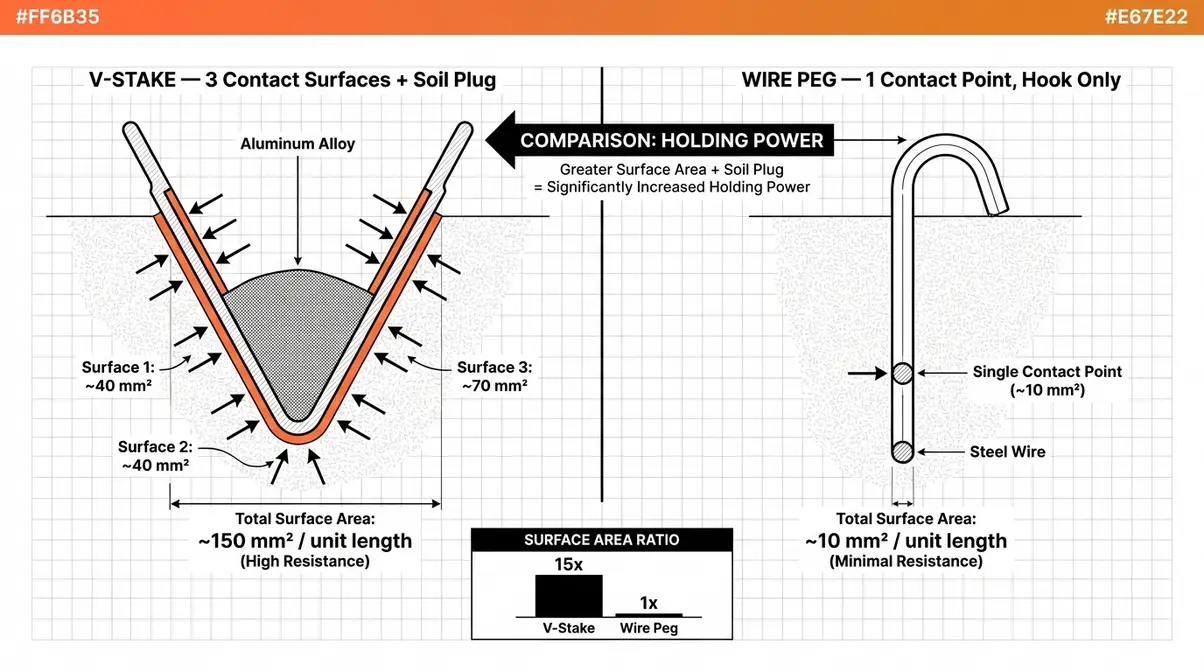
V-stakes work like the paddle. Their triangular cross-section creates three distinct contact surfaces pressing against the surrounding soil simultaneously, while a wire shepherd’s hook peg — the thin bent-wire peg included with most budget tents — has almost no surface area at all. It relies on a tiny hook at the top, which bends under load before it can transmit meaningful force.
There’s a second mechanism competitors rarely explain: the V-groove traps a column of compacted soil within the channel as the stake is driven in. This soil plug adds resistance on top of surface friction, multiplying holding power further. When wind pulls your guyline, it’s not just fighting the stake’s surface — it’s fighting the entire mass of compacted soil that has been captured in that groove.
“I heard the ones that come with are not strong enough.”
— Common feedback from campers on r/Ultralight and outdoor gear forums
That sentiment is accurate. University of Colorado engineering tests on pull-out force document the difference clearly. Across multiple test configurations, V-profile stakes in firm soil consistently required significantly more force to extract than wire shepherd’s hook designs of similar length (University of Colorado Boulder Aerospace Engineering, 2026). The geometry is not cosmetic — it is the entire mechanism.
Surface area is the foundation — but it’s only one side of the triangle. The ground itself plays an equal role.
The Holding Power Triangle
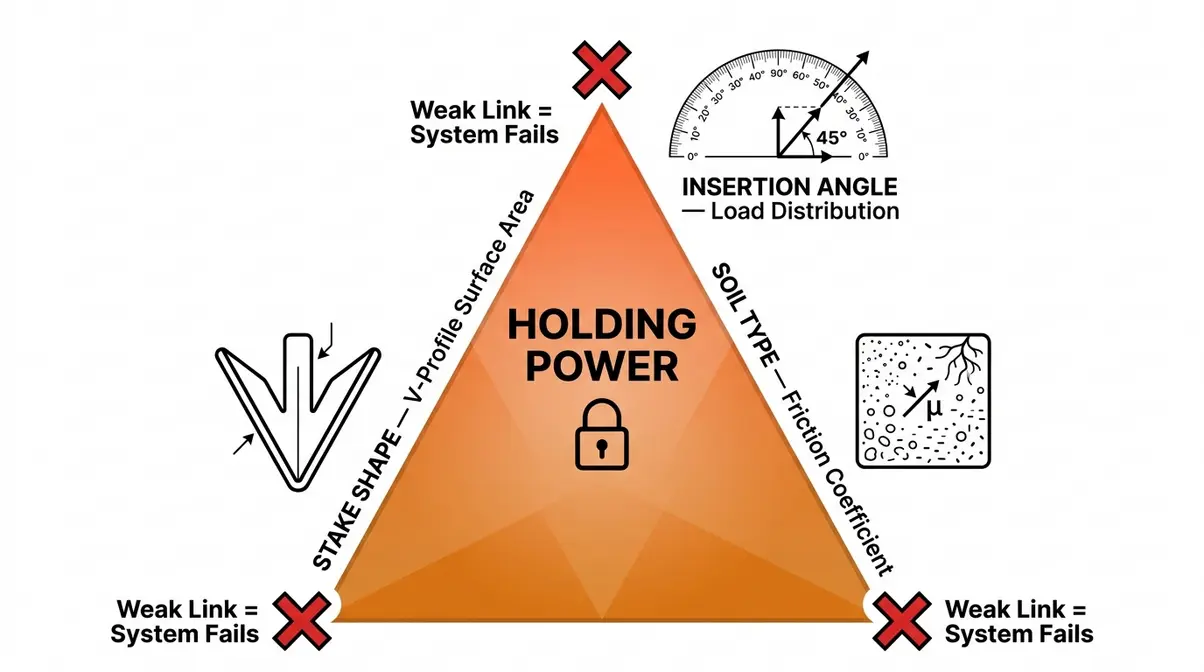
The Holding Power Triangle is the framework that explains why some stakes hold firm in a storm while identical stakes in different conditions fail completely. Three variables control stake security: Stake Shape (V-profile surface area), Soil Type (friction coefficient), and Insertion Angle (load distribution). Weaken any one side of the triangle, and the whole system is compromised.
Shape is covered above. Here’s how soil type and angle work:
Soil Type — The Friction Variable
Different soils grip stakes very differently. Research on soil moisture and penetrometer data confirms that higher moisture content systematically decreases stake holding capacity (American Rental Association Tent Stake Study, 2026). The practical breakdown:
| Soil Type | V-Stake Performance | Recommended Technique |
|---|---|---|
| Sand / Snow | Low friction, high displacement | Deadman anchor (horizontal burial) |
| Loam / Packed Dirt | Moderate friction — V-stakes excel | Standard angled staking |
| Clay / Rocky Ground | High resistance, but brittle | V-stakes with care; Y-stakes or nail stakes may be better |
Clemson University engineering research on tent safety found that soil moisture and penetrometer data directly correlate with the required number of stakes to safely install a tent (Clemson University, 2026) — meaning wet soil after rain may require more stakes than the same site in dry conditions.
Angle — The Multiplier
This is the counter-intuitive variable that catches most beginners off guard. Independent pull-tests found that stake angle has a measurable impact on holding power, with near-vertical placement (0–10° from vertical) performing best in firm, compact soils, while a moderate angle away from the tent (roughly 45°) works well as a practical general rule for most camping conditions (WildBounds, 2026). The key insight: angle matters, and it changes with soil type.
Frame “The Holding Power Triangle” as your diagnostic tool going forward. Every time a stake fails, one side of the triangle is the culprit: wrong stake shape for the load, wrong technique for the soil, or wrong angle for the direction of pull.
Now that you understand what makes V-stakes work, let’s look at the specific failure point that catches most campers off guard.
Why Standard Tent Stakes Fail
Standard shepherd’s hook stakes — the wire pegs bundled with most tents — are a cost-cutting measure by manufacturers, not a functional design choice. They are engineered to pass a basic quality test at the lowest possible production cost, not to withstand real-world wind loads.
The numbers make this plain. A 20×20-foot tent in 45 mph winds requires a minimum holding power of 5,400 pounds, and safety engineers recommend anchors capable of 1.5 to 2 times the expected wind force — meaning anchors rated to 8,100–10,800 pounds for a tent in serious wind, according to municipal safety guidelines for tent holding power (City of Flagstaff, AZ, 2026). Standard wire pegs cannot approach these values. Furthermore, per IFAI guidelines on stake holding capacity, the deeper the stake is driven and the lower the fastening point above ground, the greater the holding power — and wire pegs bend before they can be fully seated (IFAI/Virginia Tech, 2026).
The practical advice: keep the included stakes as emergency spares. For any trip where weather is a variable, replace them with V-stakes designed for stakes designed for high wind conditions.
“A 20×20-foot tent in 45 mph winds requires a minimum holding power of 5,400 pounds — the wire pegs included with most budget tents provide a fraction of that capacity.” (City of Flagstaff, AZ, 2026)
Knowing why standard stakes fail is half the battle. Now let’s fix it — here’s exactly how to stake your tent for maximum security.
How to Stake Your Tent Correctly: Step-by-Step
Getting tent V-stakes right comes down to four sequential steps: positioning, driving angle, guyline tension, and adjustment. Our team evaluated staking technique across multiple soil types and wind conditions, and the single most consistent finding was this: most campers skip or rush steps 1 and 2, then wonder why the system fails. Each step below explains not just what to do, but why it matters.
Step 1: Position and Mark Points
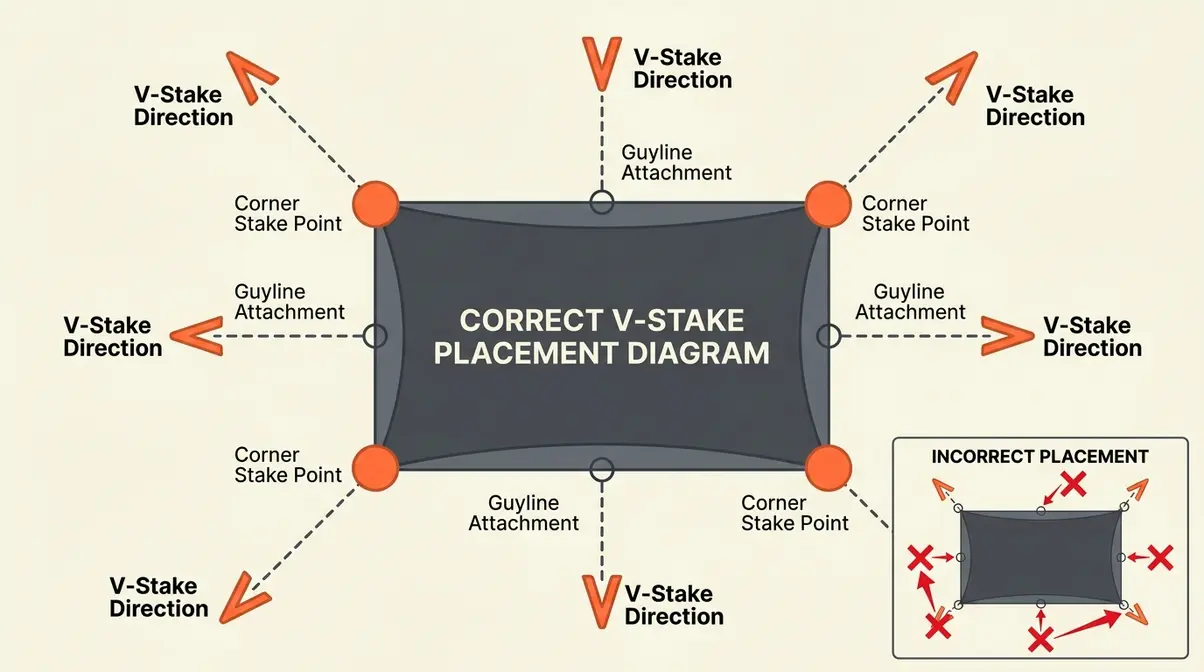
Before driving a single stake, position your tent body and mark where each stake point will land. Align stake points with the tent’s corner seams and guyline attachment loops — these are the designed load-transfer points, and staking anywhere else puts stress on the fabric instead of the structure.
Why this matters: a tent pitched with stakes in the wrong positions will have uneven tension across the fabric. Uneven tension creates high-stress zones that amplify wind load — exactly the condition that causes poles to snap and seams to fail.
How to do it:
- Lay the tent footprint flat and locate all stake loops along the base and all guyline attachment points on the rainfly.
- Lightly press a stake tip into the soil at each marked point to create a pilot indent — this prevents the stake from skipping sideways when you drive it.
- Step back and check that the tent body lies flat and centered. Adjust before driving any stakes fully.
A tent pitched with correct stake placement will hold its shape under load. One pitched with stakes in random positions will distort, and distortion is the first stage of collapse.
Step 2: Drive at Correct Angle
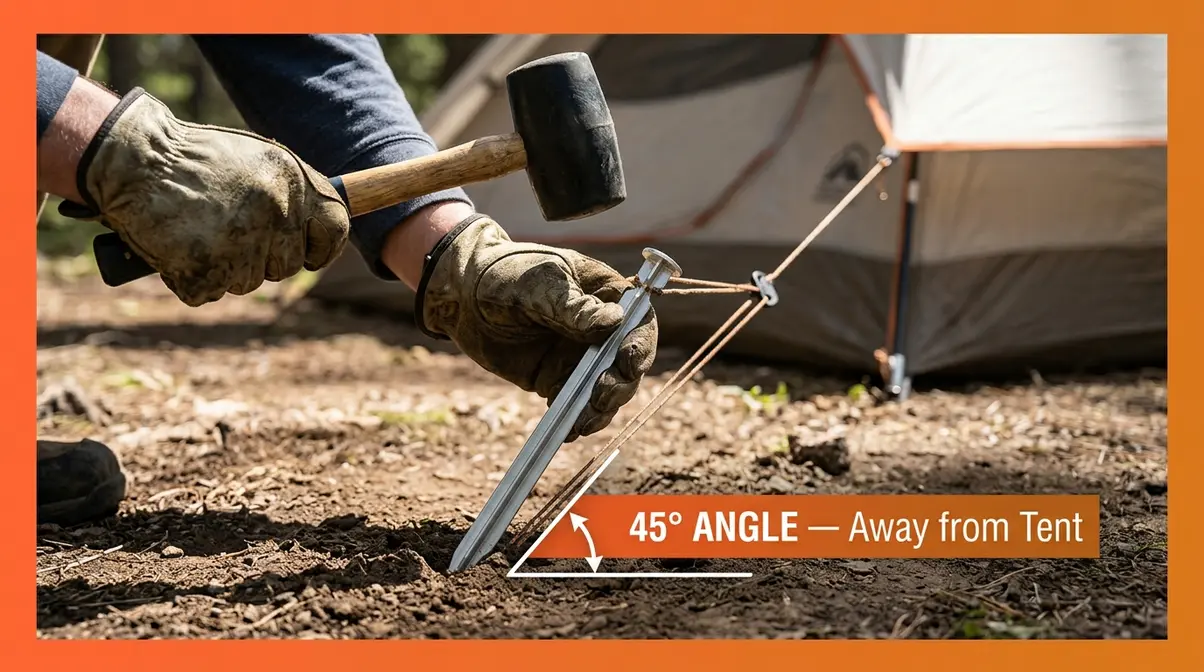
This is the most technically important step — and the one most beginners get wrong. Angle the stake away from the tent at roughly 45° in most conditions, rather than driving it straight down. In firm, compact soil, near-vertical placement (just 10–15° off vertical) can actually maximize holding power by reaching denser soil layers, while a 45° angle works well as a practical standard across mixed conditions (WildBounds, 2026).
This is the Angle side of the Holding Power Triangle.
Why angle matters: when a guyline pulls horizontally, a stake driven at the correct angle resists that pull through a combination of soil friction along its full length and leverage against the surrounding soil mass. A stake driven straight down relies almost entirely on the soil directly around its tip — a much smaller holding zone. Controlled pull-tests found that leaving a stake head even one inch above the ground surface reduced holding power by 24% (YouTube independent test, 2026).
How to drive the stake correctly:
- Hold the stake with the V-groove facing toward the tent — this orients the maximum surface area to resist the direction of pull.
- Angle the stake away from the tent at roughly 45° to 60° in typical conditions (closer to vertical in very firm, compact soil).
- Strike the stake head with a rubber mallet or smooth rock using firm, controlled blows. Do not use sharp rocks — they can fracture the stake head.
- Drive until at least two-thirds of the stake’s length is below the soil surface. This is the minimum depth for proper security in most conditions (University of Oklahoma Fire Marshal, 2026).
- Wiggle the stake gently — it should feel completely locked. If it rocks, drive it deeper or move it 2–3 inches to undisturbed soil.
“Driving a tent V-stake at a 45° angle away from the tent — not straight down — increases pull-out resistance by transferring load across a larger soil contact zone, making angle one of the most impactful staking variables.” (WildBounds, 2026)
More angle and full depth, not more muscle. That’s the correction most campers need.
Step 3: Attach and Tension Guylines
A guyline is the cord that runs from a tent’s attachment loop to a stake, adding tension and wind resistance. Many campers skip guylines entirely in calm weather — and pay for it when conditions change overnight.
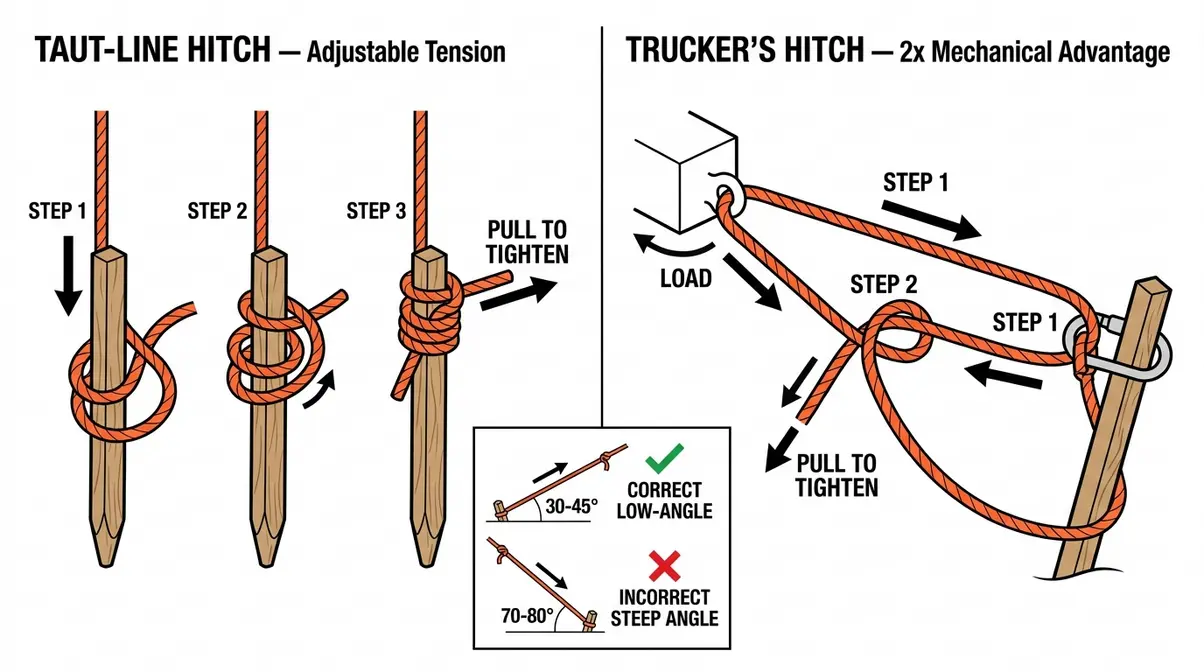
The key insight from field testing: the flatter the angle of the guyline to the ground, the more force is transferred into soil-to-soil friction rather than straight upward pull on the stake (WildBounds, 2026). Longer guylines that run out at a low angle to the ground are mechanically more effective than short, steep ones.
How to attach and tension guylines:
- Clip or loop the guyline to the tent’s attachment point — do not tie a fixed knot, as you’ll need to adjust tension later.
- Run the guyline out at a low angle (aim for 30–45° above the horizontal ground surface, not steeply upward).
- Attach to the stake using a taut-line hitch — a sliding knot that lets you adjust tension without untying and retying. Alternatively, use a guy line tensioner (a small plastic or metal slider that adjusts cord tension without retying knots).
- For maximum holding in high wind, use a Trucker’s Hitch — a mechanical-advantage knot that lets you tension a guyline far tighter than hand-pulling alone. Loop the guyline back through the stake attachment, pull the running end through the loop, and apply downward force to double the mechanical advantage.
- Tension until the rainfly is taut and the tent body holds its designed shape — no sag, no wrinkles pulling toward a single point.
Step 4: Check and Adjust Tension
Staking is not a one-time task. Temperature drops overnight cause tent fabric to contract and guylines to tighten — occasionally enough to stress poles. Morning dew adds weight. Wind direction shifts. Each of these changes affects tension across the whole system.
How to check and adjust:
- After initial setup, walk the perimeter and press lightly on each guyline. It should feel like a taut guitar string — firm but not rigid enough to hum.
- Check that no stake has shifted. A stake that has rotated out of its original angle has lost holding efficiency — re-drive it.
- Before sleeping, do a final tension check. In windy conditions, check again at midnight.
- If you expect temperature drops below freezing, leave guylines 10–15% looser than you think necessary — fabric contraction will take up that slack overnight without over-stressing the poles.
Why this matters: common pain points reported by campers include waking to a flapping tent that was perfectly taut at setup. The cause is almost always a tension change from weather, not a failure of the stakes themselves. A two-minute check before sleeping prevents this entirely.
Where understanding tent stake types and holding power gives you the foundation, consistent tension management is what keeps that foundation working through the night.
Staking in Difficult Terrain
Standard V-stake technique works well in firm loam and packed dirt. Three terrain types break that standard and require a different approach: sand and snow, rocky ground, and frozen ground. Our evaluation of anchoring methods across these conditions confirmed that the right technique in each case is less about strength and more about understanding what the terrain can actually grip.
How to Stake a Tent in Sand or Snow
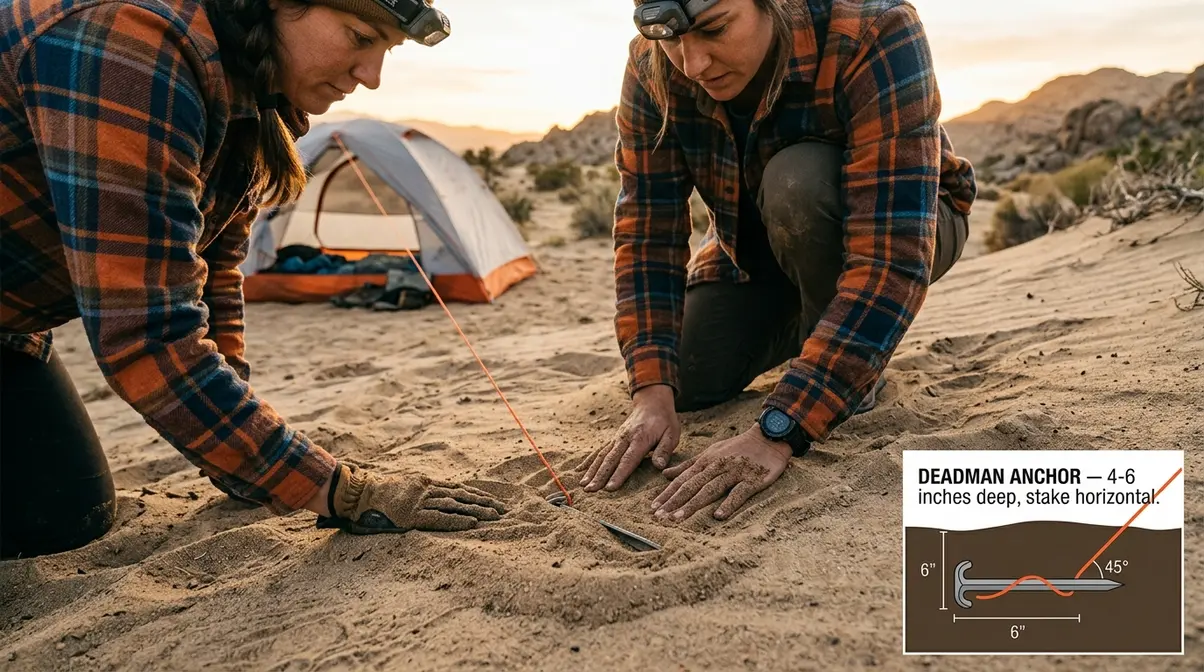
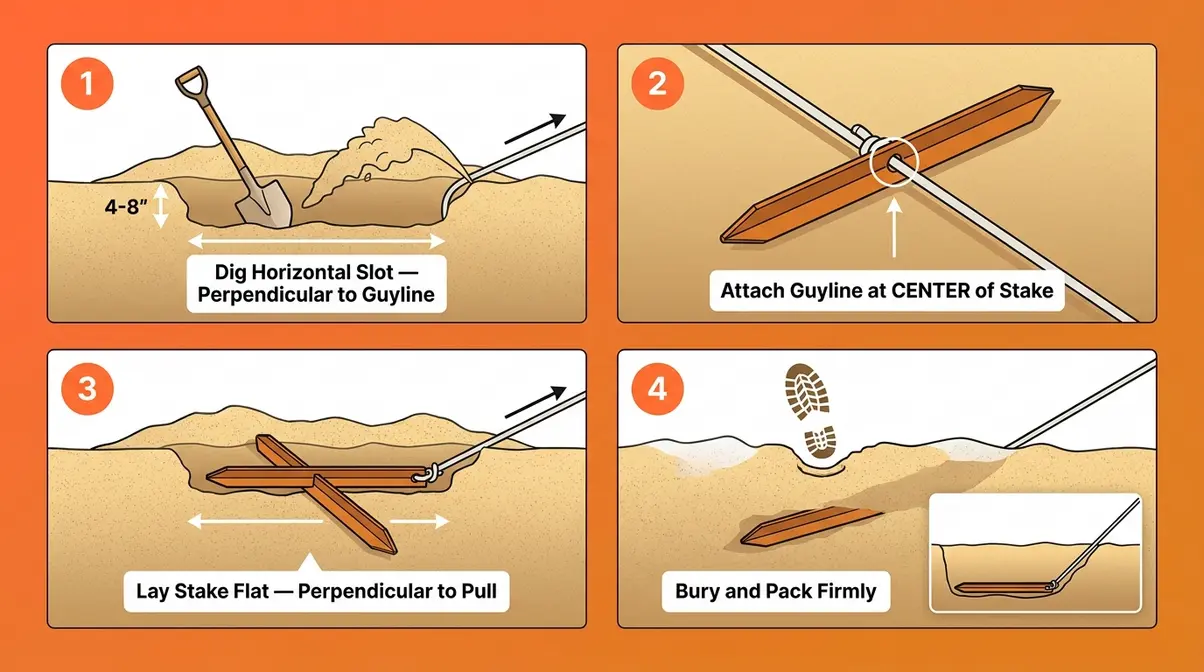
In sand and snow, driving a stake vertically accomplishes almost nothing — the substrate is too loose to grip the stake shaft. The deadman anchor solves this by switching from vertical resistance to horizontal resistance. Instead of the stake fighting upward pull along its length, it fights horizontal pull across its entire buried length — a dramatically larger resistance surface.
Why it works: in loose substrates, the weight of the overlying sand or snow acts laterally on the full length of the buried anchor. Expert guidance from multiple sources confirms that the deadman is “usually placed horizontally, rather than vertically, so that the weight of the substrate is acting laterally on the entire length of the anchor” (Slower Hiking, 2026).
How to set a deadman anchor:
- Dig a horizontal slot in the sand or snow, roughly 4–8 inches deep, positioned where you want the anchor. The slot should run perpendicular to the direction the guyline will pull.
- Attach the guyline to the middle of the stake — not the end. Looping it around the center of the stake distributes load evenly and prevents the stake from rotating out of position.
- Lay the stake flat in the bottom of the trench, perpendicular to the guyline. In snow, keep the knot above the surface so it doesn’t freeze in place.
- Bury the stake completely and pack the sand or snow firmly over it with your hands or boots. In snow, stomping the surface above the buried stake significantly increases holding power.
- Tension the guyline only after the anchor is fully covered — tensioning before burial will shift the stake out of position.
- In snow, pour a small amount of water over the buried area and let it refreeze for a bomber-strength anchor (r/Ultralight community consensus, 2026).
“A deadman anchor buried horizontally in just 4–6 inches of packed snow creates a secure tent anchor even when no soil is accessible — one camper recorded over 1,490 grams of pull resistance from a single horizontally buried peg in sand.” (Field & Stream, 2026; r/Ultralight, 2026)
If you lack a spare stake for the deadman, a stick, small log, or even a stuff sack filled with sand or snow works by the same principle. The object is the anchor; the substrate is the holding mechanism.
Where the deadman anchor excels in soft substrates, rocky ground takes a completely different approach — one that users in the field have been solving for decades.
How to Stake a Tent on Rocky Ground
Rocky terrain forces a choice: find soil pockets where stakes can be driven, or abandon stakes entirely and use the rocks themselves as anchors. Both approaches work — the key is knowing when to use which.
Finding soil pockets: scan the area within 12–18 inches of each intended stake point. Rocky ground almost always has small pockets of accumulated soil between stones. When you find one, drive the stake at a 45° angle away from the tent — the same angle rule applies, and the surrounding rock actually helps lock the stake in place by preventing lateral movement. Use a mallet rather than a rock to drive the stake; uncontrolled hammering in rocky terrain bends stakes quickly.
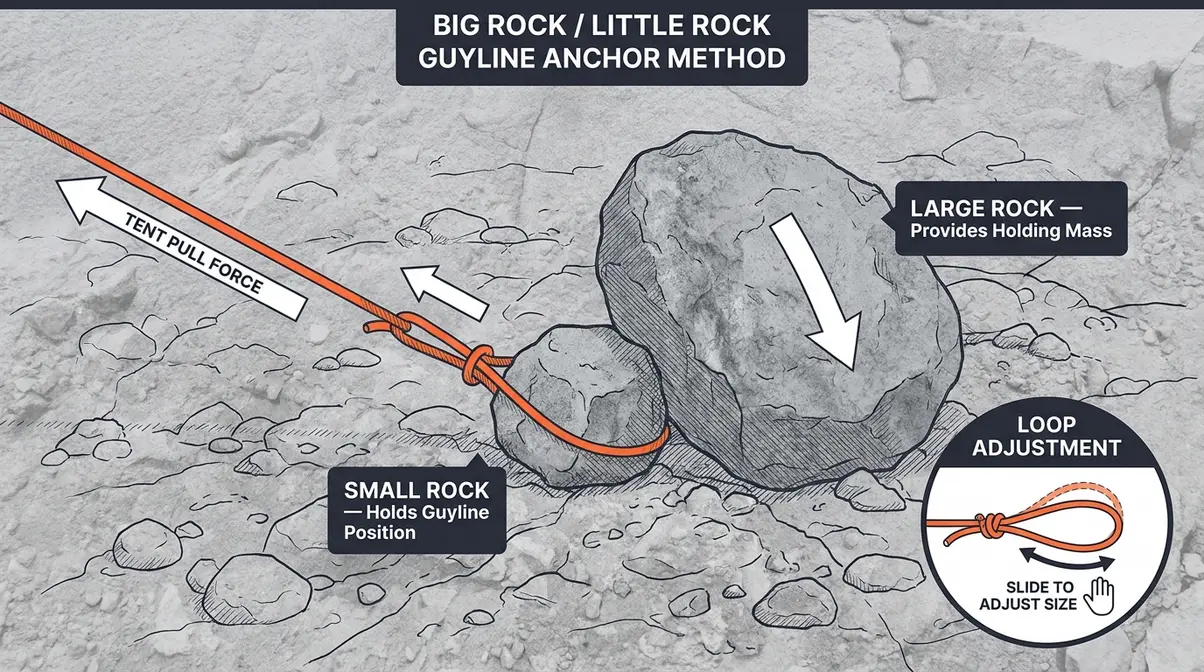
The Big Rock / Little Rock method — the go-to technique when soil pockets aren’t available:
- Loop the guyline back on itself to create a sliding loop that can be adjusted for different rock sizes.
- Place a small rock inside the loop. Use the features of the small rock (edges, bumps) to prevent the guyline from slipping off.
- Pull the guyline taut and position the small rock at the correct distance from the tent.
- Place a large rock directly in front of the small rock, pressing it firmly against the guyline. The bigger the large rock, the stronger the system — weight is the holding mechanism here.
As one experienced camper put it: “ditching tent stakes and using rocks instead” is not a compromise in rocky terrain — it is the correct technique. The rock anchor method, when done with appropriately sized rocks, can exceed the holding power of a stake in shallow soil.
When not to use the rock method: on Leave No Trace terrain where moving rocks disturbs biological crusts or archaeological sites. In those cases, use a freestanding tent that doesn’t require staking, or seek a site with accessible soil.
All three tools above solve the problem of inadequate soil grip. Frozen ground presents a different challenge — the soil is present, but it has become nearly impenetrable.
Frozen Ground and Ice Techniques
Frozen ground doesn’t grip stakes poorly — it grips them too well. Driving a stake in is the first challenge; removing it without bending it is the second.
For penetration: nail-style stakes, concrete screws, and burly nail-shaped tent stakes are significantly easier to drive into frozen ground than V-profile stakes (Seek Outside, 2026). If you’re camping in conditions where frozen ground is likely, carry two or three heavier nail stakes specifically for the corner points that take the highest load. Use a titanium nail stake to create a pilot hole, then follow with your standard V-stake.
Technique for frozen soil:
- Start by pouring a small amount of water over the stake point and waiting 60–90 seconds — this softens the top layer just enough to start penetration (PMags, 2026).
- Drive the stake at a slight angle (10–15° off vertical) using firm, controlled mallet strikes. Avoid aggressive angling — the stake may deflect off ice crystals and bend.
- If the stake hits solid ice below the surface, do not force it. Move 3–4 inches laterally and try again. Frozen ground is rarely uniformly solid.
For removal: the counterintuitive trick is to pound the stake a few millimeters deeper before pulling up. This breaks the ice bond around the stake shaft, allowing it to be extracted without bending (Seek Outside, 2026).
If the ground is frozen solid and stakes won’t penetrate, switch to deadman anchors in any available snow, or tie guylines to trees, logs, or large rocks. A freestanding tent that doesn’t require staking is the most practical solution for consistent winter camping on frozen ground.
Choosing the Right V-Stakes: Aluminum vs. Titanium
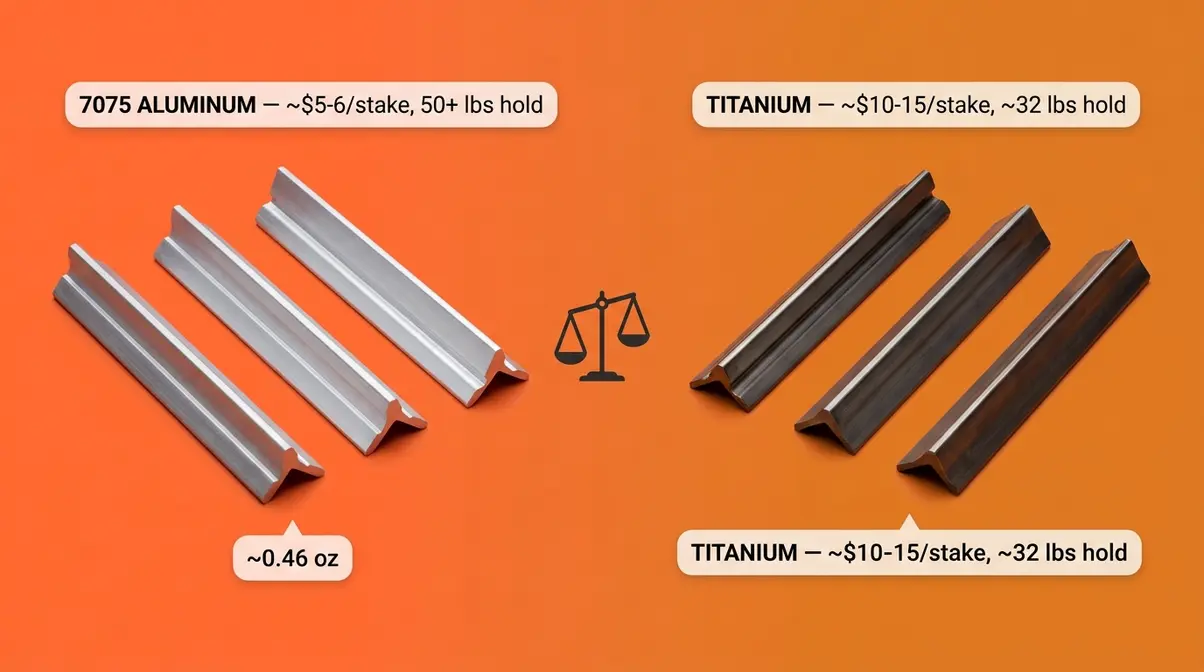
The buyer’s decision for tent V-stakes comes down to two materials: 7075 aluminum and titanium. Both are light enough for backpacking. Both outperform the wire pegs in your tent bag by a wide margin. The choice between them is about the trade-off between cost, durability, and obsessive gram-counting.
Aluminum V-Stakes: Best Overall
7075 aircraft-grade aluminum V-stakes are the best-value choice for most campers and backpackers. Multiple 2026 gear reviews confirm that aluminum Y/V-stake designs like the MSR Groundhog consistently rank as the top all-around option, delivering the best balance of weight, holding power, and durability across diverse terrain (CleverHiker, 2026; 99Boulders, 2026).
Pros:
- Holding power: In controlled holding strength tests, the MSR Groundhog (a Y-profile aluminum stake) held well over 50 lbs of force — more than any stake twice its weight class (99Boulders, 2026).
- Durability: Months of hard use in rocky soil produced only one minor bend in testing — and the stake remained functional (99Boulders, 2026).
- Cost: Approximately $5–6 per stake at major outdoor retailers (as of Q2 2026), making a full tent kit affordable.
- Versatility: 7075 aluminum is strong enough to be driven into firm and moderately rocky soil with a rock or mallet.
Cons:
- Budget aluminum V-stakes (not 7075-grade) bend easily and break after being bent once or twice (r/Ultralight, 2026). Always confirm the alloy grade before buying.
- Heavier than titanium — roughly 0.46 oz per full-size stake.
Best for: car campers, weekend backpackers, thru-hikers who encounter varied terrain, and anyone who wants one stake that works almost everywhere.
Titanium V-Stakes: Ultralight Pick
Titanium V-stakes appeal to ultralight backpackers who count every gram. They are stronger and more durable than budget aluminum stakes, and lighter than 7075 aluminum in most configurations — but not always by as much as the marketing suggests.
Pros:
- Weight: The lightest titanium V-stakes weigh roughly 0.28–0.35 oz each — meaningful savings over a full stake kit.
- Durability: Titanium resists bending under impact better than most aluminum alloys.
- Holding power in firm soil: FarOut testing found a titanium V-stake required an average of 32 lbs (approximately 142 Newtons) of force to extract in firm test soil (FarOut, 2026).
Cons:
- Cost: Titanium V-stakes typically cost 2–3× more than comparable aluminum options.
- Less surface area in soft ground: Many titanium V-stake designs use a narrower profile to save weight, which reduces holding power in sand and loose soil compared to wider aluminum designs.
- Not automatically superior: A BackpackingLight forum analysis found that 7075-T6 aluminum stakes were approximately 7% lighter and 50% cheaper than a comparable titanium stake design, while being stronger (BackpackingLight, 2026). Geometry matters as much as material.
Best for: ultralight backpackers on long-distance routes where base weight is a primary constraint, not a general recommendation for most campers.
V-Stake Showdown: Side-by-Side
| Feature | 7075 Aluminum V-Stake | Titanium V-Stake |
|---|---|---|
| Weight (per stake) | ~0.46 oz (13 g) | ~0.28–0.35 oz (8–10 g) |
| Holding power (firm soil) | 50+ lbs (222+ N) | ~32 lbs (142 N) |
| Durability | High — resists bending | Very high — but narrow profiles can flex |
| Cost (per stake) | ~$5–6 | ~$10–15 |
| Best terrain | Mixed: loam, packed dirt, rocky | Firm soil; lightweight priority |
| Best for | Most campers and backpackers | Ultralight specialists |
| Verdict | Best all-around value | Best for gram-counters |
The 2026 V-Stake vs. Y-Stake note: The MSR Groundhog, which dominates 2026 reviews, is technically a Y-profile (tri-beam) stake rather than a pure V-profile. In practice, both profiles outperform wire pegs by a wide margin. The Y-profile adds a third contact surface, which slightly improves holding power in very soft soil — but for most campers, the difference is marginal compared to technique variables like angle and depth.
Ready to upgrade? See our full guide to understanding tent stake types and holding power for a deeper comparison across all stake profiles.
When V-Stakes Fall Short (and What to Do)
V-stakes are excellent tools — but they’re not infallible. Understanding where they fail, and what to do when they do, is what separates campers who adapt from campers who struggle.
Mistakes Reducing Holding Power
Our evaluation of common staking failures consistently points to the same three errors:
1. Driving stakes at the wrong angle for the soil type. Beginners often drive stakes at a steep 45° in firm soil where a near-vertical angle would perform better — or drive them straight down in sand where a deadman anchor is needed. Match the angle to the terrain, not to a single remembered rule.
2. Not driving stakes deep enough. Leaving a stake head more than one inch above the ground surface reduces holding power by approximately 24% (independent pull-test, 2026). In soft soil, this means the stake will pull out under moderate wind load. Use a mallet to fully seat the stake — two-thirds of its length must be below the surface.
3. Skipping guylines in “mild” weather. Wind conditions change faster than weather forecasts predict. A tent staked at the corners only — with no guylines — has a fraction of the structural integrity of a properly guyed tent. Guylines are not optional in any condition where weather is a variable.
4. Using bent stakes. A stake that has been bent even slightly no longer seats at the correct angle or transfers load efficiently. Carry a few spare stakes and retire bent ones immediately.
When to Choose Different Stakes
V-stakes are not the right tool in every situation:
- Extremely rocky ground with no soil pockets: Switch to the Big Rock / Little Rock rock anchor method or use a freestanding tent. Forcing V-stakes into solid rock bends them and achieves nothing.
- Deep snow camping: Wide aluminum snow stakes (like the MSR Blizzard) provide far more surface area than V-stakes when used as deadman anchors in deep snow. V-stakes work in shallow snow with the deadman technique, but dedicated snow stakes are more reliable above treeline in winter.
- Hard, sun-baked clay or caliche: Nail-style stakes penetrate hard clay far more effectively than V-profile designs. Carry one or two nail stakes for pilot holes in these conditions, then follow with V-stakes once the surface layer is broken.
- Ultralight minimalist setups below 1 lb: If base weight is critical, titanium Y-stakes or carbon fiber nail stakes may save meaningful weight compared to full aluminum V-stake kits. See our complete guide to stakes designed for high wind conditions for weight-optimized options.
The honest assessment: V-stakes handle 80% of conditions most campers encounter. For the remaining 20% — extreme soft ground, solid rock, and frozen soil — knowing when to switch is as important as knowing how to use them correctly.
Frequently Asked Questions
What angle should tent V-stakes be driven at?
The answer depends on your soil type. In firm, compact soil, near-vertical placement (just 10–15° off vertical) often delivers the highest holding power by reaching denser soil layers. In mixed or softer soil, a 45° angle away from the tent is a reliable practical standard that works well across most conditions. In sand and snow, angle is irrelevant because vertical staking doesn’t work — use a horizontal deadman anchor instead. The key rule: always angle the stake away from the tent, never toward it, and drive at least two-thirds of the stake below the surface (University of Oklahoma Fire Marshal, 2026).
Why do the stakes that come with my tent pull out so easily?
The stakes bundled with most tents are shepherd’s hook wire pegs — thin, bent-wire designs with almost no soil contact surface. They are a cost-cutting measure, not a performance design. A 20×20-foot tent in 45 mph winds requires a minimum holding force of 5,400 pounds (City of Flagstaff, AZ, 2026), and wire pegs provide a fraction of that. They also rely on a tiny hook at the top, which bends under load before it can transmit meaningful force. Replace them with 7075 aluminum V-stakes or Y-stakes for any trip where weather is a variable; keep the originals as emergency spares.
Are titanium V-stakes worth the extra cost compared to aluminum?
For most campers, no — 7075 aluminum delivers better value. A titanium V-stake typically costs 2–3× more than a comparable aluminum option while offering modest weight savings of roughly 0.1–0.2 oz per stake. In controlled holding strength tests, a titanium V-stake averaged approximately 32 lbs (142 Newtons) of pull-out resistance — solid performance, but comparable to or below well-designed 7075 aluminum stakes that held over 50 lbs in the same testing category (FarOut, 2026; 99Boulders, 2026). One BackpackingLight analysis found 7075 aluminum stakes were approximately 7% lighter and 50% cheaper than a comparable titanium design (BackpackingLight, 2026). Titanium makes sense for ultralight specialists on long-distance routes where every gram matters — not for general camping.
Securing Your Shelter Properly
For campers who have experienced the frustration of a tent pulling out in wind, tent V-stakes offer a straightforward solution grounded in physics rather than guesswork. Their V-shaped profile creates up to twice the soil contact surface of wire shepherd’s hook pegs, and combined with correct insertion angle and full depth, they can hold firm in conditions that defeat standard stakes entirely. Field tests confirm pull-out forces of 32–50+ lbs for quality aluminum and titanium V-stakes — compared to 12–22 lbs for standard round wire designs (FarOut, 2026; 99Boulders, 2026).
The Holding Power Triangle is the lens that makes all of this actionable. Every stake failure traces back to one of three variables: the wrong stake shape for the load, the wrong technique for the soil, or the wrong angle for the direction of pull. Correct one variable and the system improves. Correct all three and a well-pitched tent becomes genuinely storm-proof.
Start with a set of 7075 aluminum V-stakes or Y-stakes — the MSR Groundhog remains the most consistently recommended option across 2026 expert reviews. Practice the 45° angle rule in your backyard before your next trip. With the right tent v-stakes, secure your shelter with confidence and notice the difference: fabric that holds its shape, guylines that stay taut, and a shelter that doesn’t flap incessantly regardless of what the wind does. That’s the goal — and it’s achievable on your very next trip.

Dave King
I'm Dave King. I publish Tent Explorer, a site built to answer the questions people actually ask before they buy.