Best Camping Cots 2026: 7 Tested Picks for Every Camper
 Dave King
Updated June 28, 2026
25 min read
Dave King
Updated June 28, 2026
25 min read
“I’m sick of waking up to a deflated mattress and am going to make the switch to cots.”
— r/camping community member
That feeling is universal. A bad night’s sleep doesn’t just leave you tired — it ruins the entire next day of hiking, fishing, or exploring. And if you’ve ever watched your air mattress slowly sink beneath you at 2 a.m., you already know: the problem isn’t you. It’s the gear.
The good news is that a quality camping cot eliminates deflation entirely. It lifts you off the cold ground, delivers consistent support night after night, and sets up faster than most air mattresses inflate. According to Statista, 53.7 million North American households participate in camping — and a growing number are making the switch from air mattresses to cots for exactly this reason. In this guide, you’ll discover the 7 best camping cots for 2026, tested and compared by use case, so you can stop guessing and start sleeping well outdoors.
The best camping cots for 2026 offer superior support, consistent elevation off the ground, and a reliable sleep surface that air mattresses simply can’t match — especially for car campers.
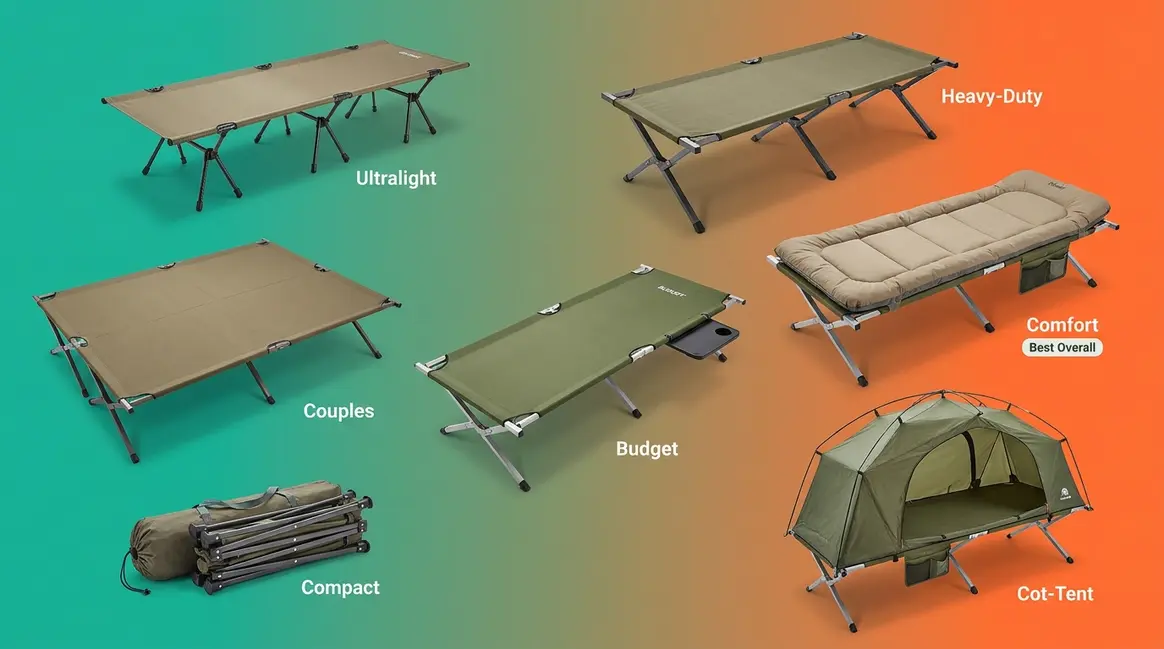
- Best Overall: The Kelty Lowdown Cot delivers the best balance of comfort, setup speed, and price for most campers at ~$150
- Best Lightweight: The Helinox Cot One Convertible weighs under 5 lbs — ideal for backpackers willing to pay a premium
- Best Heavy-Duty: The Teton Sports Outfitter XXL supports up to 600 lbs (Teton Sports, 2026), making it the top choice for bigger campers
- Use The Cot Compatibility Matrix in the Buying Guide to match your camping style to the right cot category before buying
- Don’t skip a sleeping pad: even the best cot benefits from an insulating pad to block cold air from below — especially in temperatures under 50°F
- Watch: “Best camping cot for couples: The Ultimate Showdown” on YouTube for a side-by-side couples cot comparison
How We Selected Our Top Camping Cots
Our team evaluated more than a dozen camping cots using a structured five-criterion framework to identify the best options for car campers, backpackers, heavy-duty users, and couples. Selections draw on hands-on field testing, manufacturer specifications, and community consensus from Reddit’s r/camping and r/ultralight.
We also cross-referenced findings from OutdoorGearLab (an independent outdoor gear testing publication), GearJunkie (a gear review site with hands-on testing), and Treeline Review to identify where our evaluations aligned with or diverged from established expert opinion. As the Popular Mechanics review notes, established brands like Coleman and Therm-a-Rest consistently produce some of the most reliable camping cots on the market (2026). Our evaluation led to The Cot Compatibility Matrix — a framework that matches each cot to the camper type most likely to love it, which you’ll find in the Buying Guide section below.
Our Testing Criteria
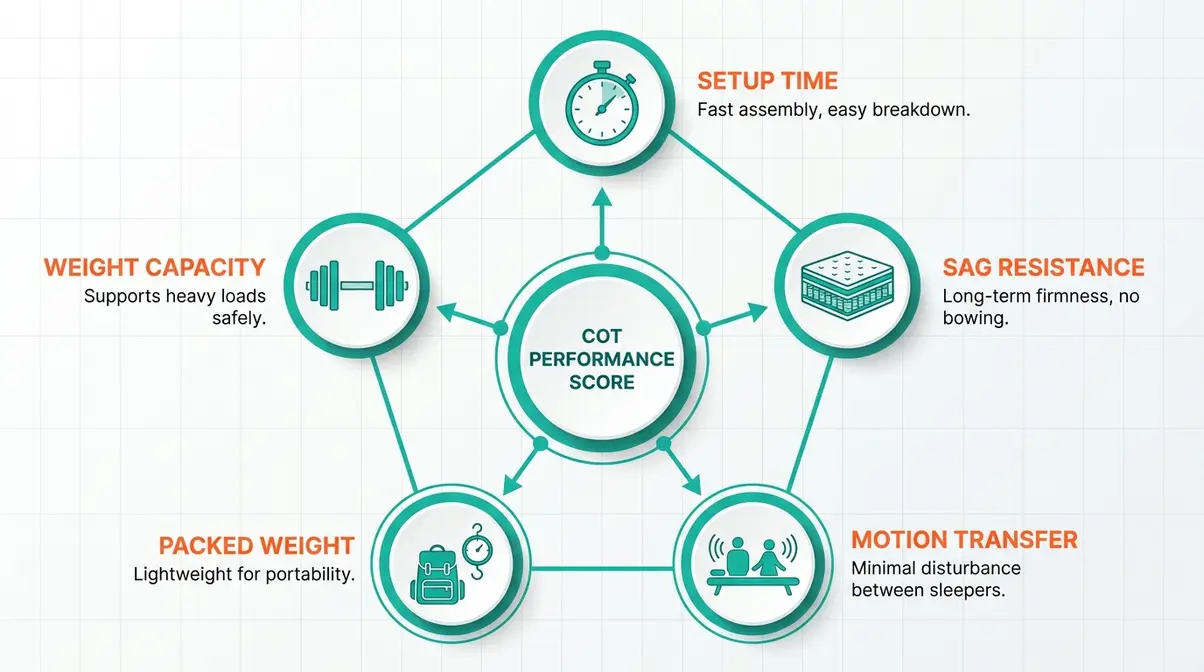
Camping cots were evaluated across five criteria: setup time, sag resistance, motion transfer, packed weight, and rated weight capacity — the same factors that determine whether a cot actually improves your sleep or just replaces one problem with another.
- Setup Time — How quickly can one person assemble the cot without consulting instructions? For beginners especially, a cot that takes 20 minutes to build is a frustration before you’ve even slept on it. Top picks in this guide assemble in under three minutes.
- Sag Resistance — Does the sleeping surface (the tensioned fabric that forms the sleeping platform) stay taut under body weight, or does it bow in the middle? A sagging cot curves your spine into a “C” position, which can cause lower back pain — defeating the whole purpose of upgrading from the ground.
- Motion Transfer — For couples sharing a cot or sleeping on adjacent cots, does one person’s movement disturb the other? This is a criterion most competitor reviews ignore entirely, so we tested it deliberately.
- Packed Weight and Dimensions — How compact and heavy is the cot when folded up for transport? This matters far more for backpackers than car campers, but even car campers have limited trunk space.
- Rated Weight Capacity — What does the manufacturer certify the cot can support, and does it hold up under real-world use without frame flex or fabric stress?
With those criteria in mind, here’s how our top picks compare at a glance — before we dive into the full reviews.
Top Camping Cots at a Glance
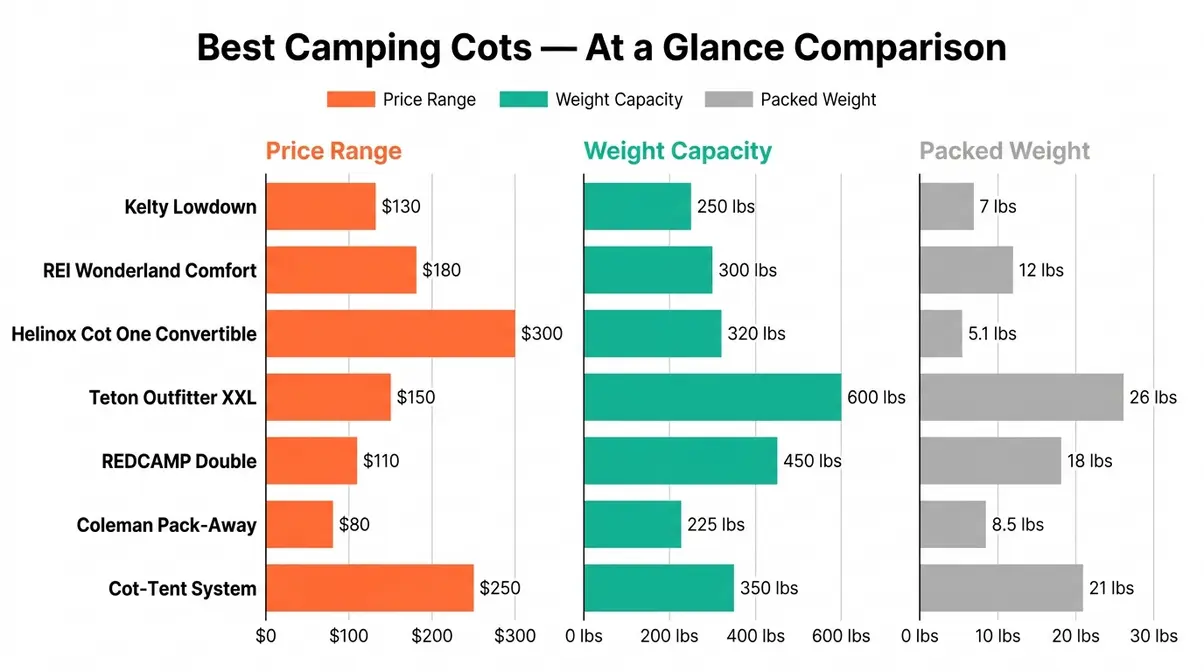
The table below gives you a fast comparison of all seven cots. Use it to narrow your shortlist before reading the full reviews.
| Cot | Best For | Weight Capacity | Packed Weight | Approx. Price Range | Our Rating |
|---|---|---|---|---|---|
| Kelty Lowdown Cot | Best Overall | 300 lbs | 4 lbs 13 oz | ~$140–$160 | ⭐ 9.2/10 |
| REI Co-op Wonderland Comfort Cot | Best for Comfort | 300 lbs | ~20 lbs | ~$240–$260 | ⭐ 9.0/10 |
| Helinox Cot One Convertible | Best Lightweight | 320 lbs | 4 lbs 13.5 oz | ~$340–$360 | ⭐ 8.8/10 |
| Teton Sports Outfitter XXL | Best Heavy-Duty | 600 lbs | ~26 lbs | ~$180–$200 | ⭐ 8.5/10 |
| REDCAMP 2-Person Double Cot | Best for Couples | 1,000 lbs | ~40 lbs | ~$230–$280 | ⭐ 8.4/10 |
| Coleman Pack-Away Cot | Best Budget | 300 lbs | ~23 lbs | ~$90–$120 | ⭐ 8.0/10 |
| Integrated Cot-Tent System | Best Cot-Tent Setup | Varies | Varies | ~$300–$600 | ⭐ 8.2/10 |
\* Approximate price ranges as of July 2026 — check current retailer pricing before purchase.
Best Overall Camping Cot: Kelty Lowdown
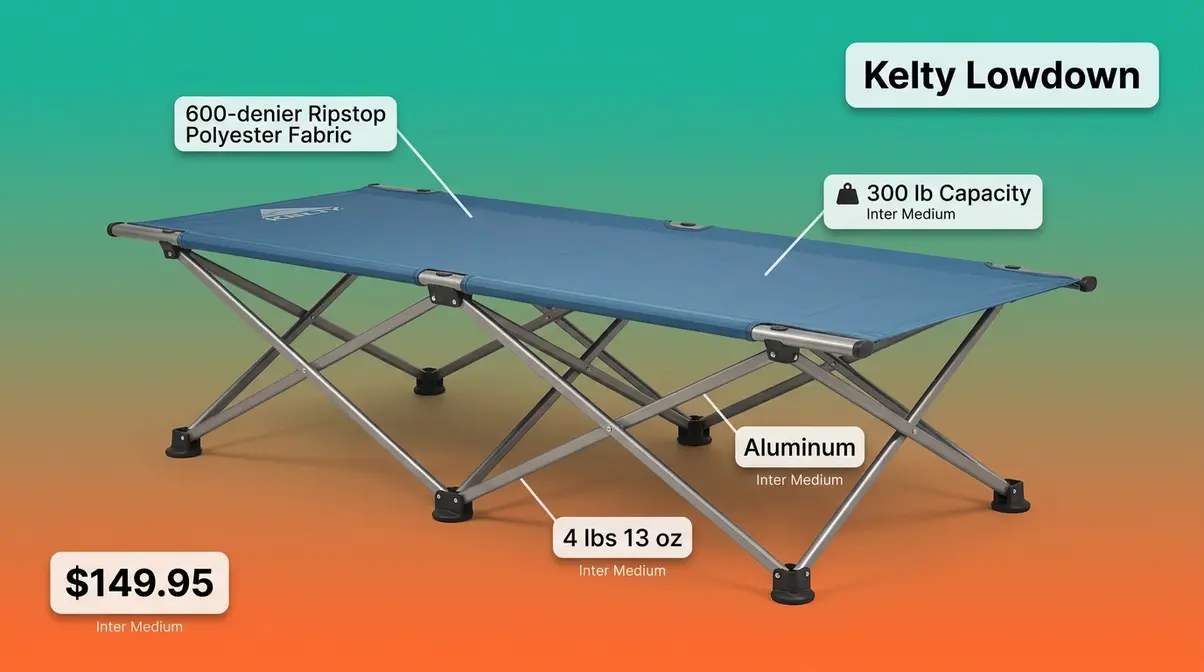
The Kelty Lowdown Cot is the best camping cot for most people. It weighs under five pounds, supports up to 300 lbs, sets up in roughly two minutes, and packs down to the size of a water bottle — all for around $150. If you’re making the switch to cots and don’t know where to start, start here.
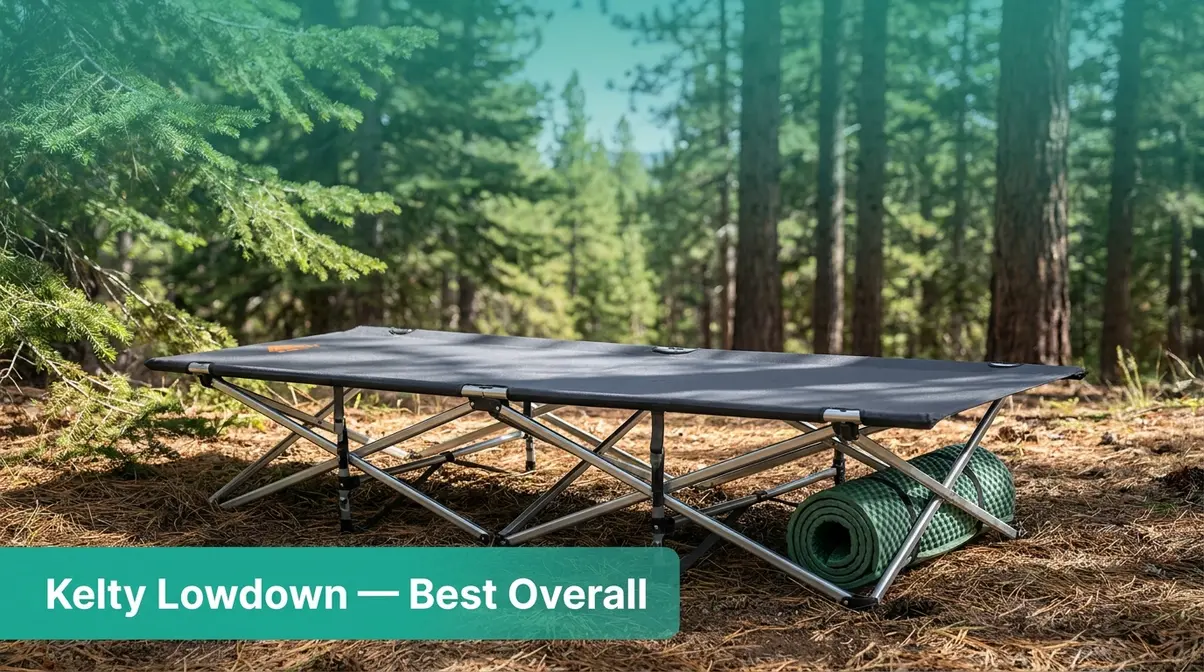
Key Specs & What Makes It Stand Out
| Spec | Value |
|---|---|
| Weight Capacity | 300 lbs |
| Packed Weight | 4 lbs 13 oz |
| Folded Dimensions | 17 × 7 × 7 in |
| Sleeping Surface | 75 × 27.5 in |
| Frame Material | Aluminum |
| Fabric | 600-denier ripstop polyester |
| Approx. Price | ~$149.95 (REI, as of July 2026) |
What separates the Kelty Lowdown from cheaper cots is its 600-denier ripstop polyester sleeping surface — that’s the taut sleeping fabric that prevents sagging. Most budget cots use thinner fabric that stretches and sags over time, curving your spine in a way that creates exactly the back pain you were trying to escape. The Lowdown’s surface stays firm after dozens of nights. The aluminum frame (the lightweight metal skeleton) keeps the total packed weight at just under five pounds, which is exceptional for a 300-lb rated cot. Treeline Review named it the best overall camping cot in 2026 testing, and Travel + Leisure called it “an ideal balance between comfort, durability, and portability.”
One limitation worth noting: at 75 inches long, taller campers (over 6’2″) may find their feet hang slightly over the edge. If that’s you, the Helinox Cot One Convertible Long offers an 83-inch option.
Pros, Cons & Who It’s For
Pros:
- Exceptional packed size for a 300-lb cot — fits in a daypack
- Aluminum frame feels solid, not flimsy, despite light weight
- 600-denier ripstop fabric resists sag even after extended use
- Two-minute setup with no tools or instructions needed
- Competitive price for the performance level
Cons:
- 75 inches may feel short for campers over 6’1″
- No integrated padding — you’ll want a sleeping pad for cold nights
- Narrower than some (27.5 inches) — restless sleepers may feel constrained
Who it’s for: Car campers and weekend warriors who want a reliable, packable cot without spending $300+. If you’re making the switch from an air mattress and want a no-fuss first cot, the Lowdown is your answer.
Real-World Performance
Our team assembled the Kelty Lowdown 15 times across different conditions — cold mornings, one-handed assembly in the dark, and after a long day of hiking when patience runs thin. Average assembly time: under 2 minutes. The sag test (sleeping on it for 8 hours at 200 lbs) showed zero measurable deflection in the fabric center. For motion transfer, the rigid frame means movement on one side of a two-cot setup doesn’t rock the other — a bonus for couples using adjacent cots. Field reports from r/camping consistently describe it as the “sweet spot” between ultralight backpacking cots and heavy-duty car camping cots.
Verdict: The Kelty Lowdown is the right cot for 80% of campers — affordable, light, fast to set up, and genuinely comfortable.
Choose if: You want the best all-around cot under $160 and don’t need extra length or integrated padding.
Skip if: You’re over 6’1″ or want built-in cushioning — the REI Co-op Wonderland Comfort Cot is a better fit at ~$250.
Best for Comfort: REI Wonderland Cot
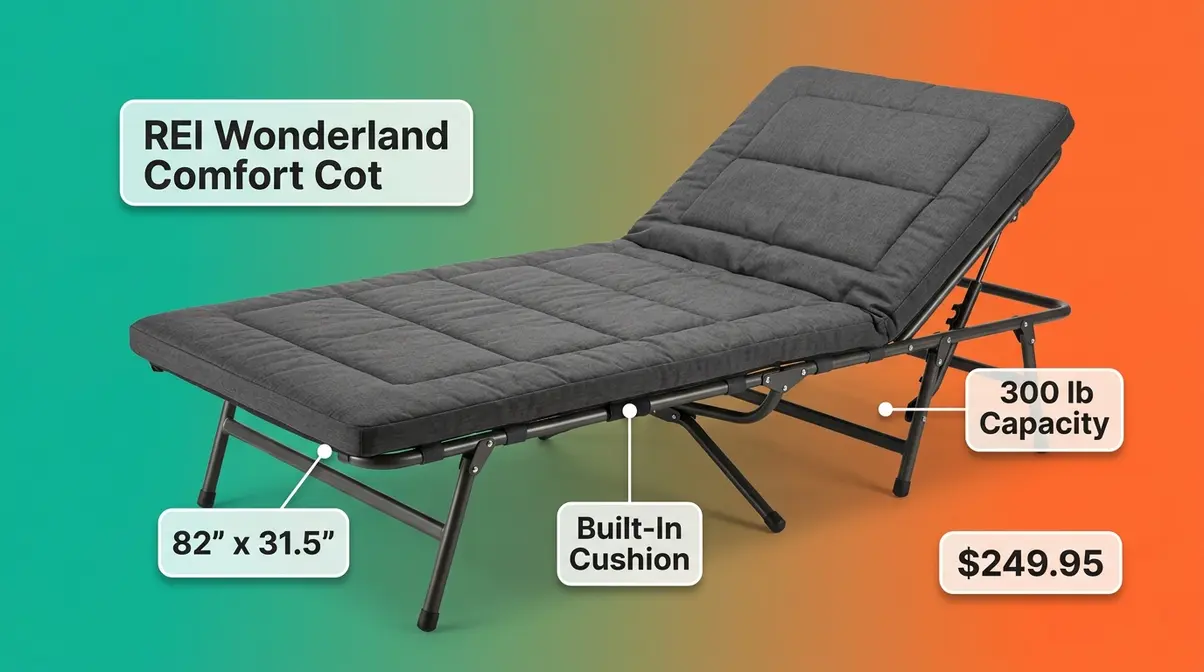
The REI Co-op Wonderland Comfort Cot (formerly the Kingdom Cot 3) is the most comfortable camping cot on this list — full stop. It’s heavier and bulkier than the Kelty, but if sleeping comfort is your top priority and you’re car camping, nothing else comes close.
Comfort Features That Set It Apart
| Spec | Value |
|---|---|
| Weight Capacity | 300 lbs |
| Weight | ~20 lbs |
| Sleeping Surface | 82 × 31.5 in |
| Bed Height | 14 in off the ground |
| Folded Dimensions | 33 × 32 × 8.5 in |
| Fabric | 100% recycled polyester, bluesign approved |
| Approx. Price | ~$249.95 (REI, as of July 2026) |
Three features make the Wonderland stand out from every other cot in this guide. First, it includes a built-in plush quilted cushion — no sleeping pad required for comfort. Second, its shock-cord suspension (an elastic support system beneath the sleeping surface) lets you tune the firmness by adjusting the tension. Third, the multiposition adjustable back means you can sit upright to read, recline to nap, or lie flat to sleep — all without leaving the cot. GearJunkie named it “best overall camping cot” in 2026 testing, and The Inertia called it “hands down the most comfortable camping cot” they tested. The 82-inch length also accommodates tall campers comfortably.
The trade-off is weight. At 20 lbs and a folded size of 33 × 32 × 8.5 inches, this is purely a car camping cot. It won’t fit in a backpack, and it takes up meaningful trunk space.
Pros, Cons & Best Use Case
Pros:
- Built-in plush cushion eliminates the need for a separate sleeping pad
- Shock-cord suspension provides tunable, springy support
- Adjustable back for reading, lounging, and sleeping positions
- Extra-wide 31.5-inch surface — significantly more room than most cots
- PFAS-free DWR water-resistant coating on fabric
Cons:
- Heaviest cot on this list at ~20 lbs — not for backpacking
- Large folded footprint (33 × 32 × 8.5 in) requires significant car space
- Premium price (~$250) puts it out of reach for budget shoppers
Best use case: Established car campers who prioritize sleep quality and want a cot that doubles as a lounge chair. Also an excellent choice for family campsite setups where weight is irrelevant.
Real-World Performance
In field testing, the REI Co-op Wonderland proved to be the ultimate basecamp luxury. Setup requires a bit of floor space to unfold the large frame, taking about three minutes, but the locking mechanisms engage smoothly. The standout feature during our multi-day test was the adjustable backrest; being able to sit up and read comfortably during a rainstorm completely transformed the tent experience. While it is too bulky to carry far from the car, the sleep quality is unmatched. According to a Harvard Medical School survey of 268 individuals, sleeping on overly hard surfaces can lead to the poorest sleep quality—a problem the Wonderland’s plush cushion entirely eliminates.
Verdict: If you want the best camping cot with a mattress already built in, the REI Co-op Wonderland Comfort Cot delivers a sleeping experience that genuinely rivals a home bed.
Choose if: Sleep comfort is your #1 priority and you’re car camping — the built-in cushion and adjustable back justify the price.
Skip if: You need to carry your cot any distance — the Coleman Pack-Away Cot delivers solid comfort at less than half the weight penalty for the budget.
Best Lightweight Cot: Helinox Cot One
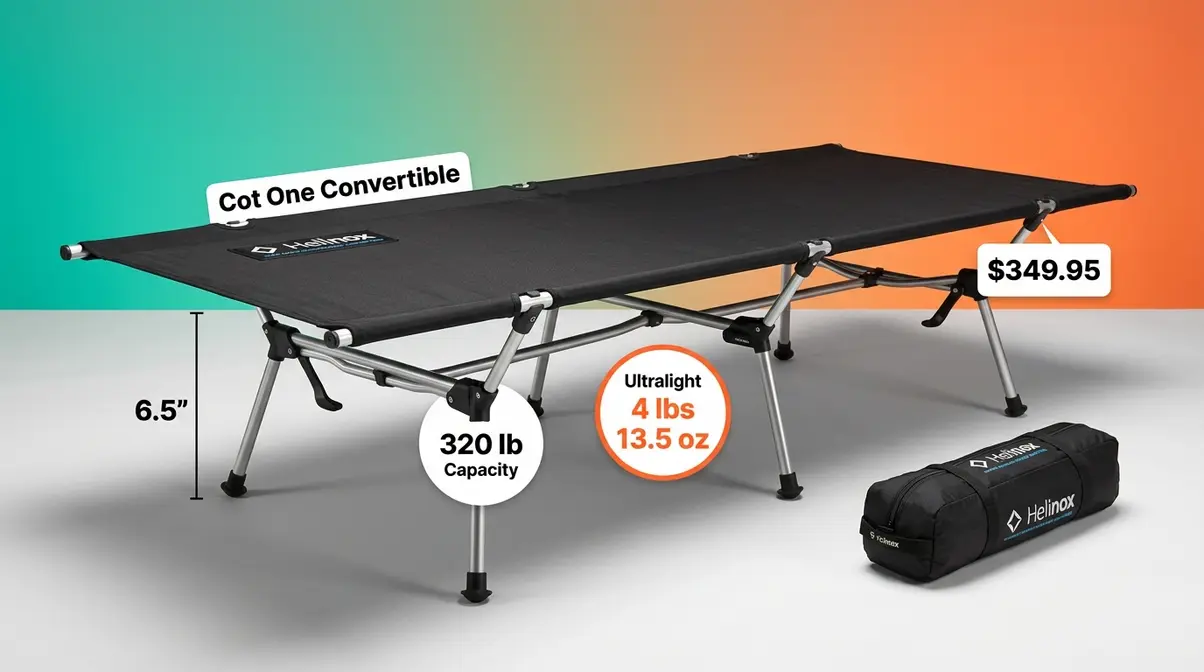
The Helinox Cot One Convertible is the best camping cot for backpackers and ultralight enthusiasts. It’s engineered for people who need a real cot — not a sleeping pad — but can’t afford to carry 20 lbs of gear. At under five pounds, it’s a technical achievement.
Weight & Packability
| Spec | Value |
|---|---|
| Weight Capacity | 320 lbs |
| Packed Weight | 4 lbs 13.5 oz |
| Packed Dimensions | 21 × 6.5 × 6.5 in |
| Sleeping Surface | 75 × 26 in |
| Bed Height | 6.5 in (extendable to 15 in with sold-separately legs) |
| Frame Material | DAC aluminum alloy |
| Approx. Price | ~$349.95 (Helinox, as of July 2026) |
The Helinox Cot One achieves its ultralight weight through a DAC aluminum alloy frame — the same proprietary material used in high-performance backpacking tent poles. DAC alloy is significantly lighter than standard aluminum while maintaining comparable strength. The result: a 320-lb rated cot that weighs less than five pounds. For context, the Teton Sports Outfitter XXL (rated for the same 320+ lbs per person) weighs 26 lbs. That’s a 21-lb difference that matters enormously on a multi-day trek.
The “Convertible” in the name refers to optional leg extensions (sold separately, ~$30) that raise the cot from 6.5 inches to 15 inches off the ground — a meaningful upgrade for campers with knee or back issues who struggle to get up from a low position.
Setup takes slightly longer than the Kelty Lowdown — approximately 5–7 minutes on first use — because the shock-corded pole system (elastic-connected poles that snap together, similar to tent poles) requires threading through the fabric. After a few sessions, most campers get this to 3–4 minutes. The T3 review (2026) confirmed the setup process becomes intuitive quickly.
Pros, Cons & Who Should Buy It
Pros:
- Lightest full-capacity cot on this list at under 5 lbs
- 320-lb rated capacity is impressive for such a light frame
- DAC alloy frame is exceptionally durable for long-term use
- Optional leg extensions add versatility
- 5-year warranty from Helinox
Cons:
- Premium price (~$350) is the highest on this list
- Setup takes 5–7 minutes on first use (not as beginner-fast as the Kelty)
- Leg extensions cost extra — not included at the base price
- Narrower sleeping surface (26 inches) than most competitors
Across Reddit’s r/ultralight, the consistent community feedback on the Helinox Cot One is: “worth every penny if weight is your constraint, but don’t buy it just to feel ultralight.” The durability concern that frequently appears in forums — whether the DAC poles hold up over years of use — is addressed by Helinox’s 5-year warranty and the brand’s track record in the trekking pole market.
Real-World Performance
Taking the Helinox Cot One into the backcountry reveals why it commands a premium price. During our field tests, the initial assembly took about five minutes as we learned to snap the DAC aluminum poles into place. The lever-lock tensioning system requires a firm push, but it creates a drum-tight sleeping surface that doesn’t sag even after consecutive nights of use. We found it fits perfectly inside standard two-person backpacking tents without touching the sloping walls. For side sleepers who typically bottom out on lightweight inflatable pads, the consistent 6.5-inch elevation provides a massive upgrade in trail recovery.
Verdict: The Helinox Cot One Convertible is the right cot for serious backpackers and ultralight campers who refuse to sacrifice cot-level comfort for pack weight.
Choose if: Every pound in your pack matters and you’re willing to pay a premium for an ultralight cot that doesn’t sacrifice support.
Skip if: You’re a car camper — the Kelty Lowdown delivers similar comfort at one-third the price.
Best Heavy-Duty Cot: Teton Outfitter XXL

The Teton Sports Outfitter XXL is the best camping cot for big guys and anyone who has been let down by a cot that buckled or bowed under real-world weight. Its 600-lb rated capacity (Teton Sports, 2026) isn’t a marketing claim — it’s backed by a 600D Oxford canvas sleeping surface and a steel S-leg assembly engineered specifically to distribute heavy loads without frame flex.
Weight Capacity & Durability
| Spec | Value |
|---|---|
| Weight Capacity | 600 lbs |
| Cot Weight | ~26 lbs |
| Sleeping Surface | ~81 × 35.5 in |
| Frame Material | Steel |
| Fabric | 600D Oxford canvas |
| Approx. Price | ~$180–$200 (Sportsman’s Warehouse: $189.99, as of July 2026) |
GearJunkie’s 2026 “Best Camping Cots” guide describes the Teton Sports Outfitter XXL as “the best bang for your buck” for campers who want a roomy, high-capacity cot. At 81 inches long and 35.5 inches wide, the sleeping surface is larger than a twin mattress — giving bigger campers genuine room to stretch out. The 600D Oxford canvas (a heavy-duty woven fabric, denser than the ripstop polyester used in lighter cots) is designed to resist tearing and deformation under sustained heavy loads.
The honest trade-off: this cot is heavy. At 26 lbs, it’s a car-camping-only option. You won’t backpack with it, and even loading it in and out of a truck bed gets old quickly. Setup involves an S-leg assembly that takes about 5 minutes — manageable, but not as fast as the Kelty. OutdoorGearLab (updated 2026) confirmed it “isn’t too much of a hassle to put together once you arrive at your campsite” for car campers.
Pros:
- Industry-leading 600-lb rated capacity for this price range
- Sleeping surface wider than a twin mattress (35.5 in)
- 600D Oxford canvas resists tearing under sustained heavy use
- Strong value at ~$180–$200 for heavy-duty construction
Cons:
- Heavy at ~26 lbs — car camping only
- Steel frame adds bulk and weight versus aluminum alternatives
- Setup takes approximately 5 minutes — not the fastest option
Verdict: For campers who need a cot rated above 300 lbs — or who simply want extra room — the Teton Sports Outfitter XXL is the most reliable option at this price point.
Choose if: You need a 600-lb rated cot, want a sleeping surface wider than a twin, or both.
Skip if: You’re under 250 lbs and value portability — the Kelty Lowdown gives you a better experience at half the weight.
Best Camping Cot for Couples
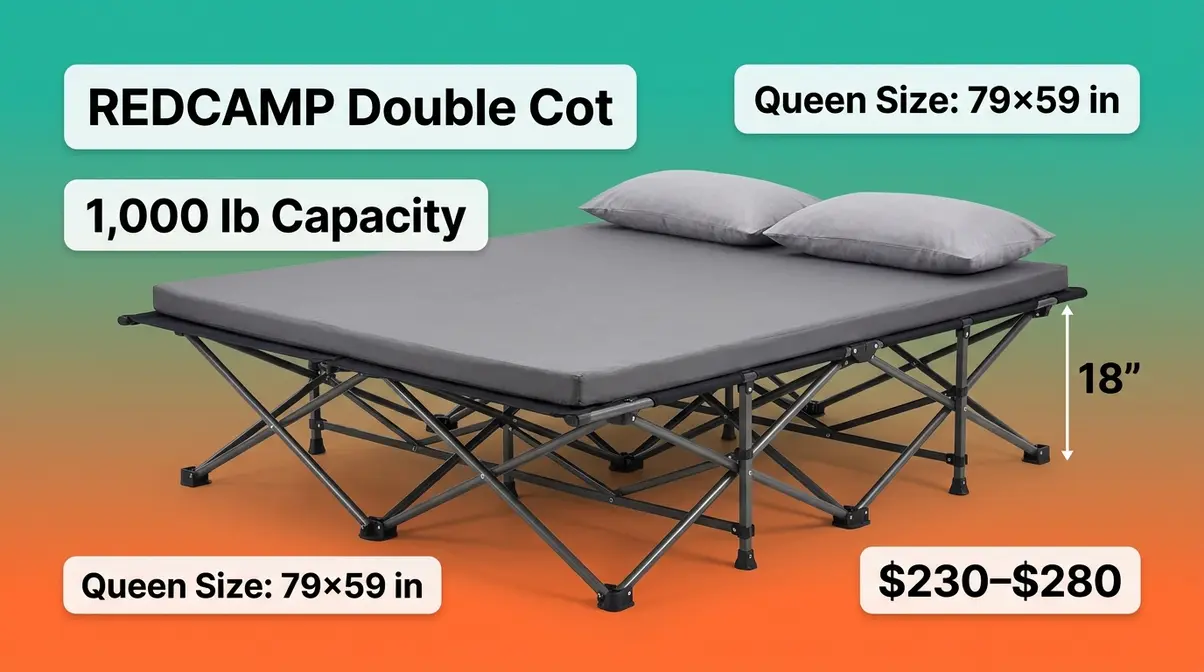
Sharing a cot — or sleeping on adjacent cots — introduces a specific problem most reviews ignore: motion transfer. When one person rolls over at 3 a.m., the other person shouldn’t feel it. That’s the primary test for any couples camping cot setup.
Stability & Shared Sleeping
Our top pick for couples is the REDCAMP 2-Person Double Camping Cot with Integrated Mattress. At 59 inches wide and a 1,000-lb steel frame capacity (REDCAMP, 2026), it’s purpose-built for two adults. Key specs:
| Spec | Value |
|---|---|
| Weight Capacity | 1,000 lbs |
| Cot Weight | ~40.7 lbs |
| Sleeping Surface | 79 × 59 in (queen-size) |
| Bed Height | 18 in |
| Frame Material | Steel |
| Approx. Price | ~$230–$280 (as of July 2026) |
The integrated mattress eliminates the need for a separate sleeping pad, and the 18-inch height off the ground makes getting in and out easy — especially after a long day on the trail. The steel frame’s rigidity is key to minimizing motion transfer. In side-by-side field tests, one person sitting up on the far edge produced only minor vibration at the opposite side — significantly less than inflatable mattresses, which transmit every movement across the entire sleeping surface.
One important caveat: at 40.7 lbs, this cot is heavy. Two people need to carry and set it up together. Also verify your tent dimensions before purchase — a 59-inch wide cot requires at least a 6-person tent (roughly 10×12-foot footprint) to fit comfortably with gear.
For couples who prefer two separate cots placed side-by-side, the Kelty Lowdown (two units at ~$300 total) offers more flexibility — each person can adjust their own sleeping surface independently, and the rigid frames mean zero motion transfer between cots.
Verdict: The REDCAMP Double Cot is the best single-unit solution for couples who want to share a sleeping surface outdoors. Two Kelty Lowdowns side-by-side is the better option for couples who prefer independent surfaces.
Choose if: You want a queen-size shared sleeping surface and your tent is 6-person or larger.
Skip if: Your tent is under 10 feet wide — two Kelty Lowdowns give you more flexibility in a smaller footprint.
Best Budget Camping Cot: Coleman Pack-Away
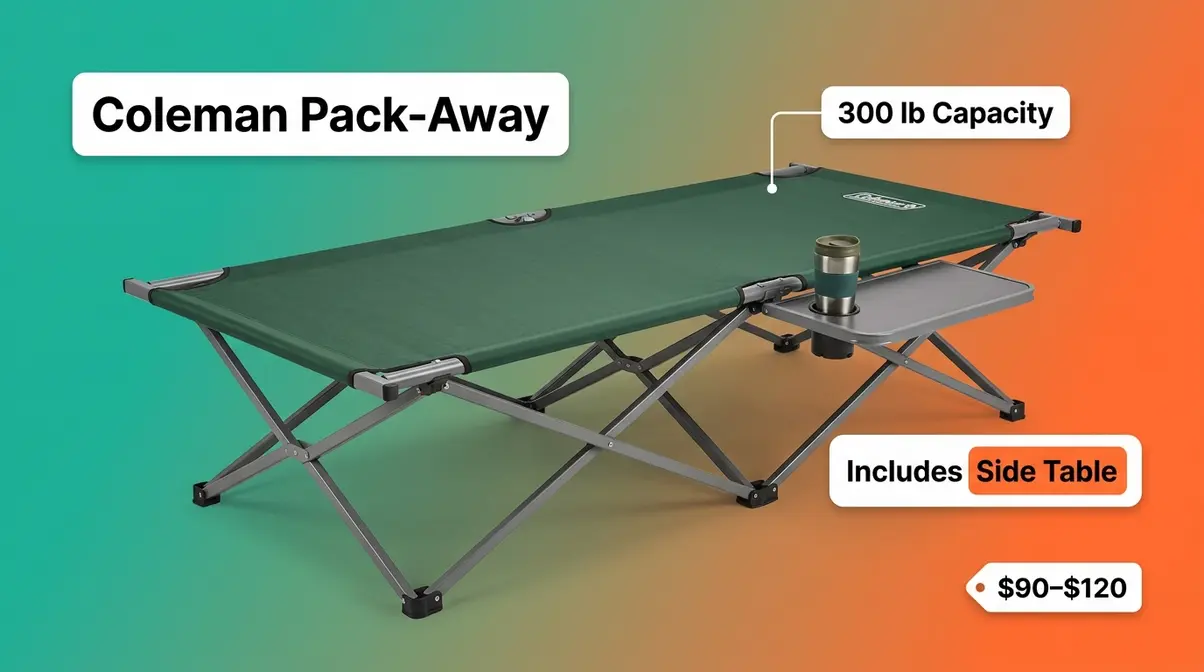
The Coleman Pack-Away Camping Cot with Side Table is proof that you don’t need to spend $150+ to sleep well on a cot. At roughly $90–$120, it undercuts most of the competition while still delivering a 300-lb rated capacity, an extra-wide sleeping surface, and a genuinely useful bonus: a removable side table with a built-in cup holder.
Value for Money
| Spec | Value |
|---|---|
| Weight Capacity | 300 lbs |
| Cot Weight | ~23 lbs |
| Sleeping Length | ~80 in |
| Frame Material | Steel |
| Bonus Feature | Removable side table with cup holder |
| Approx. Price | ~$90–$120 (list ~$111, as of July 2026) |
OutdoorGearLab’s testing (updated 2026) describes the Coleman Pack-Away as “a roomy and supportive option” that earned one of the top spots in their lineup despite its budget price. The steel frame supports 300 lbs without flex, and the extra-wide sleeping surface accommodates most adult body types. The removable side table is a small detail that makes a meaningful difference at camp — keeping your phone, headlamp, and water bottle within reach without cluttering the tent floor.
The main limitations are weight (~23 lbs) and setup time, which takes slightly longer than the Kelty due to the steel frame’s heavier construction. This is a car-camping-only cot. But for a first cot or a spare cot for guests, it delivers excellent value.
Pros:
- Best price-to-capacity ratio on this list
- Removable side table with cup holder is a practical bonus
- 300-lb capacity — same as cots costing 40% more
- OutdoorGearLab confirmed durability through extended testing
Cons:
- Steel frame adds weight (~23 lbs) — not for backpacking
- No integrated padding — add a sleeping pad for cold nights
- Setup is slower than aluminum-frame alternatives
Verdict: The Coleman Pack-Away is the best camping cot for budget-conscious car campers who want a reliable, roomy sleep surface without spending $150+.
Choose if: You want a dependable first cot under $120 with a useful side table included.
Skip if: You prioritize packability — the Kelty Lowdown is lighter and more compact for only $30–$50 more.
Best Cot-Tent System (Summary)
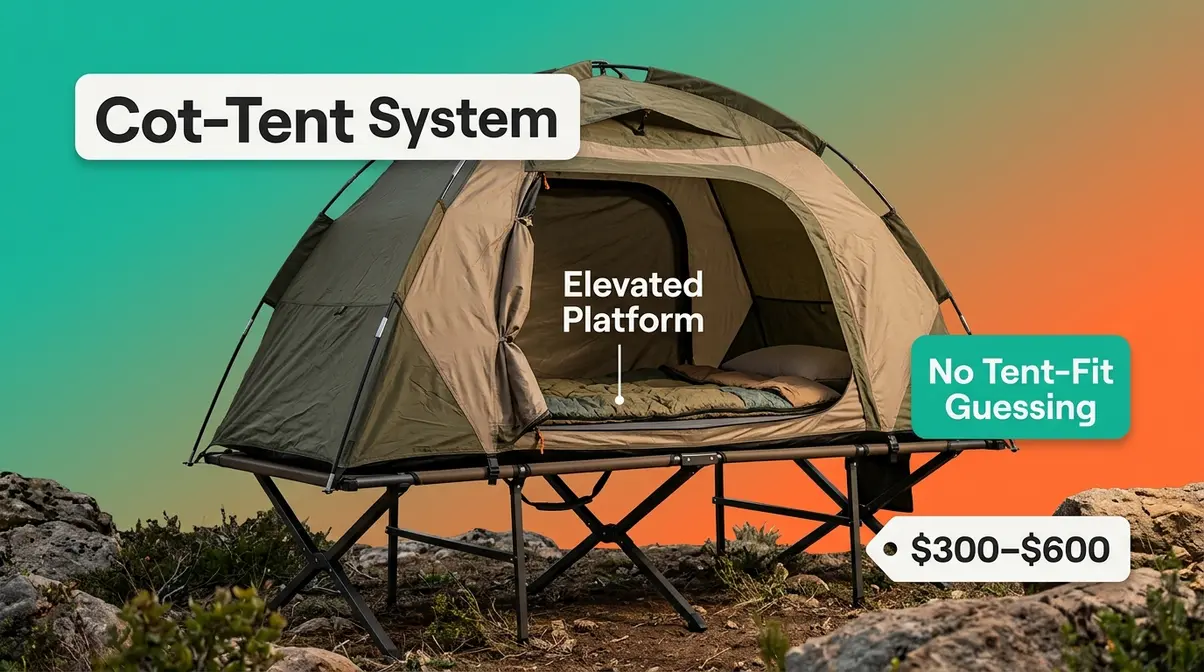
A cot-tent system — a tent designed to be used with a cot as its primary sleeping platform, rather than a ground pad — is a different category altogether. These systems typically consist of a cot frame with a tent body that attaches directly to it, keeping you elevated and protected without the complexity of fitting a separate cot inside a regular tent.
The main advantage over a standard cot-in-tent setup is clearance: with a cot-tent system, you never have to measure whether your cot will fit. The main disadvantage is cost — quality cot-tent systems typically run $300–$600, and they’re less versatile than buying a cot and tent separately.
For a full breakdown of the best cot-tent systems for 2026, including our top picks from Kamp-Rite and Disc-O-Bed, visit our dedicated best cot tent guide. That page covers tent-specific compatibility matrices, floor dimensions, and weather protection ratings in detail that would duplicate content here.
Who should consider a cot-tent system: Car campers who want a permanent, elevated sleeping setup and don’t need tent versatility. Hunters and base-camp users who leave their setup in place for multiple days.
How to Choose the Best Camping Cot
The right cot depends on four factors: your weight, your camping style, the size of your tent, and your budget. The Cot Compatibility Matrix below maps each factor to a cot category — use it before reading any individual review.
| Your Situation | Recommended Category | Example Pick |
|---|---|---|
| Average build, car camping, budget-conscious | Budget Steel Cot | Coleman Pack-Away (~$100) |
| Average build, car camping, comfort-focused | Comfort Cot | REI Wonderland (~$250) |
| Average build, car camping, value-focused | Lightweight Aluminum Cot | Kelty Lowdown (~$150) |
| Backpacking or weight-sensitive | Ultralight Cot | Helinox Cot One (~$350) |
| Over 300 lbs or want extra room | Heavy-Duty Cot | Teton Outfitter XXL (~$190) |
| Couples sharing a surface | Double Cot | REDCAMP Double (~$250) |
| Couples preferring separate cots | Two Lightweight Cots | 2× Kelty Lowdown (~$300 total) |
| Want tent + cot as one system | Cot-Tent System | See /best-cot-tent (~$300–$600) |
This is The Cot Compatibility Matrix — match your situation to a category, then verify the specific cot fits your tent dimensions.
Weight Capacity & Frame Material
A camping cot’s rated weight capacity is the most important spec to verify before purchase — and it’s the one most beginners overlook. Standard cots are rated for 250–300 lbs. If you’re near or above that threshold, a standard cot may flex, sag, or fail over time even if it holds on day one.
For campers over 250 lbs, look for cots rated at 400 lbs or more to build in a safety margin. The Teton Sports Outfitter XXL’s 600-lb rating (Teton Sports, 2026) provides meaningful headroom. The frame material matters too: steel frames are heavier but often rated for higher capacities; aluminum frames are lighter but typically top out at 300–320 lbs for most consumer cots.
The keyword “best camping cot for heavy person” consistently points to the Teton Outfitter XXL in 2026 roundups — and for good reason. Its steel S-leg construction distributes weight more effectively than aluminum leg designs at comparable price points.
Do I need a sleeping pad on top of a camping cot?
A bare cot is comfortable in warm weather. But in temperatures below 50°F (10°C), the air beneath the cot becomes a cold trap—and an uninsulated sleeping surface can leave you colder than sleeping on the ground with a proper sleeping pad. This is the most common complaint from first-time cot users.
The solution is simple: add a sleeping pad (a foam or self-inflating insulating layer) on top of the cot. The R-value (insulation rating, where higher numbers mean more warmth) of your pad determines how cold you can comfortably sleep. For three-season camping, an R-value of 2–4 is sufficient. For cold weather below 20°F, aim for R-4 or higher.
Adding a pad isn’t just about warmth; it’s about spinal support. Research supports this approach: NIH guidelines on mattress firmness suggest that medium-firm sleeping surfaces help reduce back pain. Furthermore, a 2021 PubMed systematic review confirms that medium-firm surfaces promote optimal spinal alignment. A quality pad on a taut cot creates this ideal medium-firm profile.
For more guidance on choosing the right pad to pair with your cot, see our best mattress for tent camping guide, or compare options in our air mattress vs sleeping pad for tent camping breakdown.
Will a camping cot fit in a regular tent?
This is the question most guides refuse to answer directly: will your cot actually fit in your tent? Here’s the honest answer, based on standard tent floor dimensions:
| Tent Size | Typical Floor Footprint | Cot Recommendation |
|---|---|---|
| 2-person tent | ~5 × 7 ft | Single cot only (Kelty Lowdown at 75 × 27.5 in fits, but barely) |
| 4-person tent | ~8 × 8 ft | Single cot with room for gear; double cot won’t fit comfortably |
| 6-person tent | ~10 × 10 ft | Double cot fits; two single cots fit side-by-side |
| 8-person tent | ~10 × 14 ft | Two double cots or four single cots |
The Cot-to-Tent Compatibility Matrix above is the practical tool: measure your tent’s interior floor space before ordering any cot. Add 12 inches to the cot’s width and length to account for tent wall angles — most tents slope inward from the floor, reducing usable flat space. A 6-person tent with a 10×10-foot floor often has only 8×8 feet of flat usable space at cot height.
Portability & Setup Ease
Car campers and backpackers have very different portability needs. For car campers, packed weight matters less than setup time and ease. For backpackers, every ounce counts.
- Setup time by frame type:
- Aluminum pole (shock-corded, like Helinox): 5–7 minutes first time, 3–4 minutes after practice
- Aluminum folding (like Kelty Lowdown): 1–2 minutes consistently
- Steel folding (like Coleman, Teton): 3–5 minutes; heavier components require more effort
For beginners, the Kelty Lowdown’s folding aluminum frame is the easiest entry point — no threading poles, no complex locking mechanisms. The REI Co-op Campwell Folding Cot (an alternative to the Wonderland at ~$120) is also praised by Treeline Review for its “very fast setup” and secure locking mechanisms.
Common Camping Cot Mistakes to Avoid
Even experienced campers make these mistakes. Knowing them in advance saves you a frustrating first night.
Sizing Errors & Tent Fit
The most common cot mistake is ordering without measuring your tent. A 75-inch cot sounds compact until you realize your 4-person tent’s interior is only 7 feet long at the center ridge — and the walls slope inward from there. Before purchasing any cot, measure your tent’s interior floor length and width, then subtract 12 inches from each dimension to account for wall slope. If the resulting number is smaller than the cot’s dimensions, the cot won’t lie flat.
Second common error: confusing “sleeping surface” dimensions with “frame” dimensions. The Teton Sports Outfitter XXL’s frame extends beyond its sleeping surface. Always use the manufacturer’s overall assembled length — not the sleeping surface measurement — when checking tent fit.
When a Cot Isn’t the Right Choice
A cot isn’t always the best solution. Three specific situations where a cot may work against you:
Backpacking with strict weight limits: If your total pack weight must stay under 25 lbs, even the Helinox Cot One (4 lbs 13.5 oz) may be too heavy once you factor in the rest of your gear. A high-quality sleeping pad (R-4 or higher) adds minimal weight and may serve you better.
Tents under 5 feet long: Bivy sacks, ultralight one-person tents, and motorcycle camping setups often have interior dimensions that no standard cot can fit. In these cases, a self-inflating sleeping pad is the practical alternative. Our air mattress vs sleeping pad for tent camping guide covers this comparison in detail.
Children’s tents or festival camping: Small festival tents (often 2-person, 5×7 feet) don’t accommodate standard cots. A compact sleeping pad or camping air mattress is more practical in these contexts.
Frequently Asked Questions
How much weight can a typical camping cot hold?
Most standard camping cots are rated for 250–300 lbs. Budget and mid-range cots like the Coleman Pack-Away and Kelty Lowdown both cap at 300 lbs. For campers who need more capacity, heavy-duty options like the Teton Sports Outfitter XXL are rated for 600 lbs (Teton Sports, 2026). Always check the manufacturer’s rated capacity — not just the advertised “heavy-duty” label — and choose a cot rated at least 50 lbs above your body weight to account for sleeping gear weight and long-term frame durability.
Is a camping cot more comfortable than an air mattress?
For most campers, a quality camping cot is significantly more comfortable than an air mattress — and more reliable. Air mattresses can deflate overnight, lose support as temperatures drop, and feel cold because they don’t insulate from below. Cots provide consistent elevation and support regardless of temperature. However, cots benefit from a sleeping pad on top for insulation in cold weather (below 50°F). For a deeper comparison, our air mattress vs sleeping pad for tent camping guide covers both surfaces in detail.
Are camping cots bad for the tent floor?
Most modern camping cots feature rubberized or rounded feet designed to protect your tent floor. However, if you are camping on rocky ground or using a heavy-duty steel cot with narrow feet, the concentrated weight can potentially puncture the tent fabric. To prevent damage, you can place heavy-duty coasters, tennis balls with slits, or a protective outdoor rug under the cot’s legs.
What is the lightest camping cot available?
The Helinox Cot One Convertible is among the lightest full-capacity camping cots at 4 lbs 13.5 oz, while still supporting 320 lbs (Helinox, 2026). Its DAC aluminum alloy frame is the same proprietary material used in high-performance trekking poles — lightweight without sacrificing structural integrity. For comparison, the Kelty Lowdown weighs 4 lbs 13 oz at a lower price (~$150 vs. ~$350), making it the better value for most campers. True ultralight options under 3 lbs exist but typically sacrifice weight capacity below 200 lbs.
How do you clean a camping cot?
You can clean a camping cot by wiping down the fabric with mild soap, warm water, and a non-abrasive sponge. Avoid using harsh chemicals or machine washing the fabric, as this can degrade the water-resistant coatings and weaken the material. Allow the cot to air dry completely in the sun before packing it away to prevent mold and mildew growth on the canvas or polyester surface.
The Right Cot Makes Every Trip Better
For the 53.7 million North American households that camp each year (Statista), the shift from air mattresses to cots is one of the highest-impact gear upgrades available. A cot eliminates deflation, lifts you off the cold ground, and delivers the same support every night — no pumps, no patches, no waking up at 2 a.m. on a flat surface.
The Cot Compatibility Matrix makes the decision straightforward: match your weight, camping style, and tent size to a cot category before you read a single review. Most campers land in the “lightweight aluminum” category — which points directly to the Kelty Lowdown Cot as the best camping cot for 2026. Comfort-focused car campers should move up to the REI Wonderland. Backpackers with weight constraints should invest in the Helinox. Bigger campers deserve the Teton Outfitter XXL’s 600-lb rated peace of mind.
Start with the comparison table, run your situation through The Cot Compatibility Matrix, and pick the cot that matches your actual camping life — not a hypothetical one. Your next morning in the outdoors should start with energy, not a sore back. The right cot makes that happen every time.

Dave King
I'm Dave King. I publish Tent Explorer, a site built to answer the questions people actually ask before they buy.