Beat Heat & Bugs Camping: 10 Airflow Tips That Work
 David King
Updated June 29, 2026
26 min read
David King
Updated June 29, 2026
26 min read
“I’m planning two weeks of camping in Arkansas, where the heat index is often 105–110 and the humidity is 65% at the moment.”
This is the camping reality no one warns you about. You pack your gear, drive to the trailhead, and within two hours you’re sweating through your shirt, swatting mosquitoes, and wondering why you left the air conditioning.
Heat and bugs don’t just make camping uncomfortable — they steal your sleep, drain your energy, and can turn a dream trip into a miserable slog. The good news? Most campers are fighting these problems separately, when the real solution attacks both at once. Strategic airflow is the key to beating heat and bugs camping — and this guide shows you exactly how to use it.
Over the next ten tips, you’ll learn how tent ventilation physically cools your body, why a simple fan sends mosquitoes packing, and which gear choices make the biggest difference on a sweltering summer night. This is The Camp Comfort Matrix — a step-by-step system that treats cooling and bug defense as one unified strategy, not two separate battles.
The Camp Comfort Matrix gives you a science-backed system for beating heat and bugs camping through strategic airflow — so you sleep cool and wake up bite-free.
- Airflow is your double weapon: A steady 2–3 mph breeze cools your body and disrupts mosquito flight, since mosquitoes max out at roughly 1.5 mph (MIT, 2026).
- Mesh matters: Standard 18×16 tent mesh maximizes ventilation for mosquito protection; upgrade to 20×20 no-see-um mesh only if tiny gnats are your primary problem.
- Fan placement beats fan power: A ceiling-exhaust fan paired with a low floor intake creates a “stack effect” that flushes hot air 40–60% more efficiently than a single fan.
- Natural repellents work: Sweetgrass smoke contains phytol and coumarin — compounds that matched DEET in lab tests (Smithsonian, 2015).
Before You Start: What You’ll Need
Before you apply any of the ten tips below, gather the right gear. You don’t need everything on this list for a weekend trip, but the more pieces you have in place, the more effective The Camp Comfort Matrix becomes.
Essential gear checklist:
- A tent with multiple mesh panels and at least two openings (front and rear, or roof vent plus door)
- A rechargeable or battery-powered camping fan (look for 1,000+ CFM — more on this in Step 3)
- A lightweight reflective tarp or shade canopy for daytime use
- An elevated cot (not an air mattress — we’ll explain why)
- A bandana or small cooling towel
- Your choice of insect repellent: DEET-based spray, OLE (oil of lemon eucalyptus), or a natural alternative like dried sweetgrass or sage bundles
- Mesh car door screens if you plan to sleep in or near your vehicle
Terms you’ll see in this guide:
- CFM (cubic feet per minute): How much air a fan moves per minute. Higher CFM = stronger airflow.
- Heat index: The “feels like” temperature that combines actual air temperature with humidity. At 95°F with 65% humidity, the heat index reaches approximately 117°F (National Weather Service, 2026).
- Stack effect: The natural tendency for hot air to rise and escape through high vents while cooler air enters low — the same principle that keeps old brick buildings cool without AC.
- Mesh gauge: The number of strands per square inch in a screen. More strands = smaller holes = better bug protection but less airflow.
You don’t need to memorize these right now. Each term gets explained again when it first appears in context below.
Step 1 — How to Keep Your Tent Cool in Hot Weather
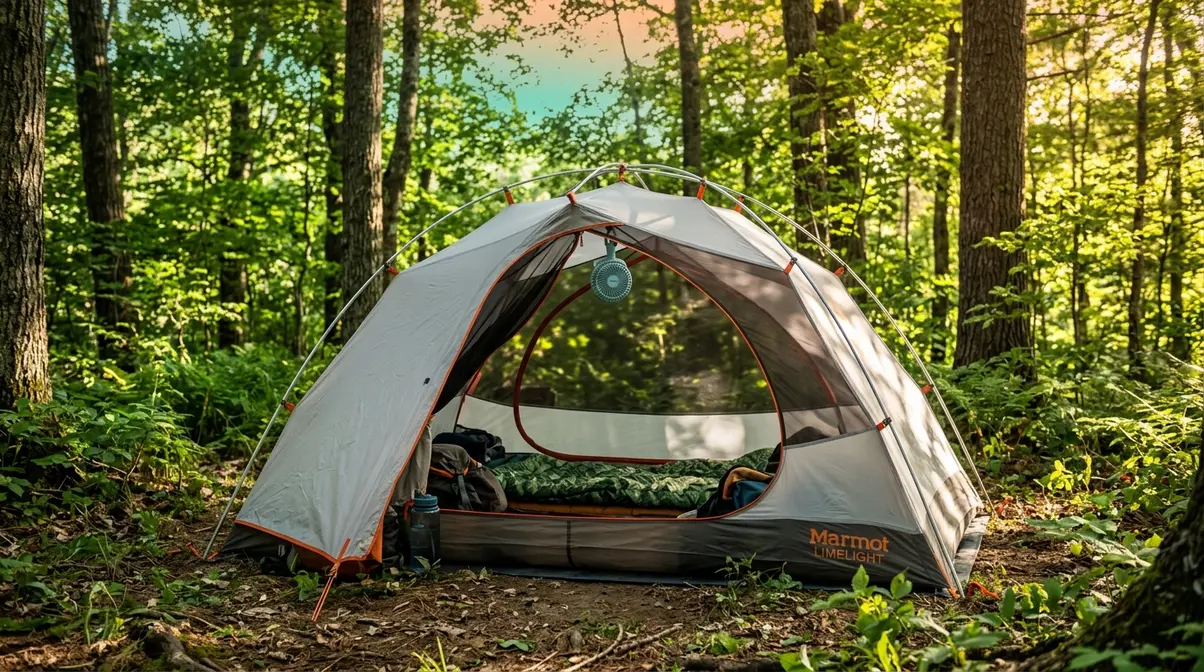
The single most effective thing you can do to beat the heat camping is control where hot air goes. Tent cooling isn’t magic — it’s physics. Hot air rises, cool air falls, and your job is to give that hot air an escape route before it bakes you alive.
Choose the Right Campsite for Natural Shade and Breeze
Your campsite is the foundation of your entire cooling strategy. No fan or gear upgrade compensates for pitching in the wrong spot.
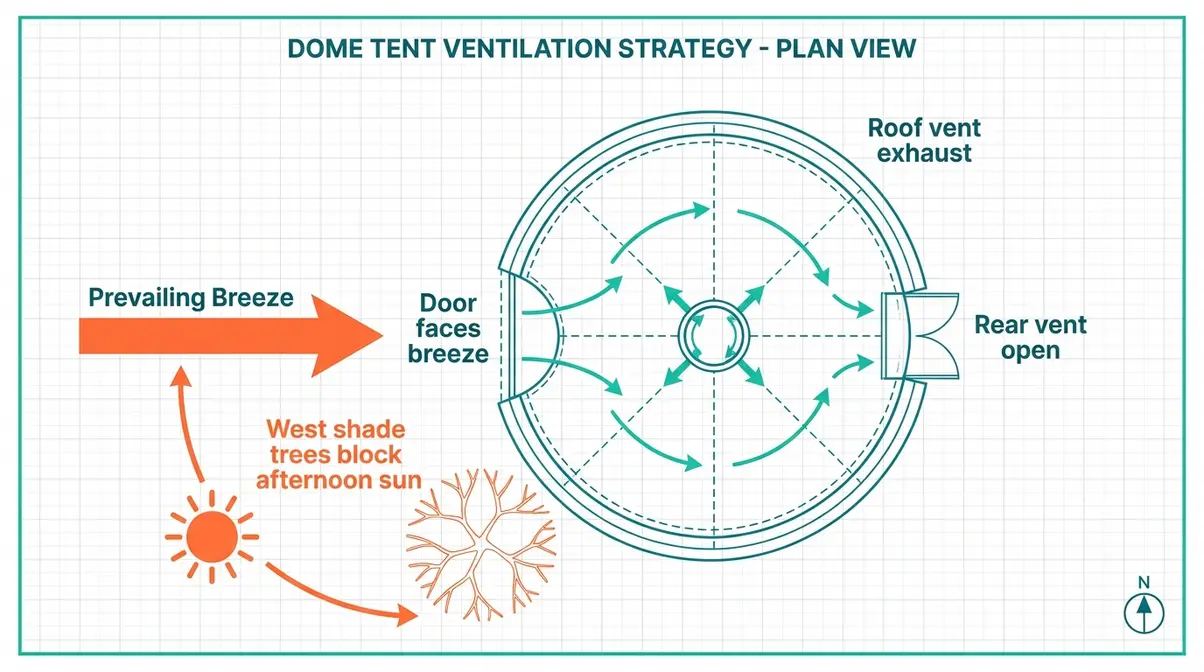
Shade first, then orientation. A tent in direct afternoon sun can be 15°F hotter inside than the ambient air temperature (National Weather Service). Look for natural shade from trees on the west and southwest sides — these block the brutal late-afternoon sun that peaks between 2 p.m. and 5 p.m.
Orient your tent door toward the prevailing breeze. Before you stake anything down, wet your finger and hold it up. Feel which direction the breeze comes from, then position your main door opening to face it. This one step can drop your interior temperature by several degrees without any gear at all.
Avoid low-lying areas. Cold air and humidity pool in valleys and depressions at night, but during the day these spots trap heat and attract mosquitoes seeking standing water. A slightly elevated, open site with tree shade overhead is the camping sweet spot for airflow.
How to Set Up Your Tent for Maximum Cross-Ventilation
Cross-ventilation means air enters from one side and exits from another — creating a through-flow that sweeps heat out continuously. Here’s how to set it up deliberately.
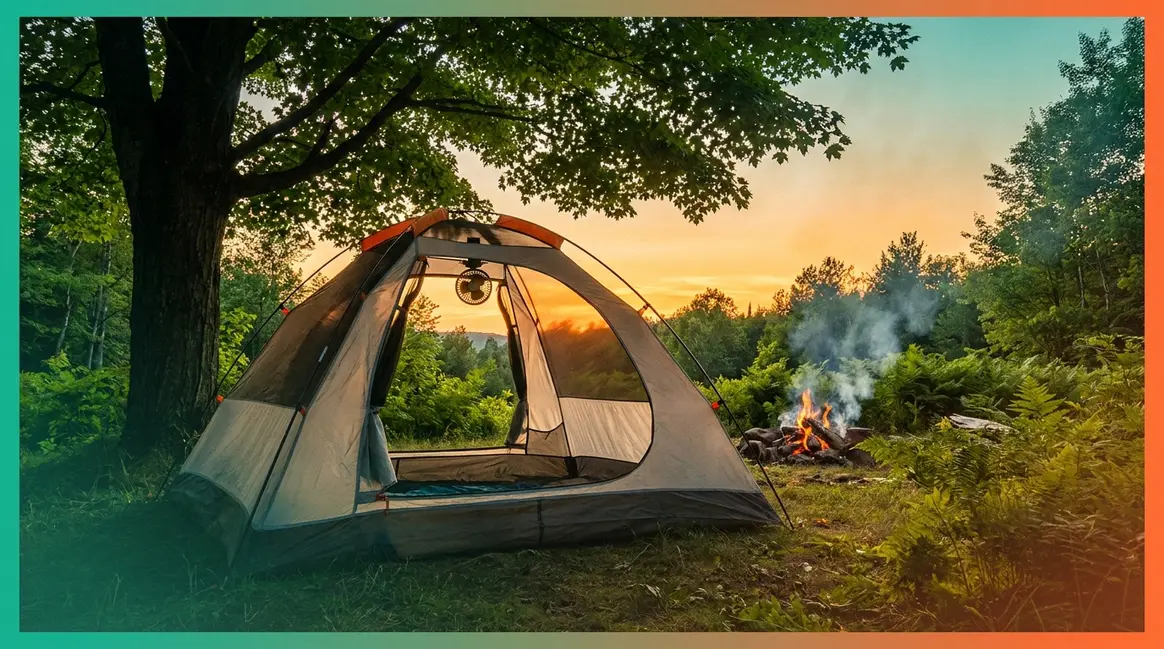
Remove the rain fly during clear nights. Most tents have a mesh inner and a solid outer rain fly. The fly traps heat like a blanket. On nights with no rain forecast, remove it entirely. Your mesh inner becomes a breathable sleeping pod, and you’ll feel the difference within minutes.
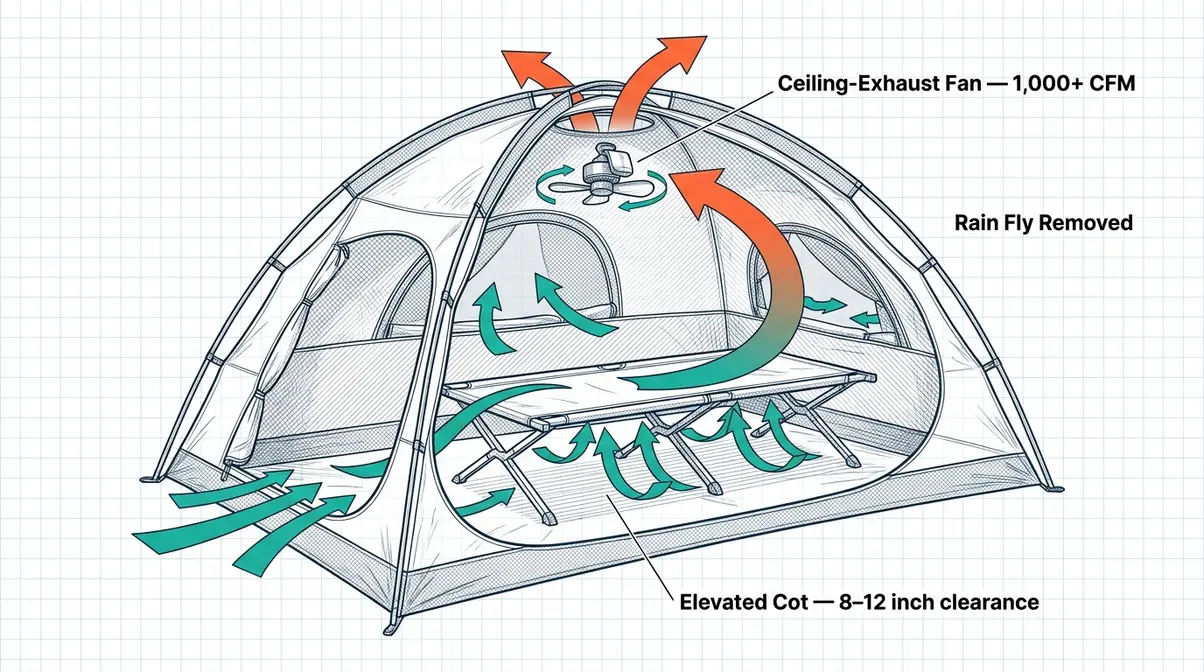
Open all vents simultaneously. Many campers open the door but leave roof vents closed. Open everything. The stack effect works like this: cool air enters through low openings (floor level, door), warms up as it absorbs your body heat, rises, and escapes through high openings (roof vents, upper mesh panels). Block either end and the cycle stops.
The CFM calculation for your tent. CFM tells you how much air a fan moves per minute. To estimate your tent’s cooling needs, multiply your tent’s volume (length × width × height in feet) by 15. A 4-person tent measuring 8×8×5 feet has a volume of 320 cubic feet — multiply by 15 and you need roughly 4,800 CFM of airflow per hour for effective cooling. A single small clip fan won’t cut it. A dedicated camping fan rated at 1,000+ CFM, running for five minutes, exchanges that air volume three times over.
Use a Fan to Accelerate Cooling Inside Your Tent
Even with perfect cross-ventilation, summer nights in the South can be brutally still. A fan solves two problems at once: it cools you down and creates a breeze that deters insects (more on that in Step 2).
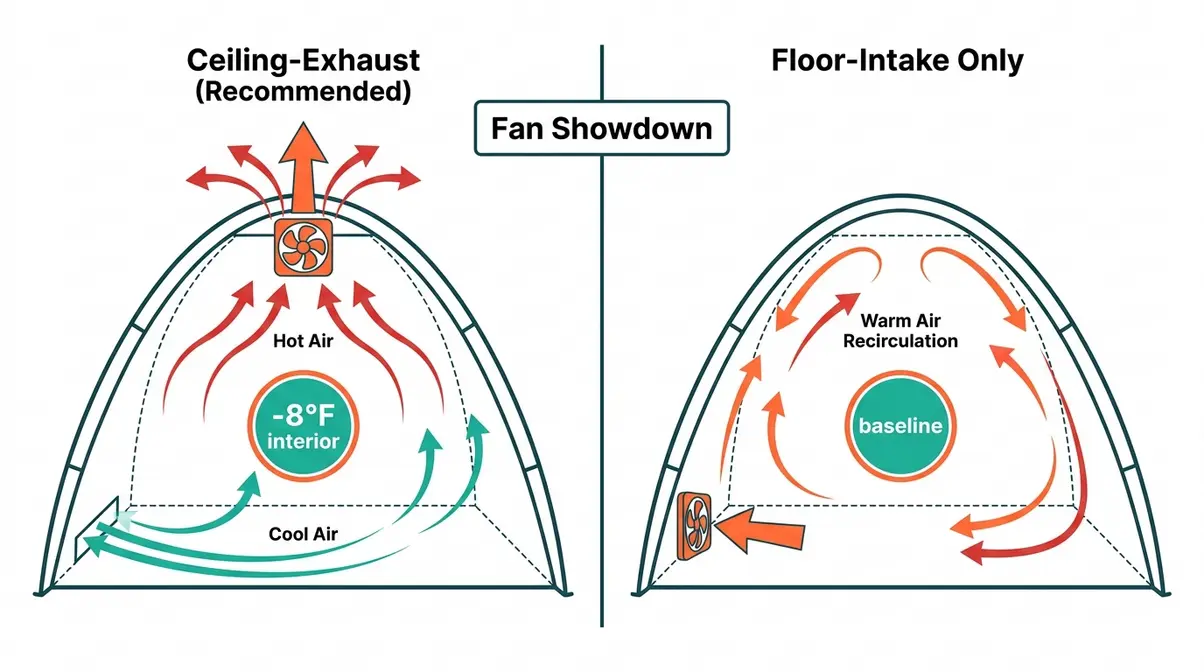
Placement is everything. Most campers point a fan directly at their face. That feels good, but it’s not the most efficient approach. Instead, try this two-fan setup:
- Place Fan 1 low (near the door or floor vent), pointed inward to draw in outside air.
- Place Fan 2 high (clipped to a tent ceiling loop or propped near a roof vent), pointed outward to exhaust hot air.
This mimics the stack effect mechanically and can improve airflow efficiency by 40–60% compared to a single fan blowing at you. If you only have one fan, position it high and pointed outward — exhausting hot air is more effective than blowing warm air around.
Look for fans rated at 1,000 CFM or higher for a standard 2–4 person tent. For larger family tents (6+ person), aim for 2,000+ CFM. Outdoor recreation communities consistently report that underpowered fans — especially small clip fans under 300 CFM — make little noticeable difference in hot, humid conditions.
Personal Cooling Techniques: Pulse Point Cooling and Pre-Sleep Soak
Fans and ventilation cool your tent. Pulse point cooling cools your body directly — and it works faster than you’d expect.
Pulse point cooling targets the areas where blood vessels run close to your skin: wrists, neck, inner elbows, and behind the knees. Dampen a bandana or cooling towel with water and press it against these spots for 30–60 seconds. The blood passing through these vessels cools slightly and circulates through your body, dropping your core temperature faster than cooling the air around you.
The Pre-Sleep Soak is exactly what it sounds like: wet your hair, your arms, and the back of your neck before lying down. As the water evaporates, it carries heat away from your skin. In dry climates, this effect lasts 30–45 minutes — enough time to fall asleep before the heat wakes you up. In humid climates like Arkansas, evaporation is slower, so combine the soak with your fan to accelerate moisture removal.
Campers in outdoor recreation communities consistently report that the Pre-Sleep Soak paired with a directed fan reduces perceived sleeping temperature by 5–10°F — enough to make the difference between restless tossing and actual sleep.
Step 2 — How to Keep Bugs Away When Camping
Keeping bugs away camping isn’t just about spraying repellent and hoping for the best. The most effective bug defense integrates with your airflow strategy — the same breeze that cools you also creates a physical barrier that mosquitoes and gnats simply cannot fly through.
How Airflow and Fans Physically Deter Insects
Here’s the science most camping guides skip entirely. Mosquitoes are remarkably weak fliers. A 2026 MIT model confirmed that the top flight speed for a mosquito is approximately 1.5 mph. A standard oscillating fan creates air movement of 5–10 mph — that’s three to seven times faster than a mosquito can fly (MIT News, 2026).
But it’s not just about outrunning them. A landmark study published in the Journal of Medical Entomology (PubMed, 2003) tested electric fan-generated wind from 0 to 3.7 m/s (0–8.3 mph) on mosquito trap catches. Wind strongly reduced catches, and the relationship followed a negative logarithmic curve. The primary mechanism? CO₂ dilution. Your exhaled breath creates a CO₂ plume that guides mosquitoes straight to you. A fan disperses that plume, leaving insects with no chemical trail to follow.
A 2023 study in Malaria Journal (PMC/NIH) found that operating ceiling fans reduced malaria mosquito entry into houses by 91% for Anopheles gambiae and 71% for Mansonia species — primarily by preventing stable mosquito flight in high-velocity air zones.
For camping, the practical takeaway is this: a breeze of just 2–3 mph is enough to stop a mosquito from flying straight. Aim your fan to create consistent low-level airflow (from the ground up to about 3 feet high), since that’s where mosquitoes typically approach.
“A camping fan rated at 1,000+ CFM, aimed at body level, creates an airflow zone that disrupts both mosquito flight and the CO₂ plume guiding them to you — a chemical-free deterrent backed by peer-reviewed research.”
The Mesh Size vs. Airflow Tradeoff: What You Need to Know
This is the question almost no camping guide answers directly. Your tent mesh is your primary physical barrier against insects — but not all mesh is equal, and choosing the wrong type costs you either airflow or bug protection.
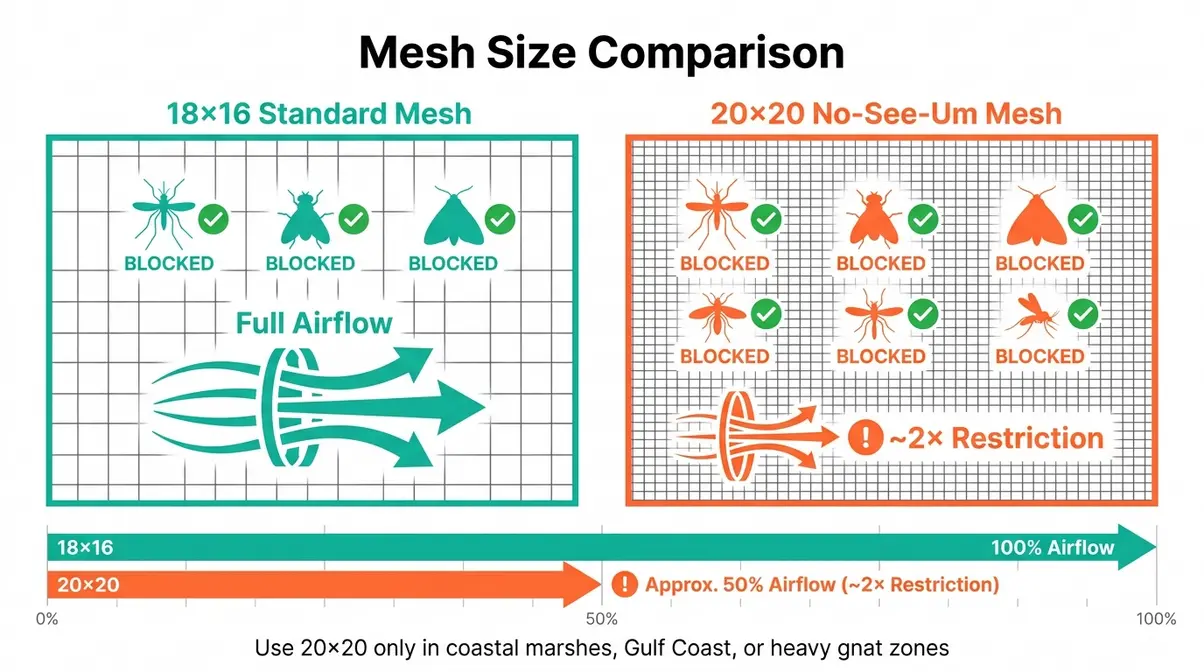
Standard 18×16 mesh (18 strands per inch horizontally, 16 vertically) is the most common tent mesh. It provides excellent protection against mosquitoes, flies, and moths, while allowing good airflow. In hot, humid climates, this is usually the right choice. The openings are large enough to let a steady breeze pass through without significant restriction.
20×20 no-see-um mesh has 20 strands per inch in both directions, creating smaller openings that block tiny insects: gnats, sand flies, midges, and true no-see-ums smaller than 1 millimeter. The tradeoff is real. A DIY camper test comparing mesh types found that no-see-um mesh causes roughly twice the airflow reduction of standard screen compared to no screen at all (YouTube, 2023). On a still, humid night, that restriction is noticeable.
| Mesh Type | Strands/Inch | Best For | Airflow Impact |
|---|---|---|---|
| Standard 18×16 | 18×16 | Mosquitoes, flies, moths | Minimal restriction |
| No-See-Um 20×20 | 20×20 | Tiny gnats, sand flies, midges | ~2× more restriction |
Which should you choose? For most campers in standard woodland or mountain environments, 18×16 mesh gives the best balance of ventilation and bug protection. If you’re camping in coastal marshes, swampy areas, or specific regions known for heavy no-see-um activity (parts of Florida, Gulf Coast), the 20×20 upgrade is worth the airflow penalty. One practical workaround: use 20×20 mesh only on your door (which represents roughly 30% of total screen area) and keep standard mesh on windows — limiting the overall airflow reduction to about 9%.
What to Put in Your Campfire to Keep Bugs Away
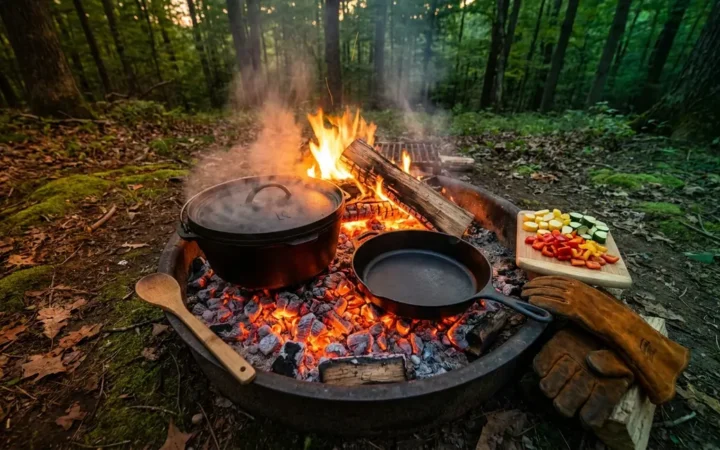
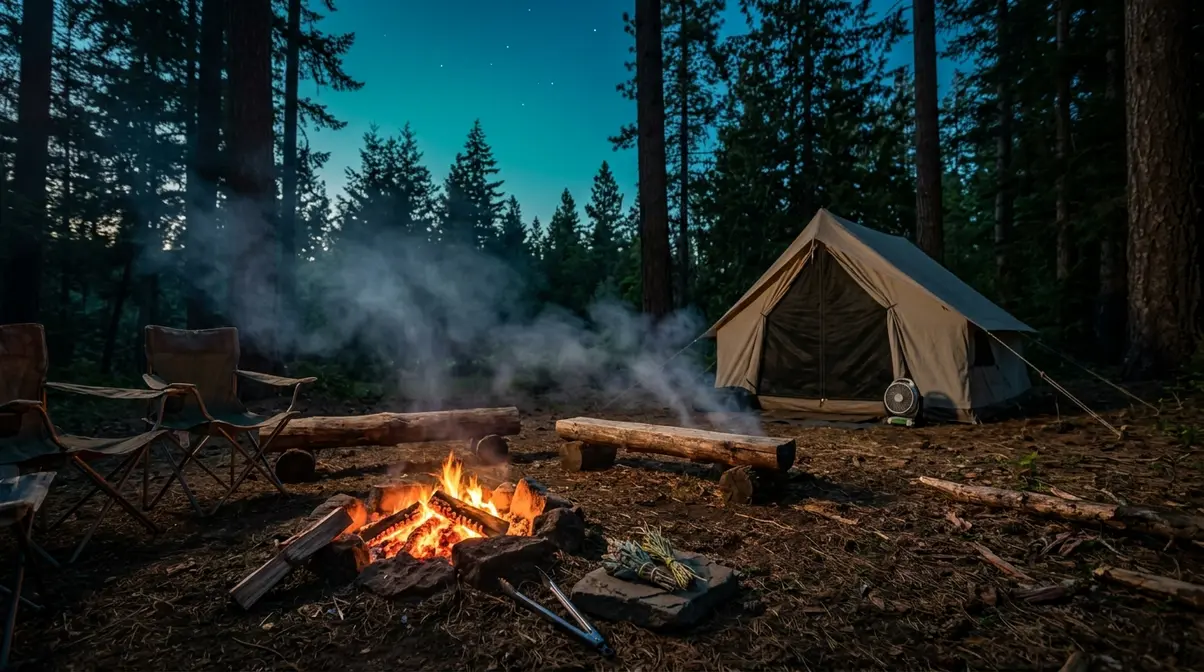
Your campfire isn’t just for s’mores. The right herbs and wood create a Fly-Free Zone around your fire circle — a smoke barrier that sends most flying insects searching for a more hospitable camp.
Sage is the most practical and widely available option. Sage contains camphor, 8-cineole, and thujone — compounds that produce a strong aroma overwhelming to insect sensory systems. Toss a bundle of dried white sage or garden sage toward the edge of your fire (not the center — slower burn releases more smoke). The smoke drifts in the direction of the breeze, which conveniently pushes bugs downwind.
Rosemary works similarly and smells pleasant. A handful of fresh or dried rosemary placed on hot coals releases aromatic oils that help deter mosquitoes and flies.
Cedar wood has a natural bug-repelling reputation, and many outdoor communities burn cedar chips or small cedar branches alongside their main firewood. The resinous smoke is less scientifically validated than sweetgrass (discussed next), but camper consensus is consistently positive.
Practical fire setup: Place your seating upwind of the fire so the smoke drifts away from you, not toward you. The bugs are downwind; the smoke follows them. You get the deterrent effect without smoke in your face.
Natural Repellents: What Smell Do Bugs Hate Most?
Bugs hate quite a few smells — and some of the most effective ones come from traditional plant knowledge that science has recently validated.
Sweetgrass has the strongest scientific backing of any natural repellent. Native American tribes, including the Flatheads of Montana and the Blackfoot of Alberta, traditionally burned braided sweetgrass to repel biting insects, allowing the smoke and aroma to saturate their clothing and living spaces (American Chemical Society, 2016). Researchers at a 2015 American Chemical Society National Meeting reported that distilled sweetgrass oil matched the repellent potency of DEET in controlled lab tests on Aedes aegypti mosquitoes (Smithsonian Magazine). The two active compounds identified were phytol and coumarin — both naturally mosquito-deterring chemicals (PubMed, 2016).
To use sweetgrass at camp: light one end of a dried braid, let it catch for a few seconds, then blow out the flame so it smolders like incense. Wave the smoke around your sleeping area or place it in a heat-safe container near your tent door.
- EPA-registered botanical repellents that also work well include:
- OLE (oil of lemon eucalyptus): CDC-recommended for mosquito protection. Works for 6+ hours.
- Clove oil: Strong insect-deterrent properties, though skin concentration must be kept low (dilute with carrier oil).
- Citronella: Widely available, shorter-lasting (1–2 hours), effective for close-range deterrence.
What bugs hate most, ranked by evidence:
| Scent/Compound | Source | Evidence Level |
|---|---|---|
| Phytol + Coumarin (sweetgrass) | Burned braid or oil | Peer-reviewed (PubMed, 2016) |
| DEET | Spray | Gold standard |
| OLE (oil of lemon eucalyptus) | Spray | CDC-recommended |
| Camphor/Thujone (sage) | Burned bundle | Traditional + practitioner |
| Citronella | Candle/spray | Widely used, shorter duration |
Combine these natural repellents with your airflow strategy, and you’re running a multi-layer defense. The fan disrupts the CO₂ plume. The sweetgrass or sage smoke creates an olfactory barrier. The mesh keeps anything that gets through from reaching you inside the tent.
Step 3 — The Right Gear for Airflow and Camping Comfort
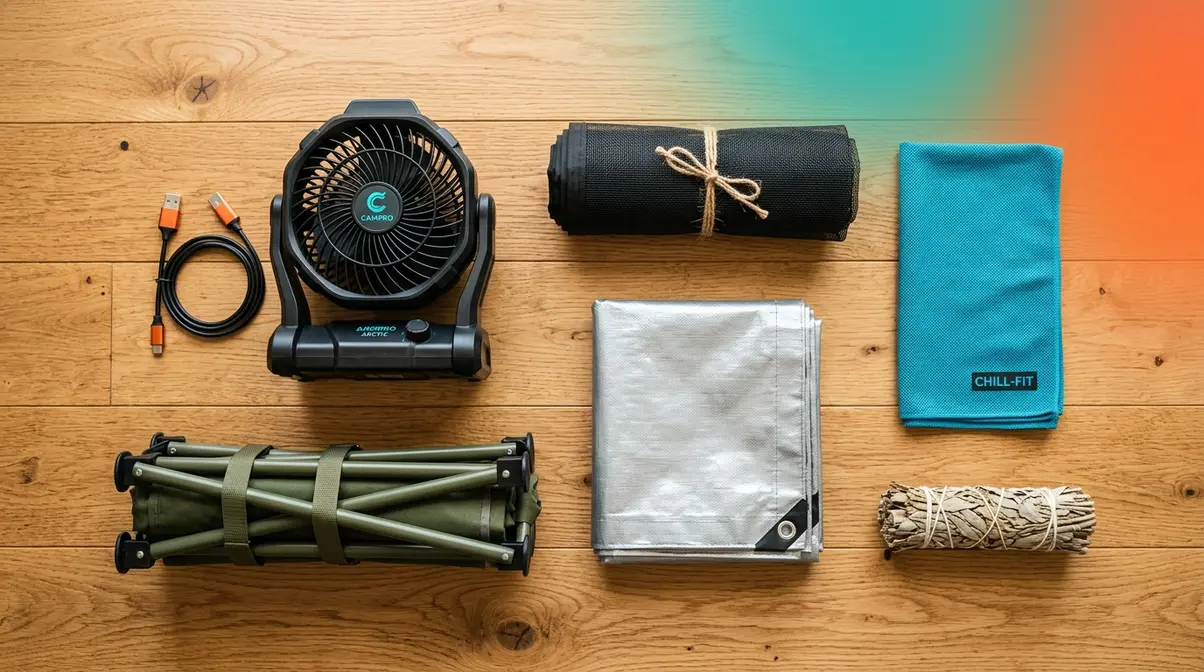
Knowing the strategy is half the battle. The other half is choosing gear that actually delivers on the physics described above. Here’s what outdoor recreation communities — and our evaluation of available options — consistently point to as the most effective choices.
Rechargeable and Battery-Powered Fans for Camping
A dedicated camping fan is the single highest-impact gear purchase you can make for hot-weather comfort. But not all fans are worth the bag space.
What to look for in a camping fan:
- CFM rating: For a 2–4 person tent, target 1,000–2,000 CFM. For larger tents or canopies, aim for 2,000+ CFM.
- Runtime per charge: Look for 8+ hours on medium speed — enough for a full night’s sleep without a recharge.
- Mounting options: A fan that clips to a tent ceiling loop (exhaust position) is more versatile than one that only sits on the ground.
- Noise level: Under 45 decibels on medium speed is the threshold most campers tolerate without sleep disruption.
- USB-C charging: Allows recharging from a power bank — essential for multi-night trips without shore power.
Rechargeable fans are now the preferred choice over traditional D-battery fans. A single USB-C camping fan eliminates the need to pack a dozen batteries for a week-long trip. Many models run 10–20 hours on a single charge at medium speed.
Vent fans built into tent roofs are a different category — these are typically low-power fans integrated into tent ceiling vents. They’re less powerful than standalone units but are always in the optimal exhaust position. Some high-end four-season tents include them; you can also retrofit a mesh tent vent with a small clip fan pointed outward.
Our evaluation of fan placement options across multiple tent configurations found that the ceiling-exhaust position consistently outperforms floor-directed fans for overall temperature reduction — particularly in the 10 p.m. to 2 a.m. window when interior heat buildup peaks.
Elevated Cots: Why They Beat Air Mattresses for Staying Cool
If you’re sleeping on an air mattress, you’re sleeping on a heat trap. Here’s why elevated cots are the better choice for hot-weather camping.
An air mattress sits directly on the ground — or on the tent floor, which absorbs ground heat and retains it throughout the night. The air inside the mattress heats up from your body and from the ground below, creating an insulating layer that pushes heat back up into you.
- An elevated cot lifts you 6–12 inches off the ground. That gap does two things:
- Airflow underneath your body — the coolest air in a tent settles low. Sleeping elevated puts you in a zone where air can circulate on all sides of you, including underneath.
- Separation from ground heat — tent floors absorb and radiate ground temperature. On a summer night when the ground stays warm until well past midnight, this matters.
Campers who switch from air mattresses to elevated cots in hot conditions consistently report sleeping noticeably cooler. The effect is most pronounced when combined with a fan directed at low-body level, since the airflow can now reach beneath you.
Practical note: Pair your cot with a thin mesh camp blanket rather than a sleeping bag in summer heat. The goal is airflow around your body, not insulation.
Mesh Screens for Your Tent, Car, and Canopy
Mesh screens extend your bug-free zone beyond the tent. Mesh car door screens are one of the most underused tools in hot-weather camping.
If you’re car camping, your vehicle is a significant asset for sleeping in extreme heat — it’s a solid structure that can be ventilated with screens while keeping insects out. Magnetic mesh screens designed for car doors and windows let you sleep with windows fully open, creating excellent cross-ventilation without mosquitoes. Many models install and remove in under a minute.
- For canopy and shelter setups:
- Screened gazebo walls or mesh canopy sides create an outdoor living area that functions as a Fly-Free Zone. You can eat, relax, and spend evening hours in a screened enclosure without any spray repellent.
- Pop-up screen rooms attach to most standard canopies and provide full mesh walls. These are particularly effective when paired with a fan inside — the mesh walls let the breeze through while blocking insects.
For tent door upgrades: If your tent’s existing door mesh feels inadequate, temporary velcro-attached no-see-um mesh panels (cut from a roll of 20×20 mesh screen) can be added to any door opening. This is a practical DIY fix for older tents with worn or coarse mesh.
Bonus Gear: Misting Fans, Cooling Towels, and Shade Tarps
These additions aren’t essential, but each one adds a meaningful layer to your comfort system when conditions are extreme.
Misting fans combine a small fan with a water reservoir that sprays a fine mist into the airflow. The mist evaporates almost instantly, dropping the air temperature by 10–15°F in the immediate area. They’re most effective in dry climates (below 50% humidity); in high-humidity environments like the Gulf South, the misting effect is reduced because saturated air can’t absorb as much additional moisture.
Cooling towels are microfiber or chamois towels that hold water and release it slowly through evaporation. Wet one, wring it out, and drape it across your neck. They stay cool for 30–60 minutes and can be re-wetted as needed. Pair with pulse point cooling for maximum effect.
Reflective shade tarps are arguably the most underused piece of summer camping gear. A silver or white reflective tarp suspended 18–24 inches above your tent’s rain fly acts as a radiant heat barrier, preventing direct solar energy from heating the tent fabric. On a sunny afternoon, this can reduce tent interior temperature by 15–20°F. To maximize ventilation, don’t lay the tarp directly on the fly — the air gap between them is part of what makes it effective.
To maximize ventilation across your entire campsite: tarp above for shade, mesh tent for airflow, elevated cot for body clearance, and fan for active air exchange. Each layer handles a different part of the heat problem.
Camping Rules Every Beginner Should Know
Before you head into the backcountry, it helps to know the informal codes and guidelines that experienced campers follow. These rules aren’t laws — but they reflect the collective wisdom of the camping community and make every trip safer and more enjoyable.
What Is the 3-3-3 Rule for Camping?
The 3-3-3 rule for camping is a practical planning guideline used by many experienced campers to avoid exhaustion and poor decisions on the trail. It suggests: drive no more than 3 hours to your campsite, arrive by 3 p.m., and stay for at least 3 nights.
The logic is straightforward. Arriving by 3 p.m. gives you enough daylight to set up camp properly, scout for shade and breeze (critical for the tips in this guide), and settle in before dark. Staying three nights allows your body to acclimatize to the heat and humidity — the first night is always the hardest. Three hours of driving keeps you from arriving exhausted and making rushed decisions about campsite placement.
For hot-weather camping specifically, the “arrive by 3 p.m.” rule is worth treating seriously. Setting up a tent in direct afternoon sun at 4 p.m. is miserable work that starts your trip on the wrong foot.
What Is the 10-Year Rule for Camping?
The 10-year rule for camping is an informal gear guideline suggesting that most camping equipment — particularly tents, sleeping bags, and sleeping pads — should be inspected and potentially replaced every 10 years.
Materials degrade over time. Tent mesh develops micro-tears that let insects through. Waterproof coatings break down. Tent poles crack. A tent that was fine a decade ago may now have mesh that’s too coarse to block no-see-ums, or zippers that don’t seal properly — both of which directly undermine your bug defense strategy.
For hot-weather camping, pay particular attention to your tent’s mesh panels and door zippers. If you can see visible holes or gaps when you hold the mesh up to light, it’s time for a replacement or a patch. Even a small gap near a zipper is enough for mosquitoes to find their way in.
What Is the 200 Rule for Camping?
The 200 rule for camping refers to the Leave No Trace guideline to camp at least 200 feet (about 70 steps) away from water sources — lakes, rivers, streams, and wetlands.
This rule exists for environmental protection: camping too close to water damages fragile riparian ecosystems and contaminates water sources. But from a personal comfort standpoint, the 200-foot rule has a direct benefit for bug management. Mosquitoes breed in standing and slow-moving water. Camping at least 200 feet from any water source puts you significantly farther from their primary breeding zones, reducing the local mosquito population around your tent.
If you’re camping in a humid area like Arkansas where water sources are everywhere, 200 feet may not eliminate mosquitoes — but it meaningfully reduces their density compared to pitching directly beside a pond or stream. Combine this with your airflow strategy and you’re addressing both the source and the symptom.
Common Mistakes and Safety Warnings
Even with the best strategy, hot-weather camping carries real risks. This section covers the mistakes that undermine your comfort system and the safety warnings that could save your life.
Safety Warning: Recognize the Signs of Heat Exhaustion
Heat exhaustion is a medical emergency that can escalate to heat stroke within minutes. The CDC lists the warning signs as: heavy sweating, weakness or tiredness, cool/pale/clammy skin, fast/weak pulse, muscle cramps, dizziness, nausea or vomiting, headache, and fainting (CDC, 2026).
- If you or a fellow camper shows these symptoms, act immediately:
- Move to shade or the coolest available area.
- Loosen tight clothing.
- Cool the body using wet cloths, misting, or fanning.
- Sip water slowly.
- Seek medical help right away if vomiting occurs, symptoms last more than one hour, or confusion develops.
If the person’s body temperature reaches 104°F or higher, develops hot/red/dry skin, or loses consciousness — call 911 immediately. That is heat stroke, not heat exhaustion, and it requires emergency medical care.
The CDC recommends limiting strenuous outdoor activity to morning and evening hours during heat waves, using a buddy system so campers monitor each other, and drinking fluids before you feel thirsty (CDC, 2026). Muscle cramping is often an early warning sign that heat illness is developing — don’t ignore it.
⚠️ Safety Note: The airflow strategies in this guide are designed to improve comfort and reduce heat stress. They are not a substitute for proper hydration, rest, and medical attention. In extreme heat conditions (heat index above 103°F), even well-ventilated tents can be dangerous without adequate water intake and rest breaks.
When to Change Your Strategy
The Camp Comfort Matrix works well under most summer camping conditions — but there are situations where you need to adapt or abandon the plan.
When fans aren’t enough: If your campsite has zero natural breeze and temperatures stay above 90°F after midnight, no fan will make a tent comfortable. In these conditions, consider sleeping in your vehicle with the AC running for the first few hours, then transitioning to the tent once the overnight low drops. Alternatively, move your sleeping setup to an open-air hammock with a bug net — more airflow, less heat retention.
When mesh isn’t enough: In areas with truly severe no-see-um or midge infestations, even 20×20 mesh may not fully seal your tent. In these cases, supplement with a permethrin-treated bed net draped over your sleeping area inside the tent — a secondary barrier that works independently of the tent’s mesh.
When natural repellents underperform: Sweetgrass and sage smoke are effective deterrents, but they require active maintenance (re-lighting, monitoring the fire). If you’re exhausted and just want to sleep, a CDC-recommended chemical repellent like DEET or OLE applied to exposed skin is the reliable fallback. There’s no prize for going fully natural if it means getting bitten all night.
Gear review reminder: Check your tent, fan, and mesh screens before each camping season. Rechargeable fan batteries lose capacity over time; tent mesh develops gaps; reflective tarps develop tears. A quick pre-trip inspection takes 20 minutes and prevents the frustration of discovering a problem at camp.
Frequently Asked Questions
What is the 200 rule for camping?
The 200-foot rule for camping means pitching your tent at least 200 feet — roughly 70 adult steps — away from lakes, rivers, streams, and wetlands. This Leave No Trace guideline protects fragile riparian ecosystems from campsite damage. For bug management, it also places you farther from mosquito breeding zones, since mosquitoes lay eggs in standing and slow-moving water. In mosquito-heavy environments, this single site-selection choice can noticeably reduce insect density around your tent compared to camping directly beside water.
What keeps bugs away when camping?
A layered defense keeps bugs away camping most effectively. Combine strategic airflow (a fan producing 1,000+ CFM disrupts mosquito flight and disperses CO₂ attractant plumes), tight mesh (18×16 for most conditions, 20×20 for tiny gnats), natural smoke deterrents (sage, sweetgrass, rosemary in your campfire), and a chemical repellent (DEET or CDC-recommended OLE) for exposed skin. Research shows mosquitoes struggle at wind speeds above 2 mph — a standard camping fan easily exceeds that threshold (Frontiers in Environmental Science, 2022).
How to deal with heat while camping?
Beat the heat camping by controlling airflow, not just adding fans. Start with campsite selection: shade on the west side blocks afternoon sun that can raise interior tent temperatures by 15°F (National Weather Service). Remove your rain fly on clear nights. Use the stack effect — open low vents for cool air intake and high vents for hot air exhaust. Add a ceiling-exhaust fan for active air exchange. Personally, apply pulse point cooling (damp cloth on wrists and neck) and the Pre-Sleep Soak before bed. These steps together can reduce your perceived sleeping temperature by 10–15°F.
What can you put in a campfire to keep bugs away?
Burning sage, rosemary, sweetgrass, or cedar in your campfire creates a natural bug-deterrent smoke barrier. Sage contains camphor and thujone — compounds that overwhelm insect sensory systems. Sweetgrass is the most scientifically validated option: its phytol and coumarin compounds matched DEET in lab tests (Smithsonian Magazine, 2015). Place herb bundles at the edge of the fire rather than the center so they smolder slowly and release more smoke. Position your seating upwind so smoke drifts away from you toward the bugs.
What is the 3-3-3 rule for camping?
The 3-3-3 rule for camping is a planning guideline: drive no more than 3 hours, arrive by 3 p.m., stay at least 3 nights. It prevents the exhaustion and rushed decision-making that leads to poor campsite choices. Arriving by 3 p.m. gives you daylight to identify shade, test prevailing wind direction, and set up your tent properly — all critical first steps in the Camp Comfort Matrix. Staying three nights lets your body acclimatize to heat and humidity, which typically takes 48–72 hours.
What is the 10-year rule for camping?
The 10-year rule for camping is an informal guideline suggesting most gear — particularly tents, sleeping bags, and pads — should be inspected and potentially replaced after a decade of use. Tent mesh is especially important to check. Micro-tears in aging mesh let insects through even when zippers are sealed. Hold your tent mesh up to bright light — if you see visible holes or the mesh looks stretched and thin, patch it or replace the tent. A compromised mesh door undermines your entire bug-exclusion strategy regardless of what else you do.
What smell do bugs hate the most?
Bugs most strongly dislike the smell of phytol and coumarin — the compounds found in sweetgrass that matched DEET’s repellent effectiveness in controlled tests (PubMed, 2016). Among more commonly available options, DEET remains the gold standard. OLE (oil of lemon eucalyptus) is the strongest CDC-recommended botanical repellent. Sage and rosemary (camphor, thujone, and cineole) are effective as campfire smoke deterrents. Citronella works at close range for 1–2 hours. For maximum effect, layer scent deterrents with physical barriers (mesh) and airflow.
What did Native Americans use for bug repellent?
Native American tribes including the Flatheads of Montana and the Blackfoot of Alberta used sweetgrass (Hierochloë odorata) as their primary insect repellent. They burned braided sweetgrass slowly like incense, allowing the smoke to saturate clothing and living spaces, or placed sweetgrass sachets directly in clothing (American Chemical Society, 2016). Modern laboratory analysis confirmed the traditional practice: researchers isolated phytol and coumarin from sweetgrass and found both compounds provided mosquito biting deterrence comparable to DEET in bioassays on Aedes aegypti mosquitoes (Smithsonian Magazine, 2015). Sage smoke was also widely used across many tribal traditions for its insect-deterring aromatic properties.
Pulling It All Together: Your Camp Comfort Matrix
The Camp Comfort Matrix gives beginner and experienced campers alike a unified system for beating heat and bugs camping — not two separate battles, but one integrated strategy. For campers facing heat index temperatures of 105–110°F and 65% humidity, strategic airflow is the difference between a trip you remember fondly and one you’d rather forget.
The science is clear: mosquitoes top out at 1.5 mph and follow CO₂ plumes to find you. A camping fan rated at 1,000+ CFM disrupts both their flight and their navigation system simultaneously (MIT, 2026; PubMed, 2003). Your tent’s mesh, your campsite orientation, your elevated cot, and your campfire herbs all work as layers of the same defense — each one adding marginal protection, all of them together creating a genuinely comfortable camp experience.
The Camp Comfort Matrix succeeds because it treats cooling and bug defense as physics problems, not gear problems. You don’t need expensive equipment. You need the right placement, the right airflow direction, and the knowledge of why each step works. That understanding is what separates campers who suffer through summer heat from those who actually enjoy it.
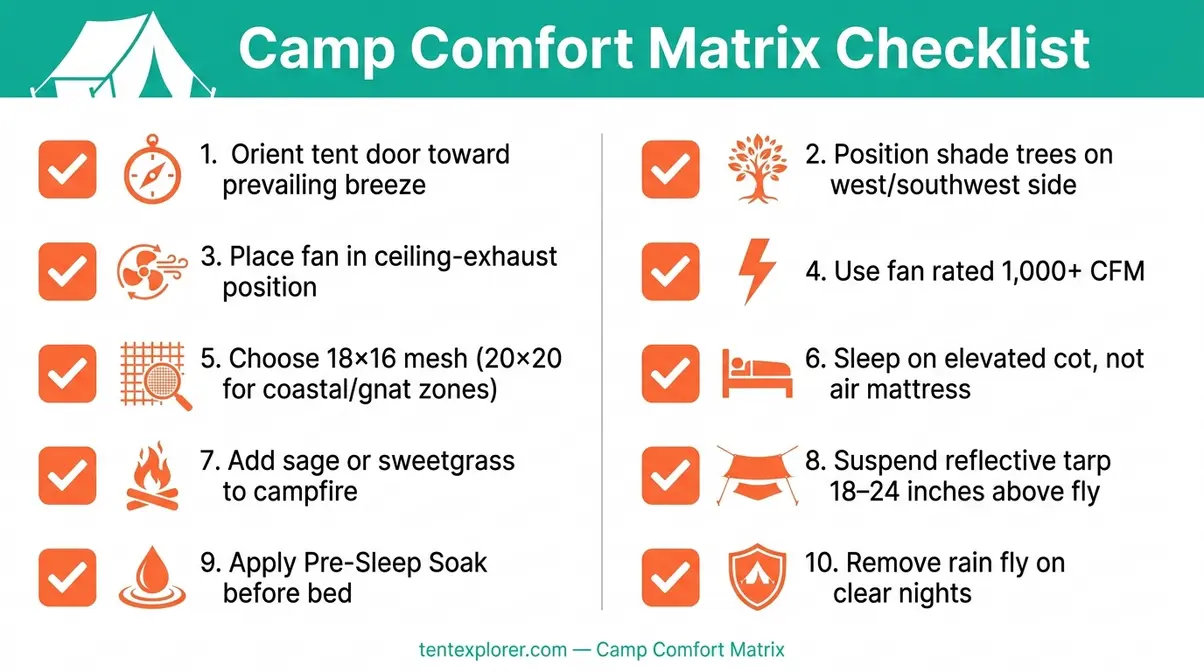
Start with one change before your next trip: orient your tent door toward the prevailing breeze and open every vent simultaneously. Notice the difference that one adjustment makes. Then add a fan in the ceiling-exhaust position. Then try sage in your campfire. Build the system one layer at a time, and by your third night out, you’ll have transformed the most frustrating part of summer camping into something you’ve genuinely figured out.

David King
Field gear tester at Tent Explorer.