What Is Tent Camping? Complete Beginner’s Guide
 David King
Updated June 24, 2026
29 min read
David King
Updated June 24, 2026
29 min read
“Tent camping means sleeping outdoors in a portable tent you pitch yourself, usually at a campground, park, beach site, forest site, or somewhere in between.”
— Common description shared across the camping community
That simple idea is backed by real science. A systematic review indexed by the National Institutes of Health found that physical activity in outdoor natural environments is associated with reduced fatigue, decreased negative emotions, and increased energy (PMC6562165, 2019). Yet most people have never spent a single night under canvas.
If you’re curious but overwhelmed — too many gear options, too much jargon, no clear starting point — you’re in the right place. By the end of this guide, you’ll know exactly what tent camping is, which style fits your comfort level, and what to pack for your very first trip. This guide covers the definition, types, tent selection, essential accessories, key rules, alternatives, and the most common beginner mistakes.

- ROOMY INTERIOR: Straight wall design with 72in center height create more space to stand up changing and move
- WEATHER PROTECTION: High-tech coating material with sealed seams and waterproof strip guarantees water-resistant
- EASY SETUP & COLOR COATED POLES: No particular skills needed, 2 people could set up the tent easily in 5 min
- GREAT VENTILATION: Mesh tent top and doors offer great views and ventilation
- 2 ROOMS: A separated curtain can be used as room divider and projector screen
Last update on 2026-06-24 / Affiliate links / Images from Amazon Product Advertising API

- Spacious with Easy Access: The tent for camping measures 216 in x 120 in, large enough for 12 people by industry standards. Easily fits 3 queen air mattresses and offers additional space for a cozy sleep. With a maximum height of 80 inches, this tent has 3-4 times more headroom compared to basic counterparts, allowing you to walk comfortably upright. Besides, it features a double-door design for easy access. A zippered divider creates 3 separate spaces, offering increased privacy and flexibility
- Set-up in 90s: The pre-installed tent poles and body make it easy to extend and anchor, allowing 2 people to set it up in just 90 seconds. The simple installation process is ideal for beginners, giving you and your family more time to enjoy the outdoors
- Waterproof and Windproof: The instant cabin tent's stable foundation comes from a removable canopy, strong camping pegs, and adjustable camping ropes that keep it firm even in the face of strong wind gusts. Made of high-quality waterproof fabric, this tent can prevent leakage and accumulation. Note: When setting up the rainfly, secure all Velcro strips on the rainfly and drive in the stakes firmly to ensure the rainfly remains stable
- Visibility & Ventilation: The tent for camping has mesh windows on all 4 sides, vents at the floor, and a mesh screen design at the ceiling, making the temperature inside the tent cooler in summer. Moreover, the windows and ceiling made of our mesh material let you experience the beautiful starry sky and the charming scenic nature on a quiet summer night
- High-quality Materials: The top-of-the-line SBS zippers bring a buttery smoother user experience; Its high-quality B3 mesh yarn with fine texture gives it that extra bump in longevity; The sturdy carbon frame with pads and protective sleeves on every extension warrants high durability and seamless stability. The power cord entrance enables equipment connection to an external power source, while mesh pockets inside facilitate easy storage
Last update on 2026-06-13 / Affiliate links / Images from Amazon Product Advertising API

- Included rainfly offers extra weather protection
- Strong frame withstands 35+ mph winds
- Large windows and a ground vent for superior ventilation
- E-Port makes it easy to bring electrical power inside
- Easy setup in 10 minutes
Last update on 2026-06-24 / Affiliate links / Images from Amazon Product Advertising API

- Roomy 6 People Family Tent: Spacious design offers enough room for 6 people family, with a size 10' x 9' x 78"(H) (90 sq ft),2 air mattresses or 6 sleeping bags are well fit in the tent,78 inch center height is enough for you to stand up changing.
- 5 Minutes Set-Up for 2 People: No particular skills are needed, 1 person could also set up the tent easily in 10 min. The portable carry bag is 24.6 x 8.26 x 8.26 inches, The camping tent weighs 18 lb. Ideal for family car camping or camping site
- Breathable Mesh Windows: The camping tent has 1 large mesh door, 5 mesh windows & mesh tent top, which allows the breeze to come in, all the mesh windows offer great views and ventilation
- Quality Material: The polyurethane hydrostatic-rated coating high-tech, waterproof,4 steel leg poles, and a rectangular roof, make the tent more firmly, stable, and windproof, ideal for outdoor camping, hiking, and fishing in all weather
- After Sale Service: UNP camping tent offers unconditional 1-year quality assurance, If you have any questions about the tents, we’ll give you a satisfactory solution in 12 hrs
Last update on 2026-06-24 / Affiliate links / Images from Amazon Product Advertising API

- 60 Seconds Set-Up: No more struggling with tent poles, with no complex assembly required. Set up this pop-up tent in just 60 seconds, and enjoy more time outdoors.
- Weather Resistant and Ventilation: The PU2000 water resistant coating and wearproof polyester cloth protect you from the elements. 1 large door、top mesh skylight and 6 mesh windows offer optimal ventilation, you can easily look at the stars at night on the instant camping tent. Includes rain fly, sturdy stakes, and tie-down ropes, oversized duffle bag for easy storage.
- Camping Tent Sleep 4: Spacious 8 'x 8' tent easy to sleep 4 person offering over 6.6 ' height, enjoy being able to stand when changing your clothes, or the openness of high ceilings, with folded size 69"L x 9"W x 9"H. 2 mesh bags inside the tent for easy storage of debris and keeping the interior space clean.
- Extra Vestibule: Provides additional storage space for outdoor gear, so you stay organized and clutter-free during camping trips. Suitable for outdoor events, camping, or picnicking.
- All TIMBER RIDGE product is meticulously crafted with care and supported by our dedication to ensuring customer contentment. Should any concerns arise, our assistance is readily available.
Last update on 2026-06-24 / Affiliate links / Images from Amazon Product Advertising API
- Included rainfly offers extra weather protection
- Strong frame withstands 35+ mph winds
- Large windows and a ground vent for superior ventilation
- E-Port makes it easy to bring electrical power inside
- Easy setup in 10 minutes
Last update on 2026-06-24 / Affiliate links / Images from Amazon Product Advertising API
Recommended Products
| # | Image | Product | Best For | Buy |
|---|---|---|---|---|
| 1 | |
CAMPROS CP 8-Person Family Tent | Large family groups | Buy on Amazon |
| 2 |  |
FanttikOutdoor Instant Cabin Tent | Fast 60-second setup | Buy on Amazon |
| 3 | |
CAMPROS CP Divided Room Tent | Families wanting privacy | Buy on Amazon |
| 4 | |
Coleman Sundome 10-Min Tent | Quick solo or couple setup | Buy on Amazon |
| 5 | |
UNP 6-Person Waterproof Tent | Wind and rain protection | Buy on Amazon |
| 6 |  |
Coleman Sundome Weatherproof Tent | Festivals and backyards | Buy on Amazon |
| 7 |  |
Timber Ridge 4-Person Hub Tent | Easy pop-up family camping | Buy on Amazon |
| 8 |  |
Dome Tent for 2-4 Campers | Budget-first beginners | Buy on Amazon |
| 9 | |
UNP Double-Layer Family Tent | Mesh ventilation priority | Buy on Amazon |
| 10 | |
Coleman Sundome All-Season Tent | Versatile 3-season use | Buy on Amazon |
What Is Tent Camping?
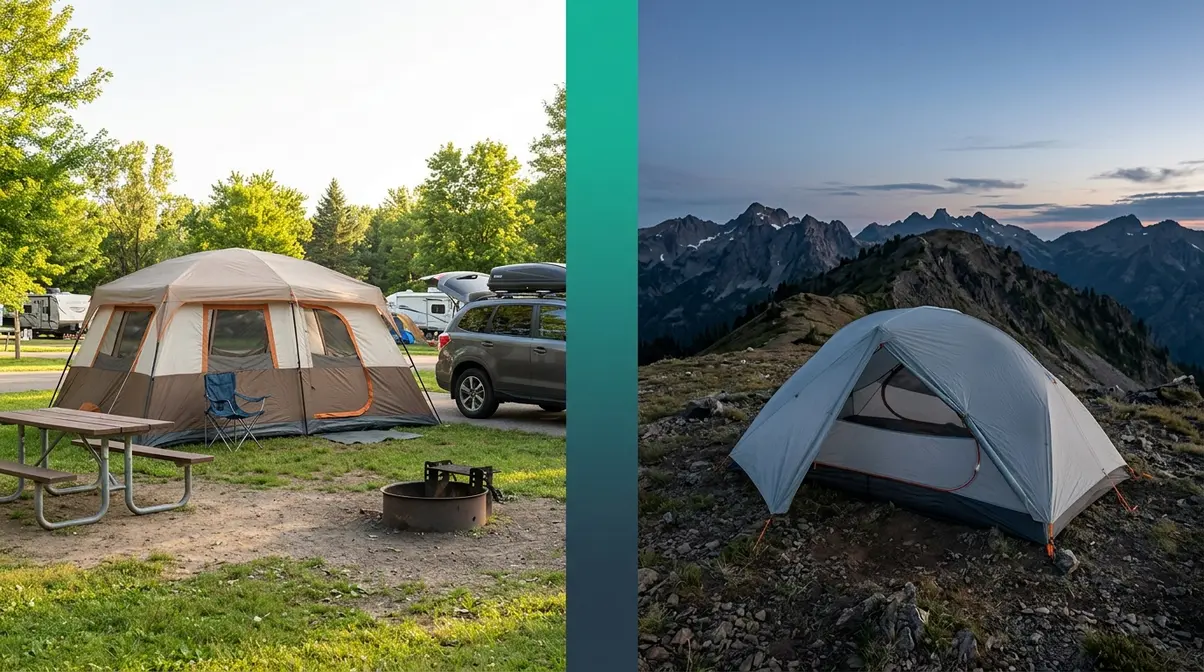
Tent camping is the practice of sleeping outdoors in a portable fabric shelter you pitch yourself, typically at a campground, forest site, or beach. Unlike RV camping or cabin stays, it places you directly in nature with minimal infrastructure between you and the environment — making it the most immersive and affordable way to spend a night outside.
Campsite fees average $35–$60 per night at popular networks like KOA, compared to $80–$200+ for cabin rentals or RV hookup sites. That gap makes tent camping the most accessible entry point into overnight outdoor recreation for most beginners.
The Simple Definition of Tent Camping
What is tent camping? It is the act of sleeping outdoors in a portable shelter — a tent — that you assemble and stake to the ground yourself. What is a camping tent? It is a portable fabric structure supported by flexible poles (or, in some modern designs, an inflatable frame) that creates a weatherproof sleeping space. You carry it to a site, set it up, sleep inside it, and pack it away when you leave.
Tent pitching (the act of assembling and staking your tent at a campsite) is the core skill every first-timer needs. It sounds intimidating, but most beginner tents go up in 10–30 minutes with no tools required.
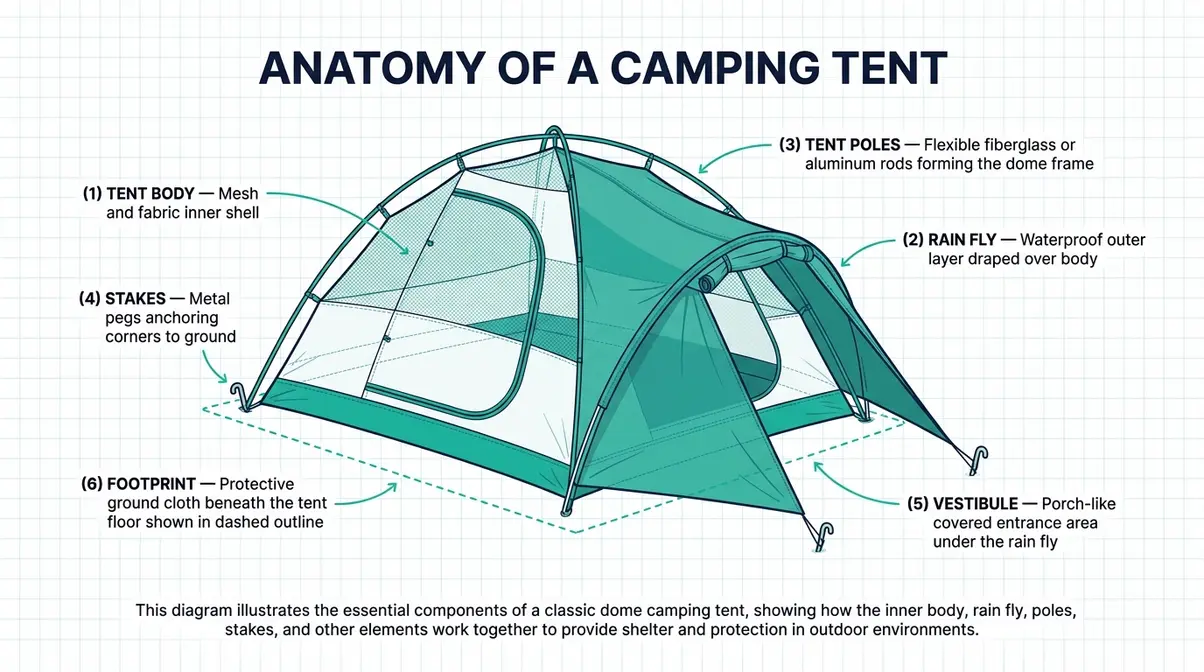
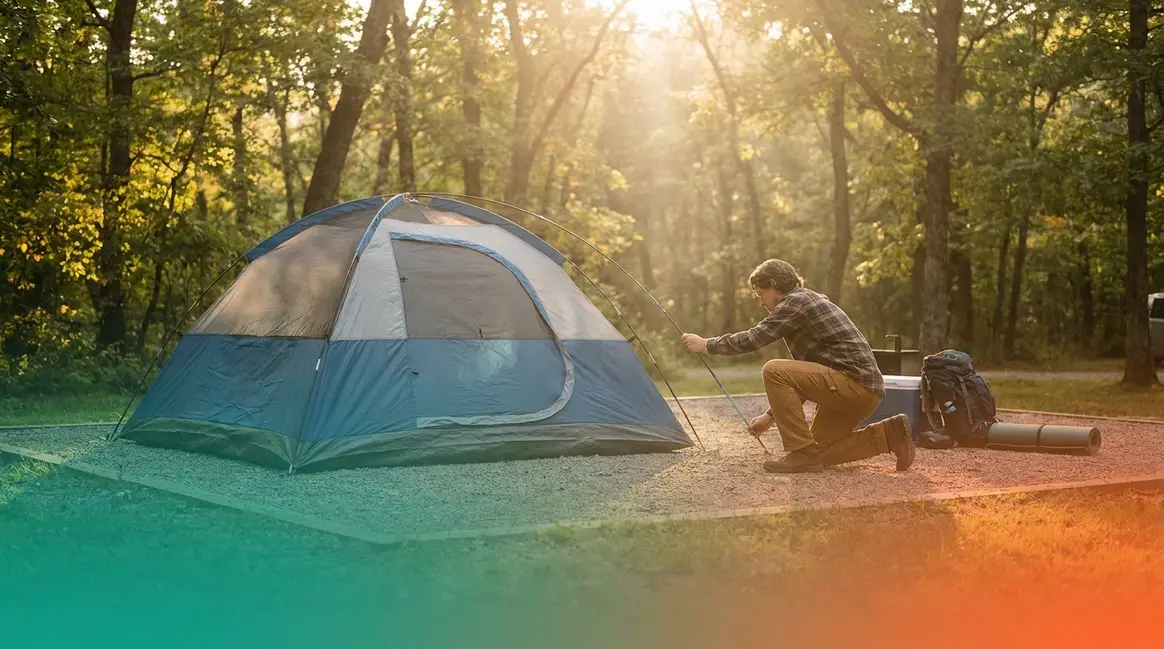
Picture a Saturday evening in a state park: you’ve set up a two-person dome tent on a flat gravel pad, zipped the rain fly (the waterproof outer layer) shut against the evening dew, and you’re listening to crickets instead of traffic. That’s tent camping in its simplest form.
For essential tent camping tips for beginners, check out our dedicated guide before your first trip. You can also download a beginner camping checklist to make sure nothing gets left behind.
Tent camping is the most affordable form of overnight outdoor recreation — with tent sites starting around $35 per night at KOA campgrounds versus $100–$250 for hotels (KOA, 2026). That cost difference alone draws millions of first-timers to the outdoors each year.
What Makes Tent Camping Different?
Tent camping is also called “traditional camping” in everyday language — it’s what most people picture when they hear the word “camping.” However, it sits on a spectrum alongside several other overnight outdoor options, and knowing the differences helps you set the right expectations.
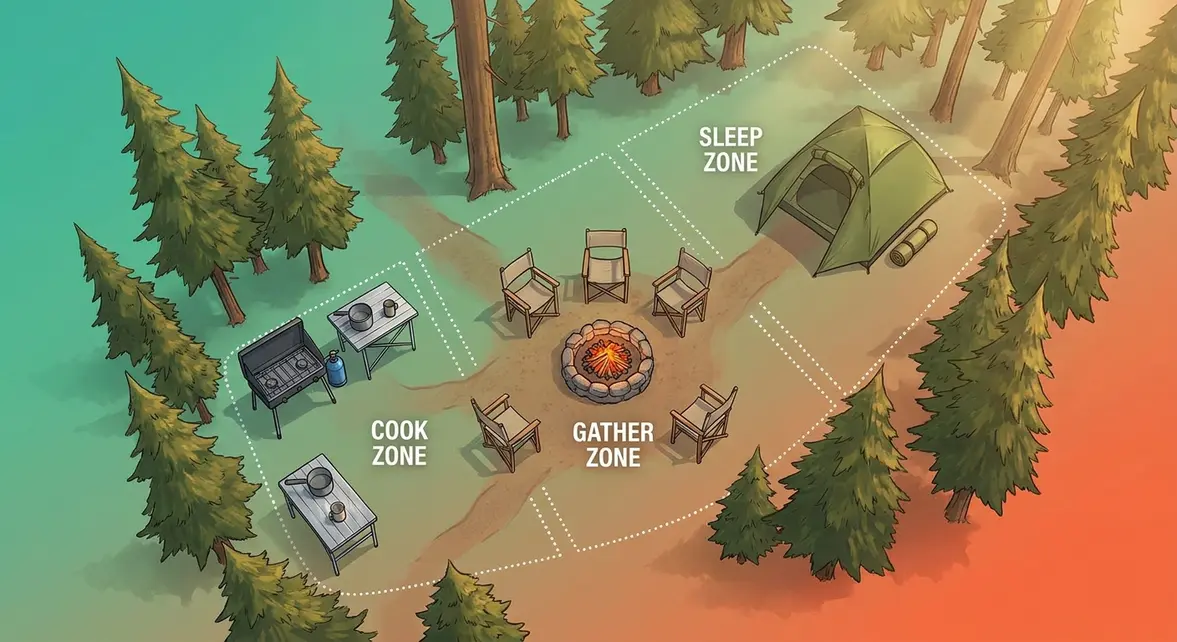
The key distinction is frontcountry vs. backcountry camping. Frontcountry (developed campgrounds with amenities like restrooms, fire rings, and sometimes electrical hookups) is where most beginners start. Backcountry (remote, undeveloped land with no facilities) is where experienced hikers go once they’ve built their skills.
| Feature | Tent Camping | RV Camping | Cabin Stay | Glamping |
|---|---|---|---|---|
| Shelter | Portable tent (you pitch) | Vehicle with sleeping quarters | Fixed structure | Luxury tent or yurt |
| Setup Time | 10–60 minutes | Drive in, park | None | None |
| Avg. Cost/Night | $35–$60 | $60–$100 | $80–$200+ | $100–$400+ |
| Nature Connection | Very high | Medium | Low | Medium |
| Skill Level | Beginner–Advanced | Beginner | None | None |
A frontcountry site at a KOA campground might have a picnic table, a fire ring (a metal or stone circle for safe campfires), and a nearby bathroom block. A backcountry site in a national forest might be a flat patch of ground you found on a map — nothing else. KOA tent sites represent the most accessible entry point into camping, with sites available at over 500 locations across North America.
The Real Benefits of Tent Camping
Is tent camping good for you? The short answer is yes — and the evidence is stronger than most people expect.
Mental health: According to the National Park Service, spending time outside can improve mental health and reduce depressive thoughts. This isn’t a vague wellness claim — it reflects findings from multiple studies the NPS references in its public health guidance (NPS, 2026).
Physical health: A systematic review published by the National Institutes of Health found that physical activity in natural outdoor environments is associated with reduced negative emotions, decreased fatigue, and increased energy (PMC6562165, 2019). All 12 studies reviewed in one meta-analysis found that exercise in nature produced greater energy increases than comparable activity indoors.
Screen detox: Research from Utah State University Extension notes that camping helps individuals unplug from screens, which reduces stress and supports a healthier circadian rhythm — your body’s natural sleep-wake cycle. Outdoor communities consistently report that even a single weekend away from devices produces noticeable improvements in sleep quality.
- Benefits at a Glance:
- Reduced stress: Lower cortisol levels after time in green spaces (NIH, 2019)
- Improved sleep: Natural light cycles reset your circadian rhythm
- Stronger relationships: Shared challenges and meals build genuine connection
- Increased energy: Nature-based activity reduces fatigue more than indoor exercise
- Mental clarity: Disconnecting from screens reduces anxiety and improves focus
Ready to explore your options? Tent camping isn’t one-size-fits-all — there’s a whole spectrum of styles, from a weekend at a campground with showers to a week in the wilderness with nothing but what’s on your back.
Types of Tent Camping: The Comfort Spectrum
Tent camping is not one experience — it’s a spectrum of styles ranging from a fully equipped campsite with showers and electricity to a remote patch of wilderness with nothing but what you carry. The Comfort Spectrum Framework helps beginners place themselves on this range before buying a single piece of gear.
Think of it this way: on the left end sits car camping (maximum comfort, minimum skill required). On the right end sits primitive camping (maximum self-reliance, no infrastructure). Every other style falls somewhere in between.
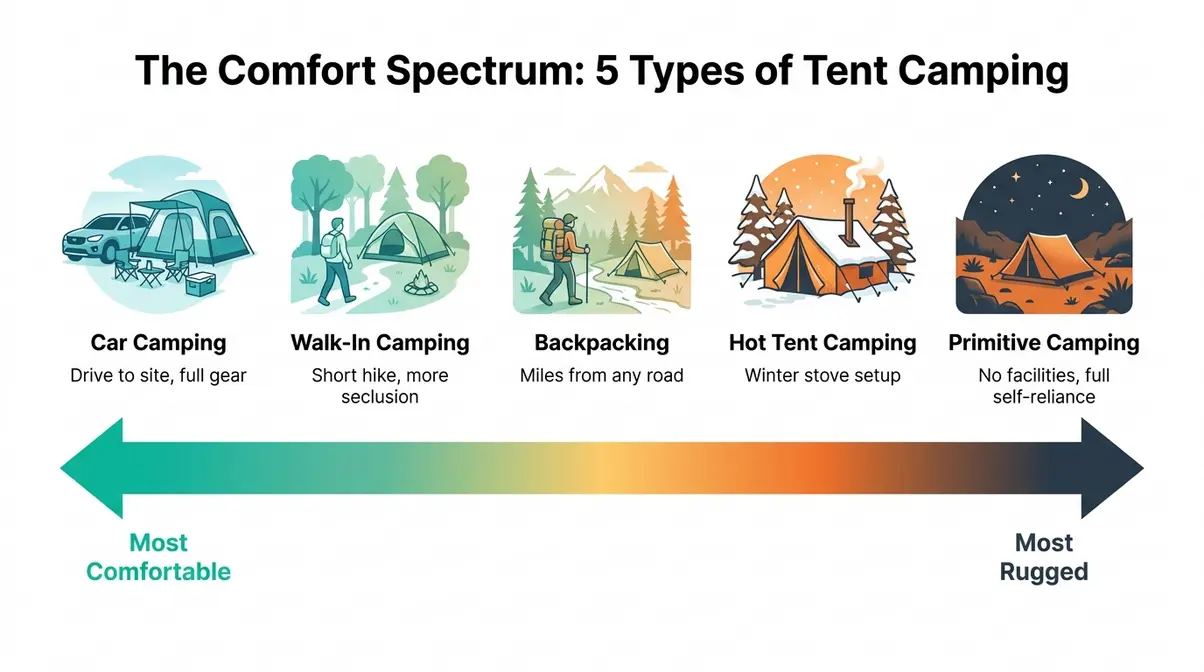
What are three types of tent camping?
The three most common types of tent camping are car camping, backpacking, and primitive camping. Car camping (frontcountry) means driving to a designated site with amenities like fire rings and restrooms — the best starting point for beginners. Backpacking means hiking to remote sites with everything on your back. Primitive camping means setting up in undeveloped land with no infrastructure. Each type requires a different skill level and gear set, which is why the Comfort Spectrum Framework helps beginners choose their starting point before buying gear.
- The five main types of tent camping, from easiest to most demanding:
- Car camping — drive to your site, maximum gear flexibility
- Walk-in camping — short hike from the parking area, more seclusion
- Backpacking — carry everything on your back, miles from any road
- Hot tent camping — specialized winter camping with an interior stove
- Primitive camping — no designated sites, no amenities, full self-reliance
According to the U.S. Forest Service, dispersed and primitive campers must be entirely self-contained and pack out all trash, as no amenities are provided. That requirement applies whether you’re in a national forest or on BLM (Bureau of Land Management) land.
Car Camping (Frontcountry Camping)
Car camping is the most beginner-friendly style where you drive your vehicle directly to a designated campsite — often within sight of the parking area. This is where the vast majority of first-time campers start, and for good reason: it removes almost every barrier.
What a car camping tent is: A car camping tent is a larger, heavier shelter that prioritizes livable space over pack weight. Because you’re driving to your site rather than hiking, weight doesn’t matter — floor space does. The CAMPROS CP 8-Person Tent and the Coleman Sundome are both strong car camping choices, offering easy setup and generous interior room.
- Quick Facts:
- Who it’s for: Absolute beginners, families with young children, anyone trying camping for the first time
- Setup time: 15–45 minutes for most models
- Typical cost: $35–$60 per night at developed campgrounds
Your site typically includes a fire ring, a picnic table, and restrooms within walking distance. You can bring a full-size cooler, camp chairs, a camp stove, and as many sleeping bags as you need — because it all travels in your trunk.
Car camping is the easiest entry point. Once you’re comfortable with the basics, you might want to explore sites that require a short walk from the parking area — that’s where walk-in camping comes in.
Backpacking (Backcountry Camping)
Backpacking means carrying everything you need in a pack and hiking to your campsite — often miles from the nearest road. Sites have no amenities, no fire rings, and no nearby restrooms.
Who it’s for: Intermediate-to-advanced campers comfortable with navigation, Leave No Trace principles, and carrying 25–45 lbs on their back. This is not the right first trip for most new campers — it requires physical fitness, navigation skills, and gear knowledge that take time to develop.
Key gear needed: An ultralight backpacking tent (1–2 lbs), a 3-season sleeping bag rated to the lowest expected temperature, a water filter (to treat water from streams), and lightweight dehydrated food.
Experienced campers across forums consistently recommend starting with car camping and completing at least 3–5 overnight trips before attempting a backpacking route. The learning curve is real, and enjoying the wilderness requires feeling confident — not overwhelmed.
For those who want to camp in cold or snowy conditions, there’s a specialized style that’s growing in popularity — and it requires a very different kind of tent.
Hot Tent Camping (Winter Camping)
Hot tent camping is a winter-specific style using a tent with a built-in stovepipe hole — a small metal-reinforced opening in the tent wall or roof — that allows a wood-burning stove to be used safely inside. This keeps the interior warm even when outside temperatures drop well below freezing.
What makes it distinct: Standard 3-season and even most 4-season tents cannot safely accommodate a wood stove. Hot tents are purpose-built with flame-retardant fabric and reinforced stovepipe ports. The result is a genuinely comfortable winter shelter — hunters, ice fishermen, and cold-weather enthusiasts use them to extend their camping season into months most people consider off-limits.
Key gear needed: A hot tent with a stovepipe port, a wood-burning camp stove, heat-resistant flooring (to protect the tent floor from embers), and a winter-rated sleeping bag.
Critical safety note: Carbon monoxide is a real risk with any combustion inside an enclosed space. Always ensure adequate ventilation — crack a vent or door slightly whenever the stove is burning. The U.S. Forest Service advises campers to use flame-retardant fabric and maintain safe distances from open flames.
To explore hot tent camping for winter, our dedicated guide covers the top models and setup techniques in detail.
On the opposite end of the Comfort Spectrum is primitive camping — the rawest, most self-reliant form of tent camping there is.
Primitive Camping (Dispersed Camping)
Primitive camping (also called dispersed camping) is the practice of setting up your tent in undeveloped land — national forests, BLM land — with no designated sites, no restrooms, no water, and no fire rings. You find your own spot using a map or GPS.
What it requires: Full self-sufficiency. You bring everything in and pack everything out. A water filter is non-negotiable. Human waste must be buried in a cathole (a 6–8 inch deep hole dug at least 200 feet from water sources and trails). The USDA Forest Service requires primitive campers to be entirely self-contained and to leave no trace of their stay.
An important distinction: Primitive camping refers to the site type (no infrastructure), not the experience quality. With the right skills and gear, a primitive campsite can be genuinely beautiful — just not the right place to learn those skills for the first time.
Who it’s for: Experienced campers who are self-sufficient and confident with navigation, water treatment, and Leave No Trace principles. Outdoor communities consistently recommend completing at least 10 frontcountry trips before attempting primitive dispersed camping.
Between car camping and primitive camping, there are a few other styles worth knowing — especially if you’re planning your first trip and want something in the middle.
Walk-In Camping and Other Styles
Not every camping style fits neatly at either end of the Comfort Spectrum. Several options sit comfortably in the middle:
- Walk-in camping: Sites that require a short hike — usually 0.25 to 1 mile — from the parking area. More secluded than car camping, but you don’t need full backpacking gear. A great second step after your first car camping trip.
- Dry camping: Camping without access to water or electrical hookups at the site. Common in desert or remote areas. You bring all your water and power with you.
- Youth camping: Organized camping programs for children and teenagers through scouting organizations or school groups — structured, supervised, and beginner-friendly by design.
Now that you know which camping style fits your comfort level, the next question is: which tent should you buy?
How to Choose the Best Camping Tent
Choosing a good tent for camping comes down to four factors: how many people it needs to sleep, what weather conditions you’ll face, your budget, and how easy it is to set up. Get these four right and brand or color becomes secondary. Here’s how to evaluate each one.
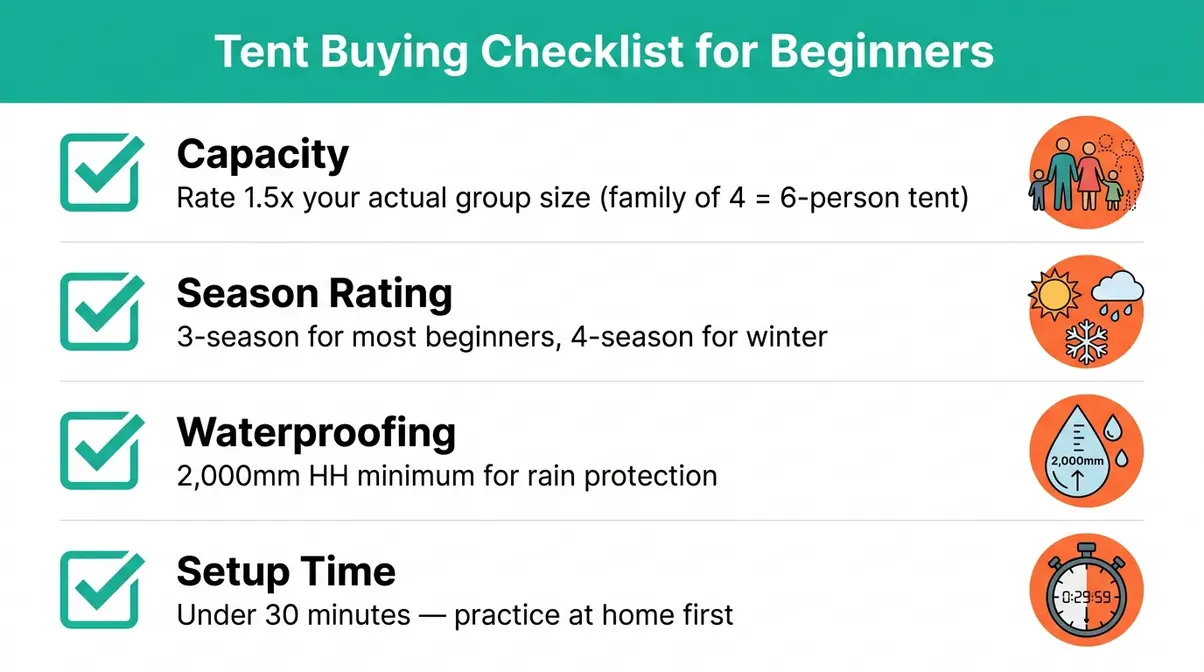
According to REI’s expert advice team, the right way to evaluate a family tent is by capacity, seasonality, and livability features — in that order. Our evaluation of beginner tent setups confirms that skipping the capacity check is the single most common first purchase mistake.
What are the 4 types of tents?
The four main tent types are dome tents, cabin tents, backpacking tents, and hot tents. Dome tents (like the Coleman Sundome) are rounded, wind-resistant, and easy to pitch — the most common beginner choice. Cabin tents have vertical walls that maximize interior headroom — ideal for families who want to stand up inside. Backpacking tents are ultralight (1–2 lbs) and designed for hikers carrying everything on their back. Hot tents are winter-specific shelters with a stovepipe port for a wood-burning stove. Most beginners should start with a dome or cabin tent.
Tent Size and Capacity: Don’t Get Fooled
Here’s the most important thing nobody tells beginners: tent capacity ratings are inflated. A tent marketed as “8-person” typically comfortably sleeps 4–5 adults with gear. Manufacturers calculate capacity by fitting people shoulder-to-shoulder with zero space for sleeping bags, backpacks, or shoes.
The real rule of thumb: Divide the stated capacity by 1.5 to 2 for comfortable family use. A family of 4 needs a tent rated for 6–8 people.
A 4-person tent comfortably sleeps 2–3 adults when you factor in gear storage — a widely recognized discrepancy in the camping community that REI’s expert advice team specifically flags in their buyer’s guides (REI Expert Advice, 2026).
For a family of 4 with two kids, the CAMPROS CP 8-Person tent or the UNP 6-Person tent gives you enough floor space to lay out sleeping bags plus store backpacks and shoes inside. Cabin-style tents with vertical walls maximize usable floor space more efficiently than dome-shaped designs.
Once you know how many people your tent needs to sleep, the next question is what weather conditions it needs to handle — and this is where season ratings matter.
Season Ratings and Weather Matching
Season ratings tell you what conditions a tent can handle. Most beginner-friendly tents are rated for 3 seasons:
- 3-season tents: Designed for spring, summer, and fall. Handle rain and mild wind. Feature mesh panels for ventilation. NOT suitable for heavy snow loads or sustained sub-freezing temperatures. The Coleman Sundome, UNP 6-Person, and Timber Ridge Hub Tent are all 3-season models — appropriate for the vast majority of first-time camping trips.
- 4-season tents: Heavier construction, fewer mesh panels, stronger poles designed to shed snow. Required for winter camping in genuinely cold climates.
- Hot tents: A subcategory of 4-season tents with a stovepipe port (covered in the Types section above).
Waterproofing — the HH rating: HH stands for hydrostatic head — the measurement of how much water pressure the fabric can withstand before leaking.
| HH Rating | Rain Resistance | Best For |
|---|---|---|
| 1,000mm | Light rain | Fair-weather camping only |
| 1,500–2,000mm | Moderate rain | Most 3-season camping |
| 3,000mm+ | Heavy rain and storms | Wet climates, extended trips |
Most beginner-appropriate tents carry 1,500–2,000mm ratings. For camping in nights above 32°F (0°C), a 3-season tent with 2,000mm HH waterproofing is the correct choice for most beginners. Below freezing, you need either a 4-season tent or a hot tent setup.
Best Tent Brands and Color Choices
The best tent brand for beginners is one that offers easy setup, clear instructions, and accessible returns. Our evaluation of beginner setups consistently highlights four brands that deliver on all three:
- Coleman — widely available, beginner-friendly designs, easy to find at any outdoor retailer
- CAMPROS — value-oriented, spacious family tents with straightforward pole systems
- Timber Ridge — instant hub designs that pop up in minutes, ideal for true first-timers
- FanttikOutdoor — 60-second setup for campers who want minimal assembly stress
REI’s expert advice recommends starting with a brand that offers clear setup instructions and an easy return policy — because your first tent should be a learning experience, not a commitment.
Tent color: Bright colors (orange, yellow, red) are easier to spot in emergencies — a real safety consideration for beginners camping alone or in large parks. Green and brown blend into natural surroundings, which matters for wildlife photography or low-impact aesthetics. In summer desert camping, darker colors absorb more heat — worth considering if you camp in hot climates.
- Buyer’s Guide Checklist:
- Capacity: rated for 1.5× your actual group size
- Season rating: 3-season for most beginners
- Waterproofing: 2,000mm HH minimum
- Setup time: under 30 minutes for beginners
- Weight: under 15 lbs for car camping; under 5 lbs for backpacking
- Color: bright for visibility; neutral for aesthetics
For more help, see our guide to choosing your first camping tent and our roundup of best camping tents for various budgets.
Your tent is the shelter — but a few key accessories make the difference between a comfortable night and a miserable one. Let’s cover the essentials.
Essential Tent Accessories Every Beginner Needs
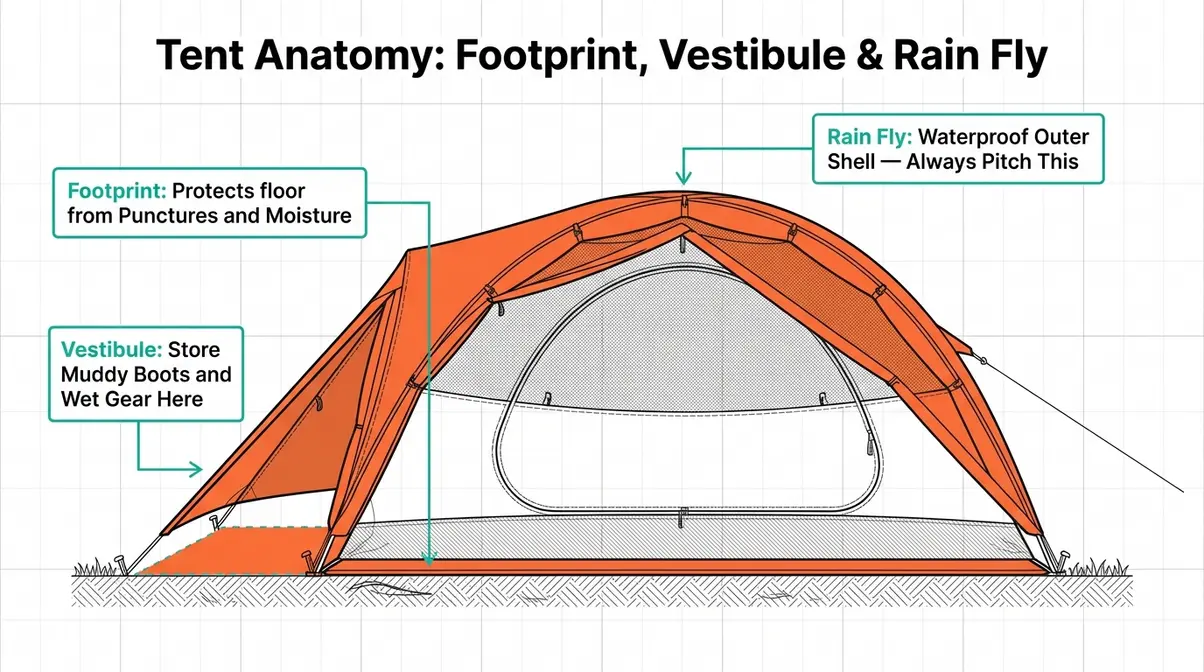
Three accessories confuse almost every new camper: the tent footprint, the tent pad, and the vestibule. None of them came with your tent (usually), and all three serve a specific purpose that becomes obvious once you’ve slept in rain or on rocky ground.
What Is a Tent Footprint?
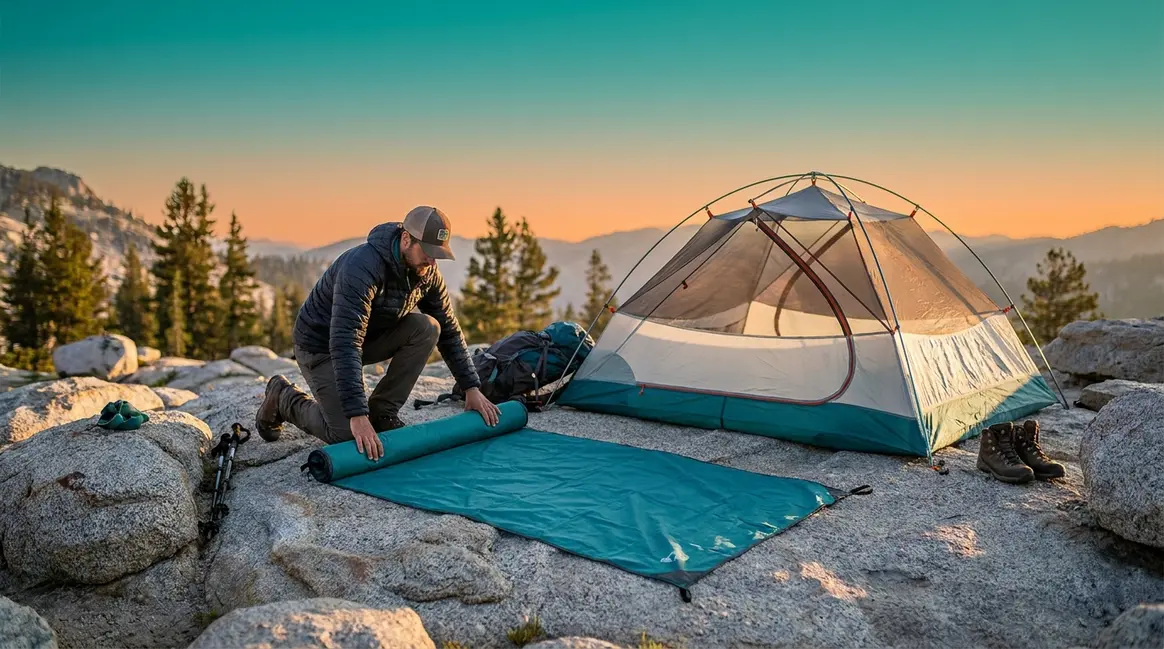
A camping tent footprint is a custom-cut ground cloth — typically made of polyester or polyethylene — placed directly under your tent floor between the tent and the ground. Think of it as a protective mat for the most vulnerable part of your shelter.
- Why you need it:
- Protects the tent floor from punctures caused by sharp rocks, roots, and gravel
- Reduces moisture seeping upward from wet ground
- Extends the lifespan of your tent floor fabric significantly
When it’s essential: Rocky or gravelly sites, wet conditions, and anytime you’re camping on terrain that isn’t soft grass. At established campgrounds with smooth gravel pads, it’s optional — but outdoor communities consistently recommend using one regardless.
Critical sizing note: Your footprint must be slightly smaller than the tent floor. If it extends beyond the tent edges, it funnels rainwater underneath your tent rather than away from it. For more detail on selecting the right ground protection, see our guide on understanding tent footprints and tarps.
A tent footprint extends the life of your tent floor by protecting against sharp rocks and moisture — making it one of the highest-value accessories available for under $30 from most outdoor retailers.
At developed campgrounds, you’ll also encounter a different kind of ground surface — the tent pad.
What Is a Tent Pad at a Campsite?
A tent pad is a designated flat area at a developed campsite — typically made of compacted gravel, packed dirt, or a wooden platform — where you’re expected to pitch your tent.
Why it exists: The tent pad serves three purposes. It protects surrounding vegetation from being trampled by repeated camping. It provides a level sleeping surface, which matters more than most beginners expect (sleeping on a slight slope is genuinely uncomfortable). It also improves drainage, directing water away from your tent during rain.
How to use it correctly: Place your tent directly on the pad. Use a footprint underneath if the surface is rough gravel. Do NOT pitch off the pad — this damages vegetation and may violate campsite rules at national and state parks.
Beyond the footprint and pad, one more tent feature trips up many beginners: the vestibule.
Tent Vestibule and Other Useful Add-Ons
A vestibule is an enclosed porch-like space at the tent entrance — created by the rain fly extending beyond the tent door — where you store muddy boots, wet rain gear, and day packs. It keeps the interior of your tent clean and dry.
Other accessories worth knowing before your first trip:
- Rain fly: The waterproof outer layer that covers your tent body. Most tents include one. Always pitch it even on clear evenings — weather changes fast.
- Guy lines: Thin cords that attach to the rain fly and stake into the ground, adding wind stability. Essential in exposed sites.
- Stakes: Metal or plastic pegs that anchor your tent to the ground. Never skip staking — an unstaked tent can collapse or blow away in moderate wind.
For a deeper look at how these pieces work together, our guide on the purpose of a tent vestibule and our guide to choosing your first camping tent cover setup in detail.
Key Rules Every Beginner Must Know
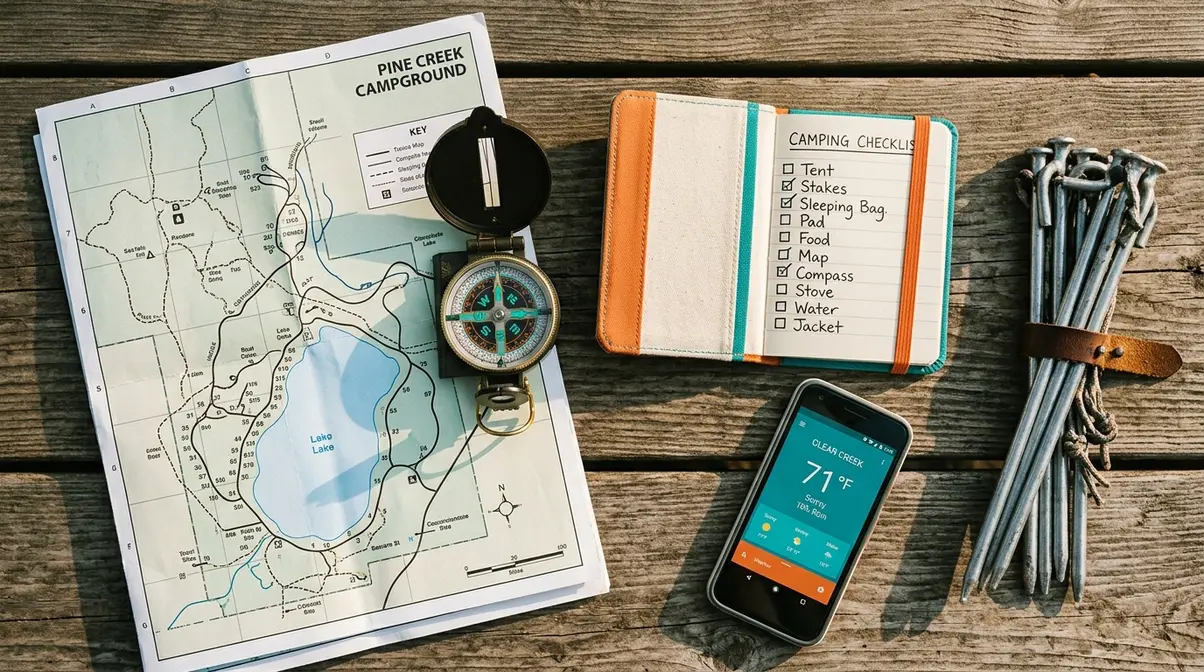
Every experienced camper follows a set of informal rules that make trips safer, more enjoyable, and more respectful of the environment. For beginners, four stand out as non-negotiable.
The 3-3-3 Rule for Tent Campers
The 3-3-3 rule is a travel pacing guideline that originated in the RV community and applies equally well to tent campers driving to campgrounds. It breaks into three simple limits:
- Drive no more than 300 miles per travel day — long drives cause fatigue, and arriving exhausted makes setup harder and less safe
- Arrive at your campsite by 3:00 PM — this gives you daylight to set up your tent, find firewood, and get oriented before dark
- Stay at least 3 nights at each location — one-night trips barely give you time to relax; three nights means two full days to actually enjoy where you are
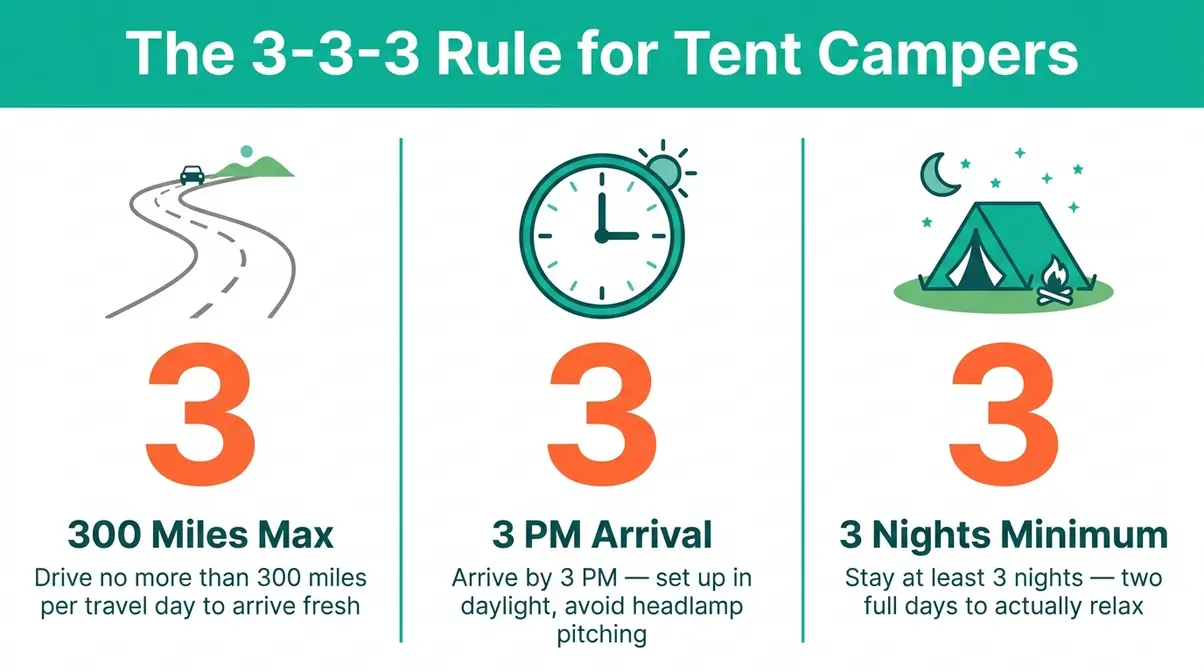
Why the 3 PM arrival matters most: Outdoor communities consistently report that arriving after dark is the single biggest source of first-trip stress. Pitching an unfamiliar tent by headlamp, on unfamiliar ground, after a long drive is a recipe for frustration. Arriving by 3 PM gives you time to troubleshoot.
The 3-3-3 rule drives no more than 300 miles, arrives by 3 PM, and stays 3 nights — the camping community’s most widely shared framework for making any first trip genuinely enjoyable rather than exhausting.
The 444 Rule
The 444 rule is a slower-travel variation of the 3-3-3 rule, suited for families, photographers, or anyone who wants to cover more ground per day while still arriving with time to settle in:
- Drive no more than ~400 miles per travel day
- Arrive by 4:00 PM
- Stay at least 4 nights at each stop
The extra distance and later arrival give you flexibility for longer highway stretches. The four-night minimum ensures you get at least three full days at each destination — enough time to explore a national park, hike multiple trails, or simply rest without feeling rushed.
Which rule is right for you? Use the 3-3-3 rule for your first trip — it builds in more buffer time. Graduate to the 444 rule once you’re comfortable with setup and campground navigation.
Temperature and Weather Safety
What temperature is too cold for tent camping? The answer depends on your gear — but outdoor communities and gear experts generally agree on the following thresholds:
| Conditions | Overnight Low | Gear Minimum |
|---|---|---|
| Mild — beginner safe | 40–60°F (4–16°C) | 3-season tent, 20°F sleeping bag, R-value 2–3 pad |
| Moderate — below freezing | 20–40°F (−7–4°C) | 3-season tent fully staked, 0°F bag, R-value 4+ pad |
| Advanced — hard freeze | 0–20°F (−18 to −7°C) | 4-season tent, −20°F bag, R-value 6+ layered pads |
| Expert only | Below 0°F (−18°C) | Expedition-grade tent + full cold-weather system |
The practical rule: Choose a sleeping bag rated at least 10–15°F colder than the lowest expected overnight temperature. A bag rated to 20°F does NOT mean you’ll be comfortable at 20°F — it means you’ll survive at 20°F. For comfort, you want meaningful buffer below the forecast low.
For beginners, the safest starting window is nights above 40°F (4°C) with a 3-season tent and a 20°F sleeping bag.
Leave No Trace and Campsite Rules
Leave No Trace (LNT) is a set of seven principles designed to minimize campers’ impact on the natural environment. For tent campers, the three most important rules are:
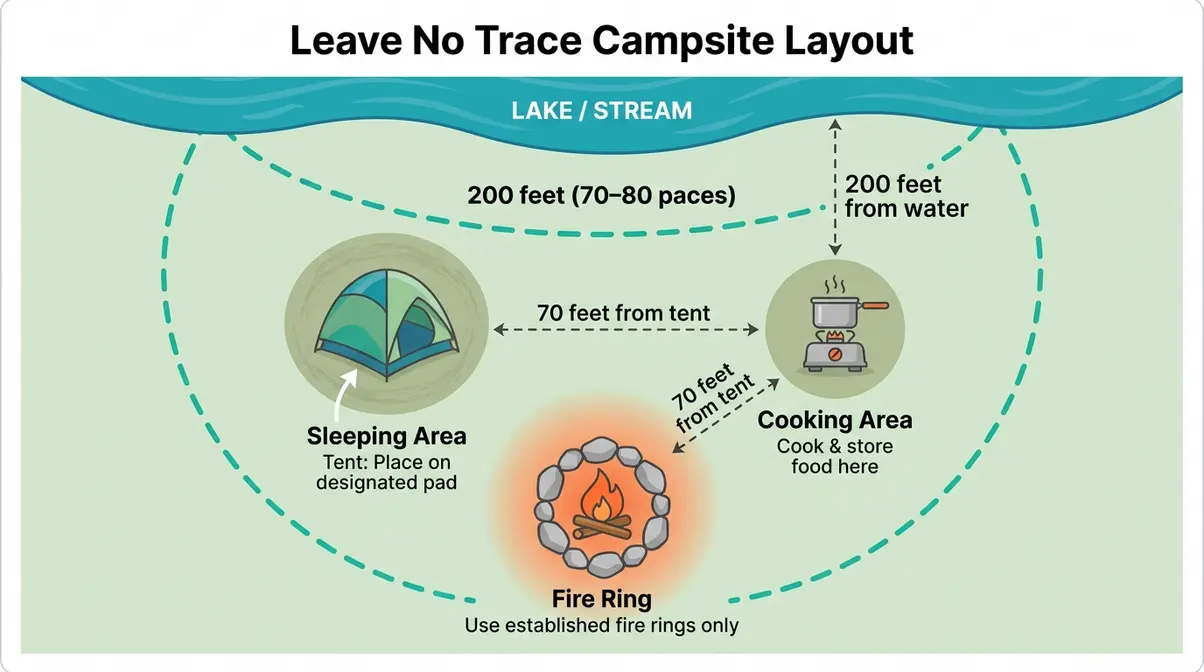
- Camp at least 200 feet from water sources — lakes, rivers, and streams. That’s roughly 70–80 adult paces. This keeps soap, food waste, and human waste out of drinking water and protects wildlife access to water.
- Pack out all trash — if you carried it in, carry it out. Leave the site cleaner than you found it.
- Use designated fire rings — never build a new fire ring; only use established ones, and fully extinguish fires before sleeping.
The 200-foot water setback applies to tent campers, RVers, and anyone sleeping in the backcountry. In developed campgrounds, follow the established site boundaries — the National Park Service sometimes places designated sites within 200 feet of water due to terrain, but the 200-foot rule still applies to washing and waste disposal (Leave No Trace, 2026).
Camping Without a Tent: The Alternatives
What Is Camping Without a Tent Called?
Camping without a tent goes by several names depending on the shelter method — or the complete absence of one. Bivouacking (often shortened to “bivy”) is the most common term: it refers to sleeping outdoors with minimal or no shelter, using just a sleeping bag and a ground pad, or a small waterproof bivy sack (an ultra-minimalist bag-shaped shelter).
- Other terms include:
- Open-air camping — sleeping under the stars with no overhead shelter
- Rough camping — an informal term for any camping without developed facilities or structured shelter
- Cowboy camping — sleeping directly on the ground in your sleeping bag, no tent or tarp
Can you sleep in an RV at Walmart overnight? This is a common question from road-trippers. Many Walmart locations allow overnight parking for RVs and campers, though policies vary by individual store and local ordinance. It is not tent camping — and it is not a substitute for a proper campsite — but it is a practical option for RV travelers mid-journey.
Bivouacking, Tarps, and Hammocks
Three shelter alternatives experienced campers use instead of traditional tents:
Bivy sacks are waterproof sleeping bag covers that add a layer of weather protection without any poles or setup. They’re ultralight (often under 1 lb) and work well in fair weather or as emergency backup. The trade-off: zero interior space and significant condensation buildup.
Tarps offer flexible, lightweight overhead coverage without full tent structure. You rig them between trees or trekking poles using guy lines and stakes. Setup requires practice and some knot knowledge. Tarps excel in dry climates and for experienced campers who prioritize weight savings over weather protection.
Hammocks suspend you between two trees, eliminating ground contact entirely. Hammock camping is growing in popularity in forested areas — it avoids rocky ground, improves airflow, and can be genuinely comfortable. However, it requires appropriate trees (6–8 inches in diameter minimum, appropriate distance apart) and an underquilt for warmth in cool temperatures.
Common Pitfalls and What to Avoid
Most Common Beginner Mistakes
Our evaluation of first-timer setups and outdoor community reports identifies eight mistakes that ruin more first camping trips than any other factors:
- Buying a tent the night before the trip — you haven’t practiced pitching it, and you’ll discover missing stakes in the dark at a campsite.
- Skipping the campsite reservation — popular campgrounds fill weeks or months in advance, especially on holiday weekends.
- Underestimating sleeping bag temperature ratings — a “40°F bag” means survival at 40°F, not comfort. Buy 10–15°F colder than your expected low.
- Forgetting a sleeping pad — this is not optional comfort gear. Cold ground conducts heat away from your body far faster than cold air. A sleeping pad is insulation, not luxury.
- Arriving after dark — pitching an unfamiliar tent by headlamp after a long drive is the most consistent predictor of a frustrating first trip.
- Overpacking food, underpacking layers — beginners pack enough food for a week and forget that temperatures drop significantly at night, even in summer.
- Ignoring the weather forecast — a 3-season tent in a surprise thunderstorm with no rain fly properly staked is a very wet night.
- Pitching the tent on a slope — even a slight incline means you’ll spend the night sliding toward the lower end of your sleeping bag.
Experience signal: Outdoor communities consistently report that mistakes #3 (sleeping bag rating) and #4 (no sleeping pad) are responsible for the most “never camping again” decisions among first-timers. Both are completely preventable with a five-minute gear check before you leave home.
When Tent Camping Isn’t the Right Choice
Tent camping is genuinely wonderful — but it isn’t the right fit for every situation or every person. Honest advice means acknowledging that.
- Consider an alternative if:
- You have mobility limitations that make ground sleeping painful or unsafe — a cabin, platform tent, or car camping cot setup may be more appropriate
- You’re camping with an infant in cold or wet conditions — the temperature management challenges of tent camping with very young children are real and require significant gear investment
- You’re in an area with active bear activity and no bear box or hang system — food storage requirements in some wilderness areas are complex for first-timers
- You genuinely dislike discomfort — and that’s fine. Glamping exists. Cabin camping exists. There is no hierarchy of worthiness in the outdoors.
The goal is to get outside. The shelter type is just the vehicle.
Frequently Asked Questions About Tent Camping
What is the meaning of tent camping?
Tent camping is the practice of sleeping outdoors in a portable fabric shelter you pitch and stake yourself, typically at a campground, forest site, or beach. It differs from RV camping (you sleep in a vehicle) and cabin camping (you sleep in a fixed structure) because the tent travels with you and requires active setup. The experience ranges from a developed campground with restrooms to remote wilderness with no facilities.
What is the 3-3-3 rule when camping?
The 3-3-3 rule is a camping travel guideline: drive no more than 300 miles per day, arrive at your campsite by 3 PM, and stay at least 3 nights. It originated in the RV community but applies equally to tent campers on road trips. The 3 PM arrival limit is the most important component — it ensures you have daylight for setup. Outdoor communities consistently rate it as the single most effective framework for stress-free first trips.
Is tent camping good for you?
Yes — research consistently links time in outdoor natural environments to meaningful health benefits. A systematic review indexed by the NIH found that physical activity in nature reduces fatigue and negative emotions while increasing energy (PMC6562165, 2019). The National Park Service cites evidence that time outside can improve mental health and reduce depressive thoughts (NPS, 2026). Utah State University Extension notes that camping helps people unplug from screens, supporting healthier sleep cycles. Even one weekend of tent camping produces measurable stress reduction in most participants.
What is the 444 rule for camping?
The 444 rule is a travel pacing guideline: drive no more than 400 miles per day, arrive by 4 PM, and stay at least 4 nights at each stop. It’s a slightly more flexible variation of the 3-3-3 rule, suited for campers who want to cover more distance while still arriving with daylight to spare. The four-night minimum is especially valuable for national park visits — it gives you three full days to explore rather than feeling rushed. Use the 3-3-3 rule for your first trip; graduate to 4-4-4 once you’re comfortable.
Sleeping in an RV at Walmart
Many Walmart locations permit overnight RV and camper parking, but policies vary by individual store. There is no national corporate guarantee — each store manager sets the local policy, and some municipalities prohibit it by ordinance. It is not tent camping, and it is not a substitute for a reserved campsite. To check availability, call the specific store ahead of arrival or use apps like Freecampsites.net or iOverlander. Never assume permission without confirming.
How do you stay warm while tent camping?
To stay warm while tent camping, you need a sleeping bag rated 10-15°F colder than the expected overnight low. Additionally, using an insulated sleeping pad is crucial because the cold ground draws heat away from your body faster than the air. Wearing moisture-wicking base layers and a warm hat to bed will also help trap your body heat inside the tent.
Is it safe to go tent camping alone?
Yes, it is generally safe to go tent camping alone if you take proper precautions and start at developed frontcountry campgrounds. Solo campers should always share their itinerary with a trusted friend, pack a first-aid kit, and carry a reliable communication device. Beginners are advised to gain experience in populated state or national parks before attempting solo backcountry trips.
Your First Tent Camping Trip Starts Here
If you started this guide wondering what is tent camping, you now know it is one of the most accessible ways to spend a night outdoors — and the research backs up what millions of campers already know. A systematic review in the NIH’s database confirms that physical activity in natural environments reduces fatigue and increases energy (PMC6562165, 2019). Whether you’re drawn to a quiet state park campground or a spot in the national forest, the barrier to entry is lower than most beginners expect.
The Comfort Spectrum Framework gives you the clearest possible starting point: identify where you fall on the spectrum from car camping to primitive camping before you spend a dollar on gear. Most first-timers belong at the car camping end — a designated site, a 3-season tent, a sleeping bag rated 10°F colder than the forecast low, and a sleeping pad. That’s the complete foundation.
Your next step is concrete: reserve a campsite at a state or national park for a Friday-to-Sunday trip within the next 60 days. Apply the 3-3-3 rule — drive no more than 300 miles, arrive by 3 PM, stay 3 nights. Bring the gear checklist from our beginner camping checklist and use our guide to choosing your first camping tent to select the right shelter. The only thing left is to go.
David King
Field gear tester at Tent Explorer.