Tent Materials Guide: Nylon, Canvas & DCF Explained
 Dave King
Updated June 29, 2026
17 min read
Dave King
Updated June 29, 2026
17 min read
You’re standing in a gear store — or scrolling a product page at midnight — and you see this: “20D Ripstop Silnylon, HH 3000mm.” You have no idea what any of it means.
“Read our jargon-busting guide to tent fabrics, denier counts & hydrostatic head ratings. Find the most durable, lightweight & waterproof tent materials.”
That confusion is completely normal. And the stakes are real. Pick the wrong tent material and you’re waking up to a wet sleeping bag at 2 a.m., a fly sagging onto your face in the rain, or a $600 ultralight tent that develops pinholes after one long trail. This tent materials guide explains every major spec, compares all five main fabrics, and tells you exactly which one fits your camping style — no engineering degree required.
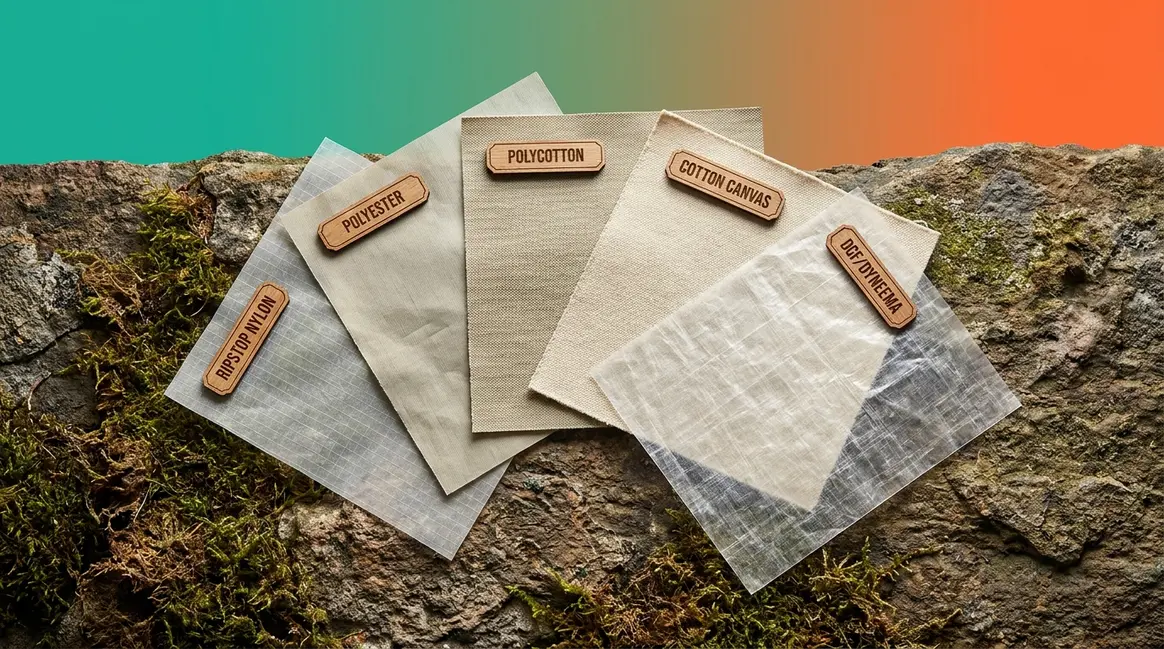
Every tent material forces a trade-off between three things: weight, durability, and weather performance. No single fabric wins on all three simultaneously — which is why so many options exist. This guide uses that framework, which we call the Weight-Durability-Weather Triangle, to help you decide which trade-off works for you. We’ll move from spec basics → synthetic fabrics → natural fabrics → ultralight options → structure types → a full comparison table.
This tent materials guide relies on the Weight-Durability-Weather Triangle — no fabric excels at weight, durability, and weather performance simultaneously, and your camping style determines which trade-off matters most.
- Nylon is lighter and stronger per gram — best for backpacking
- Polyester resists UV and won’t sag in rain — best for car camping
- Canvas/Polycotton breathes better and insulates — best for car camping and glamping
- DCF (Dyneema) is the lightest option but typically lasts only ~150 nights before pinholing becomes significant (The Trek, 2023)
- PFAS-free DWR coatings (2025 regulations) mean all tents need more regular re-treatment with products like Nikwax
How to Read Tent Fabric Specs (Before You Buy)
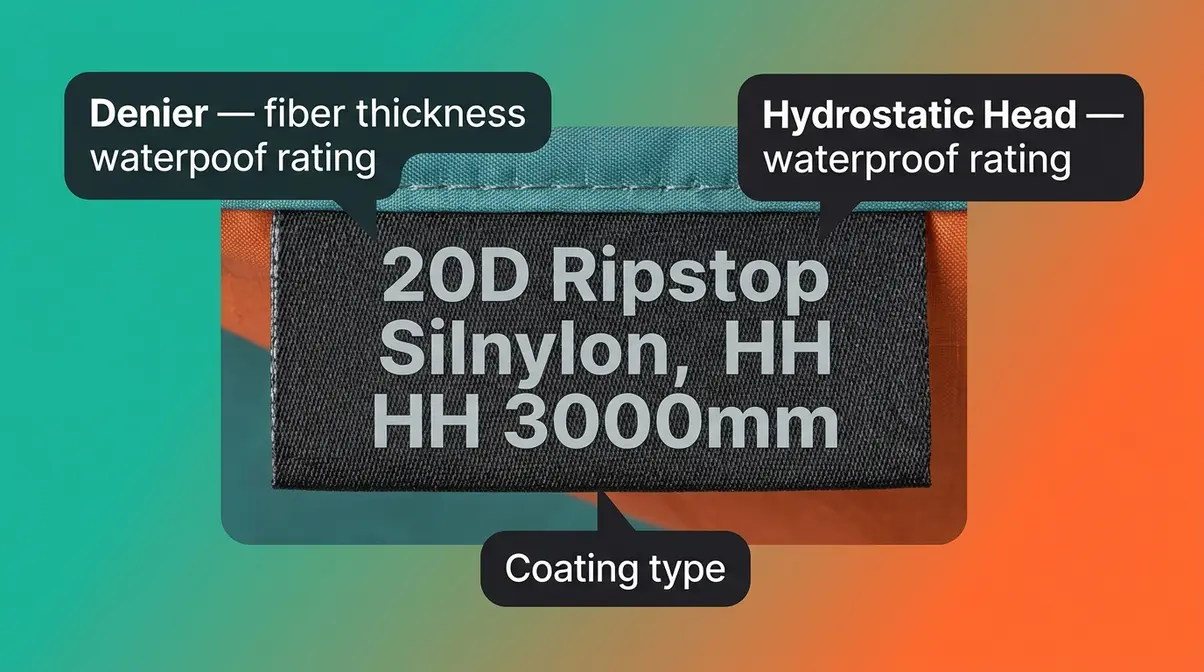
Before comparing tent materials, you need two numbers: the Denier rating and the Hydrostatic Head (HH) rating. Together, these specs tell you how thick the fabric is and how well it keeps out rain. Knowing how to read them takes about five minutes — and will save you from buying a tent that fails in a downpour.
Here’s a quick three-step approach to reading any tent spec tag:
- Find the Denier number (e.g., “20D” or “75D”) — this tells you how thick the fabric threads are
- Find the HH rating (e.g., “HH 3000mm”) — this tells you how waterproof the fabric is
- Check the coating type (Silicone, PU, or DCF) — this affects weight, feel, and long-term durability
The Weight-Durability-Weather Triangle shows up immediately here: a 10D fabric is feather-light but sacrifices durability; a 150D fabric is nearly bulletproof but adds significant pack weight. Every spec is a compromise.
What Is Denier — And Why It Matters
Denier (D) is a measure of fiber thickness in a fabric — specifically, the weight in grams of 9,000 meters of a single fiber. Think of it like the gauge of wire: a thinner wire (low Denier) is lighter but bends more easily, while a thicker wire (high Denier) is heavier but harder to break. It’s similar to thread count on bed sheets, except Denier measures thickness rather than density.
Here’s how Denier ranges across common tent fabrics:
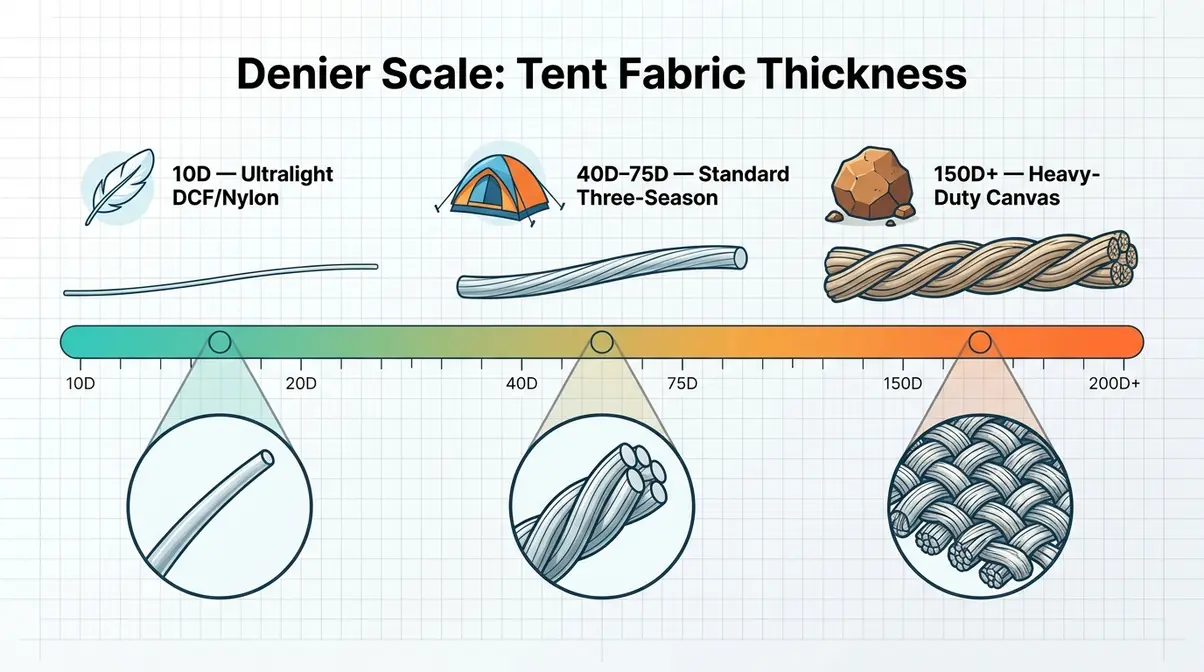
| Denier Range | Typical Use | Weight | Durability |
|---|---|---|---|
| 10D–20D | Ultralight backpacking (DCF, thin nylon) | Very light | Low — puncture-prone |
| 40D–75D | Standard three-season tents | Moderate | Good all-round |
| 100D–150D+ | Car camping, heavy-duty canvas | Heavy | High — abrasion-resistant |
Why does this matter for you? A 20D ripstop nylon fly weighs significantly less than a 75D polyester fly — but the 75D version resists abrasion from branches and rocky campsites far better. Lower Denier isn’t always better. It’s a trade-off between grams saved and nights of use gained.
For a deeper dive into how these specs appear on product pages, see this complete guide to tent fabric specifications.
Denier tells you how thick the fabric is. The Hydrostatic Head rating tells you how waterproof it is — and for wet-weather camping, that second number is arguably even more important.
Hydrostatic Head Ratings Explained
Hydrostatic Head (HH) is the standardized measure of how much water pressure a fabric can withstand before leaking — specifically, the height in millimeters of a water column placed on top of the fabric before it allows water through. The test method is defined by ISO 811:2018 hydrostatic pressure testing standards (ISO, 2018), the global benchmark used by every major tent manufacturer.
The diagram below shows exactly how the water column test works.
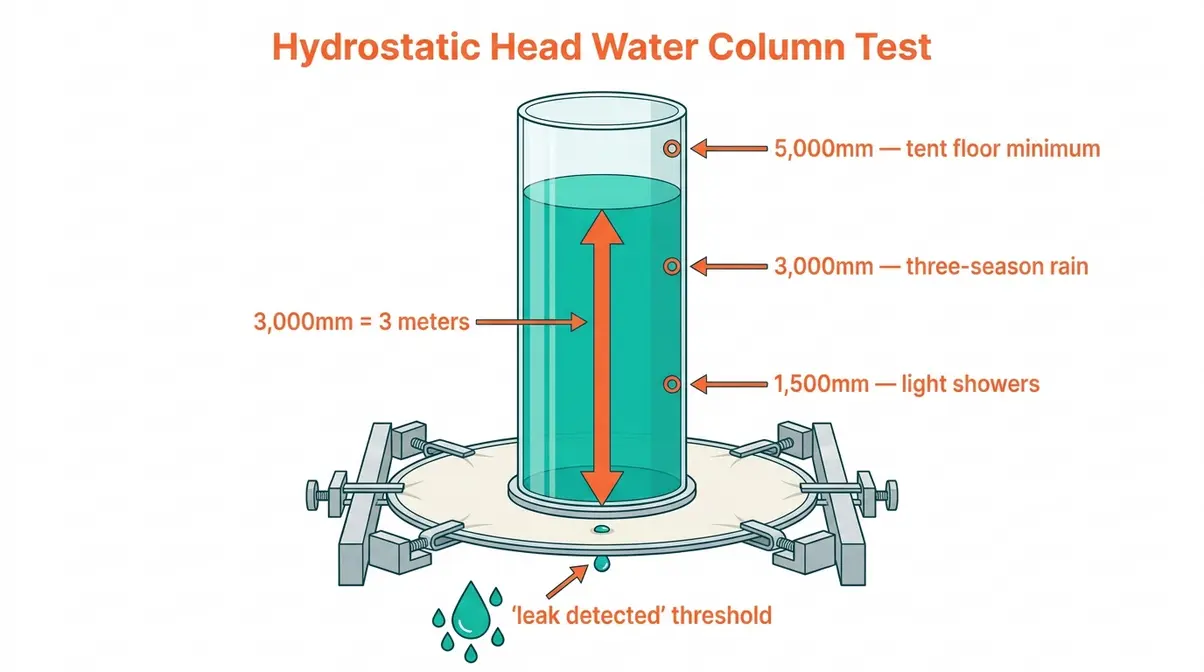
Tent fly fabrics should achieve a minimum Hydrostatic Head rating of 2,000–3,000mm for three-season camping; tent floors should meet 5,000–10,000mm to handle the added pressure of body weight on saturated ground (Crib Goch Outdoor, 2024; OutdoorAction, 2026).
Here’s a practical breakdown:
| Rating | What It Handles | Best For |
|---|---|---|
| 1,000–1,500mm | Light showers, dry climates | Summer festival tents |
| 2,000–3,000mm | Sustained rain, three-season use | General camping |
| 3,000–5,000mm | Heavy rain, backpacking, stormy conditions | Backpacking fly |
| 5,000–10,000mm | Ground pressure, saturated terrain | All tent floors |
One important distinction: HH measures the fabric’s inherent waterproofing (the coating itself). Durable Water Repellent (DWR) is the outer finish applied to the tent fly’s face that makes water bead and roll off. When DWR degrades, the surface “wets out” and feels damp — but the HH coating underneath still prevents leakage. A 1,500mm HH tent is fine for light drizzle but will struggle in sustained rain. A 3,000mm fly handles most three-season conditions confidently.
Now you know how to evaluate a tent’s specs. But there’s one more thing every tent buyer needs to understand: a regulatory shift that’s quietly changing how every tent on the market keeps you dry.
PFAS-Free Regulations and Waterproofing
Per- and polyfluoroalkyl substances (PFAS) are the synthetic chemicals historically used in Durable Water Repellent (DWR) coatings — the treatment applied to the outer face of tent fly fabrics to make water bead off. PFAS-based DWR made fabrics shed water exceptionally well, but these chemicals are highly persistent in the environment and in human tissue, earning them the nickname “forever chemicals.”
Starting January 1, 2025, California (AB 1817) and New York (S.1322/A.994) enacted bans on intentionally added PFAS in textiles and apparel (Morgan Lewis, 2024). Outdoor apparel for severe wet conditions has a phased timeline — full restrictions apply by January 1, 2028 — but the direction is clear: PFAS-based DWR is on the way out across the industry (bluesign, 2026). Research from the NIH has documented the persistence and bioaccumulation of PFAS compounds in both ecosystems and human tissue, reinforcing why regulators moved decisively.
What this means for you: PFAS-free DWR alternatives perform well but tend to degrade faster under UV exposure and heavy use than legacy coatings. This means your tent fly will need re-treatment more frequently. The good news: products like Nikwax have been PFAS-free since the company’s founding in 1977, and Nikwax is now recommended by environmental organizations including Toxic Free Future as a safe, effective re-treatment option for tents and outdoor gear (Toxic Free Future, 2025). Plan to re-treat your fly every season, or any time water stops beading on the surface.
Nylon vs. Polyester: Synthetic Fabrics
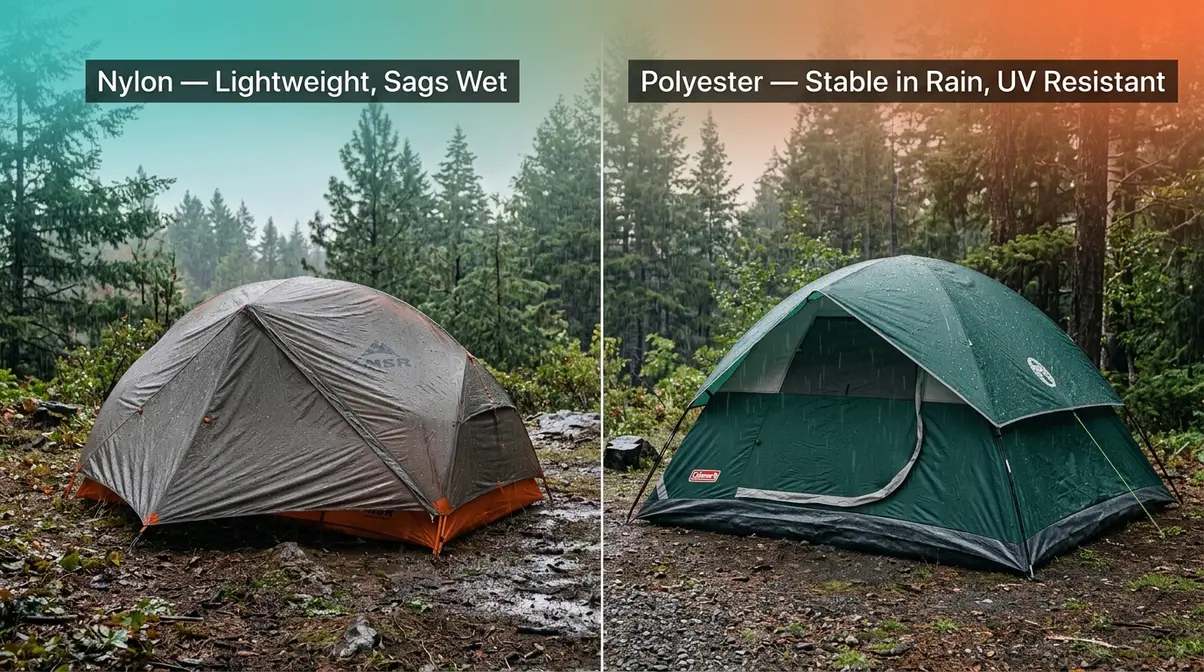
Nylon and polyester are the two most common tent materials in the world. Both are synthetic, both are durable, and both are far lighter than canvas. However, they behave very differently when wet — and that difference shapes everything from overnight comfort to how often you’re crawling out in the rain to re-tension your fly.
Understanding the nylon-polyester trade-off is central to the Weight-Durability-Weather Triangle: nylon wins on raw strength-to-weight, but polyester wins on weather stability.
Nylon Tent Fabric: Lightweight Champion
Nylon is the default choice for backpacking tents because it delivers the best strength-to-weight ratio of any coated synthetic fabric. A 20D nylon fly can be remarkably strong for its weight — and when a tent manufacturer needs to shave every gram, nylon is usually the answer.
The trade-off is water behavior. Nylon is hydrophilic (water-attracting), meaning it absorbs moisture directly into its fibers. In wet conditions, nylon tent fabric absorbs approximately 4–8% of its weight in water at the fiber level, expands by 2–4% dimensionally, and can lose around 10% of its tensile strength when fully saturated (Durston Gear, 2025; Argali Outdoors, 2025). In practice, this means a nylon fly that’s pitched perfectly at dusk can be noticeably saggy by morning — touching the inner tent and potentially causing drip-through.
Nylon also degrades faster under UV exposure than polyester. One field test documented nylon losing approximately 40% of its rip strength after 120+ days of continuous UV exposure (YouTube field test, 2024). For tents that spend long days in direct sun — festival tents, base camps, extended trips — that degradation is real.
User consensus across outdoor communities indicates nylon is the right choice when pack weight is the priority and the tent will be used in variable conditions with reasonable care. For backpackers counting grams, its strength-to-weight advantage is genuinely hard to beat.
Polyester Fabric: Weather Resistance
Polyester is the workhorse of car camping tents — and increasingly, of performance backpacking shelters too. Its key advantage over nylon is dimensional stability in wet conditions. Polyester is hydrophobic (water-repelling), with a moisture absorption rate in the tenths of a percent by fabric weight (Argali Outdoors, 2025). Where nylon expands 2–4% when wet and sags, polyester maintains its pitch through overnight rain without re-tensioning.
Polyester also holds up significantly better under UV exposure. That same field test showing nylon losing 40% rip strength under sustained UV found polyester degrading far more slowly — a critical advantage for tents used in sunny climates or left pitched for extended periods.
The trade-off is weight. Polyester fibers are slightly heavier than comparable nylon fibers for the same tensile strength. For car campers hauling gear to a trailhead parking lot, that extra weight is irrelevant. For ultralight backpackers, it matters.
Polyester delivers superior weather stability and UV resistance — nylon delivers superior raw strength per gram. Your camping style determines which advantage matters more.
Silnylon vs. Silpoly: Silicone Coatings
Most modern backpacking tents use one of two silicone-coated fabrics: Silnylon (silicone-coated nylon) or Silpoly (silicone-coated polyester). The silicone coating on both sides dramatically improves waterproofing and reduces water absorption compared to uncoated or PU-coated versions — but the underlying fiber behavior still matters.
Silnylon inherits nylon’s hydrophilic tendency. Even with silicone coating, silnylon absorbs more moisture than silpoly and stretches when wet, causing overnight sag and added pack weight on rainy mornings. However, silnylon is typically lighter and has slightly better packability.
Silpoly resists water absorption far more effectively. Because the polyester base fiber is hydrophobic, silpoly maintains tent pitch through sustained rain without frequent re-tensioning — a significant practical advantage for multi-day trips in wet climates (Jotun Gear, 2025; Nortent, 2025).
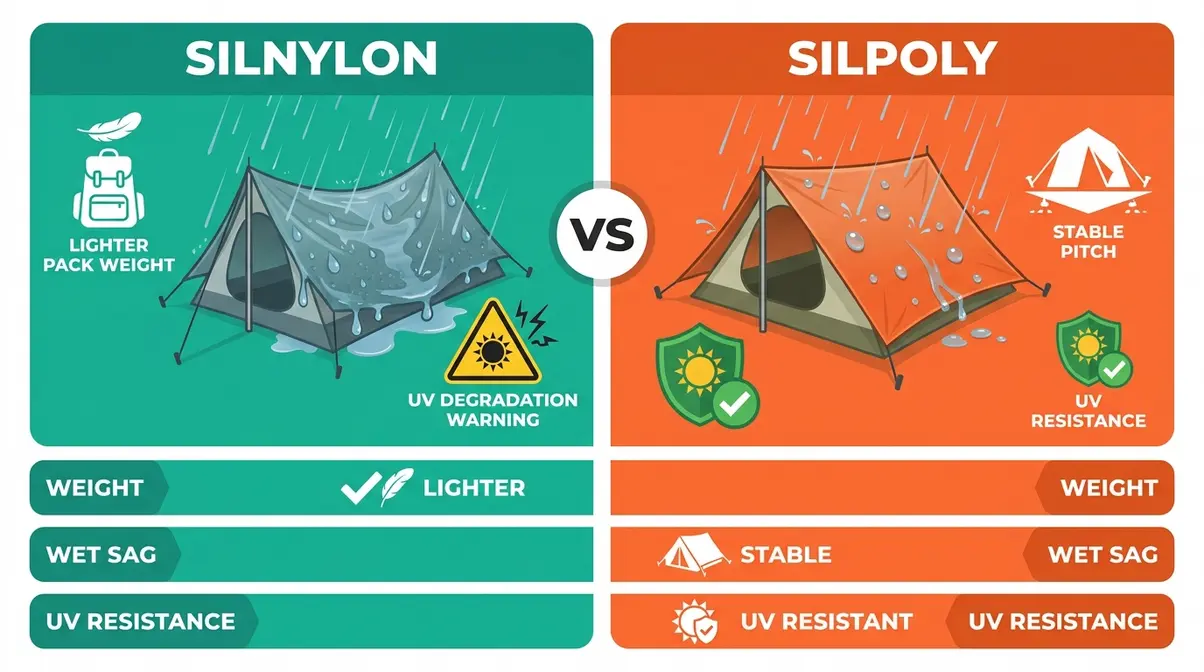
The quick verdict: If you camp frequently in the Pacific Northwest, UK, or any reliably wet region, silpoly’s no-sag performance is worth the marginal weight penalty. If you’re a gram-counter thru-hiking in variable conditions, silnylon’s lighter base weight may tip the scale.
Where silnylon and silpoly excel at lightweight performance, canvas and polycotton take a completely different approach — prioritizing breathability and long-term comfort over pack weight.
Is nylon or polyester better for a tent?
It depends on how you camp. Nylon is lighter and stronger per gram, making it the dominant choice for backpacking tents where pack weight is the priority. Polyester absorbs far less water (tenths of a percent vs. 4–8% for nylon), maintains pitch better in rain, and resists UV degradation more effectively — making it the better choice for car camping and wet climates (Argali Outdoors, 2025; Durston Gear, 2025). For a tent used mostly in the rain, silpoly outperforms silnylon. For a tent where every gram counts on long trails, silnylon has the edge.
Canvas and Polycotton: When Comfort Beats Weight
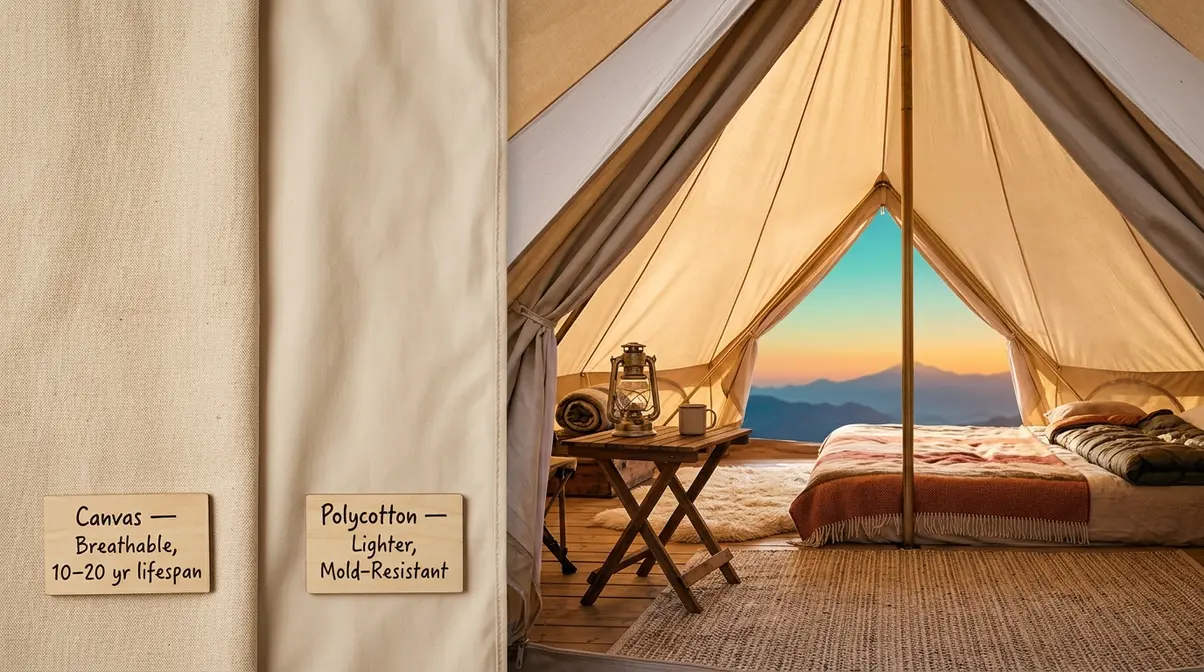
Canvas and polycotton tents are heavy. That’s not a flaw — it’s the price of admission for a camping experience that feels fundamentally different from a synthetic tent. These fabrics breathe naturally, regulate temperature, and resist condensation in ways that nylon and polyester simply cannot match. For car campers, glampers, and anyone who prioritizes a comfortable base camp over a light pack, they represent the far end of the Weight-Durability-Weather Triangle.
User consensus across camping communities consistently highlights one complaint about synthetic tents: waking up to condensation dripping from the ceiling. Canvas largely solves that problem.
Cotton Canvas: Breathability & Longevity
Cotton canvas is the original tent material — and it remains the gold standard for breathability and temperature regulation. Cotton fibers are naturally permeable, allowing water vapor (body heat and breath) to pass through the fabric rather than condensing on the inner surface. In cold conditions, this makes a canvas tent noticeably warmer and drier inside than a comparable synthetic tent.
Canvas tents also last decades with proper care. The thick fiber construction (typically 100D–300D+) resists abrasion, puncture, and UV degradation far better than ultralight synthetics. Common complaints from backpackers who’ve tried canvas include the weight (a typical canvas tent weighs 15–30 lbs) and the setup time — but car campers who’ve switched to canvas rarely go back.
The critical maintenance requirement: canvas must be dried completely before storage. Damp canvas stored in a bag will mold within days, and mold permanently damages the waterproofing and structural integrity of the fabric. Canvas also requires “weathering in” — a process of wetting and drying the new tent two or three times to allow cotton fibers to swell and close microscopic gaps, achieving full waterproofing.
For anyone who experiences condensation problems in synthetic tents, canvas is worth serious consideration — provided you have the vehicle space to carry it.
Polycotton: The Best of Both Worlds
Polycotton (also called poly-cotton or TC — “technical cotton”) blends synthetic polyester fibers with natural cotton fibers, typically in a 65/35 or 60/40 polyester-to-cotton ratio. The result is a fabric that retains most of canvas’s breathability while cutting the weight by 20–40% and improving resistance to mold and mildew.
Polycotton tents breathe far better than pure synthetic tents and significantly better than pure canvas in humid conditions. The polyester content provides dimensional stability — polycotton doesn’t sag as dramatically as pure canvas when wet — while the cotton content delivers the natural breathability that prevents condensation buildup.
The trade-off versus pure canvas: polycotton doesn’t quite match canvas’s extreme longevity or its insulation in very cold conditions. The trade-off versus synthetics: polycotton is still considerably heavier than nylon or polyester — typically 8–18 lbs for a family-sized tent.
For car campers and glampers who want the comfort of canvas without the full weight penalty, polycotton is the practical middle ground. It’s particularly well-suited to extended base camps, festival camping, and four-season use where breathability matters more than pack weight.
Dyneema (DCF): The Ultralight Premium Choice
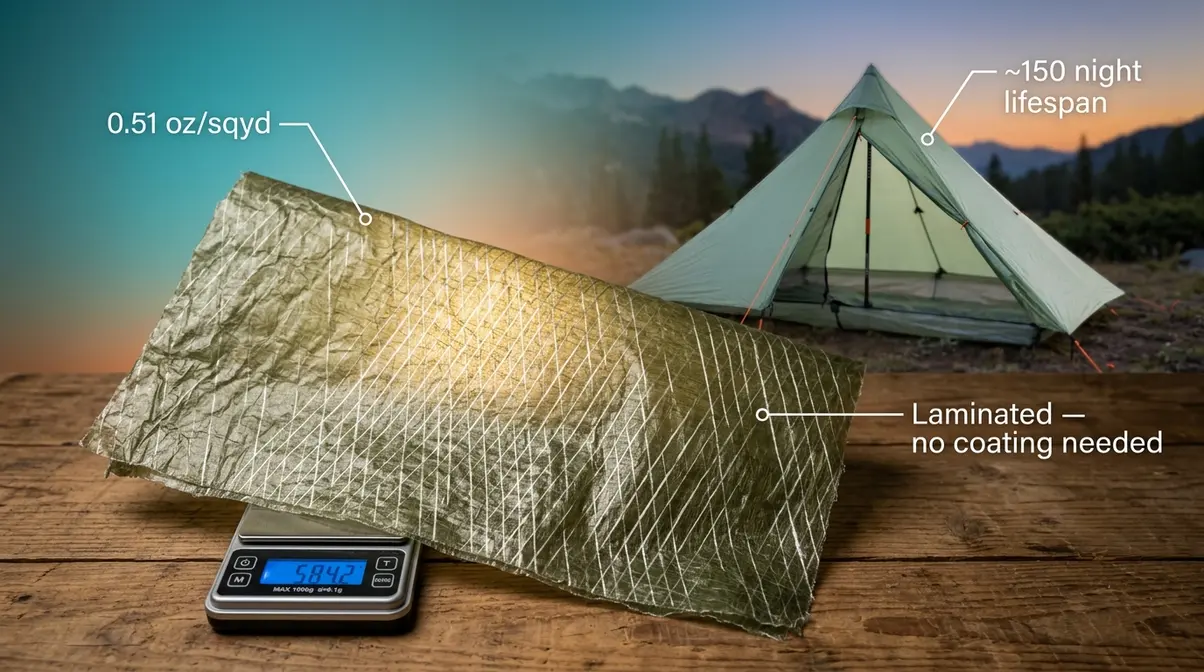
Dyneema Composite Fabric (DCF) — previously known as Cuben Fiber — is the most technically advanced tent material available to recreational campers. It’s made from ultra-high-molecular-weight polyethylene (UHMWPE) fibers laminated between two thin polyester films, rather than woven like traditional fabrics. The result is a material that’s extraordinarily strong for its weight, completely waterproof without any coating, and unlike anything else in the tent market.
DCF sits at the extreme weight corner of the Weight-Durability-Weather Triangle. It achieves that position by making significant compromises on the durability side — compromises that brand marketing rarely discusses honestly.
Why are DCF tents so expensive?
DCF’s tensile strength is remarkable — Dyneema fibers achieve a tensile strength of approximately 2.7 GPa, making them pound-for-pound stronger than steel (Purdue University, 2019). The manufacturing process is also complex and expensive: individual Dyneema fibers are aligned in specific orientations and laminated under controlled conditions to create the composite sheet. Unlike woven fabrics, DCF cannot be produced on standard textile looms.
The result is a fabric that costs roughly 5–10x more per square yard than silnylon or silpoly. A DCF tent that weighs under 600 grams can carry a price tag of $500–$1,200 or more. You’re paying for the weight savings — and for thru-hikers and ultralight enthusiasts who count every gram across a 500-mile trail, that price is genuinely justifiable.
DCF also doesn’t rely on a DWR coating for waterproofness. The polyester film laminate is inherently waterproof, which means it doesn’t degrade in the same way that coated fabrics do. This is a meaningful advantage in the current PFAS-free DWR era — DCF tents don’t need re-treatment.
In summary, DCF tents are expensive because Dyneema composite fabric costs roughly 5-10x more per square yard than standard silnylon or silpoly — the result of a complex lamination manufacturing process that can’t be replicated on standard textile equipment. DCF achieves a tensile strength of approximately 2.7 GPa (Purdue University, 2019), making it pound-for-pound stronger than steel. A DCF tent can weigh under 600 grams while remaining fully waterproof without any coating. That combination of extreme lightness and inherent waterproofness commands a premium, but buyers should weigh the ~150-night lifespan against the $500-$1,200+ price tag.
Real-World DCF Lifespan: 150 Nights
Here’s what the marketing materials don’t emphasize: DCF tents typically last approximately 150 nights of hard use before pinholing and delamination become significant problems — roughly half the lifespan of quality silnylon or silpoly tents, which commonly last 300–400 nights (The Trek, 2023; trek-lite.com, 2025).
The failure mode is abrasion. A single slide against rough rock can create dozens of microscopic pinholes in standard 0.51 oz DCF. Pinholes commonly begin appearing around 75–130 nights in harsher conditions — on tent floors, at corners, and around high-stress points like trekking pole cups and line locks (Facebook hiking communities, 2024). Once pinholes develop, waterproofness gradually diminishes from the inside out, with water creeping through invisibly before becoming noticeable.
Heavier 0.8 oz DCF is significantly more durable than standard 0.51 oz DCF — and lasts substantially longer before delamination — but also costs more and adds pack weight (trek-lite.com, 2025). Under gentle conditions with clean campsites and loose storage (never compress DCF with hard creases), some users report 200+ nights with minimal visible wear (Facebook, 2024). Under hard conditions — dusty trails, rocky ground, frequent tight-packing — pinholes can appear in as few as 75 nights.
DCF tents often last just half as long as silnylon and silpoly alternatives — most manufacturers and long-distance hikers cite approximately 150 nights as a realistic benchmark for standard 0.51 oz DCF (The Trek, 2023).
| Fabric | Typical Lifespan | Primary Failure Mode |
|---|---|---|
| Standard DCF (0.51 oz) | ~150 nights | Pinholing, delamination |
| Heavy DCF (0.8 oz) | Significantly longer | Pinholing (slower) |
| Silnylon / Silpoly | 300–400 nights | Coating degradation, UV |
| Canvas | 10–20+ years | Mold if stored damp |
For thru-hikers doing one big trail and then retiring the tent, DCF’s weight advantage is worth every dollar. For someone who wants a tent that lasts a decade of weekend trips, silnylon or silpoly is the smarter investment.
Pole vs. Frame Tents: Choosing Structure
Tent structure affects more than setup experience — it determines which tent materials work, which surfaces you can pitch on, and how much weather protection you actually get. The fabric and the structure are inseparable parts of the same system.
This section captures the core structural trade-off that most fabric guides ignore entirely.
Pole Tent Basics: Outdoor Surfaces Only
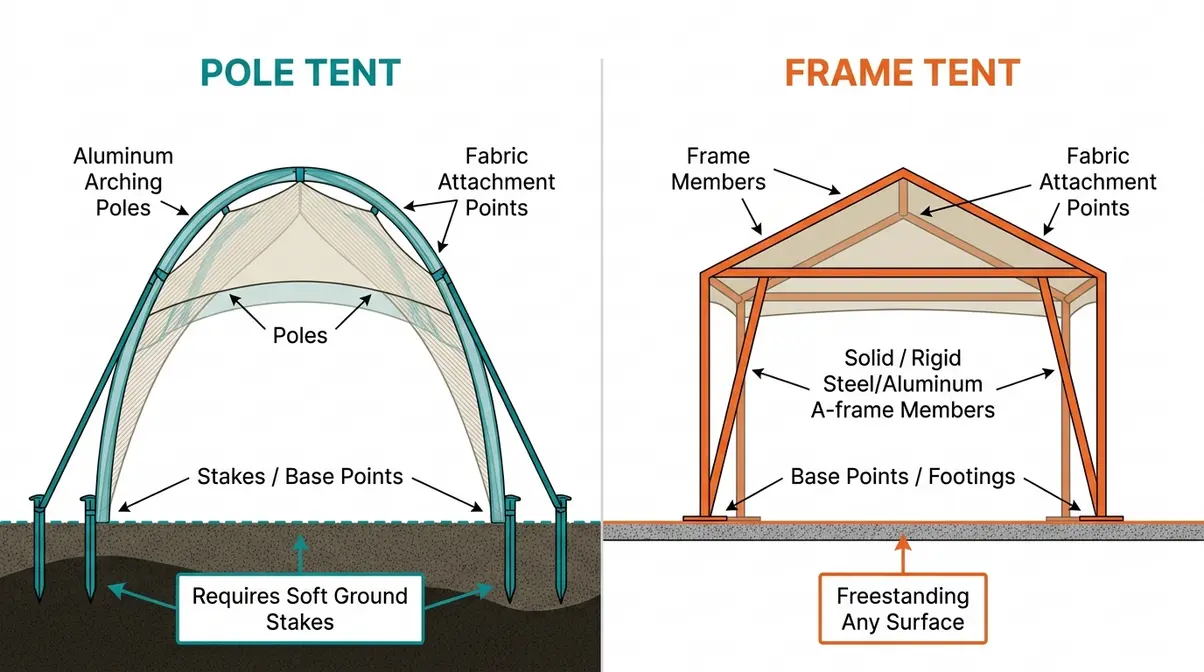
A pole tent (also called a tension tent or staked tent) relies on a combination of poles and ground stakes to create its structure. The poles create the frame shape, and the stakes pull the fabric taut — without stakes, a pole tent collapses. This design is efficient and lightweight, which is why nearly all backpacking tents use it.
Pole tents work exclusively on soft ground — grass, dirt, sand — where stakes can penetrate. Pavement, concrete, decking, or compacted gravel all prevent proper staking. In those conditions, a pole tent simply cannot be pitched safely.
Most backpacking tents, three-season tents, and lightweight camping tents use this structure. The poles are typically aluminum (strong, light, repairable) or carbon fiber (lighter but more brittle). Fiberglass poles are common in budget tents — they’re heavier and more prone to shattering in cold temperatures.
Frame Tent Basics: Freestanding Setup
A frame tent uses a rigid, self-supporting steel or aluminum frame that stands independently of ground stakes. The fabric hangs from or attaches to this frame, creating a stable structure without requiring any ground penetration. Frame tents can be pitched on pavement, concrete, wood decking, or any hard surface — making them the standard choice for events, festivals, markets, and any venue where staking isn’t possible.
Frame tents are heavier and bulkier than pole tents — the steel or aluminum frame adds significant weight — but they offer interior headroom and stability that pole tents can’t match at equivalent sizes. A 10×10 pop-up frame tent can be set up by one person in minutes, making it practical for events where speed matters.
The fabric used on frame tents is typically heavier polyester (150D–300D) or polycotton, chosen for UV resistance and durability under repeated setup and takedown cycles rather than pack weight. Canvas frame tent covers are also common for permanent or semi-permanent installations.
Choose a pole tent if you’re camping on natural ground and pack weight matters. Choose a frame tent if you need a freestanding structure on any surface, or if you’re setting up for an event rather than a wilderness trip.
Tent Material Showdown: Comparison Table
This is the section that most tent buyers wish existed before they made their purchase. The table below compares all five major tent materials across the five dimensions that matter most for real-world decisions — dimensions that the Weight-Durability-Weather Triangle maps directly onto.
User consensus across outdoor communities and gear review sites indicates these are the trade-offs that actually drive purchasing regret when buyers get them wrong.
| Material | Tear Strength | UV Resistance | Wet Sag | Lifespan (Nights) | Relative Cost |
|---|---|---|---|---|---|
| Nylon (Silnylon) | High | Moderate | Moderate (2–4% expansion) | 300–400 | Low–Moderate |
| Polyester (Silpoly) | Moderate–High | High | Very Low (<1% absorption) | 300–400 | Low–Moderate |
| Canvas (Cotton) | Very High | High | Low (sags when very wet) | 3,000+ nights / 10–20 yrs | Moderate |
| Polycotton | High | High | Low | 2,000+ nights | Moderate |
| DCF (Dyneema) | Very High (per gram) | Moderate | None | ~150 nights (0.51 oz) | Very High |
A few things stand out immediately. DCF has the highest strength-to-weight ratio of any material on this list — but its real-world lifespan is dramatically shorter than every other option. Canvas lasts longest by a wide margin but weighs the most. Silpoly hits a practical sweet spot for car campers and backpackers who camp in wet conditions regularly.
No single material wins across all five dimensions. That’s the Weight-Durability-Weather Triangle in action — every choice is a deliberate trade-off, and the right answer depends entirely on how you camp.
For a broader look at how these specs appear across specific tent models and manufacturers, resources like bettertrail.com’s backpacking tent fabric guide offer useful supplementary comparisons.
Common Tent Material Mistakes to Avoid
Even experienced campers make these errors. Understanding the most common fabric mistakes helps you evaluate tents more critically — and avoid expensive purchases you’ll regret after your first rainy night.
The Three Most Common Fabric Mistakes
Mistake 1: Choosing ultralight DCF for a first tent.
DCF tents are exceptional tools for experienced thru-hikers who understand their limitations. For first-time buyers, they’re a high-risk investment. The ~150-night lifespan, the pinhole vulnerability, and the price point ($500–$1,200+) make DCF a poor fit for someone still learning how to pitch and pack a tent carefully. A quality silnylon or silpoly tent at $150–$400 will serve a beginner far better across years of use.
Mistake 2: Ignoring the floor HH rating.
Most buyers check the fly’s waterproof rating and ignore the floor. This is backwards. Tent floors experience far more pressure than the fly — from body weight, kneeling, and saturated ground pushing upward. A fly rated 3,000mm is excellent. A floor rated 3,000mm is borderline acceptable. Look for 5,000mm+ on any tent floor you plan to use in genuinely wet conditions (Crib Goch Outdoor, 2024).
Mistake 3: Storing a tent wet.
This applies especially to canvas and polycotton, where damp storage causes mold within days — permanently damaging the waterproofing. But synthetic tents stored damp can also develop mildew, degrade their coatings faster, and develop unpleasant odors. Always pitch and dry a tent before packing it away, even if that means setting it up in your backyard the next morning.
Choosing a Different Material Entirely
Sometimes the right answer is to step back from the material comparison entirely and reconsider the use case.
If you camp primarily in summer in dry climates, a 1,500–2,000mm HH tent in standard polyester or nylon is perfectly adequate — you don’t need to pay for 5,000mm waterproofing you’ll rarely need.
If you camp in the same spot for weeks at a time — base camps, extended expeditions, festival setups — canvas or polycotton outperforms every synthetic option on breathability and long-term comfort, regardless of the weight penalty.
If budget is the primary constraint, a 40D–75D polyester tent with PU coating in the $80–$200 range handles three-season camping reliably. The diminishing returns on premium fabrics are real — a $900 DCF tent doesn’t keep you 10x drier than a $150 silpoly tent; it just weighs less.
For guidance on specific tent models that use these materials, Section Hiker’s ultralight fabric guide provides detailed real-world analysis of DCF, silnylon, and silpoly in practice.
Frequently Asked Questions
What does Denier mean for a tent?
Denier (D) measures the thickness of individual fabric fibers — specifically, the weight in grams of 9,000 meters of a single thread, where lower Denier means thinner, lighter fibers and higher Denier means thicker, more abrasion-resistant fibers. A 20D tent fly is suitable for ultralight backpacking where weight is critical, while a 75D fly handles rough campsites and extended use better because the trade-off is direct: lighter Denier saves grams but sacrifices durability. For most three-season backpacking, 40D–75D is the practical sweet spot.
What is a good hydrostatic head rating?
A good HH rating for a three-season tent fly is 2,000–3,000mm; the tent floor should be rated 5,000–10,000mm. The fly faces rain from above, but the floor faces body-weight pressure pushing against saturated ground — which multiplies the effective water pressure dramatically. A 1,500mm fly handles light showers but may struggle in sustained rain. For backpacking in wet climates like the Pacific Northwest or UK, 3,000–5,000mm on the fly is the recommended minimum (Crib Goch Outdoor, 2024). Always check both ratings separately before buying.
What are the pros and cons of cotton?
Cotton canvas tents offer exceptional breathability, temperature regulation, and longevity — but at significant weight and maintenance cost. The pros: canvas breathes naturally, preventing condensation buildup; it insulates better than synthetics in cold conditions; and a well-maintained canvas tent can last 10–20 years. The cons: canvas tents weigh 15–30 lbs (USDA Forest Service), require “weathering in” before they’re fully waterproof, and must be dried completely before storage to prevent mold. For car campers and glampers who prioritize comfort over portability, canvas is hard to beat. For anyone counting pack weight, polycotton or synthetic is the practical alternative.
Making the Right Choice for Your Camping Style
This tent materials guide has shown that the Weight-Durability-Weather Triangle gives you a clear framework for every tent material decision. No fabric wins on all three axes simultaneously — and that’s not a flaw in the market, it’s a reflection of genuine physics. Lighter materials sacrifice durability. More durable materials add weight. Fabrics optimized for weather performance often compromise on one of the other two.
Here’s how the five materials map to real camping styles: backpackers counting grams should look at silnylon (lightest) or silpoly (better wet-weather stability); car campers who want reliable performance in rain should prioritize silpoly or standard polyester with a 3,000mm+ fly and 5,000mm+ floor; comfort-focused campers and glampers will find canvas or polycotton transforms the experience; thru-hikers doing one major trail can justify the DCF premium, knowing they’ll likely retire the tent after that journey.
The PFAS-free shift reshaping the industry right now means one thing for every tent owner: plan to re-treat your DWR coating annually with a PFAS-free product like Nikwax, regardless of which fabric you choose. The era of “buy it and forget the waterproofing” is over.
Start by identifying which corner of the Weight-Durability-Weather Triangle matters most for how you actually camp — not how you imagine you’ll camp. Then use the Denier and HH ratings in this guide to evaluate any tent spec sheet with confidence. Your next tent purchase doesn’t need to be a gamble.

Dave King
I'm Dave King. I publish Tent Explorer, a site built to answer the questions people actually ask before they buy.