
Types of Camping Tents Explained: The Complete Guide
 Dave King
Updated June 20, 2026
29 min read
Dave King
Updated June 20, 2026
29 min read
You’ve been staring at tent listings for an hour, and somehow you feel more confused than when you started.
“I’ve been looking at tents and there are dome shapes, and tee-pee shapes, a frame, geodesic and more…. Can someone tell me what the different shapes are?”
— A real question from r/camping
That question captures exactly what most beginner campers feel. The wrong tent choice can ruin a trip — a heavy cabin tent lugged three miles on a solo hike, or a flimsy pop-up that leaks through the first real rainstorm. Both scenarios are avoidable, and neither requires you to become a gear expert.
By the end of this guide, you’ll understand every major shelter option, know exactly which one fits your camping style, and have a simple decision framework to evaluate any tent you encounter. With the different types of camping tents explained in plain English, we’ll cover the 7 main designs, 3 specialized options for advanced campers, the 6 key factors that actually matter when choosing, and the most common beginner mistakes to avoid.
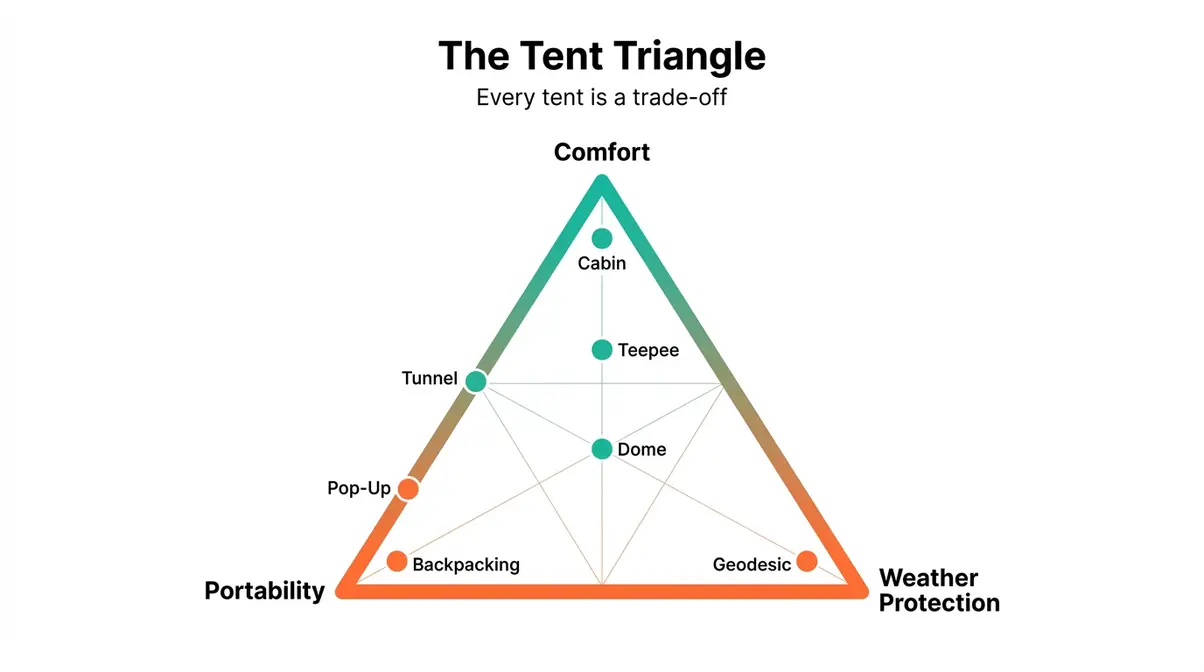
With the different types of camping tents explained below, you’ll discover 7 main designs — dome, cabin, backpacking, tunnel, pop-up, teepee, and A-frame — plus 3 specialized options for extreme conditions. Every tent design trades off between Comfort, Portability, and Weather Protection (The Tent Triangle).
- Dome tents are the best all-around choice for most beginners and casual campers
- Cabin tents offer the most living space but are heavier and slower to pitch
- Backpacking tents prioritize weight and packability over comfort — lightweight 2-person models weigh 2–3 lbs (Outdoor Gear Lab, 2026)
- Geodesic tents provide the best wind resistance, with expedition models tested up to 160 km/h (≈100 mph) in structural testing (Ferrino, 2026)
- Waterproofing is measured in millimeters (mm) — look for 3,000mm+ hydrostatic head for multi-night camping in rain
What to Know Before Buying Your First Tent
Before choosing between a dome tent, a cabin tent, or a geodesic, it helps to understand one foundational idea: the right tent depends on how you camp, not just where you camp. Two concepts answer most beginner questions before you even look at a product page.
The 3-3-3 Rule of Tent Selection
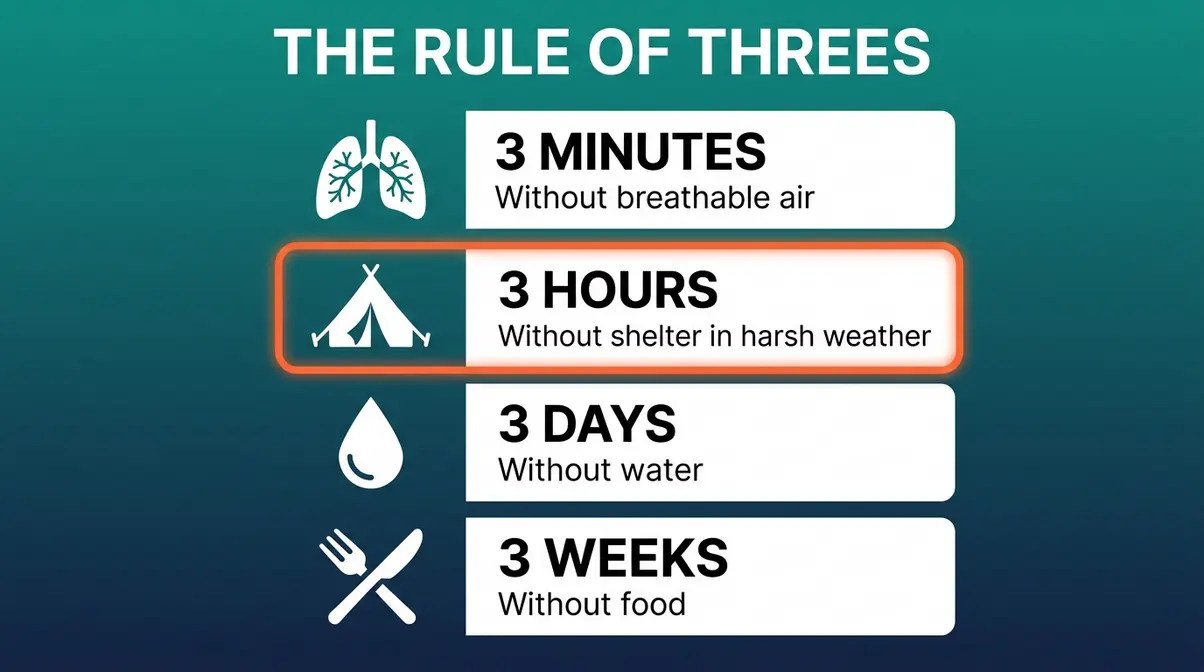
The 3-3-3 rule — also called the Survival Rule of Threes — is a framework used by outdoor educators to explain the body’s survival priorities in the wilderness. According to wilderness survival educators, a person can survive approximately:
- 3 minutes without breathable air
- 3 hours without shelter in harsh weather conditions
- 3 days without water
- 3 weeks without food
Shelter ranks second only to air. In cold, wet, or windy conditions, hypothermia can set in within hours — which is why outdoor educators consistently teach that finding or building shelter is the first action priority after securing a clear airway.
Here’s the insight no competitor covers: the 3-3-3 rule also has a camping travel version — drive no more than 300 miles per day, arrive at your campsite by 3pm, and stay at least 3 nights. This version directly affects which tent makes sense for you. If you arrive early with three nights ahead, you have plenty of time to pitch a complex cabin tent. If you’re moving camp every day, you need a fast-pitch tent you can set up in five minutes.
The practical takeaway: a family arriving relaxed with multiple nights ahead can afford a larger, more comfortable tent. A solo hiker covering 15 miles a day needs a 2-pound backpacking tent that pitches in under 10 minutes. You’ll see this connection throughout this guide. We’ll explain the full trade-off framework — The Tent Triangle — in the “How to Choose” section. For now, check off your beginner camping checklist before your first trip.
Best Tents for Beginners
For most casual camping situations, a 3-season dome tent is the recommended starting point — it balances ease of setup, weather resistance, and affordability better than any other design. Gear reviewers and outdoor educators consistently point to the 3-season dome as the single most versatile tent shape for new campers.
“3-season” means the tent is built for spring, summer, and fall — the three seasons when the vast majority of recreational camping takes place. It is not designed for winter camping or heavy snowfall.
Here’s why dome tents work so well for beginners. They’re freestanding — meaning the poles hold the tent upright without needing stakes, which makes setup far more forgiving. They’re quick to pitch (typically 10–15 minutes). They’re affordable, with solid options ranging from $50 to $300. And they handle light-to-moderate rain well, which covers most weekend camping scenarios.
There are exceptions: if you’re planning winter camping, a large family trip, or serious backpacking, the answer changes — and this guide covers all of those scenarios. But for a weekend car camping trip at a state park? A 2-3 person dome tent is all you need to get started. Once you’ve nailed the basics, check out these essential camping tips for beginners to make your first trips smooth.
The 7 Main Types of Camping Tents Explained
With the various types of camping tents explained in this section, you’ll see that the seven main designs are: dome, cabin, backpacking, tunnel, pop-up, teepee, and A-frame. Each design makes deliberate trade-offs — what outdoor gear experts call The Tent Triangle: every tent balances Comfort (space and livability), Portability (weight and packed size), and Weather Protection (structural strength and waterproofing). Understanding where each tent sits on this triangle tells you exactly who it’s built for.
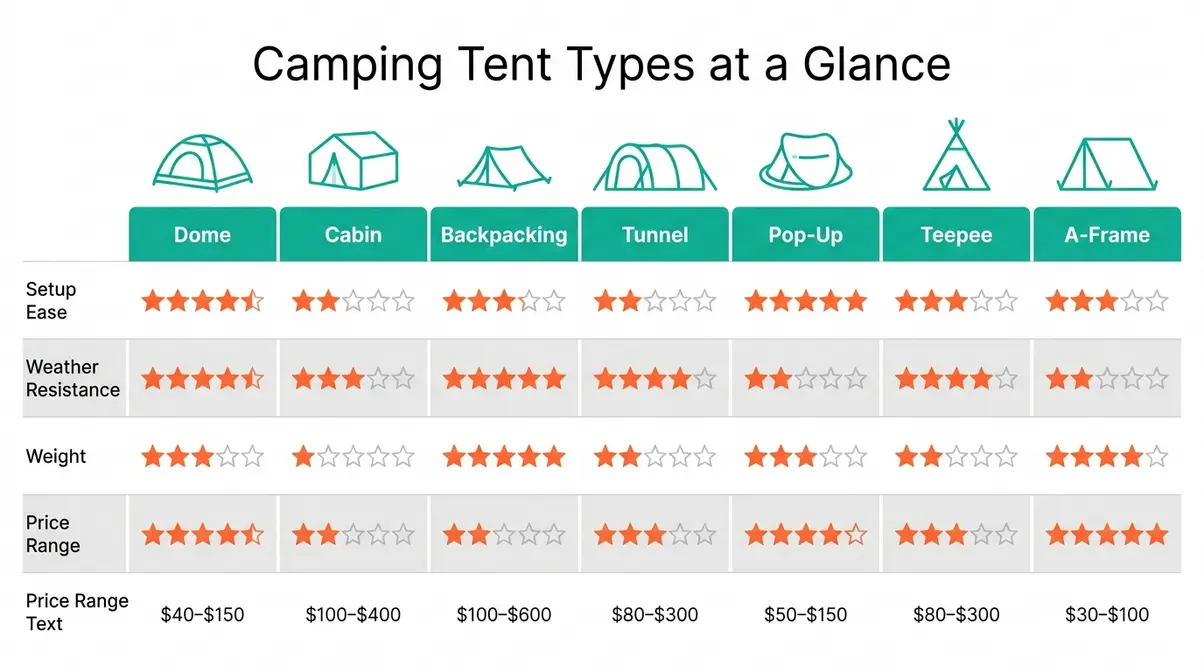
| Tent Type | Best For | Ease of Setup | Weather Resistance | Relative Weight | Price Range |
|---|---|---|---|---|---|
| Dome | Most campers, beginners | ★★★★★ | ★★★★ | Medium | $50–$400 |
| Cabin | Families, base camps | ★★★ | ★★★ | Heavy | $100–$600 |
| Backpacking | Hikers, solo travelers | ★★★★ | ★★★ | Ultralight | $100–$700 |
| Tunnel | Groups, extended trips | ★★★ | ★★★★ | Medium | $150–$500 |
| Pop-Up | Festivals, casual use | ★★★★★ | ★★ | Light | $30–$150 |
| Teepee | Glamping, large groups | ★★★ | ★★★ | Medium-Heavy | $100–$800 |
| A-Frame | Retro/budget camping | ★★ | ★★★ | Medium | $50–$200 |
Dome Tents: The All-Round Choice
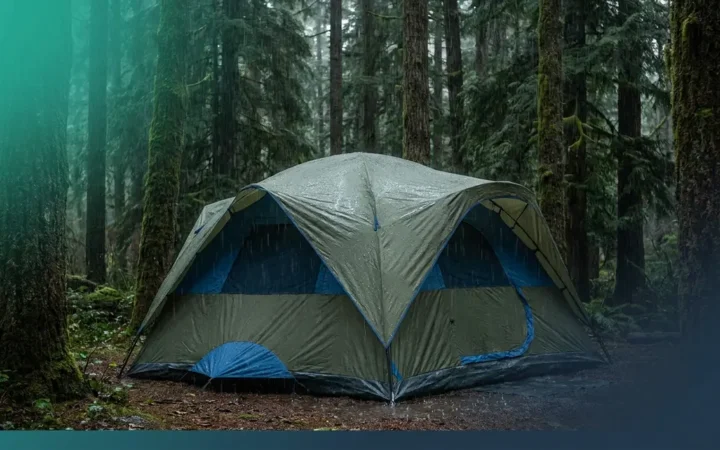
Dome tents are the most versatile camping shelter available — their aerodynamic profile reduces wind drag, making them suitable for exposed sites where cabin tents would struggle. A dome tent’s defining characteristic is two or more poles that cross at the center, creating a self-supporting curved structure. Because the poles hold the shape under tension, the tent stands up without a single stake in the ground.
That low, rounded profile does more than look good. Wind flows around the curved surface rather than hitting it flat-on, which dramatically reduces the force the tent must absorb in gusts. Engineering analysis of dome structures confirms that the crossed-pole framework distributes wind loads across multiple contact points, preventing stress from concentrating in one spot. In practical terms, this means a quality dome tent handles exposed campsites — think lakeshores, meadows, or ridge campsites — far better than a boxy cabin tent.
Best for: Beginners, weekend car campers, casual backpackers, and anyone who wants a reliable all-weather shelter without complexity.
Pros:
- Freestanding design pitches in 10–15 minutes with no staking required
- Curved walls shed rain and resist wind better than flat-sided designs
- Wide price range ($50–$400) covers every budget
- Lightweight enough for car camping and moderate backpacking trips
Cons:
- Sloped walls reduce usable headroom compared to cabin tents
- Larger 4–6 person dome tents can feel cramped for tall adults
Tent Triangle position: Dome tents sit near the center of The Tent Triangle — balanced across all three axes. They’re not the most comfortable, the lightest, or the most weather-resistant option, but they’re the best all-round compromise for most camping situations.
Where dome tents shine at general versatility, cabin tents take a completely different approach — trading aerodynamic efficiency for raw living space.
Cabin Tents: Maximum Space for Families
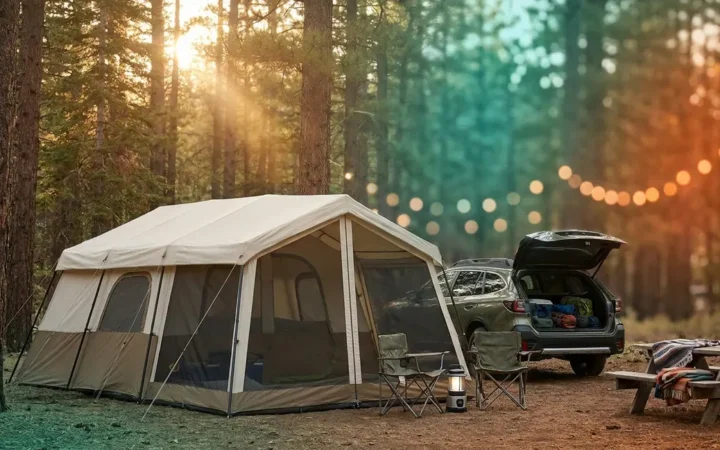
Cabin tents are large, rectangular tents with near-vertical walls that maximize interior headroom and floor space. Most cabin tents can comfortably sleep 4–8 people, and many include room dividers that create separate sleeping areas — something no other tent type offers at this price point.
The trade-off is weight and setup time. Cabin tents are the heaviest mainstream tent style, often exceeding 20 lbs for a large model. They’re also the most time-consuming to pitch, typically requiring 30–45 minutes and at least two people. Their flat, vertical walls catch wind like a sail, making them a poor choice for exposed or high-wind campsites.
Best for: Families with young children, base camp setups where you stay in one spot for 3+ nights, and car campers who prioritize comfort over portability.
Pros:
- Standing headroom lets adults move around comfortably inside
- Separate room dividers provide privacy for families
- Large windows and doors improve ventilation in warm weather
- Most models include a covered porch area or awning
Cons:
- Very heavy — unsuitable for any hiking or backpacking
- Flat walls catch wind; avoid exposed or elevated campsites
- Long setup time (30–45 min) requires multiple people
- Bulky packed size fills most of a car trunk on its own
Tent Triangle position: Cabin tents sit at the Comfort corner of The Tent Triangle. They max out livability but sacrifice portability and weather protection relative to dome or tunnel designs.
Cabin tents solve the space problem brilliantly — but for campers who need to carry their shelter on their back, the answer is at the opposite end of the weight spectrum.
Backpacking Tents: Built to Move
Backpacking tents are engineered around one constraint above all others: weight. According to Outdoor Gear Lab’s 2026 tent testing, a lightweight 2-person backpacking tent typically weighs between 2 and 3 lbs — a fraction of what a cabin tent weighs. Ultralight models push below 2 lbs for solo shelters, with cutting-edge DCF (Dyneema Composite Fabric) designs reaching under 1 lb.
That weight saving comes with real trade-offs. Backpacking tents are smaller, with lower ceilings and less floor space than car-camping tents. Many use a single-wall or semi-freestanding design that requires careful staking to stand properly. And they cost significantly more per square inch than equivalent car-camping tents, because ultralight materials carry a premium.
Best for: Hikers, thru-hikers, solo travelers, and anyone who carries their tent more than a quarter mile from a vehicle.
Pros:
- Lightweight 2-person models weigh 2–3 lbs; ultralight solo tents weigh under 1.5 lbs (Field Mag, 2026)
- Compact packed size fits inside or straps to a standard backpack
- Durable materials designed to handle repeated backcountry use
Cons:
- Tight interior — not comfortable for tall campers or extended stays
- Higher cost than comparable car-camping tents ($100–$700+)
- Non-freestanding designs require precise staking and practice
Tent Triangle position: Backpacking tents sit at the Portability corner. They’re the lightest option available, but they sacrifice Comfort and, at lower price points, some Weather Protection.
Backpacking tents solve the weight problem — but if you need more interior space than a backpacking tent offers without the bulk of a cabin tent, a tunnel tent splits the difference in an interesting way.
Tunnel Tents: Best Space-to-Weight Ratio
Tunnel tents use a series of parallel hoop poles running front to back, creating a long, cylindrical interior. This design delivers an impressive space-to-weight ratio — more livable floor space per pound than almost any other tent style. Many tunnel tents include two or three separate compartments (sleeping area, gear storage, and a porch vestibule) within a single connected structure.
The catch is stability. Unlike a dome tent, a tunnel tent is not freestanding — it needs to be staked out correctly to hold its shape. If you pitch it with the long axis facing the wind, a tunnel tent performs well. Pitch it broadside to a strong wind, and the curved walls become a large sail. Campsite orientation matters more with tunnel tents than with any other design.
Best for: Groups on extended trips, family backpacking, and base camps where space matters but weight still needs to be manageable.
Pros:
- Excellent space-to-weight ratio — more room per pound than cabin tents
- Multiple compartments keep sleeping area and gear storage separate
- Good weather resistance when pitched with the narrow end facing wind
Cons:
- Not freestanding — requires careful staking to maintain shape
- Sensitive to wind direction; poor performance if oriented incorrectly
- Less intuitive to pitch than a dome tent for beginners
Tent Triangle position: Tunnel tents sit between Comfort and Portability on The Tent Triangle — the best option when you need real space without a cabin tent’s weight penalty.
Tunnel tents reward campers who plan ahead. For those who want zero planning — just open the bag and go — the next option takes a completely different approach.
Pop-Up Tents: Fastest to Pitch
Pop-up tents use a pre-tensioned, spring-loaded frame that deploys automatically when you remove it from its bag. Setup takes literally seconds — you toss it in the air and it opens itself. That single feature makes pop-up tents enormously popular for festivals, beach days, and casual weekend trips.
However, gear reviewers consistently identify pop-up tents as the most limited design for serious camping. The spring-loaded frame cannot be disassembled, which means packing the tent back into its circular bag requires practice and patience. More critically, the lightweight frame materials and minimal waterproofing ($30–$100 models typically offer 1,000–1,500mm hydrostatic head) make pop-up tents poorly suited to heavy rain or strong wind. Across camping communities, the consistent feedback is that pop-up tents work well for calm, dry conditions — and fail quickly when conditions turn.
Best for: Music festivals, beach trips, day hikes with an overnight, and casual summer camping in fair weather.
Pros:
- Pitches in seconds — genuinely the fastest tent setup available
- Very lightweight and affordable ($30–$150)
- No poles to thread or instructions to follow
Cons:
- Notoriously difficult to fold back into the carry bag
- Poor weather resistance — not suitable for rain or wind
- Short lifespan; the spring frame weakens with repeated use
- Very limited ventilation options in most models
Tent Triangle position: Pop-up tents sit at the Portability corner but sacrifice Weather Protection significantly. They’re a convenience product, not a serious camping shelter.
Pop-up tents value speed above all else. If you want a tent that makes a visual statement while offering genuine interior space, the teepee takes a dramatically different design philosophy.
Teepee Tents: Stylish & Practical
Teepee tents (also spelled “tipi”) use a single central pole to create a tall, conical structure. The design is ancient — borrowed directly from traditional Indigenous shelters — and it works remarkably well for modern camping. The cone shape sheds rain and wind efficiently, and the single-pole design is faster to pitch than its dramatic silhouette suggests.
The interior space is genuinely impressive for a single-pole design. Many teepee tents are large enough for 6–8 people to sleep in a circle around the central pole. The natural ventilation at the peak — where the pole exits the tent — also makes teepees cooler in warm weather than enclosed dome or cabin designs. Some hot tent versions (covered in the Advanced section) include a stove jack at the peak, allowing a wood-burning stove inside the shelter.
Best for: Glamping, large group camping, family base camps, and campers who want an aesthetic experience alongside functionality.
Pros:
- Distinctive design with a spacious, open interior
- Single central pole pitches faster than multi-pole designs
- Excellent natural ventilation at the peak
- Available in canvas versions for 4-season use
Cons:
- Central pole reduces usable floor space near the center
- Canvas versions are very heavy (30–60 lbs) and require vehicle transport
- Not suitable for exposed ridgelines or high-wind sites
- Requires a large, flat campsite footprint
Tent Triangle position: Teepee tents lean toward Comfort on The Tent Triangle, with moderate Weather Protection. Portability depends heavily on material — canvas teepees are among the heaviest tent options available.
Teepee tents draw the eye and create a memorable camp atmosphere. For campers who want the opposite — a no-frills, budget-friendly classic — the A-frame returns to basics.
A-Frame Tents: The Classic Design
A-frame tents (also called ridge tents) are one of camping’s oldest designs. A horizontal ridge pole runs along the peak of the tent, with the two walls sloping down to the ground on either side — forming the classic triangular cross-section that gives this style its name.
A-frame tents are rarely the top recommendation for beginners today, and there’s a clear reason: the steeply sloped walls dramatically reduce usable interior space. You can’t sit upright near the edges, and headroom at the center is limited. Setup also requires two upright poles and careful staking, making it more complex than a modern dome tent.
Where A-frames still shine is value and simplicity. Budget A-frame tents ($50–$150) are among the most affordable camping shelters available, and their straightforward design means very few things can go wrong. For occasional campers who want the lowest possible entry cost, an A-frame is a reasonable starting point.
Best for: Budget campers, retro enthusiasts, and occasional campers who prioritize low cost over interior comfort.
Pros:
- Very affordable ($50–$200 range)
- Simple design with minimal components to break
- Classic aesthetic that many campers find appealing
Cons:
- Steeply sloped walls severely limit usable interior space
- Requires precise staking — not freestanding
- More complex to pitch than a dome tent despite simpler appearance
- Limited weather resistance compared to modern dome designs
Tent Triangle position: A-frame tents sit toward the middle-low of The Tent Triangle — modest on all three axes, with no standout advantage except price.
Advanced and Specialized Tent Types
The seven mainstream tent types cover most camping scenarios. However, three specialized designs exist for campers pushing into more demanding territory — extreme weather, extended expeditions, or cold-weather camping with a heat source.
Geodesic Tents for Extreme Weather
A geodesic tent is a dome tent taken to its structural extreme — instead of two poles crossing at the center, geodesic designs use three, four, or more poles that intersect at multiple points across the tent surface. This creates a triangulated framework that distributes stress across the entire structure rather than concentrating it at a single apex.
The result is the most wind-resistant tent design available to consumers. DAC, a leading expedition tent pole manufacturer, designs small expedition dome tents to withstand 30 m/s (108 km/h / 67.5 mph) as a baseline — and their in-house wind lab can test structures up to 45 m/s (≈100 mph). Ferrino’s wind tunnel testing of their Extreme 2 expedition tent demonstrated resistance up to 160 km/h (≈99 mph) under controlled conditions. Notably, there is currently no global ISO standard for tent wind resistance — leading expedition brands rely on internal testing protocols because no industry-wide benchmark exists.
That structural performance comes at a cost. Geodesic tents are heavier and more expensive than standard domes, and their complex pole geometry makes them slower to pitch — a genuine concern in deteriorating mountain weather. They’re also overkill for most camping situations.
Best for: Mountaineering, expedition camping, high-altitude trips, and any scenario where extreme wind or heavy snow loading is a realistic possibility.
Pros:
- Highest wind resistance of any tent type — tested to near-100 mph in structural testing (Ferrino, 2026; DAC wind lab)
- Multiple pole intersections create excellent snow-load resistance
- Triangulated structure distributes stress evenly, preventing catastrophic failure
Cons:
- Significantly heavier and more expensive than standard dome tents
- Complex pole geometry makes setup slower and more error-prone
- Overkill for three-season car camping or casual backpacking
Tent Triangle position: Geodesic tents dominate the Weather Protection corner of The Tent Triangle. They sacrifice Portability (weight and complexity) to maximize structural integrity.
Geodesic tents solve the extreme-weather problem with engineering. Canvas tents solve a different problem — long-term durability and year-round comfort — through material choice rather than geometry.
Canvas Tents: Heavy-Duty & Durable
Canvas tents use heavy cotton or polycotton fabric instead of the nylon and polyester found in mainstream camping tents. This material difference has profound practical consequences. According to Canvas Etc.’s 2026 material comparison, a quality canvas tent can last 15+ years with proper care — compared to 3–5 years for polyester camping tents under similar use. Some manufacturers cite lifespans approaching 20 years.
Cotton canvas breathes naturally, which matters more than most beginners expect. Synthetic tents trap moisture inside, leading to condensation on the walls that drips onto sleeping bags and gear. Canvas absorbs and releases moisture gradually, keeping the interior drier and more comfortable — particularly for multi-day stays in variable weather. Canvas also provides better natural insulation than thin nylon, making it genuinely suitable for 4-season use in most climates.
The trade-off is severe. Canvas fabric weighs roughly 400 g/m² — approximately twice the weight of polyester. A medium-sized canvas bell tent can weigh 30–60 lbs packed. That weight rules out any form of hiking or backpacking. Canvas tents are strictly vehicle-based camping shelters, and even loading them into a car requires meaningful effort.
Best for: Glamping, extended base camps, hunters, and anyone who prioritizes long-term durability and comfort over portability. Ideal for campers who return to the same site repeatedly.
Pros:
- Exceptional durability — 15–20 year lifespan with proper care (Canvas Etc., 2026)
- Natural breathability reduces condensation significantly
- Better temperature regulation than synthetic tents in all seasons
- Repairs easily with basic canvas repair kits
Cons:
- Very heavy (30–60 lbs for most models) — vehicle transport only
- Requires drying before storage to prevent mold and mildew
- Higher upfront cost ($200–$1,000+) than synthetic alternatives
- Takes longer to set up than modern dome or tunnel designs
Tent Triangle position: Canvas tents sit firmly at the Comfort corner of The Tent Triangle. They’re the most comfortable long-term shelter option, but they sacrifice virtually all Portability.
Canvas tents excel at long-term comfort in camp. Hot tents go one step further — bringing a heat source inside the shelter for winter camping that would be impossible with any standard design.
Hot Tents: Camping with a Wood Stove
Hot tents are a specialized category of camping tent — typically teepee or tunnel designs — that include a stove jack: a heat-resistant opening in the tent wall or roof through which a wood-burning stove pipe can safely pass. This allows a small wood stove to operate inside the tent, transforming cold-weather camping from an endurance exercise into a genuinely comfortable experience.
The stove jack design is the critical element. Without a properly sealed, fire-resistant port, running any heat source inside a tent creates a fire and carbon monoxide risk. Quality hot tents use silicone-coated or stainless steel stove jacks that seal tightly around the stove pipe, preventing sparks from contacting the tent fabric.
Hot tents are popular with winter campers, hunters, and ice fishing enthusiasts who need to spend extended time in sub-freezing conditions. They’re almost always used with canvas or heavy-duty polycotton fabric — synthetic materials cannot safely handle the radiant heat from a nearby stove. Fire safety and local regulations vary significantly by location; always check campground rules before setting up a hot tent with a stove.
Best for: Winter camping, cold-weather hunting trips, ice fishing base camps, and any situation requiring habitable warmth in below-freezing temperatures.
Pros:
- Wood stove heating makes winter camping genuinely comfortable
- Canvas versions provide excellent insulation alongside active heating
- Dramatic temperature difference versus unheated tents in extreme cold
Cons:
- Requires careful fire safety practices — stove pipe must be properly sealed
- Heavy and bulky — canvas hot tents are not portable without a vehicle
- Higher cost than standard tents; stove purchased separately ($150–$500+)
- Local regulations may prohibit open-flame heating at some campgrounds
How to Choose the Right Tent: 6 Key Factors
Understanding tent types is step one. Applying that knowledge to your specific situation is where most beginners get stuck. These six factors translate tent specs into real-world decisions.
Capacity: How Many People Actually Fit?
Tent capacity ratings are consistently optimistic. Gear reviewers and outdoor educators consistently find that manufacturer capacity ratings assume no gear inside the tent and campers sleeping shoulder-to-shoulder. A tent labeled “4-person” comfortably sleeps 2–3 adults with gear. A “6-person” cabin tent is realistically comfortable for a family of four.
The practical rule: buy one size up from the number of people sleeping in the tent. A solo camper should look at 2-person tents. A couple should consider a 3-person model. A family of four needs at least a 6-person tent for comfortable sleeping with bags, pillows, and a few personal items.
Floor area is more useful than the capacity number. Look for at least 20–25 square feet per person for comfortable sleeping. Vestibules — covered areas outside the sleeping compartment — add critical gear storage space without increasing the sleeping area measurement, so check whether vestibule area is included or excluded from the listed floor space.
| Tent Label | Comfortable For | Floor Space Target |
|---|---|---|
| 2-person | 1 adult with gear | 30–40 sq ft |
| 3-person | 2 adults with gear | 40–55 sq ft |
| 4-person | 2–3 adults with gear | 55–70 sq ft |
| 6-person | Family of 4 with gear | 80–100 sq ft |
Seasonality: 3-Season vs 4-Season Tents
Most campers need a 3-season tent — and most tents sold are 3-season designs. The terms can be confusing, so here’s a plain-English breakdown:
- 3-season tents are designed for spring, summer, and fall camping in temperate conditions. They prioritize ventilation (large mesh panels) and handle rain and moderate wind well. They are not designed for heavy snow loads or sustained sub-freezing temperatures.
- 4-season tents (also called winter or mountaineering tents) use heavier fabrics, fewer mesh panels, and stronger pole systems to handle snow loads, high winds, and freezing temperatures. They’re warmer but less breathable — which causes uncomfortable condensation in warm weather.
- Extended-season tents (sometimes labeled “3+ season”) are a middle ground — sturdier than standard 3-season designs but lighter than true 4-season tents. A good choice for shoulder-season camping in unpredictable conditions.
For most beginners and casual campers, a 3-season tent covers 95% of camping scenarios. Only purchase a 4-season tent if you’re specifically planning winter camping, mountaineering, or high-altitude expeditions.
Weight & Packability: Light Options
Weight only matters if you’re carrying the tent. For car camping, an extra 5 lbs in your tent is irrelevant — it goes in the trunk. For backpacking, every ounce counts.
Here’s a practical weight guide based on how you camp:
| Camping Style | Acceptable Tent Weight | Tent Type to Consider |
|---|---|---|
| Car camping | Any weight | Dome, cabin, tunnel, teepee |
| Short day hikes to camp | Under 5 lbs | Dome, backpacking |
| Multi-day backpacking | Under 3 lbs | Backpacking dome, tunnel |
| Ultralight backpacking | Under 1.5 lbs | Ultralight non-freestanding |
According to Outdoor Gear Lab’s 2026 backpacking tent testing, a lightweight 2-person backpacking tent weighs 2–3 lbs, while average 2-person models weigh 4–6 lbs. True ultralight solo shelters (under 1.5 lbs) are available but typically cost $300–$700 and require practice to pitch correctly.
Packed size matters alongside weight. A tent that packs to the size of a football is far easier to carry than one that fills half a backpack — even if both weigh the same. Check the compressed dimensions, not just the weight.
Setup: Freestanding vs Non-Freestanding
Freestanding tents stand up on their own once the poles are assembled — no stakes required to hold the shape. You can pick up a fully assembled freestanding tent and move it to a better spot. This makes them far more forgiving for beginners, and essential on hard surfaces (rock, gravel) where staking is difficult.
Non-freestanding tents require stakes and guylines to maintain their shape. According to Popular Mechanics’ analysis of tent structures, the trade-off is weight — non-freestanding designs eliminate the extra poles needed for a self-supporting structure, which is how ultralight tents achieve sub-2-lb weights. Most non-freestanding tents use trekking poles as their primary support, saving even more weight.
For beginners: choose a freestanding tent. The flexibility and forgiveness of freestanding designs far outweighs the small weight penalty during your first camping trips.
Weather Resistance & Waterproofing
Waterproof ratings on tents are measured in millimeters (mm) — technically called the hydrostatic head, which is a lab measurement of how much water pressure a fabric can withstand before leaking. The test (defined in ISO 811) applies increasing water pressure to a fabric sample until water penetrates, then records the equivalent height of a water column in millimeters.
Here’s what those numbers mean in practice:
| Hydrostatic Head Rating | Real-World Performance |
|---|---|
| Under 1,000mm | Light drizzle only — not suitable for camping |
| 1,000–1,500mm | Light rain and short exposure |
| 1,500–2,000mm | Moderate rain; adequate for most fair-weather camping |
| 2,000–3,000mm | Heavy rain and wind-driven rain; recommended for multi-night trips |
| 3,000mm+ | Sustained bad weather; recommended for flysheet and especially groundsheet |
For multi-night camping in any region that sees real rain, look for a flysheet rating of 2,000mm minimum, and a groundsheet rating of 3,000mm+. The groundsheet needs a higher rating because your body weight and knees concentrate pressure on the floor, which can push water through a lower-rated fabric even in dry conditions.
Seam sealing is equally important. Even a 3,000mm fabric leaks at unsealed seams. Look for “fully seam-sealed” or “taped seams” in the product description — this indicates the manufacturer has sealed every stitch line with waterproof tape, which is the primary leak point in most budget tents.
Durability: Budget vs Quality
Tent materials fall into two broad categories — synthetic (nylon and polyester) and natural (cotton canvas). Each serves a different camping style.
Nylon is the premium synthetic choice: lighter, stronger, and more packable than polyester. Most backpacking and high-end camping tents use nylon for the flysheet and body. It costs more than polyester but handles repeated use and UV exposure better.
Polyester is the budget synthetic: heavier than nylon but more resistant to UV degradation and less prone to sagging when wet. Most car-camping tents in the $50–$200 range use polyester. It’s a perfectly adequate material for occasional camping.
Cotton canvas (covered in the Advanced section) offers the best durability and breathability but at significant weight and cost penalties.
For budget-conscious beginners, a polyester dome tent in the $60–$120 range is a reasonable starting point. Gear reviewers and outdoor educators consistently find that spending $100–$200 on a reputable brand’s entry-level tent produces dramatically better results than buying a $30 no-name model — the difference shows up in waterproofing, pole quality, and how well the tent holds up after 10+ uses.
Common Tent-Buying Mistakes to Avoid
Even with a solid understanding of tent types, beginners consistently make the same few purchasing errors. Here’s what to watch for — and how to avoid each one.
Mistakes That Ruin First Trips
Mistake 1: Buying a tent rated for exactly your group size. As covered in the Capacity section, manufacturer ratings are optimistic. A “4-person tent” that actually sleeps 2 adults comfortably will leave your whole group miserable. Always size up by one capacity level.
Mistake 2: Ignoring the groundsheet rating. Most beginners focus on the flysheet waterproof rating and ignore the floor. A tent with a 3,000mm flysheet and a 1,500mm groundsheet will have a dry ceiling and a wet floor — exactly the wrong outcome. Confirm the groundsheet hydrostatic head is at minimum 3,000mm before purchasing.
Mistake 3: Not pitching the tent before the trip. Gear reviewers consistently flag this as the most common beginner error. Pitching a tent for the first time in the dark, in the rain, at a campsite you’ve never visited is a recipe for a miserable first night. Set up your tent in the backyard at least once before your trip.
When a Standard Tent Won’t Cut It
A standard 3-season dome or cabin tent covers most recreational camping scenarios — but there are specific situations where you genuinely need something more specialized.
- Switch to a 4-season or geodesic tent if:
- You’re camping above treeline, where wind speeds routinely exceed 40–50 mph
- Your trip involves snow loads on the tent — even a few inches of wet snow can collapse a 3-season dome
- You’re mountaineering or planning expeditions in genuinely alpine conditions
- Switch to a canvas or hot tent if:
- You’re planning extended winter camping (multiple nights below freezing)
- You want a heating source inside the tent
- You’re setting up a semi-permanent base camp that stays in one location for weeks
Across camping communities, the consistent feedback is this: most campers who buy 4-season tents for casual 3-season camping end up with a hotter, heavier, more expensive shelter than they needed. Match the tent to the actual conditions, not worst-case scenarios.
Frequently Asked Questions
What are the 4 main types of tents?
The four most commonly referenced tent types are dome, cabin, backpacking, and teepee. These four designs cover the broadest range of camping scenarios: dome tents for general use, cabin tents for family camping, backpacking tents for hiking, and teepee tents for large-group or glamping situations. However, a complete understanding of camping tent types includes tunnel, pop-up, and A-frame designs as well — bringing the mainstream total to seven types. For most beginner campers, understanding dome versus cabin versus backpacking covers 90% of purchasing decisions.
What are the different tent types?
There are 10 tent types covered in this guide — 7 mainstream designs and 3 specialized options. The 7 main types of camping tents are dome, cabin, backpacking, tunnel, pop-up, teepee, and A-frame. The 3 specialized types are geodesic (for extreme weather), canvas (for long-term durability and 4-season use), and hot tents (for winter camping with a wood stove). Each design trades off between Comfort, Portability, and Weather Protection — The Tent Triangle framework — which is the most useful way to compare them.
Which tent is best for most situations?
A 3-season dome tent is the recommended starting point for most camping situations. Gear reviewers and outdoor educators consistently recommend dome tents for beginners because they’re freestanding (no staking required to stand), quick to pitch (10–15 minutes), affordable ($50–$300), and aerodynamically stable in moderate wind and rain. For example, a 2–3 person dome tent handles weekend car camping at a state park, casual backpacking, and festival camping equally well. The only scenarios where a dome tent isn’t the right answer are winter camping, large family trips (cabin tent), and serious backpacking under 3 lbs (backpacking tent).
What’s the most waterproof tent?
The most waterproof tents combine a high hydrostatic head rating (3,000mm+) with fully taped seams and a reinforced groundsheet. Hydrostatic head is the lab standard (ISO 811) for measuring how much water pressure a fabric withstands before leaking — a 3,000mm rating means the fabric resists the equivalent of a 3-meter column of water. For multi-night camping in heavy rain, look for at least 2,000mm on the flysheet and 3,000mm+ on the groundsheet. Geodesic expedition tents from brands like Hilleberg and MSR typically offer the highest-rated waterproofing alongside the strongest structural wind resistance — making them the most weather-resistant option overall.
What is the 3-3-3 rule camping?
The 3-3-3 rule in camping refers to two related concepts. The survival version (also called the Rule of Threes) states that a person can survive 3 minutes without air, 3 hours without shelter in harsh conditions, 3 days without water, and 3 weeks without food — establishing shelter as the #1 survival priority after breathing. The RV/camping travel version recommends driving no more than 300 miles per day, arriving at your campsite by 3pm, and staying a minimum of 3 nights. Both versions directly affect tent choice: the survival rule explains why tent quality matters, while the travel rule determines how much setup time you realistically have — which influences whether a complex cabin tent or a fast-pitch dome makes more sense.
What are three types of tent camping?
Three broad styles of tent camping are car camping, backpacking, and glamping. Car camping means driving to a designated campsite and setting up near your vehicle — cabin tents, large dome tents, and canvas tents are all suitable. Backpacking means carrying everything on your back, which requires lightweight backpacking tents (2–3 lbs for a 2-person model). Glamping (glamorous camping) emphasizes comfort and aesthetics, typically using teepee tents, canvas bell tents, or large cabin tents with full bedding. Each style has different tent requirements, which is why understanding your camping style matters more than memorizing tent shapes.
Common Tent-Buying Mistakes and Limitations
Common Pitfalls
Pitfall 1: Trusting capacity labels without checking floor area. A “6-person tent” with 60 square feet of floor space provides only 10 square feet per person — tight even for sleeping, impossible with gear. Always calculate floor area per person (target 20–25 sq ft minimum) rather than relying on the manufacturer’s capacity number.
Pitfall 2: Confusing “water resistant” with “waterproof.” Many budget tents are water resistant — they shed light drizzle — but not waterproof. A tent without a hydrostatic head rating of at least 1,500mm will leak in sustained rain. Check the spec sheet, not just the product description language.
Pitfall 3: Skipping the rain fly. Many dome tents are sold with an optional or separate rain fly. Pitching the tent body without the fly in clear weather is tempting — the mesh ceiling is beautiful. But weather changes, and a tent body alone offers zero waterproofing. Always pitch the fly unless you’re in a covered shelter.
When to Choose Alternatives
Choose a tarp or bivy sack instead of a tent if you’re an experienced ultralight backpacker and weight is your absolute priority. Tarps can weigh under 8 oz and provide adequate protection in dry, predictable conditions. However, they offer no bug protection and require significant skill to pitch effectively — not a beginner option.
Choose a hammock shelter instead of a tent if you’re camping in forested areas with suitable trees and want to avoid sleeping on uneven or rocky ground. Hammock camping requires trees spaced correctly and a rain fly, but eliminates ground moisture entirely.
When to Seek Expert Help
If you’re planning a mountaineering expedition, a high-altitude trekking trip, or winter camping in genuinely extreme conditions, consult with a specialist outdoor retailer (like REI or a local mountaineering shop) before purchasing. The stakes — literally and figuratively — are higher in these scenarios, and the wrong tent choice carries real safety consequences beyond discomfort. Staff at dedicated outdoor retailers have firsthand experience with specific models in specific conditions, which no online guide can fully replicate.
The Bottom Line: Your Perfect Tent Is Waiting
With all the major types of camping tents explained, you can see that every shelter you’ll ever encounter is a deliberate trade-off across The Tent Triangle — Comfort, Portability, and Weather Protection. No tent wins on all three axes. The right tent for you is the one that prioritizes the axis that matters most for your specific camping style.
For most beginners, that answer is a 3-season dome tent: balanced, forgiving, affordable, and capable enough for 95% of recreational camping situations. A lightweight 2-person model handles everything from state park weekends to casual overnight hikes. As your camping evolves — longer trips, harder conditions, larger groups — The Tent Triangle gives you the framework to evaluate any new tent you encounter without starting from scratch.
Start by identifying your first trip: car camping with the family, a solo overnight hike, or a festival weekend. Match that scenario to the tent types in this guide, set your budget, and check the two numbers that matter most — the hydrostatic head rating and the actual floor area per person. Pitch it in your backyard before your trip. Then go camping.

Dave King
I'm Dave King. I publish Tent Explorer, a site built to answer the questions people actually ask before they buy.