

This blog post may contain affiliate links. As an Amazon Associate I earn from qualifying purchases.
📋 Table of Contents
- Air Mattress vs. Sleeping Pad: Quick Comparison
- What Each Option Is & Who It’s For
- Feature Comparison Table
- Comfort and Support: Which Feels Better?
- How Air Mattresses Create Comfort
- How Sleeping Pads Provide Support
- Side Sleepers and Pressure Point Relief
- Warmth & Insulation: R-Value Science
- What Is R-Value and Why It Matters
- Why Air Mattresses Lose Heat
- Sleeping Pad R-Value Guide by Season
- Portability: Why Weight Matters
- Weight: Air Mattress vs Sleeping Pad
- Pack Size: Car Camping vs. Backpacking
- Durability & Field Reliability
- Puncture Risk & Long-Term Durability
- Setup Time and Ease of Use
- Ergonomics: Sciatica & Back Pain
- Spinal Alignment on Sleep Surfaces
- Sciatica & Body-Type Considerations
- Are air mattresses good for sciatica?
- Decision Guide for Your Camping Style
- Use-Case Decision Matrix
- Practical Tips for Your Sleep System
- What to put under an airbed?
- Getting the Most from Your Setup
- Limitations and Alternatives
- Common Pitfalls
- When to Choose Alternatives
- When to Seek Expert Help
- Frequently Asked Questions
- Is a sleeping pad better for camping?
- Are air mattresses good for scoliosis?
- Sleeping bag or air mattress?
- Most comfortable camping sleep setup?
- What organ is affected by scoliosis?
- How long can you sleep on an airbed?
- Choosing Your Camping Sleep System
You’ve already been there. You hauled a bulky air mattress to the trailhead, spent ten minutes inflating it in the dark, woke up at 3 a.m. on the cold ground because it had slowly lost pressure — and swore you’d figure this out before your next trip. The air mattress vs. sleeping pad for camping debate frustrates thousands of campers every season, largely because most guides reduce it to a shallow “comfort vs. weight” summary that ignores the science underneath.
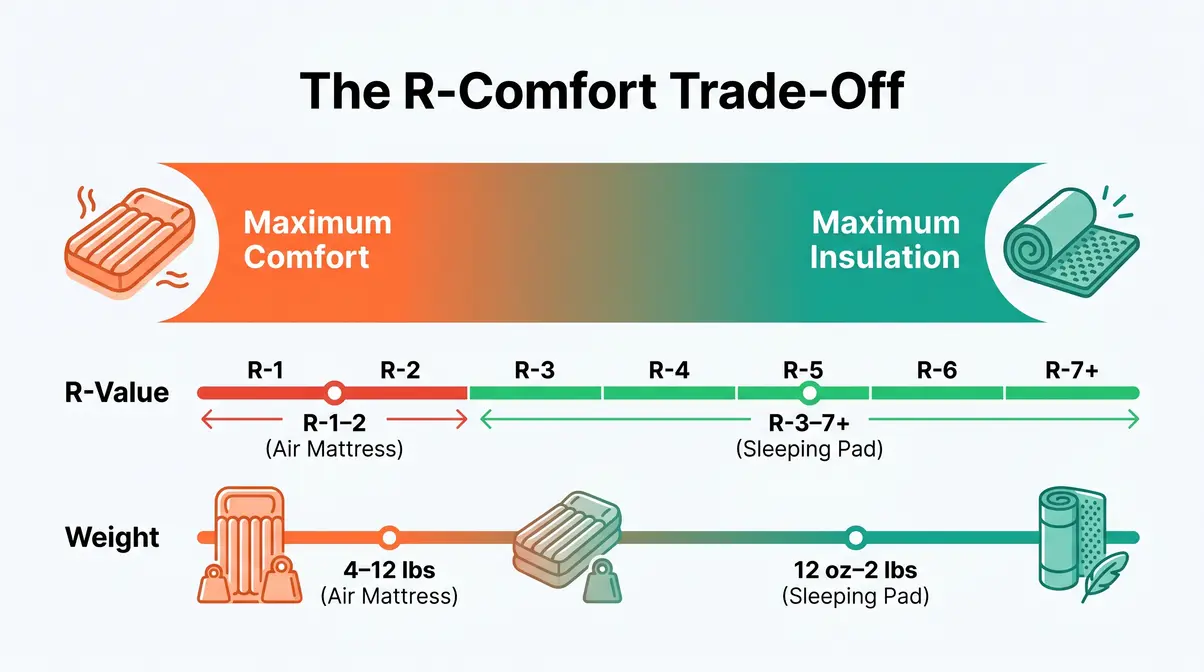
The truth is more useful: these two options sit at opposite ends of an inverse spectrum. Air mattresses win decisively on cushioned comfort; sleeping pads win decisively on thermal insulation. Understanding The R-Comfort Trade-Off — the principle that as surface softness increases, ground insulation typically decreases — is the key to choosing the right camping sleep setup for your exact situation. This guide walks through every dimension of that trade-off, from peer-reviewed ergonomic research to ASTM-standardized R-value science, so you can stop guessing and start sleeping.
Choosing between an air mattress vs sleeping pad for camping comes down to your camping context, not a single “best” answer. The R-Comfort Trade-Off means these options genuinely excel in different conditions.
- Comfort vs. insulation: Air mattresses offer superior cushioning; sleeping pads deliver superior thermal protection from cold ground.
- Temperature matters most: Any air mattress with an R-value below 2 becomes dangerously cold in temperatures under 50°F (10°C).
- Weight is a dealbreaker for backpackers: Quality sleeping pads weigh 12–26 oz; most car-camping air mattresses weigh 4–12 lbs.
- Medical context changes everything: For sciatica, scoliosis, or chronic back pain, firmness adjustability and spinal alignment matter more than either brand category.
- Hybrid approach works: Pairing a closed-cell foam pad under an air mattress adds R-value and puncture protection simultaneously.
Air Mattress vs. Sleeping Pad: Quick Comparison
The most useful starting point for any air mattress vs sleeping pad for camping decision is understanding what each product is actually designed to do — because they were not designed to compete with each other. If you are specifically looking into an air mattress vs sleeping pad for tent camping, remember that the enclosed space of a tent limits the size of the mattress you can use.
What Each Option Is & Who It’s For
Air mattresses (also called camp mattresses or double-height inflatables) are pneumatic sleeping surfaces designed primarily for elevated comfort in car camping, base camp, and festival settings. They prioritize cushioning over all else, mimicking the feel of a home bed. Most weigh between 4 and 12 lbs, pack down to the size of a large duffel, and require a pump for inflation. Their R-values typically range from 1.0 to 2.0, making them thermally limited.
Sleeping pads are insulating sleep surfaces engineered to resist conductive heat loss (the transfer of body heat directly into cold ground) while providing adequate support. They come in three main formats: closed-cell foam (lightest, most durable), self-inflating foam hybrid, and inflatable air pad. Quality sleeping pads range from 12 oz to 32 oz in weight, compress to the size of a Nalgene bottle, and reach R-values of 1.0 to 7.0+ depending on the model and season rating.
A fussy adult sleeper who drives to a campground and wants a comfy bed under the stars is the ideal air mattress user. A backpacker covering 12 miles a day who needs every ounce justified is the ideal sleeping pad user. The frustration most campers feel comes from using the wrong tool for their specific context — not from either product being inherently flawed.
Feature Comparison Table
| Feature | Air Mattress | Sleeping Pad |
|---|---|---|
| Comfort / Cushioning | Excellent (bed-like) | Good to Fair (firm to moderate) |
| R-Value (Insulation) | Low: 1.0–2.0 typical | Wide range: 1.0–7.0+ |
| Weight | Heavy: 4–12 lbs | Light: 12 oz–2 lbs |
| Packed Size | Large: duffel-sized | Compact: water-bottle to small roll |
| Durability | Moderate (puncture risk) | High (foam) to Moderate (inflatable) |
| Best Use Case | Car camping, base camp, festivals | Backpacking, cold-weather, thru-hiking |
| Price Range | $20–$200+ | $15–$250+ |
| Setup Time | 3–5 minutes (with pump) | 30 sec–3 minutes |
| Puncture Risk | Medium–High | Low (foam) / Medium (inflatable pad) |
According to Section Hiker’s analysis of ASTM F3340-18, R-values are also additive — meaning a foam pad placed under an air mattress combines their insulation values, a hybrid approach that solves the air mattress’s biggest weakness without replacing it entirely.
Comfort and Support: Which Feels Better?
When searching for the best mattress for tent camping, comfort is the most emotionally loaded dimension of the air mattress vs sleeping pad for camping debate — and it’s where the most disappointment happens. User consensus across camping communities reveals a consistent pattern: campers who buy air mattresses expecting home-bed comfort frequently find the experience falls short in ways they didn’t anticipate.
How Air Mattresses Create Comfort
Air mattresses deliver comfort through pneumatic cushioning — trapped air absorbs and redistributes body weight, reducing pressure on hips, shoulders, and knees. A properly inflated double-height air mattress can genuinely feel close to sleeping on a soft home mattress, which is why they remain popular for car camping and family campgrounds.
However, several real-world failure modes undermine that comfort promise. Bottoming out occurs when an air mattress is underinflated or loses pressure overnight, causing your heaviest body zones (hips, shoulders) to compress all the way to the ground. The instability of a large air chamber also creates what many campers describe as feeling like sleeping on a trampoline — every movement by a partner rolls across the entire surface. And cold ground temperatures accelerate pressure loss as air contracts in cooler conditions, meaning the mattress that felt firm at bedtime may be flat by 2 a.m.
“I have bought 3 different air mattresses to sleep on camping last year and they all were awful !!!”
— User consensus across camping communities reflects this exact frustration: the problem is rarely the specific brand, but the fundamental mismatch between air mattress design and camping conditions.
Cross-wing or baffle-chamber designs (internal fabric structures that divide the air mattress into columns) significantly reduce the trampoline effect and improve stability. If you’re committed to an air mattress, look for this construction feature specifically.
How Sleeping Pads Provide Support
Sleeping pads approach comfort differently — through firmness and consistent, ground-level support rather than cushioning. A quality foam or self-inflating pad maintains the same surface hardness all night, regardless of temperature. There’s no risk of developing a leak at midnight or waking up on a deflated surface.
The support quality of sleeping pads varies significantly by type. Closed-cell foam pads are the firmest and most durable, but many campers find them too hard for side sleeping. Self-inflating pads blend open-cell foam with an air chamber, offering a middle-ground firmness that most back and side sleepers find acceptable. Inflatable air pads can be tuned to individual firmness preferences and, at higher price points, include shaped chambers that contour to the body.
Side Sleepers and Pressure Point Relief
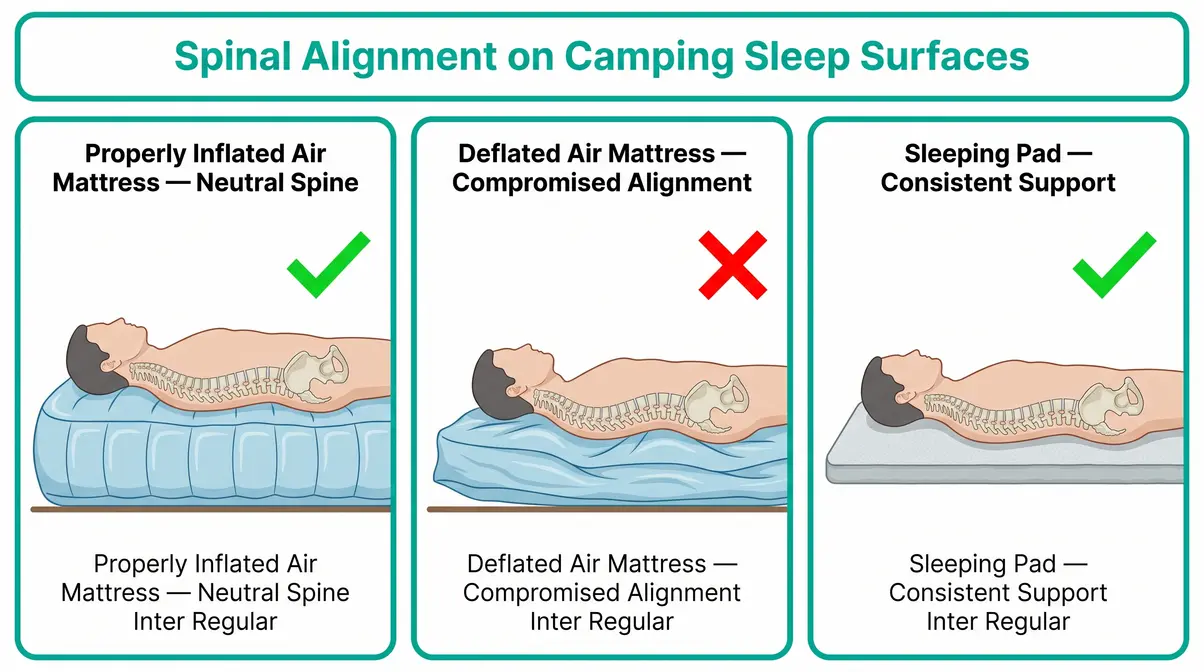
Side sleepers face a specific challenge: their hip and shoulder create concentrated pressure points that require both cushioning (to relieve pressure) and lateral support (to keep the spine neutral). A 2021 systematic review published in the Journal of Clinical Medicine (PMC8655046) found that medium-firm sleeping surfaces promote comfort, sleep quality, and spinal alignment — a finding directly applicable to camping sleep surface selection.
For side sleepers, a self-inflating pad at medium firmness or a high-quality inflatable air pad with a 3.5-inch+ loft typically outperforms a basic air mattress. The consistent support surface of a quality pad prevents the shoulder-sinking that occurs with overly soft air chambers, keeping the thoracic spine in a neutral position throughout the night.
Warmth & Insulation: R-Value Science
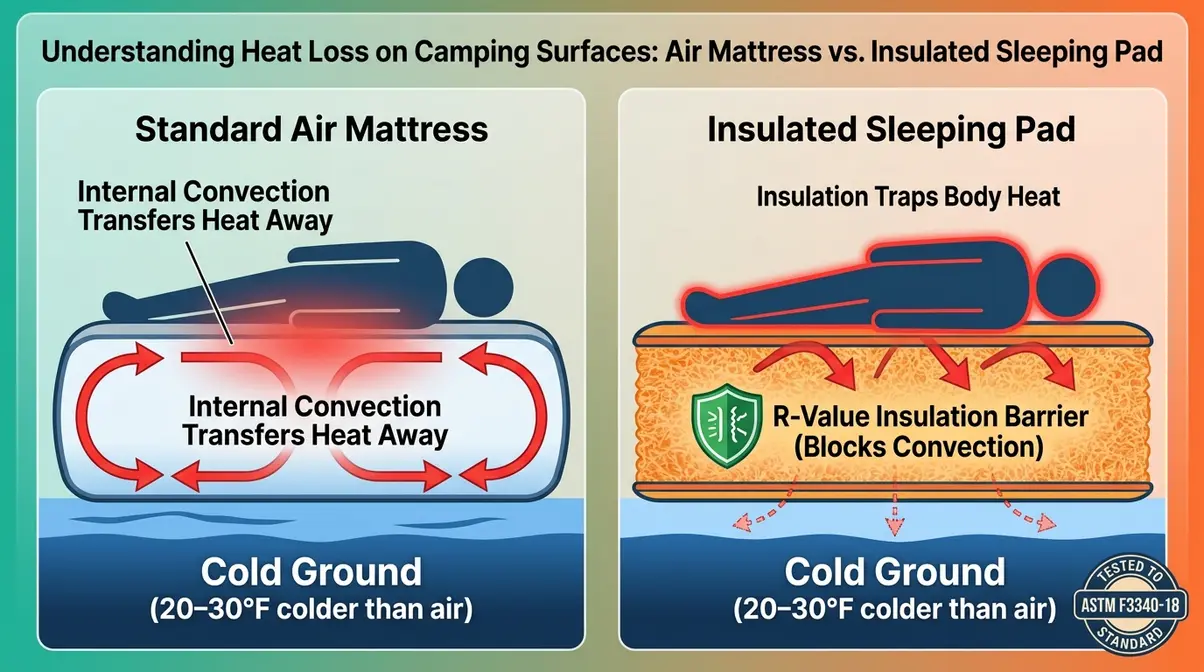
Thermal performance is the dimension most campers underestimate — and the most consequential for safety. This is where The R-Comfort Trade-Off becomes measurable science rather than subjective preference.
What Is R-Value and Why It Matters
R-value is a standardized measurement of thermal resistance — specifically, how well a sleeping surface resists the transfer of body heat into cold ground. Higher R-values indicate better insulation. Since 2020, the outdoor industry has used the ASTM F3340-18 standard (American Society for Testing and Materials) to ensure consistent, lab-verified R-value ratings that allow direct comparison across brands and products.
Before ASTM F3340-18, manufacturers used inconsistent testing methods, meaning an R-3 from one brand was not comparable to an R-3 from another. The current standard eliminates that ambiguity — any product carrying an ASTM F3340-18 R-value rating has been tested under identical laboratory conditions. When evaluating any camping sleep surface, Section Hiker recommends checking specifically for ASTM-verified ratings rather than manufacturer self-reported values.
Conductive heat loss — the direct transfer of thermal energy from your warm body into cold ground — is the primary reason campers wake up cold even inside a warm sleeping bag. Research from Princeton University shows conductive heat loss increases significantly on cold surfaces, which rapidly drains core body temperature. Frostburg State University emphasizes mitigating conductive heat loss to the ground as a critical survival metric. Ground temperatures can be 20–30°F colder than air temperatures, and without adequate R-value beneath you, your sleeping bag loses most of its effective warmth to the earth rather than retaining it around your body.
Why Air Mattresses Lose Heat
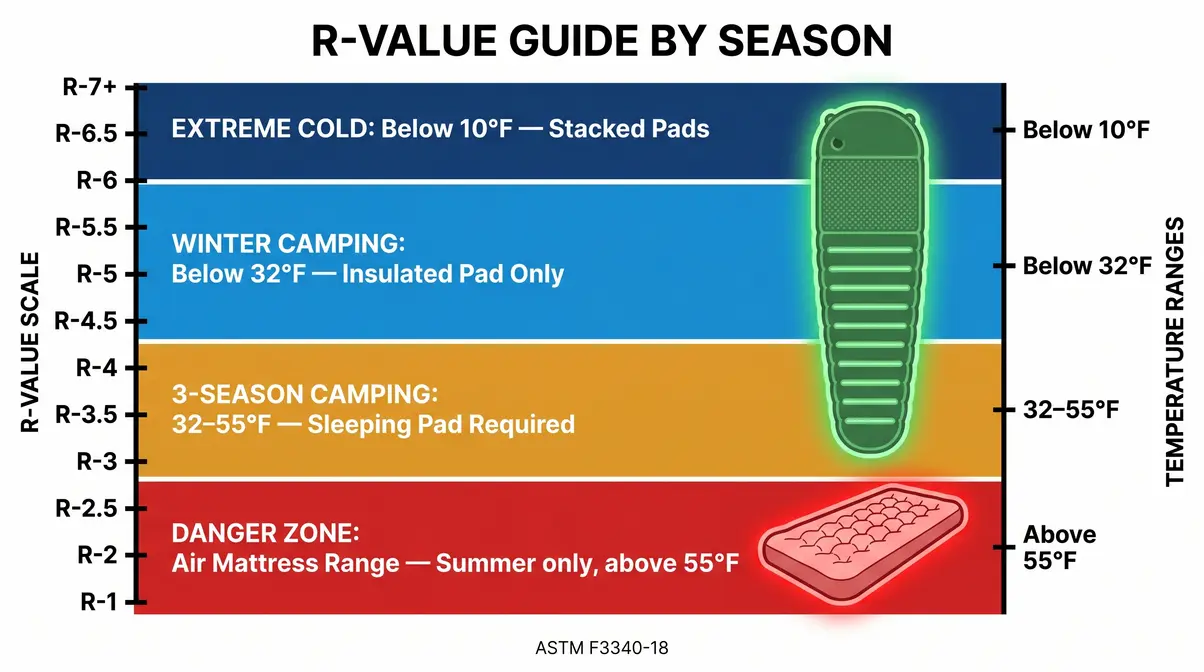
Most standard air mattresses have an R-value between 1.0 and 2.0 (ASTM F3340-18). That range provides minimal insulation — adequate only for summer camping in temperatures above 55°F (13°C). Below that threshold, the air inside the mattress acts as a convective medium: cold ground chills the bottom layer of air, that cold air circulates inside the mattress, and the entire sleeping surface becomes a cooling platform rather than an insulating one.
This phenomenon — sometimes called the cold air convection problem — is why even expensive, well-built air mattresses can sap your heat on a 45°F night that would feel comfortable with a proper sleeping pad. The physical structure of a large air chamber actually accelerates heat loss compared to a dense foam pad, because the air has room to circulate and transfer cold from the ground surface upward.
The practical solution for car campers who want air mattress comfort in cooler conditions: place a closed-cell foam pad (R-value 1.5–2.5) underneath the air mattress. Their R-values add together (ASTM F3340-18 confirms R-value additivity), giving you a combined insulation value that extends the air mattress’s usable temperature range by 15–20°F.
Sleeping Pad R-Value Guide by Season
The following seasonal guidelines represent industry consensus based on ASTM F3340-18 testing data, as synthesized from REI’s gear guidance and validated outdoor gear sources. If you are using one of the best tents for snow camping in 2026, a high R-value pad is mandatory.
| Season / Condition | Minimum R-Value | Recommended R-Value | Notes |
|---|---|---|---|
| Summer (above 55°F / 13°C) | R-1.0 | R-1.0–2.5 | Most air mattresses qualify |
| 3-Season (32–55°F / 0–13°C) | R-2.5 | R-3.0–4.0 | Most air mattresses fall short |
| Winter / Cold (below 32°F / 0°C) | R-4.5 | R-5.0–7.0+ | Sleeping pads only; foam under air mattress inadequate |
| Snow / Extreme Cold (below 10°F / -12°C) | R-6.0 | R-7.0+ | Stacked pads often required |
“Air mattresses sit at R-value 1 to 2, which means heat passes through the air chamber quickly in cold conditions — a sleeping pad with R-3 or higher is the only reliable solution for three-season camping.” (Lone Creek Apparel, 2026)
Portability: Why Weight Matters
For backpackers, the camping sleep surface question is inseparable from the weight question. For car campers, it’s largely irrelevant. Understanding which category you fall into eliminates half the confusion immediately.
Weight: Air Mattress vs Sleeping Pad
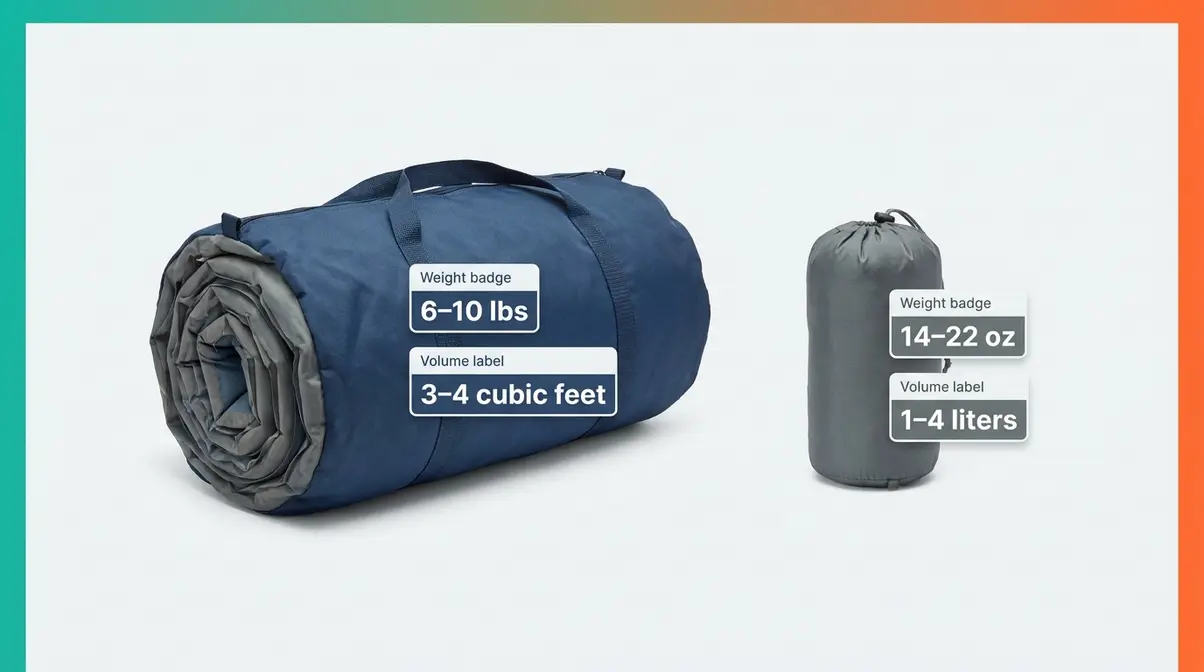
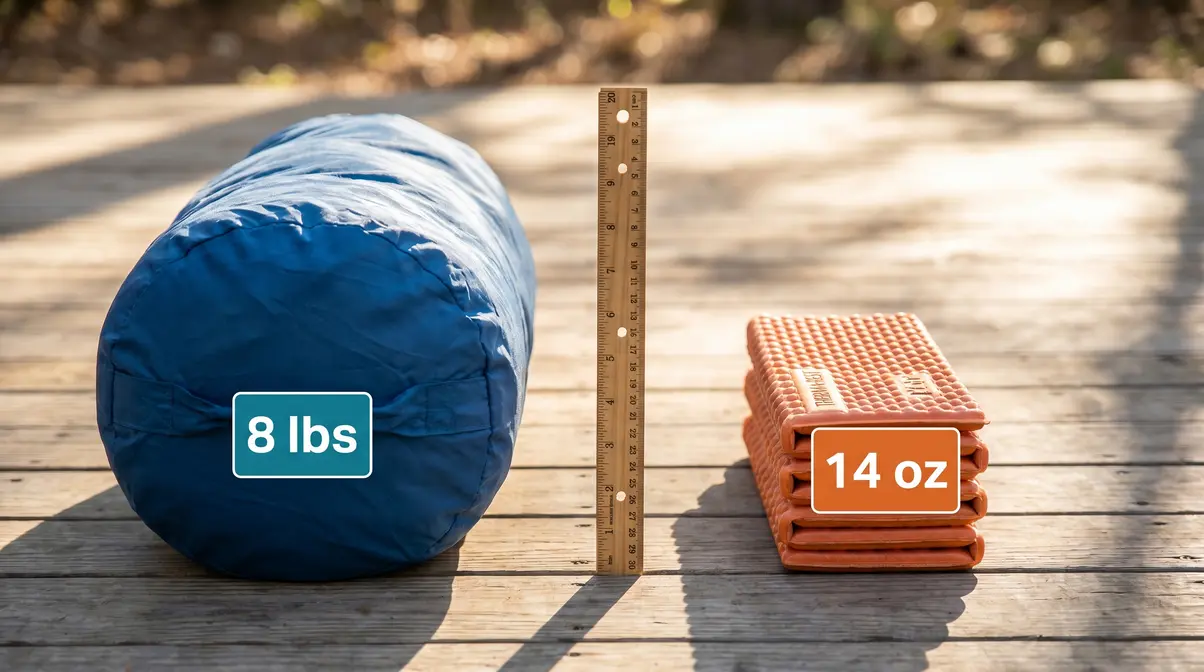
A typical double-height car camping air mattress weighs between 4 and 10 lbs — manageable when you’re loading a vehicle, but genuinely impractical when every ounce is carried on your back. Just as understanding tent weight is crucial for backpackers, your sleep surface weight matters. Even “ultralight” camping air mattresses designed for backpacking typically weigh 1.5–3 lbs, still heavier than most quality sleeping pads.
Quality sleeping pads span a wide weight range. Closed-cell foam pads (like the classic Therm-a-Rest Z Lite Sol) weigh approximately 14 oz. Mid-range inflatable pads average 16–22 oz. Premium ultralight inflatable pads reach as low as 10–12 oz. For a backpacker covering multi-day terrain, the difference between a 6-lb air mattress and a 14-oz foam pad translates directly to physical fatigue over 8+ miles of daily hiking.
Pack Size: Car Camping vs. Backpacking
Pack volume matters as much as weight for backpackers, and here the gap between options is even more dramatic. Most car camping air mattresses, when deflated and folded, occupy 2–4 cubic feet of space — roughly the volume of a large backpack itself. If you are carrying the best 1 man backpacking tent, pairing it with a heavy air mattress defeats the purpose. Self-inflating sleeping pads compress to 4–8 liters. Ultralight inflatable pads reach 1–2 liters packed. Closed-cell foam pads don’t compress at all, but strap externally to a pack with minimal volume penalty.
For car camping, pack size is essentially irrelevant — the mattress goes in the trunk. For backpacking, carrying an air mattress means sacrificing space for food, safety gear, or clothing. MasterClass’s camping gear analysis notes that weight and packability are the dominant decision factors for multi-day trekking, while comfort dominates for car camping — a framework that holds up consistently across gear communities.
The practical rule: if you’re walking more than half a mile to your campsite, a sleeping pad is the right tool. If you’re parking 50 feet from your tent, an air mattress becomes a reasonable choice.
Durability & Field Reliability
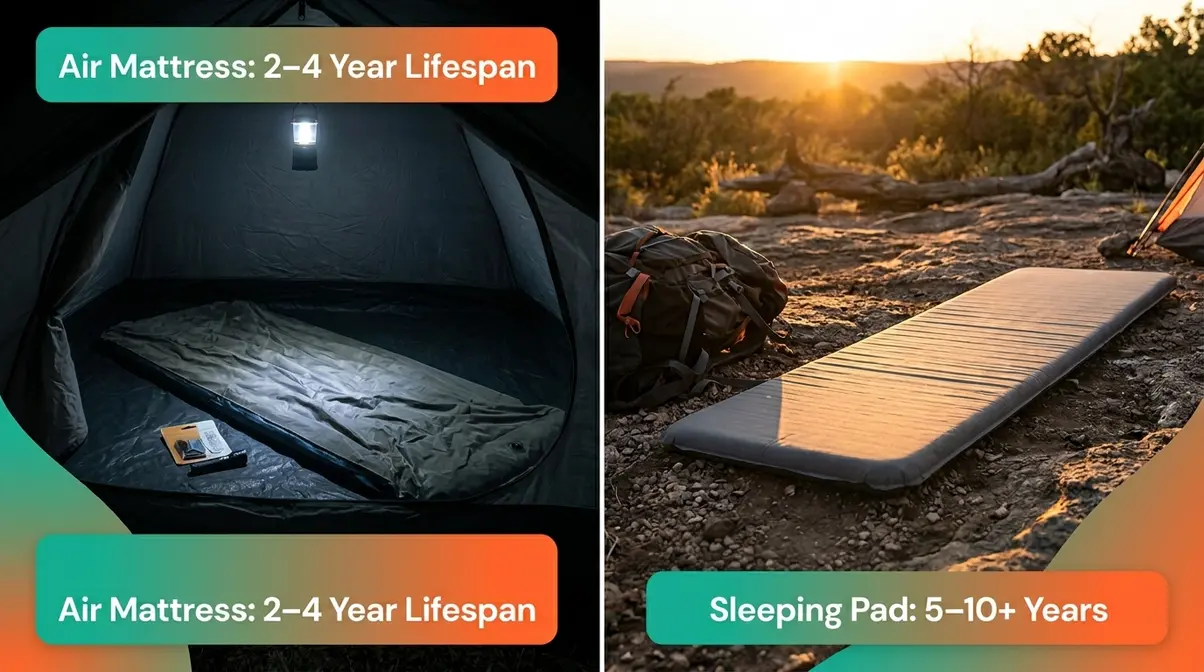
The most common source of camping gear frustration — after cold nights — is equipment failure. A popped mattress on night two of a five-day trip is more than inconvenient; it can end the trip entirely. Reliability in the field deserves honest assessment.
Puncture Risk & Long-Term Durability
Air mattresses carry meaningful puncture risk in camping environments. Most are constructed from PVC or TPU materials ranging from 0.2mm to 0.6mm thickness — thinner than the materials used in most sleeping pads. Rocks, twigs, tent zipper teeth, and even the natural abrasion of repeated setup and takedown cycles create cumulative wear. Just like perfect tent seam sealing prevents water leaks, proper ground prep prevents air leaks. User consensus across camping communities indicates that the average car camping air mattress experiences at least one significant leak event within 2–3 seasons of regular use.
Closed-cell foam sleeping pads are essentially indestructible under normal camping conditions — no inflation means no deflation. Self-inflating and inflatable sleeping pads carry some puncture risk but use thicker fabrics (typically 30–75 denier) than most air mattresses and include smaller air chambers that limit damage when puncture does occur. A pinhole in a sleeping pad typically causes gradual softening; a pinhole in an air mattress can cause complete deflation within hours.
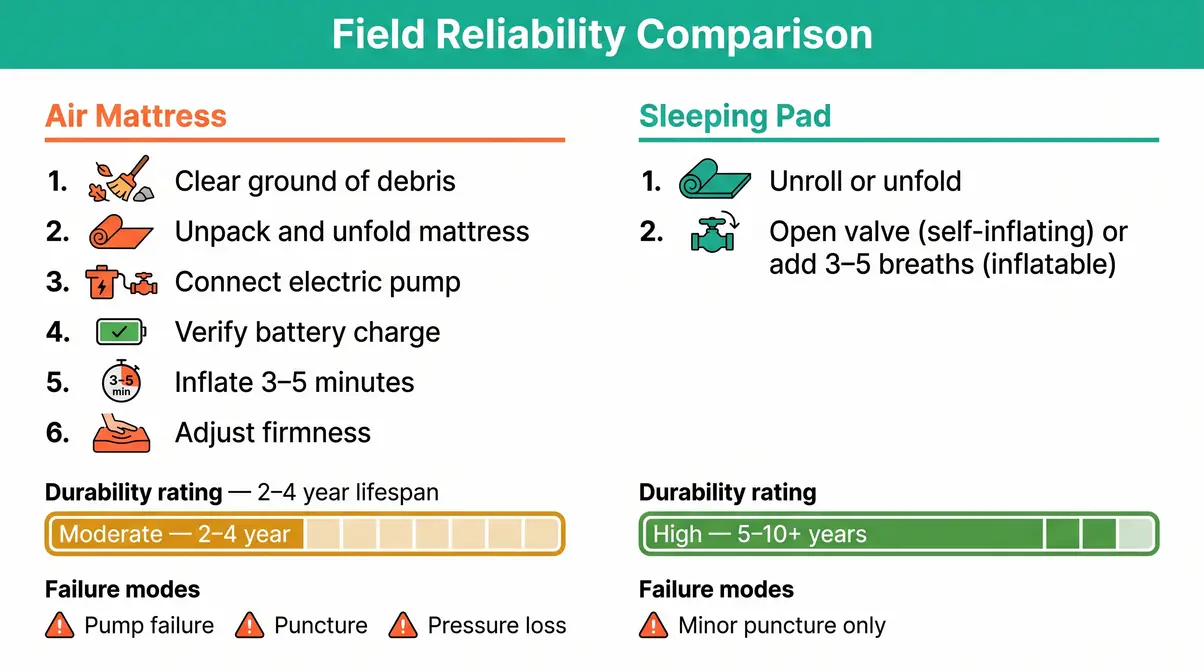
Setup time also differs meaningfully. Sleeping pads deploy in 30 seconds to 3 minutes. Air mattresses require 3–5 minutes with an electric pump (or significantly longer with manual inflation). In a rainstorm or at altitude where fine motor control is compromised, that difference matters practically.
For long-term durability, closed-cell foam pads last 10+ years with minimal degradation. Quality inflatable sleeping pads typically last 5–8 years. Car camping air mattresses average 2–4 years before seam or valve failure becomes an issue, even with careful use.
Setup Time and Ease of Use
Beyond raw setup time, reliability under field conditions separates these categories further. Air mattresses require a functional pump — which means a battery charge, an AC outlet, or significant manual effort. For those using the best instant tents for quick setup family camping, the 5-minute inflation time of an air mattress might be acceptable. However, at altitude, where air is thin, manual inflation of an air mattress can cause hyperventilation. In cold weather, an electric pump motor can fail. Sleeping pads — particularly foam pads — have zero dependencies: no pump, no battery, no risk of mechanical failure.
Self-inflating pads offer a middle ground: open the valve, wait 3–5 minutes for partial self-inflation, add a few breaths to reach desired firmness. No pump required. This low-failure-mode reliability is a meaningful advantage for backcountry camping where gear failure has real consequences.
Ergonomics: Sciatica & Back Pain
Medical Disclaimer: This information is general in nature. Consult a qualified medical professional for personalized advice about your specific condition, including scoliosis, sciatica, or chronic back pain.
Spinal health during sleep is a YMYL (Your Money or Your Life) consideration that zero competitors in this space address with scientific rigor. For the significant portion of campers managing chronic back conditions, choosing the wrong camping sleep surface can mean the difference between a restorative night and days of pain.
Spinal Alignment on Sleep Surfaces
A 2021 systematic review on mattress firmness and back pain published in PMC (NCBI) analyzed mattress firmness and spinal health across multiple studies. The research found that medium-firm sleeping surfaces promote comfort, sleep quality, and spinal (rachis) alignment — an important baseline for evaluating camping gear. Neither an overly firm surface nor an overly soft one achieves optimal spinal support. Additionally, a survey of individuals with low back pain by Harvard Health indicates that medium-firm surfaces generally provide the best relief.
Applied to camping gear: a properly inflated air mattress at medium firmness, or a quality self-inflating pad, can both approach the medium-firm zone. The critical variable is consistency — a surface that starts at medium firmness and deflates to near-flat overnight is worse for spinal alignment than a consistently firm sleeping pad. Research suggests that surface variability during sleep (caused by slow pressure loss in air mattresses) may contribute to morning stiffness and discomfort, though peer-reviewed camping-specific data remains limited.
A 2000 study published in PubMed (PMID 11104482) examined chronic back pain patients using adjustable airbeds versus innerspring mattresses. Results showed 95% of participants reported pain improvement and 88% reported better sleep quality — with an average 32% decrease in pain scores. However, these were adjustable medical-grade airbeds, not standard camping air mattresses, and the study represents short-term outcomes only. The principle that firmness adjustability matters for back pain sufferers does translate to camping contexts.
Sciatica & Body-Type Considerations
Sciatica (compression or irritation of the sciatic nerve, causing pain radiating from the lower back through the legs) is particularly sensitive to sleeping surface firmness. Experts at the University of Michigan suggest alleviating sciatica pain while sleeping requires keeping the spine neutral. Research suggests that side sleeping with a slightly firm surface — keeping the spine neutral and reducing hip rotation — may help minimize sciatic nerve compression during sleep. For campers with sciatica, a self-inflating pad at medium-to-firm inflation, or an air mattress adjusted to medium firmness with a foam pad underneath, may provide better relief than either a very soft air mattress or a very hard closed-cell foam pad.
Scoliosis (lateral curvature of the spine) creates asymmetric pressure distribution during sleep. The National Council on Aging notes that some research supports medium-firm mattresses for improved spinal alignment in scoliosis patients (NCOA, 2026). For camping, this translates to avoiding both extremes: a deflated or overly soft air mattress allows the spine to sag laterally, while an extremely firm foam pad can create uncomfortable pressure asymmetry. A self-inflating pad or adjustable inflatable pad at medium firmness — combined with a supportive sleeping bag — represents the most practical camping solution for scoliosis sufferers.
Body weight also influences which option performs better. Just as finding the best tent for a tall person backpacking ensures comfort, matching your body type to your pad is essential. Heavier campers (over 200 lbs) may find standard sleeping pads compress more than expected, reducing effective R-value and comfort. For heavier campers, a higher-loft self-inflating pad (3+ inches) or a quality air mattress with a foam pad underneath often provides better overnight support than a thin inflatable pad.
Are air mattresses good for sciatica?
Standard camping air mattresses are not ideal for most sciatica sufferers. Sciatica responds poorly to surfaces that are either too soft (causing hip sag and spinal misalignment) or that lose firmness during the night. A 2021 systematic review in PMC (PMC8655046) found medium-firm surfaces promote spinal alignment — and the key word is consistent firmness. A self-inflating pad at medium firmness, which maintains its surface properties all night without deflation risk, is typically a better choice for sciatica management than an air mattress prone to slow leaks. Consult a qualified medical professional for personalized advice.
This information is general in nature. Consult a qualified medical professional for personalized advice about your specific condition.
Decision Guide for Your Camping Style
The R-Comfort Trade-Off framework resolves most camping sleep decisions once you map your specific context. Our evaluation process examined six distinct camping scenarios across comfort needs, temperature conditions, and physical requirements to build this use-case matrix. For more details on sizing, see our guide on choosing the right air mattress for your tent.
Use-Case Decision Matrix
| Camper Profile | Recommended Option | Key Reason | Specific Gear Pairing |
|---|---|---|---|
| Car camper, summer, comfort priority | Air mattress | Comfort > insulation needs | Double-height air mattress + cross-wing design |
| Backpacker, any season | Sleeping pad | Weight + packability essential | Inflatable pad R-3.0+ for 3-season |
| Winter camper (below 32°F) | Sleeping pad only | R-4.5+ required; air mattresses fall short | Insulated inflatable pad R-5.0–7.0 |
| Sciatica or back pain sufferer | Self-inflating pad (medium firm) | Consistent firmness, no deflation risk | 3-inch self-inflating pad + sleeping bag liner |
| Side sleeper, car camping | Air mattress + foam base | Cushioning for pressure points + insulation | Air mattress on closed-cell foam pad |
| Budget buyer, occasional camper | Closed-cell foam pad | Lowest cost, zero failure modes, durable | $20–$40 foam pad (e.g., Therm-a-Rest Z Lite) |
Quick Decision Tree:
Start → “Are you backpacking (carrying gear over ½ mile)?” → Yes → “Is the overnight temperature below 32°F?” → Yes → Insulated Sleeping Pad (R-5.0+) — winter conditions require high R-value; no air mattress qualifies → No → Sleeping Pad (R-2.5–4.0) — weight and pack size make pads the only practical choice → No (car camping) → “Do you have back pain, sciatica, or scoliosis?” → Yes → Self-Inflating Pad or Adjustable Air Mattress (medium firm) + medical consult — consistency of surface matters more than cushioning → No → “Is the overnight temperature below 50°F?” → Yes → Air Mattress + Foam Pad underneath — adds R-value while preserving comfort → No → Air Mattress — summer car camping is where air mattresses genuinely excel
Practical Tips for Your Sleep System
These tips can help you improve sleep camping naturally. Add a closed-cell foam pad to your camping checklist for first time campers to ensure you are prepared for unexpected temperature drops.
What to put under an airbed?
Place a closed-cell foam pad directly under your air mattress — this is the single most impactful upgrade for car campers using air mattresses. It serves three functions simultaneously: adds R-value insulation (a foam pad rated R-2.0 under an R-1.5 air mattress creates a combined R-3.5, adequate for three-season camping), provides a puncture buffer between the mattress bottom and ground debris, and prevents the mattress from sliding on slippery tent floors. A groundsheet or tent footprint can go underneath the foam pad for additional protection. Budget approximately $20–$40 for a quality closed-cell foam pad to pair with your existing air mattress.
Getting the Most from Your Setup
- For air mattress users:
- Always clear the ground of rocks, roots, and debris before setup — most punctures happen at the contact point between mattress bottom and ground
- Inflate to 80% firmness at room temperature; air contracts as it cools, and overinflation at night can cause seam stress
- Keep a repair kit (patch + adhesive) in your kit — finding a leak in the field is frustrating but fixable in under 5 minutes with the right prep
- Place a closed-cell foam pad underneath to add R-value and create a puncture buffer between the mattress and ground
- For sleeping pad users:
- R-values are additive — stacking two pads multiplies thermal protection for extreme cold conditions (ASTM F3340-18 confirms this)
- Self-inflating pads should be stored unrolled and uncompressed to maintain foam loft over time
- Inflatable pads benefit from a small groundsheet underneath in rocky terrain
- For side sleepers, inflate to slightly softer than maximum to allow hip and shoulder accommodation without sacrificing spinal support
Limitations and Alternatives
Common Pitfalls
Pitfall 1: Buying an air mattress for three-season camping without checking R-value. A $150 air mattress with R-1.5 will leave you shivering on a 45°F night regardless of its comfort rating. Always check the ASTM F3340-18 R-value before purchasing for any camping below 55°F.
Pitfall 2: Assuming all sleeping pads are uncomfortable. Many campers try a $15 closed-cell foam pad, find it too hard, and conclude sleeping pads aren’t for them. Quality self-inflating and inflatable pads at $80–$200 offer meaningfully different comfort levels. The category is broader than its cheapest entry point suggests.
Pitfall 3: Overinflating an air mattress in cold weather. Inflating a mattress to maximum firmness in a warm car, then bringing it into a cold tent, causes pressure loss as the air contracts — leading to the “deflated by midnight” experience. Inflate inside the tent at the temperature where you’ll sleep.
Pitfall 4: Ignoring the pump dependency. An air mattress without a working pump is just a large plastic bag. Always carry a backup manual pump or verify battery charge before departure.
Pitfall 5: Using a sleeping bag’s temperature rating without accounting for pad R-value. Most sleeping bag temperature ratings assume you’re using a pad with approximately R-5. If your pad is R-2, your effective comfort temperature is significantly higher than the bag’s rating suggests.
When to Choose Alternatives
Choose a cot instead of an air mattress when car camping for multiple nights in warm weather. Cots provide excellent airflow, eliminate puncture risk entirely, and offer consistent support without inflation. They’re heavier and bulkier than air mattresses but far more reliable for base camp use.
Choose a sleeping bag quilt system over a pad + bag combination when ultralight backpacking in summer. A quilt (a sleeping bag without the back panel) paired with an insulated inflatable pad saves significant weight compared to a traditional sleeping bag over an air mattress.
Choose a hammock with an underquilt for forest camping where ground conditions are consistently rocky or uneven. A hammock + underquilt system bypasses the air mattress vs. sleeping pad question entirely for appropriate terrain.
When to Seek Expert Help
If you’re managing scoliosis, sciatica, or chronic back pain, the camping gear decision should involve your physical therapist or orthopedic specialist before your first multi-night trip. They can advise on specific firmness requirements and sleeping positions that translate directly to gear selection. For YMYL health conditions, gear community consensus is a starting point — not a substitute for personalized medical guidance.
Frequently Asked Questions
Is a sleeping pad better for camping?
Neither option is universally better — the right choice depends entirely on your camping context. Sleeping pads outperform air mattresses in thermal insulation (R-values of 3.0–7.0+ vs. 1.0–2.0 for most air mattresses), weight, and reliability. Air mattresses outperform sleeping pads in cushioned comfort and the feeling of a home bed. For backpacking or cold-weather camping, sleeping pads are the clear choice. For car camping in summer, air mattresses are a legitimate option. Section Hiker’s ASTM R-value analysis provides a useful framework for evaluating insulation claims objectively.
Are air mattresses good for scoliosis?
Air mattresses can work for scoliosis sufferers, but with important caveats. Research from the National Council on Aging (2026) suggests medium-firm surfaces support better spinal alignment for scoliosis. An adjustable air mattress set to medium firmness may provide acceptable support — but slow overnight deflation creates unpredictable firmness that can worsen asymmetric spinal pressure. A self-inflating sleeping pad at consistent medium firmness is generally more reliable for scoliosis management during camping. This is general information — consult a qualified medical professional for personalized advice about your specific condition.
Sleeping bag or air mattress?
These solve different problems and are not direct alternatives. A sleeping bag provides insulation around your body; a sleeping surface (air mattress or pad) provides insulation beneath you. You need both. The better question is which sleep surface to use with your sleeping bag. As a pairing: a sleeping bag rated to 30°F combined with an R-1.5 air mattress may leave you cold on a 40°F night, because the bag’s temperature rating assumes adequate ground insulation beneath you. Match your pad’s R-value to your expected overnight temperatures, then choose a sleeping bag to complement it.
Most comfortable camping sleep setup?
The most comfortable camping sleep setup for most people is a double-height air mattress on a cleared, level surface for car camping, or a high-quality inflatable sleeping pad (3.5-inch loft, R-3.5+) for backpacking. Comfort is subjective, but user consensus across camping communities consistently ranks double-height air mattresses highest for cushioned comfort when ground insulation isn’t the limiting factor. For side sleepers specifically, a self-inflating pad at medium firmness often outperforms a basic air mattress by providing consistent pressure point relief without the trampoline effect.
What organ is affected by scoliosis?
Scoliosis primarily affects the spine (vertebral column) — it is a lateral curvature of the spinal column that can also place pressure on surrounding structures including the ribs, lungs, and heart in severe cases. For camping purposes, the relevant impact is on sleep comfort: the spinal curvature creates asymmetric pressure distribution on any sleep surface, making consistent, medium-firm support more important than either maximum softness or maximum hardness. This is general information — consult a qualified medical professional for personalized guidance on managing scoliosis during outdoor activities.
How long can you sleep on an airbed?
Most people can sleep on a quality air mattress for 1–2 weeks without significant discomfort, provided the mattress maintains consistent firmness. For longer durations, surface consistency becomes critical: any slow leak that causes firmness loss by morning creates cumulative spinal stress over multiple nights. A 2000 PubMed study (PMID 11104482) on adjustable airbeds found 95% of participants reported pain improvement and 88% reported better sleep quality over a short-term trial — but “adjustable airbed” in that context refers to medical-grade products with precise firmness control, not standard camping air mattresses. For camping trips over 5–7 nights, a self-inflating sleeping pad’s consistent surface often produces better cumulative sleep quality than an air mattress that may gradually lose firmness.
Prices and features verified as of July 2026. Always confirm current pricing with retailers before purchase.
Choosing Your Camping Sleep System
The air mattress vs sleeping pad for camping decision has a clear answer once you stop asking “which is better?” and start asking “which is right for my camping context?” Both options have genuine, evidence-backed strengths. Neither is universally superior.
For car campers in summer conditions above 55°F who prioritize comfort, a quality air mattress with a cross-wing design and a foam pad underneath delivers a sleep experience that genuinely approaches home-bed quality. For backpackers, cold-weather campers, and anyone camping below 50°F regularly, a sleeping pad with an ASTM F3340-18 verified R-value of 3.0 or higher is the only reliable choice — air mattresses simply cannot maintain adequate insulation in those conditions, regardless of price.
The R-Comfort Trade-Off is the framework that resolves this debate: you are always trading some comfort cushioning for insulation performance, or vice versa. The camper who understands that trade-off chooses deliberately rather than hoping one product will somehow deliver both ends of the spectrum simultaneously.
Your next step is concrete: identify your most common camping scenario from the use-case matrix above, check the ASTM R-value rating on any sleep surface you’re considering, and pair it with a sleeping bag rated for your expected overnight temperature range. If you’re managing back pain, sciatica, or scoliosis, bring those specific needs to a medical professional before committing to gear. Start with one good night’s sleep — the right system makes that achievable on any campsite.