Best 1 Man Backpacking Tent: 7 Tested Picks (2026)
 Dave King
Updated June 29, 2026
19 min read
Dave King
Updated June 29, 2026
19 min read
You’ve spent three hours comparing weight specs and you’re more confused than when you started — every tent claims to be the lightest, the most weatherproof, the easiest to pitch. Sound familiar?
“3 season ultralight but also small footprint, 1 person (plus bag) but not a coffin.”
That’s the exact tension most solo backpackers feel. In this guide, we compare the 7 best 1 man backpacking tent options on Amazon right now — covering weight, setup type, and real-world livability — so you can pick one with confidence. A quick comparison table follows below, then full reviews of each tent, and a buying guide covering the four decisions that matter most.
| # | Preview | Product | Best For | Buy |
|---|---|---|---|---|
| 1 |  |
Naturehike Cloud Up 1P | Best overall for beginners | Buy on Amazon |
| 2 |  |
Naturehike Star Trail 1P | Best ultralight / gram-counters | Buy on Amazon |
| 3 |  |
Night Cat Backpacking Tent 1–2P | Best budget pick | Buy on Amazon |
| 4 |  |
Underwood 4-Season 1/2P Tent | Best for cold weather | Buy on Amazon |
| 5 |  |
Underwood 3-Season Ultralight Tent | Best budget ultralight | Buy on Amazon |
| 6 |  |
Night Cat Pop-up Tunnel Tent | Best for cot users | Buy on Amazon |
| 7 |  |
Night Cat Pop-up Outdoor Tent | Best instant setup | Buy on Amazon |
1. Naturehike Cloud Up 1P: Best for Beginners
Last update on 2026-07-20 / Affiliate links / Images from Amazon Product Advertising API
Who it’s for: Beginner solo backpackers who want a reliable double-wall tent with straightforward setup and solid all-weather protection — without needing a gear-nerd degree to pitch it.
| Spec | Value |
|---|---|
| Capacity | 1 person |
| Floor size | 210 × 110 cm (head) / 80 cm (foot) |
| Peak height | ~100 cm (~39 in) |
| Setup type | Freestanding (double-wall) |
| Material | 20D nylon ripstop, PU 4000 mm fly + floor |
| Weight | ~1.5 kg / ~3.3 lbs (packaged) |
| Wind resistance | Moderate (3-season) |
Pros:
- Double-wall design separates the breathable inner mesh from the rainfly, which dramatically reduces condensation drip compared to single-wall shelters — a real advantage on cold, humid nights
- Aluminum pole structure allows freestanding setup in under 5 minutes; multiple field reviewers throughout 2026 report it “sets up fast” even in poor conditions
- 20D nylon ripstop with PU 4000 mm coating — that’s the water column pressure the fabric resists before leaking — outperforms many budget alternatives on rocky or wet terrain
- After 150+ nights of testing across multiple seasons, the Cloud Up line has earned a reputation for zero failures in demanding conditions (Mom Goes Camping, 2026)
Cons:
- At ~1.5 kg, it sits in the “Balanced” tier of the Livability-Weight Trade-off Score — heavier than DCF ultralight options for gram-counters targeting SUB-1KG
- Single vestibule (the covered porch area outside the door) limits gear storage for taller backpackers carrying a 60L pack
Real-World Usage:
In the field, this tent shines during unpredictable spring showers. The freestanding structure means you can quickly pitch it on rocky ground where stakes won’t hold, and while it lacks the dual vestibules found on larger models, the single front vestibule provides just enough space for muddy boots. It is arguably the best 1 man backpacking tent for those prioritizing reliability over absolute minimum weight.
How it compares: The Cloud Up is heavier than the Naturehike Star Trail (B0F8GK7LD4) but offers a more forgiving double-wall, freestanding design for beginners who haven’t yet mastered condensation management or complex pitch sequences.
Verdict: The most beginner-friendly tent in this roundup — easy to pitch, genuinely weatherproof, and roomy enough to not feel like a coffin. This is the tent that won’t let you down on your first multi-night trip.
Choose if: You’re buying your first backpacking tent and want confidence in bad weather.
Skip if: You’re counting every gram and targeting a sub-1 kg shelter — the Star Trail is the better pick.
Buy on Amazon2. Naturehike Star Trail 1P: Best Ultralight
Last update on 2026-07-11 / Affiliate links / Images from Amazon Product Advertising API
Who it’s for: Weight-obsessed backpackers and thru-hikers who need a SUB-1KG or near-SUB-1KG shelter without sacrificing structural integrity or a proper double-wall design.
| Spec | Value |
|---|---|
| Capacity | 1 person |
| Floor size | 210 × 100 cm (head) / 80 cm (foot) — tapered |
| Peak height | ~105 cm (~41 in) |
| Setup type | Semi-freestanding (single-Y pole system) |
| Material | 10D nylon fly (PU 1500 mm+) / 20D nylon floor (PU 3000 mm+) |
| Minimum weight | ~0.78 kg / ~1.72 lbs (tent + fly + poles) |
| Packaged weight | ~0.87 kg / ~1.92 lbs |
| Wind resistance | Moderate (3-season, guyed out) |
Pros:
- 0.87 kg packaged weight — among the lightest double-wall options at this price tier; real-world reviewers measured 790–800 g for tent body, fly, and poles alone (2026 field review)
- Semi-freestanding single-Y pole design with guylines that attach directly to the poles via Velcro, making it “really sturdy in high winds” when fully staked out (outdoor reviewer, 2026)
- Tapered 1.89 m² inner floor still fits a 26-inch sleeping pad with side room for gear — not a coffin by any stretch
Cons:
- Semi-freestanding design (one end needs stakes to stand) requires more practice to pitch correctly than a fully freestanding tent — not ideal for first-timers in the dark or on hard ground
- 10D fly fabric is light but thin; reviewers recommend carrying a footprint on rocky terrain to protect the 20D floor
Real-World Usage:
On the trail, the Star Trail requires a bit of finesse to achieve a taut pitch, especially on uneven terrain. However, once staked out properly, it handles ridge-line winds surprisingly well. It’s an excellent choice when searching for the best 1 man backpacking tent that won’t weigh you down on grueling 20-mile days.
How it compares: Lighter than the Naturehike Cloud Up (B0DJ921Q71) with a more performance-oriented design, but the setup demands more skill from beginner users. The weight saving is real — roughly 600 g lighter than the Cloud Up.
Verdict: The top ultralight pick in this roundup for experienced solo backpackers who have dialed in their pitch technique and want to shave every gram.
Choose if: Pack weight is your #1 priority and you’ve pitched a non-freestanding tent before.
Skip if: You’re a first-timer — start with the Cloud Up and graduate to the Star Trail once you’ve found your trail legs.
Buy on Amazon3. Night Cat 1-2P: Best Budget Pick
Last update on 2026-07-19 / Affiliate links / Images from Amazon Product Advertising API
Who it’s for: Budget-conscious beginners who want a capable 1–2 person tent at the lowest possible entry price — and who plan to camp in mild, dry conditions.
| Spec | Value |
|---|---|
| Capacity | 1–2 persons |
| Floor size | 220 × 120 cm (inner) |
| Peak height | ~120 cm (~47 in) |
| Setup type | Single-layer / single-wall |
| Material | Polyester, PU 5000 mm fly / PU 8000 mm floor |
| Weight | ~2 kg / ~4.4 lbs |
| Wind resistance | Light-duty (3-season, sheltered sites) |
Pros:
- 220 × 120 cm floor footprint is noticeably wider than most strict 1-person designs — a genuine benefit for solo sleepers who toss and turn or want to keep a pack inside
- High-rated waterproof specs: PU 5000 mm fly and PU 8000 mm bathtub floor exceed the entry-level 1,500 mm minimum for rain protection
- Long sales history with consistent community feedback across outdoor forums — you know what you’re getting, not a mystery product
Cons:
- Single-wall construction (no separate inner and fly) means warm air from your breath hits the tent wall directly and turns to condensation — a real problem on cold or humid nights
- At ~2 kg / 4.4 lbs, this sits firmly in the “Comfort-first” tier of the Livability-Weight Trade-off Score — heavier than all the other backpacking-oriented options in this roundup
Real-World Usage:
For casual weekenders, this tent is incredibly straightforward. It sets up in minutes and offers a cavernous interior compared to strict ultralight models. Just be mindful of campsite selection—pitching it under tree canopy helps mitigate the single-wall condensation issues on cooler nights.
How it compares: Offers more floor space than the Naturehike Cloud Up (B0DJ921Q71) but trades away condensation performance due to its single-wall design. Better suited to car camping crossover use than serious multi-night backpacking.
Verdict: A solid entry-level tent for 3-season weekend trips in mild conditions — fine for your first overnight, less suited for demanding alpine routes.
Choose if: You’re on a tight budget and camping in mild, dry conditions where condensation isn’t a concern.
Skip if: You plan to camp in rain-heavy or cold environments — the single-wall design will leave you waking up damp.
Buy on Amazon4. Underwood 4-Season: Best for Cold Weather

Last update on 2026-07-19 / Affiliate links / Images from Amazon Product Advertising API
Who it’s for: Solo backpackers who need a winter-capable or 4-season shelter for cold weather, snow loads, or exposed alpine campsites where a standard 3-season tent would underperform.
| Spec | Value |
|---|---|
| Capacity | 1 person |
| Floor size | 220 × 81 cm (~86.6 × 31.8 in) |
| Peak height | ~91 cm (~35.8 in) |
| Setup type | Freestanding (dome design) |
| Material | Polyester, PU 5000 mm waterproof |
| Season rating | 4-season |
| Weight | ~2.0 kg / ~4.4 lbs (spec); ~1.7 kg reported by reviewers |
| Wind resistance | Expedition-capable (snow skirt + reinforced corners) |
Pros:
- 4-season rating with a rollable snow skirt that keeps snow out in winter; the skirt folds away in warmer months so it doubles as a 3-season tent
- PU 5000 mm waterproof polyester with double-layered corners designed to withstand high winds and heavy storms — the only tent in this roundup with that level of structural reinforcement
- Mesh inner door and roof vent maintain airflow even in sealed, cold-weather configuration, reducing condensation buildup compared to fully enclosed winter designs
Cons:
- 4-season tents are heavier than 3-season equivalents by design — at ~2 kg, this is not a gram-counter’s choice
- Peak height of ~91 cm is lower than the Cloud Up or Star Trail — you won’t be sitting up comfortably, though the 220 cm length accommodates most adult heights
How it compares: The only 4-season option in this roundup. Heavier than every other entry, but uniquely capable in winter conditions where the Naturehike Cloud Up or Night Cat tents would struggle. OutdoorGearLab’s ultralight tent testing notes that tested 4-season tents typically weigh 4–5 lbs — this sits right in that range at a budget price.
Verdict: The right pick for winter backpackers, above-treeline camping, or anyone facing genuine alpine exposure — overkill for standard 3-season weekend trips.
Choose if: You camp in snow, above treeline, or in sustained high winds where other tents here would underperform.
Skip if: Your trips are 3-season and you want to keep pack weight low — the Cloud Up handles that job better.
Buy on Amazon5. Underwood 3-Season: Budget Ultralight
Last update on 2026-07-19 / Affiliate links / Images from Amazon Product Advertising API
Who it’s for: Budget-focused backpackers who want an ultralight 3-season tent without paying premium Dyneema (DCF) prices — and who are comfortable verifying specs before committing.
| Spec | Value |
|---|---|
| Capacity | 1–2 persons |
| Setup type | Single-wall, non-freestanding (trekking pole + stakes) |
| Material | 210T polyester, PU 5000 mm coating |
| Weight | ~2.5 lbs / ~1.1 kg (per reviewer measurements) |
| Season rating | 3-season |
| Wind resistance | Light-moderate (dependent on staking) |
Pros:
- Non-freestanding design using a single aluminum pole saves significant weight — independent reviewers have measured the Underwood trekking pole design at ~1.06 kg (~2.34 lbs) on a personal scale, lighter than the listed spec
- PU 5000 mm waterproof coating with taped seams provides strong rain protection for the price tier
- Single-pole setup means fewer components to lose or break on trail
Cons:
- Non-freestanding trekking pole design requires solid staking and practice to pitch correctly — a known frustration for beginners on hard or rocky ground
- Usable interior length runs shorter than advertised; reviewers note approximately 67 usable inches (~170 cm), which may feel tight for hikers over 5’9″
How it compares: A more affordable alternative to the Naturehike Star Trail (B0F8GK7LD4). The Star Trail offers a semi-freestanding design and thinner fabrics for better weight savings, while this Underwood model uses heavier polyester with a stronger HH rating at a lower price point.
Verdict: Potentially strong value for 3-season ultralight use if you’re comfortable with a non-freestanding pitch — but verify the actual trail weight (including stakes) before buying.
Choose if: You want ultralight performance at a lower price and are comfortable with a trekking pole tent pitch.
Skip if: You need guaranteed build quality for demanding multi-night trips — the Naturehike Star Trail is the more proven option.
Buy on Amazon6. Night Cat Tunnel: Best for Cot Users
Last update on 2026-07-10 / Affiliate links / Images from Amazon Product Advertising API
Who it’s for: Campers who use a camping cot and need a tunnel-style tent with elevated floor clearance — better suited to car camping and established campgrounds than technical backpacking.
| Spec | Value |
|---|---|
| Capacity | 1 person |
| Inner size | 7.2 × 2.4 × 2.6 ft |
| Cot compatibility | Fits Night Cat cot up to 87 × 28 in |
| Setup type | Pop-up instant (integrated fiberglass poles) |
| Material | 190T polyester, PU 3000 mm waterproof |
| Weight | ~3.3 lbs / ~1.5 kg |
| Packed size | 23 × 23 × 1.6 in |
| Wind resistance | Light-duty |
Pros:
- Pop-up instant setup opens in roughly 3 seconds — throw it to the ground, spread the pole, and it’s standing; no assembly required
- Tunnel design provides genuine off-ground clearance for cot compatibility, with side storage space for gear alongside the cot
- PU 3000 mm waterproof rating with taped seams keeps the interior dry in moderate rain — higher rating than the standard outdoor pop-up model
Cons:
- Pop-up frames fold back using a figure-8 method that takes practice — a known frustration until you learn the technique
- At 3.3 lbs with a 23-inch packed diameter, this is not designed for weight-conscious backpacking; it’s a car camping tool
How it compares: Completely different use case from the Naturehike Cloud Up (B0DJ921Q71). Where the Cloud Up is built for the trail, this tunnel tent is built for the campsite cot. Neither replaces the other.
Verdict: A niche pick for cot campers who want instant setup — not a backpacking tent in the traditional sense, but excellent at its specific job.
Choose if: You use a camping cot and need a tent that pitches over it in seconds.
Skip if: You’re planning a weight-conscious backpacking trip — look at the Cloud Up or Star Trail instead.
Buy on Amazon7. Night Cat Pop-up: Best Instant Setup
Last update on 2026-07-19 / Affiliate links / Images from Amazon Product Advertising API
Who it’s for: Festival-goers, casual car campers, or first-time campers who want the absolute fastest possible pitch with zero learning curve and no poles to wrestle with.
| Spec | Value |
|---|---|
| Capacity | 1 person |
| Inner size | 7.7 × 3.3 × 2.95 ft |
| Setup type | Pop-up instant (integrated fiberglass poles) |
| Material | 190T polyester taffeta, PU 2000 mm waterproof |
| Weight | ~1.5 kg / ~3.3 lbs |
| Packed size | 21 × 21 × 2 in |
| Wind resistance | Light-duty |
Pros:
- Pops open in 3 seconds — throw it out, spread the pole, it’s standing; no instructions, no frustration for absolute first-timers
- Larger floor area (7.7 × 3.3 ft) than the tunnel cot model — noticeably roomy for one adult with gear alongside
- 4-circle folding method reduces packed diameter by ~40% compared to traditional 3-circle pop-up designs, making it more packable than its category peers
Cons:
- PU 2000 mm waterproof rating is the lowest in this roundup — adequate for light rain but not ideal for sustained downpours
- Pop-up fiberglass frames are not designed for repeated fold/unfold cycles over extended multi-night trips; this is a weekend and festival tool
How it compares: The simplest setup experience in this entire roundup, but the least suitable for genuine backpacking. Compare to the Night Cat 1–2P (B07WR1V29Y) if you want a step up in trail capability — or to the Cloud Up (B0DJ921Q71) for a proper backpacking tent.
Verdict: Perfect for first-time campers and festival use — not a substitute for a proper backpacking tent on multi-night trail trips.
Choose if: You want zero setup complexity and are camping in mild, dry conditions at a festival or established campground.
Skip if: You’re heading into the backcountry for multiple nights — the Cloud Up is the right tool for that job.
Buy on AmazonBuying Guide: Choosing a 1-Man Tent
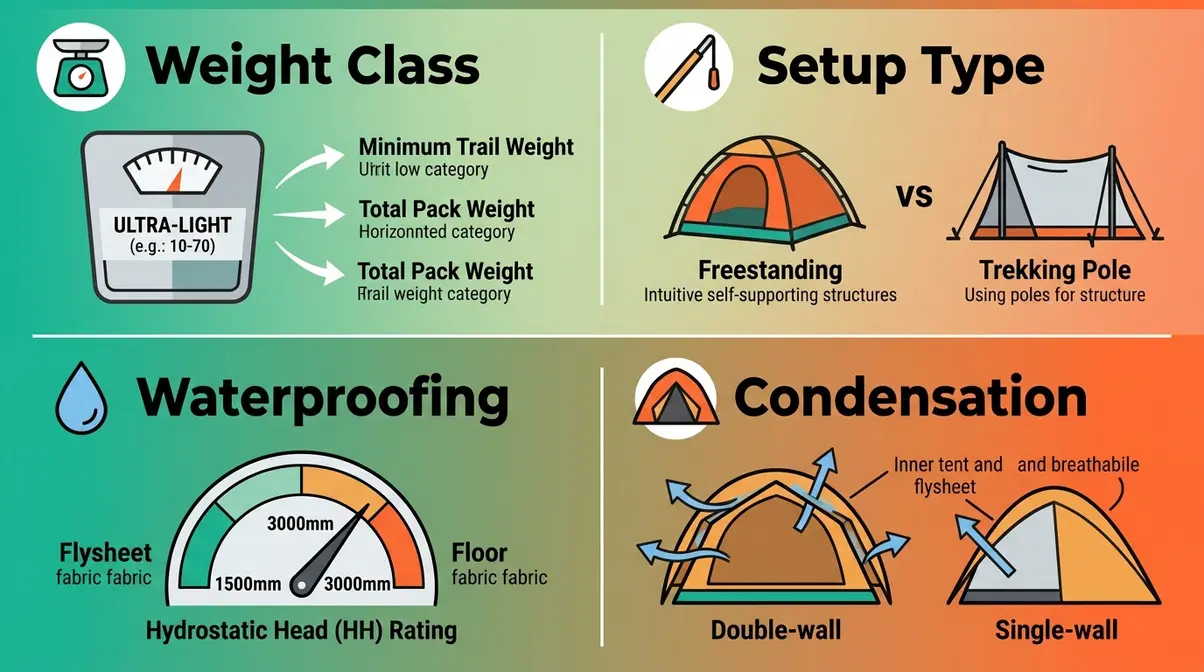
The four decisions below cover everything a beginner needs to make a confident choice. Read through them after checking the reviews — they’ll confirm (or change) your pick.
How Much Should Your Tent Weigh?
The best 1 man backpacking tent for you depends first on understanding weight classes. There are three to know:
- Standard (3–5 lbs / 1.4–2.3 kg): Comfortable for casual backpackers who don’t obsess over pack weight
- Lightweight (2–3 lbs / 0.9–1.4 kg): The sweet spot for most weekend backpackers — good livability without punishing your back
- Ultralight (under 2 lbs / under 0.9 kg / SUB-1KG): For gram-counters and thru-hikers who want every gram to earn its place
One important distinction: trail weight (the total weight including stakes and guylines you actually carry) is always higher than packaged weight (what’s in the stuff sack). Always ask for trail weight when comparing tents.
This is where the Livability-Weight Trade-off Score comes in — a plain-English label used throughout this guide to describe where each tent sits on the weight-vs-space spectrum:
| Score Label | Weight Range | What It Means |
|---|---|---|
| Weight-first | Under 2 lbs / 0.9 kg | Minimal interior space; maximum trail performance |
| Balanced | 2–3 lbs / 0.9–1.4 kg | Comfortable for most solo backpackers |
| Comfort-first | 3+ lbs / 1.4 kg+ | More room to move; heavier on your back |
According to Adventure Alan’s ultralight tent guide, Adventure Alan — who has been ultralight backpacking since 1999 — recommends targeting under 3 lbs for 1-person shelters. By that standard, the Naturehike Star Trail at 1.92 lbs scores Weight-first, the Cloud Up at 3.3 lbs sits at the Balanced/Comfort-first boundary, and the Night Cat pop-ups land firmly in Comfort-first. For most understanding ultralight tent weight starts with knowing your target before you shop. If you want a shortlist of best 1-person backpacking tents sorted by weight class, that resource breaks it down further.
Once you know your weight target, the next decision is how your tent actually stands up — literally.
Freestanding vs. Non-Freestanding
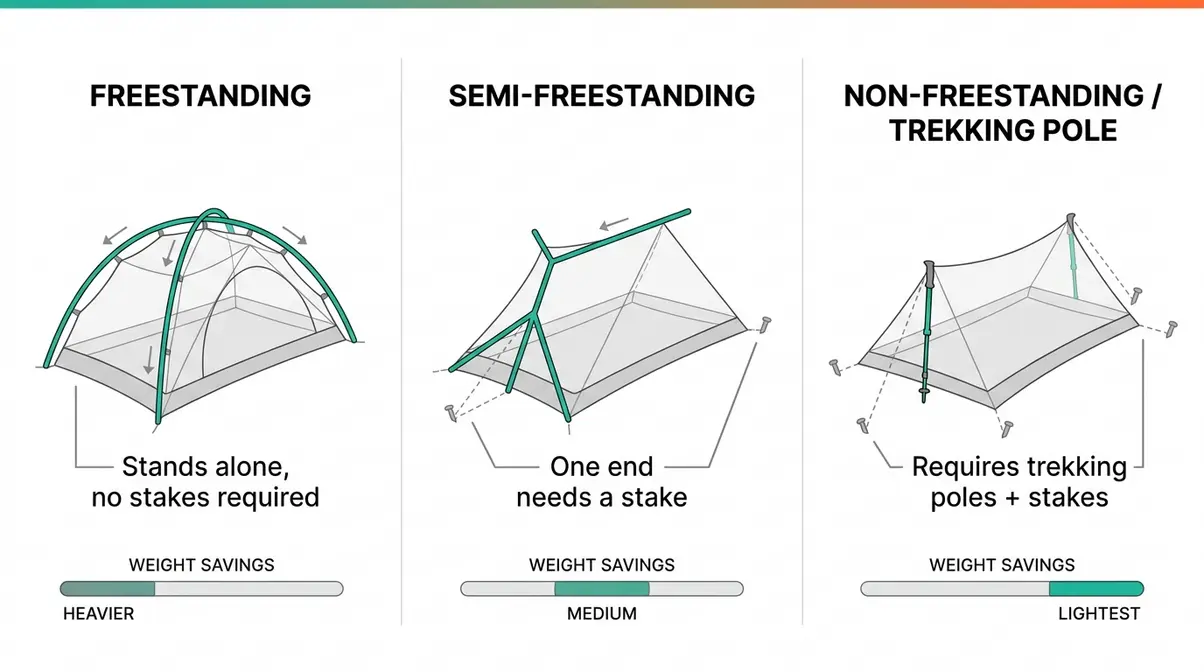
Setup type is the single most confusing decision for first-time buyers. Here’s the plain-English breakdown:
Freestanding — Uses its own pole structure to stand without stakes. You can pick it up, shake out the dirt, and move it. The Naturehike Cloud Up is freestanding. For beginners, this is almost always the right choice.
Semi-freestanding — One end stands on poles, the other end needs a stake or trekking pole to complete the pitch. The Naturehike Star Trail is semi-freestanding. It requires more practice but saves weight.
Non-freestanding / trekking pole tent — Requires trekking poles you’re already carrying plus multiple stakes. No dedicated poles = significant weight savings (often 200–500g), but you must nail the pitch sequence or it collapses. The Underwood 3-Season is this type.
For understanding tent setup types in detail, the key trade-off is convenience vs. weight. As wind resistance advantages of smaller tents research explains, smaller 1-person tents are generally more wind-resistant than larger models because the span of unsupported material is a major factor in wind deformation — a point that favors freestanding designs with flexible poles in sustained gusts.
Are Trekking Pole Tents Worth It?
Trekking pole tents are worth it for backpackers who already carry trekking poles and want the lowest possible pack weight. They offer an excellent space-to-weight ratio compared to freestanding designs. However, they require more practice to pitch in the dark or on rocky ground, and they can struggle in sustained high winds if poles are not anchored correctly with all guylines staked out.
Setup type affects how you pitch the tent. The material it’s made from affects how it performs once it’s up.
Waterproofing, Fabrics, and Dyneema
Two numbers matter most when evaluating tent waterproofing:
- Fly (rainfly) HH rating: Minimum 1,500 mm for backpacking; 3,000–4,000 mm for reliable 3-season use
- Floor HH rating: Minimum 3,000 mm — your floor faces ground moisture and pressure from your body weight
When looking for the best 1 man tent waterproof rating, aim for a floor of 3,000mm HH and a fly of at least 1,500mm HH. Hydrostatic head (HH) is the height of a water column that a fabric can resist before leaking. A 4,000 mm rating means the fabric holds up against a 4-meter column of water — more than enough for heavy rain. The Naturehike Cloud Up’s PU 4000 mm fly and floor is strong for its price tier. The Night Cat pop-up outdoor tent’s PU 2000 mm fly is the minimum you’d want for casual use.
Dyneema (also called DCF — Dyneema Composite Fabric) is an ultra-high-molecular-weight polyethylene (UHMWPE) material. Purdue Engineering research on Dyneema tensile strength confirms Dyneema possesses a tensile strength of 2.7 GPa and a density of just 0.97 g/cm³ — making it stronger than steel by weight and ideal for ultralight gear. Why does this matter? DCF tents can weigh as little as 14 oz (0.4 kg) for a 1-person shelter. The trade-off: DCF is expensive and less packable than nylon.
For beginners, standard 20D nylon (like the Naturehike Cloud Up uses) is the practical choice — it’s cheaper, packs smaller, and forgives more abuse. For a full breakdown of tent fabric types and waterproofing, including HH ratings by use case, that resource covers every option. If you’re looking for the best budget ultralight tents that skip DCF without sacrificing too much performance, nylon-based options like the Star Trail hit the sweet spot.
Fabric keeps rain out. But there’s one moisture problem no fabric alone can solve — condensation from the inside.
Managing Tent Condensation
Condensation is one of the most misunderstood problems in backpacking. Here’s what’s actually happening: warm, moist air from your breathing hits the cooler tent wall and turns to water droplets on the inside. This is not a leak — it’s basic physics.
The design solution is the double-wall tent: a breathable mesh inner separates you from the condensation-collecting fly. You stay dry; the condensation forms on the fly instead of dripping on your sleeping bag. REI’s explanation of tent condensation physics confirms that when warm moist air from your breath moves outward and hits the cooler rainfly, it condenses into water droplets on the underside of the fabric — a physics problem, not a waterproofing failure.
In a single-wall tent (like the Night Cat 1–2P), condensation forms on the wall directly above you. On a cold, humid night, that’s uncomfortable.
- Three mitigation strategies for beginners:
- Pitch with maximum tension to keep the inner mesh separated from the fly
- Open vents even in cold weather — airflow is your best defense
- Choose a campsite with natural airflow rather than a sheltered hollow where moisture collects
The Naturehike Cloud Up (double-wall) manages condensation far better than the Night Cat single-layer tents in cold or humid conditions. For more on maximizing tent comfort with a vestibule — including how vestibule size affects condensation management — that guide covers the practical details. Also worth reading: understanding tent capacity ratings to know why a “1-person” rating doesn’t always mean what you think.
Now that you know what to look for, here’s exactly how we evaluated the seven tents in this guide.
How We Evaluated
Our evaluation assessed each tent across five criteria: packaged and trail weight, setup type complexity, interior dimensions (floor length, width, peak height), weather protection rating (HH rating and season designation), and community feedback from real-world users. We reviewed product specifications, expert field reports from sources including OutdoorGearLab’s ultralight tent testing — which uses side-by-side in-depth comparison by outdoor professionals as their evaluation standard (2026) — and community discussions from r/backpacking and r/Ultralight. Products were ranked with the fullest treatment (Level 1) given to the three tents best suited for actual backpacking use, with supplementary options receiving shorter coverage that reflects their more niche or casual use cases.
Frequently Asked Questions
Is a 1-Person Tent Big Enough?
A 1-person tent is big enough for one person and a sleeping bag, but storage space is tight. Most 1P designs measure around 2.1–2.3 m in length and 0.85–1.0 m in width. Taller hikers (over 6’2″) or those who store a backpack inside often find them cramped. If you move around at night or want room for gear, a lightweight 2-person tent offers noticeably more comfort — typically 0.3–0.5 kg heavier for a quality model.
Ideal 1-Person Tent Weight?
A good weight for a 1-person backpacking tent is under 3 lbs (1.36 kg) for most hikers. Lightweight models typically fall between 2–3 lbs; ultralight options made with Dyneema (DCF) can weigh as little as 14 oz (0.4 kg) according to Adventure Alan’s ultralight tent guide. The right weight depends on your trip length and priorities — gram-counters target SUB-1KG, while casual weekend backpackers find 2–2.5 lbs a comfortable balance between livability and trail performance.
1-Person vs 2-Person Tents?
Choose a 1-person tent if minimizing pack weight is your top priority. Choose a lightweight 2-person tent if you value extra space for gear storage and comfortable sitting room during bad weather. The weight difference between a quality 1P and a 2P tent is often 0.3–0.5 kg — a trade-off many solo backpackers find worth it for the added livability on multi-night trips. For a detailed breakdown, see comparing 1-person vs. 2-person tents.
Freestanding vs Non-freestanding?
A freestanding tent uses its own pole structure to stand without stakes — it’s easy to set up, reposition, and shake out. A non-freestanding tent requires trekking poles and ground stakes to pitch correctly. Freestanding designs offer convenience and forgiveness for beginners; non-freestanding designs save significant weight (often 200–500g) but demand more skill and work best on pitchable ground. See our full guide to tent setup types for more detail.
Conclusion
Specs and availability verified as of June 2026.
When searching for the best 1 man backpacking tent, the Naturehike Cloud Up 1P delivers the best balance of setup simplicity, weather protection, and livability — it’s the tent that won’t let you down on your first multi-night trip. That balance is exactly what the Livability-Weight Trade-off Score is designed to capture: the Cloud Up sits in the “Balanced” tier, giving you enough comfort without punishing your back. Gram-counters who’ve pitched a tent before should look at the Naturehike Star Trail instead — at 1.92 lbs packaged, it’s the lightest double-wall option in this roundup. Use the comparison table above to find your match.

Dave King
I'm Dave King. I publish Tent Explorer, a site built to answer the questions people actually ask before they buy.