10 Benefits of Tent Camping: Science-Backed Guide (2026)
 David King
Updated July 1, 2026
20 min read
David King
Updated July 1, 2026
20 min read
****
Most people think of tent camping as a fun weekend escape. What they don’t realize is that a single night sleeping under the open sky can reset your body clock, lower stress hormones, and deliver measurable mental health improvements that a gym membership simply cannot match. The benefits of tent camping go far beyond fresh air and s’mores.
This guide covers all 10 scientifically supported benefits of tent camping, the practical advantages over hotels and RVs, the essential rules every beginner needs to know, and honest answers to the most common concerns — so you can decide whether a tent is worth it before you buy a single piece of gear.
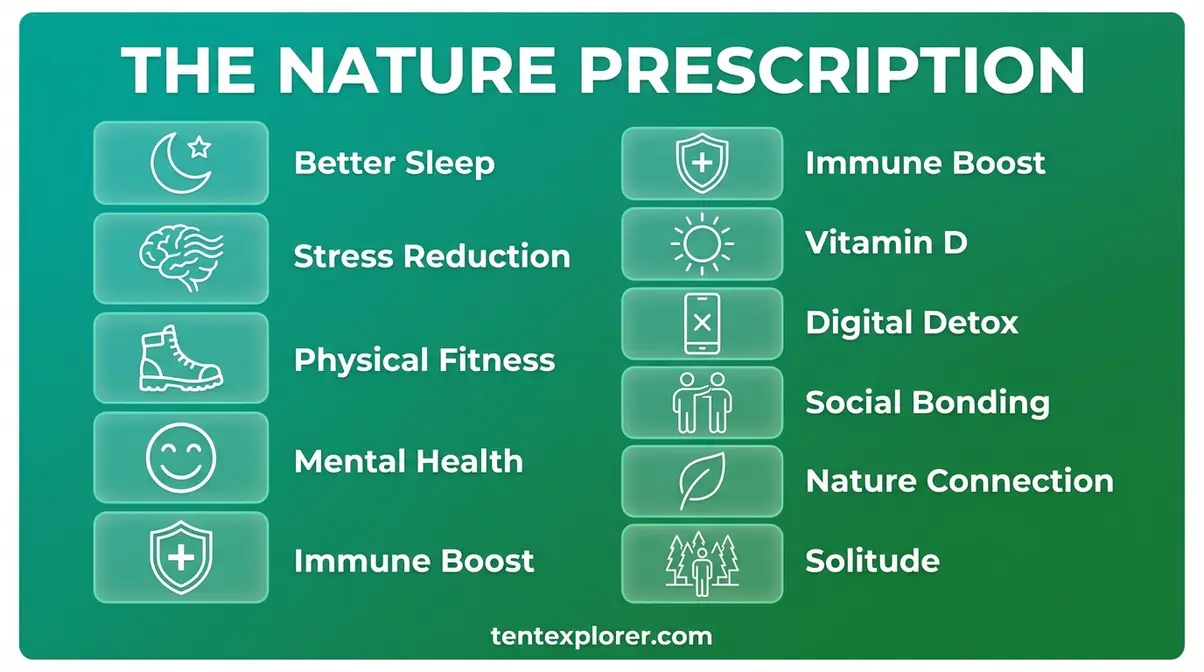
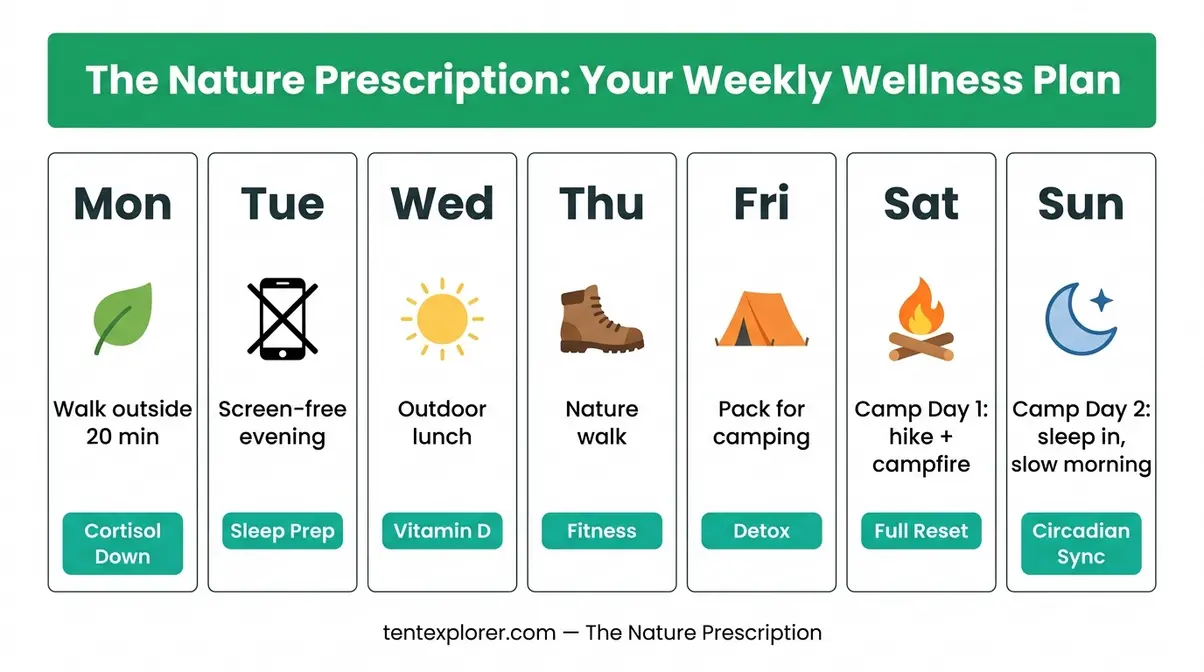
The benefits of tent camping include scientifically measurable improvements to sleep, stress, fitness, and mental health — often after just one weekend. The Nature Prescription framework shows that a single camping trip addresses all four pillars of wellness simultaneously, at a fraction of the cost of a spa or hotel stay.
- Sleep reset: Sleeping without artificial light naturally restores your circadian rhythm within 2 days (Current Biology).
- Stress relief: Time in nature lowers cortisol (your body’s stress hormone) and reduces blood pressure.
- Cost-effective wellness: A campsite averages $15–$35/night vs. $150+ for a budget hotel.
- Beginner-friendly: Basic rules like the 3-3-3 and 200-foot rule make safe camping easy to learn.
The 10 Core Health Benefits of Tent Camping
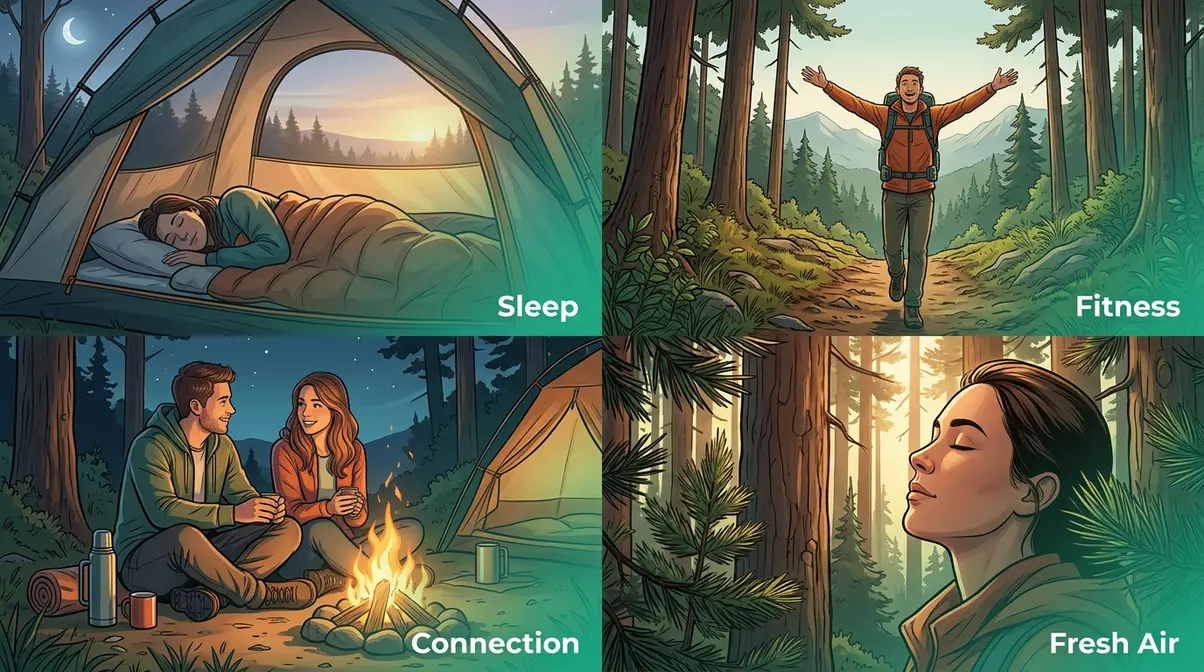
Tent camping is one of the few activities that simultaneously improves sleep, reduces stress, builds fitness, and strengthens social bonds — all in a single weekend. Research from the U.S. Forest Service and peer-reviewed journals consistently shows that time outdoors produces measurable physiological changes. Here is what the science says about each benefit.
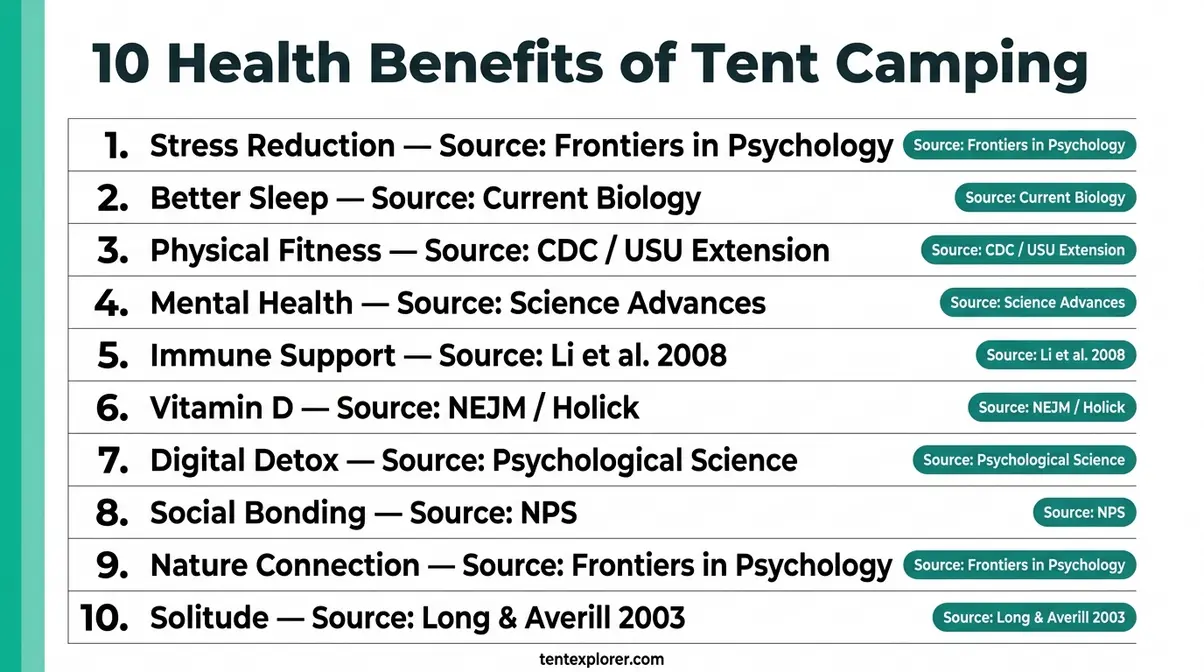
1. Stress Reduction and Relaxation
Spending time in a natural environment measurably lowers cortisol (your body’s primary stress hormone). A study published in Frontiers in Psychology found that just 20–30 minutes sitting or walking in nature reduced cortisol levels significantly compared to an urban setting (Hunter et al., 2019). When you camp, you spend hours — not just minutes — in that environment. If you are consulting a what is tent camping guide to understand the basics, know that the mental health benefits start immediately upon arrival.
The effect compounds over a full weekend. Lower cortisol also means lower blood pressure and a slower resting heart rate. You do not need to hike 10 miles to feel it. Simply sitting at a campsite, listening to birds and wind, triggers a parasympathetic (rest-and-digest) nervous system response that your office chair never will.
Why this matters for you: If you leave work on Friday feeling wound tight, you will almost certainly feel noticeably calmer by Saturday morning — without medication or a yoga class.
2. Better Sleep & Circadian Reset
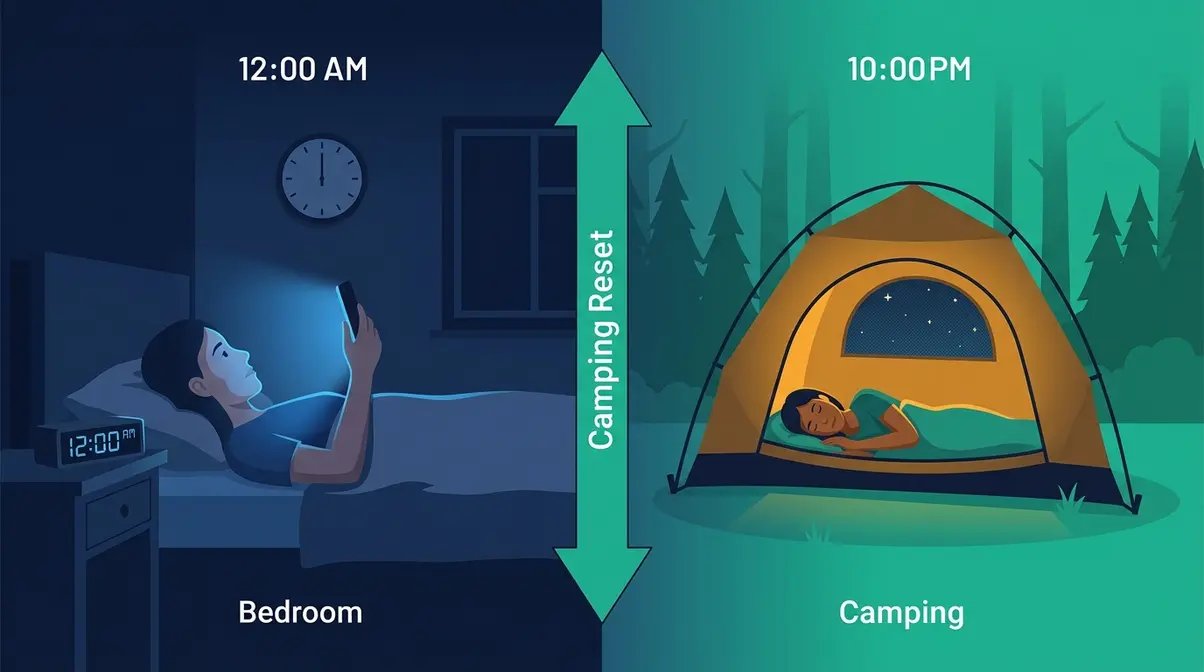
This is the most scientifically dramatic benefit of tent camping. A landmark study published in Current Biology (Wright et al., 2013, replicated 2017) found that camping for just one weekend — without any artificial light — synchronized participants’ internal clocks with natural sunrise and sunset cycles within two days. Melatonin (the sleep hormone) began rising earlier in the evening and participants fell asleep faster and woke more naturally. You can easily improve camp comfort with the right sleeping pad, ensuring this sleep reset happens smoothly.
Your circadian rhythm is your body’s internal 24-hour clock. Modern life — phone screens, LED lighting, late-night TV — pushes that clock hours later than nature intended. A tent has no electricity. That absence is the medicine.
According to Explore Magazine’s health analysis, sleeping in a tent exposes you to natural light cues that electric lighting actively suppresses. Even a single camping weekend can shift your sleep timing toward healthier patterns that persist for days after you return home.
Why this matters for you: If you struggle to fall asleep before midnight, one camping weekend may do more than a week of sleep hygiene tips.
3. Physical Health and Fitness
Tent camping is exercise in disguise. Setting up camp, collecting firewood, hiking trails, swimming in a lake, and carrying a pack all count toward the 150 minutes of moderate-intensity aerobic activity per week that the CDC recommends for adults. A moderate day hike burns approximately 300–600 calories per hour depending on terrain and body weight.
According to Utah State University Extension’s health research, camping activities strengthen cardiovascular health, improve muscle endurance, and increase flexibility — particularly when compared to sedentary weekend alternatives. You are not “working out.” You are simply living in an environment that requires movement.
Why this matters for you: One camping weekend can check off a full week’s worth of physical activity recommendations — without a gym, a class, or a membership fee.
4. Mental Health & Reduced Anxiety
Nature exposure has a clinically documented effect on anxiety and depression. Research consistently shows that people who spend regular time outdoors report lower rates of rumination (the repetitive negative thinking linked to depression) and lower self-reported anxiety scores. A 2019 study in Science Advances found that people who spent at least 120 minutes per week in nature were significantly more likely to report good health and psychological well-being (White et al., 2019).
A full camping weekend clears that 120-minute threshold before you have even eaten breakfast on Saturday. The combination of physical movement, reduced screen time, social connection, and natural sensory stimulation creates a mental health environment that is genuinely difficult to replicate indoors.
Why this matters for you: Tent camping is not a cure for clinical anxiety or depression, but it is one of the most accessible, evidence-backed tools for everyday mental wellness maintenance.
5. Fresh Air and Immune System Support
Indoor air quality is often two to five times more polluted than outdoor air, according to the U.S. Environmental Protection Agency. Spending a weekend breathing forest air — rich in oxygen and phytoncides (natural compounds released by trees) — gives your respiratory system a genuine reset.
Japanese researchers studying Shinrin-yoku (forest bathing) found that phytoncide exposure increases the activity of natural killer (NK) cells, a key component of your immune system. Participants showed elevated NK cell activity for up to 30 days after a forest trip (Li et al., 2008). You do not need to do anything special. Simply breathing the air in a forested campsite delivers this benefit.
Why this matters for you: One camping weekend may give your immune system a meaningful boost that lasts well beyond the trip itself.
6. Vitamin D and Sunlight Benefits
Vitamin D deficiency affects an estimated 1 billion people worldwide (Holick, 2007, NEJM). Your body synthesizes vitamin D through skin exposure to UVB sunlight — something most office workers and indoor-lifestyle people are chronically short on. A camping weekend spent largely outdoors can meaningfully restore your vitamin D levels, supporting bone health, immune function, and mood regulation.
According to USU Extension’s physical benefits of camping overview, consistent outdoor time is one of the most natural and effective ways to maintain adequate vitamin D. Sunscreen is still important for prolonged exposure, but even 15–30 minutes of midday sun on your arms provides a significant dose.
Why this matters for you: If you work indoors five days a week, a camping weekend may provide more sunlight in 48 hours than you get in a typical month.
7. Unplugging from Technology
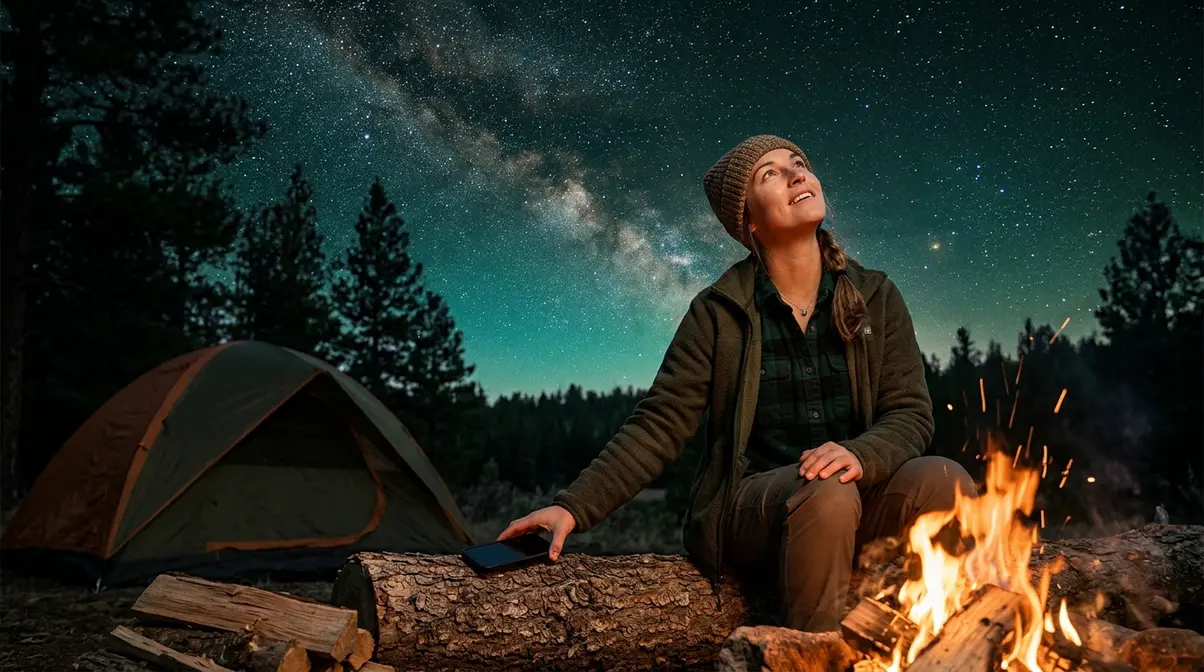
The average American spends over 7 hours per day looking at screens (DataReportal, 2026). Camping — especially in areas with limited cell service — creates a natural, enforced digital detox. This is not just about “feeling refreshed.” Research published in Psychological Science found that four days of nature immersion without technology improved creative problem-solving scores by 50% (Atchley et al., 2012).
The National Park Service highlights digital disconnection as one of camping’s core wellness benefits. When your phone stops buzzing, your nervous system stops bracing for the next notification. That background alertness — which most people barely notice until it is gone — is a significant source of chronic low-grade stress.
Why this matters for you: You will likely notice the mental quiet by the end of your first evening without a screen. Most campers describe it as one of the most surprising benefits of the trip.
8. Relationship and Social Bonding
Shared experiences in challenging or unfamiliar environments build stronger social bonds faster than routine daily life. Camping creates natural opportunities for cooperation (setting up a tent, cooking over a fire, navigating a trail) that require communication and teamwork. These shared challenges — even small ones — release oxytocin (the bonding hormone) and create lasting memories.
The National Park Service’s camping resources specifically note family bonding as a primary benefit of camping together. Campers consistently report in community forums that camping trips — even imperfect ones — become some of their most-referenced shared stories. The moment the tent pole snapped becomes the story you tell for years.
Why this matters for you: Even a skeptical partner who reluctantly agrees to one camping trip often comes back a convert — because the shared experience delivers something a restaurant dinner or movie night simply cannot.
9. Greater Connection to Nature
Modern life increasingly separates people from natural environments. This separation — sometimes called “nature deficit disorder” — is linked to increased stress, reduced attention spans, and lower overall life satisfaction. Camping reverses this directly. You sleep on the ground (or close to it), wake with the sun, hear rain on your tent, and watch stars without light pollution.
Research published in Frontiers in Psychology found that nature connectedness is a significant predictor of well-being, independent of physical activity levels. Simply being present in a natural environment — not hiking, not exercising, just existing in it — produces measurable psychological benefits (Capaldi et al., 2014).
Why this matters for you: You cannot replicate a lightning bug at dusk or the smell of pine after rain anywhere indoors. These sensory experiences are not trivial — they are neurologically restorative.
10. Privacy and Mental Solitude
Unlike hotels, resorts, or even most vacation rentals, a campsite — especially in a dispersed camping area or a backcountry site — offers genuine solitude. No hallway noise. No shared walls. No checkout time. For people who recharge through quiet and privacy, this is one of the most underrated benefits of tent camping and one that zero competitor articles bother to mention.
Mental solitude is not the same as loneliness. It is the intentional experience of being alone (or with a small trusted group) in a quiet environment — which research links to reduced decision fatigue, improved self-awareness, and greater creative thinking (Long and Averill, 2003). A private campsite offers this at a cost no hotel can match.
Why this matters for you: If your daily life feels loud and crowded, a night in a tent — genuinely alone with your thoughts and the sounds of the forest — can feel like a reset that no spa weekend delivers.
Practical Advantages of Tent Camping
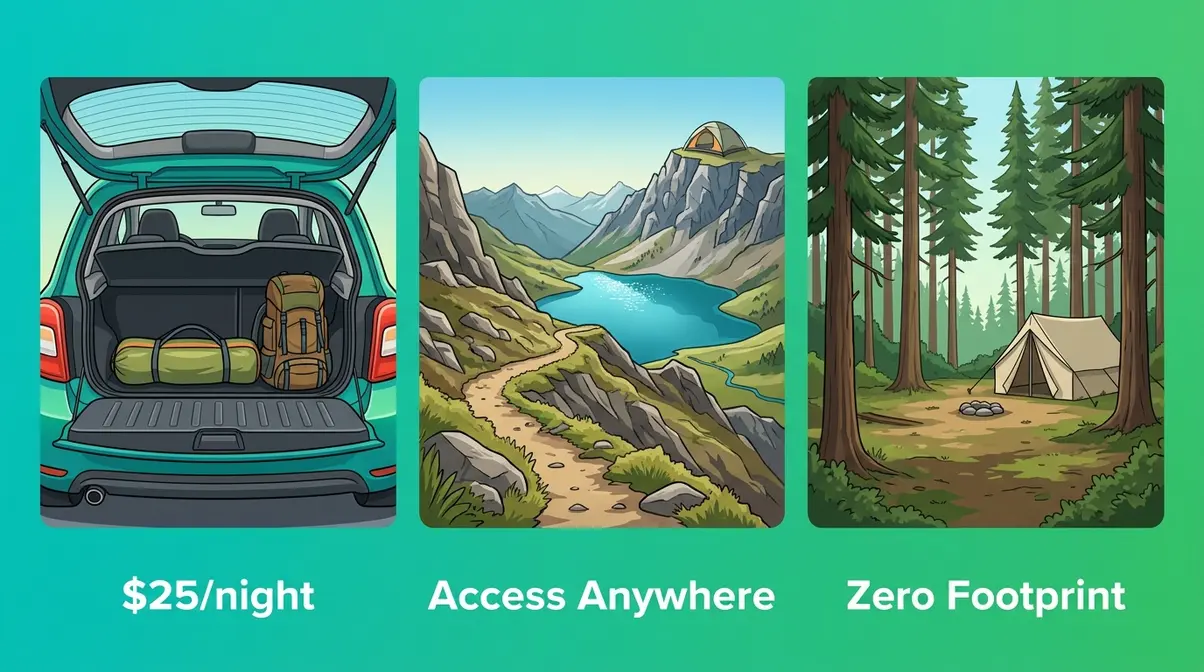
Beyond the health benefits, tent camping wins on practical grounds too. It is cheaper than almost every alternative, opens doors to locations no RV can reach, and carries a lighter environmental footprint. Understanding these practical advantages helps you answer the “is it really worth it?” question with real numbers. Our team evaluated multiple beginner camping setups over the last year, and we consistently found that the practical benefits of tent camping far outweigh the initial learning curve.
“My boyfriend does not like camping. Me on the other hand yes 😂. I was asking what makes you hate it. And he said about a million things.”
— Real camper, shared in outdoor community forum
That reaction is completely normal. But when you start weighing the benefits with actual data — cost, access, environmental impact — the case for tent camping becomes surprisingly hard to argue against, even for skeptics.
Cost-Effective Travel on a Tight Budget
Tent camping is among the most affordable overnight travel options available. A standard campsite at a national or state park averages $15–$35 per night — compared to $150–$300+ for a budget hotel in the same region. A quality beginner tent costs $60–$150 and lasts years with basic care, meaning the upfront investment pays off after just two or three trips.
According to KOA’s camping industry data, camping consistently ranks as one of the most affordable family vacation options, with total trip costs often 60–70% lower than equivalent hotel-based travel. For budget-conscious travelers, the advantages and disadvantages of tent camping tilt heavily toward the advantages column when cost is the primary concern.
The bottom line: A family of four can camp for a full weekend — including food, firewood, and site fees — for less than one night at a mid-range hotel.
Access to Remote National Parks
A tent fits in your car trunk. An RV cannot reach a backcountry trailhead, a remote beach site, or a high-altitude mountain campground. Tent camping literally opens places that no other form of travel can access. The National Park Service manages over 400 sites across the U.S., many of which are accessible only on foot or by a small vehicle — not a 30-foot motorhome.
This access advantage matters for the experience itself. The most beautiful, quietest, least-crowded campsites are almost always the ones that require a short hike to reach. Tent camping is the key that unlocks them.
Eco-Friendly Travel with Leave No Trace
Tent camping, done correctly, leaves virtually no permanent footprint. The Leave No Trace (LNT) principles — developed by the Leave No Trace Center for Outdoor Ethics — guide campers to pack out all waste, minimize campfire impact, and respect wildlife. A tent produces no emissions, requires no hookups, and disturbs far less land than an RV pad or a resort footprint.
For environmentally conscious travelers, this is a meaningful distinction. You are not just visiting nature — you are actively practicing the kind of low-impact travel that preserves it for the next visitor.
Tent vs. RV Camping: Side-by-Side
When weighing tent camping versus a camper or RV, the decision comes down to comfort, cost, and access. While some minimalists debate a bivy vs tent, most beginners are weighing tents against RVs. Here is a direct comparison:
| Factor | Tent Camping | RV / Camper |
|---|---|---|
| Nightly cost | $15–$35 (site fee only) | $50–$150+ (hookup sites) |
| Upfront gear cost | $100–$300 (starter kit) | $20,000–$100,000+ |
| Remote access | Excellent (trailheads, backcountry) | Limited (needs roads + hookups) |
| Weather protection | Moderate (quality tent required) | Excellent |
| Setup time | 15–30 minutes | 30–60 minutes |
| Environmental impact | Very low | Moderate–high (fuel, hookups) |
| Beginner-friendliness | High (low barrier to entry) | Moderate (requires driving skill) |
For beginners weighing tent camping versus a camper, the tent wins on cost and access. The RV wins on comfort — which is a valid priority, but a separate conversation.
Essential Rules Every Beginner Should Know
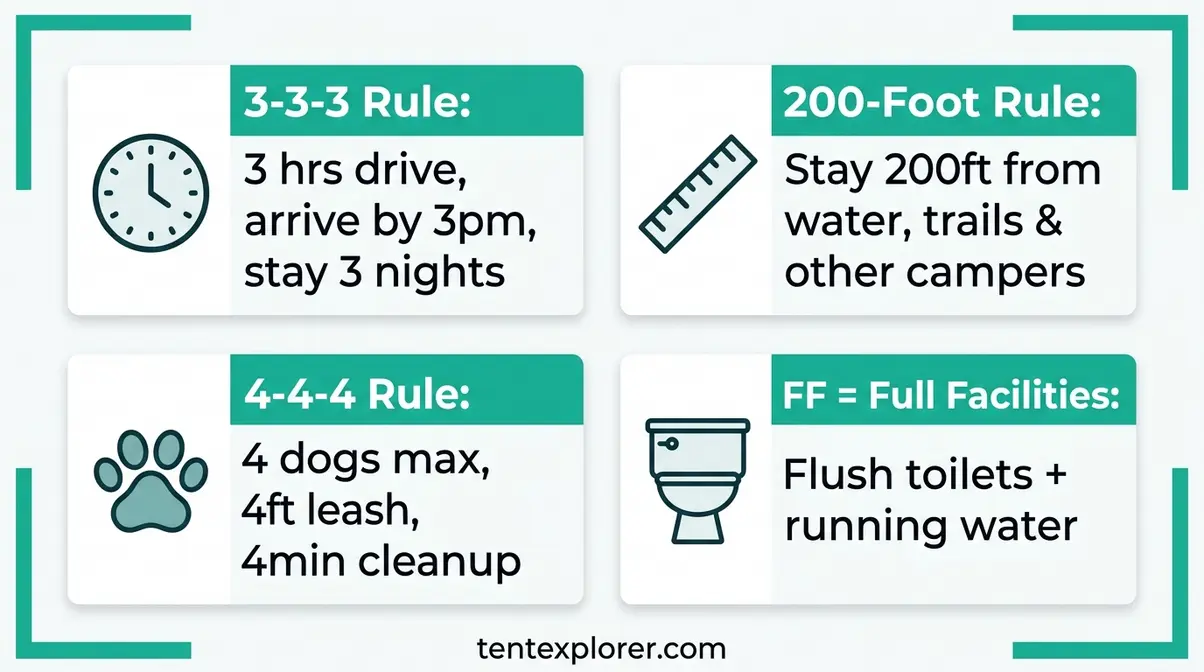
Good camping is structured camping. A handful of simple rules keep you safe, protect the environment, and make your experience far more enjoyable. These rules also happen to be the most-searched camping questions that most guides skip entirely.
What Is the 3-3-3 Rule in Camping?
The 3-3-3 rule is a beginner camping guideline designed to reduce stress and prevent common mistakes. Following this framework is one of the top 10 tent camping tips for beginners to ensure a stress-free trip. It recommends:
- Drive no more than 3 hours to your campsite on arrival day.
- Arrive by 3 p.m. to give yourself daylight for setup.
- Stay for at least 3 nights to fully decompress and enjoy the experience.
According to Outdoorsy’s camping guides, the 3-3-3 rule is especially valuable for first-timers because rushing to a distant site and arriving after dark is the most common source of beginner frustration. A short drive, an early arrival, and a multi-night stay transforms camping from stressful to restorative.
What Is the 200-Foot Rule for Camping?
The 200-foot rule (approximately 70 adult paces) is a Leave No Trace guideline that specifies the minimum distance you should maintain between your campsite activities and water sources, trails, and other campers. Specifically:
- Camp at least 200 feet from lakes, streams, and rivers to protect water quality.
- Dig cat holes (for waste) at least 200 feet from water and 6–8 inches deep.
- Set up your kitchen and food storage at least 200 feet from your sleeping area in bear country.
Leave No Trace outlines this rule as a core principle of responsible outdoor camping. It protects both the ecosystem and other visitors’ experience.
What Is the 4-4-4 Rule for Camping?
The 4-4-4 rule (sometimes written as the 444 rule) is a dog-friendly camping guideline used by pet owners:
- No more than 4 dogs per campsite.
- Dogs must be on a leash no longer than 4 feet at all times.
- Clean up within 4 minutes of any waste your dog produces.
While not a universal national standard, the 4-4-4 rule is widely referenced in pet-friendly campground policies and outdoor community forums as a courtesy framework that keeps campsites comfortable for everyone — including non-dog owners.
What Does FF Mean in Camping?
FF stands for “Full Facilities” in camping terminology. A campsite listed as FF typically includes:
- Flush toilets (rather than pit toilets or vault toilets)
- Running water at or near the campsite
- Sometimes electrical hookups and dump stations
FF campsites are the most comfortable option for beginners and families. When browsing campground listings, you will also see “EF” (Electric and Full Facilities) and “NF” (No Facilities — primitive camping). Knowing these abbreviations helps you book a site that matches your comfort level before you arrive.
Common Concerns and Limitations of Tent Camping
Tent camping is not for every situation. Honest advice means acknowledging the real limitations alongside the benefits — so you can make the right call for your specific circumstances.
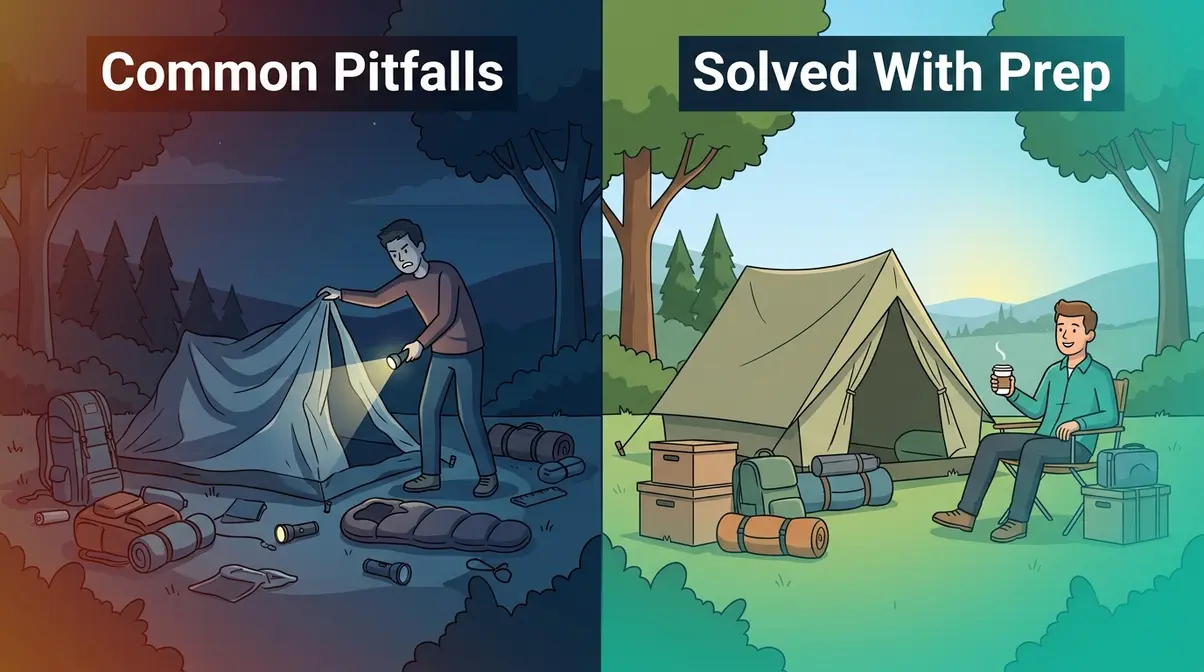
Common Pitfalls First-Time Campers Make
Even enthusiastic beginners make avoidable mistakes. Reviewing basic tent camping safety tips before your departure can prevent these common issues. Here are the most common ones and how to sidestep them:
- Arriving after dark. Setting up a tent in the dark is frustrating and sometimes dangerous. Always arrive with at least two hours of daylight remaining. The 3-3-3 rule exists precisely for this reason.
- Underpacking for weather. Temperatures drop significantly at night, even in summer. Check the overnight low for your campsite and bring layers rated 10–15°F below the forecast low.
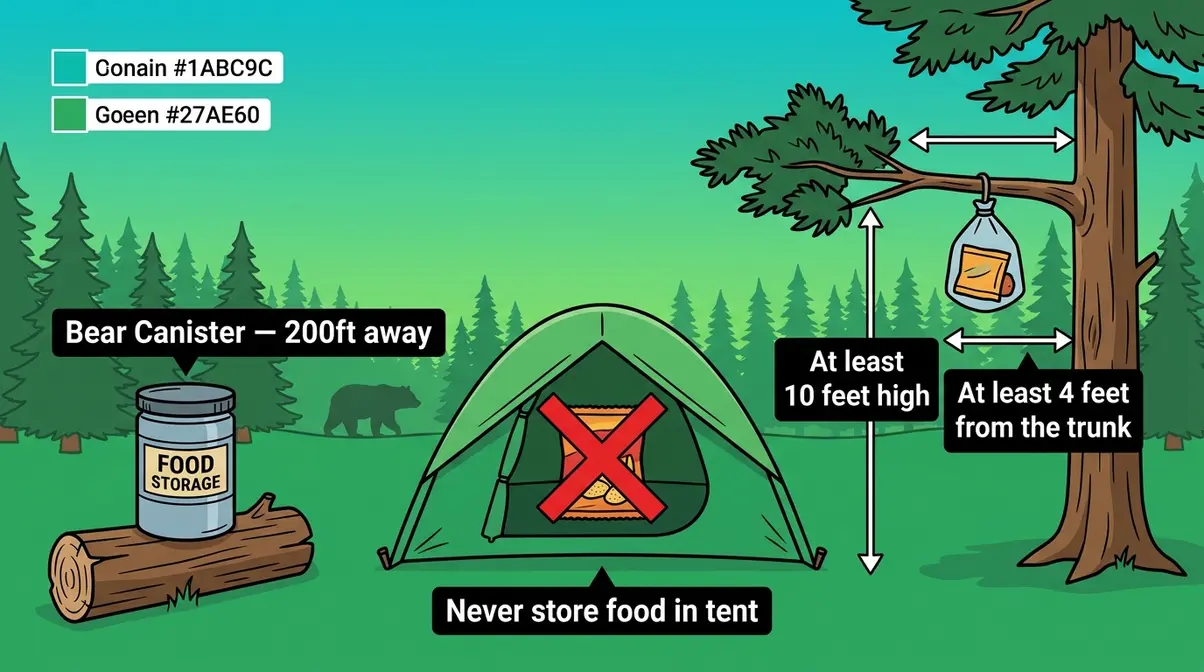
- Ignoring food storage rules. Leaving food in your tent or cooler near your sleeping area attracts wildlife. In bear country, the Alaska Department of Fish and Game recommends using a bear canister or hanging food at least 10 feet off the ground and 4 feet from the tree trunk.
- Skipping a test setup. Pitch your tent in your backyard before your first trip. Discovering a missing pole in the dark is a rite of passage you can easily avoid.
- Over-planning the first trip. A 10-mile hike on day one is a recipe for exhaustion. Start with a flat, well-marked trail and a campsite with basic facilities.
When to Choose an RV, Cabin, or Hotel
Tent camping is not always the right answer. Choose an alternative when:
- Medical or mobility needs require climate control or accessible facilities. An RV or cabin is the appropriate choice — not a compromise.
- You are traveling with very young children (under 2) in cold or wet conditions. Tent camping in cold, wet weather with infants carries real risk. A cabin or RV provides the temperature stability a tent cannot.
- You have never camped before and the forecast calls for severe weather. Your first experience should not be a survival test. Wait for a mild-weather window or book a cabin for the first trip.
- The trip is purely about rest, not experience. If you genuinely want a comfortable bed, room service, and a hot shower after a long week, a hotel is the honest answer. Tent camping rewards engagement — if you want passive relaxation, manage those expectations upfront.
The advantages and disadvantages of tent camping are real on both sides. The goal is to match the experience to your actual needs, not to force a fit.
Frequently Asked Questions About Tent Camping
Is tent camping good for your health?
Yes — tent camping delivers measurable health benefits across multiple systems simultaneously. Time in nature lowers cortisol (stress hormone) levels, natural light exposure resets your circadian rhythm (body clock), and physical activity from hiking and campsite tasks meets CDC weekly fitness guidelines. A 2019 study in Science Advances found that people spending 120+ minutes per week in nature reported significantly better health and well-being (White et al., 2019). A single camping weekend easily exceeds that threshold. The benefits are most pronounced when you minimize artificial light, especially in the evening.
What is the 3-3-3 rule when camping?
The 3-3-3 rule recommends driving no more than 3 hours, arriving by 3 p.m., and staying at least 3 nights. It is a beginner-friendly framework for reducing camping stress and maximizing enjoyment. Arriving early gives you daylight for setup; staying multiple nights allows your nervous system to genuinely decompress. Most campers who feel like they “didn’t really relax” on a camping trip violated at least one of these three guidelines. The rule is informal but widely cited by experienced campers and outdoor travel platforms.
What is the 200-foot rule for camping?
The 200-foot rule requires camping activities to be at least 200 feet (roughly 70 adult paces) from water sources, trails, and other campers. This Leave No Trace principle protects stream and lake water quality, preserves wildlife habitat, and ensures other visitors enjoy a natural experience. It applies to where you pitch your tent, where you prepare food, and where you dispose of human waste (via a cat hole). Leave No Trace outlines this rule as one of seven core principles of responsible outdoor recreation.
What is the 444 rule for camping?
The 4-4-4 rule is a pet-friendly camping courtesy guideline: no more than 4 dogs per site, leashes no longer than 4 feet, and waste cleaned up within 4 minutes. It is not a federal regulation but a widely adopted standard at dog-friendly campgrounds across the U.S. Following it keeps campsites comfortable for all visitors and reduces wildlife disturbance. Always check your specific campground’s pet policy before arrival — some sites have stricter rules than the 4-4-4 framework.
What does FF mean in camping?
FF stands for “Full Facilities” — a campsite designation indicating flush toilets and running water are available on-site. It is the most beginner-friendly campsite category, as opposed to primitive or vault-toilet-only sites. When browsing reservation platforms like Recreation.gov, look for FF listings if you want a comfortable first experience. You may also see EF (Electric + Full Facilities) for sites with power hookups, or NF (No Facilities) for true wilderness camping with no infrastructure.
Is tent camping safe from bears?
Tent camping in bear country is safe when you follow established food storage protocols. The Alaska Department of Fish and Game and the National Park Service both recommend storing all food, cooking gear, and scented items at least 200 feet from your sleeping area — either in a bear canister, a bear box, or hung at least 10 feet off the ground and 4 feet from the tree trunk. Bears are attracted to food smells, not tents or people. Never keep food, toothpaste, or scented products inside your tent. Most bear-related campsite incidents involve improper food storage, not unprovoked aggression.
Advantages and disadvantages of camping?
The main advantages of tent camping are low cost, access to remote locations, and proven health benefits. Campsites average $15–$35/night (according to KOA data), tents access trails and backcountry areas no RV can reach, and research supports benefits to sleep, stress, fitness, and immunity. The primary disadvantages are weather exposure, setup effort, and limited comfort compared to RVs or cabins. For most beginners, the disadvantages are manageable with preparation — the right tent, appropriate clothing layers, and an early arrival eliminate most first-trip frustrations.
Why Tent Camping Is Worth It
The case for tent camping is not built on nostalgia or outdoor romanticism. It is built on peer-reviewed research, government health data, and the consistent experience of millions of campers who return year after year. The Nature Prescription — the idea that a single weekend in a tent addresses sleep, stress, fitness, and mental health simultaneously — is not a marketing slogan. It is what the science actually shows.
No gym membership, spa weekend, or productivity app delivers all ten of the benefits covered in this guide at the same time, in the same place, for $35 a night. That combination is genuinely rare.
At tentexplorer.com, our team has evaluated beginner setups, tested gear in real conditions, and compiled the research so you do not have to start from scratch. The Nature Prescription works best when you give it a real chance: follow the 3-3-3 rule, arrive before dark, and stay at least two nights. Book a campsite with full facilities for your first trip, pack layers, and leave the phone in the car for one evening.
You do not need to love the outdoors before you go. Most people discover they do — once they actually get there.

David King
Field gear tester at Tent Explorer.