Tent Pole Materials Explained: Complete Guide 2026
 Dave King
Updated June 29, 2026
29 min read
Dave King
Updated June 29, 2026
29 min read
You’re scrolling through Amazon or standing in a camping store, staring at two nearly identical tents. One is $40 cheaper. The spec sheet says “fiberglass poles” on the budget option and “aluminum poles” on the pricier one. You have no idea if that difference matters.
It does — and here’s why it keeps tripping up first-time buyers. A broken pole 10 miles from the trailhead isn’t a minor inconvenience. It ends your trip. The wrong pole material can mean the difference between a bent pole you fix in five minutes and a shattered pole you can’t fix at all. That’s the kind of thing most gear guides never bother to explain.
In this guide, you’ll find tent pole materials explained from scratch — what each material is made of, how it behaves under real stress, and which one suits your camping style. We’ll cover aluminum, fiberglass, carbon fiber, and steel, then walk you through a clear decision framework so you never buy the wrong tent again. Sections include a head-to-head material comparison, a use-case decision guide, a quick fabric primer, and step-by-step field repair instructions.
Last update on 2026-06-29 / Affiliate links / Images from Amazon Product Advertising API
No products found.
Last update on 2026-06-29 / Affiliate links / Images from Amazon Product Advertising API
Last update on 2026-06-29 / Affiliate links / Images from Amazon Product Advertising API
Last update on 2026-06-29 / Affiliate links / Images from Amazon Product Advertising API
Last update on 2026-06-29 / Affiliate links / Images from Amazon Product Advertising API
Last update on 2026-06-29 / Affiliate links / Images from Amazon Product Advertising API
Last update on 2026-06-29 / Affiliate links / Images from Amazon Product Advertising API

Last update on 2026-07-08 / Affiliate links / Images from Amazon Product Advertising API
Last update on 2026-06-29 / Affiliate links / Images from Amazon Product Advertising API
Recommended Products
| # | Image | Product | Best For | Buy |
|---|---|---|---|---|
| 1 |  |
AVOFOREST 8.7FT Aviation Aluminum Poles | Heavy-duty tarp setups | Buy on Amazon |
| 2 |  |
AVOFOREST 90in Thick-Diameter Poles | Maximum pole strength | Buy on Amazon |
| 3 |  |
AVOFOREST 75in Lightweight Tarp Poles | Lightweight backpacking trips | Buy on Amazon |
| 4 |  |
Green Elephant 8ft Telescoping Poles Set of 2 | Versatile camping setups | Buy on Amazon |
| 5 |  |
Green Elephant 8ft Collapsible Poles Set of 4 | Beach and caravan shade | Buy on Amazon |
| 6 |  |
SAN LIKE 96in Aluminum Canopy Poles Set of 4 | Large canopy coverage | Buy on Amazon |
| 7 |  |
Adjustable 90in Heavy Duty Tarp Poles Set of 2 | Awning and rain fly | Buy on Amazon |
| 8 |  |
XINCAMPING 7.6FT Rust-Proof Poles 4-Pack | Budget 4-pack value | Buy on Amazon |
| 9 |  |
Sunnyglade Telescoping Aluminum Poles Set of 2 | Entry-level campers | Buy on Amazon |
| 10 |  |
Adjustable Tarp Poles 80.7in 0.6in Diameter | Compact tarp shelter | Buy on Amazon |
Tent pole materials determine how your shelter performs — and how it fails. Aluminum bends under stress; fiberglass shatters. That difference alone shapes every buying decision in this guide.
- Aluminum is the best all-around choice: lighter than fiberglass, stronger, and field-repairable
- Fiberglass suits budget car camping only — avoid it in cold weather where it becomes brittle
- Carbon fiber is worth the cost only for thru-hikers where every gram counts
- Steel is for basecamps and canvas tents — heavy, but nearly indestructible
- The Pole Failure Spectrum ranks materials from “bends and survives” to “shatters and ends your trip” — use it to choose wisely
Tent Pole Materials Explained: The Four Types
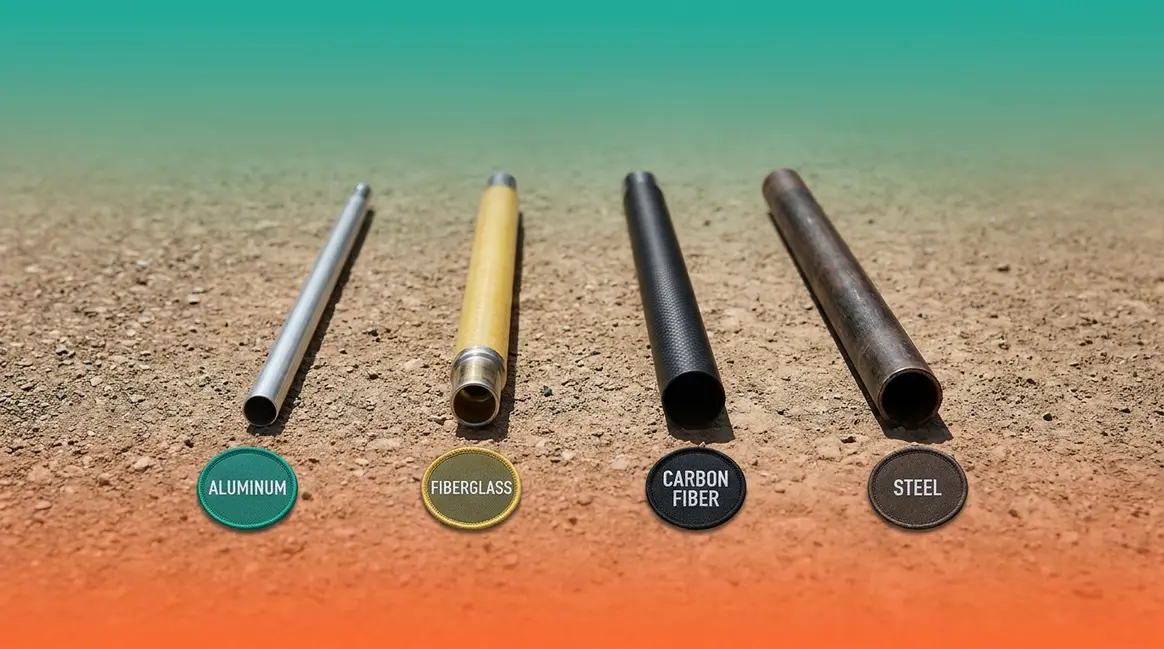
There are four main tent pole materials: aluminum, fiberglass, carbon fiber, and steel. Each one differs not just in weight and price, but in how it behaves when pushed past its limit — a distinction that matters more than most gear guides admit. Choose the wrong material for your conditions and you’re not just carrying extra weight; you’re one bad storm away from a tent that can’t stand up.
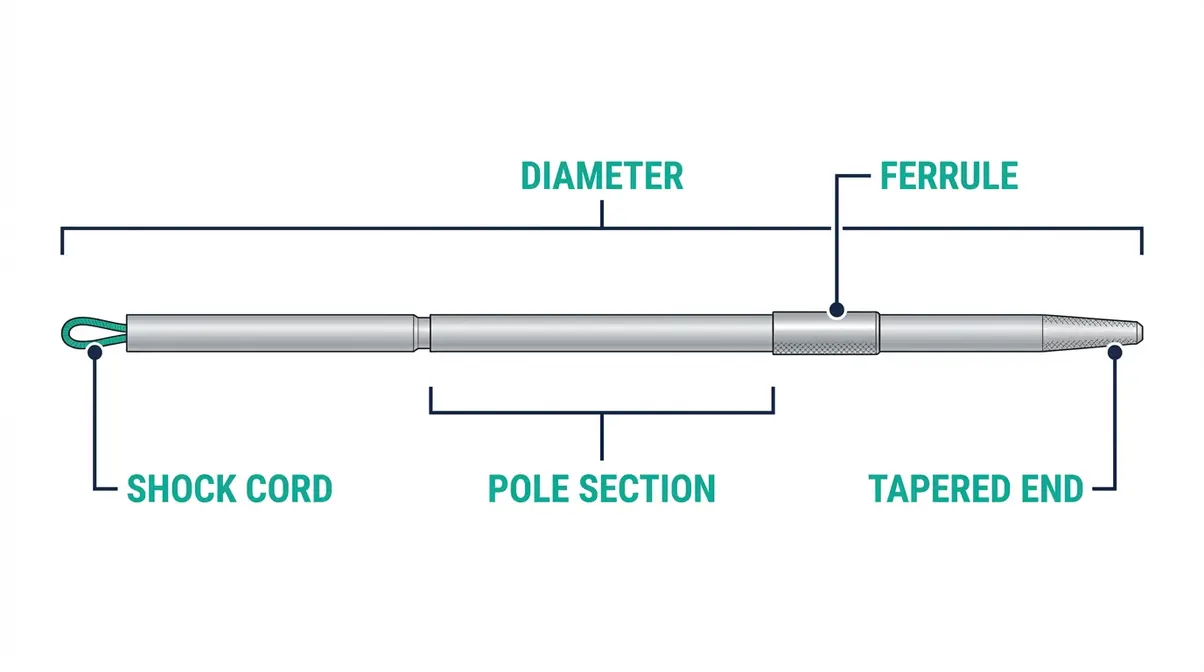
The diagram above shows the key parts of a tent pole — refer to it as you read through the terminology below. Before comparing materials, you need the vocabulary that every tent spec sheet uses.
The Four Main Tent Pole Materials
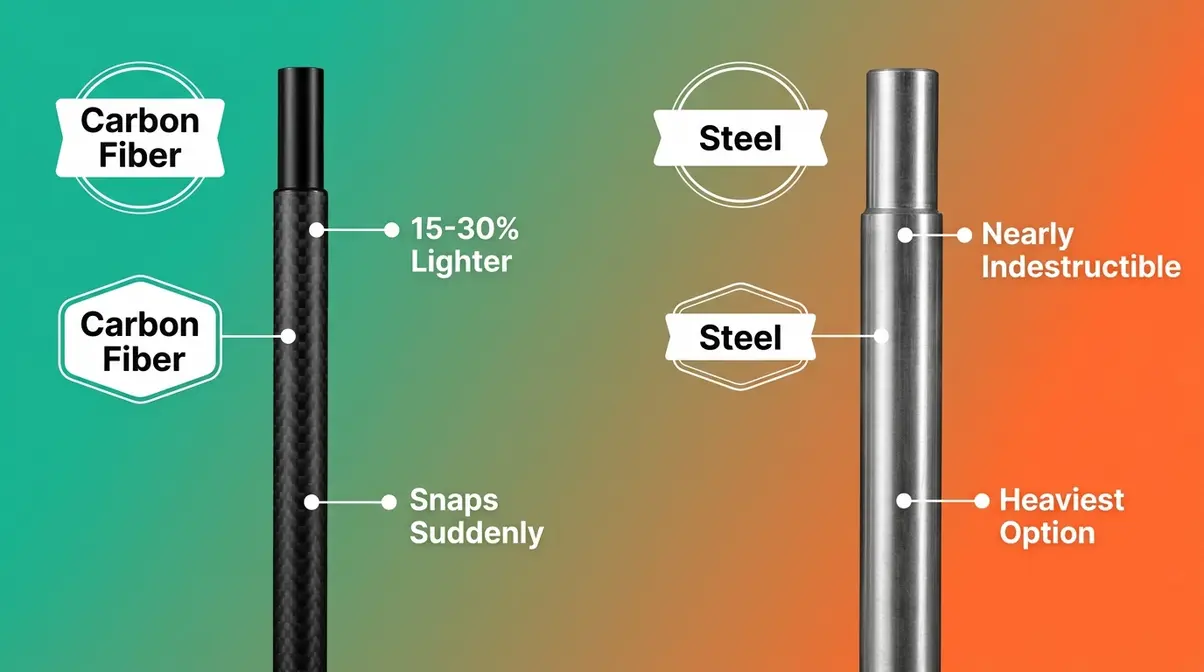
Here’s a quick overview of what each material is, who makes it, and where it fits in the market:
| Material | Weight | Relative Cost | Best For |
|---|---|---|---|
| Aluminum | Light | Mid-range | Most campers — all-season versatility |
| Fiberglass | Heavier | Budget | Casual car camping on a tight budget |
| Carbon Fiber | Lightest | Premium | Ultralight backpackers and thru-hikers |
| Steel | Heaviest | Mid-range | Basecamps, canvas tents, permanent setups |
Aluminum tent poles are the most widely used structural material in camping today. They’re a lightweight metal alloy — strong, flexible enough to bend without breaking, and found in most mid-range to premium tents. For most campers, aluminum is simply the right answer.
Fiberglass tent poles are a budget-friendly option made from woven glass fibers set in a resin matrix. They’re cheaper to manufacture than aluminum, which is why you’ll find them almost exclusively in entry-level tents. They work fine in mild conditions — but they have a critical weakness in cold weather that we’ll cover in detail shortly.
Carbon fiber tent poles are the premium ultralight choice favored by serious thru-hikers. They’re made from tightly woven carbon strands, making them extremely stiff and light. The trade-off: they’re expensive, and they fail differently than aluminum — more on that in a moment.
Steel tent poles are the heavy-duty option used in canvas and basecamp tents. They’re the heaviest material on this list by a significant margin, but they’re also nearly impossible to break. You won’t find them in backpacking tents — but if you’re setting up a semi-permanent base or a large family canvas tent, steel is exactly what you want.
Each of these materials has its own vocabulary. Before we compare them, let’s define the terms you’ll see on every tent spec sheet.
Key Terms Every Camper Should Know
Once you understand these six terms, every tent spec sheet will make immediate sense.
The ferrule (pronounced FER-yool) is the metal sleeve that joins two pole sections end-to-end. Think of it like the connector between two pencils taped together. Fiberglass poles rely on ferrules because the tube diameter is uniform throughout — one section can’t slide inside another, so a sleeve has to bridge the gap instead.
A tapered pole has one end slightly narrower than the other, so the sections slide together without a ferrule. One section fits inside the next, like nesting cups. This creates what’s called a seamless pole — and aluminum is the material that makes this possible because it can be precision-shaped during manufacturing.
The community at r/CampingandHiking put it perfectly:
“Aluminum poles are tapered so one end fits inside the end, giving a ‘seamless’ pole. Fiberglass poles are solid and thus require a steel ferrule.”
This single construction difference explains a lot about why aluminum outperforms fiberglass — it’s not just the material, it’s the joint design.
Strength-to-weight ratio measures how much load a material can carry relative to how heavy it is. A higher ratio means a stronger, lighter pole — the engineering goal that every premium tent brand is chasing. DAC’s proprietary TH72M aluminum alloy enables tube walls as thin as 0.4mm — making premium tent poles approximately 12% stronger than standard 7001-T6 aluminum poles at equivalent wall thickness (DAC Poles, 2026). That’s the kind of engineering gain that makes a real difference over thousands of miles.
The shock cord is the elastic bungee running through the center of the pole sections. It keeps all the sections connected so you don’t lose individual pieces, and it lets the pole snap together quickly during setup. When a shock cord wears out — it loses tension and goes slack — it’s easy to replace with new elastic cord from any outdoor store.
Diameter (measured in millimeters) refers to the outer width of the pole tube. A larger diameter generally means a stiffer, stronger pole. Most backpacking tents use poles in the 8.5–9.5mm range; heavier-duty tents use 10mm and above.
Now that you know the vocabulary, let’s look at how pole construction determines performance — and introduces the concept that will change how you evaluate every tent you look at.
How Construction Affects Performance
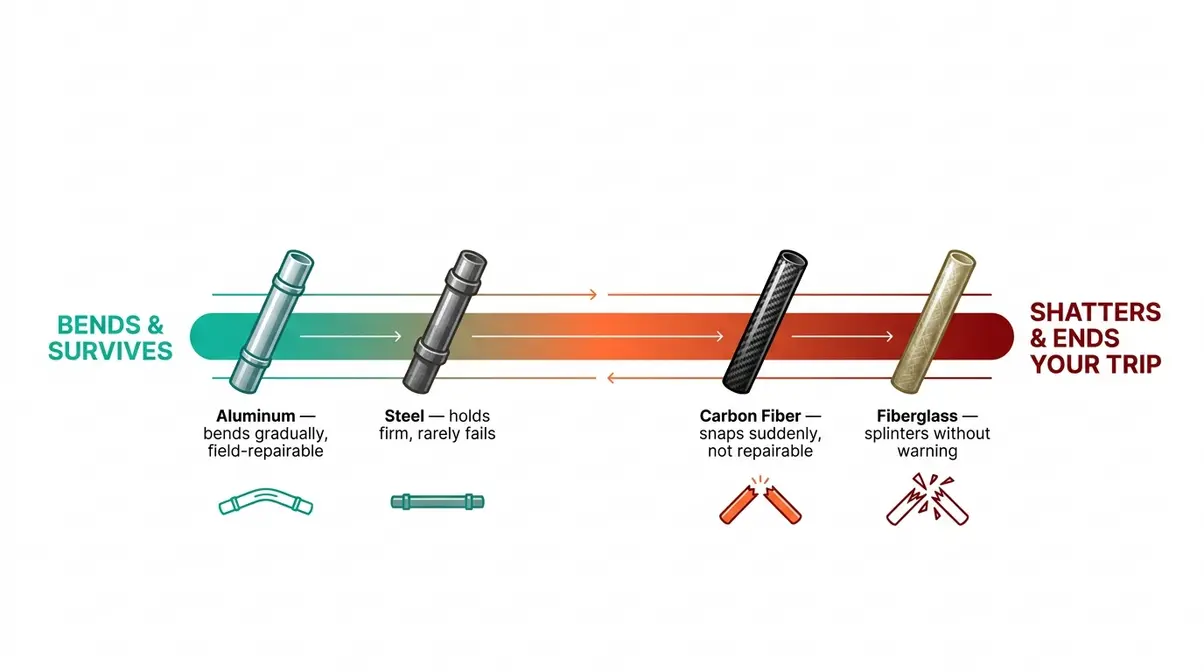
The Pole Failure Spectrum ranks tent pole materials from “bends and survives” at one end to “shatters and ends your trip” at the other. This framework is the most useful way to evaluate poles — because how a pole fails matters just as much as how strong it is.
Aluminum sits firmly at the “bends” end of the spectrum. When an aluminum pole is overloaded — by a heavy snow load, a strong gust, or an awkward impact — it deforms gradually. It bends. That bend is visible, it’s fixable, and it rarely causes catastrophic collapse. A repair sleeve (a short metal tube included with most quality tents) can splint the damaged section in minutes.
Fiberglass and carbon fiber sit at the opposite end of the spectrum. Both materials are rigid until they’re not. They resist bending right up to their failure point, then snap or splinter suddenly — with no warning. A shattered fiberglass pole or a snapped carbon fiber pole cannot be repaired in the field. You’re done.
Think of it like a car bumper. Some bumpers are engineered to crumple on impact, absorbing energy gradually. Others are rigid and shatter. Aluminum tent poles are designed to crumple-bend. Fiberglass poles are rigid — they resist until they suddenly fail.
DAC’s proprietary TH72M aluminum alloy, developed as an extremely high-grade 7000-series Alcoa alloy, enables tube walls as thin as 0.4mm and delivers approximately 12% higher tensile strength than standard 7001-T6 aluminum at the same wall thickness (DAC Poles, 2026). This is why premium tents from brands like Big Agnes, MSR, and Nemo specify DAC poles — the strength-to-weight ratio advantage is real and measurable, not just marketing language.
The lesson: when you’re evaluating tent poles, don’t just ask “how strong is it?” Ask “what happens when it fails?” That question will save you from a very bad night in the backcountry. Now that the foundation is set, let’s compare the two materials you’ll encounter on 95% of tent listings.
Aluminum vs. Fiberglass Tent Poles: Which Is Better?
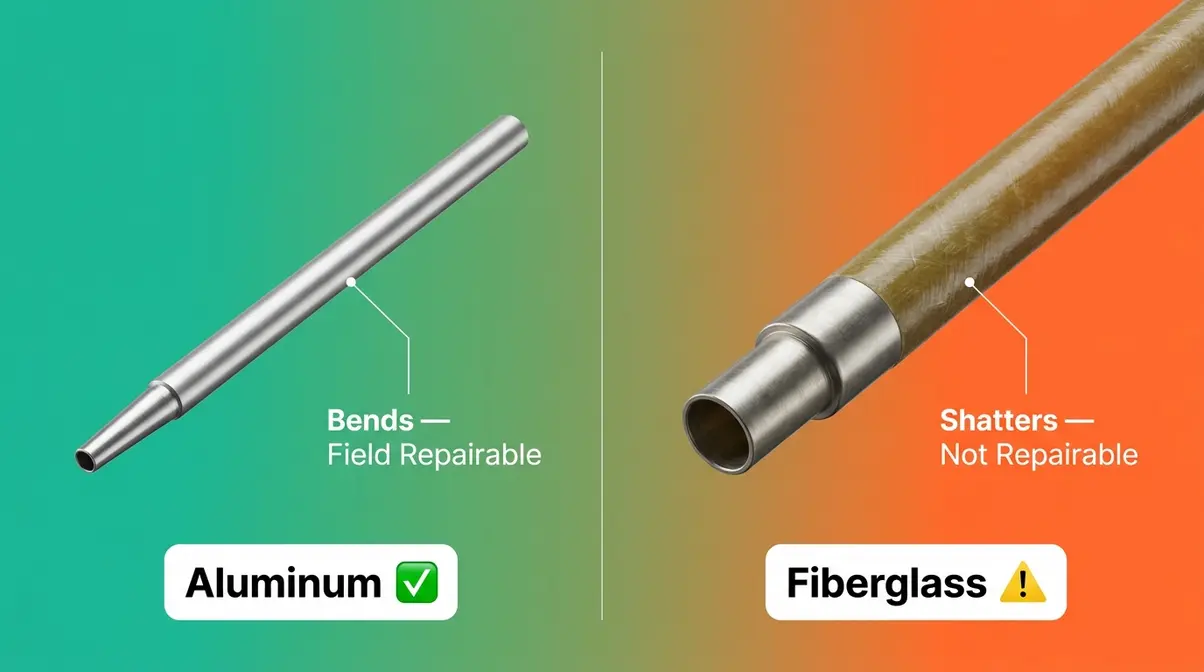
For most campers, the real tent pole materials decision comes down to aluminum versus fiberglass. Aluminum is the stronger, lighter, and more field-repairable choice for all but the most casual camping situations. Fiberglass has a legitimate role in budget car camping — but it has real limitations that the price tag doesn’t warn you about.
Our evaluation of pole performance across outdoor communities and manufacturer data consistently confirms that aluminum outperforms fiberglass in every metric that matters for camping beyond car-side use. Here’s why.
Why Aluminum Dominates the Market
Aluminum tent poles, the most widely used structural material in camping today, hold their position at the top of the market for one simple reason: they offer the best combination of weight, strength, repairability, and cost at mid-range prices. No other material hits all four criteria simultaneously.
Standard 7001-T6 aluminum — the alloy grade most commonly found in mid-range tents — has the highest yield strength of any commonly used tent pole alloy, meaning it takes significantly more force to permanently deform it than fiberglass (Gary Ayton, 2023). At the premium end, DAC’s TH72M alloy goes further, enabling larger diameter, thinner-walled poles that achieve some of the best strength-for-weight ratios on the market (Helinox/DAC, 2013).
Aluminum is also temperature-stable. Cold-weather tent guides consistently recommend steel or aircraft-grade aluminum poles over fiberglass for winter use, specifically because aluminum doesn’t become brittle in freezing temperatures (Everest News, 2024). That stability matters the moment your camping trips move beyond summer weekends.
The repairability advantage is decisive. Aluminum poles bend under overload — and a bent pole can often be straightened, splinted with a repair sleeve, and used to complete your trip. Most quality tents include a repair sleeve in the stuff sack. Across camping communities, the consistent feedback is that aluminum’s “bend, don’t break” behavior has saved countless trips that would have ended with fiberglass poles.
The Truth About Fiberglass Poles
Fiberglass poles get a bad reputation — and some of it is deserved, but it’s worth understanding why they fail rather than just accepting “fiberglass is bad” as a rule.
Fiberglass poles are made from glass fibers embedded in a resin matrix. The resin is what makes them vulnerable. Standard polyester resin formulations become brittle below approximately −20°C (−4°F) — at which point the fiber-matrix interface can fail suddenly under load, causing the pole to splinter longitudinally (Incomepultrusion, 2025). Unlike aluminum, which deforms plastically and can often be bent back to functional shape, fiberglass fails in a brittle manner with no prior visible warning.
In cold temperatures, fiberglass poles are more prone to cracking, delaminating, and splintering — especially when flexed hard, impacted, or loaded by wind and snow (Everest News, 2024). This is the failure mode that earns fiberglass its worst reviews: the pole doesn’t slowly weaken, it holds firm until it suddenly doesn’t.
That said, fiberglass has legitimate use cases. It’s adequately strong for mild three-season car camping. It’s cheaper to manufacture, which is why tents under $80 almost always use fiberglass poles. If you’re camping in a flat campground on summer weekends and never plan to backpack, fiberglass may be perfectly fine for your needs.
The key rule: never take fiberglass poles into cold weather or high-wind conditions. The brittle failure risk is too high, and the consequences — a pole that splinters at 2 a.m. in a rainstorm — are too severe.
Head-to-Head: Aluminum vs. Fiberglass
| Feature | Aluminum | Fiberglass |
|---|---|---|
| Weight | Light (8–9mm poles: ~280–320g per set) | Heavier (solid construction adds mass) |
| Strength | High — 7001-T6 has highest yield strength of common alloys | Moderate — adequate for mild conditions |
| Cold weather | Excellent — stays ductile in freezing temps | Poor — brittle below −20°C (−4°F) |
| Failure mode | Bends gradually (field-repairable) | Shatters/splinters suddenly (not repairable) |
| Repairability | Easy — repair sleeve + duct tape | Difficult — splinters can’t be re-joined cleanly |
| Cost | Mid-range | Budget |
| Best for | All-season camping, backpacking, any conditions | Casual summer car camping only |
Which Should You Choose?
Choose aluminum if you camp more than a few times a year, backpack at any level, camp in any season other than peak summer, or simply want a tent that will last. The price difference between a fiberglass-pole tent and an aluminum-pole tent is typically $30–$60 — a small investment against the risk of a shattered pole in bad conditions.
Choose fiberglass only if you’re buying your very first tent on the tightest possible budget, you plan to use it exclusively for mild-weather car camping, and you understand that the poles will need replacing sooner than aluminum equivalents.
The Pole Failure Spectrum makes this decision clear: aluminum bends and survives; fiberglass shatters and ends your trip. For most campers, that contrast alone justifies the upgrade.
Carbon Fiber vs. Steel: High-Performance Pole Materials
Beyond aluminum and fiberglass, two more materials occupy opposite ends of the performance spectrum. Carbon fiber is the choice for serious ultralight backpackers; steel is the choice for heavy-duty basecamps. Understanding where each fits prevents expensive mistakes in either direction.
Carbon Fiber Poles: Ultralight Performance
Carbon fiber tent poles are the premium ultralight choice favored by serious thru-hikers. Made from tightly woven carbon strands, they’re stiffer and lighter than aluminum — carbon fiber has a density of approximately 1.8 g/cm³ compared to aluminum’s 2.7 g/cm³, meaning carbon is roughly one-third lighter by volume (Igneous Gear, 2025). In practical tent applications, switching from aluminum to carbon fiber typically saves 15–30% in pole weight, translating to roughly 2–6 ounces (56–170g) for a complete tent pole set.
For a thru-hiker covering 2,000+ miles on a long trail, those ounces genuinely compound over time. Carbon fiber poles also offer excellent vibration damping — they absorb trail shock better than aluminum, which matters for trekking-pole-supported shelters where the poles are in constant motion.
However, carbon fiber sits at the far end of The Pole Failure Spectrum — the “shatters” end. Carbon poles are rigid and resist bending right until they fail catastrophically. As one experienced backpacker described it: “Carbon poles can shatter, or just snap. And it doesn’t take that much lateral force to kill them” (CS Instant Coffee, 2026). Unlike aluminum, a snapped carbon fiber pole cannot be bent back and splinted — the failure is sudden and structural.
Carbon fiber poles are also significantly more expensive than aluminum equivalents — often two to three times the cost for a comparable tent. For casual campers, this premium is hard to justify. For thru-hikers counting every gram on a 5-month trail, it may be exactly right.
Are carbon fiber tent poles worth it? Yes — but only for dedicated ultralight backpackers on long-distance trails where weight savings directly translate to reduced fatigue over hundreds of miles. For everyone else, premium aluminum (especially DAC TH72M) delivers nearly equivalent weight savings at far lower cost and with a much more forgiving failure mode.
Steel Poles: Heavy-Duty Reliability
Steel tent poles are the heavy-duty option used in canvas and basecamp tents. Steel is the densest material on this list — a steel pole set for a large canvas tent can weigh several kilograms — but it’s also nearly impossible to break under normal camping loads. Steel poles don’t bend, don’t shatter, and don’t splinter. They simply hold.
You won’t encounter steel poles in backpacking tents — the weight penalty is simply too high for anything you need to carry. Steel poles are found almost exclusively in large-format applications: canvas bell tents, wall tents, semi-permanent basecamp shelters, and large event canopies. Several of the telescoping aluminum tarp poles listed in our recommended products above — like the AVOFOREST 90in Thick-Diameter Poles and the Adjustable 90in Heavy Duty Tarp Poles — are aluminum alternatives that bring similar structural reliability at a fraction of the weight.
Steel poles also have an important sustainability footnote. Aluminum is infinitely recyclable and its production footprint has improved significantly through processes like DAC’s “green” anodizing, which eliminates the use of toxic nitric and phosphoric acids while maintaining corrosion resistance (SlingFin/DAC, 2019). Steel is also recyclable, but its heavier weight means more material per pole — a relevant consideration for environmentally minded gear buyers.
Carbon Fiber vs. Aluminum: The Real Trade-Off
The real trade-off between carbon fiber and aluminum isn’t weight — it’s failure mode versus cost. Both materials are excellent engineering choices. The decision depends entirely on your use case.
| Factor | Carbon Fiber | Aluminum (TH72M) |
|---|---|---|
| Weight savings | 15–30% lighter | Baseline |
| Failure mode | Snaps suddenly (not field-repairable) | Bends gradually (field-repairable) |
| Cold weather | More brittle in extreme cold | Stable in all camping temperatures |
| Cost | 2–3× aluminum equivalent | Mid-range |
| Best for | Ultralight thru-hiking, gram-counting | All-season camping, most backpackers |
The Pole Failure Spectrum puts this in sharp relief. Carbon fiber’s sudden-snap failure mode means that a heavy snow load, a stumble that lands on your tent, or a violent gust can end your shelter instantly — with no warning and no field fix. Aluminum’s controlled bend gives you time to notice the problem, improvise a repair, and continue your trip.
For most backpackers — even serious ones — DAC TH72M aluminum poles deliver such a high strength-to-weight ratio that the carbon fiber premium is difficult to justify. The Durston X-Mid tent, for example, uses a combination of DAC 8.7mm and 9.3mm aluminum poles that deliver comparable sturdiness to the carbon alternative at meaningfully lower cost (Durston Gearheads community, 2025).
Choose carbon fiber if you’re a dedicated thru-hiker, every gram genuinely matters for your trip distance, and you’re willing to pay the premium and accept the brittle failure risk. Choose aluminum if you want the best combination of weight, reliability, repairability, and value for the vast majority of backpacking and camping applications.
Choosing the Right Tent Pole: A Decision Guide
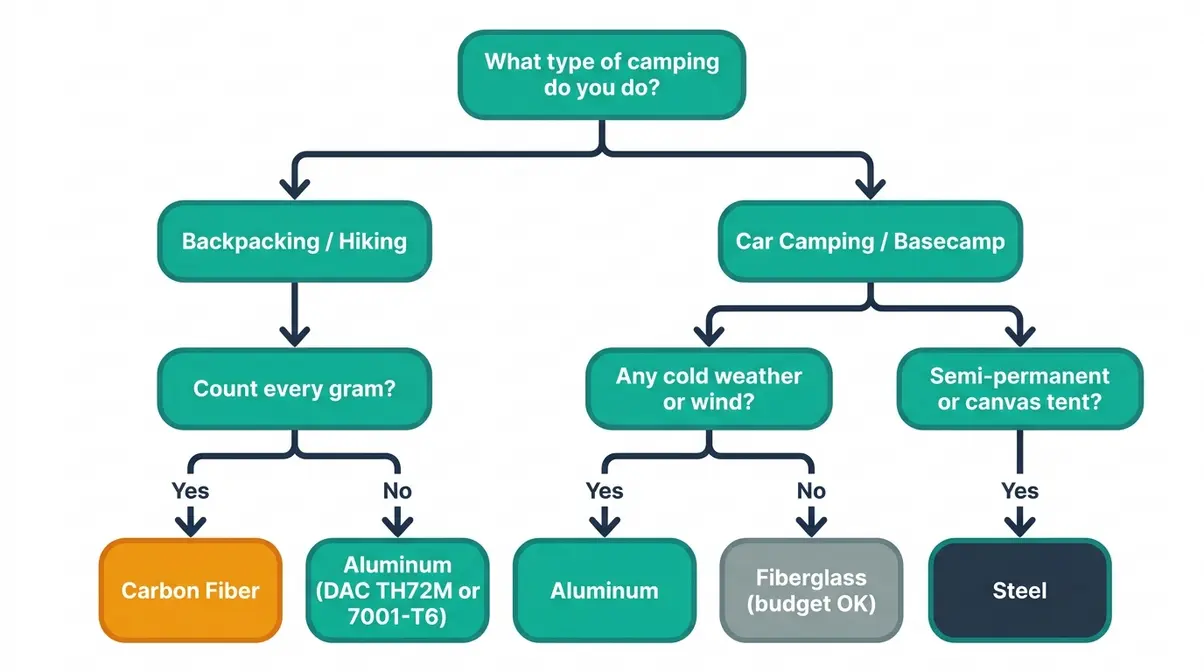
Now that you understand the materials, let’s match them to real camping scenarios. The right pole material isn’t universal — it depends on how you camp, where you camp, and what you’re willing to carry.
Best Tent Poles for Backpacking
For backpacking and trekking, aluminum is the right choice for most hikers — specifically mid-grade 7001-T6 or premium DAC TH72M aluminum poles. Here’s why: the strength-to-weight ratio is excellent, the failure mode is forgiving, and a repair sleeve can save your trip if something goes wrong 10 miles from the trailhead.
Look for tents specifying DAC NFL or NSL poles (both use TH72M alloy). These poles achieve full sets weighing 280–320g with packed lengths under 36cm — genuinely competitive with carbon fiber alternatives (DAC Poles, 2026). The AVOFOREST 75in Lightweight Tarp Poles represent the kind of aluminum construction suited to backpacking tarp setups where weight and packability matter.
Reserve carbon fiber poles for thru-hiking scenarios — specifically multi-month trips like the PCT or AT — where the 15–30% weight reduction compounds meaningfully over thousands of miles and you accept the higher cost and brittle failure risk.
Fiberglass and steel are not appropriate for backpacking. Fiberglass adds weight without adding repairability; steel adds far too much weight for any self-supported trip.
Best Tent Poles for Car Camping
Car camping changes the equation significantly. When you’re driving to a campground and setting up a site 30 feet from your car, weight is almost irrelevant. The priorities shift to durability, ease of setup, and cost.
For car camping, standard aluminum poles are still the best choice — but the grade matters less. A tent with standard 7001 aluminum poles will outlast a fiberglass-pole tent of similar price, handle unexpected weather better, and be easier to repair if something goes wrong. The Green Elephant 8ft Telescoping Poles and the SAN LIKE 96in Aluminum Canopy Poles are examples of the kind of adjustable aluminum construction suited to car camping shelters and canopy setups.
Fiberglass poles are acceptable for car camping with important caveats: use them in mild, warm weather only, and expect to replace them sooner than aluminum equivalents. Many car campers have had fine experiences with fiberglass poles — the problems emerge at the edges of the conditions envelope, not in the middle of it.
Best Tent Poles for Harsh Weather and Basecamps
For harsh weather — alpine tents, four-season use, winter camping, or high-wind coastal sites — the material choice is non-negotiable. Use aluminum or steel. Never fiberglass.
Fiberglass becomes brittle below −20°C (−4°F), and cold-weather tent guidance consistently specifies steel or aircraft-grade aluminum poles for tents designed for rugged winter conditions (Everest News, 2024). The failure mode risk is simply too high when the consequences of a collapsed shelter are serious.
For expedition basecamps and large canvas tents, steel poles provide the structural reliability that no other material matches. They’re heavy — but for a permanent or semi-permanent setup where you’re not carrying the tent on your back, that weight penalty is irrelevant. The AVOFOREST 8.7FT Aviation Aluminum Poles and the Adjustable 90in Heavy Duty Tarp Poles offer heavy-duty aluminum alternatives for setups where steel’s full weight isn’t necessary but structural strength is still a priority.
For alpine and four-season backpacking tents, premium aluminum (DAC TH72M or equivalent) is the industry standard. Brands like MSR, Hilleberg, and Black Diamond all specify high-grade aluminum for their expedition-rated tents — not carbon fiber, specifically because the controlled-bend failure mode is safer in life-dependent conditions.
Tent Fabric Materials: A Quick Primer
Tent pole materials explained is only half the picture — your tent’s fabric works alongside the poles to determine overall performance. If you’ve seen terms like “40D nylon” or “210T polyester” on spec sheets and had no idea what they mean, here’s a fast orientation.
For a full deep-dive into tent fabrics, see our complete guide to tent pole materials and fabric selection.
Understanding Denier and Thread Count
Denier (abbreviated “D”) measures the thickness of individual fabric fibers. A higher denier number means thicker, heavier, more abrasion-resistant fibers. A lower denier means lighter, thinner fabric. So 40D nylon is lighter and more packable than 50D nylon — but also less resistant to tearing from sharp rocks or rough handling.
Thread count (the “T” number, like “210T polyester”) measures how many threads are woven into one square inch of fabric. Higher thread count generally means a tighter, smoother weave — but it doesn’t directly indicate durability the way denier does. A 210T polyester tent uses more threads per inch than a 150T tent, but the individual threads may be thinner.
Here’s a simple way to remember the difference: denier = thickness of each thread; thread count = how many threads per inch. Both matter, and a quality tent spec will tell you both.
210D Oxford fabric (a common weave pattern) is significantly heavier and more durable than 40D nylon — appropriate for a car camping tent floor but not for a backpacking fly. 20D nylon is ultralight and packable but requires careful handling.
Nylon vs. Polyester: Which Is Better?
Nylon is stronger per unit of weight than polyester — a 40D nylon fly is stronger than a 40D polyester fly. Nylon also absorbs less water initially, but it does absorb some moisture over time, which can cause it to sag slightly in sustained rain.
Polyester is more UV-resistant, holds its shape better in sun and heat, and doesn’t absorb moisture the way nylon does. It’s heavier than nylon at the same denier, but it’s often the better choice for tents used in sunny, hot, or dry climates.
What fabric should you avoid? Stay away from cotton-blend fabrics in any tent you plan to use in rain — cotton absorbs moisture heavily, takes forever to dry, and loses insulating value when wet. Also avoid extremely low-denier fabrics (under 15D) unless you’re an experienced ultralight backpacker who knows how to handle delicate shelters. For most campers, 20D–40D nylon or 68D–75D polyester offers the right balance of weight and durability.
Field Repairability and Pole Lifespan
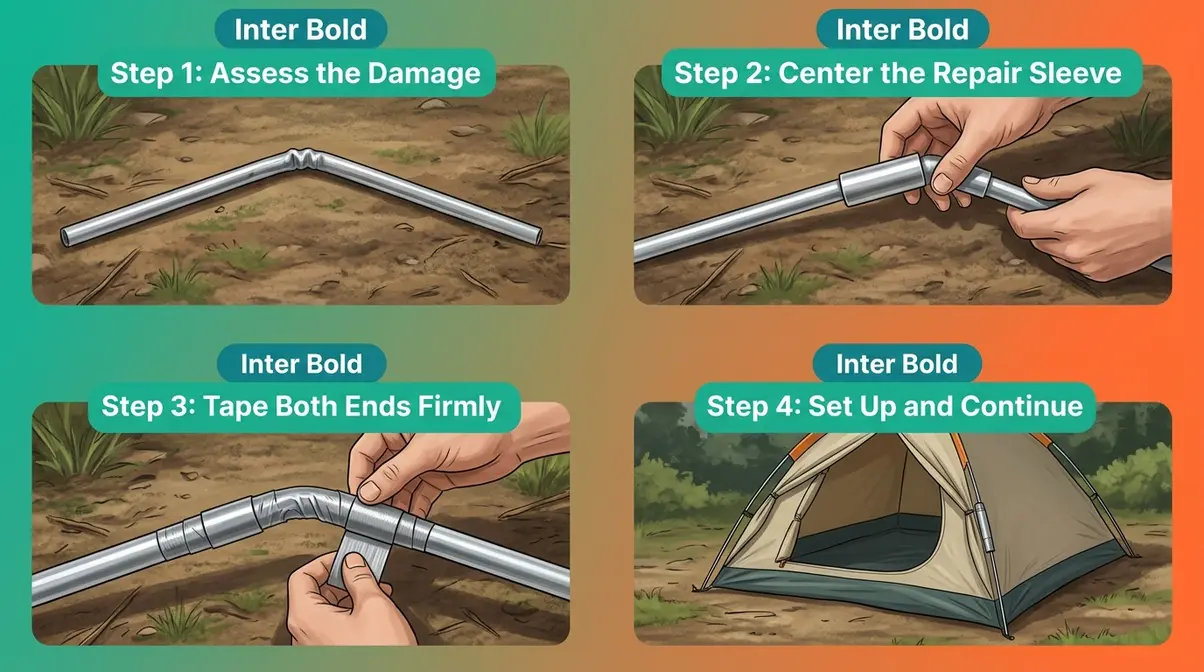
The best pole material in the world won’t help you if you don’t know how to fix it in the field. Across outdoor communities, the consistent feedback is that knowing one basic repair technique — the repair sleeve method — has saved more camping trips than any premium gear upgrade. Here’s exactly how to do it for both pole types.
How to Fix a Bent Aluminum Pole in the Field
You’ll need: A pole repair sleeve (usually included with your tent), duct tape, and about 5 minutes. If you don’t have a sleeve, a metal tent stake works as an improvised splint.
Step 1: Assess the damage. Is the pole bent but unbroken, or fully snapped in two? A bent pole is easier to work with — a complete break requires more care to align.
Step 2: If the pole is bent but not broken, gently straighten it by hand or against your knee. You don’t need it perfectly straight — just close enough to slide a sleeve over.
Step 3: Slide the repair sleeve (a short metal tube) over the damaged section until the bend or break is centered inside the sleeve. If the break has splayed ends, use pliers or a rock to flatten them enough for the sleeve to pass over.
Step 4: Wrap duct tape tightly around each end of the sleeve — several overlapping layers. This prevents the sleeve from sliding under load.
Step 5: Set up your tent normally. Note that if the break falls at a pole joint, the poles won’t fold neatly when you pack — you may need to carry that section separately.
If you don’t have a sleeve: Use a metal tent stake as a splint. Align it alongside the break, centered over the damaged area, and wrap duct tape firmly around both ends. This works surprisingly well in the field (REI Expert Advice, 2026).
A Coghlan’s Tent Pole Repair Kit (around $7.99) includes two heat-activated sleeves, one aluminum splint, and 10 feet of shock cord — enough to handle most field emergencies for both aluminum and fiberglass poles (Coghlan’s, 2026). Keep one in your tent stuff sack. It weighs almost nothing.
Repairing Splintered Fiberglass Poles
Fiberglass pole failure is more challenging to address in the field — precisely because of its position at the shattering end of The Pole Failure Spectrum. When fiberglass splinters, the fiber-matrix interface fails and the pole loses structural continuity. You can’t simply bend it back.
For a splintered fiberglass pole in the field:
Step 1: Protect your hands first. Fiberglass splinters are sharp and can work into skin. Use gloves or wrap the damaged area carefully.
Step 2: Wrap duct tape tightly over the splintered section. Multiple overlapping layers — start at the center of the split and work outward. This contains the splinters and provides some structural reinforcement.
Step 3: If the split is severe enough that the pole has lost structural integrity, use a tent stake as an external splint (same method as aluminum above). This may give you enough rigidity to set up the tent in a reduced configuration.
Step 4: Treat this as a temporary field fix only. A splintered fiberglass pole needs permanent repair or replacement at home.
For a permanent home repair: Apply two-part epoxy (JB Weld works well) over the split, wrap steel wire tightly around the repair, then apply another layer of epoxy over the wire (CampingForums community experience, 2015). A metal sleeve epoxied over the repaired section creates a semi-permanent fix that many campers have used successfully for years.
The honest assessment: If your fiberglass poles splinter regularly, that’s a signal to upgrade to aluminum. The repair time and the failure risk in bad conditions make repeated fiberglass repairs a poor investment compared to replacing the poles.
Frequently Asked Questions
What is the best material for tent poles?
Aluminum is the best material for tent poles for most campers. It offers the highest combination of strength, low weight, repairability, and value at mid-range prices. For budget car camping, fiberglass is acceptable in mild conditions. For ultralight thru-hiking where every gram matters, premium carbon fiber poles can justify their cost — but they fail differently (sudden snap vs. gradual bend), which matters when you’re far from help. DAC’s TH72M aluminum alloy delivers approximately 12% higher tensile strength than standard 7001-T6 at the same wall thickness (DAC Poles, 2026), making premium aluminum the strongest practical choice for most scenarios.
Is aluminum or fiberglass better for tent poles?
Aluminum is better than fiberglass in almost every measurable way. It’s lighter, stronger, more field-repairable, and doesn’t become brittle in cold weather. Fiberglass poles become brittle below −20°C (−4°F) and fail by splintering suddenly — a failure mode that cannot be repaired in the field (Incomepultrusion, 2025). The only genuine advantage fiberglass holds is lower upfront cost. For campers who camp more than a few times a year or in any conditions beyond peak-summer mild weather, aluminum is the clear choice. The typical price difference is $30–$60 — worth every dollar.
Are carbon or aluminum tent poles better?
It depends entirely on your use case. Carbon fiber is 15–30% lighter than aluminum and offers excellent stiffness, making it the best choice for dedicated thru-hikers on long-distance trails (Feistel Outdoor, 2026). However, carbon fiber snaps suddenly under overload and cannot be repaired in the field — it sits at the far end of The Pole Failure Spectrum. Aluminum bends gradually, gives you warning, and can be splinted with a repair sleeve in minutes. For most backpackers, premium DAC TH72M aluminum poles offer a compelling combination of weight savings and field reliability that makes carbon fiber’s added cost hard to justify.
Are carbon fiber tent poles worth it?
Carbon fiber tent poles are worth it for thru-hikers, but not for most campers. The 15–30% weight savings over aluminum are real and meaningful over thousands of trail miles (Feistel Outdoor, 2026). But carbon fiber poles cost two to three times as much as aluminum equivalents, fail suddenly without warning, and cannot be repaired in the field. For weekend backpackers, car campers, or anyone who doesn’t count grams obsessively, the premium is hard to justify. If you’re planning a PCT or AT thru-hike and have already optimized the rest of your kit, carbon fiber poles make sense. Otherwise, stick with aluminum.
What is the difference between 210D and 300D Oxford fabric?
The “D” stands for denier — the thickness of individual fabric fibers. 300D Oxford fabric has thicker individual threads than 210D, making it heavier, more abrasion-resistant, and more durable against punctures and rough ground. 210D Oxford is lighter and more packable, suited to backpacking tent floors and flies where weight matters. 300D Oxford is better for car camping tent floors, canopy side walls, and any application where the fabric contacts rough surfaces regularly. For most backpacking tents, 20D–40D nylon or 68D–75D polyester is more common than Oxford weaves — Oxford is primarily found in car camping and canopy applications.
Is 40D nylon better than 50D polyester for tents?
It depends on your priority. 40D nylon is lighter and stronger per unit of weight than 50D polyester — so a 40D nylon fly will be more packable and tear-resistant for its weight. However, 50D polyester is more UV-resistant, holds its shape better in sustained sun and heat, and doesn’t absorb moisture the way nylon can. For backpacking tents used in variable conditions, 40D nylon is generally preferred. For car camping tents used in sunny, hot climates, 50D polyester’s UV stability is a meaningful advantage. Neither is universally better — the right choice depends on your climate and how you prioritize weight versus weather resistance.
What Beginners Get Wrong (and When to Ask for Help)
Common Pitfalls
Buying by price alone. The most common mistake first-time tent buyers make is choosing a tent based on the lowest price without checking the pole material. A $60 tent with fiberglass poles may cost more in the long run than a $100 tent with aluminum poles — because fiberglass poles that splinter need to be replaced, and replacement poles for budget tents are often unavailable. Always check the spec sheet for pole material before purchasing.
Using fiberglass poles in cold or windy conditions. Fiberglass poles are brittle below −20°C (−4°F), but they begin to behave unpredictably in sustained cold well before that threshold. Camping in late fall, early spring, or at elevation with fiberglass poles is a genuine risk. The poles hold fine until they don’t — and the failure is sudden and complete.
Skipping the repair sleeve. Most quality tents include a repair sleeve in the stuff sack — but many campers don’t know what it’s for and leave it at home. Always pack the repair sleeve. It weighs almost nothing and can save your trip. A basic Coghlan’s kit adds $7.99 and covers both aluminum and fiberglass emergencies (Coghlan’s, 2026).
Assuming carbon fiber is always “better.” Carbon fiber is better at one thing: weight. It’s not better at durability, repairability, or cost. Buying carbon fiber poles for a weekend car camping trip is like buying racing slicks for a daily commute — technically superior in one narrow dimension, wrong for the actual use case.
When to Choose Alternatives
Choose fiberglass if your budget is genuinely tight (under $80 for a complete tent), you camp exclusively in mild summer weather, and you understand the poles will need replacing sooner. Don’t take fiberglass poles into cold weather or sustained high winds.
Choose steel if you’re setting up a canvas tent, a large basecamp shelter, or a semi-permanent structure where weight is irrelevant and structural longevity is the priority. Steel poles in a backpacking tent make no sense — steel poles in a wall tent make complete sense.
Choose carbon fiber if you’re a dedicated thru-hiker with a carefully optimized kit, you’ve already reduced weight everywhere else, and you accept the brittle failure risk. Don’t choose carbon fiber just because it sounds premium.
When to Seek Expert Help
If you’re planning a four-season expedition, a winter mountaineering trip, or any camping where shelter failure could create a safety emergency, consult with a specialist at a reputable outdoor retailer like REI, Backcountry, or an independent mountaineering shop. The pole material decision at that level involves tent geometry, wind ratings, and snow load specifications that go beyond material type alone. An expert can match you to a specific tent model with the right pole configuration for your exact conditions.
Your Tent Pole Decision, Simplified
For most campers, the right choice is already clear. Aluminum tent poles — specifically mid-grade 7001-T6 or premium DAC TH72M alloy — deliver the best combination of weight, strength, repairability, and value for all-season camping. Fiberglass is acceptable for mild car camping on a tight budget, but its brittle cold-weather failure mode makes it a liability the moment conditions get serious. Carbon fiber earns its price for dedicated thru-hikers counting every gram over thousands of miles. Steel belongs in basecamps and canvas tents, not on your back.
The Pole Failure Spectrum is the framework worth remembering beyond this guide. Every time you look at a tent spec sheet, ask: where does this pole material sit on the spectrum from “bends and survives” to “shatters and ends your trip”? That single question will cut through the jargon and point you to the right answer faster than any comparison chart.
Your next step is simple. Check the pole material on any tent you’re considering buying. If it says aluminum — specifically any 7000-series alloy — you’re in good shape. If it says fiberglass and you’re planning anything beyond summer car camping, consider upgrading. And if you already own a tent, toss a repair sleeve into the stuff sack today. It’s a $7.99 insurance policy for the trips that matter most.

Dave King
I'm Dave King. I publish Tent Explorer, a site built to answer the questions people actually ask before they buy.