Home/Tent Troubleshooting and Maintenance
Tent Troubleshooting and MaintenanceTent Waterproof Ratings Explained: What the mm Means
 Dave King
Updated June 6, 2026
21 min read
Dave King
Updated June 6, 2026
21 min read
You’re standing in a gear store — or scrolling a product page — staring at two tents. One says 3,000mm. The other says 5,000mm. You assume the bigger number is better, but you’re not sure by how much, or whether it’s worth the extra $80. This guide exists because that confusion is completely normal, and because getting it wrong means waking up in a puddle on night one of your trip.
A leaking tent isn’t just uncomfortable. In cold or windy conditions, wet sleeping gear can become a genuine safety problem. The frustrating part? Most buyers fixate on the mm number and miss the three other factors that actually determine whether they stay dry. Tent waterproof ratings explained properly go far beyond a single spec on a tag.
By the end of this guide, you’ll know exactly what waterproof ratings mean, which number you actually need for your camping style, and the three other factors that determine whether your tent stays dry — so you can shop with confidence instead of guessing. This guide covers the rating system, a practical decision matrix, the full waterproofing system, and a condensation troubleshooting checklist.
Key Takeaways: Tent Waterproof Ratings Explained
For most 3-season camping, a tent rated 1,500mm–3,000mm provides reliable protection in heavy rain — and going higher often reduces fabric durability without improving real-world performance (The Coating Ceiling).
- 1,500mm–3,000mm covers most 3-season camping, including heavy rain
- 3,000mm–5,000mm is for exposed campsites, storms, and 4-season use
- The Coating Ceiling means more mm ≠ more durable — fabric tear strength matters too
- Seam taping, a rainfly, and bathtub floors matter as much as the mm rating itself
- Tent ratings (1,500–3,000mm) differ from jacket ratings (10k–20k) by design, not by quality
What Are Tent Waterproof Ratings?
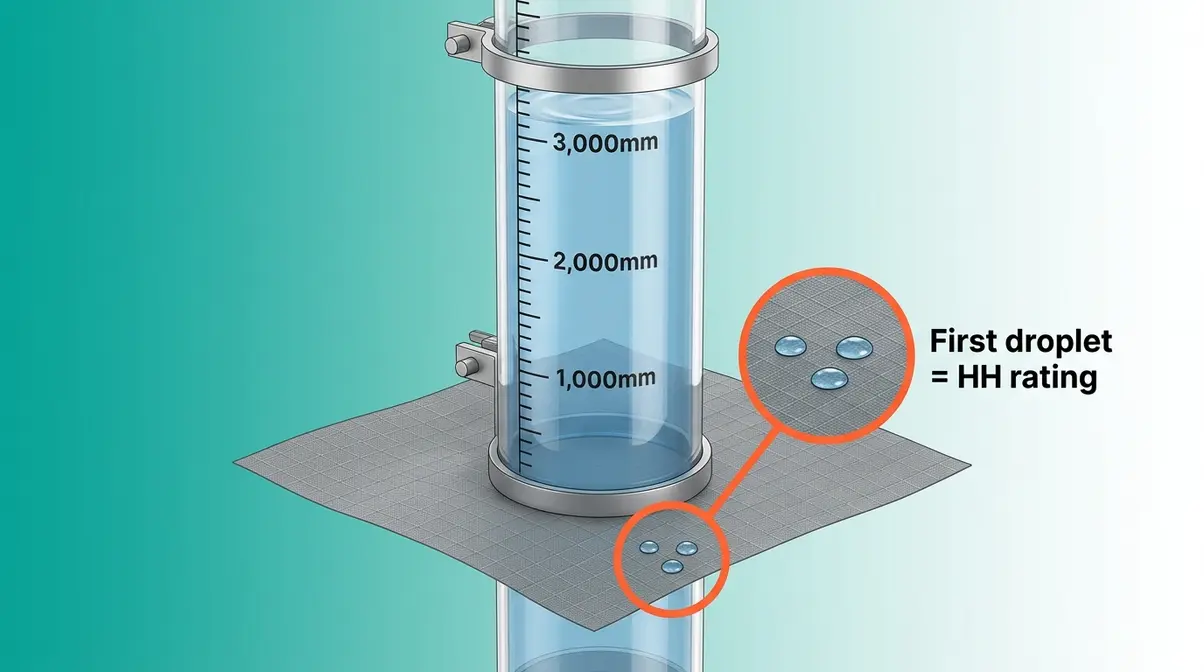
Tent waterproof ratings measure how much water pressure a fabric can resist before it starts to leak. The number — expressed in millimeters — tells you how tall a column of water that fabric can hold before a drop pushes through. A 3,000mm rating means the fabric resists a column of water 3,000 millimeters (about 10 feet) tall. That’s the core of how tent waterproof ratings work, and everything else builds from there.
This section covers the test behind the number, the tradeoff most brands don’t mention, and the two main coating types you’ll see on product pages.
What Is Hydrostatic Head (HH)?
Hydrostatic Head, often abbreviated as HH rating, is the standard measure of how waterproof a tent fabric is. “Hydrostatic” simply means “related to water pressure,” and “head” refers to the height of that water column. So a tent rated at 2,000mm HH can withstand the pressure of a 2,000mm (2-meter) tall column of water pressing down on it before any water seeps through.
The ISO 811:2018 standard governs how this test is performed across the outdoor gear industry. Testing labs place a fabric sample over a tube, fill the tube with water, and measure the height at which water first appears on the dry side of the fabric. That height becomes the rating. What this means for you: The mm number is a controlled lab measurement — useful for comparison, but not a direct predictor of how your tent performs in a windstorm.
Tent fabrics typically range from 1,000mm on the low end to 30,000mm at the extreme high end, though most 3-season camping tents sit between 1,500mm and 5,000mm. Understanding tent material waterproofing and HH ratings is crucial for picking the right shelter. The floor of your tent — which faces ground pressure, puddles, and kneeling campers — usually carries a higher rating than the flysheet (the outer rain cover).
How Is the HH Test Performed?
Picture a hollow cylinder, like a thick cardboard tube, clamped over a square of tent fabric. Water fills the tube from above, slowly rising. Technicians watch the underside of the fabric. The moment three droplets appear, they stop filling and record the water height. That height, in millimeters, is the HH rating.
The test follows the ISO 811:2018 methodology — or, for some US manufacturers, the AATCC TM127 standard, which uses a very similar column-of-water approach. Both standards produce comparable results, so a 3,000mm rating from a European brand and a 3,000mm rating from a US brand are measuring the same resistance. What this means for you: When you compare tents by mm rating, you’re comparing apples to apples — as long as both brands tested to ISO 811 or AATCC TM127.
The Coating Ceiling Tradeoff
Here’s the insight most product pages skip entirely — and it’s the most important thing you’ll read in this guide.
“A higher waterproofing rating doesn’t always translate into durability. In fact, the more coating you add, the heavier and more rigid the fabric.”
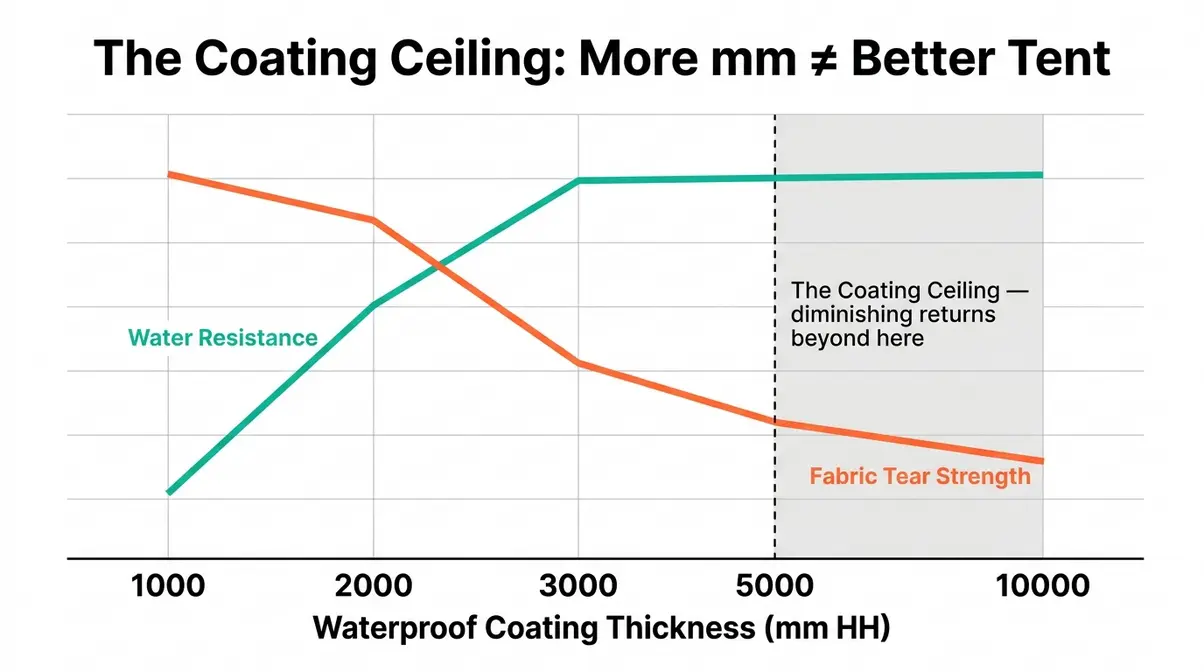
This is The Coating Ceiling — the performance threshold at which adding more waterproof coating to a tent fabric begins to reduce tear strength and increase weight without meaningfully improving real-world weather protection. Beyond roughly 3,000mm–5,000mm for a flysheet, you’re not getting a tent that handles heavier rain. You’re getting a heavier, stiffer tent that may actually tear more easily under stress.
Here’s why: Waterproof coatings — usually polyurethane (PU) — are applied to the inner surface of the fabric. Thicker coatings add more grams per square meter and make the weave less flexible. OutdoorGearLab’s fabric testing research consistently shows that coating thickness and tear strength move in opposite directions: as one goes up, the other tends to come down. A tent rated at 10,000mm isn’t ten times better than a 1,000mm tent in real rain. It may actually be weaker in a windstorm.
What this means for you: Don’t chase the highest mm number. Find the rating that matches your conditions — and trust the rest of the waterproofing system (seams, rainfly, floor design) to do the heavy lifting.
The Coating Ceiling will come up again when we look at premium materials like Gore-Tex, where a fundamentally different approach sidesteps this tradeoff entirely.
PU vs. Silicone Waterproof Coatings
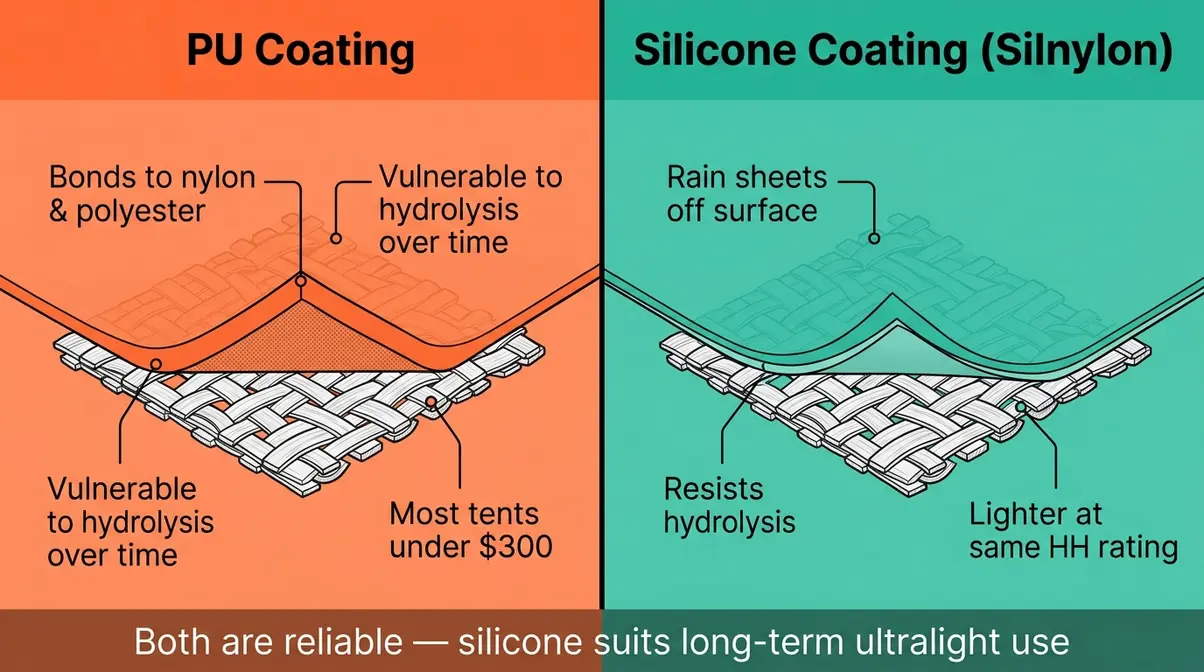
When you see a tent described as “PU coated” or “silicone coated,” the brand is telling you what type of waterproof treatment was applied to the fabric. Learning how to define camping tent fabrics helps you understand their unique properties.
PU (polyurethane) coating is the most common waterproofing treatment applied to tent fabrics. It’s affordable, bonds well to nylon and polyester, and can be applied in thick layers to hit high HH ratings. The downside: PU coatings are vulnerable to hydrolysis — a chemical breakdown caused by repeated exposure to moisture and heat. Over years of use, a PU-coated tent may start to feel sticky or flake inside. This is normal aging, not a manufacturing defect.
Silicone coating — sometimes called “silnylon” when applied to nylon — is an alternative that offers better durability and lighter weight but cannot be re-coated in the field. Silicone-coated fabrics are slippery, which helps rain sheet off the surface, and they resist hydrolysis far better than PU. However, they require silicone-specific seam sealants and are generally found on higher-end or ultralight tents.
What this means for you: Most tents under $300 use PU coatings — perfectly reliable for years of regular use. If you’re buying a lightweight backpacking tent and expect to use it for a decade, silicone-coated options are worth the price premium.
What Waterproof Rating Do You Actually Need?
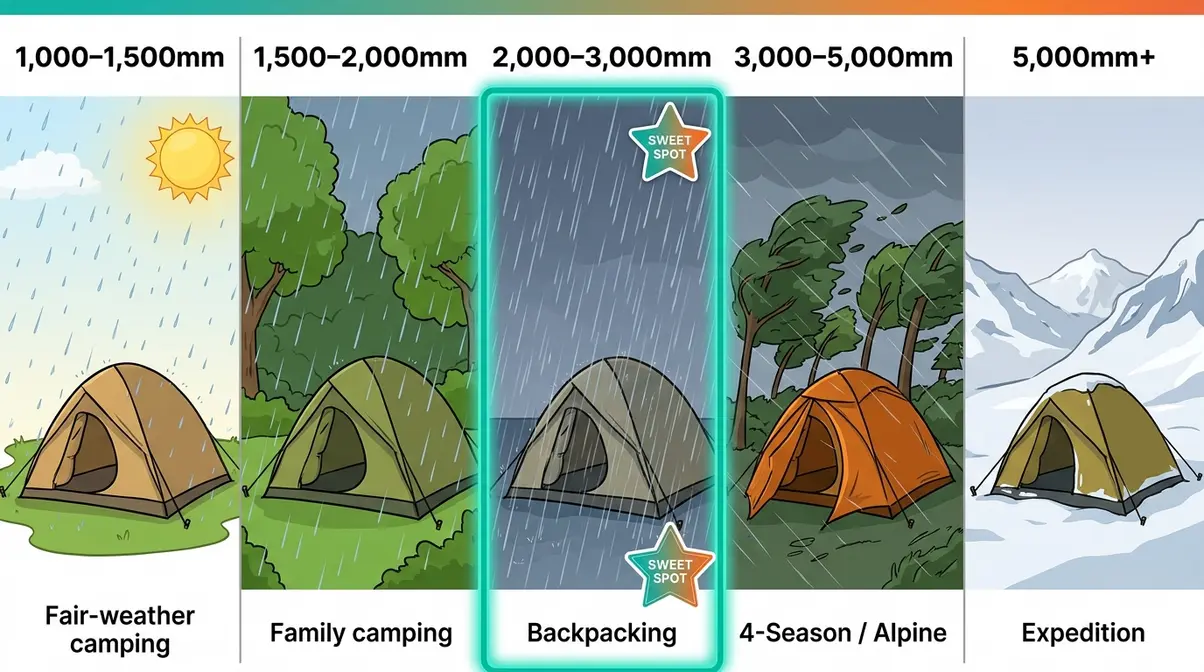
Knowing how ratings are measured is useful. Knowing which rating matches your camping style is what actually keeps you dry. For most people, the answer is simpler than the product pages suggest — and it doesn’t require the highest number on the shelf.
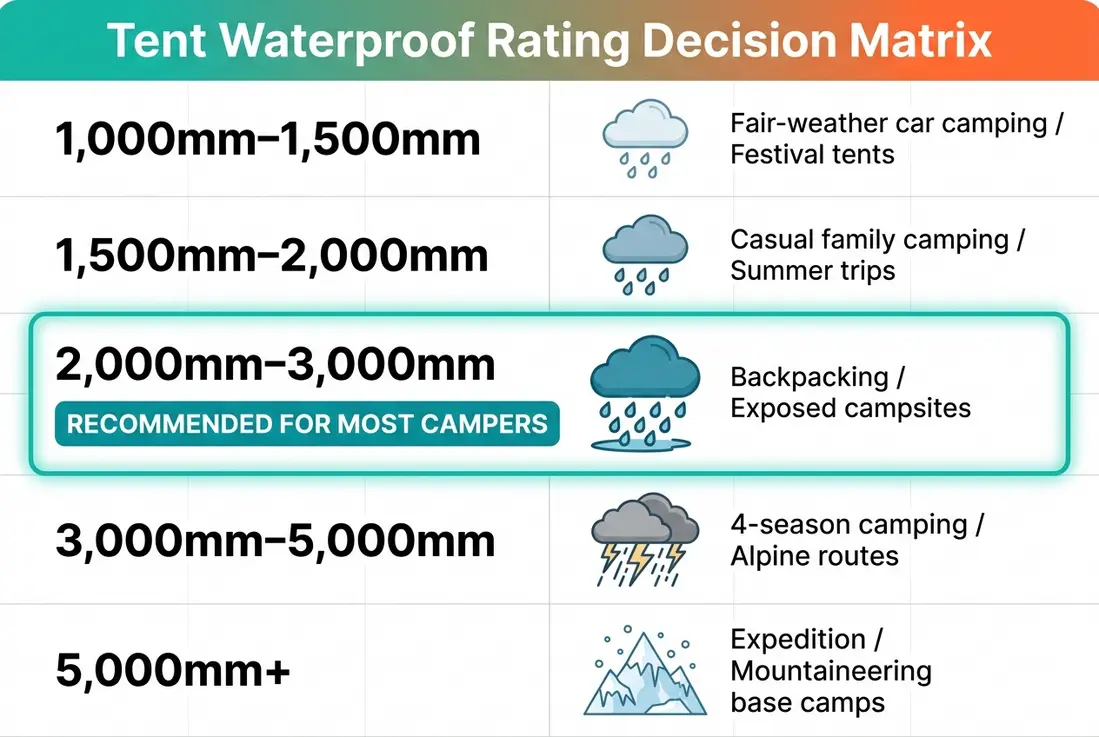
Rating Tiers: 1,000mm to 5,000mm+
Tent waterproof ratings translate directly into weather conditions when you use the following tiers as a practical guide. The table below is the fastest way to match your camping style to the right rating. This is especially helpful when searching for the best tent for wind and rain protection.
| Rating | Weather Resistance | Best For | Notes |
|---|---|---|---|
| 1,000mm–1,500mm | Light drizzle, brief showers | Fair-weather car camping, festival tents | Minimum viable protection; avoid if rain is likely |
| 1,500mm–2,000mm | Moderate rain | Casual family camping, summer trips | Reliable for most 3-season conditions |
| 2,000mm–3,000mm | Heavy sustained rain | Backpacking, exposed campsites | The sweet spot for most campers — strong protection without excess weight |
| 3,000mm–5,000mm | Storms, wind-driven rain | 4-season camping, alpine approach routes | Diminishing returns on the flysheet; floor rating matters more here |
| 5,000mm+ | Extreme conditions | Expedition, mountaineering base camps | Often overkill for recreational camping; watch for The Coating Ceiling weight penalty |
According to REI’s Expert Advice on tent buying, most recreational campers in North America experience conditions well within the 1,500mm–3,000mm range. A 2,000mm flysheet and a 3,000mm floor represent a well-balanced setup for the vast majority of 3-season trips.
Quotable benchmark: A 2,000mm HH rating can withstand sustained moderate-to-heavy rain — equivalent to a typical summer storm — without any seepage through the fabric itself.
Floor vs. Fly: Two Different Ratings
Here’s something that trips up almost every first-time buyer: your tent has two waterproof ratings, not one. The flysheet (the outer layer that sheds rain) and the floor (the groundsheet you sleep on) carry different ratings — and that’s intentional.
The floor faces a completely different type of stress. It contends with ground moisture seeping up, puddles collecting underneath, and the direct pressure of your body weight. That’s why tent floors typically carry ratings of 3,000mm–10,000mm, while flysheets are rated at 1,500mm–3,000mm. A higher floor rating isn’t a sign of a premium tent — it’s simply the right engineering response to a different problem.
When reading a tent’s specs, look for both numbers. A tent listed at “3,000mm” may be quoting only its flysheet rating. If the floor rating isn’t listed, that’s worth asking about before you buy.
Tent vs. Jacket Ratings: 10k/20k
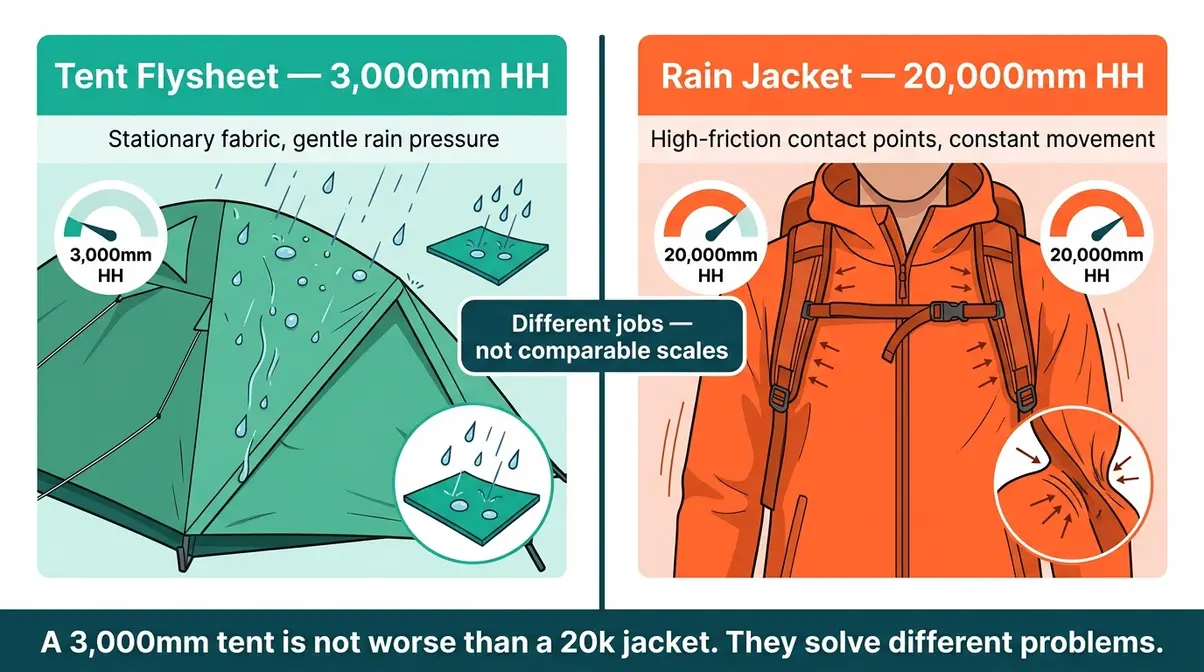
This is the most common question outdoor gear forums field from beginners, and almost no tent buying guide answers it directly: Why does my rain jacket say 20,000mm but my tent only says 3,000mm? Is my tent worse?
No — and the difference comes down to design requirements, not quality.
Rain jackets are designed to handle a very specific type of pressure: the direct impact of heavy rain on a moving human body, combined with pressure from backpack straps, arm movement, and leaning against surfaces. Jacket ratings of 10,000mm–20,000mm (often called “10k” and “20k”) are calibrated to that use case — high impact, high friction, constant movement.
Tent fabrics are designed for a different scenario: stationary exposure to falling rain and wind-driven rain, where the fabric hangs under gentle tension. The pressure a tent flysheet faces is far lower than what a jacket shoulder faces under a pack strap. A 3,000mm flysheet handles real-world tent conditions comfortably — a 20,000mm jacket rating would be excessive (and unnecessarily heavy) for the same application.
The MSR Gear Guide on tent fabrics confirms this directly: the two rating systems exist in parallel because the use cases are fundamentally different. A 3,000mm tent is not worse than a 20,000mm jacket. They’re solving different problems.
What this means for you: Stop comparing your tent’s mm rating to your jacket’s. They’re not on the same scale. Judge your tent’s rating against other tents — and use the decision matrix above.
What Else Makes a Tent Waterproof?
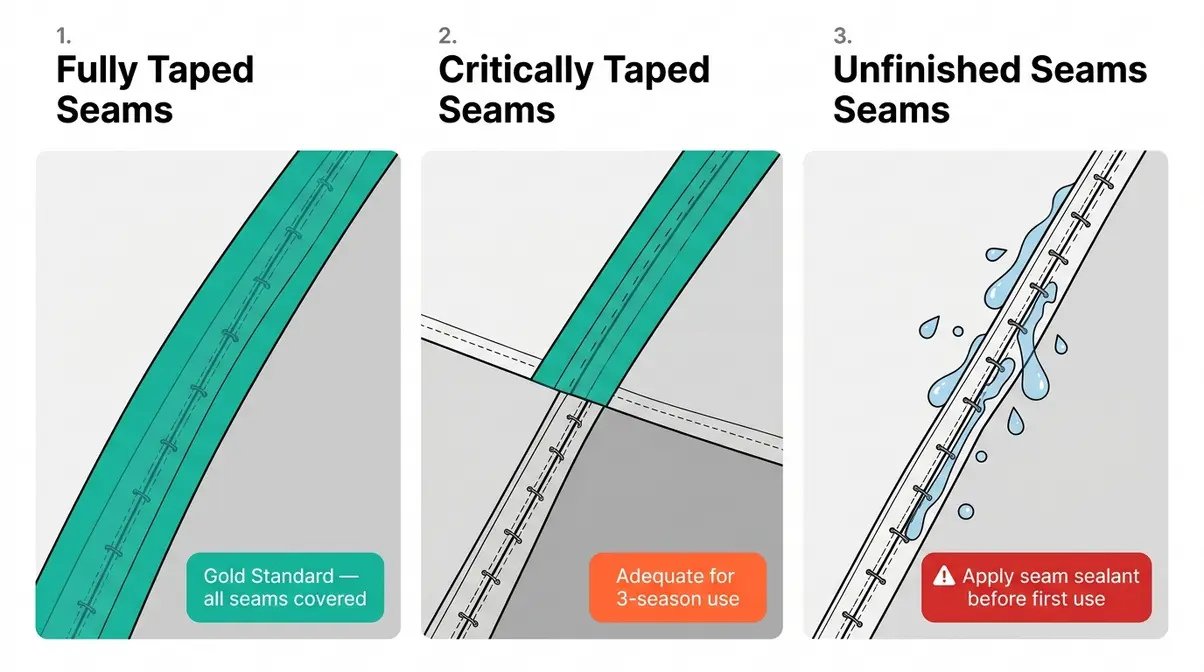
Here’s the honest truth about waterproof ratings: the mm number on the tag only tells you about the fabric. It tells you nothing about the stitching holes, the door zippers, or the gap between the flysheet and the inner tent. Outdoor experts consistently report that most tent leaks — especially in tents under $200 — originate at the seams, not through the fabric itself.
Taped, Sealed, and Unfinished Seams
Every seam in your tent is a row of needle holes. Water finds needle holes. The difference between a tent that stays dry and one that drips on you in the night often comes down to how those holes are handled.
There are three main approaches to seam construction:
- Fully taped seams — A heat-bonded waterproof tape is applied over every seam, inside and out. This is the gold standard. Look for “fully seam taped” in the specs of any tent you plan to use in genuine rain.
- Critically taped seams — Only the high-risk seams (typically the flysheet seams directly above the sleeping area) are taped. This saves weight and cost but leaves lower-priority seams exposed. Adequate for most 3-season camping.
- Unfinished or sealed seams — No tape; the manufacturer may recommend applying seam sealant yourself before the first trip. Common on budget tents and some silicone-coated ultralight designs. Not a dealbreaker — but you need to do the prep work. Fortunately, learning how to seal tent seams effectively takes very little time.
What this means for you: If a tent doesn’t specify “fully taped” or “critically taped” seams, ask. A 5,000mm flysheet with unfinished seams will leak before a 2,000mm flysheet with full seam taping.
The Rainfly and Bathtub Floor
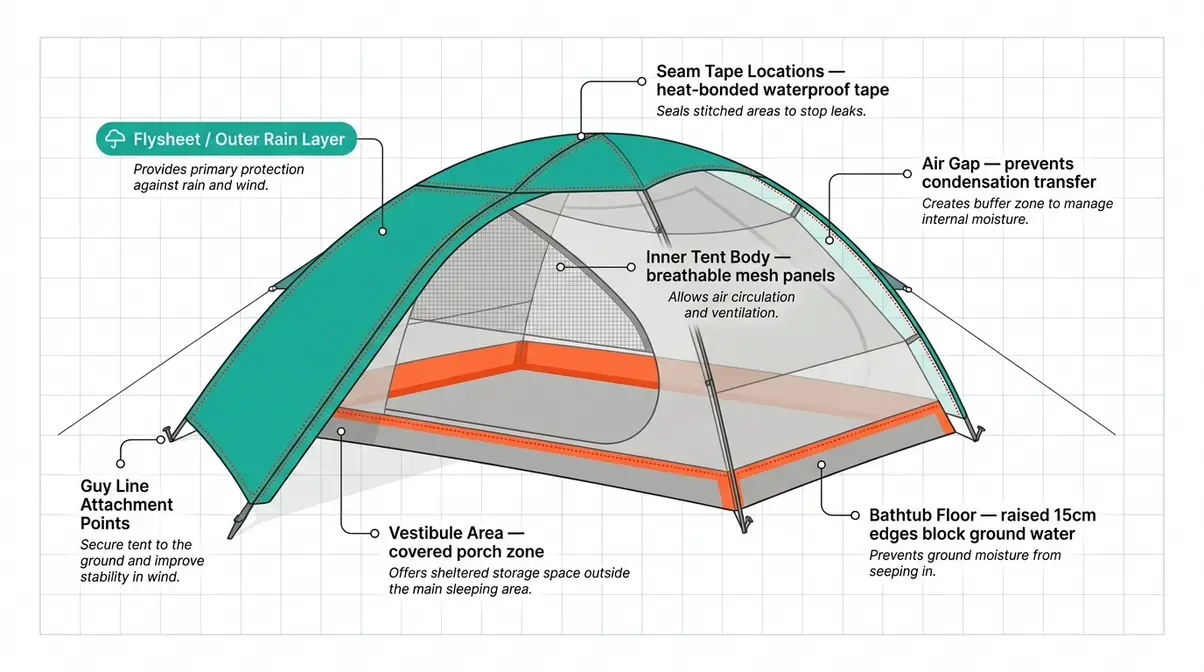
The rainfly — which means the separate outer waterproof shell that drapes over your tent — is your primary defense against rain. Most quality 3-season tents use a double-wall design: the inner tent provides structure and breathability, while the flysheet handles all weather exposure. The air gap between them is critical — it prevents rain from contacting the inner tent directly and reduces condensation transfer.
The bathtub floor (also called a “tub floor”) refers to a tent floor design where the waterproof groundsheet material wraps up the sides of the tent by 5–20 centimeters before connecting to the inner tent walls. This raised lip prevents ground-level water — from puddles, run-off, or a light flood — from seeping in under the tent wall. According to Snowys Outdoors’ guide on waterhead ratings, a proper bathtub floor with a 3,000mm rating provides far more ground protection than a flat-cut floor rated at 10,000mm, because the geometry matters as much as the spec.
What this means for you: When evaluating a tent, check that the floor is cut in a “tub” style. If the spec sheet doesn’t mention it, look at the product photos for a raised floor edge.
Waterproofing vs. Breathability
There’s a tension at the heart of tent design that no waterproof rating can resolve: the more airtight a tent is, the less moisture from your breath and body can escape. Every camper exhales roughly a liter of water vapor overnight. In a poorly ventilated tent, that vapor hits the cold flysheet and condenses back into liquid — dripping onto you and your gear.
This isn’t a waterproofing failure. It’s physics. However, it’s the #1 reason campers incorrectly believe their tent is leaking. A well-designed tent manages this through mesh inner panels, adjustable vents at the peak of the fly, and the air gap of the double-wall design. What this means for you: If you wake up damp inside a tent with a high waterproof rating, condensation is the most likely culprit — and the next section has a 3-step check to confirm it.
Premium Waterproof Tent Materials
Beyond standard PU-coated nylon and polyester, a small category of premium tent materials offers meaningfully different performance — at meaningfully different prices. Understanding what these materials actually do (and don’t do) is where The Coating Ceiling concept becomes most useful.
Is 20k Waterproof Same as Gore-Tex?
Not at all — and the difference matters more than the number.
A 20,000mm HH rating tells you that a fabric, coated with a thick layer of PU or similar compound, resists a 20-meter column of water in a lab test. It says nothing about breathability, long-term durability, or how the fabric performs after five years of use.
Gore-Tex is a fundamentally different technology. It’s a microporous expanded polytetrafluoroethylene (ePTFE) membrane — a physical structure with billions of tiny pores that are large enough to let water vapor (sweat, breath) escape but small enough to block liquid water droplets. According to GORE-TEX brand documentation, the membrane itself is rated to over 28,000mm HH, but that number undersells what Gore-Tex actually delivers: waterproofing and breathability simultaneously, without a coating that degrades over time.
The practical difference: a 20,000mm PU-coated tent flysheet may be more waterproof in a lab test than a Gore-Tex shell jacket. But the Gore-Tex garment breathes, ages gracefully, and doesn’t face The Coating Ceiling tradeoff — because the waterproofing comes from a membrane structure, not a thick coating layer. Most Gore-Tex tents (like the Hilleberg Nallo GT) use the membrane for the inner tent body, combined with a standard fly — prioritizing breathability and condensation management over raw HH numbers.
What this means for you: If someone quotes a “20k rating” as proof of superior waterproofing, ask whether it’s a coating or a membrane. The answer changes the long-term performance picture entirely.
What Is DCF (Dyneema Composite Fabric)?
DCF (Dyneema Composite Fabric) — formerly marketed as Cuben Fiber — is a composite material made from ultra-high-molecular-weight polyethylene (UHMWPE) fibers laminated between two layers of polyester film. It’s the material used in ultralight tents from brands like Zpacks and Hyperlite Mountain Gear.
DCF is inherently waterproof — the polyester film laminate provides a continuous barrier with no coating required. According to DSM Dyneema’s material specifications, DCF achieves HH ratings exceeding 20,000mm without any PU or silicone coating. This means it completely sidesteps The Coating Ceiling problem: there’s no coating to degrade, no hydrolysis risk, and no weight penalty from thick chemical layers.
The tradeoffs are real, though:
- Cost: DCF tents typically cost $400–$1,200+, versus $100–$400 for equivalent PU-nylon tents
- Abrasion resistance: DCF is strong in tension but cuts and punctures more easily than coated nylon
- Packability: DCF crinkles rather than compressing softly — it packs smaller but feels stiffer
What this means for you: DCF is the right call if you’re a serious backpacker counting grams on multi-day routes. For car camping or occasional weekend trips, a quality PU-coated nylon tent at a fraction of the price is the smarter investment.
Choosing the Right Tent Material
The “best” tent material depends entirely on your priorities. Here’s a quick framework:
| Priority | Best Material Choice | Why |
|---|---|---|
| Lowest cost | PU-coated polyester | Affordable, widely available, easy to repair |
| Best durability (long-term) | Silicone-coated nylon | Resists hydrolysis; lighter than PU at same rating |
| Lightest weight | DCF (Dyneema) | No coating weight penalty; waterproof by structure |
| Best breathability | Gore-Tex membrane | Vapor-permeable; premium price |
| Best all-around value | PU-coated nylon (2,000–3,000mm) | Proven technology; replaceable; most repair-friendly |
For first-time buyers and casual campers, PU-coated nylon in the 2,000mm–3,000mm range remains the most practical choice. You get reliable waterproofing, easy field repairs with seam sealant, and a price point that doesn’t require justifying to your camping partner.
Is My Tent Leaking or Is It Condensation?
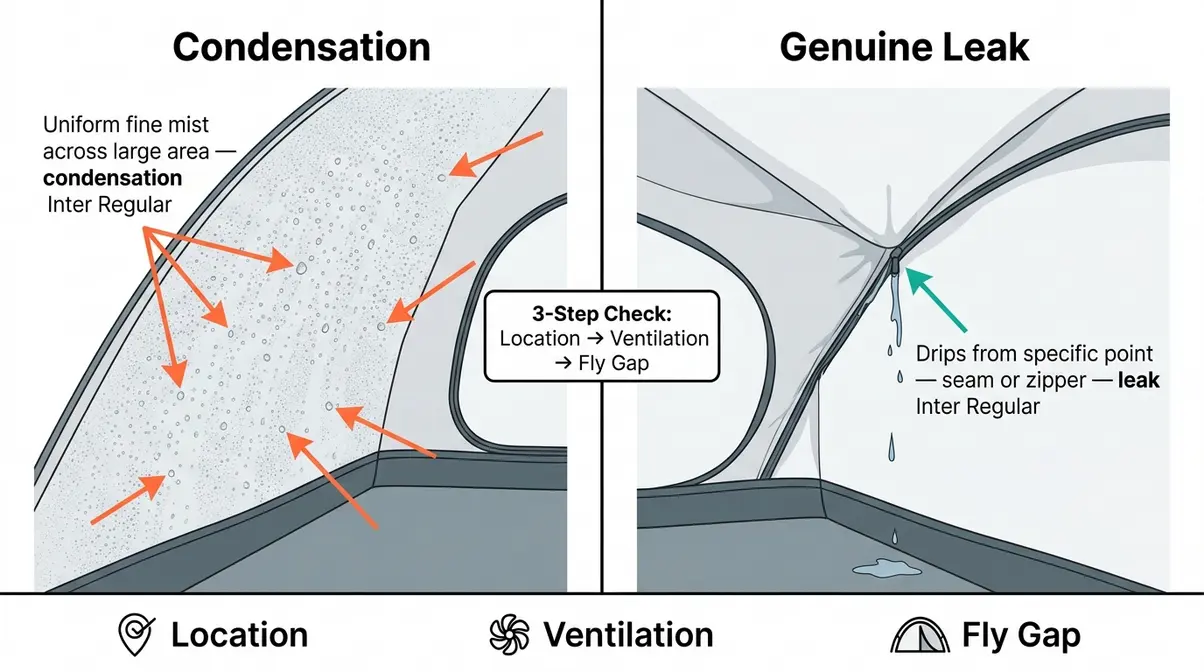
This question comes up in every camping forum, every gear subreddit, and every outdoor retailer’s inbox. Outdoor experts and experienced backpackers on communities like r/Ultralight consistently report that condensation is misdiagnosed as a tent leak far more often than actual fabric failure. Knowing the difference saves you money, frustration, and an unnecessary warranty claim.
A genuine leak means water is entering your tent from outside — through the fabric, seams, or a gap in the rainfly coverage. Condensation means moisture from inside the tent (your breath, your body heat) is turning to liquid on the cold inner surfaces of the fly or inner tent walls.
The 3-Step Condensation Check
Before concluding your tent is defective, run through this checklist:
Step 1: Check where the moisture appears.
Run your hand across the inner wall of the flysheet. If it’s damp on the inside surface of the fly (the side facing you), that’s condensation. If water is dripping through the seams or pooling on the floor near the walls, that’s a potential leak. Condensation typically appears as a uniform fine mist or droplets on a large surface area. A leak typically appears as drips from a specific point — a seam, a zipper line, or a corner.
Step 2: Check your ventilation.
Close all vents and you’ll wake up wetter. Open the peak vent and any low-level mesh panels, even in cold weather. The goal is airflow — moving that moisture-laden air out before it condenses. If opening the vents reduces the moisture problem on subsequent nights, condensation was the culprit.
Step 3: Check the fly-to-ground gap.
Your flysheet should hang close to — but not touching — the ground on all sides. If the fly is pressed against the inner tent, moisture transfers directly. If rain is driving horizontally under a fly that doesn’t reach low enough, water can enter without ever passing through the fabric. Stake out the fly to its full tension and check the gap on the windward side.
If you pass all three steps and still have water pooling on your floor, your seams may need resealing — or your floor’s waterproofing may be worn.
When to Reproof or Replace Your Tent
Tent waterproofing doesn’t last forever. PU coatings begin to degrade through hydrolysis — a reaction with moisture and heat — typically after 3–7 years of regular use, or sooner if the tent is stored damp. The warning signs are a sticky or flaking inner coating, a musty smell that won’t wash out, or water that no longer beads on the flysheet surface.
When to reproof: If water stops beading and starts soaking into the flysheet fabric (called “wetting out”), the DWR (Durable Water Repellent) finish — which is a surface treatment separate from the HH coating — has worn off. This is easy to fix. Products like Nikwax Tent & Gear SolarProof or Grangers Performance Repel can restore DWR performance in an afternoon. Using the best waterproofing spray for tents ensures long-lasting protection. According to Mountain Warehouse’s tent buying guide, reproofing every 2–3 years of active use is standard maintenance.
When to replace: If the inner coating is visibly flaking, peeling in sheets, or the seam tape is lifting and bubbling, the tent has reached end-of-life for waterproofing. Reproofing won’t restore a delaminating coating. At that point, either send it to a specialist repair service or retire it.
The key signal: If your tent wets out (soaks through) but shows no seam failure and no floor leaks, start with a DWR reproof. It’s a $15–$25 fix that restores performance in most cases.
Frequently Asked Questions
Is 10k or 20k better for a tent?
For tent use, neither 10k nor 20k is meaningfully “better” than a quality 3,000mm tent — because the rating systems aren’t directly comparable. According to MSR’s fabric guide, jacket ratings of 10,000mm and 20,000mm are calibrated for high-pressure contact points like backpack straps and arm movement. Tent fabrics face much lower pressure from falling rain, so a 3,000mm flysheet handles typical storm conditions comfortably. A 20k jacket and a 3,000mm tent are both doing their jobs correctly — they’re just different jobs.
What is a good rating for tents?
A rating of 1,500mm–3,000mm is a good waterproof rating for most 3-season camping. As noted by REI’s Expert Advice, this range handles moderate to heavy sustained rain reliably without the weight and rigidity penalties that come with higher coatings (The Coating Ceiling). For your tent floor, look for 3,000mm–5,000mm to handle ground moisture and body pressure. If you’re camping in exposed alpine terrain or planning 4-season trips, 3,000mm–5,000mm on the flysheet is appropriate.
Is 5,000mm waterproof good for a tent?
Yes — 5,000mm is excellent waterproofing for a tent flysheet, which OutdoorGearLab’s testing confirms provides reliable protection in heavy storms and wind-driven rain. However, it’s worth knowing that 5,000mm represents the upper end of where additional coating delivers real-world benefit. Beyond this point, The Coating Ceiling effect means you’re adding weight and reducing fabric flexibility without gaining measurable storm protection. For most campers, 5,000mm is more than enough — and a well-seamed 3,000mm tent often outperforms a poorly seamed 5,000mm one.
Is 2,000mm waterproof good for a tent?
A 2,000mm rating is good for most 3-season camping conditions, including moderate to heavy rain. According to Snowys Outdoors, it comfortably handles typical summer and autumn storms across most of North America and Europe. The key is pairing it with fully taped or critically taped seams and a rainfly that extends close to the ground. A 2,000mm flysheet with good seam construction will outperform a 3,000mm flysheet with unfinished seams in real-world conditions.
What is the strongest waterproofing?
DCF (Dyneema Composite Fabric) and Gore-Tex membranes represent the strongest waterproofing technologies available for tents, for different reasons. DSM Dyneema and GORE-TEX documentation confirm that DCF achieves HH ratings above 20,000mm through its laminated film structure — with no coating to degrade over time. Gore-Tex provides a similar performance ceiling with the added benefit of vapor permeability. Both sidestep The Coating Ceiling problem entirely. However, both also cost significantly more than PU-coated nylon — and for most recreational campers, a quality 2,000mm–3,000mm PU tent remains the strongest value proposition.
Choose the Right Rating and Trust the System
Tent waterproof ratings explained simply: the mm number tells you how much water pressure the fabric can resist, measured by a standardized column-of-water test (ISO 811:2018). For most 3-season campers, 1,500mm–3,000mm on the flysheet and 3,000mm–5,000mm on the floor is the right target range — reliable in heavy rain, without the weight and rigidity penalties of higher coatings. Our research across professional outdoor communities and gear testing publications confirms that seam construction, rainfly coverage, and bathtub floor design contribute as much to real-world dryness as the rating itself.
The Coating Ceiling is the most important concept to carry with you when you shop. More mm doesn’t mean a better tent — it means a heavier, stiffer fabric that may sacrifice tear strength for a lab number that doesn’t change how you sleep in a rainstorm. The best tent for your trip is the one that matches your conditions and your conditions only, with proper seam taping and a well-designed fly.
Start with the decision matrix: pick your typical weather conditions, match them to the rating tier, and then verify that the tent specifies fully or critically taped seams and a double-wall design. Do that, and you’ll choose with confidence — not guesswork.

Dave King
I'm Dave King. I publish Tent Explorer, a site built to answer the questions people actually ask before they buy.