
This blog post may contain affiliate links. As an Amazon Associate I earn from qualifying purchases.
Waking up to dripping tent walls can quickly dampen any outdoor trip. Research shows that even American campers lose sleep and comfort due to poorly managed condensation inside tents. This issue goes beyond just a wet sleeping bag, affecting warmth and gear performance for everyone from Canadian adventurers to European hikers. Learn how understanding moisture sources and smart techniques can keep your tent dry and your adventure enjoyable.
Key Takeaways
| Point | Details |
|---|---|
| Understanding Condensation | Tent condensation is a natural process caused by warm, moisture-laden air contacting cooler surfaces, not a manufacturing defect. |
| Ventilation is Key | Effective ventilation strategies, such as using mesh panels and adjusting vents, can significantly reduce moisture buildup inside the tent. |
| Choose the Right Tent | Tent designs vary in susceptibility to condensation; double-wall and geodesic tents generally manage moisture better than single-wall options. |
| Moisture Management Practices | Keep wet gear outside and use moisture-absorbing items like silica gel packets to help limit condensation levels in the tent. |

- ROOMY INTERIOR: Straight wall design with 72in center height create more space to stand up changing and move
- WEATHER PROTECTION: High-tech coating material with sealed seams and waterproof strip guarantees water-resistant
- EASY SETUP & COLOR COATED POLES: No particular skills needed, 2 people could set up the tent easily in 5 min
- GREAT VENTILATION: Mesh tent top and doors offer great views and ventilation
- 2 ROOMS: A separated curtain can be used as room divider and projector screen

- Roomy 6 People Family Tent: Spacious design offers enough room for 6 people family, with a size 10′ x 9′ x 78″(H) (90 sq ft),2 air mattresses or 6 sleeping bags are well fit in the tent,78 inch center height is enough for you to stand up changing.
- 5 Minutes Set-Up for 2 People: No particular skills are needed, 1 person could also set up the tent easily in 10 min. The portable carry bag is 24.6 x 8.26 x 8.26 inches, The camping tent weighs 18 lb. Ideal for family car camping or camping site
- Breathable Mesh Windows: The camping tent has 1 large mesh door, 5 mesh windows & mesh tent top, which allows the breeze to come in, all the mesh windows offer great views and ventilation
- Quality Material: The polyurethane hydrostatic-rated coating high-tech, waterproof,4 steel leg poles, and a rectangular roof, make the tent more firmly, stable, and windproof, ideal for outdoor camping, hiking, and fishing in all weather
- After Sale Service: UNP camping tent offers unconditional 1-year quality assurance, If you have any questions about the tents, we’ll give you a satisfactory solution in 12 hrs

- WeatherTec system’s welded corners and inverted seams keep water from getting in
- Integrated rainfly improves airflow
- Double-thick Polyguard 2X fabric stands up to the elements season after season
- Instant setup in as fast as 1 minute
- Dimensions: 10 x 9 ft
- Spacious for 10 Person: Unique 18 ft x 9 ft x78 in, well fitting 10 sleeping bags or 3 queen air mattress, ideal for family camping.
- Easy-up Tent: There are no particular skills needed. Two people can set it up in 10 minutes. A bigger carry bag size of 25.6 x10.2 x 10.2 inches will let you feel relaxed and easily repack the tent.
- Good Ventilation, Large View: Top Large Mesh Roof makes it possible to watch stars with a wide view at night, three sides of big mesh windows, and the other two on each door boost air ventilation.
- 2 Room Tents: Hang one Privacy Divider Curtain from the ceiling, the tent becomes a room cabinet tent with 2 doors, which improves privacy. With a projector, the tent can also become an outdoor cinema by projecting videos on the divider screen.
- Quality Material: Polyester 185T PU1000mm fabric waterproof. Vestibular awning and extended awning design in rainfly better prevent rain from dropping inside.

- 60 Seconds Set Up: You can set up the instant camping tent in under 60 seconds, thanks to its pre-installed poles and seamless construction. The quick and easy installation makes it the ideal companion for beginner campers, allowing you and your family to enjoy more time with nature
- Water-resistant & Windproof: The tent is crafted from premium water-resistant fabric. The door zipper features a drainage channel at the bottom, complemented by a bathe tube design at the base. This effectively prevents rainwater accumulation and leakage while keeping insects out. Equipped with sturdy tent pegs and adjustable guy lines, this tent can withstand wind at 35 MPH. Note: The inner tent top uses mesh fabric and is not waterproof. It must be used with the outer tent during rainy weather
- Visibility & Ventilation: The tent for camping has mesh windows on all 4 sides, vents at the floor, and a mesh screen design at the ceiling, making the temperature inside the tent cooler in summer. Moreover, the windows and ceiling made of our mesh material let you experience the beautiful starry sky and the charming scenic nature on a quiet summer night
- Spacious Interior & Portable: The spacious tent measures 120 inches x 108 inches, large enough for 6 people by industry standards. The interior seamlessly fits a Queen air mattress. With a maximum height of 66 inches, the 6 person tent is spacious enough to easily stand upright, too. It is well-built using rock-solid carbon structural steel while weighing only 16.8 lbs, making it easy to carry for the smoothest camping trips
- High-quality Materials: The camping tent’s top-of-the-line SBS zippers bring a buttery smoother user experience; Its high-quality B3 mesh yarn with fine texture gives it that extra bump in longevity; The sturdy carbon frame with pads and protective sleeves on every extension warrants high durability and seamless stability. The power cord entrance enables equipment connection to an external power source, while mesh pockets inside facilitate easy storage
Last update on 2026-03-07 / Affiliate links / Images from Amazon Product Advertising API
What Is Tent Condensation? Key Facts
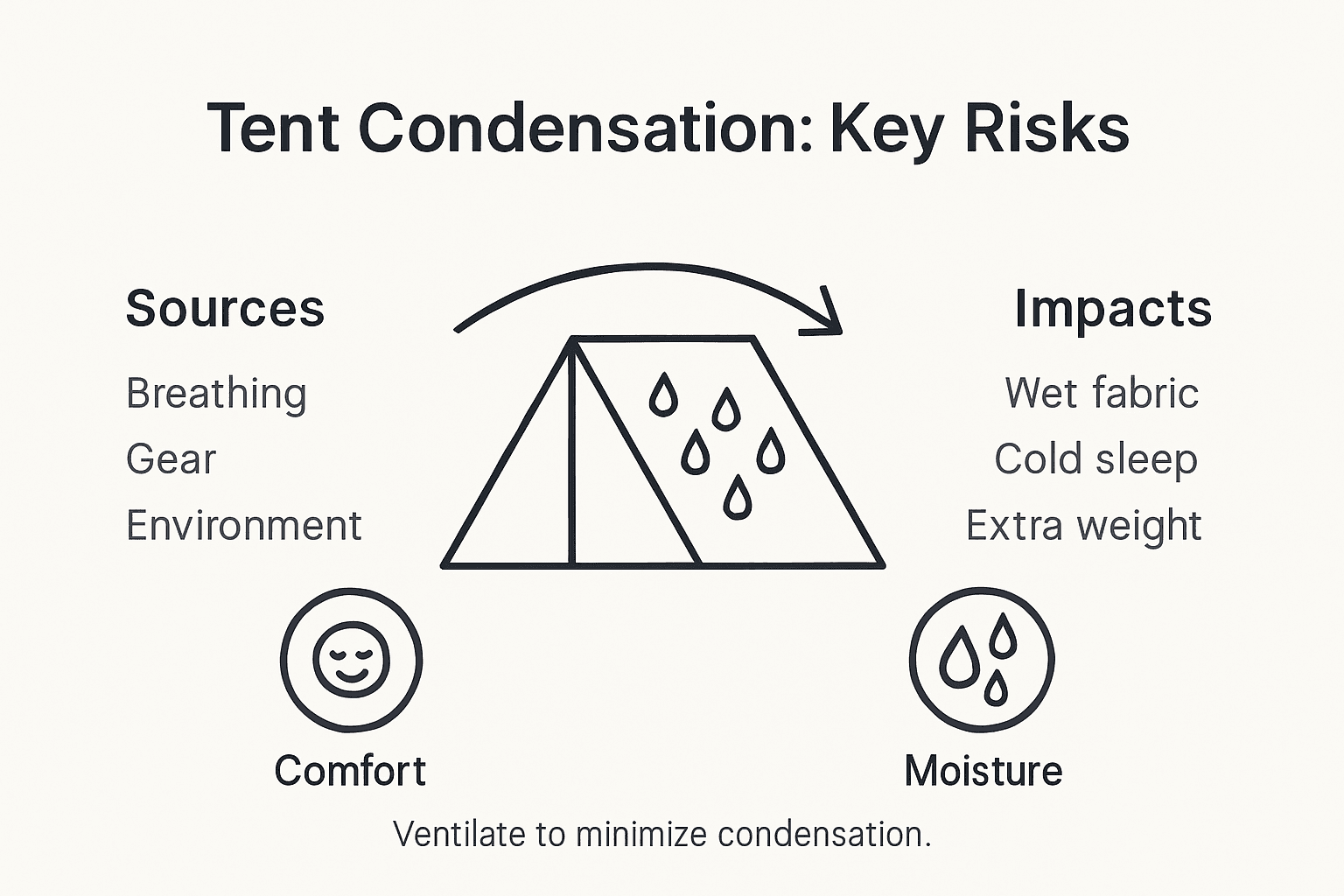
Tent condensation is a natural moisture phenomenon that occurs when water vapor transforms from gas to liquid droplets inside your camping shelter. Water vapor transitions happen when air cools to its dew point, creating small water droplets that collect on tent walls and surfaces. This process happens because air can only hold a specific amount of moisture at any given temperature.
The primary sources of tent condensation are the campers themselves and the surrounding environment. Breathing, sweating, and wet clothing release significant amounts of water vapor inside an enclosed tent space. External factors like ground moisture, ambient humidity, and temperature differences between inside and outside the tent also contribute to condensation formation. When warm, humid air contacts cooler tent surfaces, moisture quickly transforms into water droplets.
Condensation impacts tent performance by potentially wetting sleeping gear, adding unnecessary weight, and reducing overall camping comfort. Academic research indicates that vapor accumulation can significantly affect tent fabric performance, making it crucial for campers to understand and manage moisture levels. Different tent materials and designs have varying capacities to manage moisture transfer, which directly influences how much condensation builds up during your outdoor adventure.
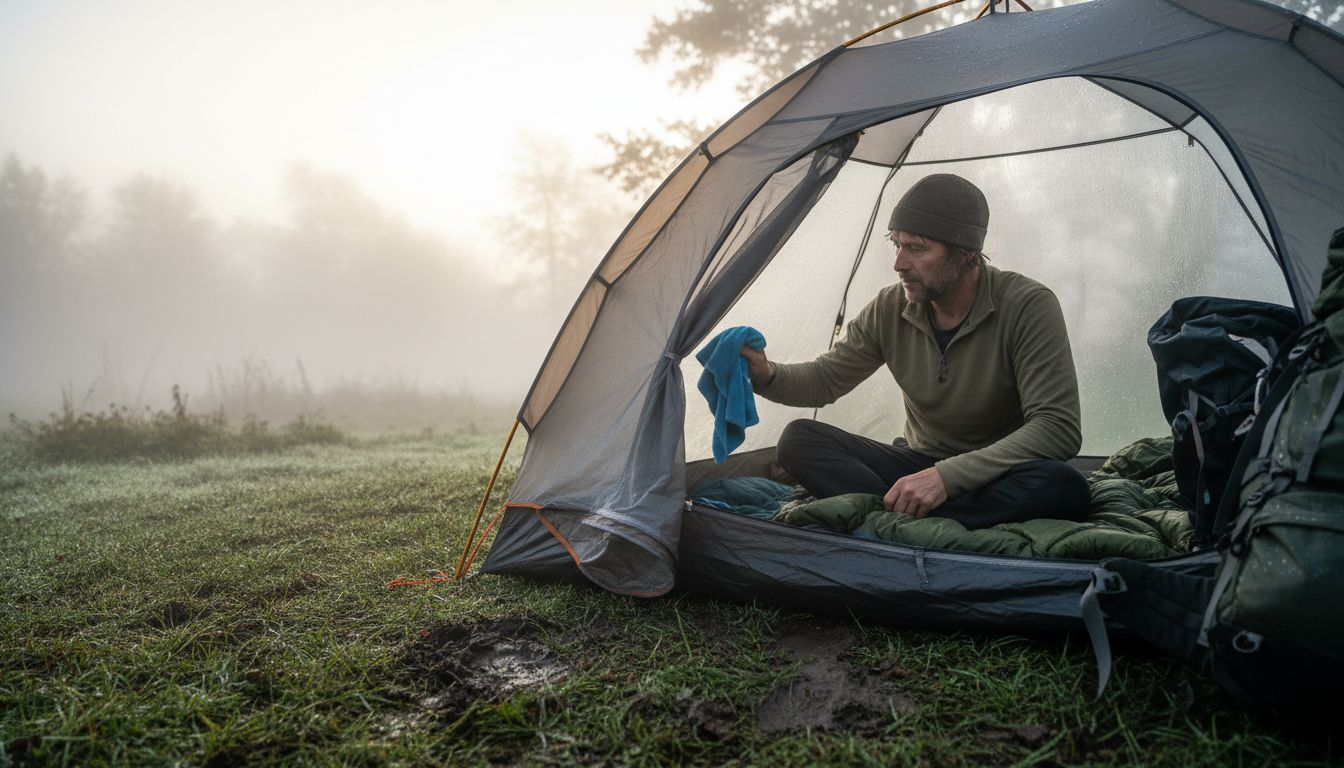
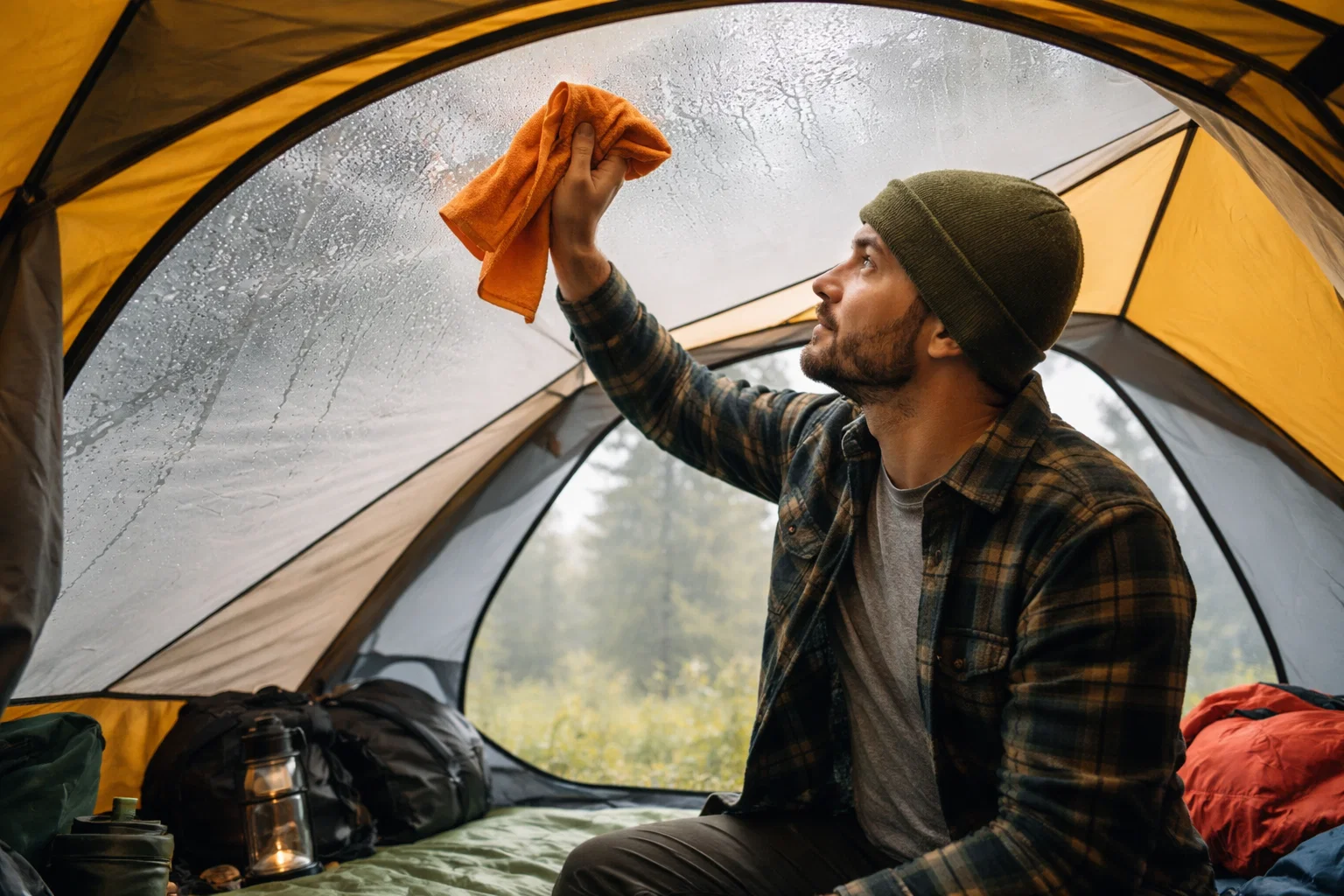
Pro tip: Always pack a lightweight microfiber towel to quickly wipe down tent interior surfaces and reduce moisture accumulation during your camping trip.
Common Misconceptions About Tent Moisture
Tent moisture is frequently misunderstood by campers, leading to unnecessary frustration and incorrect assumptions about their camping experience. Condensation is not a sign of tent failure but a natural atmospheric process, occurring when warm, moisture-laden air contacts cooler surfaces. Many campers mistakenly believe that water droplets inside their tent indicate a manufacturing defect or damage, when in reality, it’s a standard physical phenomenon.
Another prevalent misconception is that condensation only happens during rainy conditions or when water is physically present. Humidity and temperature interactions control moisture formation, not just visible water sources. The amount of water vapor in the air, combined with surface temperature differences, determines condensation likelihood. This means a completely dry environment can still experience significant tent interior moisture, especially during temperature transitions from day to night.
Campers often blame their tent’s waterproofing or design for moisture issues, but the root cause is typically environmental and biological factors. Breathing, body heat, and perspiration contribute substantial moisture to enclosed tent spaces. External conditions like ground humidity, ambient temperature, and air circulation play crucial roles in condensation development. Understanding these dynamics helps campers manage expectations and implement effective moisture control strategies.
Pro tip: Improve tent ventilation by slightly unzipping windows or using mesh panels to allow moisture-laden air to escape, reducing condensation buildup.
Why and How Condensation Forms Inside
Condensation inside tents is a complex process driven by multiple environmental and biological factors. The principles of atmospheric moisture transformation apply directly to the confined space of a tent, creating a unique microclimate where water vapor readily converts to liquid droplets. When warm air laden with moisture encounters cooler tent surfaces, the temperature differential triggers an immediate condensation response.
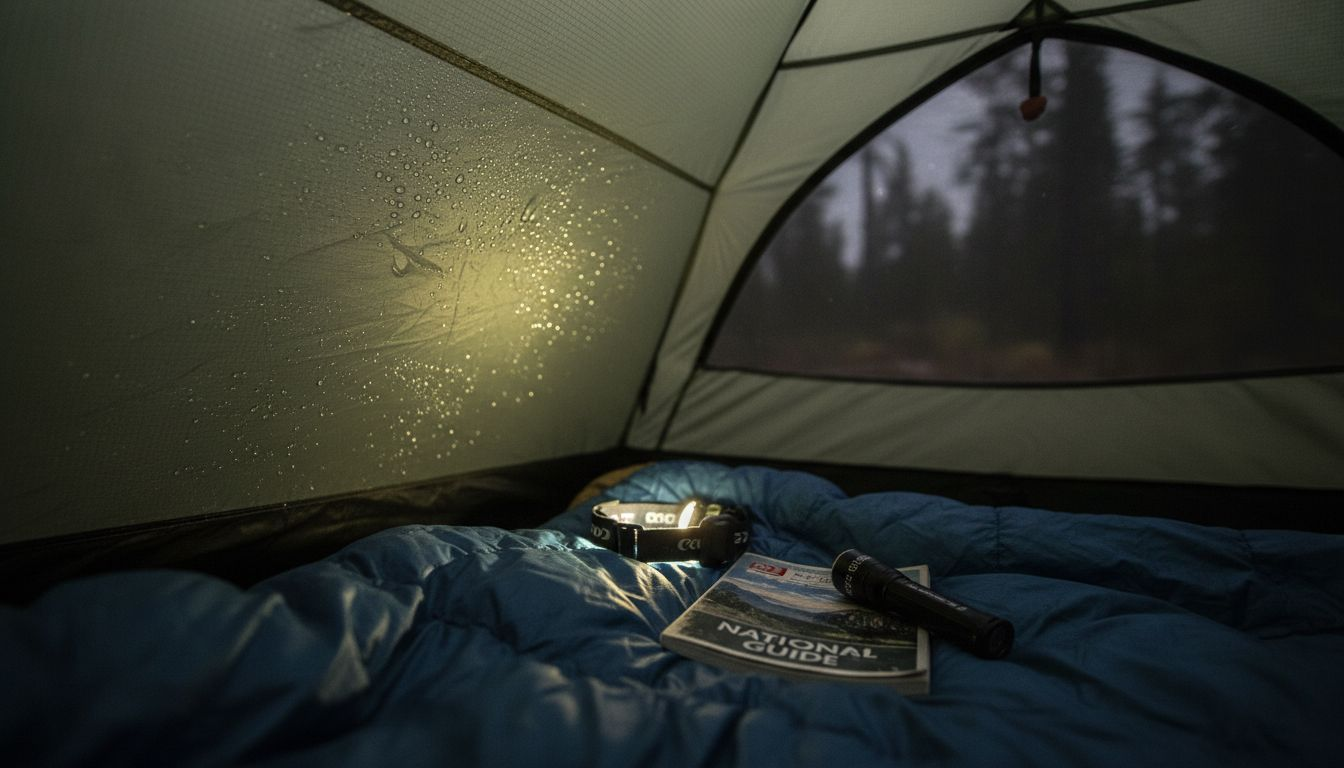
Temperature gradient plays a critical role in condensation formation. During nighttime camping, the dramatic temperature drop between your body heat and the tent’s exterior creates an ideal environment for moisture conversion. Human activities significantly contribute to this process – every breath you exhale releases approximately 40 milliliters of water vapor, while wet clothing and perspiration introduce additional moisture into the enclosed tent space. The more occupants in a tent, the higher the moisture generation.
The physical mechanics of condensation involve air reaching its dew point – the temperature at which water vapor transforms into liquid water. Factors like tent material, ventilation, ground conditions, and ambient humidity all influence this delicate balance. Synthetic tent fabrics with low breathability tend to accumulate more moisture, while natural materials like cotton can absorb and release water more dynamically. Understanding these intricate interactions helps campers anticipate and manage interior moisture levels more effectively.
Pro tip: Use moisture-wicking sleeping bags and clothing, and create small air gaps between your gear and tent walls to minimize direct contact and reduce condensation potential.
Types of Tents and Condensation Risks
Different tent designs create unique moisture management challenges, with some tent types inherently more prone to condensation than others. Single-wall tents, typically lightweight and popular among backpackers, trap moisture more readily due to their compact construction and limited breathability. These tents have fewer layers to manage air circulation, making them particularly susceptible to interior moisture buildup.
Double-wall tents represent a more sophisticated approach to condensation management. The inner breathable layer and outer rainfly create a critical air gap that helps disperse moisture and reduce direct condensation on sleeping areas. Tent materials play a crucial role in this process – synthetic fabrics with low breathability accumulate moisture faster, while specialized water-vapor permeable materials can significantly reduce condensation risks. Different tent construction techniques directly impact moisture retention and air circulation, making material selection a critical factor for campers.
Camping environments further complicate condensation dynamics. Tents used in humid forests, near water sources, or during temperature fluctuations experience more significant moisture challenges. Geodesic and tunnel tent designs with multiple ventilation points offer better moisture management compared to traditional dome or cabin-style tents. Strategic placement of mesh panels, adjustable vents, and thoughtful internal configuration can dramatically reduce the likelihood of interior water droplet formation.
Here’s a quick comparison of tent types and their relative condensation risks:
| Tent Type | Condensation Risk | Moisture Management Features |
|---|---|---|
| Single-wall | High | Minimal ventilation, fewer layers |
| Double-wall | Moderate | Air gap, inner mesh, rainfly vents |
| Geodesic/Tunnel | Low | Multiple vents, superior airflow |
| Cabin/Dome | Moderate | Limited vent options, solid fabric |
Pro tip: Choose tents with mesh panels and adjustable rainfly vents, and always leave a small opening for air circulation, even in cooler weather.
Major Impacts of Condensation on Comfort
Condensation dramatically undermines camping comfort by compromising the thermal and physical performance of your outdoor gear, creating a cascade of challenges that extend far beyond simple moisture accumulation. When water droplets form inside your tent, they immediately begin to degrade your sleeping environment, transforming what should be a restful retreat into a cold, clammy experience. Wet sleeping bags lose significant insulation capacity, meaning you’ll feel colder and more uncomfortable throughout the night.
Thermal regulation becomes severely compromised when condensation takes hold. Moisture-saturated fabrics conduct heat away from your body much faster than dry materials, increasing the risk of cold stress and potentially dangerous temperature drops. The relationship between humidity, dampness, and thermal comfort is complex and directly impacts a camper’s physiological well-being, creating a physiological cascade that can disrupt sleep, reduce recovery, and potentially expose campers to heightened health risks.
Beyond personal comfort, condensation creates practical challenges that can derail an entire camping experience. Wet gear becomes heavier, more difficult to pack, and prone to mildew and fabric degradation. Electronics, important documents, and sensitive equipment face increased risk of water damage. Clothing and sleeping systems that remain damp can lead to extended discomfort, increased susceptibility to chills, and a higher likelihood of cutting a camping trip short due to persistent moisture-related issues.
Pro tip: Carry moisture-absorbing silica gel packets and place them strategically inside your tent to help reduce ambient humidity and minimize condensation buildup.
Practical Strategies to Prevent Tent Condensation
Comprehensive condensation prevention requires a multi-layered approach targeting moisture sources and tent environmental conditions, focusing on strategic ventilation and humidity management. The fundamental goal is creating an environment where moisture cannot easily accumulate and transform into water droplets. Strategic tent placement, careful gear management, and intelligent airflow design can dramatically reduce condensation risks.
Ventilation emerges as the most critical strategy for moisture control. Airflow management involves creating deliberate pathways for humid interior air to escape while allowing drier external air to circulate. This means positioning your tent with consideration for wind direction, using mesh panels and adjustable rainfly vents, and ensuring small gaps exist between your tent’s inner and outer layers. Maintaining a delicate balance between interior air temperature and moisture content prevents condensation formation, requiring campers to be proactive about air exchange.
Practical tactics include minimizing internal moisture sources by keeping wet clothing and gear outside or in designated vestibule areas, using moisture-wicking sleeping bags and clothing, and avoiding cooking or boiling water inside enclosed tent spaces. Ground conditions also play a significant role – choose camping sites with good air circulation, avoid low-lying areas with high humidity, and consider using a ground cloth that provides a moisture barrier between the tent floor and potentially damp earth.
Summary of effective strategies to reduce tent condensation:
| Strategy | How It Helps | Extra Benefit |
|---|---|---|
| Improve ventilation | Removes humid air from tent | Prevents stuffy atmosphere |
| Use dry gear | Minimizes vapor sources | Keeps sleeping area drier |
| Select campsite wisely | Reduces ground and air humidity | Promotes restful sleep |
| Moisture management | Absorbs excess interior moisture | Protects equipment and gear |
Pro tip: Carry a small microfiber towel to quickly wipe down tent interior surfaces during the morning, removing accumulated moisture before it can cause long-term dampness.
Take Control of Tent Condensation and Stay Dry on Your Next Camping Trip
Condensation inside your tent can turn a peaceful night into a wet and uncomfortable experience. This article breaks down why moisture builds up, how your breath and gear add to the problem, and how different tent types cope with these challenges. If you want to get ahead of condensation and protect your gear and sleep comfort, exploring expert advice and hands-on tips is the key. Discover how improving ventilation and managing moisture sources can transform your camping comfort.
Ready to conquer tent moisture issues once and for all Explore our practical solutions in the Tent Tips – Tent Explorer to optimize airflow and reduce dampness inside your shelter. Learn maintenance tricks in Tent Troubleshooting And Maintenance – Tent Explorer to keep your tent in top shape against condensation challenges. For the best gear to fight moisture, check out Tent Accessories – Tent Explorer. Visit Tent Explorer now and make your outdoor nights drier and more comfortable with expert guidance you can trust.
Frequently Asked Questions
What causes tent condensation?
Tent condensation is caused by the transformation of water vapor into liquid droplets when warm, humid air meets cooler tent surfaces. This can occur due to factors like breathing, sweating, wet clothing, and external environmental conditions such as humidity and temperature differences.
How can I reduce condensation inside my tent?
To reduce condensation, improve ventilation by using mesh panels and adjustable vents, minimize internal moisture sources by keeping wet items outside, and choose camping sites with good air circulation to prevent moisture buildup.
What are the differences between single-wall and double-wall tents regarding condensation?
Single-wall tents are more prone to condensation due to their limited ventilation and compact design, while double-wall tents with an inner breathable layer and outer rainfly create an air gap that helps manage moisture more effectively, reducing condensation risks.
How does condensation affect camping comfort?
Condensation can make your camping experience uncomfortable by wetting gear, decreasing insulation in sleeping bags, and leading to cold stress. Wet gear also becomes heavier and more challenging to handle, posing risks to both comfort and safety.