Tent Packed Size Guide: Dimensions, Types & Tips
 Dave King
Updated June 30, 2026
25 min read
Dave King
Updated June 30, 2026
25 min read
You finally find the perfect tent online — the right capacity, the right price, maybe even the right color. It arrives, you stuff it back into its bag, and then you hold it up next to your pack and realize: it won’t fit.
“When I solo camp I use a 2 person tent that fits me and my gear. Generally, the sizes do run smaller.”
That one sentence from an experienced backpacker captures the #1 gear mistake beginners make. A tent too bulky to carry means strapping it to the outside of your pack — adding wind resistance, snag risk, and shoulder strain — or worse, leaving it behind. In this tent packed size guide, you’ll learn the exact dimensions to look for, how to compare tent types side by side, and the packing techniques that can cut your load in half. This guide covers definitions, packed dimensions by tent type, the key factors that affect bulk, smart packing methods, expert backpacking rules, ultralight brands, and the most common pitfalls to avoid.
Key Takeaways: Tent Packed Size at a Glance
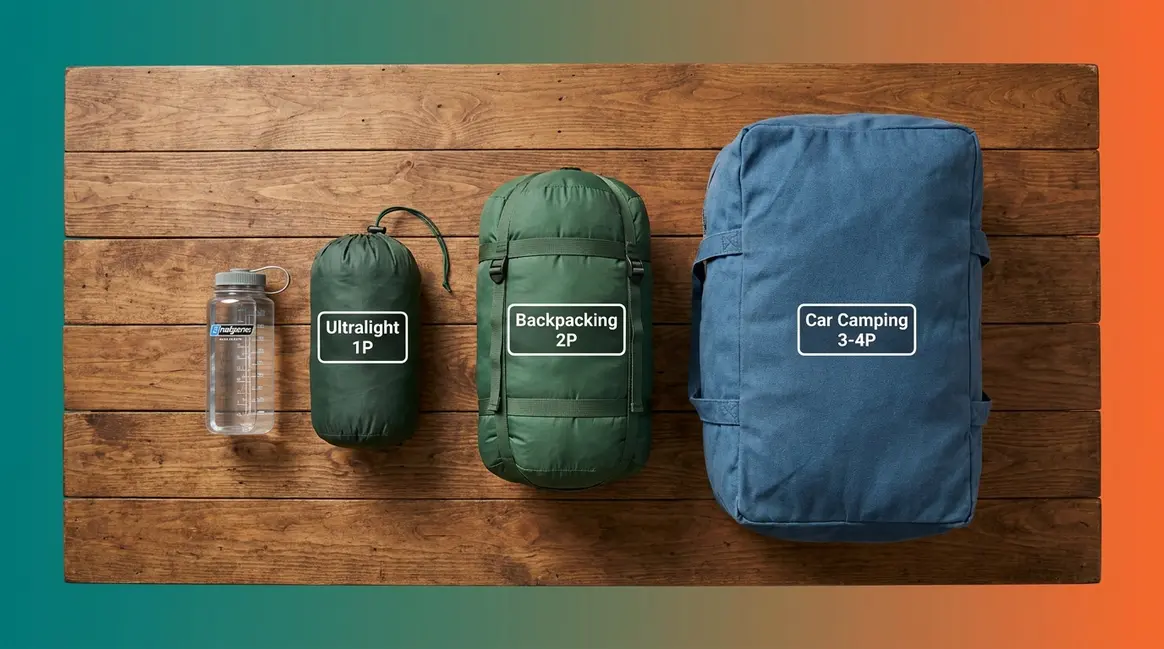
This tent packed size guide reveals that choosing a tent by packed size — not just capacity — prevents the #1 gear mistake: buying a shelter too bulky to carry. Ultralight 1-person tents pack to 4–6″ × 12–16″ (similar to a large water bottle), while family car-camping tents can exceed 24″ × 10″ in diameter.
- Packed size ≠ packed weight: The dimensions of the stuff sack matter as much as the number on the scale.
- The Packed-Size Sweet Spot balances packed volume, trail weight, and livability for your camping style.
- Stuffing (not folding) is the correct method for most tents — it protects seams and reduces volume.
- The 20% rule: Your loaded pack should not exceed 20% of your body weight — tent packed size directly affects this.
- Bell tents and canopy shelters are car-camping only; their packed dimensions make backpacking impossible.
Recommended Products
| # | Image | Product | Best For | Buy |
|---|---|---|---|---|
| 1 |  |
Zippered Tent Bag Medium | Backpackers replacing stuff sacks | Buy on Amazon |
| 2 |  |
Tent Accessory Storage Bag | Organizing tent components | Buy on Amazon |
| 3 |  |
Canopy Tent Roller Bag | Pop-up canopy tent owners | Buy on Amazon |
What Is Tent Packed Size?
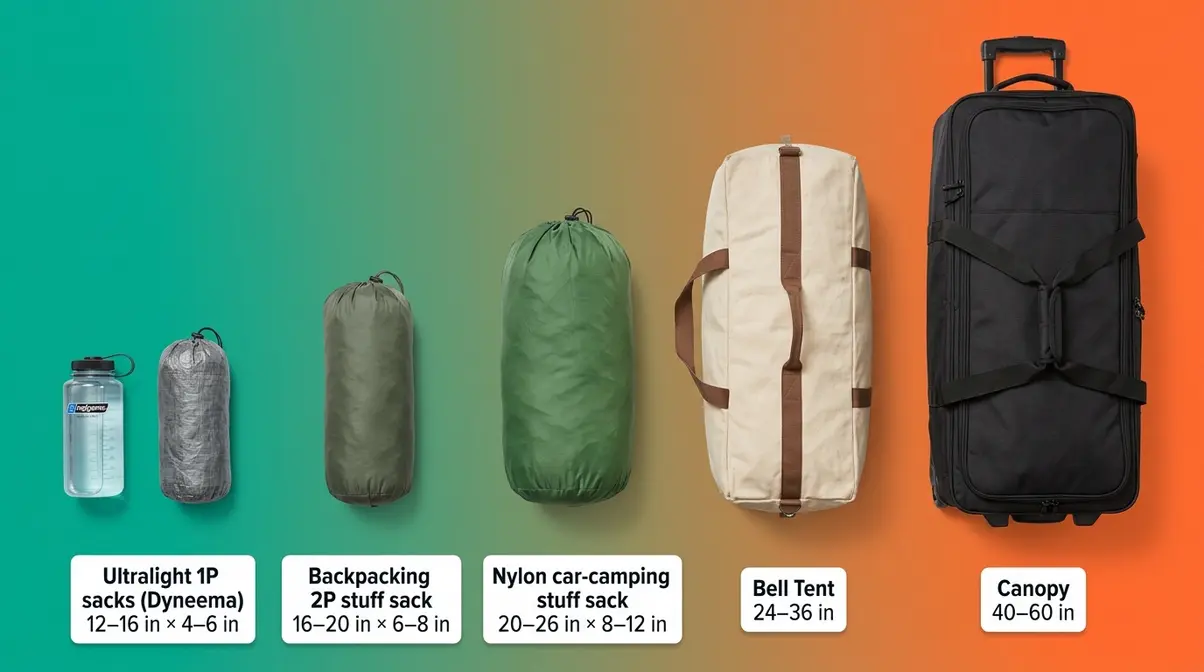
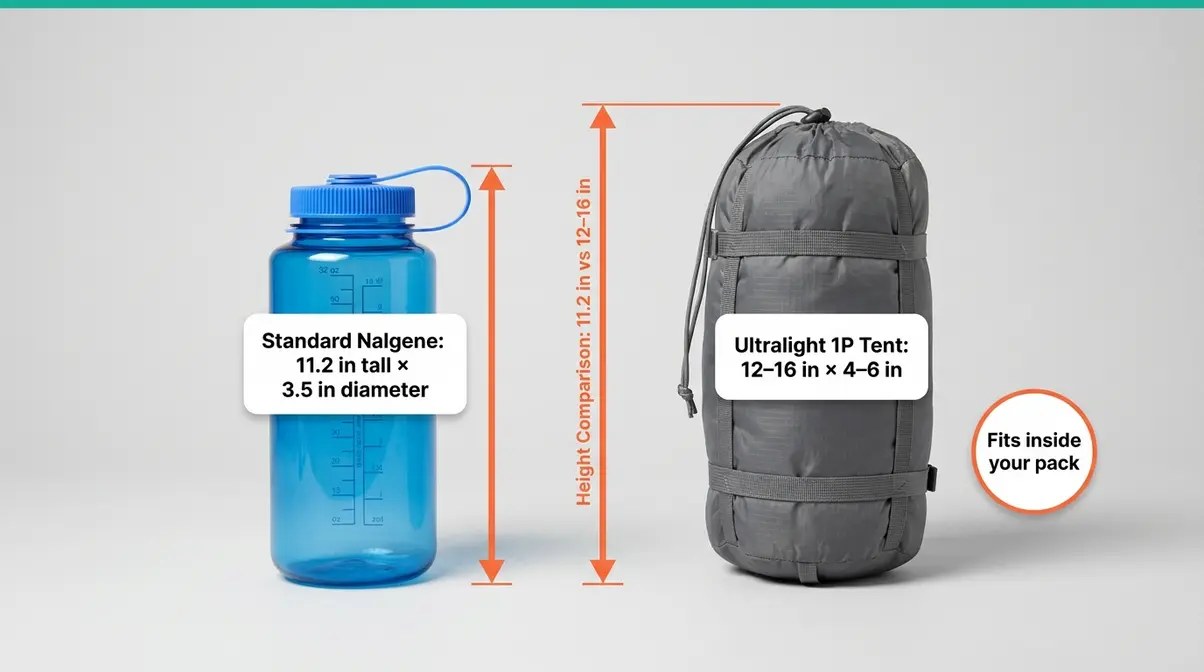
Tent packed size is the physical footprint of your tent compressed into its stuff sack — measured as length × diameter, not as a weight. An ultralight 1-person tent, for example, packs down to roughly 4–6 inches in diameter and 12–16 inches long (REI, rei.com/learn/expert-advice/backpacking-tent.html) — about the size of a large Nalgene water bottle. Why does that matter? Because if the packed length of your tent exceeds the depth of your pack’s main compartment, the tent simply won’t fit inside, no matter how light it is.
Packed Size vs. Trail Weight
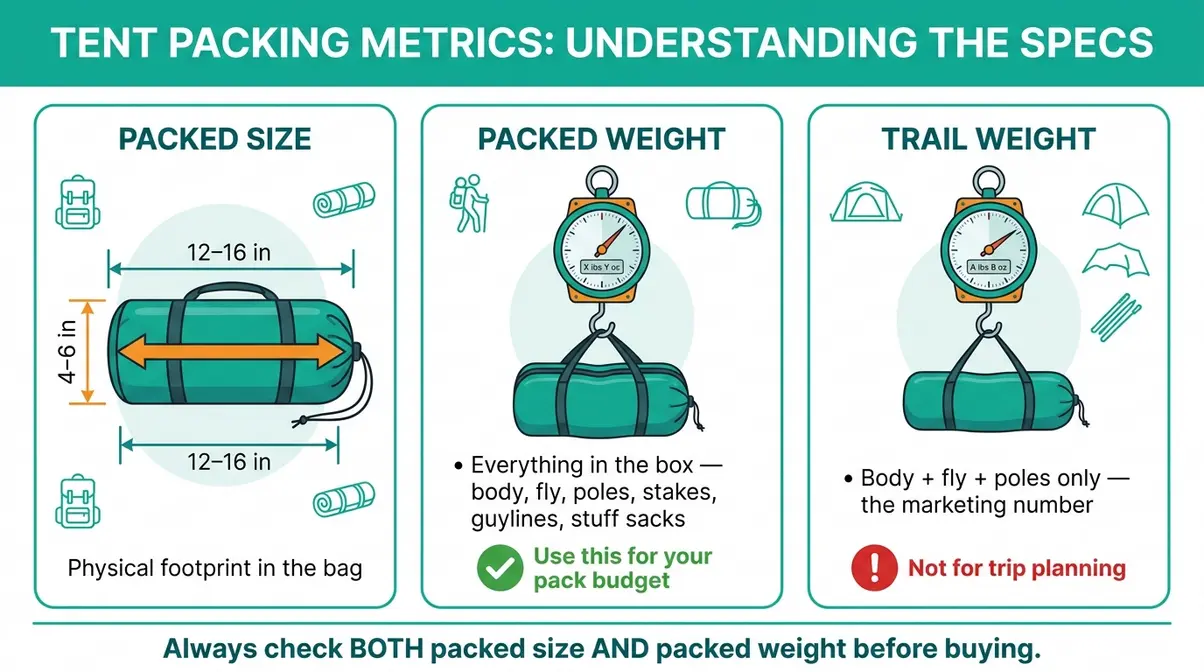
Three terms appear on nearly every tent spec sheet, and manufacturers use them inconsistently. Here’s what each actually means — and why the difference matters for your trip planning.
Packed size is the physical dimension of the compressed tent in its bag: length × diameter. This tells you whether the tent fits inside your pack or must be lashed to the outside.
Packed weight (sometimes called “packaged weight”) is the total weight of everything in the bag — tent body, rainfly, poles, stakes, guylines, and stuff sacks. According to MSR’s definition of packaged versus minimum tent weight, packaged weight includes every item shipped with the tent, following the ASTM F1934-98 standard. This is the number you feel on your back, and it’s the one you should use for trip planning. A tent advertised at “trail weight: 2 lbs 3 oz” might have a packed weight of 3 lbs 1 oz — a difference that adds up fast over miles of trail.
Trail weight (or “minimum weight”) strips things down further: body, rainfly, and poles only. Manufacturers use this figure for marketing comparisons because it’s always lighter. As SlingFin explains, trail weight is a “standardized metric for comparison” that deliberately excludes stakes, guylines, and stuff sacks — making it the most flattering number on the spec sheet, but the least useful for real-world planning.
Packed weight includes the tent body, rainfly, poles, stakes, guylines, and stuff sacks — everything in the box — while trail weight strips it down to just the essentials. Always use packed weight when calculating your total load. For a deeper breakdown, see our complete tent weight and packed size guide.
Why Packed Size Matters
Many beginners optimize only for weight — and get burned by shape. A lightweight tent with long aluminum poles can be impossible to fit vertically in a 65L pack even if the total weight is perfectly acceptable. The length of your pole bag is often the binding constraint, not the scale reading. Packed weight represents the absolute maximum your tent will weigh without aftermarket add-ons — giving backpackers realistic expectations for starting tent load.
Picture this: your pack’s main compartment is 22 inches deep. Your tent’s pole bag is 24 inches. You now have two choices — strap it to the outside (adding wind drag and snag risk on brushy trails) or shop for a tent with shorter packed dimensions. Neither is a great surprise to discover at the trailhead.
This is where The Packed-Size Sweet Spot becomes your planning framework. It’s the optimal intersection of packed length, packed diameter, and trail weight for your specific camping style. A solo backpacker’s sweet spot looks completely different from a car camper’s. The backpacker needs short and narrow; the car camper can tolerate length because the tent goes in a trunk, not a pack. Understanding which sweet spot applies to you is the first decision this tent packed size guide asks you to make. For more context on how tent size ratings interact with dimensions, read how tent capacity influences packed dimensions.
What does packed weight mean for tents?
Packed weight is the total weight of everything in the tent bag — body, rainfly, poles, stakes, guylines, and stuff sacks. It’s distinct from trail weight (body + fly + poles only) and from packed size (the physical dimensions of the compressed bundle). According to MSR, packed weight includes every accessory shipped with the tent. Always use packed weight, not trail weight, when calculating your total pack load for a trip.
Now that you know what to measure, let’s look at what those measurements actually look like across different tent types — because a backpacking tent and a car-camping tent live in completely different size universes.
Packed Size by Tent Type
Tent type is the single biggest determinant of packed size. After evaluating specifications across major retailers — REI, Hilleberg, and SlingFin — our team compiled the typical ranges below. No single source had consolidated all tent types in one place; this table fills that gap.
| Tent Type | Typical Packed Length | Typical Packed Diameter | Typical Packed Weight | Best Camping Style |
|---|---|---|---|---|
| Ultralight 1-Person | 12–16 inches | 4–6 inches | 1–2 lbs | Backpacking, thru-hiking |
| Standard 2-Person Backpacking | 16–20 inches | 6–8 inches | 3–5 lbs | Weekend backpacking |
| 3–4 Person Family/Car Camping | 20–26 inches | 8–12 inches | 8–14 lbs | Car camping, base camp |
| Bell Tent (6–16 Person) | 24–36 inches | 12–18 inches | 20–40 lbs | Glamping, drive-in camping |
| Pop-Up / Canopy (10×10 ft) | 40–60 inches (roller bag) | 8–12 inches | 15–30 lbs | Events, car camping |
These are typical ranges based on market data. Frame them as starting points, not guarantees for any single product.
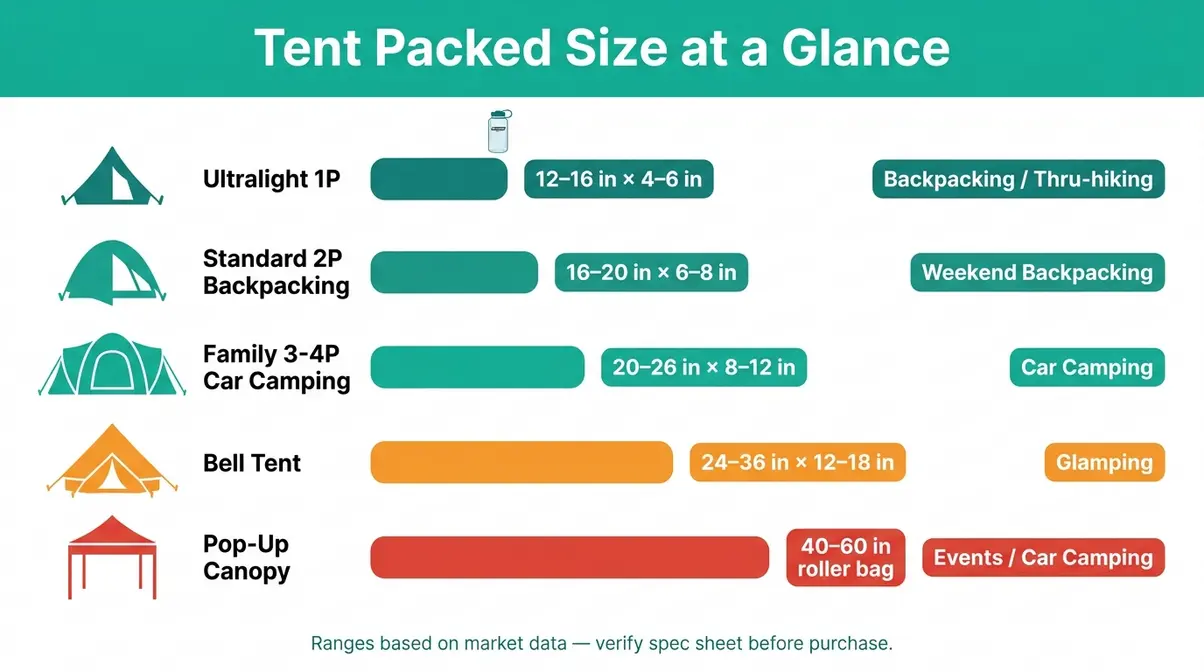
Each tent type has a different Packed-Size Sweet Spot — and the table above is your first tool for identifying yours.
Ultralight 1-Person Tents
A 1-person ultralight tent is purpose-built for one thing: disappearing into your pack. A 1-person ultralight backpacking tent packs to roughly the size of a large water bottle — 4 to 6 inches in diameter and 12 to 16 inches long (REI). Premium trekking-pole designs, like the Zpacks Plex Solo, pack even smaller — measured at 11″ × 6.5″ × 6.5″ in independent lab testing (OutdoorGearLab, 2026). That’s genuinely pocketable compared to any other shelter category.
The trade-off is livability. A 1-person tent is exactly that: one person, one sleeping pad, minimal gear. Across the backpacking community, the consistent feedback is that going up one size — a 2-person tent for solo use — dramatically improves comfort without wrecking packed dimensions.
2-Person Backpacking Tents
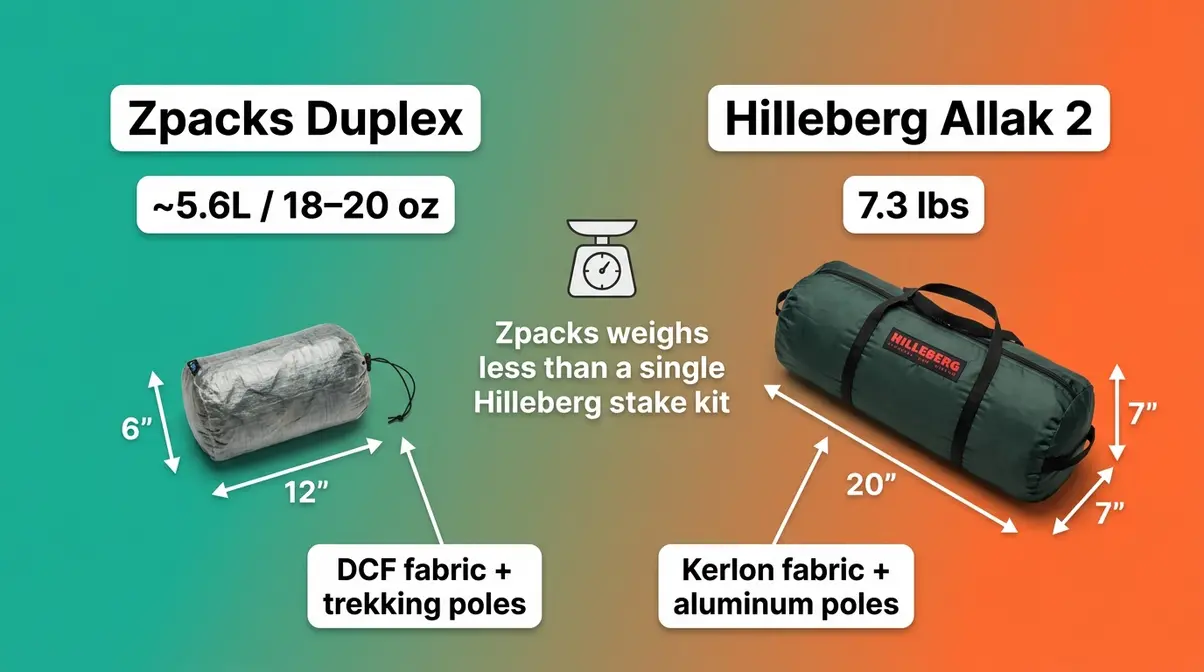
The 2-person backpacking tent is the most versatile category in the market. Freestanding designs from mainstream brands typically pack to around 19–21 inches long and 5–7 inches in diameter, with packed weights in the 3–5 lb range (OutdoorsMagic, 2026). Ultralight trekking-pole 2-person designs — like the Zpacks Duplex — pack smaller: roughly 6″ diameter × 12″ tall, or about 5.6 liters (Zpacks product page; Treeline Review, 2026).
The “sizes do run smaller” reality hits hardest here. A tent marketed as “2-person” typically fits two people with nothing else — no gear, no dog, no comfort. Common pain points reported by campers include waking up with their face against the rainfly because their sleeping bag pushed them to the tent wall. If you camp with gear or a partner who moves in their sleep, size up to a 3-person tent and enjoy the space.
3-4 Person Car Camping Tents
Car camping tents trade packed convenience for livability. A typical 3–4 person tent packs to 20–26 inches long and 8–12 inches in diameter — far too bulky for a backpack’s main compartment. The packed weight of 8–14 lbs means these tents belong in a trunk, not on a trail.
Manufacturer capacity ratings consistently overstate usable space by 20–30%. A “3-person tent” comfortably sleeps 2 adults with their gear. A “4-person tent” is a realistic 2-person family tent with room to spare. This is the #1 real-world complaint in camping forums — and the reason the VoC quote above resonates so strongly with experienced campers. Plan one size larger than your headcount suggests.
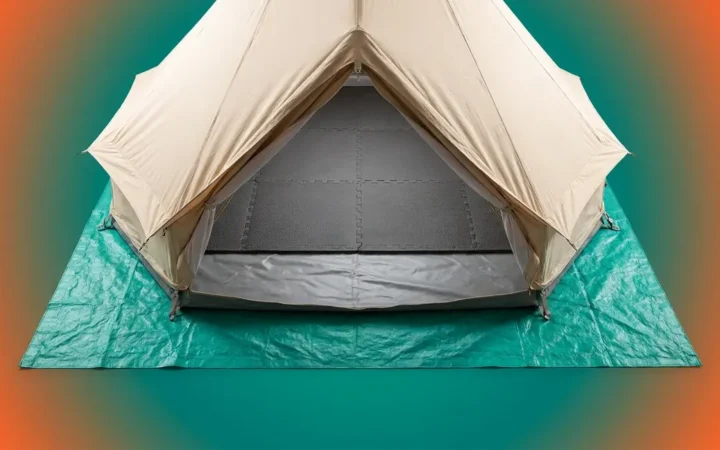
Bell Tents: Glamping Sizes
A bell tent (keyword: bell tent packed size) is a canvas or poly-canvas freestanding structure, typically ranging from 13 to 23 feet in diameter and designed for glamping or drive-in camping. The keyword “bell tent packed size” surfaces regularly in searches — and the reality is sobering. Bell tents pack to 24–36 inches in length and 12–18 inches in diameter, with packed weights of 20–40 lbs. That’s the size of a large duffel bag stuffed with camping gear.
Bell tents are car-camping-only shelters. Full stop. Their packed dimensions make backpacking physically impossible, and even car camping requires significant trunk space. If you’re drawn to the aesthetic, embrace it — but plan your transportation accordingly.
Pop-Up and Canopy Tents
Pop-up canopy tents (the 10×10 ft event-style shelters) present the most unusual packed dimensions: 40–60 inches in a roller bag, 8–12 inches in diameter. That roller bag is designed to stand upright in a truck bed or SUV cargo area, not to fit in any conventional backpack. Packed weights of 15–30 lbs reinforce the car-camping-only designation. A zippered replacement stuff sack won’t help here — these shelters need their dedicated roller bag for protection and portability.
Where the 2-person and 3-person categories reward careful dimension-shopping, pop-up canopy tents are effectively non-negotiable: you need a vehicle, and you need the dedicated bag that comes with the shelter.
Key Factors Affecting Packed Size
Knowing your tent type is step one in this tent packed size guide. Step two is understanding why two tents in the same category can pack to completely different sizes. After comparing dozens of models across major outdoor retailers, the differences consistently come down to three variables.
Tent Materials and Fabrics
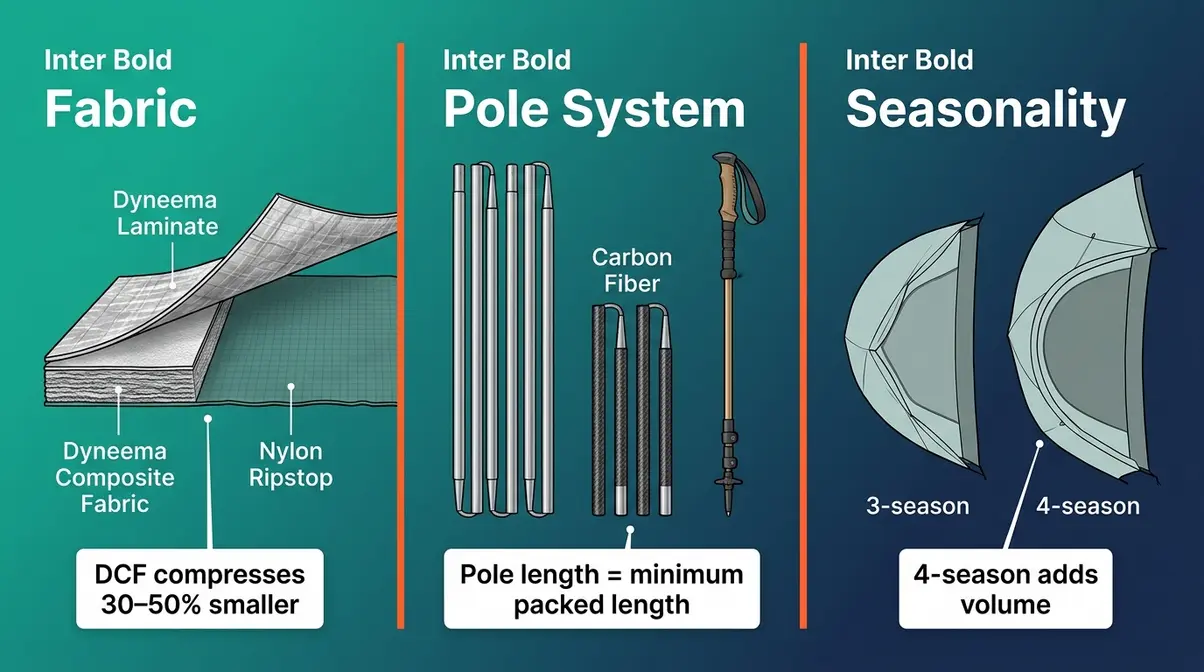
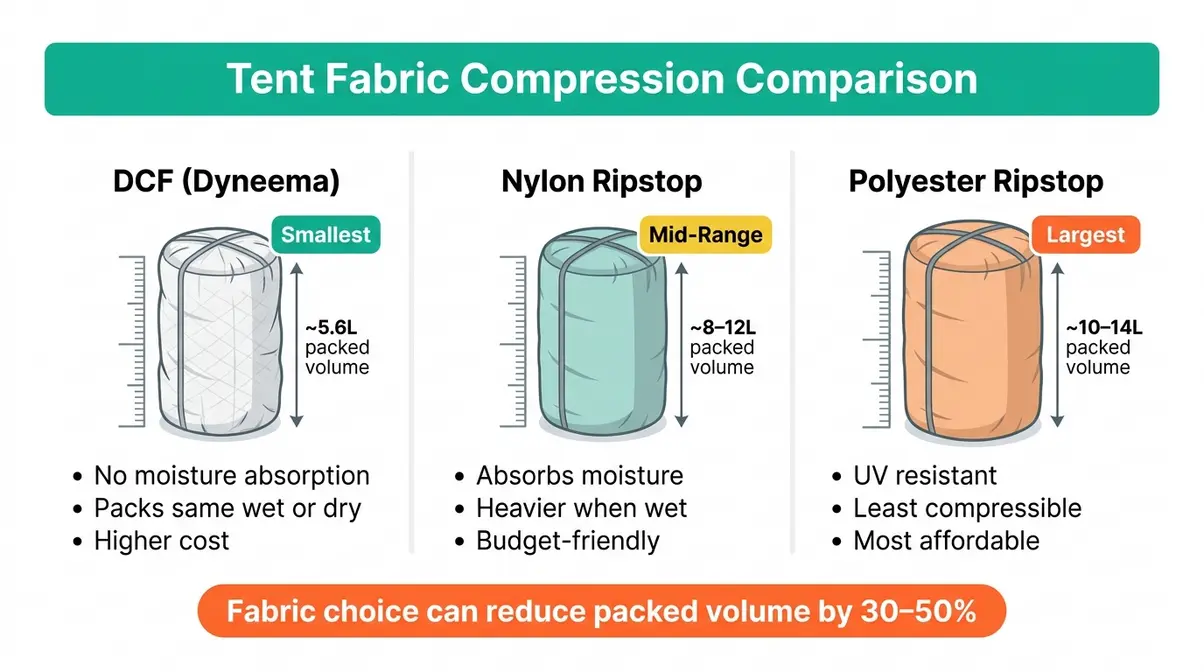
The fabric your tent is made from has an enormous impact on how small it compresses. Standard nylon and polyester ripstop — the materials in most budget and mid-range tents — pack reasonably well but have a compression floor. They won’t get much smaller no matter how hard you stuff.
Dyneema Composite Fabric (DCF, formerly Cuben Fiber) is the outlier. It’s a laminate material that packs dramatically smaller than equivalent-weight nylon and resists moisture absorption (wet nylon gains weight and resists compression). The Zpacks Duplex’s 5.6-liter packed volume is a direct result of DCF construction. The trade-off: DCF tents cost significantly more and require careful handling to avoid punctures.
Single-wall construction (one layer of fabric instead of a separate body and rainfly) also reduces packed size significantly — though it trades condensation management for compactness.
Pole System and Design
Pole design is the most underappreciated packed-size variable. Aluminum poles compress to a fixed minimum length — the length of each individual pole segment. A tent with 24-inch pole segments cannot pack shorter than 24 inches, regardless of how the fabric compresses. Carbon fiber poles use shorter segments and can reduce packed length by 2–4 inches versus equivalent aluminum designs.
Trekking-pole tents eliminate dedicated poles entirely, using your hiking poles as the support structure. This is why ultralight trekking-pole tents (Zpacks, Big Agnes Bikepack series) pack so much smaller than freestanding equivalents — the pole system is already in your hand. The constraint: you must carry trekking poles, and setup requires learning a different pitching technique.
Freestanding hub-and-clip designs are easiest to set up but generate the largest pole bundles. Geodesic and semi-geodesic designs (common in 4-season tents) use longer, crossing poles that increase packed length further.
Seasonality and Feature Count
Every feature you add to a tent adds packed volume. A 4-season tent requires heavier poles, more fabric panels, additional guyline attachment points, and a full-coverage rainfly — all of which compress less efficiently than a 3-season design. Common pain points reported by campers who over-buy on seasonality: carrying a 4-season tent on a July backpacking trip and wondering why their pack feels like a sandbag.
3-season tents hit The Packed-Size Sweet Spot for most hikers. They handle rain, wind, and mild cold without the bulk penalty of winter-rated designs. If you’re not planning expeditions above treeline in shoulder season, a 3-season tent will serve 95% of your trips at a fraction of the packed volume.
Folding vs. Stuffing Techniques
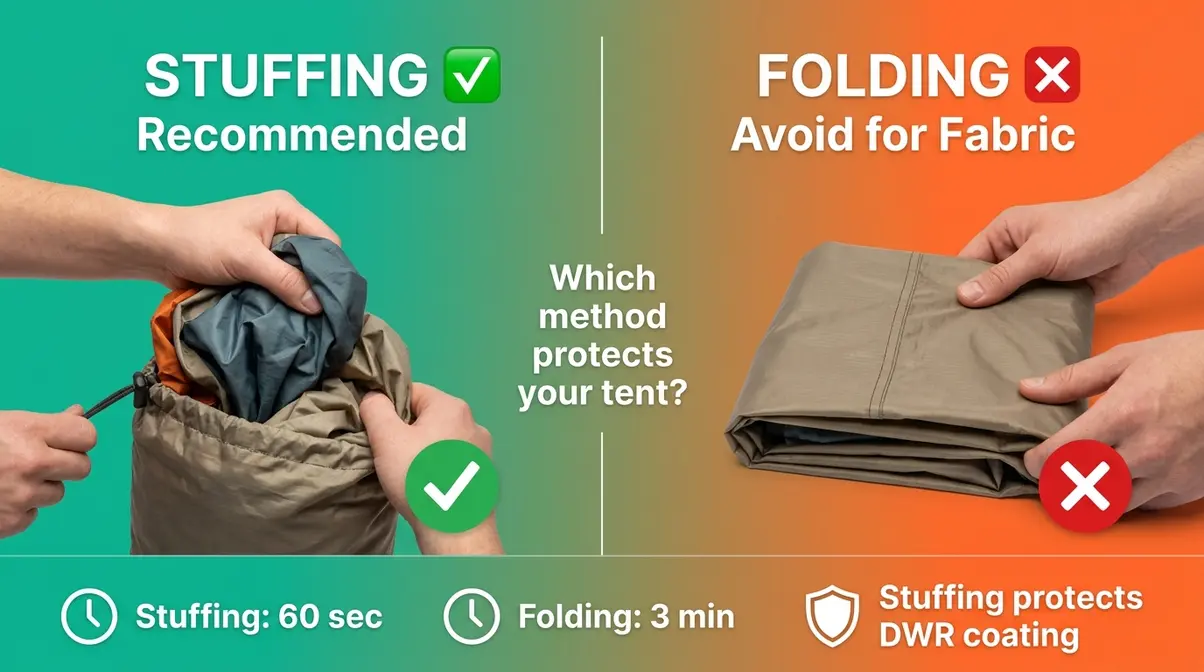
Packing technique is where most beginners leave efficiency on the table. The method you use matters almost as much as the tent you buy. After evaluating guidance from major outdoor retailers and the backpacking community, the evidence consistently points in one direction: stuffing beats folding for most tents, most of the time.
The Case for Stuffing Your Tent
Stuffing means pushing the tent material loosely into the stuff sack without folding it into a consistent shape first. This sounds counterintuitive — but it’s the correct method for most modern backpacking tents. Here’s why it works:
- Distributes stress evenly. Folding the tent the same way every time creates crease lines. Over dozens of pack-and-unpack cycles, those crease lines become stress fractures in the waterproof coating (called the DWR, or Durable Water Repellent finish). Stuffing randomizes the fold points, spreading wear across the entire fabric.
- Fills irregular pack shapes better. A stuffed tent conforms to the available space in your pack like a soft item, rather than leaving air gaps around a rigid folded block.
- Faster in the field. On a wet morning when your campsite neighbor is already three miles ahead, stuffing takes 60 seconds. Precise folding takes three minutes.
Stuffing is the correct method for most tents — it protects seams, distributes wear, and reduces volume more effectively than folding. Always stuff the tent body and rainfly separately to prevent moisture transfer between the two.
A zippered replacement stuff sack (like the Zippered Tent Bag Medium available through our Recommended Products) can make stuffing even faster by giving you a reliable closure without fighting a drawstring. If you are new to this process, check out our top 10 tent camping tips for beginners for more foundational advice.
When Folding Wins
Folding does have its place — specifically for the pole bag and for tents with delicate silnylon or DCF fabrics. Here’s when to fold instead of stuff:
- Poles always go in a dedicated sleeve. Never stuff poles loose into the tent bag. They puncture fabric and bend under compression. Roll the pole bag separately, secure it with the included velcro strap, and pack it alongside (not inside) the tent body.
- Silnylon tents benefit from loose rolling. Silnylon (silicone-coated nylon) is slippery and resists creasing naturally, but aggressive stuffing can stress the silicone coating at contact points. A loose roll along the length of the tent — not a tight fold — works better for these fabrics.
- Long-term storage only. If you’re storing your tent for more than two weeks, fold it loosely and store it uncompressed in a large mesh bag or pillowcase. Compression sacks are for the trail, not the closet. Prolonged compression degrades polyurethane waterproof coatings and weakens seam tape over time.
Protective folding rule: Keep the pole bag separate, the tent body stuffed, and the rainfly stuffed independently. That’s three separate packages — and it’s the method that extends tent life the longest.
Bikepacking Length Limits
Bikepacking and moto camping impose the strictest packed-length requirements of any camping style — and they’re the constraints most tent spec sheets fail to address. Here’s what you actually need to know:
The 30–33 cm (12–13 inch) target. Bikepacking-specific tents are engineered with pole segments of approximately 12–13 inches so they fit inside frame bags, handlebar rolls, or compact motorcycle panniers. The MSR Hubba Hubba Bikepack packs to 13″ × 6.5″ with a dedicated 12-inch pole set (Treeline Review, 2026). The Big Agnes Copper Spur UL2 Bikepack packs to 6″ × 12″ using a 12″ Shortstik Poleset designed explicitly to fit bicycle handlebars, frames, or panniers (Big Agnes product page).
The 50 cm (20 inch) wall. Standard backpacking tents with pole segments of 50+ cm are frequently cited as “excluding” many bikepacking setups (Tom’s Bike Trip, 2026). At that length, your tent goes on an external rack mount or not at all. For motorcycle panniers, the same constraint applies: aim for tents with a packed length under 14 inches for maximum flexibility, or plan to strap the tent externally on a rear rack.
Eight actionable packing guidelines for bike and moto campers:
- Measure your pannier’s internal depth before buying any tent.
- Target a packed length of ≤33 cm (13 inches) for frame bag or handlebar roll storage.
- Pack tent body in the frame bag; poles in a separate handlebar bag or pannier pocket.
- Use a compression stuff sack to reduce diameter when width is the constraint.
- Store the rainfly in a rear dry bag if length is the issue — it’s the most compressible component.
- Bikepacking-specific tents (MSR Bikepack, Big Agnes Bikepack series) are worth the premium if you ride more than you hike.
- For moto camping, a standard 3-season tent with 20-inch poles fits most large adventure panniers when packed diagonally.
- Never compress DCF tents in a stuff sack that’s smaller than the manufacturer’s recommended size — the laminate can delaminate under extreme compression.
Backpacking Rules for Packed Size
Weight rules exist because getting them wrong has real consequences: joint injury, early turnarounds, and emergency rescues. These three guidelines are the most commonly cited across the backpacking community — and each one directly informs how you should think about your tent’s packed weight and dimensions.
The 20% Rule for Pack Weight
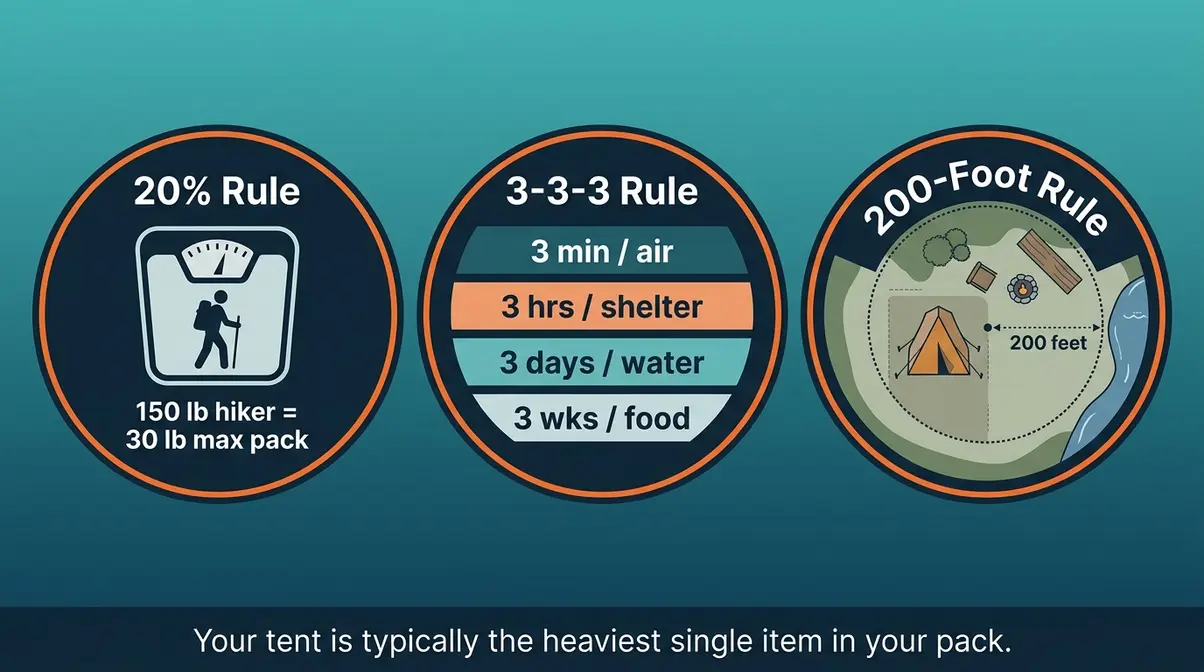
The 20% rule states that your total loaded pack weight should not exceed 20% of your body weight for multi-day backpacking trips, a benchmark supported by medical guidelines on backpack weight limits (Battlbox, battlbox.com). For a 150-pound hiker, that’s a 30-pound pack ceiling. For a 130-pound hiker, it’s 26 pounds.
This guideline is the most widely repeated rule in hiking education — and it directly connects to your tent choice. A car-camping tent weighing 12 lbs consumes 40–46% of that budget before you’ve packed food, water, or a sleeping bag. An ultralight 2-person tent at 2 lbs leaves room for everything else. The math is unforgiving, and your tent is usually the single heaviest item in your pack.
Most hikers find a realistic comfort zone between 16–25% of body weight (Daggerfish Gear). The 20% figure is a conservative target — not a physiological limit — and individual capacity varies with fitness, terrain, and trip length. Use it as a planning ceiling, not a challenge.
The 3-3-3 Rule for Safe Camping
The 3-3-3 rule is the outdoor educator’s shorthand for the survival rule of threes: you can survive approximately 3 minutes without air, 3 hours without adequate shelter in harsh conditions, 3 days without water, and 3 weeks without food.
For tent selection, the “3 hours without shelter” component is the one that matters most. In driving rain at 45°F, a wet hiker in a compromised shelter is in genuine danger within hours. This is why packed size and shelter quality are inseparable concerns — a tent that’s too bulky gets left behind, and a tent left behind is a tent that can’t protect you when conditions deteriorate. Your shelter is your first line of survival, not an optional comfort item. Understanding these limits is a core part of our tent camping safety tips.
The 200-Foot Rule and Campsite Sizing
The 200-foot rule comes from Leave No Trace (LNT) principles: set up camp at least 200 feet (approximately 70 adult paces) from water sources, trails, and other campsites to minimize environmental impact and protect water quality. This applies to tent placement, dishwashing, and waste disposal.
What does this have to do with packed size? Campsite selection. A compact, freestanding tent gives you flexibility to pitch on uneven ground, among trees, or on rocky terrain where space is limited. A large family tent requires a flat, clear area of at least 10 × 12 feet — and finding that 200 feet from a lake or trail narrows your options considerably. Smaller packed size often correlates with smaller floor footprint, which means more campsite options in Leave No Trace environments.
Ultralight Tents: Zpacks & Beyond
The ultralight tent category has redefined what “compact” means for backpackers. After reviewing current specifications and independent testing data, the gap between premium ultralight brands and standard backpacking tents is larger than most beginners realize.
What Makes Zpacks Tents So Compact?
Zpacks, an ultralight gear brand known for Dyneema Composite Fabric shelters, builds tents that pack smaller than almost any freestanding alternative. The Zpacks Hexamid Solo packed weight specifications show it at just 9.7 ounces, while the Zpacks Duplex Lite, as of 2026, is the lightest fully enclosed 2-person tent available at 14.9 oz (Adventure Alan, adventurealan.com) — lighter than some 1-person tents from conventional brands. The Zpacks Duplex — a 2-person trekking-pole tent — packs to just 6 inches in diameter × 12 inches tall (approximately 5.6 liters), described by Treeline Review (2026) as roughly “the size of three Nalgene water bottles.”
Three engineering decisions explain the compactness:
- DCF fabric. Dyneema Composite Fabric doesn’t absorb moisture and compresses to a smaller volume than equivalent-weight nylon. A wet DCF tent packs the same size as a dry one.
- Trekking-pole support. Eliminating dedicated poles removes the longest, most rigid component from the packed bundle.
- Single-wall construction. One layer of fabric instead of a separate body and fly halves the material volume.
The trade-off: Zpacks tents require trekking poles, careful site selection (no pitching on sharp rocks), and a higher upfront investment. They are not beginner tents — but they are the benchmark against which all other packed sizes should be measured.
Zpacks vs. Hilleberg Comparison
Hilleberg, a Swedish premium tent manufacturer, represents the opposite end of the spectrum: maximum durability and all-season protection at the cost of significant packed size and weight. According to Hilleberg’s official FAQ (hilleberg.com), most Hilleberg tents pack to approximately 45–50 cm (17–19 inches) in length. The Hilleberg Allak 2, for example, packs to 20″ × 7″ at a packed weight of 3.3 kg / 7.3 lbs (Explore Everything, 2026).
| Brand | Model | Packed Size | Packed Weight | Best For |
|---|---|---|---|---|
| Zpacks | Duplex (2P) | 6″ × 12″ (~5.6L) | ~18–20 oz | Ultralight thru-hiking |
| Zpacks | Duplex Lite (2P) | Similar to Duplex | 14.9 oz | Minimum weight priority |
| Hilleberg | Allak 2 (2P) | 20″ × 7″ | 7.3 lbs | All-season, expedition |
| Hilleberg | Jannu 2 (2P) | ~20″ × 7″ | 7.1 lbs | Technical alpine use |
The gap is stark: a Zpacks Duplex Lite weighs less than a single Hilleberg stake kit. Hilleberg’s Kerlon fabric and burly pole systems add weight and bulk that DCF shelters simply don’t carry — but they also survive conditions that would destroy a Zpacks tent. Choosing between them isn’t about which is better; it’s about which sweet spot fits your camping style and conditions. For three-season backpacking in moderate terrain, Zpacks wins on packed size. For expedition mountaineering or Scottish winter camping, Hilleberg earns its bulk.
What is the smallest tent pack size?
The smallest commercially available tent pack sizes belong to ultralight DCF trekking-pole shelters. The Zpacks Plex Solo packs to approximately 11″ × 6.5″ × 6.5″ (OutdoorGearLab, 2026) — smaller than a standard water bottle. The Zpacks Duplex Lite, a 2-person tent, packs to roughly 6″ × 12″ at a trail weight of just 14.9 oz (Adventure Alan, 2026). These figures represent the current ceiling of tent miniaturization using Dyneema Composite Fabric and trekking-pole support systems.
Common Packed Size Pitfalls
3 Mistakes to Avoid
Mistake 1: Trusting trail weight instead of packed weight. Trail weight is a marketing metric. Packed weight is your planning metric. A tent listed at “trail weight: 2 lbs 4 oz” can easily have a packed weight of 3 lbs 2 oz once stakes, guylines, and stuff sacks are included. Always find the packed weight before committing.
Mistake 2: Ignoring pole length. Packed volume gets most of the attention, but packed length is what determines whether your tent fits inside your pack. A tent that compresses to a narrow 5-inch diameter but has 22-inch pole segments still won’t fit in a 20-inch pack compartment. Measure your pack’s internal depth and compare it to the tent’s pole bag length — not just the stuff sack diameter.
Mistake 3: Buying capacity without checking dimensions. A “3-person tent” can pack to 20 inches or 26 inches depending on the manufacturer. Two tents with identical capacity ratings can differ by 6 inches in packed length and 4 inches in diameter. Always check the actual packed dimensions in the spec sheet, not just the person-count.
When a Bigger Tent is Right
Sometimes the right answer isn’t a smaller tent — it’s a different storage strategy or a tent category shift. If you’re car camping, a large family tent’s packed dimensions are irrelevant: it goes in the trunk. Fighting to minimize packed size for car camping wastes money on ultralight materials you don’t need.
For backpackers who genuinely need a 3-person tent for a family trip, consider splitting components between pack members: one person carries the tent body, another carries the poles and rainfly. This approach — standard practice among experienced group backpackers — eliminates the “it won’t fit” problem entirely without requiring a tent upgrade.
And if you’re a canopy or event tent owner, a dedicated Canopy Tent Roller Bag (see Recommended Products above) is the correct solution. No compression sack will help a 10×10 canopy frame — you need the purpose-built roller bag that matches your shelter’s geometry.
Tent Packed Size FAQ
What is the 20% rule for backpacking?
The 20% rule states your total loaded pack weight should not exceed 20% of your body weight on multi-day backpacking trips. A 150-pound hiker aims for a 30-pound pack ceiling. Most experienced backpackers find their comfort zone between 16–25% of body weight (Daggerfish Gear), with the 20% figure serving as a conservative planning target. Your tent is typically the heaviest single item in your pack, making it the first place to trim weight if you’re over budget.
What is the 3-3-3 rule for camping?
The 3-3-3 rule is the survival rule of threes: approximately 3 minutes without air, 3 hours without shelter in harsh conditions, 3 days without water, and 3 weeks without food. For tent selection, the “3 hours without shelter” threshold is the critical one. A tent too bulky to carry gets left behind — and a missing shelter becomes a survival emergency when temperatures drop and rain arrives. Your shelter is the highest-priority item in your pack after water.
What is the lifespan of a Zpacks tent?
A Zpacks tent lasts 3–5 years with regular use when properly maintained, though DCF fabric is more puncture-sensitive than nylon. The main lifespan variables are UV exposure (DCF degrades faster in sustained direct sunlight than nylon), storage compression (avoid storing in a stuff sack long-term), and ground contact (always use a footprint on rocky terrain). Across the backpacking community, the consistent feedback is that Zpacks tents held in a dry bag between trips and pitched on soft ground routinely exceed 500 nights of use before showing material degradation.
Pitfalls and Alternatives
Common Pitfalls
Pitfall 1: Buying “ultralight” without checking the pole bag separately. Many spec sheets list the stuff sack dimensions but omit the pole bag dimensions. On a freestanding tent, the pole bag is often 2–4 inches longer than the stuff sack — and it’s the pole bag length that determines whether the tent fits inside your pack.
Pitfall 2: Assuming compression sacks solve everything. A compression sack (a stuff sack with straps that cinch down the volume) can reduce a tent’s packed diameter by 20–30%. However, it cannot shorten the poles. If your tent’s length is the problem, a compression sack won’t fix it. Compression sacks work best for reducing the diameter of a bulky tent body — not for solving a length problem.
Pitfall 3: Storing a tent compressed for months. Polyurethane waterproof coatings and seam tape both degrade under sustained compression. Store your tent loosely in a breathable mesh bag between trips. The stuff sack is for the trail, not the closet.
When to Choose Alternatives
If your tent’s packed length consistently exceeds your pack’s main compartment, consider two alternatives before buying a new tent: (1) a top-loading pack with a longer main compartment (many 65L packs have 24-inch compartments that accommodate most standard backpacking tents), or (2) a bikepacking-specific tent with shortened pole segments if you’re constrained by pannier dimensions.
When to Seek Expert Help
If you’re planning a technical mountaineering trip, an expedition above 14,000 feet, or winter camping in sustained below-zero temperatures, the packed-size tradeoffs change fundamentally. A gear specialist at REI or an expedition outfitter can help you navigate the intersection of packed size, structural integrity, and 4-season rating in ways that general guides cannot. Don’t optimize purely for compactness when the conditions demand structural resilience.
Additional Questions
(Additional questions from the backpacking community)
What is the 200 rule for camping?
The 200-foot rule is a Leave No Trace guideline requiring you to camp, wash dishes, and dispose of waste at least 200 feet (approximately 70 adult paces) from lakes, streams, trails, and other campsites. This distance protects water quality and minimizes impact on other hikers. For tent selection, this guideline means a smaller-footprint tent gives you more viable campsite options in areas where flat, clear ground 200 feet from water is limited.
What is the lightest Zpacks tent?
The lightest Zpacks tent is the Duplex Lite at 14.9 oz (approximately 422 grams), making it the lightest fully enclosed 2-person tent that fits two full-length sleeping pads (Adventure Alan, adventurealan.com, 2026). For solo hikers, the Plex Solo Classic at 14.5 oz offers a similar weight floor in a 1-person footprint. Both use Dyneema Composite Fabric and require trekking poles for setup.
Find Your Packed-Size Sweet Spot
For most backpackers, the path forward is straightforward: a 3-season, 2-person tent with a packed length under 20 inches and a packed weight under 4 lbs hits The Packed-Size Sweet Spot for weekend and multi-day trips. Pair it with the 20% body-weight rule to set your total pack budget, and use the stuffing technique (not folding) to maximize compression on the trail.
The Packed-Size Sweet Spot isn’t a single number — it’s a framework. Ultralight thru-hikers find their sweet spot at 6″ × 12″ and 15 ounces. Weekend backpackers find it at 19″ × 6″ and 3.5 lbs. Car campers find it in a trunk, not a pack at all. The framework is the same; the numbers shift with your style.
Your next step: measure the internal depth of your pack’s main compartment. Write that number on a sticky note. Every tent you consider from now on gets checked against it before anything else. That single measurement — more than any spec sheet rating, any capacity number, or any marketing claim — will determine whether your shelter fits your adventure. This tent packed size guide has given you the framework; now check out our tent weight and packed size deep-dive to apply these principles to specific models before your next purchase.

Dave King
I'm Dave King. I publish Tent Explorer, a site built to answer the questions people actually ask before they buy.