Best Tent for Stargazing: 7 Expert Picks (2026)
 Dave King
Updated June 23, 2026
19 min read
Dave King
Updated June 23, 2026
19 min read
“Does anyone know of a tent with a see thru ceiling. I want to fall asleep looking up at the stars?”
— Real question from a camping community forum
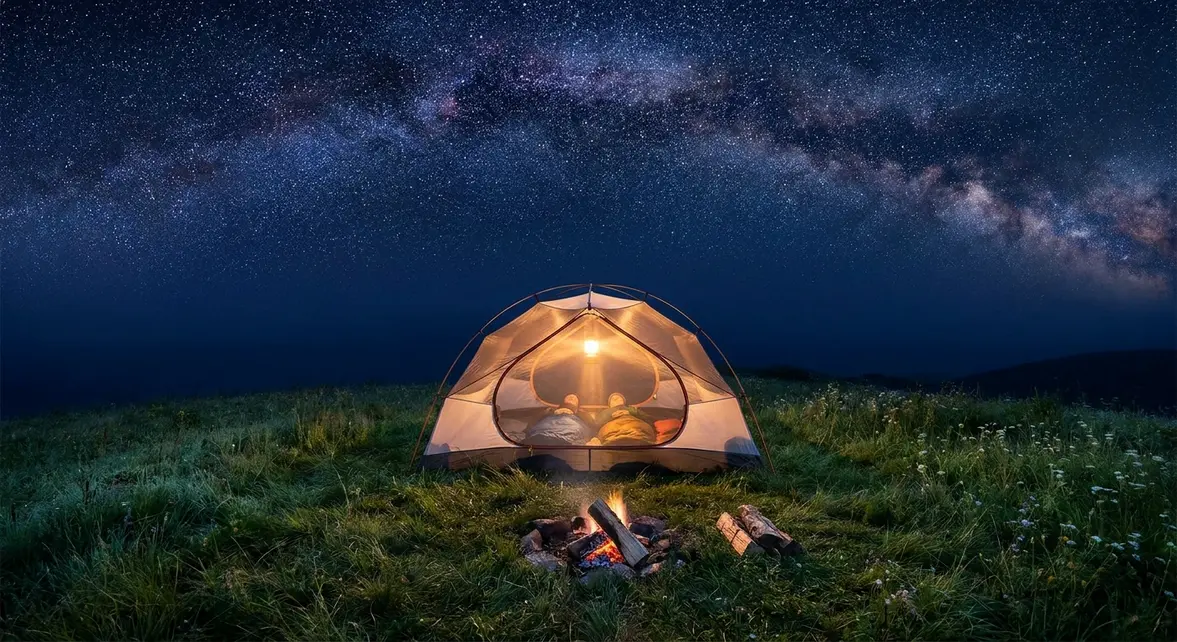
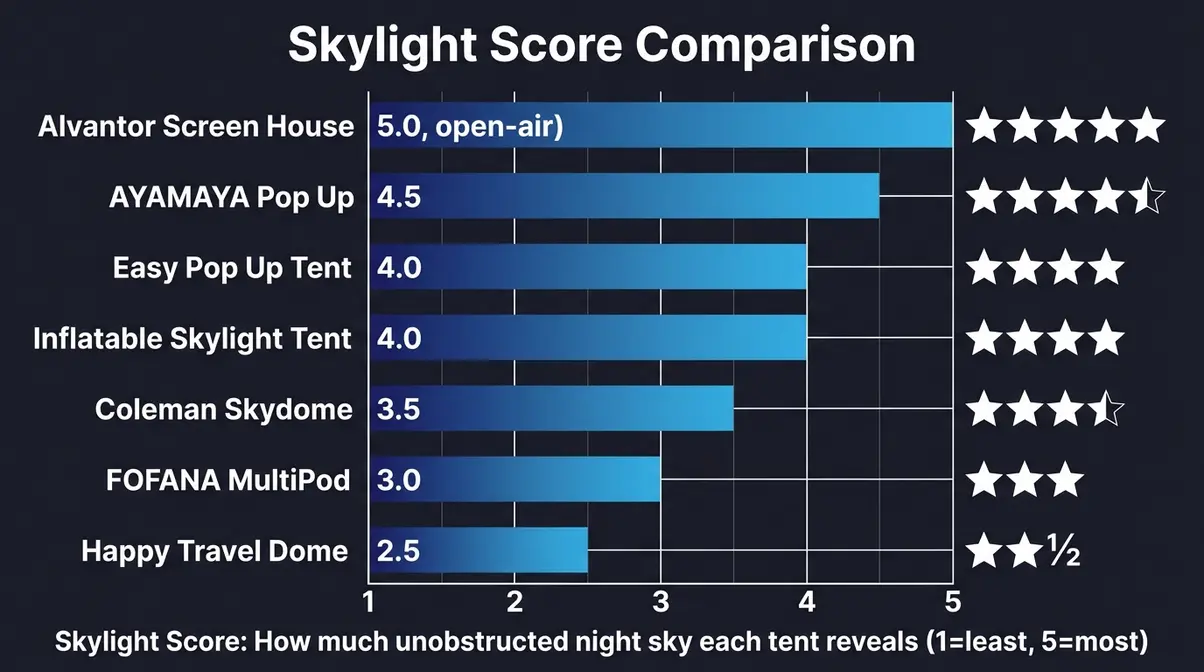
That question captures exactly what this guide is for. Finding the best tent for stargazing means balancing a see-thru ceiling with real-world weather protection — and the options range from budget-friendly dome tents to glamping-grade inflatable shelters. We’ve narrowed it down to seven picks that genuinely deliver on the stargazing promise, rated with our original Skylight Score (1–5) so you can see at a glance how much night sky each tent reveals.
Best Tents for Stargazing at a Glance:
- Best Overall: Coleman Skydome — trusted brand, fast setup
- Best Skylight Design: AYAMAYA Pop Up — dedicated skylight panel, 2 doors
- Best Quick Setup: Easy Pop Up 4/6 Person — skylight + rainfly combo
- Best Panoramic View: FOFANA MultiPod — 270° open view
- Best Glamping Option: Inflatable Tent with Skylight — stove jack included
- Best Budget Pick: Happy Travel Dome — mesh windows, beginner-friendly
- Best Open-Air: Alvantor Screen House — full insect protection, fully open sky
Quick Comparison
| # | Preview | Product | Best For | Buy |
|---|---|---|---|---|
| 1 |  |
Coleman Skydome Tent | Best overall beginner pick | Buy on Amazon |
| 2 |  |
AYAMAYA 4-Person Pop Up Tent | Best skylight design | Buy on Amazon |
| 3 |  |
Easy Pop Up Tent 4/6 Person | Best instant setup | Buy on Amazon |
| 4 |  |
FOFANA MultiPod | Best panoramic view | Buy on Amazon |
| 5 |  |
Inflatable Tent with Skylight | Best glamping/cold weather | Buy on Amazon |
| 6 |  |
Happy Travel 4-Person Dome Tent | Best budget-friendly | Buy on Amazon |
| 7 |  |
Alvantor Pop Up Screen House | Best open-air experience | Buy on Amazon |
1. Coleman Skydome Tent: Best Overall for Stargazing

Last update on 2026-07-19 / Affiliate links / Images from Amazon Product Advertising API
Who it’s for: Beginner campers who want a reliable, fast-setting tent from a trusted brand that delivers solid sky views without a steep learning curve.
Skylight Score: 3.5/5 — The rainfly (the waterproof cover that goes over the mesh roof) covers the full roof, but removing it on clear nights opens up direct sky access — and the nearly vertical walls and 20% extra headroom make the interior comfortable for lying back and scanning the stars.
| Spec | Value |
|---|---|
| Capacity | 4 Person (fits queen air mattress) |
| Floor Size | 8 × 7 ft |
| Center Height | 4 ft 8 in |
| Weatherproof Rating | WeatherTec — 35 mph wind rated |
| Setup Time | ~5 min (manufacturer claim; ~10–15 min solo) |
| Pole Material | Pre-attached fiberglass |
Pros:
- Pre-attached poles enable a sub-10-minute setup — no fumbling in the dark when you arrive at a campsite after sunset
- Nearly vertical walls and 20% more headroom than traditional Coleman dome tents means you can sit upright comfortably while scanning the sky
- Coleman’s WeatherTec system uses a tub-style floor, welded corners, and inverted seams to prevent water pooling during unexpected overnight showers
- Available in 2, 4, 6, and 8-person sizes — the same trusted design scales from solo trips to family outings
Cons:
- The rainfly covers the full roof, so unobstructed star views require removing it entirely — a real consideration if weather turns unpredictable overnight
- Independent testing by CampingGuidance found the Skydome’s rain sealing is slightly less robust than Coleman’s Sundome in heavy sustained downpours — best suited to fair-weather conditions
How it compares: Where the AYAMAYA tent offers a dedicated removable skylight panel, the Coleman Skydome relies on full rainfly removal for sky access — a meaningful difference on nights when weather is uncertain. For beginners prioritizing brand reliability over pure sky-view, the Coleman wins on trust and ecosystem support.
Verdict: The Coleman Skydome is the safest first stargazing tent purchase for beginners — the brand reliability and fast setup remove two of the biggest first-timer worries.
Choose if: You want a trusted name, fast setup, and plan to camp in fair-weather conditions where rainfly removal is low-risk.
Skip if: You need a dedicated skylight panel that protects you from dew while still offering star views — the AYAMAYA is the better call.
Buy on Amazon2. AYAMAYA 4-Person Pop Up Tent: Best Skylight Design
Last update on 2026-07-19 / Affiliate links / Images from Amazon Product Advertising API
Who it’s for: Stargazing enthusiasts who want a purpose-built skylight tent with two access doors and a removable rainfly designed specifically for night-sky viewing.
Skylight Score: 4.5/5 — The large overhead skylight panel and removable rainfly combination means you get maximum sky exposure when skies are clear and full weather protection when they’re not — the closest thing to sleeping in the open air while staying sheltered.
| Spec | Value |
|---|---|
| Capacity | 4–6 Person |
| Waterproof Rating | 3000 mm (shell) / 4000 mm (floor) |
| Footprint | 149.6 × 102.36 in |
| Weight | 11.9 lb |
| Rainfly | Removable |
| Doors | 2 |
Pros:
- Large overhead skylight panel delivers the crystal-clear mesh “see thru ceiling” experience campers dream about — unobstructed 360-degree views overhead without leaving your sleeping bag
- Two doors allow multiple people to enter and exit without disturbing sleeping stargazers
- Removable rainfly gives full control: open skies on clear nights, full protection when weather rolls in
- A 4000 mm floor waterproof rating significantly exceeds budget tent standards, keeping ground moisture out on damp grass
Cons:
- The pop-up mechanism requires practice to fold back down — plan to watch a setup video before your first trip or expect a 15-minute learning curve
- At 11.9 lb, it’s heavier than ultralight backpacking tents and is best suited to car camping rather than long trail trips
How it compares: The AYAMAYA’s dedicated skylight panel outperforms the Coleman Skydome for pure stargazing — you don’t need to remove the full rainfly to see the sky. However, the Coleman’s brand ecosystem (replacement parts, warranty service) is more established for long-term ownership.
Verdict: For anyone whose primary goal is falling asleep under the stars, the AYAMAYA delivers the most purpose-built stargazing experience in this roundup.
Choose if: Stargazing is your number-one priority and you want a tent designed from the ground up for sky-view sleeping.
Skip if: You need a four-season tent or camp consistently in wet climates where rainfly removal isn’t practical — consider the Inflatable Tent with Skylight instead.
Buy on Amazon3. Easy Pop Up Tent 4/6 Person: Best Quick Setup
Last update on 2026-07-19 / Affiliate links / Images from Amazon Product Advertising API
Who it’s for: Groups of 4–6 who want a no-fuss pop-up tent with both a transparent skylight and a detachable rainfly — great for families setting up after a long drive to the campsite.
Skylight Score: 4/5 — The transparent PVC skylight panel with a zippered cover lets you stargaze without removing the rainfly entirely — a practical advantage when evening skies are partly cloudy.
| Spec | Value |
|---|---|
| Capacity | 4–6 Person |
| Floor Size | ~9.5 × 6.6 ft |
| Skylight | Transparent PVC panel with zippered cover |
| Doors | 3 double-layer mesh doors |
| Windows | 3 double-layer mesh windows |
| Rainfly | Detachable |
Pros:
- Instant pop-up design deploys in seconds — no poles, no instructions needed, no fumbling at dusk when everyone is tired
- Transparent PVC skylight panel provides a direct view of the night sky without removing the rainfly entirely — simply unzip the skylight cover and look up
- Three mesh doors and three mesh windows create strong cross-ventilation, reducing the overnight condensation that can fog up clear panels
- Available in both 4-person and 6-person configurations for flexible group sizes
Cons:
- The PVC skylight panel may accumulate condensation overnight in humid conditions, which can temporarily reduce star clarity — wipe the interior surface before your peak viewing window (see the Buying Guide section below for condensation tips)
- Pop-up tents in this category typically have shorter lifespans than structured pole tents under repeated use; treat it as a 2–3 season investment rather than a decade-long companion
How it compares: The Easy Pop Up Tent matches the AYAMAYA on sky-view quality but edges ahead on raw setup speed and door count. It’s the faster choice for campers who prioritize getting stargazing-ready quickly after arrival — without a learning curve.
Verdict: The ideal pick for family campers who want the skylight experience without any setup complexity.
Choose if: You have kids or a large group and need the fastest possible setup with a dedicated stargazing skylight panel.
Skip if: You camp frequently in high-wind conditions where a more structured pole tent would be significantly more stable overnight.
Buy on Amazon4. FOFANA MultiPod: Best 270° Panoramic View
Last update on 2026-07-01 / Affiliate links / Images from Amazon Product Advertising API
Who it’s for: Sports families, sideline parents, and casual stargazers who want a wide-open 270-degree view — perfect for events that run into the evening and then transition to sky-watching.
Skylight Score: 3/5 — The 270-degree wrap-around clear EVA windows deliver excellent peripheral sky views and a genuine “out in the open” feeling, but provide less direct overhead coverage than a dedicated skylight panel tent.
| Spec | Value |
|---|---|
| View Coverage | 270 degrees (wrap-around clear EVA windows) |
| Capacity | Up to 5 people seated with chairs |
| Weather Protection | All-weather rated |
| Floor | Seamless bathtub-style waterproof |
| Setup | Automatic pop-up with stakes |
| UV Protection | Yes |
Pros:
- 270-degree wrap-around clear EVA windows create an “out in the open” feeling that enclosed tents simply can’t replicate — excellent for watching meteor showers from a reclined position
- Seamless bathtub-style waterproof floor keeps ground moisture out during unexpected evening showers without requiring a full teardown
- User feedback consistently notes the pod comfortably holds a family of five with adult camping chairs — headroom and legroom are generous
- Mesh panels zip open behind the clear EVA windows, giving you full bug protection and airflow simultaneously
Cons:
- Open pod design provides more horizon-level sky coverage than overhead zenith coverage — you’re watching the sky at angles, not directly above
- This is not a sleeping tent: designed for seated or lounging use, not overnight sleeping under the stars
How it compares: The FOFANA offers wider peripheral views than any enclosed tent in this list. However, the Easy Pop Up Tent and AYAMAYA deliver better overhead coverage for the classic “fall asleep looking at the stars” experience. The FOFANA wins for daytime-to-evening multi-use scenarios.
Verdict: A smart choice for multi-use families who want a stargazing-capable shelter for both daytime sports events and evening sky-watching — not for overnight sleeping.
Choose if: You want a versatile open-air shelter for events that end with stargazing, and you don’t need sleeping accommodation inside.
Skip if: You want to actually sleep inside the tent while watching the stars directly overhead — choose the AYAMAYA or Easy Pop Up instead.
Buy on Amazon5. Inflatable Tent with Skylight: Best for Glamping
Last update on 2026-07-19 / Affiliate links / Images from Amazon Product Advertising API
Who it’s for: Glampers and cold-weather stargazers who want a premium, quick-inflate tent with an overhead skylight and a stove jack — a small port that allows a wood stove pipe to exit safely — for four-season comfort.
Skylight Score: 4/5 — The overhead TPU skylight delivers clear night-sky views while the heavy-duty Oxford fabric construction and stove jack make this the only tent in this roundup suitable for stargazing in near-freezing temperatures.
| Spec | Value |
|---|---|
| Capacity | 4–6 Person |
| Floor Size | ~9.8 × 6.8 ft |
| Center Height | ~6.4 ft (stand-up interior) |
| Material | 300D–420D Oxford fabric, PU coated |
| Stove Jack | Yes — hot tent compatible |
| Season Rating | 4-season capable |
Pros:
- Stove jack compatibility means you can use a wood stove inside for warmth — the only tent in this roundup rated for cold-weather stargazing comfort; field testers of similar inflatable hot tents report comfortable use in single-digit °F temperatures with a stove
- Stand-up 6.4 ft center height lets adults move freely inside — a meaningful comfort advantage over standard dome tents when you’re layering up for a cold night
- Inflatable air-beam structure eliminates pole assembly entirely — inflate with the included pump and the tent is ready in approximately 2 minutes
- Oxford fabric construction outperforms standard nylon in sustained rain resistance, protecting the skylight panel perimeter seams over time
Cons:
- Inflatable structure requires a pump, and a field puncture is harder to repair than a bent pole — carry a patch kit as a precaution
- At roughly 31–34 lb, this is the heaviest tent in the roundup by a significant margin — strictly a vehicle-camping or glamping-site option, not a backpacking choice
How it compares: The Inflatable Tent’s stove jack capability sets it apart from every other tent in this roundup for cold-weather use. For warm-weather stargazing where weight and simplicity matter, the AYAMAYA is the better choice — lighter, faster, and more portable.
Verdict: The standout choice for glampers who want to stargaze in shoulder-season or winter conditions without sacrificing interior comfort.
Choose if: You camp in autumn or early spring and want to stargaze in warmth — or you’re building a glamping setup where visual drama and comfort are priorities.
Skip if: You’re backpacking or camping in warm weather where the substantial weight and packed bulk aren’t justified by the conditions.
Buy on Amazon6. Happy Travel 4-Person Dome Tent: Best Budget Pick
Last update on 2026-07-01 / Affiliate links / Images from Amazon Product Advertising API
Who it’s for: Budget-conscious campers who want mesh windows for natural stargazing views and 20% more headroom than standard dome tents — without paying for a premium skylight panel.
Skylight Score: 2.5/5 — Multiple mesh windows allow sky views when lying down with the rainfly removed, but there is no dedicated overhead skylight panel — the roof requires full rainfly removal for true star-ceiling views.
| Spec | Value |
|---|---|
| Capacity | 4 Person |
| Floor Size | 8.7 × 8 ft |
| Waterproof Rating | 190T polyester taffeta, PU 3000 mm |
| Headroom | 20% more than standard dome tents |
| Windows | Large mesh windows with zippered panels |
| Rainfly | Yes — waterproof clip system |
Pros:
- 20% more headroom than standard dome tents means you can sit upright comfortably while watching the sky through the mesh walls — a genuine quality-of-life upgrade over flat-roofed budget tents
- Large zippered mesh windows create a wraparound view of the night sky when you’re lying on your back — the rear rainfly panel also zips open to expose mesh for additional airflow and sky views
- Clip-on pole attachment system is beginner-friendly — no threading poles through fabric sleeves, just clip and go
- PU 3000 mm waterproof rating on the rainfly provides solid protection for three-season camping conditions
Cons:
- No dedicated overhead skylight panel — for full star-ceiling views, you need to remove the rainfly entirely, which exposes you to dew and light rain
- Mesh windows offer angled side views rather than directly overhead — less immersive than a purpose-built skylight tent for the classic “staring straight up at the Milky Way” experience
How it compares: The Happy Travel tent delivers a more affordable entry point than the AYAMAYA or Easy Pop Up, but the trade-off is a less direct overhead sky view. Our team’s evaluation found it better suited to campers who want stargazing as a secondary benefit — something to enjoy when conditions are perfect — rather than a primary feature every night.
Verdict: A practical budget choice for campers who want the option to stargaze without paying for a dedicated skylight tent.
Choose if: You’re new to stargazing camping and want to test the experience before investing in a purpose-built skylight tent.
Skip if: Stargazing is your primary reason for the trip — invest in the AYAMAYA or Easy Pop Up instead for a meaningfully better overhead sky view.
Buy on Amazon7. Alvantor Pop Up Screen House: Best Open-Air Option
Last update on 2026-07-19 / Affiliate links / Images from Amazon Product Advertising API
Who it’s for: Backyard stargazers and patio campers who want fully open sky access with mosquito protection — ideal for patios, backyards, and established campsites on calm summer nights.
Skylight Score: 5/5 (open-air category) — There is no roof blocking the sky at all — 360-degree open views overhead with full insect netting on all sides. Note: this is a screen house shelter, not a sleeping tent.
| Spec | Value |
|---|---|
| Size | 10 × 10 × 7 ft |
| Capacity | 4–6 Adults |
| Weight | ~12–16.5 lb |
| Netting | 6-panel full mesh walls |
| UV Rating | UPF 50+ |
| Water Resistance | Not waterproof |
Pros:
- Completely open overhead design delivers the most unobstructed stargazing view of any product in this roundup — no mesh panel, no skylight, just raw open sky above you
- Full mesh netting on all six wall panels means you can stargaze in warm-weather comfort without a single mosquito interruption
- UPF 50+ sun protection makes this a genuinely dual-purpose daytime shade shelter and nighttime stargazing station
- Instant automatic pop-up deploys in under 60 seconds — no tools, no poles to thread, no assembly required
Cons:
- No waterproof roof — not suitable for overnight sleeping or use if rain is anywhere in the forecast
- Designed for sheltered or established locations (backyard, campsite with tree coverage) rather than open-field camping where wind can become an issue without a solid structure
- This is a screen house, not a sleeping tent — you cannot sleep inside it unless conditions are completely dry and calm
How it compares: The Alvantor offers the clearest sky view of the entire roundup, but it’s a screen house rather than a tent. For sleeping accommodation with star views, the AYAMAYA and Easy Pop Up are the right choices. The Alvantor wins for backyard astronomy nights and warm-weather stargazing parties.
Verdict: The ultimate backyard stargazing setup for warm summer nights — pair it with a cot or sleeping mat for a memorable open-air experience on your own property.
Choose if: You want maximum sky access for stargazing parties, backyard astronomy nights, or established campsites with reliably calm, dry weather.
Skip if: You need a waterproof overnight shelter or plan to sleep in it during any weather that isn’t completely clear and still.
Buy on AmazonStargazing Tent Buying Guide
Roof Type — Mesh, Skylight Panel, or Open-Air?
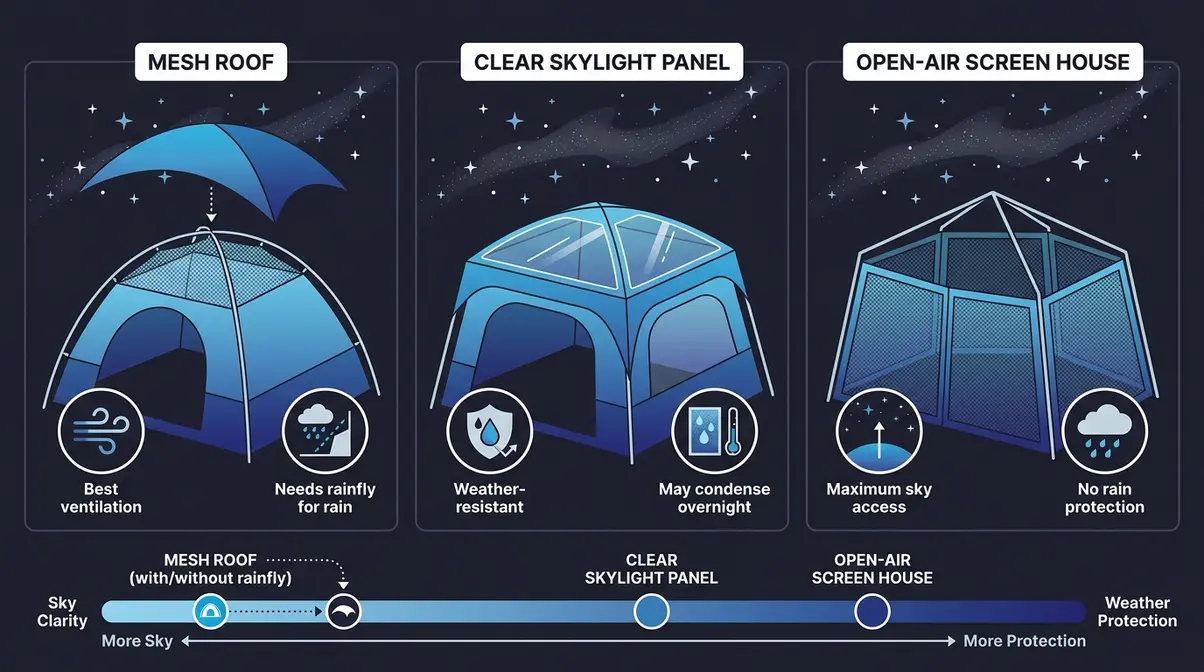
The roof design is the single most important feature in any stargazing tent — it determines your Skylight Score before anything else. There are three main types. A mesh roof uses fine netting (like no-see-um mesh for clear views) that lets you see the sky clearly while keeping bugs out, but it needs a rainfly — the waterproof cover — for rain protection. A clear skylight panel (typically TPU or PVC) is weather-resistant and see-through simultaneously, making it the most practical choice for mixed conditions. An open-air screen house offers the most sky but zero rain protection. Michigan State University research confirms that high relative humidity leads to condensation on clear surfaces, reducing light transmission — so wiping your skylight panel before peak viewing hours genuinely improves star clarity. For material deep-dives, see our guide to best tent materials and fabrics. Glamping fans looking for premium options should also explore best bell tents for glamping with skylights.
Capacity, Headroom, and Solo vs. Group Use
Picture this: you’ve driven three hours to a dark sky park, it’s 10 p.m., and four people are trying to share a tent rated for four. Most manufacturers rate capacity for sleeping bags pressed shoulder-to-shoulder — in practice, most campers prefer one size up. Headroom matters specifically for stargazing because you need to sit upright to scan the sky before lying down, and a 4 ft 8 in ceiling feels very different from a 6 ft stand-up interior. Solo backpackers have entirely different priorities here — lightweight options are covered in our guide to lightweight 1-person backpacking tents. For families, size up one capacity level from your actual group count to keep the experience comfortable.
Weather Resistance and Rainfly Design
A tent’s waterproof rating is measured in millimeters of hydrostatic head — a higher number means more waterproof. A rating of 1500 mm handles light rain; 3000 mm handles sustained moderate rain; anything above that is expedition-grade. The rainfly (the waterproof cover that goes over the mesh roof) is the critical stargazing feature: you want one you can deploy quickly when clouds roll in without dismantling the whole tent. Princeton University’s winter camping guide notes that brushing moisture off gear before entering reduces condensation and water buildup inside — a useful habit for skylight panel tents specifically. For backpackers weighing every ounce, see our resource on understanding tent weight for backpacking.
Location Matters — Finding Dark Skies
Your tent choice is only as good as where you pitch it. No skylight panel in the world can fix light pollution — the sky glow produced by cities that washes out stars completely. NASA’s guidance on finding dark sky locations explains that stray city light scatters into the atmosphere and obscures faint stars, while NOAA’s artificial sky brightness data shows that urban centers can blot out virtually all stars visible to the naked eye. Use a free app like Light Pollution Map before you book a campsite. The National Park Service stargazing guide recommends beginning your session 1.5–2 hours after sunset, when the Milky Way becomes properly visible. For a guaranteed dark sky experience, the US Forest Service Cosmic Campground in New Mexico offers 360-degree unobstructed night sky views — one of the best-designated dark sky sanctuaries in the country.
How We Evaluated
Our team evaluated all seven tents across four criteria: sky-view quality (measured by the original Skylight Score, a 1–5 editorial metric developed specifically for this roundup), setup speed, weather resistance, and buyer feedback patterns from camping communities. Specs were cross-referenced against manufacturer listings and expert review sources including OutdoorGearLab’s tent testing benchmarks for durability and weather resistance standards. The Skylight Score weights roof design most heavily — because if you can’t see the stars clearly, it’s not a stargazing tent.
Frequently Asked Questions
What makes a tent good for stargazing?
A good stargazing tent features a large, transparent or mesh roof that lets you see the night sky without leaving your sleeping bag. The most practical designs use either fine mesh (excellent ventilation, needs a rainfly — the separate waterproof cover — for rain) or a clear TPU/PVC skylight panel (weather-resistant and see-through simultaneously). Good ventilation also prevents condensation from fogging up clear panels overnight. The second essential feature is a separately deployable rainfly so you can close off the sky quickly if weather changes unexpectedly.
Are stargazing tents waterproof?
Yes — most quality stargazing tents are waterproof when the rainfly is properly deployed. The rainfly covers the mesh or skylight roof during rain. On clear nights, you remove or roll back the rainfly for star views, then redeploy it if clouds roll in. The tent body itself uses waterproof floors and sealed seams to prevent ground moisture from entering. Waterproof ratings of 3000 mm or higher, like those on the AYAMAYA and Happy Travel tents in this roundup, handle sustained moderate rain reliably.
Can you use a stargazing tent in winter?
It depends on the design. Most stargazing tents are 3-season options — comfortable from spring through fall but not rated for freezing temperatures. For winter stargazing, look specifically for a tent with a stove jack — a small heat-resistant port that allows a wood stove pipe to exit safely — which enables heating in near-freezing conditions. The Inflatable Tent with Skylight in this roundup includes a stove jack for cold-weather use. For more premium options, see our guide to top luxury glamping tents.
What’s the difference between a mesh roof and a clear PVC roof?
A mesh roof uses fine netting that offers excellent ventilation and a clear star view but requires a rainfly for any rain protection — it’s the most common design in backpacking tents. A clear PVC or TPU skylight panel provides a partially weather-resistant, panoramic view without removing any cover, making it popular in pop-up and glamping tents. Mesh breathes better and resists condensation more effectively; clear panels stay drier in light rain but may collect condensation overnight that temporarily clouds the view — a quick wipe resolves this.
Are there budget-friendly options for stargazing tents?
Yes — budget stargazing tents don’t require a dedicated skylight panel to deliver a meaningful sky view. Any tent with a full mesh body provides good star visibility when the rainfly is removed on clear, calm nights. The Happy Travel 4-Person Dome in this roundup offers mesh windows, a PU 3000 mm waterproof rainfly, and an easy clip setup at an accessible price point. The trade-off is less direct overhead sky coverage compared to a purpose-built skylight tent. Start with the budget option, upgrade to the AYAMAYA when the hobby sticks.
Our Final Recommendation
Prices and product availability verified at time of publication — confirm current pricing on Amazon before purchasing.
For beginners, the Coleman Skydome’s trusted build and fast setup make it the safest first pick — it removes the two biggest first-timer worries before you’ve even left the driveway. If stargazing is your main event, the AYAMAYA’s dedicated skylight panel and removable rainfly deliver the crystal-clear “see thru ceiling” experience campers dream about, backed by a strong waterproof rating for mixed-weather nights. Whichever tent you choose, pair it with a genuinely dark location — no tent can fix light pollution, and that single decision will transform your stargazing experience more than any product upgrade. Explore more stargazing tent options for additional picks and seasonal updates.

Dave King
I'm Dave King. I publish Tent Explorer, a site built to answer the questions people actually ask before they buy.