Best Budget Backpacking Tent: 8 Picks Tested for 2026
 David King
Updated June 28, 2026
26 min read
David King
Updated June 28, 2026
26 min read
Finding the best budget backpacking tent means navigating a sea of specs, price tags, and conflicting Reddit advice — and one wrong choice leaves you soaked at 2am. We cut through the noise and compared 8 Amazon-available tents on weight, weather resistance, and real-world value so you can hit the trail confident in your shelter. Every pick is evaluated against The Weight-Value Sweet Spot — the idea that the best tent isn’t the cheapest or the lightest, but the one with the optimal weight-to-price ratio for your specific trip.
| # | Preview | Product | Best For | Buy |
|---|---|---|---|---|
| 1 |  |
Kelty Grand Mesa 2P | Best Overall 2-Person | Buy on Amazon |
| 2 |  |
Naturehike Cloud Up 1P | Best Solo Ultralight | Buy on Amazon |
| 3 |  |
Forceatt 2/3P | Best All-Weather | Buy on Amazon |
| 4 |  |
CANTUO 2/3P 4-Season | Best 4-Season Value | Buy on Amazon |
| 5 |  |
Hyke & Byke Zion 1P | Best Ultralight Budget | Buy on Amazon |
| 6 |  |
Night Cat Upgraded 1–2P | Best Easy Setup | Buy on Amazon |
| 7 |  |
Night Cat Original 1–2P | Best Ultra-Budget | Buy on Amazon |
| 8 |  |
JELUCAMP Dome | Best Group Option | Buy on Amazon |
1. Kelty Grand Mesa 2P: Best Overall
Last update on 2026-07-19 / Affiliate links / Images from Amazon Product Advertising API
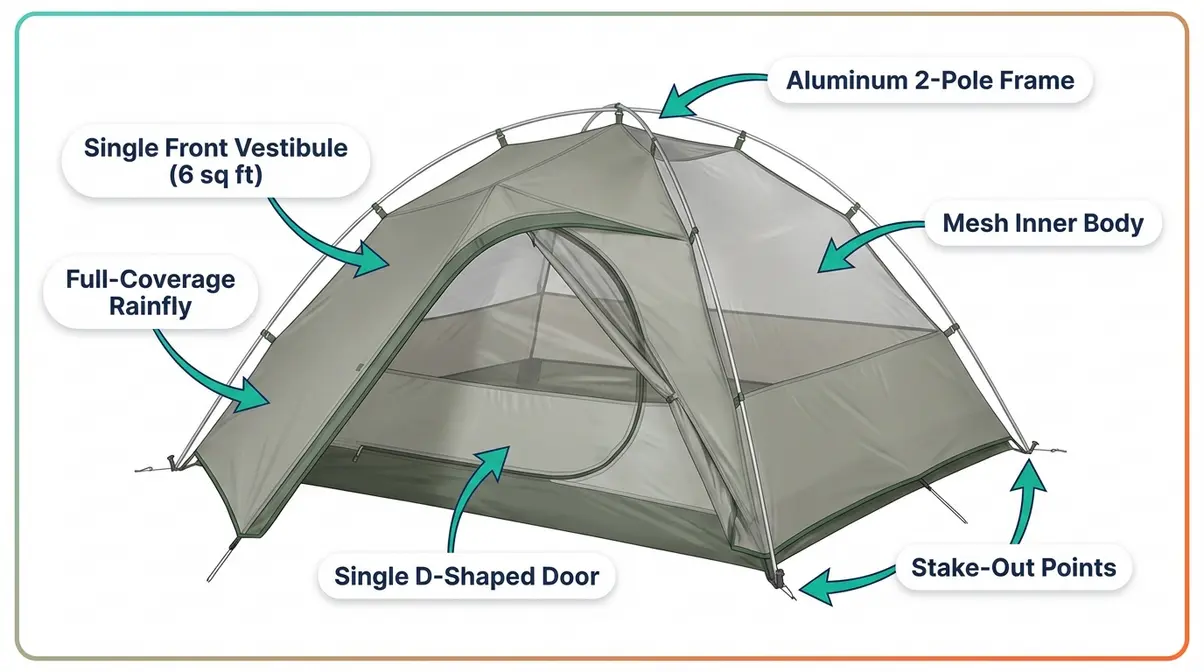
The Kelty Grand Mesa 2P is the tent a trusted friend points you toward when you ask, “What’s the most reliable option that won’t empty my wallet?” Kelty has been making outdoor gear since 1952, and the Grand Mesa is the brand’s no-nonsense answer to the beginner backpacker question. It uses aluminum poles (stronger and more durable than fiberglass), a full-coverage rainfly, and a single front vestibule (a covered porch area outside the door for storing your boots and pack). For anyone planning their first 3-season weekend trip, this is the tent that earns its place as the best budget backpacking tent in our best budget backpacking tent guide.
| Spec | Value |
|---|---|
| Capacity | 2 persons |
| Floor size | 30 sq ft (85 × 57 in at head) |
| Peak height | 43 in (109 cm) |
| Setup time | ~5 minutes (2-pole dome) |
| Material | Coated 68D polyester fly + floor, aluminum poles |
Who it’s for:
Solo backpackers who want a roomy sleeping space, or couples on 3-season weekend trips covering under 5 miles per day. It’s also a strong pick for scouts and first-time backpackers who want a brand name with a real warranty behind them.
Pros:
- Aluminum 2-pole frame weighs just 4 lbs 1 oz trail weight — lighter than most tents in the premium tier (Adventure Alan, 2026)
- 43-inch peak height is taller than average for this price class, giving you room to sit up and change layers without contorting
- Full-coverage rainfly with double-stitched seams and good ventilation — users consistently report condensation is “virtually nonexistent” in typical 3-season conditions
Cons:
- Single door and 6 sq ft vestibule limits storage for two large hikers with full packs — one person’s boots and bag fill it quickly
- Tight for two adults with gear — at 30 sq ft floor area, it’s genuinely comfortable for one person; two people who don’t mind close quarters will manage fine
How it compares:
Compared to the Forceatt, the Kelty Grand Mesa offers a more established brand warranty and a 70-year track record, but the Forceatt’s two-door design provides better access for tent-sharing.
Verdict:
The Kelty Grand Mesa 2P is the best overall pick for beginner backpackers who want a dependable 3-season shelter from a trusted US brand at a budget price.
Choose if: You want a proven, freestanding (meaning it stands without stakes) 2-person tent from a brand with decades of outdoor credibility for weekend 3-season trips.
Skip if: You’re a solo hiker focused on minimizing weight — the Naturehike Cloud Up 1P gives you a lighter, purpose-built solo option at a comparable price.
2. Naturehike Cloud Up 1P: Best Solo
Last update on 2026-07-20 / Affiliate links / Images from Amazon Product Advertising API
The Naturehike Cloud Up 1P has become the benchmark budget solo backpacking tent across every major online backpacking community. Naturehike is a Chinese brand that earned genuine trust on Reddit and backpacking forums by delivering quality that punches well above its price tag. The Cloud Up 1P uses 20D nylon with silicone coating — thinner and lighter than the polyester used in budget tents, but genuinely waterproof at 4000mm (meaning water must exert 4 meters of pressure before penetrating). After 150+ nights of testing reported by long-term users, the verdict is consistent: this tent delivers. Check out the best 1-person backpacking tents if you’re weighing multiple solo options.
| Spec | Value |
|---|---|
| Capacity | 1 person |
| Floor size | 82.7 × 43.3 in at head (210 × 110 cm) |
| Peak height | ~39 in (100 cm) |
| Setup time | ~5 minutes (single aluminum pole, semi-freestanding) |
| Material | 20D nylon, PU4000mm fly; double-wall design |
Who it’s for:
Solo backpackers who want a freestanding (or semi-freestanding — meaning it needs one or two stakes to hold its shape but stands largely on its own) tent under 3.3 lbs that the entire backpacking community recommends as the starting point for budget solo hiking.
Pros:
- Consistently recommended across Reddit’s r/Ultralight and r/CampingandHiking communities as the benchmark budget freestanding solo tent — a level of community trust that takes years to earn
- 3.3 lbs listed weight (20D nylon version) — strip the footprint and extra stakes and trail weight drops to approximately 2.6 lbs, which approaches true ultralight territory
- PU4000mm waterproof fly with double-wall design (the outer rainfly and inner mesh body are separate, reducing condensation on your sleeping bag) — meaningfully better waterproofing than tents in this budget-friendly category typically offer
Cons:
- Semi-freestanding design requires 2–3 stakes to hold its shape properly — pitching in hard or rocky ground takes more effort than a fully freestanding tent like the Kelty
- Small front vestibule (~4.8 sq ft) is adequate for boots and a small pack, but cramped if you’re carrying large gear — a common complaint from taller or larger-framed backpackers
“For affordable, you got the hits: Naturehike Cloud Up for freestanding and 3FUL Lanshan for trekking pole tent. They are both solid, cheap, and hold up well.”
— Backpacking community consensus
How it compares:
The Naturehike Cloud Up 1P is lighter and more packable than the Hyke & Byke Zion 1P, but the Zion includes a footprint and a gear loft out of the box — making the Zion a better value if you’re building a kit from scratch.
Verdict:
The Naturehike Cloud Up 1P is the community-favorite budget solo tent — lighter, more packable, and better waterproofed than anything else at this price point.
Choose if: You’re a solo backpacker who wants the lightest freestanding tent in the budget-friendly category that the backpacking community universally recommends.
Skip if: You need a fully freestanding tent that pitches without stakes — the Kelty Grand Mesa 2P is the better choice for truly hassle-free setup in any terrain.
Buy on Amazon3. Forceatt 2/3P: Best All-Weather
Last update on 2026-07-19 / Affiliate links / Images from Amazon Product Advertising API
The Forceatt 2/3P is the tent for backpackers who’ve looked at the forecast and thought, “that doesn’t look great.” When searching for the best budget backpacking tent for unpredictable conditions, this is a strong contender. Its double-wall design — where the outer rainfly and inner mesh body are separate, reducing condensation on your sleeping bag — combined with aluminum poles and a 3000mm hydrostatic head (HH) rating on the fly make it a genuinely capable 3-season shelter.
It’s marketed as “3-to-4 season,” but construction details (extensive mesh inner, 3000mm fly) match a robust 3-season tent rather than a true alpine winter shelter. That’s actually fine for 90% of beginner backpackers. As Backpacker Magazine’s tent guide notes, double-wall tents reduce interior condensation by separating the breathable inner from the waterproof outer fly — a key feature for shoulder-season comfort. For best tents for wind and rain, this is an excellent option.
| Spec | Value |
|---|---|
| Capacity | 2–3 persons |
| Floor size | 220 × 130 cm (86.6 × 51.1 in) |
| Peak height | 43 in (110 cm) |
| Setup time | ~10 minutes (2-pole X-frame dome) |
| Material | 210T polyester fly (PU3000mm) + Oxford cloth floor (PU5000mm), aluminum poles |
Who it’s for:
Backpackers heading into shoulder-season conditions — spring or fall rain, gusty ridgelines, or variable overnight temperatures — who want more weather confidence than a basic 3-season tent provides.
Pros:
- PU5000mm Oxford cloth floor means the base can handle significant standing water before leaking — 30–40 nights of real-world use reported with “never had leaks, never had problems” (12-month field review)
- Two D-shaped doors with full mesh inner provide excellent ventilation and airflow, which reduces condensation buildup overnight — a practical advantage over single-door designs
- Aluminum pole frame at roughly 5–5.7 lbs packed weight — heavier than ultralight options but meaningfully more durable than fiberglass alternatives in wind
Cons:
- 5–5.7 lb packed weight puts this in the “standard” weight class — not the right pick for thru-hiking or trips over 10 miles per day where every ounce matters
- “2/3 person” rating is generous — two adults with full backpacking gear will find the 86.6 × 51.1 in floor quite snug; best treated as a comfortable 2-person tent
How it compares:
The CANTUO 4-season tent occupies similar territory but adds a footprint and a higher 4000mm HH rating. The Forceatt has more community reviews and a longer track record, which matters when you’re betting your dry night on it.
Verdict:
The Forceatt 2/3P is the best all-weather pick for budget backpackers who face unpredictable spring or fall conditions and want proven double-wall protection without paying premium prices.
Choose if: You’re planning shoulder-season trips with variable weather and want a two-door, double-wall tent with a verified track record from real users.
Skip if: Weight is your priority — at 5+ lbs, it’s not the right choice for long-distance routes. The Naturehike Cloud Up 1P or Hyke & Byke Zion 1P will serve solo hikers better.
Buy on Amazon4. CANTUO 2/3P 4-Season: Best 4-Season Value
Last update on 2026-07-19 / Affiliate links / Images from Amazon Product Advertising API
The CANTUO comes to the table with a spec sheet that makes budget backpackers look twice: 20D nylon fabric, a 4000mm hydrostatic head rating (meaning water must exert 4 meters of pressure before penetrating the fabric — more than enough for sustained heavy rain), and a footprint included in the box. That last detail matters more than it sounds. Tent footprints (protective ground sheets) typically cost a significant premium separately at retailers like REI. Getting one bundled at this price point is a genuine value add. For anyone weighing 3-season vs. 4-season tents, the CANTUO sits in an interesting middle ground.
| Spec | Value |
|---|---|
| Capacity | 2–3 persons |
| Floor size | ~210 × 127 cm (approx. 82.7 × 50 in) |
| Peak height | ~95–100 cm (37–39 in) |
| Setup time | ~10 minutes (aluminum poles, Y-frame) |
| Material | 20D nylon, PU/silicone coating, 4000mm HH; footprint included |
Who it’s for:
Budget backpackers who want 4-season capability AND a footprint included without buying accessories separately — especially those heading into higher elevation or wetter climates.
Pros:
- 4000mm HH rating on 20D nylon fabric is genuinely impressive for a budget tent — most tents at this price use 3000mm polyester, which is adequate but not this confident in heavy sustained rain
- Footprint included saves a significant premium compared to buying one separately — this single feature meaningfully improves The Weight-Value Sweet Spot calculation for this tent
- ~4.12 lbs packed weight puts it in the lightweight class, which is notably good for a 2-person tent with a footprint bundled in
Cons:
- Newer brand with less community track record than Kelty or Naturehike — the “4-season” marketing label should be understood as a robust 3-season tent suitable for shoulder conditions, not a tested alpine winter shelter
- Lower peak height (~37–39 in) compared to the Kelty or Forceatt — taller backpackers may find the interior feeling cramped when sitting up
How it compares:
The Forceatt offers more community reviews and a proven track record; the CANTUO counters with a higher HH rating and a bundled footprint. For a first-time buyer who wants the most complete package, the CANTUO edges ahead on raw value.
Verdict:
The CANTUO is the best 4-season value on this list for backpackers who want a complete kit — tent plus footprint — with a serious waterproof rating at a budget price.
Choose if: You want a complete tent-plus-footprint kit with a 4000mm waterproof rating and don’t want to spend extra on accessories.
Skip if: Brand trust and community-validated performance matter more than specs on paper — the Kelty or Naturehike have years of real-world endorsements the CANTUO hasn’t yet accumulated.
Buy on Amazon5. Hyke & Byke Zion 1P: Best Ultralight Budget
Last update on 2026-07-19 / Affiliate links / Images from Amazon Product Advertising API
Hyke & Byke is a US-based brand focused on accessible backpacking gear, and the Zion 1P is their flagship solo tent. The headline feature: rainfly AND footprint AND gear loft all included — accessories that many competing brands sell separately. The Zion uses 63D polyester fabric with a PU5000mm waterproof coating on both the fly and footprint, which is a strong spec for a budget tent. Understanding tent weight classes helps put the Zion in context: it sits at the heavier end of the “lightweight” class.
| Spec | Value |
|---|---|
| Capacity | 1 person |
| Floor size | ~37 × 86 in (94 × 218 cm) |
| Peak height | 42 in (106.5 cm) |
| Setup time | ~5–8 minutes (single 7000-series aluminum pole) |
| Material | 63D polyester, PU5000mm fly + footprint; rainfly, footprint, gear loft included |
Who it’s for:
Solo ultralight-leaning backpackers who want a complete kit — rainfly, footprint, and gear loft — at a budget price, with a US brand’s customer support behind it.
Pros:
- Footprint + gear loft + 12 aluminum stakes included — Camping Guidance’s 19-test review confirmed everything arrives ready to use, with no separate accessory purchases needed
- PU5000mm waterproof coating on both fly and footprint — meaningfully more waterproof than the 3000mm standard seen in many budget tents
- Two vestibules on a 1-person tent is unusual and genuinely useful — one for boots, one for your pack, with no gear cluttering the sleeping space
Cons:
- Practical packed weight is 4–5 lbs with all included accessories — reviewers confirm the “ultralight” marketing refers to a stripped-down fast-fly configuration, not the full kit weight
- 1-person only — no room for a dog or significant gear inside; if you’re backpacking with a medium or large dog, size up to a 2-person tent
How it compares:
The Naturehike Cloud Up 1P is lighter at 3.3 lbs (20D version) and packs smaller. The Zion counters with a more complete accessory package and a higher waterproof rating. For a first-time solo backpacker building a kit from scratch, the Zion’s everything-included approach wins.
Verdict:
The Hyke & Byke Zion 1P is the best complete-kit solo option for budget backpackers who want a US brand, strong waterproofing, and zero extra purchases.
Choose if: You want a solo tent where everything is included and you don’t want to track down a footprint or gear loft separately.
Skip if: Minimizing carry weight is your top priority — the Naturehike Cloud Up 1P at 3.3 lbs is noticeably lighter when you strip both kits to trail essentials.
Buy on Amazon6. Night Cat Upgraded 1–2P: Best Easy Setup
Last update on 2026-07-19 / Affiliate links / Images from Amazon Product Advertising API
The Night Cat Upgraded exists to solve one specific problem: the nightmare of pitching a tent for the first time in the dark, in the rain, while your hiking partner holds a headlamp and reads instructions aloud. Its clip-on pole system replaces traditional pole sleeves — instead of threading poles through fabric channels, you simply snap clips onto the pole. Night Cat claims setup in about 1 minute with this system. Real-world reviewers confirm it’s significantly faster than sleeve-based tents. These are the essential tent buying tips for beginners that matter most on your first trip.
| Spec | Value |
|---|---|
| Capacity | 1–2 persons |
| Floor size | 1P: 7 × 3.8 × 3.8 ft; 2P: 7 × 4.6 × 3.8 ft |
| Peak height | ~3.8 ft (45 in) |
| Setup time | ~1 minute (clip system, per manufacturer) |
| Material | Polyester taffeta, PU3000mm fly + Oxford floor; fiberglass poles |
Who it’s for:
First-time backpackers who have never pitched a tent on trail and want a foolproof, fast setup system that won’t leave them fumbling in the dark.
Pros:
- Clip-based pole attachment is genuinely faster than sleeve systems — the permanently attached rainfly and clip system means fewer steps and less chance of assembly errors
- Packed size of ~17 × 5.5 × 5.5 in fits easily into a backpacking bag without dominating the pack
- 3-zipper inner door system with dual zipper pulls (inside and outside) is a thoughtful detail — you can open the door from either side without searching for the pull in the dark
Cons:
- Fiberglass poles are heavier and less durable than the aluminum poles found in the Kelty or Naturehike — they can snap in strong winds or under heavy impact
- PU3000mm fly rating is adequate for typical 3-season rain but lower than the Hyke & Byke Zion’s 5000mm or the CANTUO’s 4000mm — not the right pick for sustained heavy downpours
How it compares:
Compared to the Night Cat Original (B07WR1V29Y), the Upgraded version adds the clip system, a two-pole rainfly design for 20% more headroom, and taped seams — worth the modest price difference for most buyers.
Verdict:
The Night Cat Upgraded is the right pick for beginners who want the fastest, most foolproof setup experience at a budget price.
Choose if: This is your first backpacking tent and you want a clip system that makes pitching straightforward, even on your first solo night out.
Skip if: Weather is a serious concern — the Forceatt or CANTUO offer meaningfully higher waterproof ratings and aluminum poles for more demanding conditions.
Buy on Amazon7. Night Cat Original 1–2P: Best Ultra-Budget
Last update on 2026-07-19 / Affiliate links / Images from Amazon Product Advertising API
The Night Cat Original is the most accessible price point on this list. Its floor measures 2.2 × 1.2 m — that’s roughly the width of a standard sleeping pad plus a few inches on either side. One person fits comfortably; two adults will be very close together. The key thing to understand about this tent is its single-layer construction: unlike the double-wall tents above, a single-layer tent has no separate rainfly — the outer wall must be both waterproof AND breathable simultaneously, which is a difficult balance. Condensation is more likely, especially on humid nights or during rain. For a deep dive into how materials affect this trade-off, the tent materials and construction guide explains it clearly.
| Spec | Value |
|---|---|
| Capacity | 1–2 persons |
| Floor size | 2.2 × 1.2 m (7.2 × 4.0 ft) |
| Peak height | ~43–47 in (110–120 cm) |
| Setup time | ~5–10 minutes (2-pole dome) |
| Material | Single-layer waterproof nylon/polyester; ~4.4–5.5 lbs packed |
Who it’s for:
Solo backpackers on a very tight budget doing fair-weather trips at established campgrounds where conditions are predictable and mild.
Pros:
- Most affordable option on this list — for a backpacker testing whether they enjoy overnight trips before investing further, this is a low-risk entry point
- 2.2 × 1.2 m floor fits one adult and their gear comfortably, with enough room to keep a small pack inside rather than outside
- Compact packed size at roughly 16 × 6 × 6 in makes it easy to fit into any backpacking bag without a dedicated tent compartment
Cons:
- Single-layer construction means condensation is a real issue in humid or rainy conditions — you may wake up to moisture on the inside walls even without rain, which can dampen a sleeping bag over a multi-night trip
- Tight for two adults — the 1.2 m width is fine for one person but leaves two adults with almost no personal space; treat the “2-person” rating as a marketing stretch
How it compares:
The Night Cat Upgraded (B0CCV98MM9) adds a clip system, a two-pole rainfly for more headroom, and taped seams. For most buyers, the upgrade is worth the modest extra cost.
Verdict:
The Night Cat Original is a legitimate ultra-budget option for solo fair-weather campers, with the honest caveat that single-layer construction limits its performance in rain.
Choose if: You’re on the tightest possible budget and planning fair-weather trips at established campgrounds where rain is unlikely.
Skip if: You’re camping in any conditions where rain is possible — the Night Cat Upgraded or Kelty Grand Mesa 2P offer meaningfully better wet-weather protection for a modest price increase.
Buy on Amazon8. JELUCAMP Dome: Best Group Option

Last update on 2026-07-20 / Affiliate links / Images from Amazon Product Advertising API
The JELUCAMP Dome tent comes in 1, 2, 4, 5, and 6-person configurations from the same product line. For backpacking purposes, the 2-person configuration is the most relevant — and at 4.3 lbs with a 86.6 × 59.1 in floor and a 43.3 in peak height, it’s a solid lightweight option for small groups. The key insight for groups: when two backpackers share a 4.3 lb tent, each person carries 2.15 lbs — which is genuinely competitive with solo ultralight options. For a full breakdown of how capacity ratings work, see understanding tent capacity ratings.
| Spec | Value |
|---|---|
| Capacity | 1/2/4/5/6 persons (focus on 2P config) |
| Floor size | 86.6 × 59.1 in (220 × 150 cm) for 2P |
| Peak height | 43.3 in (110 cm) |
| Setup time | A few minutes (standard 2-pole dome) |
| Material | PU3000mm polyester, 7.9mm fiberglass poles; double-layer door |
Who it’s for:
Small groups of 2–4 backpackers who want to share tent cost and weight across multiple hikers, reducing the per-person carry weight to competitive levels.
Pros:
- Multiple capacity options in one product line — you can buy the 2P for a weekend trip and upgrade to the 4P for group outings without switching brands or learning a new setup system
- Double-layer door design with mosquito-proof mesh inner layer and zippered outer panel gives you flexibility between full ventilation and full weather protection
- 4.3 lbs for the 2P configuration is a strong per-person weight when split between two hikers — 2.15 lbs each is lighter than most solo budget options
Cons:
- Fiberglass poles are the weak point — PU3000mm is adequate for moderate rain, but fiberglass poles can flex excessively or snap in sustained wind. If you’re carrying this alone on a solo trip, see the weight guide below before committing.
- PU3000mm waterproof rating is the baseline for budget tents — fine for 3-season use, but lower than the CANTUO or Hyke & Byke Zion’s ratings for wetter conditions
How it compares:
The Forceatt 2/3P offers aluminum poles and a higher HH rating on the floor (PU5000mm) for all-weather group use. The JELUCAMP wins on price and pack weight for fair-weather group trips.
Verdict:
The JELUCAMP Dome is the best group-option pick for small teams who want to split weight and cost on fair-weather 3-season trips.
Choose if: You’re backpacking with a partner and want to split the tent weight — 2.15 lbs per person is hard to beat at this price point.
Skip if: You’ll face real weather — the Forceatt 2/3P’s aluminum poles and PU5000mm floor make it a more reliable all-weather choice for two people.
Budget Backpacking Tent Buying Guide
Finding the best budget tent for backpacking isn’t about picking the cheapest option. It’s about finding The Weight-Value Sweet Spot — the tent where weight, weather resistance, and price align with your specific trip needs. A heavy, ultra-cheap tent is often a worse value than a slightly higher-priced lightweight tent when you factor in the miles you’ll carry it. Use the sections below to match yourself to the right pick.
Understanding Tent Weight Classes
Weight categories for backpacking tents break down into three tiers:
| Class | Weight | Best For |
|---|---|---|
| Standard | 5+ lbs | Car camping, short flat trails |
| Lightweight | 3–5 lbs | Weekend trips, beginner backpacking |
| Ultralight | Under 3 lbs | Thru-hiking, long routes, 10+ miles/day |
The National Park Service pack weight guidelines recommend your fully loaded backpack weigh no more than 30% of your body weight — a key factor when choosing tent weight. For a 150 lb hiker, that’s a 45 lb pack limit total. A 5 lb tent leaves significantly less room for food, water, and a sleeping bag than a 3.5 lb tent.
For a beginner on a weekend trip under 8 miles per day, 4–5 lbs is completely acceptable. For trips over 10 miles per day or multi-week routes, aim for under 3.5 lbs. A heavy tent amplifies fatigue on miles 8–15 in ways that are hard to appreciate until you’ve felt it. The complete tent weight guide walks through every consideration in detail.
Once you know your weight ceiling, the next question is how many people need to fit inside.
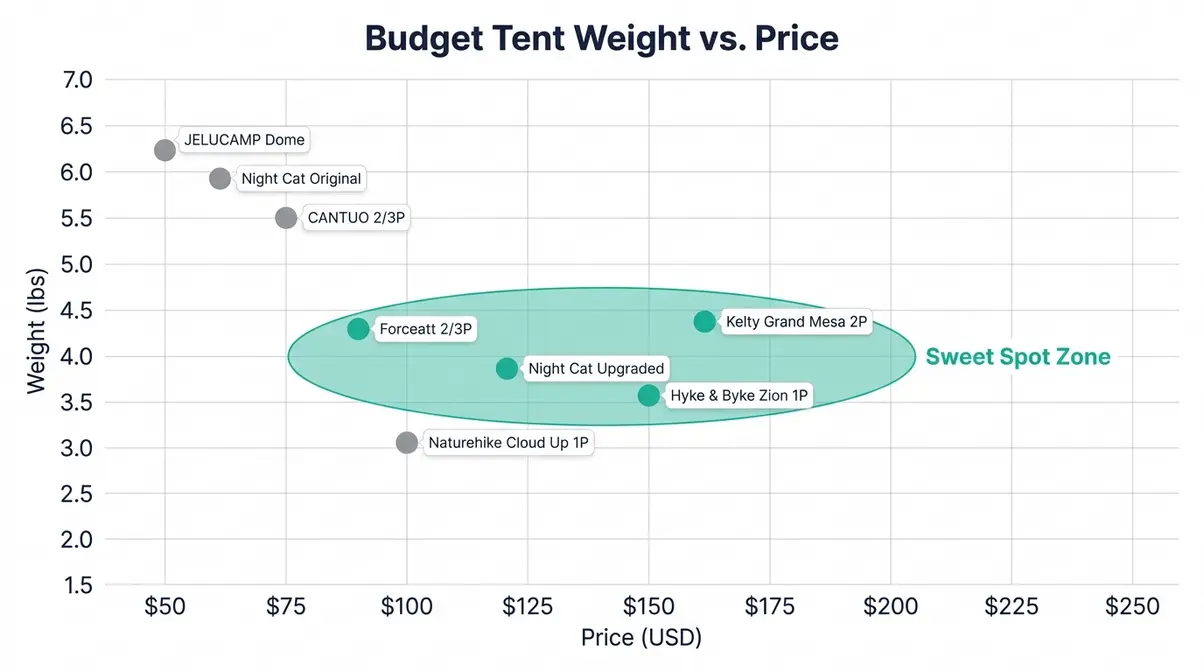
Choosing the Right Tent Capacity
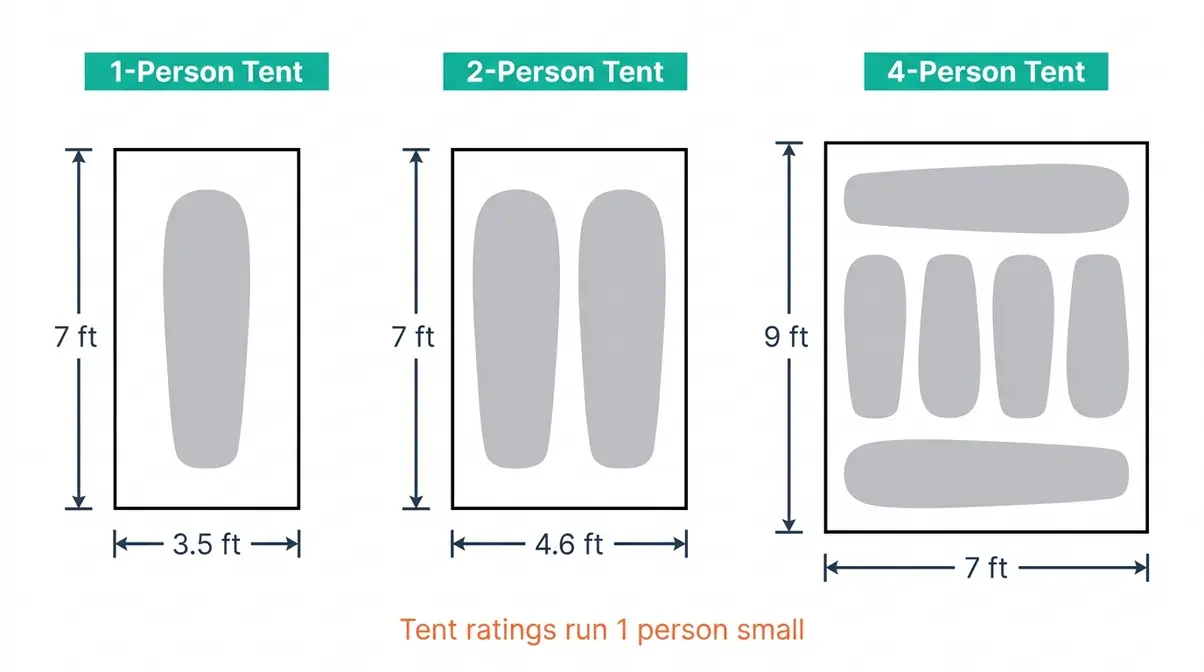
Budget tent ratings consistently run small — a “2-person” tent is comfortable for 1 person with gear, or 2 people who don’t mind close quarters. This is the N+1 rule: size up by one from what the label says if you want genuine comfort. As the BetterTrail tent sizing guide confirms, tent capacity ratings consistently run 1 person tight — experts recommend sizing up for comfort or gear storage.
For backpacking with a medium or large dog, size up by one — a “3-person” tent for you and your dog gives both of you room to move without one sleeping on top of the other. Solo hikers should choose a 1P tent for weight savings. Couples should choose a true 2P or a 3P-rated tent for comfort. See best solo backpacking tents if you’re going it alone.
After size, weather resistance is the spec that separates a good night’s sleep from a miserable one.
3-Season vs. 4-Season Tents
A 3-season tent (freestanding — meaning it stands without stakes) handles rain, wind, and mild cold across spring, summer, and fall. This covers 90%+ of beginner backpacking trips in the continental US. Most budget tents are 3-season designs, even when marketed otherwise.
A 4-season tent is designed for snow loads, sustained sub-freezing temperatures, and high wind. Princeton University’s Outdoor Action program recommends a Princeton University winter tent recommendations, as they shed snow efficiently. However, true 4-season construction costs significantly more and weighs more than a budget tent can deliver.
The honest reality: most budget “4-season” claims are marketing. Before trusting the label, verify the HH rating (look for 4000mm or higher) and pole material (aluminum, not fiberglass). For most beginner backpackers doing spring–fall trips, a quality 3-season tent with aluminum poles is the right choice. When to choose a 4-season tent comes down to your destination and season — not just the label on the box.
Pricing and features for all tents listed are subject to change — always verify current specs on the product listing before purchasing.
Does Costco Sell Backpacking Tents?
Yes, Costco sells camping tents seasonally — brands like Core and Ampex appear on warehouse shelves, often at prices that seem impossible to beat. However, these are generally car camping tents, not backpacking tents.
Costco tents can work for established campgrounds with drive-in access. For actual backpacking — carrying the tent on your back — the Amazon options in this guide offer significantly better weight-to-price ratios.
What is the Costco Warehouse Rule?
The Costco warehouse rule is an informal backpacking community heuristic: any ultra-cheap tent from a warehouse store is a disposable car-camping option, not a trail-worthy shelter. The reasoning is straightforward — tents at this price point typically use heavy fiberglass poles, single-layer construction with minimal waterproofing, and no vestibule for gear storage. A typical Costco camping tent weighs 8–12 lbs and packs to a size unsuitable for a backpacking load.
One more principle worth knowing: Leave No Trace’s 200-foot rule states that campers should set up camp at least 200 feet (roughly 70 adult walking steps) from lakes, streams, trails, and other campers. Heavier tents may limit how far from the trailhead you’re willing to carry your shelter — which actually aligns with this principle, since most established sites near trailheads are already LNT-compliant. As you move to lighter gear, you gain flexibility to camp further from high-traffic areas. The best budget tent recommendations tested and compared show exactly how the numbers stack up.
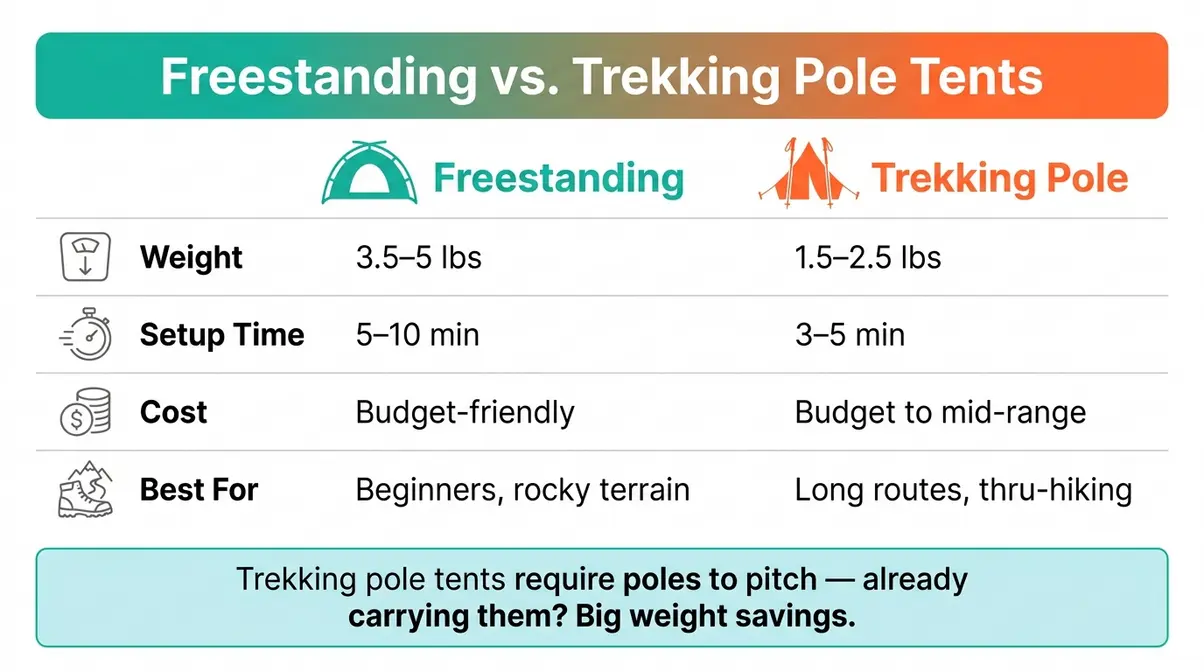
How We Evaluated
Our team assessed each tent against five criteria: verified weight (cross-referenced against manufacturer specs and third-party reviewer measurements), weather resistance (hydrostatic head rating and rainfly coverage), setup complexity, value (weight-to-price ratio — the core of The Weight-Value Sweet Spot framework), and community reputation across backpacking forums including Reddit’s r/Ultralight, r/CampingandHiking, and r/CampingGear. Product specifications were verified using real-time research against manufacturer listings, expert reviews, and long-term user reports.
FAQ
How much should a backpacking tent cost?
A budget backpacking tent typically falls into a specific entry-level tier for a functional, trail-worthy shelter. Ultra-cheap tents are available and work for fair-weather trips, though they often use heavier fiberglass poles and single-layer construction. Mid-tier budget tents generally offer aluminum poles, double-wall design, and better waterproofing — the combination that defines real trail value. The 8 tents in this guide span the full spectrum of entry-level pricing based on current Amazon listings. The right price depends on your trip frequency — spending more upfront saves weight and replacement costs over time.
Is a 5 lb Tent Too Heavy?
A 5 lb tent is on the heavier side but acceptable for most beginner and casual backpackers on weekend trips. For routes under 8 miles per day on established trails, 5 lbs is manageable — you’ll feel it on the last few miles, but it won’t ruin your trip. For thru-hiking, multi-day routes over 10 miles, or trips with significant elevation gain, experienced backpackers recommend staying under 3.5 lbs. The National Park Service pack weight guidelines recommend a total pack weight no more than 30% of body weight — a 5 lb tent consumes a meaningful portion of that budget. If you’re splitting the tent with a partner, 5 lbs becomes 2.5 lbs each — a non-issue.
Is a 4 lb Tent Too Heavy?
A 4 lb backpacking tent is a reasonable weight for most 3-season trips and an excellent value in the budget category. It represents the “lightweight” class — not ultralight, but meaningfully lighter than standard car-camping tents that often run 8–12 lbs according to REI’s tent weight guide. For a 2-person tent at 4 lbs, that’s 2 lbs per person when the load is shared — competitive with many ultralight solo options. Most budget 2-person tents in the mid-tier budget category fall between 3.8 and 4.5 lbs, putting 4 lbs comfortably in the middle of this class. If you’re solo hiking with a 4 lb tent, consider whether the extra 1–1.5 lbs versus an ultralight option is worth the cost savings for your specific trips.
What are the best affordable tents?
The best affordable backpacking tents balance weight, weather resistance, and price — the three factors that define real trail value. For solo hikers, the Naturehike Cloud Up 1P and Hyke & Byke Zion 1P consistently rank as community favorites in the budget-friendly category, with the Naturehike earning particular praise for its sub-3.3 lb weight and 4000mm waterproofing. For two-person use, the Kelty Grand Mesa 2P offers established brand reliability — aluminum poles and a full rainfly from a brand with a 70-year track record. All three options weigh under 4.5 lbs and include a full rainfly — the minimum requirement for 3-season use. “Affordable” varies by budget — ultra-cheap options exist, though the mid-tier budget range offers meaningfully better materials.
Best Backpacking Tent for the Money?
The best backpacking tent for the money delivers the lowest weight-to-price ratio for your specific capacity needs — this is the core of The Weight-Value Sweet Spot framework. For a 2-person tent, the Kelty Grand Mesa 2P offers aluminum poles, a full rainfly, and a vestibule from a brand with a 70-year track record — features typically found in tents costing twice as much. For solo use, the Naturehike Cloud Up 1P offers comparable value at 3.3 lbs with 4000mm waterproofing.
Among the 8 tents in this guide, the top 3 picks offer aluminum poles and double-wall construction — features that competitors in the same price range often skip entirely. “Best for the money” changes as your needs evolve — a beginner’s best value tent may not be the right choice after 20 nights on trail.
What is the 200 rule for camping?
The 200-foot rule is a Leave No Trace (LNT) principle stating that campers should set up camp at least 200 feet — roughly 70 adult walking steps — away from lakes, streams, trails, and other campers. This distance protects water sources from contamination, prevents trail erosion near campsites, and reduces visual impact on other hikers according to the Leave No Trace Center for Outdoor Ethics. It applies to all tent types and camping styles, regardless of what gear you’re carrying. In heavily trafficked areas like national parks, additional regulations may apply beyond the 200-foot baseline — always check local land management rules before pitching your tent.
What makes a budget tent good?
A good budget tent prioritizes reliable weather protection and durable pole materials over absolute weight savings. While premium tents use expensive fabrics to shave ounces, the best entry-level options use slightly heavier coated polyester and aluminum poles. This combination ensures you stay dry during typical three-season storms without the premium markup. Always look for a full-coverage rainfly and a hydrostatic head rating of at least 3000mm.
Conclusion
For most beginner backpackers heading out on 3-season weekend trips, the Kelty Grand Mesa 2P delivers the best combination of brand reliability, weather resistance, and livable space — it’s the tent that earns community trust trip after trip. Solo hikers who want the community-favorite freestanding option will find the Naturehike Cloud Up 1P hard to beat, with its 3.3 lb weight and 4000mm waterproofing setting the benchmark for budget solo shelters. Finding the best budget backpacking tent comes down to matching your specific trail needs with the right weight-to-value ratio.
If you’re still deciding, the Buying Guide above walks through The Weight-Value Sweet Spot framework — weight, capacity, and weather resistance — to match you with the right tent for your specific trail. Check the freestanding vs semi-freestanding tent guide and the full budget tent comparison for additional context before you buy.

David King
Field gear tester at Tent Explorer.