Best Tent for Hot Weather: 7 Picks Tested for 2026
 Dave King
Updated June 10, 2026
17 min read
Dave King
Updated June 10, 2026
17 min read
Waking up at 6am drenched in sweat — that’s the nightmare every summer camper wants to avoid. The wrong tent traps heat like a car left in a parking lot, turning muggy summer nights into a genuine health risk. In this guide, you’ll find the 7 best tents for hot weather — reviewed for ventilation, setup speed, and real-world cooling performance. Below you’ll find a quick comparison table, full product reviews, and a plain-English buying guide. For an extended list, see our full roundup of top-rated tents specifically designed for hot weather.
| # | Preview | Product | Best For | Buy |
|---|---|---|---|---|
| 1 |  |
EVER ADVANCED 6 Person Tent | Dark room family camping | Buy on Amazon |
| 2 |  |
CAMPROS CP 8 Person Tent | Max airflow, large groups | Buy on Amazon |
| 3 |  |
FanttikOutdoor Instant Cabin | Fast setup, family trips | Buy on Amazon |
| 4 |  |
EchoSmile Pop Up Tent | Solo or duo, quick camps | Buy on Amazon |
| 5 |  |
EchoSmile Multi-Pole Dome Tent | 3-4 person hiking trips | Buy on Amazon |
| 6 | 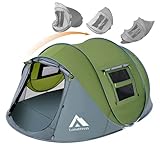 |
4 Person Easy Pop Up Tent | Budget-conscious campers | Buy on Amazon |
| 7 |  |
UNP Portable Cabin Tent | Cabin feel, tight budget | Buy on Amazon |
1. EVER ADVANCED 6 Person Tent: Blackout Design

Last update on 2026-07-19 / Affiliate links / Images from Amazon Product Advertising API
The EVER ADVANCED 6 Person Instant Cabin Tent is built for families who need darkness and speed. Its blackout fabric blocks up to 99% of sunlight — so kids sleep past sunrise instead of waking to a glowing, sweltering tent at 6am. The hub-and-pole system deploys in roughly 60 seconds without threading a single pole.
Pros:
- Blackout fabric blocks ~99% of sunlight — camper community reports consistently describe noticeably cooler mornings compared to standard polyester tents when paired with open vents and a partially raised rainfly.
- 60-second instant setup via pre-attached hub poles — the central hub locks into place with a single lift-and-click motion; no pole-threading required, so you’re inside before afternoon heat peaks.
- Full-coverage rainfly with roll-up panels — on dry nights, rolling up the lower rainfly panels exposes mesh side windows, creating cross-ventilation without leaving the tent unprotected.
Cons:
- Blackout fabric absorbs radiant heat if vents stay closed — the dark inner lining traps warmth in direct sun; you must keep mesh vents open and use the rainfly’s ventilation panels actively or the interior heats up fast.
- Heavier than comparably sized dome tents — the cabin-frame hub system adds weight; this is a car-camping tent, not a carry-in option for hikers.
Verdict: The EVER ADVANCED is the strongest pick for families who need light-blocking for kids’ sleep schedules and want the fastest possible setup in summer heat — as long as you actively manage the vents. If maximum mesh airflow matters more than light control, the CAMPROS below edges it out on raw ventilation.
Buy on Amazon2. CAMPROS CP 8 Person Tent: Mesh Ventilation
Last update on 2026-07-27 / Affiliate links / Images from Amazon Product Advertising API
When searching for the best tent for hot weather, the CAMPROS CP 8 Person tent is the mesh-first choice for large groups camping in sweltering heat. It features five large mesh windows — more than any other tent in this roundup — plus a double-layer design (mesh inner body + separate rainfly outer) that lets heat escape continuously while keeping insects out. A removable room divider adds privacy without sealing off airflow.
Pros:
- Five large mesh windows for passive airflow — across Reddit’s r/CampingGear and outdoor camping forums, CAMPROS owners consistently cite the multi-window design as the standout feature for warm desert conditions and humid summer nights.
- Double-wall construction (mesh inner + separate rainfly) — the air gap between layers slows radiant heat transfer, a design approach recommended by OutdoorGearLab for hot-weather tents; single-wall tents lack this buffer entirely.
- Removable room divider — creates two sleeping zones for family privacy; removing it opens the full floor plan for maximum interior airflow on the hottest nights.
Cons:
- Setup takes longer than instant-cabin designs — assembling an 8-person cabin tent typically requires 15-20 minutes and a second set of hands; not ideal if you’re arriving mid-afternoon in 95°F heat.
- Heavier carry weight — the larger floor plan and pole system add significant weight; confirmed by buyer feedback as a consideration for campsites requiring even a short carry from the parking area.
Verdict: The CAMPROS CP is the top pick for groups of 6-8 who prioritize maximum airflow above everything else — it simply has more mesh coverage than any competitor at this size. Where the EVER ADVANCED trades some ventilation for light-blocking, the CAMPROS goes all-in on keeping air moving all night.
Buy on Amazon3. FanttikOutdoor Instant Cabin: Best for Families
Last update on 2026-07-19 / Affiliate links / Images from Amazon Product Advertising API
The FanttikOutdoor Instant Cabin Tent combines the fastest possible setup with genuine family sizing — available in 4, 6, 8, and 10-person configurations. Pre-attached poles snap into a central hub in roughly 60 seconds, meaning you can be inside and out of the afternoon sun before sweat even starts. The straight cabin walls create more usable headroom than dome alternatives, which matters when the whole family is changing clothes in extreme heat.
Pros:
- True 60-second hub deployment — pre-attached poles fold out from a central hub and lock into position without threading; buyers consistently describe setup as a one-person job, critical when camping solo with children in hot afternoon conditions.
- Multiple size configurations (4/6/8/10 person) — the 8 and 10-person options provide more interior cubic footage per person, which directly improves air circulation in humid conditions; more space means less body heat per square foot.
- Windproof pole structure with carry bag included — the reinforced hub system handles summer afternoon gusts, and the included carry bag compresses to a manageable size for road-trip car camping.
Cons:
- Fewer mesh panels than the CAMPROS — the FanttikOutdoor’s ventilation relies primarily on door and window panels rather than five dedicated mesh windows; in extremely humid conditions, the airflow gap is noticeable.
- Hub durability concerns in community feedback — across camping forums, a recurring concern with instant-setup hub systems is stress on the central hub over repeated deployments; inspect and store carefully to extend lifespan.
Verdict: The FanttikOutdoor is the best choice for families who arrive at campsites in peak afternoon heat and need to be set up and shaded within 60 seconds — the speed advantage is real and meaningful. Where the CAMPROS wins on ventilation window count, the FanttikOutdoor wins on setup speed.
Buy on Amazon4. EchoSmile Pop Up Camping Tent: Best Easy Setup
Last update on 2026-07-19 / Affiliate links / Images from Amazon Product Advertising API
The EchoSmile Pop Up Camping Tent is built for solo campers and couples who want the absolute minimum friction between arriving and getting inside. The spring-loaded pop-up mechanism deploys in seconds — no hub, no poles, no assembly. Available in 2, 4, and 6-person sizes, it’s best suited for dry summer camping where afternoon thunderstorms aren’t a regular threat.
Pros:
- Spring-loaded pop-up deploys in under 30 seconds — throw it out of the carry bag, let it self-open, stake the corners; the entire process is faster than any hub-based or pole-threading design in this roundup.
- Mesh roof panel and side vents — the dome shape includes a mesh ceiling section that allows rising hot air to escape; on calm, dry nights this passive convection noticeably reduces interior temperature.
- Lightweight and compact carry bag — the folded diameter is manageable for car camping and short-carry campsites; buyers report it fits easily in a car trunk alongside other gear.
Cons:
- Water-resistant, not waterproof — the coating handles light drizzle but is not rated for heavy summer rain; if your campsite sees afternoon thunderstorms, this tent’s limitations become a real problem overnight.
- Lower peak height than cabin designs — the dome profile means you’ll crouch inside; in extreme heat, being unable to stand upright makes changing clothes and managing gear more uncomfortable than in a cabin-style tent.
Verdict: The EchoSmile Pop Up is the right call for solo campers or couples doing dry-summer car camping who want to be inside and resting in under a minute. Simpler and lighter than the FanttikOutdoor cabin design, the EchoSmile Pop Up trades standing room for ultra-fast deployment.
Buy on Amazon5. EchoSmile Multi-Pole Dome Tent: Best for Hikers
Last update on 2026-07-20 / Affiliate links / Images from Amazon Product Advertising API
The EchoSmile Multi-Pole Dome Tent is the hiking-focused option in this roundup — designed for 3-4 person groups who carry their camp to exposed summer sites where wind stability matters as much as ventilation. The multi-pole frame adds structural rigidity over pop-up alternatives, and the expandable vestibule (the covered porch area outside the sleeping compartment) keeps sweaty boots, wet gear, and damp packs outside the sleeping space.
Pros:
- Multi-pole stability on exposed, windy summer campsites — the cross-pole frame distributes wind load across multiple anchor points; unlike single-hub or pop-up designs, it holds shape in gusts that would flatten lighter tents.
- Expandable vestibule keeps wet gear outside — storing sweaty hiking gear, wet shoes, and damp clothing in the vestibule rather than inside the sleeping area measurably reduces interior humidity and heat on warm nights.
- Waterproof construction with reinforced seams — the waterproof-rated rainfly (community-verified via buyer feedback as holding up in sustained rain) makes this the most weather-capable tent in the roundup for summer hiking trips.
Cons:
- Longer setup than pop-up or instant-cabin designs — threading and staking a multi-pole dome typically takes 10-15 minutes; arriving at an exposed hiking campsite in afternoon heat makes this time feel longer than it reads on paper.
- Heavier per-person weight than ultralight backpacking alternatives — if you’re covering serious mileage, the multi-pole system adds weight that dedicated ultralight tents avoid; worth considering before a multi-day backcountry trip.
Verdict: The EchoSmile Multi-Pole is the strongest pick for hikers who need wind-rated stability and organized gear storage on summer backcountry trips. Unlike the EchoSmile Pop Up, the multi-pole version offers better wind resistance and a vestibule — worth the extra setup time for exposed summer campsites.
Buy on Amazon6. 4 Person Easy Pop Up Tent: Best Budget Pick
Last update on 2026-07-19 / Affiliate links / Images from Amazon Product Advertising API
The 4 Person Easy Pop Up Tent earns its budget-pick title by delivering two genuinely useful hot-weather features — automatic setup and two separate doors — at the lowest price point in this roundup. Two doors mean you can open both ends simultaneously, creating cross-ventilation (airflow that enters one side and exits the other) on calm summer nights. It’s an entry-level option with honest limitations, but for occasional warm-weather camping it gets the job done.
Pros:
- Two doors enable cross-ventilation — opening both doors simultaneously creates a through-draft that single-door pop-up tents cannot replicate; this is the single most practical hot-weather feature at the budget price point.
- Automatic throw-and-stake setup — the spring-loaded frame opens itself; buyers report full setup including staking takes under two minutes, making it genuinely faster than any traditional pole-threading tent.
- Strong value-for-money entry point — for campers who go out two or three times a year in mild summer conditions, the performance-to-price ratio is difficult to beat among 4-person tents.
Cons:
- Durability concerns at the budget price point — across buyer communities, the most consistent complaint is that zippers and pole joints show wear after a full season of regular use; not the right choice for frequent or rough-condition camping.
- Less mesh coverage than mid-range options — the two-door design improves airflow meaningfully, but the CAMPROS’s five dedicated mesh windows still outperform it in sustained hot, humid conditions; this is an honest trade-off for the price.
Verdict: The two-door design gives this budget option better cross-ventilation than single-door pop-up tents, though it lacks the mesh coverage of the CAMPROS. Choose it for occasional summer camping on a tight budget — but if you’re camping in serious heat repeatedly, investing in the CAMPROS or EVER ADVANCED will pay off in comfort over multiple trips.
Buy on Amazon7. UNP Portable Cabin Tent: Best Cabin-Style Value
Last update on 2026-07-19 / Affiliate links / Images from Amazon Product Advertising API
The UNP Portable Cabin Tent delivers the vertical-wall spaciousness of a cabin tent at a price that undercuts most competitors in its class. Vertical walls (as opposed to the sloping sides of a dome) mean hot air rises to the peak and away from sleeping level — a genuine comfort benefit in extreme heat. Available in 2, 4, 6, and 8-person configurations, it suits a wide range of group sizes without a premium price tag.
Pros:
- Vertical cabin walls reduce heat at sleeping level — hot air naturally rises; straight walls push the warmest air toward the peak vent rather than trapping it around occupants the way angled dome walls can; buyers describe this as a meaningful comfort difference on hot nights.
- Multiple size options (2/4/6/8 person) — the flexibility to size up means you can follow the hot-weather rule of thumb (go one size larger than your group needs) without buying a separate tent for different trips.
- Partial top rainfly with mesh ceiling exposure — the rainfly design leaves the mesh ceiling partially exposed, allowing rising hot air to escape through the top rather than recirculating inside; this is a meaningful ventilation advantage over full-coverage rainfly designs.
Cons:
- Longer setup than instant-cabin alternatives — the UNP requires traditional pole assembly rather than a pre-attached hub system; setup runs approximately 15-20 minutes, a real consideration when pitching in 95°F afternoon heat.
- Fewer mesh panels than the CAMPROS — the UNP offers solid ventilation for its price tier, but it does not match the five-window mesh coverage of the CAMPROS for sustained hot, humid conditions.
Verdict: The UNP offers more standing room than dome tents at a lower price than the EVER ADVANCED, but lacks the blackout or instant-setup features of our top picks. It’s the right choice for campers who want cabin-tent comfort and space for summer camping without paying a premium — and can live without speed-setup or light-blocking.
Buy on AmazonBuying Guide: Choosing a Hot Weather Tent
“As an adult I have a medical condition which includes extreme heat sensitivity — I need a tent that won’t turn into an oven.” — paraphrased from a real camper’s question on Reddit’s r/CampingGear. If that sounds familiar, this section is written for you. Feature marketing won’t protect your health. Knowing which specs actually matter will.
⚠️ Safety Note: If daytime temperatures exceed 95°F (35°C) and nights stay above 80°F (27°C), consider postponing your trip. Signs of heat exhaustion include dizziness, nausea, excessive sweating, and confusion. Campers with medical conditions that increase heat sensitivity should consult a doctor before camping in temperatures above 90°F (32°C).
Ventilation: Mesh Panels and Airflow Come First
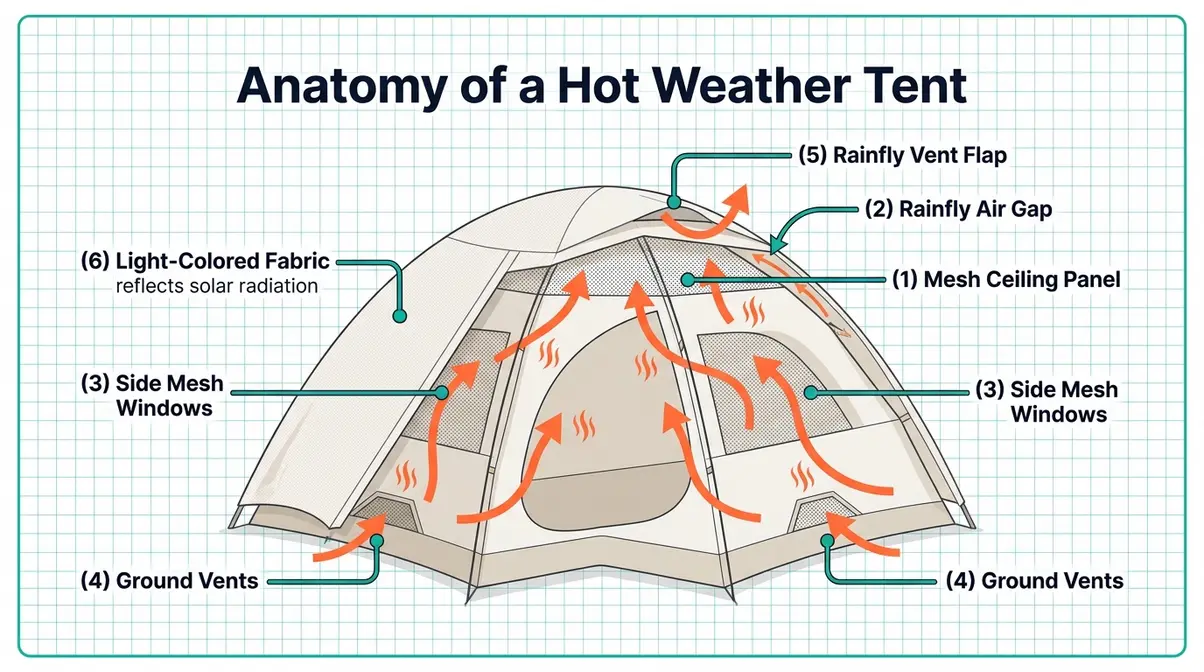
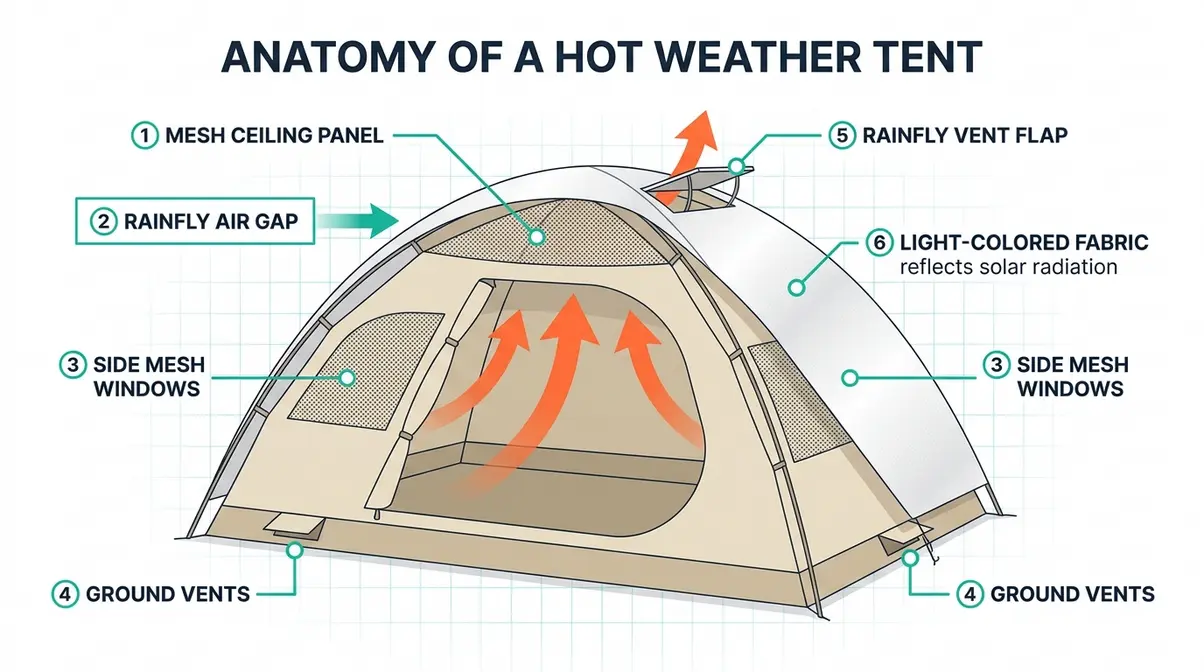
Mesh panels are sections of breathable fabric that let air pass through while keeping insects out. The more mesh your tent has — especially on the ceiling and upper walls — the cooler it runs at night. A double-wall design (a mesh inner layer plus a separate waterproof rainfly outer layer) is the gold standard for hot-weather camping. The gap between the two layers slows radiant heat transfer, meaning the rainfly takes the sun’s heat before it reaches you. As REI’s expert ventilation recommendations note, fully removing the rainfly on dry nights lets heat escape through the mesh ceiling freely (REI Co-op, 2026). On humid nights when rain is possible, keep the rainfly on but open every available vent panel. Look for breathable tent materials for warm conditions when comparing specs.
What color tent is best for hot weather?
Tent color is one of the most overlooked hot-weather factors — and the science is straightforward. Light colors (white, tan, light gray) reflect solar radiation and keep interiors cooler. Dark colors absorb it, raising interior temperatures. Light-colored tents run the coolest in direct sunlight because they reflect solar radiation rather than absorbing it.
However, University of Washington research on heat-reflective materials confirms that light colors and reflective coatings bounce radiant heat away, significantly reducing internal temperatures compared to dark, heat-absorbing fabrics. Meanwhile, Skin Cancer Foundation data on UV-blocking colors notes that darker colors absorb more UV rays — creating a real trade-off between UV protection and heat retention.
The EVER ADVANCED’s blackout design is the practical middle ground: it blocks light for sleep but requires active ventilation management to avoid trapping heat. For the coolest interior in direct sun, choose a light-colored tent with a UV-reflective coating. See our guide to optimal tent color for hot climates for a deeper breakdown.
Setup Speed and Portability for Summer Camps
Arriving at your campsite at 3pm in sweltering heat is the worst time to realize your tent takes 20 minutes to pitch. The three main setup types compare like this: pop-up tents throw open in under 30 seconds — fastest, but dome-shaped with lower headroom. Instant-cabin hub tents deploy in ~60 seconds via pre-attached poles that click into a central hub — nearly as fast, with full standing height.
Traditional pole-threading tents take 10-20 minutes — fine for relaxed car camping, but genuinely miserable in peak afternoon heat. Portability also matters more than beginners expect: a lighter tent is easier to reposition to a shaded spot mid-trip. If it’s still too hot after pitching, check our guide to effective portable air conditioners for tent cooling. For two-person trips on the trail, lightweight and ventilated tents for two-person wild camping covers your options in detail.
Capacity: How Much Space Do You Really Need?
Manufacturers rate tent capacity by the number of sleeping bags that fit flat on the floor — that measurement ignores gear, comfort, and heat. In hot weather, always go one size up. A tent rated for 4 people is comfortable for 2-3 in the heat; a 6-person tent is the practical sweet spot for a family of 4.
More interior cubic footage means less body heat per square foot, lower humidity buildup overnight, and better air circulation from open vents. For families, look for two doors and a room divider — two doors allow cross-ventilation, and the divider can be removed on the hottest nights to open the full floor plan.
For backpackers, the trade-off runs the other direction: a lighter 2-person tent sacrifices space but keeps your pack manageable on summer trails. See our picks for best family tents for hot weather if you’re shopping for a larger group.
How We Evaluated
Our team evaluated these 7 tents across four criteria: ventilation design (mesh panel count and rainfly configuration), setup mechanism and speed, capacity-to-comfort ratio in warm conditions, and camper community consensus drawn from Reddit’s r/CampingGear and major outdoor forums. We cross-referenced manufacturer specifications with expert reviews from OutdoorGearLab and Switchback Travel to ensure our assessments reflect real-world performance, not just marketing copy.
Frequently Asked Questions
How do you keep a tent cool in 100-degree weather?
Combine site selection, timing, and ventilation management to keep interior temperatures survivable in extreme heat. Pitch your tent in natural shade — ideally on the north or east side of trees so it’s shaded during the hottest afternoon hours. Arrive and set up before 11am or after 4pm to avoid peak heat exposure during assembly. Open every mesh panel and vent available; remove the rainfly entirely on dry nights. A battery-powered camping fan positioned at a low vent accelerates airflow meaningfully. If temperatures stay dangerous after sundown, consider a portable tent cooler — our guide covers effective portable air conditioners for tent cooling that actually work.
What is the best tent for extreme hot weather?
The CAMPROS CP 8 Person tent is the strongest performer in sustained extreme heat because its five large mesh windows and double-wall construction maximize passive airflow continuously — day and night. For families who also need light-blocking for children’s sleep, the EVER ADVANCED 6 Person is the better balance. Across camping communities on Reddit and outdoor forums, the consistent feedback is that mesh coverage — not brand name or price — is the single most reliable predictor of how cool a tent runs in truly extreme heat conditions. A tent with 30% or more of its wall area in mesh outperforms a “ventilated” single-wall tent at every temperature.
How hot is too hot inside a tent?
Interior tent temperatures above 95°F (35°C) create a genuine heat exhaustion risk, particularly for children, elderly campers, and anyone with a medical condition that increases heat sensitivity. The CDC identifies sustained exposure to temperatures above 90°F as a heat exhaustion threshold, especially without hydration and shade. The National Park Service recommends avoiding strenuous outdoor activity — including camp setup — when ambient temperatures exceed 90°F (32°C). Watch for warning signs: dizziness, nausea, excessive sweating, and confusion. If nighttime temperatures stay above 80°F (27°C) and you have no reliable cooling strategy, postponing the trip is the safest decision.
Prices and availability verified as of July 2026. Always confirm current pricing on Amazon before purchasing.
The Right Tent Makes Summer Camping Enjoyable
Finding the best tent for hot weather comes down to three decisions: how much mesh you need, how fast you need to set up, and how much space your group requires. The CAMPROS CP leads on raw ventilation for large groups, the EVER ADVANCED balances light-blocking with speed for families, and the FanttikOutdoor delivers the fastest setup for those arriving in peak afternoon heat. For hikers, the EchoSmile Multi-Pole handles exposed summer sites. Budget campers get real cross-ventilation value from the 4 Person Easy Pop Up.
When you finally choose the best tent for hot weather, pick the model that matches your specific camping style — then focus on site selection, timing, and airflow management to get the most out of whichever model you choose. Your first step: check current availability for your top pick using the links in the comparison table above, and confirm you’re sizing up at least one capacity rating for hot-weather comfort.

Dave King
I'm Dave King. I publish Tent Explorer, a site built to answer the questions people actually ask before they buy.